
Who is a terrorist? One sentiment is “One Man’s Terrorist another Man’s Freedom Fighter“. I’m surprised to learn there is not a widely accepted definition of terrorism. And that lack of definition facilitates the ability of governments to define those who criticize them as terrorists. And to incarcerate or kill them. As they killed forest defender Manuel “Tortuguita” Terán.
In terms of their overall organization and movement strategy, the Cop City protests are in many ways a far cry from the Civil Rights Movement of the ’60s. But it’s still worth asking: if MLK got arrested in Atlanta today during a political demonstration, would he be charged as a domestic terrorist? And would those who lionize him today have remained silent?
The Terrorism Charges Against Cop City Protesters Are Ominous by Ryan Zickgraf, Jacobin, Jan 27, 2023
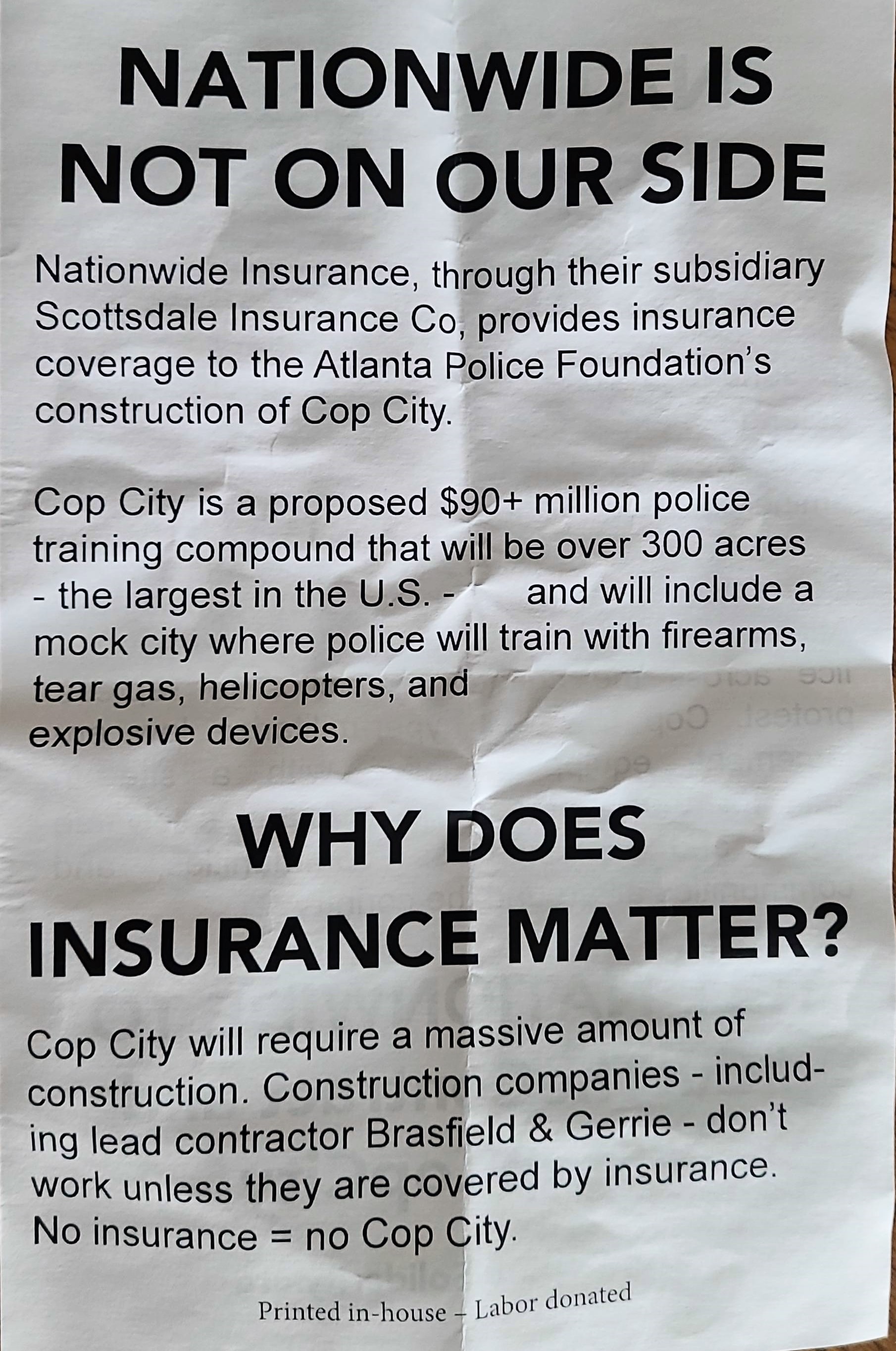
Friday I participated in a demonstration calling for Nationwide insurance company to cut their contract to insure the construction of Cop City.
See: #StopCopCity activists shouldn’t be tried as terrorists
After that, I read the following from the Department of Homeland Security.
“Since spring of 2022, alleged DVEs (Domestic Violent Extremists) in Georgia have cited anarchist violent extremism, animal rights/environmental violent extremism, and anti-law enforcement sentiment to justify criminal activity in opposition to a planned public safety training facility in Atlanta. Criminal acts have included an alleged shooting and assaults targeting law enforcement and property damage targeting the facility, construction companies, and financial institutions for their perceived involvement with the planned facility”
Summary of Terrorism-Related Threat to the United States, Department of Homeland Security
Defining terrorism
In 1988 two European scholars Alex Schmid and Albert Jongman produced one of the more robust definitions of terrorism. They did this by surveying 200 leading academics in the field of terrorism studies. The research asked each expert to define terrorism.
Terrorism is some form of purposive and planned violence that has a political, religious, or ideological motivation. It is intended to coerce or intimidate and is targeted at civilians or government. Legislation prohibiting terrorism ought to have extra-territorial effect.
One man’s freedom fighter… can we ever define terrorism? by Fergal Davis, The Conversation, January 7, 2013
extra-territorial – (of a law or decree) valid outside a country’s territory
Extra-territorial is part of the definition to preclude a definition of terrorism pertaining to a local political situation. Such as local opposition to Cop City. That is, supporters of Stop Cop City would not be classified as terrorists by this definition.
Escalation of charges
Protesters against a massive police militarization complex in Atlanta have been slapped with domestic terrorism charges for throwing bottles and breaking windows. That should be deeply worrisome for anyone who values the right to dissent.
Can you be charged with terrorism for throwing bottles or breaking a window of a bank? You can in Atlanta, where the state of Georgia has slapped serious domestic terrorism charges on eleven people who’ve been demonstrating since December against the construction of a massive police militarization complex known as Cop City.
Governor Brian Kemp justified the severe punishment on Twitter, saying, “Violence and unlawful destruction of property are not acts of protest. They are crimes that will not be tolerated in Georgia and will be prosecuted fully.” On Thursday, Kemp signed an executive order declaring a state of emergency and authorizing the deployment of a thousand National Guard troops to arrest Cop City protesters. The state of emergency lasts two weeks, until February 9.
Kemp’s definition of “prosecuting fully” has changed since 2020. During the George Floyd protests that filled the streets of downtown Atlanta, most protesters arrested were taken to the city jail for offenses that included disorderly conduct, burglary, and criminal property damage.
Now, two years later, Georgia authorities are trumping up property crimes and relatively minor vandalism by Cop City political demonstrators as acts of terrorism. If convicted, the activists could face up to thirty-five years in prison — which in the state of Georgia is a punishment similar to second-degree murder.
The Terrorism Charges Against Cop City Protesters Are Ominous by Ryan Zickgraf, Jacobin, Jan 27, 2023
Atlanta, Georgia – 66 environmental, human rights, and civil liberties organizations sent a letter to Georgia prosecutors urging them to drop domestic terrorism charges against Stop Cop City/Defend the Atlanta Forest protesters. The charges represent a draconian escalation seemingly intended to chill First Amendment protected activity.
The letter reads, in part:
Civil disobedience and disruptive activism are part of the American protest tradition. From the Boston Tea Party to the civil rights movement, Americans have long drawn on civil disobedience tactics akin to the occupation of the Atlanta forest by the Stop Cop City protesters. Based on the information contained in the arrest warrants, many of the people charged with domestic terrorism are accused only of trespassing or other minor crimes. In all cases, application of the domestic terrorism statute is an escalatory intimidation tactic and a draconian step that seems intended to chill First Amendment protected activity.
66 ORGANIZATIONS URGE THAT DOMESTIC TERRORISM CHARGES BE DROPPED by Defending Rights and Dissent, March 8, 2023
Critics of domestic terrorism laws, including some civil rights groups, oppose them “because of the risk of politicization because they can be used against politically disfavored groups by the government,” Patrick Keenan, a professor of law at the University of Illinois, said.
A 2017 Georgia law defines domestic terrorism as a felony intended to kill or harm people; “disable or destroy critical infrastructure, a state or government facility, or a public transportation system”; “intimidate the civil population or any of its political subdivisions”; and change or coerce state policy or affect the conduct of government “by use of destructive devices, assassination, or kidnapping.” Conviction carries a maximum sentence of 35 years in prison.
The allegations against the protesters include trespassing, resisting arrest, throwing rocks and glass bottles and damaging property, including setting fire to a police car. Authorities have also said they found “explosive devices, gasoline, and road flares” in an area in the forest where protesters had makeshift treehouses.
Georgia Gov. Brian Kemp, a Republican, has called the protesters “militant activists” and said “we will bring the full force of state and local law enforcement down on those trying to bring about a radical agenda through violent means.”
Arrests in Atlanta ‘Cop City’ protests raise concerns over domestic terrorism charges. Critics of such laws, including civil rights groups, say they can be politicized and used against marginalized groups or those disliked by government. By Danielle Silva, NBC News, Jan 29, 2022




 Quakers and Mutual Aid