Blog

Father, son, and Little Friend

Thomas Lake writes about a 5K run he did with his son. As they drove into town, his son noticed an insect on the hood of the car.

It was neon green, no longer than a fingernail. And it was friendly. This little green thing hopped onto my son’s finger, and walked across my shirt, and then went back to my son’s hand, where it stayed for a long, long time. It stayed so long that we would eventually give it a name: Little Friend.

A few minutes before the race, Little Friend either fell or jumped off my son’s hand and landed on the sidewalk. Maybe it wanted to go free. But this was not a good place for that. Pedestrian traffic was heavy and unpredictable. Little Friend was in danger. So my son knelt and reached out his hand. Little Friend came back.

The race was about to start. Thomas felt the need to tell his son Little Friend would be dislodged by the running.

I felt compelled to have a talk with the boy.
You will lose Little Friend, I told him.
My son nodded, treating the moment with appropriate solemnity.
Little Friend perched silently on his wrist.
The race began, and I lost sight of them.

Thomas then tells of how worried he was when his son didn’t appear at the finish line after 40 minutes. His son had run a 5K race in 30 minutes previously. He writes about the panic he felt.

But then his son appeared, and Little Friend was still with him. A happy reunion. As they left the race course, his son nudged Little Friend off his hand, saying, “Be free.”

A boy has his reasons, some of them unknown even to himself. There is more than one way to win a race.

One day my son will leave too, running off on his own adventure. My brother recently sent me a picture of us together. It almost broke my heart. My son, then 6, was holding my hand, looking up at me with this indescribable expression of hope and innocence. It seemed he was trying to tell me something. But I was looking ahead at something else. When I saw that picture, I wanted to yell at myself: Turn your head! Look at him! Nothing in the world is more important!

My son knew the truth. Sometimes life gives you something beautiful, a fragile, fleeting treasure that attaches to your hand. There is no need to rush ahead. Treat it gently. Savor each moment. Hold on while you can.

My son and I ran the same 5k. When he didn’t show up at the finish line I went looking for him by Thomas Lake, CNN, Dec 19, 2023.


I had a similar experience with my godson, Brandon.

I ran almost every day. In part because I refused to have a car, running was often a necessary form of transportation. And I just loved to run.

When I told Brandon about the “Turkey Trot Run,” held ‘Thanksgiving’ morning, he wanted to run, too. He was around 10 years old at the time. I was glad he wanted to do that, so we rode out to the race course at Eagle Creek Park (Indianapolis).

On the way there, I was wondering if we should run separately. But I decided no, I wanted us to run together. I could tell that was his expectation. So we ran through the quiet woods of the park. He wasn’t a runner, so he needed some encouragement along the way. It was a 5K race, and I wasn’t sure he could do it.

But he did.

It was the best race I ever ran.


The Spirit of the Glacier Speaks

I recently attended the Zoom meeting hosted by the Pachamama Alliance, Insights for Earth Activists, with Arkan Lushwala. That video recording can be found below.

Arkan Lushwala is a Peruvian ceremonial leader and author who focuses on teaching others practices that can restore balance to the planet. He was adopted by a Lakota elder named Basil Brave Heart and carries spiritual traditions from the Andes and the Amazon. He has written three books: The Time of the Black Jaguar, Deer and Thunder, and The Spirit of the Glacier Speaks. You can read the Epilogue of The Spirit of the Glacier Speaks here.

I value what Arkan says because of the way he expresses his spirituality. I find it similar to how I try to express my own.

He speaks of ancestral wisdom having more to offer than technology, that technology cannot illuminate nor improve what lives inside people. I am blessed to have wisdom from my Quaker ancestors.

Introduction

While singing to the spirits of the mountains and preparing sacred offerings to feed our Mother Earth, I am seeing the paths that the Universe has opened for us lately—paths of spiritual and human development that we are going to need to walk in order to continue living. In the midst of so many disasters affecting humanity, I have seen something beautiful that I can no longer hide. Even more, I feel a longing to give birth to something new. And as mothers know well, this can only be done with full conviction, like a whale that crosses an ocean. Among my convictions, one comes from my relationship with the ancestral world I grew up surrounded by, having been born in the Andes. I am convinced that anything new, to have real power, needs an ancestral root.

When seeking new and better solutions for the great social problems and natural catastrophes of the present moment, I believe that ancestral wisdom has more to offer than technological advances. Because technology does not have the ability to illuminate nor improve what lives inside people—the true source of the problems that are harming the world. Social injustice, the destruction of nature, excessive wealth, and extreme poverty come as a result of excessive human ambition. Such greed will not disappear with new technologies. We need greed to stop being fashionable, to cease being the marker of human progress. Only with wisdom will it be possible to resolve the problems of our time, with sensible cultural proposals that can help us aspire to reach happiness in another way. Therefore, I have no doubt that the ancestral wisdom of our Andean-Amazonian communities has much to contribute to the development of a new world culture.
Lushwala, Arkan. The Spirit of the Glacier Speaks: Ancestral Teachings of the Andean World for the Time of Natural Disorder (pp. 7-8). Disruption Books. Kindle Edition.


Arkan writes about the early European settlers being only interested in gold and being afraid of the Indigenous sacred world.

Just as they (Europeans) lost interest in being healed by our food, they could no longer see our hearts. Their eyes sought only gold, and they could not see us. They saw our sacred world from afar and, afraid of it, did not come closer. Their lack of experience in the art of entering into good relationships did not allow them to love us. Their only experience was with fighting, and they waged a terrible war in order to legalize the theft of our lands through their triumph. And despite the fact that they made our lands their own, they were never able to know their true treasures. Given that those who cannot be satisfied also don’t know how to stop, they didn’t consider taking the time to get to know the deepest secrets and the real treasures of the place they had come to. They continued on their way, looking for something new to appropriate. If they had simply let themselves sit down for a moment amid the pastures of these lands, they might have felt something in their hearts, and they might have become enamored of the beautiful people here who were one with the land. But they were too busy and could not take notice of what lay right in front of them. And so they lost the chance of encountering our mother, the mother we all have in common, the one they had forgotten—our Mother Earth.

Lushwala, Arkan. The Spirit of the Glacier Speaks: Ancestral Teachings of the Andean World for the Time of Natural Disorder (pp. 8-9). Disruption Books. Kindle Edition.

The most spiritual thing now is action.
This action needs to be born from a place in ourselves.

Arkan Lushwala

One day a brother from another country who was becoming a good friend came to see me. He was very affected by these same questions, tired of feeling himself separated from the beauty of the world. He had a great spiritual hunger and was searching for something different. I remember him asking me, “What can we do to change, those of us who have lost the memory of the original design for good living?” And aware that I didn’t have an answer for such a big question, I managed to not go to my head and look for one. I just responded spontaneously, “My brother, stop dedicating yourselves with so much enthusiasm to digging the holes you are going to fall into. Stop for a moment, brother, stop so much doing. Look, brother, let’s share some food, and let’s taste the earth.” I passed him some Kuka leaves and said to him: “Hallpaykusunchis wayq’echay” (Let us be the land—with tender affection—for our benefit, my little brother). And after a long silence, I smiled and said to him, “Saksachikuy wawq’ey,” which means “Make yourself satiated with tender affection for your benefit, my brother.

Arkan Lushwala, The Spirit of the Glacier Speaks

aware that I didn’t have an answer for such a big question, I managed to not go to my head and look for one

Arkan Lushwala

What can I do?

Speaking about what is happening on Earth right now,
many of the conditions of life that we used to take for granted,
now are really out of balance.
Hopefully we still have time to get back into balance
so life may continue.
I travel around the world and meet people and talk to people
from all different cultures.
And everywhere people ask, “what can we do?”
The question, what can we do, is the second question.
The first question is “what can we be?”
Because what you can do is a consequence of who you are.
Once you know what you can be, you know what you can do,
and we cannot afford wasting time;
we have little time.
We need to be precise now.
When someone sincerely asks, “what can I do?”
my humble answer,
the only answer that I find in my heart to be sincere is,
“First find out what you can be.”
Action is extremely necessary at this time.
This is not a time just to talk about it.
The most spiritual thing now is action.
To do something about what’s happening.
To go help where help is needed.
To stand up when we need to stand up,
and protect what is being damaged.
And still, this action needs to be born
from a place in ourselves that has real talent,
real intelligence, real power,
real connection to the heart of the Earth,
to universal wisdom,
so our actions are not a waste of time.
So our actions are precise,
our actions are in harmony with the movement,
the sacred movement,
of that force that wants to renew life here on Earth
and make it better for the following generations

The most spiritual thing now is action.
This action needs to be born from a place in ourselves.

Arkan Lushwala


Arkan talks about caring for our “sacred pot,” which made me want to visualize what that might look like. I’ve been learning to use a graphics tool, Microsoft Designer, to share about spirituality since words are usually inadequate.

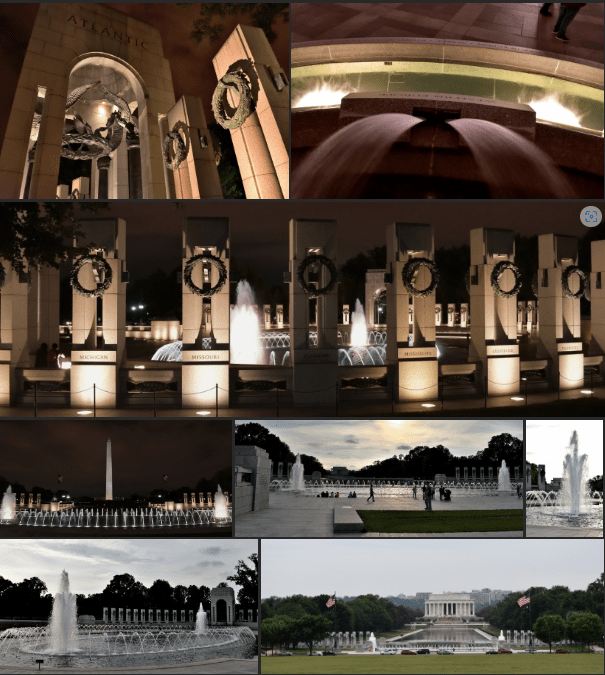
WW II Memorial

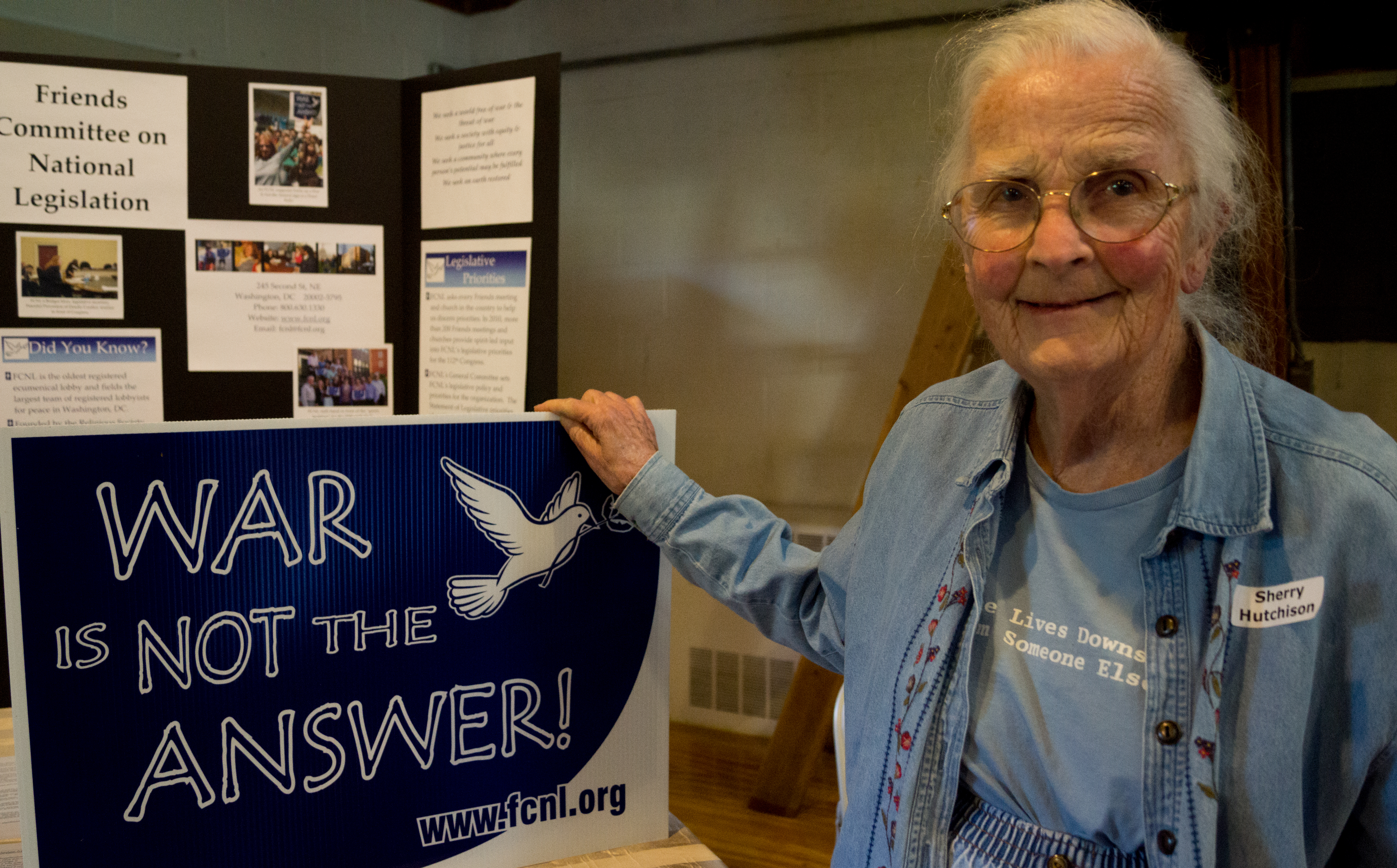
I’ve developed a collection of photographs of memorials in Washington, DC, taken while in the city to attend annual meetings of the Friends Committee on National Legislation (FCNL). I’ve begun to build a new site for my photography: https://jeffkislingphotography.wpcomstaging.com/.

Tomorrow marks a date which will live in infamy (Franklin D Roosevelt), when Japan attacked Pearl Habor, leading the United States to enter World War II. Following is a link to that photo gallery.

As I’ve been putting these galleries together, I noticed some photos included shadows or distant images of people. I make a point of not including people if at all possible in photos I take in nature. But the visitor is a part of the memorial. They make me wonder what the memorial means to them. Did a loved one serve?

The thought often arises, where are the memorials to those who worked for peace?

World War II photo gallery

Link to the WWII photo gallery: https://jeffkislingphotography.wpcomstaging.com/2023/11/17/washington-dc/nggallery/washington-dc/ww-ii-memorial

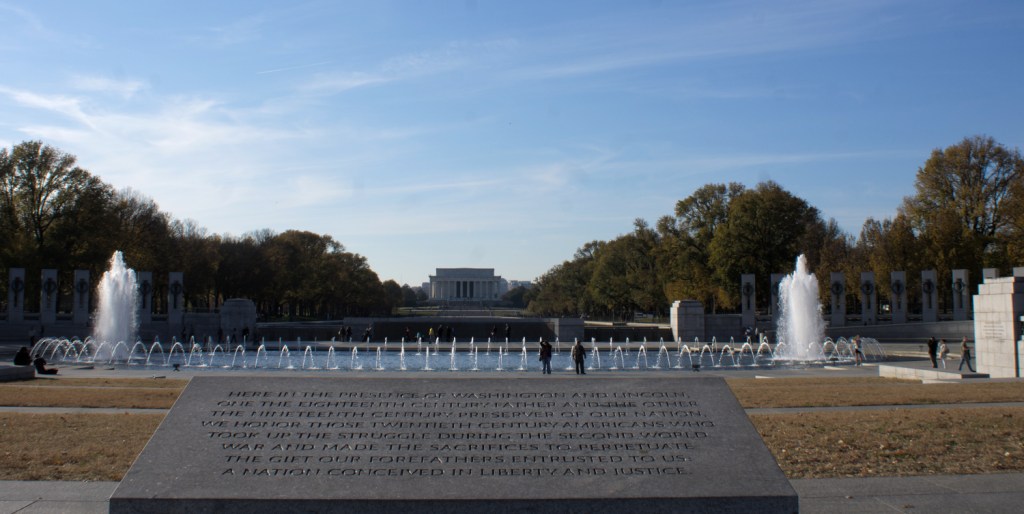
Announcement Stone

HERE IN THE PRESENCE OF WASHINGTON AND LINCOLN,
ONE THE EIGHTEENTH CENTURY FATHER AND THE OTHER
THE NINETEENTH CENTURY PRESERVER OF OUR NATION,
WE HONOR THOSE TWENTIETH CENTURY AMERICANS WHO
TOOK UP THE STRUGGLE DURING THE SECOND WORLD
WAR AND MADE THE SACRIFICES TO PERPETUATE
THE GIFT OUR FOREFATHERS ENTRUSTED TO US:
A NATION CONCEIVED IN LIBERTY AND JUSTICE.

Jeff Kisling

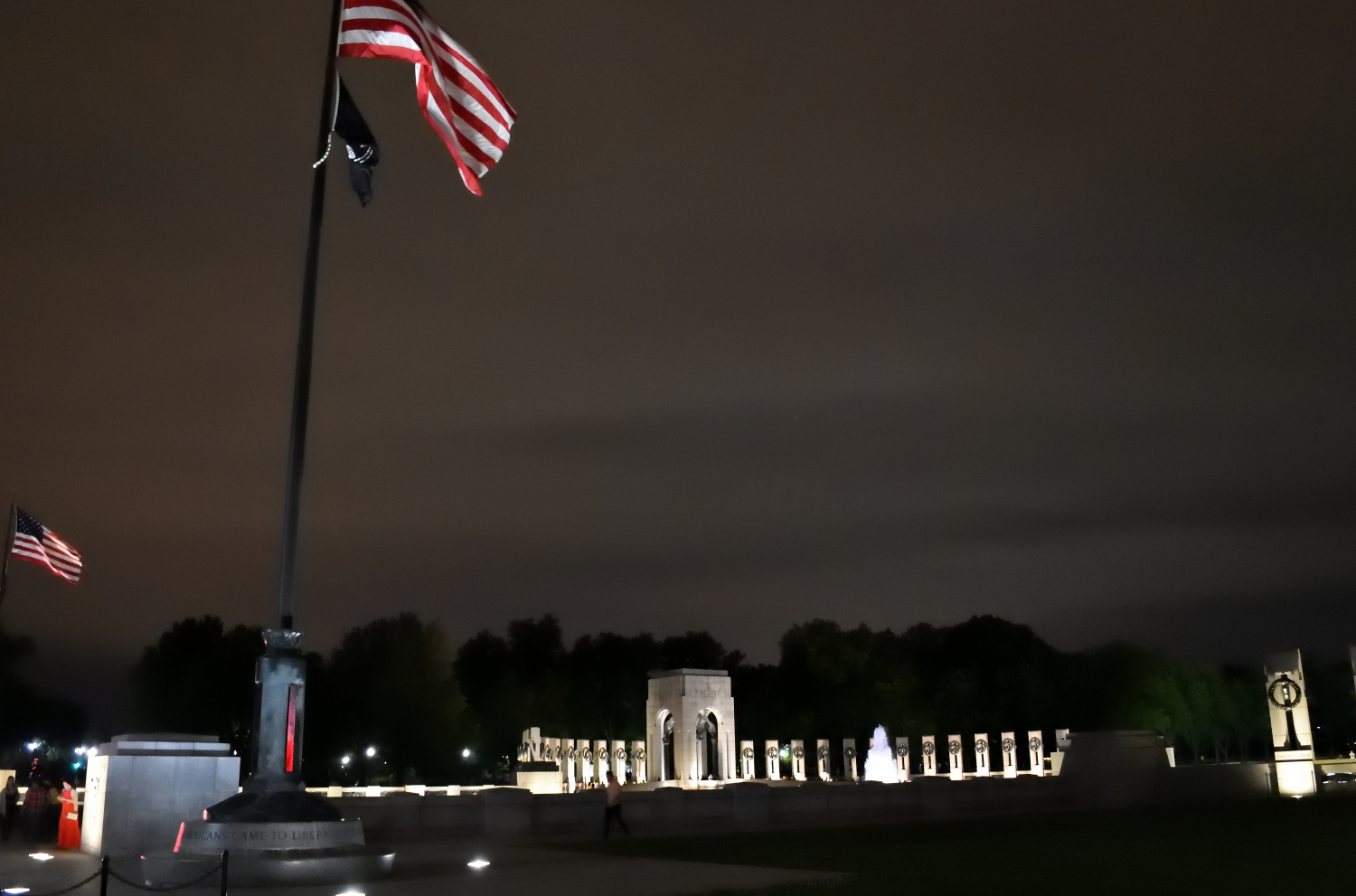
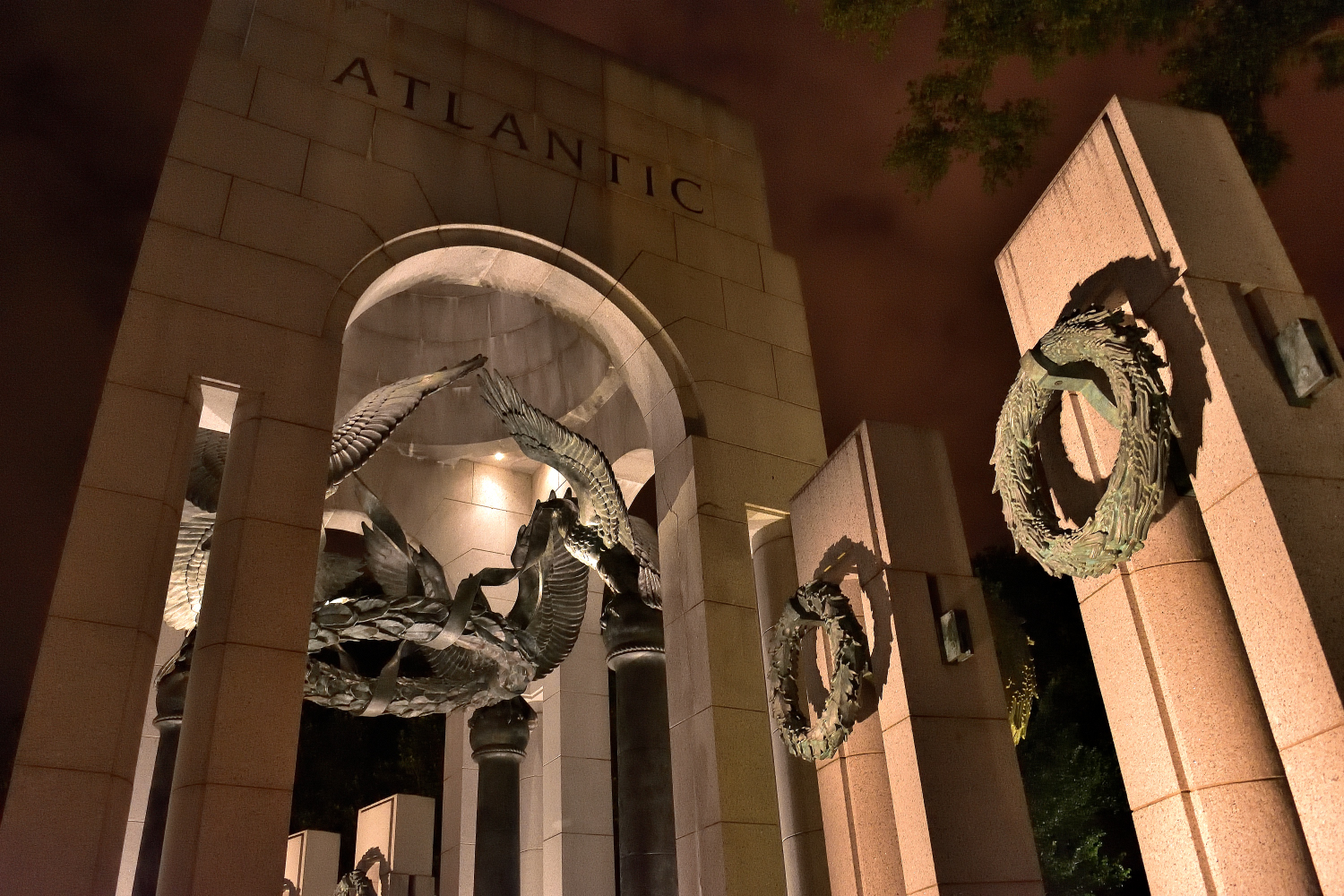
Dedicated in 2004, the World War II Memorial is a large stone plaza designed by architect Friedrich St. Florian. The plaza forms a ring of columns representing the U.S. states and territories, joined together by a bronze cord symbolizing their united effort.

Bas relief artwork by Ray Kaskey Studios depicts the many facets of the American war effort both on the homefront and the battle front. Two victory pavilions, repesenting the Atlantic and Pacific theaters where the war was fought, house massive bronze sculptures of eagles laying laurel wreaths above a representation of the Victory Medal. At the base of each pavilion is a pool with the names of campaigns and battles of each theater of the war.

At the west side of the memorial, 4,048 gold stars each represent 100 American servicemen who gave their lives in the conflict.

The World War II Memorial is located on 17th Street NW between Independence and Constitution avenues, at the east end of the Lincoln Memorial Reflecting Pool. The nearest metro stop is Smithsonian; walk west from the station past the Washington Monument and cross 17th Street at the crosswalk to enter the memorial.

World War II Memorial, National Mall and Memorial Parks, National Park Service


Previous blog posts that include photos of other war memorials in Washington, DC.

Korean War

I’m not sure why I’m led to revisit and re-edit photos I’ve taken of war memorials over the years. I think this is in part because war has become so sanitized and remote in this country. Even killing is done remotely by drone operators in the US.

I was raised in Quaker communities, which oppose war. The Vietnam War was a significant influence on me as I was coming of age, a high school student at the Quaker boarding school, Scattergood Friends School, in Eastern Iowa. I spent many days, weeks, and months, studying and praying about what to do and eventually turned in my draft cards

I’ve been re-editing photos I took of the Korean War Memorial over the years. For about a decade, I would go to Washington DC as a member of the General Committee of the Friends Committee on National Legislation (FCNL), and looked forward to taking photos while I was there.

The Korean War Memorial is very moving, as well. The artist, Frank Gaylord, was an American sculptor who created the 19 stainless steel statues of soldiers and sailors that represent the U.S. military personnel who served in that war (1950-1953).

Korean War Memorial


Vietnam War

I am grateful for many things.

My first thought went to something I recently heard someone say. That he was a draft resister in the Vietnam War era, and that was the best thing he’d ever done. I was astonished to hear that fifty years later. I know what he was saying because I was a draft resister then, as well. As an 18-year-old, I knew this decision would set the course of my life. It would be easy to accept conscientious objector status and do two years of alternative service. Fortunately, though, I was aware of the stories of many Quaker men I knew who refused to participate in the war machine. Knowing they risked imprisonment and often were. But I saw how that choice defined the rest of their lives.

Now shall I walk, or should I ride?


https://jeffkislingphotography.wpcomstaging.com/2023/11/17/washington-dc/nggallery/washington-dc/ww-ii-memorial

Korean War Memorial

I’m not sure why I’m led to revisit and re-edit photos I’ve taken of war memorials over the years. I think this is in part because war has become so sanitized and remote in this country. Even killing is done remotely by drone operators in the US.

I was raised in Quaker communities, which oppose war. The Vietnam War was a significant influence on me as I was coming of age, a high school student at the Quaker boarding school, Scattergood Friends School, in Eastern Iowa. I spent many days, weeks, and months, studying and praying about what to do and eventually turned in my draft cards.

I’ve been developing a new website for my photography.

https://jeffkislingphotography.wpcomstaging.com/

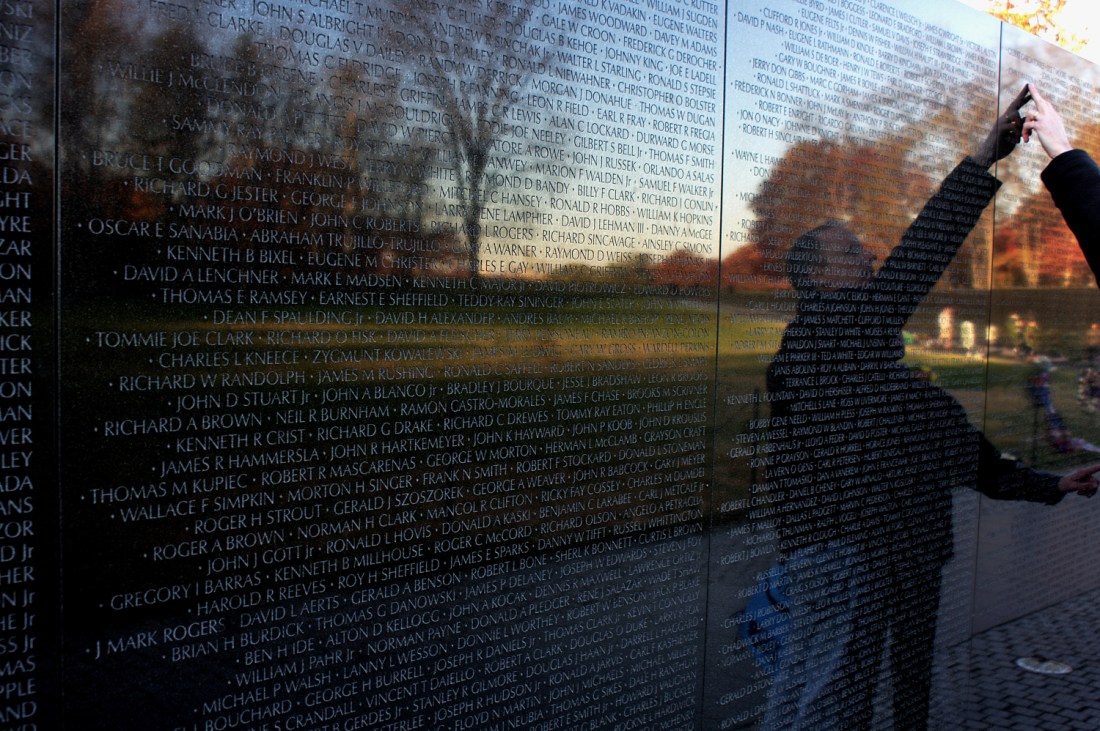
My most recent post, “Now shall I walk, or should I ride?” included a reference to this new album about the Vietnam War memorial. It is interesting to see the diversity of the designs of the memorials for this country’s wars. The Vietnam War Memorial is profoundly striking.

Next, I’ve been re-editing photos I took of the Korean War Memorial over the years. For about a decade, I would go to Washington DC as a member of the General Committee of the Friends Committee on National Legislation (FCNL), and looked forward to taking photos while I was there.

The Korean War Memorial is very moving, as well. The artist, Frank Gaylord, was an American sculptor who created the 19 stainless steel statues of soldiers and sailors that represent the U.S. military personnel who served in that war (1950-1953).

https://jeffkislingphotography.wpcomstaging.com/2023/11/17/washington-dc/nggallery/washington-dc/korean-war-memorial

As with the Vietnam War Memorial, visitors speak in hushed tones, if at all.

The group of life-sized sculptures is very disturbing in several ways. You get the sense of what it would be like to have them come upon you.

But what struck me most was the utter weariness and exhaustion on the soldiers’ faces. Even as a pacifist myself, I am always mindful of the courage it takes to be in the military. I can never fault anyone for making such sacrifices when they believe in the military as the way to protect their country and their loved ones. And are willing to risk life-long, debilitating injury or death.

In the photos below, the mural wall can be seen that depicts the faces of soldiers, nurses, and other personnel who served in the war. There is also one photo of the Pool of Remembrance, which is a shallow circular pool at the apex of the triangle of soldiers. The pool has the names of the countries that participated in the war and the numbers of casualties engraved on its walls.

Gaylord based some of the faces of the soldiers on the men he served with during World War II, such as William A. Callaway and John Erdman. He said he wanted to represent an ethnic cross-section of America and all branches of the military. https://en.wikipedia.org/wiki/Frank_Gaylord

You can see my photos of the Korean War Memorial here: https://jeffkislingphotography.wpcomstaging.com/2023/11/17/washington-dc/nggallery/washington-dc/korean-war-memorial

Now shall I walk, or should I ride?

My friends at the Great Plains Action Society (GPAS) have done a lot of work to call out the whitewashed history of Thanksgiving, one of many colonial mythologies about Indigenous Peoples and the founding of the US and Canada, which I wrote about yesterday.

But of course, there is nothing wrong with reflecting on what we are thankful for.

I am grateful for many things.

My first thought went to something I recently heard someone say. That he was a draft resister in the Vietnam War era, and that was the best thing he’d ever done. I was astonished to hear that fifty years later. I know what he was saying because I was a draft resister then, as well. As an 18-year-old, I knew this decision would set the course of my life. It would be easy to accept conscientious objector status and do two years of alternative service. Fortunately, though, I was aware of the stories of many Quaker men I knew who refused to participate in the war machine. Knowing they risked imprisonment and often were. But I saw how that choice defined the rest of their lives.

It was a clear choice that Robert Frost’s poem, The Road Not Taken, tells so eloquently.

At that same time, I found I had another decision to make. Moving to Indianapolis, I was horrified by the noxious clouds of smog pouring from every tailpipe; this was before catalytic converters covered up the damage being done to Mother Earth. I made another decision that was definitely a road less traveled (so to speak): to live without a car. That was another of the best decisions of my life, defining so much of what happened thereafter. Affecting every day of my life as I was able to witness the wonder of what I was walking through.

So the phrase ‘Now shall I walk, or shall I ride?’ in Metaphors of Movement caught my attention.

The Best Friend

Now shall I walk
Or shall I ride?
“Ride”, Pleasure said;
“Walk”, Joy replied.

William Henry Davies
1871 – 1940

In his 1914 poem The Best Friend, the Welsh poet and occasional vagabond W.H. Davies pondered a timeless question: “Now shall I walk, or should I ride?” This seemingly simple dilemma encapsulates the modern industrial choice between slow-paced ageless wandering on foot or embracing the thrill of motorized transport, along with the attendant speed and freedom it offers, which has become such an integral part of our contemporary lifestyle. It likewise speaks volumes about us and about the nature of the choices we make daily.

Gone perhaps are the days of poetic musings over the merits of walking versus riding. Yet one can’t help but wonder if we have lost something essential along the way—a connection with the world that only a leisurely walk can provide.

C.S. Lewis, while growing up in the outskirts of Belfast, Northern Ireland, counted it among his blessings that his father had no car, so the deadly power of rushing about wherever he pleased had not been given to him. He thus measured distance by the standard of a man walking on his two feet and not by the standard of the internal combustion engine, for it is here where both space and time is annihilated by the deflowering of distance. In return, he possessed “infinite riches” in comparison to what would have been to motorists a “little room.” Key to those riches was what he came to call, and experience throughout life as, “joy,” and walking became a portal through which he sought it. A participatory engagement with life and living which I contend is as vital to our survival as breathing itself. 

Metaphors of Movement by Keith Badger, Parabola, Nov 22, 2023


I hope that in this year to come, you make mistakes. Because if you are making mistakes, then you are making new things, trying new things, learning, living, pushing yourself, changing yourself, changing your world. You’re doing things you’ve never done before, and more importantly, you’re doing something.

Neil Gaiman

The Road Not Taken

Two roads diverged in a yellow wood,
And sorry I could not travel both
And be one traveler, long I stood
And looked down one as far as I could
To where it bent in the undergrowth;

Then took the other, as just as fair,
And having perhaps the better claim,
Because it was grassy and wanted wear;
Though as for that the passing there
Had worn them really about the same,

And both that morning equally lay
In leaves no step had trodden black.
Oh, I kept the first for another day!
Yet knowing how way leads on to way,
I doubted if I should ever come back.

I shall be telling this with a sigh
Somewhere ages and ages hence:
Two roads diverged in a wood, and I—
I took the one less traveled by,
And that has made all the difference.

Robert Frost

Vietnam War Memorial, Washington, DC (c) 2023 Jeff Kisling

This is a link to my photos of the Vietnam War Memorial. https://jeffkislingphotography.wpcomstaging.com/2023/11/17/washington-dc/nggallery/washington-dc/vietnam-war-memorial

Those that conspire to live the truth

whitewash: deliberately attempt to conceal unpleasant or incriminating facts about (someone or something):

Sadly, but importantly, white settler colonists such as me are learning a great deal about the genocide of native peoples, in large part facilitated by the institutions of forced assimilation. Sometimes referred to as Indian boarding or residential schools, though school is a misnomer, an example of whitewashing. The remains of thousands of native children are being located on the grounds of these institutions in this country and Canada.

My friends at the Great Plains Action Society provide the following messages and resources related to Truthsgiving. The pledge to reject colonial holidays that perpetuate dangerous stereotypes and whitewashed history is included below.

The following was written by my friend Ronnie James.

Doing Truth When The World Is Upside Down

To walk a path of Doing The Truth is a battle with a very young culture. Telling the truth is comparably easy, we have our oral histories, art and traditions created and carried on, histories printed by those that found a way to the presses. We can recount the stories and lessons that survived colonialism.

But to do the truth, to live a life that enforces what we once had, a life and culture that made a millennia of humanity possible to thrive, is to be at war with what has defined and destroyed this world for too long.

We, those that conspire to live the truth, have chosen to honor our histories of cooperation. We know, with all that we have, that a world of competition and conquest is the opposite of how we gained the knowledges that propelled our abilities to create the sciences and the art and architecture of beautiful societies that our ancestors built, and we draw our strength from that to continue, to create, a world our future generations can thrive in.

It has only been a very short time that the world has been this way, which is the proof that it doesn’t have to stay this way.

Doing Truth When The World Is Upside Down


Truthsgiving Webinar 2020

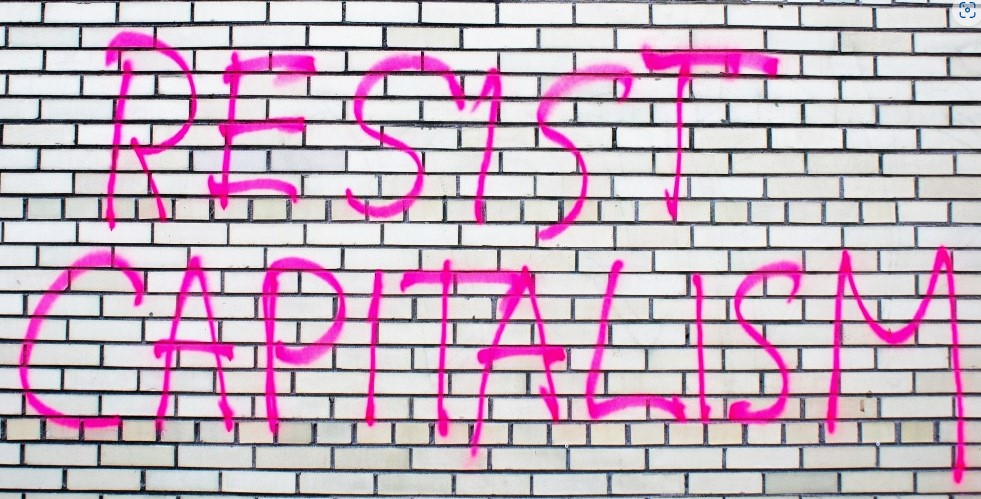
On November 26, Great Plains Action Society organized a webinar to educate folks about the mythology of Thanksgiving and celebrate the spirit of Truthsgivng by reporting on the many ways that one can resist colonial-capitalism and whitewashed history through the revolutionary act of mutual aid and truth-telling.


Take the Pledge


Truthsgiving, Day of Mourning, Anti-Thanksgiving Resources

“The following resources are available so that folks can learn more about Indigenous perspectives on Thanksgiving, the land they live on, how to be a good ally, and how they can decolonize their minds in order to abolish personal and institutionalized white supremacy.”
https://www.truthsgiving.org/resources


Why I’m going to stop publishing in Quaker spaces

Rather than just leaving Quaker spaces, I’m led to share some reasons.

I didn’t learn much from over fifty years of trying and failing to convince Friends and others to reject the automobile culture. I don’t regret writing almost daily about that and similar things. Writing is a tool that helps me make sense of the world. I’ve never worried about anyone else seeing what I wrote.

The same is true for the past decade’s work to stop the construction of fossil fuel pipelines and related environmental and justice concerns.

I’m forced to realize writing, and public vigils aren’t enough to convince people to change. That only happens from a person’s own lived and spiritual experiences.

I am so blessed to have been led to be part of communities of people of color, Indigenous friends, and those who are building and living in Mutual Aid communities. I wish I could share what I’ve learned in all those places with my White Friends in a way that would be useful to them. I tried to do that with writing, but that wasn’t enough.

Quakers believe how we live our lives should be our example to the world. I’ve tried to be faithful in doing that.

The following is a Link Tree with links to most places where I publish things. The reason for so many is the variety of audiences/subject matter for each link. If you’re interested, I still plan to share writings and photography in most of those places.

You need to go here for the tree with the working links. https://linktr.ee/jeffkisling

https://linktr.ee/jeffkisling

When I was hungry, you gave me food

The Making of a Spiritual Anarchist

I recently came across a series of articles by Barnabas Smith on medium.com titled The Making of a Spiritual Anarchist. One of them was When I Was Hungry, You Gave Me Food.

The phrase below, “after my time on the bench,” relates to Barnabas’ punishment for not getting good grades. His father made him sit on the bench outside his father’s store, hoping to give him a different perspective on the importance of a good education. I know, that begs the question of what a good education is. The store was in a part of the city where there were people living on the street.

After my time on the bench, I decided to take matters into my own hands. If the city wouldn’t take care of its citizens and churches weren’t going to take care of their neighbors, then I would do what I could. As a high schooler, it wasn’t much.

I started by buying two meals when I ate out and giving the extra away. After graduating high school, I started inviting people to have lunch with me instead. To me, if taking care of someone was also taking care of Jesus, wouldn’t it be better to have lunch with him and treat him as a friend?

I did help a few churches organize their outreach programs. If they were willing to put their time and money into the community, I figured it was best to help them do it right. And by right I mean, by treating the people they were seeking to serve as people and not a project. To see them as human beings fully loved by God and not as souls to save from God’s wrath. It was hit or miss on how the outreaches actually lived up to this.

I didn’t know at the time, but my disregard and distrust of the necessity of institutions was a hallmark of anarchism. I was simply trying to do my part to help my community. I wasn’t radicalized in college or by reading Marx. I was awakened to the needs of the people around me. My neighbors. People who the powers that be saw as unimportant.

When I Was Hungry, You Gave Me Food. The Making of a Spiritual Anarchist, Part 2 by Barnabas Smith, medium.com, Sept 18, 2023


31 “When the Son of Man comes in his glory, and all the angels with him, he will sit on his glorious throne. 32 All the nations will be gathered before him, and he will separate the people one from another as a shepherd separates the sheep from the goats. 33 He will put the sheep on his right and the goats on his left.

34 “Then the King will say to those on his right, ‘Come, you who are blessed by my Father; take your inheritance, the kingdom prepared for you since the creation of the world. 35 For I was hungry and you gave me something to eat, I was thirsty and you gave me something to drink, I was a stranger and you invited me in, 36 I needed clothes and you clothed me, I was sick and you looked after me, I was in prison and you came to visit me.’

37 “Then the righteous will answer him, ‘Lord, when did we see you hungry and feed you, or thirsty and give you something to drink? 38 When did we see you a stranger and invite you in, or needing clothes and clothe you? 39 When did we see you sick or in prison and go to visit you?’

40 “The King will reply, ‘Truly I tell you, whatever you did for one of the least of these brothers and sisters of mine, you did for me.’

Matthew 25


If you’ve read other articles I’ve written you know I was profoundly changed when the Spirit connected me with the people at Des Moines Mutual Aid about four years ago. Barnabas’s article distills a few things I’ve learned or questioned as a result of my experiences there.

  • Why are so few churches feeding, clothing, and providing shelter to those in need?
    • Sending money somewhere doesn’t count.
  • When they do, why do so many dehumanize those they are trying to help?
    • I say “trying” because how helpful is treating those in need this way?
  • Mutual Aid groups across the country and the world are doing these things and treating our neighbors as ourselves.

There is a large collection of articles about spirituality in The Anarchist Library. https://theanarchistlibrary.org/category/topic/spirituality

Solidarity with Palestine

What do you think about what is happening in the Middle East?

The mainstream media is siding with Israel. The narrative is anything Israel does is justified in response to the horrific attacks by Hamas on October 7. Ignoring 75 years of oppression by Israel against the Palestinian people. Ignoring that Hamas is separate from the Palestinian people.

Empire

Nothing can justify the relentless bombing of Gaza. The United States believes and acts otherwise. Sending U.S. military might to the region. Besides sending additional billions of dollars to Israel, the U.S. has vetoed calls for a ceasefire at the United Nations.

UNITED NATIONS (AP) — The U.S. vetoed a U.N. resolution Wednesday to condemn all violence against civilians in the Israel-Hamas war and to urge humanitarian aid to Palestinians in Gaza, saying it was too early to craft an appropriate Security Council response to the crisis.

US vetoes UN resolution condemning all violence against civilians in Israel-Hamas war by Edith M. Lederer, AP News, Oct 18, 2023

What the U.S. and Israel are doing is a blatant display of empire, which highlights the contrast with those who have been struggling against empire for centuries.

The settler states that dispossess and occupy our lands support Israel in dispossessing and occupying Palestine.

The Red Nation

Indigenous Solidarity with Palestine

The past two weeks of horrific violence in Gaza resulted from 75 years of Israeli settler colonial dispossession, 56 years of military occupation, and 16 years of an open-air prison for 2.2 million people, half of whom are children. The atrocities of the Israeli apartheid regime in Palestine are relentless, illegal under international law, and consistent with settler-colonial projects globally.

The settler states that dispossess and occupy our lands support Israel in dispossessing and occupying Palestine.

Indigenous Solidarity with Palestine by The Red Nation, October 27, 2023


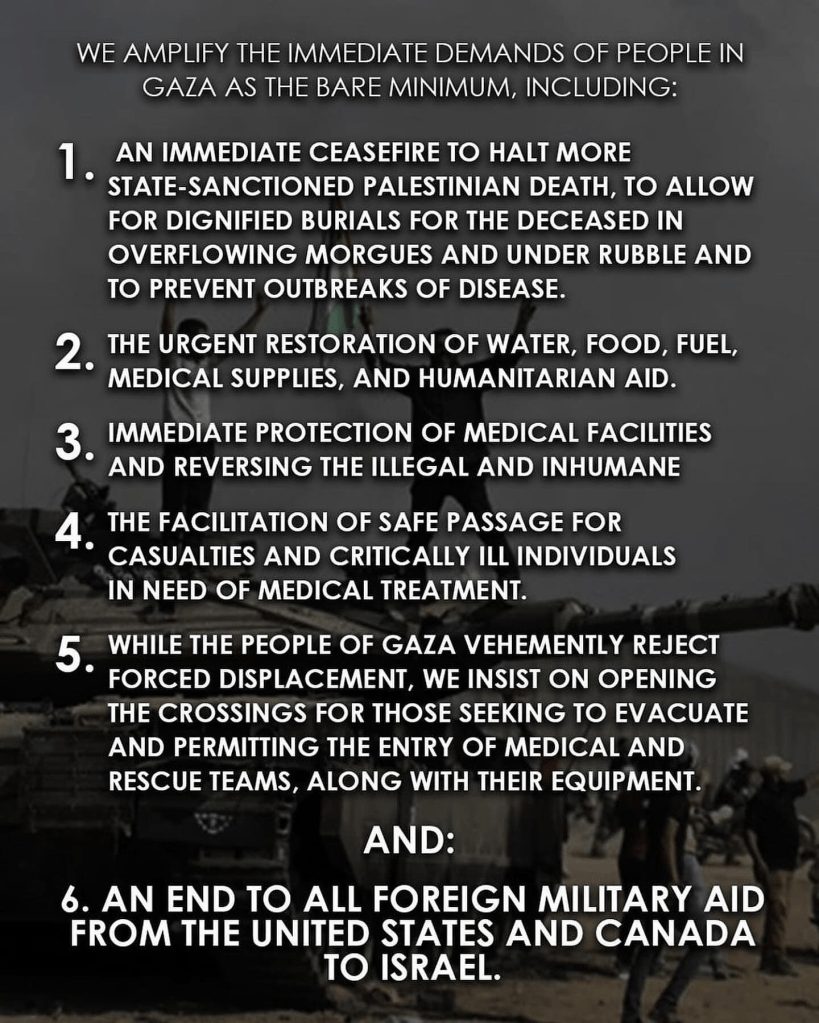
132 Indigenous activists, artists, and intellectuals, including WPLC Executive Director Natali Segovia, condemn Israel’s ongoing genocide against Palestinians. They call for an end to U.S. and Canadian military aid to Israel, an immediate ceasefire, uplifting the Palestinian call to Boycott, Divest, and Sanction (BDS) Israel and Israeli institutions complicit in apartheid and settler colonialism, freedom for political prisoners, land back, and the right of return.

Water Protector Legal Collective


https://www.facebook.com/WaterProtectorLegal/posts/734171448753298/
Indigenous Solidarity with Palestine by The Red Nation, October 27, 2023

Solidarity from Des Moines Mutual Aid and Des Moines Black Liberation Movement Collective

…to issue solidarity statements and Mutual Aid for Palestine and organize Mutual Aid for Gaza

Indigenous Solidarity with Palestine, The Red Nation

FCNL’s “Calling for a Ceasefire: Israel-Palestine Briefing”

Over one thousand people registered for FCNL’s “Calling for a Ceasefire: Israel-Palestine Briefing” held last night.

I encourage you to watch the powerful and informative briefing recording below. FCNL’s General Secretary, Bridget Moix, led the discussion with three panelists: Joyce Ajlouny, AFSC General Secretary; Odeliya Matter, FCNL program assistant for the Middle East Policy team, and Hassan El-Tayyab, FCNL’s Legislative Director for Middle East Policy.


As you heard this evening, our collective advocacy is working to shift the conversation and open up space for calls to end the violence. But we need your help to continue building momentum for a ceasefire to protect the lives of Palestinian civilians and Israeli and other hostages. We also need your help to ensure that humanitarian aid can reach those in dire need.

Take Action

What Actions Will You Take?

Please click the link below to tell us what action(s) you want to take and what kind of support (if any) you need. Your voice is vital to us as we continue to advocate for a ceasefire. You can also email us at Lobby@fcnl.org.

Sincerely,
Bridget Moix
General Secretary


The U.S. Must Act to De-Escalate the Violence in Israel and Palestine

51856 actions taken

We are heartbroken by the recent violence in Israel and Gaza. As Quakers, we deeply mourn the loss of all lives and pray for those who have lost loved ones due to this latest escalation. We unequivocally condemn Hamas’ attacks and inhumane treatment of civilians and call for the immediate release of all hostages. We also condemn the indiscriminate and violent Israeli response that has already claimed hundreds of civilian lives.

More war and weapons won’t bring peace. In the face of growing violence, lawmakers must:

  • Work to de-escalate this situation by calling for restraint, ceasefire, de-escalation, and respect for international law.
  • Protect lives—those of the Israeli hostages and the roughly 1 million children who live in Gaza.
  • Address the root causes underlying this explosion of violence, including decades of institutionalized oppression and collective punishment of Palestinians through brutal military occupation and a 16-year Gaza blockade.

Urge Congress to call for an immediate ceasefire, de-escalation, and restraint to prevent further civilian harm in Israel and the occupied Palestinian territories.

Friends Committee on National Legislation


Transcript of the video above, FCNL: Calling for a Ceasefire: Israel-Palestine Briefing.