Des Moines Mutual Aid Anti-war Actions

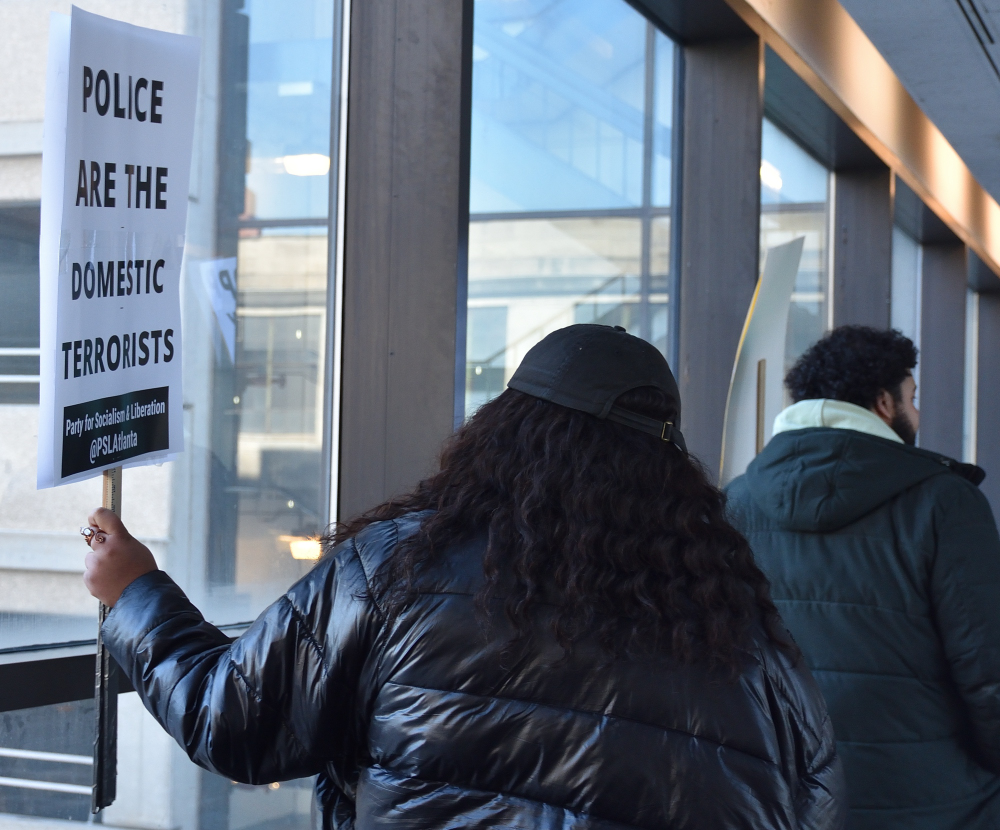
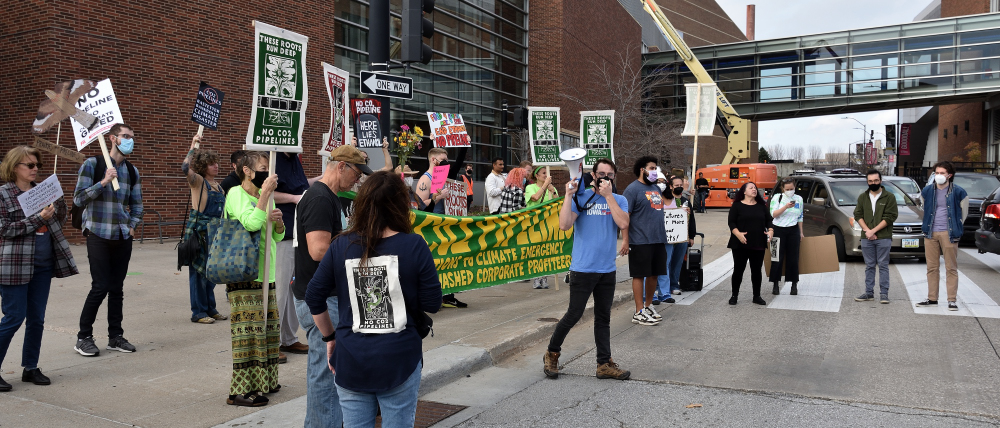
In January 2020, Des Moines Mutual Aid participated in a march protesting the potential for war or increased hostilities with Iran that followed the fallout of the assassination of Qassem Soleimani by drone strike in Baghdad.

That was an example of the principle to think globally, act locally.

January 3, 2024

Now there is the tragic news of many people who attended the fourth anniversary of Soleimani’s death being killed by explosives.

Now there have been two explosions that killed nearly 100 people and wounded scores at a ceremony in Iran on Wednesday to commemorate commander Qassem Soleimani who was killed by a U.S. drone in 2020, Iranian officials said, blaming unspecified “terrorists”.

Iranian state television reported a first and then a second blast after 20 minutes during a crowded fourth-anniversary event at the cemetery where Soleimani is buried in the southeastern city of Kerman.

Blasts kill nearly 100 at slain commander Soleimani’s memorial, Iran vows revenge by Parisa Hafezi, Reuters, January 3, 2024


January 4, 2024

Yesterday a US airstrike killed an Iran-linked militia commander in Baghdad

BAGHDAD — A U.S. airstrike here on Thursday killed an Iran-linked militia commander and risked accelerating the regional fallout from Washington’s support for Israel’s military operation in Gaza, even as the Biden administration scrambles to contain the bloodshed.

While the United States has targeted militia-affiliated locations in Iraq and Syria several times in recent months, an American operation in such a central location of Iraq’s capital is exceedingly rare. Harakat Hezbollah al-Nujaba falls under the command of the Iraqi army, which responded swiftly — and in anger — saying agreements between Baghdad and Washington had been violated.

U.S. strike in Baghdad raises specter of wider regional war. Iraq says the strike violated agreements between Baghdad and Washington. The Pentagon described it as ‘necessary’ and ‘proportionate.’ By Mustafa Salim, Louisa Loveluck, Dan Lamothe and Alex Horton, The Washington Post, January 4, 2024

Biden Administration Bypasses Congress

The Biden administration has bypassed Congress twice to approve emergency weapons sales to Israel. The first instance was a sale of nearly 14,000 rounds of tank ammunition worth more than $106 million. The second instance involved a $147.5 million sale for equipment, including fuses, charges, and primers, needed to make the 155 mm shells that Israel had already purchased functional.

The Biden administration once again bypasses Congress on an emergency weapons sale to Israel by By MATTHEW LEE, Associated Press, 12/30/2024

Gen. Qassem Soleimani assassinated 1/3/2020

The United States killed a high-profile commander of Iran’s secretive Quds Force with a drone strike in Iraq early Friday, the Department of Defense said.

“At the direction of the President, the U.S. military has taken decisive defensive action to protect U.S. personnel abroad,” the department said in a statement announcing the death of Gen. Qassem Soleimani, a commander of Iran’s military forces in Iraq, Syria, Lebanon and elsewhere throughout the Middle East.

U.S. airstrike kills top Iran general, Qassem Soleimani, at Baghdad airport by By Phil HelselKen Dilanian and Josh Lederman, NBC News, January 3, 2020


Now I understand that working for peace today is to work for justice in oppressed communities in our own country.

Where is the peace movement now?

After the Vietnam War, it seemed the peace movement in this country had died. Now I understand that working for peace today is to work for justice in oppressed communities in our own country. In this photo, I’m holding a sign related to Black Lives Matter (circa 2016). It took a while for others at the peace vigil to become comfortable with the divergence from the usual anti-war emphasis.
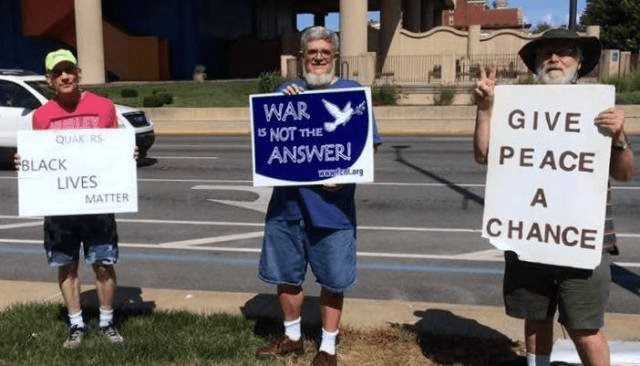
Although the West’s imperialism is not new, the U.S. is increasingly viewed as a global evil Empire. The most recent example, of course, is the Biden administration’s continuing massive support for Israel’s genocide in Gaza. Even bypassing Congress to send more military aid.

And on the global stage is the outrage of seeing the U.S. block the United Nations call for a ceasefire in Gaza.

Des Moines Mutual Aid protests the assassination of Qassem Soleimani (2020)

A Love Letter to Y’all

One year ago yesterday Des Moines Mutual Aid participated in a march protesting the potential for war or increased hostilities with Iran that followed the fallout of the assassination of Qassem Soleimani by drone strike in Baghdad.

This was our first “public” event since adopting the name Des Moines Mutual Aid, a name we gave our crew during our growing work with our relatives at the houseless camps throughout the city and our help with coordinating a weekly free grocery store that has a 50 year history, founded by the Des Moines Chapter of The Black Panther Party For Self Defense.

A year ago we started laying the foundation for work we had no idea what was coming.

As we were adjusting our work with the camps and grocery re-distribution in response to the Covid-19 pandemic, both that continued to grow in need and importance, the police continued their jobs and legacy of brutality and murder.

This nation exploded in righteous rage in response to the pig murders of Breonna Taylor and George Floyd.

DMMA realized we were in a position to organize a bail fund to keep our fighters out of jail, both to keep the streets alive as a new phase of The Movement was being born, and because jails are a hotspot of COVID-19 spread.

Not to mention the racial and economic oppression that is the cash bail system.

In the past year, DMMA has expanded its work in multiple directions and gained many partners and allies.

We partnered with the Des Moines Black Liberation Movement (@DesMoinesBLM) to create the DSM BLM Rent Relief initiative to help keep families in their homes in the midst of a pandemic and the winter.

The camp work has grown exponentially but is being managed with our collaboration with Edna Griffin Mutual Aid (@egma_dsm), DSM Black Liberation Movement (@DesMoinesBLM), and The Great Plains Action Society (@PlainsAction).

The bail fund remains successful because of desire from the public and a partnership with Prairielands Freedom Fund (@prairielandsff) (formerly The Eastern Iowa Community Bond Project).

The weekly free food store has maintained itself, carrying on the legacy it inherited.

Every one of our accomplishments are directly tied to the support of so many people donating time, talent, and funds to the work. We are overwhelmed with all of your support and hope you feel we are honoring what we promised.

All of these Mutual Aid projects are just a few of many that this city has created in the last year in response to the many crises we face, not only confronting the problems and fulfilling the needs directly in front of us, but creating a sustainable movement that will be capable of responding to what’s next and shaping our collective futures as we replace the systems that fail us.

These last 12 months have been wild and a real test of all of our capabilities to collectively organize.

But it is clear that we as a city have what it takes to do what is needed in 2021, no matter what crisis is next.

Much gratitude to you all.
In love and rage,
Des Moines Mutual Aid
January 6, 2021

Vision Quest

As a new year begins

We are facing unprecedented challenges. Meaning we need to find new paths.

  • What are we called to do?
  • Where do we look for help?

Ancestors

  • What things do we admire about our ancestors?
  • Are we living up to the lessons they provide?
  • What mistakes did they make that we can learn from?

Spirituality

  • How can we deepen faith?  
  • What gets in the way of finding that spiritual guidance?
  • Do we have the courage to follow where our faith leads us?
  • How do we support each other to express that courage?
  • How do we facilitate and learn from the expression of spirituality in the wider community?

Comfortable

  • What are the dangers of being comfortable? I don’t believe we should be comfortable with so many things as they are now. Because so much is rooted in injustice.

Collapse

It is clear the world we grew up in is no longer. The environment is rapidly becoming increasingly chaotic. Economic and political systems are failing. Physical and social infrastructure is breaking down.

Centralized systems of government and the economy will collapse for lack of resources and the infrastructure to provide them.

Increasingly we will all be forced to reckon with disasters of all kinds. We will have no choice.

Migration

What needs to be done to prepare for climate migration.

  1. Climate Action: Urgent global and national climate action is needed to mitigate the effects of climate change.
  2. Infrastructure Development: Communities need to prepare for an influx of migrants by developing physical infrastructure such as affordable housing and transport routes.
  3. Social Services Expansion: Communities will need to expand healthcare, education services, and create new jobs to accommodate the increasing population.
  4. Recognition and Support: Recognizing climate migrants and focusing on larger processes that facilitate resilience—like access to education, housing, jobs, and healthcare—is crucial.
  5. Cultural Sensitivity: Communities will also have to address increased cultural diversity and potential tensions between new settlers and the local population.
  6. Climate Havens: Some communities with certain geographical pre-conditions can become ‘climate havens’ for climate refugees. These communities have access to fresh water, are sufficiently far away from the seaside, have an adequate height above sea level, and currently have a colder climate.

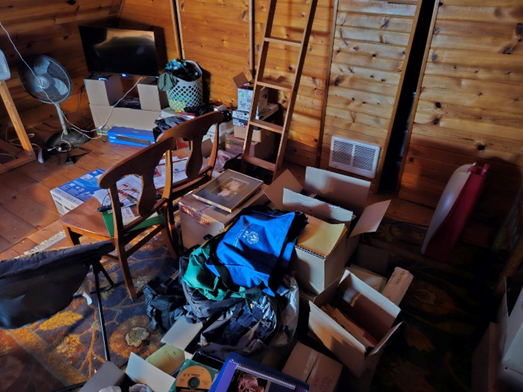
I have become a migrant myself. Having been living with my mom to care for her, I recently needed to find a new place to live when she died. The following photos show what my possessions have been reduced to. Almost all of those boxes contain books. The plastic bags contain my clothing.  

This is helping me understand what will be happening to so many very shortly. What has happened to so many already. People won’t be able to move many possessions. Transportation will be limited, and we may not know where we will end up.

When I was hungry, you gave me food

The Making of a Spiritual Anarchist

I recently came across a series of articles by Barnabas Smith on medium.com titled The Making of a Spiritual Anarchist. One of them was When I Was Hungry, You Gave Me Food.

The phrase below, “after my time on the bench,” relates to Barnabas’ punishment for not getting good grades. His father made him sit on the bench outside his father’s store, hoping to give him a different perspective on the importance of a good education. I know, that begs the question of what a good education is. The store was in a part of the city where there were people living on the street.

After my time on the bench, I decided to take matters into my own hands. If the city wouldn’t take care of its citizens and churches weren’t going to take care of their neighbors, then I would do what I could. As a high schooler, it wasn’t much.

I started by buying two meals when I ate out and giving the extra away. After graduating high school, I started inviting people to have lunch with me instead. To me, if taking care of someone was also taking care of Jesus, wouldn’t it be better to have lunch with him and treat him as a friend?

I did help a few churches organize their outreach programs. If they were willing to put their time and money into the community, I figured it was best to help them do it right. And by right I mean, by treating the people they were seeking to serve as people and not a project. To see them as human beings fully loved by God and not as souls to save from God’s wrath. It was hit or miss on how the outreaches actually lived up to this.

I didn’t know at the time, but my disregard and distrust of the necessity of institutions was a hallmark of anarchism. I was simply trying to do my part to help my community. I wasn’t radicalized in college or by reading Marx. I was awakened to the needs of the people around me. My neighbors. People who the powers that be saw as unimportant.

When I Was Hungry, You Gave Me Food. The Making of a Spiritual Anarchist, Part 2 by Barnabas Smith, medium.com, Sept 18, 2023


31 “When the Son of Man comes in his glory, and all the angels with him, he will sit on his glorious throne. 32 All the nations will be gathered before him, and he will separate the people one from another as a shepherd separates the sheep from the goats. 33 He will put the sheep on his right and the goats on his left.

34 “Then the King will say to those on his right, ‘Come, you who are blessed by my Father; take your inheritance, the kingdom prepared for you since the creation of the world. 35 For I was hungry and you gave me something to eat, I was thirsty and you gave me something to drink, I was a stranger and you invited me in, 36 I needed clothes and you clothed me, I was sick and you looked after me, I was in prison and you came to visit me.’

37 “Then the righteous will answer him, ‘Lord, when did we see you hungry and feed you, or thirsty and give you something to drink? 38 When did we see you a stranger and invite you in, or needing clothes and clothe you? 39 When did we see you sick or in prison and go to visit you?’

40 “The King will reply, ‘Truly I tell you, whatever you did for one of the least of these brothers and sisters of mine, you did for me.’

Matthew 25


If you’ve read other articles I’ve written you know I was profoundly changed when the Spirit connected me with the people at Des Moines Mutual Aid about four years ago. Barnabas’s article distills a few things I’ve learned or questioned as a result of my experiences there.

  • Why are so few churches feeding, clothing, and providing shelter to those in need?
    • Sending money somewhere doesn’t count.
  • When they do, why do so many dehumanize those they are trying to help?
    • I say “trying” because how helpful is treating those in need this way?
  • Mutual Aid groups across the country and the world are doing these things and treating our neighbors as ourselves.

There is a large collection of articles about spirituality in The Anarchist Library. https://theanarchistlibrary.org/category/topic/spirituality

The second question

What questions do you ask these days? Ask yourself or others? Are you brave enough to ask anything at all? Such as what can we do about accelerating authoritarianism? Runaway global burning? Why is the US complicit in the Israeli carpet bombing of Gaza? These things can only happen if authority is not questioned. There is a palpable sense of fear for anyone to question empire today. People who question are beaten, jailed, killed.

Yesterday I wrote about asking the right questions. As a spiritual person, I have been, and believe I will continue to receive answers from the Spirit or Inner Light. I appreciate the spirituality of the following.

From my career in medical research, the first thing I learned was the most important thing is to ask the right questions.

So, during a recent discussion about Quakers and the Indian Boarding Schools, I recognized the significance of the question that was asked, “how can we decolonize ourselves?” Prior to that, we were lost as we tried to understand our ancestor’s involvement in those institutions. It seemed the subtext of the question is “is it even possible to decolonize ourselves?” Which I tried to answer yesterday.

That question immediately brought to mind something that I had heard the Indigenous spiritual leader, Arkan Lushwala, say.

The answer to “what can I do?”

“Everywhere people ask, “what can we do?”
The question, what can we do, is the second question.
The first question is “what can we be?”
Because what you can do is a consequence of who you are.
Once you know what you can be, you know what you can do.”

Arkan Lushwala

Speaking about what is happening on Earth right now,
many of the conditions of life that we used to take for granted,
now are really out of balance.
Hopefully we still have time to get back into balance
so life may continue.
I travel around the world and meet people and talk to people
from all different cultures.
And everywhere people ask, “what can we do?”
The question, what can we do, is the second question.
The first question is “what can we be?”
Because what you can do is a consequence of who you are.
Once you know what you can be, you know what you can do,
and we cannot afford wasting time;
we have little time.
We need to be precise now.
When someone sincerely asks, “what can I do?”
my humble answer,
the only answer that I find in my heart to be sincere is,
“First find out what you can be.”
Action is extremely necessary at this time.
This is not a time just to talk about it.
The most spiritual thing now is action.
To do something about what’s happening.
To go help where help is needed.
To stand up when we need to stand up,
and protect what is being damaged.
And still, this action needs to be born
from a place in ourselves that has real talent,
real intelligence, real power,
real connection to the heart of the Earth,
to universal wisdom,
so, our actions are not a waste of time.
So, our actions are precise,
our actions are in harmony with the movement,
the sacred movement,
of that force that wants to renew life here on Earth
and make it better for the following generations.

Arkan Lushwala


Arkan says we are facing life threatening situations related to environmental damage.  We are facing such severe challenges that we cannot solve them only by ourselves.

We must move beyond thinking and talking. Action now is essential.

Action is spiritual.

We need to practice trying to reach our sacred space. We need a higher universal intelligence to help solve these problems.

We must open a sacred space for prayer so we may be open to the warrior spirit.

The importance of prayer.

  • We pray as a form of connecting to other forms of communication
  • We need to be aware of what is happening in the moment, elevate ourselves, move closer to the sacred
  • I first have to reach deep into my own heart

You start praying while you are also listening. I become aware of, remembering, what I pray about at that moment. We need to rely on our own ancient indigenous memory. Stop being isolated. Fully become part of the earth and water and plants and air. This is an immense source of knowledge about these problems.

I am in front of the sacred fire of all who are listening. Let’s say that I am thinking now. I am remembering. The notion of intelligence and to understand refers to memory. Intelligence means learning, but also achieving that state in your mind when you are remembering. The air that we are breathing carries the memories of the ages, the movement of energy. Deepest intelligence in our culture is memory. There are always memories of the ages in all that surrounds us.

The state of being, the prayer, makes us open to receiving. If we are really open, and not blocking ourselves, and connected to what is around us, with our eyes, breath, sensations, and feeling that arrive in our heart, through our antenna, if we are open in this way while we are doing something, our action is being infused with guidance or instructions. There is something there that is watching what you are doing and helping guide you. Sometimes we need the help of the elders or others to understand these experiences.

We ask for help. When we put ourselves in that elevated space, that makes it much easier for us to receive help. Help is always there but we often miss the messages.

If I am open and receptive to other frequencies and the higher state of my being, I’ll have much more help in my work.

The correct way is not to take credit, but the joy is the moment itself, by feeling integrated to life while you are doing the action.

When we sit with others in a circle, when we all change the state of our being together, we move up to the sacred together. Working with others in community, much, much more can be accomplished.

If a person expresses an experience that is from a sacred space of high resonance, I am activated by that. It resonates in my own heart and mind and spirit, and it triggers my memory, too. by the presence of something sacred.

We sit in a circle and witness someone remembering. We receive the same spirit together. Our individual self and agenda slips away. Joining our hearts. Mother Earth is the One, all of us become the One together. A lot of wisdom comes south. We are all impressed by the presence of something sacred.


It is becoming clearer and clearer, with every passing day, that walking a prayerful, peaceful spiritual path is the only way forward to a just, sustainable, and harmonious world.”

Prophecies, Unprecedented Change and the Emergence of a New Global Civilization, 2017-2020, WALKING THE RED ROAD·TUESDAY, DECEMBER 20, 2016

Asking the right questions

Today there is a lot of attention on what were called the Indian Boarding Schools in the U.S. and Canada. This is in large part because of the uncovering of remains of children on the grounds of many of those institutions using ground-penetrating radar. These searches began in order to document the known history of native children dying or being killed at these schools. Thousands of remains have been found, and the searches continue.

Stories about this are beginning to be told in many mainstream news articles, films, and books.

The National Native American Boarding School Healing Coalition (NABS) is an excellent source of information.

The New York Times recently published this extensive multimedia story, ‘WAR AGAINST THE CHILDREN’. The Native American boarding school system — a decades-long effort to assimilate Indigenous people before they ever reached adulthood — robbed children of their culture, family bonds and sometimes their lives. By Zach Levitt, Yuliya Parshina-Kottas, Simon Romero and Tim Wallace, The New York Times, Aug. 30, 2023

The Department of the Interior is investigating under the leadership of Secretary Deb Haaland, an enrolled member of the Laguna Pueblo.

Quaker Indian Boarding Schools

This is causing a lot of soul-searching in Quaker communities because some of those institutions were run by Quakers. My friend Paula Palmer published the article Quaker Indian Boarding Schools. Facing Our History and Ourselves, in Friends Journal, October 1, 2016

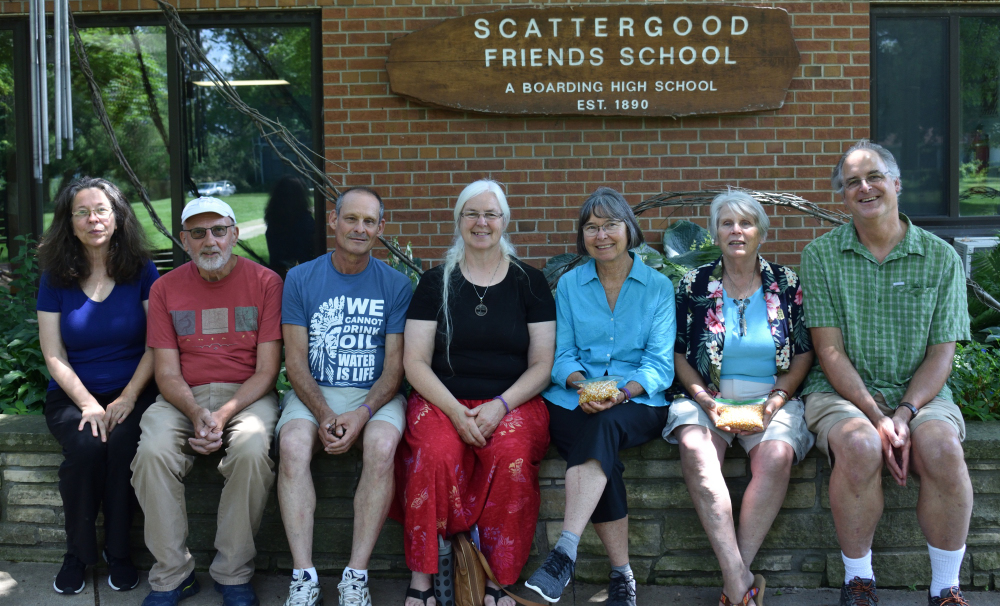
In this image at Scattergood Friends School are those of us who helped Paula Palmer (third from the right) give presentations and workshops related to her work, Toward Right Relationship with Native Peoples.

I was ignorant of this history until about a decade ago. But since then, this has become a focus of my prayers and work. I’ve written a lot about what I’ve been learning. https://quakersandreligioussocialism.com/forced-assimilation/.

I’ve sought opportunities to find ways to build relationships with Indigenous people because we cannot begin to heal until we all come together and begin to know one another. This is a list of what I have learned from spending time in Black, Indigenous, and other people of color (BIPOC) communities. Offered in the hope that many more people begin to make these connections.

This takes a real commitment to spend a lot of time in diverse communities. Until I recently moved from Iowa, I joyfully participated in our (Des Moines Mutual Aid) free food project every Saturday morning for over three years. Over that time I heard every one of my friends say these Saturday mornings were the highlight of their week. Every person became a close friend.

This takes a real commitment to keep showing up, even when we make mistakes, which I did, and you undoubtedly will. But showing our vulnerabilities is an important part of building trust. Showing we are willing to risk awkwardness.


How do we decolonize ourselves?

During a recent discussion, a Friend asked, how do we decolonize ourselves? I believe this is one of the right questions to ask. This changes the focus from what our ancestors might have done and directs it to “what we can do now?” The question correctly begins from the point that we are colonized.

Decolonizing Quakers

A group of North American Friends, Decolonizing Quakers explores these questions and offers resources for our education.

The Stories We Weren’t Told

Many Quakers have learned that our Quaker ancestors and predecessors had good relationships with the Indigenous peoples who were on this continent when Quakers arrived from England and other European lands. We have read about how William Penn was respectful of the Native people and offered to pay “rent” for the land occupied by the new settlement that became Philadelphia. We have heard about Quaker missionaries who went out to “help” Native children learn the ways of European Christians.

There are threads of truth in these stories and others that we tell ourselves, but those small threads are too weak to tie together a benign story. As we look with open eyes at the history that white, European, Christian settlers and Indigenous peoples walked through since the time of “first contact,” we can’t help but see a different picture. In truth, we must acknowledge that Quakers participated in — and sometimes led — attempts to force Indigenous people to assimilate into an inflexible mold that fit the vision that Quakers shared with other white, European, Christian settlers.

This website offers resources to help all of us set aside the myths that come between us — as settlers and Indigenous peoples –and to find joy in knowing all our relatives better and more honestly.

Decolonizing Quakers https://www.decolonizingquakers.org/

Mutual Aid is a way to decolonize ourselves

A fundamental part of the answer to how we can decolonize ourselves is to understand that colonization is a hierarchy of power. In the simplest terms, in our society, White supremacy. To decolonize ourselves, we must work to eliminate hierarchies and their resulting power structures.

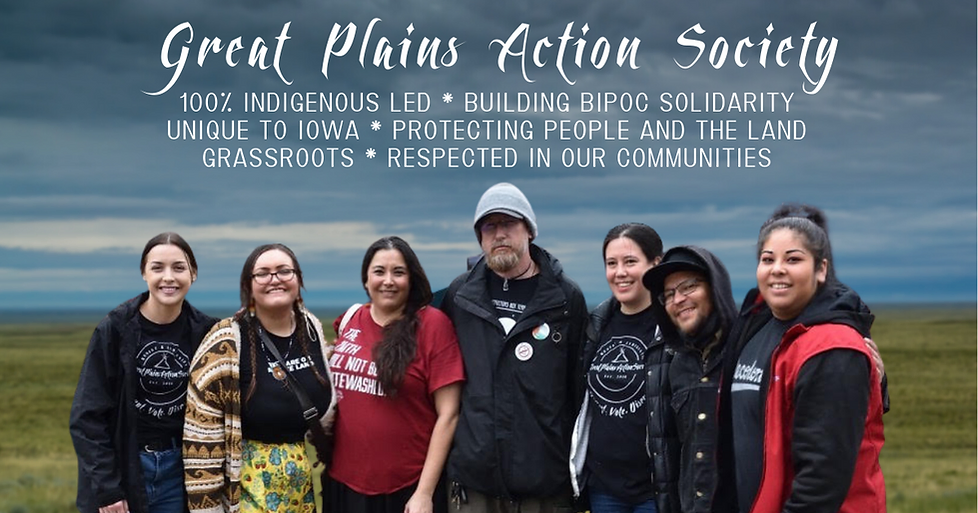
It was a leading of the Spirit that connected me with Ronnie James, an Indigenous organizer who is part of the Great Plains Action Society (GPAS) nearly four years ago. His work on Mutual Aid is supported by GPAS. Mutual Aid is a key method of the Great Plains Action Society’s Mechanism of Engagement. (https://quakersandreligioussocialism.com/mutual-aid/)

There is often a tepid response when I talk about Mutual Aid. The key to understanding the radical nature of Mutual Aid is showing this is not just another social justice idea. Mutual Aid is a fundamentally different way to live and relate to each other. There are hierarchies in even the most progressive organizations. Which means they perpetuate dominance, which leads to oppression.

Mutual Aid is a total break from that. It is a revolutionary way to be.


In the Midwest you can find information on the Iowa Mutual Aid Network website: https://iowamutualaid.org/

T-MAPs and my own story

Sometimes, I miss what is most obvious. I’ve been writing (a lot) about T-MAPs (https://quakersandreligioussocialism.com/t-maps/)

Yesterday (T-MAPs and YOUR own story) I said ‘I sense that I’ve written enough about Transformative Mutual Aid Practices (T-MAPs).’

This morning, I was feeling chaotic, I guess I might say. I won’t present the long list of my concerns. I’m sure we share many of them, especially related to the potential for global war. You might see where this is going. I realized I needed to revisit MY OWN Transformative Mutual Aid Practice document, which I had created less than a year ago. (That’s the obvious thing I realized this morning).

I can see what I did previously because when you use the online tool, you can choose to have your answers emailed to you. The alternative is to download the sections, print them, and write your answers on the forms.

I moved the conclusion to this beginning because it summarizes why T-MAPs can be a tool for Mutual Aid.

Conclusion – T-MAPs as a Tool for Mutual Aid

We hope the process of completing your T-MAP has given you new insights into your own story and inspiration to engage in this process with others. It’s a living document – you can keep revising it and adding to it as you gain more ideas and visions. While T-MAPs can help you map your individual transformation and growth, we think it’s more powerful as a collective practice. T-MAPs is a tool that is designed to be developed in groups, shared with groups, and practiced in groups. Our vision is that T-MAPs and tools like it will play an important role in evolving the ability of creative activist movements and mental health support networks to communicate with each other and build the kinds of stronger, more effective communities and forms of resistance that our current historical moment requires.
By reflecting deeply on our own experiences and developing a stronger connection with ourselves and what’s important to us, we can become more comfortable sharing that knowledge; we can learn from each other and more easily collaborate with one another. By having a better awareness of each other’s personal struggles, it’s easier to understand our similarities and differences and navigate them with respect, love, and understanding. T-MAPs is really our attempt to help operationalize mutual aid.

Crisis = Opportunity

Taking the time to articulate basic needs and desires about wellness and support when someone is in a clear head space can make an enormous difference when any kind of crisis emerges. Having others who already know what your needs and desires are can turn crisis into an opportunity for growth and transformation, for building solidarity and grounded friendship. Understood and articulated, our weaknesses can actually become our strengths.
At the same time, by opening up space to talk about life lessons and personal stories it can become easier to talk about collective dynamics, and things that are often challenging to talk about in groups, like power and larger structures that affect all of us in different ways depending on our social location, like race and class and gender and ability. While there are many ways that our differences can end up separating us, if we can learn to talk about the difference our stories can actually bring us together and raise levels of awareness. T-MAPs is an invitation to a collective practice of transformation and growth. Skillfully facilitated, a group using these questions can evolve to trust and support each other in the hard times on the horizon.


T-MAPs Section 1: Connection and Vision

The purpose of this first section is to help ground us in our strength and resilience before we undertake the T-MAPs process. To reframe the conversation so that it’s not starting from the premise that we are sick and need fixing; instead, we are reminded of what we are like when we’re well — how it feels and how we relate to the world around us. Taking the time to think about these things is generative:  this is less like a form to fill out where we already know the answers and more a starting point to prompt our imaginations.

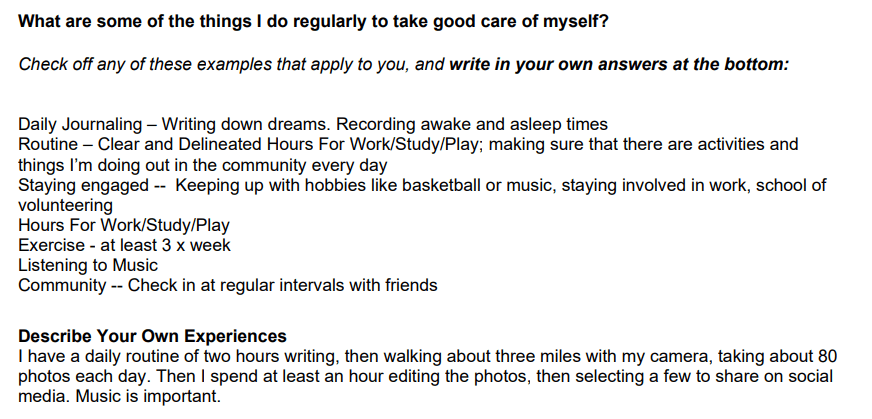
This is the format of the tool. To introduce each topic and provide checkboxes to help you answer the question, in this case, How do I feel when I’m most alive? And then a free-form box to describe your own experiences.

These were my answers at that time:

There are more pages in this section, but I think you get the idea.


Section 2: Wellness Practices

This section is designed to guide us in building our wellness toolkit – to identify what practices and supports help us manage stress, avoid crisis, and stay grounded and healthy. Once we’ve developed these lists, it is good to return to them on a daily basis and potentially share them with others in our lives. If we notice we’re slipping off track, we can return to this toolbox to help us remember how to get back on course.

My answers

And, again, there are multiple questions in this section.


Section 3: Life Lessons and Personal Stories

Where we come from and how we tell stories about ourselves is so important. In this section we have a series of questions to help you think about your own personal story and find good language for it. Society has so many expectations and frameworks for understanding your life that might not fit at all, or might fit in some ways but not others. There is an incredible power in creating a personal narrative of your life that fits well for you.

This section has two parts – the first is on understanding your journey with mental health and emotional distress, and the second on social and cultural context as it informs mental health. If you don’t identify as someone who’s been through intense mental health struggles and and/or the diagnosis process, some of the questions in the first half might not feel like they apply – it’s fine to skip them. In the second half of this section, some of these questions might be new to you – you might not have thought a lot about your cultural or class background, for example – and that’s ok. Consider these questions a starting point for your explorations.

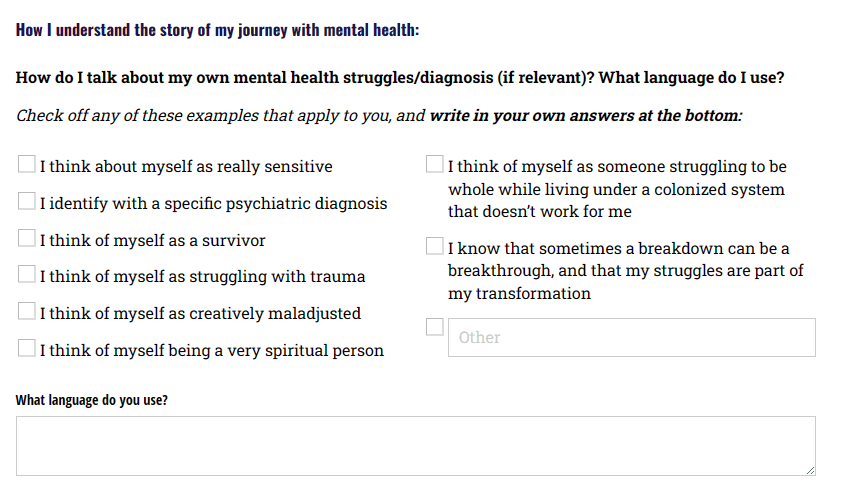
How I understand the story of my journey with mental health:

My answers

I think of myself as creatively maladjusted
I think of myself being a very spiritual person
I think of myself as someone struggling to be whole while living under a colonized system that doesn’t work for me

What language do you use?
I think of myself being a very spiritual person. My spirituality is a very important part of my mental health. And language is important because in my culture we don’t have good ways to express spirituality.
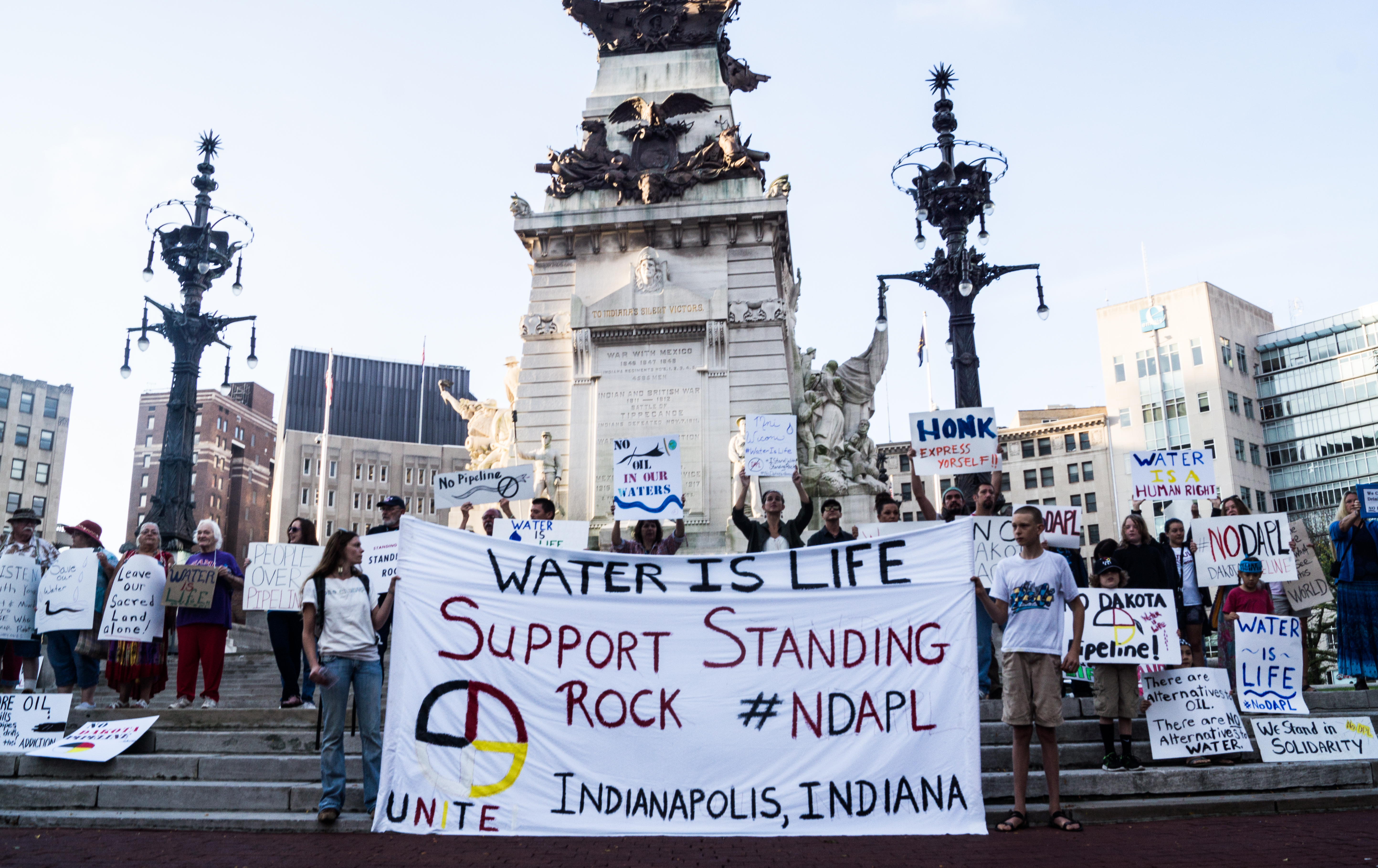
I have been learning a lot about settler colonialism from my Indigenous friends. While I continue to learn of all the ways I benefit from white superiority, life as a Quaker has meant many struggles against white dominance. At 18 years of age, I became a draft resister. I was led to live my life without a car for environmental reasons. I’ve spent the past decade working to protect the water, working against pipelines.
I’ve found a home in my Mutual Aid community that works against systems of dominance and hierarchy.

If I’ve been through serious crisis, what were some of the early indications that I was struggling? How did it all happen?
There has always been something different about me
The truth is I never really felt like I fit in

Add your own:
Quakers used to be referred to as a peculiar people, often refusing to accept the norms of the culture we live in. Living without a car was one of the most visible expressions of that. That periodically created real crisis for me, because it was not only a struggle to live without a car, but this caused conflict with my fellow Quakers, the people I looked to for support, and to be examples of faith in the wider community.
And as I learned more about racism during the years I spent in a Black youth mentoring community, it became a real conflict to find so many Quakers had no idea of their white privileges, and the ways racism was part of their lives.
Over the past five years of making and developing friendships with Indigenous people, I’m learning much more about the multigeneration traumas they, and their ancestors have from the genocide of their people as their land was stolen and millions were killed as White people moved across the country.
Again, white Quakers were involved in some of this when they were involved in the forced assimilation of native children. Native children were kidnapped from their homes and taken to institutions where horrendous things were done to try to erase their Indigenous culture and become more like white people.
Over 100,000 children were forced to go to these institutions where there was widespread physical, sexual, and psychological abuse. Thousands died. It is a struggle to be with my Indigenous friends, knowing of this history, as it must be for them to have me in their presence. And it has been another source of significant trauma to me to not only know that, but once again for so many White friends to work so hard to refuse to think about this history, let alone do anything they can to begin any process of healing.
And over the past three years as part of my Mutual Aid community, I see more clearly the systems of white dominance at every level. Learn more about these things in myself. And struggle again to get other white Quakers to understand this and do something about it.
In fairness I must say there are white Quakers who do acknowledge these things and are working to improve them


Section 4: Slipping off the tracks

The point of this section is to map out what is hard for us, what we struggle with, and help us develop the self-knowledge to be able to figure out what to do about it. This section is often the hardest one to fill out because it asks us to think about hard times, but the information we gather is really useful in our journey. Often unresolved things from our past can make us feel unsafe or upset in the present – this is called getting triggered. Sometimes our triggers contain useful information about what needs to heal in us, and what we need to express. If you find yourself getting triggered or overwhelmed as you complete your map, take a break and do one of the practices in your wellness toolkit. It can also help to do the T-MAPs process with other people and realize you are not alone.

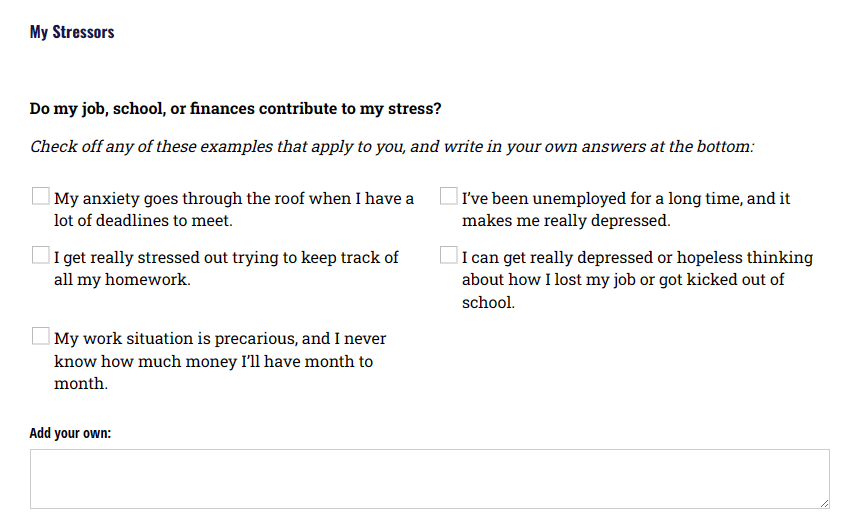
My answers

Add your own:
My stressors relate to conflicts that arise from my spiritual guidance and trying to get Quakers and/or others to understand that guidance and follow it with me. Or for certain guidance, finding out how to implement it, and then do it myself.
I realize this isn’t much compared to the awful things many people have gone, are going through.


Section 5: Support

One of the main benefits of making an T-MAPs document is being able to get clarity on the things that are important to us and being able to share it with other people. In this section, we identify the people, services, and resources that are the most important sources of support for us. This helps us remember where we can turn when things get hard, and who to stay in touch with along the way

My answers

In this section, we are asked questions about who our support people and networks are.


T-MAPs and your own story

I sense that I’ve written enough about Transformative Mutual Aid Practices (T-MAPs). This is a link to all that I’ve written about T-MAPs: https://quakersandreligioussocialism.com/t-maps/

You can create your own T-MAP. This can be helpful either for you personally, or as a tool to share with a group you belong to.

Writing down stories about our lives helps us understand who we are, how we got here, and how we relate to the world around us.

  • Download PDF Workbooks and write your answers in them.
  • Or you can use the T-MAPs Online Creator Tool, which is described below. The Tool will save your responses to the questions. You can save what you have done and return to it later. If you enter your email address, you will be mailed a PDF copy of each section you complete.

T-MAPs Online Creator Tool

You can use these questionnaires to create your own T-MAP and have your answers emailed to you in a printable pdf. There are 5 sections. Click one of the images below to try filling out that section, see what you think, and let us know!

Before you start working on creating your T-MAP, take a few minutes to ground yourself – the more centered you are, the better time you’ll have with this process. The T-MAPs workbook is designed to begin with questions that explore who you are and what you care about, and as they go on become more challenging, digging into what it’s like when you’re struggling. Eventually, you’ll want to answer the following questions thoroughly, but you may start out with notes and evolve your answers over time. This is a living document. You don’t need to do it all at once, and it can be really helpful to talk over these questions with other people. If they get too challenging, take a break and come back to it. Remember that you are creating a map for you and other people to be able to follow – it’s worth taking the time to find the right language that will make sense to you, and that you will be able to share with others


T-MAPs are drawn from our collective wisdom. These tools take into account our social, economic, and political context, and create space for thinking through how our histories and backgrounds shape who we are now. As our political climate becomes more heartless and unstable, we feel the need to weave our own safety nets. T-MAPs can be nourishing to everyone from grassroots social justice activists to woke health care practitioners and Peer Specialists working on the front lines of the mental health system.

Writing down stories about our lives helps us understand who we are, how we got here, and how we relate to the world around us. Wellness strategies are things like eating enough food every day and talking to our support people, which help us stay on our path. Resilience practices are things that bring us a feeling of being whole and alive – spending time in nature, singing, hanging out with people we care about – which help us stay grounded. Resources can be things in our local community – like friendly gathering spaces and places where we can watch the stars at night – or our favorite media, like helpful books and podcasts, or international resources like Madness Radio and The Hearing Voices Network. Articulating these things gives us a resource we can share with the people in our lives to guide our conversations and help us support each other through rough times.

https://commedesfous.com/wp-content/uploads/2022/07/T-MAPs-Transformative-Mutual-Aid-Practices.pdf
Creative Commons License

 T-MAPs is licensed by Jacks McNamara and Sascha DuBrul under a Creative Commons Attribution-NonCommercial-NoDerivatives 4.0 International License.


Transformative Mutual Aid Practices Part 2

Today, October 18, 2023, the world seems to be falling into chaos on so many levels. Beyond the increasing threats of environmental devastation, there is the complete dysfunction of the US Congress. Economic stresses are increasing as prices for everything are skyrocketing. Wars in Ukraine and the Middle East threaten to draw more countries into their conflicts. And killing thousands of people, of children.

I usually write about those things. But now it’s overwhelming to even try to figure out which of these many threats and injustices to write about, let alone what to say about them.

As I often say, I try to discern what the Spirit is leading me to say. Recently, I’ve been led to revisit Transformative Mutual Aid Practices (T-MAPs). The subject is relevant to help us deal with all these stresses in our lives. And a framework to support each other.

[A note to people of faith. From what I’ve been learning about T-MAPs, I don’t think faith is talked about specifically. Rather, you can include that in the parts of T-MAPs related to what gives you support. I think T-MAPs can be helpful for faith groups, such as Quaker meetings, as a better way to do justice work and communal care.]

Mutual Aid

I’m not always successful in explaining why my focus for the past four years has been on Mutual Aid (and Transformative Mutual Aid Practices). One is my lived experiences working in my Mutual Aid community. Not only of the many ways this community serves the survival needs of our community (our neighbors and ourselves) but also how powerful this is in our own lives and care for each other.

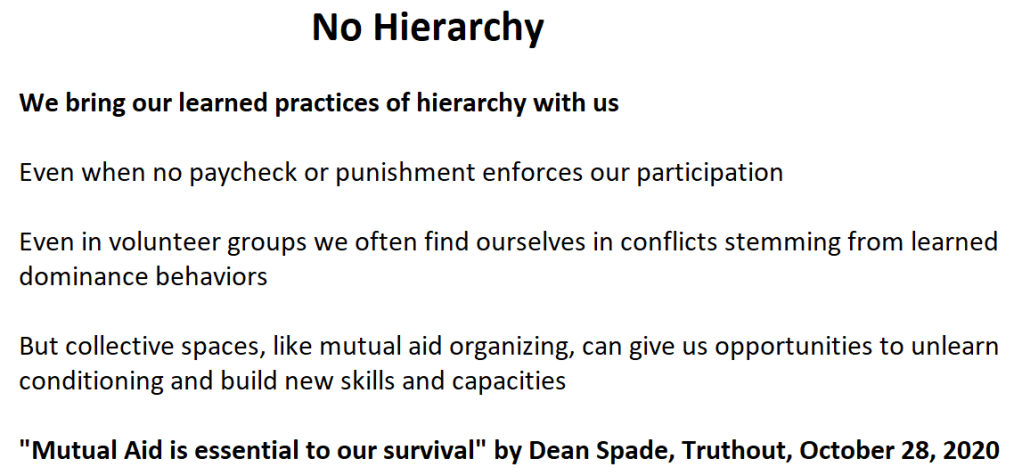
This is so because Mutual Aid is about a completely different way of thinking and being. The root of injustices in our society is the hierarchical structure of everything involved in our economic, political, and, usually, social structures. All hierarchies are power relationships and enforce a model of domination. The heart of Mutual Aid is a focus on preventing hierarchical structures. Mutual Aid is not just another approach to living and working in a community. It is about changing the very basis of how communities work.

These quotes are from “Mutual Aid Is Essential to Our Survival Regardless of Who Is in the White House. Mutual aid is inherently anti-authoritarian, demonstrating how we can organize human activity without coercion” by Dean Spade, truthout, Oct 27, 2020. Dean Spade is the author of the essential manual about mutual aid, “Mutual Aid. Building Solidarity During This Crisis (and the Next)“.


T-MAPs

Transformative Mutual Aid Practices (T-MAPs) are a set of tools that provide space for building a personal “map” of wellness strategies, resilience practices, unique stories, and community resources. Creating a T-MAP will inspire you to connect your struggle to collective struggles. When we make and share our T-MAPs with others they become potent tools for healing and liberation.

The acronym T-MAPs stands for Transformative Mutual Aid Practices

Transformation
We understand that we’re always in a process of transformation and growth; we’re not just in a process of ‘recovery’ or going back to some state of health (that we may have never known). As our lives change, it’s helpful to leave tracks for ourselves about where we’ve been and where we want to be going. T-MAPs help facilitate this process.

Mutual Aid
We also understand that just working on our own “self-care” isn’t enough; we also need mutu aid. Most simply, mutual aid is when people help each other. Historically, mutual aid has been a way that people have self-organized to create interdependent networks of support. People might help each other with things as basic as growing food and building barns or as abstract as education and mental health support.


Practice
When we think about how personal and community change happens, it’s pretty clear to us that the only way to grow and evolve is to intentionally practice what we want to see happen in our lives. Practice might be as simple as not getting on our smart phone as soon as we wake up in the morning, or as intentional and deliberate as a daily sitting meditation practice. Practice that happens with groups of people has the potential to change the world.

T-MAPS. Transformative Mutual Aid Practices


The mental health of all members (of your group) should be supported in an ongoing way. Go around the circle so that comrades can indicate to the group if:

▪ they would like others to reach out to them for a period of time or in an ongoing way, and how
▪ they would be willing to reach out to others who ask for that support
▪ they are currently unable to provide support to others
▪ they would like people to hang out with when they are not feeling well
▪ they are available to hang out with others to decrease their isolation during difficult times
▪ etc

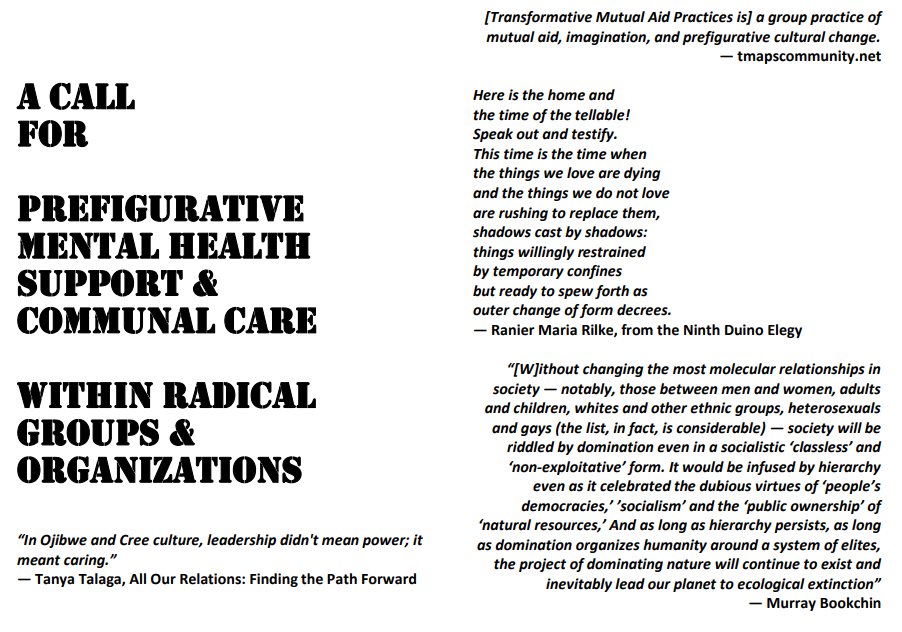
A Call for Prefigurative Mental Health Support and Communal Care Within Radical Groups and Organizations

Additional resources:


Creative Commons License

 T-MAPs is licensed by Jacks McNamara and Sascha DuBrul under a Creative Commons Attribution-NonCommercial-NoDerivatives 4.0 International License.

Prefigurative Mental Health Support

What is the condition of your mental health today? I’ve been thinking about this more recently when I read this quote.

“Everyone is depressed. It’s not just you. It’s everywhere and everyone. It is the state of the world.”

Tracy Collins

Until recently, I had not allowed myself to pay attention to my mental health. I grew up when there was a significant stigma related to mental health.

I recently read that a hallmark of White supremacy is individualism, wanting to fix things on your own. That had been my approach until very recently. I think it’s only fair to say that was because I had so little success getting others to join my work. But, difficult as it is to admit, I can now see that was largely because of my White supremacy approach.

One of the many benefits of being in my Mutual Aid community has been becoming aware of that. And learning ways to deal with my White supremacy.


Prefigurative politics

Prefigurative politics is based on the idea that the means and the ends of social change are interconnected and that the way we organize ourselves in the present should reflect the kind of society we want to create in the future. I’ve experienced prefigurate politics in practice in my Mutual Aid community. So, prefigurative mental health support means applying Mutual Aid principles to mental health care. Which means rejecting hierarchies.

Without changing the most molecular relationships in society — notably, those between men and women, adults and children, whites and other ethnic groups, heterosexuals and gays (the list, in fact, is considerable) — society will be riddled by domination even in a socialistic ‘classless’ and ‘non-exploitative’ form. It would be infused by hierarchy even as it celebrated the dubious virtues of ‘people’s democracies,’ ‘socialism’ and the ‘public ownership’ of ‘natural resources.’ And as long as hierarchy persists, as long as domination organises humanity around a system of elites, the project of dominating nature will continue to exist and inevitably lead our planet to ecological extinction.

Toward an Ecological Society (1980). Murray Bookchin

Prefigurative mental health

The zine below has a lengthy mental health and communal care-related list. Here are a few.

  • Many of us experienced childhood and adolescent traumas and continue to experience traumas based on our individual intersectionalities
  • We understand the mechanics of the harms and traumas inflicted by the prevailing social order’s oppressive and exploitative systems
  • We must recondition ourselves towards caring for each other; communal care is ongoing radical action
  • Alone we are vulnerable, but together we are strong; therefore, genuine community is paramount
  • We acknowledge that the architecture of capitalist society is colonizing white supremacy culture; it is an architecture of domination, abuse and exclusion
  • We focus intensely on the concept and practice of mutual aid
  • We endeavor to decolonize our thinking, group interactions, and architecture of group processes
  • We center acting in solidarity across groups in ways that build unity through diversity
  • We emphasize prefiguration within our organizations as necessary to counteract the abuses of prevailing society and manifest community and liberatory ways of being and living
  • When we do not prefigure communal care into our group structures and routines, we unconsciously recreate the alienation, racism, homophobia and transphobia, hierarchical ableisms, and neuro-homogeneities of capitalist society, along with their negative effects
  • If we don’t practice solidarity with our own comrades, we cannot expect to practice solidarity with others
  • Knowing what we know about how prevailing society operates to oppress, exploit, and traumatize vulnerable people, a group or org that does not actively engage and support the mental and emotional wellbeing of its members is not revolutionary
  • Many folx who show up to our groups do not stay because they sense the group is non-supportive or unsafe for their being

A Call for Prefigurative Mental Health Support and Communal Care Within Radical Groups and Organizations


Upskilling for an Uncertain Future

How do you see the future? Do you try to avoid thinking about it at all?

Yesterday, I wrote Rethinking the Hero’s Journey, based on the article, “White men’s roles in anti-racism work: Rethinking the Hero’s Journey,” on the Healing Minnesota Stories blog site. Because it resonated with what I’ve learned about working for peace and justice. Which is the need to find your own power, which is what gives you joy. That provides you with the positive attitude, fortitude, and the skill you can bring to the difficult work of fighting for justice.

This morning, I found the article Upskilling for an Uncertain Future that expands on those ideas. The subtitle is A middle-aged perspective on sparking joy in darkness.

The trifecta of depression, anxiety, and untethered rage are unbearable at times. Even with HRT, micro-dosing, meditation, sleeping pills, and a relatively healthy, active lifestyle, most days are permeated with a deep sense of dread, fear, rage, and sadness. On the plus side, the odd day when my old self surfaces for a day or two feels exquisite.
I wanted to ask my doctor if there were any adjustments to my HRT that might improve my mood.
Exasperated, she said: Everyone is depressed. It’s not just you. It’s everywhere and everyone. It is the state of the world.”
In other words, suck it up.
Then the closer: “Do you need tranquilizers?”

Sparking joy in darkness

Tracy Collins

If I’m honest, there is a darker motivation…

Cooking in and of itself is proving to be a reprieve from my current, sad state of despair. But underneath the self-soothing, there is a deeper purpose.

I don’t talk about it much, but when I do, there are quiet nods of agreement. Friends share their darkest fears as well as their personal preparations for the unthinkable. With the chaos of the world, it is hard not to think about what might happen in the coming decade. The floods, water shortages, famine, and fires are already here.

The way I figure is that if I can master making delicious food, then I’ll be indispensable in the event of a collapse. No one will want to turf the lady who makes the best scones on the planet, the legendary stew, or life-altering casserole. They’ll keep me around so long as I keep everyone fed and happy.

Upskilling for an Uncertain Future. A middle-aged perspective on sparking joy in darkness by Tracy Collins, medium.com, 12/12/2023


For the sake of your own mental health and what you can offer to your community in the uncertain future, find your own power. Even better, put your life-long learning skills to work to learn additional skills and power.