My Quaker meeting plans to discuss questions to not only stimulate discussion, but to begin to form a plan to meet our survival needs. We need to establish a baseline to know what Friends think about our present condition and what to do about it.
Survival needs are ranked as:
Oxygen/air
Water
Food
Shelter
Physical, mental, and spiritual health
So, the questions are:
What will we do to prepare for when clean water is no longer available? (Coming through water lines or even available to buy).
What will we do when food is no longer available from grocery stores?
What will we do for shelter? Survival will require us to live near water and food supplies. And each other.
How do we govern our communities? Who is included in our communities?
What to do about energy?
What to do about safety?
What medications and diagnostic equipment (blood pressure, thermometer, etc) should we stockpile?
What are our children thinking? Can we find ways to engage those who aren’t now involved?
How can we gather and store things like books for when digital technologies are no longer available?
The are several reasons for my excitement about, and continued involvement in DMMA. The first time I went to the DMMA food project I was immediately aware I was in a special place. There was a greater diversity of people than I had found in any other gathering in Iowa. “These spaces become intergenerational, diverse places of Indigenous joy, care and conversation.”
There were usually around a dozen of us. There is a signup sheet on the Internet. So many people wanted to come to help that we had to limit attendance. This was also important for social distancing because of the COVID virus. Wearing masks is mandatory. No mask, no work.
As I spent more time in this community, I often heard people say these Saturday mornings together, putting together boxes of food and handing them out, were the highlight of their week.
Care is shown when each person coming to help is greeted by name, and how as we moved around, filling the boxes of food, when we came near each other, we would exchange a few words, asking how we were doing. When asked how you are, more than a surface “OK” was expected.
Whenever a problem came up, you were welcome to ask anyone what to do. The answer was always given in a positive manner, and usually ended with “but do whatever you think is best.” Taking initiative and critical thinking were expected.
I remember a specific instance early in my Mutual Aid experience. I was helping move the tables we usually set the boxes to be filled upon from the basement of the church to the yard outside. That was because the church that let us use their basement was holding a COVID vaccine clinic there that Saturday morning. Ronnie, who helped facilitate DMMA taking over the free food project, asked me, a relative newcomer, to tell him what he could do to help.
Since we were all working toward the same end, there weren’t the tensions of someone telling you to do things a certain way. This is the non-hierarchical way that is the foundation of mutual aid. This also meant our work was done very quickly and efficiently, as no one was waiting for someone to tell them what to do. In just one hour we put out sixty boxes and proceeded to add the vegetables and food from three sources into each box.
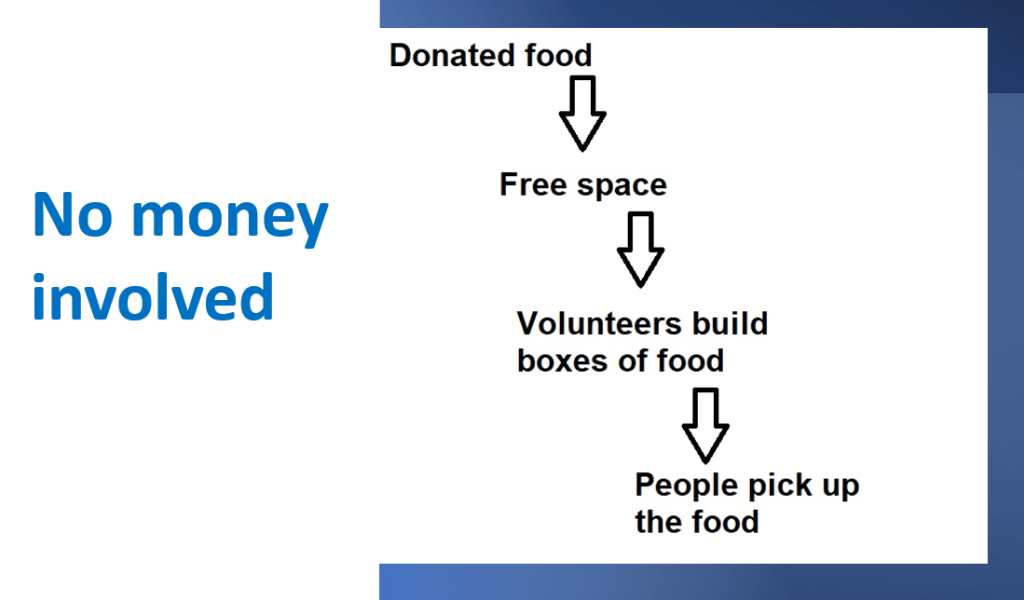
The vegetables were waiting for us when we arrived. There might be about a dozen boxes full of peppers and other vegetables. Someone would arrive with a car full of boxes of dated food from one source, and someone would arrive with the van that one of us drove to another source to be fill with donated food. All this food was carried into the church basement, and each bag opened and the food from it distributed. It’s hard to give you an idea of how much food that is, but it all got distributed quickly.
Four long tables were setup outside. When we finished distributing all the food, we carried those boxes out to the tables. People coming for the food knew to park in the parking lot of the school cross the street from the church. When we were ready, one of us would direct those cars, one at a time, to drive to the tables. We would open the car door, greet the people, and put a box of food in the car. This is one of my favorite parts, seeing how great my friends are at interacting with those in the car.
There is an aspect of self-determination and ethical engagement in organizing to meet our peoples’ material needs. There is a collective emotional lift in doing something worthwhile for our peoples’ benefit, however short-lived that benefit might be. These spaces become intergenerational, diverse places of Indigenous joy, care and conversation, and these conversations can be affirming, naming, critiquing, as well as rejecting and pushing back against the current systems of oppression. This for me seems like the practice of movement-building that our respective radical practices have been engaged with for centuries.
Maynard, Robyn; Simpson, Leanne Betasamosake. Rehearsals for Living (Abolitionist Papers) (p. 39). Haymarket Books. Kindle Edition.
I learned about the Des Moines Mutual Aid food project from a series of messages about it with Ronnie James who I was getting to know. The more I learned the more I wanted to see how that was done. From experience I knew a level of trust needed to be established and we need to be careful about inviting ourselves into these situations. Finally, the spirit led me to ask Ronnie if it was alright for me to participate. He said, several times, that it was fast paced, which sounded like a caution. I later learned several people had not been able to keep up with the physical demands. And I’m seventy years old. But he said yes.
That first Saturday morning I was a bit apprehensive. I’m not good at meeting new people and wasn’t sure what to expect. As I met people, they were polite but reserved. I imagine part of that was the mistrust of the old, white man. And the people were protective of each other. I was told we were all expected to take any of the food ourselves, and then I began to help fill the food boxes.
One mistake I made was not taking any of the food myself. When after a few weeks someone in a pleasant manner said I never took any food, I realized I hadn’t been participating in the mutual aspect of this. So, I began to take something each week. There were some awesome cakes from Whole Foods. I realized my sweet tooth was noticed when someone asked me if I wanted something they had come across. Just one example of how we learned more and more about each other.
I had thought I’d attend just once or twice, just enough to see how this worked. But from the start I began to see all the wonderful things about Mutual Aid that I’m writing about today. I was ‘hooked’ as the expression goes. It didn’t take long to feel accepted and begin developing deep friendships. I’ve attended almost every week for the past two years.
It was only recently, though, that I’ve recognized the healing aspect of this work. It is difficult to learn of the wrongs of the past. The atrocities white people executed on others. The damage done to Mother Earth. And the wrongs continuing today. The injustices we are complicit in. Helping meet people’s survival needs is something we can do now. This is what I meant when I wrote Faith Now yesterday.
And then the second part of the talk is an evocation of the healing that is necessary and possible, a gradual elevation of the human spirit. It’s about the mobilization that is needed and which is within our reach. Then people know you’ve spoken truthfully, and you have evoked in each person a desire to help, to take care of their families, to have self-regard. I see this pattern in every talk I give.
My reference to faith now comes from being led to call on Quakers to apply our spiritual practices to critically evaluate the systems we live in and take for granted. That are unjust and must be replaced. We must reject capitalist systems and systems of dominance. Build Beloved communities where everyone is cared for. Mutual Aid communities are a template for doing so. Are radical in the sense of freeing us from the power systems we find ourselves living in.
By faith now I mean today. Every day we live in this settler, colonial, capitalist society, we continue to be oppressors.
How are we working to deal with existing chaos and preparing for further collapse?
Do we provide for everyone’?
What is our relationship with Mother Earth? Do we honor and conserve the resources we use?
What systems of dominance, of vertical hierarchies are we involved in?
Do we work to ensure there aren’t vertical hierarchies in our communities, in our relationships with all our relatives?
Do we have the courage to follow what the Spirit is saying to us? To not force those messages to conform to our existing beliefs and practices.
How do we connect with communities beyond our Quaker meetings? What are we learning about spiritual connections beyond our meetinghouses? Are we sharing these spiritual lessons with others?
Kheprw Institute (KI) IndianapolisOn the First Nation-Farmer Climate Unity March, 2018
Faith Now can refer to what the state of our faith is at this moment. And/or it can be an admonition to focus our faith on what is happening now.
My witness has been so many people, including people of faith, are driven by the past. This is obviously true with religious practices demanding adherence to some set of rules. Rules created in the past. Rules designated by systems of dominance.
One of the reasons I have remained a Quaker is the minimum of such rules. We say we believe the Spirit can speak to us now, that ours is a living faith. We use a set of queries (questions) to help us continue to examine our faith. This can make our faith less passive.
It is not my place to judge other’s faith and practice. But there are things that have troubled my spirit for a long time.
One is that Quakers do have unwritten rules. As a recent example, prior to the forced separation because of the COVID pandemic, I was told, many times, that Quaker business decisions could only be made when Friends were together physically. When I lived in Indianapolis, I had suggested using programs for remote connections to my meeting in Iowa, but that was universally held to be unacceptable. We see how that has changed. What are other unwritten rules? Identifying them might account for why we are attracting few new attenders in this time of spiritual poverty.
And there is the universal challenge of living our daily lives consistently with our faith.
White Quakers were and continue to be settler colonists. Our ancestors claimed Indigenous land for their homes and farms. Ever since, we have continued to live on and profit from these lands. And have engaged with capitalism and systems of dominance and control that come from this colonization.
There is the devastating history of churches’, including white Quaker’s involvement in the institutions of forced assimilation of native children and genocide of Indigenous peoples.
I’m also devastated by the use of fossil fuels. Speaking from my own experience, when I saw the smog when I moved to Indianapolis (1970), I was led to know I could not be part of owning cars. My faith showed me how to go about this, helped me get through the significant challenges involved. I’m of course not the only person to have made the same choices. And I’m challenged today having moved to a small town in Iowa. The sprawling way our cities and towns are designed coupled with the absence of mass transit is a challenge. But we would not have built cities this way if we had chosen to build mass transit systems instead of the massive infrastructure for cars. Building all the streets and highways. Parking areas, traffic control systems, so many gas stations, extractive systems for coal and oil, and pipelines.
Had the decision not been made to follow the path of cars, we would not be in accelerating environmental collapse now. Think about that.
My reference to faith now comes from being led to call on Quakers to apply our spiritual practices to critically evaluate the systems we live in and take for granted. That are unjust and must be replaced. We must reject capitalist systems and systems of dominance. Build Beloved communities where everyone is cared for. Mutual Aid communities are a template for doing so. Are radical in the sense of freeing us from the power systems we find ourselves living in.
By faith now I mean today. Every day we live in this settler, colonial, capitalist society, we continue to be oppressors.
The following quote expresses this eloquently. People are desperately hungry to have a purpose, to do something concrete to help others.
You and your relations, my friend, are (still) busy building a different world at the end of this one. This is something I’ve emphasized over and over again in my own work. I cherish the belief and practice that it is never enough to just critique the system and name our oppression. We also have to create the alternative, on the ground and in real time. In part, for me, because Nishnaabeg ethics and theory demand no less. In part because in Nishnaabeg thinking, knowledge is mobilized, generated, and shared by collectively doing. It’s more than that, though. There is an aspect of self-determination and ethical engagement in organizing to meet our peoples’ material needs. There is a collective emotional lift in doing something worthwhile for our peoples’ benefit, however short-lived that benefit might be. These spaces become intergenerational, diverse places of Indigenous joy, care and conversation, and these conversations can be affirming, naming, critiquing, as well as rejecting and pushing back against the current systems of oppression. This for me seems like the practice of movement-building that our respective radical practices have been engaged with for centuries.
Maynard, Robyn; Simpson, Leanne Betasamosake. Rehearsals for Living (Abolitionist Papers) (p. 39). Haymarket Books. Kindle Edition.
Spirituality can show us how to live with integrity now. How to be examples to others. This is how change happens.
The Creator can help us heal the wounds of the past. And the wounds that continue to be inflicted.
The Spirit can guide us through the coming chaos.
It is by the Spirit we create connections among diverse peoples.
We must be willing to let go of the life we have planned, so as to accept the life that is waiting for us.
Joseph Campbell
Queries
How are we working to deal with existing chaos and preparing for further collapse?
Do we provide for everyone’?
What is our relationship with Mother Earth? Do we honor and conserve the resources we use?
What systems of dominance, of vertical hierarchies are we involved in?
Do we work to ensure there aren’t vertical hierarchies in our communities, in our relationships with all our relatives?
Do we have the courage to follow what the Spirit is saying to us? To not force those messages to conform to our existing beliefs and practices.
How do we connect with communities beyond our Quaker meetings? What are we learning about spiritual connections beyond our meetinghouses? Are we sharing these spiritual lessons with others?
Running throughout (Lopez’s book) Horizon is the question of human survival. The multiple threats we now face, especially the very real possibility of climate disaster, expose the tensions between human aspiration and ecological reality. Perhaps what is most needed, Lopez suggests, is for us to lament what we’ve destroyed, but also to praise and love the world we still have. “Mystery,” he writes, “is the real condition in which we live, not certainty.”
Bahnson: You’ve confronted the darkness you see on the horizon with anthropogenic climate change. How do you talk about this with audiences? People need to know what’s coming, yet if you overwhelm them with depressing news, they might freeze. How do you strike the balance between educator and artist?
Lopez: Whenever I speak in public, I write out a new talk. I begin by stipulating, with a modulated voice, that things are way worse than we imagine. And I offer some examples: the collapse of pollinating insect populations; the rise of nationalism; belligerent and ignorant narcissists like Donald Trump; methane gas spewing out of the Siberian tundra. You’re saying to everybody, “Let’s take off the rose-colored glasses now and see what our dilemma really is.” And then the second part of the talk is an evocation of the healing that is necessary and possible, a gradual elevation of the human spirit. It’s about the mobilization that is needed and which is within our reach. Then people know you’ve spoken truthfully, and you have evoked in each person a desire to help, to take care of their families, to have self-regard. I see this pattern in every talk I give. To remember, geographically, exactly where you are speaking that night, and to know whether there might be a full moon outside the building; to offer that sense of immediacy and groundedness; to underscore the specificity of the moment; and to be sure that you implicate yourself in the trouble. It all helps in these situations. If you attempt any version of “I know, and you don’t” or “This is not my fault” or “I am the holy messenger, and you’re the fools,” the evening ends in darkness. You have to be in it with them.
For many years I’ve been praying, thinking, writing, and discussing how we can prepare for an increasingly dystopian future. In an article in Friends Journal, Donald McCormick asks “why is there no vision for the future of Quakerism?” I wrote about my vision in the article What is your vision for the future?
The increasing threats from environmental devastation and chaos lead me to share more of my vision, which has been evolving over the past several years. It’s taken me a long time to write this article, I think because I haven’t found resources available to check on what I’m saying here.
I’ve always believed the greatest problem to solve is how communities of the future organize and govern themselves. We’ll have to do things differently because our present systems are collapsing. Which is often not a bad thing since those systems are based on colonialism and capitalism.
Spirituality
Spirituality is especially important now as we experience increasing environmental chaos, which will contribute to further social, economic, and political collapse. We will have no choice but to band together for the survival of us all. The alternative is tribalism with its violence, destruction and death.
We will need the help of those who know survival skills that we don’t. It takes time to build the trust necessary for these connections. It is urgent to do this now. It is by the Spirit that we can engage with everyone around us, of all cultures, identities, ethnicities.
Spirituality can show us how to live with integrity now. How to be examples to others. This is how change happens.
The Creator can help us heal the wounds of the past. And the wounds that will be inflicted in the future.
The Spirit can guide us through the coming chaos.
It is by the Spirit we create connections among diverse peoples.
At my first meeting with the KI community, I was asked a number of questions. When I said I was a Quaker, one of the adults (the group was mainly teenagers) spoke about the history of Quakers related to the underground railroad. When she finished, all eyes turned to me. I said I was glad my ancestors did that, it was the right thing to do, but we try not to take credit for things we have not done ourselves. When I was asked to speak more about that, I wasn’t sure what to say. I remember clearly that an answer came from the Spirit, which told me to not only say that Quakers believe there is that of God in everyone, but to also look into the eyes of each one there and say, “and that includes you”. Each person smiled at me when I did that. That ended the questioning, and I was welcomed into the community. We had this spiritual basis for our work together.
But that was just the first step. Trust was built, but slowly. With permission, I invited members of my Quaker community to engage with KI’s monthly book discussions. This was one way we began to get to know each other. But it was two years after this introduction before I was invited to teach a class on photography for KI.
Kheprw Institute, Indianapolis
First Nation-Farmer Climate Unity March
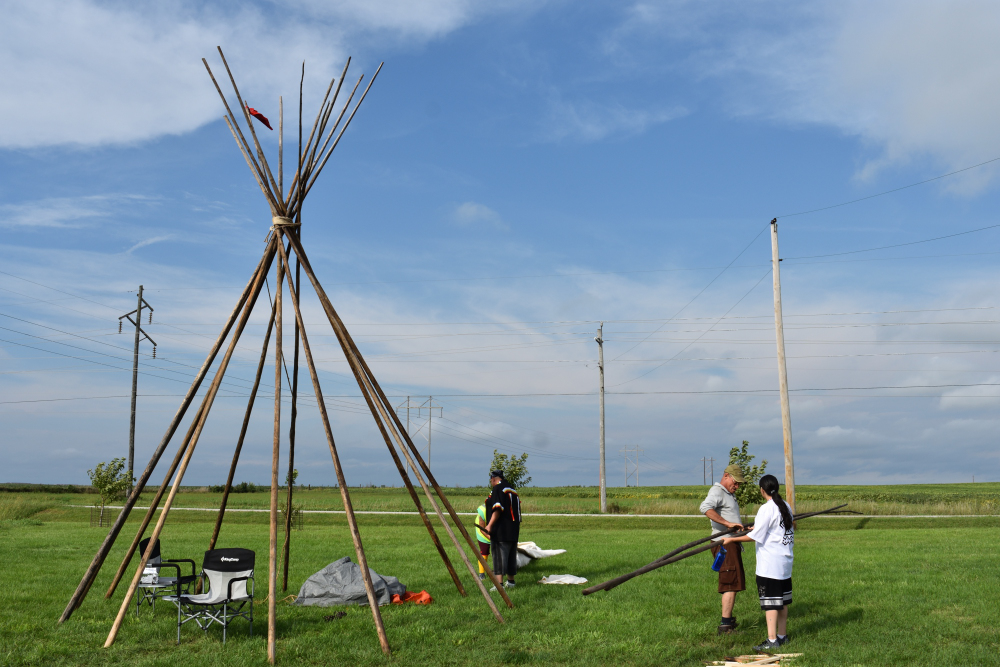
Because of my lifelong commitment to care for our environment, I’d always wanted to learn about Indigenous peoples and their sustainable lives. I jumped at the opportunity to do so when I heard about theFirst Nation-Farmer Climate Unity March in 2018. The intention was to build a community of native and nonnative people by walking and camping together along the route of the Dakota Access pipeline from Des Moines to Fort Dodge, Iowa (94 miles). Many long hours walking together, for eight days, along empty Iowa gravel roads was very effective in creating the beginnings of trust. There were about fifteen native and fifteen nonnative people, which allowed each of us the opportunity to share stories with every other person.
I’d hoped there would be ways to learn more about their spirituality, and to share some about my own. But I knew there was a huge barrier between us related to Friends’ involvement in the institutions of forced assimilation of native children. It is uncomfortable to admit this, but at the time I wondered how much awareness there was about the Indian Boarding Schools. I was soon to learn how profound that trauma was, and how it was passed from generation to generation. Is a deep wound today in every Indigenous person I know. I discuss this in detail in White Quakers and Native Peoples and other writings.
I didn’t know if, or how, the occasion might occur to talk about this during the March. Or whether I should.
But I vividly remember when the Spirit told me to say, “I know Quakers were involved in the Indian boarding schools and I’m sorry that happened” to the native person I was getting to know the best early in the March. I was worried saying that would upset him, open wounds. But he just nodded his head, and we kept walking together. But later in the day he said, “I want to tell you a story”, and proceeded to tell me a story related to him and his mother and the boarding schools.
At various times the Spirit led me to bring this up with each of my native friends. Every one of them and their families have had traumatic experiences related to forced assimilation. And the removal of native children from their homes continues in the guise of child welfare.
This is something that should not be taken lightly. A certain level of connection and trust is important. This is not about us (White people) and what we would like to see or do. There should be clear spiritual guidance.
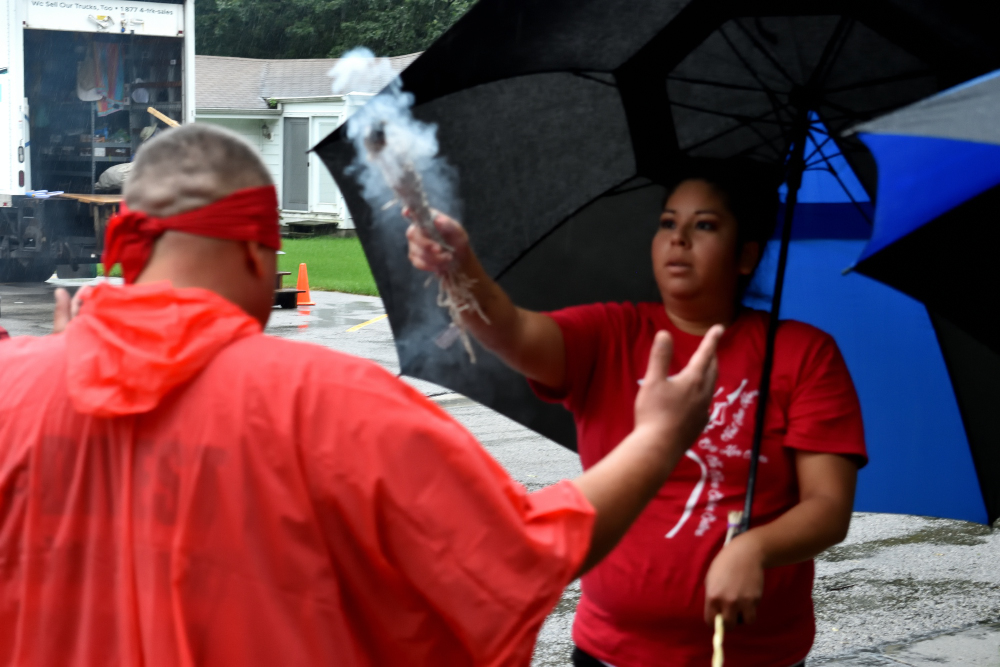
I’ve found my Indigenous friends to be deeply spiritual. I like the sign, Earth is my church, carried by my friends Foxy and Alton Onefeather during the March. That says a lot about why I feel my friends are spiritual, their reverence of all things human and nonhuman. And their practices such as smudging, putting down tobacco, expressing thanks to the Creator each time they speak in public. Their humbleness. One friend often says “we are just pitiful people” during her prayers.
In the four years since that March, various combinations of us have had numerous opportunities to work together.
And yet again, that trust has been built, is being built slowly.
Foxy Onefeather holds sign on First Nation-Farmer Climate Unity March (2018)
Spiritual guidance
Quakers believe our lives must be guided by the Spirit. But far too often people haven’t found, or don’t try to discern that spiritual guidance. They try to figure out how to do justice work on their own or in conjunction with like-minded people. with the best of intentions. That phrase usually indicates not listening to those affected by injustice. And indicates not having discerned what their faith is trying to tell them.
And that often results in unintended, harmful consequences. A common phrase to keep in mind is nothing about us without us. This is especially challenging for White people who are accustomed to their privileges. Often not even aware of those privileges. We would not need to qualify what our intentions were if we were following the leadership of the communities facing injustice.
One horrific example of best intentions gone wrong were the Indian boarding schools. A policy of forced assimilation of native children into White culture was thought by many to be a way to help Indian children adjust to the enveloping White society. But tens of thousands of children suffered physical, emotional, and sexual abuse. Thousands died. Genocide. And that trauma has been passed to each following generation, including todays. Every one of my native friends has been affected.
This is an example of difficulties in making connections between different communities and/or cultures. With this horrific history, and ongoing trauma, how can a bridge ever be built between these two cultures, White and Indigenous? Or between White and BIPOC people and communities? (Black, Indigenous and other people of color)
But for others, especially in the government and military, this policy and horror was exactly what they intended.
Mutual Aid
The Spirit also led me to become involved in a Mutual Aid community. And led me to be involved in efforts to abolish police and prisons. I’ve written extensively about these things on my website Quakers and Religious Socialism, Intersection of Mutual Aid, Abolition and Socialism.
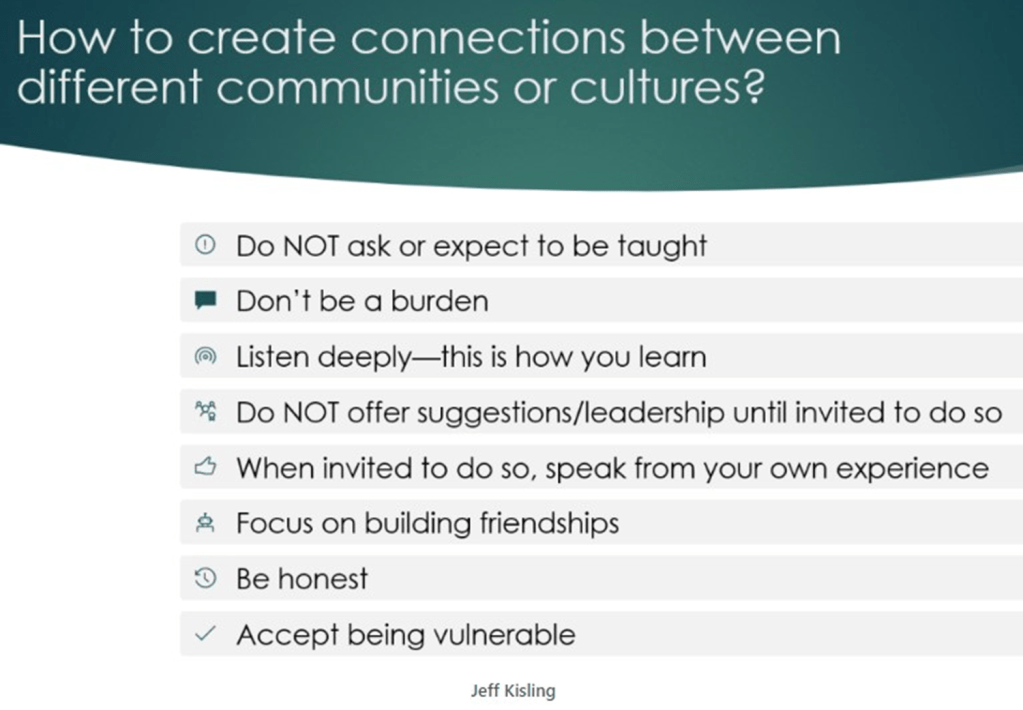
How to create connections between different communities or cultures
Returning to Donald McCormick’s question, “why is there no vision for the future of Quakerism?” I’ve tried to express my answer here. In these increasingly trying times, spiritual guidance is crucial. Sharing this with others is a gift Quakers have to offer. But we need to understand the history and concepts of oppression. Of Quakers’ role in oppression. And discern how the Spirit is leading us.
Frontline communities are figuring out how to live when the systems that are supposed to serve them no longer do, if they ever did. White communities will look to these communities and their solutions for our own survival.
I was recently surprised when a Quaker friend said I had a way of finding and connecting with oppressed communities. Which made me realize something I hadn’t expressed before, which is we must seek out these communities ourselves. Be guided to these communities by the Spirit. Search for these opportunities. Searching social media is usually very useful. And we can learn what our Friends and friends are doing and join those efforts.
Following is a list of things I have been learning from my experiences related to making connections between different communities and/or cultures.
As I was sitting in the dark this morning praying about what to write, I noticed the light from the sunrise reflecting on the clouds in front of my windows. So, I went out to take some photos. Photography has been one of the threads of my lifelong foundational stories.
On my way to Mutual Aid Saturday I stopped at Easter Lake, even though it was raining heavily. So, I rolled down the window and shot the photos from within the car.
Easter Lake, Des Moines, Iowa
I usually avoid the subject, but American politics is in the news as the Midterm elections approach. The Republican party is no longer participating in the democratic means of governance. That is such a radical departure, and the damage can only be minimized by not electing those politicians.
But even if the Democrats win control of the Senate and House, they will continue to be beholden to corporate financial influence and White superiority. Continue to use armed forces throughout the world. Or as one of the most glaring failures, will continue to support the fossil fuel industry. For example, releasing millions of barrels of oil from the Strategic Petroleum Reserves and supporting carbon (CO2) pipelines.
Whatever happens in the election, our political, economic, and social systems will continue to fail, and fail completely in the face of environmental catastrophe and chaos.
I see all of this through my experiences with Mutual Aid, which is as much about building beloved communities as it is about supporting people’s survival needs. It is important to build Mutual Aid communities now in preparation for continued collapse.
There will continue to be a need to transition from the current, dominant systems of governance to alternatives such as Mutual Aid. This process is referred to as “dual power”.
Dual Power
How do we effectively build political space where direct democracy, mutual aid, solidarity, and an ecologically sustainable human existence can prevail? To start with, we need to be able to provide for our immediate needs. In doing so, we must organize to seize control of powerful nodes of production, reproduction, and realization while simultaneously cultivating models of the society we wish to live in.
Dual power is a strategy that builds liberated spaces and creates institutions grounded in direct democracy. Together these spaces and institutions expand into the ever widening formation of a new world “in the shell of the old.” As the movement grows more powerful, it can engage in ever larger confrontations with the ruling class—and ultimately a contest for legitimacy against the institutions of capitalist society.
In our view, dual power is comprised of two component parts: (1.) building counter-institutions that serve as alternatives to the institutions currently governing production, investment, and social life under capitalism, and (2.) organizing through and confederating these institutions to build up a base of grassroots counter-power which can eventually challenge the existing power of capitalists and the State head-on. In the short term, such a strategy helps win victories that improve working people’s standard of living, helps us meet our needs that are currently left unaddressed under capitalism, and gives us more of a say over our day-to-day lives.
Dual Power: A Strategy To Build Socialism In Our Time, DECEMBER 31, 2018 – CAUCUS STATEMENT. DSA LIBERTARIAN SOCIALIST CAUCUS
Building counter-institutions
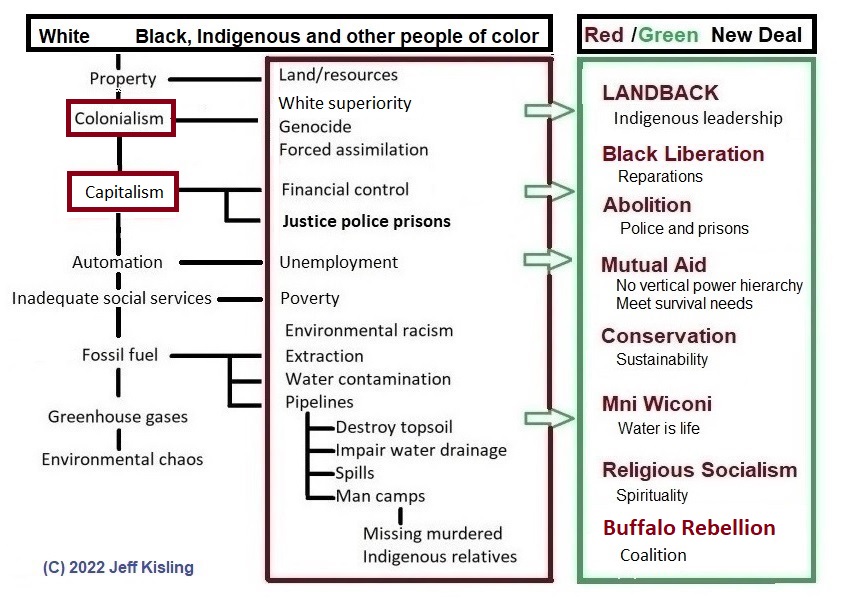
In this graphic the concepts under Red/Green New Deal are counter-institutions that are being built now.
Confederating counter-institutions
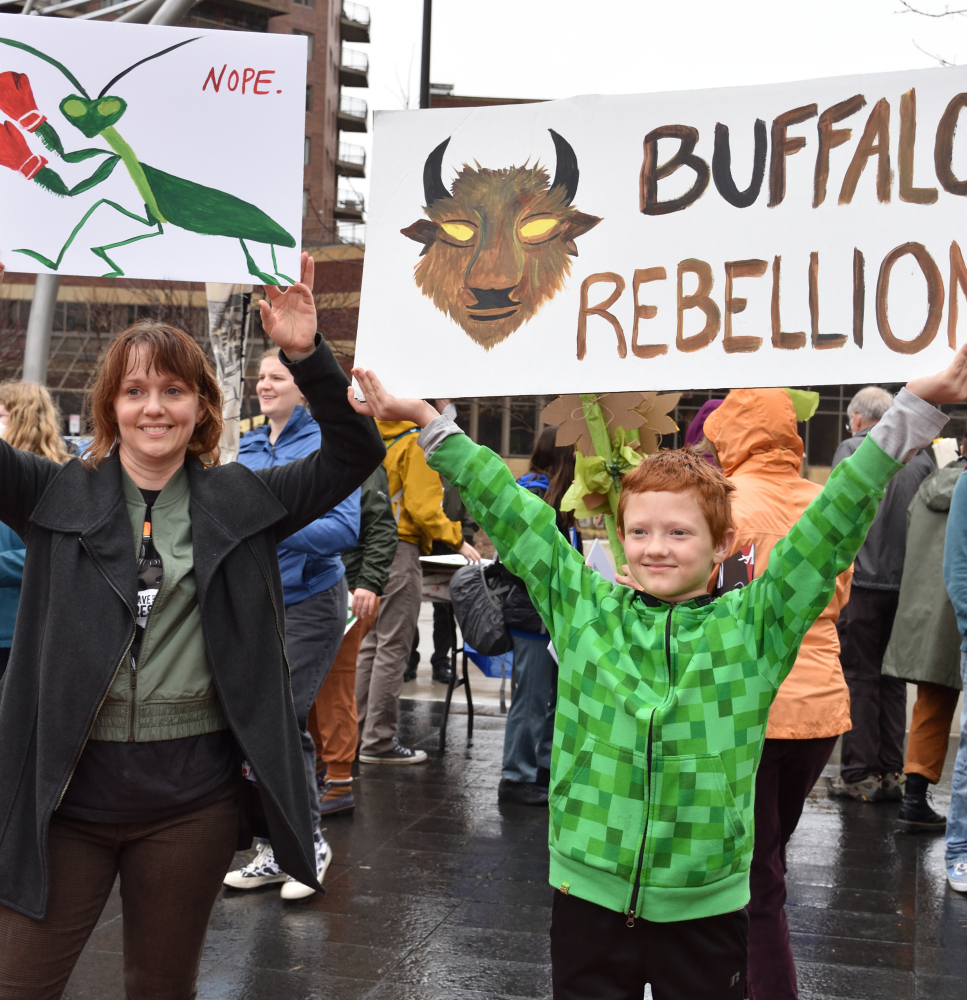
Buffalo Rebellion
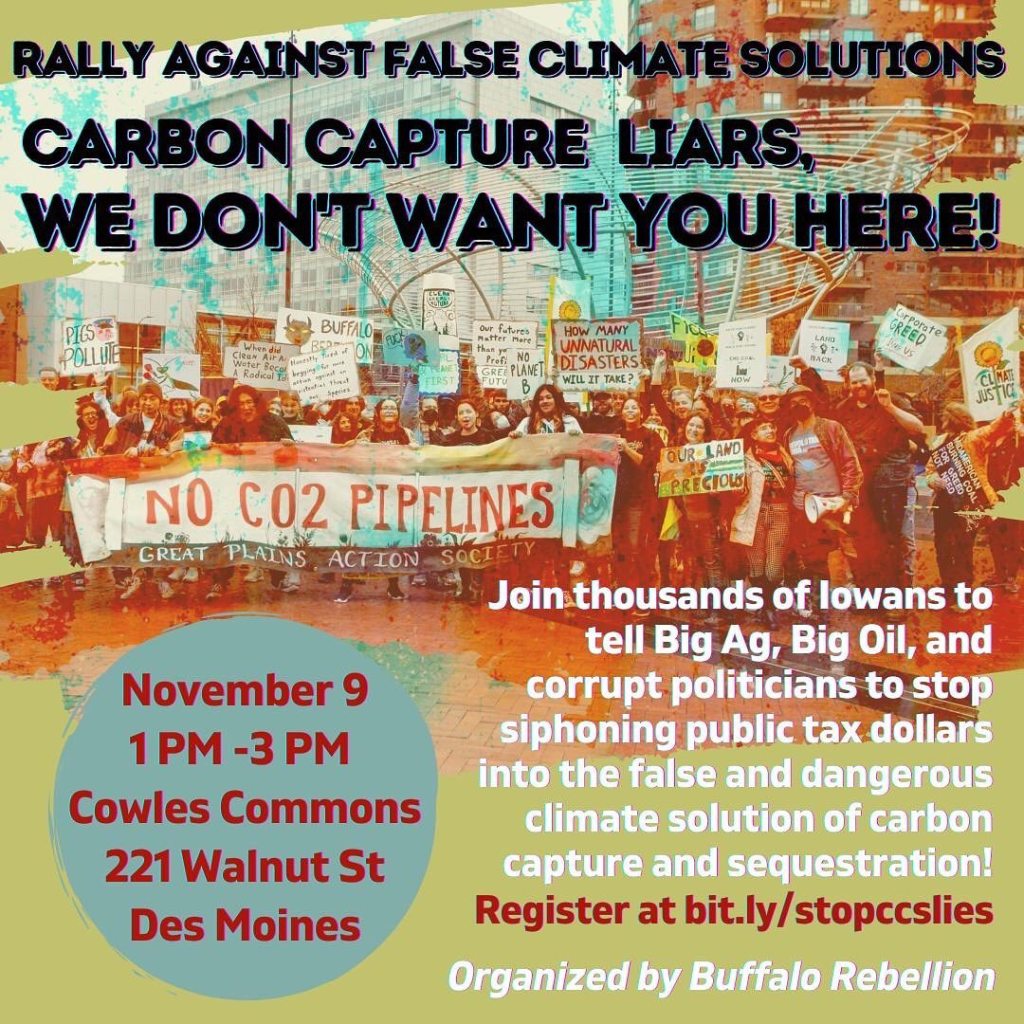
The recently formed Buffalo Rebellion is an example of confederating counter-institutions.
Buffalo Rebellion is a new coalition of Iowa organizations that are growing a movement for climate action that centers racial and economic justice. The Earth Day Rally will be an afternoon of honoring Mother Earth through sharing stories and visions for climate justice and taking action together for a world that puts people and the planet before profits for a few.
Following the Earth Day Rally, Buffalo Rebellion will be holding two days of immersive training to develop 100 grassroots leaders who will build local teams to take on climate justice issues in their community and come together to create a thriving state-wide movement.
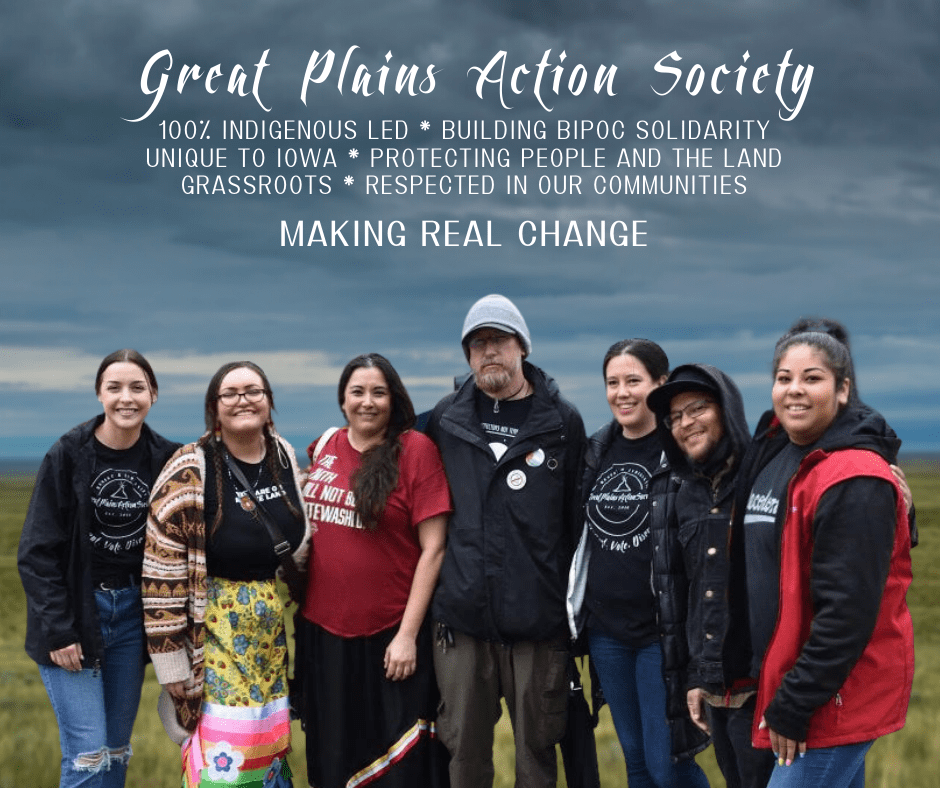
Formed in 2021, the Buffalo Rebellion is comprised of seven Iowa organizations: Great Plains Action Society, DSM Black Liberation Movement, Iowa Migrant Movement for Justice, Sierra Club Beyond Coal, Cedar Rapids Sunrise Movement, SEIU Local 199, and Iowa CCI
I believe that world-ending and world-making can occur, are occurring, have always occurred, simultaneously. Given that racial and ecological violence are interwoven and inextricable from one another, more now than ever, Black and Indigenous communities—who are globally positioned as “first to die” within the climate crisis—are also on the front lines of world-making practices that threaten to overthrow the current (death-making) order of things. Put otherwise, our communities, quite literally the post-apocalyptic survivors of world-endings already, are best positioned to imagine what this may be. This, after all, is the radical promise (if as of yet unachieved) that was and is extended to us by the world-making projects of abolition and decolonization.
Maynard, Robyn; Simpson, Leanne Betasamosake. Rehearsals for Living (Abolitionist Papers) (p. 31). Haymarket Books. Kindle Edition.
But it’s not just that mutual aid can ease material conditions or help striking workers so that they have more power against the bosses. Its assault on the existing power structure runs much deeper. Consider this: if mutual aid can meet the food needs of everyone in a city without them having to pay for the food, what’s the point of paying for food in the first place? Start asking questions like this, and you can quickly start to unravel the capitalist economy itself in that local area. Capitalism is based upon a network of institutions that draw their power from control and exclusion. Free access is capitalism’s poison. By building up the capacity to universally provide resources on a non-market basis, we plant the seeds for capitalism’s ultimate destruction.
In all this, we must remember that mutual aid runs not from the socialist movement to the grateful workers but is something workers do for each other on an egalitarian basis. We must work to ensure our mutual aid raises each other up as opposed to charity which hands down from “on high.”
Dual Power: A Strategy To Build Socialism In Our Time, DECEMBER 31, 2018 – CAUCUS STATEMENT. DSA LIBERTARIAN SOCIALIST CAUCUS
[My foundational stories are related to the intersections between my Quaker faith, protecting Mother Earth, and photography. My faith led me to try to share my spiritual experiences and show my love for the beauty of Mother Earth through photography.]
Yesterday I described where my story related to photography is at this time. Today I write about where I am regarding protecting Mother Earth. The beginning of my stories about protecting Mother Earth and the water can be found here: Foundational stories about care for Mother Earth.
Concern for Mother Earth has been a constant in my life. I was 20 years old when I moved to Indianapolis and was horrified by the thick, noxious exhaust from cars. I couldn’t be part of that and have lived without a car since then (1970).
My foundational stories now
Protecting Mother Earth
It took a while for me to become comfortable with the term Mother Earth. But vocabulary can affect how you feel about something. Having Earth as your Mother describes a living relationship. This is one of the many things I’ve learned from my Indigenous friends.
It is a dichotomy that today, despite knowing the many ways our environment and so many other things are collapsing, I have more hope than I’ve had for years. That’s because of the coalitions of people coming together to heal each other and Mother Earth. We can’t be so paralyzed with fear about what may be coming that we don’t enjoy the beauty all around us.
Following are some ways I’m involved in protecting Mother Earth now.
Last night I participated in a meeting of the Buffalo Rebellion, which I’m proud to be a part of. This coalition of environmental activists is one of the things that gives me hope. Realizing we are all working on similar things, this coalition is being built to empower our work and support one another. Last night someone remarked that we’ve all suffered trauma and are all in need of healing.
Following is a description of the Buffalo Rebellion, including a link to a recording of my friend Sikowis Nobiss describing it.
The topic this month is on a newly formed Green New Deal coalition in Iowa called Buffalo Rebellion formed to protect the planet by demanding change from politicians and convincing the public that climate should be a priority. Buffalo Rebellion, is a coalition of grassroots, labor, and climate justice organizations growing a movement to pass local, state, and national policies that create millions of family-sustaining union jobs—ensuring racial and gender equity and taking action on climate at the scale and scope the crisis demands. It was formed in November 2021 and consists of:
The root causes of what we are fighting against are capitalism and colonialism
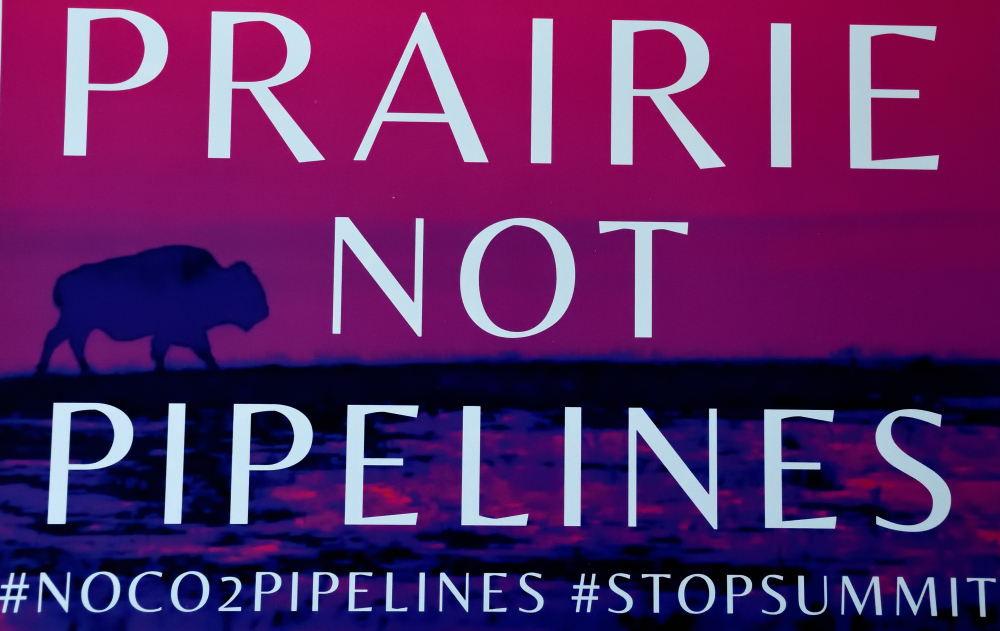
The subject of last night’s gathering (at Iowa CCI and via Zoom) was CO2 (carbon) pipelines, the latest man-made environmental threat. Iowa is at the center of this problem because most of the ethanol plants are located here, because ethanol is produced from corn, and releases carbon emissions in the process. The carbon dioxide in the carbon pipelines is a hazardous material and could cause deaths if there is a rupture. A CO2 pipeline in Satartia, Mississippi ruptured last year, sickening dozens of people. First responders’ vehicles could not run because of the absence of oxygen. READ: “The Gassing Of Satartia” (Huffington Post, August 2021)
Sikowis talked about what is below the crust of the earth also being a sacred space, and we don’t know what disturbing that with pipelines and fracking will cause.
The only way to address fossil fuel emissions is to stop burning fossil fuels.
Des Moines Mutual Aid has been the focus of my work for the past couple of years. How is this related to the protection of Mother Earth?
Being in a Mutual Aid community, we support each other and help each other heal.
Mutual Aid members are encouraged to use critical thinking to anticipate and solve problems. And immediately implement solutions, not waiting for permission from anyone.
Mutual Aid is about eliminating vertical hierarchies and the damage those hierarches do to a community. And how they harm Mother Earth.
Mutual Aid communities are explicitly local. There is no need for fossil fuel transportation and energy production. Our Mutual Aid communities are or will be “walkable”.
Our Mutual Aid communities are an example to others of how we can escape capitalism and colonialism that are the root causes of injustice
Our Mutual Aid practices are about sustainability and protection of Mother Earth
“These spaces become intergenerational, diverse places of Indigenous joy, care and conversation, and these conversations can be affirming, naming, critiquing, as well as rejecting and pushing back against the current systems of oppression”. Maynard, Robyn; Simpson, Leanne Betasamosake.
“…capitalism and colonialism created structures that have disrupted how people have historically connected with each other and shared everything they needed to survive. As people were forced into systems of wage labor and private property, and wealth became increasingly concentrated, our ways of caring for each other have become more and more tenuous.”Dean Spade
Ronnie James, Des Moines Mutual Aid
…in Nishnaabeg thinking, knowledge is mobilized, generated, and shared by collectively doing. It’s more than that, though. There is an aspect of self-determination and ethical engagement in organizing to meet our peoples’ material needs. There is a collective emotional lift in doing something worthwhile for our peoples’ benefit, however short-lived that benefit might be. These spaces become intergenerational, diverse places of Indigenous joy, care and conversation, and these conversations can be affirming, naming, critiquing, as well as rejecting and pushing back against the current systems of oppression. This for me seems like the practice of movement-building that our respective radical practices have been engaged with for centuries.
Maynard, Robyn; Simpson, Leanne Betasamosake. Rehearsals for Living (Abolitionist Papers) (p. 39). Haymarket Books. Kindle Edition.
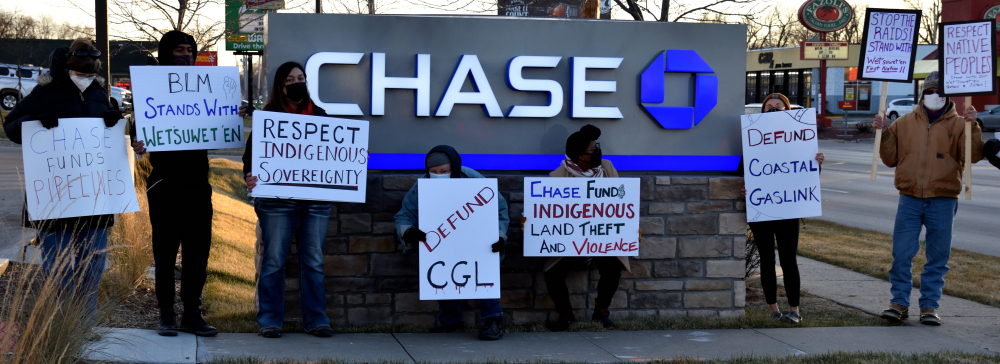
In another example of how our work is interrelated, my Mutual Aid friends support the Wet’suwet’en.
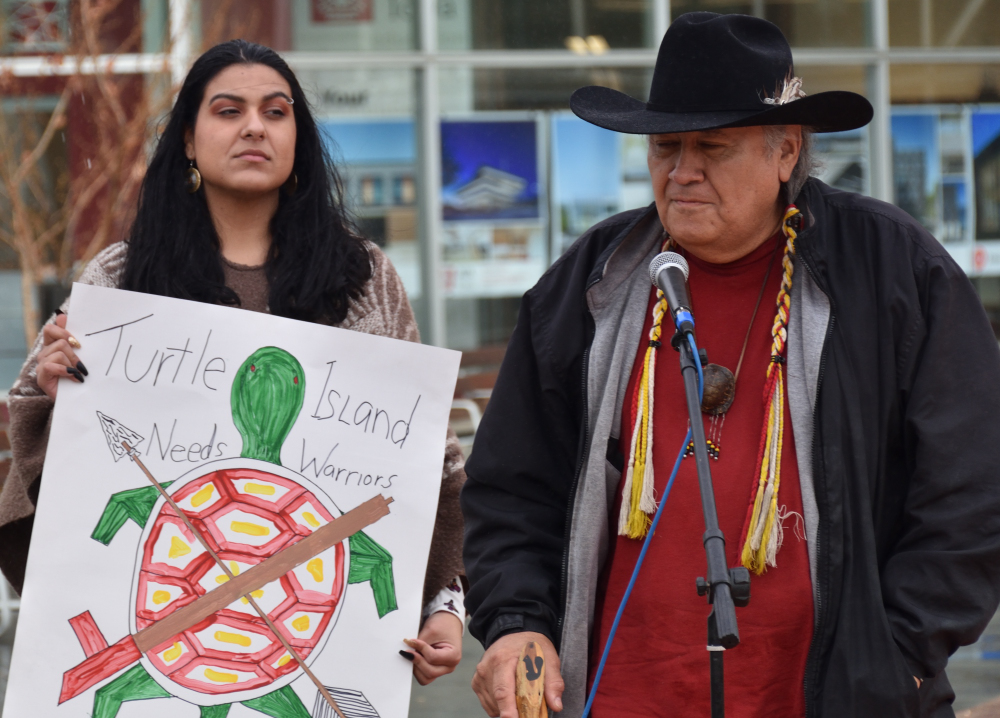
The Wet’suwet’en peoples have been struggling for years to prevent the construction of the Coastal GasLink liquified natural gas pipeline from being built through their pristine, unceded lands.
There was one particularly significant Spirit-led event in my life related to the Wet’suwet’en. When I first became involved with the Wet’suwet’en peoples was when they were asking allies to spread the news about their struggles, since there was no mainstream media coverage.
In February 2020, some of us were already planning to be at Friends House in Des Moines. We decided to hold a vigil for the Wet’suwet’en on the street in front of Friends House prior to that meeting. I created an event announcement on Facebook, that was shared by my friend Ed Fallon or Bold Iowa, an Iowa Citizens for Community Improvement.
As anticipated just those few of us who were planning to attend the meeting at Friends House anyway showed up. But the Spirit-led part of this is that Ronnie James, who I didn’t know at the time, joined us. Ronnie is an Indigenous organizer with twenty years of experience. He was surprised anyone in Iowa knew about the Wet’suwet’en peoples, so he came to see who was attending, a good organizing technique.
Ronnie and I began to exchange messages over the next couple of months. I was intrigued with the stories he was telling me about Des Moines Mutual Aid community he was involved with. When I felt we had begun to know each other well enough, I tentatively asked if I could attend the food giveaway that Ronnie/Des Moines Mutual Aid held every Saturday morning. This was a continuation of a variation of the Black Panther Party’s free school breakfast program in Des Moines from the 1970’s.
I thought I would just attend a time or two to see how that worked. Instead, I’ve been there almost every Saturday morning for over two years now, and Ronnie is one of my best friends. One of the many good things about Mutual Aid is how it attracts and keeps people engaged.
I continue to do what I can to support the Wet’suwet’en. We are presently organizing another gathering at Chase bank to call attention to their funding fossil fuel projects. Some others from the Buffalo Rebellion will be involved.
Bear Creek Friends Meeting
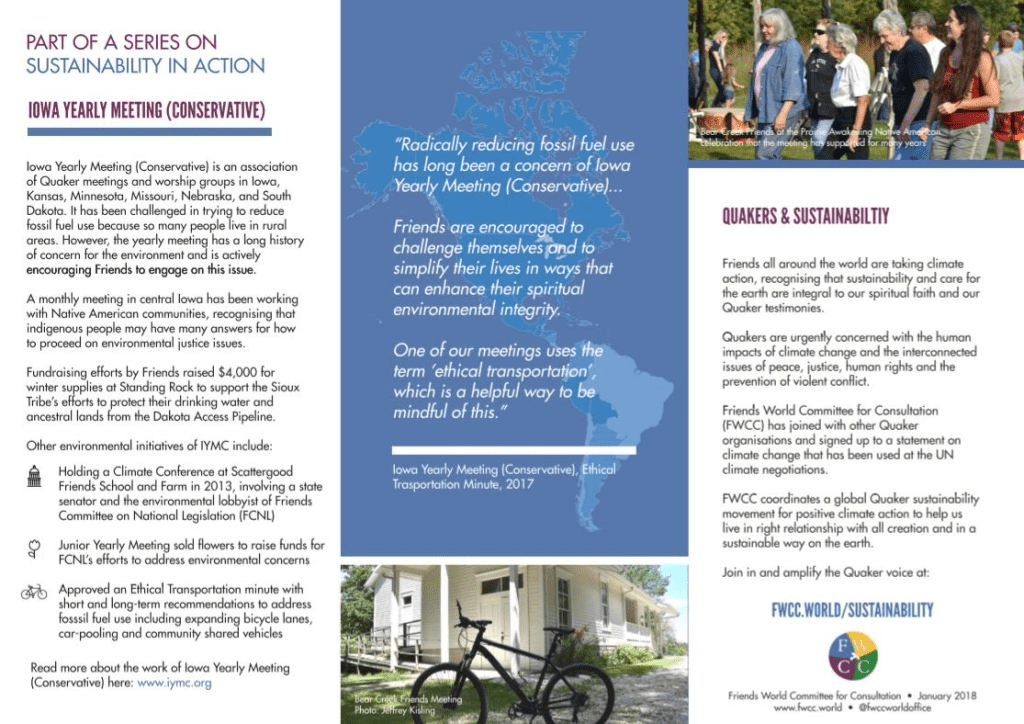
The small, rural Quaker meeting I’m a member of continues today to try to find ways we can help protect Mother Earth. This is one way to bring a Spiritual approach to these problems which I believe is very important.
Members of the meeting have supported the annual Prairie Awakening/Prairie Awoke ceremony that takes place at the Kuehn Conservation Area, just a few miles from the meetinghouse.
Bear Creek Friends Meeting
It is difficult to reduce fossil fuel use in rural areas.
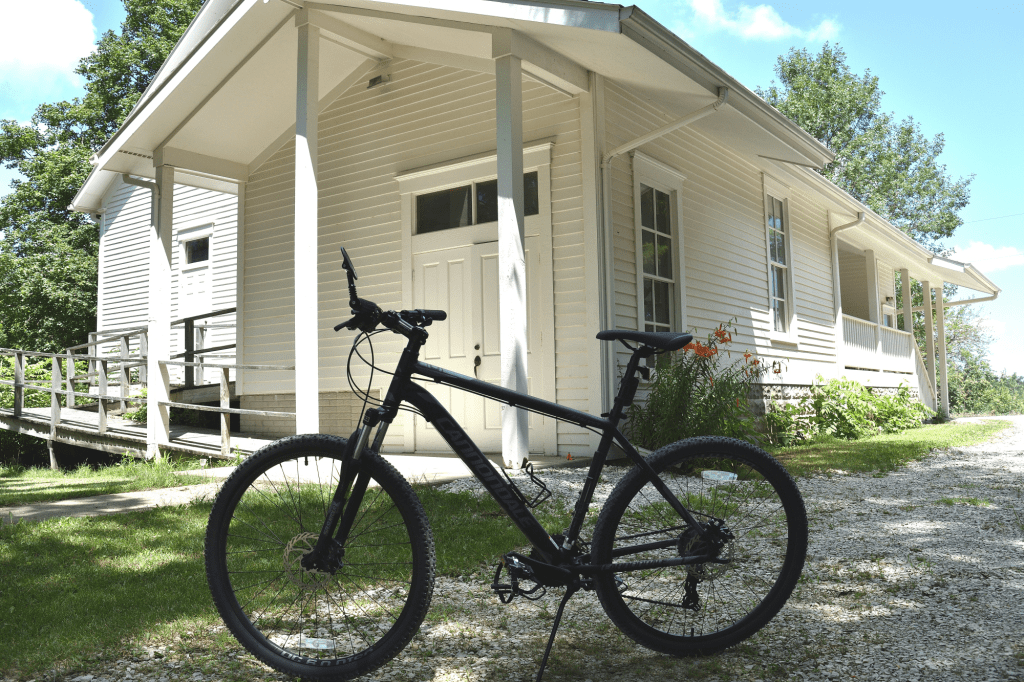
One thing we realized we could do was encourage more use of bicycles, since many members lived close to the meetinghouse just north of Earlham, Iowa. And encourage Friends in urban meetings to use bicycles when possible.
The Minute we wrote, and that was approved by Iowa Yearly Meeting of Friends (Conservative) was referred to as a Minute on “Ethical Transportation”.
Radically reducing fossil fuel use has long been a concern of Iowa Yearly Meeting (Conservative). A previously approved Minute urged us to reduce our use of personal automobiles. We have continued to be challenged by the design of our communities that makes this difficult. This is even more challenging in rural areas. But our environmental crisis means we must find ways to address this issue quickly.
Friends are encouraged to challenge themselves and to simplify their lives in ways that can enhance their spiritual environmental integrity. One of our meetings uses the term “ethical transportation,” which is a helpful way to be mindful of this.
Long term, we need to encourage ways to make our communities “walkable”, and to expand public transportation systems. These will require major changes in infrastructure and urban planning.
Carpooling and community shared vehicles would help. We can develop ways to coordinate neighbors needing to travel to shop for food, attend meetings, visit doctors, etc. We could explore using existing school buses or shared vehicles to provide intercity transportation.
One immediately available step would be to promote the use of bicycles as a visible witness for non-fossil fuel transportation. Friends may forget how easy and fun it can be to travel miles on bicycles. Neighbors seeing families riding their bicycles to Quaker meetings would have an impact on community awareness. This is a way for our children to be involved in this shared witness. We should encourage the expansion of bicycle lanes and paths. We can repair and recycle unused bicycles, and make them available to those who have the need.
Minute approved by Iowa Yearly Meeting (Conservative) 2017
As often happens, when I sat down to write this morning, I wasn’t sure what the subject would be. I’m aware of looking forward to being with my Mutual Aid friends this morning. I know they feel the same from comments I’ve heard over the past couple of years. I’ve heard my friends say this is the best part of their week.
In contrast, I sense so many people don’t have much joy in their lives. So many things are going wrong, things we could once rely on, we no longer can. We are entering a time of collapse. There is a general malaise, a fear for our future, the feeling we have no control, a spiritual poverty.
What’s the most effective way to voluntarily get billions of people to the point they are capable of exercising the skills below?
How do we get the timing right: Not so early that there’s not yet a sense of urgency, but not so late that we’re trying to do it in an environment of chaos?
How might we begin to identify, improve the competencies of, and empower the right people to do the mentoring, teaching, training, demonstrating, connecting, modelling, and other hands-on imparting of knowledge and skills needed to make it happen?
How can we make this new, crucial learning easier, and fun?
What caught my attention is how can we make this new learning fun? I think of endless committee meetings related to justice work, for example, and how they were not fun. And usually not effective. My friend Alvin at the Kheprw Institute always asks, “what actually changed as a result of what was done?”
Those of us who have organized rallies and marches know how difficult it is to get people to participate. If participating in something isn’t fun in the sense of being enjoyable, exciting, fulfilling, and meaningful, there will be little enthusiasm for people to participate and they won’t.
Our Mutual Aid work is fun and effective. We enjoy working together to put boxes of food together and enjoy our interactions with those who come for food. We are meeting an immediate survival need. But it does require a commitment to be present as often as possible. And it is very physical work. I remember when Ronnie was explaining this to me, he said at the end of the food distribution you were tired, sweaty, and feeling good. And so it was.
That is captured in this quote. “There is an aspect of self-determination and ethical engagement in organizing to meet our peoples’ material needs. There is a collective emotional lift in doing something worthwhile for our peoples’ benefit, however short-lived that benefit might be.“
You and your relations, my friend, are (still) busy building a different world at the end of this one. This is something I’ve emphasized over and over again in my own work. I cherish the belief and practice that it is never enough to just critique the system and name our oppression. We also have to create the alternative, on the ground and in real time. In part, for me, because Nishnaabeg ethics and theory demand no less. In part because in Nishnaabeg thinking, knowledge is mobilized, generated, and shared by collectively doing. It’s more than that, though. There is an aspect of self-determination and ethical engagement in organizing to meet our peoples’ material needs. There is a collective emotional lift in doing something worthwhile for our peoples’ benefit, however short-lived that benefit might be. These spaces become intergenerational, diverse places of Indigenous joy, care and conversation, and these conversations can be affirming, naming, critiquing, as well as rejecting and pushing back against the current systems of oppression. This for me seems like the practice of movement-building that our respective radical practices have been engaged with for centuries.
Maynard, Robyn; Simpson, Leanne Betasamosake. Rehearsals for Living (Abolitionist Papers) (p. 39). Haymarket Books. Kindle Edition.
I imagine you have experienced this. As I think of this in my life, I remember how significant it was at Scattergood Friends School when we did our assigned, rotating crews together. Such as preparing meals, baking bread, pruning trees in the orchard, even laundry crew that did the laundry for the entire student body. We had to have name tags sewn into every piece of our clothing so the laundry crew could separate everything out when the clothes were dry.
We experience this when we respond to community needs, such as weather disasters.
This is why I urge us to create our own, local Mutual Aid communities. Perhaps as important as providing essential resources to people is the experience of doing something meaningful. People have a desperate yearning to feel they are doing something worthwhile, something that fulfills their need to feel appreciated.
Collapse is coming at us far more quickly than we had anticipated.
In response to Pollard’s questions (above), the right timing is now. The way to get billions of volunteers to engage is to build Mutual Aid communities everywhere now, in part because Mutual Aid work is fun, meaningful, satisfying.
Soft skills
Critical thinking
Group facilitation
Helping people cope
Preparing healthy food
Caring for the young, old, and sick
Imaginative, reflective and creative skills
Mentoring
Listening, noticing and attention skills
Conversation
Community-building
Hard skills (that require some specific technical knowledge/experience
Growing and harvesting food
Making and repairing clothing and shelter from the elements
Accessing clean, safe water
Weaving, fabric-making, pottery and other crafting skills tha that make life much more pleasant and comfortable
Medical, medicinal, and injury-healing knowledge and skills
Food preservation
Bicycle construction and repair
Basic engineering skills
Ecological skills
Decommissioning-nuclear reactors and petrochemical sites
I’m reading a book about the lives of people in the most polluted, least educated, most disadvantaged, and most dangerously toxic (and most conservative) part of Louisiana (more about that in an upcoming article). What emerges from the author’s study is that (1) these people are living in a ‘world’ that is already in a very advanced state of economic and ecological collapse, one that may foretell what the rest of us in ‘affluent’ nations will soon face; (2) they are far more of a ‘community’ than most people living in cities could claim; and (3) they are not particularly interested in paternalistic ‘grief professionals’ ‘coaching’ them on how to manage the massive grief and other emotions they and their families have been dealing with for generations.
But capitalism and colonialism created structures that have disrupted how people have historically connected with each other and shared everything they needed to survive. As people were forced into systems of wage labor and private property, and wealth became increasingly concentrated, our ways of caring for each other have become more and more tenuous. Today, many of us live in the most atomized societies in human history, which makes our lives less secure and undermines our ability to organize together to change unjust conditions on a large scale. We are put in competition with each other for survival, and we are forced to rely on hostile systems— like health care systems designed around profit, not keeping people healthy, or food and transportation systems that pollute the earth and poison people— for the things we need. More and more people report that they have no one they can confide in when they are in trouble. This means many of us do not get help with mental health, drug use, family violence, or abuse until the police or courts are involved, which tends to escalate rather than resolve harm. In this context of social isolation and forced dependency on hostile systems, mutual aid— where we choose to help each other out, share things, and put time and resources into caring for the most vulnerable— is a radical act.
Dean Spade. Mutual Aid: Building Solidarity During This Crisis (and the Next) (Kindle Locations 111-121). Verso.
This is a continuation of an article I recently wrote about critical skills to prepare for collapse. It is telling that the idea of collapse is more widely accepted, but not surprising as the signs are appearing in so many ways. Rather than being something environmentalists just talk about, the actual damage is occurring everywhere.
But simply applying critical thinking to a problem or situation doesn’t necessarily mean you arrive at the best solution. The more you know about the situation you are facing, the better. Which is why banning books and all the other restrictions being placed on education is so tragic. It also explains why that is being done. Those working to control us don’t want us to have that knowledge. They want us to be dependent on what they want and say.
The point of critical thinking is that as you learn more, you can integrate that into your knowledge base and make better decisions. Which is going to be crucial in the face of the rapid and dramatic changes that will be, already are occurring.
And there are many situations that involve our values, which are not subject to critical thinking.
Several people have asked me why I put ‘critical thinking’ on this list. My sense, from reading works like the Davids’ The Dawn of Everything and Peter Brody’s The Other Side of Eden is that what most distinguishes our civilization from most prehistoric and indigenous ones is that, before education became something that we ‘did’ to people, most people naturally acquired this essential skill, by facing the many existential challenges that life outside our synthetic, infantilizing, prosthetic, standardized culture presented to them every day. In short, they learned how to learn because they had to; they didn’t have to be ‘taught’.
My experience has been that, given that it is no longer a prerequisite for survival, critical thinking is now something that has to be specifically nurtured in people, which probably happens most often by parents’ encouragement. Lacking that, there’s a natural propensity, I think, for simplification and uncritical reaction. But if you’re taught the value and importance of critical thinking, I think you figure out this process of weighing and assessing and challenging what the world throws at you.
But I’m not so sure about this. Maybe, just as we can learn to make our own clothes and grow much of our own food if and when we have to (as millions discovered during the Great Depression), we can also learn to learn, to think critically, to challenge unsupported rhetoric, to think for ourselves instead of relying on increasingly-incompetent media to tell us what we should and should not believe.
When it begins to dawn on us, in five years or twenty-five, that we are going to have to quickly instill the above (see the article) currently rare skills in many or even most of our people, how might we go about it? As pessimistic as I am, I just can’t believe it’s already too late to do so.
So I’m thinking about these questions:
What’s the most effective way to voluntarily get billions of people to the point they are capable of exercising the above skills?
How do we get the timing right: Not so early that there’s not yet a sense of urgency, but not so late that we’re trying to do it in an environment of chaos?
How might we begin to identify, improve the competencies of, and empower the right people to do the mentoring, teaching, training, demonstrating, connecting, modelling, and other hands-on imparting of knowledge and skills needed to make it happen?
How can we make this new, crucial learning easier, and fun?
‘How Do We Teach the Critical Skills Needed to Face Collapse?” by Dave Pollard, How To save the world, September 10, 2022.
So I don’t see any top-down ‘professional’ answer to developing the above essential skills in the coming decades, not even the skill of ‘helping people cope’ with collapse. I think the answer has to emerge bottom up, from within each community as that community establishes itself.
‘How Do We Teach the Critical Skills Needed to Face Collapse?” by Dave Pollard, How To save the world, September 10, 2022.
So, we arrive at my experience with Mutual Aid. A future article will discuss how Mutual Aid is providing skills and developing communities to face collapse.
Something that’s always been below the surface of my consciousness is that the root of our social and political problems is inadequate education. It’s not “I know if people understood ______ issue”, they would agree with me. I know I’m not always right. There are so many things we can have honest disagreements about. But you cannot have such discussions with people who refuse to accept basic facts and reasoning. It is about not falling for disinformation. It’s about critical thinking. It’s a real problem when emerging school policies are intended to make it impossible for students to be able to think critically.
At Scattergood Friends (high) School the focus is on preparing students to be lifelong learners. Which means developing critical thinking skills. At the Kheprw Institute, a youth mentoring community, the students are taught to be critical thinkers.
Rapidly emerging educational policies are intended to make students NOT think critically. Banning books! I never thought I’d see the day. Telling teachers they aren’t allowed to teach about racism, sexual orientation, or gender identity.
I was intrigued when I saw the article ‘How Do We Teach the Critical Skills Needed to Face Collapse?” by Dave Pollard, How To save the world, September 10, 2022. He goes into some detail about these skills, but for now I’ll just list the soft skills and hard skills he says we need to face collapse.
So civilization, at least as we know it, is going to collapse — political, economic, social, educational, health, transportation, technological systems all will fail, a bit a first, and then more and more.
We have no idea when it will be complete — could be in 10 years, or in 40. We have no idea how it will play out — how quickly, where first, what systems and governments will go first.
We don’t even know how people will react to this Slow (and Permanent) Emergency. So how can we possibly prepare for it?
I think the best answer to this is to teach a lot of people a lot of skills, hard and soft, that they don’t currently have, so that we’re kind of ready for anything. Here’s a list of ten possibly critical soft skills, and ten possibly critical hard skills, that very few of us (in most countries) are competent at at the moment. The ones in italics are, IMO, those that it is important that most people learn; for the remainder, it’s important that some people in each community be very competent at them:
Soft skills
Critical thinking
Group facilitation
Helping people cope
Preparing healthy food
Caring for the young, old, and sick
Imaginative, reflective and creative skills
Mentoring
Listening, noticing and attention skills
Conversation
Community-building
Hard skills (that require some specific technical knowledge/experience
Growing and harvesting food
Making and repairing clothing and shelter from the elements
Accessing clean, safe water
Weaving, fabric-making, pottery and other crafting skills tha that make life much more pleasant and comfortable
Medical, medicinal, and injury-healing knowledge and skills
Food preservation
Bicycle construction and repair
Basic engineering skills
Ecological skills
Decommissioning-nuclear reactors and petrochemical sites
Building Communities-The Vision
For years I’ve been thinking about how to build communities as collapse occurs. I’d thought there would be millions of climate refugees moving inland in the country as their homes and communities are ruined by rising sea levels, severe storms, drought, collapsing infrastructure and social systems. It’s clear now that no place will really be safe. Here in the Midwest we’ve had severe flooding, drought, and strong storms.
We need to build model sustainable communities. There have been numerous such experiments in intentional community. But this model must be created with the intention of being replicated many times over with minimal complexity, using locally available materials—a pre-fab community.
Pre-fab components
Community hub with housing and other structures
Simple housing
Straw bale houses
Passive solar and solar panels
No kitchens, bathrooms or showers (community ones instead)
Stores, school, meetinghouse
Central kitchen, bathrooms and showers
Surrounding fields for food and straw
Water supply
Wells, cisterns and/or rain barrels
Power
Solar, wind, hydro, horse
Manufacturing
3 D printing
Pottery
Sawmill
Communication
Radio, local networks
Transportation
Bicycles
Horses
Pedal powered vehicles
Medical
Stockpile common medications
Essential diagnostic and treatment equipment
Medical personnel adapt to work in community
Spiritual
Meeting for worship
Meeting for business
Religious education
I plan to write more about critical thinking soon.
Rather than dwelling on all the current and oncoming catastrophes, we can recognize the crossroads we are at, and choose to live in a better way.
We only have a finite amount of energy personally and must use it wisely. I’m led to believe we should stop wasting energy trying to make incremental changes in existing systems of oppression. And instead turn our attention and energy to building more just alternatives. Living out our spiritual guidance.
I’m of the firm opinion that a system that was built by stolen bodies on stolen land for the benefit of a few is a system that is not repairable. It is operating as designed, and small changes (which are the result of huge efforts) to lessen the blow on those it was not designed for are merely half measures that can’t ever fully succeed.
So, the question is now, where do we go from here? Do we continue to make incremental changes while the wealthy hoard more wealth and the climate crisis deepens, or do we do something drastic that has never been done before? Can we envision and create a world where a class war from above isn’t a reality anymore?”
Ronnie James, Des Moines Mutual Aid
As Grace Lee Boggs writes below, “it is about acknowledging that we Americans have enjoyed middle-class comforts at the expense of other peoples all over the world.” We, especially White Quakers, can end our complicity in the systems of oppression, colonialism, and White supremacy.
I’ve been blessed to be part of several communities building such alternatives. These include the Kheprw Institute, Des Moines Mutual Aid, and the Buffalo Rebellion.
These experiences have helped me understand something black, Indigenous, and other people of color (BIPOC) have always known. That the systems of racial capitalism and white supremacy have never worked for anyone who is not a wealthy white male.
Robyn Maynard and Leanne Betasamosake Simpson have succinctly captured what needs to happen in their book Rehearsals for Living (Abolitionist Papers).
In my mind, Indigenous nations, Indigenous homespaces, Indigenous homelessness must be engaged in a radical and complete overturning of the nation-state’s political formations and a refusal of racial capitalism. My vision to create Nishnaabeg futures and presences must structurally refuse and reject the structures, processes and practices that end Indigenous life, Black life and result in environmental desecration. This requires societies that function without policing, prisons, and property.
Nishnaabeg formations of nationhood mean a radical overturning of the current conditions and configurations within which we live—an absolute refusal of capitalism.
Maynard, Robyn; Simpson, Leanne Betasamosake. Rehearsals for Living (Abolitionist Papers) (p. 125). Haymarket Books. Kindle Edition.
What we need now are societies that function without policing, prisons, and property. That is how we build alternatives to what is collapsing. Owning land, property is not an Indigenous concept. The commons are meant for community use.
Property is the basis for accumulation of wealth.
Policing is how this concept of property is protected.
Prison is how those who threaten property and landowners are removed from society.
The next American Revolution, at this stage in our history, is not principally about jobs or health insurance or making it possible for more people to realize the American Dream of upward mobility. It is about acknowledging that we Americans have enjoyed middle-class comforts at the expense of other peoples all over the world. It is about living the kind of lives that will not only slow down global warming but also end the galloping inequality both inside this country and between the Global North and the Global South. It is about creating a new American Dream whose goal is a higher Humanity instead of the higher standard of living dependent on Empire. It is about practicing a new, more active, global, and participatory concept of citizenship. It is about becoming the change we wish to see in the world.
The courage, commitment, and strategies required for this kind of revolution are very different from those required to storm the Winter Palace or the White House. Instead of viewing the U.S. people as masses to be mobilized in increasingly aggressive struggles for higher wages, better jobs, or guaranteed health care, we must have the courage to challenge ourselves to engage in activities that build a new and better world by improving the physical, psychological, political, and spiritual health of ourselves, our families, our communities, our cities, our world, and our planet.
Grace Lee Bogg. The Next American Revolution
How can Friends achieve the 2022 theme of World Quaker Day, “Becoming the Quakers the World Needs,” while functioning in a blatantly and politically corrupt, racialized world? In engagement with this exciting theme, offered by the Friends World Committee for Consultation (FWCC), the Black Quaker Project would like to remind Friends of the tools at our disposal to challenge those aspects of society which we wish to change and to see changed. Our fractured societies are further divided by enormous gaps of inequality in almost every imaginable category—psychological, social, political, cultural, economic. How might we, as Quakers, achieve justice, equity, and peace under these circumstances?
The Black Quaker Project
In late 2020, the two of us wrote an article for this magazine, called “Abolish the Police.” Through writing the piece, we realized we wanted to convene a larger space where Friends with an interest in police and prison abolition could have conversations with one another. Quaker abolitionists today face major pushback from our Meetings; we hoped that drawing Friends together would support and strengthen our work.
In this context, the Quakers for Abolition Network is being born. We are a collection of Friends from at least five Yearly Meetings; we range in age from high school to our 80s; we are disproportionately queer and trans. While AFSC and FCNL staff are participating, this is a grassroots project without any formal connections to existing organizations. We are in the process of defining our mission statement, structure, and our methods for addressing white supremacy when it shows up in our work, while building relationships with each other as we go. Below, four Friends write about their approaches to abolition, their lessons, and their visions for where Quakers might be headed.
Jeff Kisling: Mutual Aid and Abolition
I grew up in rural Iowa, where there was very little racial diversity and interactions with police and the court system were rare. About ten years ago, I was blessed to become involved with the Kheprw Institute, a Black youth mentoring and empowerment community. I’ll never forget how shocked I was when a Black mother broke down in tears, explaining how terrified she was every minute her children were away from home. It was obvious that every other person of color in the discussion knew exactly what she was saying.
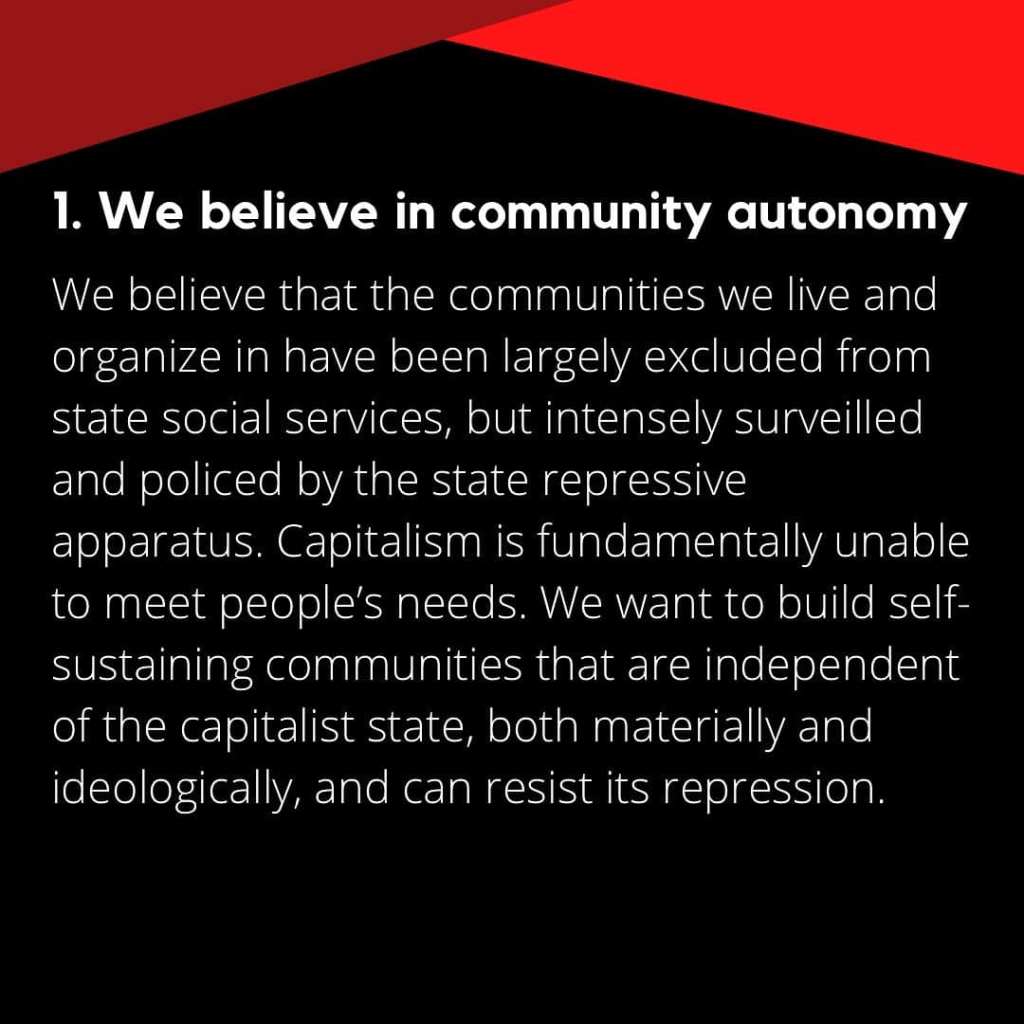
After retiring, I was led to connect with Des Moines Mutual Aid, a multiracial organization founded to support houseless people. For over a year, I’ve helped my friends fill and distribute boxes of donated food, while continuing to learn about the framework of mutual aid.
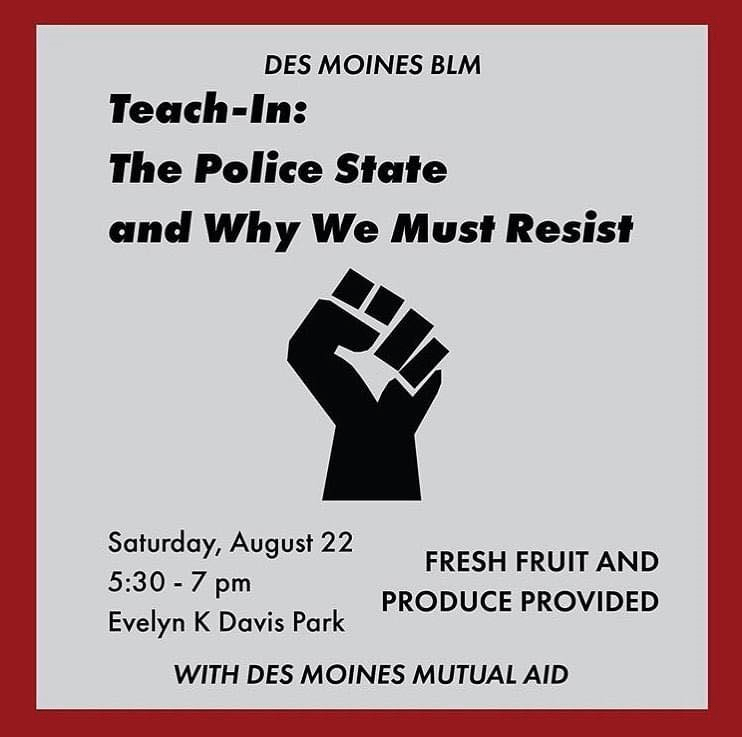
To me, mutual aid is about taking back control of our communities. Besides the food giveaway, we support houseless people and maintain a bail fund to support those arrested agitating for change. We also work for the abolition of police and prisons.
Mackenzie Barton-Rowledge and Jed Walsh: Introducing the Quakers for Abolition Network, Western Friend, Sept 2021
























 Quakers and Mutual Aid