Becoming the Quakers the World Needs

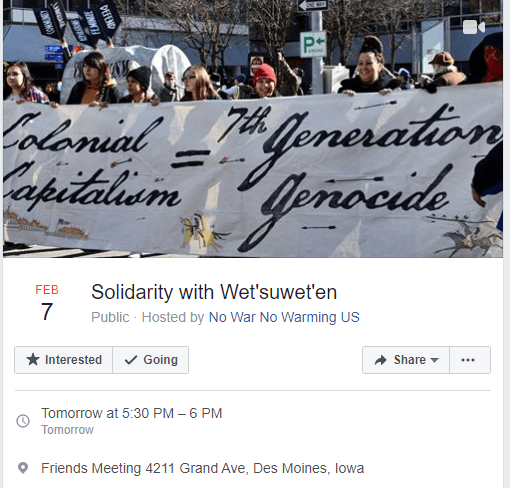
October 2, 2022, is World Quaker Day. The theme this year is Becoming the Quakers the World Needs. Becoming” implies we are not, presently, the Quakers the World Needs, which I agree with. Quakers are too comfortable living in a capitalist system that is inherently unjust. A system whose goal is the accumulation of wealth no matter how unethical the means are to acquire it. A system that commodifies all resources, even those that should be part of the commons. A system not intended to care for those without wealth.

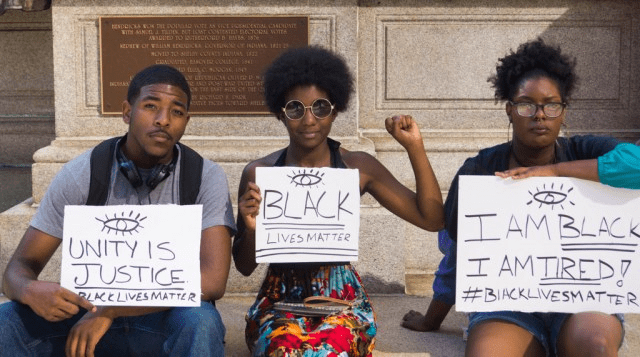
How can Friends achieve the 2022 theme of World Quaker Day, “Becoming the Quakers the World Needs,” while functioning in a blatantly and politically corrupt, racialized world? In engagement with this exciting theme, offered by the Friends World Committee for Consultation (FWCC), the Black Quaker Project would like to remind Friends of the tools at our disposal to challenge those aspects of society which we wish to change and to see changed. Our fractured societies are further divided by enormous gaps of inequality in almost every imaginable category—psychological, social, political, cultural, economic. How might we, as Quakers, achieve justice, equity, and peace under these circumstances? 

Black Quaker Project

“Quakers will only be truly prophetic when they risk a great deal of their accumulated privilege and access to wealth. Prophets cannot have a stake in maintaining the status quo. Any attempt to change a system while benefiting and protecting the benefits received from the system reinforces the system. Quakers as much as anyone not only refuse to reject their white privilege, they fail to reject the benefits they receive from institutionalized racism, trying to make an unjust economy and institutionalized racism and patriarch more fair and equitable in its ability to exploit. One can not simultaneously attack racist and patriarchal institutions and benefit from them at the same time without becoming more reliant upon the benefits and further entrenching the system. Liberalism at its laziest.”      Scott Miller


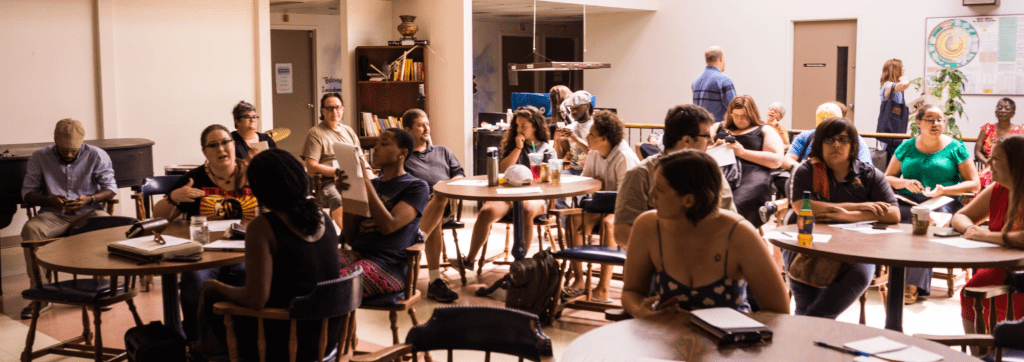
How can we escape the capitalist society we live in? We build communities that care for one another. Sometimes called beloved communities. An example is Mutual Aid. I’ve been involved in Des Moines Mutual Aid for two years and have written extensively about my experiences. https://quakersandreligioussocialism.com/mutual-aid/


Capitalism is so repugnant that we use other terms to refer to ourselves and the work we do, such are anarchists, communists, Black Liberationists, or accomplices.

Des Moines Mutual Aid

Randomly passing an accomplice on the street and throwing up a fist at each other as we go our separate ways to destroy all that is rotten in this world will never fail to give me extra energy and a single tear of gratitude for what this city is creating.

member of Des Moines Mutual Aid

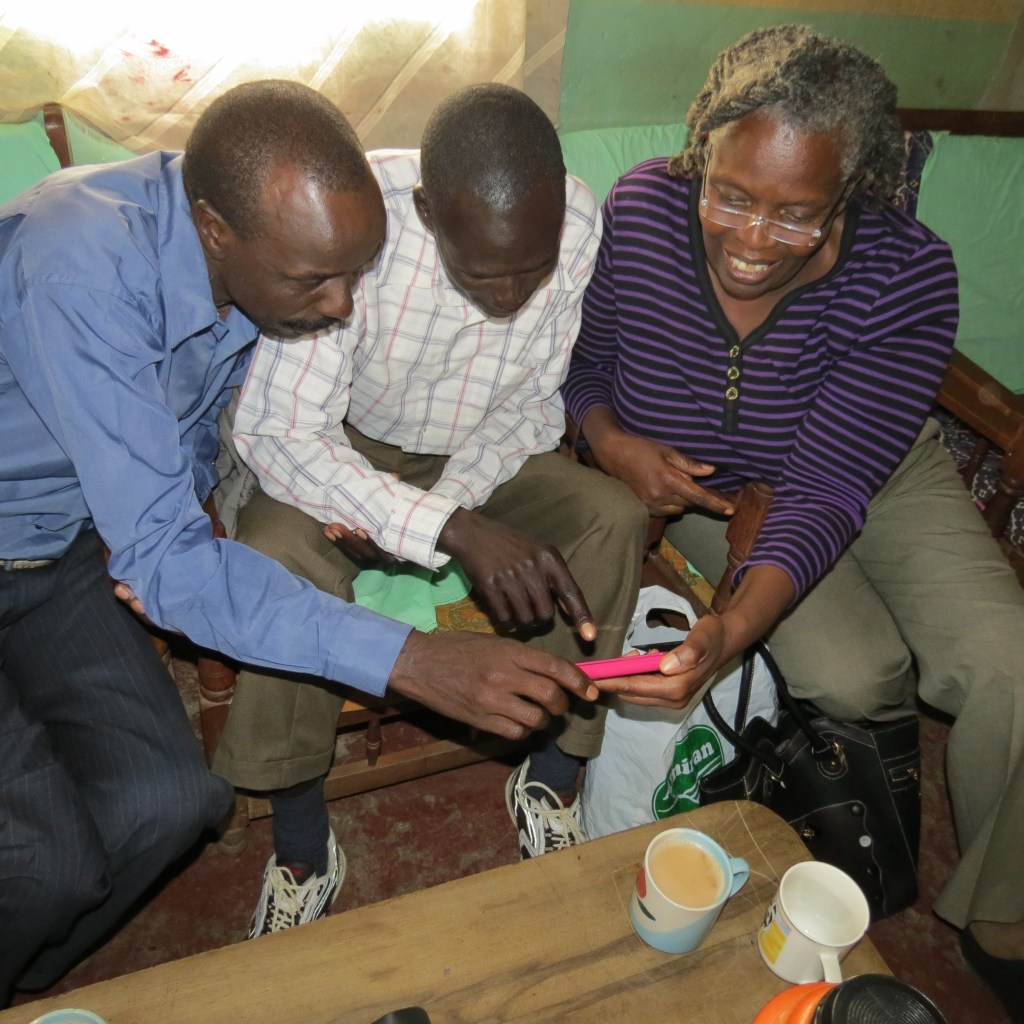
mutual aid is the new economy. mutual aid is community. it is making sure your elderly neighbor down the street has a ride to their doctor’s appointment. mutual aid is making sure the children in your neighborhood have dinner, or a warm coat for the upcoming winter. mutual aid is planting community gardens.

capitalism has violated the communities of marginalized folks. capitalism is about the value of people, property and the people who own property. those who have wealth and property control the decisions that are made. the government comes second to capitalism when it comes to power.

in the name of liberation, capitalism must be reversed and dismantled. meaning that capitalistic practices must be reprogrammed with mutual aid practices.

Des Moines Black Liberation

World Quaker Day, SUNDAY, 2 OCTOBER 2022 
“Becoming the Quakers the World Needs:”
Taking Action Now for Retrospective Justice.


Dear Friends and friends of Friends,

         How can Friends achieve the 2022 theme of World Quaker Day, “Becoming the Quakers the World Needs,” while functioning in a blatantly and politically corrupt, racialized world? In engagement with this exciting theme, offered by the Friends World Committee for Consultation (FWCC), the Black Quaker Project would like to remind Friends of the tools at our disposal to challenge those aspects of society which we wish to change and to see changed. Our fractured societies are further divided by enormous gaps of inequality in almost every imaginable category—psychological, social, political, cultural, economic. How might we, as Quakers, achieve justice, equity, and peace under these circumstances? 

         Our ministry has long advocated that retrospective justice is the key to bringing peace and equality to the world and to dismantling White Supremacy. As a reminder, retrospective justice is “an attempt to administer justice years after the commission of a severe injustice or series of injustices against persons, communities, or racial and ethnic groups.” Our definition draws upon the 2006 Brown University report, Slavery and Justice, which notes the following three steps as necessary to implement retrospective justice: (1) acknowledge an offense formally and publicly; (2) commit to truth-telling and ensure the facts are uncovered, discussed, and shared; and (3) make amends in the present to give substance to expressions of regret. While the all-too visible injustices of direct violence may command our attention, they are only symptoms of the structural violence deeply rooted in our societies. British Peace Studies founder, Friend Adam Curle, defines structural violence as “the political and economic inequalities which are built into the social structure.”  This violence can be economic, political, cultural, religious, or environmental–classifications outlined in Occupied With Nonviolence: A Palestinian Woman Speaks (2008) by Palestinian Friend Jean Zaru and expanded upon to include educational and health structural violence in our Pendle Hill pamphlet, Race, Systemic Violence, and Retrospective Justice: An African American Quaker Scholar-Activist Challenges Conventional Narratives (2020).  It is these various types of STRUCTURAL violence that we must keep in mind when implementing retrospective justice, not only direct violence. As we reminded readers in our 2008 Beacon Hill Friends pamphlet, Facing Unbearable Truths: “[Violence] must be treated at its roots if we are to abolish it. Just as a doctor must treat the root causes of an illness, not merely the symptoms, so must we act similarly as social, progressive, analytical activists. We must be “anti-violent,” not merely “non-violent.” 

         In recent years, we have seen notable truth-telling initiatives which our ministry recognizes as actions of retrospective justice. A few notable examples include: the groundbreaking New York Times publication and institutionalization of The 1619 Project; the National Museum of African American History and Culture in Washington, DC; the International Slavery Museum in Liverpool, UK; the Apartheid Museum in Johannesburg, South Africa; and the United Nations establishment of an International Day of Remembrance for Victims of Slavery and the Transatlantic Slave Trade, itself a prelude to the UN Decade for People of African Descent (2015-2024). What do we–Quakers and friends of Quakers–have to offer in these needed efforts of Retrospective Justice?  To answer this query, our ministry offers three responses:

Reason #1: Justice
         Drawing again on the words of Friend Adam Curle, we agree that justice has a dual meaning: “one, spiritual—righteousness, the observance of the divine law; the other temporal—fairness, righteous dealing. … [Our] vision of justice is the result of seeking to live [in alignment with] non-violence, compassion, redemption, and love.”  For too long this crucial Quaker testimony has been neglected in favor of acronyms such as “SPICES,” which mislead about the essence of Quakerism and fail to include justice. Can we have peace without justice? Can we have equality without justice? Our ministry challenges Friends to return the justice testimony not only to the front-burner but to front-and-center within the Religious Society of Friends by engaging in this important work of Retrospective Justice.

Reason #2: Truth
         Like justice, truth and integrity are at the root of Quakerism, so much so that early Quakers called themselves the Friends of Truth, a name to keep in mind as we reckon with our own history of past misdeeds. Our ministry encourages Friends to collectively shoulder the responsibility of telling the truth, in all its complexity, including the reality that Quakers, despite our well-known anti-slavery activities, were participants, profiteers, and supporters of the slave trade. A truth Harold D. Weaver has called on the Religious Society of Friends to acknowledge in the past, most recently, in his January 2021 Friends Journal article, “A Proposed Plan for Retrospective Justice.” Friends need to confront and atone for the 400-year legacy of oppression, economic exploitation, and human degradation that affects people of African descent worldwide, such as Jim Crow, colonialism, and apartheid. Perhaps we will never know to what extent current Friends–individuals, Meetings, and organizations– have profited from the inheritance of significant sums of money for the past exploitation of people of African descent worldwide. However, Friends can still work to correct misinformation and disinformation so that we may understand the roots of the issues we seek to resolve. Quakers in some monthly, quarterly, and yearly meetings seem to be grappling with this process.

Reason #3: Reputation, Influence, and Expectations 
         Since the publication of Uncle Tom’s Cabin in 1852, Quakers have had a reputation as being among history’s foremost abolitionists. While we question whether Friends fully deserve this reputation, it is one that has endured. Across history, and around the world, Quakers have been involved in movements of peace and justice. Friends organized relief efforts for the starving masses of the Irish potato famine, cared for the sick and injured as World War I ravaged Europe, and aided interned Japanese Americans during World-War II. Celebrated Quaker human rights activist, writer, and social critic Bayard Rustin emerged as a leading figure in the Civil Rights Movement which Quakers widely participated in (Rustin is just one of the trailblazing African American Quakers we document in Black Fire: African American Quakers on Spirituality and Human Rights). Friends would also make their presence known during South Africa’s struggle against apartheid, peace efforts throughout the “Troubles’’ era of Northern Ireland, and beyond. 

         In 1947, the Friends Service Council in the UK and the American Friends Service Committee were jointly awarded the Nobel Peace prize ON BEHALF OF ALL QUAKERS for post World-War-II peace, reconstruction, and recovery efforts. While some people might forget that Quakers even exist today, many remember our historical image as leaders in truth, peace, justice, abolition, and equity. It is this reputation that we are expected to maintain and which our ministry recommends we live up to.          As the population of Quakers decreases in the Global North, the future of the Religious Society of Friends will be greatly defined by Friends of Color across Asia, South America, and, most prominently, Africa, which, as of 2017, is home to over 180,000 Friends. As we become further unmoored from our Eurocentric roots, the growing majority of Friends in the Global South are vulnerable to the very worst effects of systemic racism and structural violence. We hope Friends participate in plans of Retrospective Justice, “Becoming the Quaker’s The World Needs,” by taking action now.

         What additional reasons might there be for Quakers to be actively involved in USA and worldwide Retrospective Justice efforts?  Please write to us at theblackquakerpoject@gmail.com with your suggestions.

Note: The above narrative is adapted from Dr. Harold D. Weaver’s 21 September 2022 presentation to the Joseph Rowntree Charitable Trust Interim Working Group at Friends  House, London, UK. We appreciate the invitation of collaboration from Friend Nozizwe Madlala-Routledge, the new, dynamic Director of the Quaker United Nations Office-Geneva.

Global

It is obvious that environmental devastation is a global problem which demands a global response. But I’ve been so discouraged by the paralysis in this country, that I haven’t had the energy to think globally. Didn’t think a global response was ever going to be possible.

But in a recent article umair haque writes about the speech Secretary General of the United Nations, Antonio Guterres recently gave to the General Assembly. Which gives me a little hope that a global response might be possible.

The Secretary General of the UN just called for a Global New Deal. And nobody listened. But they should have, because this is precisely the idea we need if our civilization is going to survive. What he means by Global New Deal is all the above — taxing windfall profits, so that investments can be made, now, urgently, in basic systems for all, which we so clearly need, from food to water to energy and so on.

But he doesn’t stop there. He’s not just proposing, but demanding, a reinvention of the global financial system to invest even more. He calls on the IMF to expand its Special Drawing Rights, and create a Global Stimulus Package.

The Alarm Bells of Civilizational Collapse Are Ringing — But Are We Listening? If Our Civilization Is Going to Survive, It’s Going to Have to Change Like This — Fast by umair haque, Eudaimonia and Co, Sep 22, 2022


In this latest version of a diagram I’ve been working on, newly added are attention to the global aspects of environmental chaos and the need for a global new deal.


We have a duty to act. And yet we are gridlocked in colossal global dysfunction.

The international community is not ready or willing to tackle the big dramatic challenges of our age. These crises threaten the very future of humanity and the fate of our planet.

Let’s have no illusions. We are in rough seas. A winter of global discontent is on the horizon. A cost-of-living crisis is raging. Trust is crumbling. Inequalities are exploding. Our planet is burning. People are hurting — with the most vulnerable suffering the most.

Our world is in peril — and paralyzed. Geopolitical divides are undermining the work of the Security Council. Undermining international law. Undermining trust and people’s faith in democratic institutions. Undermining all forms of international cooperation. We cannot go on like this. Even the various groupings set up outside the multilateral system by some members of the international community have fallen into the trap of geopolitical divides, like in the G-20.

But the reality is that we live in a world where the logic of cooperation and dialogue is the only path forward. No power or group alone can call the shots. No major global challenge can be solved by a coalition of the willing. We need a coalition of the world.

There is another battle we must end — our suicidal war against nature. The climate crisis is the defining issue of our time. It must be the first priority of every government and multilateral organization. And yet climate action is being put on the back burner — despite overwhelming public support around the world. Global greenhouse gas emissions need to be slashed by 45 percent by 2030 to have any hope of reaching net zero emissions by 2050. And yet emissions are going up at record levels — on course to a 14 percent increase this decade.

Secretary General of the United Nations, Antonio Guterres

Excellencies, let’s tell it like it is. Our world is addicted to fossil fuels. It’s time for an intervention. We need to hold fossil fuel companies and their enablers to account. That includes the banks, private equity, asset managers and other financial institutions that continue to invest and underwrite carbon pollution.

And it includes the massive public relations machine raking in billions to shield the fossil fuel industry from scrutiny. Just as they did for the tobacco industry decades before, lobbyists and spin doctors have spewed harmful misinformation. Fossil fuel interests need to spend less time averting a PR disaster — and more time averting a planetary one.

Of course, fossil fuels cannot be shut down overnight. A just transition means leaving no person or country behind. But it is high time to put fossil fuel producers, investors and enablers on notice.

Polluters must pay.

Today, I am calling on all developed economies to tax the windfall profits of fossil fuel companies. Those funds should be re-directed in two ways: to countries suffering loss and damage caused by the climate crisis; and to people struggling with rising food and energy prices.

Secretary General of the United Nations, Antonio Guterres


Joy is the sunrise
breaking through night’s remains,
bright shone new
on a shell-wracked shore;
a fresh tide-scrubbed world
redeems what was,
to is.

J. Drew Lanham Joy is the Justice We Give Ourselves. (excerpt)

Foundational Stories 9/28/2022

This summer I began writing about my foundational stories. This was in response to a Quaker friend urging us to think back on the beginnings of our stories. Then about how our stories evolved, and what they look like now. That led me to write many stories about this evolution.
[See: https://quakersandreligioussocialism.com/?s=foundational ]

I’ve been looking forward to describing the current state of my foundational story. The article below about Cai Quirk is remarkably similar to parts of my story now.

My foundational story is related to the intersections between my Quaker faith, protecting Mother Earth, and photography. This combination has remained a powerful, yet evolving, influence throughout my life. My faith led me to try to share my spiritual experiences and show my love for the beauty of Mother Earth through photography. These three things came into play in many ways throughout my life.

I continue to rely on my Quaker faith to guide these decisions. Sometimes the guidance is clear. Other times either I’m not discerning what the Spirit is telling me, or there isn’t anything new to hear. It’s all too easy to stay on a path we are comfortable with, to the extent we might not hear, or might ignore leadings that say we need to change direction, to do something we are uncomfortable with. One thing I was blessed to realize early in my life was the times I took risks resulted in significant growth. Which led me to search for ways to take risks.

The reason I invested in the idea of the evolution of my foundational stories is because I’m feeling I might need to change how I think about and put into practice faith, protecting Mother Earth, and photography. I don’t have a way to know how many people read my blog posts but have a better indication of how people see my photography. My impression is that more people see my photographs. I’m sensing I should “focus” more on photography to express my spirituality and encourage more people to work to protect Mother Earth. Although the main reason I write so much is to try to organize and clarify what I discern about my spiritual life, and what that means, how to put these leadings into practice, how to practice hope.

People often mistake hope for a feeling, but it’s not. It’s a mental discipline, an attentional practice that you can learn. Like any such discipline, it’s work that takes time, which you fail at, succeed, improve, fail at again, and build over years inside yourself.

Hope isn’t just looking at the positive things in this world, or expecting the best. That’s a fragile kind of cheerfulness, something that breaks under the weight of a normal human life. To practice hope is to face hard truths, harder truths than you can face without the practice of hope. You can’t navigate dark places without a light, and hope is that light for humanity’s dark places. Hope lets you study environmental destruction, war, genocide, exploitative relations between peoples. It lets you look into the darkest parts of human history, and even the callous entropy of a universe hell bent on heat death no matter what we do. When you are disciplined in hope, you can face these things because you have learned to put them in context, you have learned to swallow joy and grief together, and wait for peace.

IT IS BITTER TEA THAT INVOLVES YOU SO: A SERMON ON HOPE by Quinn Norton, April 30, 2018

I recently found the article “Cai Quirk Invites Friends to Expand Our Faith” by Emma Hulbert, FCNL, July 12, 2022. Cai Quirk speaks about faith, risks, and art.

“One of the pieces of Quaker witness I have been carrying in the world for many years now is around gender diversity and using art and storytelling as a way to explore that. This is some of the ministry that I carry.”

Cai Quirk 

Cai Quirk (they/them or ey/em pronouns) shared this reflection with FCNL staff in a late-June Zoom lunch, along with the ways Spirit has been leading them to explore gender, faith, and nature through art.

Cai is a life-long Quaker. After years of spiritual deepening through writing poetry and creating self-portraits, Cai will soon release their first book. “Transcendence: Queer Restoryation” includes words and images that offer an expansive understanding of faith.

In speaking to FCNL staff, Cai showed many of their self-portraits, focusing especially on those exploring gender in the natural world. “I was finding new ways to create new stories that are empowering,” they told us. “Through these self-portraits, I found how far I can go in following Spirit. A lot of these photos were very freeing and empowering and have given me more connection to Spirit.” Cai explained that nature itself holds some inherent queerness; “Even when society tries to erase queer stories, they are still there in the landscape.”

Growing up Quaker, Cai learned the history of the social disruption inherent in Quaker faith. Yet today, Cai has noticed that only certain kinds of social disruption and ministry are accepted within some circles of Friends. “My art is an invitation to see how Spirit invites us all in different ways,” they said. While not all Quaker communities can feel welcome to those who rock the boat, social disruption and rage can be sacred as well. Changemaking occurs in many ways for many different people, and Cai is working to create more spaces where this kind of expansion and ministry are accepted, where more people can exist as their true selves.

“If I change myself to match society’s conventions, then I am not being authentic, I am not being faithful to Spirit,” Cai told us. Can we as the Religious Society of Friends expand our ideas of faith and community to invite everyone in? What would it take to seek and live into that welcoming Quakerism moving forward?

“Cai Quirk Invites Friends to Expand Our Faith” by Emma Hulbert, FCNL, July 12, 2022

Minute
There is that of God in every being. We support those of all gender identities and sexual orientation. And respect and will endeavor to use the pronouns each person identifies themselves by.

Approved by Iowa Yearly Meeting (Conservative) 2022

ecology, culture, and spirituality

Spirituality is rarely spoken of in the tsunami of information and stories found on all types of media, related to the dangerous times we are living in. And the future our children face. The unfolding apocalyptic reality.

As the reality of escalating environmental chaos becomes impossible to ignore, vast numbers of people are demanding immediate solutions. And with the realization there are no quick fixes, panic spreads. Dystopian stories emerge. Hopelessness sets in.

I’m glad to have found Emergence Magazine, which asks the question “what does living in an unfolding apocalyptic reality look like?”

”Emergence is an essential and exquisite addition to our way of seeing and honoring this extraordinary planet.”

-Camille Dungy, editor of B1ack Nature: Four Centuries of African American Nature Poetry

Launched in Spring 2018, Emergence Magazine is an award-winning quarterly online publication with an annual print edition exploring the threads connecting ecology, culture, and spirituality.

My last blog post was about one of the stories from Emergence Magazine. Joy is the justice we give ourselves.

“If we are to find a new kind of good life amid the catastrophes these myths have spawned, then we need to radically rethink the stories we tell ourselves.”

James Allen

Stories are the way we share our lived experiences, thoughts, and calls for change. And express our views of the present and the future. The stories in Emergence Magazine explore these things.


Some of the ways I’m involved in sharing stories include:


“The end of the world as we know it is not the end of the world full stop. Together, we shall find the hope beyond hope, the paths that lead to the unknown world ahead of us.” Paul Kingsnorth & Dougald Hine

Most of us lack the stories that help imagine a future where we thrive in the midst of unstoppable ecological catastrophe. To borrow a phrase from storyteller Martin Shaw, this is because our imaginations have been colonised by things that don’t always mean us well.

We have been propelled to this point by the myths of progress, limitless growth, our separateness from nature and god-like dominion over it. These myths have shown up in our stories in peculiar ways of late. Since around the turn of the millennium there has been a surge in post-apocalyptic fiction. A steady stream of films, television series and novels have portrayed desolate and barely habitable future landscapes, often roamed by marauding bands of psychopaths, flesh-eating zombies or similar agents of malevolence. The frequent appearance of post-apocalyptic themes undoubtedly reflects our rising collective existential anxiety about our future. But perhaps more telling is the recurring themes of horror, deprivation and dystopian political order that nearly always characterise these depictions of the future. It seems our minds have been so thoroughly colonised by the myths of growth and progress that we cannot imagine how the collapse of the current order could possibly produce a future that resembles anything short of hell.

If we are to find a new kind of good life amid the catastrophes these myths have spawned, then we need to radically rethink the stories we tell ourselves. We need to dig deep into old stories and reveal their wisdom, as well as lovingly nurture the emergence of new stories into being. This will not be easy. The myths of this age are deeply rooted in our culture. The talking heads (even the green ones) echo these myths with the dogmatic fervour of zealots. They talk of “saving the planet” through transitioning to a “sustainable” future, primarily through new renewable energy technologies. They seem only able to conceive of a good life that mirrors our lives more or less as they are now, where the living standard continues to improve and rate of consumption continues to grow, yet somehow decoupled from all the pollution, destruction and guilt.

Pontoon Archipelago or: How I Learned to Stop Worrying and Love Collapse by James Allen, originally published by Medium, June 18, 2019


Let this darkness be a bell tower

Quiet friend who has come so far,
feel how your breathing makes more space around you.
Let this darkness be a bell tower
and you the bell. As you ring,
what batters you becomes your strength.
Move back and forth into the change.
What is it like, such intensity of pain?
If the drink is bitter, turn yourself to wine.
In this uncontainable night,
be the mystery at the crossroads of your senses,
the meaning discovered there.
And if the world has ceased to hear you,
say to the silent earth: I flow.
To the rushing water, speak: I am.

Sonnets to Orpheus II, 29. By Rainer Maria Rilke

Joy is the justice we give ourselves

The following story and poem are from an online magazine I recently discovered, Emergence Magazine.

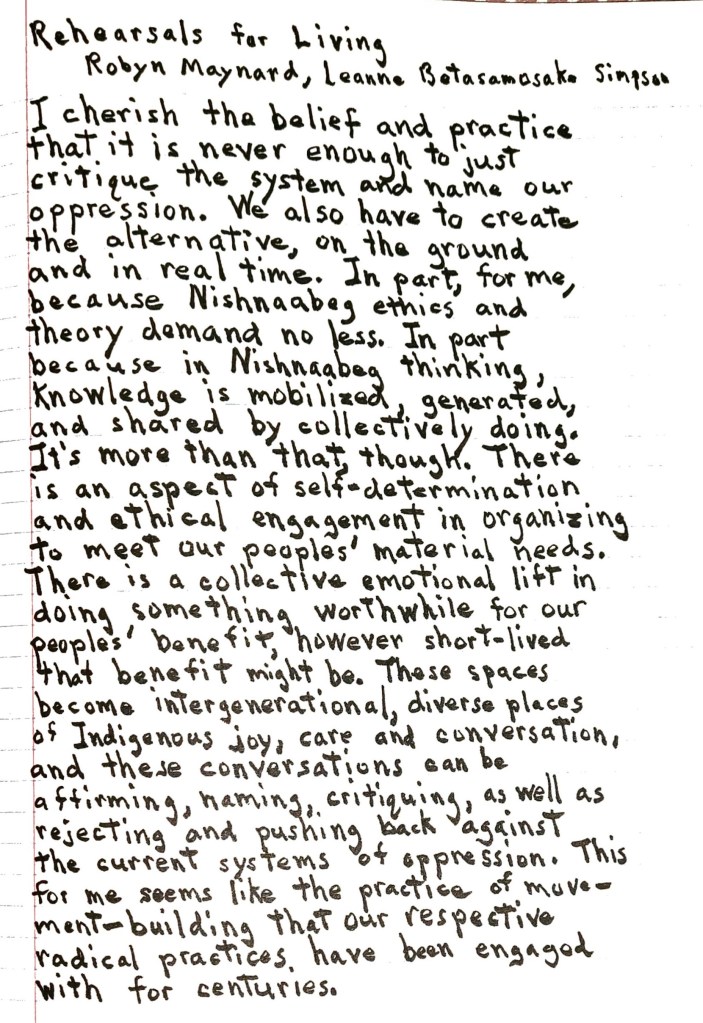
The title caught my attention because joy is one of the main benefits of Mutual Aid communities. It has been true for my involvement in Des Moines Mutual Aid for the past two years. Especially in these times of growing fear about the baffling breakdown of so many things we took for granted, finding joy is so important. This quote from the book “Rehearsals for Living” by Robyn Maynard and Leanne Betasamosake Simpson describes this well.

“Rehearsals for Living” by Robyn Maynard and Leanne Betasamosake Simpson

Roots anchor and support us. Firmly and deeply established, they can carry us through difficult times. When we do the work of rooting, we find those threads that can nourish us in the face of adversity.

In “Joy Is the Justice We Give Ourselves,” poet J. Drew Lanham grounds his vision of racial justice in quiet moments of awe in nature. Celebrating radical acts of joy, he lifts up liberation, reparations, and deep connection to ancestors and the living world.

Emergence Magazine

Joy is the justice
we give ourselves.
It is Maya’s caged bird
sung free past the prison bars,
holding spirits bound—
without due process,
without just cause.

Joy is the steady run stream,
rights sprung up
through moss-soft ground—
water seeping sweet,
equality made clear
from sea
to shining sea,
north to south,
west to east.

Joy is the truth,
crooked lies hammered straight,
whitewashed myths
wiped away.
Stone Mountain
—just stone.
Rushmore
—no more.
Give the eagles
their mountains back.

(continues…)

Joy is the justice we give ourselves

CONTRIBUTOR BIOS

POET
J. Drew Lanham is a birder, naturalist, and hunter-conservationist. He is the author of The Home Place: Memoirs of a Colored Man’s Love Affair with Nature, which received the Reed Award from the Southern Environmental Law Center and the Southern Book Prize, and was a finalist for the John Burroughs Medal. His essays and poetry can be found in Orion, Audubon, Flycatcher, and Wilderness, and in the anthologies The Colors of Nature, State of the Heart, Bartram’s Living Legacy, and Carolina Writers at Home. He is an Alumni Distinguished Professor of Wildlife Ecology and Master Teacher at Clemson University.

PHOTOGRAPHER
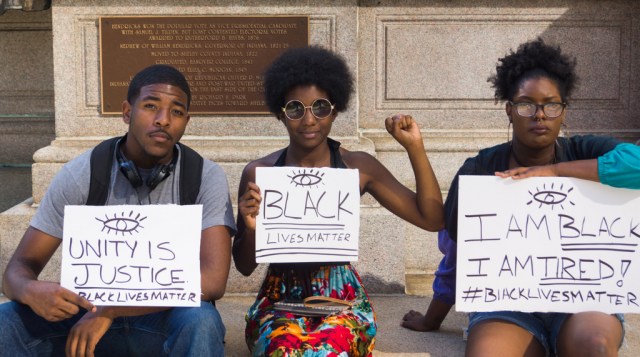
Sheila Pree Bright is an acclaimed fine-art photographer known for her series Young Americans, Plastic Bodies, and Suburbia. Her documentation of responses to police shootings in cities across the US inspired her book #1960Now: Photographs of Civil Rights Activists and Black Lives Matter Protests.


Foundational stories: Finding accomplices

“There’s nothing more radically activist than a truly spiritual life. And there’s nothing more truly spiritual than a radically activist life.”

Brian McLaren, Naked Spirituality

At the dawn of a new day, I listen to hear what I will write. I did not expect to be writing about accomplices today. But as I prayed about the next episode of this series of foundational stories, I am trying to express what or who I was looking for when I retired and moved back to Iowa (2017).

This quote immediately came to mind. “Destroy” might sound extreme, but the author is one of the most nonviolent people I know.

Randomly passing an accomplice on the street and throwing up a fist at each other as we go our separate ways to destroy all that is rotten in this world will never fail to give me extra energy and a single tear of gratitude for what this city is creating.

Mutual Aid friend

I leave the author unnamed because we never know what the authorities will use against us. I include myself in this by saying “against us“. I say Mutual Aid friend because we are both involved in a Mutual Aid community, which means we all support each other.

Although accomplice is defined as a person who helps another commit a crime, the meaning in the quote is more like associate or collaborator.

Or is it?

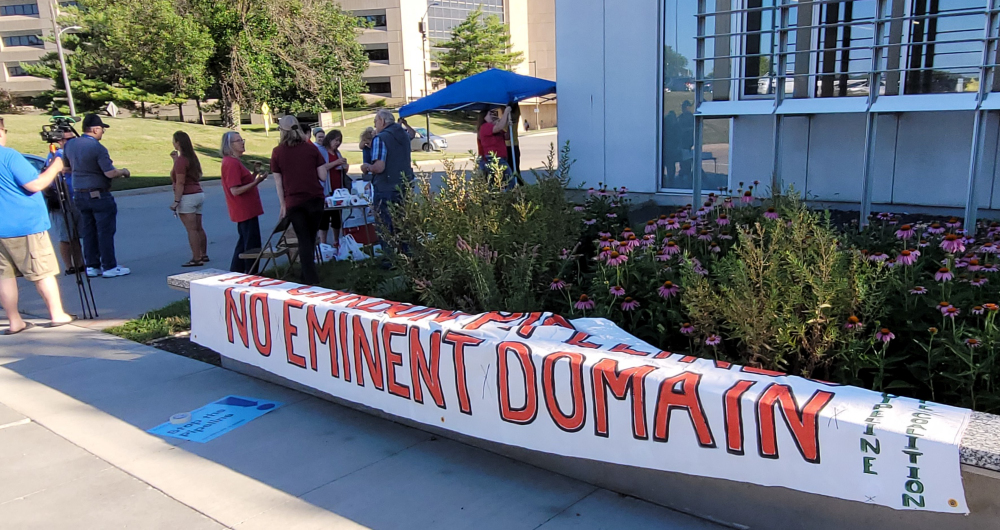
Nonviolent civil disobedience most often involves intentionally committing a crime. I previously wrote about being trained as a trainer for nonviolent direct actions, i.e. the Keystone Pledge of Resistance. And being prepared to break the law by blocking the doors of the Federal building in downtown Indianapolis, if necessary, to try to stop the construction of the Keystone XL pipeline.

I intentionally broke the law when I resisted the draft.

And there is the whole question of what is legal and who determines that? Legality and justice are not the same. Laws often enforce injustice, protecting the status quo.

The Doctrines of Discover gave permission to steal the land from and kill indigenous peoples all over the world. Manifest destiny said the expansion of white settlers across the land was justified and inevitable. There is the institution of enslavement. Forced assimilation.


…Under a government which imprisons any unjustly, the true place for a just man is also a prison. The proper place to-​day, the only place which Massachusetts has provided for her freer and less desponding spirits, is in her prisons, to be put out and locked out of the State by her own act, as they have already put themselves out by their principles. It is there that the fugitive slave, and the Mexican prisoner on parole, and the Indian come to plead the wrongs of his race, should find them; on that separate, but more free and honorable ground, where the State places those who are not with her, but against her — the only house in a slave State in which a free man can abide with honor. If any think that their influence would be lost there, and their voices no longer afflict the ear of the State, that they would not be as an enemy within its walls, they do not know by how much truth is stronger than error, nor how much more eloquently and effectively he can combat injustice who has experienced a little in his own person. Cast your whole vote, not a strip of paper merely, but your whole influence. A minority is powerless while it conforms to the majority; it is not even a minority then; but it is irresistible when it clogs by its whole weight. If the alternative is to keep all just men in prison, or give up war and slavery, the State will not hesitate which to choose. If a thousand men were not to pay their tax-​bills this year, that would not be a violent and bloody measure, as it would be to pay them, and enable the State to commit violence and shed innocent blood. This is, in fact, the definition of a peaceable revolution, if any such is possible. If the tax-​gatherer, or any other public officer, asks me, as one has done, “But what shall I do?” my answer is, “If you really wish to do anything, resign your office.” When the subject has refused allegiance, and the officer has resigned his office, then the revolution is accomplished. But even suppose blood should flow. Is there not a sort of blood shed when the conscience is wounded? Through this wound a man’s real manhood and immortality flow out, and he bleeds to an everlasting death. I see this blood flowing now…

Henry David Thoreau

I hope the foundational stories I’ve written thus far illustrate that what has been meaningful for me is to find people and communities who act instead of just talk. I was looking for such people and organizations to work with when I moved to Iowa. I’m blessed to have been led to them.


Foundational stories: Spiritual Warriors

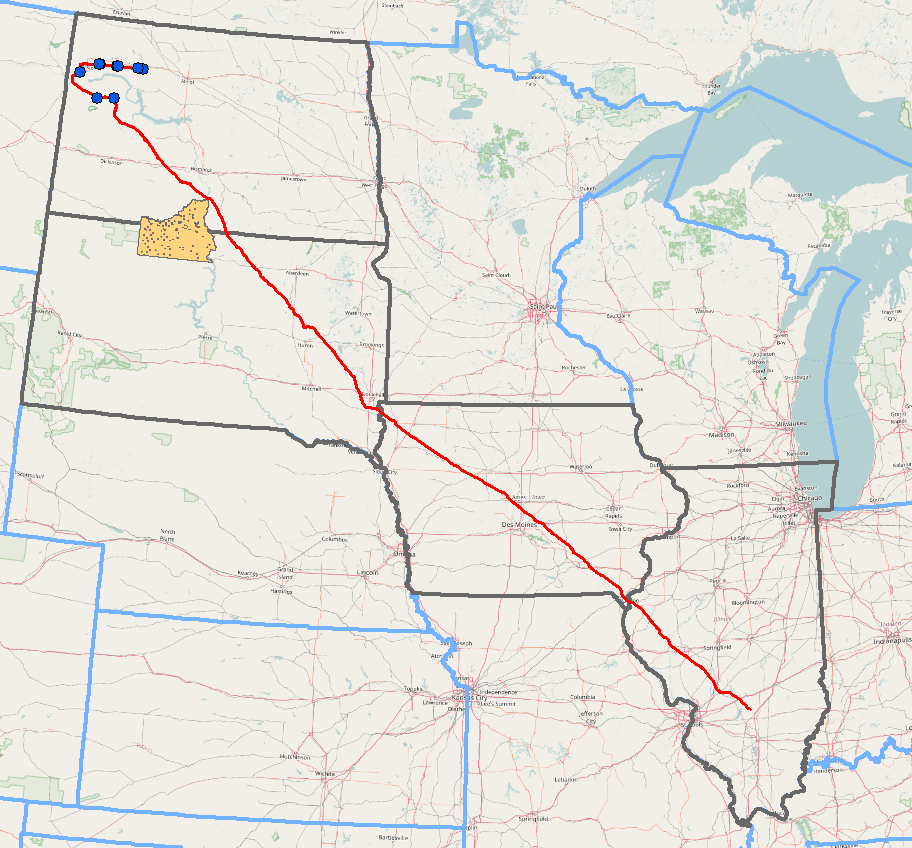
The Keystone pipeline resistance ended with President Obama’s denial of the pipeline’s permit. But then we began to hear about the construction of the Dakota Access Pipeline (DAPL). In one of the most transparent, egregious examples of environmental racism, the route of the pipeline was changed when people in Bismarck, North Dakota, objected to the original plan for DAPL to cross the Missouri River just upstream from them, fearing contamination of their water. So, the route was changed to cross beneath Lake Oahe (Missouri River), at the edge of the border of the Standing Rock Indian Reservation (orange in the map below).

By NittyG – Own work, CC BY-SA 4.0, https://commons.wikimedia.org/w/index.php?curid=52776844

Dakota Access Pipeline route (Standing Rock Indian Reservation is shown in orange)

That new route stimulated months of prayers and ceremonies by hundreds of Native American tribes and thousands of people.

By late September, (2016) NBC News reported that members of more than 300 federally recognized Native American tribes were residing in the three main camps, alongside an estimated 3,000 to 4,000 additional pipeline resistance demonstrators. Several thousand more gathered at the camps on weekends.[7][34][35]

Dakota Access Pipeline protests

DAPL support begins in Indianapolis

In a recent post (Keystone Pledge of Resistance) I described how Jim Poyser, Ted Wolner, and I were trained to design peaceful, nonviolent civil disobedience actions. And how we trained about fifty people in Indianapolis to participate in such actions.

A Spirit-led connection was made when Jim was talking with Joshua Taflinger about the Dakota Access Pipeline (DAPL). Jim lived near Joshua’s White Plains Wilderness Academy. Joshua wanted to know what he could do locally to bring attention to the Dakota Access pipeline. I say ‘bring attention’ rather than protest, because one of the first things I learned from those opposing DAPL was the difference between protesting and being a water protector.

Water protector was about an integral, Spiritual connection with Mother Earth, and all things human and nonhuman.

Bringing attention to the Dakota Access pipeline (DAPL) in downtown, Indianapolis

Jim told Joshua about the Keystone Pledge of Resistance, and those of us who had been trained to organize public gatherings and actions. And told Joshua we would be glad to support similar efforts to call attention to the dangers of DAPL. We were all excited about helping Joshua and White Plains Wilderness Academy, glad our experience could be useful.

Before getting into what we did related to DAPL, I’d like to express how working with Joshua and his wife Brandi, made me aware of the concept of spiritual warriors.


It may seem odd for a Quaker to speak about warriors. But what I mean by warriors is what Chief Sitting Bull said.

For us, warriors are not what you think of as warriors. The warrior is not someone who fights, because no one has the right to take another’s life. The warrior, for us, is one who sacrifices himself for the good of others. His task is to take care of the elderly, the defenseless, those who cannot provide for themselves and above all, the children, the future of humanity.

Chief Sitting Bull

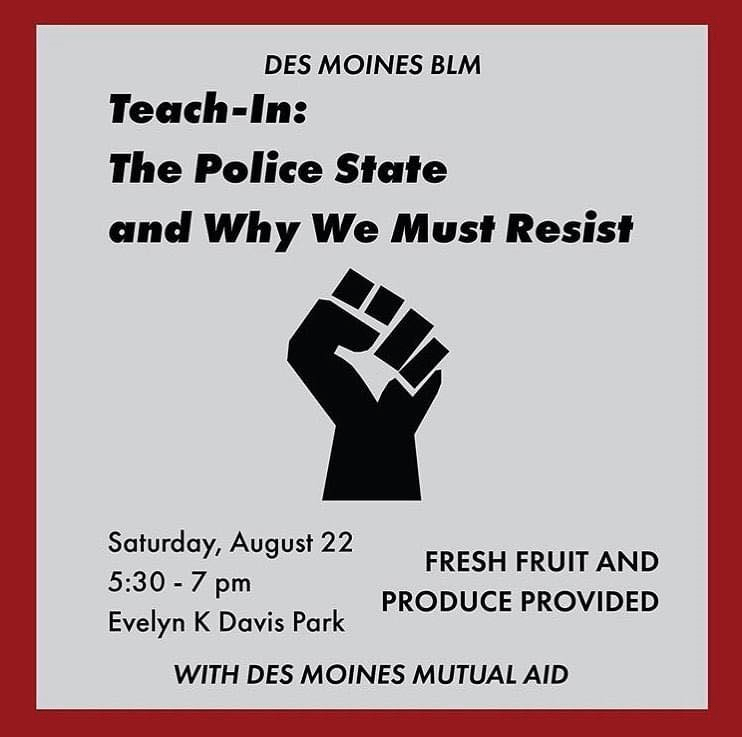
Warriors today are forging different ways to live together, returning to Indigenous ways to live in community. Mutual Aid is an alternative to our broken systems. Members of Mutual Aid communities are working for the abolition of police and prisons. To escape the colonial capitalist system. Feeding the hungry and finding shelter for the houseless. Collecting clothing.


The following from Joshua, is another example of radically rethinking our stories.

I am inspired to share with you all more directly a post I wrote, because I consider you an established and effective nature/spiritual warrior and believe that there is a need for the perspectives shared in the attached post to be more common thought in the minds of the many.

If you feel truth from this writing, and are inspired, I highly encourage you to re-write your own version, in your own words/perspectives, and post to your network.

With the intention of helping us all wake up, with awareness, clarity, and direction.

..spreading and weaving reality back into the world….

What has risen to the surface at Standing Rock is a physical/spiritual movement. Learn how to quiet your mind. To find the silent receptive space to receive guidance. To learn to adapt and follow the pull of synchronicity to guide you to where you will find your greatest support and strength.

What I have found in my time praying in the indigenous earth-based ways, is that it’s not about putting your hands together and talking to God…. It’s about quieting and connecting with the baseline of creation, of nature. Tuning into the frequency and vibration of the natural world, the nature spirits. The beings and entities that have been in existence, for all of existence, the examples and realities of sustainability and harmony.

It’s about becoming receptive to these things. Being open and flowing with them. The spirit guides us, but we have to make ourselves receptive to feel, sense, and respond to this guidance.

Joshua Taflinger


Each Warrior of the Light contains within him the spark of God. His destiny is to be with other Warriors, but sometimes he will need to practice the art of the sword alone; this is why, when he is apart from his companions, he behaves like a star. He lights up his allotted part of the Universe and tries to point out galaxies and worlds to all those who gaze up at the sky. The Warrior’s persistence will soon be rewarded. Gradually, other Warriors approach , and they join together to form constellations, each with their own symbols and mysteries. 

Coelho, Paulo. Warrior of the Light: A Manual (p. 89). HarperCollins. Kindle Edition


There comes a time when all life on Earth is in danger. Great barbarian powers have arisen.

Although these powers spend their wealth in preparations to annihilate one another, they have much in common: weapons of unfathomable destructive power, and technologies that lay waste our world. In this era, when the future of sentient life hangs by the frailest of threads, the Shambhala warriors appear.

The warriors have no home. They move on the terrain of the barbarian powers. Great courage is required, both moral and physical, for they must go into the heart of the barbarian powers to dismantle their weapons, into the places where the weapons are created, into the corridors of power where decisions are made.

The Shambhala warriors are armed only with the weapons of compassion and insight. Both are necessary. Compassion gives them the energy to move forward, not to be afraid of the pain of the world. Fueled by compassion, warriors engage with the world, step forward and act. But by itself compassion burns with too much passion and exhausts us, so the second weapon is needed — insight into the interdependence of all phenomena.

With that wisdom we see that the battle is not between “good guys” and “bad guys,” because the line between good and evil runs through every human heart. And with insight into our profound interrelatedness, we discern right action, knowing that actions undertaken with pure intent have repercussions throughout the web of life, beyond what can be measured or discerned.

Together these two weapons sustain the warriors: the recognition and experience of our pain for the world and the recognition and experience of our radical interconnectedness with all life.

Adapted from Dugu Choegyal, as recounted by Joanna Macy


The Spiritual Warrior is a person who challenges the dreams of fear, lies, false beliefs, and judgments that create suffering and unhappiness in his or her life. It is a war that takes place in the heart and mind of a man or woman. The quest of the Spiritual Warrior is the same as spiritual seekers around the world.  

www.toltecspirit.com/four-agreements/characteristics-of-a-spiritual-warrior/.


My foundational stories: Humility

I feel awkward when writing stories of my life because I was raised to believe we should not call attention to ourselves. I’m feeling this now as I continue to write my foundational stories.

A friend of mine expresses this awkwardness by saying, “anyways, brag, brag, blah, blah”. But we both tell our stories to pass on lessons we’ve learned that might be helpful to others. And in the spirit of Mutual Aid (that we are both involved in), might lead others to share their stories with us. To build a community library of our stories. My mom has worked to gather such a library of stories, the Quaker Stories project. https://quakerstories.wordpress.com/


Dear reader

I offer you this essay in the hope that you may find something within it that will keep you buoyed in the years ahead. It reflects my own attempt to understand the converging crises in our near future, and to grapple with the question of what I might be able to offer that will be useful in that future.

It was the birth of my first child that catalysed a sense of urgency to take the idea-threads I had been tracing for some years now and to weave them into a relatively coherent whole. As any conscientious parent will testify, there are few things that will sharpen one’s focus on the future than a deeply felt sense of responsibility for a new being.

If we are to find a new kind of good life amid the catastrophes these myths have spawned, then we need to radically rethink the stories we tell ourselves. We need to dig deep into old stories and reveal their wisdom, as well as lovingly nurture the emergence of new stories into being.

Pontoon Archipelago or: How I Learned to Stop Worrying and Love Collapse. By James Allen, originally published by Medium, June 18, 2019

So, this is me radically rethinking the stories I tell myself (and you). We are being forced to nurture the emergence of new stories into being because of the catastrophes that are ever worsening because of environmental devastation and social collapse.


It’s not who our ancestors were, or how many committees we serve on, or whether we’ve read John Woolman’s journal that places us in the living stream of Friends. It’s through living our own authentic journey of faithfulness that we can become Children of Light. Without this, we are claiming an inheritance not our own. You can know the motion of thieves is present when you find yourself feeling humble, authentic, and vulnerable. We need to be careful when we talk about humility. The kind of humility this work brings isn’t the kind that would have us reject or repress our gifts. This kind of false humility leads us to oppress each other in the name of preventing pridefulness. This happens far too often. Real, life-giving humility means living up to the light that we have been given without judgment of how bright or dim that light is. False humility is hiding this light under a bushel for fear of jealousy or judgment. The challenge is to be faithful right where we are—no more, no less. This takes courage. To be faithful, we have to make space.

Prophets, Midwives, and Thieves: Reclaiming the Ministry of the Whole by Noah Baker Merrill

 I hope that in this year to come, you make mistakes. Because if you are making mistakes, then you are making new things, trying new things, learning, living, pushing yourself, changing yourself, changing your world. You’re doing things you’ve never done before, and more importantly, you’re doing something.

Neil Gaiman

My foundational stories: Keystone Pledge of Resistance

This is a continuation of a series of posts about the evolution of my foundational stories, which are related to the intersection between my Quaker faith, protecting Mother Earth, and photography.

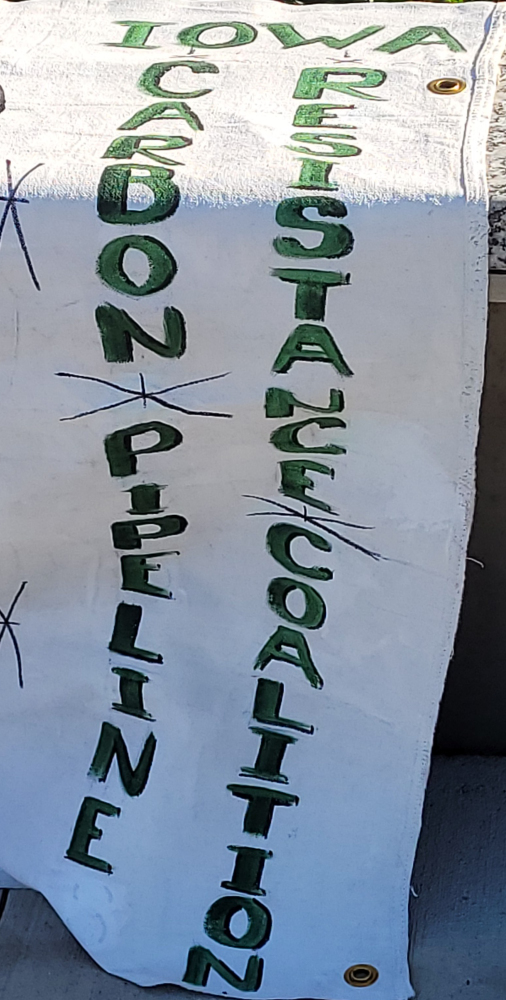
Much of my justice work for the past twenty years has been and continues to be related to pipelines because they are the critical infrastructure needed to transport oil and natural gas from where they are mined, to the refineries. And against proposed “carbon” pipelines to transport carbon dioxide to storage facilities. Pipelines are usually hundreds of miles long, often traveling through fragile ecosystems and/or rivers and lakes.

It is at the construction sites that activists can resist the pipelines. Or, in the case of the Keystone XL pipeline, prevent the approval of the pipeline permit required to cross the US/Canadian border.

The stories related to each pipeline are so long that they require separate articles for each. I learned a great deal about designing and training for different ways to resist pipelines. And developed deep friendships with many amazing people. These are some of the stories related to the Keystone XL pipeline. We were able to stop its construction.

The (Keystone XL pipeline) project was delayed for the past 12 years due to opposition from U.S. landowners, Native American tribes and environmentalists.

Keystone pipeline officially canceled after Biden revokes key permit. CNBC, JUN 9, 2021

Protecting Mother Earth

Looking back over the past fifty years, it is obvious the industrial world made a fundamental error by the unrestrained use of fossil fuels. We would not be experiencing evolving environmental chaos and social collapse today if not for those tragic decisions. We disregarded the indigenous wisdom of considering the effects our actions would and are having on future generations.

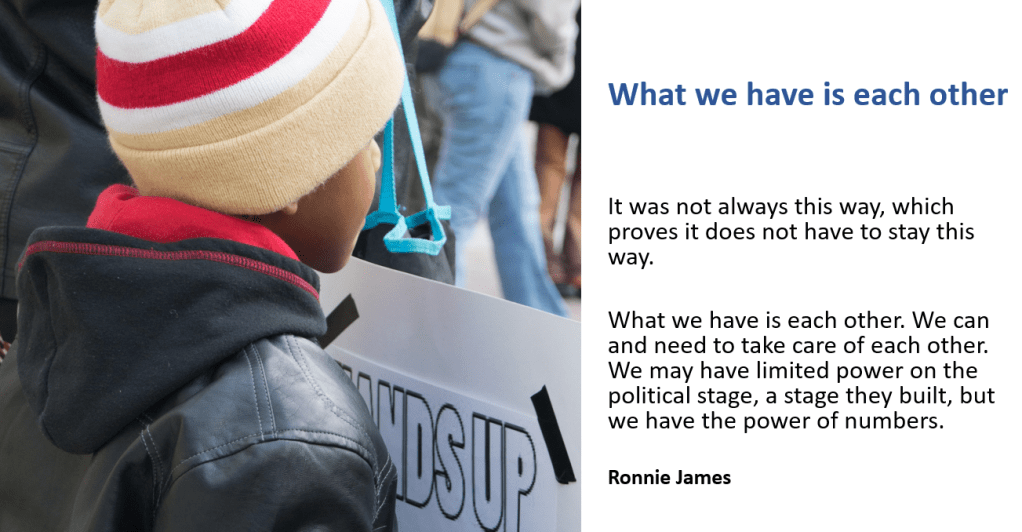
But as my friend Ronnie James, an Indigenous organizer says, “it was not always this way, which proves it does not have to stay this way.”

It is sad to realize young people today have little idea of what life was like just a few decades ago, in the times before rampant fossil fuel consumption.


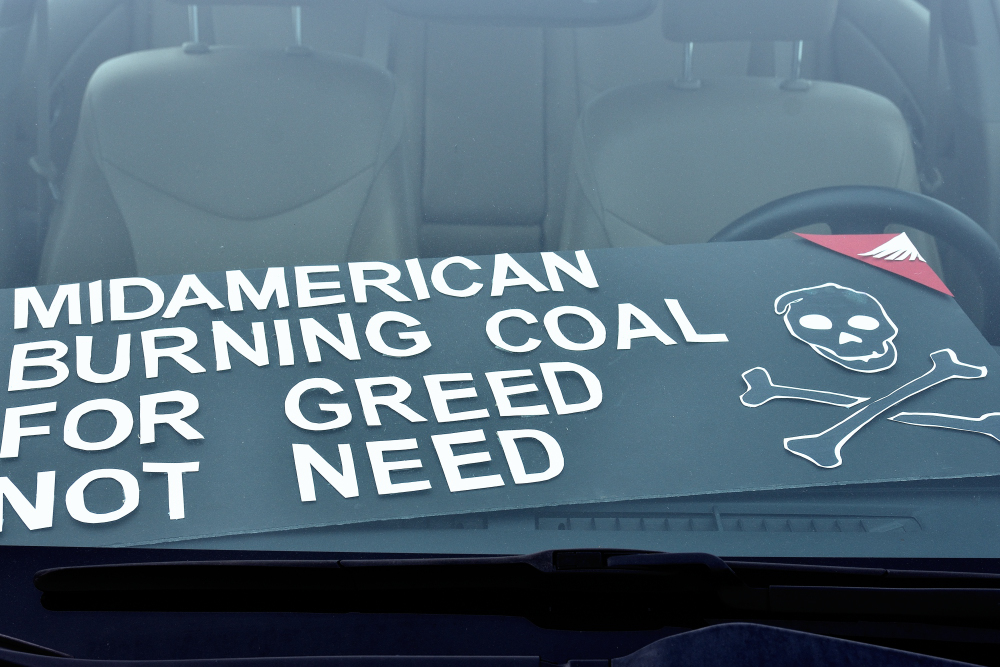
I’ve written many times about living my life without a car. And my futile efforts to get even one other person to give up theirs. To say I was discouraged is an understatement. (See the story about Cars as Weapons of Mass Destruction at the end of this article).

But then I found some hope. One of the benefits of the emerging use of the Internet was a way to learn about what others were doing and organizing like-minded people to work together. I discovered the Keystone Pledge of Resistance on the Internet.

Keystone Pledge of Resistance

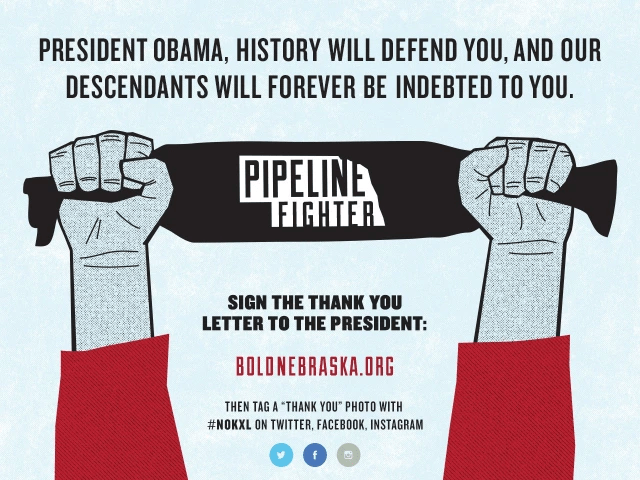
The Keystone Pledge of Resistance was an Internet campaign designed to put pressure on President Obama to deny the permit for the Keystone XL pipeline, which would carry the thick tar sands oil from Canada to the refineries on the Gulf of Mexico.

Environmentalists were having a difficult time persuading the public and industry to transition away from fossil fuels. The environmental organizations Rainforest Action Network (RAN), CREDO, and The Other 98% recognized the Keystone decision as an opportunity to both raise awareness about the dangers of tar sands and possibly even stop the construction of the pipeline. President Obama alone would decide whether to approve the pipeline’s permit, required because it would cross the US-Canada border.

The Pledge was posted on the Internet for people to sign.

“I pledge, if necessary, to join others in my community, and engage in acts of dignified, peaceful civil disobedience that could result in my arrest in order to send the message to President Obama and his administration that they must reject the Keystone XL pipeline.”

97,236 activists signed the Pledge.

Keyston resist

The brilliant part was also collecting the contact information of those who signed, creating a grass roots network.

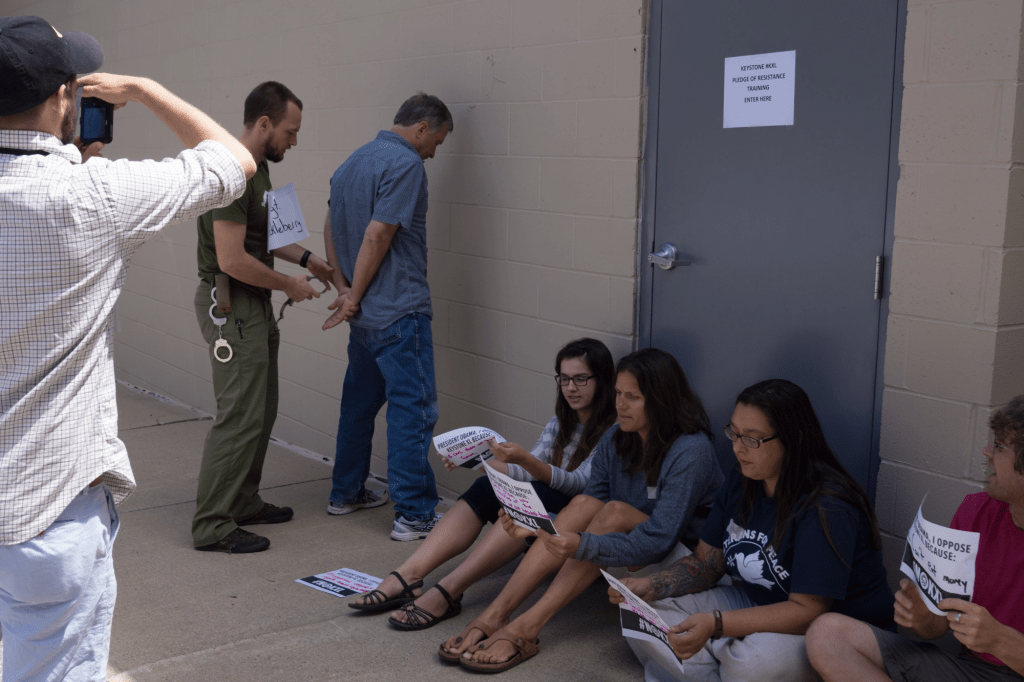
The website also asked if you were willing to lead in organizing an action in your community, which I did. The Rainforest Action Network identified the twenty-five cities that had the most people who had signed the Pledge and spent the summer of 2013 going to those cities to train Action Leaders. Indianapolis was not one of those twenty-five, but Des Moines, Iowa, was. Todd and Gabe held our training session at Iowa Citizens for Community Improvement. The syllabus took 8 hours to complete, with discussion about the pipeline, dangers of fossil fuels, theory of nonviolent resistance, legal aspects, all the necessary roles (media, police liaison, jail support and how to organize an action and train others to participate. Role playing was another part. Below we experience being handcuffed. The second day of the training involved the participants doing the training we received the day before.

You can see the syllabus for this training here: KXL_Pledge_Participant_Guide

Practicing being handcuffed for civil disobedience.

I returned to Indianapolis where three others, Jim Poyser, Ted Wolner, Wayne Moss, and I designed a nonviolent direct action at the Federal Building in Indianapolis. (We didn’t have to execute the action because President Obama denied the permit).


Jim Poyser, Ted Wolner and Jeff Kisling, Keystone Pledge of Resistance organizers, Indianapolis

Over the next several months we held training sessions for local people who had signed the Pledge, eventually training about 50 people. Nationwide about four hundred action leaders trained nearly 4,000 people. President Obama was made aware of this nonviolent “army” and its plans. All this was done in the open.

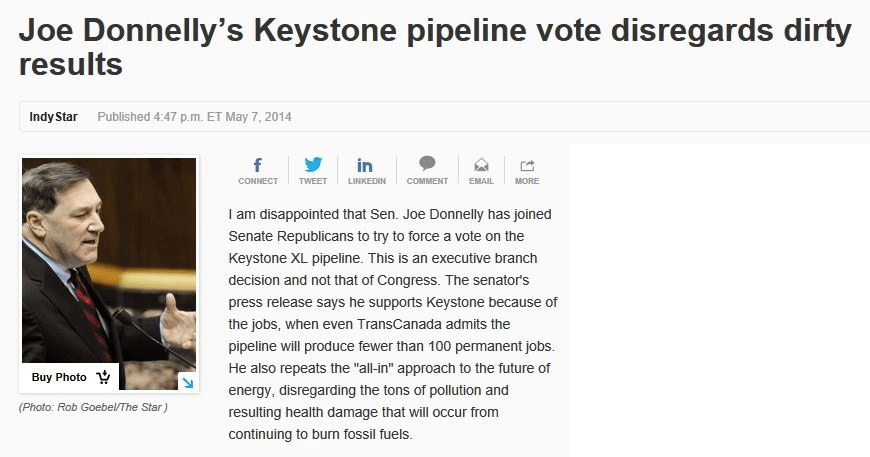
We used other opportunities to raise awareness about the Keystone Pipeline, fossil fuels and the effects of greenhouse gas emissions. The Indianapolis Star published this letter to the editor I wrote. Senator Donnelly had been talking about the jobs the pipeline would create. In reality less the fifty full-time jobs would be created. After this editorial, he didn’t talk about jobs again.

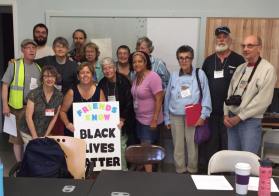
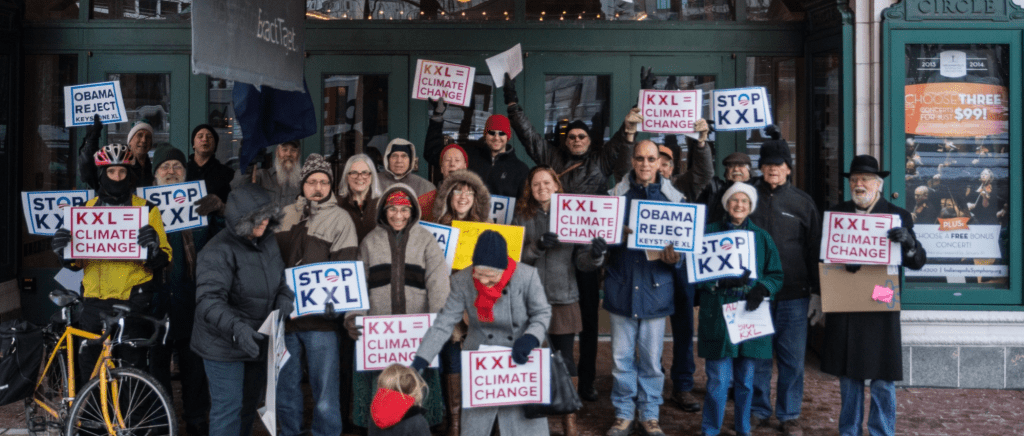
We also held multiple demonstrations related to the pipeline. Quakers from the North Meadow Circle of Friends often participated.

Stop the Keystone pipeline, downtown Indianapolis

The Kheprw Institute (KI), a Black youth mentoring community I was involved with, allowed us to hold a public meeting about the Keystone Resistance. Each of the Action Leaders spoke about why we were willing to risk arrest to stop the pipeline.

Kheprw Institute, Indianapolis

In addition, my friend Derek Glass created this video about KXL from some of my photos and a script I wrote.


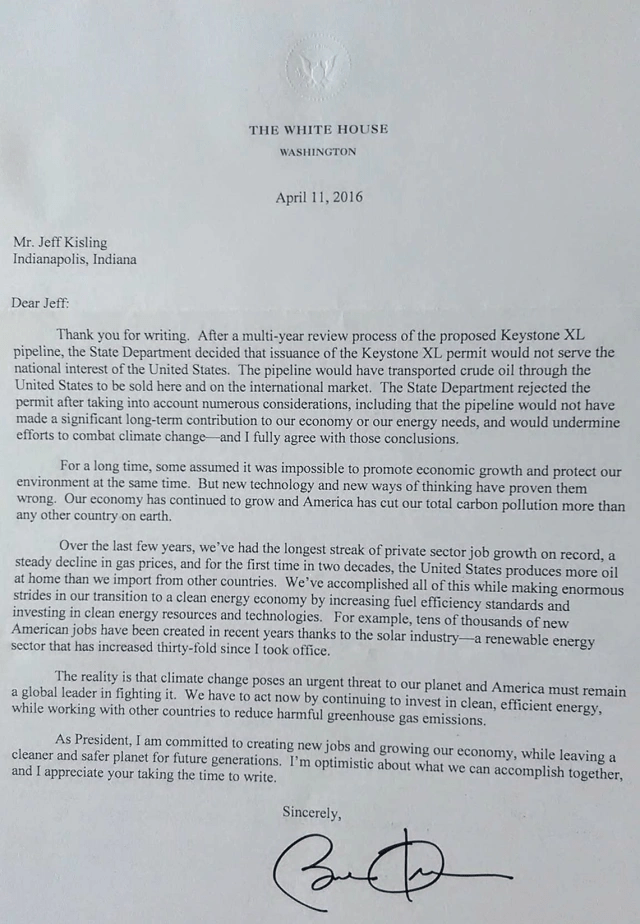
November 6, 2015, President Obama rejected the Keystone XL pipeline permit. Then on one of the first days of the Trump administration (January 2020) the pipeline permit was approved. Finally, the Biden administration revoked the permit, and TC Energy gave up on building the pipeline.

  • Keystone XL was halted (2021) by owner TC Energy after U.S. President Joe Biden this year revoked a key permit needed for a U.S. stretch of the 1,200-mile project.
  • The Keystone XL pipeline was expected to carry 830,000 barrels per day of Alberta oil sands crude to Nebraska.
  • The project was delayed for the past 12 years due to opposition from U.S. landowners, Native American tribes and environmentalists.

Keystone pipeline officially canceled after Biden revokes key permit. CNBC, JUN 9, 2021


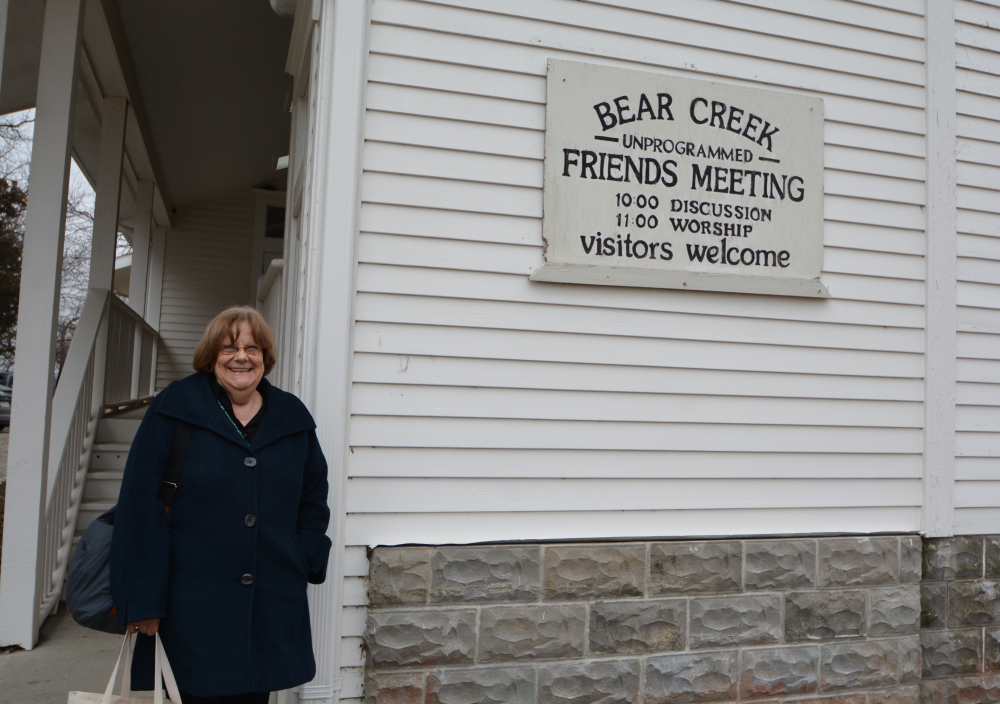
A Bear Creek Friend gave me this sign which meant a lot to me.

A more detailed account of my years of work in resistance to the Keystone XL pipeline can be found here: Lessons Learned from the Keystone Pledge of Resistance.


Summary

In summary, the Keystone Pledge of Resistance and actions against other pipelines and fossil fuel projects played a significant role in my foundational stories.

Protecting Mother Earth

Besides the greenhouse gas emissions from burning the oil transported in the Keystone and other pipelines, construction of pipelines disturbs the topsoil where the pipeline is constructed, often excellent soil in Iowa. Drainage systems are destroyed. And the clay that gets mixed in with the topsoil when the pipeline trench is refilled means the fields no long drain water well.

Photography

I learned a lot about taking photos as I documented our many actions related to the pipelines. And later used those photos when I wrote stories about the actions. You can see of some of those photos related to the Keystone pipeline resistance here: https://tinyurl.com/KeystoneResistance

I should note these days I don’t take photos at events that don’t have a public permit because law enforcement uses such photos to identify who was present.

Quaker

It was my Quaker faith that led me to be trained as an Action Lead in the Keystone Pledge of Resistance. Members of the Quaker meeting I attended in Indianapolis participated in demonstrations against the Keystone and Dakota Access pipelines.

Additionally, following are several reports and Minutes that were approved by my Quaker Yearly Meeting, Iowa (Conservative) over the years.


The following Minute was approved by Iowa Yearly Meeting (Conservative) in 2017.

 Radically reducing fossil fuel use has long been a concern of Iowa Yearly Meeting (Conservative). A previously approved Minute urged us to reduce our use of personal automobiles. We have continued to be challenged by the design of our communities that makes this difficult. This is even more challenging in rural areas. But our environmental crisis means we must find ways to address this issue quickly.

Friends are encouraged to challenge themselves and to simplify their lives in ways that can enhance their spiritual environmental integrity. One of our meetings uses the term “ethical transportation,” which is a helpful way to be mindful of this.

Long term, we need to encourage ways to make our communities “walkable”, and to expand public transportation systems. These will require major changes in infrastructure and urban planning.

Carpooling and community shared vehicles would help. We can develop ways to coordinate neighbors needing to travel to shop for food, attend meetings, visit doctors, etc. We could explore using existing school buses or shared vehicles to provide intercity transportation.

One immediately available step would be to promote the use of bicycles as a visible witness for non-fossil fuel transportation. Friends may forget how easy and fun it can be to travel miles on bicycles. Neighbors seeing families riding their bicycles to Quaker meetings would have an impact on community awareness. This is a way for our children to be involved in this shared witness. We should encourage the expansion of bicycle lanes and paths. We can repair and recycle unused bicycles, and make them available to those who have the need.


Although we have tried to find ways to promote environmental concerns, such as supporting Environmental Protection Agency (EPA) regulations, engaging with the Occupy Movement, and protesting the Keystone XL Pipeline, it has become increasingly clear that traditional approaches to creating political change are not working well. Civil liberties are being eroded, making it more difficult to petition for change.
We have been trying to understand a system of irresponsible actions on the part of policy makers across the developed world related to the environment and our changing climate. It is painful to conclude that concern for each other and the environment has largely been replaced with protecting and promoting economic growth and profit without regard to the environmental consequences.

Report of the Earthcare Subcommittee, Iowa Yearly Meeting (Conservative) 2012

ENVIRONMENTAL STATEMENT OF CONCERN
Addendum to Peace and Social Concerns Committee Report 2013

[It was agreed in business session that this statement was too long to be
read and discussed and that instead it could be used as a resource and as
background material to the minute proposed by the Peace and Social
Concerns Committee and approved by the yearly meeting on Seventh
Day.]


Every good that we can do, every good that we can imagine
doing, will be for naught if we do not address climate change.

Van Jones, Rebuild the Dream, February 2013


We, members of Iowa Yearly Meeting (Conservative) of the Religious Society of Friends (Quakers), are dismayed at the damage that has been done, and continues to be done, to our environment.

The widespread availability of refined fossil fuels began to revolutionize societies worldwide early in the last century. Progress came to be defined as the development and use of a vast array of products and devices to make work and living tasks easier or to do things that weren’t
possible before. Initially the industrial revolution resulted in widespread employment, but eventually human labor was largely replaced with work done by machines, which were either directly powered by gasoline or indirectly by electricity which was usually produced by fossil fuel.

One huge effect of this was the migration from the farm to the city. Very inexpensive gasoline and the availability of personal automobiles led to urban development that assumed people would travel some distance from their homes to get to work, school, grocery stores and other businesses. That requires the use of significantly greater volumes of fossil fuel for daily life and a sprawling infrastructure of highway, water, waste, and electrical systems, and emergency and other services.

A culture evolved that changed priorities to material consumption and convenience. Business profits from that became the key drivers of economic and political policies. This move to cities tended to disconnect people’s close relationship with nature, and environmental consequences
of these changes were purposely minimized. Businesses did not want protecting the environment to impact profits, so subsidies (tax incentives, price controls, favorable trade regulations, etc.) were employed to hide the true costs of energy and water production. Environmental concerns were not the priority when they conflicted with profits. We didn’t have
ways to understand, quantitate, and price environmental damage.

There are three major problems we are now facing as a result of this:

  1. We are passing the point of peak oil production. Supplies of this nonrenewable resource are dwindling, and it will be much harder to extract the fossil fuel supplies that are left (such as tar sands). Energy return on energy investment (EROEI, or EROI) is an important concept, being the ratio of the amount of usable acquired energy divided by the energy expended to
    produce that energy. Hydroelectric power has an EROEI of 100. In the early days of easy oil extraction, oil’s EROEI was about 100, but has been falling steadily, and was 19 by 2006. Tar
    sands’ is making it hard to justify extracting it.
  2. Our economic system is dependent on continual growth. We are reaching limits to available resources to sustain that growth. Much of industry has replaced human and animal
    labor with fossil fuels and is not prepared for rapidly increasing costs and decreasing supplies of energy and water. Widespread unemployment is the root of many social problems and injustices today. Through tax laws and business regulations, this economic
    system is facilitating greater inequities in the distribution of wealth.
  3. Greenhouse gas (GHG) emissions are increasing. Carbon dioxide (CO2), primarily from burning fossil fuel, and methane (from animal digestive gases and released from thawing
    frozen deposits) trap heat in the atmosphere. That is what has kept earth air temperatures moderate. But rapidly increasing atmospheric greenhouse gas concentrations are increasing the atmospheric temperature. The consequences include melting ice caps, which results in less sunlight reflected off the ice and more heat absorbed by the earth’s surface, rising ocean water levels from the melting ice, and release of methane deposits that had
    been frozen, further increasing greenhouse gases in the atmosphere. These changes also affect ocean currents and are thought to be contributing to changing weather patterns. Warmer air holds more water. Less water returned to the earth as rain and changing precipitation patterns are contributing to desertification of some areas of the earth.

The two major ways CO2 is removed from the atmosphere (known as carbon sinks) are by:

  1. Photosynthesis of plants: Chlorophyll combines CO2 from the air with water to produce sugar and oxygen. Destruction of forests decreases this carbon sink, reducing CO2 removal (as well as decreasing oxygen production).
  2. Absorption into the ocean: CO2 combines with water to form carbonic acid. Increasing atmospheric CO2 leads to increased CO2 absorbed into the ocean, resulting in abnormal
    acidification of the ocean, which damages coral reefs and other marine life.

Unfortunately, the rate at which carbon sinks remove CO2 is significantly slower than the rate at which CO2 is being added. It is estimated that it takes about 100 years to remove CO2 after it has been added to the atmosphere. The over 14 TONS of CO2 dumped into the atmosphere by the U.S. alone in a 24 hour period will remain there for nearly 100 years, unless ways are found to increase CO2 extraction. For example, some progress is being made in developing artificial
photosynthesis, but the impact this could have on CO2 removal is not yet known.

Public education is required so that informed personal decisions and economic policies can be made. Protecting and restoring our environment must become the primary goal of political and economic policies. Addressing greenhouse gas emissions and preserving our water and food supplies must become our overriding principles. As a case in point, it is crucial that the Keystone pipeline to transport tar sands oil from Canada to the U.S. Gulf Coast not be built. CO2 from burning tar sands oil must not be added to the atmosphere, and the very high risk of contamination of the Ogallala aquifer, the primary water supply for many f the Great Plains states, cannot be justified. The construction of the Keystone pipeline has become the defining issue for our future direction. Ecocide refers to the destructive impact of humans upon the
environment, leading to human extinction. Many believe we must immediately stop greenhouse gas emissions if we are to have any chance of avoiding ecocide. Construction of the Keystone pipeline will both signal that environmental concerns will continue to be systematically
denied and likely assure that ecocide will occur. Some Friends are engaging with others in acts of civil disobedience to try to stop construction of the Keystone pipeline and raise awareness of the
consequences of building it. This is seen as an opportunity to make others aware of the climate catastrophe that continued fossil fuel extraction and use represents.

Similarly, hydraulic fracturing (fracking) for buried natural gas inserts toxic chemicals into the earth that are polluting drinking water supplies.

Approved Minute:
Iowa Yearly Meeting (Conservative) opposes the practices of both tar sands extraction and hydraulic fracturing.

Conservation (reducing use and recycling) is one of the most efficient and readily available ways to conserve energy and other resources.

Simple supply and demand will inevitably result in rapid and dramatic increases in the cost of fossil fuel products and water. Because so many sectors of the present economy rely on cheap energy and water, severe stress, and possibly even collapse of this system, will occur. Widespread travel will significantly decrease as result of both the scarcity and cost of fossil fuels. Transoceanic transport of food and other goods will cease. Changing weather patterns, droughts, desertification, pollution, and increased energy costs will increase the cost of water, since a great deal of energy is needed for water distribution. Distribution of goods, especially food, will be severely impacted. Social unrest will result.

In broad terms, a cultural shift is required to reverse what led to this point. The recent cultural shift toward secular materialism does not reflect Friends’ values. In addition, we are faced with the moral travesty of consuming nonrenewable resources and the additional environmental
damage done in the process, knowing at least some of the catastrophic effects this will have on future generations. Since this cultural and economic model is not sustainable, as it fails, we have an opportunity to help move toward a more nearly equal and socially just society. We should examine our own lives, and how our lifestyle could be changed.

Two minutes have been approved by the yearly meeting (2008, 2012) that address these issues. As they state, one of our goals is to reduce the use of or get rid of personal automobiles. It is obviously significantly more efficient to share public transportation vehicles, more and more of which use alternatives to fossil fuels. Each time we think of travel, we should consider alternatives to using a car, such as walking, bicycling, or using public transportation. Bicycles in particular can easily cover significant distances without great effort and are at the same time good exercise, as well as being enjoyable to ride. Adult tricycles are available for those who need the extra stability. Various devices can be used to help carry things like groceries. Pedal-powered trolleys can be found in more and more cities. We can encourage shared bicycle systems in our communities and the development of bicycle paths through city streets. Friends meetings should encourage bicycling, including providing bicycle racks and perhaps offering help with bicycle maintenance. This can be a visible witness.

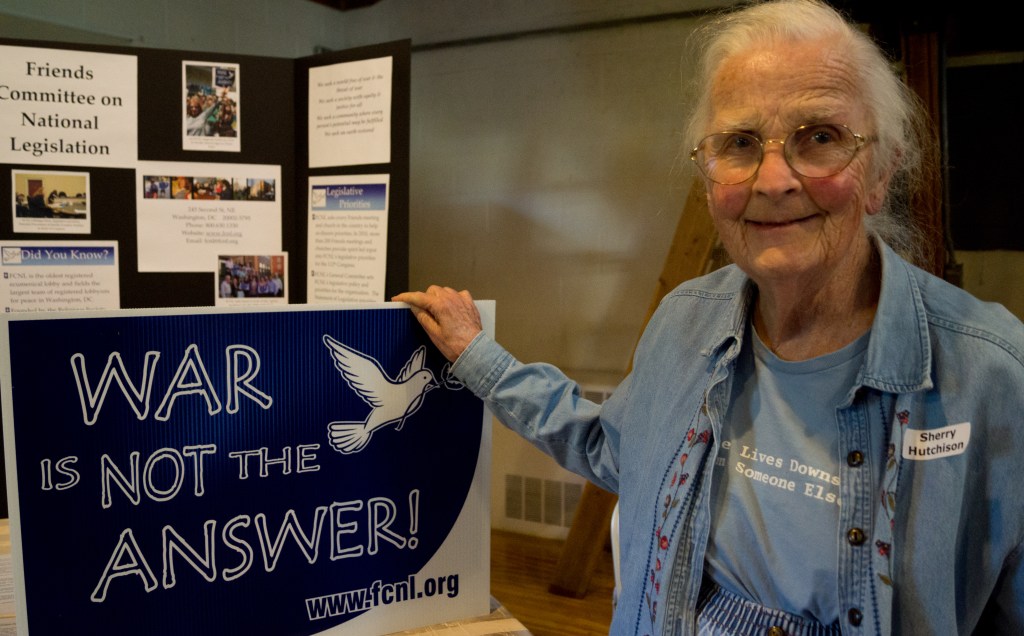
Jeff Kisling and Sherry Hutchison, co-clerks
Peace and Social Concerns Committee


Sustainable Indiana staff include John Gibson, Jim Poyser, Shannon Anderson, Judy Voss and Richard Clough.  They have appeared in many of my blog posts, because they are involved in so many environmental efforts.  John and Jim were very active in the Keystone Pledge of Resistance, and they have all been involved in Indiana Moral Mondays and many other projects.

“Sustainable Indiana 2016 is a Indiana  Bicentennial Legacy Project of Earth Charter Indiana.  Our mission has been to collect and celebrate stories of people who are taking the lead on a sustainable future in Indiana.  This book contains some of those stories, for Hoosiers and by Hoosiers, to serve as a guide to a future that gives us a deeper and healthier connection to our environment and each others.”

They were kind enough to include one of my stories, Cars as Weapons of Mass Destruction in the Transportation chapter.

My foundational stories: 1970’s

My previous post was a description of the beginnings of my foundational stories, which related to the intersection between my Quaker faith, protecting Mother Earth, and photography. The intention of this series of articles is to show how these foundational stories changed over time.

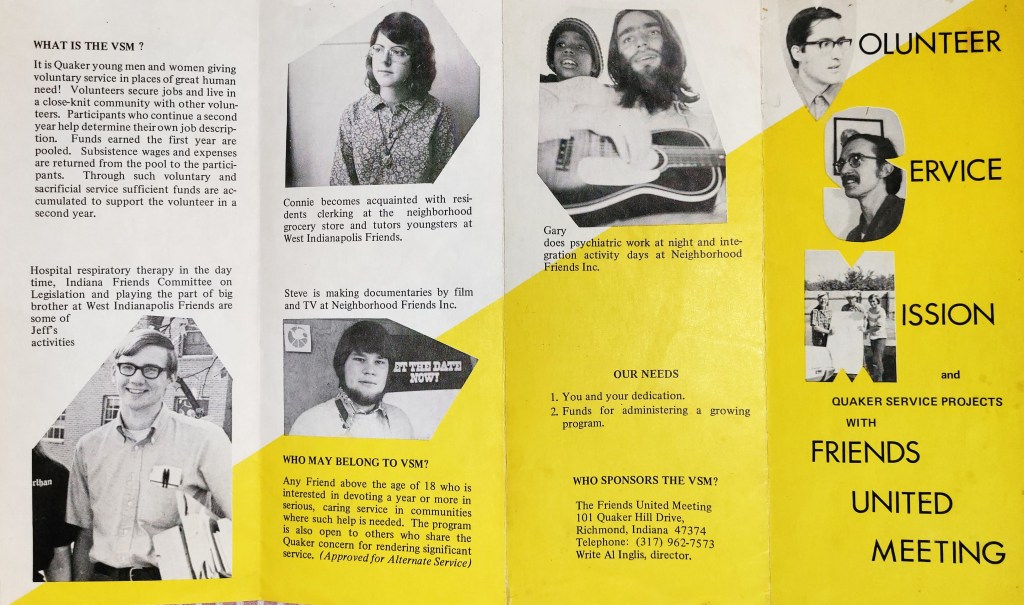
The beginnings of the stories were about my struggles and eventual decision to resist the draft. Although I wasn’t prosecuted for that felony offense, there were other consequences. During the time it took for my family to adjust to my intention to resist the draft, I joined the Friends Volunteer Service Mission (VSM) in inner city Indianapolis in 1971. This was a Quaker part of my foundational story.

Quaker

VSM was set up to provide alternative service work for conscientious objectors. The two-year program involved working at the type of job that qualifies for alternative service, most often in a hospital. And saving enough money from that job to support yourself to work full time in the community. Others, not doing alternative service, were also able to apply.

VSM was impactful in my life in two ways. The work I found was in respiratory therapy, then called “inhalation therapy”. I received on-the-job training to do this work during my first year at VSM. After my VSM experience, I obtained a degree in respiratory therapy and worked for about five years as a neonatal respiratory therapist. And for the rest of my career worked in an infant pulmonary function research lab.

VSM was also where I began to learn important (foundational) lessons about community organizing, Quaker faith in action. Others at VSM did what I thought of as traditional organizing, which included many meetings about setting up a neighborhood health clinic or trying to prevent the construction of an interstate highway through the local community.

I quickly found I didn’t like that type of community organizing. And felt a little guilty that I didn’t. But I eventually discovered what kind of community organizing I was led to do. During my first year at VSM I spent a lot of time with the kids in the neighborhood. The VSM house was next to Second Friends Church, which had a nice yard where we played games like capture the flag. One of our VSM projects involved setting up a basketball hoop in front of the garage of the church.

There were no programs for kids in the neighborhood and I really enjoyed working with them. When thinking about what to do during my second year at VSM, it became clear I should continue to work with the kids full time. We organized a 4-H club, went swimming, and rode bicycles to shopping centers, where we played “wall ball” on the walls at the back of the stores.

This would determine my approach to social justice work for the rest of my life. What was important was being in the communities where the work was to be done. And to focus on building friendships.


Photography

At VSM, there became another way photography became important in my life. I knew how to set up a basic darkroom and did that in the VSM house bathroom. Photography became one of the kids’ favorite things to do. We would ride around the city on bicycles with a couple of (film) cameras. Then develop the negatives and print the photos. I can still see the wonder in their faces as the image gradually appeared on the paper (in the red light of the darkroom).

Now, fifty years later, on two separate occasions, kids from that time found me on Facebook. They both talked about those darkroom experiences.


Protecting Mother Earth and photography

During this time in Indianapolis (early 1970’s) I didn’t have a car, simply because I couldn’t afford one. So, riding a bicycle everywhere, including to the hospital for work, was my routine.

But moving to Indianapolis had a major (foundational) impact on me, which influenced the rest of my life. I couldn’t believe how foul the air was. I saw clouds of fumes pouring out of the exhaust of every car. This was before the availability of catalytic converters, which cut out the visibility of the exhaust, but didn’t stop the greenhouse gas emissions. No one was talking about global warming and greenhouse gases then.

But I had a profound vision of clouds of pollution blocking the view of my beloved mountains. Specifically, obscuring Long’s Peak in this photo I took and developed around the time I moved to Indianapolis. That horrific vision stayed with me the rest of my life. As a consequence, I refused to have a personal automobile for the rest of my life. (Protecting Mother Earth).

Long’s Peak, Rocky Mountain National Park, Colorado

These are more of the ways my foundational stories are about the intersection between my Quaker faith, protecting Mother Earth, and photography.