I was searching for a way to describe what WE experienced during OUR Buffalo Rebellion Climate Summit this weekend. A moment reminiscent of the times of the civil rights and anti-war movements which brought together thousands of people and created change. This weekend a coalition of people and organizations came together to rise to the challenges of rapidly evolving environmental devastation and collapse of the systems of capitalism and white supremacy.
As I wondered whether to write “what WE experienced” versus “what I experienced” I realized this was emblematic of what the Buffalo Rebellion is about. Dare WE hope? In its simplest expression, we need to change from “I” to “We” in all we do.
Those of us who have been working to protect Mother Earth are more aware than the general public of the breadth and depth of damage being done. More alarmed, more discouraged after years of work with little apparent progress.
The COVID pandemic made us more isolated and made it difficult to safely do our organizing work. Although our Des Moines Mutual Aid community never stopped distributing free food every week. We strictly enforced wearing masks and gloves and attempted to maintain social distancing by limiting the number of volunteers.
As an example of how long some of us have been working to protect our environment, fifty years ago I was led to refuse to own a car. I’m not aware of that changing other people’s lives.
In 2013 the Keystone XL pipeline struggles began to bring some people and organizations together. One group was known as the Cowboy-Indian Alliance.
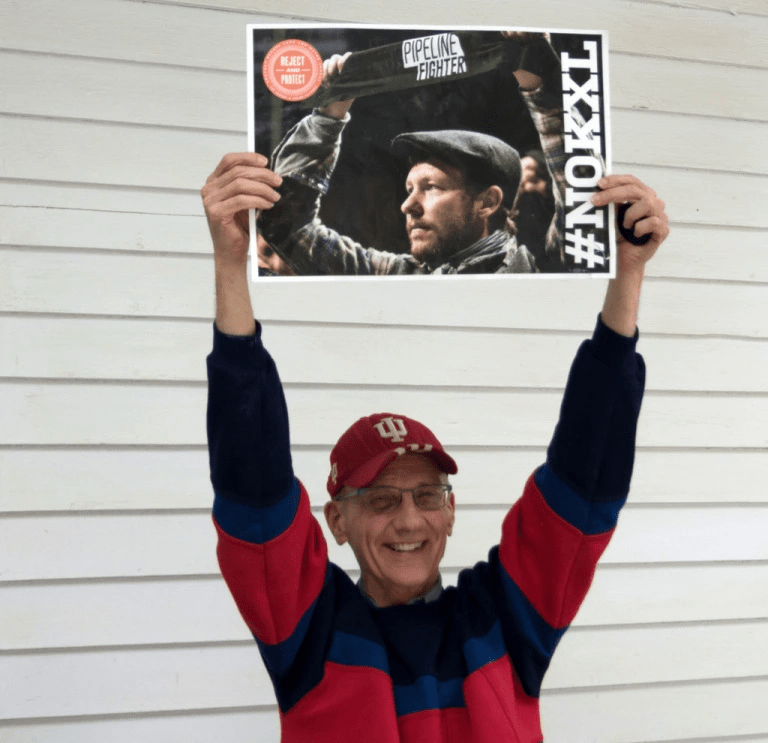
What little I learned about native cultures showed peoples who lived with far more integrity than I was able to. When I first became engaged with fossil fuel and pipeline resistance in 2013, I began to hear stories of Indigenous peoples working to protect the water. The Cowboy-Indian Alliance came together to oppose the Keystone XL pipeline. I was honored to be given this poster from the 2014 Harvest the Hope concert. [See: The Cowboy and Indian Alliance.]
It was clear to me and others that nonnative folks needed not only to join with Indigenous peoples but be led by them. How to make that happen?
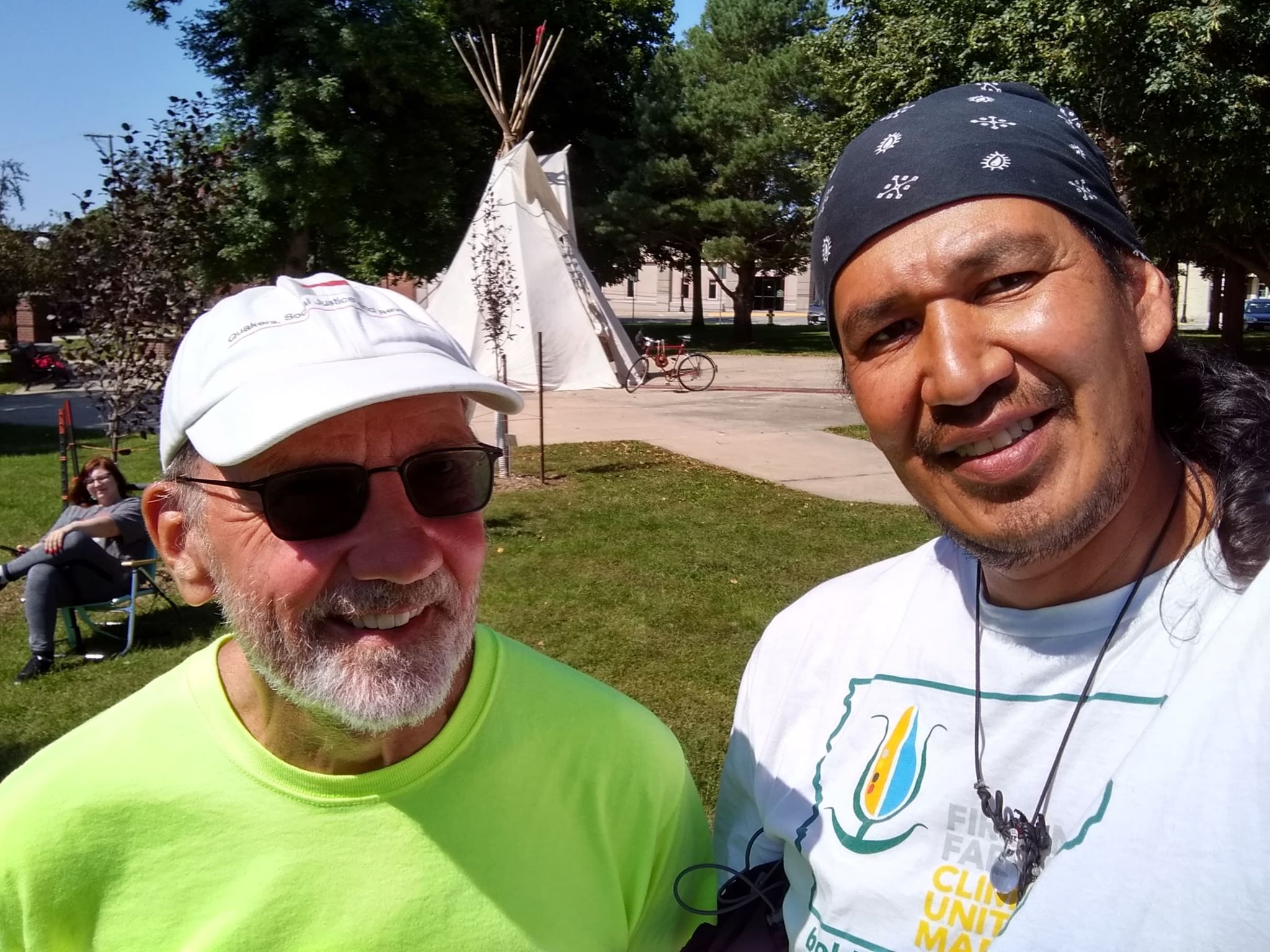
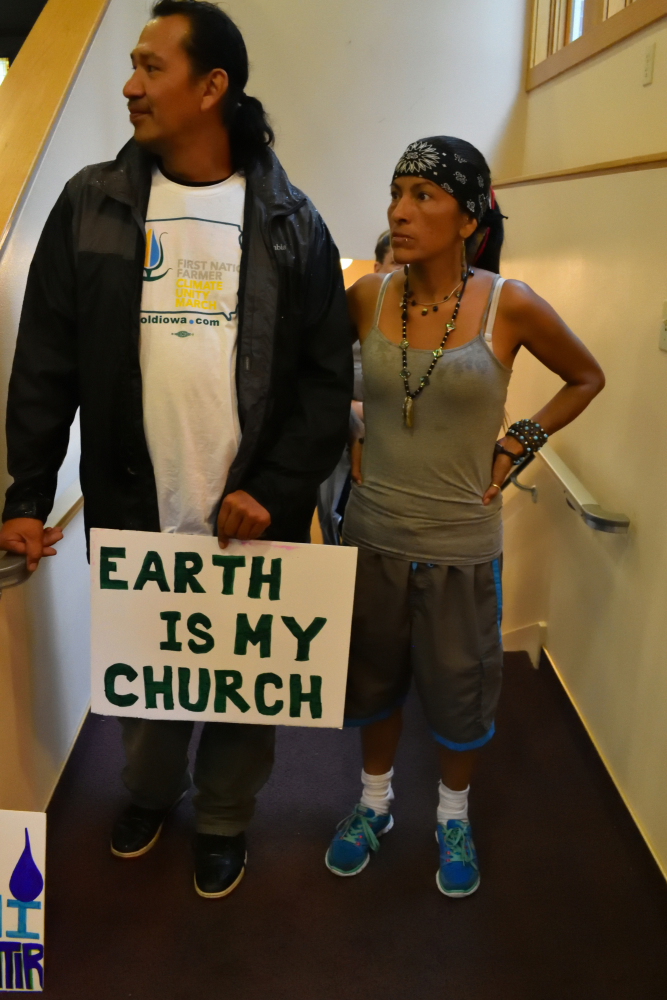
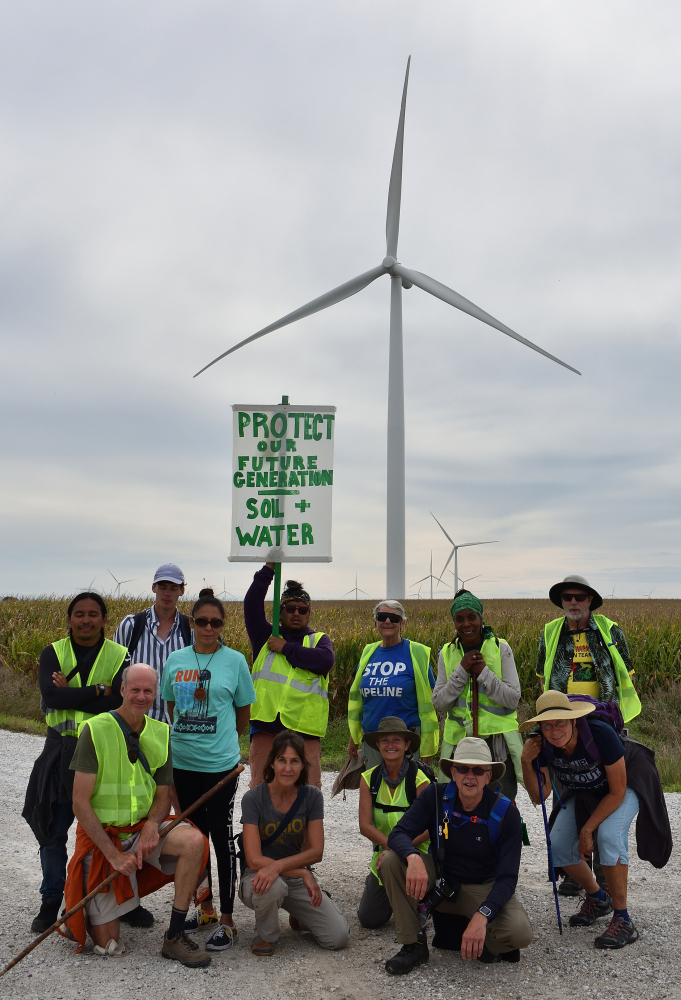
Indigenous Iowa and Bold Iowa organized the First Nation-Farmer Climate Unity March in 2018, with the intent of providing a small group of native and nonnative people the time to get to know each other, so we could begin to work on issues of common interest and concern. We walked and camped for eight days along the path of the Dakota Access pipeline from Des Moines to Fort Dodge, Iowa, ninety-four miles. [see stories and photos from that sacred journey here: First Nation Famer Climate Unity March]
A number of us worked on various projects together since, strengthening our friendships. A number of those on that March are involved in the new coalition, the Buffalo Rebellion. That includes Sikowis Nobiss, Mahmud Fitil, Trisha Entringer, Donnielle Wanatee, Miriam Kashia, Peter Clay and me.
I plan to write a lot about the Buffalo Rebellion but wanted to begin with this introduction.
I believe the answer to the question posed by this post, Dare WE hope? is yes.
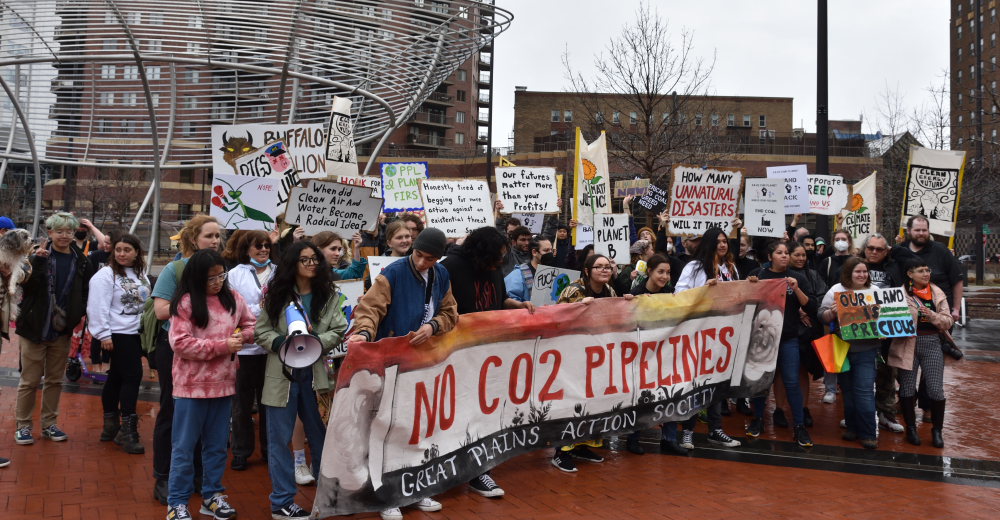
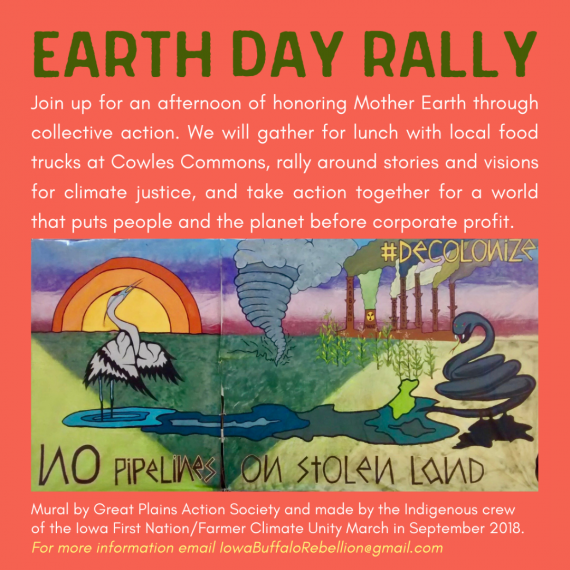
I’m excited about attending this Earth Day Rally organized by the Buffalo Rebellion. And attending the immersive training Saturday and Sunday. The organizations that make up this coalition can be found below.
We believe that we must address the root of climate change, insatiable corporate greed and white supremacy, to make change happen. This will require a multi-racial movement of working people struggling together to upend politics as usual.
This Earth Day, millions of people are demanding that world leaders take the crises we’re facing seriously.
If you listen to Iowa Public Radio today, you’ll hear about Buffalo Rebellion, an exciting new coalition of Iowa organizations working to grow a movement for climate action that centers racial and economic justice.
This weekend, Buffalo Rebellion is holding two-days of immersive training to develop 100 grassroots leaders who will build local teams to take on climate justice issues in their community.
But first, we want to come together for an afternoon of honoring Mother Earth through collective action.
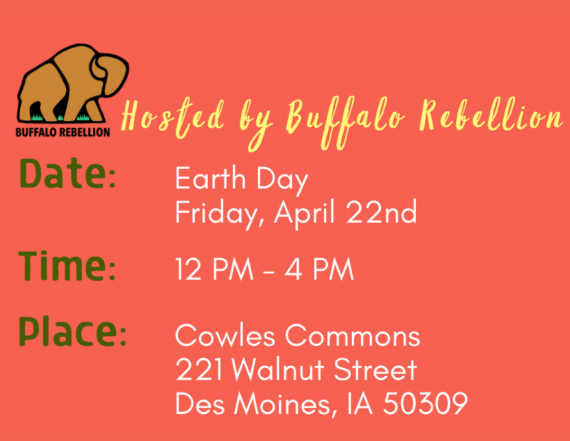
WHAT: Honor Mother Earth Rally & Action! WHEN: Friday, April 22 from 12 pm – 4 pm 12 pm – we’ll gather for lunch with local food trucks at Cowles Commons, 1 pm – rally around stories and visions for climate justice, 1:45 pm – we’ll take action together for a world that puts people and the planet before corporate profit. WHERE: Cowles Commons, 221 Walnut St, Des Moines, IA 50309 DETAILS TO KNOW: The event will happen rain or shine (forecast looking ok though)! Bring money for lunch (or bring your own) and parking (parking maps and info here). The action will consist of a <1 mile march. Family friendly, the action is youth-led. WHY: The latest IPCC report continues to make the path forward very clear: it’s either people and the planet or fossil fuels. It’s up to us to build power and push our leaders to action. For a brighter future,
We believe that we must address the root of climate change, insatiable corporate greed and white supremacy, to make change happen. This will require a multi-racial movement of working people struggling together to upend politics as usual.
“Iowa has been made into a sacrifice zone by government sanctioned Big-Ag corporations, which have a stranglehold on the climate and environmental legislation. Colonial-capitalist farming practices are poisoning our water, depleting the soil, and are a leading contributor to Iowa’s greenhouse emissions causing climate chaos.” – Sikowis Nobiss, Plains Cree/Saulteaux, Executive Director, Great Plains Action Society
Buffalo Rebellion was formed in November 2021 and consists of: Great Plains Action Society DSM Black Liberation Movement Iowa Migrant Movement for Justice Sierra Club Beyond Coal Sunrise Movement Cedar Rapids SEIU Local 199 and Iowa CCI.
The coalition is part of the national Green New Deal Network.
If you’re interested in attending the training potion of the summit or have any other questions, please email us at IowaBuffaloRebellion@gmail.com.
I had forgotten Bayard Rustin had been incarcerated for draft resistance. He joins the list of those who have written about their prison experiences such as Henry David Thoreau and Martin Luther King, Jr.
In March 1948, Bayard T. Rustin, in his capacity as secretary of FOR’s Racial-Industrial Department, was honored with the opportunity to deliver the William Penn Lecture as part of the Young Friends Movement of Philadelphia Yearly Meeting. Since its inception in 1916, the William Penn Lecture had been given by several Quaker luminaries. The lecture, titled “In Apprehension How Like a God” (drawing on Shakespeare’s Hamlet), touched on many Quaker values but, more importantly, the moral and pragmatic lessons Rustin had learned while incarcerated for two years in Kentucky and Pennsylvania federal prisons for refusing induction into the military.
In his lecture, Rustin reminded Friends of the need to uphold their moral responsibility with integrity as individuals and within the broader community whenever witnessing and confronting domestic or global social injustices. Rustin implored Friends toward consistency and truthfulness in the face of violence, war, and oppression.
In the magazine, Ithaca College’s Carlos Figueroa looks back at an important talk Bayard Rustin gave to the young Friends association in Philadelphia in 1948. It was a pivotal moment in a life that contained so many: Rustin had spent the early 1940s organizing with the Fellowship of Reconciliation and was recently released from a prison term for violating the Selective Service Act. This was his opportunity to lay out a pacifist politics for the Cold War era:
Rustin explicitly sought to persuade others into considering civil disobedience as a social democratic strategy for pursuing structural and policy change. Rustin advocated for a humanitarian, communal, and moralistic approach to change, thus disregarding an individual’s political affiliation, geographic location, or government system.
Rustin explicitly sought to persuade others into considering civil disobedience as a social democratic strategy for pursuing structural and policy change.
From the introduction of the QuakerSpeak video below: As a gay African-American, civil rights activist Bayard Rustin faced discrimination his entire life—sometimes, Walter Naegle reminds us, among his fellow Friends. Walter, Rustin’s partner and companion in his final decades, discusses his vital contributions to Quaker testimony of peace, integrity and equality.
“Bayard believed in the oneness of the human family, in the brotherhood and sisterhood of all people,” Walter says. “He believed in the power of nonviolence which comes out of that belief in the oneness of all people.… He saw everybody as equal in the eyes of the divine.”
“I put my life on pause, rewound, now I’m pressing play. The come up, grinding until the sun up, knowing it could all be gone if one person puts their guns up. A black Quaker no savior, I’m on my Bayard Rustin to convince all the skeptics and get people to just trust em.”
Sterling Duns
I’m reminded of a teach-in by my friend Ronnie James, The Police State and Why We Must Resist. “As bleak as this is, there is a significant amount of resistance and hope to turn the tide we currently suffer under.”
I’ve been working on this post for days, which is unusual. Not quite sure how these seemingly disparate parts fit together. In part because there will increasingly be direct actions related to environmental devastation. I’ll be attending a Climate Summit this weekend, which will include training for and participation in direct action.
In 2020, President Biden told voters, “no more drilling on federal lands, period.” Yesterday the Biden administration broke that promise, saying it will resume selling leases to drill for oil and gas on federal lands.
The fossil fuel industry has found new life as the energy consequences of the war in Ukraine are being used not as an opportunity to wean off oil production, but the opposite; to ramp up fossil fuel development.
“Investing in new fossil fuel infrastructure is moral and economic madness,” UN Secretary-General António Guterres said as the Intergovernmental Panel on Climate Change (IPCC) released part of its latest report on Monday.
Humanity confronts a great dilemma: to continue on the path of capitalism, depredation, and death, or to choose the path of harmony with nature and respect for life.
Jake Grobe
“It is never a good sign when the President announces something at 5pm on a Friday. But President Biden can’t get away with this disastrous climate decision. The fact of the matter is that more drilling won’t solve high gas prices right now – so why is Biden breaking his campaign promise to stop drilling on public lands?
“This is why young people are doubting the political process altogether. If Biden wants to solve for voter turnout in 2022, he should actually deliver on the things he promised, not move farther away from them. On November 8, 2022 we don’t want to hear anyone asking why young people didn’t vote. Biden is actively turning voters away. If we’re going to combat fascism and win in 2022, he must be a leader and course correct. This election and our futures depend on it.”
In 2020, President Biden not only ran and won on a bold climate agenda, but told voters, “no more drilling on federal lands, period.” Today, his administration is expanding drilling on public lands, stalling on climate legislation and concurrently, his approval ratings are plummeting, especially among young people.
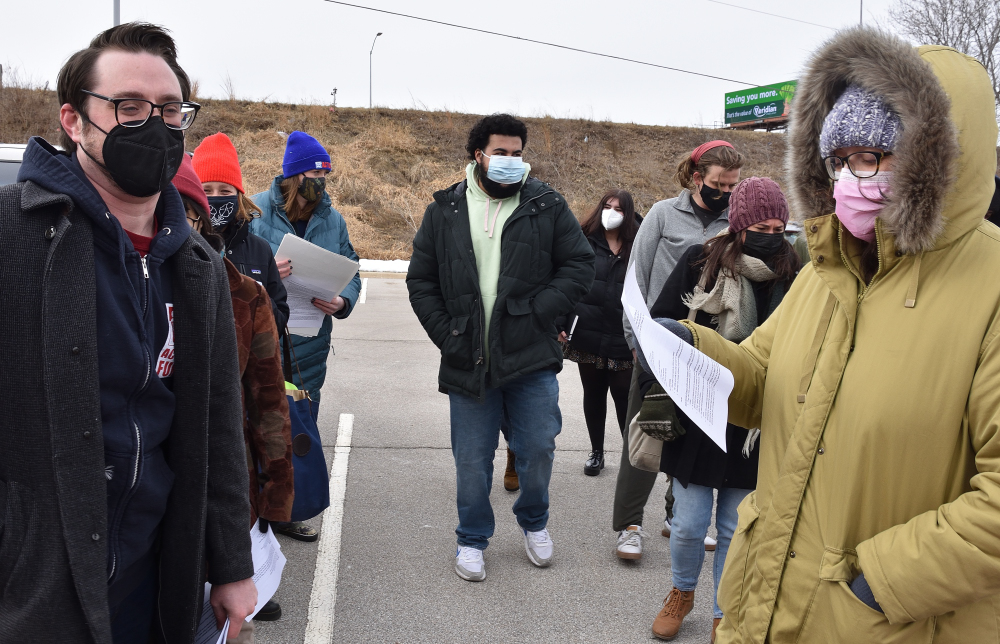
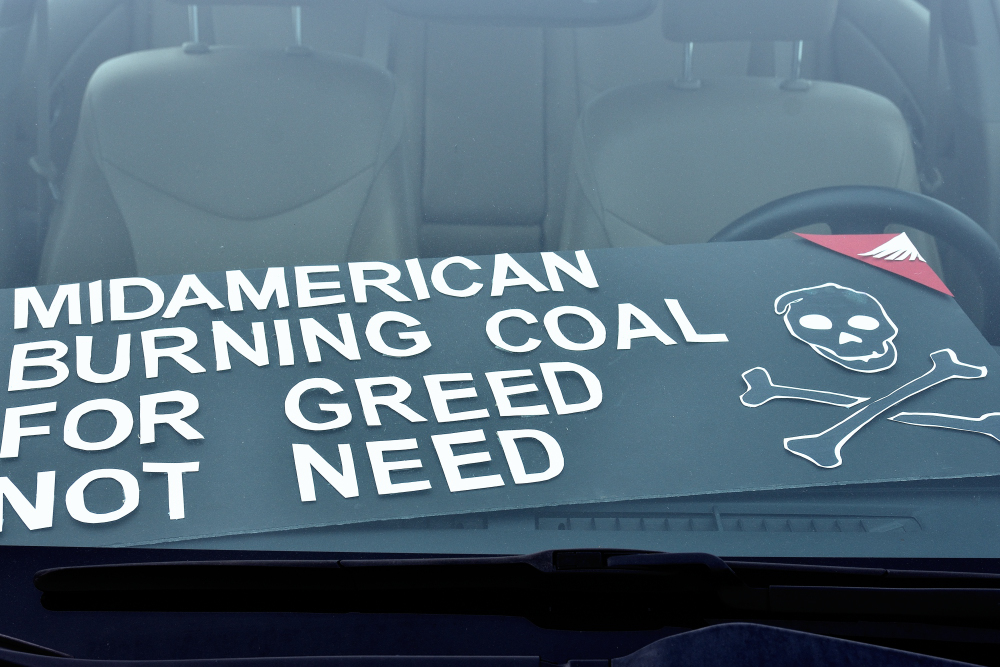
Iowa Citizens for Community Improvement is working to get 1,000 of us to sign this petition to make the Des Moines City Council demand MidAmerican Energy commit to stop burning coal. MidAmerican is negotiating a new franchise agreement with Des Moines to secure a monopoly on supplying the city with energy.
Right here in Iowa, we have an incredible opportunity to significantly cut carbon emissions that are contributing to the devastating effects of climate change. But we’re going to have to up the ante if we want to succeed.
We need to demonstrate widespread community support to push our elected leaders to action. Organizationally, we want to add 1,000 petition names to this effort to put pressure on city council and to build our people power.
For the people and places we love, and the whole damn planet, Jake Grobe (he/him) Climate Justice Organizer
P.S. We know a petition alone will not get us the change we need. Join us on Earth Day, Friday, April 22nd to take our message directly to Iowa’s biggest carbon polluter. Learn more and RSVP here.
My friend Jake Grobe is ICCI’s Climate Justice Organizer. From his bio: He believes that climate justice is an intersectional fight for racial, economic, and social justice. “Humanity confronts a great dilemma: to continue on the path of capitalism, depredation, and death, or to choose the path of harmony with nature and respect for life.”
Des Moines needs to follow through on 100%, 24/7 carbon-free electricity resolution
Target: Des Moines City Council
Last year the community made it loud and clear that we need climate action now. We were pleased to see Des Moines City Council follow suit by passing a resolution for 100%, 24/7 carbon-free electricity by 2035.
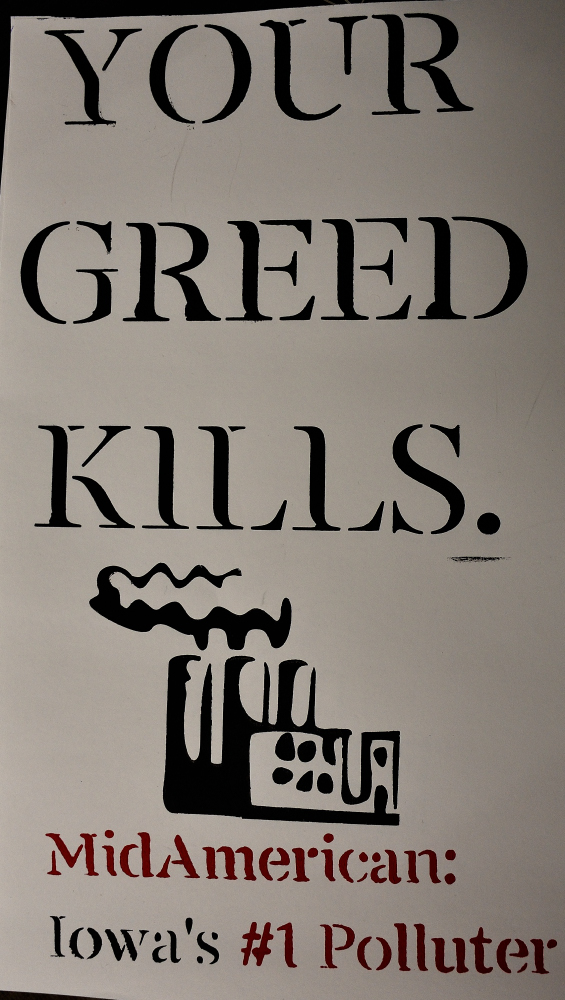
Now it’s time to make this goal a reality, but MidAmerican Energy – Iowa’s biggest carbon polluter and monopoly energy corporation – has publicly stated they’re planning to burn coal until 2049.
The choice is simple. We can work together to decarbonize our energy system as quickly as possible to prevent the worse effects of the climate crisis, or we can continue burning coal to extinction.
Right now, MidAmerican Energy is negotiating a new franchise agreement with Des Moines to secure a monopoly on supplying the city with energy. The current contract lasted 25 years and expires in June.
We are calling on Des Moines City council to refuse approving a new franchise agreement until they get these three commitments from MidAmerican Energy:
Phase out their five remaining coal plants in Iowa by 2030 and replace them with wind and solar plus energy storage for 24/7 carbon-free electricity use
Increase funding to insulate and weatherize Iowa homes to lower energy bills and save on energy use (to make up for the bad bill MidAmerican lobbied Iowa to pass in 2018 that cut funding requirements for much-loved energy efficiency programs.)
Stop utility shutoffs and provide energy debt relief for working families (MidAmerican made a record $883 million in profits in 2021)
Franchise negotiations are one of the rare opportunities that cities have used to push their energy provider to help them meet their clean energy goals. MidAmerican wants a long contract because it guarantees profit for a long period of time, and Des Moines is their largest customer.
To: Des Moines City Council From: ______________________
The climate crisis is an existential threat that requires bold action now to drastically reduce the greenhouse gas emissions fueling it. We were pleased to see Des Moines City Council take this seriously by passing the 100%, 24/7 carbon-free electricity by 2035 resolution in 2021.
When it passed, MidAmerican Energy agreed to work with the city to achieve this goal, which would have a big impact on lowering our emissions and keeping rates low. However, the company has publicly stated that it plans to burn coal until 2049.
As the monopoly energy provider to Des Moines, we can’t achieve the aforementioned resolution if MidAmerican Energy is supplying the grid with electricity from coal-fired power plants.
Being MidAmerican’s largest customer, and knowing that they want a contract with us that will guarantee long-term profits, Des Moines should refuse to sign a new franchise agreement until getting these three commitments:
–Phase out their five remaining coal plants in Iowa by 2030 and replace them with wind and solar plus energy storage for 24/7 carbon-free electricity use –Increase funding to insulate and weatherize Iowa homes to lower energy bills and save on energy use (to make up for the bad bill MidAmerican lobbied Iowa to pass in 2018 that cut funding requirements for much-loved energy efficiency programs.) –Stop utility shutoffs and provide energy debt relief for working families (MidAmerican made a record $883 million in profits in 2021)
MidAmerican Energy owns five coal plants which make them the single biggest carbon polluter in Iowa. Most of which is burned to sell excess electricity to other utilities that don’t serve Iowans.
Wind and solar energy coupled with storage is now the lowest cost source of electricity available. We can keep rates low and continue making Des Moines a leader in clean energy by demanding these plants be retired as quickly as possible with a just transition for workers.
Making the carbon-free resolution a reality will require investment in local clean energy production, storage, and microgrids. These developments will boost the local economy and improve energy reliability for Des Moines.
The climate crisis is an existential threat, anything less than bold action that meets the scale of the crisis will be a death sentence for generations to come. We call on you to act now
Humanity confronts a great dilemma: to continue on the path of capitalism, depredation, and death, or to choose the path of harmony with nature and respect for life.
Jake Grobe
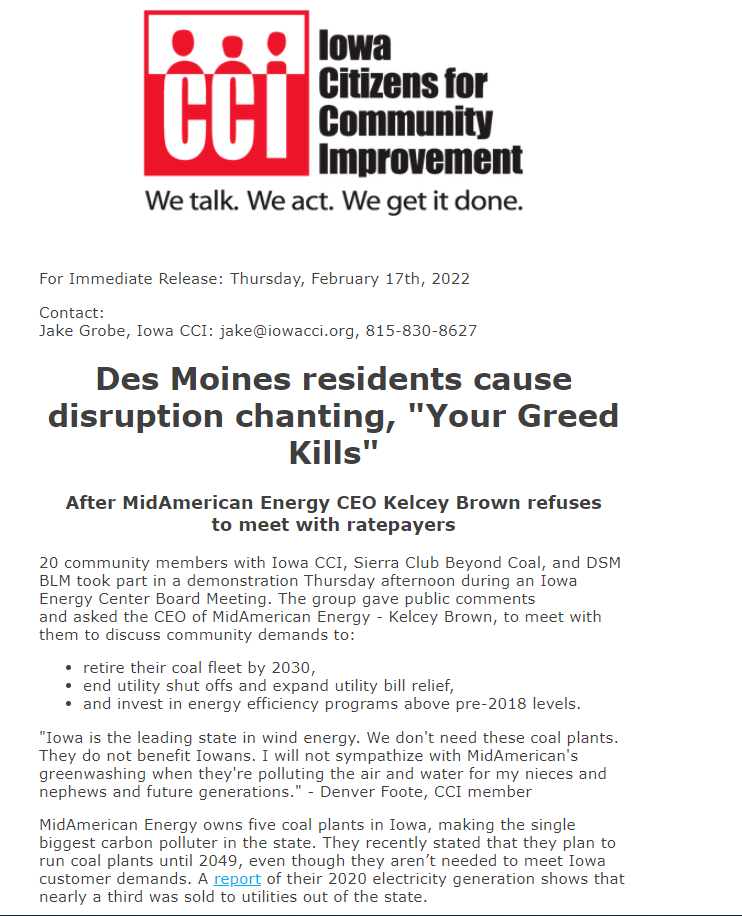
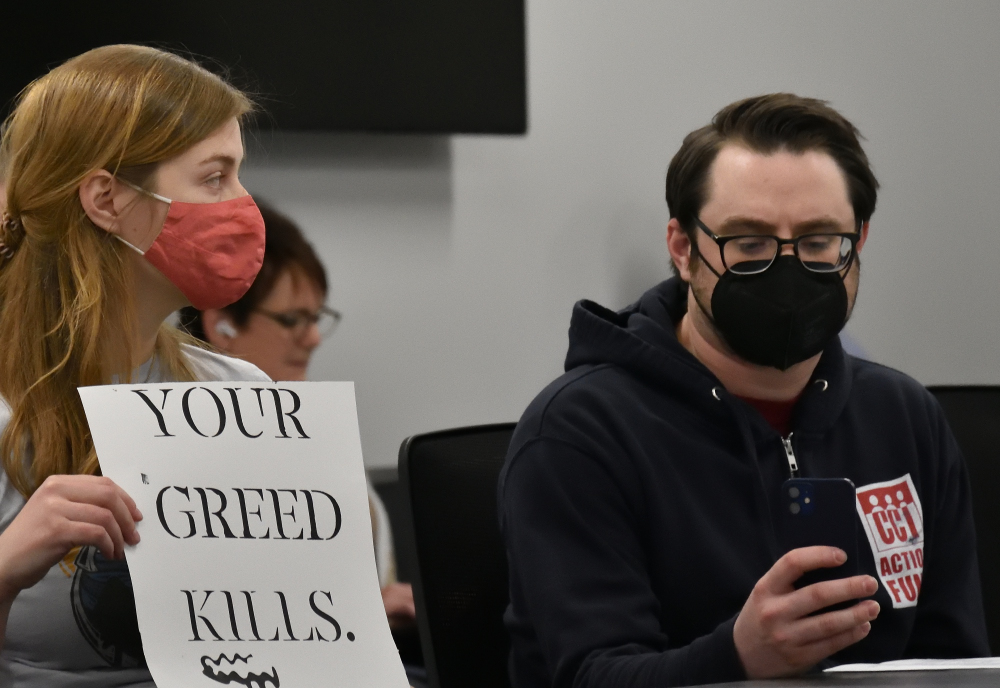
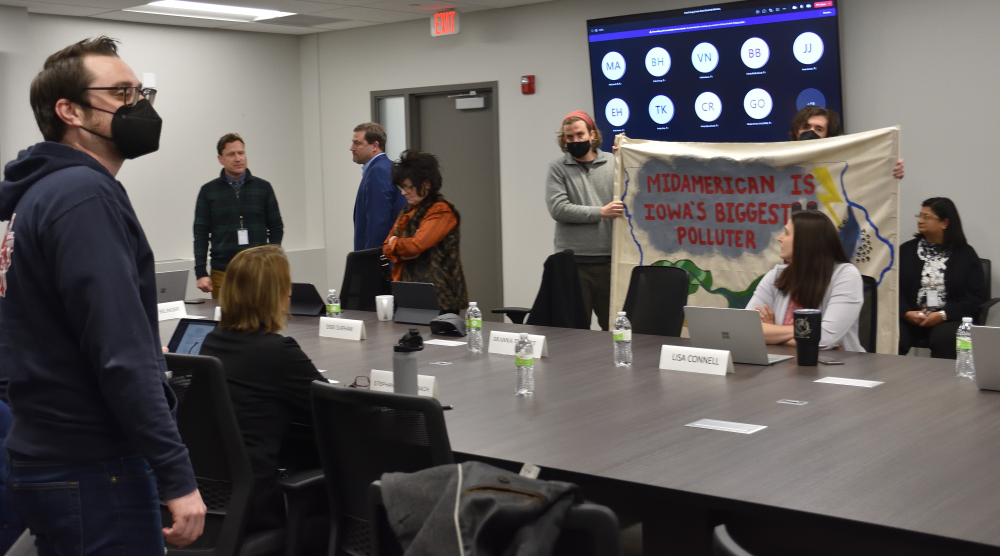
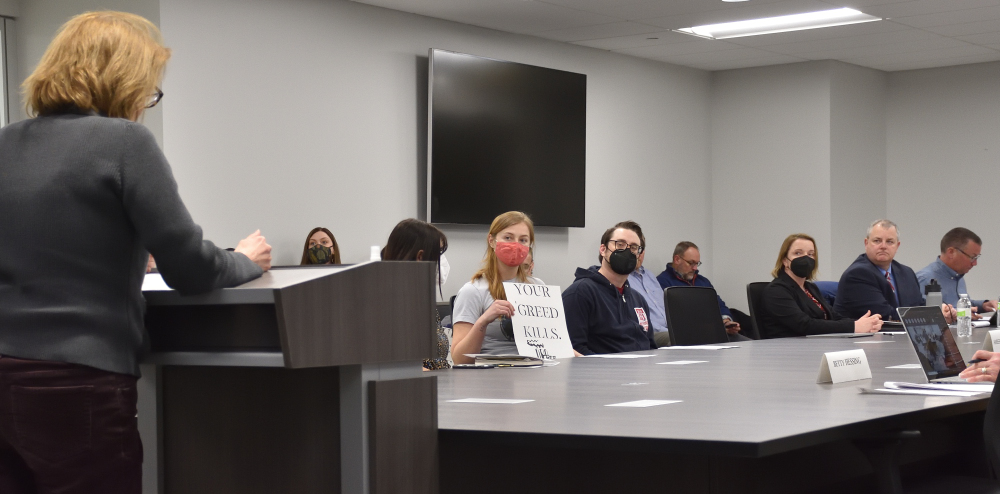
In February Jake organized people to attend a meeting at the Iowa Energy Center. The reason for going to the meeting was MidAmerican’s CEO Kelcey Brown had refused multiple requests to meet with ICCI and she was going to be at this meeting. I was there to take photos and wrote a blog post about the meeting. https://quakersandreligioussocialism.com/2022/02/18/stopburningcoal
The fossil fuel industry has found new life as the energy consequences of the war in Ukraine are being used not as an opportunity to wean off oil production, but the opposite; to ramp up fossil fuel development.
The Biden administration is releasing a million barrels of oil a day from the Strategic Petroleum Reserve. And pressuring oil companies to activate their oil leases. To ramp up natural gas exports. Other countries are releasing their oil reserves.
PARIS (AP) — The International Energy Agency said Thursday that its member countries are releasing 60 million barrels of oil from their emergency reserves on top of previous U.S. pledges to take aim at energy prices that have soared since Russia invaded Ukraine.
The releases show “the determination of member countries to protect the global economy from the social and economic impacts of an oil shock following Russia’s aggression against Ukraine,” IEA Executive Director Fatih Birol said. “Events in Ukraine are becoming more distressing by the day, and action by the IEA at this time is needed to relieve some of the strains in energy markets.”
Energy markets have been squeezed by surging demand as the global economy rebounded from the COVID-19 pandemic, outpacing supply and driving up prices. High energy prices have fueled inflation worldwide, and the war in Ukraine exacerbated the problem amid uncertainties about oil and natural gas supplies from Russia and Western sanctions on Moscow.
IEA member countries hold 1.5 billion barrels in public reserves.
As horrific as the atrocities of the war are, the real consequence is acceleration and escalation of the consequences and chaos of increasing greenhouse gas emissions.
“Investing in new fossil fuel infrastructure is moral and economic madness,” UN Secretary-General António Guterres said as the Intergovernmental Panel on Climate Change (IPCC) released part of its latest report on Monday. This scientific summary, focused on how the world can cut greenhouse gas emissions, warns of the extraordinary harm to all of humanity caused by fossil fuels and the need for a rapid energy transition away from oil, gas, and coal, calling for meaningful changes over the next three years. “Such investments will soon be stranded assets, a blot on the landscape, and a blight on investment portfolios.”
That same day, oil giant ExxonMobil made an announcement of its own: a $10 billion final investment decision for an oil and gas development project in the South American nation of Guyana that the company said would allow it to add a quarter of a million barrels of oil a day to its production in 2025.
As a result of that one-two punch, new fossil fuel projects may find themselves fighting against the tides, facing not just cheaper competition but also the drive to slash demand for their products to combat climate change. “Without carbon capture, coal and gas plants would need to retire about 23 years earlier than expected in order to hold global temperature rise to 1.5 degrees Celsius
ExxonMobil Announces $10 Billion Oil Investment the Same Day IPCC Signals End for Fossil Fuels. The oil giant’s massive plan to drill in Guyana’s waters comes as the UN Secretary General warns of fossil fuels as a “blight on investment portfolios.” By Sharon Kelly, DeSmog, Apr 5, 2022
As the article says, one bright spot is that the expense and failure of carbon capture means the oil industry cannot legitimately use that technology as a part of their plans to show how they will meet targets to curb their greenhouse gas emissions. That doesn’t mean they won’t try.
The following article is wrong. It states the “giant warning” is that it will take time to ramp up oil production. The real warning is the increase in greenhouse gas emissions that will result.
U.S. crude oil prices jumped more than $10 overnight to $130 a barrel on news that the U.S. was considering prohibiting Russian oil imports, though prices backed off later during Monday trading. That rally has driven retail gasoline prices up more than 46 cents in the past week, reaching a national average of $4.06 a gallon, according to fuel price service GasBuddy.
Exxon has said it expected to increase its production from the Permian by 100,000 barrels per day this year, on top of a sharp ramp up last year to 460,000 barrels per day. “We’re well on our way to that,” CEO Darren Woods told an industry conference in Houston on Monday. Chevron has also said it would increase its production there by 60,000 barrels per day this year.
U.S. oil industry prepares to boost production — but with a giant warning. A jump in gasoline prices above $4 has oil companies eyeing crude oil output hikes, but pain at the pump will linger as shaky oil markets shun Russian cargoes. by Ben Lefebvre, Politico, March 7/2022
While the PA Governor and Attorney General continue to delay halting construction and cleaning up toxic spill in Marsh Creek, local residents take matters into their own hands with direct action and win in court today. “We had no choice but to resort to peaceful protest on an active construction site to raise awareness of the dangers that have not been addressed by the responsible government agencies.”
The proceedings were watched with cheering support from families across Pennsylvania. Attorney Read used the argument § 503. Justification generally (a) General rule. Conduct which the actor believes to be necessary to avoid a harm or evil to himself or to another is justifiable if: (1) the harm or evil sought to be avoided by such conduct is greater than that sought to be prevented by the law defining the offense charged.
Greenhouse gas emissions are the primary cause of increasing environmental catastrophe, most recently evidenced by days of multiple tornados and severe thunderstorms.
This is an existential crisis. Dramatically reducing greenhouse gas emissions, radically reducing burning fossil fuels is the only way to start to mitigate the environmental chaos
Instead, the Biden administration is bringing more oil into the market.
releasing a record-shattering 180 million barrels of oil from the Strategic Petroleum Reserve, and
proposing fines on companies that aren’t producing oil on lands they are leasing for that purpose.
Reducing fossil fuel emissions or increasing oil production are mutually exclusive.
Capitalist economic systems are driven by profits regardless of the consequences. Even though the consequences will continue to be rapidly evolving environmental chaos. What choice do you think your children and their children want us to make?
The consequences of increasing gasoline prices need to be dealt with. But there are alternatives to bringing more oil to markets. Greenhouse gas emissions decreased as many worked from home because of the pandemic. Free public transportation would help although capacity would need to be increased significantly, rapidly.
Alternatives to capitalist economic systems need to be developed. Such as Mutual Aid communities.
Even though oil prices have nearly doubled since the end of 2019, US production is down about 10% over that period.
“This is a bridge towards greater supply coming on the market from the United States and elsewhere,” a senior administration official told reporters during a conference call Thursday.
To encourage US oil companies to ramp up production, the White House said Biden is calling on Congress to make companies pay fees on wells from their leases that they haven’t used in years and on acres of public lands that they are hoarding without producing.
Companies “will have to choose” whether to start producing or pay a fee for each idled well and unused acre, the White House said.
It was predictable that ridiculous schemes would appear now that the public can no longer ignore environmental chaos beginning to occur in so many, increasingly devastating ways. Learning the cause of these climate catastrophes is greenhouse gas emissions from burning fossil fuels, the public is desperately calling for ways to reduce those emissions now.
The common theme is the demand to reduce emissions without affecting their lifestyles that are dependent upon energy that is produced by burning fossil fuels.
That is impossible. Not nearly enough renewable energy capacity could be built to meet the demand.
The idea of sucking carbon dioxide from the atmosphere sounds good, but it is not. The amount of carbon dioxide that could be removed this way is miniscule. And to deal with even that small amount would involve unproven and dangerous technology. Pipelines would be required to transport the carbon hundreds of miles in most cases, to places where it would be pumped into underground rock formations. And no one knows how long it would be before the carbon begins to leak out of those formations.
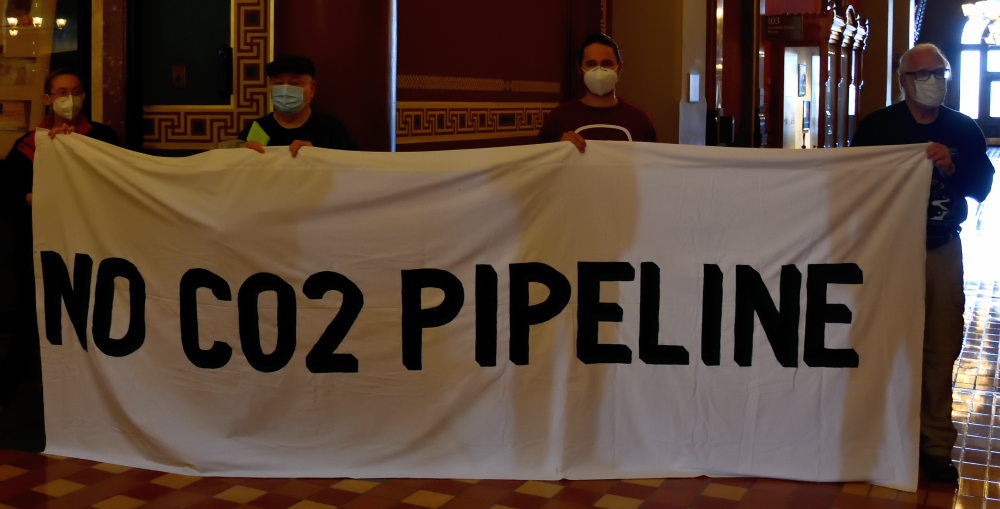
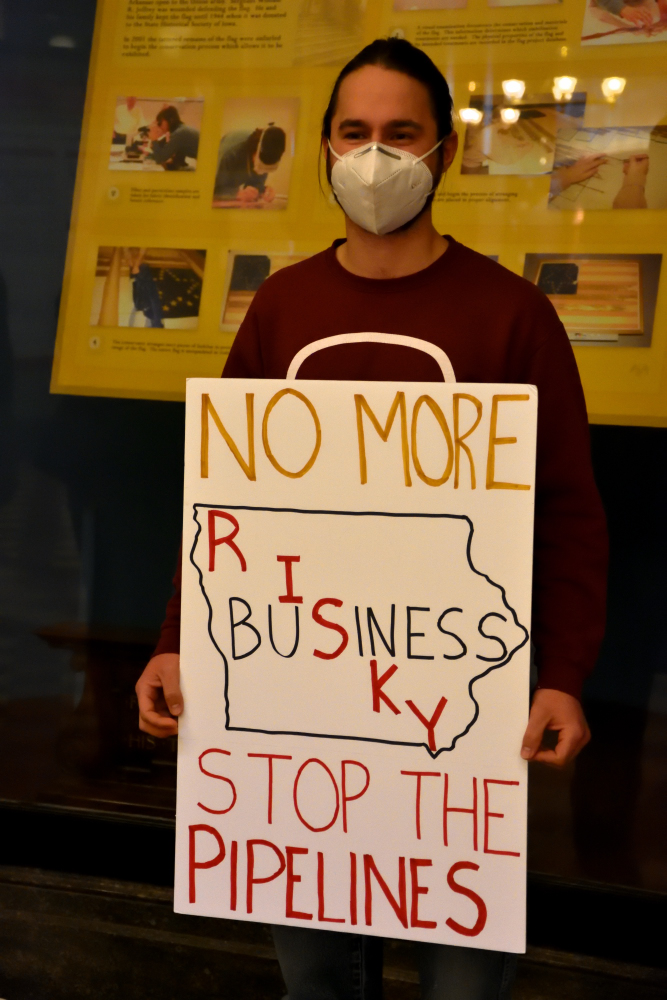
As with the Keystone XL, Dakota Access and other pipelines, significant environmental damages would occur if the carbon pipelines were built. Eminent Domain would be used to force farmers to allow construction of pipelines through their fertile lands.
These pipelines have the added danger of harming or killing people and animals if they leak. This occurred in Satartia, Mississippi, in 2020. See Carbon Pipeline Opposition.
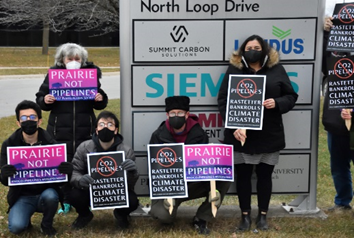
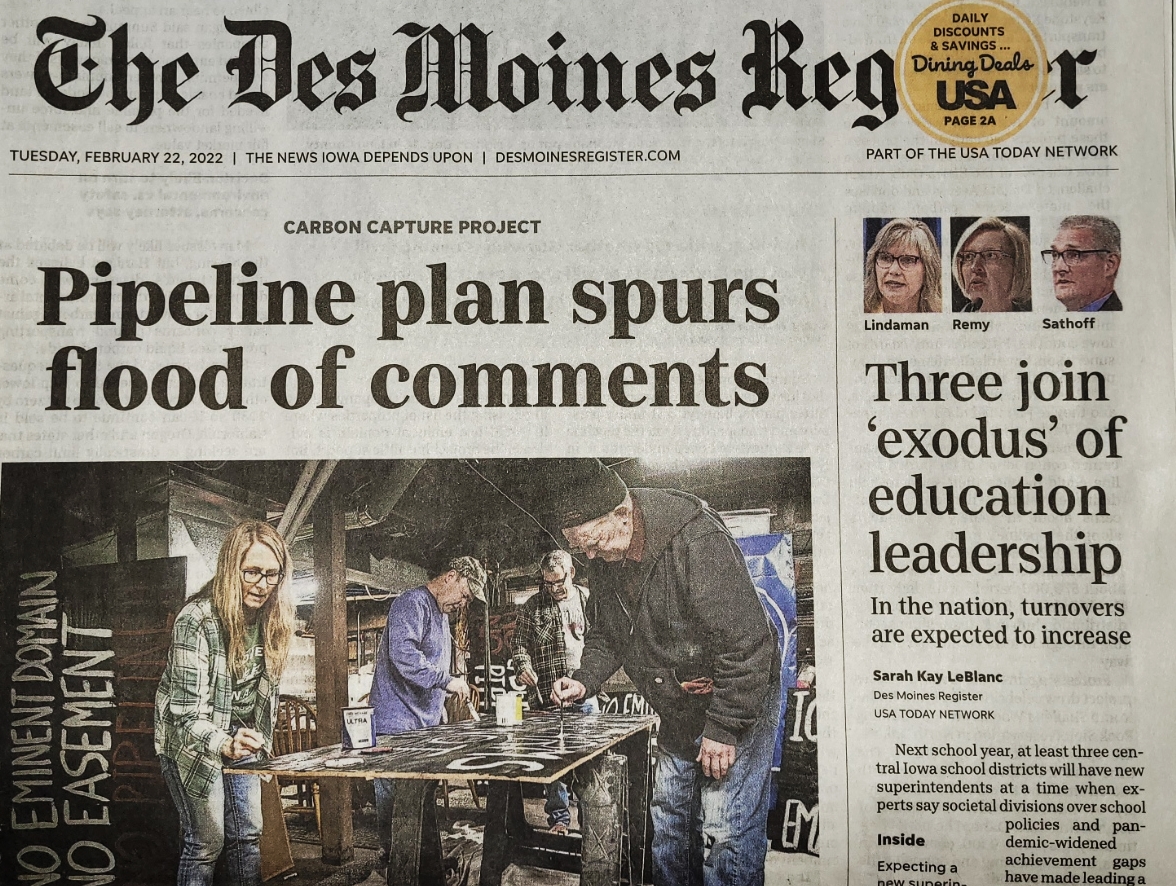
Kathy Stockdale says she has the unlucky distinction of having two of three planned carbon capture pipelines across Iowa proposing to run through the 550-acre Hardin County farm her family has owned for a century.
Summit Carbon Solutions’ $4.5 billion project would run between her and her son, Kurtis’, homes, while Navigator CO2 Ventures’ $3 billion pipeline would cut across a nearby field.
“This land is part of us. We’ve worked hard to make improvements,” said Stockdale, 71, adding that she feels “like my property rights are being taken away.”
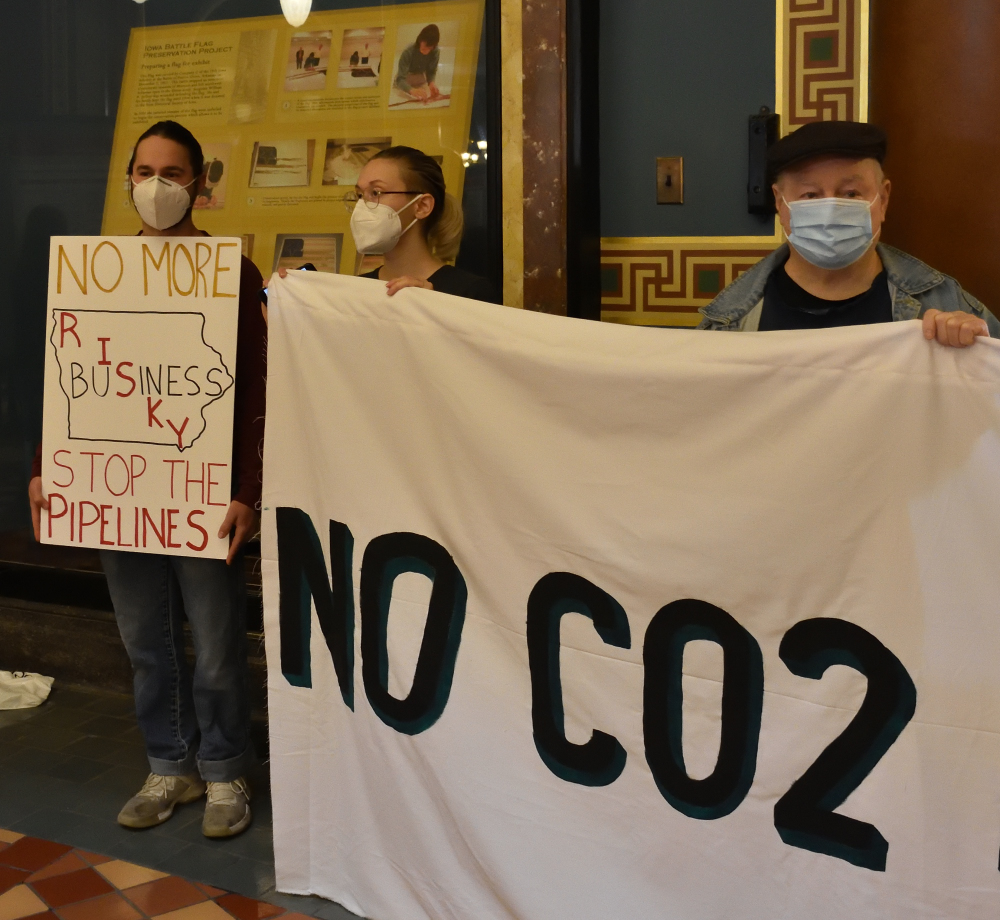
Stockdale was among about 100 Iowans Tuesday who joined what was billed as a “people’s public hearing” at the Iowa Capitol. They called on lawmakers to impose stronger restrictions on the pipeline developers’ use of eminent domain to force unwilling landowners to sell access to their property for their projects.
Carbon Capture and Storage (CCS) is not the answer to the climate emergency. CCS is unproven, dangerous and delays real solutions to the climate crisis such as energy conservation, regenerative agriculture and renewable energy.
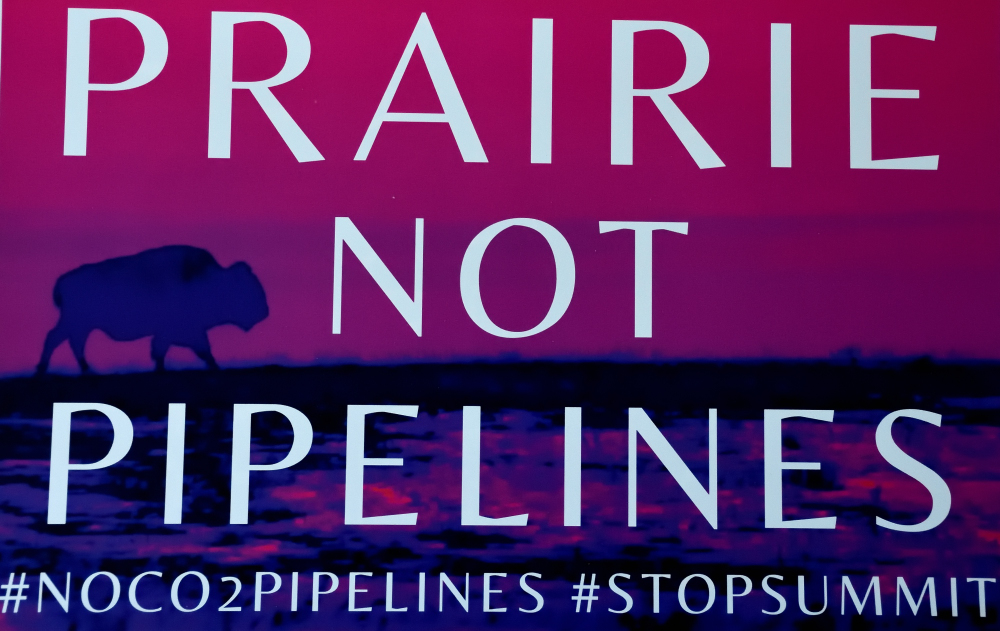
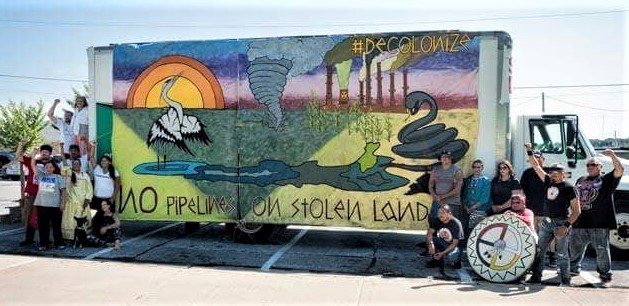
Join us in standing against private corporations for private gain and corrupt governments in Iowa as these pipelines are headed to tribal lands in Nebraska, South Dakota, and North Dakota, following the DAPL easement.
Organizations and landowners were at the Iowa State Capitol rotunda yesterday (3:30-6:00) to let our legislators know that Iowans won’t stand for the abuse of eminent domain!
With only a few short weeks left in the legislative session, we need to show our legislators how crucial it is that they take meaningful action right now.
We will hear from experts, landowners, impacted Iowans, Indigenous folks, and legislators as they address concerns about Iowa’s three proposed carbon pipelines—Summit, Navigator, and Wolf.
This event is hosted by Iowa Sierra Club, Science and Environmental Health Network, Iowa Food and Water Watch, and Great Plains Action Society—who are all a part of the Iowa Carbon Pipeline Resistance Coalition.
Organizations and landowners are at the Iowa State Capitol rotunda today to let our legislators know that Iowans won't stand for the abuse of eminent domain! pic.twitter.com/pVK3VawzJL
Cuba Prepares for Disaster by Don Fitz caught my attention for several reasons. Reading the article and watching the video below, I’m astonished by what Cuba has been doing for decades related to our changing climate. The work there implements many of the things I’ve been learning from Mutual Aid and Indigenous ways. Cuba is a model for the way I believe we must change to deal with oncoming environmental chaos. And although Cubans might not call it Mutual Aid, what they have done, are doing, is consistent with the concepts of Mutual Aid.
For Cuba to implement global environmental protection and degrowth policies it would need to receive financing both to research new techniques and to train the world’s poor in how to develop their own ways to live better. Such financial support would include …
Reparations for centuries of colonial plunder.
Reparations for the 1961 Bay of Pigs invasion, multiple attacks which killed Cuban citizens, hundreds of attempts on Fidel’s life, and decades of slanderous propaganda: and,
In the video Cuba’s Life Task, Orlando Rey also observes that “There must be a change in the way of life, in our aspirations. This is a part of Che Guevara’s ideas on the ‘new man.’ Without forming that new human, it is very difficult to confront the climate issue.”
Since Rio de Janeiro [Earth Summit in 1992] the words of our commander-in-chief Fidel Castro provide evidence of the actions and concern for human beings.
An important biological species is at risk of disappearing due to the rapid and progressive elimination of its natural habitat: mankind… It must be said that consumer societies are chiefly responsible for this appalling environmental destruction… They have poisoned the seas and the rivers. They have polluted the air… The forests are disappearing. The deserts are expanding… Third World countries cannot be blamed for all this; yesterday’s colonies and today nations exploited and plundered by an unjust international economic order. The solution cannot be to prevent the development of those who need it the most. In reality, everything that contributes to underdevelopment and poverty today is a flagrant violation of the environment… If we want to save humanity from this self-destruction, wealth and available technologies must be distributed better throughout the planet… Stop transferring to the Third World lifestyles and consumer habits that ruin the environment… Pay the ecological debt, not the foreign debt. Eradicate hunger and not humanity Tomorrow will be too late to do what we should have done a long time ago. Thank you.
Fidel Castro, Earth Summit, 1992
The main value of the speech was to put environmental problems in their socioeconomic context. The environmental issue has been detached from its origins in capitalist development, from the foundations of a system that, based on excessive consumption, on unequal production and consumption patterns, created the present situation.
From the video Cuba’s Life Task: Combatting Climate Change
Cuba has a system of civil protection established since the early 1960s following Hurricane Flora [1963] which caused major losses of human and animal lives, and economic damage. It is organized so that the moment there is a threat that phenomenon comes under permanent vigilance and various stages are established with mechanisms for protection and evacuation. Cuban Civil Defense adopts a systemic approach. The function is to protect the population, their resources, the economy, and the environment against natural, technological, and sanitary threats. Not just disasters, but also war, or the consequences of climate change.
The political organizations and organizations of the masses, made up of the population, are part of the Civil Defense system. When there is a situation or event, they join the health brigades activated in the Popular Councils in the defense zones, they support the lineworker – specialists who establish the vital systems related to energy – the neighborhood clean-up, after damage incurred during the event, including to building structures.
They contribute to local efforts. This guarantees several things; first, that there is protection at the neighborhood level, and second, that there is complete knowledge, because those neighbors know where the most vulnerable people and the most unprotected buildings are. That secures the process.
Every year in May before the hurricane season begins, we have an annual exercise, ‘Meteoro’, in which the population practice for disaster situations. Initially it was focused on tropical cyclones and hurricanes, but it has been broadened to prepare the population for droughts and earthquakes.
Recently we had a meeting about climate change in Cuba and Puerto Rico, and we saw that the number of people who died from Hurricane Irma was 10 in Cuba and 3,000 in Puerto Rico.
People die here from meteorological events too, but loss of life is minimal.
This whole process of relocating people who reside in high risk, vulnerable settlements. is financed by the state. This is one of the complexities to speeding up this process. It is not dependent on the ability of each citizen, the state assumes that responsibility and it requires substantial resources that the state has to allocate among its many expenses. But it is a state priority to carry out these relocations. New settlements and communities have been built, new buildings in existing communities. We have also learned that it is not only a physical issue of rebuilding houses. You have to relocate a whole way of life, rebuild a setting where people have social services, medical services, educational services, job opportunities. This is more complex when the community’s work is linked to the coast, as with fishing communities. We have concluded that relocating communities is an extreme measure against natural, technological, and sanitary threats. Not just disasters, but also war, or the consequences of climate change.
We can do it. What is our big problem? The worst problem is the [US] blockade. That is why we cannot advance any faster. Martí, Fidel, Raúl, Díaz-Canel…Long live free Cuba!
It is more than 60 years of the [US] blockade, which was greatly tightened by the Trump administration causing a lot of damage, and Biden, despite what he said in his electoral campaign, has still done nothing to loosen those measures. The country is in a very difficult situation as, although many do not think so, persecution is real. Remove the genocidal blockade against the Cuban people!
It is very difficult in conditions of poverty or deep economic and social inequality to advance a climate agenda.
One problem today is that you cannot convert the world’s energy matrix, with current consumption levels, from fossil fuels to renewable energies. There are not enough resources for the panels and wind turbines, nor the space for them. There are insufficient resources for all this.
If you automatically made all transportation electric tomorrow, you will continue to have the same problems of congestion, parking, highways, heavy consumption of steel and cement.
There must be a change in the way of life, in our aspirations.
This is part of the debate about socialism, part of Che Guevara’s ideas on the ‘new man’.
Without forming that new human, it is very difficult to confront the climate issue. I believe that a plan like Tarea Vida needs to be supported by a socialist system. It requires a vision that not directed towards profit, or self-interest. It must be premised on social equity and rejecting inequality. A plan of this nature requires a different social system, and that is socialism.
Perhaps the three most important lessons learned are: political will, communication to translate results, and training young people. From my point of view, these are the most important achievements in Cuba. My message to this climate change conference is a message of social inclusion
I also place Cuba’s disaster response system in conversation with these emergent practices of mutual aid
With the global and local effects of COVID-19 bearing down on us and without any clear expectation of when it might end, it’s as important as ever to take care of our communities. In this episode, we talk about the importance of mutual aid, the history of these networks, and why – if you haven’t before – now is the time to seriously consider getting involved with them.
…We talked about this in an earlier episode about social work in Cuba and the way that model was really rooted more in community organizing and almost somewhat of a mutual aid, at least from what I understood from what we read at that time of basically the community was supporting each other, but then the social worker’s job was actually to almost be the liaison with the state to get stuff that the community needed in order to facilitate that support.
This research comprises a literature review of both humanitarian organization-oriented and social science-oriented sources. In drawing from both NGO and local analyses, I hope to locate practices that could foster a less colonial approach to disaster response. I also place Cuba’s disaster response system in conversation with these emergent practices of mutual aid: in many ways, what theorists learned in the aftermath of the Haiti disaster was already implemented, in a top-down manner, by the Cuban government, which is highly successful at limiting damage and human casualties from disasters (Castellanos Abella, 2008).
Watching the tragedy of war unfolding in Ukraine makes real the future I fear we are moving into. Are already experiencing in many ways.
Fear not only as a noun, “an unpleasant emotion caused by the belief that someone or something is dangerous”, but also as a verb, “to be afraid of.”
I can’t imagine anyone watching the stories from Ukraine, and not thinking about how tenuous our own lives are. Seeing people’s lives destroyed in an instant. Injury or death of loved ones. Loss of shelter and infrastructure. No water, power, medicines, food, community.
What would we do in a similar situation?
We might find out sooner than we think. We are facing numerous crises ourselves.
Environmental chaos
Economic collapse
Political collapse
War
Domestic extremism and armed conflict
There have been warnings about these things for decades, with little effect. But now we are seeing everything on that list happening to various degrees. And each negatively impacts the others.
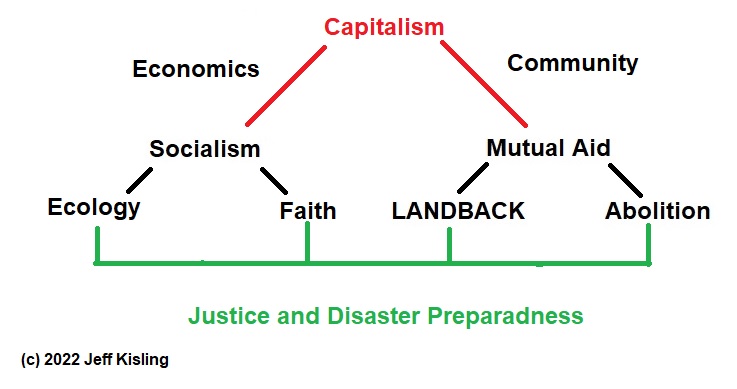
Following is a new diagram I’m working on to show relationships among systems. The reason justice is in today’s title is because so many of our current systems have injustices embedded in them. As we prepare for disasters, not addressing injustice would mean:
Not benefiting from the wisdom and skills of those we don’t have relationships with now. Because of the mistrust between us.
Bringing these injustices and conflicts into the disaster relief communities.
We have three choices:
We can just react to what is coming at us. Go into survival mode.
We can prepare for disaster locally.
We can work for justice as part of disaster preparedness.
Descriptions of the systems in the diagram: ecosocialism, LANDBACK, abolition and Mutual Aid follow.
I believe faith is an important part of this. This morning I thought faith was going to be the subject, but found this background needed to be covered first.
Ecosocialism
Ecosocialism brings together two complementary ways of thinking about humans and the environment they live in. The “eco-” in ecosocialism comes from the science of ecology and its emphasis on the complex and dynamic interactions among the living and non-living components within an ecosystem. In particular ecologists understand how the life-supporting functions within an ecosystem can be disrupted by the behavior of one organism, for example, humans.
But ecology lacks a social analysis; it has no way of understanding how economic and political forces drive human behavior and social change.
Ecosocialists start with the premise that environmental degradation and social injustice stem from the same source: a world where profit is the highest goal. We believe that the emancipation of people from capital and its masters goes hand-in-hand with the emancipation of the earth and its biosphere from the cancer of capitalism.
The criminal justice system is violent and harmful: The UK’s prison population has risen by 90% in the last two decades, bringing the number to over 90,000. At the time of writing we are 156 days into 2018 and already we have seen at least 129 deaths in prison, immigration detention centres and at the hands of the police. As the effects of neoliberalism and austerity deepen each day, increasing numbers of people find themselves made disposable by our economic system and structural inequality, targeted by the agencies of the criminal justice system simply for being homeless, experiencing poor mental health or being born in a different country.
The criminal justice system does not reduce social harm: Policing, courts and the prison system are presented to us by politicians and the media as solutions to social problems. Yet, as the prison population has soared, we have continued to seen violence and harm in our society on a massive scale. Violence against women and girls is endemic, racism and the far right are on the rise in Britain and rates of murder and violent assaults are beginning to increase again. As politicians continue to scapegoat those with the least power in society, the conditions of structural violence that so often precede interpersonal violence remain in place.
We can build a world based on social justice, not criminal justice: All over the world, communities are coming together to build real solutions to societal problems. These solutions lie outside of the criminal justice system, in preventing harm through building a better society. By bringing together groups and organisations working for social justice, we want to demonstrate and strengthen the links between prison abolition and wider struggles for housing, health, education, and environment; and for economic, racial, gender, sexual and disability justice.





















 Quakers and Mutual Aid