Polycrisis: Introduction

As I research environmental and societal collapse, I have begun to see more references to polycrisis. The term defines itself as multiple crises.

As globalization created increasingly networked societies to facilitate the flow of information, capital, goods, services, and people, it led to the emergence of global systemic risks that could precipitate a catastrophic failure of the system. Systemic risks are “potential threats that endanger the functionality of systems of critical importance for society.” They are complex phenomena characterized by high uncertainty and ambiguity that express ripple effects impacting other systems. The global financial crisis of 2007-8 was a watershed moment for the field of systemic risks, leading to a growth of interest and scholarship.

When multiple systemic risks combine in a network it is called a risk nexus. The water-energy-food nexus and the energy-environment-growth nexus are particularly well-known and widely discussed. Risk nexuses that interact can produce interrelated and synchronized systemic crises, generating a multi-systemic crisis—called a polycrisis— with cascading effects to society. A growing number of people argue polycrisis is already here and has been developing for some time. Though there is need for further study, there already exists some literature that measures, tracks, and analyzes the interacting systemic risks implicated in a polycrisis, and in some cases, they provide theoretical or conceptual models for understanding the relationships between these risks (e.g. 1, 2, 3, 4, 5, 6). By reviewing the literature, one can identify global systemic risks that frequently reappear.

The global polycrisis reflects a civilizational crisis that calls for systemic alternatives by Zack Walsh, Omega, June 1, 2023

A polycrisis is a situation where multiple crises occur simultaneously or in a sequence, with the potential to exacerbate each other and create a complex, interconnected web of challenges. These crises can span various dimensions, such as economic, political, social, and environmental factors.

https://www.resilience.org/stories/2023-06-01/the-global-polycrisis-reflects-a-civilizational-crisis-that-calls-for-systemic-alternatives/

Although by no means exhaustive, the following list identifies risks that are commonly associated with polycrisis and gives a short description highlighting some effects and interactions:

  • Environmental Degradation diminishes the Earth’s carrying capacity, including the  resources available for consumption, and causes premature deaths due to toxins and pollutants.
  • Climate Change is a threat multiplier. It significantly contributes to food and water crises, weather-related disasters, migration, and global insecurity.
  • Biodiversity Loss contributes to habitat and species loss, destroys vital ecosystem services required for subsistence, and reduces nature-based carbon sequestration, further exacerbating climate change.
  • Population Growth increases consumption of energy and resources, putting pressure on the environment.
  • Food, Water, and Energy Insecurity creates famine, premature death, and is a primary contributor of civil unrest, violence, war, terrorism, and migration.
  • Civil Unrest, War, and Terrorism leads to trauma, violence, death, environmental damage, waste, social instability and/or collapse.
  • Mass Migration leads to global insecurity, death, and contributes to the rise of racism, right wing populism, and authoritarianism.
  • Crisis of Democracy includes issues of corruption, political polarization, decreasing institutional legitimacy, and rising authoritarianism. Falling rates of democratic participation and the diminishing health of democracies exacerbate most other systemic risks, as misalignment between political elites and the public interest make progress on urgent issues less likely.
  • Decreasing Availability and Increasing Costs of Energy and Raw Materials reduces economic productivity and growth, increases the cost of living, and may eventually cause breakdown or collapse if inputs of energy and resources do not meet maintenance costs.
  • Economic Inequality drives negative social outcomes (e.g. physical and mental illness, high rates of incarceration, obesity, violence, substance-abuse, social isolation) and makes social unrest and revolution more likely.
  • Global Pandemics cause premature deaths, disrupt global supply chains, and lead to economic contractions, possibly leading to a recession or depression.
  • Debt bubbles lead to defaults, the loss of capital, and potentially financial crisis due to broader contagion effects.
  • Inflation debases the value of money, increases the cost of living, and may cause economic or financial crisis.
  • Declining Growth Rates contribute to structural (esp. financial) crises, given that capitalism depends on growth for its stability.

The global polycrisis reflects a civilizational crisis that calls for systemic alternatives by Zack Walsh, Omega, June 1, 2023


Interconnected risks pose the greatest threat of a polycrisis

The relationship between polycrisis and risk is complex and dynamic. Polycrisis refers to a situation where multiple global risks interact and amplify each other, creating a systemic crisis that exceeds the sum of its parts. Risk is the potential for negative consequences from uncertain events or conditions. Polycrisis increases the likelihood and severity of risks, as well as the uncertainty and complexity of managing them. Polycrisis also reduces the resilience and adaptability of societies, making them more vulnerable to shocks and disruptions. Therefore, polycrisis and risk have a mutually reinforcing effect, creating a vicious cycle that threatens global stability and well-being.


The intersection of current risks with emerging crises poses the greatest risk of a polycrisis. For example, the Global Risks Report 2023 draws a link between the cost-of-living crisis, the failure to mitigate the climate crisis, and the growing pressure on finite resources as a potential catalyst for such an event.

The 2023 edition of the Global Risks Report highlights the multiple areas where the world is
at a critical inflection point. It is a call to action, to collectively prepare for the next crisis the world may face and, in doing so, shape a pathway to a more stable, resilient world.

The Global Risks Report 2023 18th Edition Insight Report, World Economic Forum


The global risks interconnection map above brought my attention to the concept of polycrisis. I have been working on the following diagram to show connections between justice-related ideas and systems for years.

Eyes of the Future

How can Friends achieve the 2022 theme of World Quaker Day, “Becoming the Quakers the World Needs,” while functioning in a blatantly and politically corrupt, racialized world?

Black Quaker Project

Introduction

These are times of upheaval, with greater changes rapidly approaching. Times of uncertainty and fear. These are also times of opportunity. Can we use this collapse to envision and build more just communities?

I believe we can. But first, we need to understand the injustices the capitalist economic system is based upon. And use this understanding to guide the development of mutual aid communities. which reject capitalism.

It is difficult to escape the status quo. But that is the only way we can protect and heal Mother Earth and build communities for future generations. The status quo in this country is about preserving the capitalist economic system and White superiority. Maintaining the status quo will only deepen environmental devastation and collapse. And collapse of the systems built on capitalism.


The eyes of the future are looking back at us, and they are praying for us to see beyond our own time. They are kneeling with hands clasped that we might act with restraint, that we might leave room for the life that is destined to come.

Terry Tempest Williams

The Seventh Generation Principle is based on an ancient Haudenosaunee (Iroquois) philosophy that the decisions we make today should result in a sustainable world seven generations into the future.

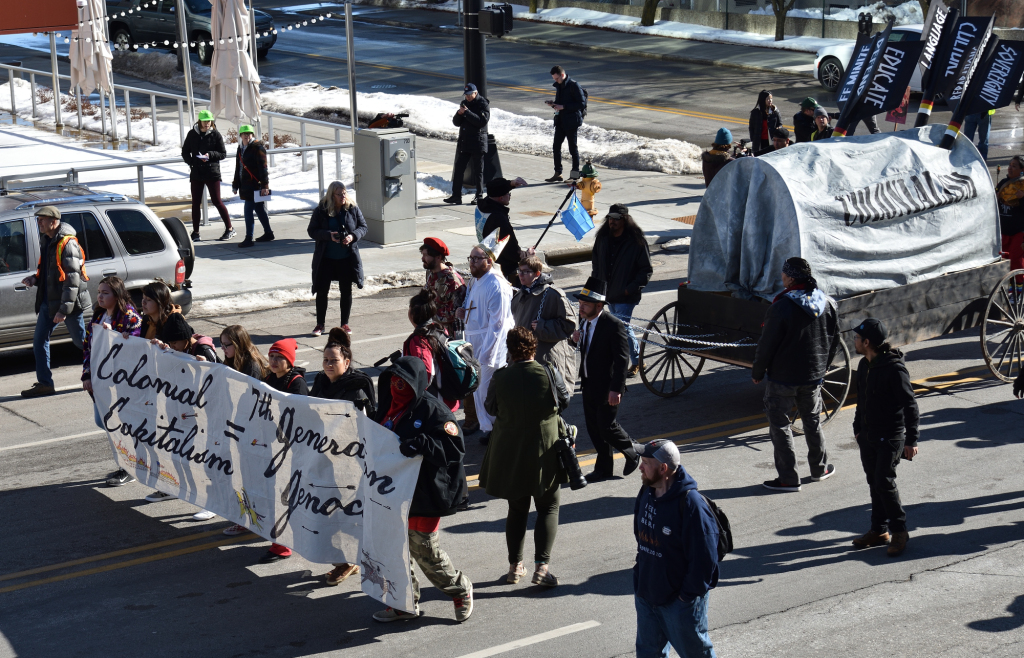
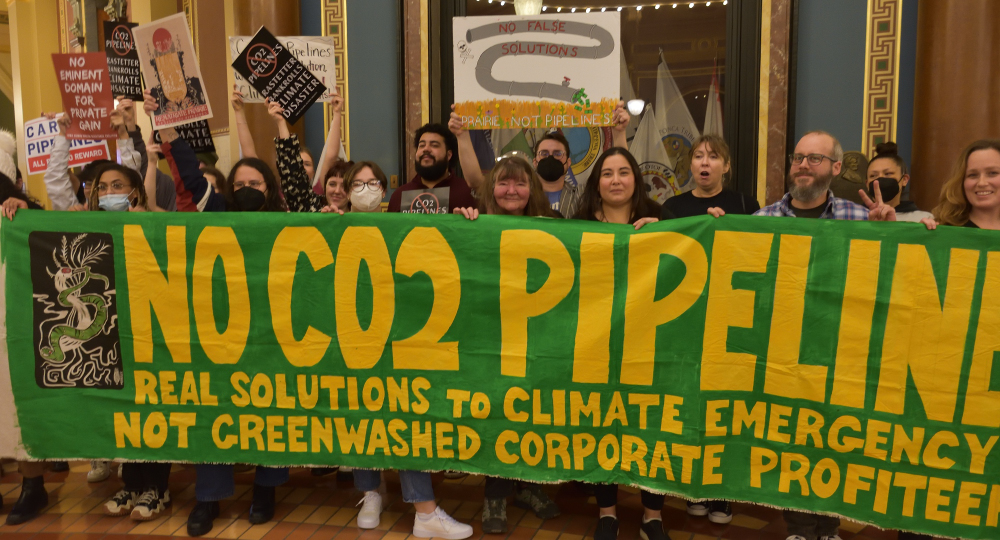
Climate Justice March, Des Moines, Iowa

Then

Environment

I’ve had my own experiences of looking back and trying to help people “to see beyond our own time“. Over fifty years ago, I moved to Indianapolis, a big change for a farm boy. I was not prepared for the noxious clouds of auto exhaust enshrouding the city. I was led to live without a car. Of course, that was not the status quo.

Looking back to that time, I feel sorrow for what might have been. How different the world would be if we had rejected the car culture in this country. Our cities and towns would have been built to be walkable. Land would not be covered by asphalt and concrete. Most importantly, we would have been able to live in a sustainable manner and would not be on a path toward extinction.

Looking back now, who doesn’t wish we had rejected the car culture in this country? Wish we had not let banks and fossil fuel companies rape the earth?

If those who lived prior to the rise of the car culture could have visited our world today, to see the disastrous consequences we are dealing with now, I believe many people who lived then would have chosen to live a different (sustainable) lifestyle.


Capitalism

Wealth is attended with power, by which bargains and proceedings, contrary to universal righteousness, are supported; and hence oppression, carried on with worldly policy and order, clothes itself with the name of justice and becomes like a seed of discord in the soul.

John Woolman, “A Plea for the Poor.”

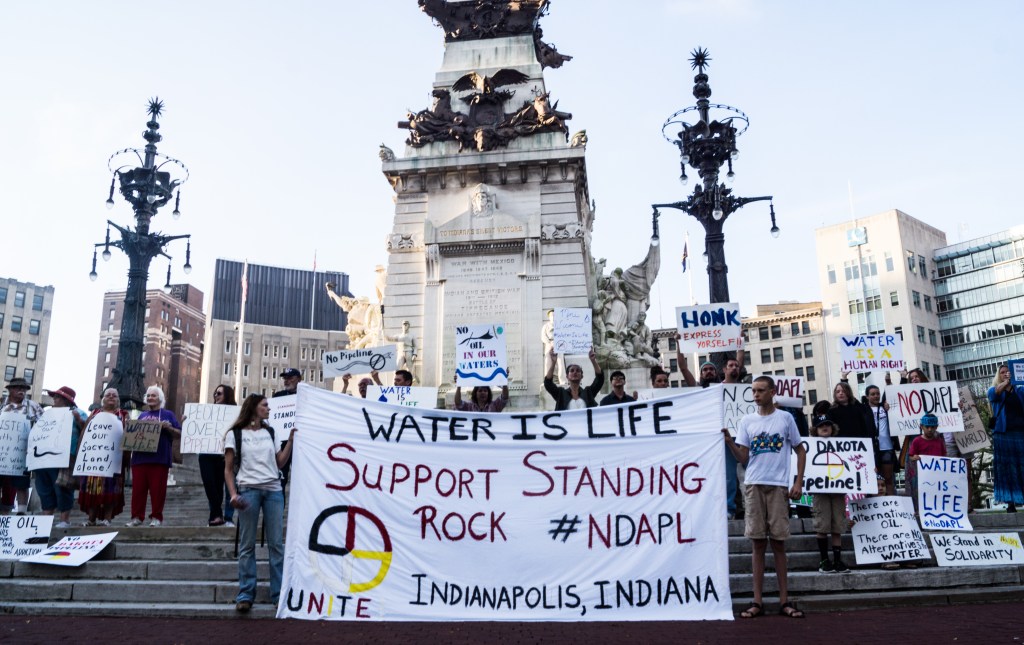
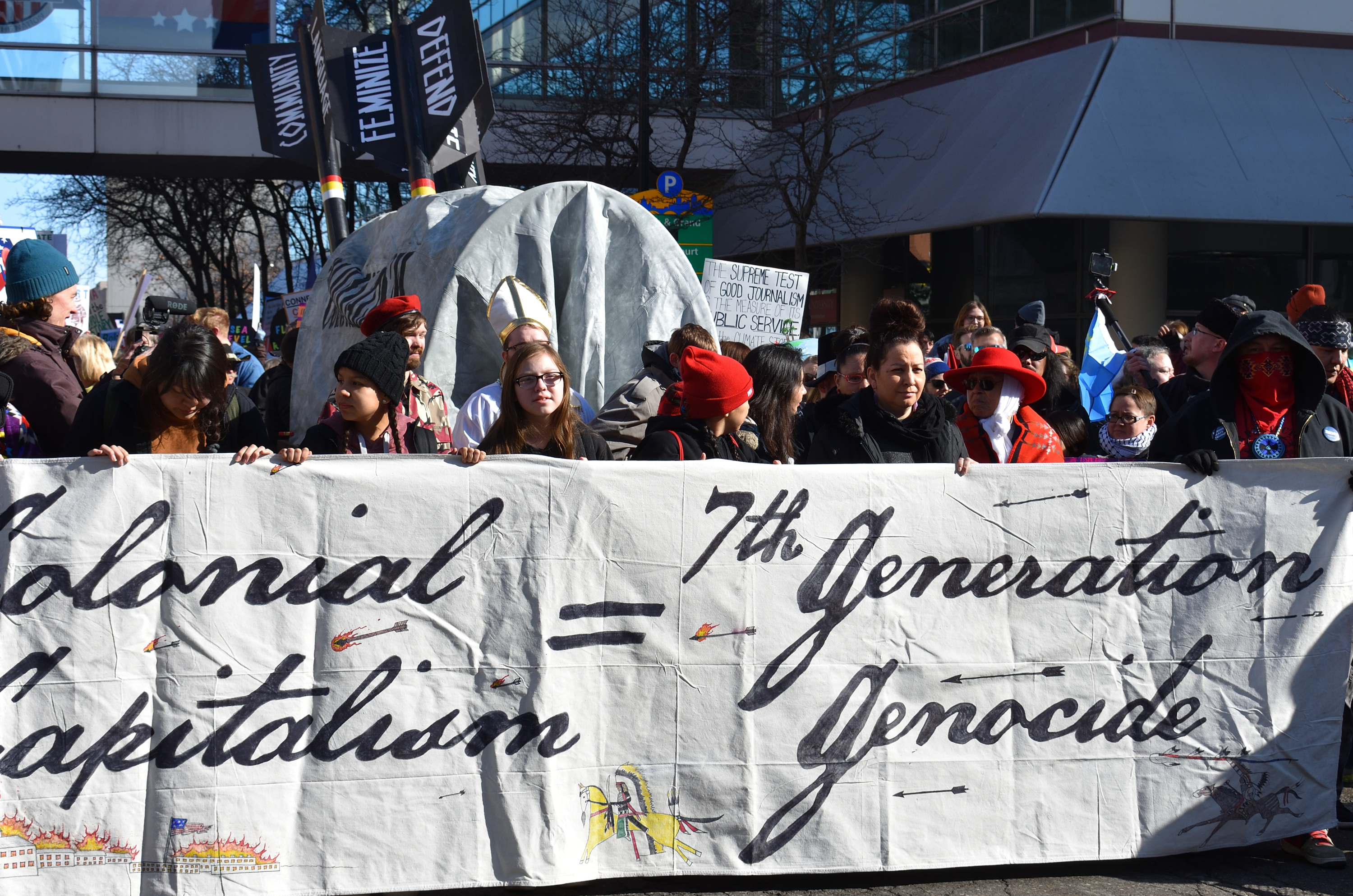
As the sign in the photo above says, Colonial Capitalism = 7th Generation Genocide

Despite trying every way I could think of, regardless of my prayers, I was not able to convince others to give up their car. People chose convenience over care for Mother Earth and future generations.

It is the same when I urge others to build alternatives to capitalism. Those who are comfortable economically strongly resist any suggestion to abandon capitalism. Capitalism is the materialism Martin Luther King warned about. “The giant triplets of racism, materialism and militarism”.

How has hunger for millions become acceptable? Houselessness? Lack of access to medical care? Police brutality? Locking people away for years for nonviolent crime? Profligate consumption of nonrenewable fossil fuels? Poisoning water?

As Americans honor King on his birthday, it is important to remember that the civil rights icon was also a democratic socialist, committed to building a broad movement to overcome the failings of capitalism and achieve both racial and economic equality for all people.

Capitalism “has brought about a system that takes necessities from the masses to give luxuries to the classes,” King wrote in his 1952 letter to Scott. He would echo the sentiment 15 years later in his last book, Where Do We Go From Here: Chaos or Community?: “Capitalism has often left a gap of superfluous wealth and abject poverty [and] has created conditions permitting necessities to be taken from the many to give luxuries to the few.”

In his famous 1967 Riverside Church speech, King thundered, “When machines and computers, profit motives and property rights are considered more important than people, the giant triplets of racism, materialism and militarism are incapable of being conquered.”

“What good is having the right to sit at a lunch counter,” King is widely quoted as asking, “if you can’t afford to buy a hamburger?” In King’s view, the Greensboro lunch counter sit-ins, the voter registration drives across the South and the Selma to Montgomery march comprised but the first phase of the civil rights movement. In Where Do We Go From Here, King called the victories of the movement up that point in 1967 “a foothold, no more” in the struggle for freedom. Only a campaign to realize economic as well as racial justice could win true equality for African-Americans. In naming his goal, King was unflinching: the “total, direct, and immediate abolition of poverty.”

THE FORGOTTEN SOCIALIST HISTORY OF MARTIN LUTHER KING JR. By Matthew Miles Goodrich, In These Times, January 16, 2023


Now

What will the eyes of the future see when they look back upon us today? How will they feel about the state of the world we are leaving them?

What are we willing to do now to make the world a better place for ourselves and future generations?

Will we:

  • Radically reduce our fossil fuel consumption?
  • Continue to build renewable energy infrastructure?
  • Resist false solutions such as carbon capture?
  • Reject capitalism?
  • Reject White superiority?
  • Build Mutual Aid communities?

There is an urgent need for reflection on these questions. And to seek and implement ways to answer them.


mutual aid is the new economy. mutual aid is community. it is making sure your elderly neighbor down the street has a ride to their doctor’s appointment. mutual aid is making sure the children in your neighborhood have dinner, or a warm coat for the upcoming winter. mutual aid is planting community gardens.

capitalism has violated the communities of marginalized folks. capitalism is about the value of people, property and the people who own property. those who have wealth and property control the decisions that are made. the government comes second to capitalism when it comes to power.

in the name of liberation, capitalism must be reversed and dismantled. meaning that capitalistic practices must be reprogrammed with mutual aid practices.

Des Moines Black Liberation

“Quakers will only be truly prophetic when they risk a great deal of their accumulated privilege and access to wealth. Prophets cannot have a stake in maintaining the status quo. Any attempt to change a system while benefiting and protecting the benefits received from the system reinforces the system. Quakers as much as anyone not only refuse to reject their white privilege, they fail to reject the benefits they receive from institutionalized racism, trying to make an unjust economy and institutionalized racism and patriarch more fair and equitable in its ability to exploit. One cannot simultaneously attack racist and patriarchal institutions and benefit from them at the same time without becoming more reliant upon the benefits and further entrenching the system. Liberalism at its laziest.”   

Scott Miller

How can Friends achieve the 2022 theme of World Quaker Day, “Becoming the Quakers the World Needs,” while functioning in a blatantly and politically corrupt, racialized world? In engagement with this exciting theme, offered by the Friends World Committee for Consultation (FWCC), the Black Quaker Project would like to remind Friends of the tools at our disposal to challenge those aspects of society which we wish to change and to see changed. Our fractured societies are further divided by enormous gaps of inequality in almost every imaginable category—psychological, social, political, cultural, economic. How might we, as Quakers, achieve justice, equity, and peace under these circumstances? 

Black Quaker Project

New Perspectives

I grew up in Quaker communities, which defined my justice work for much of my life.

Then a decade ago I was led to engage with a number of communities, working outside Quaker meetings. By engagement I mean spending significant time in these communities. These experiences have taught me decidedly different approaches to justice work. These new perspectives convince me that Quakers, particularly White Quakers, need to change how we think about and do justice work.

My perspectives include:

  • The need to advocate for Indigenous leadership to help protect and heal Mother Earth.
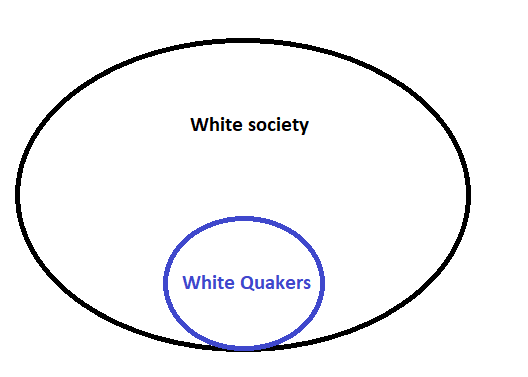
  • Black, Indigenous and other people of color (BIPOC) do not see any distinction between White Quakers and other White people in this country.
  • The capitalist economic system is fundamentally unjust.
    • Capitalism transfers great wealth to the wealthy by exploiting and oppressing those who aren’t.
    • Capitalism impoverishes millions of people
    • Capitalism is economic slavery
    • Capitalism treats natural resources as commodities to be exploited for profit
    • Capitalist systems do not feel the need to conserve resources
  • Police and prisons must be abolished.
    • The criminal justice system enforces the policies of the White dominant culture.
    • The criminal justice system violently targets BIPOC people
    • It is inhumane to lock people in cages.
  • White Quakers are settler-colonists. We continue to live on and profit from Indigenous lands.
  • The involvement of some White Quakers in the native boarding schools and how to begin healing related to that, is crucial for authentic relations between White Quakers and native peoples.
    • I have witnessed the multigenerational trauma affecting Indigenous people today.
  • Increasingly, as environmental chaos worsens, responding to the disastrous consequences will consume our attention and resources.
Black, Indigenous and other people of color (BIPOC) do not see any distinction between White Quakers and other White people in this country.

The most significant new perspectives are about the capitalist economic system. I hadn’t been as aware of many of the injustices fueled by capitalism prior to spending time in oppressed communities. Now I have witnessed the devastating effects of capitalism in these communities.

The nearly universal resistance to my attempts to convince White people to build systems not based upon capitalism is because the system works for them.

Capitalism is an unjust system. A different system is required. Mutual Aid is such a system.

Justice cannot be attained by incremental changes to an unjust system.

Accelerating environmental chaos is increasingly disrupting life as we know it. Which means, among other things, that the current political and economic systems in this country will continue to collapse. Now is the time to envision and build alternatives such as mutual aid.

Justice cannot be attained within an unjust system

Our Quaker Queries recognize the injustices of our capitalist economic system.

‘We are part of an economic system characterized by inequality and exploitation. Such a society is defended and perpetuated by entrenched power. “

The advice also says “we envision a system of social and economic justice that ensures the right of every individual to be loved and cared for…” 

Faith and Practice, Iowa Yearly Meeting (Conservative)

This is well summarized by my friend Ronnie James. We work together at Des Moines Mutual Aid.

I’m of the firm opinion that a system that was built by stolen bodies on stolen land for the benefit of a few is a system that is not repairable. It is operating as designed, and small changes (which are the result of huge efforts) to lessen the blow on those it was not designed for are merely half measures that can’t ever fully succeed.

So the question is now, where do we go from here? Do we continue to make incremental changes while the wealthy hoard more wealth and the climate crisis deepens, or do we do something drastic that has never been done before? Can we envision and create a world where a class war from above isn’t a reality anymore?”

Ronnie James, Des Moines Mutual Aid

This is a simplified schematic of the consequences of White dominance (Red), and the alternatives for a transition to justice and disaster preparedness (Green).


Implementing the transition to a more just society will be impeded by

  • Environmental chaos
  • Corrupt and failing institutions
  • Authoritarianism

This diagram shows the current systems in the column labeled White.
The column under Black, Indigenous and other people of color shows the injustices resulting from the current systems.
The Red/Green New Deal shows how we can address these injustices.
The solid red column indicates the challenges to moving to systems of justice, sustainability, and resilience.


I’ve written about these concepts on my blog: https://quakersandreligioussocialism.com/

AI revisited

As I wrote yesterday, I’ve been enthusiastic about my recent experiences with Artificial Intelligence (AI). I know AI works well as a research assistant, because yesterday AI discovered many sources of information I had not found after months of searching on my own.

And the AI results not only returned new pieces of information but was even more impressive at combining concepts to reveal new relationships among them, often providing a new path of information and concepts to explore.

But I also have grave concerns about AI.

My experiences with computers are relevant. When I was a student at Scattergood Friends School (late 1960’s), the University of Iowa (about fifteen miles away) donated time on their mainframe computers for use by students in nearby schools. My math teacher suggested I read a book about the FORTRAN computer language, which is how I began to learn, i.e. taught myself to program computers. In those days, prior to the availability of classes in computer science, most of us were self-taught. I went on to teach myself about six computer languages. A computer programmer has to be a life-long learner, because computer languages and systems were changing very rapidly. I usually spent about 20 percent of my time at work downloading and learning evolving information. It wasn’t always a smooth process. I spent about six months trying to learn the PROLOG language, and never mastered it.

During the summer prior to my Senior year at Scattergood, Don Laughlin (an Iowa Quaker and mentor) arranged for me to spend the summer at the University of Iowa Hospitals working with him in his medical electronics lab. The lab had just purchased one of the first commercially available desktop computers and wanted me to write the software to automate the process of calculating results from pulmonary function testing, which took a couple of hours, each, to do manually.

This was at a time when laboratories were transitioning from using oscilloscopes to measure and display data, to using computers, instead. The many advantages included real time display of signals (from babies breathing, in my case), the opening and closing of various valves to regulate the testing proedure, immediate calculation and display of complex results, and automatic storage of all the data in databases. But it immediately became apparent that developing such software was a complex and very long-term process. The last software system I worked on, which measured how well gases in a baby’s lungs diffused between the alveoli in the lungs, and the capillary blood, took three years to finish. That involved measuring eight channels of data (flow, volume, gas concentrations), reading gas concentrations in thousandths of a percent, monitoring and displaying the signals in real time, and making decisions, in real time, of when to turn a specific valve on or off. But as a result, ours is the only lab in the world that can do those measurements.

I also spent a lot of time writing “teaching programs”, using computers to display information, and giving and grading “tests” to students about the material. I especially liked “simulations”, such as a mathematical model that allowed students to make adjustments to how the respiratory system was functioning, for example, and to display the results of those changes.

This is on the “other side” of machine learning, which is a large part of AI. AI can sort through huge amounts of data to discover patterns, i.e. “learn” about the data.

My ultimate concern is AI might be used by computer systems to learn what humans don’t know, and use their ability to control devices, including movement, to somehow overcome humans in certain situations.

Prior to that, now actually, there are many concerns about how “well” AI is working in many instances. This would not be the time to allow AI to make decisions for you.

I thought I would see what AI had to say about cautions related to artificial intelligence. What follows was completely written by the AI system I’m using, copy.ai

NOTE: The following was completely generated by copy.ai from a list of keywords I entered related to caution about artificial intelligence.

Caution about artificial intelligence

Introduction

Artificial intelligence (AI) is the use of computers to imitate human intelligence. AI can be used for many purposes, including making recommendations about what products to buy or which advertisements to view. It has become a hot topic in business and politics but also raises concerns about its potential dangers. This post will address some common questions about artificial intelligence such as:

Artificial intelligence will never be perfect.

AI is not perfect yet, but it can be improved.

AI is still a work in progress, and there’s still plenty of room for improvement. The best way to know if your AI system is up to par is by testing it against other models—that way you’ll know if it’s performing well or not. If you’re in doubt about the accuracy of your model (or how well it’s working), consider running some tests on it!

AI can make mistakes.

AI can make mistakes. It’s not perfect, and it should be treated with the same respect as any other human being.

AI can make mistakes in the same way that humans do: by making assumptions about their environment and then acting on those assumptions without much thought or consideration of consequences. For example, if your computer tells you “There’s a dog at the door,” this isn’t necessarily accurate—sometimes dogs are just dogs and don’t have a door (or even an owner). On top of that, computers aren’t really good at perceiving subtle differences between different kinds of animals like dogs; if you don’t want your house cat getting into mischief because someone told you there was a big black dog outside waiting for her to come home from school with cookies from Dunkin’ Donuts…well…then maybe we should stop using AI altogether until we figure out how best to train these programs?

What exactly do we mean when we say that a computer program is “learning”?

When you’re talking about artificial intelligence, the term “learning” is used a lot. But what exactly does it mean?

First of all, learning is a process that occurs over time. It involves changing the way you do things and/or think about things. Learning also involves changing your view of everything around you—your environment and its contents are part of this change as well (e.g., when someone learns how to drive). Finally, learning means changing from one state or stage in life to another stage or state—for example: from childhood into adulthood; from being single into getting married; etcetera

Can you teach a computer to learn?

When you learn something new, are you teaching the information to yourself?

  • The answer is yes. When you’re learning something new, your brain has to store that information in order for it to be useful later on. This process of storing and retrieving information is called memory and memory storage is what makes up human intelligence.

So can computers learn? Well… sorta… but not exactly like us humans do! A computer learns by reproducing patterns from previous experiences (e.g., if they’ve seen an object before, they’ll recognize its shape). It doesn’t necessarily understand why these patterns exist — just what they do when combined with other objects or situations (for example: how many squares are needed around a triangle?). That said, computers have been programmed with algorithms designed specifically for teaching machines how best to learn tasks like memorizing lists of words or playing chess against humans using only their neural networks as processors instead of traditional CPUs/GPUs (which require lots more energy).

When it comes to the use of AI, there is always a trade off between accuracy and speed.

When it comes to the use of AI, there is always a trade off between accuracy and speed. The speed of artificial intelligence is limited by the speed of your computer, which can be improved with faster processors and more RAM (Random Access Memory). The accuracy of artificial intelligence is limited by the accuracy of your data, which can be improved with more advanced statistical methods.

Although both these factors play important roles in determining how fast or accurate an algorithm will be at identifying objects in photographs, they don’t necessarily have to be mutually exclusive—you may have both high-quality images as well as good computational power available when building an algorithm for this task!

We need to think about how to continue developing and improving artificial intelligence, but also recognize its limitations

We need to think about how to continue developing and improving artificial intelligence, but also recognize its limitations.

The development of artificial intelligence is a complicated process that involves many different fields. The field of computer science has developed new ways of thinking about the problem, but there are still many unanswered questions. For example, what does it mean for an artificially intelligent system to have “intelligence”? What would it mean if we created an artificial being with no emotions or empathy?

We must continue developing and improving our understanding of these issues so that we can make informed decisions about how best to use AIs in our daily lives – as well as what they’re capable of doing in general terms!

Conclusion

We now know that artificial intelligence is still in its infancy, but it’s a fascinating topic to explore. There are many potential applications of AI today, including self-driving cars and robots capable of performing complex tasks. While AI can make our lives easier by performing certain tasks more efficiently, we should be careful not to forget its limitations—and the need for human oversight when it comes to making decisions about our own safety or well-being.


Neonatal Intensive Care Unit, circa 1980. Permission was obtained for patient photo for a publication about Riley Hospital for Children.

Three Years Later

Don’t you find there are periods of rapid change interspersed among long plateaus in your life? Although those plateaus are becoming fewer and lasting shorter periods of time.

The last three years have been a time of momentous change, both in my life, and in the world. I’m trying to explain what has been happening to me, because these experiences convince me we must all make similar changes if we are going to make the major adjustments needed to try to mitigate deepening environmental damage. The world has been spiraling out of control these past three years, dramatically impacting all our communities and individual lives. I think of these changes as related to the idea of a house of cards. The cards in this case being dollars of the capitalist economy.

(c)2023 Jeff Kisling

Foundational Stories

I was born into a rural Iowa Quaker community and have been a Quaker all my life. I attended Scattergood Friends School, a Quaker boarding high school on a farm in Eastern Iowa.

Recently I was challenged to consider what my foundational stories are, how they began, how they changed over time, and what they are now. I’ve been writing this series of blog posts about these stories, which are related to the intersections between my Quaker faith, protecting Mother Earth, and photography. You can read my foundational stories here: https://quakersandreligioussocialism.com/foundational-stories/

I spent my entire adult life in Indianapolis. I arrived in 1970 to spend two years in a Quaker community organizing project, Friends Volunteer Service Mission. To support myself financially, I received on-the-job training to be a respiratory therapy technician. I later obtained a degree in Respiratory Therapy, and a career in neonatal respiratory therapy, and then thirty years doing research in infant lung development and disease in Indianapolis at Riley Hosptial for Children, Indiana University Medical Center. I retired and returned to Iowa in the summer of 2017.

Part of the Mother Earth piece of my foundational stories was “driven” by a spiritual leading that showed me I could not contribute to the pollution from owning a personal automobile, so I didn’t. That had all kinds of repercussions.

Although my leading to try to live without a personal automobile grew over time, the actual decision came about abruptly. I had a couple of used cars but felt increasingly uncomfortable having one. When my car was totaled in an accident, I took the opportunity to see if I could live without a car in the city. It took some time to work out the bus schedules, especially because I was working all kinds of hours and on weekends. And I had to learn how to shop such that I could carry everything home.

But because we derive our sense of identity and socioeconomic status from work embedded in a profit driven economy, transformative day-to-day self-sufficient activities, when they are applied in an urban or suburban setting, give rise to second set of intangible sociocultural barriers that involve taking significant social risks. Peter Lipman the former (founding) chair of Transition Network and Common Cause Foundation encourages us to take these social and cultural risks. But what exactly are the more difficult risks needed to move us in the right direction? It is important to identify intangible socioeconomic challenges in order to side-step them.

In short, our identities are tied up in what we do for a living and how we do what we do for a living must radically change. Because, let’s be honest, living and working, having lifestyles and livelihoods that are truly regenerative and sustainable look nothing like how most of us currently live and work.

Against the Economic Grain: Addressing the Social Challenges of Sustainable Livelihoods by Kim Kendall, originally published by Resilience.org, January 27, 2023

It was difficult for us (environmentalists) to find pressure points, places where we could call attention to the existential threats of environmental chaos from burning fossil fuels. In 2013, activists recognized the application for approval of the Keystone XL Pipeline as such an opportunity. This decision was solely up to President Obama, allowing us a focus for our efforts. I was trained as an Action Lead in the Keystone Pledge of Resistance in 2013. There I learned many skills related to community organizing. Four of us trained about forty people in the Indianapolis community, and organized many demonstrations and actions against fossil fuel companies and the banks that fund them.
https://jeffkisling.com/2018/06/05/lessons-learned-from-the-keystone-pledge-of-resistance/

We were able to train others in those skills later when the White Pines Wilderness Academy in Indianapolis wanted to bring attention to the dangers of the Dakota Access Pipeline (DAPL).


Wet’suwet’en peoples

I was always looking for news about fossil fuels and our environment. This blog post from 1/14/2020 describes my discovery of the Wet’suwet’en peoples and their struggles against the Coastal GasLink (CGL) liquid natural gas pipeline being constructed through their pristine territory in British Columbia.

I have just begun to learn about the Wet’suwet’en people. A friend of mine from the First Nation-Farmer Climate Unity March traveled to the Unist’ot’en camp about 4 years ago and found it to be a life-changing experience. I also asked other friends I made during the March about this, and they indicated support for these people.

You may wonder why I am trying to learn and write about the Wet’suwet’en people now. The literal answer is I saw this article recently: Hereditary First Nation chiefs issue eviction notice to Coastal GasLink contractors. TC Energy says it signed agreements with all 20 elected First Nations councils along pipeline’s path. Joel Dryden · CBC News · Posted: Jan 05, 2020.

Any efforts to stop pipelines catch my interest.

Wet’suwt’en People, Jeff Kisling, 1/14/2020

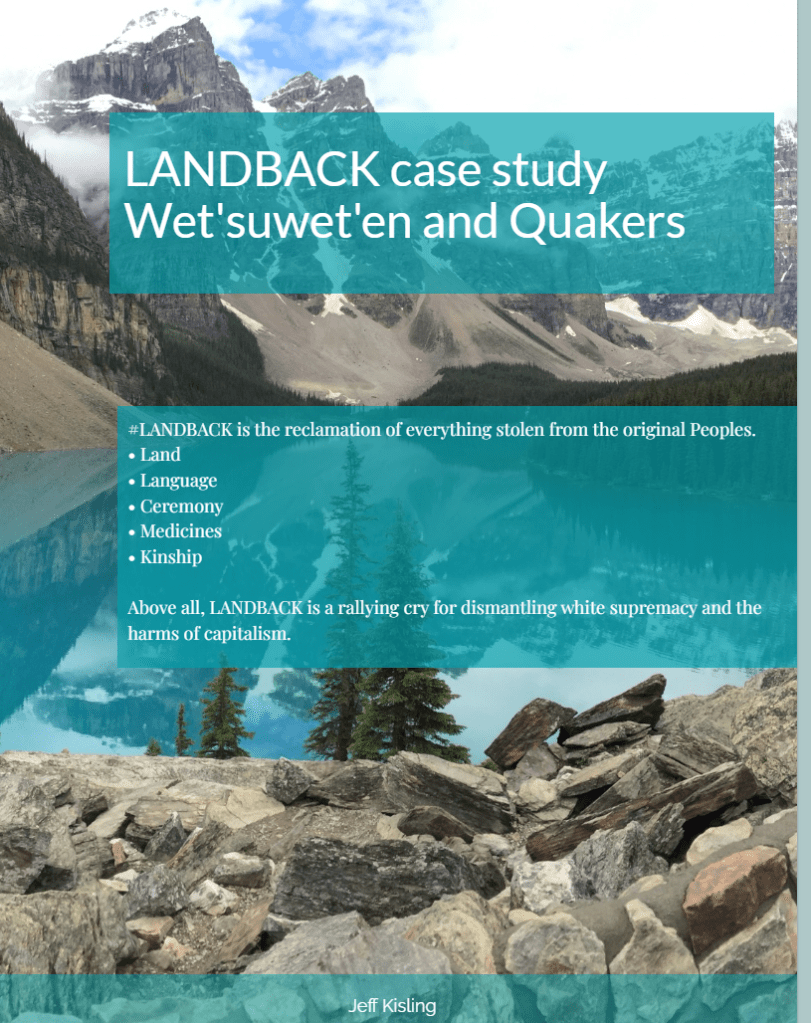
I wrote this booklet about the Wet’suwet’en struggles, including some videos of confrontations with Royal Canadian Mounted Police (RCMP). Assault rifles trained on unarmed youth.


Spirit led connection to Mutual Aid

The title THREE YEARS LATER refers to my introduction to Des Moines Mutual Aid a little over three years ago. I took the photo below on Feb 7, 2020, when a small group of us organized a vigil in support of the Wet’suwet’en. I know the Spirit led Ronnie James, from Des Moines Mutual Aid, to join us. He was surprised that anyone outside his circle knew what was happening to the Wet’suwet’en. Ronnie is an Indigenous organizer working with the Great Plains Action Society (GPAS), and as such was interested to see if these were people who could become allies.

That meeting changed my life in many ways, all stemming from what I was learning from Ronnie and others about Mutual Aid, which has become the focus of my justice work since.

Over the years I’ve enjoyed documenting justice actions photographically. I like the challenge of an ever-moving group of people, the varieties of signs, the reactions of the people and the public. But for the past several years posting photos of demonstrations is discouraged if people’s faces are visible. Which police sometimes later use to bring charges against those people.

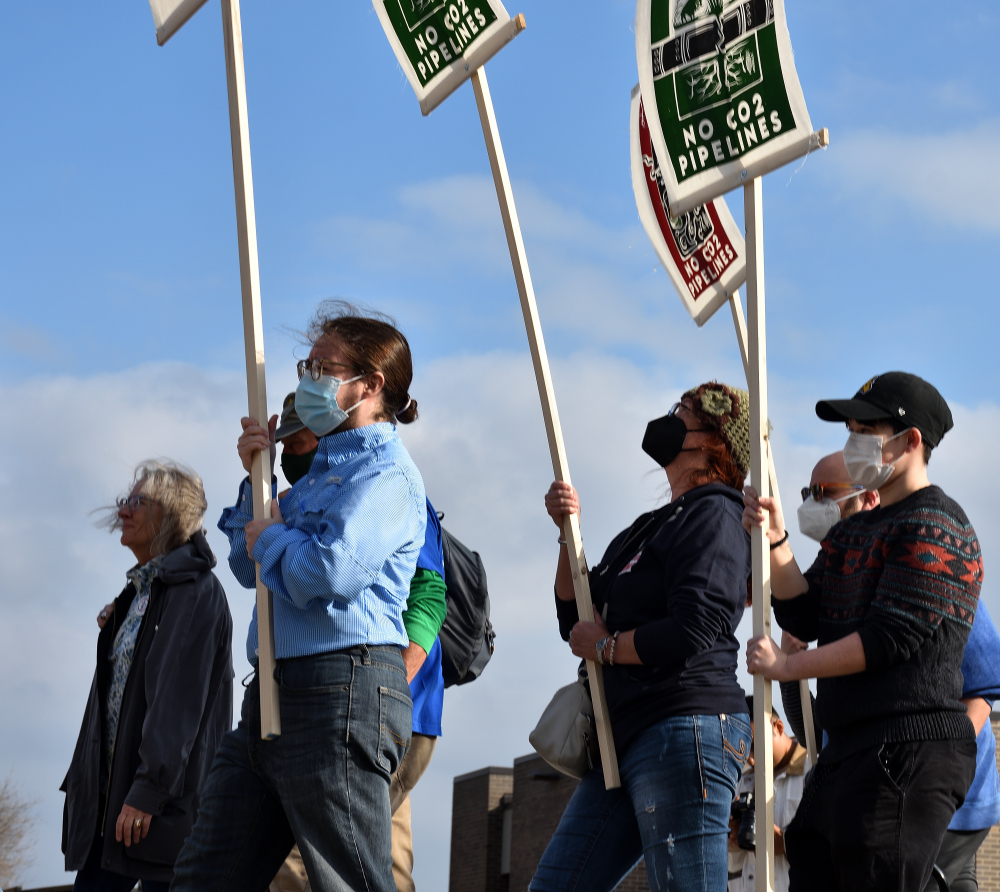
Ronnie and I are both part of Des Moines Mutual Aid’s free food project. The Wet’suwet’en being part of our history, we continue to support them. Because of COVID and people wearing masks, we were comfortable taking this photo during one of our Mutual Aid gatherings for the food project.

Des Moines Mutual Aid supports Wet’suwet’en peoples’ struggle again Coastal GasLink natural gas pipeline

Three Years Later

And yet, three years later, the Wet’suwet’en peoples’ struggles continue.

FOR IMMEDIATE RELEASE
March 29, 2023
Contact: Jennifer Wickham, Media Coordinator, Gidim’ten Checkpoint, yintahaccess@gmail.com, 778-210-0067

URGENT MEDIA ADVISORY: RCMP C-IRG Raid Wet’suwet’en Village Site, Make 5 Arrests 

VIDEO AVAILABLE HERE

WET’SUWET’EN TERRITORY (Smithers, BC) – This morning, a large force of RCMP C-IRG raided a Gidimt’en village site and arrested five land and water defenders, mostly Indigenous women, including Gidimt’en Chief Woos’ daughter. The raid accompanied a search warrant for theft under $5000 with no clear relation to the Gidimt’en village site.

This large-scale action by the RCMP’s Community Industry Response Group (C-IRG) involved more than a dozen police vehicles and officers drawn from throughout British Columbia. The arrests come just weeks after the Civilian Review and Complaints Commission (CRCC) announced they have “initiated a systemic investigation into the activities and operations of the RCMP “E” Division Community-Industry Response Group (C-IRG).”

In the days leading to this police action, RCMP C-IRG have been found patrolling Wet’suwet’en traplines and cultural use areas, harassing and intimidating Wet’suwet’en members and disrupting constitutionally protected Wet’suwet’en cultural activities. Members of a private security firm hired by Coastal Gaslink pipeline, Forsythe, have also escalated harassment and surveillance efforts against Wet’suwet’en members in recent days. 

Both the RCMP’s C-IRG unit and Forsythe are named as defendants in an ongoing lawsuit launched by Wet’suwet’en members, which alleges that police and private security have launched a coordinated campaign of harassment and intimidation in an effort to force Wet’suwet’en people to abandon their unceded territories. 

Sleydo’, spokesperson for Gidimt’en Checkpoint, said: 

“This harassment and intimidation is exactly the kind of violence designed to drive us from our homelands. The constant threat of violence and criminalization for merely existing on our own lands must have been what our ancestors felt when Indian agents and RCMP were burning us out of our homes as late as the 50s in our area. The colonial project continues at the hands of industry’s private mercenaries–C-IRG”

The arrests come days before Indigenous delegates are set to arrive at Royal Bank of Canada’s Annual General Meeting to oppose expansion of fossil fuels without consent on their territories, including Wet’suwet’en Hereditary Chiefs who oppose RBC’s funding of the Coastal Gaslink pipeline.

Wet’suwet’en Hereditary Chief Na’Moks offered the following:

“This is harassment, and exactly what Royal Bank of Canada is funding. Ahead of its shareholder meeting next week, RBC continues to fund corporate colonialism, and displace Indigenous peoples from our lands at gunpoint – all for a fracked gas pipeline we cannot afford now or in the future. In the context of the theft of our ancestral land, alleging stolen saws and clothing is outrageous.”

https://www.yintahaccess.com/?link_id=0&can_id=c209e67251859e28ba86a98fe9ff687a&source=email-take-the-streets-with-us&email_referrer=email_1865847&email_subject=take-the-streets-with-us

Yesterday morning at my Quaker meeting, we considered the following set of questions related to our environmental responsibilities.

ENVIRONMENTAL RESPONSIBILITY

ADVICE

All of creation is divine and interdependent: air, water, soil, and all that lives and grows. Since human beings are part of this fragile and mysterious web, whenever we pollute or neglect the earth we pollute and neglect our own wellsprings. Developing a keen awareness of our role in the universe is essential if we are to live peacefully within creation.

The way we choose to live each day‑‑as we manufacture, package, purchase and recycle goods, use resources, dispose of water, ‑design homes, plan families and travel‑affects the present and future of life on the planet. The thought and effort we give to replenishing what we receive from the earth, to keeping informed and promoting beneficial legislation on issues which affect the earth, to envisioning community with environmental conscience, are ways in which we contribute to the ongoing health of the planet we inhabit.

Preserving the quality of life on Earth calls forth all of our spiritual resources. Listening to and heeding the leadings of the Holy Spirit can help us develop qualities which enable us to become more sensitive to all life

QUERY

  • What are we doing about our disproportionate use of the world’s resources?
  • Do we see unreasonable exploitation in our relationship ‑with the rest of creation?
  • How can we nurture reverence and respect for life?  How I can we become more fully aware of our interdependent relationship with the rest of creation?
  • To what extent are we aware of all life and the role we play? What can we do in our own lives and communities to address environmental concerns?

Faith and Practice, Iowa Yearly Meeting (Conservative)


Birth Again the Dream of Global Peace and Mutual Respect

On the one-year anniversary of the Russia-Ukraine conflict, China has released a peace plan (below). The U.S. has portrayed this in a negative light, but Ukraine, France, and Russia have expressed interest in the plan. This is one example of China providing leadership for peace. In another example, Saudi Arabia and Iran agreed to reestablish relations on March 10 after a round of successful talks that took place in Beijing.


On 24 February 2023, the Chinese Foreign Ministry released a twelve-point plan entitled ‘China’s Position on the Political Settlement of the Ukraine Crisis’. This ‘peace plan’, as it has been called, is anchored in the concept of sovereignty, building upon the well-established principles of the United Nations Charter (1945) and the Ten Principles from the Bandung Conference of African and Asian states held in 1955. The plan was released two days after China’s senior diplomat Wang Yi visited Moscow, where he met with Russia’s President Vladimir Putin. Russia’s interest in the plan was confirmed by Kremlin spokesperson Dmitry Peskov shortly after the visit: ‘Any attempt to produce a plan that would put the [Ukraine] conflict on a peace track deserves attention. We are considering the plan of our Chinese friends with great attention’. 

Ukraine’s President Volodymyr Zelensky welcomed the plan hours after it was made public, saying that he would like to meet China’s President Xi Jinping as soon as possible to discuss a potential peace process. France’s President Emmanuel Macron echoed this sentiment, saying that he would visit Beijing in early April. There are many interesting aspects of this plan, notably a call to end all hostilities near nuclear power plants and a pledge by China to help fund the reconstruction of Ukraine. But perhaps the most interesting feature is that a peace plan did not come from any country in the West, but from Beijing. 

Birth Again the Dream of Global Peace and Mutual Respect: The Eleventh Newsletter (2023) 


Wang Yi, director of the Office of the Foreign Affairs Commission of the Communist Party of China (CPC) Central Committee, called the agreement (between Saudi Arabia and Iran) a victory for peace. He was right. That two nations with complex differences and disputes were willing to sit down with their Chinese counterparts to work toward peace in a region that’s been devastated by war and external interference is indeed a major victory.

Contrary to the U.S. narrative, China’s leadership has injected confidence into a world of uncertainty and strife. In the field of global politics, China has demonstrated through concerted action just how serious it is about the cause of peace. The landmark diplomatic achievement between Saudi Arabia and Iran does not exist in a vacuum. It is part of China’s overall leadership role in the larger global movement to democratize international relations and move away from destructive hegemonism.

China’s Example of Leadership Injects Hope into a World of Uncertainty by Danny Haiphong, Black Agenda Report, March 19, 2023


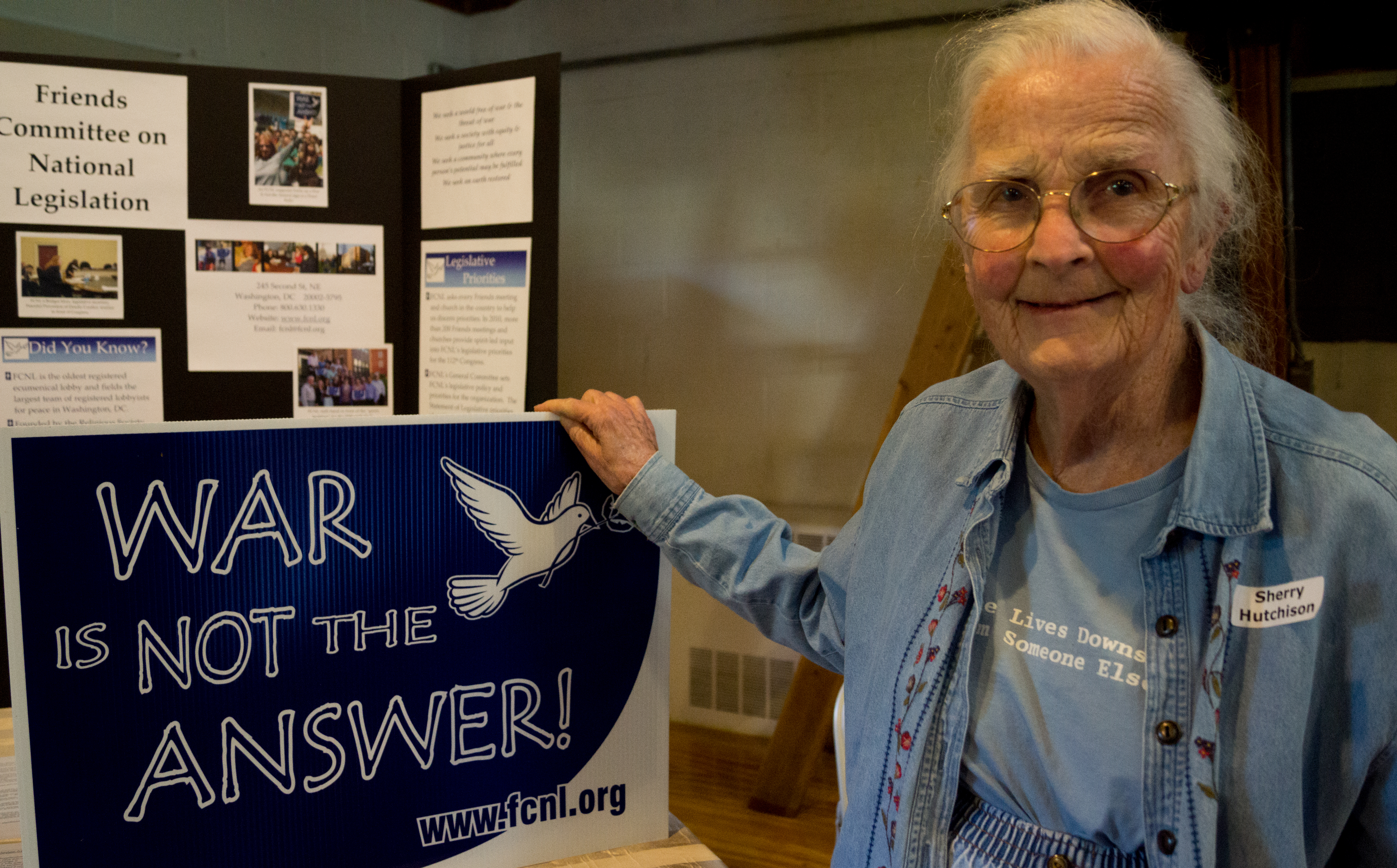
Friends Committee on National Legislation (FCNL)

In this video, Hassan El-Tayyab, Friends Committee on National Legislation’s legislative director for Middle East policy discusses the Saudi-Iran deal.

Hassan El-Tayyab, Friends Committee on National Legislation

(from the video transcript)

Hassan El-Tayyab is a legislative director for Middle East policy at Friends Committee on National legislation and he joins us now from Washington. Thank you very much for joining us and it’s interesting the Chinese have been the mediators in this because usually we would associate the United States with sort of Middle East issues particularly with Saudi Arabia.

Thank you so much for having me on to discuss this really crucial issue and the relationship between Saudi Arabia and Iran has fluctuated over the decades but as you mentioned at the top of the segment has been really tense in recent years and this recent agreement to normalize relations mediated by China as really a sea change in the Middle East and through this move China has demonstrated its ability to resolve conflicts impartially rather than relying solely on arms sales on the contrary the United States has had a habit of taking sides and conflicts such as the war in Yemen and as the Region’s largest weapons dealer.

Looking at China’s increasing involvement and mediating these conflicts in the Middle East I think really they (U.S.) should look at this as a positive development that we should all welcome because regional stability is good for the United States, it’s good for the region, and it’s obviously good for the whole world and in terms of regional stability.

They (U.S.) should take advantage of this opportunity to shift its approach in the Middle East away from hegemony away from dominance away from endless war to towards diplomacy towards restraint and towards supporting regional power sharing deals like the one we’re seeing play out right now.


Perhaps the most interesting feature is that a peace plan did not come from any country in the West, but from Beijing


When I read ‘China’s Position on the Political Settlement of the Ukraine Crisis’, I was reminded of ‘On the Pulse of Morning’, a poem published by Maya Angelou in 1993, the rubble of the Soviet Union before us, the terrible bombardment of Iraq by the United States still producing aftershocks, the tremors felt in Afghanistan and Bosnia. The title of this newsletter, ‘Birth Again the Dream of Global Peace and Mutual Respect’, sits at the heart of the poem. Angelou wrote alongside the rocks and the trees, those who outlive humans and watch us destroy the world. Two sections of the poem bear repeating: 

On the Pulse of Morning

Each of you, a bordered country, 
Delicate and strangely made proud, 
Yet thrusting perpetually under siege. 
Your armed struggles for profit 
Have left collars of waste upon 
My shore, currents of debris upon my breast. 
Yet today I call you to my riverside, 
If you will study war no more. Come, 
Clad in peace, and I will sing the songs 
The Creator gave to me when I and the 
Tree and the rock were one. 
Before cynicism was a bloody sear across your 
Brow and when you yet knew you still 
Knew nothing. 
The River sang and sings on. 

… 

History, despite its wrenching pain 
Cannot be unlived, but if faced 
With courage, need not be lived again. 

Maya Angelou

Birth Again the Dream of Global Peace and Mutual Respect: The Eleventh Newsletter (2023) 


China’s Position on the Political Settlement of the Ukraine Crisis

2023-02-24 09:00

1. Respecting the sovereignty of all countries. Universally recognized international law, including the purposes and principles of the United Nations Charter, must be strictly observed. The sovereignty, independence and territorial integrity of all countries must be effectively upheld. All countries, big or small, strong or weak, rich or poor, are equal members of the international community. All parties should jointly uphold the basic norms governing international relations and defend international fairness and justice. Equal and uniform application of international law should be promoted, while double standards must be rejected. 

2. Abandoning the Cold War mentality. The security of a country should not be pursued at the expense of others. The security of a region should not be achieved by strengthening or expanding military blocs. The legitimate security interests and concerns of all countries must be taken seriously and addressed properly. There is no simple solution to a complex issue. All parties should, following the vision of common, comprehensive, cooperative and sustainable security and bearing in mind the long-term peace and stability of the world, help forge a balanced, effective and sustainable European security architecture. All parties should oppose the pursuit of one’s own security at the cost of others’ security, prevent bloc confrontation, and work together for peace and stability on the Eurasian Continent.

3. Ceasing hostilities. Conflict and war benefit no one. All parties must stay rational and exercise restraint, avoid fanning the flames and aggravating tensions, and prevent the crisis from deteriorating further or even spiraling out of control. All parties should support Russia and Ukraine in working in the same direction and resuming direct dialogue as quickly as possible, so as to gradually deescalate the situation and ultimately reach a comprehensive ceasefire. 

4. Resuming peace talks. Dialogue and negotiation are the only viable solution to the Ukraine crisis. All efforts conducive to the peaceful settlement of the crisis must be encouraged and supported. The international community should stay committed to the right approach of promoting talks for peace, help parties to the conflict open the door to a political settlement as soon as possible, and create conditions and platforms for the resumption of negotiation. China will continue to play a constructive role in this regard. 

5. Resolving the humanitarian crisis. All measures conducive to easing the humanitarian crisis must be encouraged and supported. Humanitarian operations should follow the principles of neutrality and impartiality, and humanitarian issues should not be politicized. The safety of civilians must be effectively protected, and humanitarian corridors should be set up for the evacuation of civilians from conflict zones. Efforts are needed to increase humanitarian assistance to relevant areas, improve humanitarian conditions, and provide rapid, safe and unimpeded humanitarian access, with a view to preventing a humanitarian crisis on a larger scale. The UN should be supported in playing a coordinating role in channeling humanitarian aid to conflict zones.

6. Protecting civilians and prisoners of war (POWs). Parties to the conflict should strictly abide by international humanitarian law, avoid attacking civilians or civilian facilities, protect women, children and other victims of the conflict, and respect the basic rights of POWs. China supports the exchange of POWs between Russia and Ukraine, and calls on all parties to create more favorable conditions for this purpose.

7. Keeping nuclear power plants safe. China opposes armed attacks against nuclear power plants or other peaceful nuclear facilities, and calls on all parties to comply with international law including the Convention on Nuclear Safety (CNS) and resolutely avoid man-made nuclear accidents. China supports the International Atomic Energy Agency (IAEA) in playing a constructive role in promoting the safety and security of peaceful nuclear facilities.

8. Reducing strategic risks. Nuclear weapons must not be used and nuclear wars must not be fought. The threat or use of nuclear weapons should be opposed. Nuclear proliferation must be prevented and nuclear crisis avoided. China opposes the research, development and use of chemical and biological weapons by any country under any circumstances.

9. Facilitating grain exports. All parties need to implement the Black Sea Grain Initiative signed by Russia, Türkiye, Ukraine and the UN fully and effectively in a balanced manner, and support the UN in playing an important role in this regard. The cooperation initiative on global food security proposed by China provides a feasible solution to the global food crisis.

10. Stopping unilateral sanctions. Unilateral sanctions and maximum pressure cannot solve the issue; they only create new problems. China opposes unilateral sanctions unauthorized by the UN Security Council. Relevant countries should stop abusing unilateral sanctions and “long-arm jurisdiction” against other countries, so as to do their share in deescalating the Ukraine crisis and create conditions for developing countries to grow their economies and better the lives of their people.

11. Keeping industrial and supply chains stable. All parties should earnestly maintain the existing world economic system and oppose using the world economy as a tool or weapon for political purposes. Joint efforts are needed to mitigate the spillovers of the crisis and prevent it from disrupting international cooperation in energy, finance, food trade and transportation and undermining the global economic recovery.

12. Promoting post-conflict reconstruction. The international community needs to take measures to support post-conflict reconstruction in conflict zones. China stands ready to provide assistance and play a constructive role in this endeavor.

China’s Position on the Political Settlement of the Ukraine Crisis 2023-02-24 09:00

Moribund imperialism vs successful socialism led by China

What do you know about China? I’m beginning to learn how little I know. I’m just beginning to learn about socialism with Chinese characteristics, so I don’t know how successful socialism is there.

I recently wrote about a new text called Eight Contradictions in the Imperialist ‘Rules-Based Order’,
(see: Contradictions of the Imperialist ‘Rules-Based Order’).
I have been increasingly concerned about this country’s militarism and authoritarianism. Increasing poverty and failure to address anything related to increasingly severe climate chaos. And the choice that MUST be made between protecting our environment versus continuation of military operations and war.

The world currently stands at the beginning of a new era in which we will witness the end of the US global empire. The neoliberal system is deteriorating under the weight of numerous internal contradictions, historical injustices, and economic unviability.

Vijay Prashad, Tricontinental: Institute for Social Research

…leaders in the Global South have been making the case to halt the warmongering over Ukraine and against China. As Namibia’s Prime Minister Saara Kuugongelwa-Amadhila said, ‘We are promoting a peaceful resolution of that conflict so that the entire world and all the resources of the world can be focused on improving the conditions of people around the world instead of being spent on acquiring weapons, killing people, and actually creating hostilities’.

CONTRADICTIONS OF THE IMPERIALIST ‘RULES-BASED ORDER’ by Vijay Prashad, Tricontinental: Institute for Social Research, March 10, 2023

The first of the Eight Contradictions in the Imperialist ‘Rules-Based Order’ is the contradiction between moribund imperialism and an emerging successful socialism led by China.

This contradiction has intensified because of the peaceful rise of socialism with Chinese characteristics. For the first time in 500 years, the Atlantic imperialist powers are confronted by a large, non-white economic power that can compete with them. This became clear in 2013 when China’s GDP in purchasing power parity (PPP) overtook that of the United States. China accomplished this in a much shorter period than the West, with a significantly larger population and without colonies, enslaving others, or military conquest. Whilst China stands for peaceful relations, the US has become increasingly bellicose.

The US has led the imperialist camp since World War II. Post-Angela Merkel and with the advent of the Ukraine military operation, the US strategically subordinated dominant sections of the European and Japanese bourgeoisie. This has resulted in weakening intra-imperialist contradictions. The US first permitted and then demanded that both Japan (the third-largest economy in the world) and Germany (the fourth-largest economy) – two fascist powers during World War II – greatly increase their military expenditure. The result has been the ending of Europe’s economic relationship with Russia, damage to the European economy, and economic and political benefits for the US. Despite the capitulation of most of Europe’s political elite to full US subordination, some large sections of German capital are heavily dependent on trade with China, much more than on their US counterparts. The US, however, is now pressuring Europe to downgrade its ties to China.

The US has led the imperialist camp since World War II. Post-Angela Merkel and with the advent of the Ukraine military operation, the US strategically subordinated dominant sections of the European and Japanese bourgeoisie. This has resulted in weakening intra-imperialist contradictions. The US first permitted and then demanded that both Japan (the third-largest economy in the world) and Germany (the fourth-largest economy) – two fascist powers during World War II – greatly increase their military expenditure. The result has been the ending of Europe’s economic relationship with Russia, damage to the European economy, and economic and political benefits for the US. Despite the capitulation of most of Europe’s political elite to full US subordination, some large sections of German capital are heavily dependent on trade with China, much more than on their US counterparts. The US, however, is now pressuring Europe to downgrade its ties to China.

More importantly, China and the socialist camp now face an even more dangerous entity: the consolidated structure of the Triad (the United States, Europe, and Japan). The US’s growing internal social decay should not mask the near absolute unity of its political elite on foreign policy. We are witnessing the bourgeoisie placing its political and military interests over its short-term economic interests.

The centre of the world economy is shifting, with Russia and the Global South (including China) now accounting for 65% of the world’s GDP (measured in PPP). From 1950 until the present, the US share of the global GDP (in PPP) has fallen from 27% to 15%. The growth of the US’s GDP has also been declining for more than five decades and has now fallen to only around 2% per year. It has no large new markets in which to expand. The West suffers from an ongoing general crisis of capitalism as well as the consequences of the long-term tendency of the rate of profit to decline.

CONTRADICTIONS OF THE IMPERIALIST ‘RULES-BASED ORDER’ by Vijay Prashad, Tricontinental: Institute For Social Research, March 10, 2023

I had not known about socialism with Chinese characteristics.

Socialism with Chinese characteristics

Socialism with Chinese characteristics (Chinese: 中国特色社会主义; pinyin: Zhōngguó tèsè shèhuìzhǔyì) is a set of political theories and policies of the Chinese Communist Party (CCP) that are seen by their proponents as representing Marxism–Leninism adapted to Chinese circumstances and specific time periods, consisting of Deng Xiaoping Theory, Three Represents (Jiang Zemin), Scientific Outlook on Development (Hu Jintao), and Xi Jinping Thought on Socialism with Chinese Characteristics for a New Era.

Socialism with Chinese characteristics

Here is a link to Socialism with Chinese characteristics, A Guide for Foreigners.


Contradictions of the Imperialist ‘Rules-Based Order’

Have your views about our environmental situation changed? It is more difficult to deny environmental damage in the face of all kinds of climate chaos occurring globally.

Did you know the U.S. Military emits more carbon dioxide than many nations?

This leads to an existential paradox. If we are ever going to begin to mitigate greenhouse gas emissions, we must end military operations. Could this be a path to peace? Or will imperialism continue to feed increasing environmental devastation?

The new document described below, “Eight Contradictions in the Imperialist ‘Rules-Based Order’” identifies conflicts between imperialist nations and the rest of the world.


The Bulletin of the Atomic Scientists has now moved the Doomsday Clock to 90 seconds to midnight, the closest it has been to the symbolic time of the annihilation of humanity and the Earth since 1947. This is alarming, which is why leaders in the Global South have been making the case to halt the warmongering over Ukraine and against China. As Namibia’s Prime Minister Saara Kuugongelwa-Amadhila said, ‘We are promoting a peaceful resolution of that conflict so that the entire world and all the resources of the world can be focused on improving the conditions of people around the world instead of being spent on acquiring weapons, killing people, and actually creating hostilities’.

In line with the alarm from the Doomsday Clock and assertions from people such as Kuugongelwa-Amadhila, the rest of this newsletter features a new text called Eight Contradictions in the Imperialist ‘Rules-Based Order’ (which you can download as a PDF here). It was drafted by Kyeretwie Opoku (the convenor of the Socialist Movement of Ghana), Manuel Bertoldi (Patria Grande /Federación Rural para la producción y el arraigo), Deby Veneziale (senior fellow, Tricontinental: Institute for Social Research), and me, with inputs from senior political leaders and intellectuals from across the world. We are offering this text as an invitation to a dialogue. We hope that you will read, circulate, and discuss it.

We are now entering a qualitatively new phase of world history. Significant global changes have emerged in the years since the Great Financial Crisis of 2008. This can be seen in a new phase of imperialism and changes in the particularities of eight contradictions.

CONTRADICTIONS OF THE IMPERIALIST ‘RULES-BASED ORDER’ by Vijay Prashad, Tricontinental: Institute For Social Research, March 10, 2023

Eight Contradictions in the Imperialist ‘Rules-Based Order’

  • The contradiction between moribund imperialism and an emerging successful socialism led by China.
  • The contradiction between the ruling classes of the narrow band of imperialist G7 countries and the political and economic elite of capitalist countries in the Global South.
  • The contradiction between the broad urban and rural working class and sections of the lower petty bourgeoisie (collectively known as the popular classes) of the Global South versus the US-led imperial power elite.
  • The contradiction between advanced rent-seeking finance capital versus the needs of the popular classes, and even some sections of capital in non-socialist countries, regarding the organisation of societies’ requirements for investment in industry, environmentally sustainable agriculture, employment, and development.
  •  The contradiction between the popular classes of the Global South and their domestic political and economic power elites.
  •  The contradiction between US-led imperialism versus nations strongly defending national sovereignty.
  • The contradiction between the millions of discarded working-class poor in the Global North versus the bourgeoisie who dominate these countries.
  • The contradiction between Western capitalism versus the planet and human life.

In my mind, Indigenous nations, Indigenous homespaces, Indigenous homelessness must be engaged in a radical and complete overturning of the nation-state’s political formations and a refusal of racial capitalism. My vision to create Nishnaabeg futures and presences must structurally refuse and reject the structures, processes and practices that end Indigenous life, Black life and result in environmental desecration. This requires societies that function without policing, prisons, and property.

Nishnaabeg formations of nationhood mean a radical overturning of the current conditions and configurations within which we live—an absolute refusal of capitalism.

Maynard, Robyn; Simpson, Leanne Betasamosake. Rehearsals for Living (Abolitionist Papers) (p. 125). Haymarket Books. Kindle Edition.

Process as Solution

When I’m overwhelmed with complexity and questions, I try to express things visually. Following is the most recent iteration of something I’ve been working on for years.

The most recent change is the red line, representing how failing and corrupt institutions, authoritarianism, and environmental chaos, are blocking solutions like LANDBACK, Black Liberation, Abolition, and Mutual Aid. The forces being used by empire to crush dissent are escalating rapidly.

I still believe Mutual Aid, Abolition, and all the pieces of the Red/Green New Deal are how we will continue to build just communities. Those are the ways we will address the rising forces of injustice. But rather than just the goal of the Red/Green New Deal, they are also the means by which we defeat the forces of empire.


Authoritarianism

It has been apparent for decades that rapidly escalating environmental chaos would overwhelm the resources of our government and society. What I hadn’t given enough attention to was how rapidly authoritarianism would spread.

That is exactly what the idea is here, as it is with all these laws. It’s not just just about bloggers or kids or books. It’s about a strategy. That strategy is blitzkrieg. Again, a classic fascist maneuver. See how hard and fast these laws and bills are coming? You can scarcely catch your breath before there’s another one. The very same day news broke of the “we’re going to keep a file on you if you write about us” bill, news also broke of a bill to give women the death penalty for the crime of…miscarriages.

The point is to overwhelm the system, society, institutions. Sure, maybe all these bills won’t pass. But a few just might. And where they do, they set precedents. Those precedents are like cracks in a dam, that open whole fissures, and eventually — the deluge. This crackpot legislator, tomorrow, can point to that precedent, in that state. This lunatic lawyer can use to it to appeal, when a court strikes down some law.

The idea here is to accelerate. Propose a thousand crackpot bills. Pass maybe three. But those three become precedents, footholds, spearheads, for nine. And those nine become fifty. And those fifty become…and so it goes. This is a classic form of destabilizing democracy, loved by fanatics and extremists, who’ve failed at using hard power — open violence, like Jan 6th. They resort to a kind of blitzkrieg from the ground up, where a top down approach — storming Congress — failed. Accelerate the breakdown of democracy. Just one crackpot bill passes — and the precedent is set for another hundred.

Welcome to the GOP’s Vision for an Authoritarian America. The GOP’s Blitzkrieg of Hate on Peaceful, Innocent People — And Why It’s Fascism by umair ahque, Medium, March 4, 2023

The question is, how are we living today? Are we comfortable with a status quo based upon white superiority, materialism, militarism, and oppression, i.e. empire? To do nothing is to support this status quo.

I’ve been writing about a new campaign from the Climate Mobilization Network that hopes to build a movement of movements, a network of Mutual Aid groups.
(See: https://quakersandreligioussocialism.com/?s=climate+mobilization)


This collective visioning, movement incubation and learning gathering will equip you with space for reflection, new ideas, inspiration, and next steps to participate in this new campaign.

Together we will build relationships and explore:

  • How survival and mutual aid programs can grow the movement
  • New, creative approaches to taking action against fossil fuels
  • Ways to integrate healing into our work
  • And how to create space for reflection, intentionality and strategic clarity
https://www.theclimatemobilization.org/


CECOSESOLA: Building, here and now, the world we yearn for

I’ve been enthusiastically involved in Mutual Aid for three years. I’ve also been frustrated for those years, because I haven’t been able to tell others what a significant change Mutual Aid represents. Recently discovering Cecosesola will help with that, I think. “The theoretical frameworks for Protest and Social Movements are not sufficient to understand the emergent horizontal and prefigurative practices.”

The title of an article cited for this post, “CECOSESOLA: BUILDING, HERE AND NOW, THE WORLD WE YEARN FOR” is the definition of a term I recently learned, prefigurative.
(See: Prefigurative Societies and Mutual Aid).

What has been taking place in disparate places around the world is part of a new wave that is both revolutionary in the day-to-day sense of the word, as well as without precedent with regard to consistency of form, politics, scope and scale. The current frameworks provided by the social sciences and traditional left to understand these movements have yet to catch up with what is new and different about them. Specifically, the theoretical frameworks for Protest and Social Movements are not sufficient to understand the emergent horizontal and prefigurative practices. I suggest we think beyond these frames, and do so first by listening to, and with, those societies and groups organizing from below – and to the left.


People from below are rising up, but rather than going towards the top – ‘from the bottom up’, they are moving as the Zapatistas suggested, ‘From below and to the left, where the heart resides.’
Power over, hierarchy and representation are being rejected, ideologically and by default, and in the rejection mass horizontal assemblies are opening new landscapes with the horizon of autonomy and freedom.

Prefigurative Societies in movement by Marina Sitrin, Popular Resistance, December 21, 2022

Those who live in Black, Indigenous, and other people of color (BIPOC) communities have been on the front lines, building such communities for years. because they have never fully benefited from the systems of white superiority, dominance, and capitalism.

On September 29, 2022, Cecosesola received the Right Livelihood Award, a Swedish prize often known as the “Alternative Nobel Prize.” This award honors people and organizations that encourage social change. According to a statement issued by the Right Livelihood Foundation, the prize was given to Cecosesola for “establishing an equitable and cooperative economic model as a robust alternative to profit-driven economies.”

An Alternative to Capitalist Hierarchies: A Conversation with the Cecosesola Co-op.
A Venezuelan cooperative network that recently received the “Alternative Nobel Prize” tells its story by Cira Pascual Marquina, Venezuelanalysis, Nov 20, 2022

I have been amazed at how my Mutual Aid community functions. The services to those who are houseless, jail and court solidarity, and our free food project are some of the things we do. With no government support.

Something new is happening – something new in content, depth, breadth and global consistency. Societies around the world are in movement

Prefigurative Societies in movement by Marina Sitrin, Popular Resistance, December 21, 2022

For a long time, I’ve been looking for stories about large groups of people who have established Mutual Aid communities. I haven’t been quite sure what that would look like. The Mutual Aid community I have been part of is pretty small. The free food project usually involves about eighty people. A dozen of us filling and passing out the food boxes, about fifty people picking up food boxes, and about ten people from the places that donate the food. All of these people are part of our Mutual Aid community. That’s one of the keys of Mutual Aid, we’re all in it together. Working to avoid hierarchy.

I also wanted to find examples of large Mutual Aid communities because, when I explain what I know about Mutual Aid to others, they see us as just another one of the usual small community service groups. And they don’t see how the ideas of Mutual Aid could scale.

Those are reasons why I’m excited to be learning about Cecosesola


Cecosesola 

Cecosesola was established in Barquisimeto, capital of the State of Lara, in the central western region of Venezuela, as a cooperative integration organization on December 17, 1967. It is a meeting place where more than 50 community organizations are active, integrated in a network of production of goods and services that brings together more than 23,000 members from the popular sectors. Through this network, we develop a wide variety of activities such as: agricultural production, small-scale agro-industrial production, funeral services, transportation, health services, financial services, mutual aid funds, distribution of foods and household items. We are made up of about 1,300 associated workers who manage daily activities through participation that is open to everyone, without hierarchical positions.

Building, here and now, the world we yearn for by Cecosesola, Grassroots Economic Organizing, February 19, 2023, Popular Resistancs.org