I am grateful for many things this morning. For the waters falling from the sky. For my Mutual Aid friends who demonstrate what a Beloved community is. For the Buffalo Rebellion, growing a movement for climate action that centers racial and economic justice. Thankful for my Quaker communities. I give thanks to the Spirit.
I am grateful for my Indigenous friends. Humbled by the grace they have shown me and other white people as we seek ways to heal from the horrendous history of white supremacy and forced assimilation, abuse, and death of thousands of Native children. As we search for ways to deal with the present, ongoing injustices. The intergenerational trauma. Ripping open deep wounds as the remains of children are located. As the title of this new documentary says, “They Found Us”.
Growing up I heard references to Quakers who worked in the residential schools. I was told they were helping the Native children adjust to living in white society. I didn’t have the awareness to question why that was not a good thing.
I’ve had a life-long concern about environmental devastation. I grew up on farms. When I moved to Indianapolis in 1970, I was horrified by the dense, noxious fumes from every tailpipe, making it difficult to even see. This was before catalytic converters hid the damage being done. I was led to refuse to own a car.
It was obvious Indigenous peoples lived in sustainable ways.
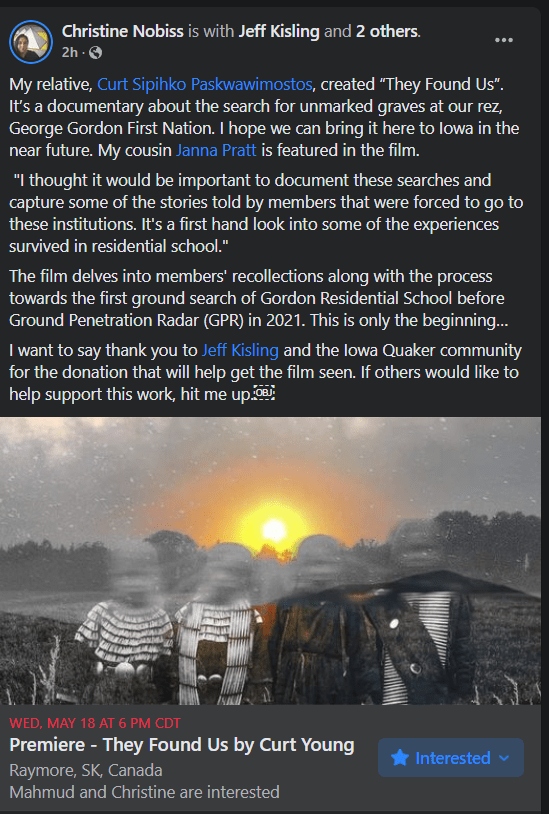
To pull this all together, here is the link to a recent blog post, Midwest Quakers and Native Peoples, which describes how I was blessed to become friends with Indigenous folks in the Midwest and the history of some of the work we’ve done together. It also talks about the Indian Residential Schools and includes a letter from Curt Young, member of George Gordon First Nation, describing the documentary he created, “They Found Us”. Sikowis is also a member of George Gordan First Nation.
“I thought it would be important to document these searches and capture some of the stories told by members that were forced to go to these institutions. It’s a first hand look into some of the experiences survived in residential school.”
Curt Sipihko Paskwawimostos, creator of “They Found Us”.
Sikowis (Christine) Nobiss is one of my close Indigenous friends. We’ve discussed the residential schools, briefly, a few times. I was glad she felt she could ask me if Quakers would help pay for expenses to travel with the film for viewing in a number of communities. She later told me it was difficult for her to ask for funds.
I am clerk of the Peace and Social Concerns Committee of Iowa Yearly Meeting (Conservative). Our committee has a budget of $1,100 to support justice work. In the past we sent $50 or $100 to a number of such organizations. Someone suggested instead sending a larger amount for one or two projects. We decided to do that but didn’t have a project in mind when we were meeting last summer.
I believed the Spirit would show us the way. The request for “They Found Us” seemed to be what we were waiting for. Our committee met to discuss and unanimously approve this. I’m grateful and humbled for that, as well.
Additional funds would be helpful. Please contact me if you are interested. jakislin@outlook.com
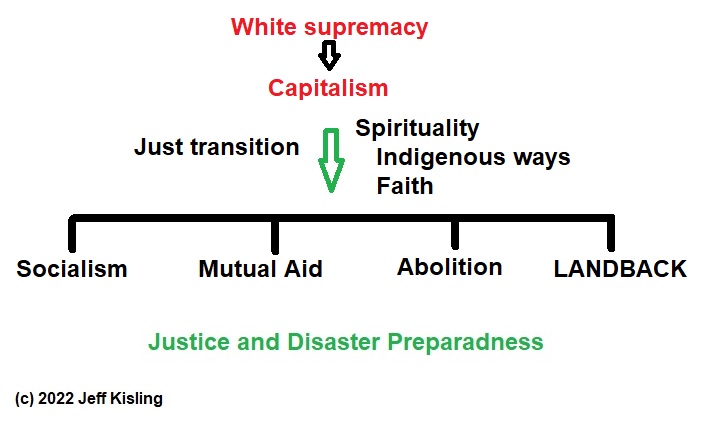
I was searching for a way to describe what WE experienced during OUR Buffalo Rebellion Climate Summit this weekend. A moment reminiscent of the times of the civil rights and anti-war movements which brought together thousands of people and created change. This weekend a coalition of people and organizations came together to rise to the challenges of rapidly evolving environmental devastation and collapse of the systems of capitalism and white supremacy.
As I wondered whether to write “what WE experienced” versus “what I experienced” I realized this was emblematic of what the Buffalo Rebellion is about. Dare WE hope? In its simplest expression, we need to change from “I” to “We” in all we do.
Those of us who have been working to protect Mother Earth are more aware than the general public of the breadth and depth of damage being done. More alarmed, more discouraged after years of work with little apparent progress.
The COVID pandemic made us more isolated and made it difficult to safely do our organizing work. Although our Des Moines Mutual Aid community never stopped distributing free food every week. We strictly enforced wearing masks and gloves and attempted to maintain social distancing by limiting the number of volunteers.
As an example of how long some of us have been working to protect our environment, fifty years ago I was led to refuse to own a car. I’m not aware of that changing other people’s lives.
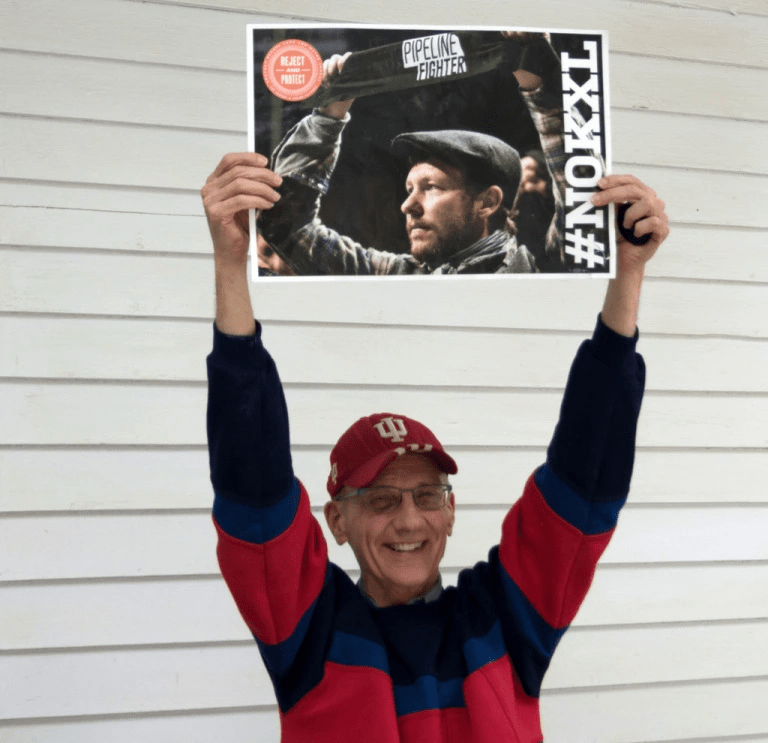
In 2013 the Keystone XL pipeline struggles began to bring some people and organizations together. One group was known as the Cowboy-Indian Alliance.
What little I learned about native cultures showed peoples who lived with far more integrity than I was able to. When I first became engaged with fossil fuel and pipeline resistance in 2013, I began to hear stories of Indigenous peoples working to protect the water. The Cowboy-Indian Alliance came together to oppose the Keystone XL pipeline. I was honored to be given this poster from the 2014 Harvest the Hope concert. [See: The Cowboy and Indian Alliance.]
It was clear to me and others that nonnative folks needed not only to join with Indigenous peoples but be led by them. How to make that happen?
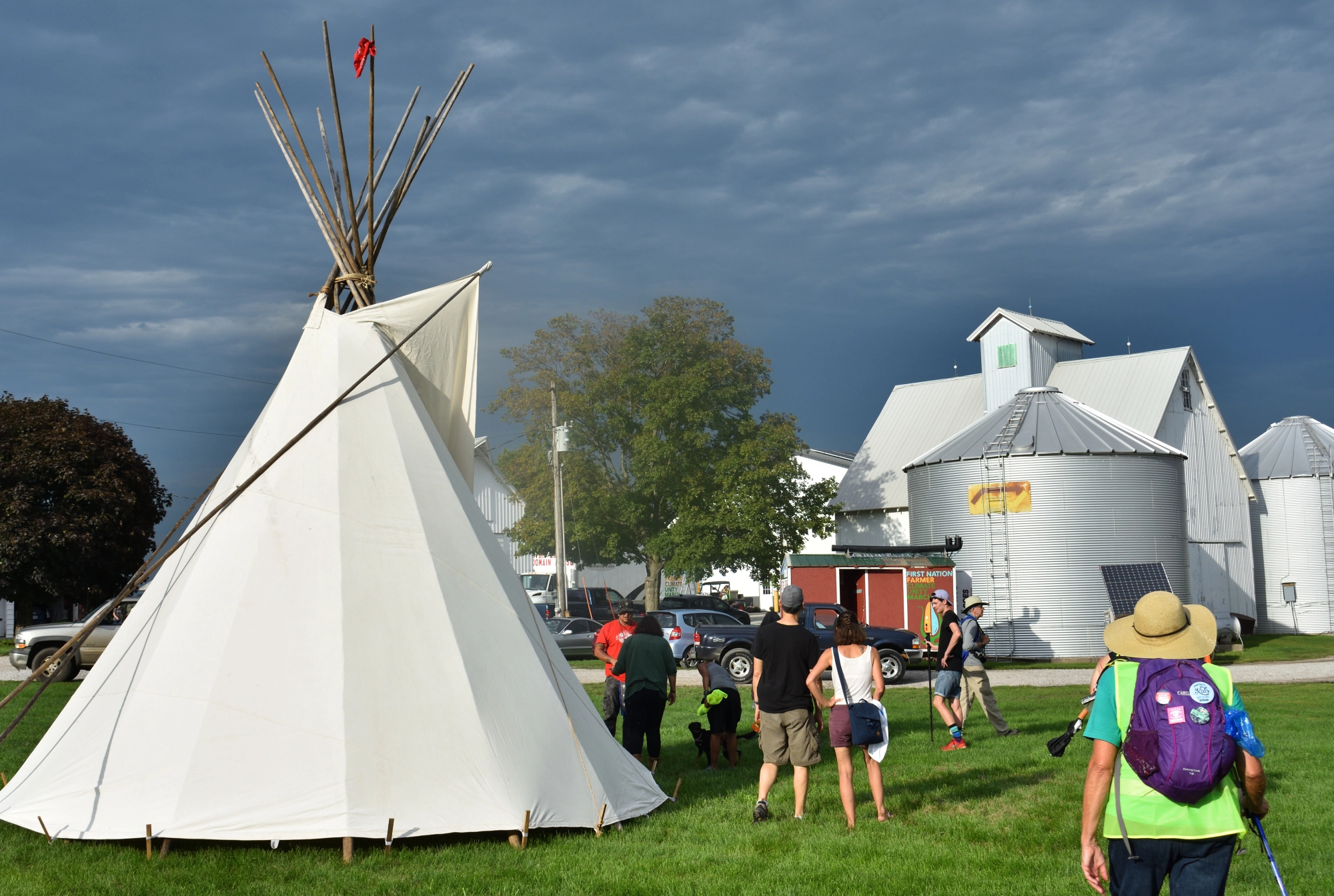
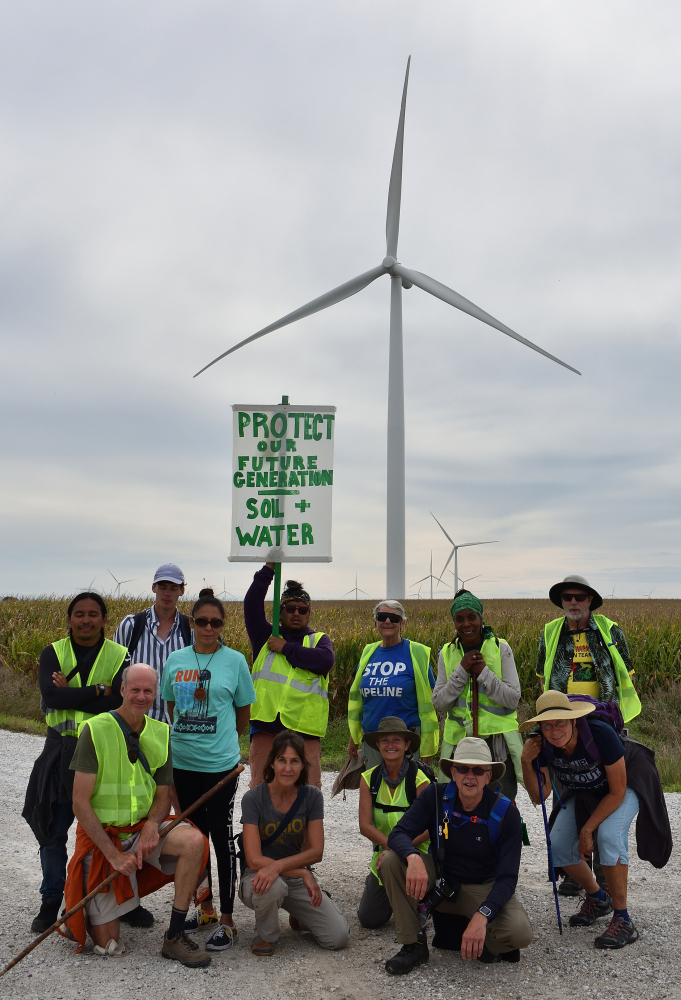
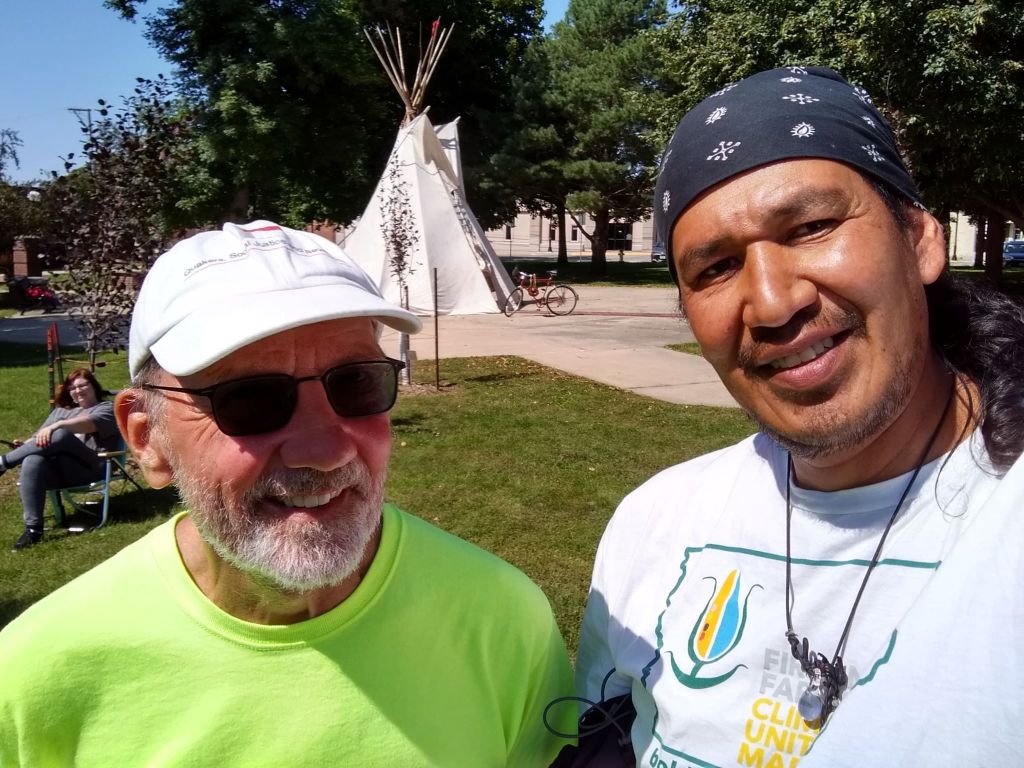
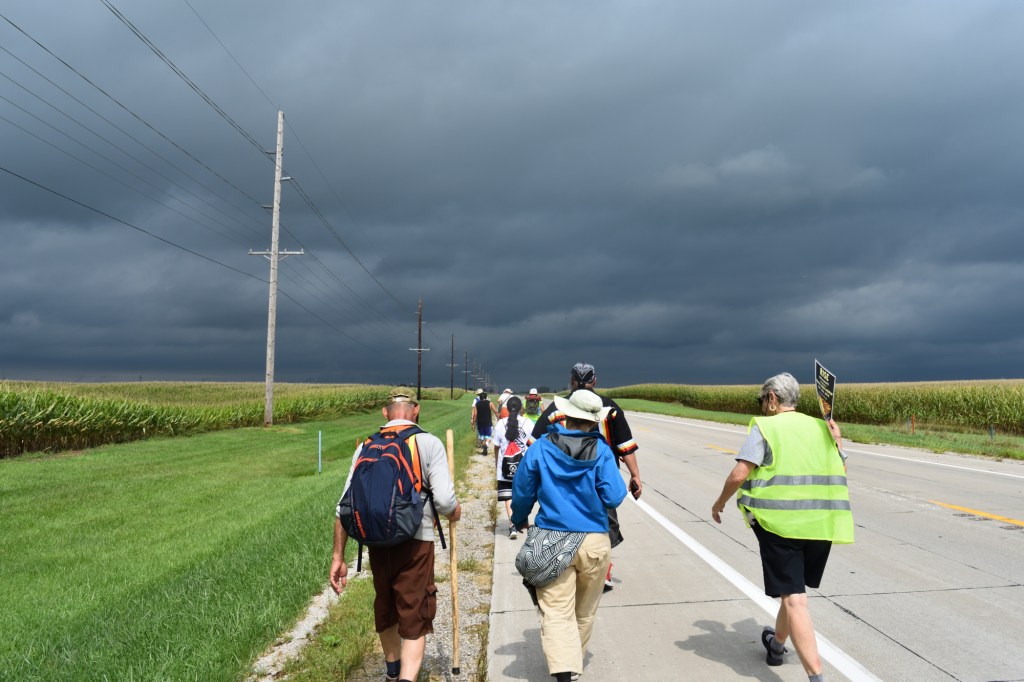
Indigenous Iowa and Bold Iowa organized the First Nation-Farmer Climate Unity March in 2018, with the intent of providing a small group of native and nonnative people the time to get to know each other, so we could begin to work on issues of common interest and concern. We walked and camped for eight days along the path of the Dakota Access pipeline from Des Moines to Fort Dodge, Iowa, ninety-four miles. [see stories and photos from that sacred journey here: First Nation Famer Climate Unity March]
A number of us worked on various projects together since, strengthening our friendships. A number of those on that March are involved in the new coalition, the Buffalo Rebellion. That includes Sikowis Nobiss, Mahmud Fitil, Trisha Entringer, Donnielle Wanatee, Miriam Kashia, Peter Clay and me.
I plan to write a lot about the Buffalo Rebellion but wanted to begin with this introduction.
I believe the answer to the question posed by this post, Dare WE hope? is yes.
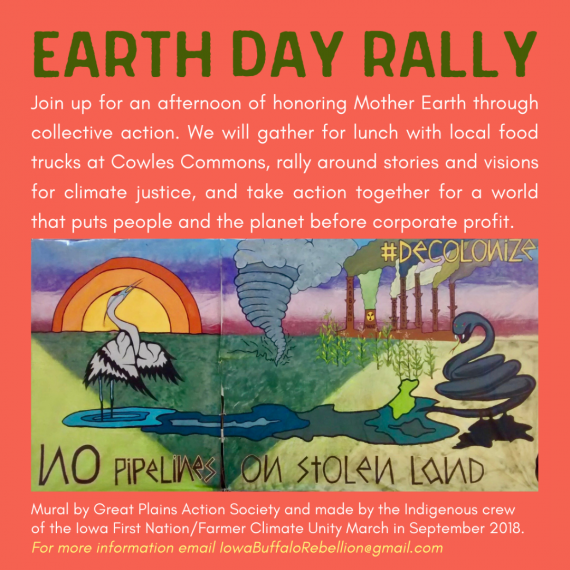
I’m excited about attending this Earth Day Rally organized by the Buffalo Rebellion. And attending the immersive training Saturday and Sunday. The organizations that make up this coalition can be found below.
We believe that we must address the root of climate change, insatiable corporate greed and white supremacy, to make change happen. This will require a multi-racial movement of working people struggling together to upend politics as usual.
This Earth Day, millions of people are demanding that world leaders take the crises we’re facing seriously.
If you listen to Iowa Public Radio today, you’ll hear about Buffalo Rebellion, an exciting new coalition of Iowa organizations working to grow a movement for climate action that centers racial and economic justice.
This weekend, Buffalo Rebellion is holding two-days of immersive training to develop 100 grassroots leaders who will build local teams to take on climate justice issues in their community.
But first, we want to come together for an afternoon of honoring Mother Earth through collective action.
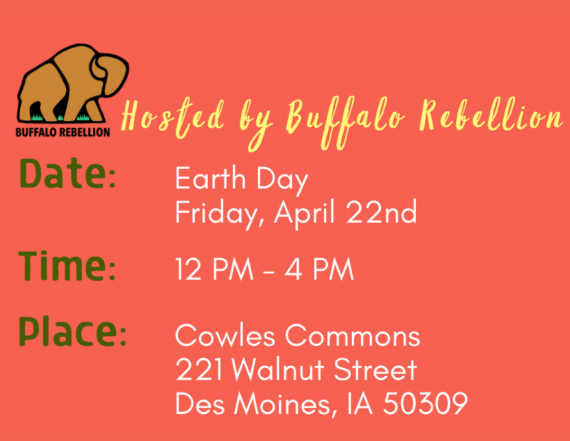
WHAT: Honor Mother Earth Rally & Action! WHEN: Friday, April 22 from 12 pm – 4 pm 12 pm – we’ll gather for lunch with local food trucks at Cowles Commons, 1 pm – rally around stories and visions for climate justice, 1:45 pm – we’ll take action together for a world that puts people and the planet before corporate profit. WHERE: Cowles Commons, 221 Walnut St, Des Moines, IA 50309 DETAILS TO KNOW: The event will happen rain or shine (forecast looking ok though)! Bring money for lunch (or bring your own) and parking (parking maps and info here). The action will consist of a <1 mile march. Family friendly, the action is youth-led. WHY: The latest IPCC report continues to make the path forward very clear: it’s either people and the planet or fossil fuels. It’s up to us to build power and push our leaders to action. For a brighter future,
We believe that we must address the root of climate change, insatiable corporate greed and white supremacy, to make change happen. This will require a multi-racial movement of working people struggling together to upend politics as usual.
“Iowa has been made into a sacrifice zone by government sanctioned Big-Ag corporations, which have a stranglehold on the climate and environmental legislation. Colonial-capitalist farming practices are poisoning our water, depleting the soil, and are a leading contributor to Iowa’s greenhouse emissions causing climate chaos.” – Sikowis Nobiss, Plains Cree/Saulteaux, Executive Director, Great Plains Action Society
Buffalo Rebellion was formed in November 2021 and consists of: Great Plains Action Society DSM Black Liberation Movement Iowa Migrant Movement for Justice Sierra Club Beyond Coal Sunrise Movement Cedar Rapids SEIU Local 199 and Iowa CCI.
The coalition is part of the national Green New Deal Network.
If you’re interested in attending the training potion of the summit or have any other questions, please email us at IowaBuffaloRebellion@gmail.com.
I had forgotten Bayard Rustin had been incarcerated for draft resistance. He joins the list of those who have written about their prison experiences such as Henry David Thoreau and Martin Luther King, Jr.
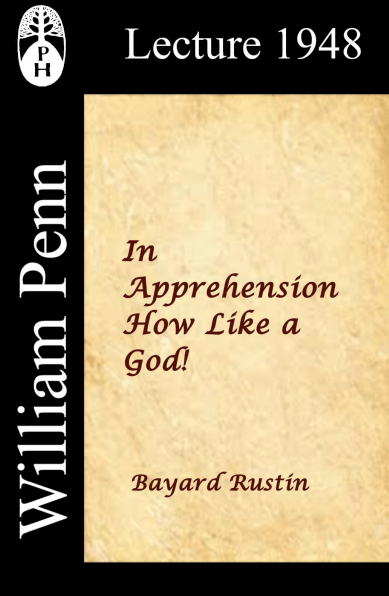
In March 1948, Bayard T. Rustin, in his capacity as secretary of FOR’s Racial-Industrial Department, was honored with the opportunity to deliver the William Penn Lecture as part of the Young Friends Movement of Philadelphia Yearly Meeting. Since its inception in 1916, the William Penn Lecture had been given by several Quaker luminaries. The lecture, titled “In Apprehension How Like a God” (drawing on Shakespeare’s Hamlet), touched on many Quaker values but, more importantly, the moral and pragmatic lessons Rustin had learned while incarcerated for two years in Kentucky and Pennsylvania federal prisons for refusing induction into the military.
In his lecture, Rustin reminded Friends of the need to uphold their moral responsibility with integrity as individuals and within the broader community whenever witnessing and confronting domestic or global social injustices. Rustin implored Friends toward consistency and truthfulness in the face of violence, war, and oppression.
In the magazine, Ithaca College’s Carlos Figueroa looks back at an important talk Bayard Rustin gave to the young Friends association in Philadelphia in 1948. It was a pivotal moment in a life that contained so many: Rustin had spent the early 1940s organizing with the Fellowship of Reconciliation and was recently released from a prison term for violating the Selective Service Act. This was his opportunity to lay out a pacifist politics for the Cold War era:
Rustin explicitly sought to persuade others into considering civil disobedience as a social democratic strategy for pursuing structural and policy change. Rustin advocated for a humanitarian, communal, and moralistic approach to change, thus disregarding an individual’s political affiliation, geographic location, or government system.
Rustin explicitly sought to persuade others into considering civil disobedience as a social democratic strategy for pursuing structural and policy change.
From the introduction of the QuakerSpeak video below: As a gay African-American, civil rights activist Bayard Rustin faced discrimination his entire life—sometimes, Walter Naegle reminds us, among his fellow Friends. Walter, Rustin’s partner and companion in his final decades, discusses his vital contributions to Quaker testimony of peace, integrity and equality.
“Bayard believed in the oneness of the human family, in the brotherhood and sisterhood of all people,” Walter says. “He believed in the power of nonviolence which comes out of that belief in the oneness of all people.… He saw everybody as equal in the eyes of the divine.”
“I put my life on pause, rewound, now I’m pressing play. The come up, grinding until the sun up, knowing it could all be gone if one person puts their guns up. A black Quaker no savior, I’m on my Bayard Rustin to convince all the skeptics and get people to just trust em.”
Sterling Duns
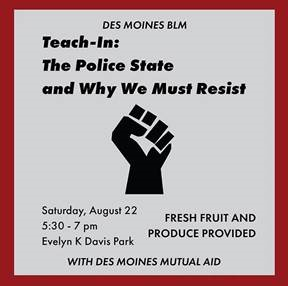
I’m reminded of a teach-in by my friend Ronnie James, The Police State and Why We Must Resist. “As bleak as this is, there is a significant amount of resistance and hope to turn the tide we currently suffer under.”
I’ve been working on this post for days, which is unusual. Not quite sure how these seemingly disparate parts fit together. In part because there will increasingly be direct actions related to environmental devastation. I’ll be attending a Climate Summit this weekend, which will include training for and participation in direct action.
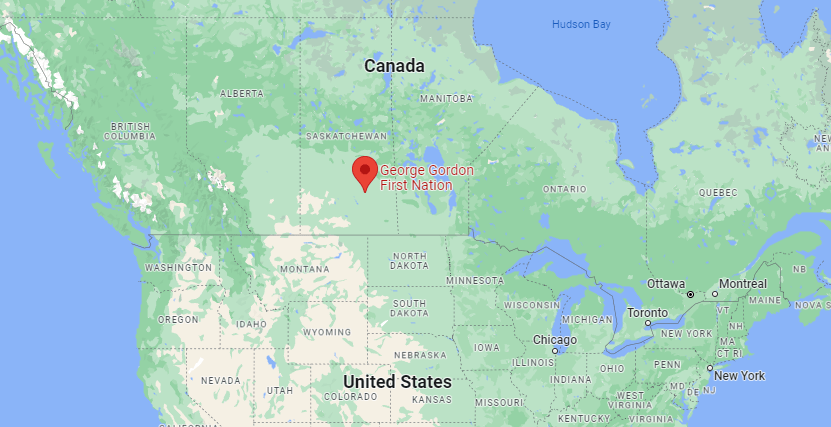
The purpose of this brief history is background for a request from Sikowis (Christine) Nobiss for funds to support the documentary “They Found Us” that’s being done about her reservation’s residential school. George Gordon First Nation had the longest running residential school, which didn’t close until 1996.
During the 2017 annual sessions of Iowa Yearly Meeting (Conservative) there was panel discussion about building bridges with native peoples. The panel consisted of Peter Clay, an Iowa Friend, Donnielle Wanatee from the Meskwaki Settlement, and Sikowis (Christine) Nobiss, one of the most active Indigenous leaders in the Midwest. All three have played a large role in my connections with Native Americans since.
In February 2018, I was part of a group who went to Minneapolis to protest US Bank’s funding of oil pipelines. Sikowis spoke at that gathering.
I began to get to know Sikowis when she and I were among a small group of native and non-native people who walked and camped for eight days along the route of the Dakota Access pipeline, from Des Moines to Fort Dodge, Iowa. Iowa Friend Peter Clay was also on this First Nation-Farmer Climate Unity March. Jon Krieg (AFSC) joined us for the first day. And my Scattergood School roommate Lee Tesdell participated in one of the evening discussions during the March. Another Iowa Yearly Meeting Friend, Liz Oppenheimer, organized a time of worship sharing and prayer among Friends each morning, supporting our sacred journey.
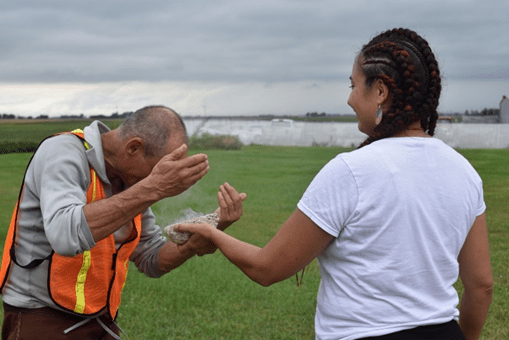
In this photo during the March Sikowis is holding the bowl Peter Clay is smudging from.
The purpose of the March was to create a community of native and non-native people who began to know and trust each other so we could work on things of common concern. That was highly successful, and we have done a number of things together since.
One of the first was when several of us from the March, including Sikowis (in the center of this photo), Iowa Friends Shazi and Fox Knight, and I lobbied Senator Grassley’s staff to support several bills related to native concerns.
Lobbying Iowa Senator Grassley about native legislation
The summer of 2019 Sikowis suggested I attend the National Network Assembly at the Des Moines YMCA Camp near Boone, Iowa, that she helped organize. I was aware that if I wanted to build on relationships with native peoples, I should wait to be invited. Seeing this as one of those opportunities, I did attend.
In early 2020, I began to hear about the struggles of the Wet’suwet’en peoples in British Columbia, as they worked to prevent the construction of a liquid natural gas pipeline (Costal GasLink) through their pristine lands and waters. There was little being written about this in the mainstream media, so supporters were asked to write about what was happening on our social media platforms.
This photo is from a post about a rally I organized to support the Wet’suwet’en in Des Moines on February 7, 2020. Iowa Friend Peter Clay attended.
I’m convinced the Spirit led Ronnie James to come to this rally. Ronnie is an Indigenous organizer with twenty years of experience. He was surprised anyone in Iowa knew about the Wet’suwet’en, so he came to see who we were. Since that day Ronnie has been patiently mentoring me about Des Moines Mutual Aid. Including helping me become involved in the food giveaway project. We’ve become good friends.
This relates to my relationship with Sikowis because Ronnie is a member of the Great Plains Action Society (GPAS) that she organized for Indigenous activism in the Midwest. Several other friends I made during the First Nation-Farmer Climate Unity March also work at Great Plains Action Society.
As often happens, once people know I love photography, I get invited to events for that purpose (even though I’d want to go, anyway). This photo of Sikowis was taken at last year’s Indigenous People’s Day. She’s holding a Great Plains Action Society bag.
Sikowis Nobiss
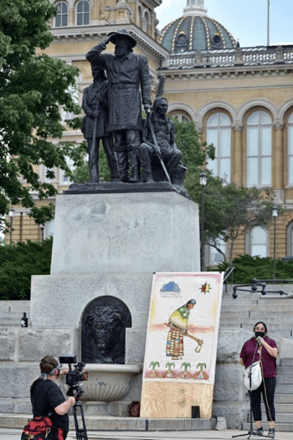
Another event where I took photos was a gathering on the State Capitol grounds related to racist statues. In this photo Sikowis is speaking at the Pioneer statue.
Sikowis Nobiss
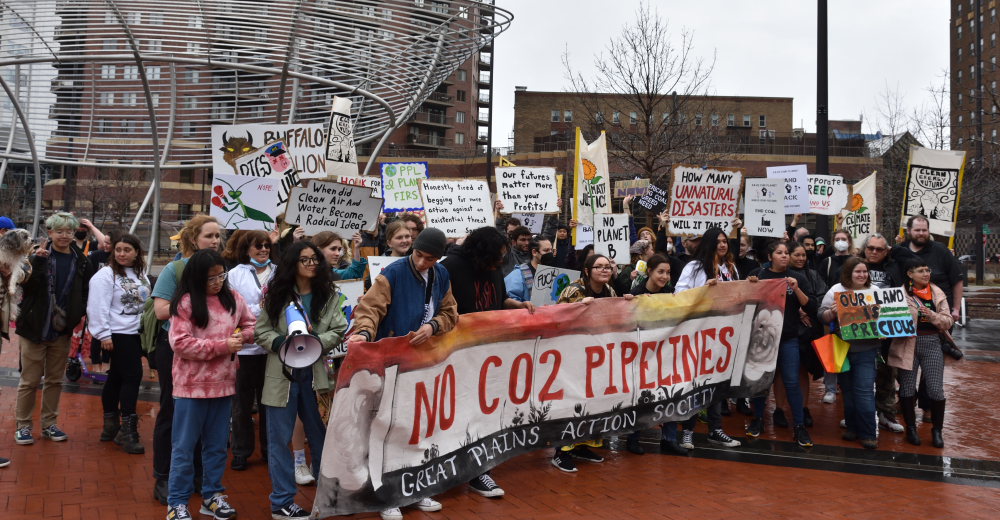
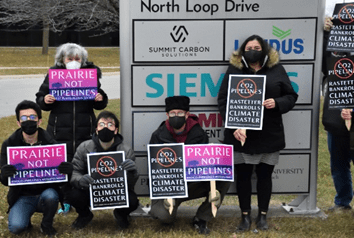
Last December, Sikowis asked me to come to Ames for a rally at the office of Summit Carbon, one of the companies that want to build a CO2 pipeline.
Residential institutions of forced assimilation
The legacy of what are sometimes called Indian Boarding Schools has been a concern of mine for years. The involvement of Quakers in establishing and teaching in these institutions has become a source of tension and conflict among Quakers today. I think my past ignorance about these institutions was common for Quakers, thinking Friends involved in those schools were doing the best they could to help native children assimilate into mainstream American society. Not critically thinking why that would be a good thing. But we began to learn more about the great harm this did to native children and their families. And that was before learning about the widespread emotional, physical and sexual abuse of the children.
I was led to make this something I needed to learn more about. And share what I was learning with Quakers and others. Friend Paula Palmer, who has become a friend of mine, was called to a ministry related to these institutions and Quaker’s involvement in them. Peter Clay and I helped organize events among Iowa Friends, Conservative and FUM, when Paula came to the Midwest.
Prior to the First Nation-Farmer Climate Unity March I was unsure whether I should bring up the subject of forced assimilation, especially as I had learned more about trauma from those institutions being passed from generation to generation. I had hoped to learn about Indigenous spirituality on the March but didn’t see how that could happen without acknowledging Quakers’ involvement in forced assimilation.
Matthew and I began to get to know each other early in the March because he was shooting video of the same things I was taking photos of. We shared quite a bit about this common interest. I believe it was the second day of the March as we were walking and talking together that the Spirit led me to tell him I knew about the Quaker involvement in the residential schools, and I was sorry for what had happened. Of course, I had no idea how he would react. But all he did was nod his head, and we continued to walk and talk together. I didn’t say anything else about that.
But just a few hours later he said he wanted to tell me a story. It involved a traumatic incident related to his mother and the residential schools. I was so grateful he felt he could share that with me. We didn’t talk about that any further.
Since then, when it seemed appropriate, I brought up Quaker involvement in the boarding schools with each of my native friends. Each one had personal experiences related to the schools. I believe that it was an important part of our developing friendships that we shared these stories.
Sikowis told me briefly of family members who had experienced traumas from those institutions. We had that brief discussion several years ago.
I believe this is in part why she invited me to ask Quakers if we would help support making a documentary about her reservation’s (George Gordon First Nation) residential school.
Iowa Yearly Meeting (Conservative)’s Peace and Social Concerns Committee has an annual budget to support peace and justice work. This year it was decided that rather than give token amounts to various peace and justice organizations, we might discern to invest a larger sum, for a more significant impact, to an organization or project. But we didn’t know what that would be.
This request from Sikowis is an opportunity to build on Iowa Yearly Meeting (Conservative)’s relationship with Indigenous peoples in the Midwest. An opportunity to begin truth and healing.
I’m pleased the Peace and Social Concerns Committee unanimously supports using our budget to support the documentary that’s being done about the George Gordon First Nation’s residential school.
March 27, 2022
This letter in regards to a request for financial support for a documentary title “They Found Us”, to support community presentations of this film that I produced.
My name is Curt Young and I a member of the George Gordon’s First Nation. I am a descendant of Mike Longman, along with my mother Longman-Young; both members of this nation. The development of this documentary was an intent for myself to learn more about my maternal familial lineage, as I had not grown up on GGFN and wanted more connections to my cultural heritage. I applied for the “Peoples Investment Grant”, while residing in Calgary and was a successful candidate. These funds were intended to financially support a compilation of Elder’s narratives, however, during the initial interviews, the findings of the 215 bodies outside of the Kamloops residential schools, inspired myself to change the direction of the documentary. I decided to focus more on the process that GGFN reserve’s undertaking of a ground search outside of the local residential school; to see if there were any unmarked graves or bodies buried there.
Over the past year, I have made three trips to GGFN to obtain footage of the community’s initial activities related to the ground search of the area. Aside from the footage of the community, I also have compiled interviews from GGFN members, and other Indigenous people, including leaders and Elders, that have shared their own narratives and experience with residential schools. The budget that I was provided by the grant I received was allocated to travel costs associated with these trips to GGFN, along with the rental of video technological equipment, necessary to create the documentary. I have spent time and effort into producing this documentary and have been promoting it through various online platforms, along with connections I have within Indigenous communities, both urban and rural. I have much interest in public showings of this documentary, particularly since June is coming up, with it being National Indigenous Peoples month. One showing that I have confirmed is the first week of June; at Fort Calgary. Although I am quite excited for the interest and opportunities, I would like to honour my home community and acknowledge the stories that are compiled in my documentary, by having the first public showing of “They Found Us” on GGFN.
In order for myself to bring the documentary to GGFN I am requesting funds to support my travel, accommodation and honorarium for traditional drummers and possibly a dancer to create a healing and culturally safe space for a community show. My first showing that I have booked for this documentary is June 4, 2022, thus, I am asking to have funds to showcase the documentary on GGFN prior to this date.
My friend Sikowis (Christine) Nobiss is raising money for a documentary that’s being done about her reservation’s residential school. George Gordon First Nation had the longest running residential school, not closing until 1996.
My relative is working to raise funds for his documentary on elders and the history of the residential school at George Gordon First Nation, which is my nation. He needs to make multiple trips throughout the plains and to GGFN and set up viewing events for the documentary, which will cost around $7,000 CAD. If there are any folks in your community interested in helping him attain this goal, please let me know. Thank you.
As described in the following letter, the project was originally for a compilation of Elder’s narratives. But during the initial interviews, the findings of the 215 bodies outside the Kamloops residential school changed the direction of the documentary. To focus on the process that George Gordon’s First Nation was undertaking related to the unmarked graves or bodies at the GGFN reserve’s residential school.
March 27, 2022
This letter in regards to a request for financial support for a documentary title “They Found Us”, to support community presentations of this film that I produced.
My name is Curt Young and I a member of the George Gordon’s First Nation. I am a descendant of Mike Longman, along with my mother Longman-Young; both members of this nation. The development of this documentary was an intent for myself to learn more about my maternal familial lineage, as I had not grown up on GGFN and wanted more connections to my cultural heritage. I applied for the “Peoples Investment Grant”, while residing in Calgary and was a successful candidate. These funds were intended to financially support a compilation of Elder’s narratives, however, during the initial interviews, the findings of the 215 bodies outside of the Kamloops residential schools, inspired myself to change the direction of the documentary. I decided to focus more on the process that GGFN reserve’s undertaking of a ground search outside of the local residential school; to see if there were any unmarked graves or bodies buried there.
Over the past year, I have made three trips to GGFN to obtain footage of the community’s initial activities related to the ground search of the area. Aside from the footage of the community, I also have compiled interviews from GGFN members, and other Indigenous people, including leaders and Elders, that have shared their own narratives and experience with residential schools. The budget that I was provided by the grant I received was allocated to travel costs associated with these trips to GGFN, along with the rental of video technological equipment, necessary to create the documentary. I have spent time and effort into producing this documentary and have been promoting it through various online platforms, along with connections I have within Indigenous communities, both urban and rural. I have much interest in public showings of this documentary, particularly since June is coming up, with it being National Indigenous Peoples month. One showing that I have confirmed is the first week of June; at Fort Calgary. Although I am quite excited for the interest and opportunities, I would like to honour my home community and acknowledge the stories that are compiled in my documentary, by having the first public showing of “They Found Us” on GGFN.
In order for myself to bring the documentary to GGFN I am requesting funds to support my travel, accommodation and honorarium for traditional drummers and possibly a dancer to create a healing and culturally safe space for a community show. My first showing that I have booked for this documentary is June 4, 2022, thus, I am asking to have funds to showcase the documentary on GGFN prior to this date.
Quakers in my Yearly Meeting, Iowa Yearly Meeting (Conservative), have instituted Spiritual Sharing Small Groups for Friends who are interested in participating. There have been several cycles of these groupings. I was led to participate in the current groupings, hoping to find some help with a Spiritual crisis I’m in.
There are four of us in my group, and we meeting every Tuesday night. There isn’t a specific format for these meetings. We each take turns introducing the night’s discussion. Tonight is my turn and I’m looking forward to sharing an experience that changed my life, and relates to my Spiritual crisis.
I plan to talk about the sacred journey I was led to make, the First Nation-Farmer Climate Unity March. I created a WordPress website with many photos, videos and stories from the March at this link:
As the name implies, this was a march to unify a small community of native and non-native people. Our group was around thirty native and non-native people. Unify in the sense of getting to know, and begin to build trust among us. It was clear to me, and many of my non Indigenous friends, that native views and practices are essential to heal Mother Earth.
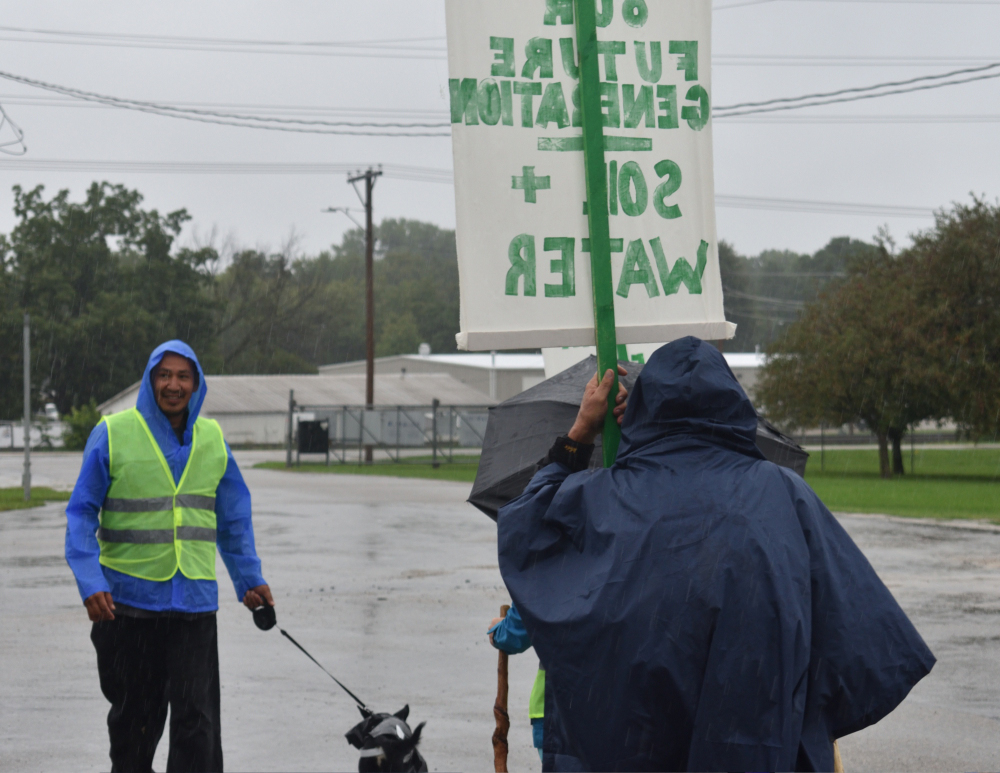
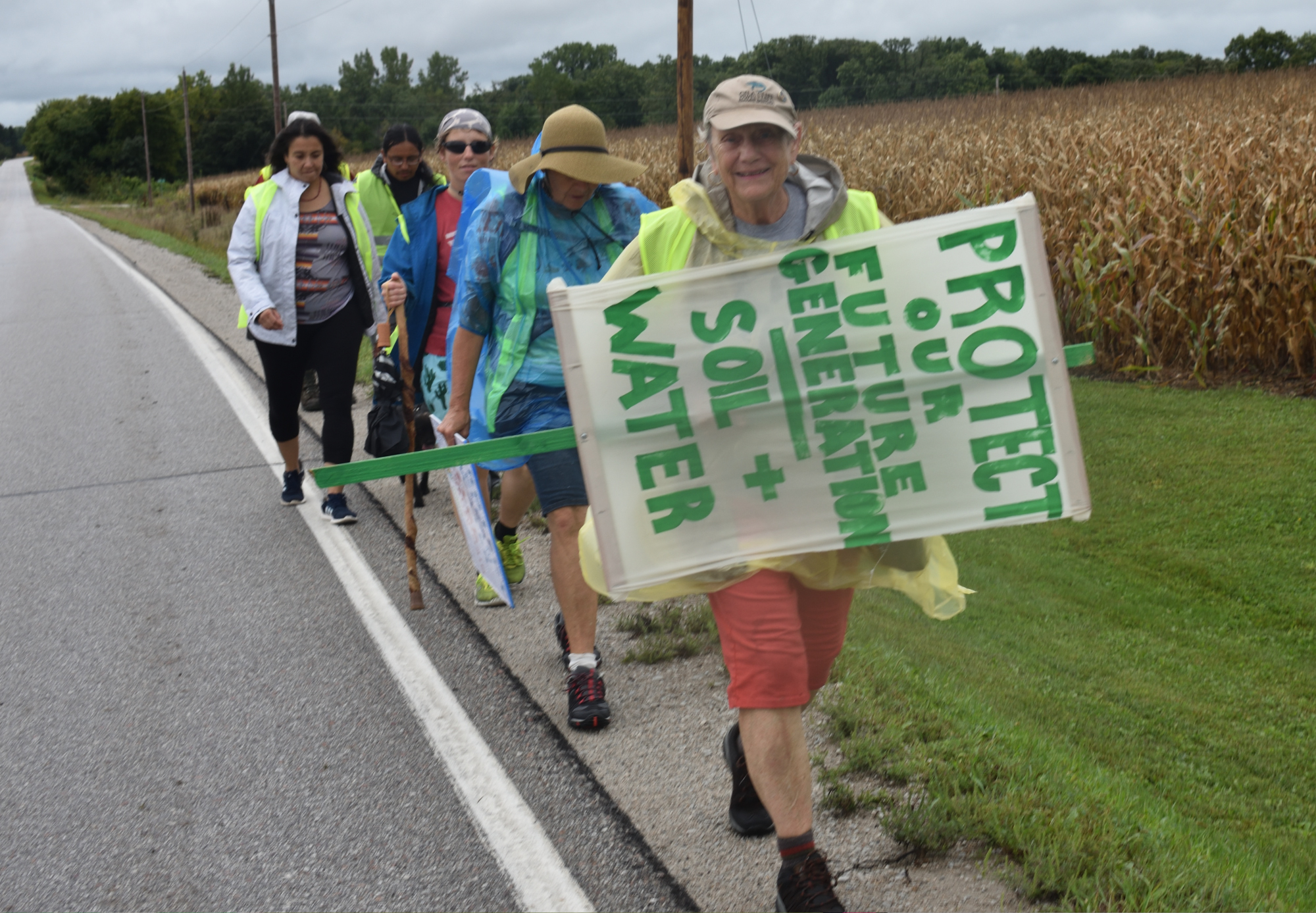
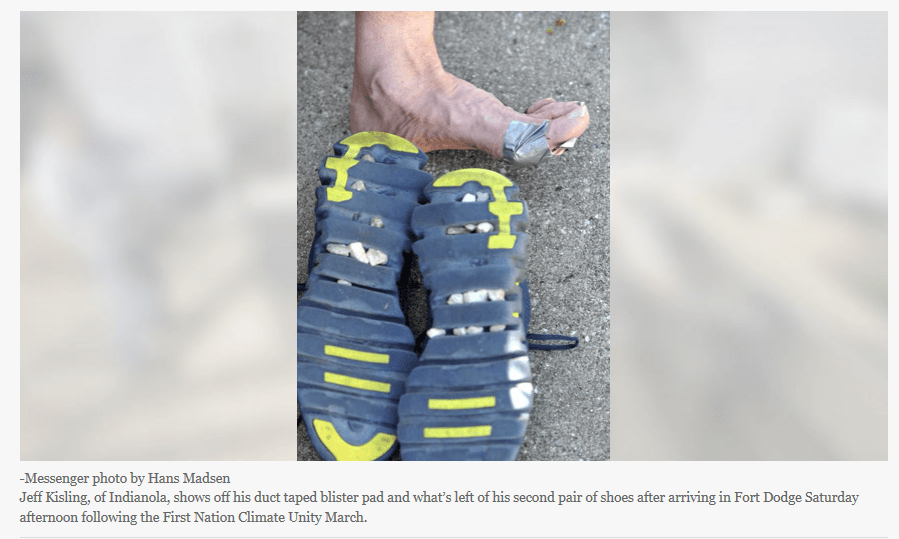
We began to get to know each other as we walked together for hours down nearly empty rural gravel roads. This sacred journey began in Des Moines, and ended ninety four miles and eight days later in Fort Dodge. This was literally an act of faith. I was not at all sure I could walk all the way, but was very grateful I made it. Fortunately it was suggested that we pack an extra pair of shoes, because my first pair were worn out about halfway.
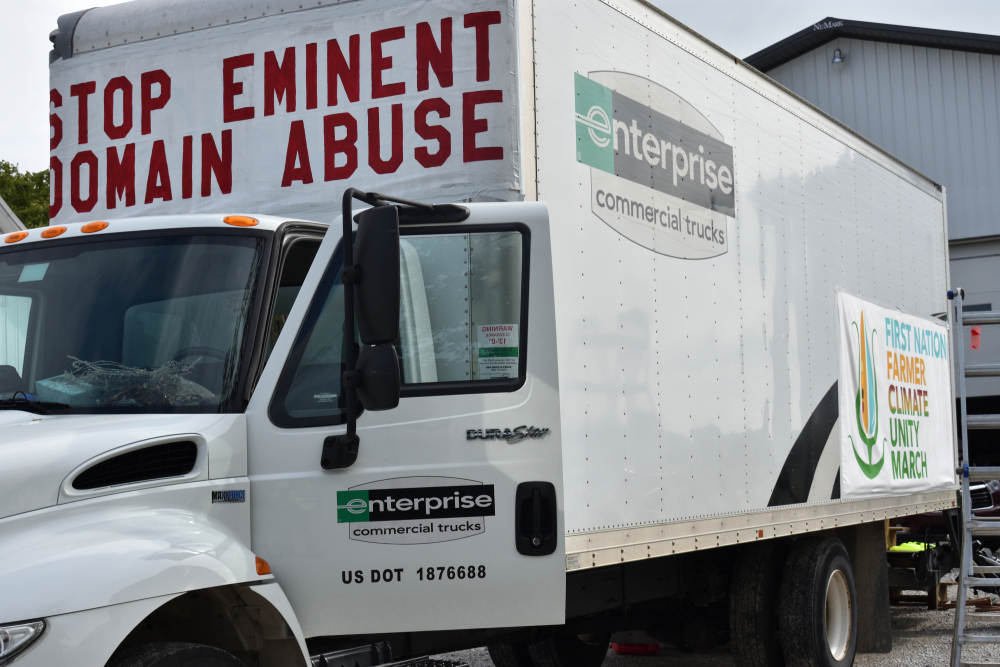
We walked and camped along the path of the Dakota Access pipeline. The truck that carried our tents from place to place had a huge banner that said “Stop Eminent Domain Abuse”. Eminent domain was used to force landowners to allow the pipeline to be built through their land despite their wishes otherwise.
Eminent domain is in the news again, as companies are pushing for the construction of carbon pipelines. My friends Sikowis Nobiss and Mahmud Fitil, both of whom walk on the March, organized this gathering at the headquarters of Summit Carbon a couple of months ago and invited me to take photos. Just one example of how those of us on the March have worked together since.
Spiritual Crisis
As I see and learn more about white supremacy and its toxic effects on peoples and Mother Earth, I find it difficult to consider myself a Christian. The weaponized version of a religion. The Crusades. The Doctrines of Discovery that not only purported to gave white people the permission to take over lands around the earth, but also to subjugate and kill the Indigenous peoples.
And the incomprehensible history and consequences of the forced assimilation of native children. The multigenerational traumas. The physical, mental, and sexual abuses and thousands of deaths.
Something important happens when we gather in pursuit of a common goal. First we form rituals that help us relate to and negotiate each other, everything from a civic tradition that allows anyone with a voice to be respectfully heard, to sharing food and music in the local town hall every Friday night, to a labour system that fairly distributes the burden of work. Then, those rituals that stand the test of time become embedded in daily life. The ritual activities themselves and the good they produce help a community identity take root. As identity strengthens, so too does our sense of connectedness — our sense of affection, responsibility and obligation — to one another. When this happens, we then share a greater capacity for coherence and cooperation. And where we share greater capacity for coherence and cooperation there is also greater resilience: the ability to mobilise skills and resources to support the emergence of collective intelligence in response to crisis, enable rapid adaptation and ensure the continuity of the most important functions and structures of the community. This coherent togetherness and the collective intelligence that emerges out of it is the source of human strength and ingenuity. Within it lies our ability to transition from one evolutionary niche to another, even against the odds.
What comes to matter then is the creation of the best possible story we can while we’re here; you, me, us, together. When we can do that and we take the time to share those stories with each other, we get bigger inside, we see each other, we recognize our kinship — we change the world one story at a time.
Richard Wagamese (October 14, 1955-March 10, 2017) Ojibwe from Wabeseemoong Independent Nations, Canada
We are our stories, stories that can be both prison and the crowbar to break open the door of that prison; we make stories to save ourselves or to trap ourselves or others, stories that lift us up or smash us against the stone wall of our own limits and fears. Liberation is always in part a storytelling process: breaking stories, breaking silences, making new stories.
Rebecca Solnit, ‘Silence Is Broken’, in ‘The Mother of All Questions’
This is the Zoom link for Witness Wednesday Silent Reflection: fcnl.org/ww-stream
What to expect at Silent Reflection
The space is open for conversation and fellowship beginning at 4 p.m. Central Time. At 4:15 p.m. CT, a designated convener will gather the group. Often the convener will share a quote or question to help the group focus. The group will settle into silence. Anyone is welcome to share a message or reflection. We ask that you leave space between messages and only share once. A few minutes before 5:00 p.m. CT, the convener will close the gathering and invite participants to introduce themselves and share closing thoughts.
To join, visitfcnl.org/ww-streamorregister hereto receive the information to join by phone. You shouldn’t need this, but just in case:
Meeting ID: 854 485 249
Passcode: SR2021
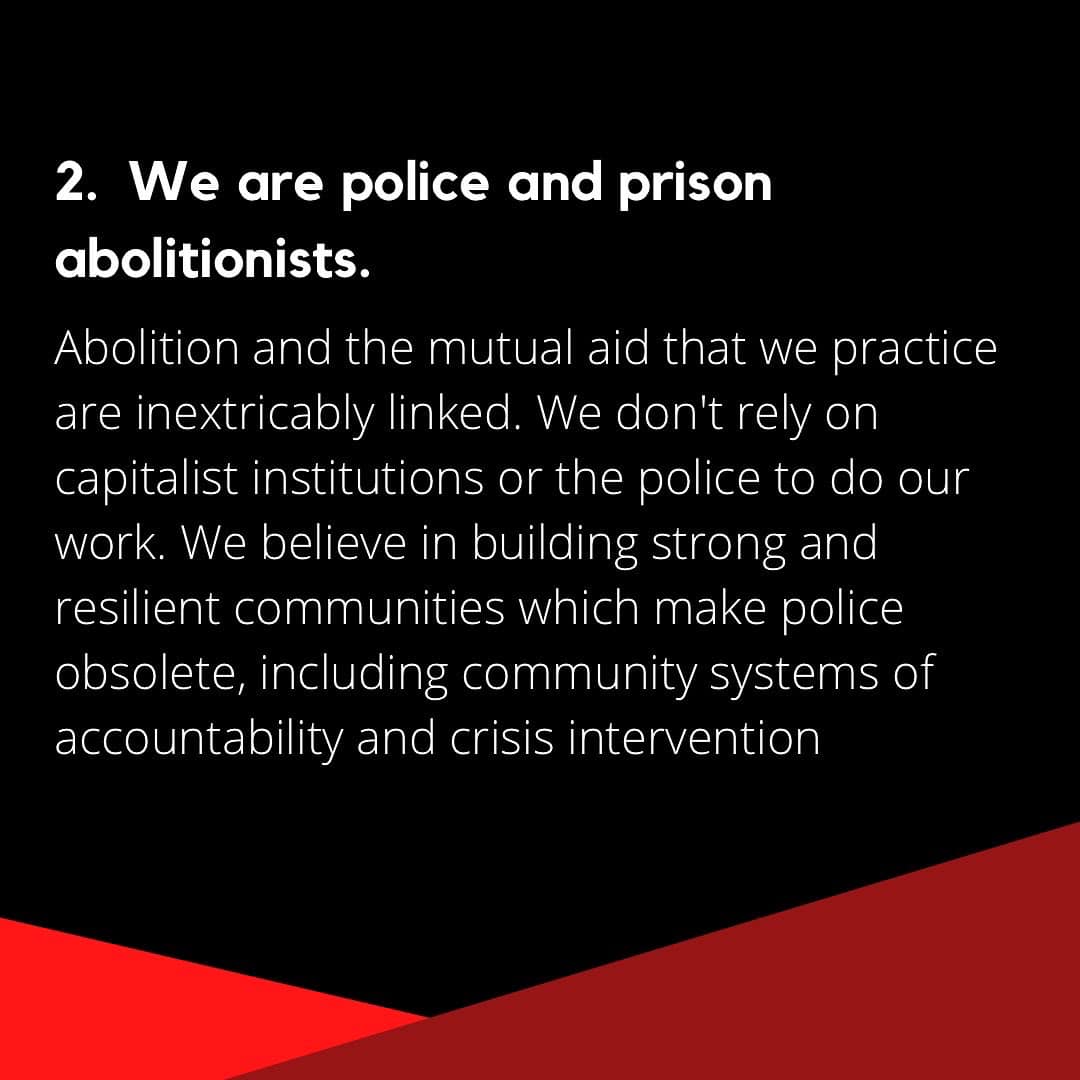
This Wednesday, April 6, I will be sharing this story from my good friend Ronnie James. Ronnie is an Indigenous organizer with twenty years of experience. I’ve been blessed to be involved in the Des Moines Mutual Aid food giveaway program he talks about in this story. Other Mutual Aid projects include court solidarity and bail fund, and food and propane support for houseless communities in Des Moines.
So I work with a dope crew called Des Moines Mutual Aid, and on Saturday mornings we do a food giveaway program that was started by the Panthers as their free breakfast program and has carried on to this day. Anyways, brag, brag, blah, blah.
So I get to work and I need to call my boss. He remembers and asks about the food giveaway which is cool and I tell him blah blah it went really well. And then he’s like, “hey, if no one tells you, I’m very proud of what you do for the community” and I’m like “hold on hold on. Just realize that everything I do is to further the replacing of the state and destroying western civilization and any remnants of it for future generations.” He says “I know and love that. Carry on.”
–Ronnie James
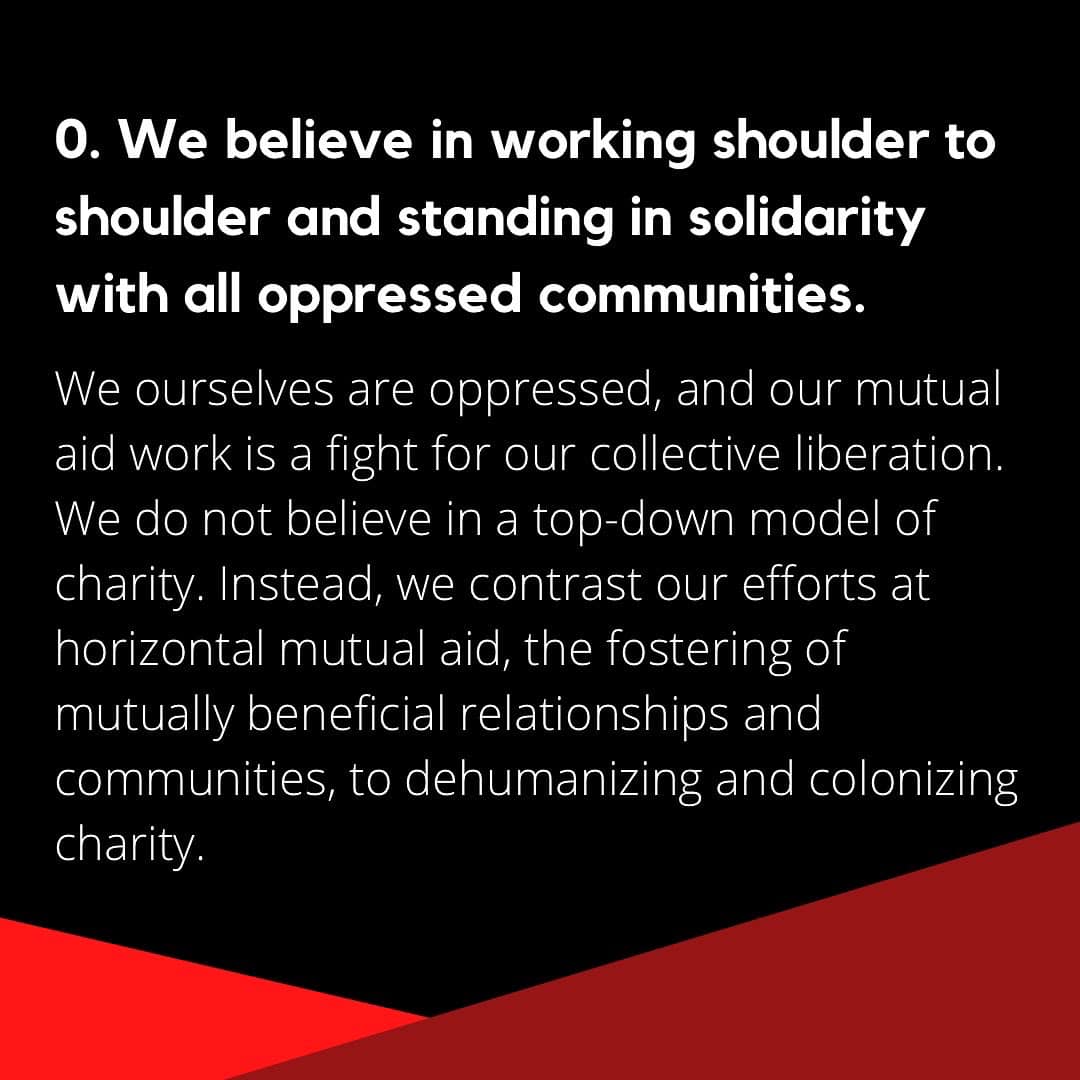
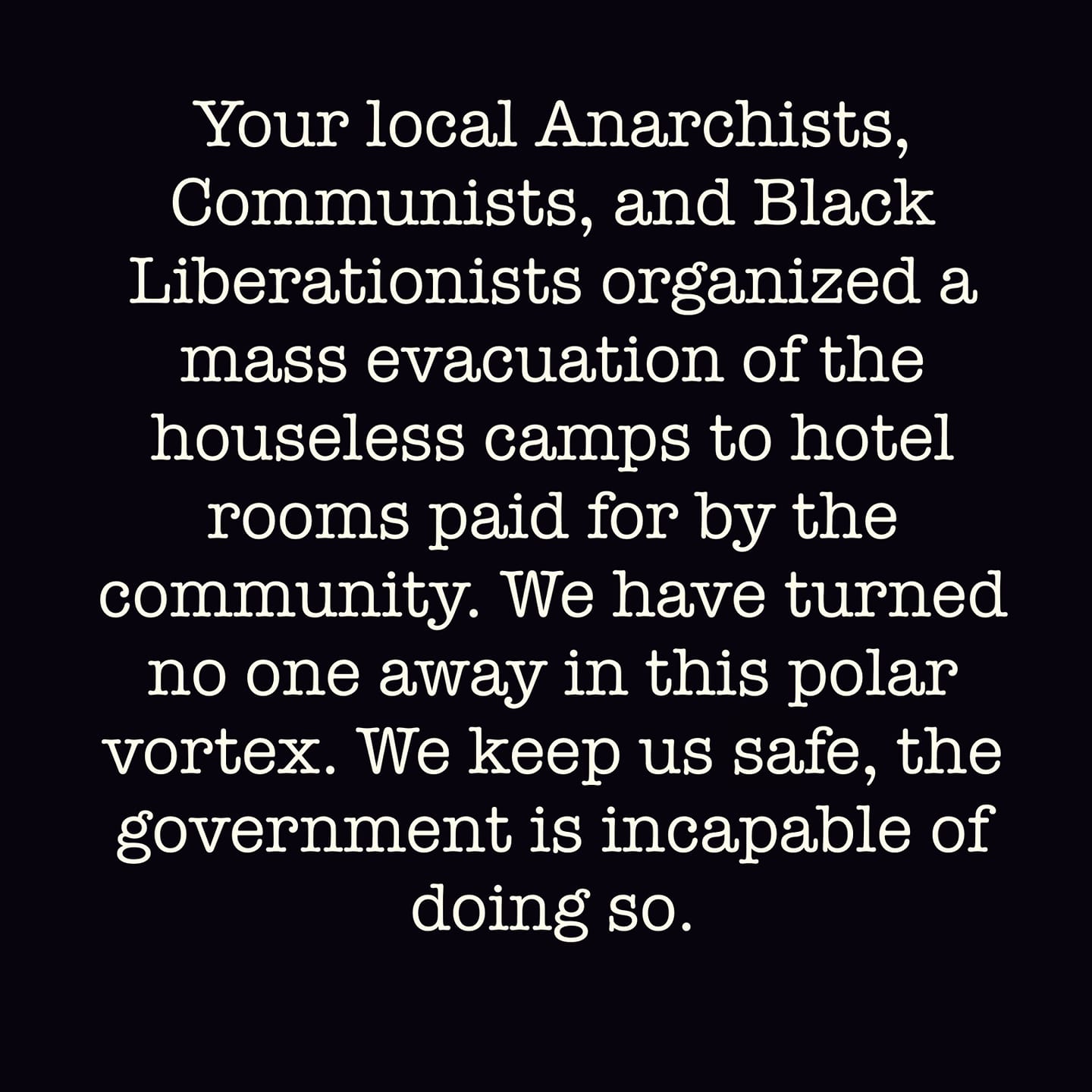
A fundamental part of Mutual Aid is the entire community is involved. We avoid “us” versus “them”. This leaflet is included in the boxes of food we distribute. I know of people who once came for food who are now helping with the distribution of the food.
This photo is from the recent Des Moines Mutual Aid zine that contains excellent articles. DOWNLOAD HERE
I don’t know what Pope Francis’ apology for the Roman Catholic Church’s role in the institutions of forced assimilation in Canada might mean to Indigenous peoples. This is something First Nations Peoples in Canada have been asking for many years. Acknowledging the harm done is part of the process of healing and reconciliation. The vast scope of the damage and the length of time it was done should have begun to be addressed years ago.
I must note that Quakers were among those who established and operated such institutions in the United States. The damage done by Quakers and other religious organizations should also have begun to be addressed years ago. This has long been and continues to be a deep concern of mine. [see: residential schools]
Vatican City. Pope Francis apologized on Friday for the Roman Catholic Church’s involvement in a system of Canadian boarding schools that abused Indigenous children for 100 years, and said he would travel to Canada as part of a process of healing and reconciliation.
His apology comes after Canada was jolted last year by the discovery of signs that more than 1,000 people, most of them children, may have been buried in unmarked graves on the grounds of the former schools.
“I feel shame — sorrow and shame — for the role” that Catholics played “in the abuses you suffered and in the lack of respect shown for your identity, your culture and even your spiritual values,” Francis said.
“I ask for God’s forgiveness and I want to say to you with all my heart: I am very sorry,” Francis said, adding that he joined with Canadian bishops “in asking your pardon.”
CALGARY, Alberta — For decades, the Indigenous children were taken from their families, sometimes by force, and housed in crowded, church-run boarding schools, where they were abused and prohibited from speaking their languages. Thousands vanished altogether.
Now, a new discovery offers chilling evidence that many of the missing children may have died at these schools: The remains of as many as 751 people, mainly Indigenous children, were found at the site of a former school in the province of Saskatchewan, an Indigenous group said on Thursday.
The burial site, the largest one to date, was uncovered only weeks after the remains of 215 children were found in unmarked graves on the grounds of another former church-run school for Indigenous students in British Columbia.
The discoveries have jolted a nation grappling with generations of widespread and systematic abuse of Indigenous people, many of whom are survivors of the boarding schools. For decades, they suggested through their oral histories that thousands of children disappeared from the schools, but they were often met with skepticism. The revelations of two unmarked grave sites are another searing reminder of this traumatic period in history.
Hundreds More Unmarked Graves Found at Former Residential School in Canada. An Indigenous group said the remains of as many as 751 people, mainly children, had been found in unmarked graves on the site of a former boarding school in Saskatchewan. Ian Auten and Dan Bilefsky, The New York Times, July 30, 2021
The Indigenous delegation also raised the issue of the Doctrine of Discovery.
The delegates also asked Francis to revoke a 1493 papal bull issued by Pope Alexander VI that had given Spain authority over the newly discovered lands of the Americas, allowing the Spanish to colonize and enslave the Indigenous peoples and convert them to Catholicism. The papal bull, which informed the “doctrine of discovery,” was “used for centuries to expropriate Indigenous lands and facilitate their transfer to colonizing or dominating nations,” according to the United Nations.
Indigenous groups in Canada say that while the theories of racial superiority that underlie the doctrine have long been discredited, it continued to surface in legal disputes over land until 2014. The Supreme Court of Canada ruled that year, without naming the papal bull, that the idea that no one owned land until it was claimed by Europeans “never applied in Canada.”
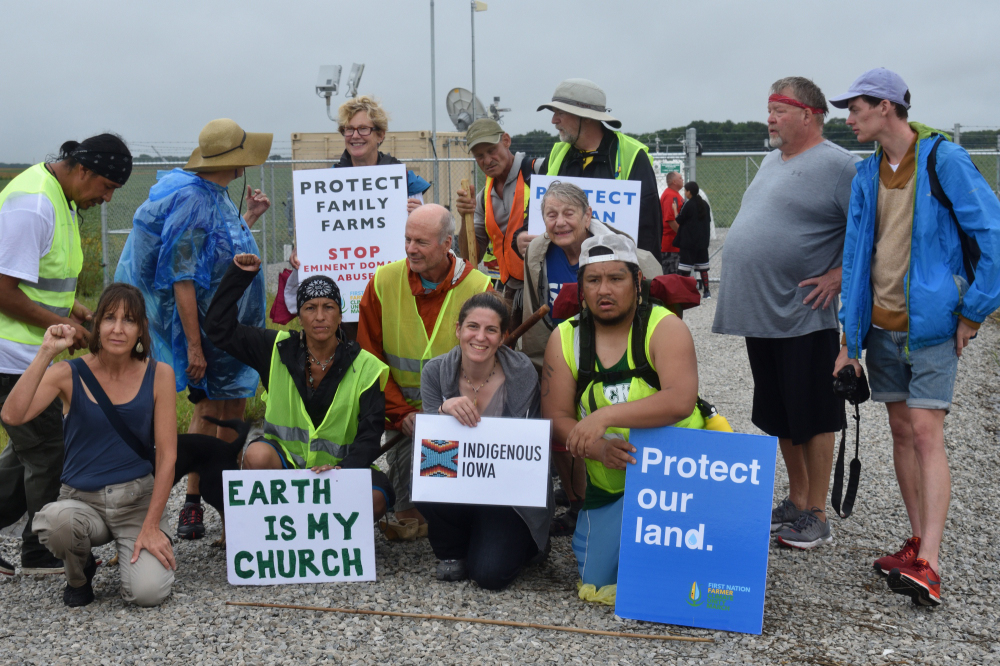
I wasn’t sure what image might be appropriate for such a horrific subject. I took this photo at the destination of the first day of the First Nation-Farmer Climate Unity March. A small group of native and nonnative people walked and camped together along the path of the Dakota Access pipeline through central Iowa. Our sacred journey required eight days and nights to walk ninety-four miles, Sept 1-8, 2018. The intent of beginning a community who began to know and trust each other was achieved. Since, many of us have worked together in many ways, which have strengthened our bonds. [see: https://firstnationfarmer.com/]
Yesterday I was struck by all the interconnected relationships among my friends at Des Moines Mutual Aid.
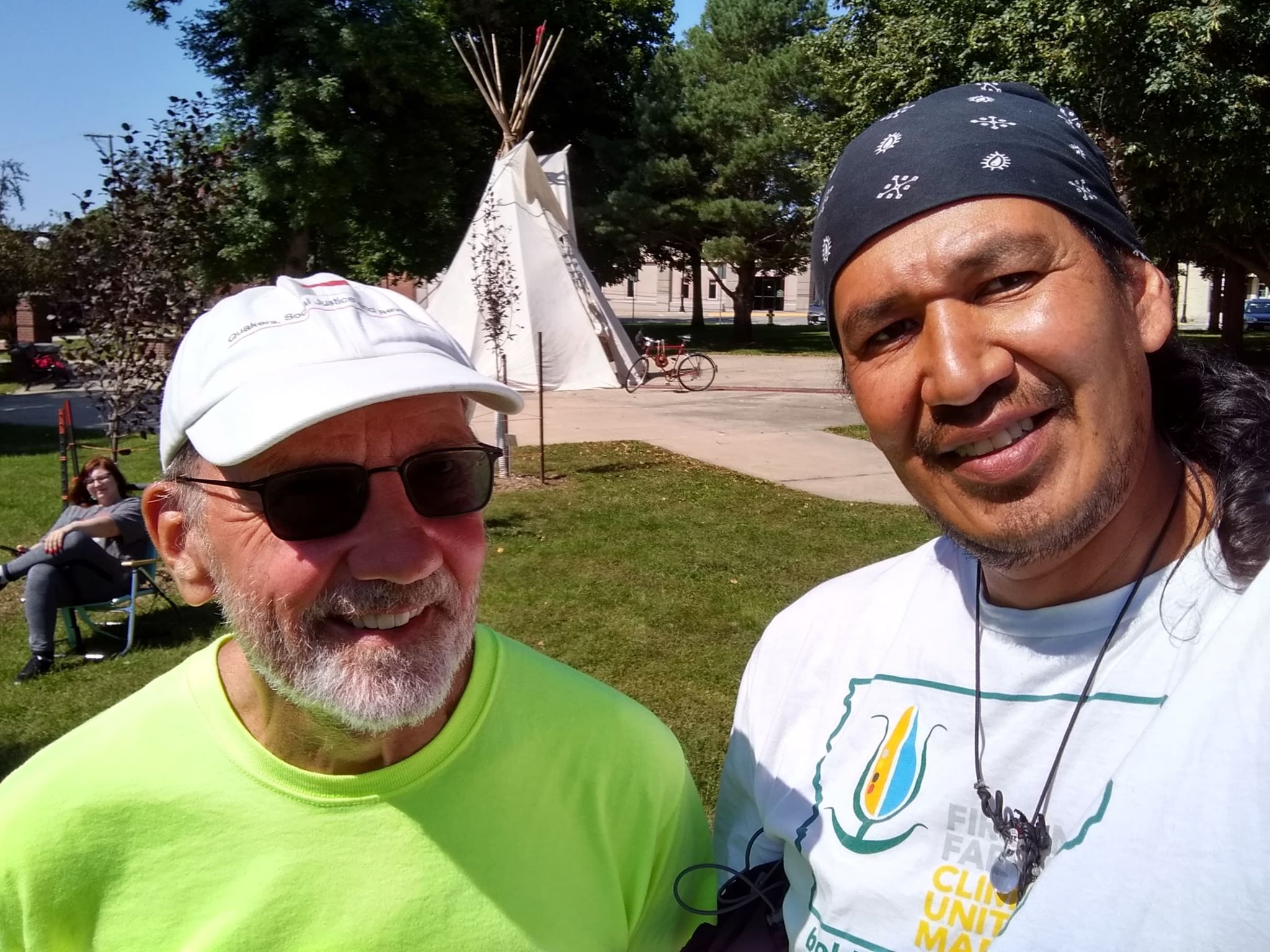
I was happy to see my friend Donnielle at Mutual Aid for the first time yesterday. She and I were part of the First Nation-Farmer Climate Unity March, September 1-8, 2018. A small group of native and non-native people walked and camped along the path of the Dakota Access pipeline, from Des Moines to Fort Dodge, Iowa (ninety-four miles). One of the main purposes of that walk was to create a group of people who began to get to know each other so we could work on issues of common interest and concern. That really worked and many of us have worked together in many ways since. One of the first things several of us did together, was to lobby Senator Grassley’s staff to support a couple of bills related to safety of Indigenous women. That was in 2018. The renewal of the Violence Against Women Act was just passed and includes those tribal protections. The photo below at the Neal Smith Federal Building was taken the day of the meeting with Senator Grassley’s staff.
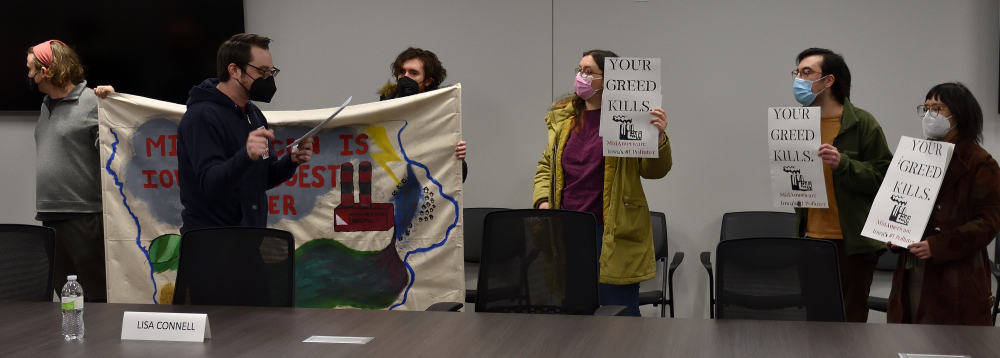
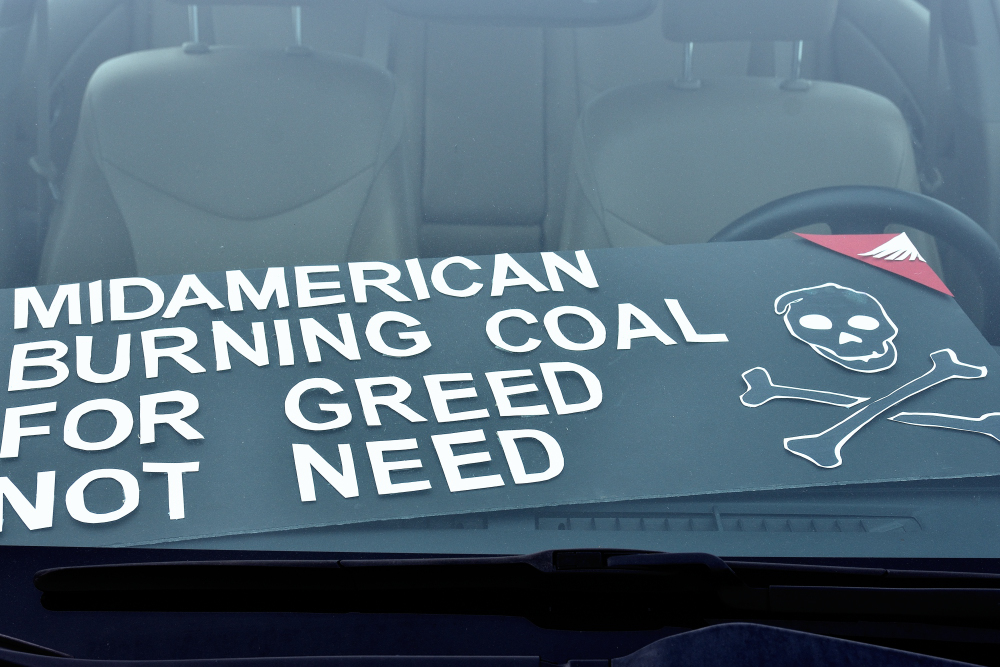
Jake, the climate justice advocate from Iowa Citizens for Community Improvement (ICCI) was also there. Two weeks ago, I attended a board meeting of the Iowa Energy Center Board, having been asked to take photos there. Jake organized a group of us to attend the board meeting to try to get MidAmerican to shut down their five coal burning plants. We have since learned our presence there has had some effect. He also asked me to write a letter to the editor about the same issue, which I did. Yesterday Donnielle asked Jake about an upcoming city council meeting where MidAmerican’s franchise with the city will be discussed.
Jade was at Mutual Aid, as usual. She organizes the prison letter writing project of Central Iowa Democratic Socialists of America, which I have joined. A friend of mine in Indianapolis, a professor at the law school there, got me involved in Religious Socialism, part of DSA, hence the name of this blog.
And as usual, my good friend Ronnie was at Mutual Aid. I had told him about some transgender people who were looking for support. Yesterday we talked about that some more, and he gave me a couple of suggestions that I passed along.
My small Quaker meeting is also part of this networking. Some members have been supporters of ICCI for years. It is this meeting that is looking into how we might support the trans people. And I will be speaking about Mutual Aid during the annual gathering of Quakers this summer.
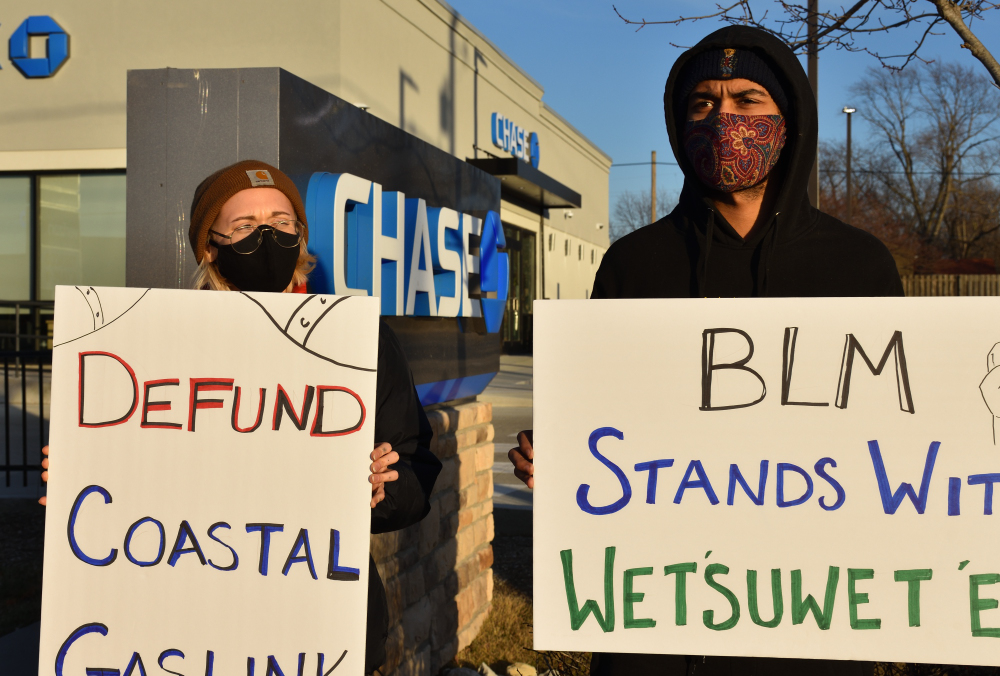
Other connections include supporting the Wet’suwet’en peoples as they try to stop the construction of the Costal GasLink pipeline through their pristine territory in British Columbia. In the photo below you can see Des Moines Black Lives Matter is helping us stand with the Wet’suwet’en.
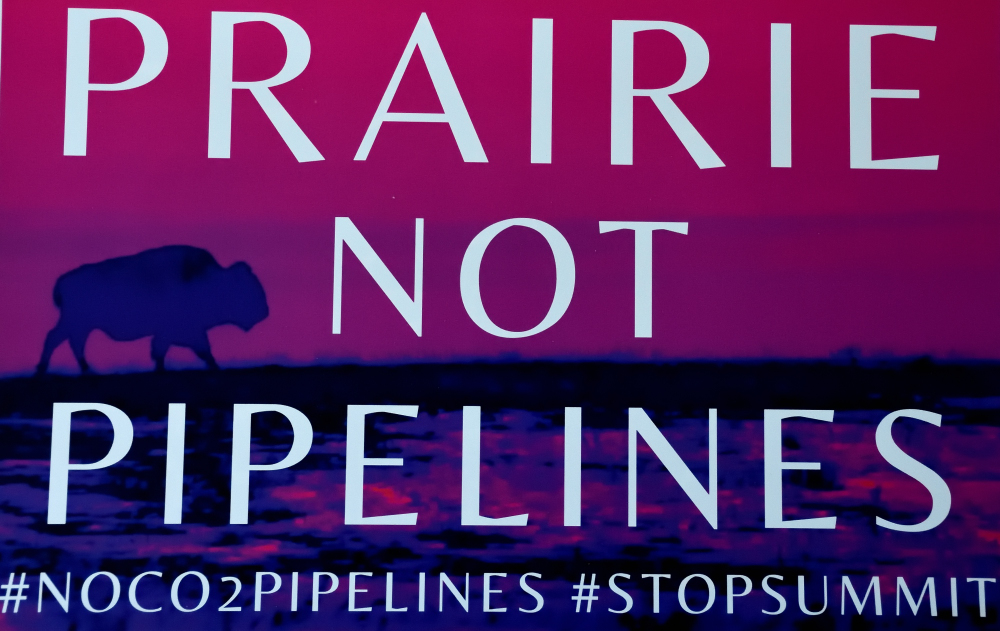
The signs about Prairies Not Pipelines and #NOCO2PIPELINES was organized by my friend Sikowis, who also walked on the First Nation-Famer Climate Unity March.

























 Quakers and Mutual Aid