Yesterday we had a meeting with Senator Ernst’s Regional Director John Hollinrake, to ask the senator to co-sponsor the Truth and Healing Commission on Indian Boarding School Policies in the United States Act (S 2907). John was very polite and attentive but offered no feedback.
It was a much different story just now when I had a Skype meeting with Reid Willis in Senator Grassley’s Washington, DC, office.
Reid was familiar with the history of Indian Boarding Schools. He told me Senator Grassley agreed with intent of S 2907 with two exceptions. He feels the commission would duplicate work already being done by the Department of Interior’s Federal Indian Boarding School Initiative (see below). And that such a commission should not have subpoena power. Senator Grassley feels this particularly because he is the Ranking Member of the Senate Judiciary Committee.
I asked him to contact me if Quakers could be helpful as the investigations into the Indian Boarding Schools progress.
Reid then told me Senator Grassley’s efforts have been focused on the RECA Extension Act of 2022, which was recently passed and signed into law by President Biden.
Public Law No: 117-139 (06/07/2022)
RECA Extension Act of 2022
This bill extends a program that compensates individuals who were exposed to radiation from atomic weapons testing or uranium mining or processing and who subsequently developed specified cancers or other medical conditions. The bill terminates the program two years after the bill’s enactment.
Federal Indian Boarding School Initiative
“I know that this process will be long and difficult. I know that this process will be painful. It won’t undo the heartbreak and loss we feel. But only by acknowledging the past can we work toward a future that we’re all proud to embrace.” — Secretary Deb Haaland
Between 1819 through the 1970s, the United States implemented policies establishing and supporting Indian boarding schools across the nation. The purpose of federal Indian boarding schools was to culturally assimilate American Indian, Alaska Native and Native Hawaiian children by forcibly removing them from their families, communities, languages, religions and cultural beliefs. While children attended federal boarding schools, many endured physical and emotional abuse and, in some cases, died.
In June 2021, Secretary of the Interior Deb Haaland announced the Federal Indian Boarding School Initiative, a comprehensive effort to recognize the troubled legacy of federal Indian boarding school policies with the goal of addressing their intergenerational impact and to shed light on the traumas of the past.
The announcement directed the Department, under the leadership of Assistant Secretary for Indian Affairs Bryan Newland, to prepare a report detailing available historical records relating to federal Indian boarding schools and to develop the first official list of sites. On May 11, 2022, Secretary Haaland and Assistant Secretary Newland released Volume 1 of the investigative report. This report lays the groundwork for the continued work of the Interior Department to address the intergenerational trauma created by historical federal Indian boarding school policies. It reflects an extensive and first-ever inventory of federally operated schools, including profiles and maps.
The investigation found that from 1819 to 1969, the federal Indian boarding school system consisted of 408 federal schools across 37 states or then territories, including 21 schools in Alaska and 7 schools in Hawaii. The investigation identified marked or unmarked burial sites at approximately 53 different schools across the school system. As the investigation continues, the Department expects the number of identified burial sites to increase.
The COVID-19 pandemic and its resulting closures of federal facilities reflect the need for further investigation. The report identifies next steps that will be taken in a second volume, aided by a new $7 million investment from Congress through fiscal year 2022.
As part of the Federal Indian Boarding School Initiative and in response to recommendations from the report, Secretary Haaland has launched “The Road to Healing.” This year-long commitment to travel across the country will allow American Indian, Alaska Native, and Native Hawaiian survivors of the federal Indian boarding school system the opportunity to share their stories, help connect communities with trauma-informed support, and facilitate collection of a permanent oral history.
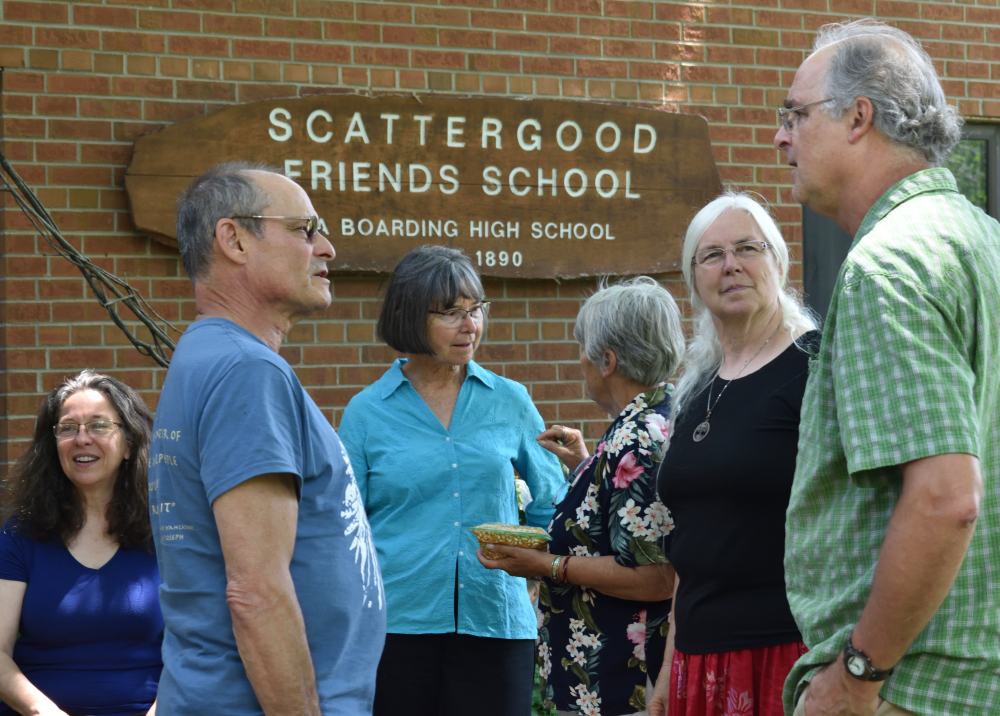
Jeff Kisling, Jean and David Hansen and Rodger Routh. Photo credit Rodger Routh
This morning Jean and David Hansen, Rodger Routh and I met with John Hollinrake, Regional Director for Iowa Republican Senator Joni Ernst. Several others had planned to join us but didn’t make it.
We expressed our appreciation for Senator Ernst voting for the Violence Against Women Act (VAWA).
I asked John if he was familiar with the Indian Boarding Schools. He indicated he had read the information I had sent from Friends Committee on National Legislation (FCNL) in emails prior to this meeting. Some of the great support we received from FCNL
John listened attentively and took notes as we told our stories and why we hope Senator Ernst will cosponsor and vote for the Truth and Healing Commission on Indian Boarding School Policies in the United States Act (S. 2907/H.R. 5444).
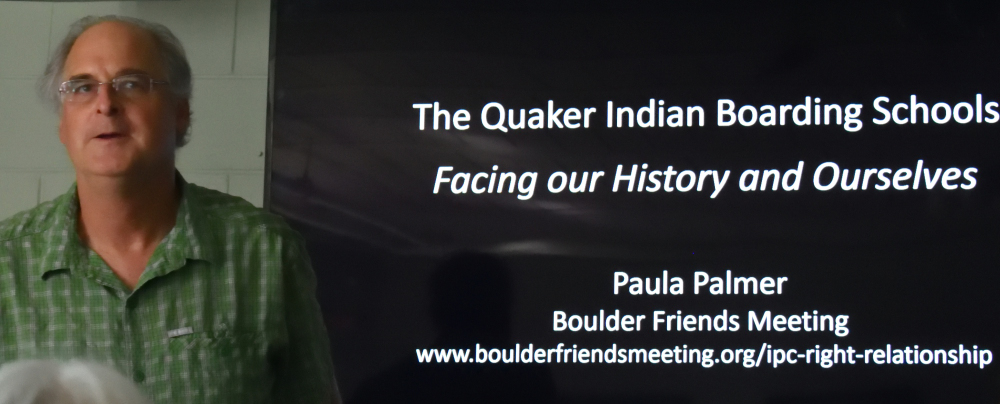
I spoke of why this was important to me, in part because of Quaker involvement with the residential schools.
Jean spoke from her Indigenous background, sharing from family experiences at those schools. She also spoke about the work of Quakers in those times trying to influence those emerging policies.
David spoke of hearing stories of Quakers helping in the residential schools, presented as good work. Most Friends I know were told similar stories. Now that he has been learning the truth about these institutions of forced assimilation, and the intergenerational traumas that occurred, he wants people to know the truth, and work toward healing, which is the purpose of the Truth and Healing Commission on Indian Boarding School Policies in the United States Act.
Rodger spoke of his Catholic upbringing, and the involvement of the Catholic church in many such schools in the lands called the U.S. and Canada.
John Hollinrake thanked us for coming but had no comment as to whether the Senator will co-sponsor the legislation. I followed up by emailing thanks to Mr. Hollinrake.
And submitted a Lobby Visit Report to FCNL.
We left the FCNL document “Co-sponsor the Truth and Healing Commission on Indian Boarding School Policies in the U.S. Act” with John.
In the 19th and early 20th centuries, Christian churches collaborated with the government to create hundreds of boarding schools for Native American children. The conditions at these schools were unspeakable. Although the wrongs committed at these institutions can never be made right, we can start the truth, healing, and reconciliation process for all of us. The August congressional recess is an opportunity to educate your member of congress on the Truth and Healing Commission on Indian Boarding School Policies Act. Join us for this special training to learn how you can ensure your voice is heard during August recess.
One of the primary reasons I embarked upon this journey about the evolution of my foundational stories was to encourage people who hadn’t been much involved in justice work to change that.
Injustices abound. The victims should be supported while working to address the root causes of the injustice.
We should search our own lives to see if and how we are contributing to injustice.
Spiritual guidance often leads to justice work.
If others observe our Spirit guided work, they may join our Quaker communities.
It is discouraging to see attendance of our Quaker meeting diminish as Friends die or move away, and few new people join. Many Friends do justice work, but that is often unseen by people in the community. This is a time of great spiritual poverty, and Quaker meetings for worship could be what some seekers are looking for. For seekers to find us, we need to be seen in our communities. And doing justice work is a way for that to happen.
The reason I’m thinking about all this now is because a group of us will be meeting with Senator Ernst’s staff in Des Moines to talk about the Truth and Healing Commission on Indian Boarding School Policies in the United States Act (S. 2907/H.R. 5444). (See: https://quakersandreligioussocialism.com/2022/08/29/practicing-hope/)
There is a web of interrelationships among Native and non-native peoples in the Midwest that presents opportunities to work together to learn and publish the truth about Indian Boardings Schools. There are parts of this that are only appropriate for each community to work on separately. But hopefully these Congressional visits will be the beginning of further work together.
This began with an appeal from Friends Committee on National Legislation (FCNL) for us to ask our Senators to support that legislation (S. 2907). And specifically, to do this during their current recess when they would be in Iowa.
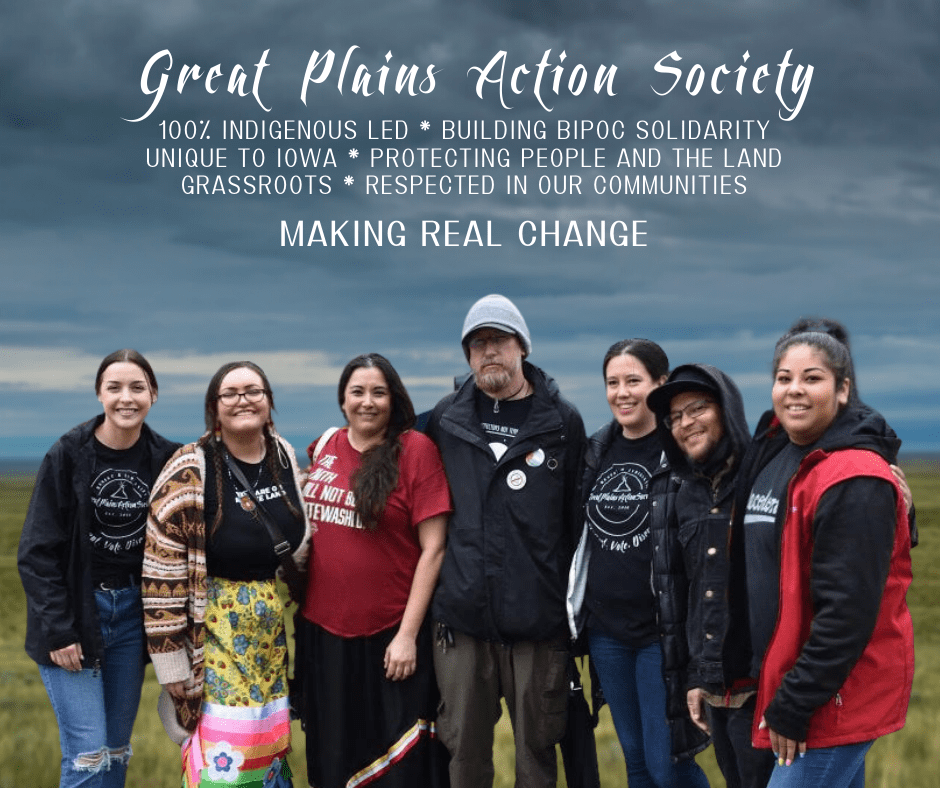
I know my friend Sikowis Nobiss is interested in supporting legislation related to Native Americans, so I contacted her about this. She put me in touch with Jessica Engelking, who is also part of the Great Plains Action Society. Fortunately, I met Jessica when we were attending the Buffalo Rebellion conference recently. Some of the networking that occurred there. Others at that conference included my friends Peter Clay, Sikowis, Mahmud Fitil, Ronnie James, Miriam Kashia and Jake Grobe.
When Jessica asked what Quakers have been doing related to our role in some of the residential schools, I shared FCNL’s decades of advocacy for Native Americans. We began to work together to arrange visits to our Senators about the truth and healing commission act, and included Jessica Bahena, FCNL’s National Organizer, who is FCNL’s contact related to this legislation in our planning.
Over the past several years there have been changes in how I do justice work. What hasn’t changed is the I’ve tried to be obedient to what the Spirit is telling me to do.
Most of my life I did justice work within the framework of Quaker meetings, communities, and organizations, such as FCNL. For about 8 years I was clerk of Iowa Yearly Meeting (Conservative)’s Peace and Social Concerns Committee. At our annual sessions a month ago, someone else took over that responsibility.
The Quaker involvement in the Indian Boarding Schools has long been a concern of mine. When I learned about this appeal from FCNL, I wanted to work on that. But no longer being on the Peace and Social Concerns Committee, I wasn’t thinking about working in the context of that committee, although I did contact the clerk of the committee in case they wanted to become involved.
Mutual Aid
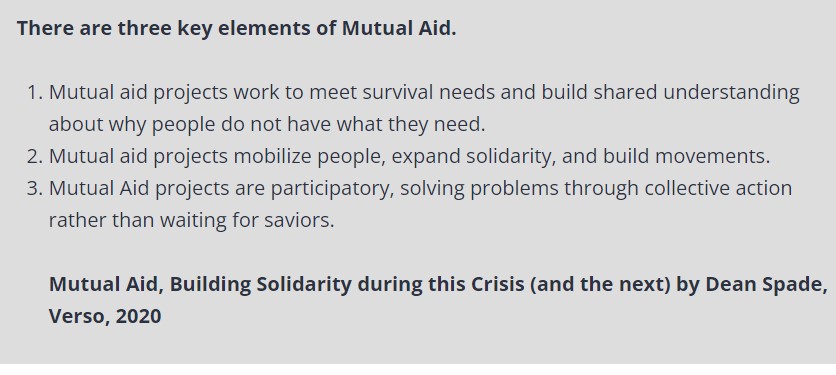
For the past two years I’ve been working in the Des Moines Mutual Aid community. This has answered a deep need in my life to find accomplices who are doing justice work in a way that focuses on root causes of injustice and builds community. (See: Mutual Aid PDF)
I’d like to explore the possibility of Native Americans and White people working together on these traumatic problems. At first, I thought the Mutual Aid part would just be an interesting possibility to frame this work, but the more I think about it, the more important I think it could be, for making our work together avoid the problems of hierarchy, who’s in charge.
Mutual Aid
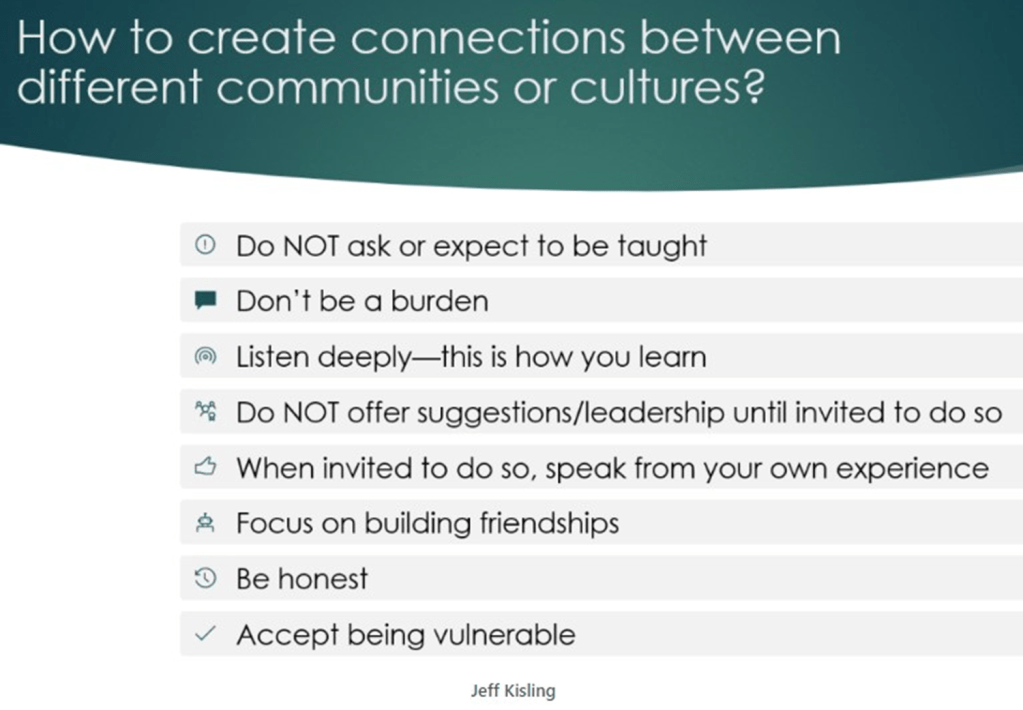
It is common to feel vulnerable when we meet new people, in new organizations and communities. But we need to venture out of our meetinghouses more often. I’ve been blessed to have found numerous communities to work with over the years. What follows are guidelines I’ve discovered that can help you as you begin to work with other communities or cultures.
I keep returning to the question, “are we really listening for that still small voice during our prayers, and meeting for worship? Do we practice hope?” Or do we force what we hear to conform to our current worldview? Do we do a sort of reinterpretation of what we hear? If we heard “give up all your possessions”, would we?
I sign my email messages “practicing hope”.
People often mistake hope for a feeling, but it’s not. It’s a mental discipline, an attentional practice that you can learn. Like any such discipline, it’s work that takes time, which you fail at, succeed, improve, fail at again, and build over years inside yourself.
Hope isn’t just looking at the positive things in this world, or expecting the best. That’s a fragile kind of cheerfulness, something that breaks under the weight of a normal human life. To practice hope is to face hard truths, harder truths than you can face without the practice of hope. You can’t navigate dark places without a light, and hope is that light for humanity’s dark places. Hope lets you study environmental destruction, war, genocide, exploitative relations between peoples. It lets you look into the darkest parts of human history, and even the callous entropy of a universe hell bent on heat death no matter what we do. When you are disciplined in hope, you can face these things because you have learned to put them in context, you have learned to swallow joy and grief together, and wait for peace.
I don’t remember reading what that quote referred to, so I read that this morning.
When Hypoc was through meditating with St. Gulik, he went there into the kitchen where he busied himself with preparing the feast and in his endeavor, he found that there was some old tea in a pan left standing from the night before, when he had in his weakness forgot about its making and had let it sit steeping for 24 hours. It was dark and murky and it was Hypoc’s intention to use this old tea by diluting it with water. And again in his weakness, chose without further consideration and plunged into the physical labor of the preparations. It was then when deeply immersed in the pleasure of that trip, he had a sudden loud clear voice in his head saying “it is bitter tea that involves you so.” Hypoc heard the voice, but the struggle inside intensified, and the pattern, previously established with the physical laboring and the muscle messages coordinated and unified or perhaps coded, continued to exert their influence and Hypoc succummed to the pressure and he denied the voice.
And again he plunged into the physical orgy and completed the task, and Lo as the voice had predicted, the tea was bitter.
From Page 37 of the Pricipia Discordia, 5th edition
Hypoc succummed to the pressure and he denied the voice.
During this morning’s prayers I was thinking that still small voice must have been ignored when grave wrongs were done, are being done. The focus of my prayers these past few years relate to the genocide of indigenous peoples. And the forced assimilation that was a large part of that.
Quaker involvement in the Indian Boarding Schools evokes strong emotions among Friends today. Deep trauma in Indigenous communities that are experiencing multigenerational trauma. Where wounds have been ripped open by locating the remains of children who died or were killed in those institutions. Grief for those not yet found.
But the process of “thinking” is problematic. Thinking involves the brain, with logic and knowledge. That still small voice is not about thinking.
Logically (thinking), from today’s vantage point, forced assimilation and genocide were absolutely wrong.
We don’t know what that still small voice led the Quakers in those days to do. We can’t judge them because we don’t know what they heard. But we can’t leave it at that. We have a responsibility to find the truth of what occurred in those “schools”. We must know the truth so healing can begin. Healing for Indigenous peoples and for Quakers.
This tragedy should lead us to re-evaluate our own lives today. To hear what that still small voice is saying to us. And to do what it is saying.
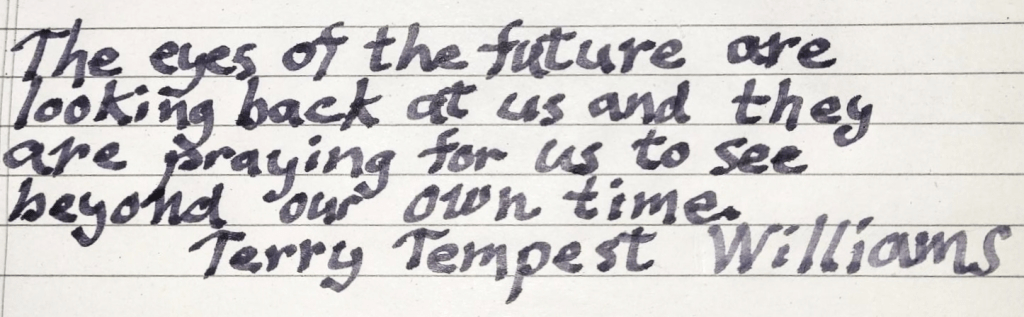
What will future generations think about when they look back at what we have done, are doing now?
Addressing the Legacy of Indian Boarding Schools
This document from the Friends Committee on National Legislation is about addressing the legacy of Indian Boarding Schools.
Minute your concern and commitment to action, including your support for this bill in your monthly meeting, Friends church, and/or yearly meeting.
This year’s report of the Peace and Social Concerns Committee of Iowa Yearly Meeting (Conservative) can be found below, which supports the bill.
Share your statement(s) with FCNL at Quakers@fcnl.org. We are compiling them on our website and can help you relay them to your members of Congress and the media: fcnl.org/NativeAmerican
Our Peace and Social Concerns Report has been sent to FCNL
Write your members of Congress about your concern: fcnl.org/BoardingSchools. You can customize FCNL campaign letters and send them directly to Congress from any Internet-connected device. Invite Friends in your community to contact their officials as well
We are making appoints with Iowa Senators Ernst and Grassley to discuss the Truth and Healing Commission on Indian Boarding School Policies in the United States Act (S. 2907/H.R. 5444) We are working with the (Indigenous) Great Plains Action Society on this.
Following is the link to a page that will help you write a letter related to the Indian Boarding Schools and send it to your representatives. That is followed by the text of the bill.
Friends Committee on National Legislation (FCNL)
It is long overdue for the United States to acknowledge the historic trauma of the Indian boarding school era. In the 19th and early 20th centuries, Christian churches collaborated with the government to create hundreds of boarding schools for Native American children. The conditions at these schools, some of them Quaker-run, were unspeakable.
Now we must work with tribal nations to advance congressional efforts to establish a federal commission to formally investigate boarding school policy and develop recommendations for the government to take further action. Although the wrongs committed at these institutions can never be made right, we can start the truth, healing, and reconciliation process for the families and communities affected as we work to right relationship with tribal nations.
Remind your members of Congress of their responsibility to tribal nations and urge them to support the Truth and Healing Commission on Indian Boarding School Policies in the United States Act (S. 2907/H.R. 5444).
Text of the bill References to Churches are highlighted.
117th CONGRESS 1st Session
S. 2907
To establish the Truth and Healing Commission on Indian Boarding School Policies in the United States, and for other purposes.
IN THE SENATE OF THE UNITED STATES
September 30, 2021
Ms. Warren (for herself, Ms. Baldwin, Ms. Smith, Mr. Padilla, Mr. Wyden, Ms. Klobuchar, Mr. Booker, Mr. Blumenthal, Mr. Markey, Mr. Luján, Mr. Merkley, Mr. Heinrich, Ms. Cortez Masto, and Mr. Schatz) introduced the following bill; which was read twice and referred to the Committee on Indian Affairs
A BILL
To establish the Truth and Healing Commission on Indian Boarding School Policies in the United States, and for other purposes.
Be it enacted by the Senate and House of Representatives of the United States of America in Congress assembled,
SECTION 1.SHORT TITLE.
This Act may be cited as the “Truth and Healing Commission on Indian Boarding School Policies Act”.
SEC. 2. FINDINGS.
Congress finds that—
(1) assimilation processes, such as the Indian Boarding School Policies, were adopted by the United States Government to strip American Indian, Alaska Native, and Native Hawaiian children of their Indigenous identities, beliefs, and languages to assimilate them into non-Native culture through federally funded and controlled Christian-run schools, which had the intent and, in many cases, the effect, of termination, with dire and intentional consequences on the cultures and languages of Indigenous peoples;
(2) assimilation processes can be traced back to—
(A) the enactment of the Act of March 3, 1819 (3 Stat. 516, chapter 85) (commonly known as the “Indian Civilization Fund Act of 1819”), which created a fund to administer the education, healthcare, and rations promised to Tribal nations under treaties those Tribal nations had with the United States; and
(B) the Grant Administration’s peace policy with Tribal nations in 1868, which, among other things, authorized amounts in the fund established under the Act of March 3, 1819 (3 Stat. 516, chapter 85) (commonly known as the “Indian Civilization Fund Act of 1819”), to be used by churches;
(3) according to research from the National Native American Boarding School Healing Coalition, the Federal Government funded church-run boarding schools for Native Americans from 1819 through the 1960s under the Act of March 3, 1819 (3 Stat. 516, chapter 85), which authorized the forced removal of hundreds of thousands of American Indian and Alaska Native children as young as 3 years old, relocating them from their traditional homelands to 1 of at least 367 known Indian boarding schools, of which 73 remain open today, across 30 States;
(4) beginning in 1820, missionaries from the United States arrived in Hawai‘i, bringing a similar desire to civilize Native Hawaiians and convert “Hawaiian heathens” to Christians, establishing day schools and boarding schools that followed models first imposed on Tribal nations on the East Coast of the United States;
(5) as estimated by David Wallace Adams, professor emeritus of history and education at Cleveland State University in Ohio, by 1926, nearly 83 percent of American Indian and Alaska Native school-age children were enrolled in Indian boarding schools in the United States, but, the full extent of the Indian Boarding School Policies has yet to be fully examined by—
(A) the Federal Government or the churches who ran those schools; or
(B) other entities who profited from the existence of those schools;
(6) General Richard Henry Pratt, the founder and superintendent of the Carlisle Indian Industrial School in Carlisle, Pennsylvania, stated that the ethos of Indian Boarding School Policies was to “kill the Indian in him, and save the man”;
(7) in 1878, General Pratt brought a group of American Indian warriors held as prisoners of war to what was then known as the Hampton Agricultural and Industrial School in Hampton, Virginia, for a residential experiment in the education of Indigenous people;
(8) prior to arriving to the Hampton Agricultural and Industrial School in 1878, the American Indian warriors held as prisoners of war had already spent 3 years imprisoned, during which time they were forced to shave their traditionally grown hair, dress in military uniforms, participate in Christian worship services, and adopt an English name;
(9) General Samuel C. Armstrong, founder and, in 1878, principal, of the Hampton Agricultural and Industrial School, was influenced by his parents and other missionaries in the United States involved in the education of Native Hawaiian children;
(10) General Armstrong modeled the Hampton Agricultural and Industrial School after the Hilo Boarding School in Hawai‘i, a missionary-run boarding school that targeted high performing Native Hawaiians to become indoctrinated in Protestant ideology, which was similar to boarding schools led by missionaries in the similarly sovereign Five Tribes of Oklahoma, including the Cherokee and Chickasaw;
(11) in addition to bringing a group of American Indian warriors held as prisoners of war to the Hampton Agricultural and Industrial School in 1878, General Pratt influenced Sheldon Jackson, a Presbyterian missionary who, in 1885, was appointed by the Secretary of the Interior to be a General Agent of Education in the Alaska Territory;
(12) Hampton Agricultural and Industrial School continued as a boarding school for American Indians, Alaska Natives, and Native Hawaiians until 1923;
(13) founded in 1879, the Carlisle Indian Industrial School set the precedent for government-funded, off-reservation Indian boarding schools in the United States, where more than 10,000 American Indian and Alaska Native children were enrolled from more than 140 Indian Tribes;
(14) Indian boarding schools, and the policies that created, funded, and fueled their existence, were designed to assimilate American Indian, Alaska Native, and Native Hawaiian children into non-Native culture by stripping them of their cultural identities, often through physical, sexual, psychological, industrial, and spiritual abuse and neglect;
(15) many of the children who were taken to Indian boarding schools did not survive, and of those who did survive, many never returned to their parents, extended families, and communities;
(16) at the Carlisle Indian Industrial School alone, approximately 180 American Indian and Alaska Native children were buried;
(17) according to research from the National Native American Boarding School Healing Coalition—
(A) while attending Indian boarding schools, American Indian, Alaska Native, and Native Hawaiian children suffered additional physical, sexual, psychological, industrial, and spiritual abuse and neglect as they were sent to non-Native homes and businesses for involuntary and unpaid manual labor work during the summers;
(B) many American Indian, Alaska Native, and Native Hawaiian children escaped from Indian boarding schools by running away, and then remained missing or died of illnesses due to harsh living conditions, abuse, or substandard health care provided by the Indian boarding schools;
(C) many American Indian, Alaska Native, and Native Hawaiian children died at hospitals neighboring Indian boarding schools, including the Puyallup Indian School that opened in 1860, which was first renamed the Cushman Indian School in 1910 and then the Cushman Hospital in 1918; and
(D) many of the American Indian and Alaska Native children who died while attending Indian boarding schools or neighboring hospitals were buried in unmarked graves or off-campus cemeteries;
(18) according to independent ground penetrating radar and magnetometry research commissioned by the National Native American Boarding School Healing Coalition, evidence of those unmarked graves and off-campus cemeteries has been found, including—
(A) unmarked graves at Chemawa Indian School in Salem, Oregon; and
(B) remains of children who were burned in incinerators at Indian boarding schools;
(19) according to research from the National Native American Boarding School Healing Coalition, inaccurate, scattered, and missing school records make it difficult for families to locate their loved ones, especially because—
(A) less than 38 percent of Indian boarding school records have been located, from only 142 of the at least 367 known Indian boarding schools; and
(B) all other records are believed to be held in catalogued and uncatalogued church archives, private collections, or lost or destroyed;
(20) parents of the American Indian, Alaska Native, and Native Hawaiian children who were forcibly removed from or coerced into leaving their homes and placed in Indian boarding schools were prohibited from visiting or engaging in correspondence with their children;
(21) parental resistance to compliance with the harsh no-contact policy described in paragraph (20) resulted in the parents being incarcerated or losing access to basic human rights, food rations, and clothing;
(22) in 2013, post-traumatic stress disorder rates among American Indian and Alaska Native youth were 3-times the general public, the same rates for post-traumatic stress disorder among veterans;
(23) in 2014, the White House Report on Native Youth declared a state of emergency due to a suicide epidemic among American Indian and Alaska Native youth;
(24) the 2018 Broken Promises Report published by the United States Commission on Civil Rights reported that American Indian and Alaska Native communities continue to experience intergenerational trauma resulting from experiences in Indian boarding schools, which divided cultural family structures, damaged Indigenous identities, and inflicted chronic psychological ramifications on American Indian and Alaska Native children and families;
(25) the Centers for Disease Control and Prevention Kaiser Permanente Adverse Childhood Experiences Study shows that adverse or traumatic childhood experiences disrupt brain development, leading to a higher likelihood of negative health outcomes as adults, including heart disease, obesity, diabetes, autoimmune diseases, and early death;
(26) American Indians, Alaska Natives, and Native Hawaiians suffer from disproportional rates of each of the diseases described in paragraph (25) compared to the national average;
(27) the longstanding intended consequences and ramifications of the treatment of American Indian, Alaska Native, and Native Hawaiian children, families, and communities because of Federal policies and the funding of Indian boarding schools continue to impact Native communities through intergenerational trauma, cycles of violence and abuse, disappearance, health disparities, substance abuse, premature deaths, additional undocumented physical, sexual, psychological, industrial, and spiritual abuse and neglect, and trauma;
(28) according to the Child Removal Survey conducted by the National Native American Boarding School Healing Coalition, the First Nations Repatriation Institute, and the University of Minnesota, 75 percent of Indian boarding school survivors who responded to the survey had attempted suicide, and nearly half of respondents to the survey reported being diagnosed with a mental health condition;
(29) the continuing lasting implications of the Indian Boarding School Policies and the physical, sexual, psychological, industrial, and spiritual abuse and neglect of American Indian and Alaska Native children and families influenced the present-day operation of Bureau of Indian Education-operated schools;
(30) Bureau of Indian Education-operated schools have often failed to meet the many needs of nearly 50,000 American Indian and Alaska Native students across 23 States;
(31) in Alaska, where there are no Bureau of Indian Education-funded elementary and secondary schools, the State public education system often fails to meet the needs of Alaska Native students, families, and communities;
(32) the assimilation policies imposed on American Indians, Alaska Natives, and Native Hawaiians during the Indian boarding school era have been replicated through other Federal actions and programs, including the Indian Adoption Project in effect from 1958 to 1967, which placed American Indian and Alaska Native children in non-Indian households and institutions for foster care or adoption;
(33) the Association on American Indian Affairs reported that the continuation of assimilation policies through Federal American Indian and Alaska Native adoption and foster care programs between 1941 to 1967 separated as many as one-third of American Indian and Alaska Native children from their families in Tribal communities;
(34) in some States, greater than 50 percent of foster care children in State adoption systems are American Indian, Alaska Native, or Native Hawaiian children, including in Alaska, where over 60 percent of children in foster care are Alaska Native;
(35) the general lack of public awareness, accountability, education, information, and acknowledgment of the ongoing and direct impacts of the Indian Boarding School Policies and related intergenerational trauma persists, signaling the overdue need for an investigative Federal commission to further document and expose assimilation and termination efforts to eradicate the cultures and languages of Indigenous peoples implemented under Indian Boarding School Policies; and
(36) in the secretarial memorandum entitled “Federal Indian Boarding School Initiative” and dated June 22, 2021, Secretary of the Interior Debra Haaland stated the following: “The assimilationist policies of the past are contrary to the doctrine of trust responsibility, under which the Federal Government must promote Tribal self-governance and cultural integrity. Nevertheless, the legacy of Indian boarding schools remains, manifesting itself in Indigenous communities through intergenerational trauma, cycles of violence and abuse, disappearance, premature deaths, and other undocumented bodily and mental impacts.”.
SEC. 3. PURPOSES.
The purposes of this Act are to establish a Truth and Healing Commission on Indian Boarding School Policies in the United States—
(1) to formally investigate and document—
(A) the attempted termination of cultures and languages of Indigenous peoples, assimilation practices, and human rights violations that occurred against American Indians, Alaska Natives, and Native Hawaiians through Indian Boarding School Policies in furtherance of the motto to “kill the Indian in him and save the man”; and
(B) the impacts and ongoing effects of historical and intergenerational trauma in Native communities, including the effects of the attempted cultural, religious, and linguistic termination of American Indians, Alaska Natives, and Native Hawaiians, resulting from Indian Boarding School Policies;
(2) to hold culturally respectful and meaningful public hearings for American Indian, Alaska Native, and Native Hawaiian survivors, victims, families, communities, organizations, and Tribal leaders to testify, discuss, and add to the documentation of, the impacts of the physical, psychological, and spiritual violence of Indian boarding schools;
(3) to collaborate and exchange information with the Department of the Interior with respect to the review of the Indian Boarding School Policies announced by Secretary of the Interior Debra Haaland in the secretarial memorandum entitled “Federal Indian Boarding School Initiative” and dated June 22, 2021; and
(4) to further develop recommendations for the Federal Government to acknowledge and heal the historical and intergenerational trauma caused by the Indian Boarding School Policies and other cultural and linguistic termination practices carried out by the Federal Government and State and local governments, including recommendations—
(A) for resources and assistance that the Federal Government should provide to aid in the healing of the trauma caused by the Indian Boarding School Policies;
(B) to establish a nationwide hotline for survivors, family members, or other community members affected by the Indian Boarding School Policies; and
(C) to prevent the continued removal of American Indian, Alaska Native, and Native Hawaiian children from their families and Native communities under modern-day assimilation practices carried out by State social service departments, foster care agencies, and adoption services.
SEC. 4. DEFINITIONS.
In this Act:
(1) ADVISORY COMMITTEE.—The term “Advisory Committee” means the Truth and Healing Advisory Committee established by the Commission under section 5(g).
(2) COMMISSION.—The term “Commission” means the Truth and Healing Commission on Indian Boarding School Policies in the United States established by section 5(a).
(3) INDIAN BOARDING SCHOOL POLICIES.—The term “Indian Boarding School Policies” means—
(A) the assimilation policies and practices of the Federal Government, which began with the enactment of the Act of March 3, 1819 (3 Stat. 516, chapter 85) (commonly known as the “Indian Civilization Fund Act of 1819”), and the peace policy with Tribal nations advanced by President Ulysses Grant in 1868, under which more than 100,000 American Indian and Alaska Native children were forcibly removed from or coerced into leaving their family homes and placed in Bureau of Indian Affairs-operated schools or church-run schools, including at least 367 known Indian boarding schools, at which assimilation and “civilization” practices were inflicted on those children as part of the assimilation efforts of the Federal Government, which were intended to terminate the cultures and languages of Indigenous peoples in the United States; and
(B) the assimilation practices inflicted on Native Hawaiian children in boarding schools following the arrival of Christian missionaries from the United States in Hawai‘i in 1820 who sought to extinguish Hawaiian culture.
SEC. 5. TRUTH AND HEALING COMMISSION ON INDIAN BOARDING SCHOOL POLICIES IN THE UNITED STATES.
(a) Establishment.—There is established the Truth and Healing Commission on Indian Boarding School Policies in the United States.
(b) Membership.—
(1) IN GENERAL.—The Commission shall include 10 members, of whom—
(A) 2 shall be appointed by the President;
(B) 2 shall be appointed by the President pro tempore of the Senate, on the recommendation of the majority leader of the Senate;
(C) 2 shall be appointed by the President pro tempore of the Senate, on the recommendation of the minority leader of the Senate; and
(D) 4 shall be appointed by the Speaker of the House of Representatives, of whom not fewer than 2 shall be appointed on the recommendation of the minority leader of the House of Representatives.
(2) REQUIREMENTS FOR MEMBERSHIP.—To the maximum extent practicable, the President and the Members of Congress shall appoint members of the Commission under paragraph (1) to represent diverse experiences and backgrounds and so as to include Tribal and Native representatives and experts who will provide balanced points of view with regard to the duties of the Commission, including Tribal and Native representatives and experts—
(A) from diverse geographic areas;
(B) who possess personal experience with, diverse policy experience with, or specific expertise in, Indian boarding school history and the Indian Boarding School Policies; and
(C) who possess expertise in truth and healing endeavors that are traditionally and culturally appropriate.
(3) PRESIDENTIAL APPOINTMENT.—The President shall make appointments to the Commission under this subsection in coordination with the Secretary of the Interior and the Director of the Bureau of Indian Education.
(4) DATE.—The appointments of the members of the Commission shall be made not later than 120 days after the date of enactment of this Act.
(5) PERIOD OF APPOINTMENT; VACANCIES; REMOVAL.—
(A) PERIOD OF APPOINTMENT.—A member of the Commission shall be appointed for a term of 5 years.
(B) VACANCIES.—A vacancy in the Commission—
(i) shall not affect the powers of the Commission; and
(ii) shall be filled in the same manner as the original appointment.
(C) REMOVAL.—A quorum of members may remove a member appointed by that President or Member of Congress, respectively, only for neglect of duty or malfeasance in office.
(c) Meetings.—
(1) INITIAL MEETING.—As soon as practicable after the date of enactment of this Act, the Commission shall hold the initial meeting of the Commission and begin operations.
(2) SUBSEQUENT MEETINGS.—After the initial meeting of the Commission is held under paragraph (1), the Commission shall meet at the call of the Chairperson.
(3) FORMAT OF MEETINGS.—A meeting of the Commission may be conducted in-person, virtually, or via phone.
(d) Quorum.—A majority of the members of the Commission shall constitute a quorum, but a lesser number of members may hold hearings.
(e) Chairperson And Vice Chairperson.—The Commission shall select a Chairperson and Vice Chairperson from among the members of the Commission.
(f) Commission Personnel Matters.—
(1) COMPENSATION OF MEMBERS.—A member of the Commission who is not an officer or employee of the Federal Government shall be compensated at a rate equal to the daily equivalent of the annual rate of basic pay prescribed for level IV of the Executive Schedule under section 5315 of title 5, United States Code, for each day (including travel time) during which the member is engaged in the performance of the duties of the Commission.
(2) TRAVEL EXPENSES.—A member of the Commission shall be allowed travel expenses, including per diem in lieu of subsistence, at rates authorized for employees of agencies under subchapter I of chapter 57 of title 5, United States Code, while away from their homes or regular places of business in the performance of services for the Commission.
(g) Truth And Healing Advisory Committee.—
(1) ESTABLISHMENT.—The Commission shall establish an advisory committee, to be known as the “Truth and Healing Advisory Committee”.
(i) the National Native American Boarding School Healing Coalition;
(ii) the National Congress of American Indians;
(iii) the National Indian Education Association;
(iv) the National Indian Child Welfare Association;
(v) the Alaska Federation of Natives; and
(vi) the Office of Hawaiian Affairs;
(B) the Director of the Bureau of Indian Education;
(C) the Director of the Office of Indian Education of the Department of Education;
(D) the Commissioner of the Administration for Native Americans of the Office of the Administration for Children and Families of the Department of Health and Human Services; and
(E) not fewer than—
(i) 5 members of different Indian Tribes from diverse geographic areas, to be selected from among nominations submitted by Indian Tribes;
(ii) 1 member representing Alaska Natives, to be selected by the Alaska Federation of Natives from nominations submitted by an Alaska Native individual, organization, or village;
(iii) 1 member representing Native Hawaiians, to be selected by a process administered by the Office of Hawaiian Affairs;
(iv) 2 health care or mental health practitioners, Native healers, counselors, or providers with experience in working with former students, or descendants of former students, of Indian boarding schools, to be selected from among nominations of Tribal chairs or elected Tribal leadership local to the region in which the practitioner, counselor, or provider works, in order to ensure that the Commission considers culturally responsive supports for victims, families, and communities;
(v) 3 members of different national American Indian, Alaska Native, or Native Hawaiian organizations, regional American Indian, Alaska Native, or Native Hawaiian organizations, or urban Indian organizations that are focused on, or have relevant expertise studying, the history and systemic and ongoing trauma associated with the Indian Boarding School Policies;
(vi) 2 family members of students who attended Indian boarding schools, who shall represent diverse regions of the United States;
(vii) 4 alumni who attended a Bureau of Indian Education-operated school, tribally controlled boarding school, State public boarding school, private nonprofit boarding school formerly operated by the Federal Government, parochial boarding school, or Bureau of Indian Education-operated college or university;
(viii) 2 current teachers who teach at an Indian boarding school;
(ix) 2 students who, as of the date of enactment of this Act, attend an Indian boarding school;
(x) 1 representative of the International Indian Treaty Council or the Association on American Indian Affairs; and
(xi) 1 trained archivist who has experience working with educational or church records.
(3) DUTIES.—The Advisory Committee shall—
(A) serve as an advisory body to the Commission; and
(B) provide to the Commission advice and recommendations, and submit to the Commission materials, documents, testimony, and such other information as the Commission determines to be necessary, to carry out the duties of the Commission under subsection (h).
(4) SURVIVORS SUBCOMMITTEE.—The Advisory Committee shall establish a subcommittee that shall consist of not fewer than 4 former students or survivors who attended an Indian boarding school.
(h) Duties Of The Commission.—
(1) IN GENERAL.—The Commission shall develop recommendations on actions that the Federal Government can take to adequately hold itself accountable for, and redress and heal, the historical and intergenerational trauma inflicted by the Indian Boarding School Policies, including developing recommendations on ways—
(A) to protect unmarked graves and accompanying land protections;
(B) to support repatriation and identify the Tribal nations from which children were taken; and
(C) to stop the continued removal of American Indian, Alaska Native, and Native Hawaiian children from their families and reservations under modern-day assimilation practices.
(2) MATTERS INVESTIGATED.—The matters investigated by the Commission under paragraph (1) shall include—
(A) the implementation of the Indian Boarding School Policies and practices at—
(i) the schools operated by the Bureau of Indian Affairs; and
(ii) church-run Indian boarding schools;
(B) how the assimilation practices of the Federal Government advanced the attempted cultural, religious, and linguistic termination of American Indians, Alaska Natives, and Native Hawaiians;
(C) the impacts and ongoing effects of the Indian Boarding School Policies;
(D) the location of American Indian, Alaska Native, and Native Hawaiian children who are still, as of the date of enactment of this Act, buried at Indian boarding schools and off-campus cemeteries, including notifying the Tribal nation from which the children were taken; and
(E) church and government records, including records relating to attendance, infirmary, deaths, land, Tribal affiliation, and other correspondence.
(3) ADDITIONAL DUTIES.—In carrying out paragraph (1), the Commission shall—
(A) work to locate and identify unmarked graves at Indian boarding school sites or off-campus cemeteries;
(B) locate, document, analyze, and preserve records from schools described in paragraph (2)(A), including any records held at State and local levels; and
(C) provide to, and receive from, the Department of the Interior any information that the Commission determines to be relevant—
(i) to the work of the Commission; or
(ii) to any investigation of the Indian Boarding School Policies being conducted by the Department of the Interior.
(4) TESTIMONY.—The Commission shall take testimony from—
(A) survivors of schools described in paragraph (2)(A), in order to identify how the experience of those survivors impacts their lives, so that their stories will be remembered as part of the history of the United States; and
(B) American Indian, Alaska Native, and Native Hawaiian individuals, tribes, and organizations directly impacted by assimilation practices supported by the Federal Government, including assimilation practices promoted by—
(i) religious groups receiving funding, or working closely with, the Federal Government;
(ii) local, State, and territorial school systems;
(iii) any other local, State, or territorial government body or agency; and
(iv) any other private entities; and
(C) those who have access to, or knowledge of, historical events, documents, and items relating to the Indian Boarding School Policies and the impacts of those policies, including—
(i) churches;
(ii) the Federal Government;
(iii) State and local governments;
(iv) individuals; and
(v) organizations.
(5) REPORTS.—
(A) INITIAL REPORT.—Not later than 3 years after the date of enactment of this Act, the Commission shall make publicly available and submit to the President, the White House Council on Native American Affairs, the Secretary of the Interior, the Secretary of Education, the Secretary of Health and Human Services, the Committee on Indian Affairs of the Senate, the Committee on Natural Resources of the House of Representatives, and the Members of Congress making appointments under subsection (b)(1), an initial report containing—
(i) a detailed statement of the findings and conclusions of the Commission;
(ii) the recommendations of the Commission for such legislation and administrative actions as the Commission considers appropriate;
(iii) the recommendations of the Commission to provide or increase Federal funding to adequately fund—
(I) American Indian, Alaska Native, and Native Hawaiian programs for mental health and traditional healing programs;
(II) a nationwide hotline for survivors, family members, or other community members affected by the Indian Boarding School Policies; and
(III) the development of materials to be offered for possible use in K–12 Native American and United States history curricula to address the history of Indian Boarding School Policies; and
(iv) other recommendations of the Commission to identify—
(I) possible ways to address historical and intergenerational trauma inflicted on American Indian, Alaska Native, and Native Hawaiian communities by the Indian Boarding School Policies; and
(II) ongoing and harmful practices and policies relating to or resulting from the Indian Boarding School Policies that continue in public education systems.
(B) FINAL REPORT.—Not later than 5 years after the date of enactment of this Act, the Commission shall make available and submit a final report in accordance with the requirements under subparagraph (A) that have been agreed on by the vote of a majority of the members of the Commission.
(i) Powers Of Commission.—
(1) HEARINGS AND EVIDENCE.—The Commission may, for the purpose of carrying out this section—
(A) hold such hearings and sit and act at such times and places, take such testimony, receive such evidence, and administer such oaths, virtually or in-person, as the Commission may determine advisable; and
(B) subject to subparagraphs (A) and (B) of paragraph (2), require, by subpoena or otherwise, the attendance and testimony of such witnesses and the production of such books, records, correspondence, memoranda, papers, videos, oral histories, recordings, documents, or any other paper or electronic material, virtually or in-person, as the Commission may determine advisable.
(2) SUBPOENAS.—
(A) IN GENERAL.—
(i) ISSUANCE OF SUBPOENAS.—Subject to subparagraph (B), the Commission may issue subpoenas requiring the attendance and testimony of witnesses and the production of any evidence relating to any matter that the Commission is empowered to investigate under this section.
(ii) VOTE.—Subpoenas shall be issued under clause (i) by agreement between the Chairperson and Vice Chairperson of the Commission, or by the vote of a majority of the members of the Commission.
(iii) ATTENDANCE OF WITNESSES AND PRODUCTION OF EVIDENCE.—The attendance of witnesses and the production of evidence may be required from any place within the United States at any designated place of hearing within the United States.
(B) PROTECTION OF PERSON SUBJECT TO A SUBPOENA.—
(i) IN GENERAL.—When issuing a subpoena under subparagraph (A), the Commission shall—
(I) consider the cultural, emotional, and psychological well-being of survivors, family members, and community members affected by the Indian Boarding School Policies; and
(II) take reasonable steps to avoid imposing undue burden, including cultural, emotional, and psychological trauma, on a survivor, family member, or community member affected by the Indian Boarding School Policies.
(ii) QUASHING OR MODIFYING A SUBPOENA.—On a timely motion, the district court of the United States in the judicial district in which compliance with the subpoena is required shall quash or modify a subpoena that subjects a person to undue burden as described in clause (i)(II).
(C) FAILURE TO OBEY A SUBPOENA.—
(i) ORDER FROM A DISTRICT COURT OF THE UNITED STATES.—If a person does not obey a subpoena issued under subparagraph (A), the Commission is authorized to apply to a district court of the United States for an order requiring that person to appear before the Commission to give testimony, produce evidence, or both, relating to the matter under investigation.
(ii) LOCATION.—An application under clause (i) may be made within the judicial district where the hearing relating to the subpoena is conducted or where the person described in that clause is found, resides, or transacts business.
(iii) PENALTY.—Any failure to obey an order of a court described in clause (i) may be punished by the court as a civil contempt.
(D) SUBJECT MATTER JURISDICTION.—The district court of the United States in which an action is brought under subparagraph (C)(i) shall have original jurisdiction over any civil action brought by the Commission to enforce, secure a declaratory judgment concerning the validity of, or prevent a threatened refusal or failure to comply with, the applicable subpoena issued by the Commission.
(E) SERVICE OF SUBPOENAS.—The subpoenas of the Commission shall be served in the manner provided for subpoenas issued by a district court of the United States under the Federal Rules of Civil Procedure.
(F) SERVICE OF PROCESS.—All process of any court to which an application is made under subparagraph (C) may be served in the judicial district in which the person required to be served resides or may be found.
(3) ADDITIONAL PERSONNEL AND SERVICES.—
(A) IN GENERAL.—The Chairperson of the Commission may procure additional personnel and services to ensure that the work of the Commission avoids imposing an undue burden, including cultural, emotional, and psychological trauma, on survivors, family members, or other community members affected by the Indian Boarding School Policies.
(B) COMPENSATION.—The Chairperson of the Commission may fix the compensation of personnel procured under subparagraph (A) without regard to chapter 51 and subchapter III of chapter 53 of title 5, United States Code, relating to classification of positions and General Schedule pay rates, except that the rate of pay for such personnel may not exceed the rate payable for level V of the Executive Schedule under section 5316 of that title.
(4) POSTAL SERVICES.—The Commission may use the United States mails in the same manner and under the same conditions as other agencies of the Federal Government.
(5) GIFTS.—The Commission may accept, use, and dispose of gifts or donations of services or property relating to the purpose of the Commission
(j) Application.—The Commission shall be subject to the Federal Advisory Committee Act (5 U.S.C. App.).
(k) Consultation With Indian Tribes.—In carrying out the duties of the Commission under subsection (h), the Commission shall consult with Indian Tribes.
(l) Collaboration By The Department Of The Interior.—The Department of the Interior shall collaborate and exchange relevant information with the Commission in order for the Commission to effectively carry out the duties of the Commission under subsection (h).
(m) Termination Of Commission.—The Commission shall terminate 90 days after the date on which the Commission submits the final report required under subsection (h)(5)(B).
(n) Authorization Of Appropriations.—There are authorized to be appropriated to the Commission to carry out this section such sums as may be necessary, to remain available until expended.
“There’s nothing more radically activist than a truly spiritual life. And there’s nothing more truly spiritual than a radically activist life.”
Brian McLaren, Naked Spirituality
At the dawn of a new day, I listen to hear what I will write. I did not expect to be writing about accomplices today. But as I prayed about the next episode of this series of foundational stories, I am trying to express what or who I was looking for when I retired and moved back to Iowa (2017).
This quote immediately came to mind. “Destroy” might sound extreme, but the author is one of the most nonviolent people I know.
Randomly passing an accomplice on the street and throwing up a fist at each other as we go our separate ways to destroy all that is rotten in this world will never fail to give me extra energy and a single tear of gratitude for what this city is creating.
Mutual Aid friend
I leave the author unnamed because we never know what the authorities will use against us. I include myself in this by saying “against us“. I say Mutual Aid friend because we are both involved in a Mutual Aid community, which means we all support each other.
Although accomplice is defined as a person who helps another commit a crime, the meaning in the quote is more like associate or collaborator.
Or is it?
Nonviolent civil disobedience most often involves intentionally committing a crime. I previously wrote about being trained as a trainer for nonviolent direct actions, i.e. the Keystone Pledge of Resistance. And being prepared to break the law by blocking the doors of the Federal building in downtown Indianapolis, if necessary, to try to stop the construction of the Keystone XL pipeline.
I intentionally broke the law when I resisted the draft.
And there is the whole question of what is legal and who determines that? Legality and justice are not the same. Laws often enforce injustice, protecting the status quo.
The Doctrines of Discover gave permission to steal the land from and kill indigenous peoples all over the world. Manifest destiny said the expansion of white settlers across the land was justified and inevitable. There is the institution of enslavement. Forced assimilation.
…Under a government which imprisons any unjustly, the true place for a just man is also a prison. The proper place to-day, the only place which Massachusetts has provided for her freer and less desponding spirits, is in her prisons, to be put out and locked out of the State by her own act, as they have already put themselves out by their principles. It is there that the fugitive slave, and the Mexican prisoner on parole, and the Indian come to plead the wrongs of his race, should find them; on that separate, but more free and honorable ground, where the State places those who are not with her, but against her — the only house in a slave State in which a free man can abide with honor. If any think that their influence would be lost there, and their voices no longer afflict the ear of the State, that they would not be as an enemy within its walls, they do not know by how much truth is stronger than error, nor how much more eloquently and effectively he can combat injustice who has experienced a little in his own person. Cast your whole vote, not a strip of paper merely, but your whole influence. A minority is powerless while it conforms to the majority; it is not even a minority then; but it is irresistible when it clogs by its whole weight. If the alternative is to keep all just men in prison, or give up war and slavery, the State will not hesitate which to choose. If a thousand men were not to pay their tax-bills this year, that would not be a violent and bloody measure, as it would be to pay them, and enable the State to commit violence and shed innocent blood. This is, in fact, the definition of a peaceable revolution, if any such is possible. If the tax-gatherer, or any other public officer, asks me, as one has done, “But what shall I do?” my answer is, “If you really wish to do anything, resign your office.” When the subject has refused allegiance, and the officer has resigned his office, then the revolution is accomplished. But even suppose blood should flow. Is there not a sort of blood shed when the conscience is wounded? Through this wound a man’s real manhood and immortality flow out, and he bleeds to an everlasting death. I see this blood flowing now…
Henry David Thoreau
I hope the foundational stories I’ve written thus far illustrate that what has been meaningful for me is to find people and communities who act instead of just talk. I was looking for such people and organizations to work with when I moved to Iowa. I’m blessed to have been led to them.
This is the continuation of a series of posts about the evolution of my foundational stories, which are related to the intersection between my Quaker faith, protecting Mother Earth, and photography. Up to this point the stories have been from my life in Indianapolis, and about protecting the water and Mother Earth from the Keystone and Dakota Access pipelines, and all the implications of that.
My reason for doing this is because our world has changed dramatically, in many ways, in my lifetime. And I want to see if I’m doing the best I can today to prepare for increasingly dystopian times. Although it’s taking longer than I planned to get there, it is an important part of the process for me to reflect on the ways my foundational stories have evolved.
Transitions
At the end of June 2017, I retired from my career doing research in the Infant Pulmonary Function Lab at Riley Hospital for Children and returned to Iowa, where I had grown up, and where my parents still lived.
It was difficult to move away from the many friends and communities I had developed relationships with over my five decades in Indianapolis. And it was difficult to leave a career I loved. Every day brought significant challenges to the scientific software development and medical engineering I was doing. In a lab where most of us had worked together for thirty years.
It was a Spirit-led decision to retire.
Another thing that made this move difficult was knowing I would be living in a small community that didn’t have a public transit system. Living without a car was part of my foundational story, impacting my life in so many ways. And I’d been agitating others to give up their cars. I walked whenever possible in Indianola. But the justice work I eventually found often meant borrowing my parents’ car to drive to Des Moines.
My friends in Indianapolis heard about my plans to use a bicycle as much as possible when they asked about my plans for retirement. I was very touched when a large number of people contributed to help me buy a good bicycle for this purpose, including my co-workers at Riley Hospital for Children, and friends from North Meadow Circle of Friends, and my friends at the Kheprw Institute (KI). In addition, Dr. Robert Tepper, a lifelong friend and the Director of the Infant Pulmonary Function Lab where I spent most of my career, gave me a great backpack designed to be used with bicycles, which included a sleeve to carry a laptop computer. The backpack is designed to hold the pack away from one’s back, keeping sweat away from the pack itself.
I had hoped to build up the stamina to ride my bicycle to Des Moines, about fifteen miles. And perhaps even the forty miles, one way, to Bear Creek meeting!
The following PDF (which can be downloaded) describes the three-day, forty-mile journey I undertook in September 2017 (two months after moving to Iowa).
My Quaker meeting, Bear Creek Friends, has struggled to figure out how to reduce fossil fuel transportation when so many Friends live in rural areas or towns without public transit. We wrote the following Minute, which was approved by our yearly meeting, Iowa Yearly Meeting (Conservative) in 2017. And below is a pamphlet from Friends World Committee for Consultation (FWCC), which had asked meetings to submit their work on sustainability.
Ethical Transportation
Radically reducing fossil fuel use has long been a concern of Iowa Yearly Meeting (Conservative). A previously approved Minute urged us to reduce our use of personal automobiles. We have continued to be challenged by the design of our communities that makes this difficult. This is even more challenging in rural areas. But our environmental crisis means we must find ways to address this issue quickly.
Friends are encouraged to challenge themselves and to simplify their lives in ways that can enhance their spiritual environmental integrity. One of our meetings uses the term “ethical transportation,” which is a helpful way to be mindful of this.
Long term, we need to encourage ways to make our communities “walkable”, and to expand public transportation systems. These will require major changes in infrastructure and urban planning.
Carpooling and community shared vehicles would help. We can develop ways to coordinate neighbors needing to travel to shop for food, attend meetings, visit doctors, etc. We could explore using existing school buses or shared vehicles to provide intercity transportation.
One immediately available step would be to promote the use of bicycles as a visible witness for non-fossil fuel transportation. Friends may forget how easy and fun it can be to travel miles on bicycles. Neighbors seeing families riding their bicycles to Quaker meetings would have an impact on community awareness. This is a way for our children to be involved in this shared witness. We should encourage the expansion of bicycle lanes and paths. We can repair and recycle unused bicycles, and make them available to those who have the need.
Minute approved by Iowa Yearly Meeting (Conservative) 2017
I’ve been working on a series of posts about the evolution of my foundational stories, which are related to the intersection between my Quaker faith, protecting Mother Earth, and photography. (See: https://quakersandreligioussocialism.com/?s=foundational)
Hearing stories of widespread and expanding areas of drought today, I was reminded of The Story of the Drought, part of a project I was involved in related to the Nandi tribe in Kenya.
My friend, neonatologist Jim Lemons, has done a lot of work in Africa related to the Kenya Mothers and Babies Hospital. He knew Indiana University anthropologist Jeanette Dickerson-Putman because of her interest in Africa. When he learned of a project she was interested in, he introduced us to each other.
Jeanette has made several trips to Africa. Recently her interest related to why the violence occurred after the elections in Kenya in 2007. The Nandi tribe was most involved in that. Jeanette found both the Nandi elders and the youth felt tribal knowledge was not being passed between generations, and partially accounted for the violent response after those elections. She wanted to find ways to bridge that gap.
When I learned what she wanted to do, I suggested a story website might be a way to help. Developing a place where Nandi people could learn the language and stories they had lost or never learned. The stories could be seen by those who had moved away from their homelands since the website could be seen from anywhere in the world. I was surprised to learn African people often had cell phones.
Jeanette made recordings of someone reading a story in the native language while the English translation was displayed on a computer or cell phone screen.
We didn’t get to implement the project. But I did create one video of The Story of the Drought from an audio recording she had obtained.
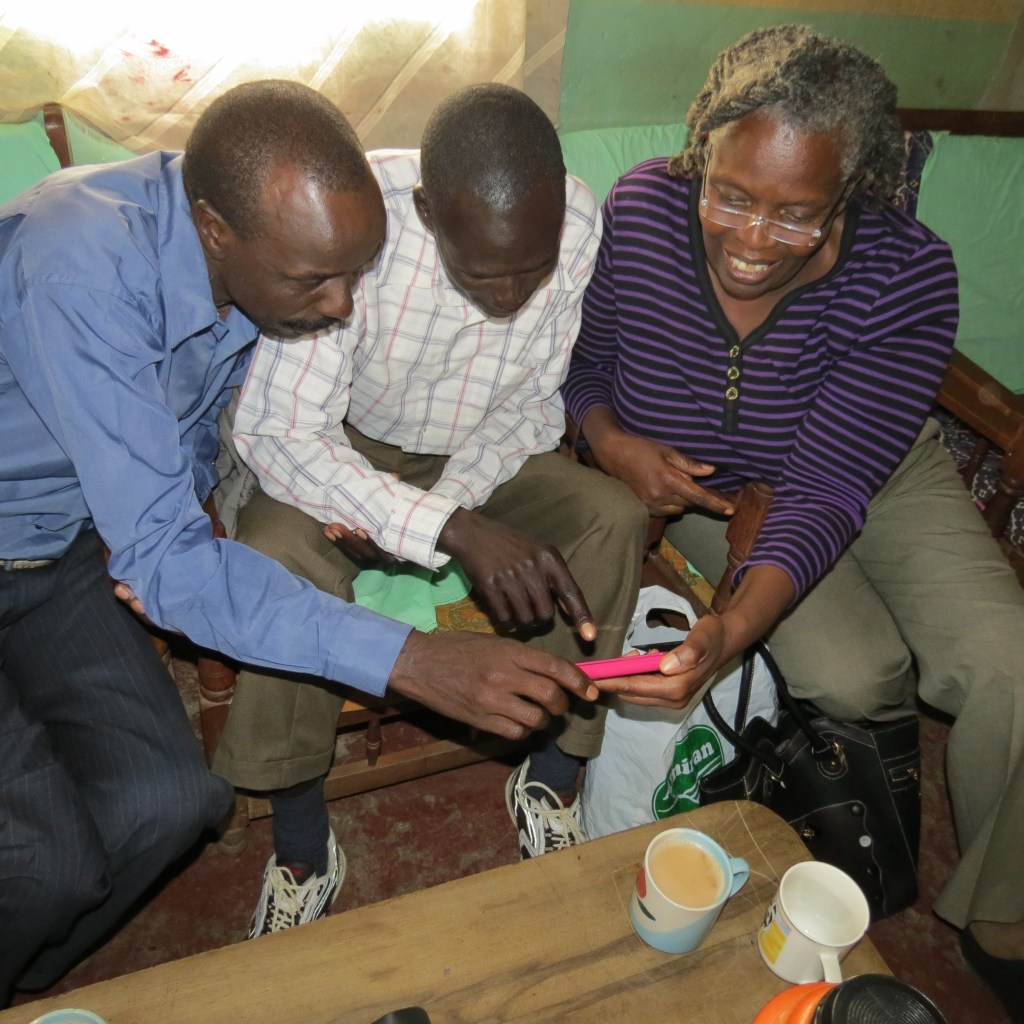
When Jeanette returned to Kenya, she was able to show some Nandi people that story, that I had uploaded to the Internet. This photo shows Nandi viewing that story on a cell phone in Kenya.
Nandi viewing the Drought Story on a cell phone in Kenya
[Note: This is a continuation of a series of posts about the evolution of my foundational stories, which are related to the intersection between my Quaker faith, protecting Mother Earth, and photography. As is often the case, it is taking me much longer than expected to tell my foundational stories (See: https://quakersandreligioussocialism.com/?s=foundational). Dramatic changes in the world have me re-evaluating how I see my Quaker faith, love of Mother Earth, and photography now. And seeking the way forward.]
There are many branches of these stories. Thus far the focus has primarily been on being a water protector, protecting Mother Earth, although my Quaker faith and photography are also parts of almost every story.
Having spent my adult life in Indianapolis, I returned to Iowa when I retired at the end of June, 2017.
But before I begin the Iowa stories, there are a couple more from Indianapolis.
I mentioned the Kheprw Institute (KI), a Black youth mentoring community I was involved with, in an earlier story about the Keystone Pledge of Resistance. KI played a huge role in my education about faith, social, racial, and environmental justice. I plan to share those stories later.
KI allowed us Keystone Action Leads to speak at a public meeting about the Keystone Resistance. Each of us spoke about why we were willing to risk arrest to stop the pipeline. We hadn’t really spoken about this before, and I was moved by what my friends said. I could tell the audience was as well.
Kheprw Institute, Indianapolis
Additionally, Ra Wyse, associated with KI, interviewed Aghilah Nadaraj (KI) and I about the Dakota Access pipeline. Following is the audio from that interview with a slideshow of photos I had taken.
Dakota Access Pipeline
Coming full circle in a way, the video below is of me talking about the Keystone Pledge of Resistance at a Dakota Access Pipeline gathering at the Indiana State Capitol in 2017. That was a moving ceremony for those of us who had been working on the Dakota Access pipeline together.
[Note: This is a continuation of a series of posts about the evolution of my foundational stories, which are related to the intersection between my Quaker faith, protecting Mother Earth, and photography. The following occurred when I was living in Indianapolis.]
The previous post described how those of us trained to bring attention to the Keystone XL pipeline connected with Joshua Taflinger and Brandi Herron of the White Pines Wilderness Academy. They wanted to support those at Standing Rock who were praying to stop construction of the Dakota Access pipeline (DAPL).
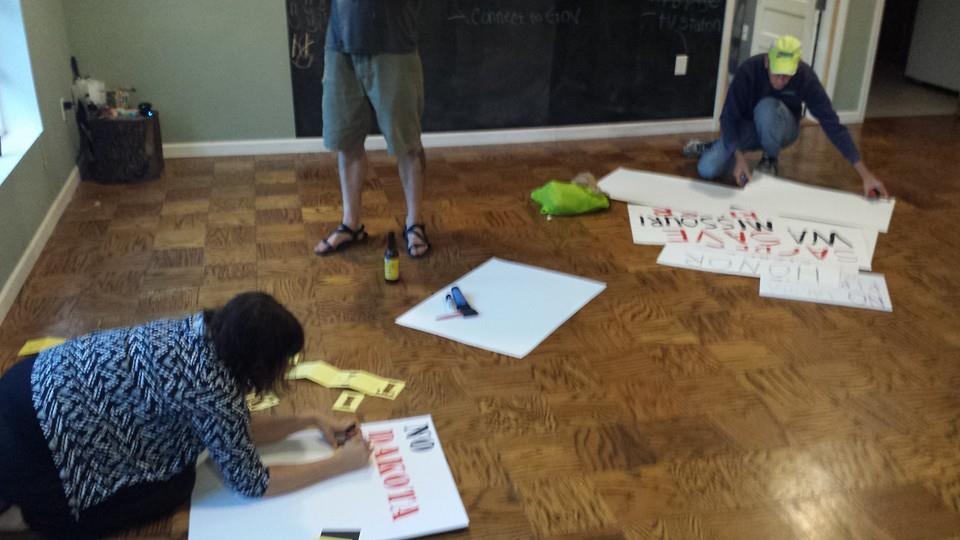
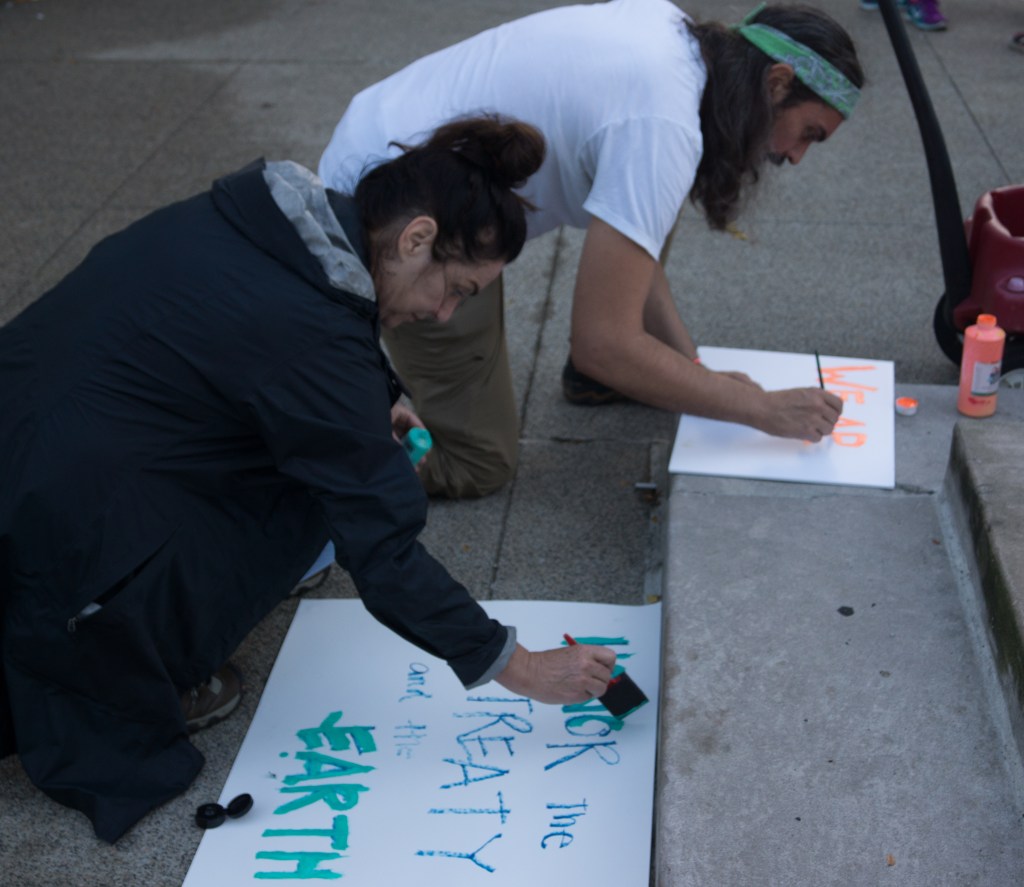
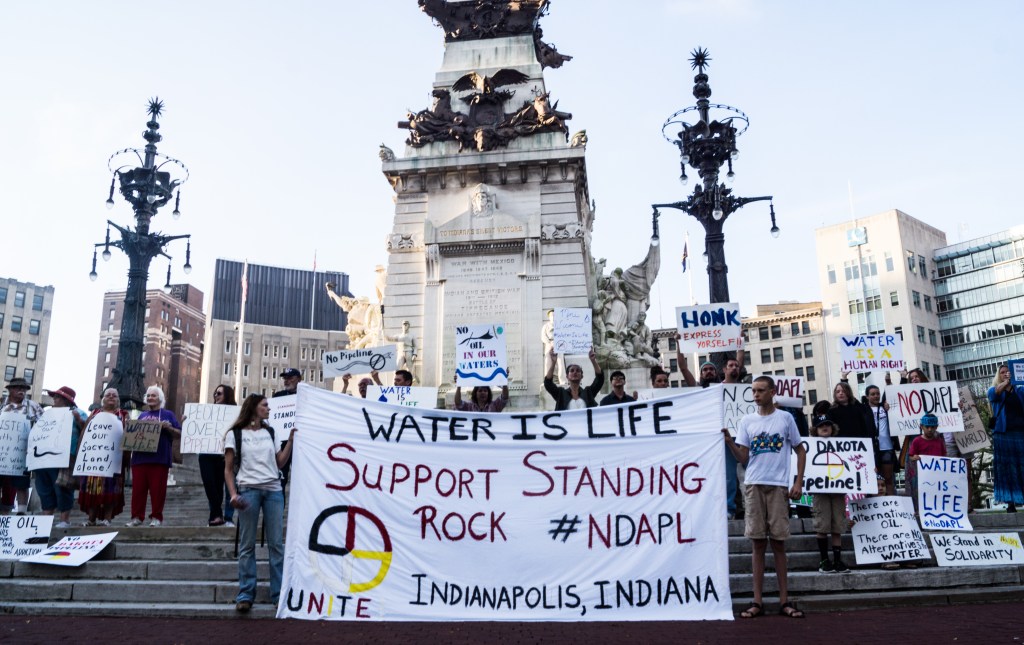
This photo was taken the first time we gathered at the Wilderness Academy, 9/8/2016. They had already made that great sign that was brought to all our gatherings, including the first one on the Circle in downtown Indianapolis the next day. The second photo from the same evening shows me inside the Academy making additional signs. The next morning sign making supplies were brought downtown where people made more of them.
Gathering at White Pines Wilderness Academy to plan first action related to the Dakota Access Pipeline, Indianapolis
Me making NODAPL signs at White Pines Wilderness Academy
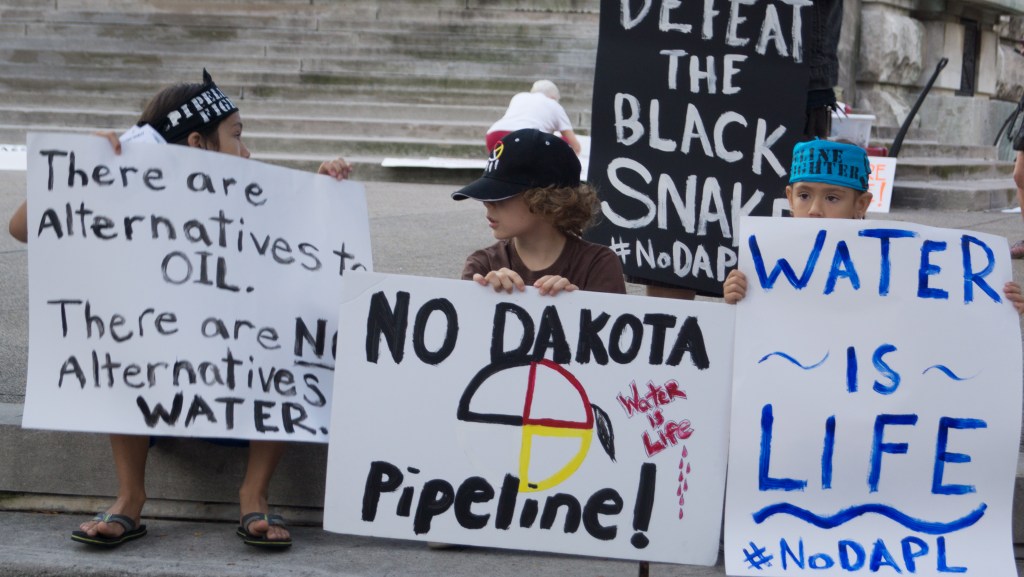
Making signs at a gathering in downtown Indianapolis
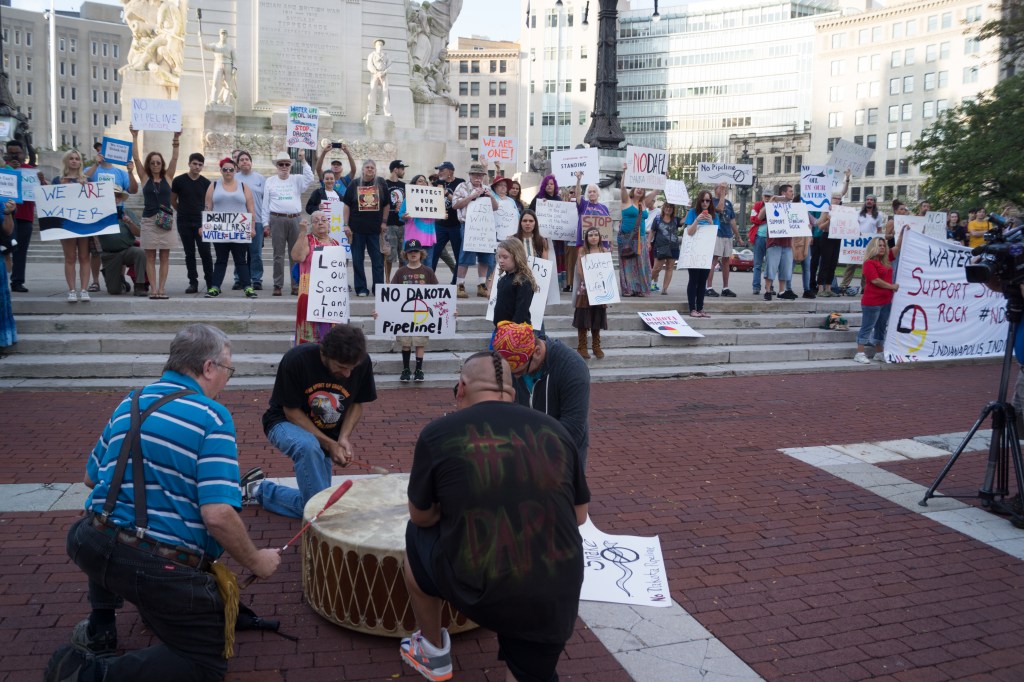
That gathering downtown on 9/9/206 was the first time Native Americans joined us. Sage was burned and there was drumming.
Burning sage
Drummers on the Circle, downtown Indianapolis
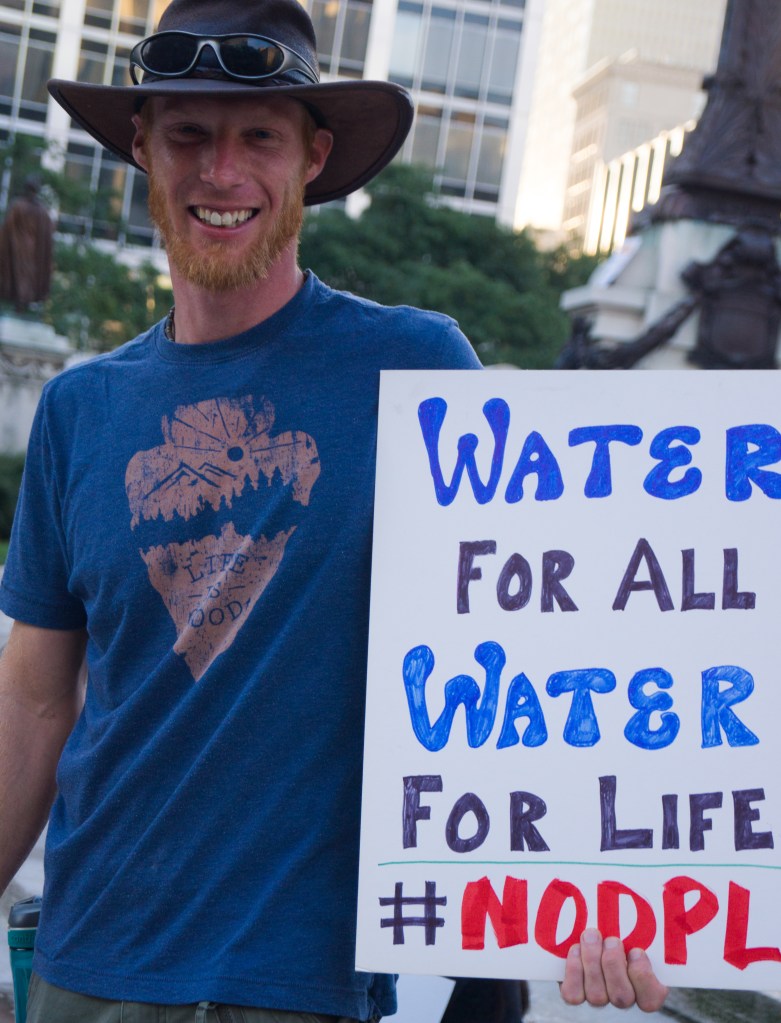
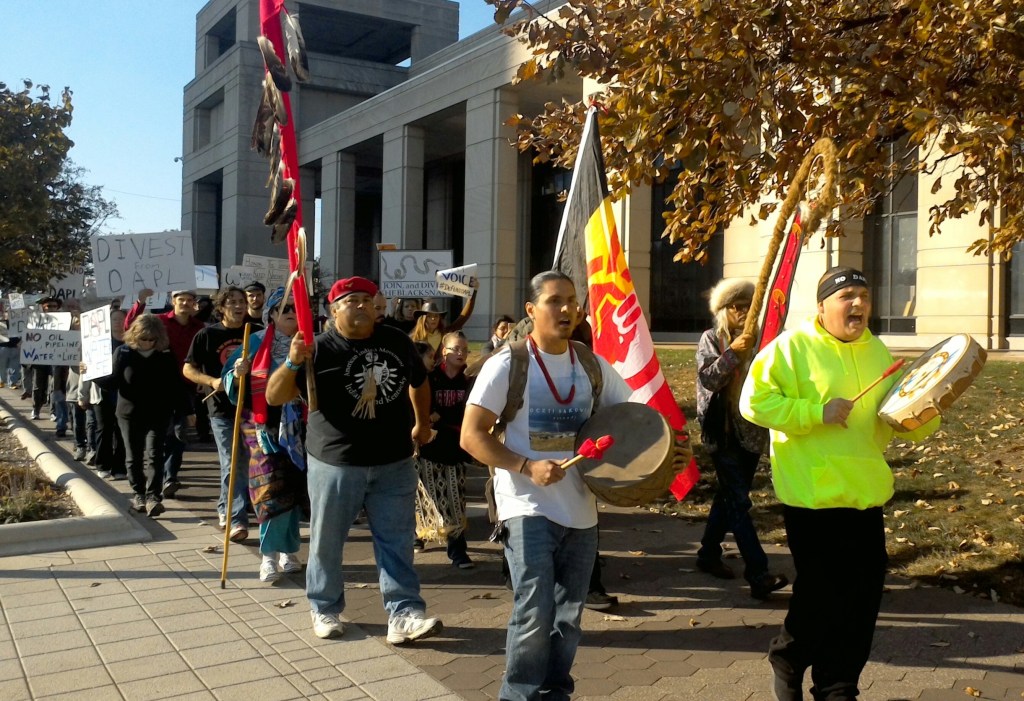
These are some photos from that gathering. Joshua is in the first photo.
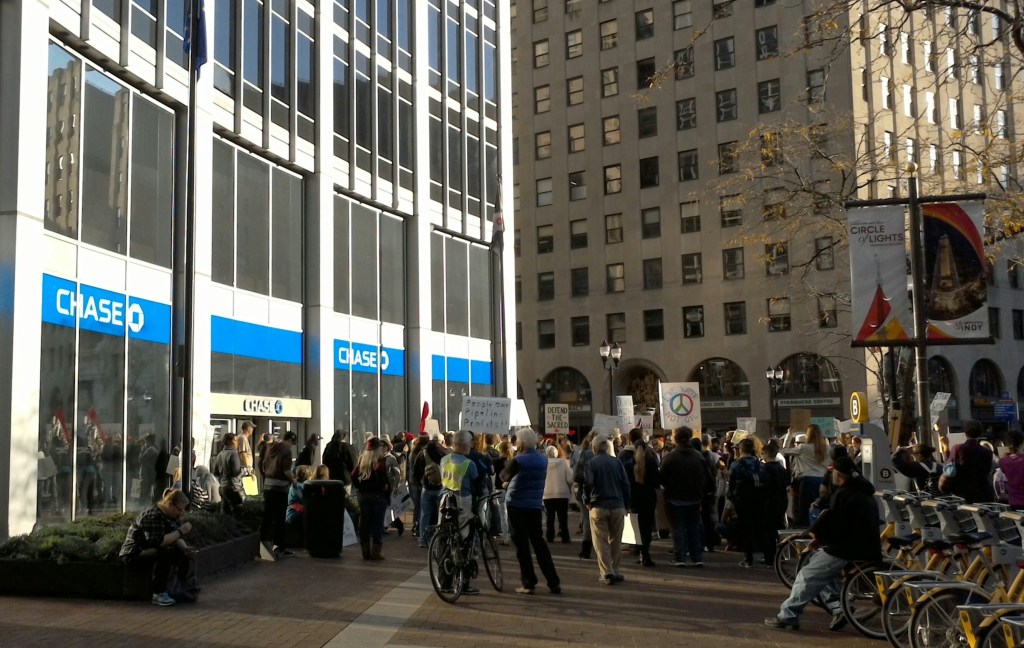
On November 15, 2016, we gathered to go to the two banks in Indianapolis that were involved in funding DAPL, which were PNC and Chase. We stood outside each bank in silence as those who had accounts went in to close them. $110,000 was withdrawn that day.
JpegJpegJpeg
I had my own experiences when I was living in Indianapolis, at the downtown Chase bank, where I closed my account.
Divestment is a strategy that has been used in many instances related to funding fossil fuel projects. In November 2015, several of us went to the Indianapolis offices of Morgan Stanley. We had a polite conversation with the manager about funding coal projects.
On February 3, 2018, Super Bowl weekend, Ed Fallon organized a van trip to Minneapolis to call attention to USBank’s funding of fossil fuel projects. USBank’s headquarters are in Minneapolis, and the game was played at the USBank stadium.
Although we had communicated by email, this was the first time I met Ed. Among the others involved were Sikowis (Christine) Nobiss and Donnielle Wanatee. It was a beautiful day with falling snow.
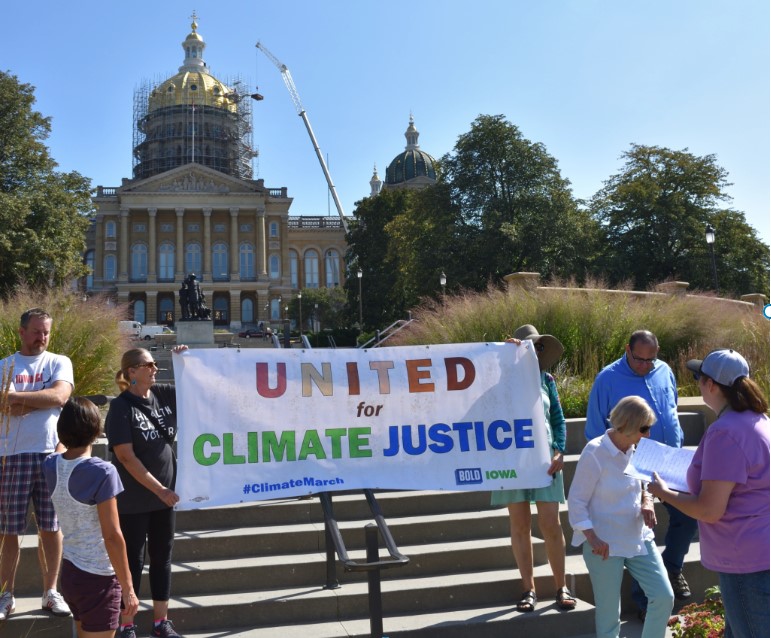
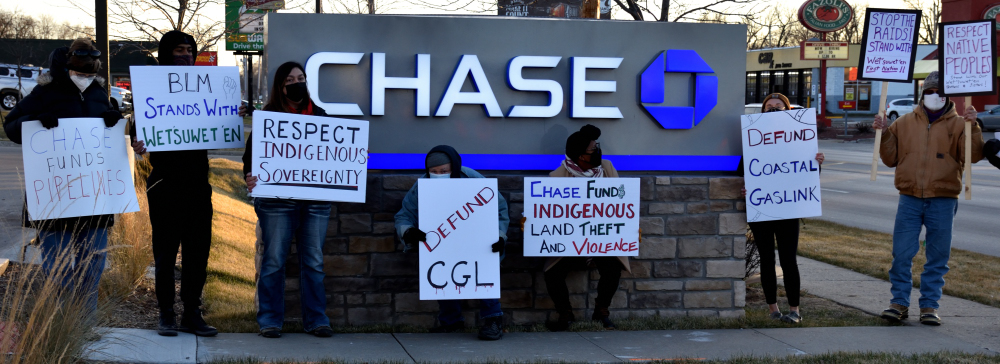
Defunding projects continue to this day. This was a gathering at a Chase bank in Des Moines in December 2021. Peter Clay and Jon Krieg were present.
























 Quakers and Mutual Aid