In 2020, President Biden told voters, “no more drilling on federal lands, period.” Yesterday the Biden administration broke that promise, saying it will resume selling leases to drill for oil and gas on federal lands.
The fossil fuel industry has found new life as the energy consequences of the war in Ukraine are being used not as an opportunity to wean off oil production, but the opposite; to ramp up fossil fuel development.
“Investing in new fossil fuel infrastructure is moral and economic madness,” UN Secretary-General António Guterres said as the Intergovernmental Panel on Climate Change (IPCC) released part of its latest report on Monday.
Humanity confronts a great dilemma: to continue on the path of capitalism, depredation, and death, or to choose the path of harmony with nature and respect for life.
Jake Grobe
“It is never a good sign when the President announces something at 5pm on a Friday. But President Biden can’t get away with this disastrous climate decision. The fact of the matter is that more drilling won’t solve high gas prices right now – so why is Biden breaking his campaign promise to stop drilling on public lands?
“This is why young people are doubting the political process altogether. If Biden wants to solve for voter turnout in 2022, he should actually deliver on the things he promised, not move farther away from them. On November 8, 2022 we don’t want to hear anyone asking why young people didn’t vote. Biden is actively turning voters away. If we’re going to combat fascism and win in 2022, he must be a leader and course correct. This election and our futures depend on it.”
In 2020, President Biden not only ran and won on a bold climate agenda, but told voters, “no more drilling on federal lands, period.” Today, his administration is expanding drilling on public lands, stalling on climate legislation and concurrently, his approval ratings are plummeting, especially among young people.
The purpose of this brief history is background for a request from Sikowis (Christine) Nobiss for funds to support the documentary “They Found Us” that’s being done about her reservation’s residential school. George Gordon First Nation had the longest running residential school, which didn’t close until 1996.
During the 2017 annual sessions of Iowa Yearly Meeting (Conservative) there was panel discussion about building bridges with native peoples. The panel consisted of Peter Clay, an Iowa Friend, Donnielle Wanatee from the Meskwaki Settlement, and Sikowis (Christine) Nobiss, one of the most active Indigenous leaders in the Midwest. All three have played a large role in my connections with Native Americans since.
In February 2018, I was part of a group who went to Minneapolis to protest US Bank’s funding of oil pipelines. Sikowis spoke at that gathering.
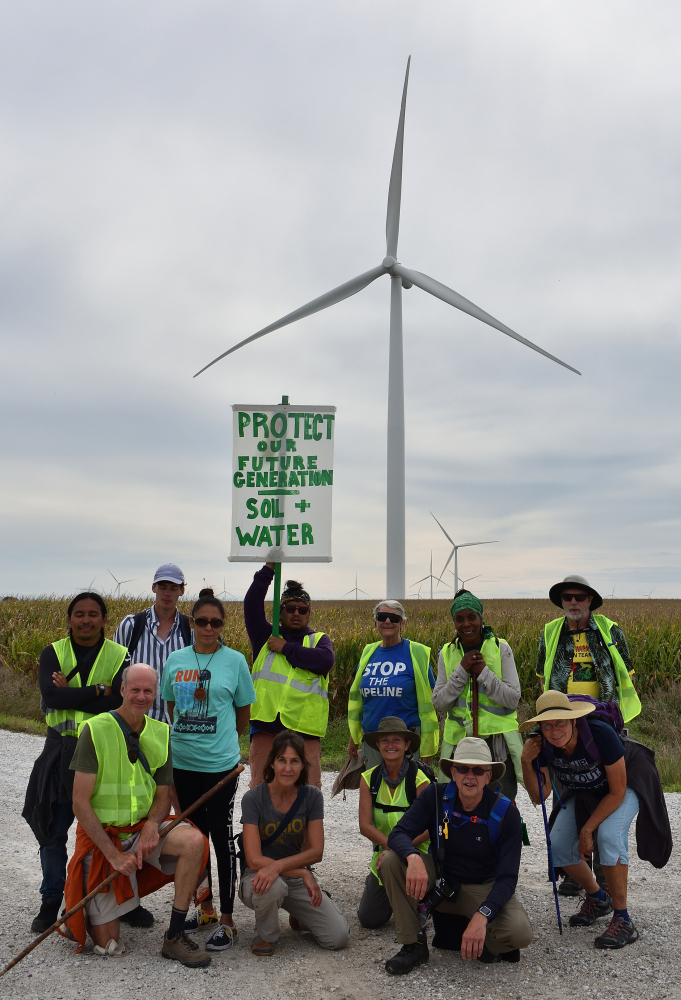
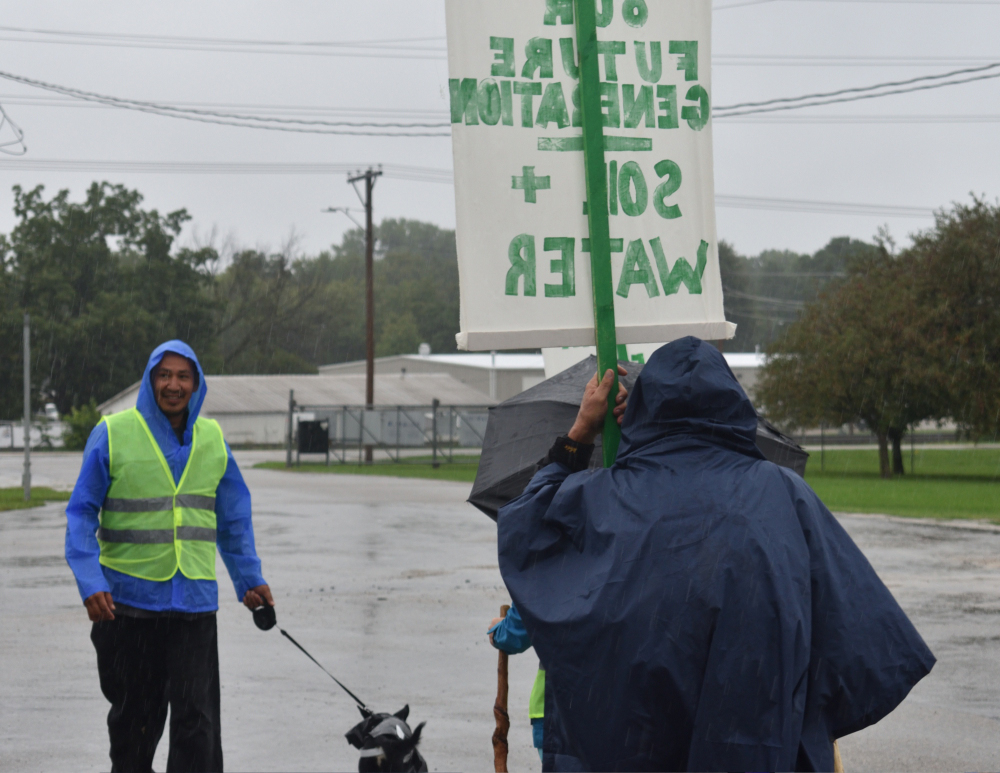
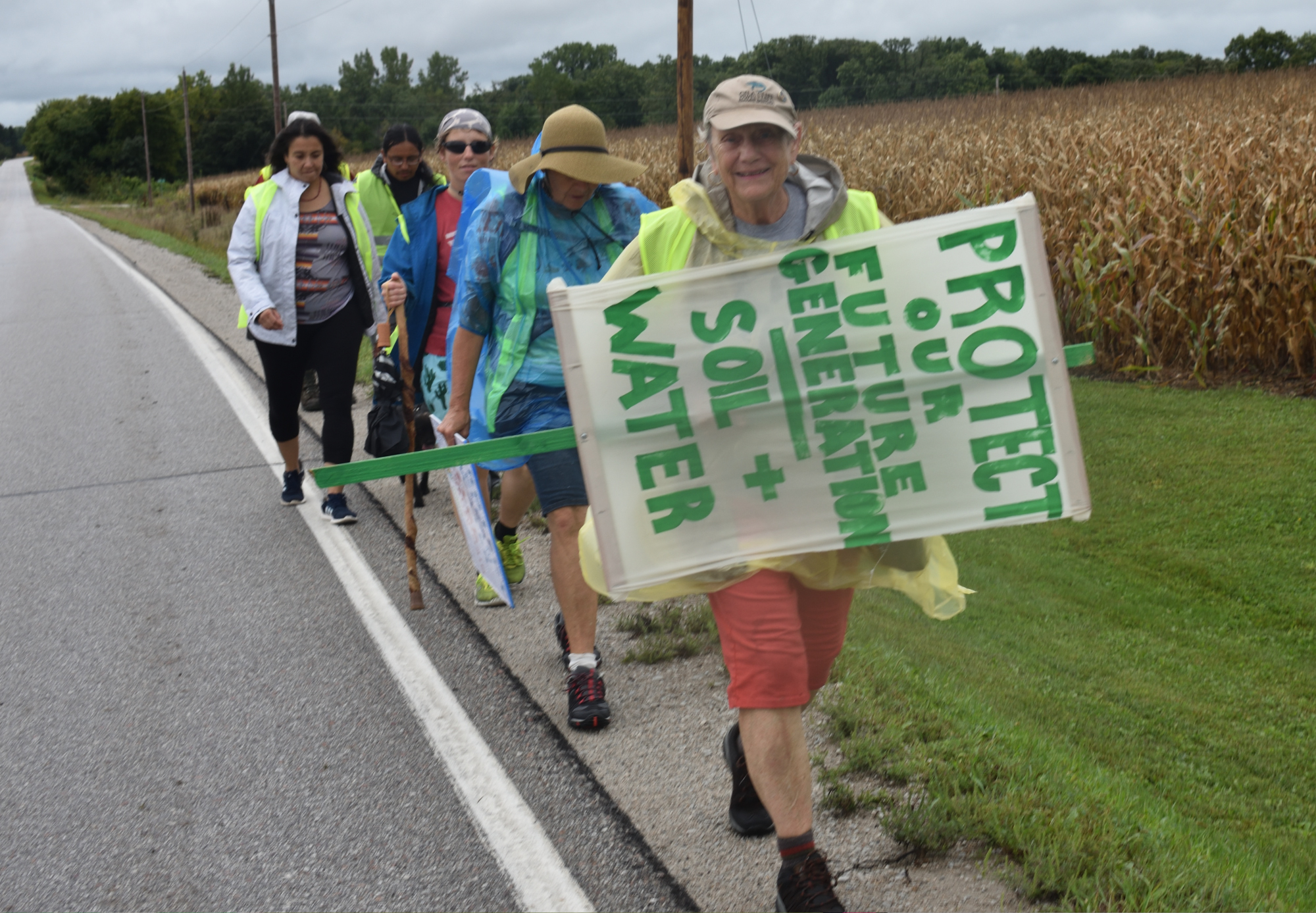
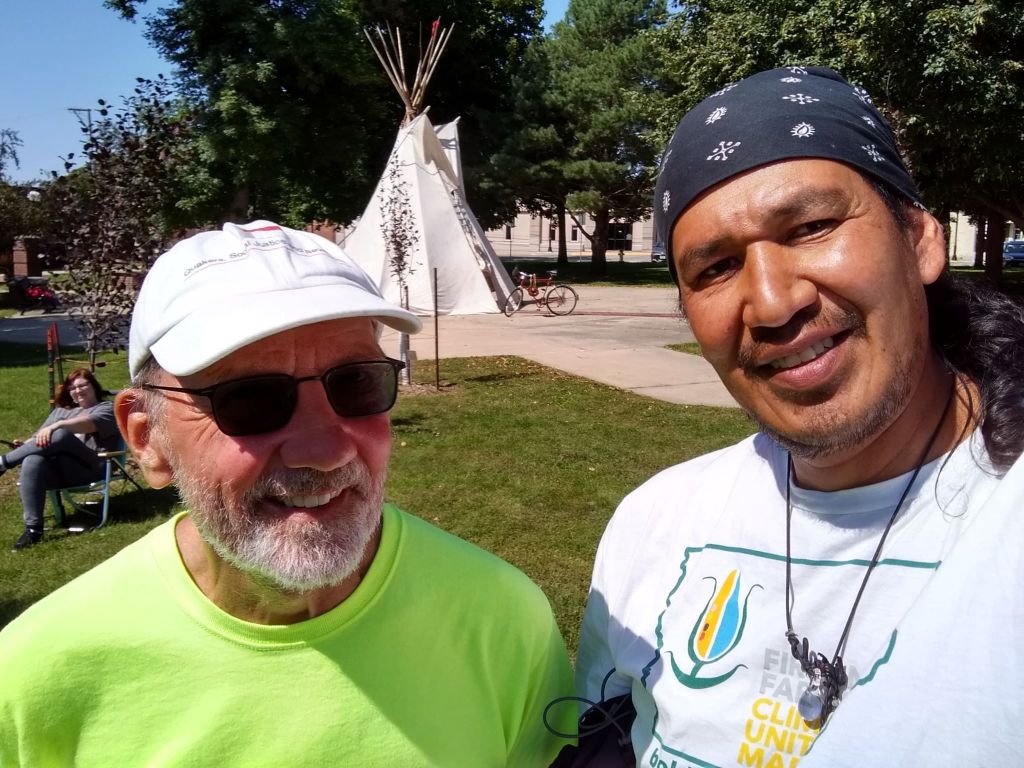
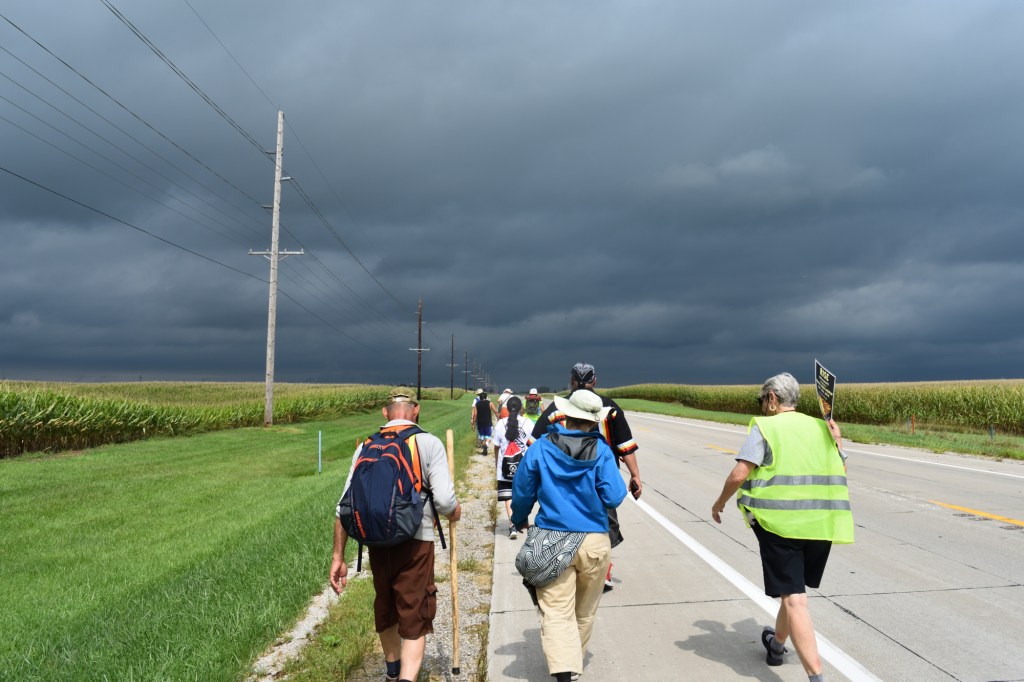
I began to get to know Sikowis when she and I were among a small group of native and non-native people who walked and camped for eight days along the route of the Dakota Access pipeline, from Des Moines to Fort Dodge, Iowa. Iowa Friend Peter Clay was also on this First Nation-Farmer Climate Unity March. Jon Krieg (AFSC) joined us for the first day. And my Scattergood School roommate Lee Tesdell participated in one of the evening discussions during the March. Another Iowa Yearly Meeting Friend, Liz Oppenheimer, organized a time of worship sharing and prayer among Friends each morning, supporting our sacred journey.
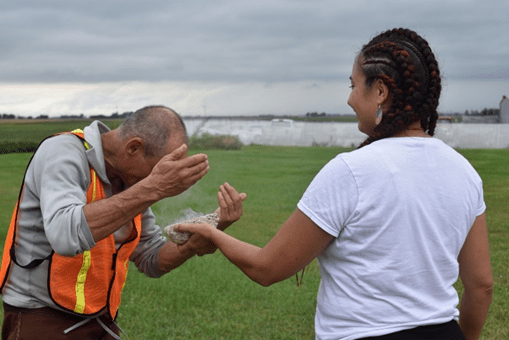
In this photo during the March Sikowis is holding the bowl Peter Clay is smudging from.
The purpose of the March was to create a community of native and non-native people who began to know and trust each other so we could work on things of common concern. That was highly successful, and we have done a number of things together since.
One of the first was when several of us from the March, including Sikowis (in the center of this photo), Iowa Friends Shazi and Fox Knight, and I lobbied Senator Grassley’s staff to support several bills related to native concerns.
Lobbying Iowa Senator Grassley about native legislation
The summer of 2019 Sikowis suggested I attend the National Network Assembly at the Des Moines YMCA Camp near Boone, Iowa, that she helped organize. I was aware that if I wanted to build on relationships with native peoples, I should wait to be invited. Seeing this as one of those opportunities, I did attend.
In early 2020, I began to hear about the struggles of the Wet’suwet’en peoples in British Columbia, as they worked to prevent the construction of a liquid natural gas pipeline (Costal GasLink) through their pristine lands and waters. There was little being written about this in the mainstream media, so supporters were asked to write about what was happening on our social media platforms.
This photo is from a post about a rally I organized to support the Wet’suwet’en in Des Moines on February 7, 2020. Iowa Friend Peter Clay attended.
I’m convinced the Spirit led Ronnie James to come to this rally. Ronnie is an Indigenous organizer with twenty years of experience. He was surprised anyone in Iowa knew about the Wet’suwet’en, so he came to see who we were. Since that day Ronnie has been patiently mentoring me about Des Moines Mutual Aid. Including helping me become involved in the food giveaway project. We’ve become good friends.
This relates to my relationship with Sikowis because Ronnie is a member of the Great Plains Action Society (GPAS) that she organized for Indigenous activism in the Midwest. Several other friends I made during the First Nation-Farmer Climate Unity March also work at Great Plains Action Society.
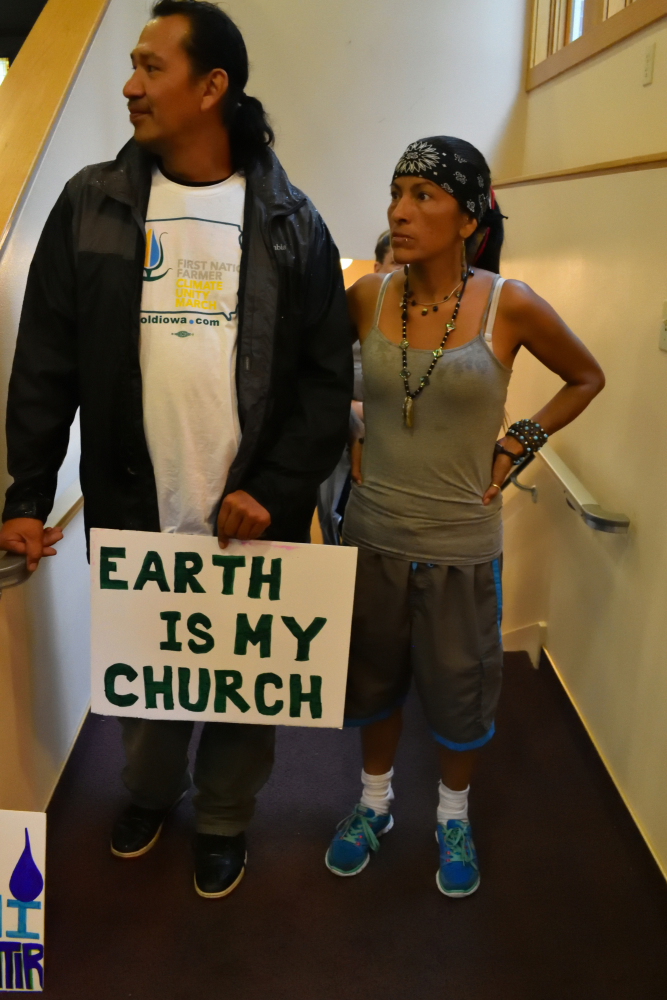
As often happens, once people know I love photography, I get invited to events for that purpose (even though I’d want to go, anyway). This photo of Sikowis was taken at last year’s Indigenous People’s Day. She’s holding a Great Plains Action Society bag.
Sikowis Nobiss
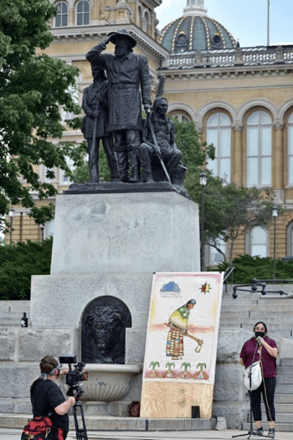
Another event where I took photos was a gathering on the State Capitol grounds related to racist statues. In this photo Sikowis is speaking at the Pioneer statue.
Sikowis Nobiss
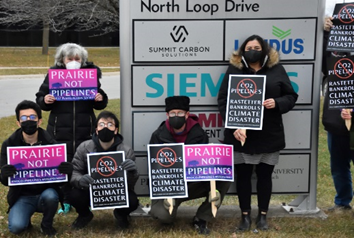
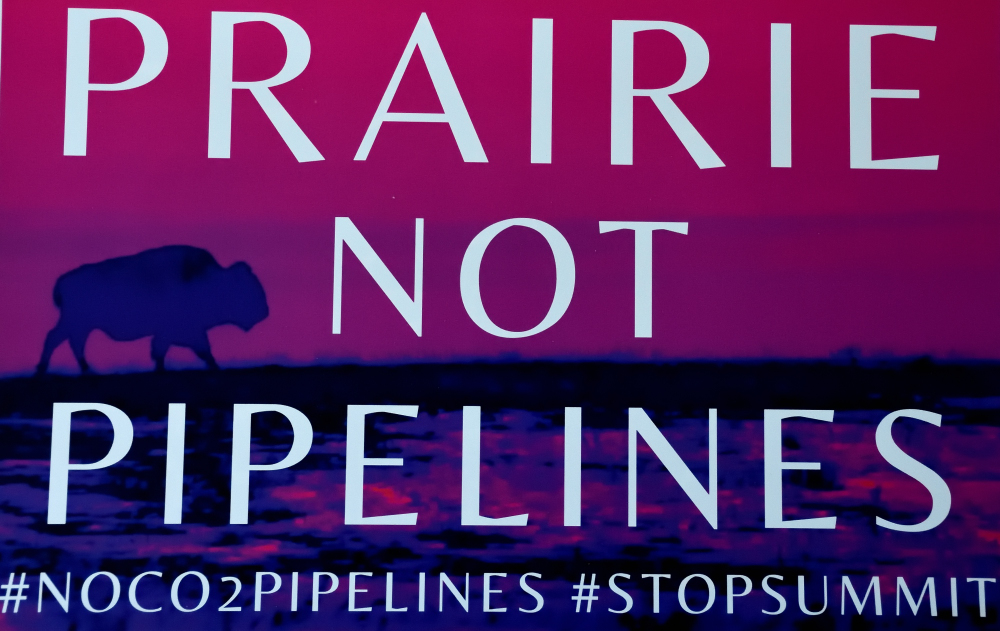
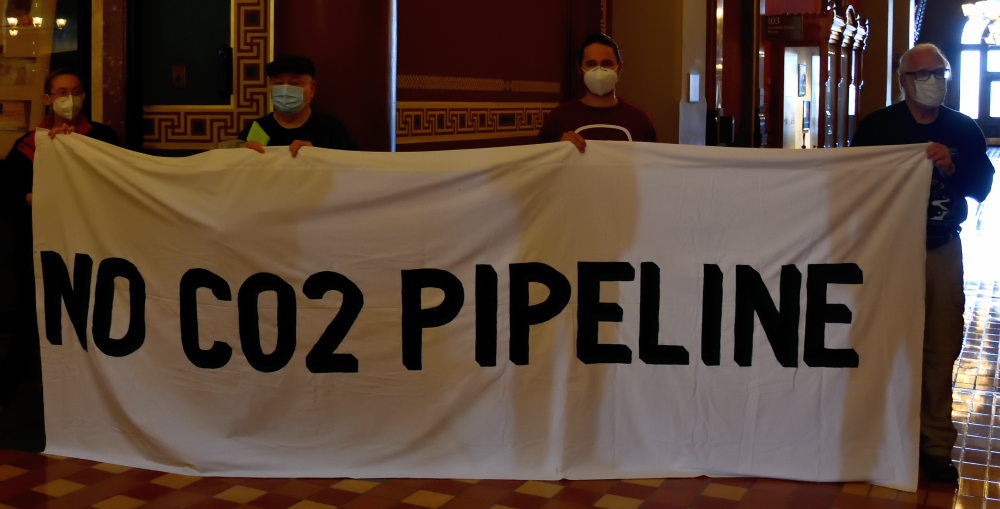
Last December, Sikowis asked me to come to Ames for a rally at the office of Summit Carbon, one of the companies that want to build a CO2 pipeline.
Residential institutions of forced assimilation
The legacy of what are sometimes called Indian Boarding Schools has been a concern of mine for years. The involvement of Quakers in establishing and teaching in these institutions has become a source of tension and conflict among Quakers today. I think my past ignorance about these institutions was common for Quakers, thinking Friends involved in those schools were doing the best they could to help native children assimilate into mainstream American society. Not critically thinking why that would be a good thing. But we began to learn more about the great harm this did to native children and their families. And that was before learning about the widespread emotional, physical and sexual abuse of the children.
I was led to make this something I needed to learn more about. And share what I was learning with Quakers and others. Friend Paula Palmer, who has become a friend of mine, was called to a ministry related to these institutions and Quaker’s involvement in them. Peter Clay and I helped organize events among Iowa Friends, Conservative and FUM, when Paula came to the Midwest.
Prior to the First Nation-Farmer Climate Unity March I was unsure whether I should bring up the subject of forced assimilation, especially as I had learned more about trauma from those institutions being passed from generation to generation. I had hoped to learn about Indigenous spirituality on the March but didn’t see how that could happen without acknowledging Quakers’ involvement in forced assimilation.
Matthew and I began to get to know each other early in the March because he was shooting video of the same things I was taking photos of. We shared quite a bit about this common interest. I believe it was the second day of the March as we were walking and talking together that the Spirit led me to tell him I knew about the Quaker involvement in the residential schools, and I was sorry for what had happened. Of course, I had no idea how he would react. But all he did was nod his head, and we continued to walk and talk together. I didn’t say anything else about that.
But just a few hours later he said he wanted to tell me a story. It involved a traumatic incident related to his mother and the residential schools. I was so grateful he felt he could share that with me. We didn’t talk about that any further.
Since then, when it seemed appropriate, I brought up Quaker involvement in the boarding schools with each of my native friends. Each one had personal experiences related to the schools. I believe that it was an important part of our developing friendships that we shared these stories.
Sikowis told me briefly of family members who had experienced traumas from those institutions. We had that brief discussion several years ago.
I believe this is in part why she invited me to ask Quakers if we would help support making a documentary about her reservation’s (George Gordon First Nation) residential school.
Iowa Yearly Meeting (Conservative)’s Peace and Social Concerns Committee has an annual budget to support peace and justice work. This year it was decided that rather than give token amounts to various peace and justice organizations, we might discern to invest a larger sum, for a more significant impact, to an organization or project. But we didn’t know what that would be.
This request from Sikowis is an opportunity to build on Iowa Yearly Meeting (Conservative)’s relationship with Indigenous peoples in the Midwest. An opportunity to begin truth and healing.
I’m pleased the Peace and Social Concerns Committee unanimously supports using our budget to support the documentary that’s being done about the George Gordon First Nation’s residential school.
March 27, 2022
This letter in regards to a request for financial support for a documentary title “They Found Us”, to support community presentations of this film that I produced.
My name is Curt Young and I a member of the George Gordon’s First Nation. I am a descendant of Mike Longman, along with my mother Longman-Young; both members of this nation. The development of this documentary was an intent for myself to learn more about my maternal familial lineage, as I had not grown up on GGFN and wanted more connections to my cultural heritage. I applied for the “Peoples Investment Grant”, while residing in Calgary and was a successful candidate. These funds were intended to financially support a compilation of Elder’s narratives, however, during the initial interviews, the findings of the 215 bodies outside of the Kamloops residential schools, inspired myself to change the direction of the documentary. I decided to focus more on the process that GGFN reserve’s undertaking of a ground search outside of the local residential school; to see if there were any unmarked graves or bodies buried there.
Over the past year, I have made three trips to GGFN to obtain footage of the community’s initial activities related to the ground search of the area. Aside from the footage of the community, I also have compiled interviews from GGFN members, and other Indigenous people, including leaders and Elders, that have shared their own narratives and experience with residential schools. The budget that I was provided by the grant I received was allocated to travel costs associated with these trips to GGFN, along with the rental of video technological equipment, necessary to create the documentary. I have spent time and effort into producing this documentary and have been promoting it through various online platforms, along with connections I have within Indigenous communities, both urban and rural. I have much interest in public showings of this documentary, particularly since June is coming up, with it being National Indigenous Peoples month. One showing that I have confirmed is the first week of June; at Fort Calgary. Although I am quite excited for the interest and opportunities, I would like to honour my home community and acknowledge the stories that are compiled in my documentary, by having the first public showing of “They Found Us” on GGFN.
In order for myself to bring the documentary to GGFN I am requesting funds to support my travel, accommodation and honorarium for traditional drummers and possibly a dancer to create a healing and culturally safe space for a community show. My first showing that I have booked for this documentary is June 4, 2022, thus, I am asking to have funds to showcase the documentary on GGFN prior to this date.
My friend Sikowis (Christine) Nobiss is raising money for a documentary that’s being done about her reservation’s residential school. George Gordon First Nation had the longest running residential school, not closing until 1996.
My relative is working to raise funds for his documentary on elders and the history of the residential school at George Gordon First Nation, which is my nation. He needs to make multiple trips throughout the plains and to GGFN and set up viewing events for the documentary, which will cost around $7,000 CAD. If there are any folks in your community interested in helping him attain this goal, please let me know. Thank you.
As described in the following letter, the project was originally for a compilation of Elder’s narratives. But during the initial interviews, the findings of the 215 bodies outside the Kamloops residential school changed the direction of the documentary. To focus on the process that George Gordon’s First Nation was undertaking related to the unmarked graves or bodies at the GGFN reserve’s residential school.
March 27, 2022
This letter in regards to a request for financial support for a documentary title “They Found Us”, to support community presentations of this film that I produced.
My name is Curt Young and I a member of the George Gordon’s First Nation. I am a descendant of Mike Longman, along with my mother Longman-Young; both members of this nation. The development of this documentary was an intent for myself to learn more about my maternal familial lineage, as I had not grown up on GGFN and wanted more connections to my cultural heritage. I applied for the “Peoples Investment Grant”, while residing in Calgary and was a successful candidate. These funds were intended to financially support a compilation of Elder’s narratives, however, during the initial interviews, the findings of the 215 bodies outside of the Kamloops residential schools, inspired myself to change the direction of the documentary. I decided to focus more on the process that GGFN reserve’s undertaking of a ground search outside of the local residential school; to see if there were any unmarked graves or bodies buried there.
Over the past year, I have made three trips to GGFN to obtain footage of the community’s initial activities related to the ground search of the area. Aside from the footage of the community, I also have compiled interviews from GGFN members, and other Indigenous people, including leaders and Elders, that have shared their own narratives and experience with residential schools. The budget that I was provided by the grant I received was allocated to travel costs associated with these trips to GGFN, along with the rental of video technological equipment, necessary to create the documentary. I have spent time and effort into producing this documentary and have been promoting it through various online platforms, along with connections I have within Indigenous communities, both urban and rural. I have much interest in public showings of this documentary, particularly since June is coming up, with it being National Indigenous Peoples month. One showing that I have confirmed is the first week of June; at Fort Calgary. Although I am quite excited for the interest and opportunities, I would like to honour my home community and acknowledge the stories that are compiled in my documentary, by having the first public showing of “They Found Us” on GGFN.
In order for myself to bring the documentary to GGFN I am requesting funds to support my travel, accommodation and honorarium for traditional drummers and possibly a dancer to create a healing and culturally safe space for a community show. My first showing that I have booked for this documentary is June 4, 2022, thus, I am asking to have funds to showcase the documentary on GGFN prior to this date.
Quakers in my Yearly Meeting, Iowa Yearly Meeting (Conservative), have instituted Spiritual Sharing Small Groups for Friends who are interested in participating. There have been several cycles of these groupings. I was led to participate in the current groupings, hoping to find some help with a Spiritual crisis I’m in.
There are four of us in my group, and we meeting every Tuesday night. There isn’t a specific format for these meetings. We each take turns introducing the night’s discussion. Tonight is my turn and I’m looking forward to sharing an experience that changed my life, and relates to my Spiritual crisis.
I plan to talk about the sacred journey I was led to make, the First Nation-Farmer Climate Unity March. I created a WordPress website with many photos, videos and stories from the March at this link:
As the name implies, this was a march to unify a small community of native and non-native people. Our group was around thirty native and non-native people. Unify in the sense of getting to know, and begin to build trust among us. It was clear to me, and many of my non Indigenous friends, that native views and practices are essential to heal Mother Earth.
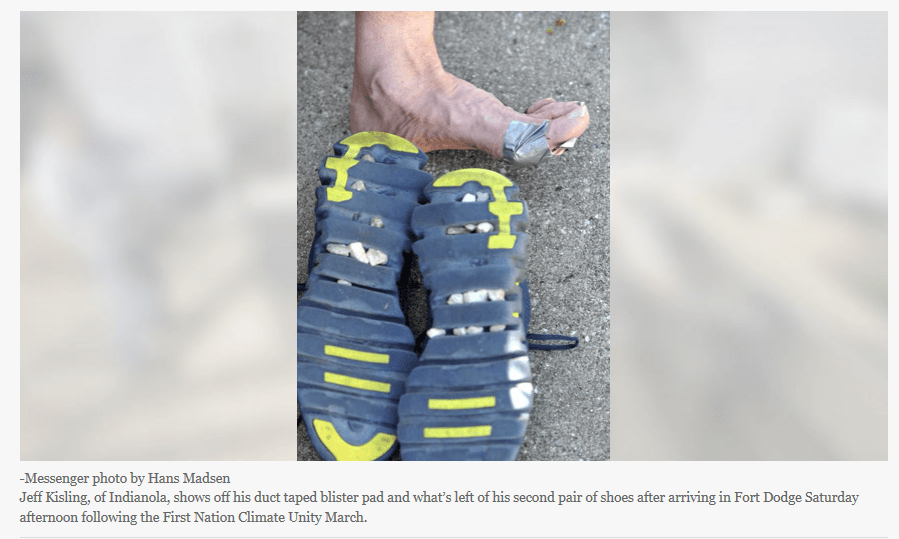
We began to get to know each other as we walked together for hours down nearly empty rural gravel roads. This sacred journey began in Des Moines, and ended ninety four miles and eight days later in Fort Dodge. This was literally an act of faith. I was not at all sure I could walk all the way, but was very grateful I made it. Fortunately it was suggested that we pack an extra pair of shoes, because my first pair were worn out about halfway.
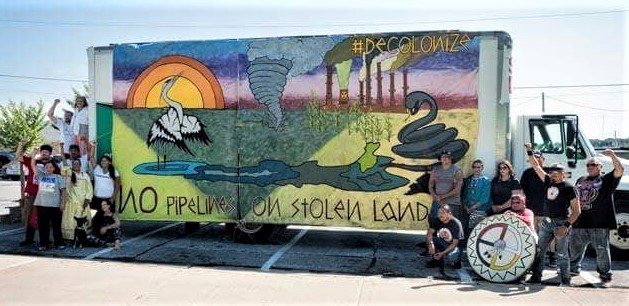
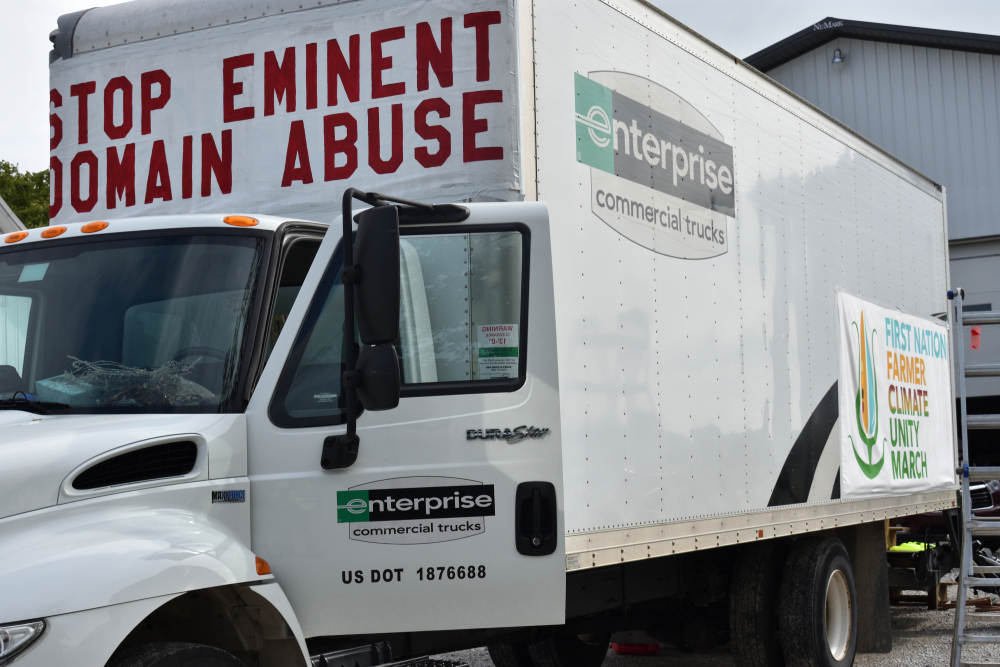
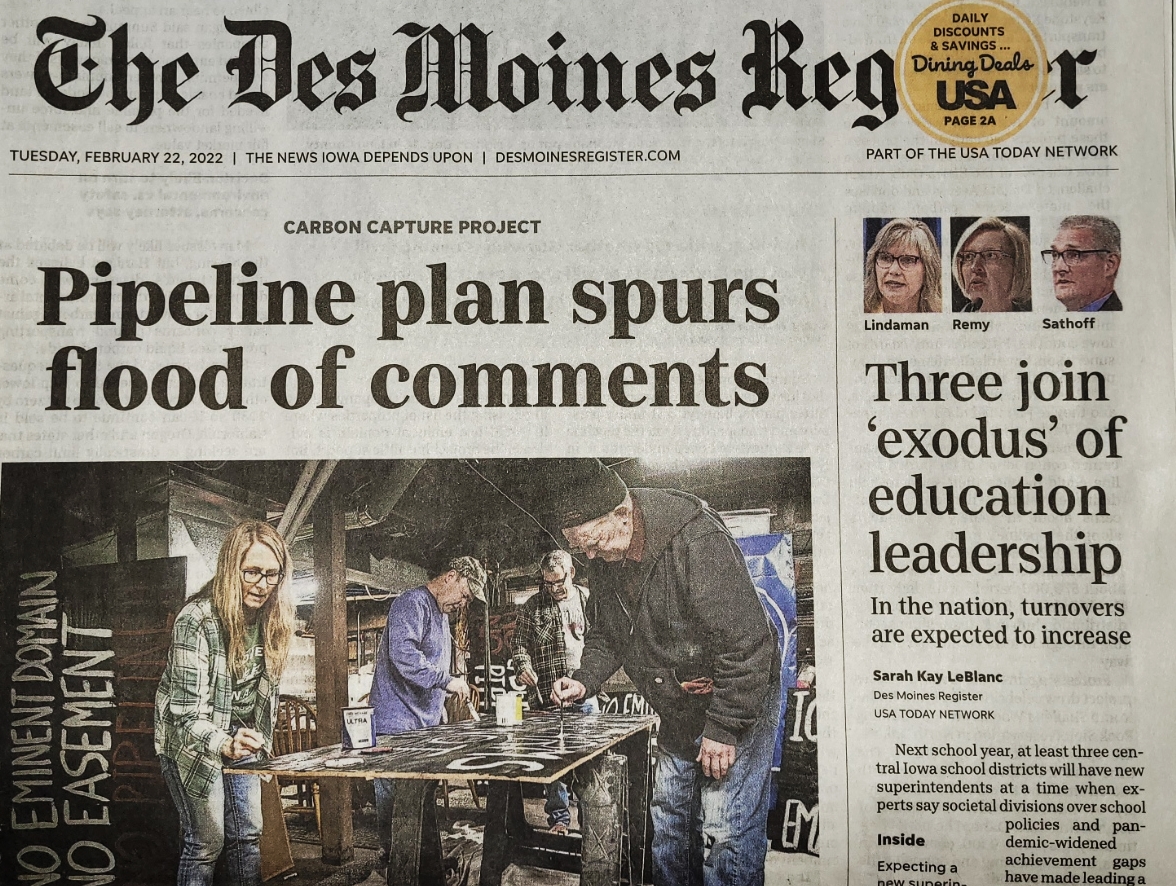
We walked and camped along the path of the Dakota Access pipeline. The truck that carried our tents from place to place had a huge banner that said “Stop Eminent Domain Abuse”. Eminent domain was used to force landowners to allow the pipeline to be built through their land despite their wishes otherwise.
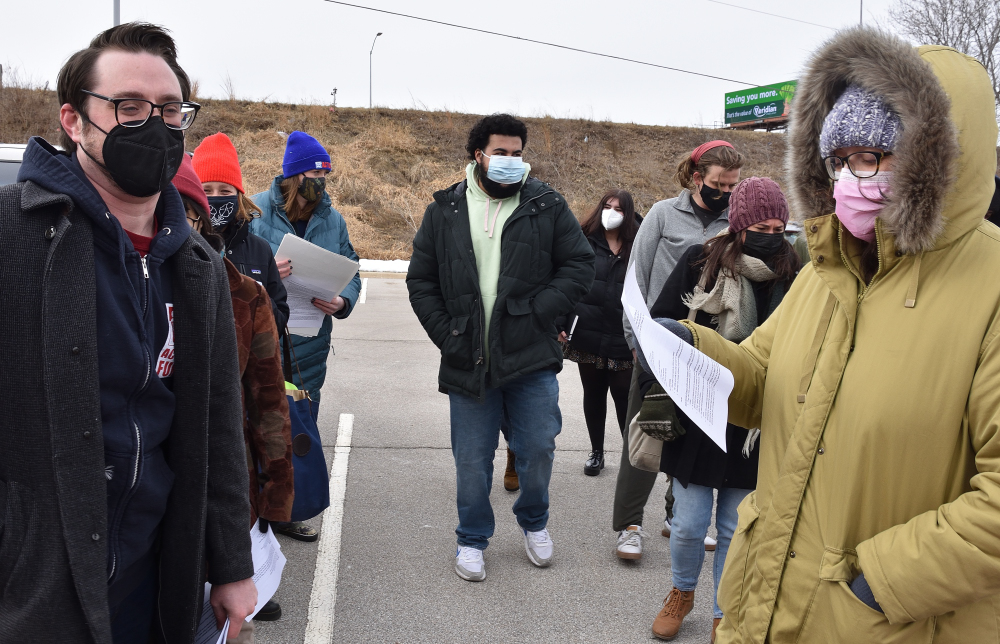
Eminent domain is in the news again, as companies are pushing for the construction of carbon pipelines. My friends Sikowis Nobiss and Mahmud Fitil, both of whom walk on the March, organized this gathering at the headquarters of Summit Carbon a couple of months ago and invited me to take photos. Just one example of how those of us on the March have worked together since.
Spiritual Crisis
As I see and learn more about white supremacy and its toxic effects on peoples and Mother Earth, I find it difficult to consider myself a Christian. The weaponized version of a religion. The Crusades. The Doctrines of Discovery that not only purported to gave white people the permission to take over lands around the earth, but also to subjugate and kill the Indigenous peoples.
And the incomprehensible history and consequences of the forced assimilation of native children. The multigenerational traumas. The physical, mental, and sexual abuses and thousands of deaths.
Something important happens when we gather in pursuit of a common goal. First we form rituals that help us relate to and negotiate each other, everything from a civic tradition that allows anyone with a voice to be respectfully heard, to sharing food and music in the local town hall every Friday night, to a labour system that fairly distributes the burden of work. Then, those rituals that stand the test of time become embedded in daily life. The ritual activities themselves and the good they produce help a community identity take root. As identity strengthens, so too does our sense of connectedness — our sense of affection, responsibility and obligation — to one another. When this happens, we then share a greater capacity for coherence and cooperation. And where we share greater capacity for coherence and cooperation there is also greater resilience: the ability to mobilise skills and resources to support the emergence of collective intelligence in response to crisis, enable rapid adaptation and ensure the continuity of the most important functions and structures of the community. This coherent togetherness and the collective intelligence that emerges out of it is the source of human strength and ingenuity. Within it lies our ability to transition from one evolutionary niche to another, even against the odds.
What comes to matter then is the creation of the best possible story we can while we’re here; you, me, us, together. When we can do that and we take the time to share those stories with each other, we get bigger inside, we see each other, we recognize our kinship — we change the world one story at a time.
Richard Wagamese (October 14, 1955-March 10, 2017) Ojibwe from Wabeseemoong Independent Nations, Canada
We are our stories, stories that can be both prison and the crowbar to break open the door of that prison; we make stories to save ourselves or to trap ourselves or others, stories that lift us up or smash us against the stone wall of our own limits and fears. Liberation is always in part a storytelling process: breaking stories, breaking silences, making new stories.
Rebecca Solnit, ‘Silence Is Broken’, in ‘The Mother of All Questions’
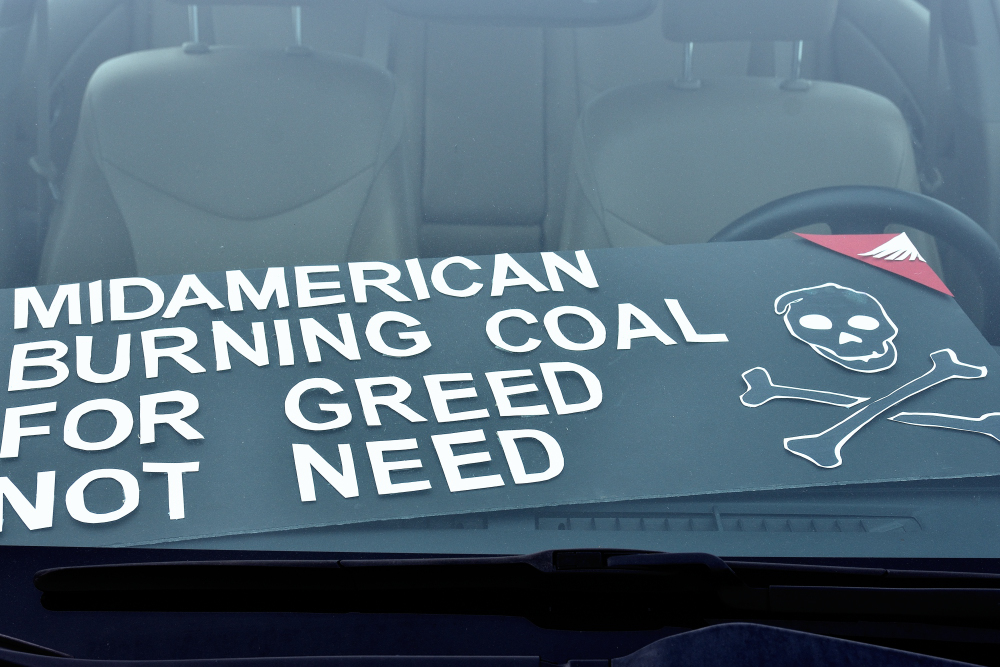
Iowa Citizens for Community Improvement is working to get 1,000 of us to sign this petition to make the Des Moines City Council demand MidAmerican Energy commit to stop burning coal. MidAmerican is negotiating a new franchise agreement with Des Moines to secure a monopoly on supplying the city with energy.
Right here in Iowa, we have an incredible opportunity to significantly cut carbon emissions that are contributing to the devastating effects of climate change. But we’re going to have to up the ante if we want to succeed.
We need to demonstrate widespread community support to push our elected leaders to action. Organizationally, we want to add 1,000 petition names to this effort to put pressure on city council and to build our people power.
For the people and places we love, and the whole damn planet, Jake Grobe (he/him) Climate Justice Organizer
P.S. We know a petition alone will not get us the change we need. Join us on Earth Day, Friday, April 22nd to take our message directly to Iowa’s biggest carbon polluter. Learn more and RSVP here.
My friend Jake Grobe is ICCI’s Climate Justice Organizer. From his bio: He believes that climate justice is an intersectional fight for racial, economic, and social justice. “Humanity confronts a great dilemma: to continue on the path of capitalism, depredation, and death, or to choose the path of harmony with nature and respect for life.”
Des Moines needs to follow through on 100%, 24/7 carbon-free electricity resolution
Target: Des Moines City Council
Last year the community made it loud and clear that we need climate action now. We were pleased to see Des Moines City Council follow suit by passing a resolution for 100%, 24/7 carbon-free electricity by 2035.
Now it’s time to make this goal a reality, but MidAmerican Energy – Iowa’s biggest carbon polluter and monopoly energy corporation – has publicly stated they’re planning to burn coal until 2049.
The choice is simple. We can work together to decarbonize our energy system as quickly as possible to prevent the worse effects of the climate crisis, or we can continue burning coal to extinction.
Right now, MidAmerican Energy is negotiating a new franchise agreement with Des Moines to secure a monopoly on supplying the city with energy. The current contract lasted 25 years and expires in June.
We are calling on Des Moines City council to refuse approving a new franchise agreement until they get these three commitments from MidAmerican Energy:
Phase out their five remaining coal plants in Iowa by 2030 and replace them with wind and solar plus energy storage for 24/7 carbon-free electricity use
Increase funding to insulate and weatherize Iowa homes to lower energy bills and save on energy use (to make up for the bad bill MidAmerican lobbied Iowa to pass in 2018 that cut funding requirements for much-loved energy efficiency programs.)
Stop utility shutoffs and provide energy debt relief for working families (MidAmerican made a record $883 million in profits in 2021)
Franchise negotiations are one of the rare opportunities that cities have used to push their energy provider to help them meet their clean energy goals. MidAmerican wants a long contract because it guarantees profit for a long period of time, and Des Moines is their largest customer.
To: Des Moines City Council From: ______________________
The climate crisis is an existential threat that requires bold action now to drastically reduce the greenhouse gas emissions fueling it. We were pleased to see Des Moines City Council take this seriously by passing the 100%, 24/7 carbon-free electricity by 2035 resolution in 2021.
When it passed, MidAmerican Energy agreed to work with the city to achieve this goal, which would have a big impact on lowering our emissions and keeping rates low. However, the company has publicly stated that it plans to burn coal until 2049.
As the monopoly energy provider to Des Moines, we can’t achieve the aforementioned resolution if MidAmerican Energy is supplying the grid with electricity from coal-fired power plants.
Being MidAmerican’s largest customer, and knowing that they want a contract with us that will guarantee long-term profits, Des Moines should refuse to sign a new franchise agreement until getting these three commitments:
–Phase out their five remaining coal plants in Iowa by 2030 and replace them with wind and solar plus energy storage for 24/7 carbon-free electricity use –Increase funding to insulate and weatherize Iowa homes to lower energy bills and save on energy use (to make up for the bad bill MidAmerican lobbied Iowa to pass in 2018 that cut funding requirements for much-loved energy efficiency programs.) –Stop utility shutoffs and provide energy debt relief for working families (MidAmerican made a record $883 million in profits in 2021)
MidAmerican Energy owns five coal plants which make them the single biggest carbon polluter in Iowa. Most of which is burned to sell excess electricity to other utilities that don’t serve Iowans.
Wind and solar energy coupled with storage is now the lowest cost source of electricity available. We can keep rates low and continue making Des Moines a leader in clean energy by demanding these plants be retired as quickly as possible with a just transition for workers.
Making the carbon-free resolution a reality will require investment in local clean energy production, storage, and microgrids. These developments will boost the local economy and improve energy reliability for Des Moines.
The climate crisis is an existential threat, anything less than bold action that meets the scale of the crisis will be a death sentence for generations to come. We call on you to act now
Humanity confronts a great dilemma: to continue on the path of capitalism, depredation, and death, or to choose the path of harmony with nature and respect for life.
Jake Grobe
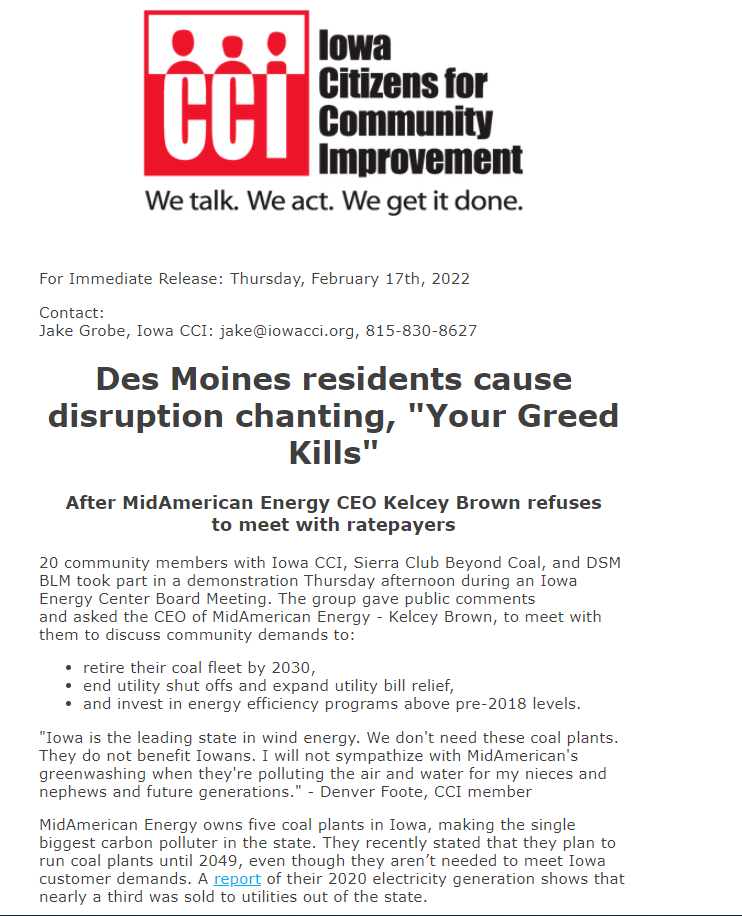
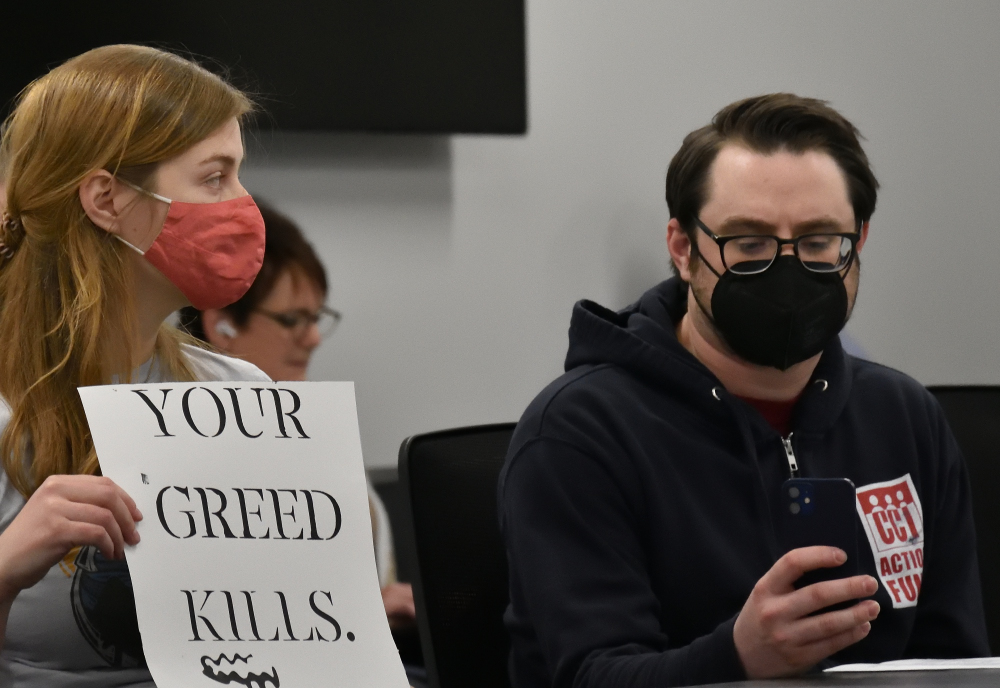
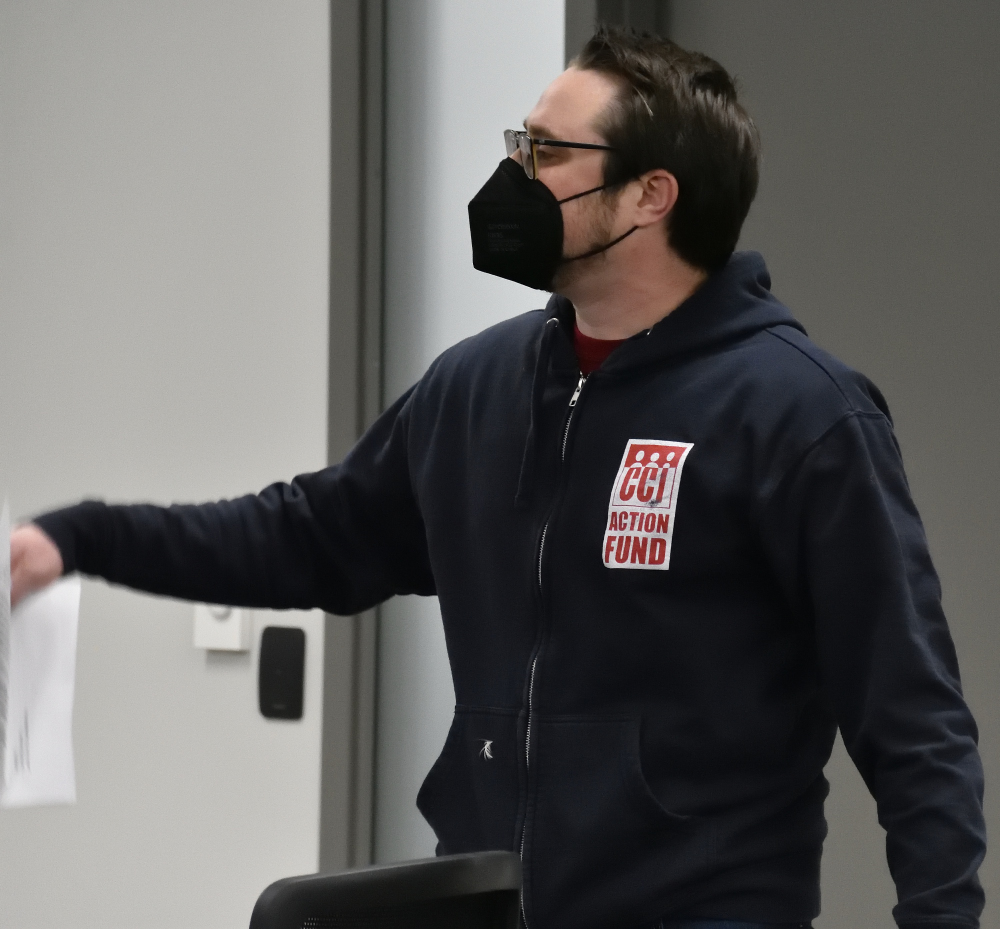
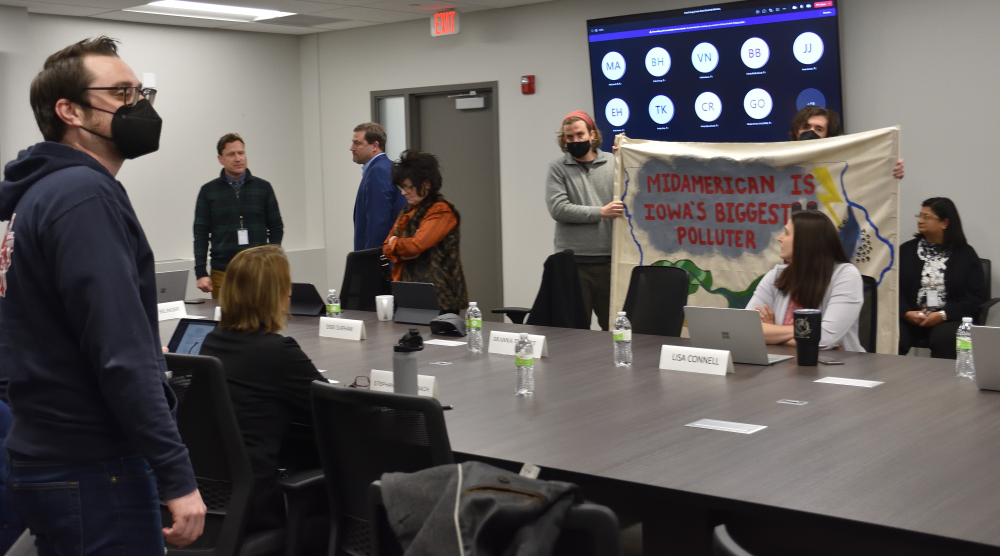
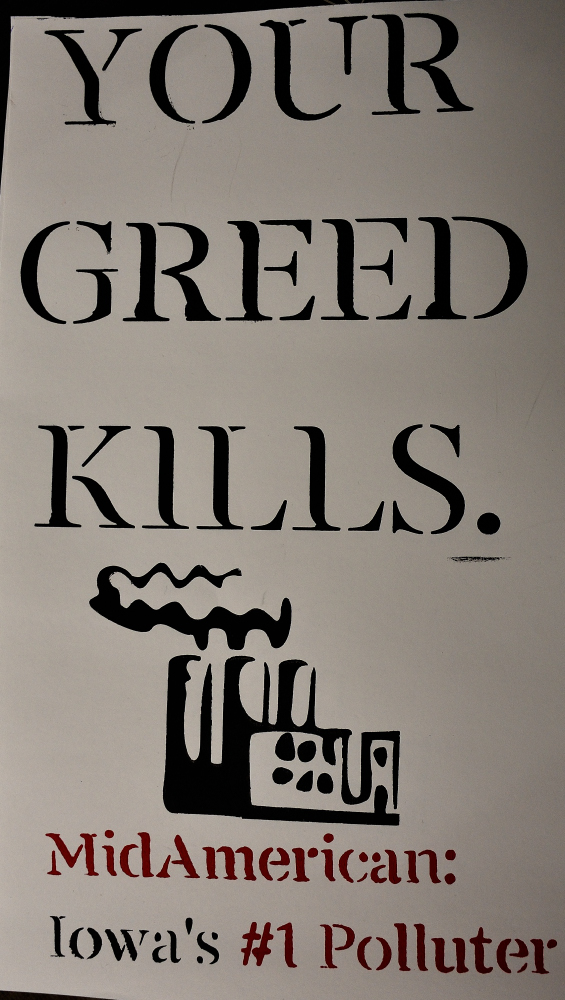
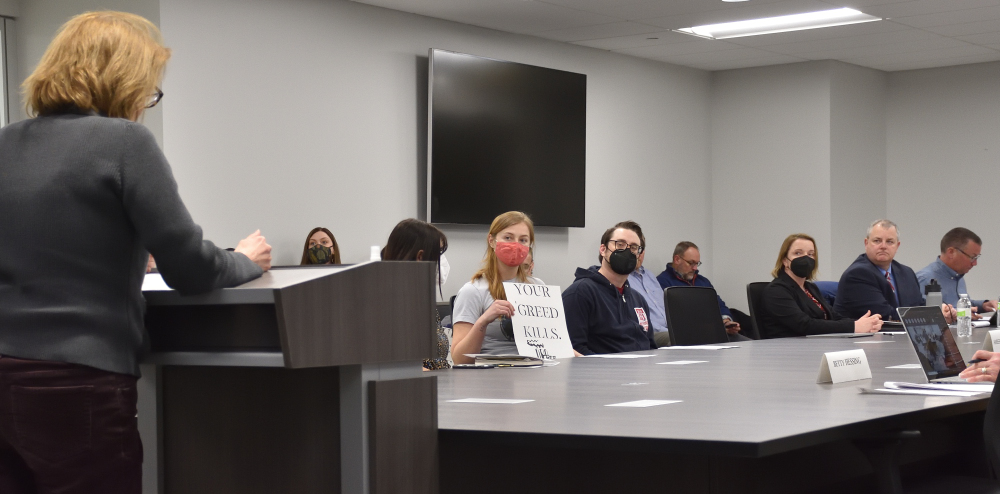
In February Jake organized people to attend a meeting at the Iowa Energy Center. The reason for going to the meeting was MidAmerican’s CEO Kelcey Brown had refused multiple requests to meet with ICCI and she was going to be at this meeting. I was there to take photos and wrote a blog post about the meeting. https://quakersandreligioussocialism.com/2022/02/18/stopburningcoal
The fossil fuel industry has found new life as the energy consequences of the war in Ukraine are being used not as an opportunity to wean off oil production, but the opposite; to ramp up fossil fuel development.
The Biden administration is releasing a million barrels of oil a day from the Strategic Petroleum Reserve. And pressuring oil companies to activate their oil leases. To ramp up natural gas exports. Other countries are releasing their oil reserves.
PARIS (AP) — The International Energy Agency said Thursday that its member countries are releasing 60 million barrels of oil from their emergency reserves on top of previous U.S. pledges to take aim at energy prices that have soared since Russia invaded Ukraine.
The releases show “the determination of member countries to protect the global economy from the social and economic impacts of an oil shock following Russia’s aggression against Ukraine,” IEA Executive Director Fatih Birol said. “Events in Ukraine are becoming more distressing by the day, and action by the IEA at this time is needed to relieve some of the strains in energy markets.”
Energy markets have been squeezed by surging demand as the global economy rebounded from the COVID-19 pandemic, outpacing supply and driving up prices. High energy prices have fueled inflation worldwide, and the war in Ukraine exacerbated the problem amid uncertainties about oil and natural gas supplies from Russia and Western sanctions on Moscow.
IEA member countries hold 1.5 billion barrels in public reserves.
As horrific as the atrocities of the war are, the real consequence is acceleration and escalation of the consequences and chaos of increasing greenhouse gas emissions.
“Investing in new fossil fuel infrastructure is moral and economic madness,” UN Secretary-General António Guterres said as the Intergovernmental Panel on Climate Change (IPCC) released part of its latest report on Monday. This scientific summary, focused on how the world can cut greenhouse gas emissions, warns of the extraordinary harm to all of humanity caused by fossil fuels and the need for a rapid energy transition away from oil, gas, and coal, calling for meaningful changes over the next three years. “Such investments will soon be stranded assets, a blot on the landscape, and a blight on investment portfolios.”
That same day, oil giant ExxonMobil made an announcement of its own: a $10 billion final investment decision for an oil and gas development project in the South American nation of Guyana that the company said would allow it to add a quarter of a million barrels of oil a day to its production in 2025.
As a result of that one-two punch, new fossil fuel projects may find themselves fighting against the tides, facing not just cheaper competition but also the drive to slash demand for their products to combat climate change. “Without carbon capture, coal and gas plants would need to retire about 23 years earlier than expected in order to hold global temperature rise to 1.5 degrees Celsius
ExxonMobil Announces $10 Billion Oil Investment the Same Day IPCC Signals End for Fossil Fuels. The oil giant’s massive plan to drill in Guyana’s waters comes as the UN Secretary General warns of fossil fuels as a “blight on investment portfolios.” By Sharon Kelly, DeSmog, Apr 5, 2022
As the article says, one bright spot is that the expense and failure of carbon capture means the oil industry cannot legitimately use that technology as a part of their plans to show how they will meet targets to curb their greenhouse gas emissions. That doesn’t mean they won’t try.
The following article is wrong. It states the “giant warning” is that it will take time to ramp up oil production. The real warning is the increase in greenhouse gas emissions that will result.
U.S. crude oil prices jumped more than $10 overnight to $130 a barrel on news that the U.S. was considering prohibiting Russian oil imports, though prices backed off later during Monday trading. That rally has driven retail gasoline prices up more than 46 cents in the past week, reaching a national average of $4.06 a gallon, according to fuel price service GasBuddy.
Exxon has said it expected to increase its production from the Permian by 100,000 barrels per day this year, on top of a sharp ramp up last year to 460,000 barrels per day. “We’re well on our way to that,” CEO Darren Woods told an industry conference in Houston on Monday. Chevron has also said it would increase its production there by 60,000 barrels per day this year.
U.S. oil industry prepares to boost production — but with a giant warning. A jump in gasoline prices above $4 has oil companies eyeing crude oil output hikes, but pain at the pump will linger as shaky oil markets shun Russian cargoes. by Ben Lefebvre, Politico, March 7/2022
While the PA Governor and Attorney General continue to delay halting construction and cleaning up toxic spill in Marsh Creek, local residents take matters into their own hands with direct action and win in court today. “We had no choice but to resort to peaceful protest on an active construction site to raise awareness of the dangers that have not been addressed by the responsible government agencies.”
The proceedings were watched with cheering support from families across Pennsylvania. Attorney Read used the argument § 503. Justification generally (a) General rule. Conduct which the actor believes to be necessary to avoid a harm or evil to himself or to another is justifiable if: (1) the harm or evil sought to be avoided by such conduct is greater than that sought to be prevented by the law defining the offense charged.
How can the government do everything it can to increase oil production and exports, when our extinction is assured if greenhouse gas emissions are not radically decreased immediately?
How could the atrocities and utter destruction have happened? In Ukraine, Syria, Afghanistan, Iraq, United States?
Wouldn’t nonviolent responses against the invasion of Ukraine have been better, even if that meant Russian occupation for a time?
How can sanctions be a good thing when they result in the impoverishment of millions of people?
Why is it possible for everyone to buy and carry a gun?
Why do culture wars prevent teachers from teaching?
How did we allow healthcare workers to be overwhelmed by COVID cases?
How is it possible for so many prescription drugs to be too expensive?
Why have we allowed the militarization of police?
Why do millions of men, women and children live in poverty? So many without shelter? So many hungry?
Racism?
How can the military budget greatly exceed all other government programs combined?
How can the government control women’s choices? So many choices of all of us?
These questions stem from the difficulty of making sense of what’s going on today. Which reminds me of the concepts of wicked problems and sensemaking that James Allen writes about. I try to refrain from using so many quotes, but the entire article is well worth reading.
One thing he writes about makes more sense to me now from my experiences with Mutual Aid. What he writes here is a good description of Mutual Aid.
Something important happens when we gather in pursuit of a common goal. First we form rituals that help us relate to and negotiate each other, everything from a civic tradition that allows anyone with a voice to be respectfully heard, to sharing food and music in the local town hall every Friday night, to a labour system that fairly distributes the burden of work. Then, those rituals that stand the test of time become embedded in daily life. The ritual activities themselves and the good they produce help a community identity take root. As identity strengthens, so too does our sense of connectedness — our sense of affection, responsibility and obligation — to one another. When this happens, we then share a greater capacity for coherence and cooperation. And where we share greater capacity for coherence and cooperation there is also greater resilience: the ability to mobilise skills and resources to support the emergence of collective intelligence in response to crisis, enable rapid adaptation and ensure the continuity of the most important functions and structures of the community. This coherent togetherness and the collective intelligence that emerges out of it is the source of human strength and ingenuity. Within it lies our ability to transition from one evolutionary niche to another, even against the odds.
…there remains the most existential risk of them all: our diminishing capacity for collective sensemaking. Sensemaking is the ability to generate an understanding of world around us so that we may decide how to respond effectively to it. When this breaks down within the individual, it creates an ineffective human at best and a dangerous one at worst. At the collective level, a loss of sensemaking erodes shared cultural and value structures and renders us incapable of generating the collective wisdom necessary to solve complex societal problems like those described above. When that happens the centre cannot hold.
The jumping-off point for this essay is a regrettable acceptance that a forthcoming energy descent combined with multiple ecological crises will force massive societal transformation this century. It’s hardly a leap to suggest that, with less abundant cheap energy and the collapse of the complex political and economic infrastructure that supports our present way of life, this transformation is likely to include the contraction and relocalisation of some (if not most) aspects our daily lives.
The problems before us are emergent phenomena with a life of their own, and the causes requiring treatment are obscure. They are what systems scientists call wicked problems: problems that harbour so many complex non-linear interdependencies that they not only seem impossible to understand and solve, but tend to resist our attempts to do so. For such wicked problems, our conventional toolkits — advocacy, activism, conscientious consumerism, and ballot casting — are grossly inadequate and their primary utility may be the self-soothing effect it has on the well-meaning souls who use them.
If we are to find a new kind of good life amid the catastrophes these myths have spawned, then we need to radically rethink the stories we tell ourselves. We need to dig deep into old stories and reveal their wisdom, as well as lovingly nurture the emergence of new stories into being.
The increasingly dire environmental chaos is seen in many ways. Most recently in multiple days of tornado outbreaks in this country. In the increasingly dire warnings in the recently released Intergovernmental Panel on Climate Change report.
And yet the Biden administration is releasing a million barrels of oil a day from the Strategic Petroleum Reserve. And pressuring oil companies to activate their oil leases. To ramp up natural gas exports.
These are just a few of the many actions that always place economics above our environment.
Banks that fund fossil fuel operations are just as guilty as the fossil fuel companies themselves: that was the message delivered to TD Bank and Bank of America at their branch locations in downtown Northampton, MA, on Saturday morning. Protesters demanded that the two banks “stop the money pipeline” by ending all loans and investments in the fossil fuel business and diverting those resources to the renewable energy sector.
Stop the Money Pipeline is an international campaign of over 175 organizations fighting to stop financial institutions from funding dirty energy. The campaign is committed to the rapid decarbonization of our economy and to principles of equity and justice. Its central demand is straightforward:
We demand that banks, asset managers, insurance companies, and institutional investors stop funding, insuring and investing in climate destruction. They need to stop funding fossil fuels and deforestation and start respecting human rights and Indigenous sovereignty.
It’s depressing to think about all the times we’ve tried to get financial institutions to change. Without success as shown by the graph above.
Perhaps if only to show future generations that we tried, following is a history of some of our efforts to stop funding fossil fuel projects.
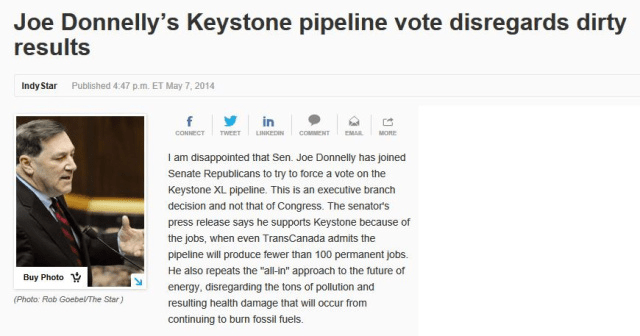
I first became involved in fossil fuel resistance when I was trained by the Rainforest Action Network as an Action Lead in the Keystone Pledge of Resistance in 2013. We didn’t focus on banks, instead planning acts of civil disobedience at Federal government buildings. We did get Senator Donnelly to stop promoting the Keystone XL pipeline as creating jobs after the Indianapolis Star published my letter to the editor.
11/19/2015 In cities across the country, coordinated actions occurred as activists went to Morgan Stanley offices to deliver petitions asking the company to stop funding fossil fuel projects. Several of us spoke to the local Morgan Stanley manager that day. At the shareholders meeting several days later, a decision was made to stop funding coal. But as seen in the graph above, they continue billions of dollars in fossil fuel investments.
In 2016 the focus became the Dakota Access pipeline (DAPL), with the leadership from Standing Rock.
DIVESTMENT One of our efforts in Indianapolis was to encourage people and organizations to divest their accounts in banks that funded DAPL. North Meadow Circle of Friends, where I attended, closed their Chase bank account.
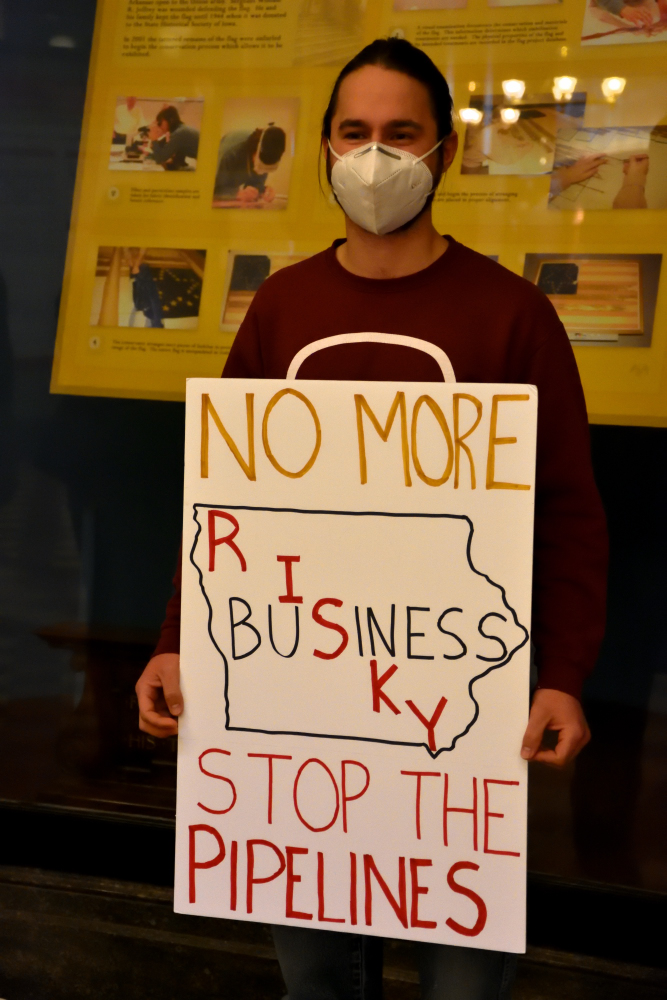
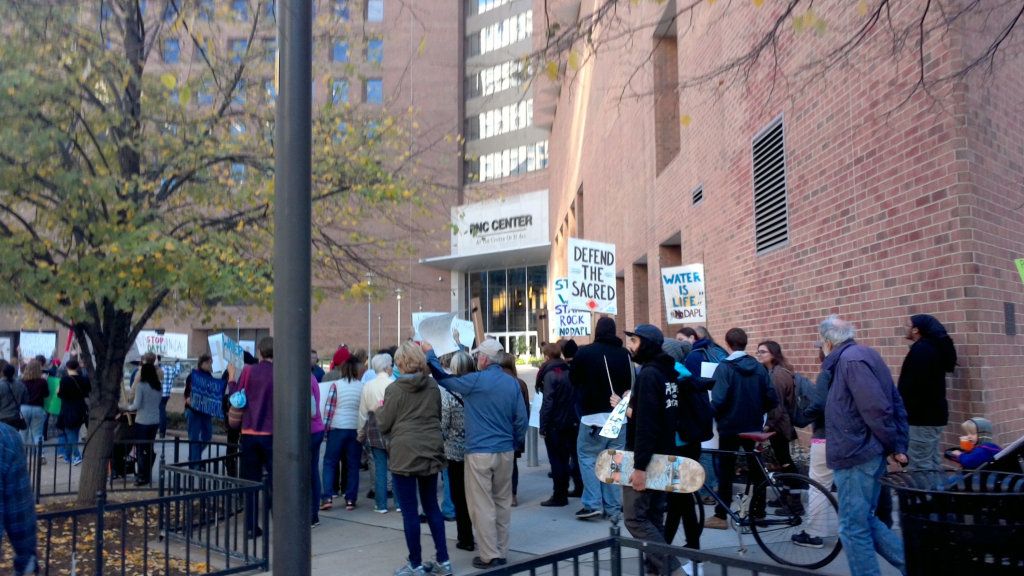
One day (2017) in Indianapolis a group of us marched from the Eiteljorg museum to two of the banks funding DAPL, Chase and PNC. We stood outside each bank in silence, with our signs, as people with accounts went into the bank to close their accounts. $110,000 was withdrawn that day.
US Bancorp is the parent company of US Bank. Since US Bancorp’s headquarters are in Minneapolis, and the Super Bowl (2018) was going to be held in the US Bank stadium there, environmental and social justice groups realized the opportunities to reach large numbers of people during the Super Bowl weekend.
I traveled to Minneapolis the day before the game with a group organized by Ed Fallon of Bold Iowa. We left Des Moines at 7:00 am and arrived at the MN350 (Minnesota branch of 350.org) at 11:30.
In 2020 I began to learn about the struggles of the Wet’suwet’en peoples in British Columbia, as they tried to prevent a liquid natural gas pipeline from being built through their pristine lands and waters. Feb 7, 2020, we held a vigil of support in Des Moines, Iowa.
First Nations peoples have been very active with demonstrations against the banks funding that Costal GasLink pipeline.
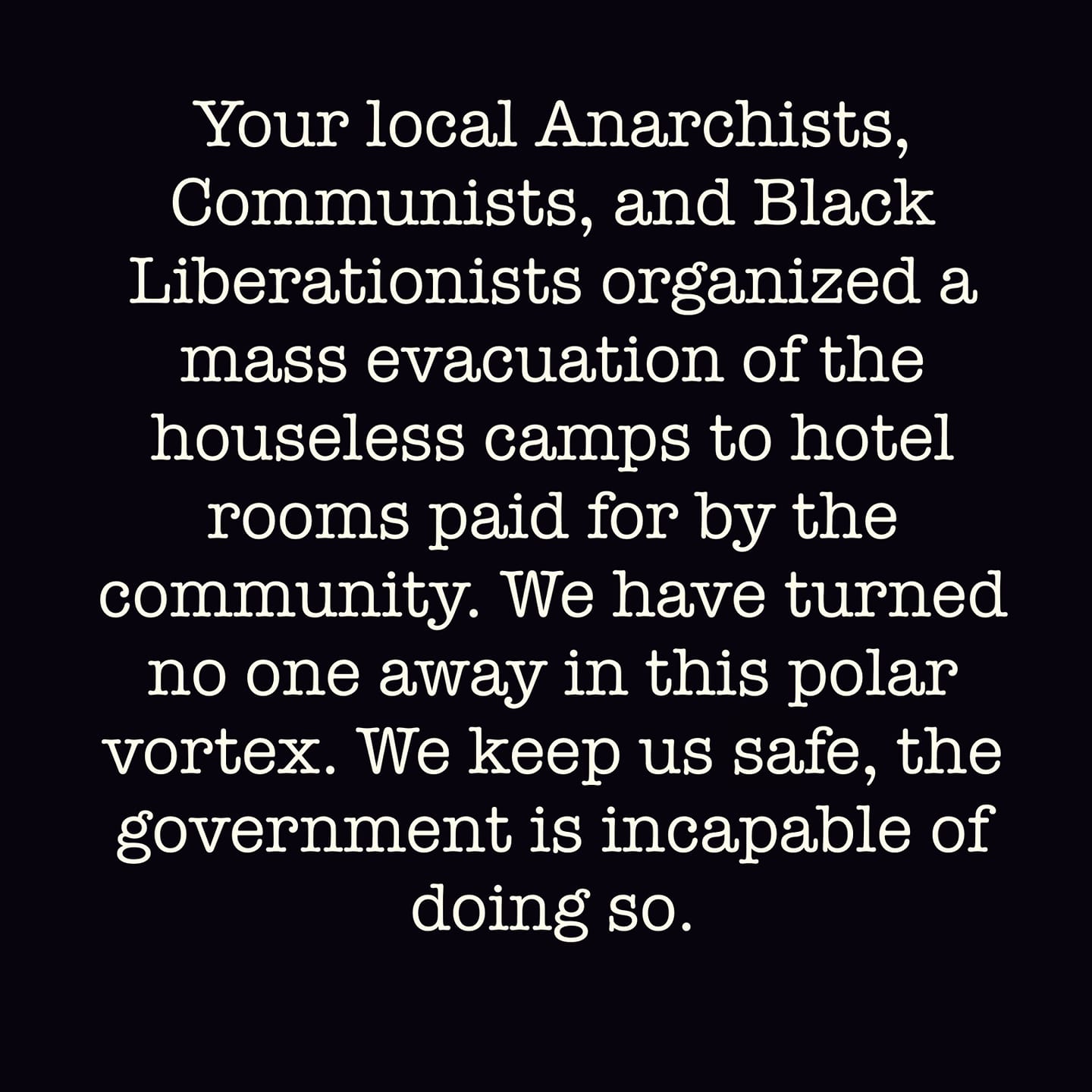
Last December a number of us rallied at a Chase bank in Des Moines, calling for Chase to stop funding fossil fuel projects. Des Moines Black Liberation attended in support of the Wet’suwet’en peoples. Our justice work forms networks.
The latest attempt to decrease carbon dioxide in the atmosphere is the proposed CO2 pipelines. Which are attracting funding but should not be built for many reasons. This is unproven technology, incredibly expensive and ineffective. And with all the problems associated with pipelines.
Sikowis Nobiss organized this gathering at Summit Carbon in Ames, Iowa, in February.
And most recently, my friend Jake Grobe at Iowa CCI organized an event in February at an Iowa Energy Center Board Meeting, where we said MidAmerican Energy’s coal burning power plants must be shut down.
This is the Zoom link for Witness Wednesday Silent Reflection: fcnl.org/ww-stream
What to expect at Silent Reflection
The space is open for conversation and fellowship beginning at 4 p.m. Central Time. At 4:15 p.m. CT, a designated convener will gather the group. Often the convener will share a quote or question to help the group focus. The group will settle into silence. Anyone is welcome to share a message or reflection. We ask that you leave space between messages and only share once. A few minutes before 5:00 p.m. CT, the convener will close the gathering and invite participants to introduce themselves and share closing thoughts.
To join, visitfcnl.org/ww-streamorregister hereto receive the information to join by phone. You shouldn’t need this, but just in case:
Meeting ID: 854 485 249
Passcode: SR2021
This Wednesday, April 6, I will be sharing this story from my good friend Ronnie James. Ronnie is an Indigenous organizer with twenty years of experience. I’ve been blessed to be involved in the Des Moines Mutual Aid food giveaway program he talks about in this story. Other Mutual Aid projects include court solidarity and bail fund, and food and propane support for houseless communities in Des Moines.
So I work with a dope crew called Des Moines Mutual Aid, and on Saturday mornings we do a food giveaway program that was started by the Panthers as their free breakfast program and has carried on to this day. Anyways, brag, brag, blah, blah.
So I get to work and I need to call my boss. He remembers and asks about the food giveaway which is cool and I tell him blah blah it went really well. And then he’s like, “hey, if no one tells you, I’m very proud of what you do for the community” and I’m like “hold on hold on. Just realize that everything I do is to further the replacing of the state and destroying western civilization and any remnants of it for future generations.” He says “I know and love that. Carry on.”
–Ronnie James
A fundamental part of Mutual Aid is the entire community is involved. We avoid “us” versus “them”. This leaflet is included in the boxes of food we distribute. I know of people who once came for food who are now helping with the distribution of the food.
This photo is from the recent Des Moines Mutual Aid zine that contains excellent articles. DOWNLOAD HERE
I don’t know what Pope Francis’ apology for the Roman Catholic Church’s role in the institutions of forced assimilation in Canada might mean to Indigenous peoples. This is something First Nations Peoples in Canada have been asking for many years. Acknowledging the harm done is part of the process of healing and reconciliation. The vast scope of the damage and the length of time it was done should have begun to be addressed years ago.
I must note that Quakers were among those who established and operated such institutions in the United States. The damage done by Quakers and other religious organizations should also have begun to be addressed years ago. This has long been and continues to be a deep concern of mine. [see: residential schools]
Vatican City. Pope Francis apologized on Friday for the Roman Catholic Church’s involvement in a system of Canadian boarding schools that abused Indigenous children for 100 years, and said he would travel to Canada as part of a process of healing and reconciliation.
His apology comes after Canada was jolted last year by the discovery of signs that more than 1,000 people, most of them children, may have been buried in unmarked graves on the grounds of the former schools.
“I feel shame — sorrow and shame — for the role” that Catholics played “in the abuses you suffered and in the lack of respect shown for your identity, your culture and even your spiritual values,” Francis said.
“I ask for God’s forgiveness and I want to say to you with all my heart: I am very sorry,” Francis said, adding that he joined with Canadian bishops “in asking your pardon.”
CALGARY, Alberta — For decades, the Indigenous children were taken from their families, sometimes by force, and housed in crowded, church-run boarding schools, where they were abused and prohibited from speaking their languages. Thousands vanished altogether.
Now, a new discovery offers chilling evidence that many of the missing children may have died at these schools: The remains of as many as 751 people, mainly Indigenous children, were found at the site of a former school in the province of Saskatchewan, an Indigenous group said on Thursday.
The burial site, the largest one to date, was uncovered only weeks after the remains of 215 children were found in unmarked graves on the grounds of another former church-run school for Indigenous students in British Columbia.
The discoveries have jolted a nation grappling with generations of widespread and systematic abuse of Indigenous people, many of whom are survivors of the boarding schools. For decades, they suggested through their oral histories that thousands of children disappeared from the schools, but they were often met with skepticism. The revelations of two unmarked grave sites are another searing reminder of this traumatic period in history.
Hundreds More Unmarked Graves Found at Former Residential School in Canada. An Indigenous group said the remains of as many as 751 people, mainly children, had been found in unmarked graves on the site of a former boarding school in Saskatchewan. Ian Auten and Dan Bilefsky, The New York Times, July 30, 2021
The Indigenous delegation also raised the issue of the Doctrine of Discovery.
The delegates also asked Francis to revoke a 1493 papal bull issued by Pope Alexander VI that had given Spain authority over the newly discovered lands of the Americas, allowing the Spanish to colonize and enslave the Indigenous peoples and convert them to Catholicism. The papal bull, which informed the “doctrine of discovery,” was “used for centuries to expropriate Indigenous lands and facilitate their transfer to colonizing or dominating nations,” according to the United Nations.
Indigenous groups in Canada say that while the theories of racial superiority that underlie the doctrine have long been discredited, it continued to surface in legal disputes over land until 2014. The Supreme Court of Canada ruled that year, without naming the papal bull, that the idea that no one owned land until it was claimed by Europeans “never applied in Canada.”
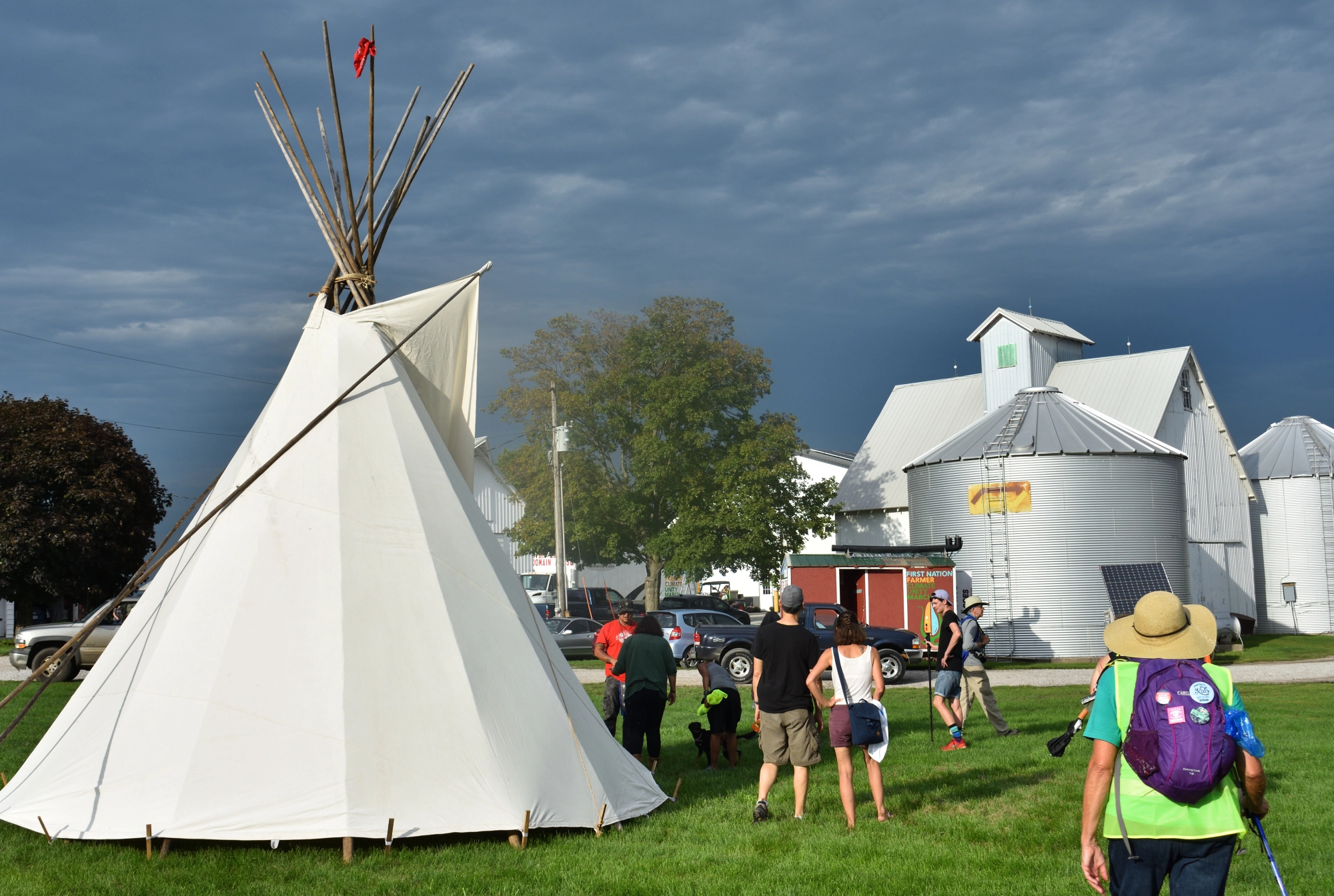
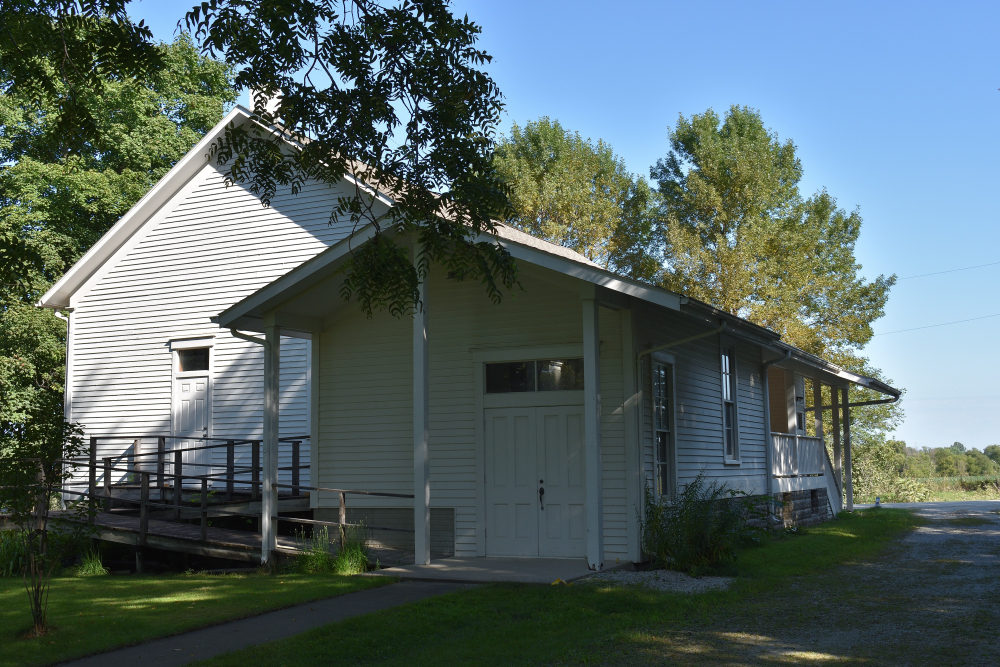
I wasn’t sure what image might be appropriate for such a horrific subject. I took this photo at the destination of the first day of the First Nation-Farmer Climate Unity March. A small group of native and nonnative people walked and camped together along the path of the Dakota Access pipeline through central Iowa. Our sacred journey required eight days and nights to walk ninety-four miles, Sept 1-8, 2018. The intent of beginning a community who began to know and trust each other was achieved. Since, many of us have worked together in many ways, which have strengthened our bonds. [see: https://firstnationfarmer.com/]





























 Quakers and Mutual Aid