Mother Earth Takes Another Hit

The approval for the construction of the Mountain Valley Pipeline (MVP) remained in the debt ceiling legislative just passed by the US Congress. This is an egregious act on many levels.

The Mountain Valley Pipeline (MVP) is a project proposed in 2014 that would transport fracked gas from West Virginia to southern Virginia through a 300-mile pipeline. The project has sparked widespread opposition for years from environmentalists, civil rights activists, and local residents who are concerned about its impacts on water quality, wildlife, climate change, and Indigenous and property rights.

The MVP was approved by Congress as part of the debt ceiling deal that was just passed. The deal included a provision that declared the MVP as “required in the national interest” and ordered the federal agencies to issue the necessary permits within 21 days and shield the project from legal challenges. The provision also weakened the National Environmental Policy Act (NEPA), a law that requires environmental reviews for major federal actions that affect the environment.

Many of us have criticized the deal that undermines:

  • the rule of law
  • public participation
  • Indigenous approval
  • and environmental justice

The MVP contradicts President Biden’s pledge to combat the climate crisis and transition to clean energy..

I recently wrote “What should be non-negotiable” to try to explain, yet again, why we can not allow continued construction of fossil fuel infrastructure, from pipelines to carbon capture to gas stations.

I know what it’s like to work year after year, fighting to protect Mother Earth from fossil fuels. I was going to say that for me this began in 2013 when I was trained as an Action Lead in the Keystone Pledge of Resistance. But it began much earlier when I was led to live without a car when I moved to Indianapolis in 1970. My love for nature actually began from growing up on farms and camping trips to national parks.

Of course, Indigenous peoples have worked to protect Mother Earth for centuries.

It’s not easy to maintain years-long resistance to a cause. That is one reason why approval of MVP is devastating. It is difficult to find people who are willing to work for justice causes. Difficult to organize and get people to commit to various actions. To get people to move outside their comfort zone. To face all kinds of opposition, time and time again. And all too often the cause is defeated. The pipelines and other infrastructure continue to be built. Mother Earth takes another hit.

Such is the case with the Mountain Valley Pipeline. Its approval hurts not only those who worked so hard against MVP, but everyone working on any environmental cause. It shows yet again the Federal administration and Congress do not understand the gravity of our evolving environmental devastation.

It also shows, again, that environmental solutions will not come from the dominant political culture in this country. Which is why I am so grateful to have been led to my Mutual Aid community. We work locally, within the community, to address basic needs. Instead of talking and having committee meetings, we come together to help our neighbors with food and shelter.

And we strive to advance Indigenous leadership. Indigenous ways can help clean our waters and move toward living sustainably. Help us heal our relationships with Mother Earth and all our relations.

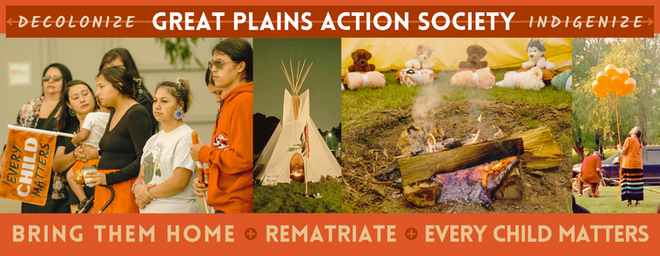
The circle is completed when Indigenous peoples support Mutual Aid, as Des Moines Mutual Aid is supported by the Great Plains Action Society (GPAS). Mutual Aid is one of the methods in the GPAS’s mechanism of engagement.


This River has Rights

Walk for River Rights

Event by Native American Coalition of the Quad CitiesRiver Action Quad Cities and 8 others

May 13, 2023 AT 11:30 AM – 12:30 PM

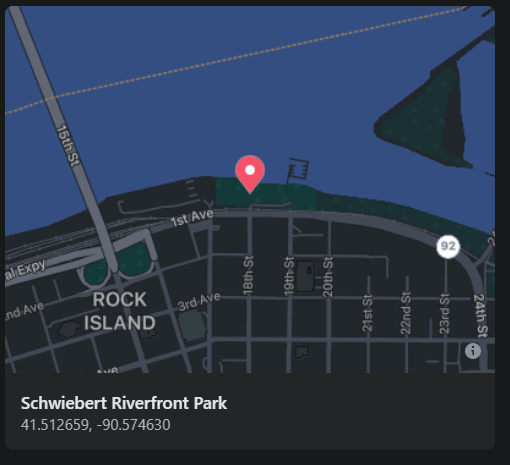
Schwiebert Riverfront Park

On Saturday, May 13th, the Walk for River Rights begins at Schwiebert Park (101 17th St, Rock Island, IL 61201) at 11:30AM and closes at 12:30PM at the Figge Entrance Plaza (225 W 2nd St, Davenport, IA 52801). There is a map of the walk on the discussion page.

***There will be a bus that can drive folks back to their cars after we are done the walk.***

Join leading BIPOC organizers who have converged in the Quad Cities to begin working towards reclaiming Rights of Nature for the Mississippi River. We will walk across the Centennial Bridge in solidarity as one River community advocating for the Rights of the Mississippi River, from the headwaters to the Gulf, and for the rights of all communities whose lives are supported by the waters. All are welcomed and encouraged to attend! A brief introduction and explanation of our convergence will begin at 11:30AM at Schwiebert Park.

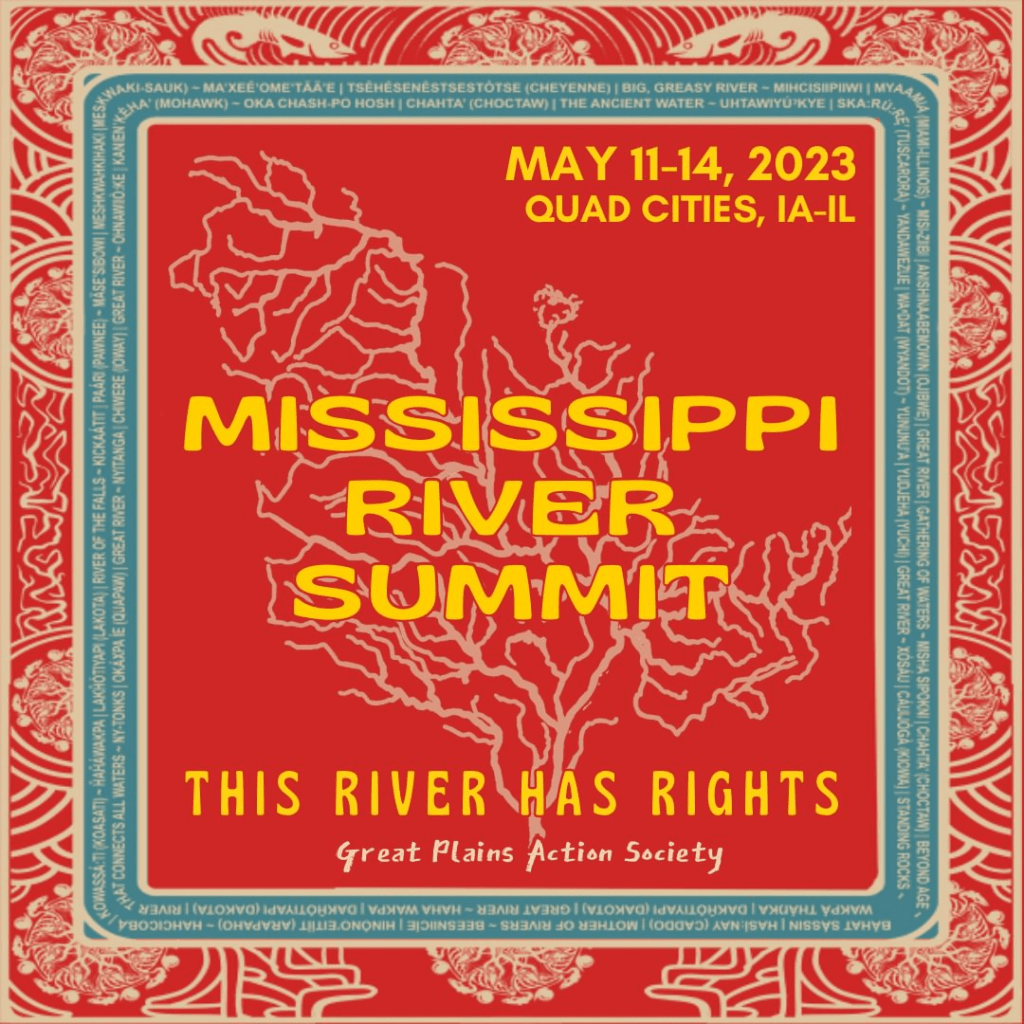
The Walk for River Rights is part of The Mississippi River Summit (May 11th-14th, 2023, Quad Cities, IA-IL), a summit centering and advancing the leadership of 40 organizers of historically racially marginalized communities working to protect water, natural places, and sacred spaces. The goal is to build a BIPOC-led coalition from the Mississippi Headwaters to the Gulf of Mexico, and eventually claim the rights of nature for the entire river system and develop an organized frontline group working to protect the Mississippi watershed and all living beings that rely on it as their home.

Organized by Great Plains Action Society. For questions contact@greatplainsaction.org

*We have modified the route to accommodate for the effects of flooding on downtown Davenport and will now end at the Figge plaza 


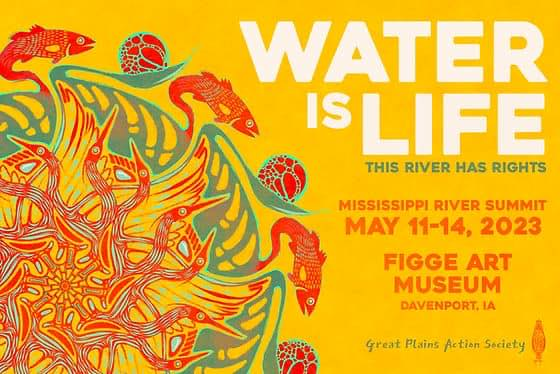
May 11-14, 2023 (Davenport, IA) The Mississippi River Summit is a BIPOC led event where folks from the headwaters to the Gulf of Mexico are converging to talk about the health of the river basin and all that rely on it and to work towards rights of nature for our river relative.

Why are we meeting in Iowa? The state of Iowa has the unique designation of being bordered by the Nation’s two largest rivers, the Mississippi and Missouri. However, water does not adhere to colonial borders and unfortunately, Iowa is the number one contributor to the ‘Dead Zone’ in the Gulf of Mexico. Iowa is also the most biologically colonized state in the country because of Big-Ag, CAFOs (concentrated animal feed operations), meatpacking plants, ethanol production, etc.

#RightsofNature
#ThisRiverHasRights
#Mississippi


This beautiful art was made by Moselle Singh. Learn more about our Mississippi River Summit at https://www.greatplainsaction.org/mississippi-river-summit

See beyond our own time

My Quaker meeting plans to discuss questions to not only stimulate discussion, but to begin to form a plan to meet our survival needs. We need to establish a baseline to know what Friends think about our present condition and what to do about it.

Survival needs are ranked as:

  • Oxygen/air
  • Water
  • Food
  • Shelter
  • Physical, mental, and spiritual health

So, the questions are:

  • What will we do to prepare for when clean water is no longer available? (Coming through water lines or even available to buy).
  • What will we do when food is no longer available from grocery stores?
  • What will we do for shelter? Survival will require us to live near water and food supplies. And each other.
  • How do we govern our communities? Who is included in our communities?
  • What to do about energy?
  • What to do about safety?
  • What medications and diagnostic equipment (blood pressure, thermometer, etc) should we stockpile?
  • What are our children thinking? Can we find ways to engage those who aren’t now involved?
  • How can we gather and store things like books for when digital technologies are no longer available?
  • Who already has such plans that might help us?