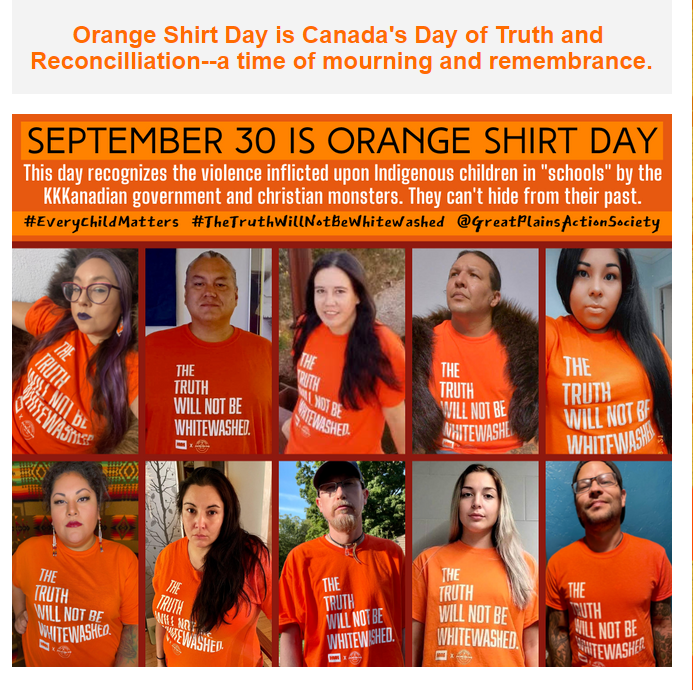
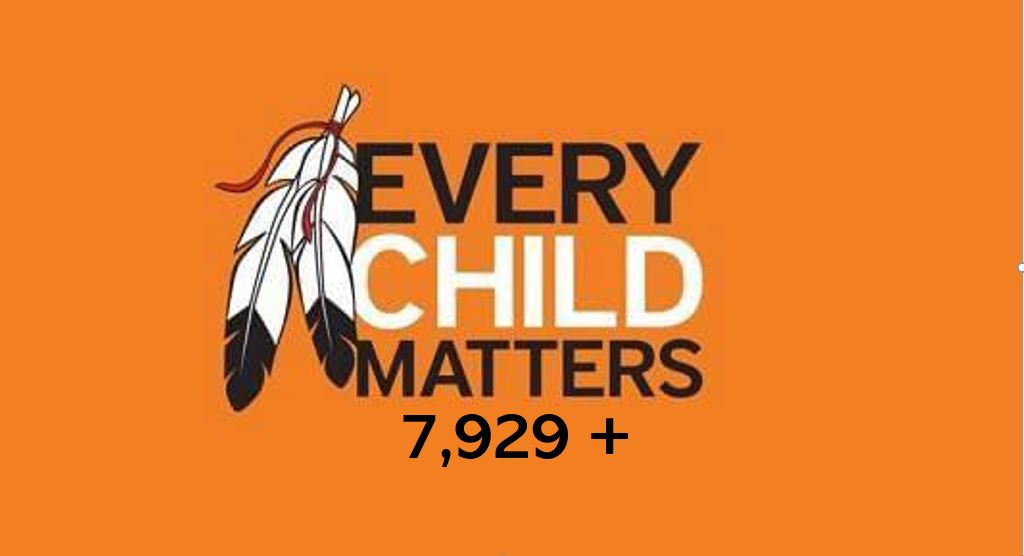
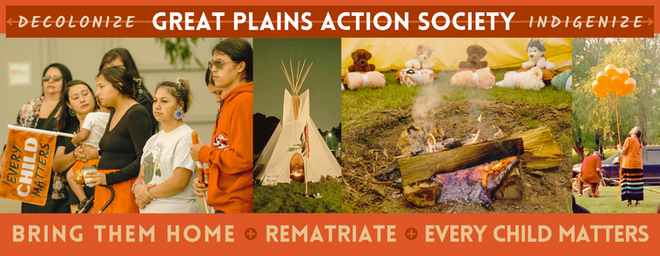
In the story below, the Great Plains Action Society (GPAS) tells what Orange Shirt Day is about. Many of my friends are in this photo. I’m wearing an orange shirt today.
Tansi Friends,
Today is September 30 – “National Day for Truth and Reconciliation,” a statutory Canadian holiday, better known as “Orange Shirt Day.” This holiday was intended to educate people and promote awareness in Canada about the Indian residential school system and the impact it has had on Indigenous communities for over a century. The use of the orange shirt is attributed to Phyllis Jack Webstad. She was sentenced to St. Joseph Mission Residential School when she was six years old. On her first day there her clothes were taken from her, including a new orange shirt given to her by her grandmother. She never saw that shirt again. The story resonated with thousands and became a symbol of the violence that Indigenous children faced in these internment camps called schools.
Recently, thousands of unmarked graves have been uncovered on the grounds of around 10 residential schools in Canada. There were over 490 residential schools (boarding schools in the U.S.) between the United States and Canada. The New York Times reported on this last summer, and while we are thankful for the coverage, it doesn’t nearly represent the pain and suffering this is causing in our community. Also, trying to quantify the number of graves that have been found is not ever going to tell the truth. The truth is that many children’s bodies will never be found as they were hidden or cremated. There were also many children that tried to run home but died of starvation or exposure. And then there are those that died from suicide and addiction because of the pain they could not overcome.
Great Plains Action Society has felt this pain firsthand, as many of our close family members attended these schools, and we are rising to meet the needs of our communities. Last year, in Sioux City, we hosted a large community feast and ceremony to honor nine children whose bodies were reMatriated back to Sicangu Oyate lands from the grounds of the Carlisle Boarding School. We have also raised funds to help one of our relatives, Curt Young, show his film, They Found Us, about the search for children’s bodies at the George Gordon First Nation. If we can raise enough funding, we would like to get his film shown throughout Iowa and the Midwest.
The Missing and Murdered Indigenous Relatives crisis largely exists because of the reprercussions of boarding schools. We have been working to support families directly impacted by colonial violence (like what was experienced in these schools) with financial support to travel to court, child care, community gatherings, and covering ceremonial/memorial expenses while continuing all of our other work, including mutual aid, political engagement action, and fighting for our earth. We are dedicated to providing whatever our community needs to grow, survive, and thrive.
Please support our work to end the MMIR crisis and help heal those affected by boarding schools (aka, internment camps for children)
Ay hai kitatamihin,
Sikowis (Fierce), aka, Christine Nobiss, she/her Plains Cree/Saulteaux, George Gordon First Nation Executive Director, Great Plains Action Society sikowis@greatplainsaction.org
In the story above, my friend Sikowis Nobiss tells about a relative, Curt Young, and his film “They Found Us.” This link is to a blog post about Iowa Yearly Meeting (Conservative)’s donation to help support the showing of this film. https://quakersandreligioussocialism.com/2023/01/29/they-found-us-2/
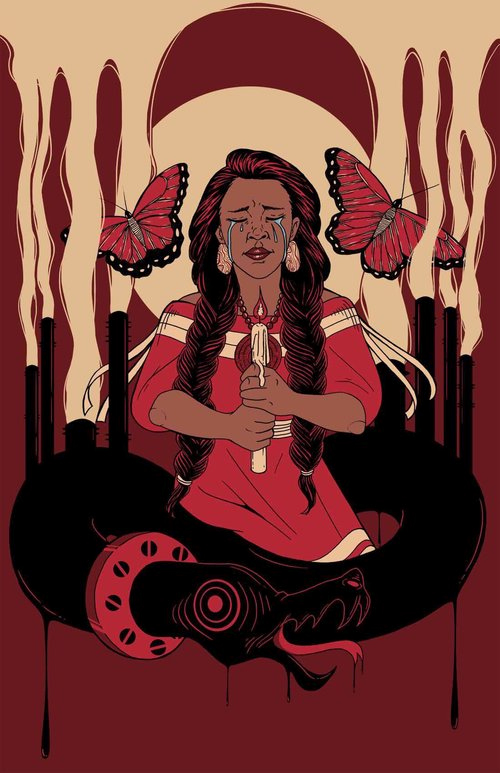
This is a very disturbing 3D graphic related to “They Found Us.” Moving the mouse around the image changes the perspective.
My relative, Curt Sipihko Paskwawimostos, created “They Found Us”. It’s a documentary about the search for unmarked graves at our rez, George Gordon First Nation. I hope we can bring it here to Iowa in the near future. My cousin Janna Pratt is featured in the film.
“I thought it would be important to document these searches and capture some of the stories told by members that were forced to go to these institutions. It’s a first hand look into some of the experiences survived in residential school.”
The film delves into members’ recollections along with the process towards the first ground search of Gordon Residential School before Ground Penetration Radar (GPR) in 2021. This is only the beginning…
I want to say thank you to Jeff Kisling and the Iowa Quaker community for the donation that will help get the film seen. If others would like to help support this work, hit me up.
Sikowis (Christine) Nobiss
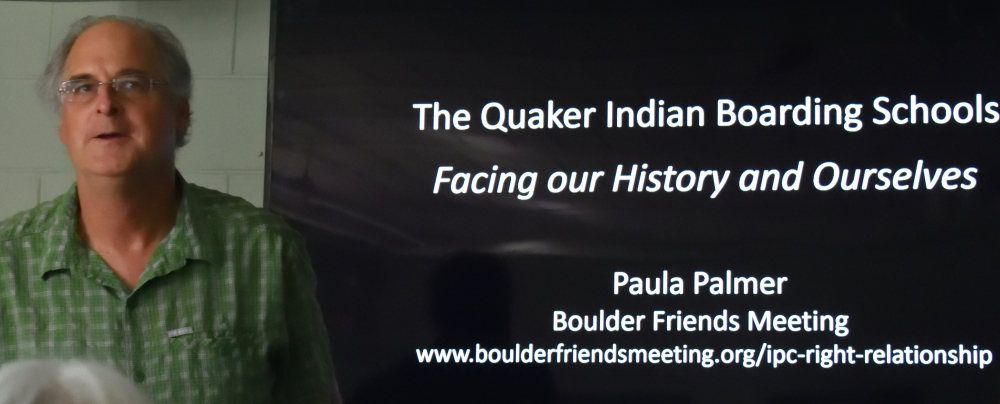
Paula Palmer wrote an article in Friends Journal that extensively discusses her ministry related to what are called Indian Boarding Schools.
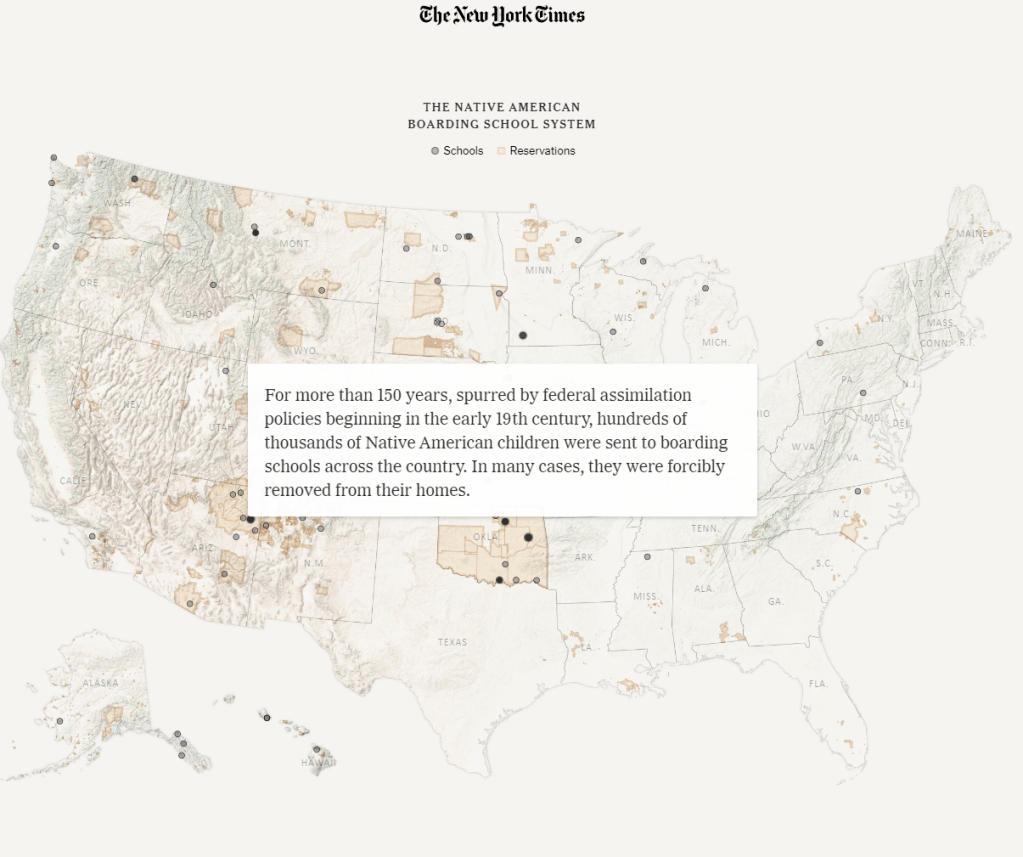
The Native American boarding school system — a decades-long effort to assimilate Indigenous people before they ever reached adulthood — robbed children of their culture, family bonds and sometimes their lives.
Beyond the vast federal system, this new list also sheds light on boarding schools that operated without federal support. Religious organizations ran at least 105 schools; many were Catholic, Presbyterian or Episcopalian, but smaller congregations such as the Quakers ran schools of their own.
As I’ve been praying about why the Quaker meetings I’m familiar with are slowly dying from attrition and not attracting new attenders, I’m struggling to understand why this is happening. I feel a special urgency, wondering if my Quaker meeting can continue when we lose even one more member. Lose another elderly member, or one who turns away from Quakerism.
I was led to think about our Advices and Queries because they guide the spiritual discussions in our meetings. And they are one concrete thing we can point to for people interested in learning about Quakerism.
It surprised me to be led to the conclusion that our Queries seem rooted in maintaining the status quo of this country’s current economic and political systems. Systems of dominance, systemic racism, and White supremacy. And an implicit view of ‘us versus them.’ (See: Advices and Queries). Today, I hope to explain that more fully and offer suggestions for what we might do differently.
I’m focusing on the abolition of police and prisons, both because this is something I’ve been learning and writing about (https://quakersandreligioussocialism.com/abolition/) and because it is a deep concern of some activist Quakers I know and of my Mutual Aid community. One of my abolitionist Friends is leaving Quakers because of the lack of attention to this concern. This is an example of the attrition I’m concerned about.
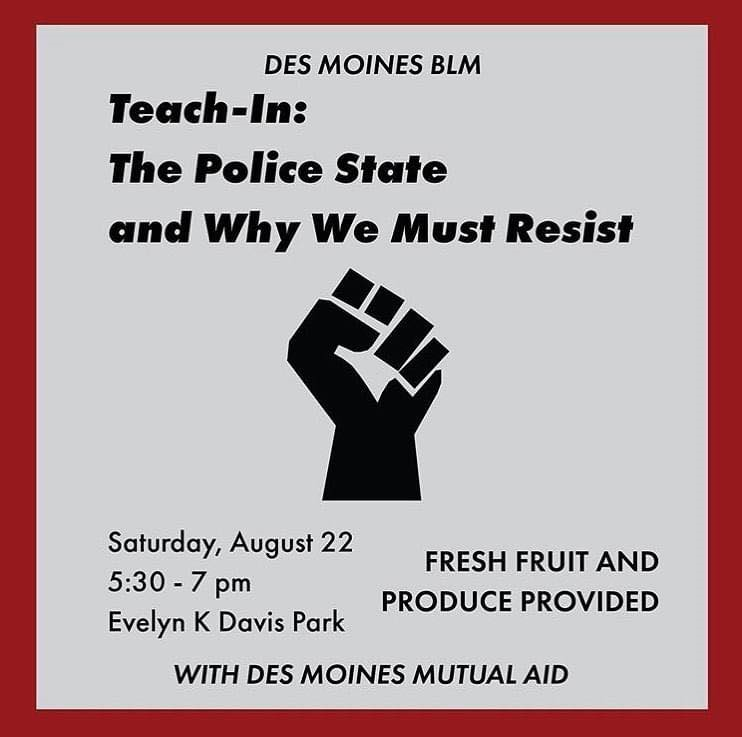
We are police and prison abolitionists. Abolition and the mutual aid that we practice are inextricably linked. We don’t rely on capitalist institutions or the police to do our work. We believe in building strong and resilient communities which make police obsolete, including community systems of accountability and crisis intervention.Des Moines Mutual Aid
What does it mean that abolition is not one of our Query topics?
Meeting for Worship
Outreach
Meeting for Business
Harmony within the Meeting
Mutual Care
Education
Home and Family
Personal Responsibility
Civic Responsibility
Environmental Responsibility
Social and Economic Justice
Peace and Nonviolence
I think that is because abolition touches several of these topics and illustrates why I think we need new queries.
Quakers are pretty white, and that comes with quite a bit of power and privilege. A Quaker in Omaha, Nebraska is going to have probably more weight in what they say to a legislator than a Black Lives Matter activist in Brooklyn, New York. I think there’s a need for Quakers to step out of their meeting and away from a lot of these phenomenal institutions that they’ve created and speak to individuals in an interfaith setting (from Black churches or Black Lives Matter) and have a cross-cultural understanding of what that experience is like because you’ll find that it’s very different, and I think the more we can do of that the more effective we’ll be in addressing these problems. These exchanges and fusion coalitions are what I think it’s going to take, not only for Friends to be effective in dismantling these systems of racism, classism, and white supremacy in American society, but also for all of us to better address these problems in our country.
Perhaps the revolutionary Quaker faith we imagine ourselves to inhabit has never really existed, and if we tell the whole truth and commit to the healing the truth-telling calls us to, perhaps together we can embody and create the prophetic religion we thirst for.
Abolitionist thinking is holistic—that ending the system of punishment and incarcerating control itself is necessary—and invites us to imagine a whole new way of not only dealing with harm but of how we think of ourselves in community. It provokes questions like, what does true justice look like? What does it mean to center healing and transforming relationships and create community safety from authentic accountability and relational reconnection? Abolition does not minimize the reality of harm or violence but rather invites us to consider a way of doing things that interrupts cycles of harm, violence, and trauma, and restores perpetrators and victims into community and their humanity.
We as White Quakers like to think of ourselves as ahead or better than dominant culture, but we have been complicit in a system and mindset that are ubiquitous. Claiming the full truth of our history and committing to repair the harms done are deeply spiritual acts of healing our own wounds of disconnection. I would argue it is the pathway upon which we can, perhaps for the first time, discover and invigorate our faith with its full promise.
Jed Walsh and Mackenzie Barton-Rowledge are close friends who do police and prison abolition work together. They sent Western Friend a conversation about what abolition means to them, and how it fits into their lives as Quakers.
The way I think about abolition is first, rejecting the idea that anyone belongs in prison and that police make us safe. The second, and larger, part of abolition is the process of figuring out how to build a society that doesn’t require police or prisons.
Abolish the Police by Mackenzie Barton-Rowledge and Jed Walsh, Western Friend, Nov 2020
Jeff Kisling: Mutual Aid and Abolition
I grew up in rural Iowa, where there was very little racial diversity and interactions with police and the court system were rare. About ten years ago, I was blessed to become involved with the Kheprw Institute, a Black youth mentoring and empowerment community. I’ll never forget how shocked I was when a Black mother broke down in tears, explaining how terrified she was every minute her children were away from home. It was obvious that every other person of color in the discussion knew exactly what she was saying.
After retiring, I was led to connect with Des Moines Mutual Aid, a multiracial organization founded to support houseless people. For over a year, I’ve helped my friends fill and distribute boxes of donated food, while continuing to learn about the framework of mutual aid.
To me, mutual aid is about taking back control of our communities. Besides the food giveaway, we support houseless people and maintain a bail fund to support those arrested agitating for change. We also work for the abolition of police and prisons.
Mackenzie Barton-Rowledge and Jed Walsh: Introducing the Quakers for Abolition Network, Western Friend, Sept 2021
Some queries about police and prison abolition:
What is your understanding of the term “abolition” and what does it entail? How does it differ from the reform or improvement of the existing system?
What are some historical and contemporary examples of abolitionist movements and practices, such as the abolition of slavery, the anti-apartheid struggle, the prison strike movement, the mutual aid networks, and the community defense initiatives?
What are some of the root causes of violence, harm, and crime in our society, and how do they relate to the structures of white supremacy, capitalism, heteronormative patriarchy, and settler colonialism?
How do the police, courts, and prisons perpetuate and exacerbate violence, harm, and crime rather than prevent or reduce them? How do they disproportionately target and oppress Black, Indigenous, and people of color (BIPOC), poor people, LGBTQIA+ people, immigrants, and other marginalized groups?
What are some of the alternatives to policing and incarceration that can address the needs and rights of survivors, perpetrators, and communities more humanely and effectively? How can we build and support these alternatives in our own contexts and networks?
What are some of the challenges and barriers to achieving abolition, internally (such as fear, doubt, or attachment) and externally (such as resistance, backlash, or co-optation)? How can we overcome or transform them through education, organizing, and action?
Police and Prison Abolition 101: A Syllabus and FAQ 4, a resource by Autostraddle that provides a comprehensive list of readings, podcasts, videos, organizations, and actions related to abolition for different levels of engagement and interest.
Rethinking Incarceration 5, a video by Radcliffe Institute for Advanced Study that features a panel discussion with scholars, activists, artists, and formerly incarcerated people who share their perspectives on abolition and its implications for public safety and liberation.
In yesterday’s post, Queries about our future, I made the mistake of concluding by saying “We need to…” That defeats the purpose of queries, intended to help Quakers discern what they are led to do by listening to the Spirit. “We look for our own truths and the truths of our meeting when we discuss the advices and answer the queries.”
Faith and Practice
Becoming aware of how we discern Spirit is important to our worship. The Quaker faith is not written in the form of a creed, but is experienced in our lives as a vibrant, living truth. Advices and queries serve to engage our minds and hearts in a process which may provide openings to the leadings of the Spirit within us. These leadings may speak to our individual and corporate needs. The advices and queries reflect experiences from many lives as they contribute to the gathered wisdom of the group. They serve to guide us on our spiritual journeys by opening our hearts and minds to the possibility of new directions and insights.
Uses of Advices and Queries
We look for our own truths and the truths of our meeting when we discuss the advices and answer the queries.
We refer to our use of queries as Advice and Queries. The ADVICE provides an introduction or the context for considering the subject. There are twelve query topics.
Meeting for Worship
Outreach
Meeting for Business
Harmony within the Meeting
Mutual Care
Education
Home and Family
Personal Responsibility
Civic Responsibility
Environmental Responsibility
Social and Economic Justice
Peace and Nonviolence
Here is an example of an Advice and the Queries related to social and economic justice.
ADVICE
We are part of an economic system characterized by inequality and exploitation. Such a society is defended and perpetuated by entrenched power.
Friends can help relieve social and economic oppression and injustice by first seeking spiritual guidance in our own lives. We envision a system of social and economic justice that ensures the right of every individual to be loved and cared for; to receive a sound education; to find useful employment; to receive appropriate health care; to secure adequate housing; to obtain redress through the legal system; and to live and die in dignity. Friends maintain historic concern for the fair and humane treatment of persons in penal and mental institutions.
Wide disparities in economic and social conditions exist among groups in our society and among nations of the world. While most of us are able to be responsible for our own economic circumstances, we must not overlook the effects of unequal opportunities among people. Friends’ belief in the Divine within everyone leads us to support institutions which meet human needs and to seek to change institutions which fail to meet human needs. We strengthen community when we work with others to help promote justice for all.
QUERIES
How are we beneficiaries of inequity and exploitation? How are we victims of inequity and exploitation? In what ways can we address these problems? What can we do to improve the conditions in our correctional institutions and to address the mental and social problems of those confined there?
How can we improve our understanding of those who are driven to violence by subjection to racial, economic or political injustice?
In what ways do we oppose prejudice and injustice based on gender, sexual orientation, class, race, age, and physical, mental and emotional conditions?How would individuals benefit from a society that values everyone? How would society benefit?
I think my Quaker community is going to be upset by the following. But as I look at these Queries and Advices after years of working in diverse communities, they seem rooted in maintaining the status quo of this country’s current economic and political systems. Systems of dominance, systemic racism, and White supremacy. I see an implicit view of ‘us versus them.’
I became so invested in Mutual Aid because our work is about alternatives to those systems of injustice. Mutual Aid is faith in action. Mutual Aid is about meeting survival needs NOW.
Our Advices and Queries are updated every so often. I’m led to believe now is the time to rewrite them. The Mutual Aid Points of Unity are a template for what our Advices might say. And then we can work on queries in the context of those new Advices.
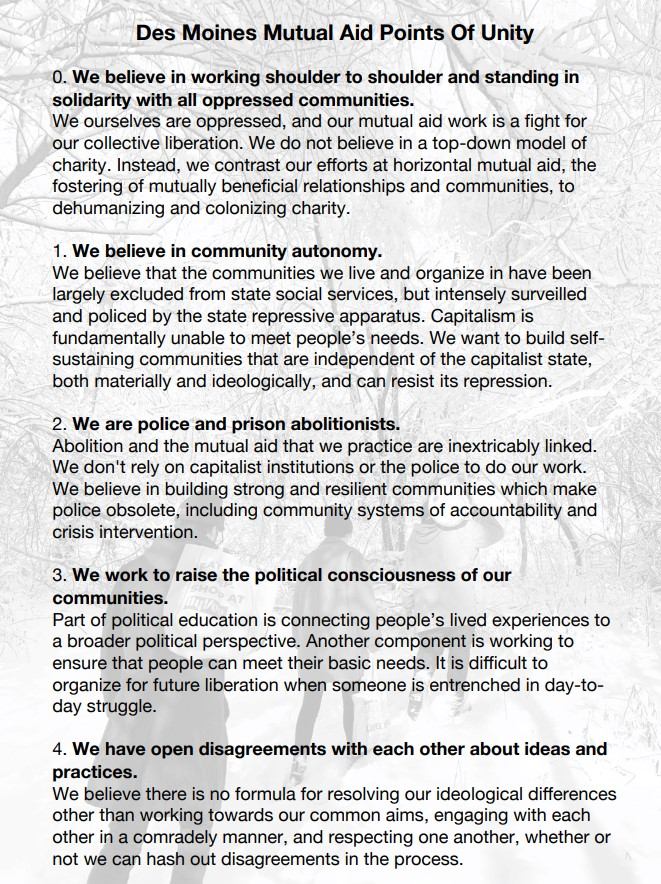
Mutual Aid Points of Unity
We believe in working shoulder to shoulder and standing in solidarity with all oppressed communities.
We ourselves are oppressed, and our mutual aid work is a fight for our collective liberation. We do not believe in a top-down model of charity. Instead, we contrast our efforts at horizontal mutual aid, the fostering of mutually beneficial relationships and communities, to dehumanizing and colonizing charity.
We believe in community autonomy.
We believe that the communities we live and organize in have been largely excluded from state social services, but intensely surveilled and policed by the state repressive apparatus. Capitalism is fundamentally unable to meet people’s needs. We want to build self-sustaining communities that are independent of the capitalist state, both materially and ideologically, and can resist its repression.
We are police and prison abolitionists.
Abolition and the mutual aid that we practice are inextricably linked. We don’t rely on capitalist institutions or the police to do our work. We believe in building strong and resilient communities which make police obsolete, including community systems of accountability and crisis intervention.
We work to raise the political consciousness of our communities.
Part of political education is connecting people’s lived experiences to a broader political perspective. Another component is working to ensure that people can meet their basic needs. It is difficult to organize for future liberation when someone is entrenched in day-to-day struggle.
We have open disagreements with each other about ideas and practices.
We believe there is no formula for resolving our ideological differences other than working towards our common aims, engaging with each other in a comradely manner, and respecting one another whether or not we can hash out disagreements in the process.
The recent passing of another of our elders brings new urgency to understanding why we are not attracting new attenders to our Quaker meetings and what to do about that.
“I’m so afraid of climate change. I just turned 17 not so long ago and I’m afraid I’ll never get to grow up because of the way our Earth is going.
“Most of my friends and family are apathetic, such as my parents who don’t like me talking about this stuff since they feel we can’t really change anything. My mom thinks it’s completely irreversible. I hate holding it all inside all the time. …
“I guess what I really wanna hear is it’s all gonna be ok even though it’s probably not the truth. I’m just scared. I’d appreciate any positive news or insight from those who feel the same way and how you manage it while doing everything you can. Thanks for reading.”
A pair of recent articles by Steve Genco is about what to say to a 17-year-old terrified about their future and poses some queries. These questions are relevant to the future of us all.
The article lists the following predictions we can rely on:
It’s going to get hotter
The weather is going to get more unpredictable and more extreme
Natural disasters are going to arrive at greater and greater frequency
Economic inequality (income and wealth) is going to get worse
We will continue depleting the natural world
The effects of climate change will be unevenly distributed around the planet
We will run out of oil and gas
What will give your life meaning?
Psychologists Edward Deci and Richard Ryan began developing what they called Self-Determination Theory (SDT) in the 1970s. SDT emerged out of Deci’s interest in intrinsic motivation.
Deci began searching for the underlying needs that intrinsically motivated behavior seemed to fulfill. He and Ryan discovered three motivators that appeared to represent basic or innate psychological needs
A need for autonomy: People need to feel self-directed and in control of our actions. We are more motivated to pursue activities we voluntarily and freely choose for ourselves, as opposed to activities we feel are imposed on us by other people or external circumstances.
A need for competence: People need to feel accomplished and capable. We are more motivated to pursue activities we feel competent to accomplish. We are also motivated to pursue activities that allow us to increase our competence through practice and repetition.
A need for belonging: People need to feel connected to others. We are more motivated to pursue activities that make us feel closer to others and that can be pursued in a supportive social context. This need is called relatedness by Deci and Ryan.
Throughout their research, Deci and Ryan studied how the goals people pursue on a daily basis and throughout their lives fulfill basic needs and contribute (or not) to personal wellbeing. In these studies, they found compelling evidence that: placing strong relative importance on intrinsic aspirations was positively associated with well-being indicators such as self-esteem, self-actualization, and the inverse of depression and anxiety, whereas placing strong relative importance on extrinsic aspirations was negatively related to these well-being indicators.
What skills and mental habits will you need?
So, how do you create a life of autonomy, competence, and belonging? You plan your life around goals and activities that make you more self-sufficient, knowledgeable, and socially connected.
In a world of cascading climate crises, shortages, and social and political unrest, people who can think for themselves, have useful practical skills, and are connected to a like-minded community, are going to have significant advantages over the cult followers, the totally-unprepared, and the socially isolated.
The needs for autonomy, competence, and belonging are exactly what Mutual Aid is about. These are the Points of Unity of my Des Moines Mutual Aid community.
Mutual Aid Points of Unity
We believe in working shoulder to shoulder and standing in solidarity with all oppressed communities.
We ourselves are oppressed, and our mutual aid work is a fight for our collective liberation. We do not believe in a top-down model of charity. Instead, we contrast our efforts at horizontal mutual aid, the fostering of mutually beneficial relationships and communities, to dehumanizing and colonizing charity.
We believe in community autonomy.
We believe that the communities we live and organize in have been largely excluded from state social services, but intensely surveilled and policed by the state repressive apparatus. Capitalism is fundamentally unable to meet people’s needs. We want to build self-sustaining communities that are independent of the capitalist state, both materially and ideologically, and can resist its repression.
We are police and prison abolitionists.
Abolition and the mutual aid that we practice are inextricably linked. We don’t rely on capitalist institutions or the police to do our work. We believe in building strong and resilient communities which make police obsolete, including community systems of accountability and crisis intervention.
We work to raise the political consciousness of our communities.
Part of political education is connecting people’s lived experiences to a broader political perspective. Another component is working to ensure that people can meet their basic needs. It is difficult to organize for future liberation when someone is entrenched in day-to-day struggle.
We have open disagreements with each other about ideas and practices.
We believe there is no formula for resolving our ideological differences other than working towards our common aims, engaging with each other in a comradely manner, and respecting one another whether or not we can hash out disagreements in the process.
Much of the above will be uncomfortable for many Friends because it involves rejecting the status quo. I contend that is why we are not attracting new attenders. If we don’t do so voluntarily these changes will be forced upon us as the status quo continues to collapse.
I believe we are in a time of great spiritual poverty. Friends have a precious gift to offer those needing a spiritual home. But the two will never be connected if Friends continue isolating themselves in their meetinghouses and cling to the status quo. We need to be police and prison abolitionists, find alternatives to capitalism, block the development of fossil fuel infrastructure, reject empire and militarism, and promote and follow the leadership of Indigenous peoples.
In Part 1, he discusses two questions youth should consider about this.
What predictions can you rely on?
What will give your life meaning?
The questions in Part 2 are:
What skills and mental habits will you need?
How will you live?
I’m just going to outline what Genko says in his article. You can find a fuller explanation of all of this there. I will then discuss my concepts of how to build communities for the (near) future we are facing.
What skills and mental habits will you need?
So how do you go about creating a life of autonomy, competence, and belonging? You plan your life around goals and activities that make you more self-sufficient, knowledgeable, and socially connected. In a world of cascading climate crises, shortages, and social and political unrest, people who can think for themselves, have useful practical skills, and are connected to a like-minded community, are going to have significant advantages over the cult followers, the totally-unprepared, and the socially isolated.
I have five suggestions for skills and mental habits worth acquiring as our fossil fuel-dependent civilization stumbles into the rest of this century.
The havoc from increasingly violent storms and development of large areas of drought will increasingly overwhelm our economic and political systems. Millions of people will no longer receive payments from employment or social safety systems. Financial institutions will fail. Military, public safety, and governance systems will break down. Municipal services such as water, power, transit, sewage and trash processing will fail. Food will no longer be available in grocery stores. We need to begin to prepare now. Not wait until the day water is no longer flowing from the faucet. Not wait until more of us are left without critical infrastructure. Not wait until millions are forced to flee coastal cities as the oceans flow into their streets, or flee wildfires, or areas with lethal heat, medical services including medications are no longer available. We’re already seeing the collapse of political and economic systems.
The Midwest
We are faced with two broad problems. How to adapt our own lives to deal with these changes, and what to do about the flood of people who will be migrating to the Midwest.
Since we will soon not be able to depend on municipal water and power, transport of food from distances, schools and hospitals, many will be forced to move to rural areas where they can live and grow their own food.
The Choice
It would seem we have two choices.
One is to narrowly focus on the best we can do to prepare ourselves and immediate community to adapt to the coming changes.
The other is to also work on ways we can help the many people who will be coming to where we live to learn, adapt and thrive as well as possible.
In the coming chaos we can help our own safety by welcoming climate refugees, instead of building walls against them.
Disaster Preparedness
This model is in part written from my Quaker viewpoint. As Friends, we will make the second choice, to care for those who will be displaced. This will be like disaster relief work, only on a scale never seen before.
We first need to learn how to adapt to this uncertain future ourselves. Part of that will be to network with others, both to learn from and to build a network to coordinate the response to the needs of the climate refugees.
Building Communities-My Vision
We need to build model sustainable communities. (See my posts: https://jeffkisling.com/?s=beloved+communities). I believe spirituality, whatever that might mean to you, will be an important factor in how we can adapt and live with each other during the collapse.
There have been numerous such experiments in intentional community. But this model must be created with the intention of being replicated many times over with minimal complexity, using locally available materials—a pre-fab community.
Each year the International Day of Peace (IDP) is observed around the world on 21 September. The UN General Assembly has declared this as a day devoted to strengthening the ideals of peace, through observing 24 hours of non-violence and cease-fire. Never has our world needed peace more.
This year’s theme is Actions for Peace: Our Ambition for the #GlobalGoals. It is a call to action that recognizes our individual and collective responsibility to foster peace. Fostering peace contributes to the realization of the Sustainable Development Goals (SDGs) and achieving the Sustainable Development Goals will create a culture of peace for all.
For some time the Spirit has been calling my attention to peace in many different ways.
I was led to take the photo below of the peace symbol on a coffee mug
I’ve been concerned but not surprised to learn of the heavy military recruitment of teens in public schools today
That made me turn my attention to conscientious objection. I discovered my Quaker meeting, Bear Creek Friends, had done significant work on conscientious objector counseling years ago. I had not known about that because I was living in Indianapolis at that time
My story about my struggles to become a draft resister
My Scattergood School classmate’s story of his imprisonment for draft resistance: The Barrett Family’s Peace Testimony by Daniel Barrett
The Moral Integrity of Muhammid Ali
I remember the day of the National Moratorium to End the War in Vietnam, October 15, 1969, when the entire student body of Scattergood Friends School had a peace march from the school to the University of Iowa (about twelve miles) to participate in actions there
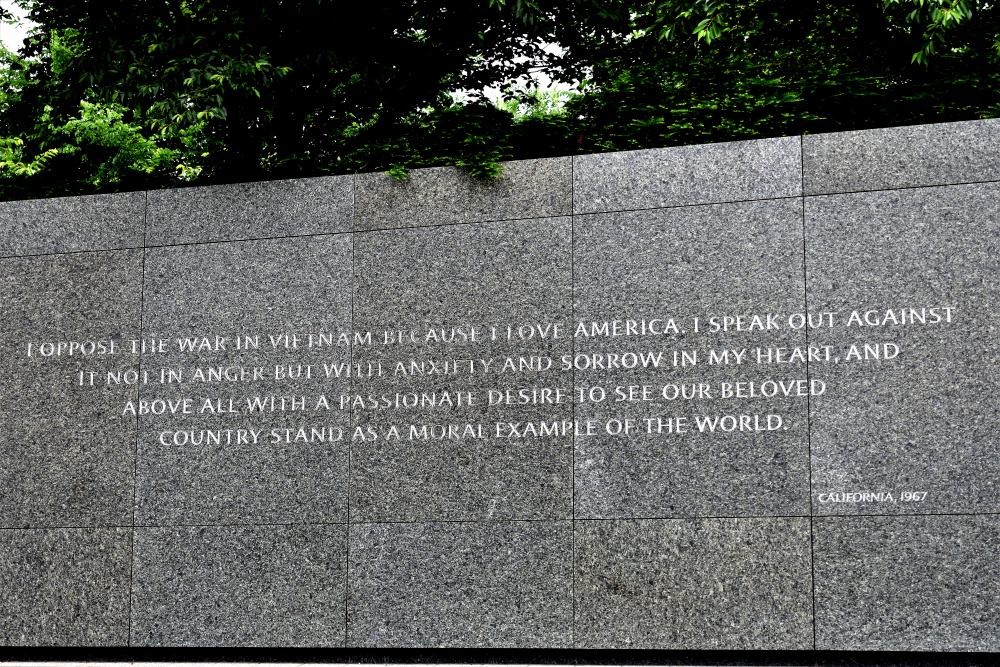
I’m reminded of Martin Luther King’s brave stance against the Vietnam War despite objections from his community
I was led to read the wonderful book Don’t Think Twice by Alison Lohans, which is a novel about the peace activities of a family set in the time of the Vietnam War. Alison and I have exchanged messages about this.
Yesterday, during our weekly Friends Committee on National Legislation (FCNL) Witness Wednesday Silent Reflection we considered the following prompt and query.
During my three years of experience with Des Moines Mutual Aid, I’ve become MUCH more aware of the internal war of the state against us.
“If, however, the peace testimony is the outward evidence of God’s work among us, then committing to it will lead us into prayerful sacrifice and radical solidarity with victims of violence. The cause of peace will encourage us to take unpopular stands for unpopular causes, because our faith is in a God who does not allow us to use violence even for a noble cause. We will be led to share our faithfulness to the Lamb and His war in a spirit of love and humility, inviting others into a new way of living.”
Query: How do you live a commitment to peace? How do you invite others into a new way of living?
I don’t know why I was prompted to take this photo of a coffee cup yesterday
An Epistle to Friends Concerning Military Conscription
Dear Friends,
It has long been clear to most of us who are called Friends that war is contrary to the spirit of Christ and that we cannot participate in it. The refusal to participate in war begins with a refusal to bear arms. Some Friends choose to serve as noncombatants within the military. For most of us, however, refusal to participate in war also involves refusal to be part of the military itself, as an institution set up to wage war. Many, therefore, become conscientious objectors doing alternative service as civilians, or are deferred as students and workers in essential occupations.
Those of us who are joining in this epistle believe that cooperating with the draft, even as a recognized conscientious objector, makes one part of the power which forces our brothers into the military and into war. If we Friends believe that we are special beings and alone deserve to be exempted from war, we find that doing civilian service with conscription or keeping deferments as we pursue our professional careers are acceptable courses of action. But if we Friends really believe that war is wrong, that no man should become the executioner or victim of his brothers, then we will find it impossible to collaborate with the Selective Service System. We will risk being put in prison before we help turn men into murderers.
It matters little what men say they believe when their actions are inconsistent with their words. Thus we Friends may say that all war is wrong, but as long as Friends continue to collaborate in a system that forces men into war, our Peace Testimony will fail to speak to mankind.
Let our lives speak for our convictions. Let our lives show that we oppose not only our own participation in war, but any man’s participation in it. We can stop seeking deferments and exemptions, we can stop filling out Selective Service forms, we can refuse to obey induction and civilian work orders. We can refuse to register, or send back draft cards if we’ve already registered.
In our early history we Friends were known for our courage in living according to our convictions. At times during the 1600’s thousands of Quakers were in jails for refusing to pay any special respect to those in power, for worshiping in their own way, and for following the leadings of conscience. But we Friends need not fear we are alone today in our refusal to support mass murder. Up to three thousand Americans severed their relations with the draft at nation-wide draft card turn-ins during 1967 and 1968. There may still be other mass returns of cards, and we can always set our own dates.
We may not be able to change our government’s terrifying policy in Vietnam. But we can try to change our own lives. We must be ready to accept the sacrifices involved if we hope to make a real testimony for Peace. We must make Pacifism a way of life in a violent world.
We remain, in love of the Spirit, your Friends and brothers,
Don Laughlin Roy Knight Jeremy Mott Ross Flanagan Richard Boardman James Brostol George Lakey
Stephen Tatum Herbert Nichols Christopher Hodgkin Jay Harker Bob Eaton Bill Medlin Alan & Peter Blood
We organized a draft conference at Scattergood Friends School in 1969
What can you tell youth about an increasingly dystopic future?
As we continue to spiral into environmental chaos and its consequences, what do we tell our children? Are we even talking about this with them? What do you say? Do they listen? Do you have any moral authority to speak from? To be clear, I speak from a life of refusing to own a car. And a life of resistance to fossil fuel pipelines and infrastructure.
Many people today seriously consider not having children.
The increasingly foul air in cities in the 1960s was a warning. And that should not have been ignored. Although introducing catalytic converters in the mid-1970s reduced the visible smog, they didn’t stop the fossil fuel emissions. But did make it easy to ignore the ever-increasing pollution.
Many people now blame the deep deceptions of the fossil fuel industry as an excuse for not having done anything about greenhouse gas emissions. When, in fact, they chose to do nothing that would interfere with the convenience of automobiles.
What cuts me deeply is knowing we absolutely would not be where we are now if we had invested in mass transit and built walkable communities instead of a car culture.
While many of my friends and I have worked hard on racism, war, poverty, and the forced assimilation of Native children, none of those compare to the travesty of what we have done to Mother Earth.
I recently came upon an interesting article by Steve Genco in response to this Reddit post.
I’m a teen and I’m really scared for my future
“I’m so afraid of climate change. I just turned 17 not so long ago and I’m afraid I’ll never get to grow up because of the way our Earth is going.
“Most of my friends and family are apathetic, such as my parents who don’t like me talking about this stuff since they feel we can’t really change anything. My mom thinks it’s completely irreversible. I hate holding it all inside all the time. …
“I guess what I really wanna hear is it’s all gonna be ok even though it’s probably not the truth. I’m just scared. I’d appreciate any positive news or insight from those who feel the same way and how you manage it while doing everything you can. Thanks for reading.”
I’ve been thinking quite a bit about what to say to a teenager like this young person to help them prepare for the dangerous world they are about to inherit. I concluded the best advice I could give would be to suggest some questions they need to consider. So here are four questions I believe any young person who wants to survive the 21st Century needs to ask and answer for themselves:
I like the idea of proposing questions for young people to ask themselves, to come to their own understanding, and to be invested in their answers. (Many Quaker meetings use questions, or queries, to guide spiritual discussions).
The article lists the following predictions we can rely on:
It’s going to get hotter
The weather is going to get more unpredictable and more extreme
Natural disasters are going to arrive at greater and greater frequency
Economic inequality (income and wealth) is going to get worse
We will continue depleting the natural world
The effects of climate change will be unevenly distributed around the planet
We will run out of oil and gas
What will give your life meaning?
This is such an important question. Throughout the coming horrific times, we must focus on what gives our lives meaning. This will allow us to be self-fulfilled no matter what is going on around us. Allows us to search through all the chaos for what gives our lives meaning and to not be led down false paths. We don’t have the time or capacity to do anything but that. No matter what happens, we can build on our own core values.
Fewer and fewer people are engaging with organized religions to find meaning in their lives. Organized religions have been involved in many atrocities.
Organized religion is usually not about spirituality. Spirituality in any of its many forms can give your life meaning. That has been and continues to be true for me as a Quaker. (I don’t think of Quakerism as organized religion). Quaker worship involves gathering together for about an hour each week in silence to seek guidance from what we call the Inner Light, the continued presence of the Spirit today and into the future. Whatever spiritual source you find, I believe that can be tremendously helpful to find a path through what is coming. I would go so far as to say essential.
Psychologists Edward Deci and Richard Ryan began developing what they called Self-Determination Theory (SDT) in the 1970s. SDT emerged out of Deci’s interest in intrinsic motivation.
Deci began searching for the underlying needs that intrinsically motivated behavior seemed to fulfill. He and Ryan discovered three motivators that appeared to represent basic or innate psychological needs.
A need for autonomy: People need to feel self-directed and in control of our actions. We are more motivated to pursue activities we voluntarily and freely choose for ourselves, as opposed to activities we feel are imposed on us by other people or external circumstances.
A need for competence: People need to feel accomplished and capable. We are more motivated to pursue activities we feel competent to accomplish. We are also motivated to pursue activities that allow us to increase our competence through practice and repetition.
A need for belonging: People need to feel connected to others. We are more motivated to pursue activities that make us feel closer to others and that can be pursued in a supportive social context. This need is called relatedness by Deci and Ryan.
Throughout their research, Deci and Ryan studied how the goals people pursue on a daily basis and throughout their lives fulfill basic needs and contribute (or not) to personal wellbeing. In these studies, they found compelling evidence that:
placing strong relative importance on intrinsic aspirations was positively associated with well-being indicators such as self-esteem, self-actualization, and the inverse of depression and anxiety, whereas placing strong relative importance on extrinsic aspirations was negatively related to these well-being indicators.
The needs for autonomy, competence, and belonging are exactly what Mutual Aid is about. These are the Points of Unity of my Des Moines Mutual Aid community.
Mutual Aid Points of Unity
We believe in working shoulder to shoulder and standing in solidarity with all oppressed communities We ourselves are oppressed, and our mutual aid work is a fight for our collective liberation. We do not believe in a top-down model of charity. Instead, we contrast our efforts at horizontal mutual aid, the fostering of mutually beneficial relationships and communities, to dehumanizing and colonizing charity.
We believe in community autonomy. We believe that the communities we live and organize in have been largely excluded from state social services, but intensely surveilled and policed by the state repressive apparatus. Capitalism is fundamentally unable to meet people’s needs. We want to build self-sustaining communities that are independent of the capitalist state, both materially and ideologically, and can resist its repression.
We are police and prison abolitionists. Abolition and the mutual aid that we practice are inextricably linked. We don’t rely on capitalist institutions or the police to do our work. We believe in building strong and resilient communities which make police obsolete, including community systems of accountability and crisis intervention.
We work to raise the political consciousness of our communities. Part of political education is connecting people’s lived experiences to a broader political perspective. Another component is working to ensure that people can meet their basic needs. It is difficult to organize for future liberation when someone is entrenched in day-to-day struggle.
We have open disagreements with each other about ideas and practices. We believe there is no formula for resolving our ideological differences other than working towards our common aims, engaging with each other in a comradely manner, and respecting one another whether or not we can hash out disagreements in the process.
Alberta Kisling was passionate about preserving stories and wrote and collected them during her life. The Quaker Stories website was created so these stories could be told.
Centering Down at Bear Creek by Alberta Kisling
Catch the mind Don’t let it wander – Center The facing bench is empty Where are they? Oh, there they are Sitting so tall So stern Faces lined, eyed downcast Always there. There – out the window The old school house Where are your children school house? Do they remember you? Yes, I feel them here They are whispering Good morning – how is thee?
Resurrection
by Alberta Kisling
Out of the crumbles of dust and termites come memories of children’s voices at play or reciting, first-day school and committee meetings. We Quakers reflect on the old school house that is gone.
Old school house at Bear Creek Friends Meeting
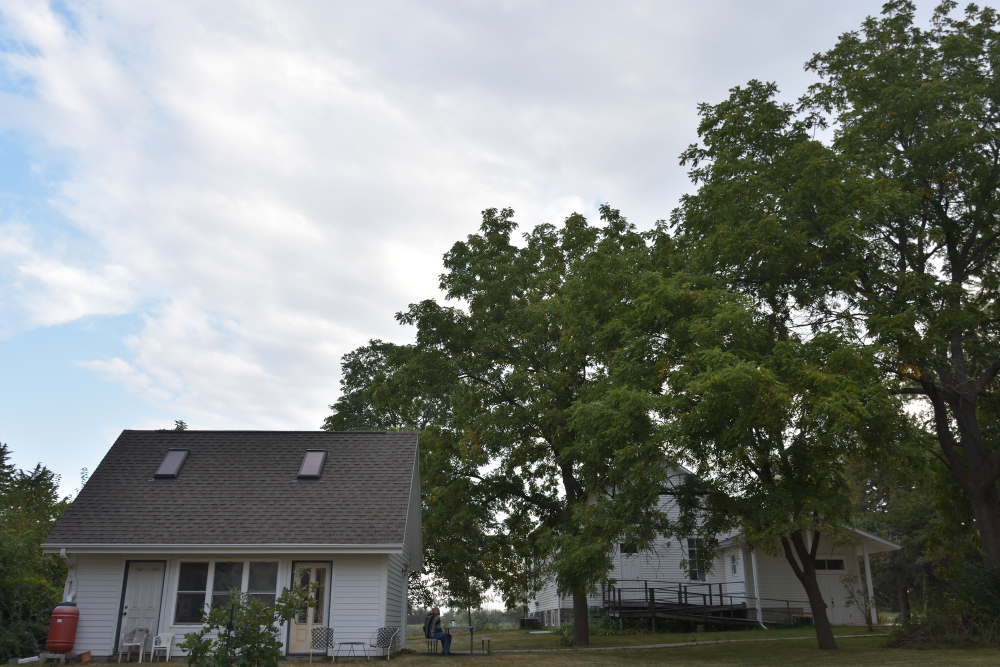
But look! Rising from the ruins of the past; a new building! Many windows for quiet gazing across the fields. Our spirits are lifted as our eyes are drawn heavenward. Skylights, and a loft for rest, and quiet meditation.
Already there have been worship groups, committee meetings, and students sleeping (?) all night. The rain barrel waters the new circle garden.
We are breathless as we absorb its beauty. We are enthralled as we contemplate the endless possibility of its future. The first of the past are weaving themselves into the miracle of new life in our beautiful, precious Quaker Cottage.
Lorene Standing
by Alberta Kisling
Mother seldom lost her temper but there were occasions that would try the patience of a saint!
Mother had gathered walnuts and wanted to dry them so she could shuck the hulls off. So she decided to put them up on the tin roof of our house so the squirrels wouldn’t get them. Imagine her dismay when it rained and black walnut stain filled our cistern.
One wash day she had carried in buckets of water and filled the copper tub on the stove to heat. After she had transferred the hot water from the wood burning cookstove to the washing machine, added the Fels-Naptha soap she had ground off a hard bar, and sorted all the clothes; whites, colored and very, very dirty chore clothes, she attempted to start the gas engine on the washing machine. She kicked and kicked and it wouldn’t start. She took out the spark plug and cleaned it, put it back and tried and tried again!
“Well Sam Hill and Seven Stakes!” she said–as near to cussing as I ever heard.
When she was working at the County Home she used a step ladder to climb up on the kitchen counter to paint the wall. When she stepped back on the ladder it shifted and she fell, catching her leg in the ladder, causing a serious compound fracture. She didn’t call us until she had been in the hospital for three days and Aunt Lydia said, “if you don’t call your daughter, I will.”
She was so angry that she hadn’t been more careful.
Several in our creative writing group are writing life histories for their families. A number of people here at the Village have already written books. Have you considered how you will pass on your family history?
There are many ways to do this and you don’t have to be a gifted writer to do it. Making a recording is a wonderful way! To be able to hear your voice after you are gone is a precious gift to give.
Have you ever interviewed family members, dear friends, or someone you admire? It helps to have questions that trigger memories and special stories: who was your best friend, what were your favorite games, describe a typical school day, how did you decide your life work what was the saddest day in your life, what was your favorite book, song, trip, pet? You can create the questions to glean the information you want.
Look through your photographs. Many of those pictures will trigger a story or a piece of history that is important. It is so easy to reproduce pictures and they are a great addition to any story. Make sure they are labeled and dated.
Lorene, Alberta, Ellis, Wilden and Albert Standing
My mother placed great importance on passing on our family history. I have a tape recording of an interview with her and my father. Occasionally I have questions I wish I had asked–too late now.
We all have family stories that happened before we were born. Those should be passed along also. Here is one from my father’s childhood. The crows were a nuisance near my father’s rural farm home. He and his sister spotted a nest in a nearby tree and decided to kill the baby crows. My father climbed the tree, and looked at the baby birds and hollered down “I can’t do it”. She called “Throw them down, I’ll do it.” Down came a baby bird. “Stop” she shouted, “Don’t throw any more.”
Sometimes it may seem the younger generation isn’t interested in the family history or some family heirlooms. It is just not on their radar yet. The day will come when they will truly value you stories and they will be so grateful you passed on the gifts that were given to you.
Family Camping
by Alberta Kisling
The highlight of our summers were camping trips. As we endured the hot, dry summers and every activity resulting in sweat running down our flushed faces and our energy draining as we pulled those icky, tough weeds or pushed and shoved the mower through heavy grass, we could hardly wait to hear the water rushing and bubbling over the rocks in Big Thompson Canyon and breathing the crisp air of Rocky Mountain National Park.
We always had a contest of who could see the mountains first – a great help as we restlessly endured the hot, barren prairie of Nebraska. As we drove into Estes Park the kids began to chatter and jump up and down. “There are the go carts, there is the amphitheater, hope we can get a camp spot in Moraine Park”! Soon we can hear the groans and moans as Dad drove around and around searching for the perfect spot. “Randy, you go sit on that picnic table to hold this spot as we look for a better one.” We would eventually return to pick up several disgruntled kids and begin the process of setting up camp. The children worked quickly so they could explore our area and climb the rocks. Eventually Burt and I would stretch out in our lawn chairs gazing in awe and wonder at Longs Peak and smelling the beautiful pine trees. Ground squirrels scurried around hoping for a tossed peanut and we smiled and sighed – it was worth the long, long trip, packing, aching heads and back.
Supper was simple but typical camp food. The most wonderful smell as the bon fire began to burn brightly. Where are our sticks – finally found them and then the smell of hot dogs roasting and sizzling and the little blazes as the marshmallows catch fire. There are homemade cookies loaded with chocolate chips and brownies. The smores are sticky and sweet and of course called for more.
Soon we join our fellow campers trudging along the gravel path to the amphitheater The Ranger is friendly and tells us fascinating stories of the area. We smell popcorn as we plod happily home but we are cold!! Everyone hurries to climb into the warm sleeping bags. “Ok Mom, you were reading ‘Hans Brinker and the Silver Skates – Remember?”
We feel so close to God under the starry sky, so thankful for our safe travels, healthy family, and for Beautiful, Beautiful Colorado!!!
Some Remarkable Quaker Women
by Alberta Kisling
Deborah Standing
While I didn’t know my Great Grandmother, many stories have been passed along. To leave her home in civilized England and travel with her husband and five sons to a strange, new pioneer land surely took enormous courage! There was no electricity, no running water, mud roads—a very primitive life. Each Standing reunion we do a choral reading written by Martha Foster that describes her and her husband going to meeting with a horse and buggy with five sons dressed in white shirts and bow ties. She was blessed with a kind, considerate husband who helped around the house. For example, pumping the water from the well and carrying it into the house to heat it for doing the laundry. Her husband Charles was a gifted Quaker minister. The Standings wanted a good education for their children and supported the Bear Creek School and later, Scattergood School. Several brothers married Nicholson sisters and both families had many artists, writers, and poets.
Eva Delitha Heald Stanley
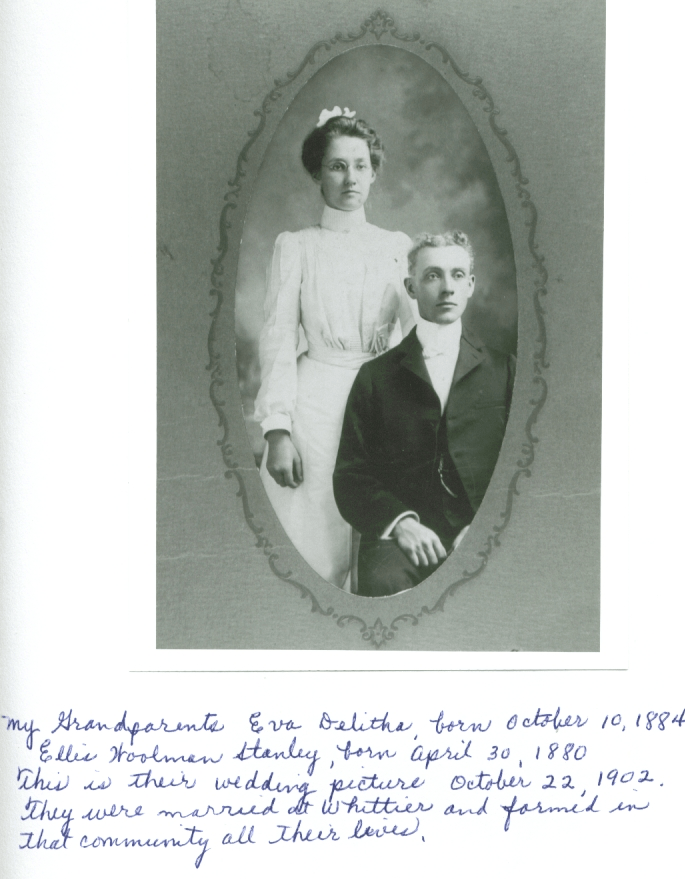
Eva contracted tuberculosis as a young bride. Ellis, her husband, took her to several doctors in Cedar Rapids and they all said there was no cure and she would die. In the little Quaker village in Whittier, Iowa, there was a homeopathic doctor. Dr. Ross came by horse and buggy several times a day and her remedies cured Grandma Eva. Grandma studied the different remedies and relied on homeopathic medicine the rest of her life. She taught her children and Grandchildren how to use the remedies, also. She and Grandpa had five daughters—Lorene, Irma, Hazel, Wilma and Clyda. She always helped milk the cows, raised lots of chickens, had a big garden, and canned a lot of food. She was known for her beautiful flowers, her good cooking, and her friendly hospitality. Grandpa didn’t believe in commercial fertilizer. He built up his soil with manure and rock phosphate. Grandpa ground the wheat they raised and Grandma baked her own bread. She also sold extra to neighbors and to the Health Store in Cedar Rapids.
She and Grandpa got up very early to chore, followed by a big breakfast. The breakfast dishes were left on the table and they retired to the parlor for Bible Reading every day.
There were few nursing homes in her day, and she took care of a number of elderly relatives in their final days.
Amy Lorene Stanley Standing
The oldest daughter of Ellis and Eva Stanley, she was raised on their farm near Whittier, Iowa. As the oldest of five girls she was the outdoor girl. She loved working outside, helping chore, working in the garden—fixing things. She wasn’t fond of cooking and inside jobs. She attended Scattergood School where she met her future husband, Albert Standing, and graduated from Olney Boarding School. She attended teacher training at William Penn College and taught school at Whittier. After their marriage she and Albert farmed at Whittier and Earlham. They had a hard life during the depression with little money and three children, Wilden, Alberta, and Ellis. She was very frugal, recycled whatever could be used. She thought of herself as shy—worked very hard for people who needed help. She could be depended upon, served on many committees but was the worker not the chair who received recognition.
Leanore Goodenow
Leanore was Director of Scattergood School, where I was a student for four years. She was the person who had the most influence on my life. Scattergood gave regular written reports instead of letter grades. While at public school I easily received A’s; at Scattergood the reports were not so good. She always expected more. I learned to work harder, set higher goals, and make better use of my time. We were heavily scheduled and free time was spent “volunteering” at work needed at the school. To this day I feel guilty if I’m wasting time.
Leanore came to Iowa Yearly Meeting when Scattergood had been closed for years. She started it up with a small staff and student body. She was a strong director, frugal, attending to details, excellent at fund raising, and she rebuilt the School—students, staff, and Instruction, Art, Main, and Science Buildings, and Boys Dorm. Her influence on the many students who attended, the faculty, the Committee, and the Yearly Meeting are immeasurable. Burt and I both served on the Committee as did our son Jeff. Our children all attended the school. It continues to be a very important part of the Yearly Meeting.
Some Quaker Mothers of our Organizations
Patricia Newkirk
When she came to William Penn House things really starting looking nice—paint happened, bookcases appeared, things just looked spiffy. She was there with a friendly smile and howdy! Never mind that Byron was down below chopping up the old piano and laying carpet half the night. We sure miss Patricia.
Olive Wilson
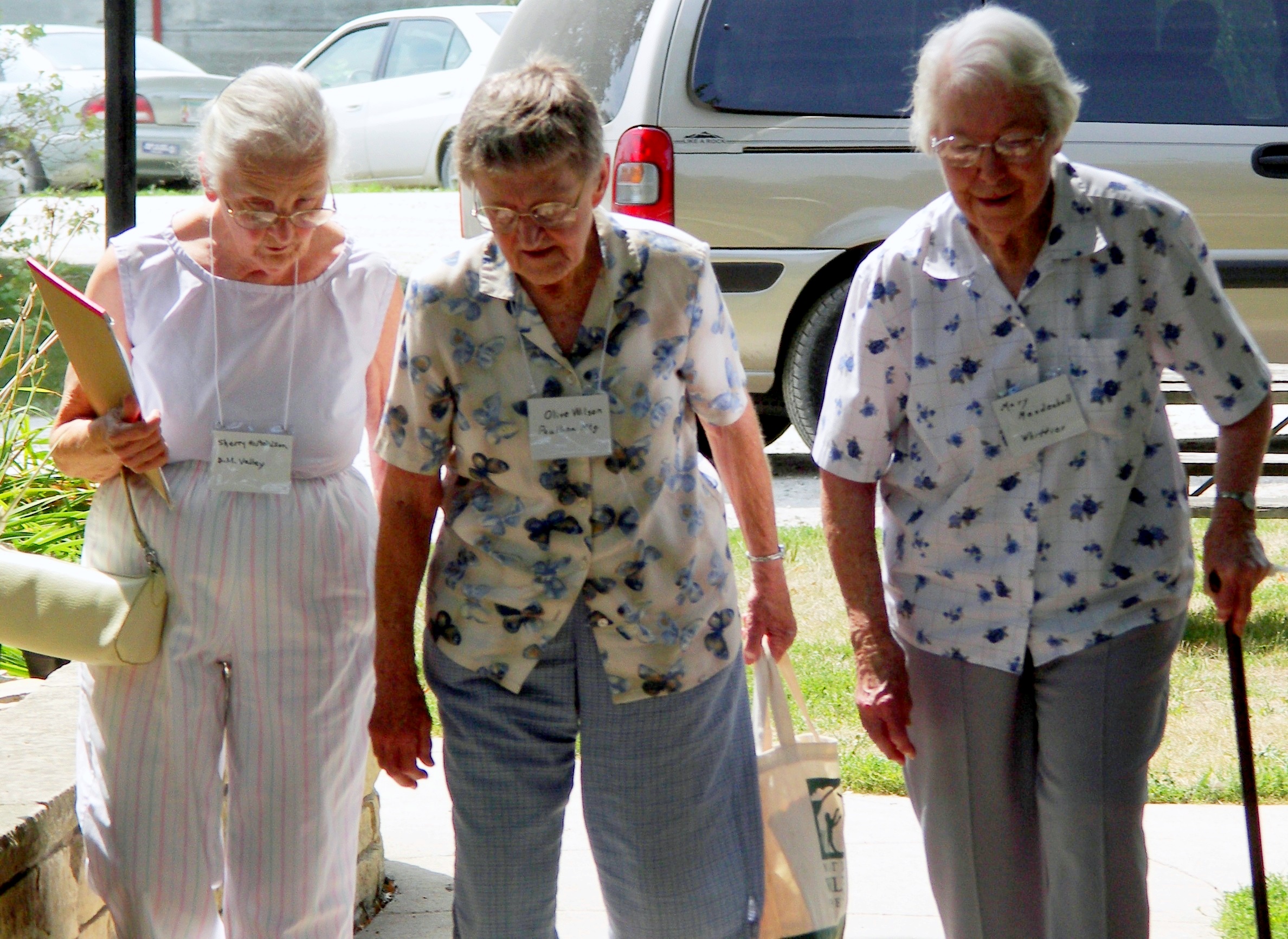
Olive was the Clerk of Everything—Mapleside Meeting, Iowa Yearly Meeting, Scattergood School, FCNL—and many other organizations I don’t know about. She edited “Iowa Peace Links”. She wrote her Congressmen endlessly, had letters to the editor printed often—worked and worked and worked some more for peace and justice. Besides that she and Warren raised three children, farmed, and worked for their meeting, community, and projects dear to the hearts. She was an amazing example.
KONICA MINOLTA DIGITAL CAMERA
Kathy Guthrie
When I was on Field Committee for FCNL Kathy was the staff person responsible for Field Committee. She worked for FCNL for many years in many capacities. She knew everyone, kept informed on what was happening, worked smoothly behind the scenes, could suggest people from all over the U.S. who might be able to fill a certain position. She was the one who welcomed you and made you feel a part of the group.
Dear Birdie, I can’t tell you how honored I was to be included in the absolutely wonderful group of Quaker women. To be listed in the same area as Olive Wilson—well, I don’t deserve it, but as I said, I’m extremely honored. I was inspired to add a Quaker mother to your list. I could think of several, Alison Oldham, for one, but decided to go with the first Quaker in my life–my mother’s favorite aunt (and mine as well).
With warm regards,
Kathy
Bessie Benson Gormong
My great aunt, Bessie Benson Gormong, was my introduction to what it was like to be a Quaker. She grew up in rural southern Indiana, 9th in a family of 11 children. She was the only girl to go to college, was a dairy farmer’s wife and partner in running the farm. They were both very involved in Western Yearly Meeting, Bloomingdale Quarter, and she in USFW. They were no doubt the backbones of a tiny country Quaker church, Benson Chapel. Bessie named her daughter for Susan B Anthony, took us to see Lincoln’s home in Springfield, and read and thought about and discussed current events. When I recall how racist and narrow minded my grandmother (her sister) and grandfather were, I think it’s a true miracle that she had such a world view. For a woman born in 1908, she not only was really a believer in equal rights for races, but for accepting differences in sexual orientation. I have always felt that being a Quaker means standing on the shoulders of giants. One of those sets of shoulders is my beloved aunt.
Kathy Guthrie
Bonfires
by Alberta Kisling
Often as we walk along in the fall we see a whiff of smoke and soon the nostalgic odor of burning leaves overwhelms our senses. What wonderful memories!!
We remember coming home on the school bus and entering the kitchen to the sight of our mother canning tomatoes. After a warm cup of tomato juice, butter and crackers, we hurry out to rake up leaves. Running and jumping into piles of leaves used some of our excess energy, and later lighting a fire helped ward off the chilly breeze.
Bonfires were central to our camping memories. After attending the Ranger’s program in the amphitheater, we would gather around the fire and enjoy a cup of hot chocolate and make some smores.
Various gatherings of your groups usually had a time of singing around the campfire. We loved those old camp songs, we loved the fellowship and sharing with our friends and the burning embers as the fire died down etched the blessing of time, friends, sharing in our memory.
Bear Creek Meeting has been the location of many bonfires. Often while cleaning the meetinghouse for a large occasion, we would gather around the fire—tired, dirty, planning for a special event. Other times our Standing family reunion was held there and we would gather in the evening for stories, singing, and, or course, smores.
There was no central heating in our childhood home. Different kinds of fires burned there—a quick summer fire in the cook stove was usually corn cobs, fires to heat in the cold winter months were usually wood and coal, each with a distinctive odor. On cold winter mornings we listened for the sounds of fire building and would race across cold floors to sit on the warm oven door of the cook stove.
Interesting how different odors bring forth certain memories. After hot, dry days a soft rain brings forth the sweet, moist smell of grass. Bacon frying, breakfast on the farm, coffee, chatting with friends or family around the kitchen table, chocolate cake—anticipation of dessert—maybe company coming—bread baking—so, so special the ultimate heartwarming food of the fortunate family where food sustains not only the body but the Spirit of Love which surrounds the gathering together as friends.
Eva D. Stanley
by Alberta Kisling
2/17/1944
I think everywhere there are those factions to contend with. Some want to be at the head of everything and often those are the least desirable, and the ones that might do better are shy, afraid to say what they think, so are just still and let the others ride over them and carry on. It is just that lack of true Christian principles and kindly loving care that has broken up so many meetings, and scattered the sheep. If we all could strive harder, and try faithfully to do our part, and in a kindly way say what we feel to be right, our meetings would have more life and we would be guided by our Heavenly Father to do and say what we are required to, be it ever so little. We all need to walk closer to God that he may guide us, otherwise our efforts are in vain. Maybe it is your place to talk plainly to …, in a kindly way. Maybe they do not realize just where they are and what doing.
Eva D Stanley
Albert and Lorene Standing
by Alberta Kisling
My Mother Lorene Stanley Standing was born on a farm near Whittier, Iowa. She attended Scattergood and Olney Boarding Schools. She taught school in Whittier for several years before she married. My Father, Albert Standing was born on a farm near Earlham, Iowa and was raised in the Bear Creek neighborhood. He attended Scattergood where he met my Mom. They were married in 1926 and were financially impacted by the great depression. Their neighbors lost their jobs so Mom and Dad gave them milk from their cows green beans from their garden and oatmeal. This was very typical of how they lived their lives. Many, many times they would help people who were having problems. They never received or wanted recognition. They worked hard, lived simply and cared for those who needed help.
After Dad died we took Mom on a trip to Colorado. We had never heard of altitude sickness and drove this 90+ year old lady up the mountains to Rocky Mountain National Park. The next morning she came out of the bedroom and said “I’m sick” She was a great believer in Homeopathic Medicine and always carried some with her. “What medicine do you need” I asked “I need Tylenol” “Have you ever taken Tylenol? I asked” ”No but I need it now.”
They were faithful Quakers all their lives, serving on committees, caretakers of the Whittier Community Building for years after they retired and Dad mowed the Cemetery for years. They both took care of Grandma.
There was a family in Whittier – a member of the community said it was a sad day for Whittier when they moved here. Mom did not agree, she had her name on the list to be called if any of their children got sick at school – she would go get them. She taught the girls to cook and sew. They gave the family food when the father was unemployed.
This is what young Jeff Kisling said at his Grandmother Lorene’s Memorial Service “We don’t know what happens after we die, but one aspect of life after death we do know about is the influence of someone like Lorene and Albert continues to exert on the lives of those who know and loved them. Not only do memories of them continue to comfort us, but what they said, how they lived, things they did with us and for us remain with us always.”
Mom’s birthday 2012
Friends Committee on National Legislation (FCNL)
Mom and Dad were deeply involved in the work of FCNL for most of their lives. Dad was instrumental in collecting money for the construction of the FCNL offices in Washington, DC. They pulled me into this work, too. I’m glad I was attending the FCNL Anual Meeting as a member of the General Committee in 2012, when they were honored by Executive Secretary, Joe Volk. (They were both extremely embarrassed by the attention).
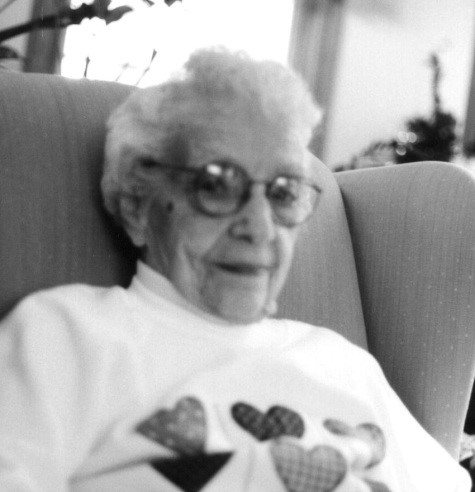
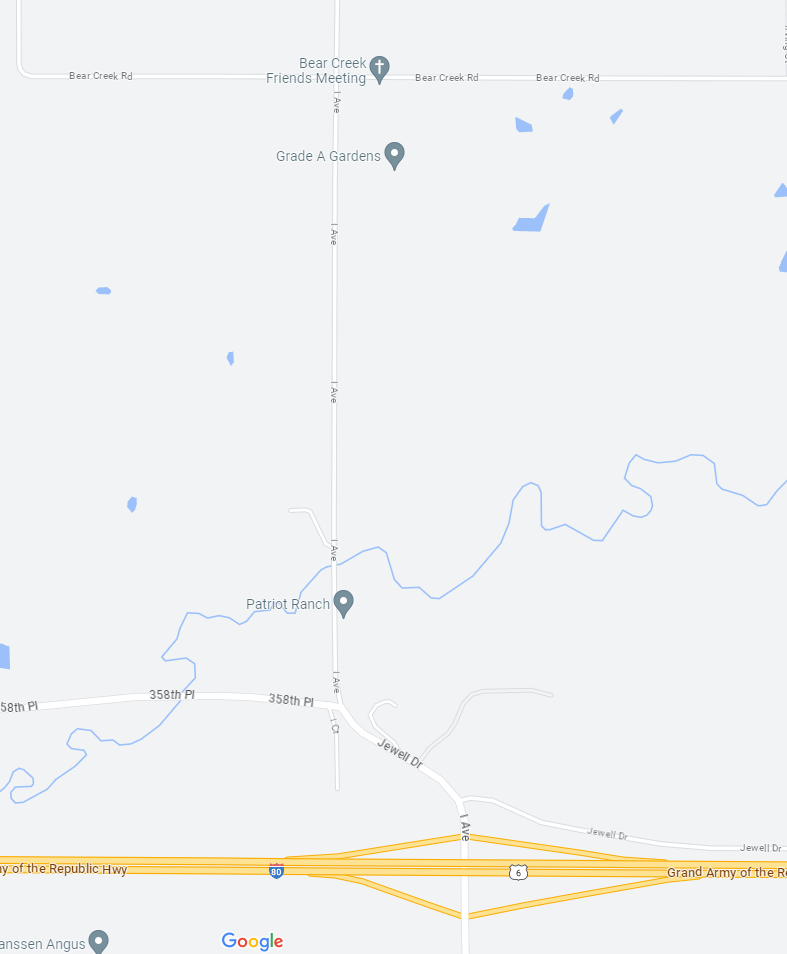
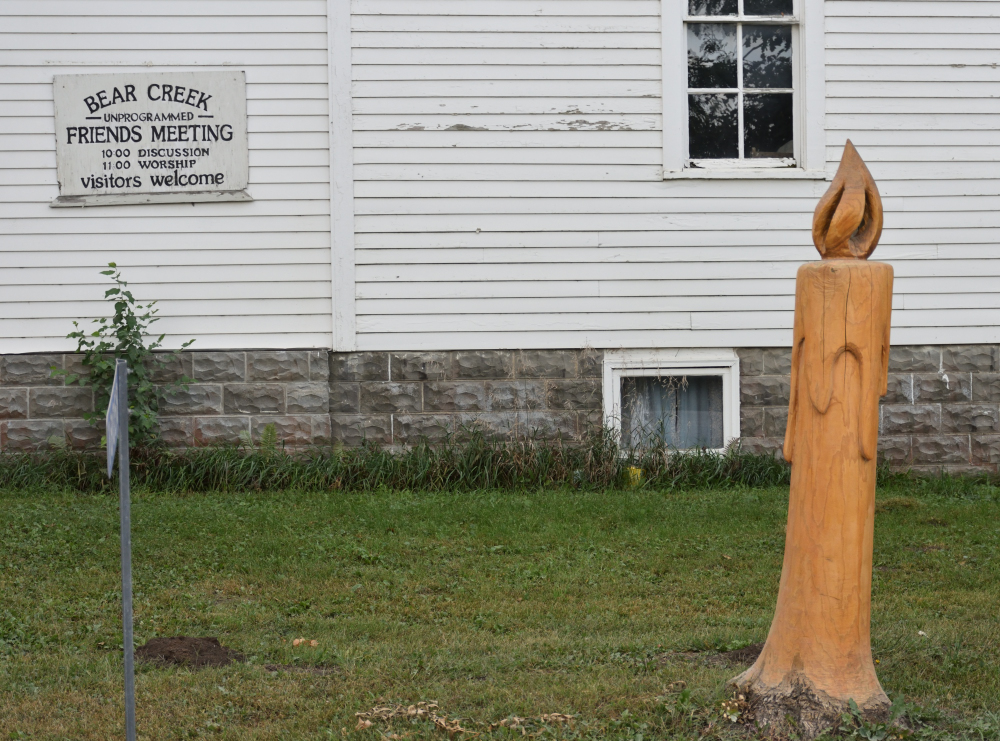
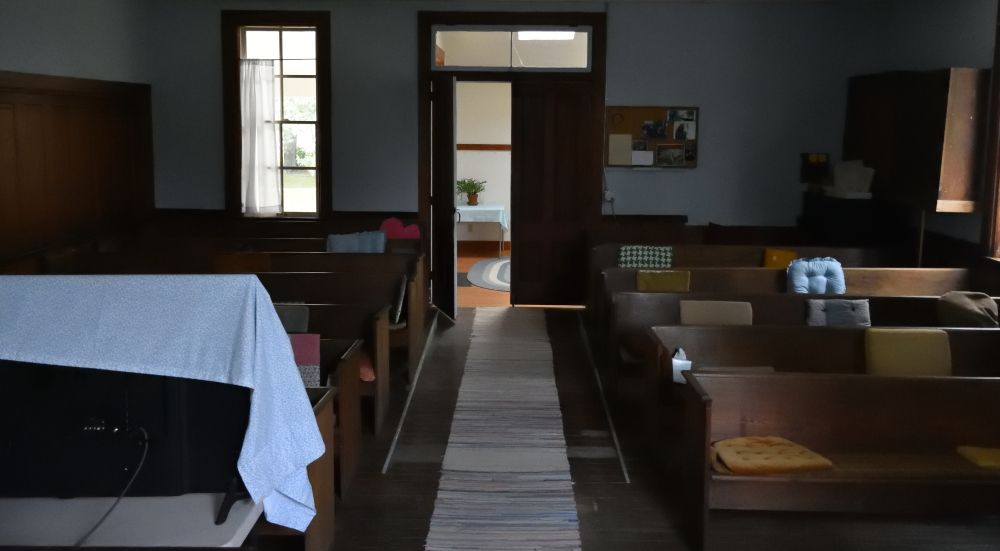
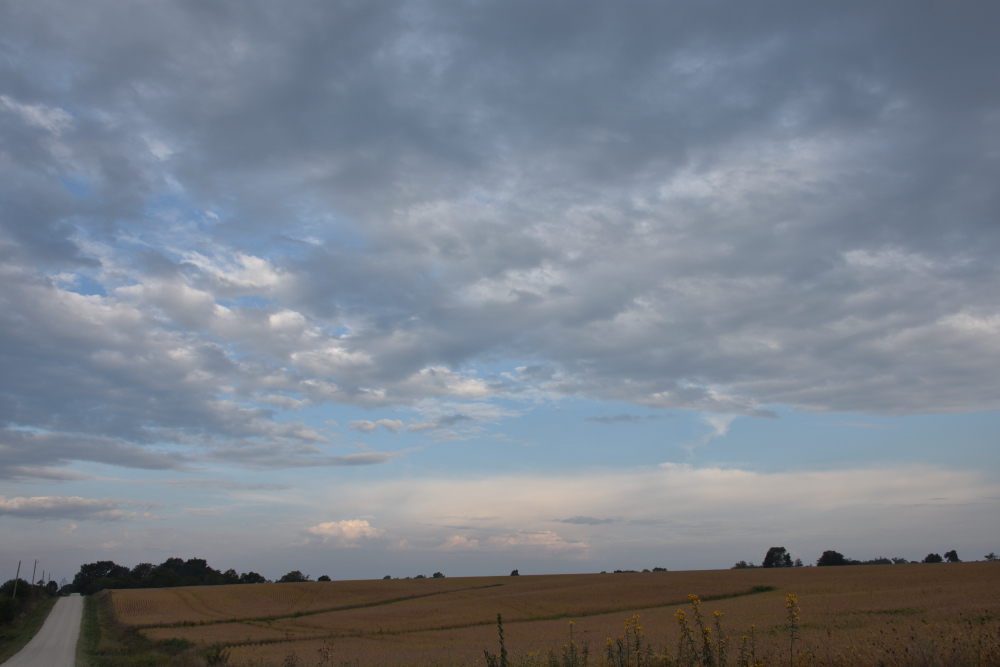
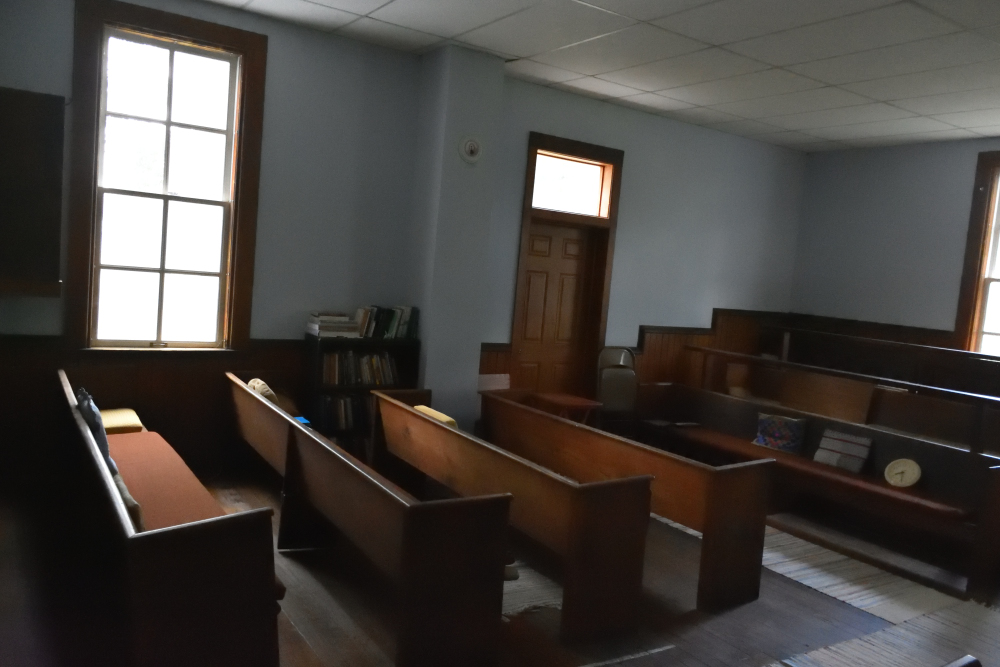
I’m sharing the news of my Mother, Alberta (Birdie) Kisling’s death. Her memorial will be at Bear Creek (Quaker) Meeting near Earlham, Iowa, on Sept 24th at 11:00 am. Since many who might want to attend might not be familiar with the Bear Creek meetinghouse, I’m including a map and photos of it.
Alberta Kisling, passed away at the Brookdale Middleton Stonefield memory facility in Madison, Wisconsin, on September 12, 2023. Her children Randy, Lisa, and Jeff were with her. Her son, Jon, was not able to arrive in time because of the sudden change in her condition.
She was born in Whittier, Iowa, on May 7, 1931, to Albert and Lorene Standing. Mom’s brother Wilden is no longer living. Her brother, Ellis, lives and farms in the Bear Creek, Iowa, community.
Her husband and life partner, Burton Kisling, died in 2018.
We were continually amazed at how many things they were involved with, including various roles in Quaker communities and organizations both locally and nationally. And the depth of their involvement together as true partners.
Their journey began with farming in Iowa and continued as Dad steadily moved up through the Farm Service organization, eventually being the manager for the entire state of Iowa. Most of those promotions meant moving from place to place. They always became actively involved in each new community. Building deep friendships in each of them. Dad would usually be involved in things like the Chamber of Commerce, and Mom would be involved in social activities, sometimes acting in plays.
We were so blessed when every summer they would take us camping in various national parks, though everyone’s favorite was Rocky Mountain National Park, Colorado.
Mom, her parents, and her children all attended Scattergood Friends School, a Quaker boarding high school. She served on the Scattergood School Committee for over twenty years.
They were both very involved in the Friends Committee on National Legislation (FCNL). As a result of lobbying for peace and justice legislation, they were on a first-name basis with Iowa’s US Congressional delegation.
She spent years as a very successful real estate agent, winning the Million-dollar award for home sales multiple times.
She was an exceptional hostess, and she and Dad delighted in organizing zany games and dressing up. At an FCNL Annual Meeting, Joe Volk said he heard a rumor that they were going on tour as Phyllis Diller and Fang.
Mom was a painter, a prolific writer, and a collector of stories about her family, and all the things she and Dad did throughout their lives. Sad though it is, we are comforted by memories of her and Dad as wonderful parents. As we sort through old photos and letters, we are delighted to discover many things we hadn’t known.
It is a priceless gift that Mom wrote much of her life story, which can be found here: The Story Now Begins
Memorial plans
You are invited to attend in person the Bear Creek Meeting just north of Earlham, Iowa.
Sunday 24th, 10:00 am sharing about Mom followed by a memorial service at 11:00.
Map to Bear Creek
Earlham, Iowa, interchange on Interstate 80.
I was at the Bear Creek meetinghouse recently for the first time in a long time. At first because of COVID precautions, but then Mom wasn’t up to traveling for an hour to get there from Indianola.
Among the changes was the candle sculpture made of the stump of a tree that was removed. You might notice the sheet at the front of the meetinghouse, covering the television we use for Zoom meetings. The photo of the barns is at the Grade A Gardens just south of the meetinghouse.
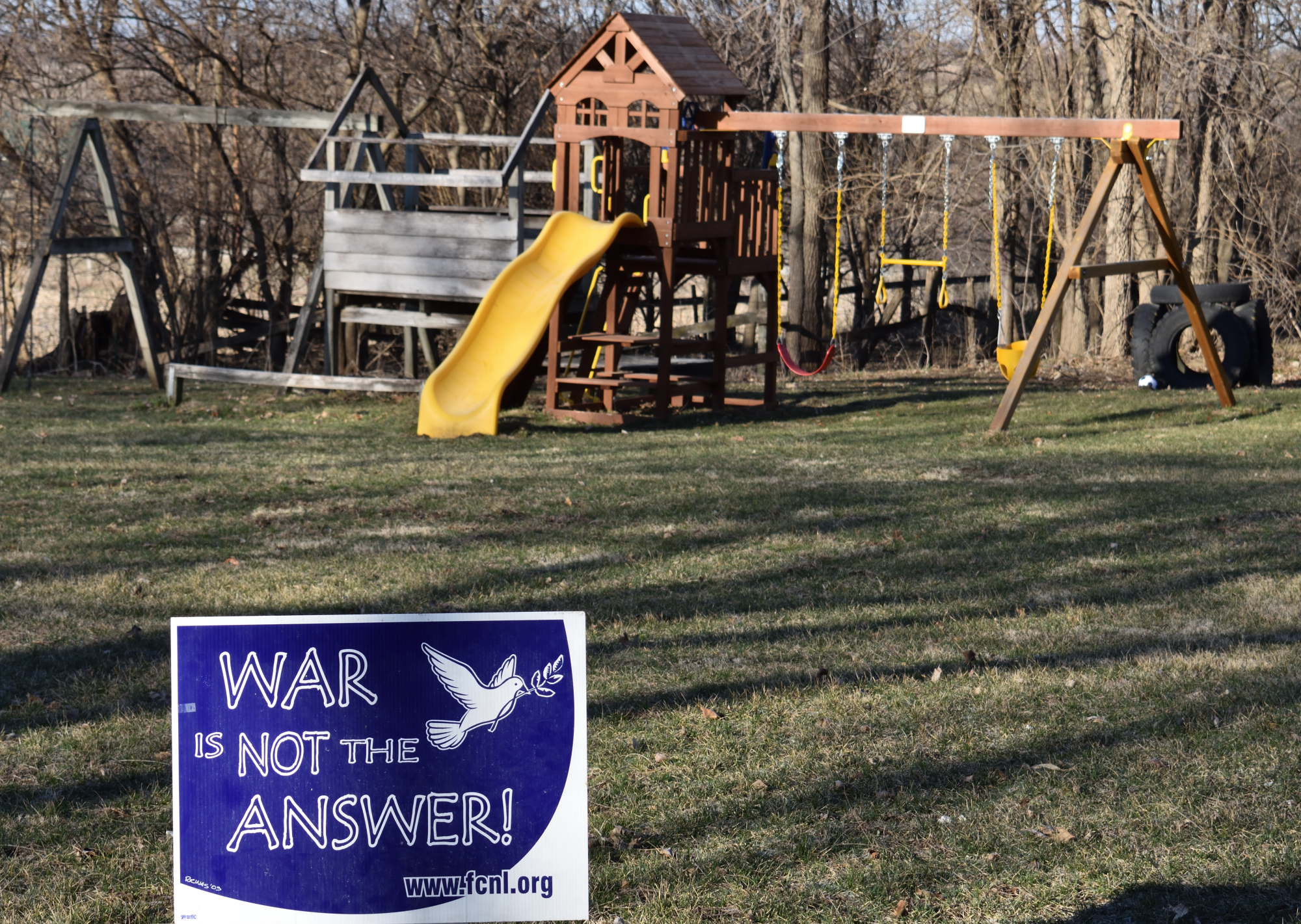
The playground equipment was donated to the meeting in memory of my Dad in 2018.



































 Quakers and Mutual Aid