This is a continuation of an article I recently wrote about critical skills to prepare for collapse. It is telling that the idea of collapse is more widely accepted, but not surprising as the signs are appearing in so many ways. Rather than being something environmentalists just talk about, the actual damage is occurring everywhere.
But simply applying critical thinking to a problem or situation doesn’t necessarily mean you arrive at the best solution. The more you know about the situation you are facing, the better. Which is why banning books and all the other restrictions being placed on education is so tragic. It also explains why that is being done. Those working to control us don’t want us to have that knowledge. They want us to be dependent on what they want and say.
The point of critical thinking is that as you learn more, you can integrate that into your knowledge base and make better decisions. Which is going to be crucial in the face of the rapid and dramatic changes that will be, already are occurring.
And there are many situations that involve our values, which are not subject to critical thinking.
Several people have asked me why I put ‘critical thinking’ on this list. My sense, from reading works like the Davids’ The Dawn of Everything and Peter Brody’s The Other Side of Eden is that what most distinguishes our civilization from most prehistoric and indigenous ones is that, before education became something that we ‘did’ to people, most people naturally acquired this essential skill, by facing the many existential challenges that life outside our synthetic, infantilizing, prosthetic, standardized culture presented to them every day. In short, they learned how to learn because they had to; they didn’t have to be ‘taught’.
My experience has been that, given that it is no longer a prerequisite for survival, critical thinking is now something that has to be specifically nurtured in people, which probably happens most often by parents’ encouragement. Lacking that, there’s a natural propensity, I think, for simplification and uncritical reaction. But if you’re taught the value and importance of critical thinking, I think you figure out this process of weighing and assessing and challenging what the world throws at you.
But I’m not so sure about this. Maybe, just as we can learn to make our own clothes and grow much of our own food if and when we have to (as millions discovered during the Great Depression), we can also learn to learn, to think critically, to challenge unsupported rhetoric, to think for ourselves instead of relying on increasingly-incompetent media to tell us what we should and should not believe.
When it begins to dawn on us, in five years or twenty-five, that we are going to have to quickly instill the above (see the article) currently rare skills in many or even most of our people, how might we go about it? As pessimistic as I am, I just can’t believe it’s already too late to do so.
So I’m thinking about these questions:
What’s the most effective way to voluntarily get billions of people to the point they are capable of exercising the above skills?
How do we get the timing right: Not so early that there’s not yet a sense of urgency, but not so late that we’re trying to do it in an environment of chaos?
How might we begin to identify, improve the competencies of, and empower the right people to do the mentoring, teaching, training, demonstrating, connecting, modelling, and other hands-on imparting of knowledge and skills needed to make it happen?
How can we make this new, crucial learning easier, and fun?
‘How Do We Teach the Critical Skills Needed to Face Collapse?” by Dave Pollard, How To save the world, September 10, 2022.
So I don’t see any top-down ‘professional’ answer to developing the above essential skills in the coming decades, not even the skill of ‘helping people cope’ with collapse. I think the answer has to emerge bottom up, from within each community as that community establishes itself.
‘How Do We Teach the Critical Skills Needed to Face Collapse?” by Dave Pollard, How To save the world, September 10, 2022.
So, we arrive at my experience with Mutual Aid. A future article will discuss how Mutual Aid is providing skills and developing communities to face collapse.
The invasion of Ukraine by Russia has dominated the news for six months now. There is news about two new developments.
The Russian draft to force men into the military
The use of weaponized drones
Russian conscription brings back memories of the draft in this country for the Vietnam War.
I came of age during the Vietnam War years. Organized a draft conference, walked with the entire student body of Scattergood Friends School (all sixty of us) fourteen miles into Iowa City during the Moratorium to End the War in Vietnam, became a draft resister. The entire country was in an uproar. Young men and their families lived in fear of induction based on a lottery system. Over 58,000 Americans were killed.
A key component to the sustenance of the permanent war state was the creation of the All-Volunteer Force. Without conscripts, the burden of fighting wars falls to the poor, the working class, and military families. This All-Volunteer Force allows the children of the middle class, who led the Vietnam anti-war movement, to avoid service. It protects the military from internal revolts, carried out by troops during the Vietnam War, which jeopardized the cohesion of the armed forces.
NO WAY OUT BUT WAR By Chris Hedges, Scheer Post. May 23, 2022. Permanent War Has Cannibalized The Country. It Has Created A Social, Political, And Economic Morass.
I’ve often despaired at the absence of an antiwar movement since our plunge into a ‘war on terror’ that is an excuse to have military presence and conflict in any place politicians define a threat.
There were three restraints to the avarice and bloodlust of the permanent war economy that no longer exist. The first was the old liberal wing of the Democratic Party, led by politicians such as Senator George McGovern, Senator Eugene McCarthy, and Senator J. William Fulbright, who wrote The Pentagon Propaganda Machine. The self-identified progressives, a pitiful minority, in Congress today, from Barbara Lee, who was the single vote in the House and the Senate opposing a broad, open-ended authorization allowing the president to wage war in Afghanistan or anywhere else, to Ilhan Omar now dutifully line up to fund the latest proxy war. The second restraint was an independent media and academia, including journalists such as I.F Stone and Neil Sheehan along with scholars such as Seymour Melman, author of The Permanent War Economy and Pentagon Capitalism: The Political Economy of War. Third, and perhaps most important, was an organized anti-war movement, led by religious leaders such as Dorothy Day, Martin Luther King Jr. and Phil and Dan Berrigan as well as groups such as Students for a Democratic Society (SDS). They understood that unchecked militarism was a fatal disease.
NO WAY OUT BUT WAR By Chris Hedges, Scheer Post. May 23, 2022. Permanent War Has Cannibalized The Country. It Has Created A Social, Political, And Economic Morass.
An anti-war demonstration against Israeli militarism
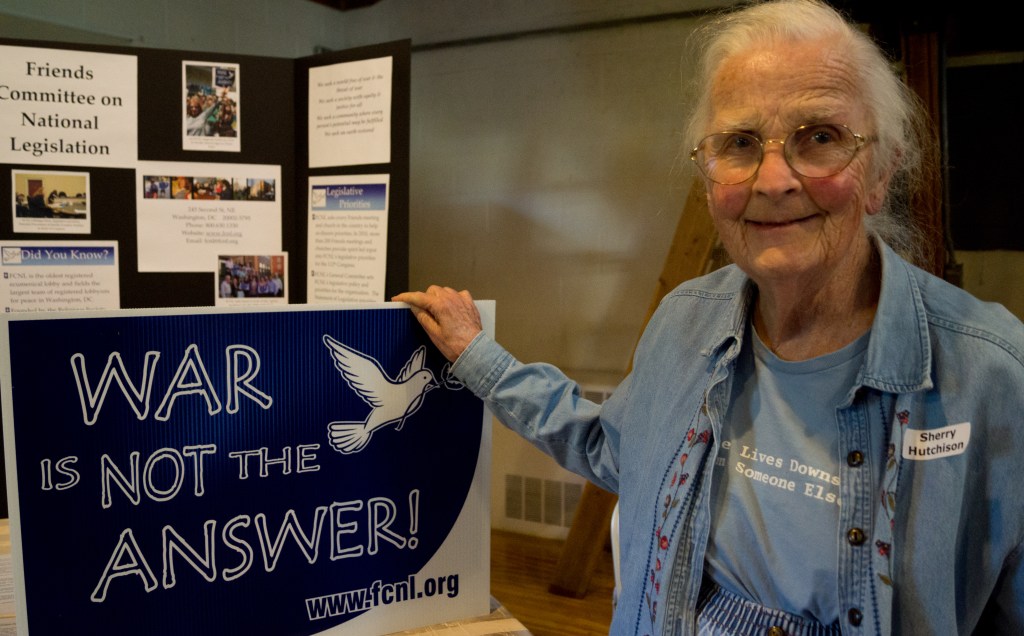
This photo was taken during a demonstration to bring attention to Israeli militarism. Christine Ashley, then head of Scattergood Friends School, offered to take the Iowa Yearly Meeting (Conservative) Peace and Social Concerns Committee to Iowa City for this demonstration in 2014. This occurred at the time when we were holding our annual sessions at the school. The sign I’m holding is from an American Friends Service Committee (AFSC) campaign to call attention of military spending and its consequences. That is a picture of a drone on the sign. You can see a War Is Not the Answer sign in the background, as well as a button on my camera strap, which I have been wearing for many years.
The peace and social concerns committee asks the clerk of Iowa Yearly Meeting (Conservative) to mail the following letter to our Congressional delegations.
Jeff Kisling and Sherry Hutchison, co-clerks [Note: the photo below is of Sherry Hutchison]
The Israeli government, with U.S. aid, now has the most powerful military in the Middle East. In 2008 Israel attacked Gaza, with 1400 civilian casualties. In 2013 Israel attacked Lebanon, with 750 civilian casualties. Currently Israel is engaging in a massive military siege of Palestine, with over 800 civilian deaths so far. All three of these Israel assaults have involved devastating destruction of schools, hospitals, power plants, and other infrastructure.
Tragically, we the American taxpayers are paying for this human rights travesty. Israel receives 9.9 million U.S. dollars each day in military aid from us. This makes it our largest aid recipient in the world. While Americans are struggling to make ends meet and our government struggles to maintain our own infrastructure, we are subsidizing Israel to conduct activities in direct opposition to international law.
We ask that no more military aid be given to the Israeli government.
Iowa Yearly Meeting (Conservative) 2014
Sherry Hutchison
Drone terrorism
Recently Russia has begun to use weaponized drones against Ukraine. I remember how devastated I was when I learned of how people, how the children in Iraq and Afghanistan were terrorized by the sounds of drones circling overhead. Knowing an attack could be triggered at any moment, with untold numbers of civilian casualties. Death by remote control.
In a recent news story, a reporter from NBC News spoke about this, about how unnerving it was to hear the sounds of the drones overhead.
It was fascinating to learn how a drone strike helped trigger the formation of Des Moines Mutual Aid, which has been the focus of my work for the past two years.
One year ago today (January 2021) Des Moines Mutual Aid participated in a march protesting the potential for war or increased hostilities with Iran that followed the fallout of the assassination of Qassem Soleimani by drone strike in Baghdad.
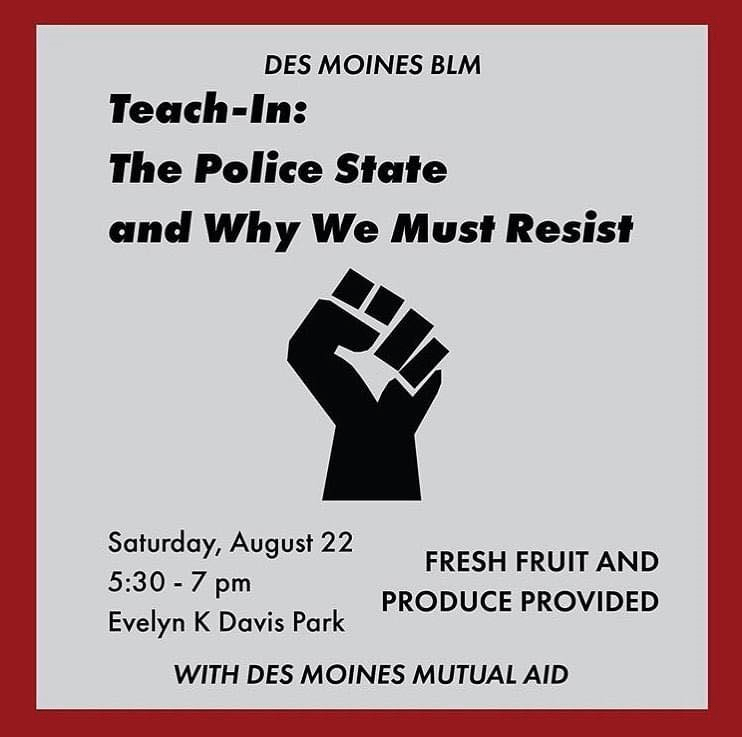
This was our first “public” event since adopting the name Des Moines Mutual Aid, a name we gave our crew during our growing work with our relatives at the houseless camps throughout the city and our help with coordinating a weekly free grocery store that has a 50 year history, founded by the Des Moines Chapter of The Black Panther Party For Self Defense.
A year ago we started laying the foundation for work we had no idea what was coming. As we were adjusting our work with the camps and grocery re-distribution in response to the Covid-19 pandemic, both that continued to grow in need and importance, the police continued their jobs and legacy of brutality and murder.
This nation exploded in righteous rage in response to the pig murders of Breonna Taylor and George Floyd. DMMA realized we were in a position to organize a bail fund to keep our fighters out of jail, both to keep the streets alive as a new phase of The Movement was being born, and because jails are a hotspot of Covid-19 spread. Not to mention the racial and economic oppression that is the cash bail system.
In the past year DMMA has expanded its work in multiple directions and gained many partners and allies.
We partnered with the Des Moines Black Liberation Movement to create the DSM BLM Rent Relief initiative to help keep families in their homes in the midst of a pandemic and the winter.
The camp work has grown exponentially, but is being managed with our collaboration with Edna Griffin Mutual Aid, DSM Black Liberation Movement, and The Great Plains Action Society.
The bail fund remains successful because of desire from the public and a partnership with Prairielands Freedom Fund (formerly The Eastern Iowa Community Bond Project).
The weekly free food store has maintained itself, carrying on the legacy it inherited.
Every one of our accomplishments are directly tied to the support of so many people donating time, talent, and funds to the work. We are overwhelmed with all of your support and hope you feel we are honoring what we promised.
All of these Mutual Aid projects are just a few of many that this city has created in the last year in response to the many crises we face, not only confronting the problems and fulfilling the needs directly in front of us, but creating a sustainable movement that will be capable of responding to what’s next and shaping our collective futures as we replace the systems that fail us.
These last 12 months have been wild and a real test of all of our capabilities to collectively organize. But it is clear that we as a city have what it takes to do what is needed in 2021, no matter what crisis is next.
Something that’s always been below the surface of my consciousness is that the root of our social and political problems is inadequate education. It’s not “I know if people understood ______ issue”, they would agree with me. I know I’m not always right. There are so many things we can have honest disagreements about. But you cannot have such discussions with people who refuse to accept basic facts and reasoning. It is about not falling for disinformation. It’s about critical thinking. It’s a real problem when emerging school policies are intended to make it impossible for students to be able to think critically.
At Scattergood Friends (high) School the focus is on preparing students to be lifelong learners. Which means developing critical thinking skills. At the Kheprw Institute, a youth mentoring community, the students are taught to be critical thinkers.
Rapidly emerging educational policies are intended to make students NOT think critically. Banning books! I never thought I’d see the day. Telling teachers they aren’t allowed to teach about racism, sexual orientation, or gender identity.
I was intrigued when I saw the article ‘How Do We Teach the Critical Skills Needed to Face Collapse?” by Dave Pollard, How To save the world, September 10, 2022. He goes into some detail about these skills, but for now I’ll just list the soft skills and hard skills he says we need to face collapse.
So civilization, at least as we know it, is going to collapse — political, economic, social, educational, health, transportation, technological systems all will fail, a bit a first, and then more and more.
We have no idea when it will be complete — could be in 10 years, or in 40. We have no idea how it will play out — how quickly, where first, what systems and governments will go first.
We don’t even know how people will react to this Slow (and Permanent) Emergency. So how can we possibly prepare for it?
I think the best answer to this is to teach a lot of people a lot of skills, hard and soft, that they don’t currently have, so that we’re kind of ready for anything. Here’s a list of ten possibly critical soft skills, and ten possibly critical hard skills, that very few of us (in most countries) are competent at at the moment. The ones in italics are, IMO, those that it is important that most people learn; for the remainder, it’s important that some people in each community be very competent at them:
Soft skills
Critical thinking
Group facilitation
Helping people cope
Preparing healthy food
Caring for the young, old, and sick
Imaginative, reflective and creative skills
Mentoring
Listening, noticing and attention skills
Conversation
Community-building
Hard skills (that require some specific technical knowledge/experience
Growing and harvesting food
Making and repairing clothing and shelter from the elements
Accessing clean, safe water
Weaving, fabric-making, pottery and other crafting skills tha that make life much more pleasant and comfortable
Medical, medicinal, and injury-healing knowledge and skills
Food preservation
Bicycle construction and repair
Basic engineering skills
Ecological skills
Decommissioning-nuclear reactors and petrochemical sites
Building Communities-The Vision
For years I’ve been thinking about how to build communities as collapse occurs. I’d thought there would be millions of climate refugees moving inland in the country as their homes and communities are ruined by rising sea levels, severe storms, drought, collapsing infrastructure and social systems. It’s clear now that no place will really be safe. Here in the Midwest we’ve had severe flooding, drought, and strong storms.
We need to build model sustainable communities. There have been numerous such experiments in intentional community. But this model must be created with the intention of being replicated many times over with minimal complexity, using locally available materials—a pre-fab community.
Pre-fab components
Community hub with housing and other structures
Simple housing
Straw bale houses
Passive solar and solar panels
No kitchens, bathrooms or showers (community ones instead)
Stores, school, meetinghouse
Central kitchen, bathrooms and showers
Surrounding fields for food and straw
Water supply
Wells, cisterns and/or rain barrels
Power
Solar, wind, hydro, horse
Manufacturing
3 D printing
Pottery
Sawmill
Communication
Radio, local networks
Transportation
Bicycles
Horses
Pedal powered vehicles
Medical
Stockpile common medications
Essential diagnostic and treatment equipment
Medical personnel adapt to work in community
Spiritual
Meeting for worship
Meeting for business
Religious education
I plan to write more about critical thinking soon.
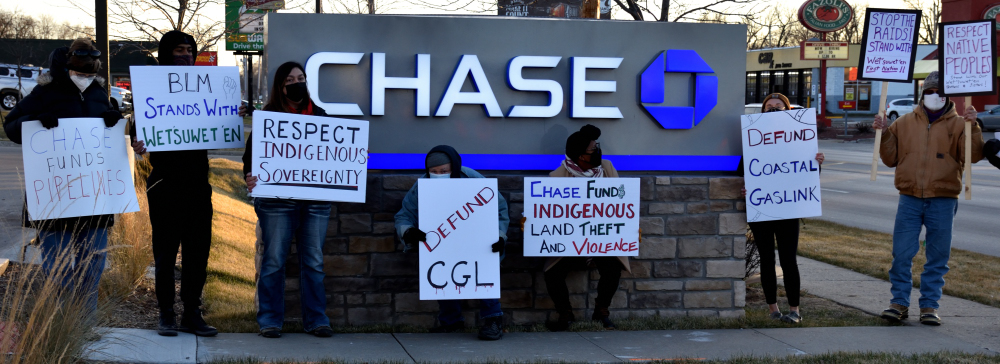
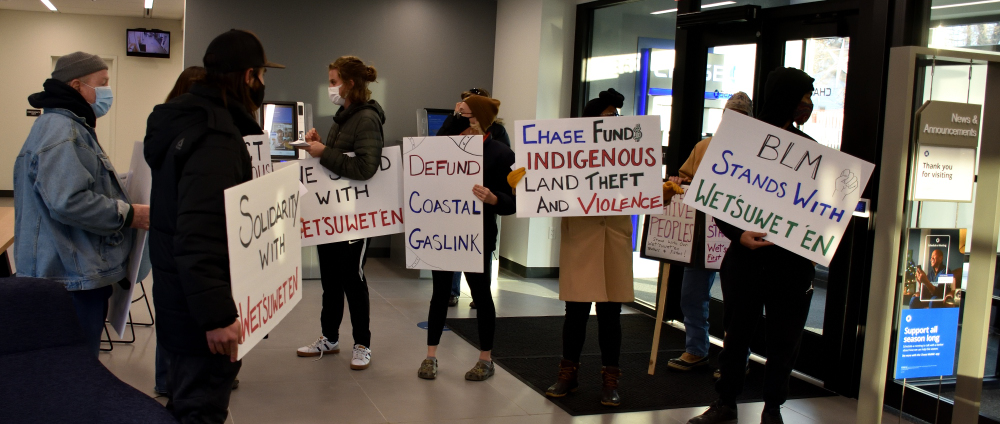
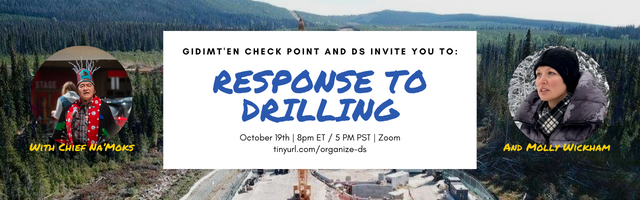
Yesterday I wrote about a solidarity organizing call to support the Wet’suwet’en peoples that will occur this Wednesday, October 19, 2022. Yesterday’s post included links to the many articles I’ve written over the past several years in solidarity with the Wet’suwet’en peoples’ struggles to protect their lands from the construction of the Coastal GasLink pipeline.
But we are all suffering the injustices of the fossil fuel industry’s rape of Mother Earth.
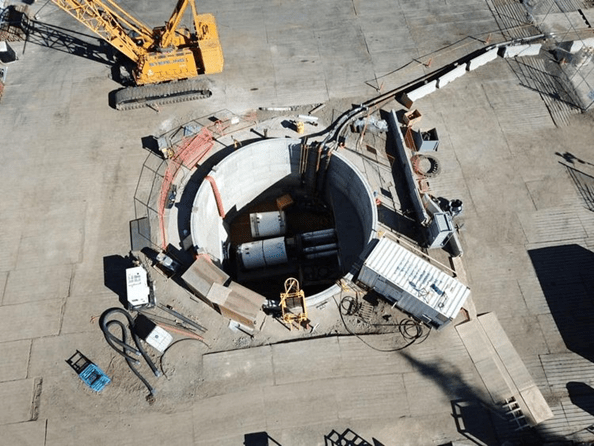
The drilling under the Wedzwin Kwa has begun, bringing greater urgency to stop the pipeline construction. It is heartbreaking to watch Wet’suwet’en Chief Na’Moks see the gigantic pipeline hole in this video.
Please watch Wet'suwet'en Chief Na'Moks as he finally is allowed to view a gigantic pipeline hole gouged illegally out of the Indigenous territory where he and his people have lived for thousands of years.
The struggle of the Wet’suwet’en and the solidarity actions must also be seen in the broader international context. In the past year we have seen mass movements erupt in country after country—in Hong Kong, France, Catalonia, Haiti, Chile, Bolivia, Ecuador, Lebanon, Iraq, and Iran, to mention a few. We also saw the mass climate change protests and movements that swept the world, including a large demonstration in Toronto and a truly massive one in Montreal.
For the Wet’suwet’en, other Indigenous communities, and their allies it’s not just about questions of title and pipelines, but centuries of colonialism, subjugation, and genocide, as well as decades of austerity, growing poverty and inequality, the lack of jobs, unaffordable housing, and poor pay. Enough is enough—and after people saw the recent RCMP invasion of Wet’suwet’en lands, they had had enough.
The power of the people is on display across the world. There is a renewed sense of confidence in those fighting inequality and injustice and a growing realization that we are fighting against common enemies—the capitalist class and its state. The Wet’suwet’en are at the forefront of this struggle in Canada, literally on the front lines, and this is why many people—who face the same enemies—have come out to support them and join the fight.
Teaming up with Decolonial Solidarity, we have decided to merge our press conference with their organizing call on October 19th.I am writing to invite you to join us.
We need a large number of allies to carry our message. Drilling under Wedzwin Kwa is illegal and must stop. We are staying in this fight despite this setback.
The call will feature Wet’suwet’en hereditary chiefs statements as well as an invitation to settler allies to become accomplices.
My name is Jen Wickham, I am the Media Coordinator for Gidimt’en Checkpoint. I am writing you because you have registered for last summer’s Kill the Drill webinar.
Following the start of drilling under Wedzwin Kwa, a senior member of our community passed away. This has hampered our efforts to mobilize allies and delayed our press conference.
Teaming up with Decolonial Solidarity, we have decided to merge our press conference with their organizing call on October 19th.I am writing to invite you to join us.
We need a large number of allies to carry our message. Drilling under Wedzwin Kwa is illegal and must stop. We are staying in this fight despite this setback.
The call will feature Wet’suwet’en hereditary chiefs statements as well as an invitation to settler allies to become accomplices.
The government of BC has acted in bad faith and failed to meet its obligations under the memorandum of understanding they signed in 2020.
Funders of this project have repeatedly peddled lies about its legitimacy. Not least the fact that the 20 First Nations it holds up do not have jurisdiction over the pipeline-crossed land.
Together, we will stop this pipeline and assert Indigenous rights in the face of overwhelming greed and corruption of the Canadian government.
Rather than dwelling on all the current and oncoming catastrophes, we can recognize the crossroads we are at, and choose to live in a better way.
We only have a finite amount of energy personally and must use it wisely. I’m led to believe we should stop wasting energy trying to make incremental changes in existing systems of oppression. And instead turn our attention and energy to building more just alternatives. Living out our spiritual guidance.
I’m of the firm opinion that a system that was built by stolen bodies on stolen land for the benefit of a few is a system that is not repairable. It is operating as designed, and small changes (which are the result of huge efforts) to lessen the blow on those it was not designed for are merely half measures that can’t ever fully succeed.
So, the question is now, where do we go from here? Do we continue to make incremental changes while the wealthy hoard more wealth and the climate crisis deepens, or do we do something drastic that has never been done before? Can we envision and create a world where a class war from above isn’t a reality anymore?”
Ronnie James, Des Moines Mutual Aid
As Grace Lee Boggs writes below, “it is about acknowledging that we Americans have enjoyed middle-class comforts at the expense of other peoples all over the world.” We, especially White Quakers, can end our complicity in the systems of oppression, colonialism, and White supremacy.
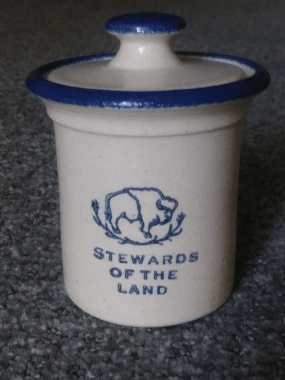
I’ve been blessed to be part of several communities building such alternatives. These include the Kheprw Institute, Des Moines Mutual Aid, and the Buffalo Rebellion.
These experiences have helped me understand something black, Indigenous, and other people of color (BIPOC) have always known. That the systems of racial capitalism and white supremacy have never worked for anyone who is not a wealthy white male.
Robyn Maynard and Leanne Betasamosake Simpson have succinctly captured what needs to happen in their book Rehearsals for Living (Abolitionist Papers).
In my mind, Indigenous nations, Indigenous homespaces, Indigenous homelessness must be engaged in a radical and complete overturning of the nation-state’s political formations and a refusal of racial capitalism. My vision to create Nishnaabeg futures and presences must structurally refuse and reject the structures, processes and practices that end Indigenous life, Black life and result in environmental desecration. This requires societies that function without policing, prisons, and property.
Nishnaabeg formations of nationhood mean a radical overturning of the current conditions and configurations within which we live—an absolute refusal of capitalism.
Maynard, Robyn; Simpson, Leanne Betasamosake. Rehearsals for Living (Abolitionist Papers) (p. 125). Haymarket Books. Kindle Edition.
What we need now are societies that function without policing, prisons, and property. That is how we build alternatives to what is collapsing. Owning land, property is not an Indigenous concept. The commons are meant for community use.
Property is the basis for accumulation of wealth.
Policing is how this concept of property is protected.
Prison is how those who threaten property and landowners are removed from society.
The next American Revolution, at this stage in our history, is not principally about jobs or health insurance or making it possible for more people to realize the American Dream of upward mobility. It is about acknowledging that we Americans have enjoyed middle-class comforts at the expense of other peoples all over the world. It is about living the kind of lives that will not only slow down global warming but also end the galloping inequality both inside this country and between the Global North and the Global South. It is about creating a new American Dream whose goal is a higher Humanity instead of the higher standard of living dependent on Empire. It is about practicing a new, more active, global, and participatory concept of citizenship. It is about becoming the change we wish to see in the world.
The courage, commitment, and strategies required for this kind of revolution are very different from those required to storm the Winter Palace or the White House. Instead of viewing the U.S. people as masses to be mobilized in increasingly aggressive struggles for higher wages, better jobs, or guaranteed health care, we must have the courage to challenge ourselves to engage in activities that build a new and better world by improving the physical, psychological, political, and spiritual health of ourselves, our families, our communities, our cities, our world, and our planet.
Grace Lee Bogg. The Next American Revolution
How can Friends achieve the 2022 theme of World Quaker Day, “Becoming the Quakers the World Needs,” while functioning in a blatantly and politically corrupt, racialized world? In engagement with this exciting theme, offered by the Friends World Committee for Consultation (FWCC), the Black Quaker Project would like to remind Friends of the tools at our disposal to challenge those aspects of society which we wish to change and to see changed. Our fractured societies are further divided by enormous gaps of inequality in almost every imaginable category—psychological, social, political, cultural, economic. How might we, as Quakers, achieve justice, equity, and peace under these circumstances?
The Black Quaker Project
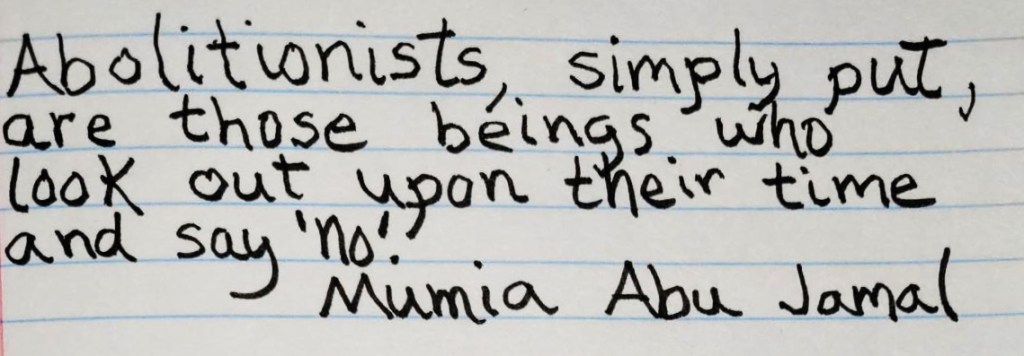
In late 2020, the two of us wrote an article for this magazine, called “Abolish the Police.” Through writing the piece, we realized we wanted to convene a larger space where Friends with an interest in police and prison abolition could have conversations with one another. Quaker abolitionists today face major pushback from our Meetings; we hoped that drawing Friends together would support and strengthen our work.
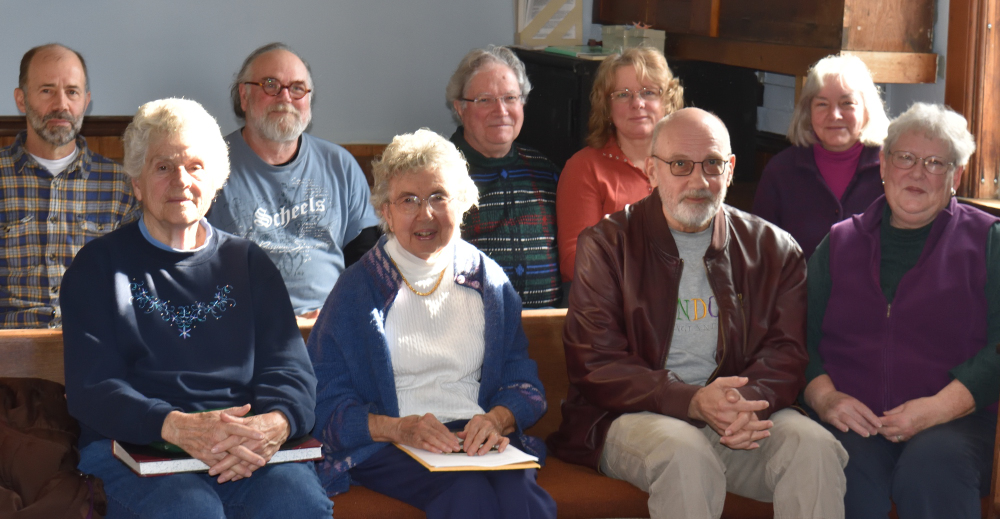
In this context, the Quakers for Abolition Network is being born. We are a collection of Friends from at least five Yearly Meetings; we range in age from high school to our 80s; we are disproportionately queer and trans. While AFSC and FCNL staff are participating, this is a grassroots project without any formal connections to existing organizations. We are in the process of defining our mission statement, structure, and our methods for addressing white supremacy when it shows up in our work, while building relationships with each other as we go. Below, four Friends write about their approaches to abolition, their lessons, and their visions for where Quakers might be headed.
Jeff Kisling: Mutual Aid and Abolition
I grew up in rural Iowa, where there was very little racial diversity and interactions with police and the court system were rare. About ten years ago, I was blessed to become involved with the Kheprw Institute, a Black youth mentoring and empowerment community. I’ll never forget how shocked I was when a Black mother broke down in tears, explaining how terrified she was every minute her children were away from home. It was obvious that every other person of color in the discussion knew exactly what she was saying.
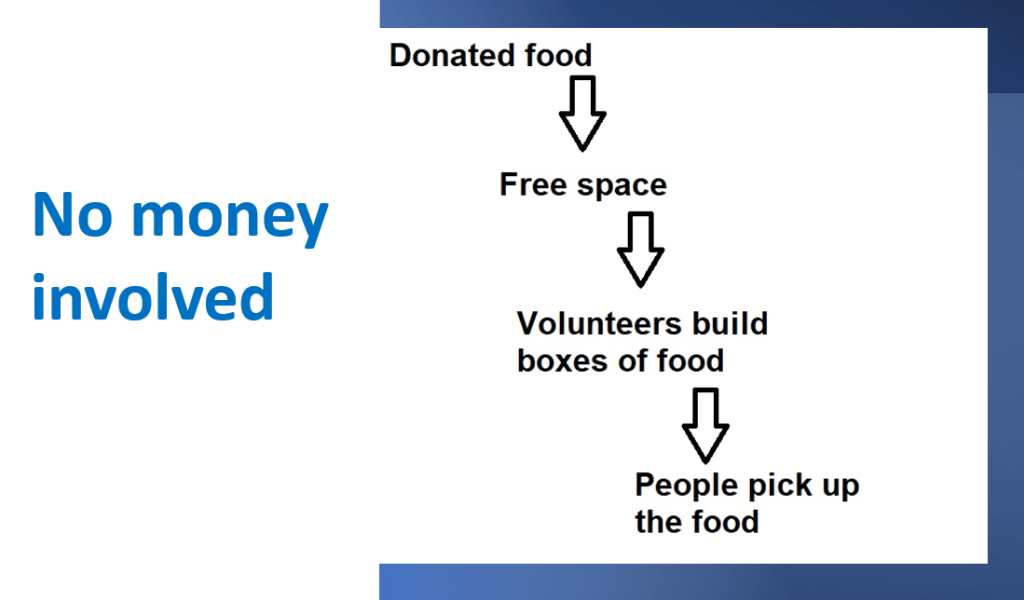
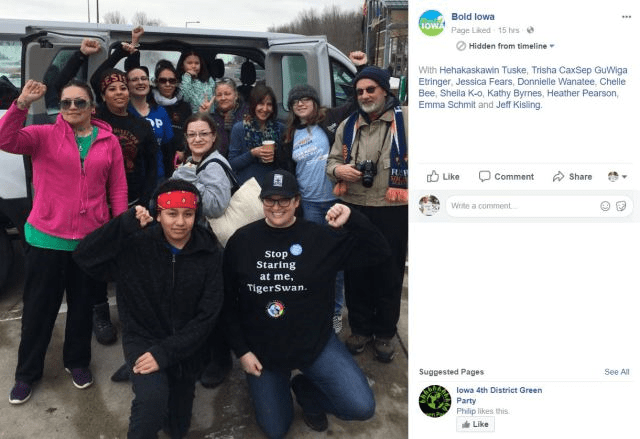
After retiring, I was led to connect with Des Moines Mutual Aid, a multiracial organization founded to support houseless people. For over a year, I’ve helped my friends fill and distribute boxes of donated food, while continuing to learn about the framework of mutual aid.
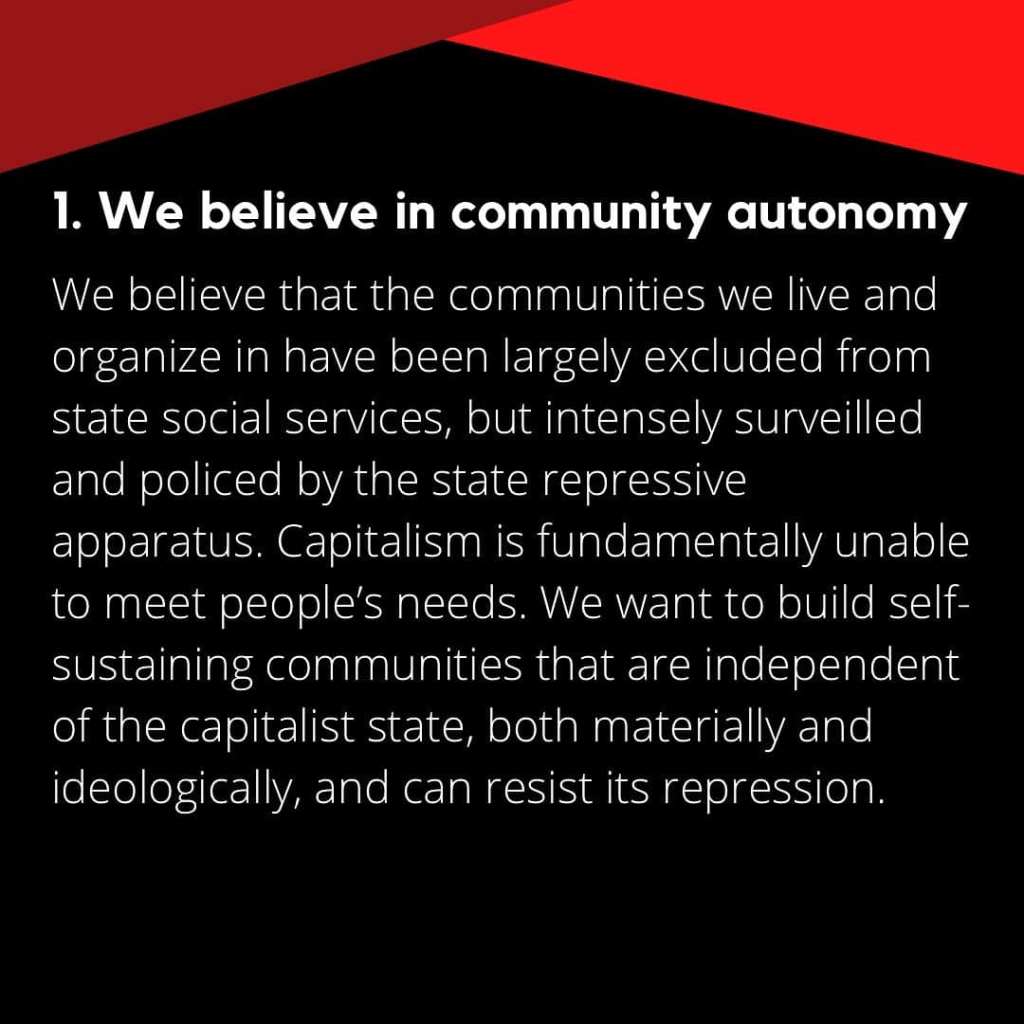
To me, mutual aid is about taking back control of our communities. Besides the food giveaway, we support houseless people and maintain a bail fund to support those arrested agitating for change. We also work for the abolition of police and prisons.
Mackenzie Barton-Rowledge and Jed Walsh: Introducing the Quakers for Abolition Network, Western Friend, Sept 2021
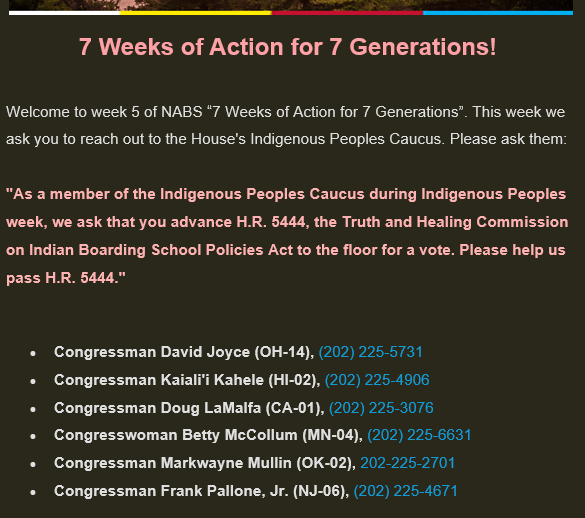
A fundamental principle of justice work is to follow the leadership of those impacted by the injustice. The 7 Weeks of Action for 7 Generations are what Native peoples are asking us to do to help them. This week we are asked to contact US House representatives belonging to the Indigenous Peoples Caucus.
I recently wrote about my friends at the Great Plains Action Society’s (GPAS) Open Letter Campaign: Truth and Healing with Friends. GPAS describes how their supporters can use the Friends Committee on Legislation’s (FCNL) online tools to help people write messages and send them to their representatives. This is a great collaboration between GPAS and FCNL that we can build upon.
Help us bring justice, accountability, awareness, and healing by telling the unvarnished truth about America’s history and genocide committed against Indigenous Peoples by way of Federal Indian boarding school policies. NABS asks us to please call members of the House’s Indigenous Peoples Caucus and request that they bring forward HR. 5444, the Truth and Healing Commission to the floor for a vote #NABS #Time4Justice
MSNBC Symone Sanders, Indigenous Peoples Day NABS Interview
NABS Creative Director Kenrick Escalanti spoke with Symone Sanders of MSNBC today on Indigenous Peoples Day to discus the history of the U.S. Indian Boarding School Policies and what needs to be done to pass House Bill H.R. 5444 and Senate Bill S.2907 the Truth and Healing Commission on Indian Boarding School Policy Act.
Recently when I wrote about life without a car, I said being led to live without a car and struggling to convince others to not use fossil fuels were the most important spirit-led actions of my life. This is a continuation of the discussion of life without a car.
My grandmother, Lorene Standing, said the will of God is often revealed in a series of steps. Which was the case related to my spiritual leadings to reduce greenhouse gas emissions. Earlier I wrote about the beginnings of my spiritual guidance regarding our environment. But there were many times as life went on when I relied on that and further guidance. The series of steps along the way.
But there were also times when I somehow got off the right path of this journey. I made a lot of mistakes related to this over the years. Among other things, this created a great deal of tension with my Quaker meeting.
It wasn’t that members of the meeting weren’t concerned about Mother Earth. They were concerned and did many things to reduce their carbon footprint and pollution.
But I believed transportation was the single greatest contributor to greenhouse gas emissions that we had personal control over. It was a matter of scale. Emissions from even the minimal use of cars dwarfed the total emissions saved by all other efforts, such as turning off lights, reducing the use of heating and air conditioning, etc., combined. It was disconcerting to see Friends and others using air travel. The skies were full of planes.
There was also collateral damage related to fossil fuel transportation. Urban sprawl was premised on the use of cars for all transportation, including to work, school, grocery, church, healthcare, sports, and entertainment. That would not have occurred, at least to the extent is has, if we had focused on mass transit instead of personal automobiles.
Our communities would not have been fractured as they were when people drove to the suburbs and stayed in their homes when they got there. Not knowing their neighbors, not having a sense of community. Investing in armed police and prisons for a false sense of security. Spending incomprehensible amounts of money for a false sense of national security. And the greater horror of squandering the lives of soldiers on both sides of conflicts. So many civilian casualties. Crushing our souls.
Most importantly, we would not be facing the existential environmental crisis we are in now.
And the U.S. armed forces are the single greatest source of pollution.
Most importantly, we would not be facing the existential environmental crisis we are in now. With the strong storms, flooding, savage wildfires, heat and drought. Leading to mass migration, famine and deaths.
The root of the tensions with my Quaker communities was that many members lived in rural areas, small towns, or cities with no public transportation.
Indianapolis had a public bus system that wasn’t highly rated. The bus routes didn’t cover large areas of the city, didn’t operate during the night, and often not on weekends. They were often not on time.
So it is a paradox that I rarely used Indianapolis’s public transportation system, in part for the reasons mentioned above while being a strong advocate for mass transit. But these problems all need to addressed. Perhaps the most important thing we can do for Mother Earth is create good public transit systems. And stop military operations.
To live without a car, I had to carefully plan where I lived. There needed to be a grocery store and laundry within walking distance. And be within walking distance of the hospital I worked at.
I had to carefully choose the food I bought, limited to the weight and bulk I could walk with. That meant things like rice and not boxes of prepared foods. Another advantage was that also meant I had little trash.
I won’t deny it was often difficult to not have a car. Walking in inclement weather was a challenge. Sometimes I would just be tired. When I did use the bus system, the buses were often not on time. These were times when I would ask for some spiritual support. Some of the small steps my grandmother spoke of. Sometimes I’d receive that support, other times not.
There are many ways not having a car was a blessing. As I walked to and from work, I began to notice flowers and views. The more closely I paid attention, the more detail I saw. I began to carry my camera with me. It soon got to the point that I had to leave a little extra early for work, to account for the time taking the photos.
And there were many times I would run to the places I was going to. Besides my nearly daily runs for pleasure and fitness.
What did I think people in rural areas could do? The easiest would be to plan trips so multiple things could be accomplished on each. Friends were doing this. Friends could also coordinate trips with each other.
Rural towns could create inter-city transportation using school buses or electric vehicles.
People could install renewable energy systems. Perhaps community renewable systems. Including the meetinghouse.
Use electric powered vehicles or perhaps a return to animals to move things around the farm, pull plows in the fields.
These conversations went on for all of my adult life.
Invite the meeting into my concern
Finally, a f/Friend asked me if I had invited the meeting into my concern. And I realized I had not. We had fallen into a pattern of my expressions of concern, and often irritation actually. The physical separation didn’t help. I lived in Indianapolis my whole adult life.
With this change in perspective, and spiritual guidance as we considered this together, worshipped together, we came up with a statement (minute) we referred to as “ethical transportation”. We asked the yearly meeting (Iowa Yearly Meeting Conservative) to consider the minute, which was approved by the Yearly Meeting (below).
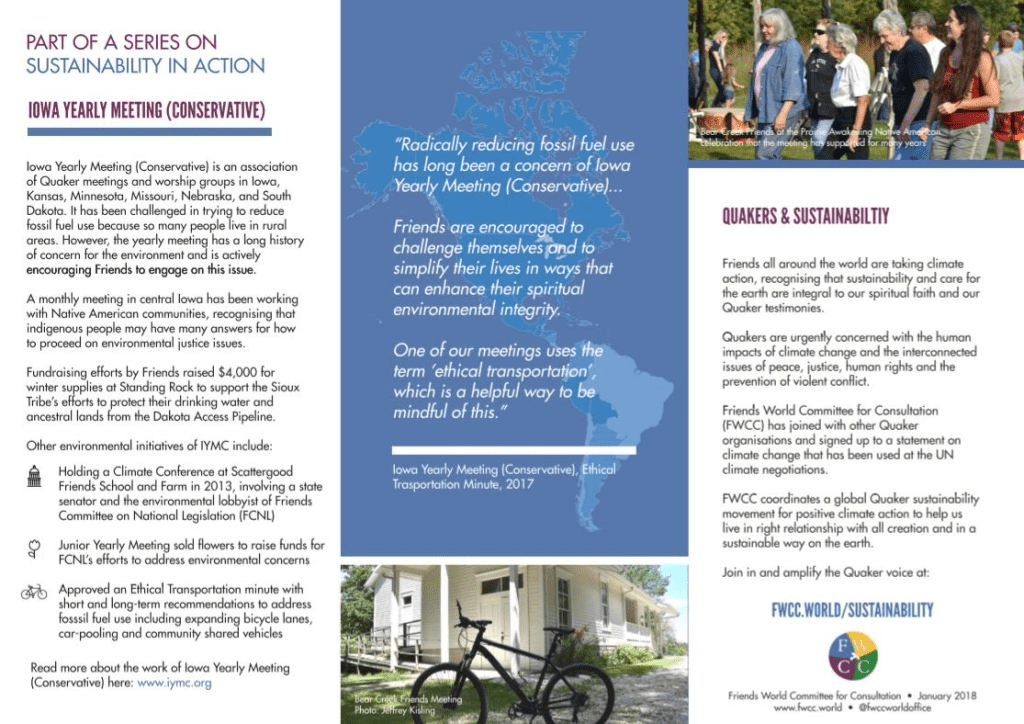
Our Yearly Meeting has approved other minutes related to our environment. In 2015 we approved this minute.
Minute
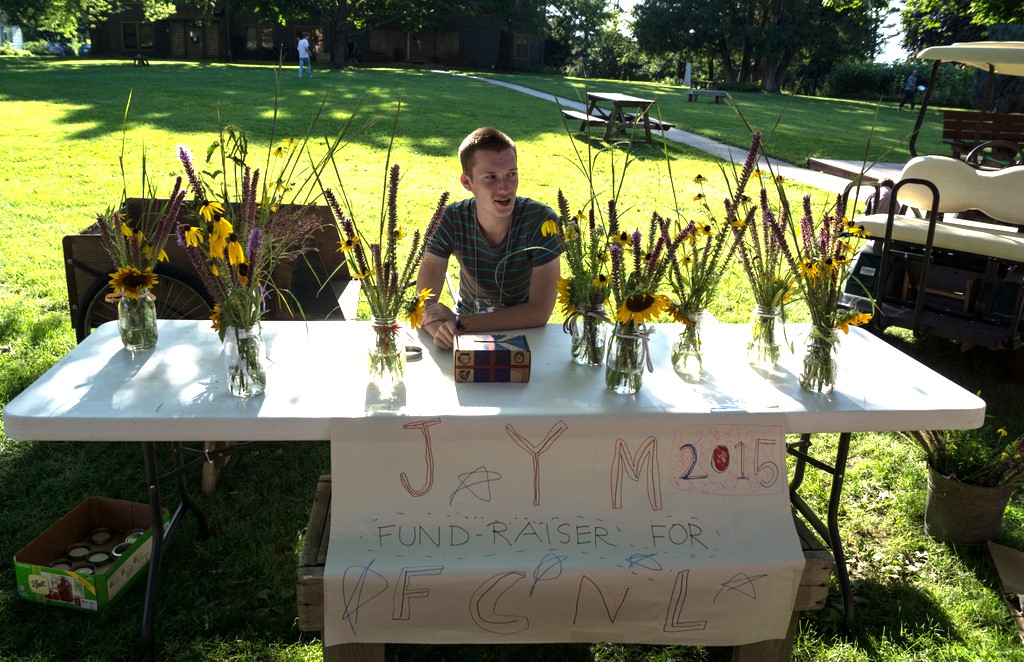
We are deeply moved and appreciate the contribution of Junior Yearly Meeting to our ongoing concern regarding changes in our environment. Their project to raise funds for FCNL’s efforts to address environmental concerns by selling flowers was both spiritually and artistically beautiful.
Junior Yearly Meeting sells flowers from the Scattergood prairie to raise money to support FCNL’s work related to our environment
And this was included in the approved Peace and Social Concerns Committee report.
We are exploring concerns of our younger Friends. Junior Yearly meeting at this Yearly Meeting are concerned about greenhouse gas emissions and rebuilding infrastructure in countries ravaged by war.
Queries
It would have been good if we had reached the point of inviting the meeting into my environmental concerns much sooner than we did. We have a practice that might have helped, which is consideration of queries (questions) related to various parts of our Quaker community lives. There are twelve sets of queries, so commonly each meeting considers one set of queries each month.
“This is my commandment: Love one another as I have loved you.” John 15:1
ADVICE
It is sometimes difficult to remember that love is a gift of the Divine Spirit and not simply a human emotion. As imperfect human beings, it is not always possible for us to feel loving toward one another, but by opening ourselves to the Light Within, we can receive and give love beyond our human abilities.
Relationships among meeting members take time to evolve. Sometimes misunderstandings develop. When differences arise, they should not be ignored for the sake of superficial unity. We believe disagreements which might divide or disrupt a meeting can be resolved through human effort and divine grace, and may result in a stronger and more creative meeting. True harmony depends upon each persons deep respect of and faithful attention to the Divine Spirit within us all. We endeavor to practice humility, attempting to understand positions of others and being aware of the possibility that we may be mistaken.
It is the responsibility of the Ministry and Oversight Committee to be sensitive to needs which may arise. Others in the meeting may be equally concerned, and because of greater understanding in certain cases, be able to give counsel. In reconciliation of differences, a position not previously considered may prove mutually beneficial. At times it may be necessary to confront individuals whose behavior is disruptive. A clearness committee or professional help may be suggested in some situations. We must always remember the power of holding one another in the Light, and the healing that comes from forgiving ourselves as well as others.
QUERY
What can we do to deepen our relationships with one another? How does gender affect the way we relate to each other?
How does our meeting balance the needs for honesty and kindness? What topics do we avoid for the sake of “unity”?
When in conflict with others, do we cultivate a forgiving spirit? Do we look to that of God in ourselves and seek to address that of God in those with whom we disagree?
Ethical Transportation
Radically reducing fossil fuel use has long been a concern of Iowa Yearly Meeting (Conservative). A previously approved Minute urged us to reduce our use of personal automobiles. We have continued to be challenged by the design of our communities that makes this difficult. This is even more challenging in rural areas. But our environmental crisis means we must find ways to address this issue quickly.
Friends are encouraged to challenge themselves and to simplify their lives in ways that can enhance their spiritual environmental integrity. One of our meetings uses the term “ethical transportation,” which is a helpful way to be mindful of this.
Long term, we need to encourage ways to make our communities “walkable”, and to expand public transportation systems. These will require major changes in infrastructure and urban planning.
Carpooling and community shared vehicles would help. We can develop ways to coordinate neighbors needing to travel to shop for food, attend meetings, visit doctors, etc. We could explore using existing school buses or shared vehicles to provide intercity transportation.
One immediately available step would be to promote the use of bicycles as a visible witness for non-fossil fuel transportation. Friends may forget how easy and fun it can be to travel miles on bicycles. Neighbors seeing families riding their bicycles to Quaker meetings would have an impact on community awareness. This is a way for our children to be involved in this shared witness. We should encourage the expansion of bicycle lanes and paths. We can repair and recycle unused bicycles, and make them available to those who have the need.
Minute approved by Iowa Yearly Meeting (Conservative) 2017
1 . SET CONFLICT RESOLUTION GROUND RULES:
Recognize whose lands these are on which we stand.
Ask the deer, turtle, and the crane.
Make sure the spirits of these lands are respected and treated with goodwill.
The land is a being who remembers everything.
You will have to answer to your children, and their children, and theirs—
The red shimmer of remembering will compel you up the night to walk the perimeter of truth for understanding.
As I brushed my hair over the hotel sink to get ready I heard:
By listening we will understand who we are in this holy realm of words.
Do not parade, pleased with yourself.
You must speak in the language of justice.
Harjo, Joy. Conflict Resolution for Holy Beings: Poems. W. W. Norton & Company. Kindle Edition.
Aside from the spiritual leadings that guided me to my career, being led to live without a car and struggling to convince others to not use fossil fuels were the most important spirit-led actions of my life. This also created a great deal of tension with my Quaker meeting. I made a lot of mistakes related to this over the years. When I say “I made mistakes” that’s a clue that I didn’t always hear, or follow what the Spirit was guiding me to do.
Growing up on farms, I had the connections to the land and creatures and the cycles of the seasons common to farmers. Scattergood Friends School is on a farm, the name changed to Scattergood Friends School and Farm since I attended. Working on the farm was an important part of our education. Over the years this has expanded significantly. In the Sophomore year we raised pigs as part of our biology class.
Being led to live without a car was at the intersection of my foundational stories, my Quaker faith, protecting Mother Earth, and photography.
I am very grateful my parents chose to take us on camping trips across the United States for our summer family vacations, specifically selecting National Parks to camp in. Actually camping in the Parks was key to the whole experience. Our first camper was a King camper, which was an aluminum trailer with a canvas covered framework that unfolded to form the top half when we stopped at the campsite. Being in the woods, hearing the sounds of the wind and wildlife and the glacier streams rush over the boulders, feeling the cold at night, and smelling the pine trees made the experience so much better than traveling into the park during the day and returning to a motel at night.
Hiking through the meadows and forests and upon mountainsides with countless, stunning vistas, were life changing experiences for me. I was overwhelmed by the intense beauty. Rocky Mountain National Park was our favorite, and we returned there time and again as we were growing up. We quickly found that not many people traveled too far from the parking areas, and with even a short hike we were practically alone in the woods. Hikes of just a mile or two brought us to lakes, canyons, waterfalls, cliffs, meadows, snowfields, boulder fields, and rock walls to climb. Places we were able to appreciate alone.
Quaker worship was a natural extension of the quiet of the mountains.
I hadn’t reflected much on why we sought opportunities to be by ourselves in the mountains. It just seemed a much better experience that way. Now I think it was related to feeling closer to God when we were deep in the quiet of the forests. Having grown up in Quaker communities, I was used to worshiping in silence, as we do so we can hear the whisper of the Spirit. Being enveloped in the silence of the mountains was a natural extension of Quaker worship. Or rather, Quaker worship was a natural extension of the quiet of the mountains. Quiet rather than silence.
This was also a reciprocal relationship. I was always challenged to find ways to share my spiritual experiences with others. These experiences are ineffable, that is they can’t be adequately expressed with words. But art can often better express spirituality. So I hoped some of my photographs might show glimpses of the Spirit.
The writer’s lonely, harrowing struggle to give shape to his or her elusive vision of the world—to complete a book, to discover among the fragments of a thought or a dream the precise image needed to breathe life into a poem—is a familiar chapter in the annals of pain and grief.
How can we save the wilderness? I was a mountain climber whose affection for the high peaks had evolved gradually into political commitment to the cause of preservation. I was, too, a fledgling writer searching for direction. I knew the importance of craft, experience, doggedness, and the other familiar requisites for literary success, but I lacked vision—an understanding of my relationship to the world.
How could we convince lawmakers to pass laws to protect wilderness? (Barry) Lopez argued that wilderness activists will never achieve the success they seek until they can go before a panel of legislators and testify that a certain river or butterfly or mountain or tree must be saved, not because of its economic importance, not because it has recreational or historical or scientific value, but because it is so beautiful.
I left the room a changed person, one who suddenly knew exactly what he wanted to do and how to do it. I had known that love is a powerful weapon, but until that moment I had not understood how to use it. What I learned on that long-ago evening, and what I have counted on ever since, is that to save a wilderness, or to be a writer or a cab driver or a homemaker—to live one’s life—one must reach deep into one’s heart and find what is there, then speak it plainly and without shame.
Reid, Robert Leonard. Because It Is So Beautiful: Unraveling the Mystique of the American West . Counterpoint. Kindle Edition
One reason I began to write was to explore why I took a given photograph. I hadn’t appreciated this until I was repeatedly told the same thing, which is thata photograph can help the viewer see the subject in a way they hadn’t before. So as I prepare to shoot a picture, I think about what I am trying to show with it, how to compose it, and set the exposure and focus in such a way as to create the photograph as closely to the image I am envisioning, as possible.
Note that I said “envision”. I don’t take photos to be as realistic as possible, which would be like make a Xerox copy of a scene.
My hope is that some of my photographs might help others to see and understand the subject as I understand it, and may see/understand it differently than before viewing the photo.
One of the many things I’m learning from Indigenous ways is the Spirit is in all things, including animals, plants, water, sky and mountains. I felt this deeply when I was in the forests and mountains. I’ve heard others express this in various ways as feeling closer to God, and that was how I felt.
This spiritual connection I developed with the mountains, lakes and forests had profound consequences in my life.
When I moved to Indianapolis in 1971, the city was enveloped in smog. This was before catalytic converters, which began to appear in 1975. When I saw the polluted air, I had a profound spiritual vision of the Rocky Mountains being hidden by clouds of smog. The possibility that I would no longer be able to see the mountains shook me to my core.
Long’s Peak from Moraine Park, Rocky Mountain National Park, Colorado
I was thinking specifically about the photo above, and how terrible it would be to no longer be able to see Long’s Peak. Although I now have many photos of the same view, I was thinking of this black an white photo specifically when I had that vision even though the quality isn’t near what I get now with a digital camera. I developed the film and the print of this in a darkroom. This is the image connected to my vision.
From that moment on I saw cars as evil because of the damage they were doing. I decided I could not be part of that, and have lived without a car since then. I began my lifelong study of environmental science and work to try to bring awareness about the catastrophic damage being done to Mother Earth. Although I give thanks that catalytic converters took care of the visible smog, I knew of the continued damage and consequences of the tons of carbon dioxide and other gases coming from the exhaust of ever increasing numbers of cars.
I saw automobiles as the ‘seeds of war’. Many wars are literally fought over fossil fuel supplies. But these seeds of war are found in the way we live our lives.
“I told [the Commonwealth Commissioners] I lived in the virtue of that life and power that took away the occasion of all wars… I told them I was come into the covenant of peace which was before wars and strife were.”
George Fox
“Oh! that we who declare against wars, and acknowledge our trust to be in God only, may walk in the light, and therein examine our foundation and motives in holding great estates! May we look upon our treasures, and the furniture of our houses, and the garments in which we array ourselves, and try whether the seeds of war have nourishment in these our possessions, or not. Holding treasures in the self-pleasing spirit is a strong plant, the fruit whereof ripens fast.”
John Woolman
It was camping in the national parks, and spiritual connections to the lakes, forests, wildlife, sky and mountains, that made me become a lifelong environmental activist. And photography was how I tried to express that for myself, and others. I knew environmental damage from burning fossil fuels would damage the mountains, forests and rivers, so I tried to preserve those scenes with photographs. Significant damage will happen with higher air temperatures, forest fires, infestation with migrating insects, torrential downpours, and drought.
It is sad to think such photographs might be historic records of the way things used to be, and no longer are. This is actually one of the reasons I am led to write my foundational stories, wondering if I shouldn’t do more to use photography to try to create change.
Recently at the annual meeting of Iowa Yearly Meeting (Conservative) I was grateful to be asked to show my photographs during one of the evening programs. The program was titled “Finding Truth and Beauty.” For about an hour the meetinghouse full Quakers watched the slideshow of photos in silence. Then, as the slideshow continued, Friends (Quakers) were invited to share their thoughts, which many did. I was grateful for this experience of sharing photos that had a spiritual significance for me, with my Quaker community in the context of silent worship.
The last post concluded with how I ended up working in the Neonatal Intensive Care Unit at Riley Hospital for Children, Indiana University Medical Center, Indianapolis.
Research: Infant Pulmonary Function
After I’d been working in the NICU for about four years, a research position was created to work in the newly opened Infant Pulmonary Function Laboratory at Riley. I was encouraged to apply for the job, in part because of my NICU experience. I didn’t know exactly what I’d be doing, since it was a new position. I didn’t have much experience in medical research at that time although I did learn about medical engineering when I spent the summer before my Senior year at Scattergood working with Don Laughlin in his medical electronics lab at the University of Iowa Hospitals in Iowa City.
I taught myself the FORTRAN computer language at Scattergood. Studying calculus at Earlham College was also very valuable.
It would be a real financial hardship in that the salary was half of what I was earning in the NICU. That was because the position was paid from research grants. Despite that, and not knowing exactly what the position would involve, the Spirit left no doubt that I should apply for that position. I had finally found my career path. It was part of the plan that I had the prerequisites for the position.
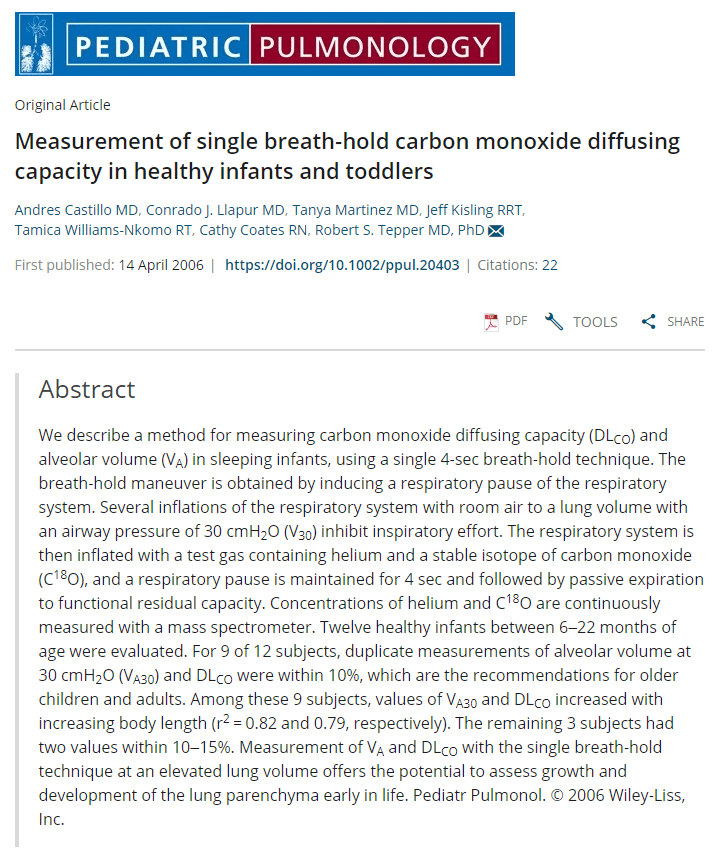
I wrote the computer software and engineered the hardware systems that allowed us to perform lung function measurements in infants. About fifteen years ago we developed a system that would measure lung diffusion in babies. That was a complex system that involved switching a number of valves at various times in the respiratory cycle, and using a mass spectrometer to measure gas concentrations of as little as hundredths of a percent. It took three years to get the system to work correctly. Ours was the only lab in the world able to perform such measurements in infants.
This editorial was about that research done by our lab with the lung diffusion system combined with molecular biology to identify the cells involved with the development of the pulmonary parenchyma in babies.






















 Quakers and Mutual Aid