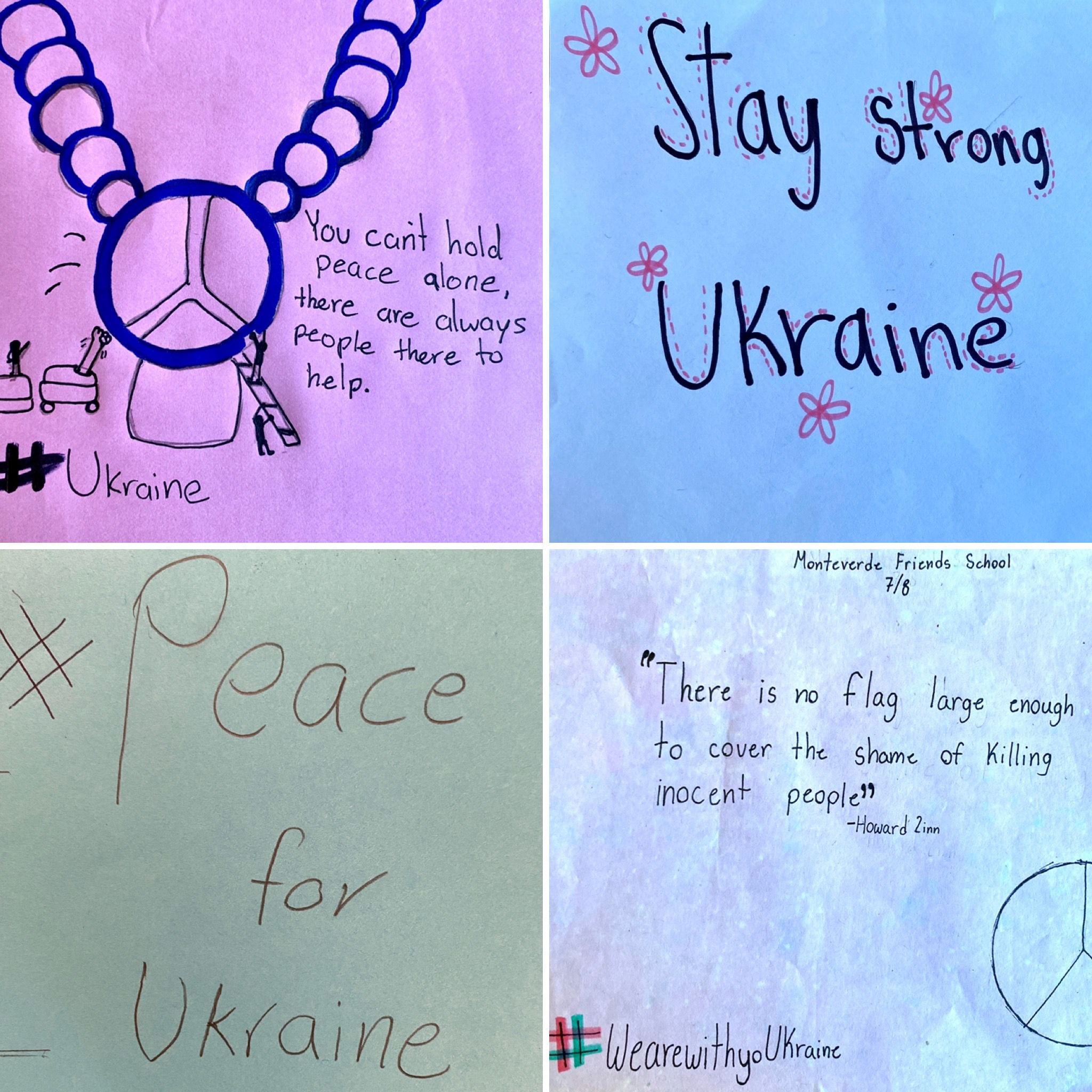
Spirituality over religion

People ask me if I believe in god… I tell them I pray to creator.
They tell me Jesus died for me… I tell them my ancestors did.
They say I will burn in hell for not following the Bible, but it has been used as weapon to colonize and murder my people…
for me it’s spirituality over religion. I don’t hate people for going to church, but I do hate what the churches have done to us…
before colonization we had our own ways and ceremonies, I choose the path of my ancestors.

Indigenous

I find myself in a spiritual crisis regarding Christianity. I realize being a Christian and professing to be a Christian are often not the same.

The Christianity I cannot be part of is the weaponized version of a religion. One that created and enforced the doctrines of discovery which gave permission to steal indigenous lands and instructed killing the people living on them. That codified white supremacy and empire. That drove global colonization.

One that raised great wealth from stolen lands and labor. And then built ostentatious churches in the midst of profound poverty.

One that tore native children from their families and took them far away, to places of forced assimilation where every kind of abuse was visited upon them. Where thousands died or were killed. And their families were often not even told of their deaths. Where other children were sometimes forced to dig the graves. The trauma passed from generation to generation. An open wound in Indigenous communities to this day that I have witnessed in my native friends. A wound that has been ripped open with the verification of the remains of thousands of native children. With many more places that haven’t been scanned yet.

Part of the reason for my crisis is reading “American Holocaust: Columbus and the Conquest of the New World” by David Stannard. Recent scholarship has revealed sophisticated Indigenous communities in the Americas prior to the arrival of white men. And much larger numbers of Indigenous people, millions more than previously thought. Meaning millions more deaths occurred.

American holocaust.

The destruction of the Indians of the Americas was, far and away, the most massive act of genocide in the history of the world.

Stannard, David E. American Holocaust: Columbus and the Conquest of the New World. Oxford University Press. Kindle Edition.

More often than we realize, in ways we don’t recognize, white Quakers continue to benefit from the American Holocaust. Continue white domination.

We made a small step in learning about land acknowledgements. But those are empty statements if we don’t take the next steps. We need actions, not more words.

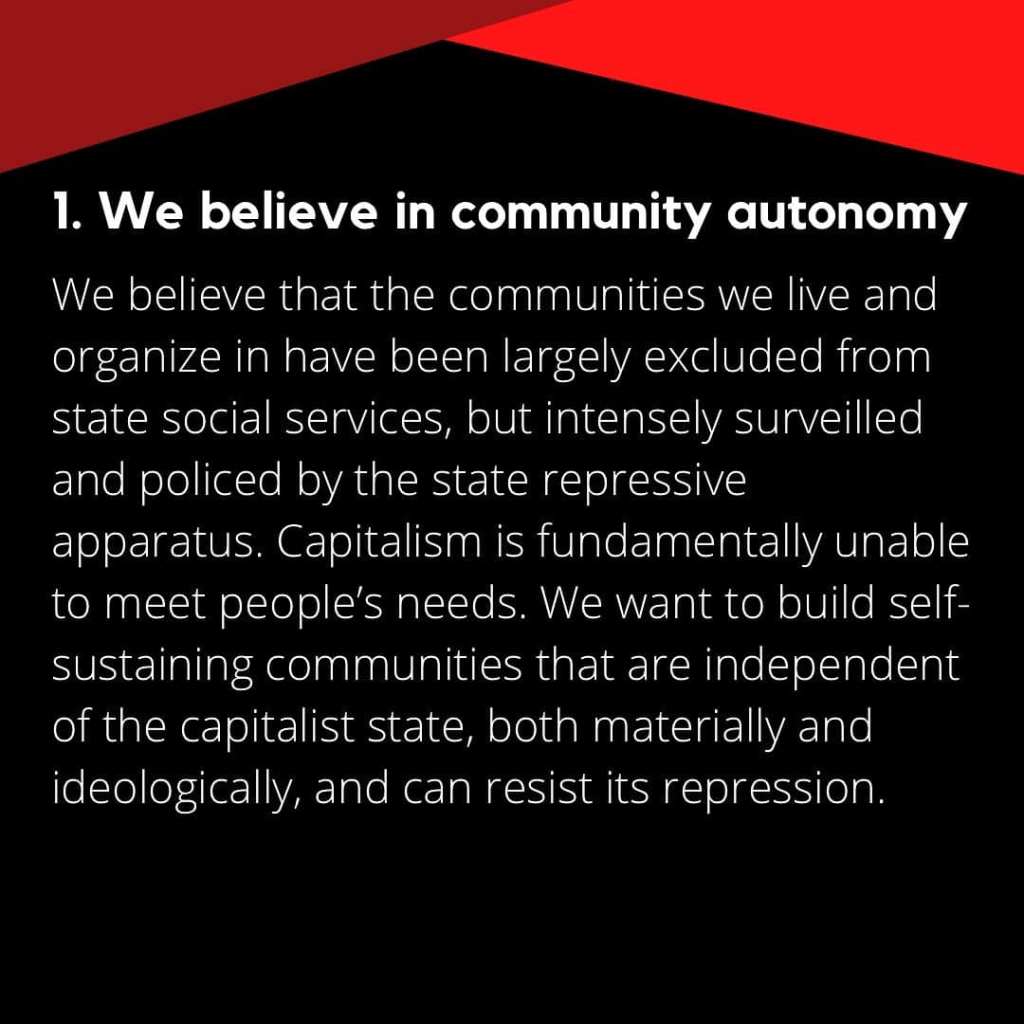
The reason I write and talk so much about my experiences with Mutual Aid is because that gets to the root causes of white supremacy. Mutual Aid exemplifies what Christianity is supposed to be. Mutual Aid is a means to begin decolonization.

As painful as it is, I know out of my confusion and distress, I will be led to a better place.

Real radicalism implores us to tell the whole ugly truth, even when it is inconvenient.

Brittney Cooper, Eloquent Rage: A Black Feminist Discovers Her Superpower (2018)
Illustrating the News

This article first appeared on The Daily Yonder and is republished here under a Creative Commons license.

Illustrating the News: What the Expanded Child Tax Credit Means for Rural Families

When the Child Tax Credit (CTC) was first expanded as part of the American Rescue Plan, the Daily Yonder assessed the impact of the the measure, using our customary mix of data-driven analysis and written commentary. We brought the same approach when the expansion was set to expire.
Now, as advocates and policymakers pursue options for keeping the expanded CTC in effect, we wanted to add another approach. Because number-crunching and political analysis aren’t for everyone, we asked Graphic Journalist Nhatt Nichols to lend her pad and pen to this issue, as she did previously with other American Rescue Plan projects.

Check out the comic below to catch up on what the expanded CTC has done for rural families and what’s at stake going forward.

comic panel depicts a family and reads: Before last year, the Child Tax Credit was a refund that came back to families once per year after they filed their taxes.

comic panel depicts woman working and reads: To receive the full credit for one child, households had to earn $12,000 or more.

comic panel depicts another woman working and reads: This translates into working at least 32 hours a week at minimum wage.

comic panel depicts despairing woman and reads: It did not fully phase in for a second child until a household earned over $21,000. That's over 58 hours a week at minimum wage.

comic panel depicts father and child and reads: Solo parents working for minimum wage, arguably the most vulnerable financially, often would not benefit from the credit for a second child.

comic panel depicts two children and reads: The American Rescue Plan Act temporarily increased the amount from $2,000 per child to $3,000.

Comic panel depicts a house and reads: And it lowered the bar so that families that did not meet the minimum earnings threshold could benefit from the child tax credit

Comic panel depicts a shopper holding a large stack of grocery items and reads: Most importantly, for paycheck-to-paycheck families it sent out monthly payments of $250 to $300 to help offset monthly bills

comic panel depicts pieces of bread and reads: These payments made a big difference for some families.

comic panel depicts person wading in water and reads: Household survey data from the Census shows that most West Virginia families used it to pay off debt, put food on the table, and buy clothing and other essentials for their kids.

comic panel depicts a pie with a slice cut out and reads: Rural counties benefitted from these changes more than metropolitan ones, as they make up 86% of those identified as being in persistent poverty by the USDA.

comic panel depicts children playing and reads: This translates into roughly 1 in 4 rural children living in poverty.

comic panel depicts a child reaching for food and reads: According to the Center for Budget and Policy Priorities, the changes raised an estimated 4.1 million children out of poverty.

comic panel depicts a sunflower field and reads: Meaning that more than a million rural children and their parents have benefitted from the expanded tax credit.

comic panel depicts small town buildings and reads: Ending the expansion will again widen the poverty gap between rural and metropolitan areas

comic panel depicts brother and sister embracing and reads: And could throw thousands of children back into crisis.

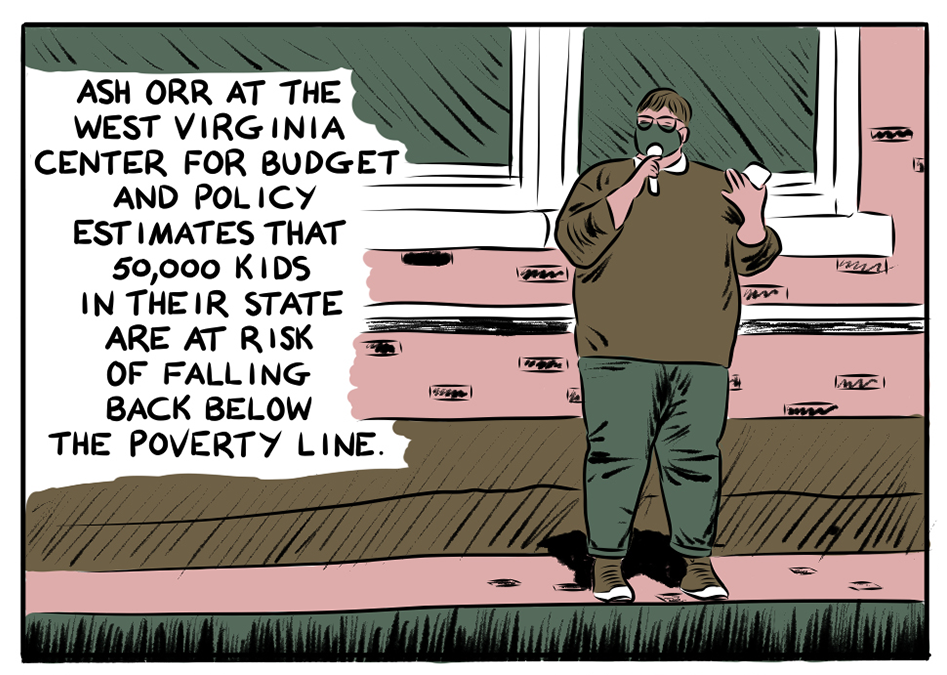
comic panel depicts a speaker on stage and reads: Ash Orr at the West Virginia Center for Budget and Policy estimates that 50,000 kids in their state are at risk of falling back below the poverty line.

comic panel depicts Ash Orr saying: Parents are having to make hard choices.

comic panel depicts Ash Orr saying: One family that I've spoken to has been using the CTC to pay for their daughter's medical care,

comic panel depicts Ash Orr saying: And without that money, they have to make hard choices between food and bills.

comic panel depicts a chicken coop and reads: Many families are in a worse position now than before the pandemic.

comic panel depicts a woman putting on a mask and reads: Food costs are rising, and not all jobs have returned for people who were laid off.

comic panel depicts state of West Virginia and reads: Ash says that in West Virginia, many jobs that have come back aren't safe for people who have health concerns.

comic panel depicts couple embracing and reads: And people are being forced to make hard choices between paying their bills or work that compromises their health.

comic panel depicts US Capitol dome and reads: The CTC expansion was set to remain in effect as part of the now dead Build Back Better bill, but activists hope that the fight isn't over.

comic panel depicts parent and child walking and reads: For families who've relied on it, there's a chance it will be included in a new bill this spring


This article first appeared on The Daily Yonder and is republished here under a Creative Commons license.

Transgress the Prison Walls

I just sat down after taking two letters to prison pen-pals to the mailbox and saw the article Abolitionist Efforts to Trangress the Prison Walls by Jaden Janak, Hood Communist, March 10, 2022. I don’t like to include too many quotes in my writing, but this article touches on many things I’ve been learning, much which is about Mutual Aid.

Through a close reading of Black Communist trans prisoner Alyssa V. Hope’s legal efforts and writings, this article unearths how a pen-pal relationship transformed into a comprehensive abolitionist community. This case study provides an example of how abolitionists are grappling with the need to support the material needs of marginalized communities while still building otherwise possible worlds separate from a failing welfare state. Mutual aid projects, like the one formed by Hope’s supporters, showcase that otherwise possible worlds are not only possible, but they are being created right now before us.

Abolitionist Efforts to Trangress the Prison Walls by Jaden Janak, Hood Communist, March 10, 2022

… it was not always this way, which proves it does not have to stay this way. 

What we have is each other. We can and need to take care of each other. We may have limited power on the political stage, a stage they built, but we have the power of numbers.

Those numbers represent unlimited amounts of talents and skills each community can utilize to replace the systems that fail us.  The recent past shows us that mutual aid is not only a tool of survival, but also a tool of revolution. The more we take care of each other, the less they can fracture a community with their ways of war

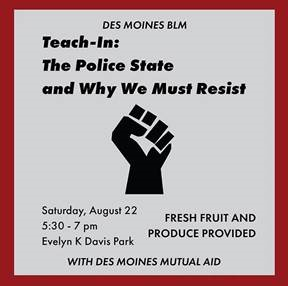
Ronnie James, The Police State and Why We Must Resist

The focus of the Transgress the Prison Walls article is on the writings of political prisoners, but much applies to prison pen-pal relationships with anyone who is incarcerated. I’ve become involved in the prison letter writing project of the Central Iowa Democratic Socialists of America. Not surprisingly, I found several of my Des Moines Mutual Aid friends are also involved.

I wrote the following based upon a sample letter.

As abolitionist organiser and theorist Mariame Kaba writes, “The work of abolition insists that we foreground the people who are behind the walls… That we transform the relationships we have with each other so that we can really create new forms of safety and justice in our communities.” (Duda/Kaba 2017) This solidarity takes many forms such as written correspondence via pen-pal pro-grams

Abolitionist Efforts to Trangress the Prison Walls by Jaden Janak, Hood Communist, March 10, 2022

More than a one-way exchange of sympathy, abolitionist solidarity operationalises mutual aid as a foundational modality for community building. Abolitionist mutual aid recognises the necessity of meeting immediate communal needs while also addressing deeper causes of violence: mechanisms of control, management, and punishment that structure everyday life (Spade 2020, 9). Historically, mutual aid communities have taken many forms including the 1969 Free Breakfast programs of the Black Panther Party in the United States and the maroon communities formed by free and escaped en-slaved people (Nelson 2011). In the 1950s and 1960s, health providers routinely refused Black patients and relegated Black people to sub-standard facilities (ibid., 24). To protest this treatment and provide for their community, the Black Panther Party of Oakland and other chapters around the nation and world opened People’s Free Medical Clinics that provided quality medical services free of charge to Black community members (ibid., 79). Mutual aid work, like that of the Black Panther Party, is not top-down charity. Rather, mutual aid projects “are an integrated part of our lives… and [they] cultivate a shared analysis of the root causes of the problem.” (Spade 2020, 28f.) Even as the welfare state continues to crumble, communities work together to meet each other’s needs while creating new relations of accountability and care in the state’s absence.

Abolitionist Efforts to Trangress the Prison Walls by Jaden Janak, Hood Communist, March 10, 2022

So, I work with a dope crew called Des Moines Mutual Aid, and on Saturday mornings we do a food giveaway program that was started by the Panthers as their free breakfast program and has carried on to this day. Anyways, brag, brag, blah, blah.

So, I get to work and I need to call my boss, who is also a very good old friend, because there is network issues. He remembers and asks about the food giveaway which is cool and I tell him blah blah it went really well. And then he’s like, “hey, if no one tells you, I’m very proud of what you do for the community” and I’m like “hold on hold on. Just realize that everything I do is to further the replacing of the state and destroying western civilization and any remnants of it for future generations.” He says “I know and love that. Carry on.”

Ronnie James, Des Moines Mutual Aid

Tool Libraries, Circular Economy, and Mutual Aid

Several years ago, a friend in Indianapolis started a tool library. He was supported by the Kheprw Institute community I was involved with.

That library included photography equipment. I liked the idea that those who couldn’t afford their own camera being able to check one out for a while. Besides taking personal photos, it could also be used for justice events.

iTooLL: Indy Tool Lending Library

iTooLL is a membership-based tool sharing project that makes audio, visual, creative, and event production tools available for just $1/week. As a member, you are also given direct purchasing power to fill the library with the tools you need.

Economic status should not determine Indianapolis art, culture, and entrepreneurship! For creatives, makers, organizers, and aspiring professionals alike, access to quality equipment can often dictate creative capacity, event effectiveness, and overall community impact. Equal access is key to amplifying diverse Indianapolis voices.

For the past two years I’ve been part of a Mutual Aid community and I see as a just alternative to capitalism. Tool libraries work within the context of Mutual Aid.

Based on principles and practices of resource use reduction, sharing, conviviality, solidarity, and mutual aid, the BTL can be considered a small-scale laboratory for a reorientation of society towards degrowth.

Brisbane Tool Library

I share here few key insights of my experience in being part of and contributing to the Brisbane Tool Library (BTL). Based on principles and practices of resource use reduction, sharing, conviviality, solidarity, and mutual aid, the BTL can be considered a small-scale laboratory for a reorientation of society towards degrowth. The most common understanding of a tool library is that it is a library for things, in which people can borrow tools, camping gear, kitchen appliances, and many other items. The work undertaken at the BTL since 2017, however, goes beyond lending items — it seeks to build systemic change.

The Brisbane Tool Library challenges the system’s misconception that quality of life rests solely on individual ownership of more and more things. It shows that we can meet people’s needs by prioritizing access over individual ownership. This enables a cultural shift towards an economy of sufficiency that nurtures limitation of private ownership as a cultural journey of plenitude. Additionally, by prioritizing access over ownership, tool libraries could also represent a way to reduce inequalities, in particular in cities. The Brisbane Tool Library, like many other tool libraries across the world (such as the Toronto Tool Library in Canada, Seattle Tool Library in the USA, Glasgow Tool Library in the UK Scotland, and La Manivelle in Switzerland) is based on a membership model, meaning that people pay a small annual fee that allows them to borrow various items through the year. 

The Revolutionary Power of the Real Circular Economy. How the Brisbane Tool Library provides an inspiring example of degrowth in action by Sabrina Chakori, Medium, 1/27/2022

The Brisbane Tool Library Inc. is a not-for-profit organization that is sustained by the voluntary contribution of its members. There are many different ways you can get involved and support this change with us. You can help out on a specific project or focus on specific tasks. If you don’t see anything interesting below, just reach out to us and we can discuss any ideas you have about how you can help.

Within the possible tasks we always need staff working at the tool library:

  • Checking in and out the tools that people borrow,
  • Testing & tagging
  • Marketing/media production guru (marketing, photography, videography)
  • Community event organisers (for workshops & social events)
  • Fundraiser heroes and
  • General casual volunteers

Brisbane Tool Library http://brisbanetoollibrary.org/

This is a page from the Brisbane Tool Library. They have more than 1,000 items in their inventory.

tool library is an example of a Library of Things. Tool libraries allow patrons to check out or borrow tools, equipment and “how-to” instructional materials, functioning either as a rental shop, with a charge for borrowing the tools, or more commonly free of charge as a form of community sharing.[1] A tool library performs the following main tasks:

  • Lending: all kinds of tools for use in volunteer projects, facility maintenance and improvement projects, community improvement events, and special events.
  • Advocacy: for the complete and timely return of all borrowed tools, to guarantee the long-term sustainability of available inventory. Staff also seeks compensation for lost tools and tools returned late.
  • Maintenance: performing routine maintenance and repairs on all equipment to ensure good condition and to extend the lifespan of the inventory. This function is typically performed by volunteers and community service workers.
  • Education: Some tool libraries also provide educational classes. Vancouver Tool Library and Community Access Center (VTLCAC) in Vancouver, Washington offers individual project support and classes on woodworking and basic car maintenance[2]

Tool Library
Wikipedia https://en.wikipedia.org/wiki/Tool_library

Congress reauthorizes Violence Against Women Act

Tribal nations are celebrating the reauthorized Violence Against Women Act.

Congress passed the omnibus spending package for the 2022 fiscal year late Thursday, which included major tribal provisions. It passed in the Senate with a 68-31 vote. The bill will now head to the president’s desk to be signed.

This means that tribal nations “will continue to increase safety and justice for victims who had previously seen little of either,” said Fawn Sharp, president of the National Congress of American Indians in a statement.

VAWA reauthorization headed to President’s desk. Tribal provisions passed in appropriations bill for 2022 fiscal year, INDIAN COUNTRY TODAY, March 11, 2022

The US Congress just passed the omnibus spending package that included major tribal provisions. Many people and organizations have been lobbying for these provisions for years. Below you will find some history of our lobbying efforts in Iowa since 2018. Despite frustrations about the process and time required, sometimes our goals are achieved. I am especially thankful for all I have learned about lobbying and the support from the Friends Committee on National Legislation (FCNL).

Coalition to Work with Senator Grassley

November 20, 2018

Today a coalition of Native and non-Native people, representing several organizations, met with Carol Olson, Senator Chuck Grassley’s State Director at the Federal Building in Des Moines, Iowa. Two of Senator Grassley’s staff from Washington, DC, joined us via a conference call. The meeting was a chance for us to get to know each other and find ways we can work with Senator Grassley and others to pass legislation to support Native American communities. Those who attended are shown in the photo below.

This coalition came together from two circumstances. One relates to the First Nation-Farmer Climate Unity March this September, where a group of about forty Native and non-Native people walked ninety-four miles, from Des Moines to Fort Dodge, along the route of the Dakota Access Pipeline. This March was organized by Bold Iowa, Indigenous Iowa and Seeding Sovereignty. The goal was the development of a community of Native and non-Native people who would get to know each other so we could work together on areas of common interest. All those in the photo were on the March except Shazi and Fox Knight, who are members of Bear Creek Friends Meeting, as am I.

The other circumstance is the desire of the Friends Committee on National Legislative (FCNL) to build teams of people to develop ongoing relationships with the staff of their U.S. Senators and Representatives in their in-district offices. FCNL is a 75-year-old Quaker organization that has worked to support legislation for peace and justice issues. FCNL is non-partisan and has developed an extensive national network of Friends and others who support this work for peace and justice. Since the 1950’s Native American Affairs have been one of the principal areas of focus of the organization.

During this meeting, I talked about the Friends Committee on National Legislation and the SURVIVE Act. Christine Nobiss (Sikowis) spoke about the racism and violence against Native women and Savanna’s Act. Everyone else then contributed to the discussions.

Jeff Kisling, Fox and Shazi Knight, Christine Nobiss, Shari Hrdina and Sid Barfoot

October 15, 2018

Dear Mr. Kisling:

Thank you for taking the time to contact me to express your support for a tribal set-aside within the Crime Victims Fund. As your senator, it is important that I hear from you.

I was an original cosponsor of the Victims of Crime Act (VOCA), which established the Crime Victims Fund. As chairman of the Senate Judiciary Committee, I’ve also called on congressional appropriations leaders to provide an appropriate funding stream for Tribes under VOCA.  As stated in a letter I initiated to the Senate Appropriations Committee earlier this year, “individuals on Tribal lands experience high rates of domestic and sexual violence, and resources from the Crime Victims Fund are critical in addressing” these victims’ needs.  This letter was cosigned by several dozen of my Senate colleagues.

I hope you find this information helpful. Your involvement in this issue is important, and I encourage you to keep in touch.

Sincerely,

Chuck Grassley
United States Senate

“For too long, tribal communities have been under-resourced and under-supported in their pursuit of justice,” said FCNL General Secretary Bridget Moix. “By reauthorizing the Violence Against Women Act as part of the omnibus spending package, lawmakers are helping chart a more just and secure future for Native communities across the country.”

“Expanding tribal criminal jurisdiction strengthens the capacity of tribes to exercise their sovereign authority to protect their citizens,” said Portia K. Skenandore-Wheelock, FCNL’s Native American advocacy program congressional advocate. “The ability of tribal nations to hold all perpetrators accountable is directly linked to protecting tribal communities from further violence and truly getting a handle on this crisis.”

As a Quaker organization, FCNL continues a historic commitment to working in solidarity with Native American communities in support of the full realization of their rights.

Quaker Lobby Commends Congress for Reauthorizing Violence Against Women Act by Alex Frandsen, Friends Committee on National Legislative, March 11, 2022

The historic tribal provisions in VAWA:

  • Reaffirm Tribal Nations’ jurisdiction to prosecute non-Indian perpetrators of child violence, sexual violence, sex trafficking, stalking, crimes against tribal law enforcement and correctional officers, and obstruction of justice;
  • Establish an Alaska pilot project, which will allow a limited number of Alaska Native Villages to exercise Special Tribal Criminal Jurisdiction and civil jurisdiction over non-Indian perpetrators for the first time since the 1998 U.S. Supreme Court decision in Alaska v. Native Village of Venetie;
  • Clarify that all Tribal Nations in Maine can exercise tribal jurisdiction under VAWA;
  • Ensure that non-Indian defendants must exhaust all Tribal court remedies;
  • Reauthorize funding for and amending the Tribal Access Program, to ensure that all Tribal Nations can access national crime information systems for criminal justice and non-criminal justice purposes;
  • Make the 2010 Bureau of Prisons Tribal Prisoner Program permanent and allow Tribal Nations to place offenders in federal facilities that are sentenced to one year or more; and
  • Significantly increase resources for Tribal Nations to exercise Special Tribal Criminal Jurisdiction and establish a reimbursement program to cover tribal costs.

National Congress of American Indians

https://us02web.zoom.us/webinar/register/WN_uOAEpwyjQXi_NjF30w85aA
NCAI Tribal Leader Town Hall on the Violence Against Women Act
Date: March 16, 2022
Time: 2:00 – 3:15 p.m. EDT
NCAI will host a virtual Town Hall on March 16, 2022 on the VAWA reauthorization to discuss this historic moment for Indian Country, review the tribal provisions in the law, and highlight the next steps for Tribal Nations. More information to come.
https://us02web.zoom.us/webinar/register/WN_uOAEpwyjQXi_NjF30w85aA

What else is in the bill?

$6.707 billion for Native health programs at the Department of Health and Human Services

  • $6.63 billion for Indian Health Service programs, including $2.3 billion for IHS clinical services
  • $55 million for the Substance Abuse and Mental Health Services Administration’s Tribal Opioid Response grant program
  • $22 million for Health Resource and Services Administration grants to the Native Hawaiian Health Care Systems

$3.65 billion for the Bureau of Indian Affairs and Bureau of Indian Education at the Department of the Interior

  • $7 million for DOI’s Indian Boarding School Initiative to conduct a comprehensive review of the troubled legacy of federal boarding school policies

$1 billion for Native American housing programs at the Department of Housing and Urban Development

  • $922 million for the Indian Housing Block Grant program
  • $72.09 million for the Indian Community Development Block Grant program
  • $22.3 million for the Native Hawaiian Housing Block Grant program

More than $86 million to address the missing and murdered Indigenous women crisis and public safety needs of Native communities

  • $50 million for the Department of Justice’s Office of Justice Programs assistance to tribes
  • $25 million for DOI’s initiative to address MMIW cases
  • $5.5 million for DOJ’s Office of Violence Against Women Tribal VAWA implementation grant program
  • $3 million for a DOJ initiative to support cross-designation of tribal prosecutors as Tribal Special Assistant United States Attorneys
  • $1 million for DOJ – OVW to conduct analysis & research on violence against Indian women
  • $1 million to support establishment of a Native Hawaiian Resource Center on Domestic Violence
  • $500,000 for a national Training and Technical Assistance clearinghouse on issues relating to sexual assault of American Indian and Alaska Native women
  • Five percent set-aside for tribes to receive direct funding from the Crime Victims Fund

More than $47.5 million for programs to support Native American languages and cultures

  • $16 million for Tribal Historic Preservation Officers
  • $14 million for HHS’s Administration for Native Americans Native language grant programs
  • $9.37 million for the Department of Education’s K-12 Native American language immersion grants
  • $2.3 million for Native American and Hawaiian museum services
  • $1.5 million for Native Hawaiian and Alaska Native culture and arts development
  • $1.5 million for DOI Native American language instruction and immersion programs for federally recognized tribes and tribal organizations
  • $1.5 million for Native American Graves Protection and Repatriation Act implementation and enforcement at BIA
  • $1 million for the National Bison Range
  • $600,000 for a cultural resource study to protect Chaco Canyon
  • $500,000+ for ED to fund establishment of a Native American Language Resource Center

More than $65.42 million in tribal climate and environmental resiliency funding to help tribal communities address and prepare for the effects of climate change

  • $5 million for DOI’s tribal climate adaptation grants
  • $8 million for DOI’s tribal relocation grants
  • $10.65 million for reclamation of abandoned mines on tribal lands
  • $4.8 million for clean energy development through BIA Minerals and Mining
  • $12 million for mitigation of environmental impacts of Department of Defense activities on Indian lands
  • $6 million for the tribes wildlife conservation grant program at DOI’s Fish and Wildlife Service

VAWA reauthorization headed to president’s desk. Tribal provisions passed in appropriations bill for 2022 fiscal year, INDIAN COUNTRY TODAY, March 11, 2022

Questions and observations

Obviously, I have no idea about the deep details of either US or Russian policy. I’m horrified by the images and stories from Ukraine and fervently pray for the conflict to end.

But having worked for peace my whole life, I’m alarmed by the nearly universal support for the war in Ukraine.

History has shown the many times a pretext, or even false claims started wars. There were the Gulf of Tonkin incidents that led to the US becoming involved in the war in Vietnam. The false claims of weapons of mass destruction in Iraq. Claims that weren’t credible even at the time they were made.

Some might say the US is not directly at war with Russia. But the US involvement is obviously a proxy war.

Former U.S. Ambassador to Russia Michael McFaul joins Garrett Haake to share his reaction to Russia’s strike on a Ukrainian nuclear plant, and to assess the motivations behind President Putin’s aggression in Ukraine. “I think people really need to understand that this is just a proxy war for his fight against us,” says Ambassador McFaul. “That’s the way he frames this: the regime there is just a puppet American regime put in place by us.”

Amb. McFaul: Putin’s fight in Ukraine ‘is just a proxy war for his fight against’ the U.S., NBC Universal, March 4, 2022

Some of my questions and observations are:

  • Why was it not possible to meet Putin’s demand that Ukraine would not join NATO?
  • Who benefits from this conflict?
    • The war industry
    • Energy
      • Shutting down Russia’s oil industry
      • Shutting down the Nord Stream 2 pipeline
      • Terminating Russian oil imports
      • Calls to increase US oil and gas production
      • Calls to increase renewable energy
    • The President’s approval ratings
  • Why is it so easy for Congress to provide billions of dollars in aid to Ukraine, but not for social programs in the US?
  • Where is the concern about adding to the national debt?

Bear Creek Friends Meeting

Spirituality for a just transition

Ever since I wrote yesterday’s post, I knew something wasn’t right. Trying to think things through in public can be disconcerting. Hopefully, there is some value in showing the process. Making mistakes is how we learn and grow.

I’ve been praying and thinking about all the things I’m learning in my Mutual Aid community for a long time. I’ve been wondering what sustains my friends in this work. Sometimes difficult work. My Mutual Aid community is definitely an example of Beloved community. We feel and share the love. Never have I seen anger. This is part of what sustains us.

And the joy of being able to provide food to our community is a large part, too. I wrote that sentence carefully, to demonstrate an important part of Mutual Aid. It is NOT us helping them. We are all in this together. A friend recently told me at one time she needed food. Now she is so happy to help distribute food.

Des Moines Mutual Aid

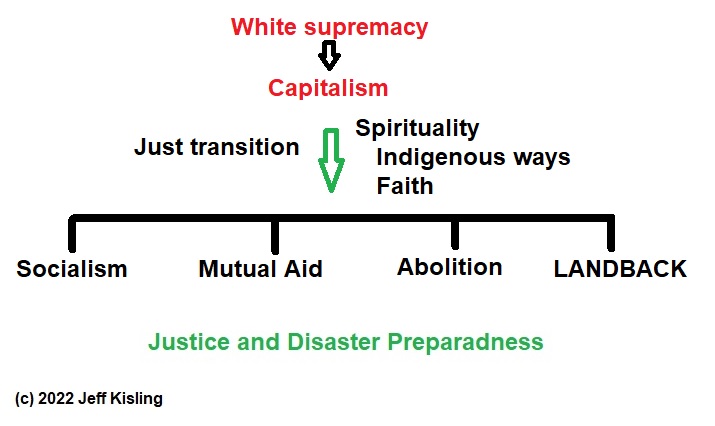
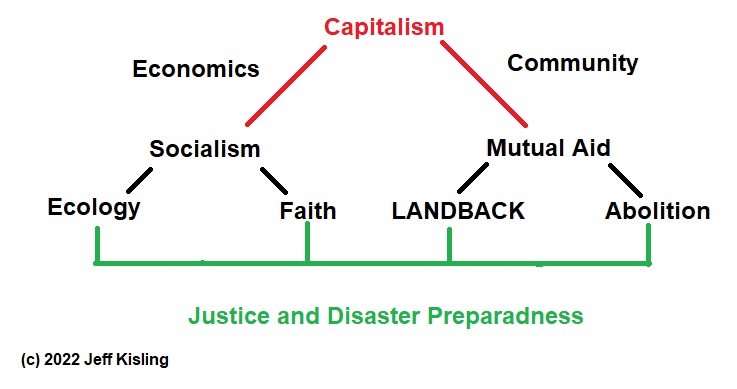
Returning to yesterday’s post, Justice and Disaster Preparedness, I tried to simplify the main concepts I think are important for making a transition to the communities we want, need to create. I was trying to figure out where faith fit. I put it under Socialism because I’ve been learning about religious socialism. That and other problems made me decide to scrap that diagram. Following is today’s version.

Socialism, Mutual Aid, Abolition, and LANDBACK each have a role in building Beloved communities. Especially regarding disaster preparedness.

Spirituality is what will help us make the just transition to communities needed to prepare for the present and coming disasters.

Spirituality can be expressed in many ways. But there is only one Creator or God.

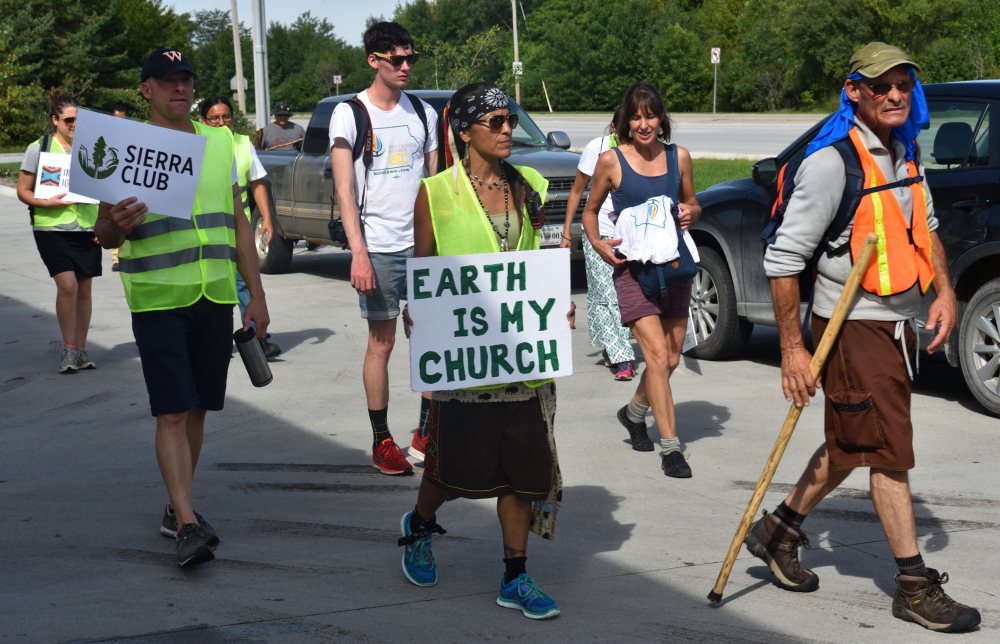
I love the EARTH IS MY CHURCH sign my friends Alton and Foxy Onefeather carried during our First Nation Farmer Climate Unity March.

Justice and Disaster Preparedness

Watching the tragedy of war unfolding in Ukraine makes real the future I fear we are moving into. Are already experiencing in many ways.

Fear not only as a noun, “an unpleasant emotion caused by the belief that someone or something is dangerous”, but also as a verb, “to be afraid of.”

I can’t imagine anyone watching the stories from Ukraine, and not thinking about how tenuous our own lives are. Seeing people’s lives destroyed in an instant. Injury or death of loved ones. Loss of shelter and infrastructure. No water, power, medicines, food, community.

What would we do in a similar situation?

We might find out sooner than we think. We are facing numerous crises ourselves.

  • Environmental chaos
  • Economic collapse
  • Political collapse
  • War
  • Domestic extremism and armed conflict

There have been warnings about these things for decades, with little effect. But now we are seeing everything on that list happening to various degrees. And each negatively impacts the others.

Following is a new diagram I’m working on to show relationships among systems. The reason justice is in today’s title is because so many of our current systems have injustices embedded in them. As we prepare for disasters, not addressing injustice would mean:

  • Not benefiting from the wisdom and skills of those we don’t have relationships with now. Because of the mistrust between us.
  • Bringing these injustices and conflicts into the disaster relief communities.

We have three choices:

  • We can just react to what is coming at us. Go into survival mode.
  • We can prepare for disaster locally.
  • We can work for justice as part of disaster preparedness.

Descriptions of the systems in the diagram: ecosocialism, LANDBACK, abolition and Mutual Aid follow.

I believe faith is an important part of this. This morning I thought faith was going to be the subject, but found this background needed to be covered first.

Ecosocialism

Ecosocialism brings together two complementary ways of thinking about humans and the environment they live in. The “eco-” in ecosocialism comes from the science of ecology and its emphasis on the complex and dynamic interactions among the living and non-living components within an ecosystem. In particular ecologists understand how the life-supporting functions within an ecosystem can be disrupted by the behavior of one organism, for example, humans.

But ecology lacks a social analysis; it has no way of understanding how economic and political forces drive human behavior and social change.

Ecosocialists start with the premise that environmental degradation and social injustice stem from the same source: a world where profit is the highest goal. We believe that the emancipation of people from capital and its masters goes hand-in-hand with the emancipation of the earth and its biosphere from the cancer of capitalism.

What is ecosocialism? System Change Not Climate Change

LANDBACK

  • It is a relationship with Mother Earth that is symbiotic and just, where we have reclaimed stewardship. 
  • It is bringing our People with us as we move towards liberation and embodied sovereignty through an organizing, political and narrative framework. 
  • It is a catalyst for current generation organizers and centers the voices of those who represent our future. 
  • It is recognizing that our struggle is interconnected with the struggles of all oppressed Peoples.
  • It is a future where Black reparations and Indigenous LANDBACK co-exist. Where BIPOC collective liberation is at the core. 
  • It is acknowledging that only when Mother Earth is well, can we, her children, be well. 
  • It is our belonging to the land – because – we are the land. 
  • We are LANDBACK!

LANDBACK

Abolition

The criminal justice system is violent and harmful: The UK’s prison population has risen by 90% in the last two decades, bringing the number to over 90,000. At the time of writing we are 156 days into 2018 and already we have seen at least 129 deaths in prison, immigration detention centres and at the hands of the police. As the effects of neoliberalism and austerity deepen each day, increasing numbers of people find themselves made disposable by our economic system and structural inequality, targeted by the agencies of the criminal justice system simply for being homeless, experiencing poor mental health or being born in a different country.

The criminal justice system does not reduce social harm: Policing, courts and the prison system are presented to us by politicians and the media as solutions to social problems. Yet, as the prison population has soared, we have continued to seen violence and harm in our society on a massive scale. Violence against women and girls is endemic, racism and the far right are on the rise in Britain and rates of murder and violent assaults are beginning to increase again. As politicians continue to scapegoat those with the least power in society, the conditions of structural violence that so often precede interpersonal violence remain in place.

We can build a world based on social justice, not criminal justice: All over the world, communities are coming together to build real solutions to societal problems. These solutions lie outside of the criminal justice system, in preventing harm through building a better society. By bringing together groups and organisations working for social justice, we want to demonstrate and strengthen the links between prison abolition and wider struggles for housing, health, education, and environment; and for economic, racial, gender, sexual and disability justice.

Abolitionist Futures

Mutual Aid

Gas Prices

I have no idea how high gas prices will go or how long they will remain high.

“High” is a relative term. Shouldn’t gas prices reflect the environmental damage from both the horrendous destruction of the land and water from fossil fuel extraction and the many and extensive damages from burning fossil fuels?

What I find fascinating today is hearing so many people saying if gas prices go much higher, they will walk or take public transportation! Exactly what should have been done decades ago. I always thought there should have been high government gas taxes to try to drive this behavior modification.

Thinking of the impacts on those who are impoverished, this population tends not to have personal automobiles. Are already using public transportation. Similar to food subsidies there might be a need for something similar for transportation.

Most of us have gotten used to remote video/audio conferencing because of the pandemic. If gas prices remain high or go even higher, that will probably result in a return to that. It is likely even more people will work remotely.

This has the potential to significantly reduce fossil fuel emissions.


I love this story about Barry Lopez.

How could we convince lawmakers to pass laws to protect wilderness? Lopez argued that wilderness activists will never achieve the success they seek until they can go before a panel of legislators and testify that a certain river or butterfly or mountain or tree must be saved, not because of its economic importance, not because it has recreational or historical or scientific value, but because it is so beautiful. His words struck a chord in me. I left the room a changed person, one who suddenly knew exactly what he wanted to do and how to do it. I had known that love is a powerful weapon, but until that moment I had not understood how to use it. What I learned on that long-ago evening, and what I have counted on ever since, is that to save a wilderness, or to be a writer or a cab driver or a homemaker—to live one’s life—one must reach deep into one’s heart and find what is there, then speak it plainly and without shame.

Reid, Robert Leonard. Because It Is So Beautiful . Counterpoint. Kindle Edition.

We can’t put a price on beauty. I hadn’t thought of it this way, but if we believe in preserving beauty, wouldn’t it have been amazing if we demanded any resource mining could not be done if it harmed the beauty?

Instead, there are hundreds of square miles of filthy pits from tar sands extraction. Instead, the tops of mountains were blown off.

Instead, the fossil fuel industry receives billions of dollars in government subsidies. How insane is that? Environmental and Energy Study Institute

Likewise, a price cannot be put on all the damage done by burning fossil fuels.

And there is the incomprehensible situation of an energy returned on investment of only 3:1 for tar sands mining. The unit of energy it takes to extract tar sands produces only 3 units of energy. In other words, it takes almost as much energy to mine tar sands as the energy produced. Unbelievable.

Fog of War

I’m horrified by all the consequences of the Russian invasion of Ukraine.

There are many aspects beyond the actual fighting that I’m having trouble understanding or believing. Not much of which is being covered in the mainstream media. Vitally important issues that should inform decisions being made now, and in the future.

This confusion has been expressed as the fog of war.

The fog of war is the uncertainty in situational awareness experienced by participants in military operations. The term seeks to capture the uncertainty regarding one’s own capability, adversary capability, and adversary intent during an engagement, operation, or campaign.

Fog of War. Wikipedia

Access to fossil fuel sources has been and will continue to be a major part of all wars and conflicts.

It is past time to stop fossil fuel emissions. That is the existential global threat. Nothing else will matter as our environmental catastrophe rapidly worsens.

And yet what is informing political decisions in this country is the impact on gas prices. Capitalism.

Releasing strategic oil reserves is an example of the kind of decisions being made now that are absolutely wrong. Burning fossil fuels is indefensible as our environmental catastrophe accelerates. But that hasn’t slowed down fossil fuel emissions, yet.

As Jade Begay says, the current conflict will drive up domestic oil and gas development.

This makes it clear that not only are oil and gas used to carry out war but are also a root cause for exponential climate change. Second, as an organizer who is actively working to shut down fossil fuel infrastructure, I am hyper aware that this conflict will potentially drive up domestic oil and gas development, onshore and offshore gas leasing, and/or potentially roll back recent wins when it comes to fossil fuels, thus contributing to an increase in carbon emissions. Finally, I’d be remiss to not mention the impact that militaries have on the climate, when it comes to the U.S., our military is the single largest institutional polluter in the world, which creates more greenhouse emissions than 140 other countries.

Jade Begay. Climate justice campaign director for the NDN Collective, said Russia’s oil and gas money allowed it to pay for the invasion, according to an article in Indian Country Today.

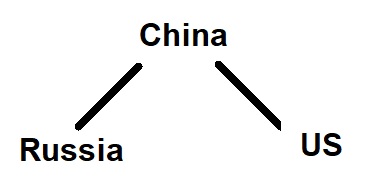
There is this triangle between Russia, China and the US, where China buys Russian oil for its economy. And the US buys products from China. Which means Russian profits come indirectly from the US economy. Which means the US is helping to financing the war in Ukraine.

Another part of the fog of war is a strengthening relationship between Russia and China.

Releasing strategic oil reserves is an example of the kind of decisions being made now that are absolutely wrong. Burning fossil fuels is indefensible as our environmental catastrophe accelerates.

Indigenous communities have a unique perspective on Ukraine’s tragic and horrific situation. They understand what it’s like to be invaded by a colonial power. They see the war not only as an attack on human rights, but an attack on Mother Earth.

Indigenous leaders speak out on Russia’s Ukraine invasion, Healing Minnesota Stories, March 3, 2022

Is what is happening in the Arctic another part of the fog of war? Indigenous people above the Arctic Circle are wary of what Russia’s attacks foreshadow, according to the Indian Country Today article Monitoring the Arctic in Russian invasion of Ukraine.