Blog

Judy Plank

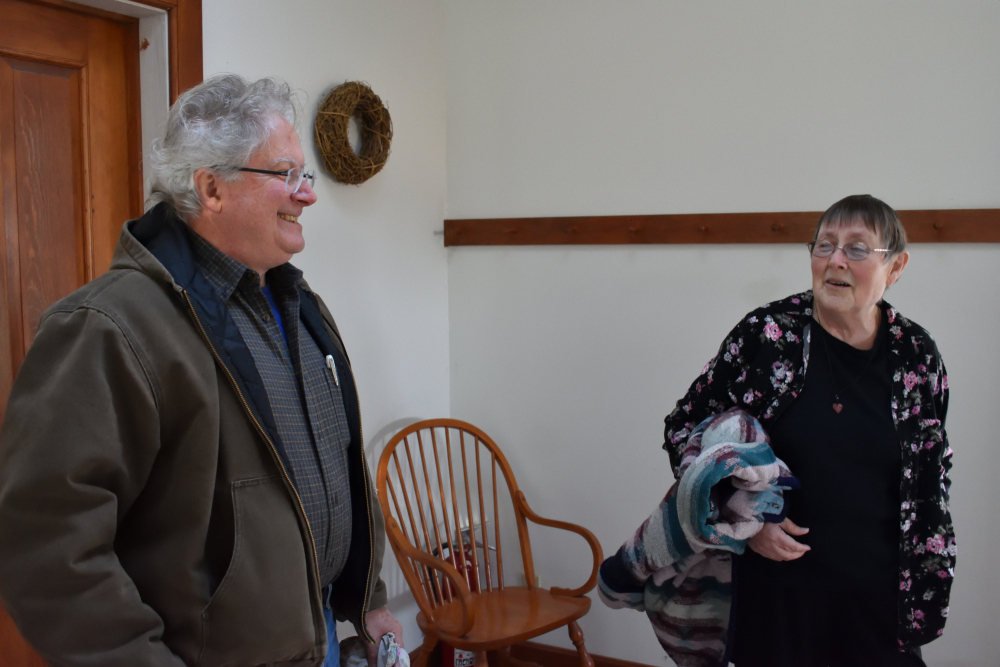
Judy Plank was a good friend of mine. She was always present and helpful as we worked together on peace and justice issues for Iowa Yearly Meeting (Conservative).

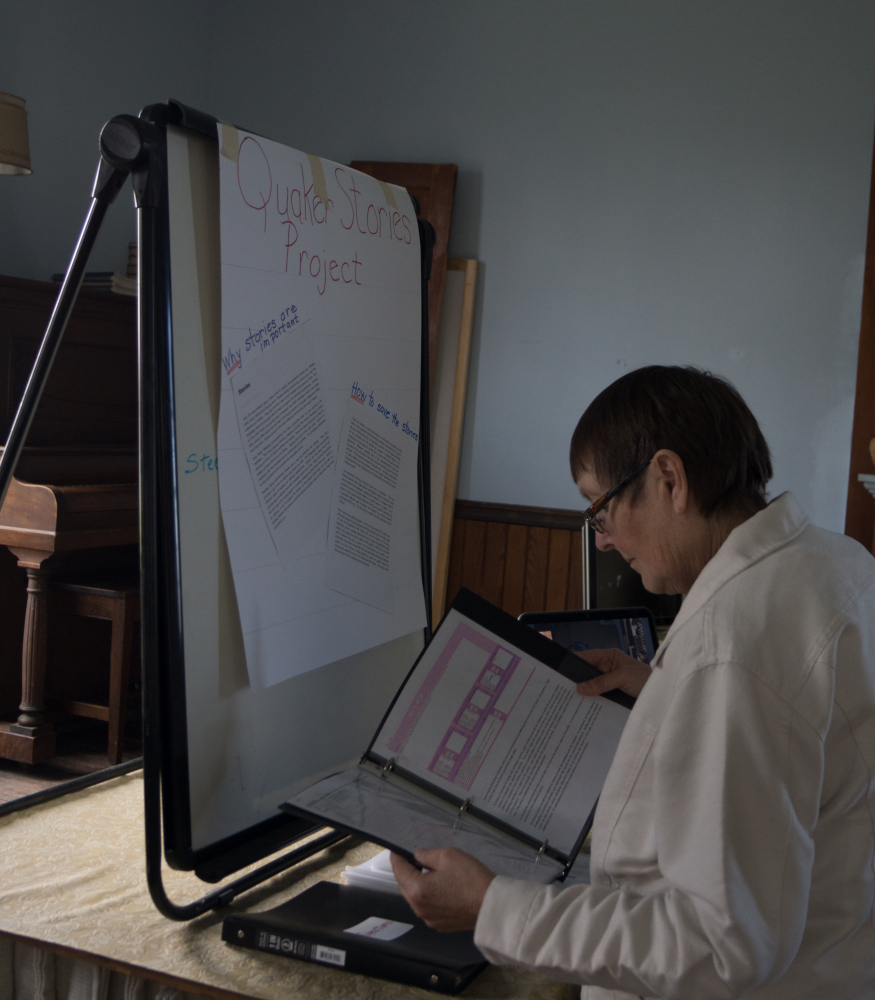
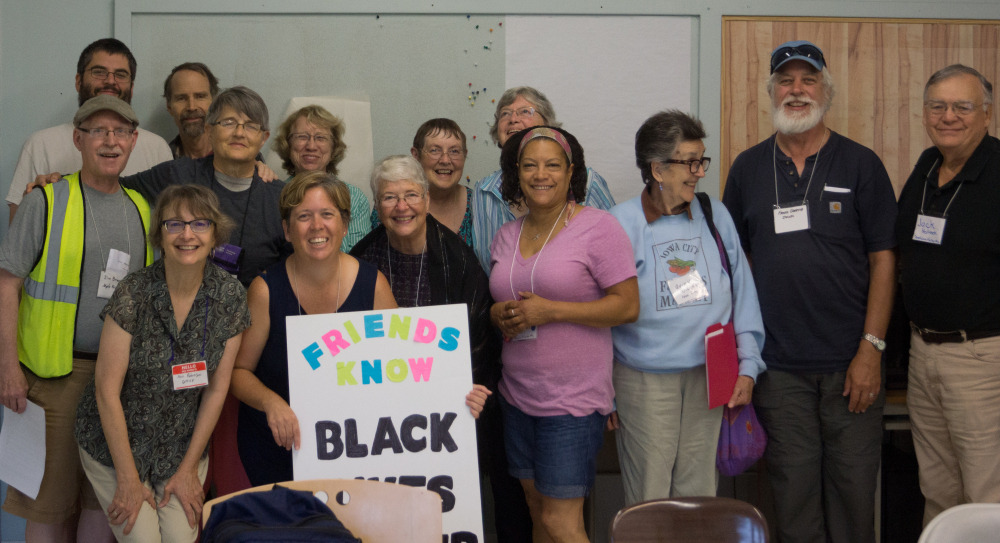
I was glad she asked me to take photos of her for the jacket of her book, Paradise Still Has Snakes. (the first of the photos below).

I will miss her.


Judy Ann Plank

Dec 14, 1942 – Oct 12, 2023

Obituary

Judy Plank, 80 of Le Mars, Iowa, passed away on Thursday, October 12, 2023 at the Good Samaritan Society of Le Mars. 

There will be a Memorial Service at a later date. Expressions of sympathy may be expressed to the family through www.rexwinkelfh.com

Judy Ann Juhl was born on December 14, 1942, the oldest child of Howard ‘Bud’ and Jean (Stowater) Juhl of rural Remsen. Judy grew up on the family farm between Marcus and Remsen. She had fond memories of her childhood pet Holstein milk cow, ‘Coke’.

She started school at Meadow Township county school and when it closed, she then attended Marcus Public School and graduated in 1960. She then attended Westmar College in Le Mars for one year. While at Westmar, Judy met her husband to be, Kenneth Paul Plank. They were united in marriage at Faith Lutheran Church in Marcus, Iowa on December 27, 1961.

Twenty years later she graduated with a BA degree in sociology from Southwest State University in Marshall, MN. She later also received an associate degree in accounting. Judy’s sporadic work history included: working in a welfare department briefly, in a residence for the mentally handicapped for three years, and primarily providing childcare in her home.

Judy and Paul enjoyed traveling, from Costa Rica to Alaska. At a young age, Judy was always an avid reader. This led her to writing prose and poetry. It also culminated in the writing of her autobiographical published book, Paradise Still Has Snakes. She enjoyed gardening and having her hands in the dirt. She also enjoyed baking and sharing her ever-present zucchini bread.

Judy’s spiritual journey led her to the Religious Society of Friends (Quakers). As a member of the Paullina Friends Meeting, she served on many committees and was also actively involved in the Iowa Yearly Meeting. She was a longtime member of the Northwest Iowa Peace Links.

Judy was always a champion for the downtrodden. She described herself as a progressive/socialist peace activist and was an avid protestor. Her strong belief in peace, nonviolence, and social justice was the guiding light in her political and social involvement. After Paul’s retirement, they began wintering near Douglas, Arizona. There she was at the founding of Healing our Borders, a group attempting to stop the increasing deaths of migrants crossing the borders and to change the nation’s immigration policies. She attended weekly vigils remembering those who perished at the border and handed out blankets to protect migrants from the cold. Judy was also proud of the work she did co-facilitating teaching ‘Alternative to Violence Project’ workshops at the Ford Dodge Correctional Facility. She was also a part of the ‘New Roads Reentry’ team helping men back into society following a prison sentence. 

Judy was an active member of the Plymouth County Democrats. She was not afraid to knock on doors or hold up a sign on a street corner for her cause.

Judy’s greatest joy was spending time with her family and friends.

Judy will be lovingly missed by her husband, Paul; son: Kipp Plank of Sioux City; 4 grandchildren: Nick Plank, Lacey Overman, Athena Marshall (Mason Bakker) all of Le Mars, and Rick Plank of Los Angeles, California; 4 great grandchildren: Jade, Alex, Boston, and Pierce; brothers: Mark (Cheryl) Juhl and Dale (Faith) Juhl both of Remsen, IA; nieces, nephews, cousins, and friends.

Judy is preceded in death by her parents; daughter, Kristine Redhouse; and granddaughter in law, Jen Plank. 

taboo

taboo against a subject or activity is a social custom to avoid doing that activity or talking about that subject, because people find them embarrassing or offensive.

Yesterday I wrote about umair haque’s new publication, the Issue. And began discussing the latest issue (of the Issue): Our Civilization’s Melting Down—But We’re Not Allowed to Talk About It.

I got to the part where he began to explain why it is taboo to talk about our civilization’s meltdown.

You see, right now, at this juncture in human history, a New Set of Taboos have emerged. Taboos exist for a reason—to hide truths we’d rather not see the light of day, because they’re too uncomfortable, painful, shameful, difficult, or challenging. As we do that, social bonds rupture. And so taboos, while they hide Issues that We Have to Face, do so precisely because they keep our tribes and hierarchies intact. There’s a form of short-term stability in them, even if the price, over the long-term, is steep, as it has been for so many civilizations before us.

What are the New Taboos of the Age of Extinction? Well, we’re not supposed to discuss How Bad Things Really Are. In what way? In almost any way. Economically—how our economies are sputtering out. Hey, billionaires are getting richer! Whee! Socially—how predators of the human soul and body both are skyrocketing to power, from abusers of women, to Manfluencers leading young men to become…abusers. How our social contracts have been ripped apart by crackpots who think nobody should have anything. Biologically–how life on the planet is undergoing a literal mass extinction. And—hey, what exactly are we going to do about climate change, and do you think the summer a decade from now is going to…be…pretty…let alone…survivable…for many?

We’re not supposed to talk about itAny of it.

Our Civilization’s Melting Down—But We’re Not Allowed to Talk About It.

He goes on to describe in detail the taboos we are facing and their many profound, negative, consequences. But you get the idea as soon as it is put in the context of taboo.

Just in the last few months, high-temperature records have been broken multiple times, around the globe. Extreme drought has made it hopeless to even plant crops, which means famine will be increasing. Water supplies for cities and states are drying up. Out-of-control wildfires pollute the air for hundreds of miles. Prices of everything are skyrocketing at the same time many people are losing their jobs to automation and artificial intelligence.

To talk about police brutality. Prisons that function to remove Black men and women from society. Structural racism.

The party in control of the US Congress is nonfunctional. The President of the other party is war-mongering. The expansion of NATO increases the threat felt by Russia. We are pouring billions of dollars into Ukraine as a proxy for this country’s war machine. It is taboo to point out that a small fraction of the military budget could completely fund all social programs.

It is taboo to talk about the rapid rise of Authoritarianism.

It is taboo to even talk about the theft of land from Indigenous peoples, the epidemic of Missing and Murdered Indigenous relatives, and the horrors of the institutions of forced assimilation of native children.

And just now the widening war in the Middle East. It is taboo to even suggest Israel’s policies of apartheid had anything to do with that.

In our Quaker communities, it is taboo to talk about continued racism, involvement with the Indian boarding schools, the abolition of police and prisons, or allowing conveniences to stop us from confronting our use of fossil fuels. To suggest there is anything wrong with capitalism and hierarchies of power.


The minute you even start talking about any of this stuff seriously? Repeatedly? Urgently? You’re met with the Greatest Wall in Human History. It’s not made of bricks or stone. But of something far stronger. Hegemony and ideology. Power. Conformity and social pressure

Our Civilization’s Melting Down—But We’re Not Allowed to Talk About It.

the Issue

the Issue

I often say I don’t know what I’ll be writing when I sit down first thing in the morning. That’s important for me to say, if only to myself. Because writing (and photography) are spiritual to me. Writing and photography are prayers. This viewpoint helps me try to keep my ego out of it and helps me do one of the most difficult things: writing about myself. But I believe we must write our own stories from our experiences.

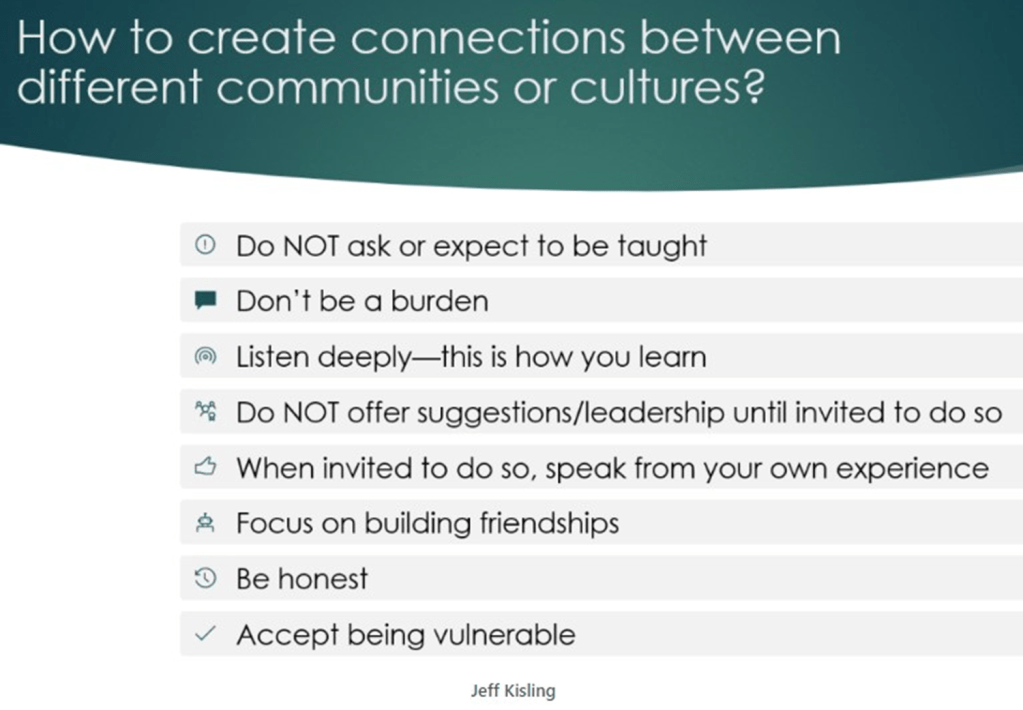
That is so important that it is one of the principles I’ve developed about creating connections between different communities or cultures. When (and only when) you are invited to do so, speak from your own experience.


The only author I read daily is Umar Haque. “The Issue’s founder is Umair Haque. Umair’s been one of the world’s top 50 thinkers, has published several books through Harvard Business Press, been one of Harvard Business Review online’s top authors for many years.”

Umar now writes on The Issue, an independent, subscriber-supported publication launched in August 2023. https://www.theissue.io/


Our Manifesto

Here are a few things we believe.

The Issue’s mission is simple.  We bring you deep insight and fresh thinking, 3-5 times a week, about one of the Big Issues. The ones that matter most. Why?

This is a critical juncture in history. Our world is being rocked by crisis after crisis. Democracy’s declining. The climate’s changing. Extremism’s on the rise. Our economies aren’t delivering. Pessimism’s swept the globe. Institutions aren’t trusted, systems are failing, and polities are shattering.

Everyone deserves to understand the Issues at stake in this age—this critical juncture in human history—with clarity, rigor, and reality. Not just fall prey to disinformation, misinformation, and false notions of balance. The stakes are too high for that.

Our mission is to help you understand the Issues that matter most. We keep it real, raw, and razor-sharp. Like an expert would. We’re not here to play games. The Issues today are too big and urgent for that. Our goal is to take you one step closer to becoming you an expert—not just a passive consumer of news. Someone who understands The Issues that matter, with depth, resonance, and focus.

The news end of journalism covers the Big Issues well—sometimes. But the analysis end of news—op-ed pages, opinion sections—doesn’t. Reading it, you’d get the impression that climate change might not exist, or that democracy’s not in trouble, or that the future’s not in question. That’s not good enough.

The Issues that matter belong to all of us. They concern all of us. And we deserve better when it comes to them, than we’re currently doing. It’s up to each of us to understand them well—with a little help. That’s our job at The Issue. Welcome.


This morning, I feel unmoored. There are so many crises that are spinning out of control. And no one seems to have an answer for any of them.

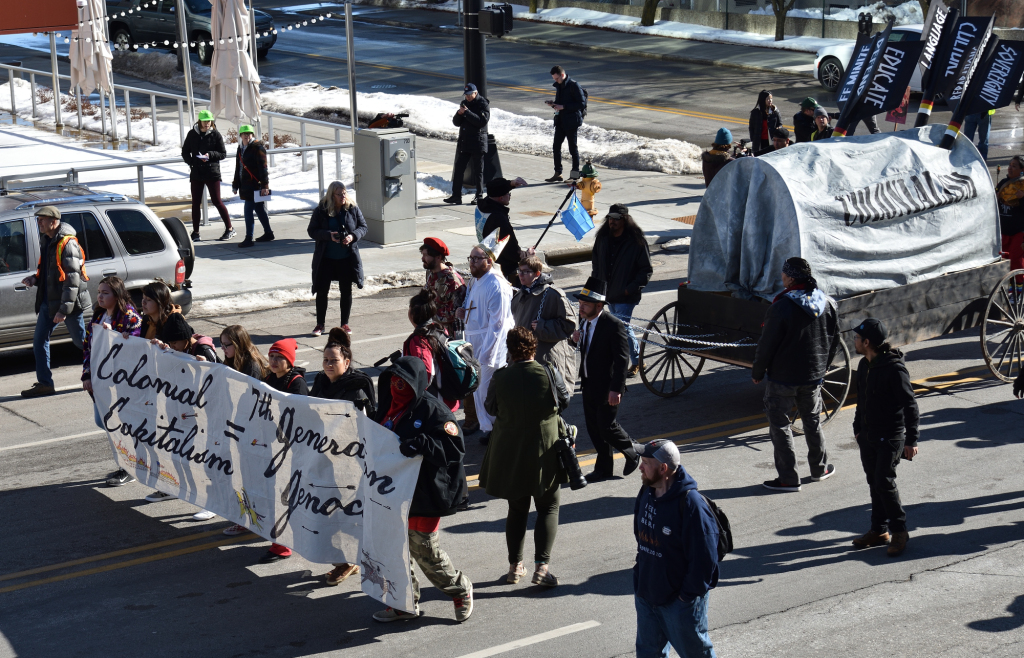
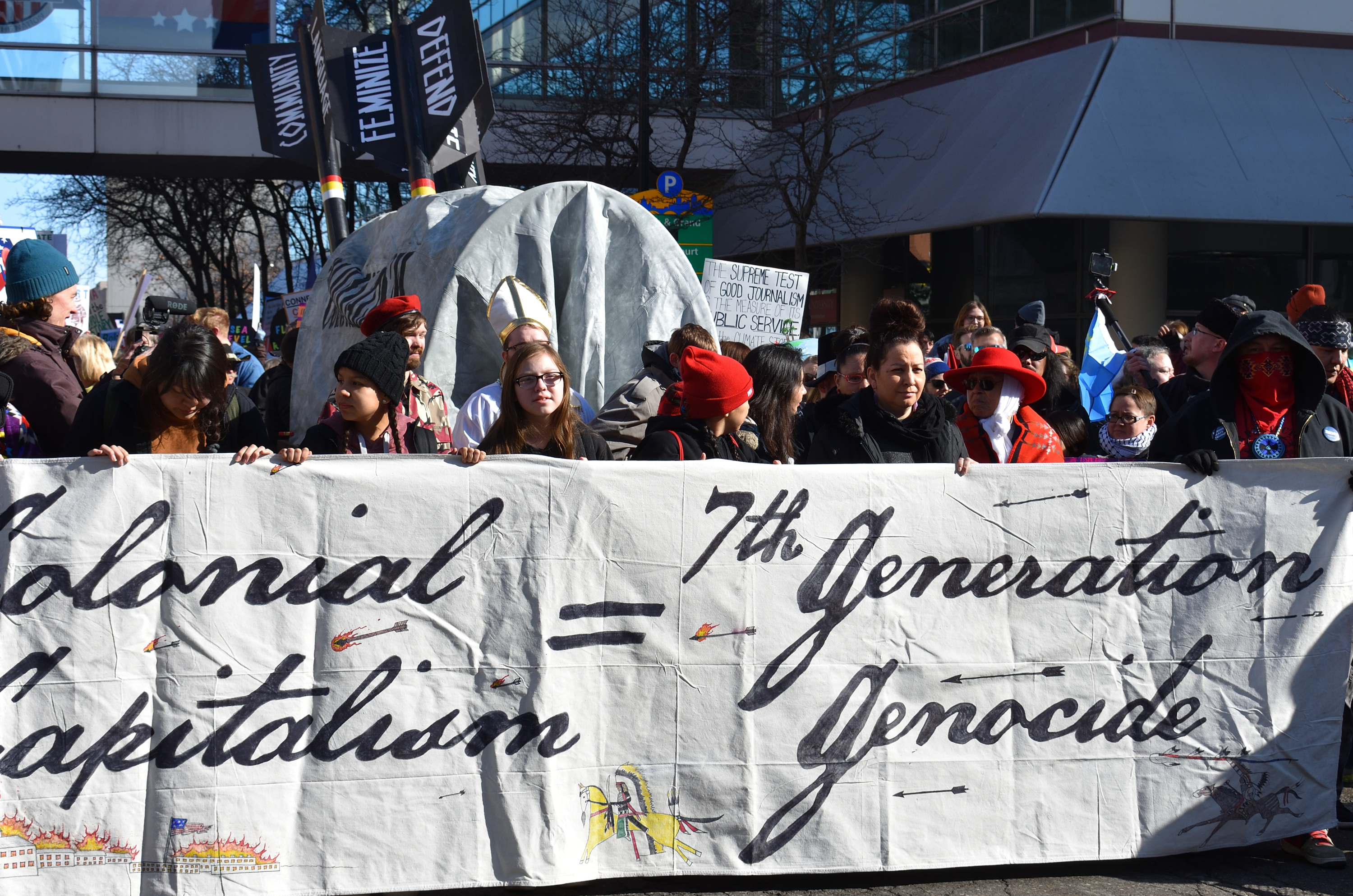
Indigenous People’s Day brings attention, yet AGAIN, to settler colonialism capitalism. Reminding us White people that we are living on stolen land. And of the horrors of Missing and Murdered Indigenous Relatives. The genocide at the institutions of forced assimilation of native children where all kinds of abuse occurred, and tens of thousands died.


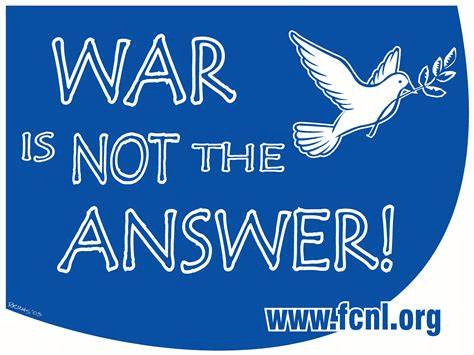
We have become desensitized to this country’s endless, global military incursions. The declaration of war by Israel just seems like one more military operation. Why aren’t we saying War is Not the Answer?


And the greatest threat of all, rapidly accelerating environmental chaos, leading to social, economic, and political collapse. Threatening our possible extinction.


To give you a sense of what the Issue is like, the latest article is Our Civilization’s Melting Down—But We’re Not Allowed to Talk About It.


There’s a strange and baffling thing happening these days.

On the one hand, people are…wrecked. The stats reveal a portrait, globally, of sweeping, pervasive pessimism. Trauma, in rising rates of anxiety and anger and stress. Despair, in skyrocketing depression and suicide and loneliness. People are the walking wounded these days.

And yet…we’re all staggering around pretending like none of this is happeningOK, not you and me, and those like us—we’re a little different, and I’ll come back to that. But by and large? It’s as if this fatal tide of despair, grief, and trauma isn’t…happening…at all. We’re not supposed to talk about it. Write about it. Discuss it. Think about it. Maybe once in a while, we read an article in a newspaper, and are supposed to nod, stroke our chins—and then go right back to pretending that none of this is happening.

It’s not something we discuss much, is it? Think about it. Look at social media, which is where, unfortunately, we spend most of our lives. Smile for the camera! Glance at our culture. Take a look at the kinds of discussions which animate our societies—the ones we’re supposed to respond to and be involved in. This catastrophic state of affairs, the status quo of the human world and soul, if you like, isn’t even on the list of priorities of our civilization, societies, countries. We’re just supposed to walk along merrily and…what? Buy stuff? Fake a grin? Grin and bear it. Ignore it.

That’s a taboo.

Our Civilization’s Melting Down—But We’re Not Allowed to Talk About It by umair haque, the Issue, Oct 9, 2023


This is just the introduction to the article, which deserves a reading. The monthly subscription is $5.00. https://www.theissue.io/

Dangers of lack of diversity revisited

I am glad some friends have responded to my post yesterday, Dangers of lack of diversity in Quaker meetings today.

Some comments mention an underlying tone of anger, making broad generalizations and not being clear about what I’m asking Friends to do. All of which I can see now.

As I was writing, I understood I was making generalizations. But if I always said things like “some Friends…”, “male Friends…”, I felt that would dilute what I was trying to say. Some would see those qualifications as an indication that what I was saying was not directed at them. I made the assumption that those who are exceptions would realize they were (exceptions). Now I can see that such an implicit assumption was not good.

I sometimes make the mistake of feeling anger in situations where I am frustrated. That also is not good. I have been deeply frustrated about many things, some for my entire life. Chief among those is a life-long disappointment that many Friends seemed comfortable with the status quo, with many conveniences from being part of the dominant culture in this country.

Some specific examples include my disappointment that few Friends refused to cooperate with the Selective Service System, which meant an acceptance of the validity of the draft, and militarism. Some of the people I most admired were those who refused to cooperate, most of whom were incarcerated. It was their example that helped me make my own decision to not cooperate. These were risky decisions, but I thought that was what Quakers did, take those risks when that was what they were led to do.

There is my life-long attempt to convince Friends to reject the conveniences of the automobile culture that developed in this country. I was led to live without owning a car. That was inconvenient in many ways. I was always aware the reason I could do so was because I lived where mass transit was available. Actually, anytime I moved in Indianapolis, I made sure the new place would be on a city bus line and within walking distance of a grocery store, laundry, and my work.
Of course, mass transit was not an option in rural areas. I hoped Friends living there would work on ways to rely less on fossil-fueled transportation. Why couldn’t there be community based transit systems in rural areas? Most did what they could to otherwise reduce their carbon footprint.

But here is the point. If we had all worked to build mass transit systems and walkable communities, we would not be in our current, dire, rapidly deepening environmental chaos, on the path to our own extinction. How could we do this to our children and Mother Earth? This life-long frustration does leak out as anger at times.

If we had all worked to build mass transit systems and walkable communities, we would not be in our current, dire, rapidly deepening environmental chaos, on the path to our own extinction

Much of this frustration is with myself. Why wasn’t I more effective in getting Friends to see what was happening?

This was a constant in many of the dangers of lack of diversity I wrote about. I am not blameless. Thus, much of the frustration and anger is directed at myself as well.

As I spent years in oppressed communities, I began to understand the deep injustices inflicted on my friends. Injustices hurting them everyday, in so many ways. That’s why I feel such a sense of urgency and frustration that more Friends don’t see these injustices and work to heal them now.

This is not an equivocation about what I wrote yesterday.

As to what I long for Friends to do, it is to find any way they are led to become engaged in diverse communities. And specifically Mutual Aid communities. (I capitalize Mutual Aid to emphasize the difference between “real” Mutual Aid versus charity work. I write about all this extensively on my blog, Quakers and Mutual Aid). Because Mutual Aid communities are founded on the principle of rejecting hierarchies. The power structure of any type of hierarchy always results in a form of dominance. And dominance is the root of injustice. So, any attempt at social justice that has any hierarchical structure simply extends the dominance.

There is an Iowa Mutual Aid Network. You can connect with Mutual Aid communities and projects here: https://iowamutualaid.org/

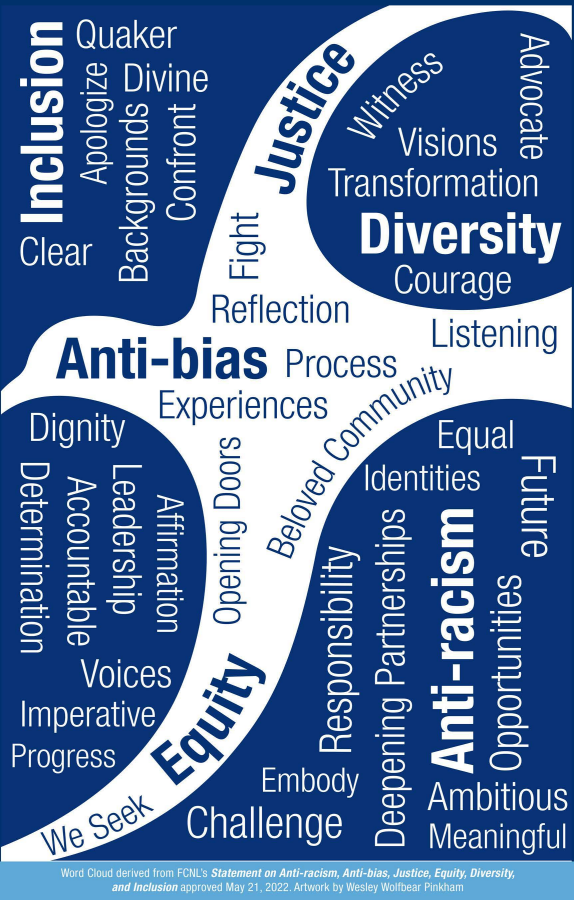
I included this graphic in yesterday’s post in the hope that you will seek a way to engage with a Mutual Aid or similar community. And hope these points can help you as the Spirit might guide you on your own journey.

Finally, I believe we will be forced to work with communities outside our meetings as the collapse of our social, economic, and political structures accelerates. We will all be forced to find our way through the chaos. Mutual Aid communities already know how to do this because we are doing it now.

Dangers of lack of diversity in Quaker meetings today

Diversity can refer to many things, such as race, ethnicity, gender, sexuality, class, age, ability, and faith background. Both the state of Iowa and our Quaker meetings in the Midwest have very little racial and other types of diversity. This does not reflect the diversity of the wider society nor the diversity in Quaker history and values.

Reasons why Friends need to confront their lack of diversity now

This is a topic that generates significant emotional reactions for numerous reasons. Perhaps one of the most basic is knowing we are not doing what our ancestors had done, what they would probably be doing if alive today.

If we are converging on history and practice, we are missing the point. If we are depending on institutions to create a new society or usher in the Kingdom, then we are deceived. These will not bring the radically egalitarian and Spirit-filled communities that God fostered among early Friends. These are forms, and Friends must follow the Spirit.

I’ve met others who need a Spirit-led Society. We share this vision, and we share the disappointment of being drowned out in meeting by classism, ageism, and racism. Some of us wonder if Quakerism isn’t all that different from the rest of liberal religion. From what we’ve seen, it isn’t apocalyptic. It isn’t radical. It doesn’t sound like Fox or look like Jesus. It works at incremental transformation while simultaneously shushing those who need the system overthrown.

Hye Sung Francis, Seeking a People

  • Many of our Quaker meetings are small and growing smaller.
    • A significant number of Friends are elderly
    • We are failing to attract new members
    • Members are leaving their (Quaker) meetings because
      • Their justice work is not understood or supported
      • They see the harm done to Black, Indigenous, and other people of color (BIPOC) in their meetings.
      • They are frustrated by the meeting’s lack of understanding and involvement around their privilege
      • And the lack of engagement and support for BIPOC communities.
  • Many meetings fail to engage with justice groups that are doing good work, such as Mutual Aid communities.
  • Friends need to engage with Indigenous peoples now

Most White Friends fail to understand their privileges and the consequences.

  • There are a range of justice activities by (Quaker) meeting members. Much of that relates to Friends’ long history of opposing war and violence. But because of our lack of diversity, we fail to understand many other significant and often insidious forms of violence, such as sexual, emotional, psychological, spiritual, cultural, verbal, economic, symbolic, and gender-based violence.
  • Most male Friends are unaware of gender inequality and violence.
  • Much of what passes for justice work are committee meetings, political letter writing, and financial support of Quaker justice organizations such as the Friends Committee on National Legislation and the American Friends Service Committee. That is not enough.
  • Lack of connections with Indigenous peoples is a significant problem for Friends today.
    • Friends are unaware of their ancestors’ settler colonization, including the theft of native lands. Many Friends don’t believe the land they occupy today is stolen land.
    • Unaware of the ongoing crisis of Missing and Murdered Indigenous Relatives. And how this is tied to the construction of fossil fuel pipelines.
    • Just becoming aware of Friends’ involvement with the forced assimilation of native children. Of the many forms of abuse and deaths of thousands of children at those institutions.
    • Friends often don’t have the depth of spiritual awareness of all our relations that we can learn from Indigenous peoples.
  • Structural violence is embedded in the social and economic systems that produce and maintain inequalities and injustices. It is often invisible or rationalized by the dominant groups that benefit from it.
  • Symbolic violence is a form of power exerted through cultural and symbolic means rather than direct physical force. It reinforces social hierarchies and inequalities by imposing the norms and values of the dominant group on the subordinate group. It is often unconsciously accepted by both parties and can be expressed through various practices such as language, representation, body language, and self-presentation. The concept was developed by sociologist Pierre Bourdieu.
    • This is a significant reason why Friends need to support and create Mutual Aid communities which address these very injustices related to symbolic violence.
    • This makes me more aware that Mutual Aid is an expression of nonviolence.


MLK understood — or would have — that all the following things are forms of violence. People forced to “crowdfund” healthcare — to beg their neighbors for pennies for medicine. A workplace culture where being abused and berated by your boss is totally normal. Incomes not rising for half a century — while costs skyrocket to absurd levels. The average American dying in debt. Being forced to choose between healthcare and your life savings. Having to give up your home because you want to educate your kids.

All these things are forms of violence. Violence runs deep. It isn’t just mobs of fascists smearing feces on the walls — though it is also that. It’s what Americans do to one another as everyday interaction — and shrug off as normal. Mental, emotional, social, cultural violence makes up the very fabric of everyday American life. It’s the poisonous residue of slavery. And it’s profoundly traumatic. It has lacerated the American mind, and made violence a legitimate solution to every social problem. But these forms of all-pervasive violence are what a capitalist society is limited to, because everything is competition, rivalry, and ultimately, domination and subjugation.

Americans Don’t Understand What Violence Really Is by umair haque, Eudaimonia and Co, January 17, 2022

This lack of diversity has numerous consequences

  • Excluding or marginalizing people who do not fit the dominant norms or expectations of Quaker culture
  • Limiting the perspectives and experiences that inform Quaker discernment and action
  • Missing out on the richness and joy of learning from and celebrating differences
  • Failing to live up to the Quaker testimonies of equality, peace, and justice

For a long time, I had prayed that my Quaker community would engage with communities like my Mutual Aid community, thinking that would be mutually beneficial. But the clashes and the lack of lived experience with diverse communities of many White Friends have changed that. Now, I feel I need to protect my justice communities from the injuries they would experience from White Friends. It’s not that White Friends wouldn’t try to do what they thought would be helpful, but their lack of knowledge of oppression always results in harm.

For years, I’ve envisioned Quakers and oppressed people working together. But we (White Quakers) have to have enough experience in communities outside our meetinghouses to understand what is happening in these communities. To have a valid perspective. Until that happens, Friends will show they cannot be trusted, and we will be unable to cross the divide.

Over the years I’ve built this list of things I’ve learned from my experiences. I hope White Friends who haven’t yet had experiences outside their meetinghouse would keep these things in mind.

By far the most important is to not offer suggestions until the community trusts you enough to ask you for your input. When you are invited to do so, speak from your own experience. Do not talk about things in the abstract. It’s perfectly fine to say you don’t know the answer to a question. This honesty, this vulnerability is crucial. I like to keep in mind “we don’t know what it is that we don’t know.”

Time

It will take much longer than you expect to see this trust begin to develop. I’d been involved with the Kheprw Institute in Indianapolis for three years before I was asked to teach the kids there about photography.


Quakers are pretty white, and that comes with quite a bit of power and privilege. A Quaker in Omaha, Nebraska is going to have probably more weight in what they say to a legislator than a Black Lives Matter activist in Brooklyn, New York. I think there’s a need for Quakers to step out of their meeting and away from a lot of these phenomenal institutions that they’ve created and speak to individuals in an interfaith setting (from Black churches or Black Lives Matter) and have a cross-cultural understanding of what that experience is like because you’ll find that it’s very different, and I think the more we can do of that the more effective we’ll be in addressing these problems. These exchanges and fusion coalitions are what I think it’s going to take, not only for Friends to be effective in dismantling these systems of racism, classism, and white supremacy in American society, but also for all of us to better address these problems in our country.

José Santos Woss (FCNL), Quaker Faith and Justice Reform, QuakerSpeak video

This is another graphic I’ve been working on for years to put things in context.

Orange Shirt Day

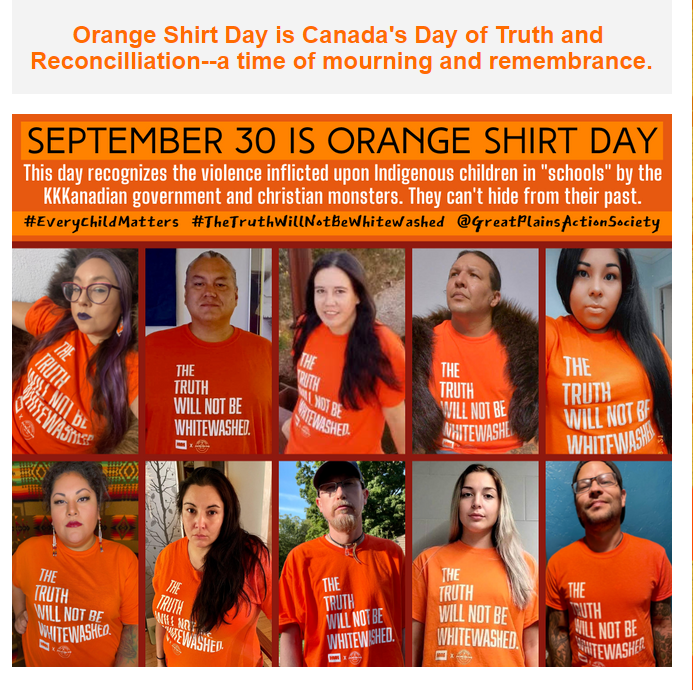
September 30 is Orange Shirt Day in Canada.

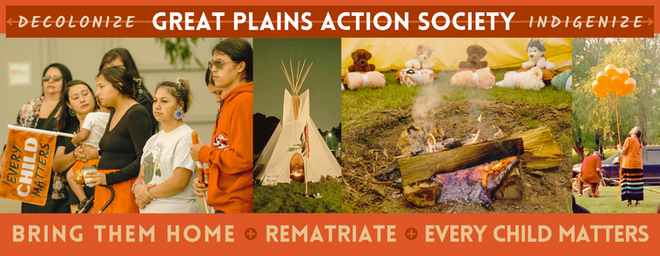
In the story below, the Great Plains Action Society (GPAS) tells what Orange Shirt Day is about. Many of my friends are in this photo. I’m wearing an orange shirt today.

Tansi Friends, 

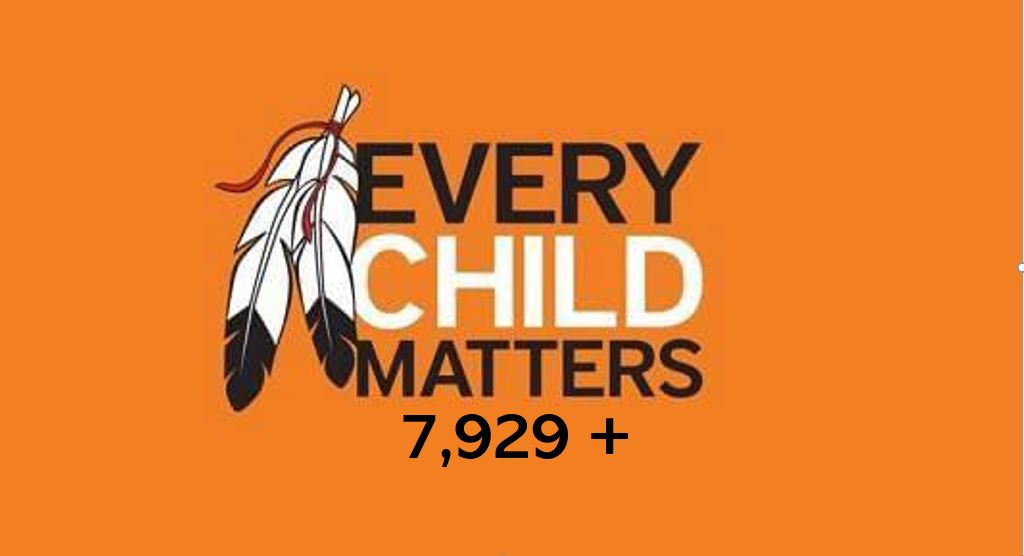
Today is September 30 – “National Day for Truth and Reconciliation,” a statutory Canadian holiday, better known as “Orange Shirt Day.” This holiday was intended to educate people and promote awareness in Canada about the Indian residential school system and the impact it has had on Indigenous communities for over a century. The use of the orange shirt is attributed to Phyllis Jack Webstad. She was sentenced to St. Joseph Mission Residential School when she was six years old. On her first day there her clothes were taken from her, including a new orange shirt given to her by her grandmother. She never saw that shirt again. The story resonated with thousands and became a symbol of the violence that Indigenous children faced in these internment camps called schools. 

Recently, thousands of unmarked graves have been uncovered on the grounds of around 10 residential schools in Canada. There were over 490 residential schools (boarding schools in the U.S.) between the United States and Canada. The New York Times reported on this last summer, and while we are thankful for the coverage, it doesn’t nearly represent the pain and suffering this is causing in our community. Also, trying to quantify the number of graves that have been found is not ever going to tell the truth. The truth is that many children’s bodies will never be found as they were hidden or cremated. There were also many children that tried to run home but died of starvation or exposure. And then there are those that died from suicide and addiction because of the pain they could not overcome. 

Great Plains Action Society has felt this pain firsthand, as many of our close family members attended these schools, and we are rising to meet the needs of our communities. Last year, in Sioux City, we hosted a large community feast and ceremony to honor nine children whose bodies were reMatriated back to Sicangu Oyate lands from the grounds of the Carlisle Boarding School. We have also raised funds to help one of our relatives, Curt Young, show his film, They Found Us, about the search for children’s bodies at the George Gordon First Nation. If we can raise enough funding, we would like to get his film shown throughout Iowa and the Midwest.

The Missing and Murdered Indigenous Relatives crisis largely exists because of the reprercussions of boarding schools. We have been working to support families directly impacted by colonial violence (like what was experienced in these schools) with financial support to travel to court, child care, community gatherings, and covering ceremonial/memorial expenses while continuing all of our other work, including mutual aid, political engagement action, and fighting for our earth. We are dedicated to providing whatever our community needs to grow, survive, and thrive. 
 
Please support our work to end the MMIR crisis and help heal those affected by boarding schools (aka, internment camps for children)

Ay hai kitatamihin,
 
Sikowis (Fierce), aka, Christine Nobiss, she/her
Plains Cree/Saulteaux, George Gordon First Nation
Executive Director, Great Plains Action Society
sikowis@greatplainsaction.org
 
Web – greatplainsaction.org
FB – @GreatPlainsActionSociety
IG – @greatplainsactionsociety
Tw – @PlainsAction


In the story above, my friend Sikowis Nobiss tells about a relative, Curt Young, and his film “They Found Us.” This link is to a blog post about Iowa Yearly Meeting (Conservative)’s donation to help support the showing of this film. https://quakersandreligioussocialism.com/2023/01/29/they-found-us-2/

This is a very disturbing 3D graphic related to “They Found Us.” Moving the mouse around the image changes the perspective.

My relative, Curt Sipihko Paskwawimostos, created “They Found Us”. It’s a documentary about the search for unmarked graves at our rez, George Gordon First Nation. I hope we can bring it here to Iowa in the near future. My cousin Janna Pratt is featured in the film.

“I thought it would be important to document these searches and capture some of the stories told by members that were forced to go to these institutions. It’s a first hand look into some of the experiences survived in residential school.”

The film delves into members’ recollections along with the process towards the first ground search of Gordon Residential School before Ground Penetration Radar (GPR) in 2021. This is only the beginning…

I want to say thank you to Jeff Kisling and the Iowa Quaker community for the donation that will help get the film seen. If others would like to help support this work, hit me up.

Sikowis (Christine) Nobiss


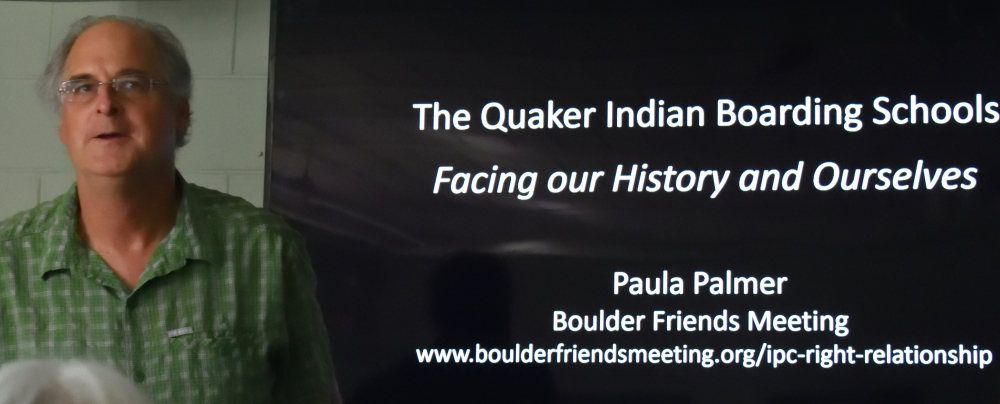
Paula Palmer wrote an article in Friends Journal that extensively discusses her ministry related to what are called Indian Boarding Schools.

Quaker Indian Boarding School. Facing Our History and Ourselves by Paula Palmer, Friends Journal, October 1, 2016

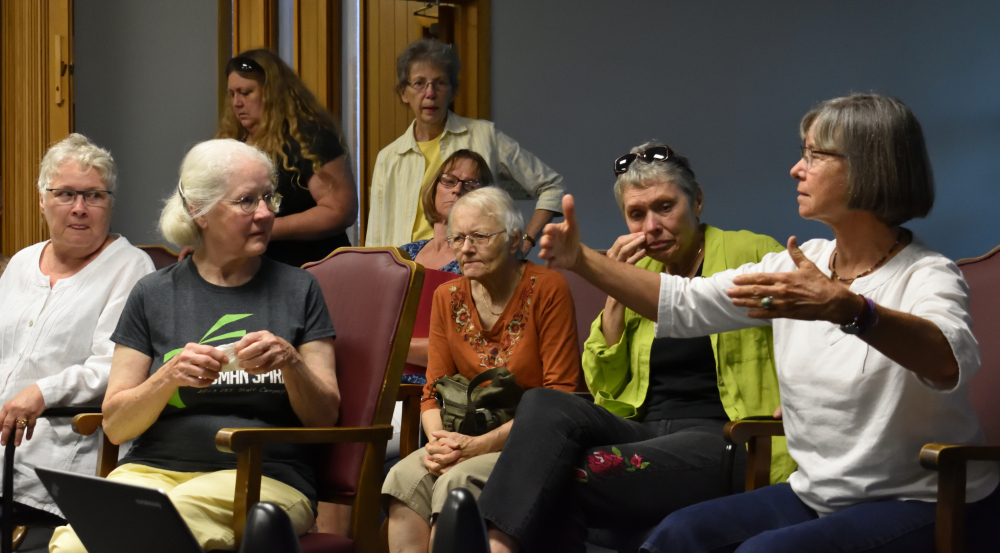
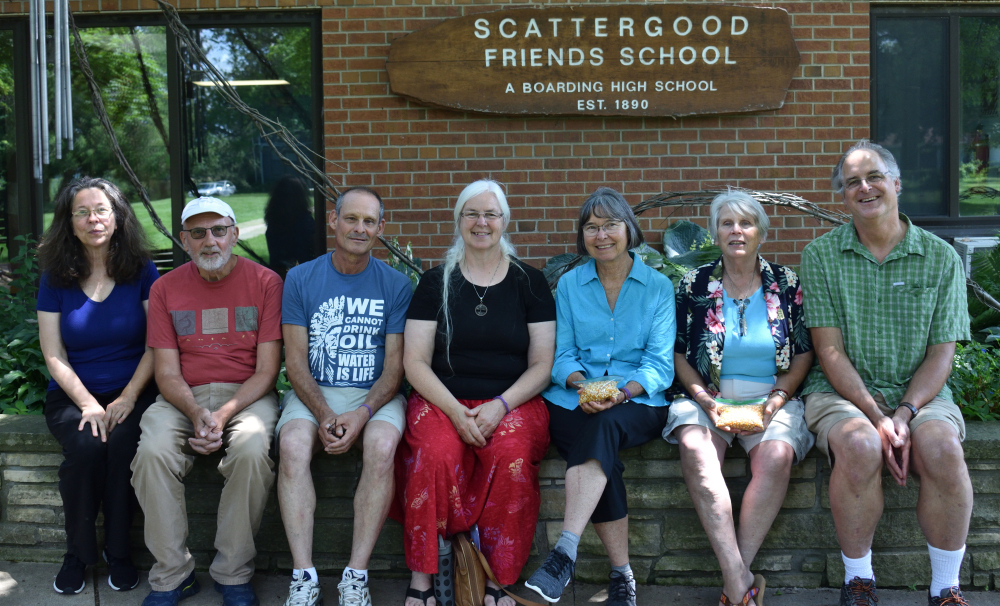
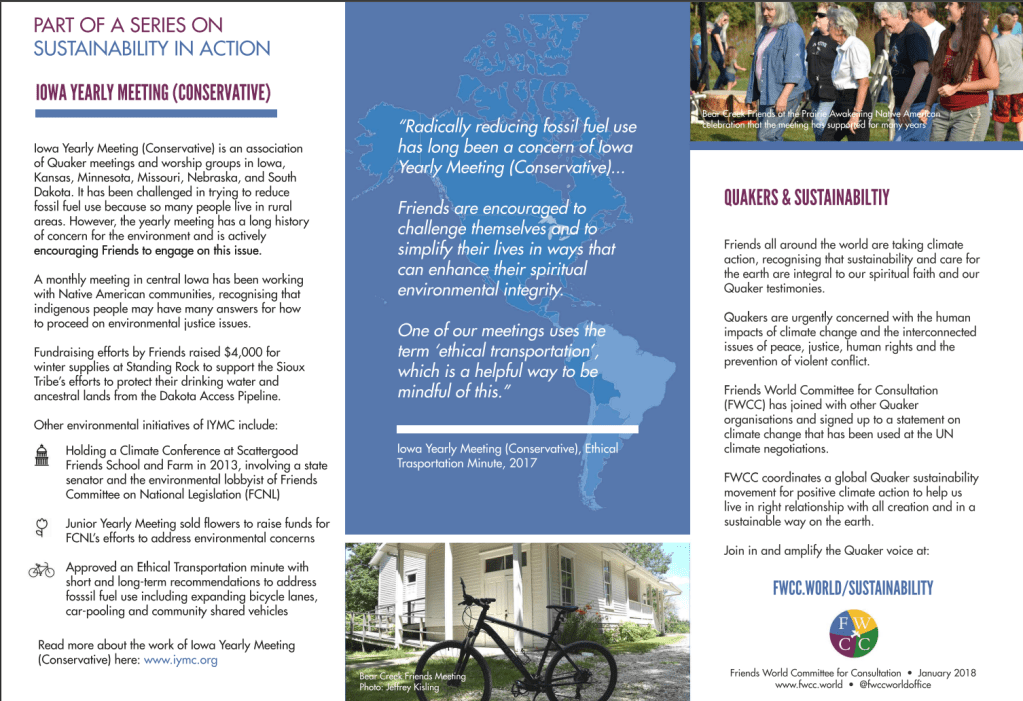
These photos are from Paula’s visit to Iowa Yearly Meeting (Conservative)


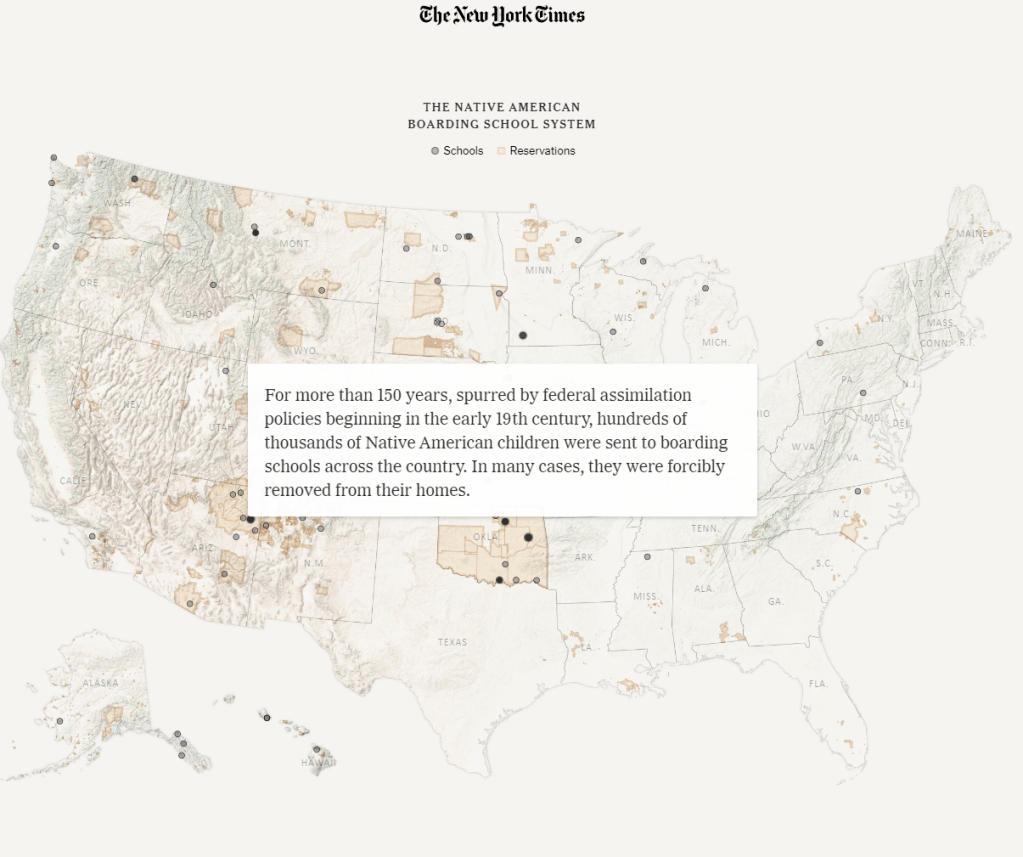
The New York Times recently published an extensive article about the Native American Boarding School System, War Against the Children.

WAR AGAINST THE CHILDREN

The Native American boarding school system — a decades-long effort to assimilate Indigenous people before they ever reached adulthood — robbed children of their culture, family bonds and sometimes their lives.

By Zach LevittYuliya Parshina-KottasSimon Romero and Tim Wallace Aug. 30, 2023

Beyond the vast federal system, this new list also sheds light on boarding schools that operated without federal support. Religious organizations ran at least 105 schools; many were Catholic, Presbyterian or Episcopalian, but smaller congregations such as the Quakers ran schools of their own.


Another excellent resource about these institutions of forced assimilation is the National Native American Boarding School Healing Coalition.

Why we need different queries

As I’ve been praying about why the Quaker meetings I’m familiar with are slowly dying from attrition and not attracting new attenders, I’m struggling to understand why this is happening. I feel a special urgency, wondering if my Quaker meeting can continue when we lose even one more member. Lose another elderly member, or one who turns away from Quakerism.

I was led to think about our Advices and Queries because they guide the spiritual discussions in our meetings. And they are one concrete thing we can point to for people interested in learning about Quakerism.

It surprised me to be led to the conclusion that our Queries seem rooted in maintaining the status quo of this country’s current economic and political systems. Systems of dominance, systemic racism, and White supremacy. And an implicit view of ‘us versus them.’ (See: Advices and Queries). Today, I hope to explain that more fully and offer suggestions for what we might do differently.

I’m focusing on the abolition of police and prisons, both because this is something I’ve been learning and writing about (https://quakersandreligioussocialism.com/abolition/) and because it is a deep concern of some activist Quakers I know and of my Mutual Aid community. One of my abolitionist Friends is leaving Quakers because of the lack of attention to this concern. This is an example of the attrition I’m concerned about.

We are police and prison abolitionists. Abolition and the mutual aid that we practice are inextricably linked. We don’t rely on capitalist institutions or the police to do our work. We believe in building strong and resilient communities which make police obsolete, including community systems of accountability and crisis intervention. Des Moines Mutual Aid

What does it mean that abolition is not one of our Query topics?

  • Meeting for Worship
  • Outreach
  • Meeting for Business
  • Harmony within the Meeting
  • Mutual Care
  • Education
  • Home and Family
  • Personal Responsibility
  • Civic Responsibility
  • Environmental Responsibility
  • Social and Economic Justice
  • Peace and Nonviolence

I think that is because abolition touches several of these topics and illustrates why I think we need new queries.


Quakers are pretty white, and that comes with quite a bit of power and privilege. A Quaker in Omaha, Nebraska is going to have probably more weight in what they say to a legislator than a Black Lives Matter activist in Brooklyn, New York. I think there’s a need for Quakers to step out of their meeting and away from a lot of these phenomenal institutions that they’ve created and speak to individuals in an interfaith setting (from Black churches or Black Lives Matter) and have a cross-cultural understanding of what that experience is like because you’ll find that it’s very different, and I think the more we can do of that the more effective we’ll be in addressing these problems. These exchanges and fusion coalitions are what I think it’s going to take, not only for Friends to be effective in dismantling these systems of racism, classism, and white supremacy in American society, but also for all of us to better address these problems in our country.

José Santos Woss (FCNL), Quaker Faith and Justice Reform, QuakerSpeak video

Perhaps the revolutionary Quaker faith we imagine ourselves to inhabit has never really existed, and if we tell the whole truth and commit to the healing the truth-telling calls us to, perhaps together we can embody and create the prophetic religion we thirst for.

Abolitionist thinking is holistic—that ending the system of punishment and incarcerating control itself is necessary—and invites us to imagine a whole new way of not only dealing with harm but of how we think of ourselves in community. It provokes questions like, what does true justice look like? What does it mean to center healing and transforming relationships and create community safety from authentic accountability and relational reconnection? Abolition does not minimize the reality of harm or violence but rather invites us to consider a way of doing things that interrupts cycles of harm, violence, and trauma, and restores perpetrators and victims into community and their humanity.

We as White Quakers like to think of ourselves as ahead or better than dominant culture, but we have been complicit in a system and mindset that are ubiquitous. Claiming the full truth of our history and committing to repair the harms done are deeply spiritual acts of healing our own wounds of disconnection. I would argue it is the pathway upon which we can, perhaps for the first time, discover and invigorate our faith with its full promise.

A Quaker Call to Abolition and Creation by Lucy Duncan, Friends Journal, April 1, 2021

Jed Walsh and Mackenzie Barton-Rowledge are close friends who do police and prison abolition work together. They sent Western Friend a conversation about what abolition means to them, and how it fits into their lives as Quakers.

The way I think about abolition is first, rejecting the idea that anyone belongs in prison and that police make us safe. The second, and larger, part of abolition is the process of figuring out how to build a society that doesn’t require police or prisons.

Abolish the Police by Mackenzie Barton-Rowledge and Jed Walsh, Western Friend, Nov 2020

Jeff Kisling: Mutual Aid and Abolition

I grew up in rural Iowa, where there was very little racial diversity and interactions with police and the court system were rare. About ten years ago, I was blessed to become involved with the Kheprw Institute, a Black youth mentoring and empowerment community. I’ll never forget how shocked I was when a Black mother broke down in tears, explaining how terrified she was every minute her children were away from home. It was obvious that every other person of color in the discussion knew exactly what she was saying.

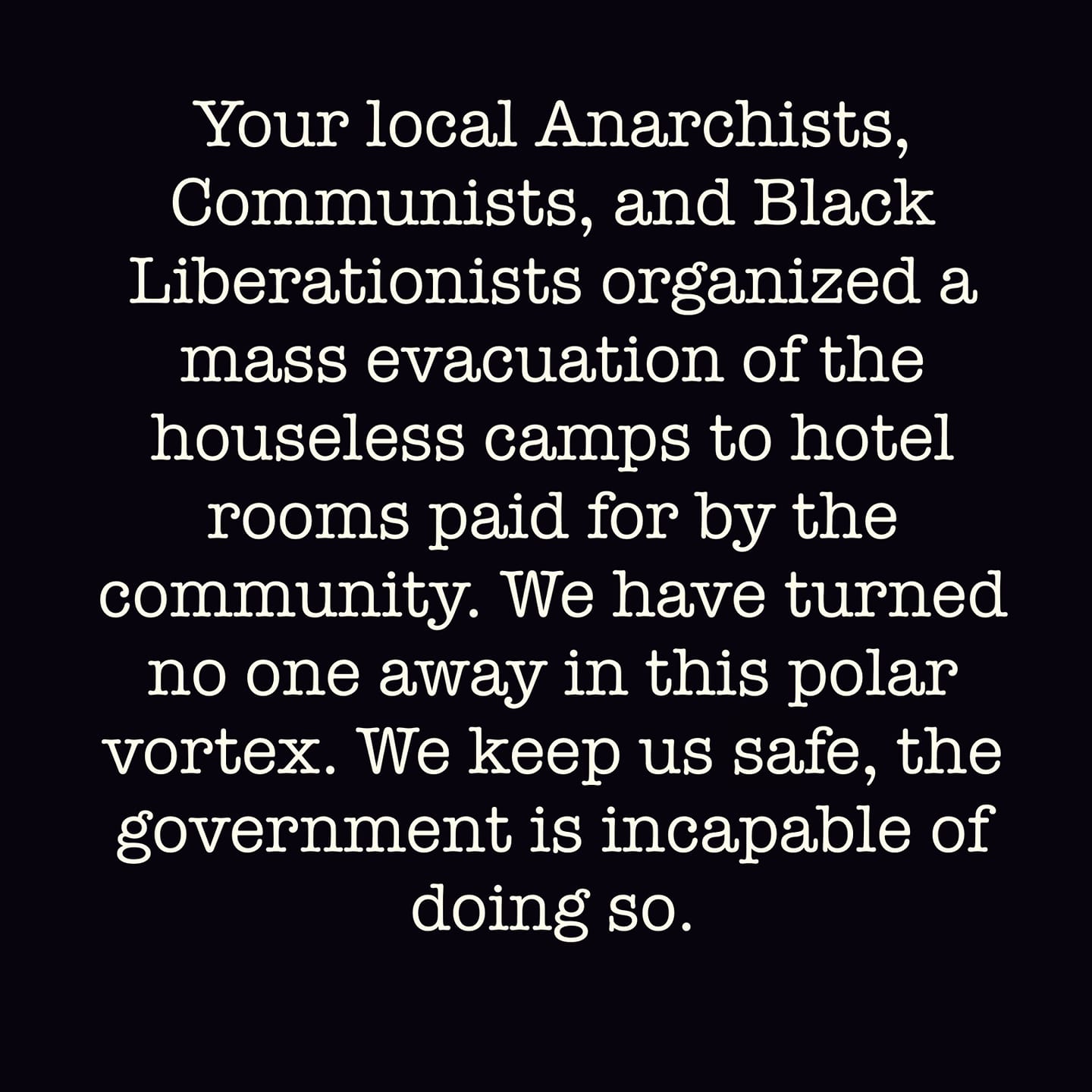
After retiring, I was led to connect with Des Moines Mutual Aid, a multiracial organization founded to support houseless people. For over a year, I’ve helped my friends fill and distribute boxes of donated food, while continuing to learn about the framework of mutual aid.

To me, mutual aid is about taking back control of our communities. Besides the food giveaway, we support houseless people and maintain a bail fund to support those arrested agitating for change. We also work for the abolition of police and prisons.

Mackenzie Barton-Rowledge and Jed Walsh: Introducing the Quakers for Abolition Network, Western Friend, Sept 2021

Some queries about police and prison abolition:

  • What is your understanding of the term “abolition” and what does it entail? How does it differ from the reform or improvement of the existing system?
  • What are some historical and contemporary examples of abolitionist movements and practices, such as the abolition of slavery, the anti-apartheid struggle, the prison strike movement, the mutual aid networks, and the community defense initiatives?
  • What are some of the root causes of violence, harm, and crime in our society, and how do they relate to the structures of white supremacy, capitalism, heteronormative patriarchy, and settler colonialism?
  • How do the police, courts, and prisons perpetuate and exacerbate violence, harm, and crime rather than prevent or reduce them? How do they disproportionately target and oppress Black, Indigenous, and people of color (BIPOC), poor people, LGBTQIA+ people, immigrants, and other marginalized groups?
  • What are some of the alternatives to policing and incarceration that can address the needs and rights of survivors, perpetrators, and communities more humanely and effectively? How can we build and support these alternatives in our own contexts and networks?
  • What are some of the challenges and barriers to achieving abolition, internally (such as fear, doubt, or attachment) and externally (such as resistance, backlash, or co-optation)? How can we overcome or transform them through education, organizing, and action?

Sources:

Learn more:

1. https://www.newyorker.com/news/our-columnists/the-emerging-movement-for-police-and-prison-abolition
2. https://www.peoplesworld.org/article/prison-and-police-abolition-re-imagining-public-safety-and-liberation/
3. https://www.peoplesworld.org/article/on-becoming-police-and-prison-abolitionists-but-what-about-the-murderers/
4. https://www.autostraddle.com/police-and-prison-abolition-101-a-syllabus-and-faq/
5. https://www.radcliffe.harvard.edu/news-and-ideas/rethinking-incarceration


Advices and Queries

In yesterday’s post, Queries about our future, I made the mistake of concluding by saying “We need to…” That defeats the purpose of queries, intended to help Quakers discern what they are led to do by listening to the Spirit. “We look for our own truths and the truths of our meeting when we discuss the advices and answer the queries.”

Faith and Practice

Becoming aware of how we discern Spirit is important to our worship. The Quaker faith is not written in the form of a creed, but is experienced in our lives as a vibrant, living truth. Advices and queries serve to engage our minds and hearts in a process which may provide openings to the leadings of the Spirit within us. These leadings may speak to our individual and corporate needs. The advices and queries reflect experiences from many lives as they contribute to the gathered wisdom of the group. They serve to guide us on our spiritual journeys by opening our hearts and minds to the possibility of new directions and insights.

Uses of Advices and Queries

We look for our own truths and the truths of our meeting when we discuss the advices and answer the queries.

The Book of Discipline of Iowa Yearly Meeting of Friends (Conservative)
Religious Society of Friends


We refer to our use of queries as Advice and Queries. The ADVICE provides an introduction or the context for considering the subject. There are twelve query topics.

  • Meeting for Worship
  • Outreach
  • Meeting for Business
  • Harmony within the Meeting
  • Mutual Care
  • Education
  • Home and Family
  • Personal Responsibility
  • Civic Responsibility
  • Environmental Responsibility
  • Social and Economic Justice
  • Peace and Nonviolence

Here is an example of an Advice and the Queries related to social and economic justice.

ADVICE

We are part of an economic system characterized by inequality and exploitation. Such a society is defended and perpetuated by entrenched power.

Friends can help relieve social and economic oppression and injustice by first seeking spiritual guidance in our own lives. We envision a system of social and economic justice that ensures the right of every individual to be loved and cared for; to receive a sound education; to find useful employment; to receive appropriate health care; to secure adequate housing; to obtain redress through the legal system; and to live and die in dignity. Friends maintain historic concern for the fair and humane treatment of persons in penal and mental institutions.

Wide disparities in economic and social conditions exist among groups in our society and among nations of the world. While most of us are able to be responsible for our own economic circumstances, we must not overlook the effects of unequal opportunities among people. Friends’ belief in the Divine within everyone leads us to support institutions which meet human needs and to seek to change institutions which fail to meet human needs. We strengthen community when we work with others to help promote justice for all.

QUERIES

How are we beneficiaries of inequity and exploitation? How are we victims of inequity and exploitation? In what ways can we address these problems? What can we do to improve the conditions in our correctional institutions and to address the mental and social problems of those confined there?

How can we improve our understanding of those who are driven to violence by subjection to racial, economic or political injustice?

In what ways do we oppose prejudice and injustice based on gender, sexual orientation, class, race, age, and physical, mental and emotional conditions?How would individuals benefit from a society that values everyone? How would society benefit?

The Book of Discipline of Iowa Yearly Meeting of Friends (Conservative)

I think my Quaker community is going to be upset by the following. But as I look at these Queries and Advices after years of working in diverse communities, they seem rooted in maintaining the status quo of this country’s current economic and political systems. Systems of dominance, systemic racism, and White supremacy. I see an implicit view of ‘us versus them.’

I became so invested in Mutual Aid because our work is about alternatives to those systems of injustice. Mutual Aid is faith in action. Mutual Aid is about meeting survival needs NOW.

Our Advices and Queries are updated every so often. I’m led to believe now is the time to rewrite them. The Mutual Aid Points of Unity are a template for what our Advices might say. And then we can work on queries in the context of those new Advices.


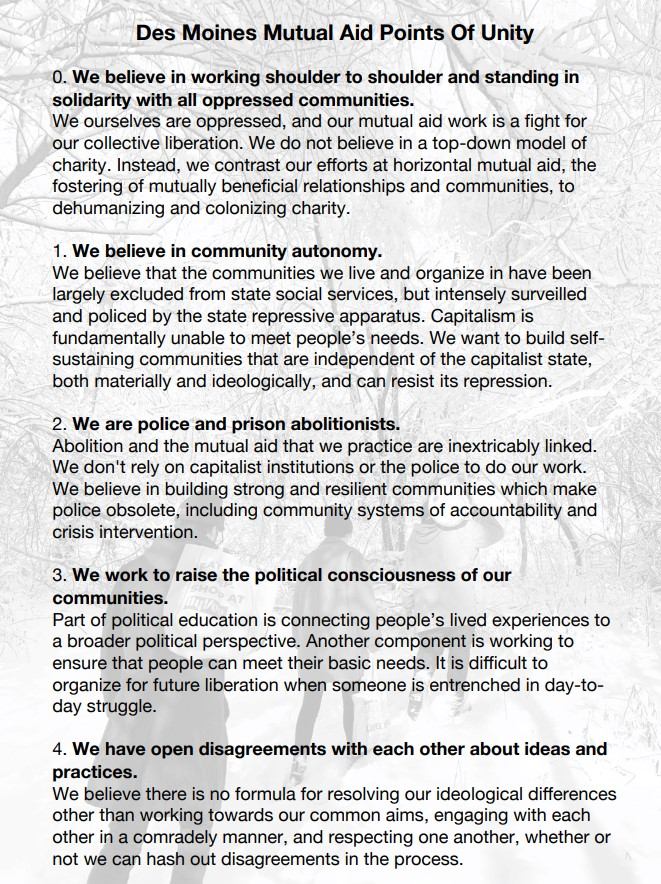
Mutual Aid Points of Unity

We believe in working shoulder to shoulder and standing in solidarity with all oppressed communities.

We ourselves are oppressed, and our mutual aid work is a fight for our collective liberation. We do not believe in a top-down model of charity. Instead, we contrast our efforts at horizontal mutual aid, the fostering of mutually beneficial relationships and communities, to dehumanizing and colonizing charity.

We believe in community autonomy.

We believe that the communities we live and organize in have been largely excluded from state social services, but intensely surveilled and policed by the state repressive apparatus. Capitalism is fundamentally unable to meet people’s needs. We want to build self-sustaining communities that are independent of the capitalist state, both materially and ideologically, and can resist its repression.

We are police and prison abolitionists.

Abolition and the mutual aid that we practice are inextricably linked. We don’t rely on capitalist institutions or the police to do our work. We believe in building strong and resilient communities which make police obsolete, including community systems of accountability and crisis intervention.

We work to raise the political consciousness of our communities.

Part of political education is connecting people’s lived experiences to a broader political perspective. Another component is working to ensure that people can meet their basic needs. It is difficult to organize for future liberation when someone is entrenched in day-to-day struggle.

We have open disagreements with each other about ideas and practices.

We believe there is no formula for resolving our ideological differences other than working towards our common aims, engaging with each other in a comradely manner, and respecting one another whether or not we can hash out disagreements in the process.


Queries about our future

The recent passing of another of our elders brings new urgency to understanding why we are not attracting new attenders to our Quaker meetings and what to do about that.

“I’m so afraid of climate change. I just turned 17 not so long ago and I’m afraid I’ll never get to grow up because of the way our Earth is going.

“Most of my friends and family are apathetic, such as my parents who don’t like me talking about this stuff since they feel we can’t really change anything. My mom thinks it’s completely irreversible. I hate holding it all inside all the time. …

“I guess what I really wanna hear is it’s all gonna be ok even though it’s probably not the truth. I’m just scared. I’d appreciate any positive news or insight from those who feel the same way and how you manage it while doing everything you can. Thanks for reading.”

I’m a teen and I’m really scared for my future

A pair of recent articles by Steve Genco is about what to say to a 17-year-old terrified about their future and poses some queries. These questions are relevant to the future of us all.

  • What predictions can you rely on?
  • What will give your life meaning?
  • What skills and mental habits will you need?
  • How will you live?

What Can You Tell a 17 Year Old Who’s Afraid of Dying from Climate Change? Part 1 by Steve Genco, Aug 29, 2023, Medium

The article lists the following predictions we can rely on:

  • It’s going to get hotter
  • The weather is going to get more unpredictable and more extreme
  • Natural disasters are going to arrive at greater and greater frequency
  • Economic inequality (income and wealth) is going to get worse
  • We will continue depleting the natural world
  • The effects of climate change will be unevenly distributed around the planet
  • We will run out of oil and gas

What will give your life meaning?

Psychologists Edward Deci and Richard Ryan began developing what they called Self-Determination Theory (SDT) in the 1970s. SDT emerged out of Deci’s interest in intrinsic motivation

Deci began searching for the underlying needs that intrinsically motivated behavior seemed to fulfill. He and Ryan discovered three motivators that appeared to represent basic or innate psychological needs

  • A need for autonomy: People need to feel self-directed and in control of our actions. We are more motivated to pursue activities we voluntarily and freely choose for ourselves, as opposed to activities we feel are imposed on us by other people or external circumstances.
  • A need for competence: People need to feel accomplished and capable. We are more motivated to pursue activities we feel competent to accomplish. We are also motivated to pursue activities that allow us to increase our competence through practice and repetition.
  • A need for belonging: People need to feel connected to others. We are more motivated to pursue activities that make us feel closer to others and that can be pursued in a supportive social context. This need is called relatedness by Deci and Ryan.

Throughout their research, Deci and Ryan studied how the goals people pursue on a daily basis and throughout their lives fulfill basic needs and contribute (or not) to personal wellbeing. In these studies, they found compelling evidence that:
placing strong relative importance on intrinsic aspirations was positively associated with well-being indicators such as self-esteem, self-actualization, and the inverse of depression and anxiety, whereas placing strong relative importance on extrinsic aspirations was negatively related to these well-being indicators.

What skills and mental habits will you need?

So, how do you create a life of autonomy, competence, and belonging? You plan your life around goals and activities that make you more self-sufficient, knowledgeable, and socially connected.

In a world of cascading climate crises, shortages, and social and political unrest, people who can think for themselves, have useful practical skills, and are connected to a like-minded community, are going to have significant advantages over the cult followers, the totally-unprepared, and the socially isolated.

What Can You Tell a 17 Year Old Who’s Afraid of Dying from Climate Change? Part 2 by Steve Genco, Aug 29, 2023, Medium

How will you live?

  • Think global, act local
  • Stay mobile
  • Embrace simplicity
  • Learn how to repair/reuse/recycle
  • Don’t tie your happiness to material accumulation

The needs for autonomy, competence, and belonging are exactly what Mutual Aid is about. These are the Points of Unity of my Des Moines Mutual Aid community.

Mutual Aid Points of Unity

We believe in working shoulder to shoulder and standing in solidarity with all oppressed communities.

We ourselves are oppressed, and our mutual aid work is a fight for our collective liberation. We do not believe in a top-down model of charity. Instead, we contrast our efforts at horizontal mutual aid, the fostering of mutually beneficial relationships and communities, to dehumanizing and colonizing charity.

We believe in community autonomy.

We believe that the communities we live and organize in have been largely excluded from state social services, but intensely surveilled and policed by the state repressive apparatus. Capitalism is fundamentally unable to meet people’s needs. We want to build self-sustaining communities that are independent of the capitalist state, both materially and ideologically, and can resist its repression.

We are police and prison abolitionists.

Abolition and the mutual aid that we practice are inextricably linked. We don’t rely on capitalist institutions or the police to do our work. We believe in building strong and resilient communities which make police obsolete, including community systems of accountability and crisis intervention.

We work to raise the political consciousness of our communities.

Part of political education is connecting people’s lived experiences to a broader political perspective. Another component is working to ensure that people can meet their basic needs. It is difficult to organize for future liberation when someone is entrenched in day-to-day struggle.

We have open disagreements with each other about ideas and practices.

We believe there is no formula for resolving our ideological differences other than working towards our common aims, engaging with each other in a comradely manner, and respecting one another whether or not we can hash out disagreements in the process.


Much of the above will be uncomfortable for many Friends because it involves rejecting the status quo. I contend that is why we are not attracting new attenders. If we don’t do so voluntarily these changes will be forced upon us as the status quo continues to collapse.

I believe we are in a time of great spiritual poverty. Friends have a precious gift to offer those needing a spiritual home. But the two will never be connected if Friends continue isolating themselves in their meetinghouses and cling to the status quo. We need to be police and prison abolitionists, find alternatives to capitalism, block the development of fossil fuel infrastructure, reject empire and militarism, and promote and follow the leadership of Indigenous peoples.


What Can You Tell Youth Afraid of Dying from Climate Change? Part 2

This is part 2 of What Can You Tell a 17 Year Old? These posts are based on the two part series on this topic by Steve Gencko

In Part 1, he discusses two questions youth should consider about this.

  • What predictions can you rely on?
  • What will give your life meaning?

The questions in Part 2 are:

  • What skills and mental habits will you need?
  • How will you live?

I’m just going to outline what Genko says in his article. You can find a fuller explanation of all of this there. I will then discuss my concepts of how to build communities for the (near) future we are facing.


What skills and mental habits will you need?

So how do you go about creating a life of autonomy, competence, and belonging? You plan your life around goals and activities that make you more self-sufficient, knowledgeable, and socially connected. In a world of cascading climate crises, shortages, and social and political unrest, people who can think for themselves, have useful practical skills, and are connected to a like-minded community, are going to have significant advantages over the cult followers, the totally-unprepared, and the socially isolated.

I have five suggestions for skills and mental habits worth acquiring as our fossil fuel-dependent civilization stumbles into the rest of this century.

  • Develop a resilient mindset
  • Hone your capacity for evidence-based reasoning
  • Develop competence in practical skills
    • First aid
    • Multi-crop gardening
    • Food preparation and preservation
    • Wood-working
    • Water collection
    • Appliance repair
    • Fire-building
    • Hunting and preparing game
  • Stay fit
  • Avoid declining industries and toxic people

What Can You Tell a 17 Year Old Who’s Afraid of Dying from Climate Change? Part 2 by Steve Genco, Aug 29, 2023, Medium


How will you live?

Some organizing principles

  • Think global, act local
  • Stay mobile
  • Embrace simplicity
  • Learn how to repair/reuse/recycle
  • Don’t tie your happiness to material accumulation

What Can You Tell a 17 Year Old Who’s Afraid of Dying from Climate Change? Part 2 by Steve Genco, Aug 29, 2023, Medium


The havoc from increasingly violent storms and development of large areas of drought will increasingly overwhelm our economic and political systems. Millions of people will no longer receive payments from employment or social safety systems. Financial institutions will fail. Military, public safety, and governance systems will break down. Municipal services such as water, power, transit, sewage and trash processing will fail.  Food will no longer be available in grocery stores. We need to begin to prepare now. Not wait until the day water is no longer flowing from the faucet. Not wait until more of us are left without critical infrastructure. Not wait until millions are forced to flee coastal cities as the oceans flow into their streets, or flee wildfires, or areas with lethal heat, medical services including medications are no longer available. We’re already seeing the collapse of political and economic systems.

The Midwest

We are faced with two broad problems. How to adapt our own lives to deal with these changes, and what to do about the flood of people who will be migrating to the Midwest.

Since we will soon not be able to depend on municipal water and power, transport of food from distances, schools and hospitals, many will be forced to move to rural areas where they can live and grow their own food.

The Choice

It would seem we have two choices.

  1. One is to narrowly focus on the best we can do to prepare ourselves and immediate community to adapt to the coming changes.
  2. The other is to also work on ways we can help the many people who will be coming to where we live to learn, adapt and thrive as well as possible.

In the coming chaos we can help our own safety by welcoming climate refugees, instead of building walls against them.

Disaster Preparedness

This model is in part written from my Quaker viewpoint. As Friends, we will make the second choice, to care for those who will be displaced. This will be like disaster relief work, only on a scale never seen before.

We first need to learn how to adapt to this uncertain future ourselves. Part of that will be to network with others, both to learn from and to build a network to coordinate the response to the needs of the climate refugees.

Building Communities-My Vision

We need to build model sustainable communities. (See my posts: https://jeffkisling.com/?s=beloved+communities). I believe spirituality, whatever that might mean to you, will be an important factor in how we can adapt and live with each other during the collapse.

There have been numerous such experiments in intentional community. But this model must be created with the intention of being replicated many times over with minimal complexity, using locally available materials—a pre-fab community.

Pre-fab components

  • Community hub with housing and other structures
    • Simple housing
    • Stores, school, meetinghouse
    • Central kitchen, bathrooms and showers
  • Surrounding fields for food and straw
  • Water supply
    • Wells, cisterns and/or rain barrels
  • Power
    • Solar, wind, hydro, horse
  • Manufacturing
    • 3 D printing
    • Pottery
    • Sawmill
  • Communication
    • Radio, local networks
  • Transportation
    • Bicycles
    • Horses
    • Pedal powered vehicles
  • Medical
    • Stockpile common medications
    • Essential diagnostic and treatment equipment
    • Medical personnel adapt to work in community
  • Spiritual
    • Meeting for worship
    • Meeting for business