Walk a Path of Doing the Truth

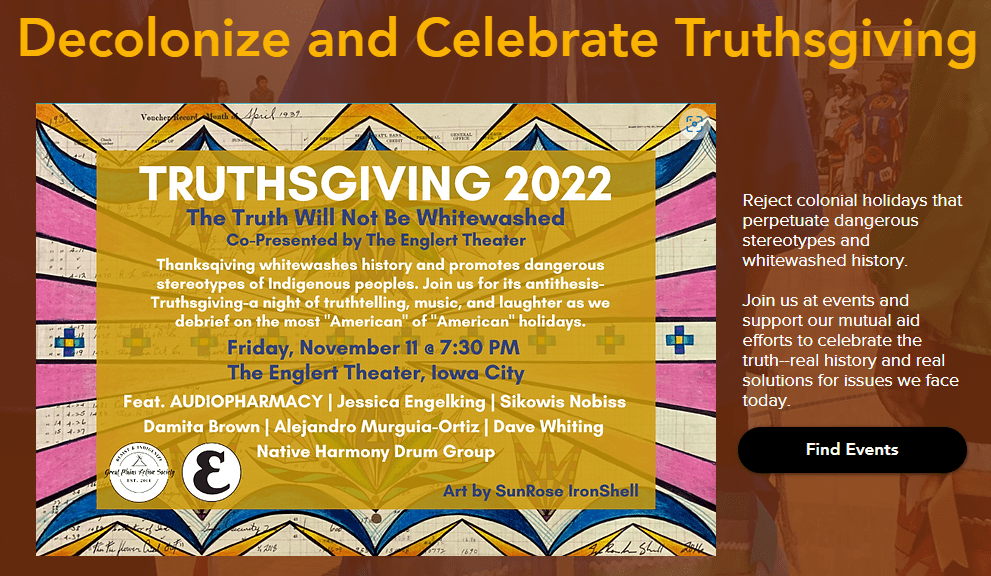
Truthsgiving is about the holiday known by many non native people as Thanksgiving. A day when families gather together. Family gatherings are wonderful. Unfortunately, the myth of a peaceful gathering of settler colonists and Indigenous peoples comes up.

I didn’t think I would write about this today. Didn’t want to bring negativity to joyful gatherings. But the Spirit is telling me to share this, this plea to at the least not whitewash the history.

The term Truthsgiving is about the opportunity to spread awareness about the true history, about the genocide and land theft from Indigenous peoples by white settler colonists.

Truthsgiving is an ideology that must be enacted through truth telling and mutual aid to discourage colonized ideas about the thanksgiving mythology—not a name switch so we can keep doing the same thing. It’s about telling and doing the truth on this day so we can stop dangerous stereotypes and whitewashed history from continuing to harm Indigenous lands and Peoples, as well as Black, Latinx, Asian-American and all oppressed folks on Turtle Island. https://www.truthsgiving.org/about

If there is an opportunity for truth telling, there will probably be questions about what to do about this. That’s where mutual aid comes in. I was blessed to be led to connect with Des Moines Mutual Aid and have written a lot about that. https://quakersandreligioussocialism.com/mutual-aid/

The reason mutual aid is important is because it provides an alternative to the capitalism and white superiority that our mainstream society is built upon. Mutual aid can help us Walk a Path of Doing the Truth as my friend Ronnie James wrote in “Doing Truth When the World is Upside Down.”

To walk a path of Doing the Truth

To walk a path of Doing the Truth is a battle with a very young culture. Telling the truth is comparably easy, we have our oral histories, art and traditions created and carried on, histories printed by those that found a way to the presses. We can recount the stories and lessons that survived colonialism.

But to do the truth, to live a life that enforces what we once had, a life and culture that made a millennia of humanity possible to thrive, is to be at war with what has defined and destroyed this world for too long.

Doing Truth When the World is Upside Down by Ronnie James, TRUTHSGIVING, Nov 18, 2020

Truthsgiving is an ideology that must be enacted through truth telling and mutual aid to discourage colonized ideas about the thanksgiving mythology

TRUTHSGIVING. The Truth will not be whitewashed

Des Moines Mutual Aid Points of Unity

0. We believe in working shoulder to shoulder and standing in solidarity with all oppressed communities. We ourselves are oppressed, and our mutual aid work is a fight for our collective liberation. We do not believe in a top-down model of charity. Instead, we contrast our efforts at horizontal mutual aid, the fostering of mutually beneficial relationships and communities, to dehumanizing and colonizing charity. 

1. We believe in community autonomy. We believe that the communities we live and organize in have been largely excluded from state social services, but intensely surveilled and policed by the state repressive apparatus. Capitalism is fundamentally unable to meet people’s needs. We want to build self-sustaining communities that are independent of the capitalist state, both materially and ideologically, and can resist its repression. 

2. We are police and prison abolitionists. Abolition and the mutual aid that we practice are inextricably linked. We don’t rely on capitalist institutions or the police to do our work. We believe in building strong and resilient communities which make police obsolete, including community systems of accountability and crisis intervention. 

3. We work to raise the political consciousness of our communities. Part of political education is connecting people’s lived experiences to a broader political perspective. Another component is working to ensure that people can meet their basic needs. It is difficult to organize for future liberation when someone is entrenched in day-to-day struggle.

4. We have open disagreements with each other about ideas and practices. We believe there is no formula for resolving our ideological differences other than working towards our common aims, engaging with each other in a comradely manner, and respecting one another, whether or not we can hash out disagreements in the process. 


Des Moines Mutual Aid is an Abolitionist Mutual Aid Collective made up of varying radical and revolutionary tendencies in what is current known as central iowa.

None of these articles represent the collective as a whole. Take what you can from these pieces and burn the prisons.

In Love and Rage,
Des Moines Mutual Aid


https://www.truthsgiving.org/take-the-pledge
https://www.truthsgiving.org/

Spiritual connections for survival

For many years I’ve been praying, thinking, writing, and discussing how we can prepare for an increasingly dystopian future. In an article in Friends Journal, Donald McCormick asks “why is there no vision for the future of Quakerism?”  I wrote about my vision in the article What is your vision for the future?

The increasing threats from environmental devastation and chaos lead me to share more of my vision, which has been evolving over the past several years. It’s taken me a long time to write this article, I think because I haven’t found resources available to check on what I’m saying here.

I’ve always believed the greatest problem to solve is how communities of the future organize and govern themselves. We’ll have to do things differently because our present systems are collapsing. Which is often not a bad thing since those systems are based on colonialism and capitalism.


Spirituality

Spirituality is especially important now as we experience increasing environmental chaos, which will contribute to further social, economic, and political collapse. We will have no choice but to band together for the survival of us all. The alternative is tribalism with its violence, destruction and death.

We will need the help of those who know survival skills that we don’t. It takes time to build the trust necessary for these connections. It is urgent to do this now. It is by the Spirit that we can engage with everyone around us, of all cultures, identities, ethnicities.

  • Spirituality can show us how to live with integrity now. How to be examples to others. This is how change happens.
  • The Creator can help us heal the wounds of the past. And the wounds that will be inflicted in the future.
  • The Spirit can guide us through the coming chaos.
  • It is by the Spirit we create connections among diverse peoples.

Kheprw Institute (KI)

One set of my spiritual experiences relates to my introduction to a community of people of color, the Kheprw Institute (KI). I wrote about this in detail at: https://jeffkisling.com/2021/03/14/white-quakers-and-spiritual-connections-with-the-kheprw-institute/

At my first meeting with the KI community, I was asked a number of questions. When I said I was a Quaker, one of the adults (the group was mainly teenagers) spoke about the history of Quakers related to the underground railroad. When she finished, all eyes turned to me. I said I was glad my ancestors did that, it was the right thing to do, but we try not to take credit for things we have not done ourselves. When I was asked to speak more about that, I wasn’t sure what to say. I remember clearly that an answer came from the Spirit, which told me to not only say that Quakers believe there is that of God in everyone, but to also look into the eyes of each one there and say, “and that includes you”. Each person smiled at me when I did that. That ended the questioning, and I was welcomed into the community. We had this spiritual basis for our work together.

But that was just the first step. Trust was built, but slowly. With permission, I invited members of my Quaker community to engage with KI’s monthly book discussions. This was one way we began to get to know each other. But it was two years after this introduction before I was invited to teach a class on photography for KI.

Kheprw Institute, Indianapolis

First Nation-Farmer Climate Unity March

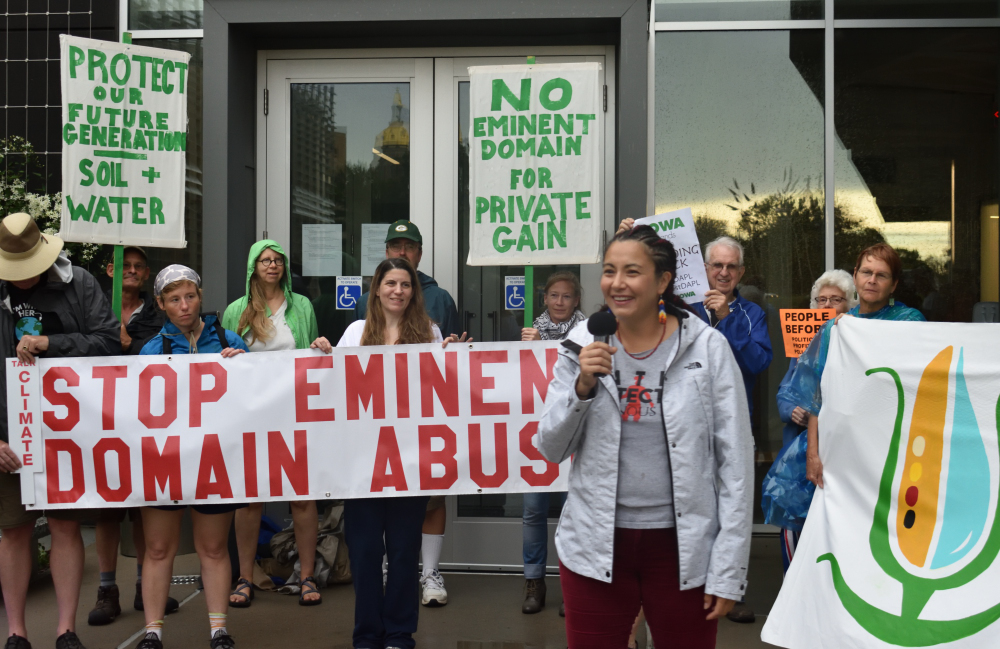
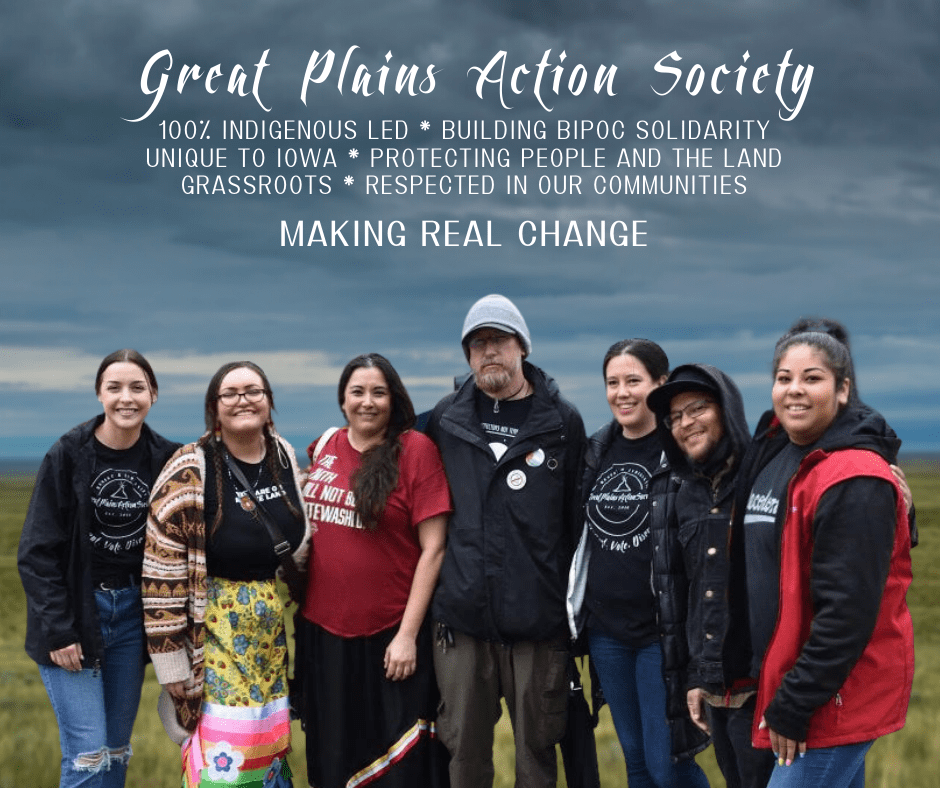
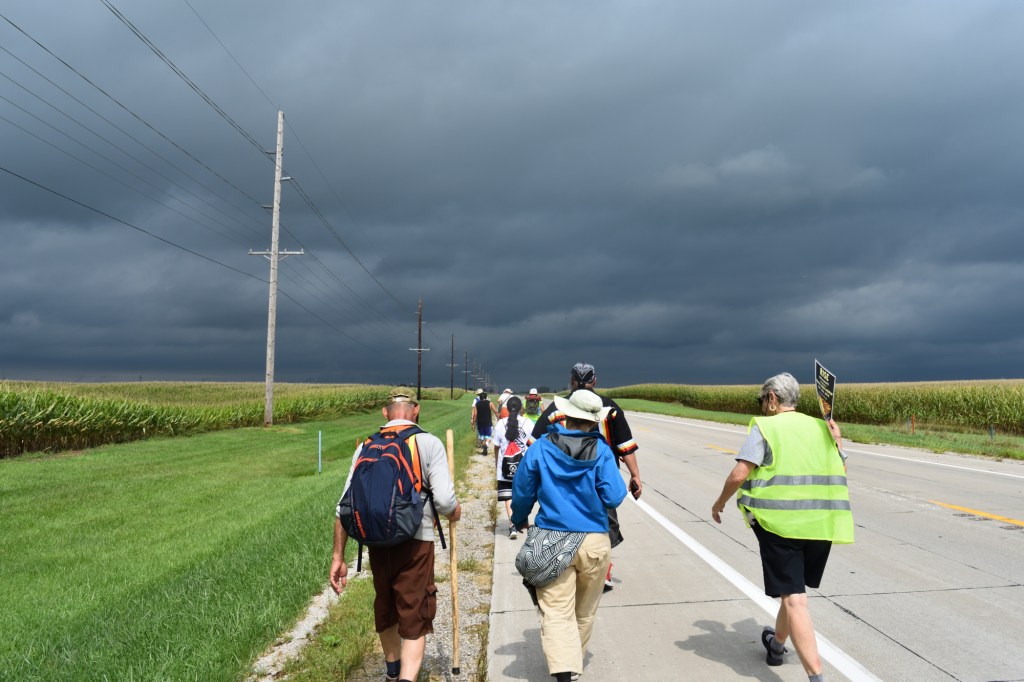
Because of my lifelong commitment to care for our environment, I’d always wanted to learn about Indigenous peoples and their sustainable lives. I jumped at the opportunity to do so when I heard about the First Nation-Farmer Climate Unity March in 2018. The intention was to build a community of native and nonnative people by walking and camping together along the route of the Dakota Access pipeline from Des Moines to Fort Dodge, Iowa (94 miles). Many long hours walking together, for eight days, along empty Iowa gravel roads was very effective in creating the beginnings of trust. There were about fifteen native and fifteen nonnative people, which allowed each of us the opportunity to share stories with every other person.

I’d hoped there would be ways to learn more about their spirituality, and to share some about my own. But I knew there was a huge barrier between us related to Friends’ involvement in the institutions of forced assimilation of native children. It is uncomfortable to admit this, but at the time I wondered how much awareness there was about the Indian Boarding Schools. I was soon to learn how profound that trauma was, and how it was passed from generation to generation. Is a deep wound today in every Indigenous person I know. I discuss this in detail in White Quakers and Native Peoples and other writings.

I didn’t know if, or how, the occasion might occur to talk about this during the March. Or whether I should.

But I vividly remember when the Spirit told me to say, “I know Quakers were involved in the Indian boarding schools and I’m sorry that happened” to the native person I was getting to know the best early in the March. I was worried saying that would upset him, open wounds. But he just nodded his head, and we kept walking together. But later in the day he said, “I want to tell you a story”, and proceeded to tell me a story related to him and his mother and the boarding schools.

At various times the Spirit led me to bring this up with each of my native friends. Every one of them and their families have had traumatic experiences related to forced assimilation. And the removal of native children from their homes continues in the guise of child welfare.

This is something that should not be taken lightly. A certain level of connection and trust is important. This is not about us (White people) and what we would like to see or do. There should be clear spiritual guidance.

I’ve found my Indigenous friends to be deeply spiritual. I like the sign, Earth is my church, carried by my friends Foxy and Alton Onefeather during the March. That says a lot about why I feel my friends are spiritual, their reverence of all things human and nonhuman. And their practices such as smudging, putting down tobacco, expressing thanks to the Creator each time they speak in public. Their humbleness. One friend often says “we are just pitiful people” during her prayers.

In the four years since that March, various combinations of us have had numerous opportunities to work together.

And yet again, that trust has been built, is being built slowly.

Foxy Onefeather holds sign on First Nation-Farmer Climate Unity March (2018)


Spiritual guidance

Quakers believe our lives must be guided by the Spirit. But far too often people haven’t found, or don’t try to discern that spiritual guidance. They try to figure out how to do justice work on their own or in conjunction with like-minded people. with the best of intentions. That phrase usually indicates not listening to those affected by injustice. And indicates not having discerned what their faith is trying to tell them.

And that often results in unintended, harmful consequences. A common phrase to keep in mind is nothing about us without us. This is especially challenging for White people who are accustomed to their privileges. Often not even aware of those privileges. We would not need to qualify what our intentions were if we were following the leadership of the communities facing injustice.

One horrific example of best intentions gone wrong were the Indian boarding schools. A policy of forced assimilation of native children into White culture was thought by many to be a way to help Indian children adjust to the enveloping White society. But tens of thousands of children suffered physical, emotional, and sexual abuse. Thousands died. Genocide. And that trauma has been passed to each following generation, including todays. Every one of my native friends has been affected.

This is an example of difficulties in making connections between different communities and/or cultures. With this horrific history, and ongoing trauma, how can a bridge ever be built between these two cultures, White and Indigenous? Or between White and BIPOC people and communities? (Black, Indigenous and other people of color)

But for others, especially in the government and military, this policy and horror was exactly what they intended.


Mutual Aid

The Spirit also led me to become involved in a Mutual Aid community. And led me to be involved in efforts to abolish police and prisons. I’ve written extensively about these things on my website Quakers and Religious Socialism, Intersection of Mutual Aid, Abolition and Socialism.


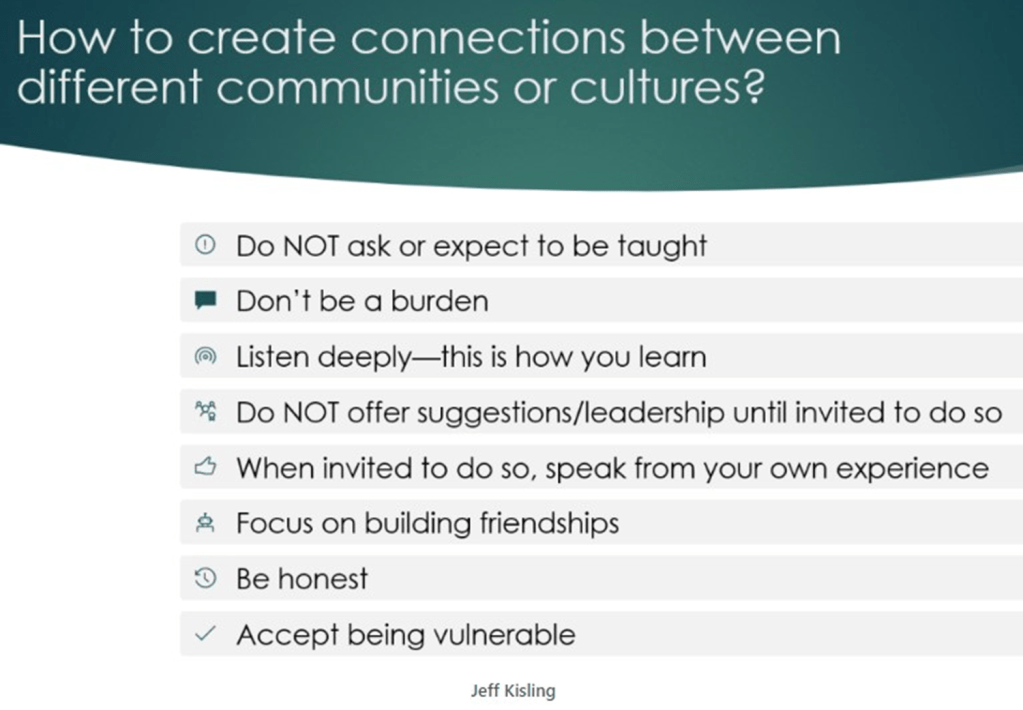
How to create connections between different communities or cultures

Returning to Donald McCormick’s question, “why is there no vision for the future of Quakerism?” I’ve tried to express my answer here. In these increasingly trying times, spiritual guidance is crucial. Sharing this with others is a gift Quakers have to offer. But we need to understand the history and concepts of oppression. Of Quakers’ role in oppression. And discern how the Spirit is leading us.

Frontline communities are figuring out how to live when the systems that are supposed to serve them no longer do, if they ever did. White communities will look to these communities and their solutions for our own survival.

I was recently surprised when a Quaker friend said I had a way of finding and connecting with oppressed communities. Which made me realize something I hadn’t expressed before, which is we must seek out these communities ourselves. Be guided to these communities by the Spirit. Search for these opportunities. Searching social media is usually very useful. And we can learn what our Friends and friends are doing and join those efforts.

Following is a list of things I have been learning from my experiences related to making connections between different communities and/or cultures.

Foundational stories now: Quaker faith

[My foundational stories are related to the intersections between my Quaker faith, protecting Mother Earth, and photography. My faith led me to try to share my spiritual experiences and show my love for the beauty of Mother Earth through photography.]

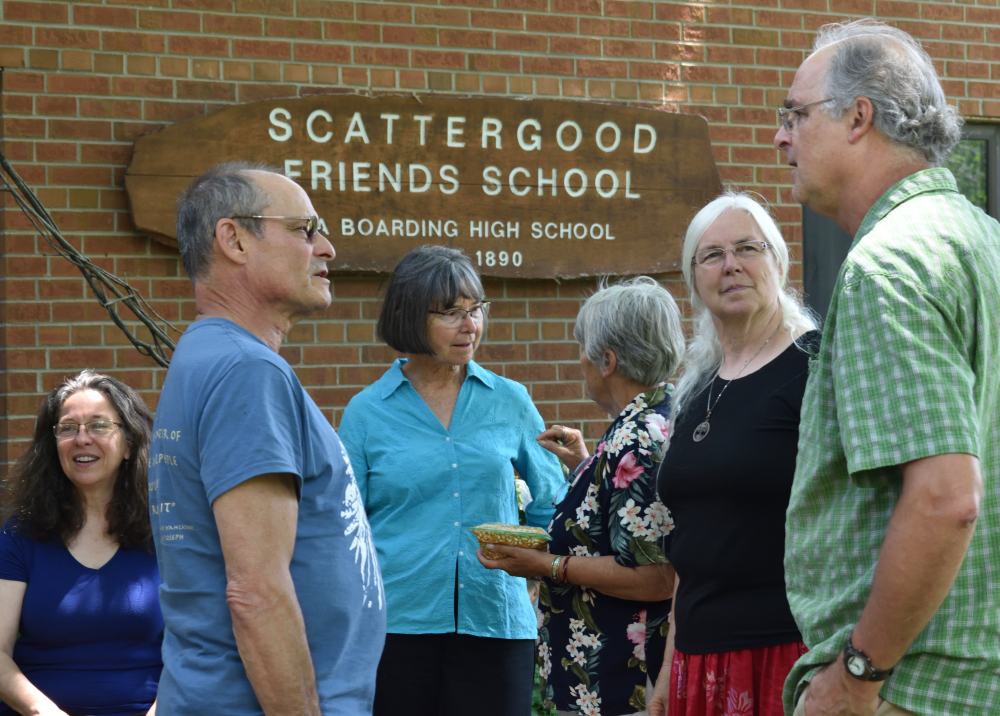
I’ve been praying and struggling for many days to discern how to express the state of my Quaker faith today. Quakerism is the faith community I was born into and have remained in. I was raised in a White Quaker family and community. I had a Spiritual experience at the Bear Creek Meetinghouse when I was about ten years old, an experience that I have drawn upon for the rest of my life. I attended Scattergood Friends School, a Quaker high school, and Earlham College, a Quaker institution.

One of the reasons I accepted the challenge of reflecting on my foundational stories is because of my crisis of faith now.

I think it is common for people to be disappointed by their faith community at various times, for a variety of reasons. That has been true for me. Coming of age during the Vietnam War I wished more young men had resisted the draft. I wish we all had done more to reign in the use of fossil fuels. And that White people like myself had worked, harder to acknowledge our complicity in the oppression of Black, Indigenous, and other people of color (BIPOC), of various gender identities, and certain social and economic classes. I wish we were working harder now on acknowledging and trying to heal these injustices.

This country was built on the historical injustices of the institution of slavery, and the genocide and removal of Indigenous peoples from their lands. And the forced assimilation of native children in institutions where they were often physically and sexually abused, where thousands of children were killed or died.

Many people, including Quakers today question how complicit our ancestors were in these injustices. There were White Quakers who were involved in the slave trade, and who enslaved Black men, women, and children. Our ancestors were settler colonists. As are we who are now living on these lands. Quakers were involved in the Indian residential schools.

being involved with others in wrongdoing

complicity

These issues often generate significant emotional responses. I don’t have all the answers. But I have had spiritual and community experiences that I am led to speak and work from today. Many of these experiences have led me to understand we are living in a country, a society of structural racism and white superiority. As much as many of us White Quakers wish it weren’t so, our skin color automatically gives us many significant advantages in this country.

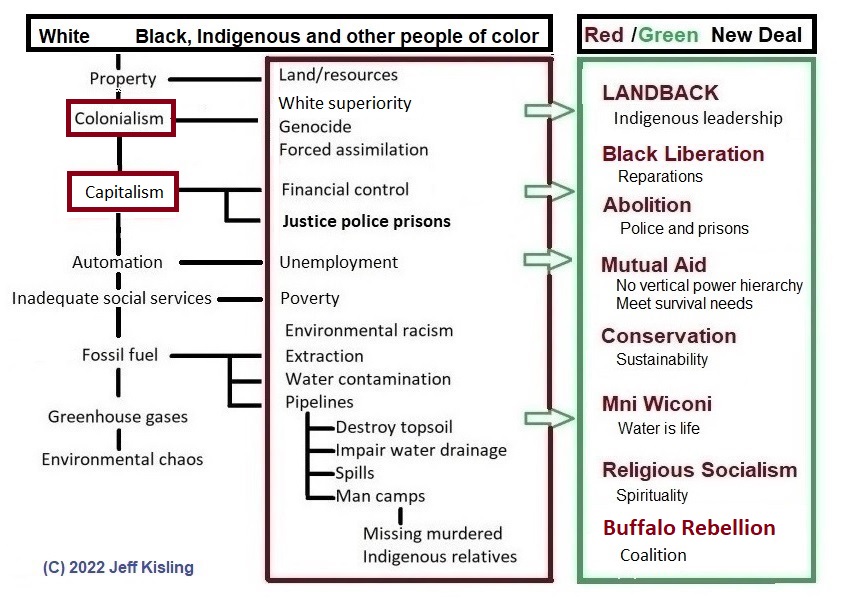
Our mainstream social, economic, and political systems are predicated on White superiority and dominance. I say mainstream because many people, including myself, are building alternative systems today. I’ve been deeply involved in Mutual Aid for a couple of years and believe this to be part of the answer. Mutual Aid is included in the following graphics.

NOTE: White supremacy is different from white superiority. “White supremacy or white supremacism is the belief that white people are superior to those of other races and thus should dominate them.”

Wikipedia

I’ve also seen in the lives of my friends what I once thought of as isolated historical traumas have been passed from generation to generation. They profoundly affect the lives of people today. What does that mean for White Quakers now?


“…capitalism and colonialism created structures that have disrupted how people have historically connected with each other and shared everything they needed to survive. As people were forced into systems of wage labor and private property, and wealth became increasingly concentrated, our ways of caring for each other have become more and more tenuous.”

Dean Spade, Mutual Aid: Building Solidarity During This Crisis (and the Next) (Kindle Locations 111-121). Verso

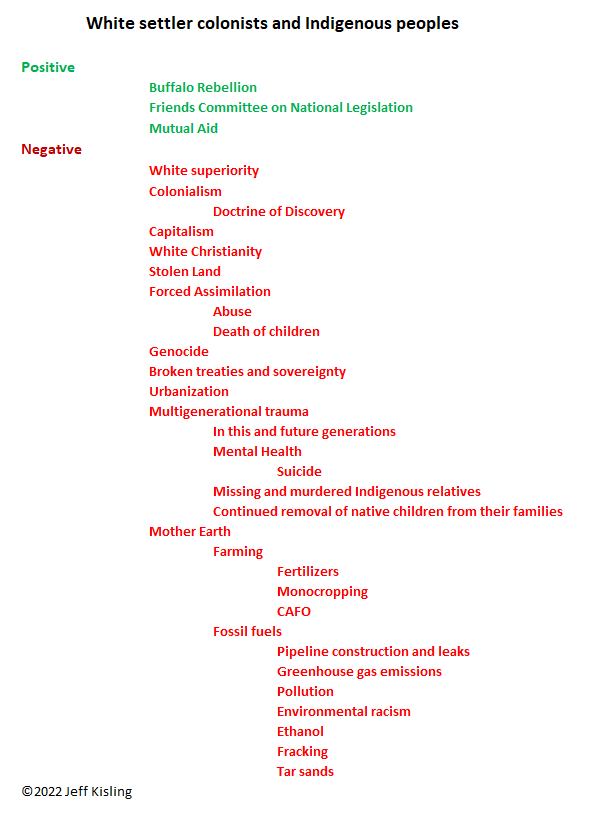
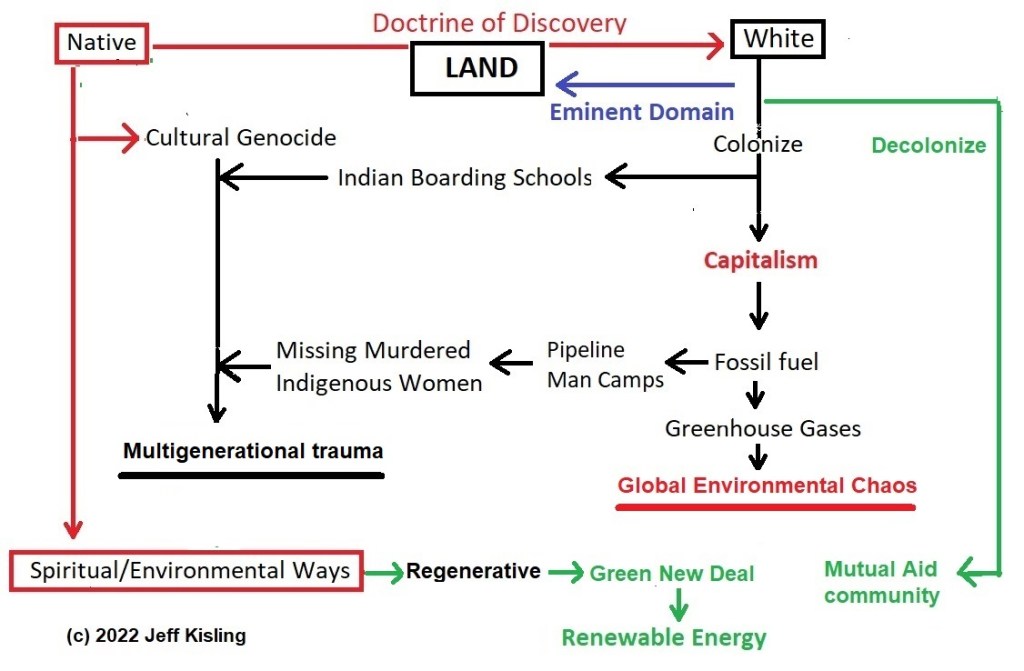
Following is another way of looking at the relationships between White settler colonists and Indigenous peoples. White Quakers need to acknowledge that when our ancestors came to these Indigenous lands, they were settler colonists. And since we are still occupying these lands, we are settler colonists, too. Some White Quakers were involved in the forced assimilation of Indigenous children. We are implicated in most of the “negative” things listed below.

Acknowledgement of wrongs is the necessary first step in the healing process.


On the positive side are Mutual Aid, the Buffalo Rebellion, and the Friends Committee on National Legislation (FCNL). I’ve written a lot about my experiences with Mutual Aid https://quakersandreligioussocialism.com/mutual-aid/

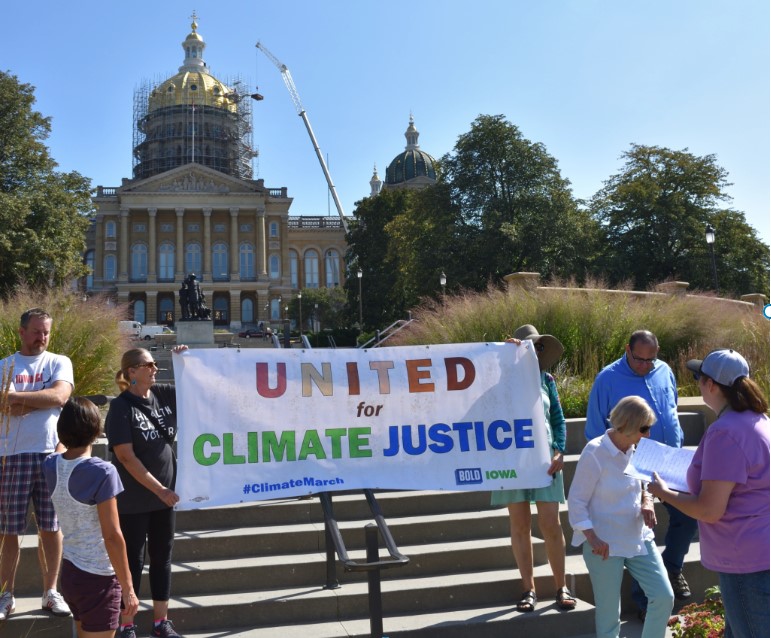
I’m fortunate to be part of the Buffalo Rebellion, a newly formed Green New Deal coalition in Iowa formed to protect the planet by demanding change from politicians and convincing the public that climate should be a priority. Buffalo Rebellion, is a coalition of grassroots, labor, and climate justice organizations growing a movement to pass local, state, and national policies that create millions of family-sustaining union jobs—ensuring racial and gender equity and taking action on climate at the scale and scope the crisis demands. It was formed in November 2021 and consists of: 

The Friends Committee on National Legislation (FCNL) has years of experience advocating for legislation related to Native American affairs. Recently FCNL has been supporting legislation to form a Truth and Healing Commission related to the Indian Boarding Schools. I’ve been blessed to have many years of experience with FCNL and have been working with my native friends in creating connections with FCNL, including several visits to our US Senators.


Critical thinking

This is a continuation of an article I recently wrote about critical skills to prepare for collapse. It is telling that the idea of collapse is more widely accepted, but not surprising as the signs are appearing in so many ways. Rather than being something environmentalists just talk about, the actual damage is occurring everywhere.

But simply applying critical thinking to a problem or situation doesn’t necessarily mean you arrive at the best solution. The more you know about the situation you are facing, the better. Which is why banning books and all the other restrictions being placed on education is so tragic. It also explains why that is being done. Those working to control us don’t want us to have that knowledge. They want us to be dependent on what they want and say.

The point of critical thinking is that as you learn more, you can integrate that into your knowledge base and make better decisions. Which is going to be crucial in the face of the rapid and dramatic changes that will be, already are occurring.

And there are many situations that involve our values, which are not subject to critical thinking.

Several people have asked me why I put ‘critical thinking’ on this list. My sense, from reading works like the Davids’ The Dawn of Everything and Peter Brody’s The Other Side of Eden is that what most distinguishes our civilization from most prehistoric and indigenous ones is that, before education became something that we ‘did’ to people, most people naturally acquired this essential skill, by facing the many existential challenges that life outside our synthetic, infantilizing, prosthetic, standardized culture presented to them every day. In short, they learned how to learn because they had to; they didn’t have to be ‘taught’.

My experience has been that, given that it is no longer a prerequisite for survival, critical thinking is now something that has to be specifically nurtured in people, which probably happens most often by parents’ encouragement. Lacking that, there’s a natural propensity, I think, for simplification and uncritical reaction. But if you’re taught the value and importance of critical thinking, I think you figure out this process of weighing and assessing and challenging what the world throws at you.

But I’m not so sure about this. Maybe, just as we can learn to make our own clothes and grow much of our own food if and when we have to (as millions discovered during the Great Depression), we can also learn to learn, to think critically, to challenge unsupported rhetoric, to think for ourselves instead of relying on increasingly-incompetent media to tell us what we should and should not believe.

When it begins to dawn on us, in five years or twenty-five, that we are going to have to quickly instill the above (see the article) currently rare skills in many or even most of our people, how might we go about it? As pessimistic as I am, I just can’t believe it’s already too late to do so.

So I’m thinking about these questions:

  1. What’s the most effective way to voluntarily get billions of people to the point they are capable of exercising the above skills?
  2. How do we get the timing right: Not so early that there’s not yet a sense of urgency, but not so late that we’re trying to do it in an environment of chaos?
  3. How might we begin to identify, improve the competencies of, and empower the right people to do the mentoring, teaching, training, demonstrating, connecting, modelling, and other hands-on imparting of knowledge and skills needed to make it happen?
  4. How can we make this new, crucial learning easier, and fun?

 ‘How Do We Teach the Critical Skills Needed to Face Collapse?” by Dave Pollard, How To save the world, September 10, 2022.


So I don’t see any top-down ‘professional’ answer to developing the above essential skills in the coming decades, not even the skill of ‘helping people cope’ with collapse. I think the answer has to emerge bottom up, from within each community as that community establishes itself.

 ‘How Do We Teach the Critical Skills Needed to Face Collapse?” by Dave Pollard, How To save the world, September 10, 2022.

So, we arrive at my experience with Mutual Aid. A future article will discuss how Mutual Aid is providing skills and developing communities to face collapse.


Societies that function without policing, prisons, and property

Rather than dwelling on all the current and oncoming catastrophes, we can recognize the crossroads we are at, and choose to live in a better way.

We only have a finite amount of energy personally and must use it wisely. I’m led to believe we should stop wasting energy trying to make incremental changes in existing systems of oppression. And instead turn our attention and energy to building more just alternatives. Living out our spiritual guidance.

I’m of the firm opinion that a system that was built by stolen bodies on stolen land for the benefit of a few is a system that is not repairable. It is operating as designed, and small changes (which are the result of huge efforts) to lessen the blow on those it was not designed for are merely half measures that can’t ever fully succeed.

So, the question is now, where do we go from here? Do we continue to make incremental changes while the wealthy hoard more wealth and the climate crisis deepens, or do we do something drastic that has never been done before? Can we envision and create a world where a class war from above isn’t a reality anymore?”

Ronnie James, Des Moines Mutual Aid

As Grace Lee Boggs writes below, “it is about acknowledging that we Americans have enjoyed middle-class comforts at the expense of other peoples all over the world.” We, especially White Quakers, can end our complicity in the systems of oppression, colonialism, and White supremacy.

I’ve been blessed to be part of several communities building such alternatives. These include the Kheprw Institute, Des Moines Mutual Aid, and the Buffalo Rebellion.

These experiences have helped me understand something black, Indigenous, and other people of color (BIPOC) have always known. That the systems of racial capitalism and white supremacy have never worked for anyone who is not a wealthy white male.

Robyn Maynard and Leanne Betasamosake Simpson have succinctly captured what needs to happen in their book Rehearsals for Living (Abolitionist Papers).

In my mind, Indigenous nations, Indigenous homespaces, Indigenous homelessness must be engaged in a radical and complete overturning of the nation-state’s political formations and a refusal of racial capitalism. My vision to create Nishnaabeg futures and presences must structurally refuse and reject the structures, processes and practices that end Indigenous life, Black life and result in environmental desecration. This requires societies that function without policing, prisons, and property.

Nishnaabeg formations of nationhood mean a radical overturning of the current conditions and configurations within which we live—an absolute refusal of capitalism.

Maynard, Robyn; Simpson, Leanne Betasamosake. Rehearsals for Living (Abolitionist Papers) (p. 125). Haymarket Books. Kindle Edition.

What we need now are societies that function without policing, prisons, and property. That is how we build alternatives to what is collapsing. Owning land, property is not an Indigenous concept. The commons are meant for community use.

  • Property is the basis for accumulation of wealth.
  • Policing is how this concept of property is protected.
  • Prison is how those who threaten property and landowners are removed from society.

Des Moines Mutual Aid


The next American Revolution, at this stage in our history, is not principally about jobs or health insurance or making it possible for more people to realize the American Dream of upward mobility. It is about acknowledging that we Americans have enjoyed middle-class comforts at the expense of other peoples all over the world. It is about living the kind of lives that will not only slow down global warming but also end the galloping inequality both inside this country and between the Global North and the Global South. It is about creating a new American Dream whose goal is a higher Humanity instead of the higher standard of living dependent on Empire. It is about practicing a new, more active, global, and participatory concept of citizenship. It is about becoming the change we wish to see in the world.

The courage, commitment, and strategies required for this kind of revolution are very different from those required to storm the Winter Palace or the White House. Instead of viewing the U.S. people as masses to be mobilized in increasingly aggressive struggles for higher wages, better jobs, or guaranteed health care, we must have the courage to challenge ourselves to engage in activities that build a new and better world by improving the physical, psychological, political, and spiritual health of ourselves, our families, our communities, our cities, our world, and our planet.

Grace Lee Bogg. The Next American Revolution

How can Friends achieve the 2022 theme of World Quaker Day, “Becoming the Quakers the World Needs,” while functioning in a blatantly and politically corrupt, racialized world? In engagement with this exciting theme, offered by the Friends World Committee for Consultation (FWCC), the Black Quaker Project would like to remind Friends of the tools at our disposal to challenge those aspects of society which we wish to change and to see changed. Our fractured societies are further divided by enormous gaps of inequality in almost every imaginable category—psychological, social, political, cultural, economic. How might we, as Quakers, achieve justice, equity, and peace under these circumstances? 

The Black Quaker Project

In late 2020, the two of us wrote an article for this magazine, called “Abolish the Police.” Through writing the piece, we realized we wanted to convene a larger space where Friends with an interest in police and prison abolition could have conversations with one another. Quaker abolitionists today face major pushback from our Meetings; we hoped that drawing Friends together would support and strengthen our work.

In this context, the Quakers for Abolition Network is being born. We are a collection of Friends from at least five Yearly Meetings; we range in age from high school to our 80s; we are disproportionately queer and trans. While AFSC and FCNL staff are participating, this is a grassroots project without any formal connections to existing organizations. We are in the process of defining our mission statement, structure, and our methods for addressing white supremacy when it shows up in our work, while building relationships with each other as we go. Below, four Friends write about their approaches to abolition, their lessons, and their visions for where Quakers might be headed.

Jeff Kisling: Mutual Aid and Abolition

I grew up in rural Iowa, where there was very little racial diversity and interactions with police and the court system were rare. About ten years ago, I was blessed to become involved with the Kheprw Institute, a Black youth mentoring and empowerment community. I’ll never forget how shocked I was when a Black mother broke down in tears, explaining how terrified she was every minute her children were away from home. It was obvious that every other person of color in the discussion knew exactly what she was saying.

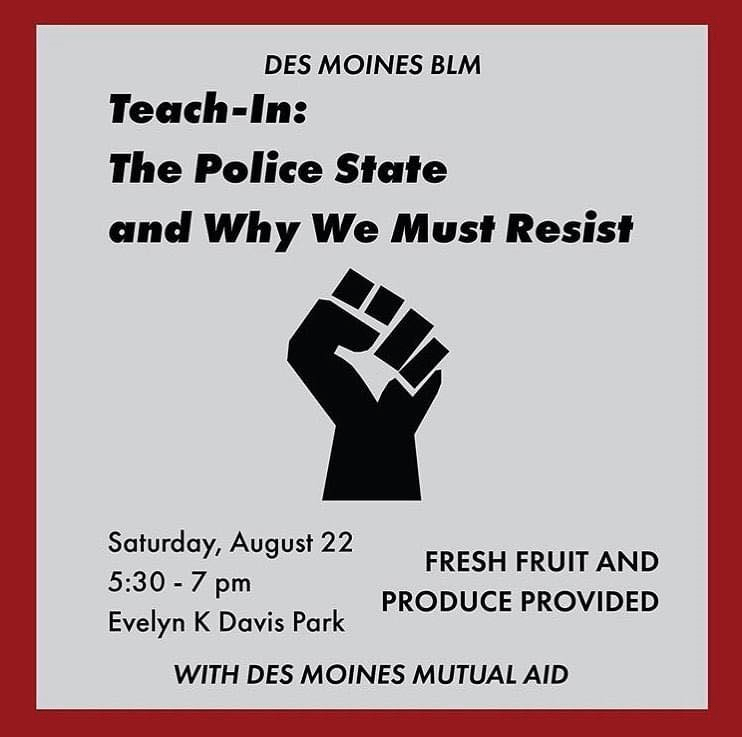
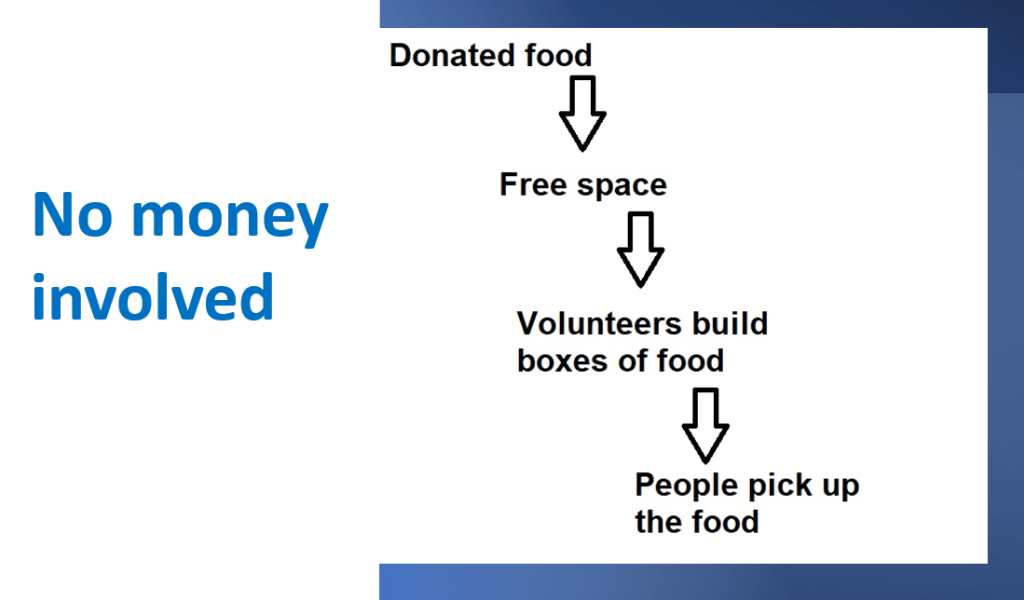
After retiring, I was led to connect with Des Moines Mutual Aid, a multiracial organization founded to support houseless people. For over a year, I’ve helped my friends fill and distribute boxes of donated food, while continuing to learn about the framework of mutual aid.

To me, mutual aid is about taking back control of our communities. Besides the food giveaway, we support houseless people and maintain a bail fund to support those arrested agitating for change. We also work for the abolition of police and prisons.

Mackenzie Barton-Rowledge and Jed Walsh: Introducing the Quakers for Abolition Network, Western Friend, Sept 2021


Des Moines Mutual Aid

Des Moines Mutual Aid

Becoming the Quakers the World Needs

October 2, 2022, is World Quaker Day. The theme this year is Becoming the Quakers the World Needs. Becoming” implies we are not, presently, the Quakers the World Needs, which I agree with. Quakers are too comfortable living in a capitalist system that is inherently unjust. A system whose goal is the accumulation of wealth no matter how unethical the means are to acquire it. A system that commodifies all resources, even those that should be part of the commons. A system not intended to care for those without wealth.

How can Friends achieve the 2022 theme of World Quaker Day, “Becoming the Quakers the World Needs,” while functioning in a blatantly and politically corrupt, racialized world? In engagement with this exciting theme, offered by the Friends World Committee for Consultation (FWCC), the Black Quaker Project would like to remind Friends of the tools at our disposal to challenge those aspects of society which we wish to change and to see changed. Our fractured societies are further divided by enormous gaps of inequality in almost every imaginable category—psychological, social, political, cultural, economic. How might we, as Quakers, achieve justice, equity, and peace under these circumstances? 

Black Quaker Project

“Quakers will only be truly prophetic when they risk a great deal of their accumulated privilege and access to wealth. Prophets cannot have a stake in maintaining the status quo. Any attempt to change a system while benefiting and protecting the benefits received from the system reinforces the system. Quakers as much as anyone not only refuse to reject their white privilege, they fail to reject the benefits they receive from institutionalized racism, trying to make an unjust economy and institutionalized racism and patriarch more fair and equitable in its ability to exploit. One can not simultaneously attack racist and patriarchal institutions and benefit from them at the same time without becoming more reliant upon the benefits and further entrenching the system. Liberalism at its laziest.”      Scott Miller


How can we escape the capitalist society we live in? We build communities that care for one another. Sometimes called beloved communities. An example is Mutual Aid. I’ve been involved in Des Moines Mutual Aid for two years and have written extensively about my experiences. https://quakersandreligioussocialism.com/mutual-aid/

Capitalism is so repugnant that we use other terms to refer to ourselves and the work we do, such are anarchists, communists, Black Liberationists, or accomplices.

Des Moines Mutual Aid

Randomly passing an accomplice on the street and throwing up a fist at each other as we go our separate ways to destroy all that is rotten in this world will never fail to give me extra energy and a single tear of gratitude for what this city is creating.

member of Des Moines Mutual Aid
mutual aid is the new economy. mutual aid is community. it is making sure your elderly neighbor down the street has a ride to their doctor’s appointment. mutual aid is making sure the children in your neighborhood have dinner, or a warm coat for the upcoming winter. mutual aid is planting community gardens.

capitalism has violated the communities of marginalized folks. capitalism is about the value of people, property and the people who own property. those who have wealth and property control the decisions that are made. the government comes second to capitalism when it comes to power.

in the name of liberation, capitalism must be reversed and dismantled. meaning that capitalistic practices must be reprogrammed with mutual aid practices.

Des Moines Black Liberation

World Quaker Day, SUNDAY, 2 OCTOBER 2022 
“Becoming the Quakers the World Needs:”
Taking Action Now for Retrospective Justice.


Dear Friends and friends of Friends,

         How can Friends achieve the 2022 theme of World Quaker Day, “Becoming the Quakers the World Needs,” while functioning in a blatantly and politically corrupt, racialized world? In engagement with this exciting theme, offered by the Friends World Committee for Consultation (FWCC), the Black Quaker Project would like to remind Friends of the tools at our disposal to challenge those aspects of society which we wish to change and to see changed. Our fractured societies are further divided by enormous gaps of inequality in almost every imaginable category—psychological, social, political, cultural, economic. How might we, as Quakers, achieve justice, equity, and peace under these circumstances? 

         Our ministry has long advocated that retrospective justice is the key to bringing peace and equality to the world and to dismantling White Supremacy. As a reminder, retrospective justice is “an attempt to administer justice years after the commission of a severe injustice or series of injustices against persons, communities, or racial and ethnic groups.” Our definition draws upon the 2006 Brown University report, Slavery and Justice, which notes the following three steps as necessary to implement retrospective justice: (1) acknowledge an offense formally and publicly; (2) commit to truth-telling and ensure the facts are uncovered, discussed, and shared; and (3) make amends in the present to give substance to expressions of regret. While the all-too visible injustices of direct violence may command our attention, they are only symptoms of the structural violence deeply rooted in our societies. British Peace Studies founder, Friend Adam Curle, defines structural violence as “the political and economic inequalities which are built into the social structure.”  This violence can be economic, political, cultural, religious, or environmental–classifications outlined in Occupied With Nonviolence: A Palestinian Woman Speaks (2008) by Palestinian Friend Jean Zaru and expanded upon to include educational and health structural violence in our Pendle Hill pamphlet, Race, Systemic Violence, and Retrospective Justice: An African American Quaker Scholar-Activist Challenges Conventional Narratives (2020).  It is these various types of STRUCTURAL violence that we must keep in mind when implementing retrospective justice, not only direct violence. As we reminded readers in our 2008 Beacon Hill Friends pamphlet, Facing Unbearable Truths: “[Violence] must be treated at its roots if we are to abolish it. Just as a doctor must treat the root causes of an illness, not merely the symptoms, so must we act similarly as social, progressive, analytical activists. We must be “anti-violent,” not merely “non-violent.” 

         In recent years, we have seen notable truth-telling initiatives which our ministry recognizes as actions of retrospective justice. A few notable examples include: the groundbreaking New York Times publication and institutionalization of The 1619 Project; the National Museum of African American History and Culture in Washington, DC; the International Slavery Museum in Liverpool, UK; the Apartheid Museum in Johannesburg, South Africa; and the United Nations establishment of an International Day of Remembrance for Victims of Slavery and the Transatlantic Slave Trade, itself a prelude to the UN Decade for People of African Descent (2015-2024). What do we–Quakers and friends of Quakers–have to offer in these needed efforts of Retrospective Justice?  To answer this query, our ministry offers three responses:

Reason #1: Justice
         Drawing again on the words of Friend Adam Curle, we agree that justice has a dual meaning: “one, spiritual—righteousness, the observance of the divine law; the other temporal—fairness, righteous dealing. … [Our] vision of justice is the result of seeking to live [in alignment with] non-violence, compassion, redemption, and love.”  For too long this crucial Quaker testimony has been neglected in favor of acronyms such as “SPICES,” which mislead about the essence of Quakerism and fail to include justice. Can we have peace without justice? Can we have equality without justice? Our ministry challenges Friends to return the justice testimony not only to the front-burner but to front-and-center within the Religious Society of Friends by engaging in this important work of Retrospective Justice.

Reason #2: Truth
         Like justice, truth and integrity are at the root of Quakerism, so much so that early Quakers called themselves the Friends of Truth, a name to keep in mind as we reckon with our own history of past misdeeds. Our ministry encourages Friends to collectively shoulder the responsibility of telling the truth, in all its complexity, including the reality that Quakers, despite our well-known anti-slavery activities, were participants, profiteers, and supporters of the slave trade. A truth Harold D. Weaver has called on the Religious Society of Friends to acknowledge in the past, most recently, in his January 2021 Friends Journal article, “A Proposed Plan for Retrospective Justice.” Friends need to confront and atone for the 400-year legacy of oppression, economic exploitation, and human degradation that affects people of African descent worldwide, such as Jim Crow, colonialism, and apartheid. Perhaps we will never know to what extent current Friends–individuals, Meetings, and organizations– have profited from the inheritance of significant sums of money for the past exploitation of people of African descent worldwide. However, Friends can still work to correct misinformation and disinformation so that we may understand the roots of the issues we seek to resolve. Quakers in some monthly, quarterly, and yearly meetings seem to be grappling with this process.

Reason #3: Reputation, Influence, and Expectations 
         Since the publication of Uncle Tom’s Cabin in 1852, Quakers have had a reputation as being among history’s foremost abolitionists. While we question whether Friends fully deserve this reputation, it is one that has endured. Across history, and around the world, Quakers have been involved in movements of peace and justice. Friends organized relief efforts for the starving masses of the Irish potato famine, cared for the sick and injured as World War I ravaged Europe, and aided interned Japanese Americans during World-War II. Celebrated Quaker human rights activist, writer, and social critic Bayard Rustin emerged as a leading figure in the Civil Rights Movement which Quakers widely participated in (Rustin is just one of the trailblazing African American Quakers we document in Black Fire: African American Quakers on Spirituality and Human Rights). Friends would also make their presence known during South Africa’s struggle against apartheid, peace efforts throughout the “Troubles’’ era of Northern Ireland, and beyond. 

         In 1947, the Friends Service Council in the UK and the American Friends Service Committee were jointly awarded the Nobel Peace prize ON BEHALF OF ALL QUAKERS for post World-War-II peace, reconstruction, and recovery efforts. While some people might forget that Quakers even exist today, many remember our historical image as leaders in truth, peace, justice, abolition, and equity. It is this reputation that we are expected to maintain and which our ministry recommends we live up to.          As the population of Quakers decreases in the Global North, the future of the Religious Society of Friends will be greatly defined by Friends of Color across Asia, South America, and, most prominently, Africa, which, as of 2017, is home to over 180,000 Friends. As we become further unmoored from our Eurocentric roots, the growing majority of Friends in the Global South are vulnerable to the very worst effects of systemic racism and structural violence. We hope Friends participate in plans of Retrospective Justice, “Becoming the Quaker’s The World Needs,” by taking action now.

         What additional reasons might there be for Quakers to be actively involved in USA and worldwide Retrospective Justice efforts?  Please write to us at theblackquakerpoject@gmail.com with your suggestions.

Note: The above narrative is adapted from Dr. Harold D. Weaver’s 21 September 2022 presentation to the Joseph Rowntree Charitable Trust Interim Working Group at Friends  House, London, UK. We appreciate the invitation of collaboration from Friend Nozizwe Madlala-Routledge, the new, dynamic Director of the Quaker United Nations Office-Geneva.

Reflections on Reflections

The First Nation-Farmer Climate Unity March involved a group of about thirty native and non-native people walking, eating, and camping together for 8 days. We walked ninety-four miles from Des Moines to Fort Dodge Iowa, along the route of the Dakota Access Pipeline during the first week of September 2018.

It was a bit amazing when I read the following as I’m reflecting on my experiences and friendships from the March.

Roughly a year later, in 2019, as part of my work at the Dechinta Centre for Research and Learning in Denendeh, I helped organize a solidarity gathering that took place in March, in the territory of the Yellowknives Dene First Nation (YKDFN). Our idea was simple—to invite a small group of Black, Brown and Indigenous activists, thinkers, writers, and organizers to spend time with us, in the spring, on an island in what the Yellowknives Dene known as Tindeè, or “big lake.” Together we fished nets under the ice, travelled by snowmobile and sleigh across the frozen lake, shared moose ribs cooked over the fire, stories from YKDFN Elders, our own ideas, and time with each other.

We wanted to invest in our relationship with each other and our affinities, outside of the institution, the internet, and crises, because we believed that the land would pull out a different set of conversations and gift us with a different way of relating. We wanted to sit together on the land, immersed in a Dene world, engage in a practice of Dene hospitality to see if we related to each other in a different way. This is exactly what happened. The land nurtured a set of conversations and way of relating to each other outside of the institution and its formations.

Maynard, Robyn; Simpson, Leanne Betasamosake. Rehearsals for Living (Abolitionist Papers) (p. 35). Haymarket Books. Kindle Edition.

In many ways the March was transformative for me. I wrote a long blog post of reflections on the March in early 2020. See: Reflections on the March.

The world, and I, have changed a lot in just the two years since those reflections were written. These two images represent the time span between the March and work we are doing today.


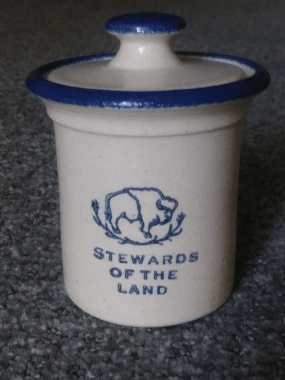
The first time I attended Quaker meeting after the March (2018), Russ Leckband gave me this piece of pottery, which was still warm from the kiln. The graphic on the right is about the Buffalo Rebellion, a climate justice summit, that I attended earlier this year.
(See: https://quakersandreligioussocialism.com/?s=Buffalo+rebellion )

I suppose this blog post is more reflections on the prior reflections.
(As a photographer, I envision what that might look like)

Indy Art Jeff Kisling

Changes since the March in 2018

Environmental devastation and chaos are occurring much more rapidly than expected. In some ways not anticipated. The havoc from increasingly ferocious and frequent wildfires, violent storms, floods, and development of large areas of drought are overwhelming our social, economic, and political systems. Continued wars ruin or prevent the transport of vast quantities of agricultural products.

So many of the systems we used to depend on, we no longer can. Municipal services such as water, power, sewage, and trash processing will fail, are failing.  Food will no longer be available in grocery stores. Medical services will collapse. What will happen to those in prisons and long-term care facilities? Financial failures will wreck the economy and end social safety nets.

There are other compelling reasons to design and build new communities. Our economic system has not adapted to the loss of jobs overseas and to automation. There are simply not enough jobs for millions of people, and many of those who do have work are paid at poverty levels. Forced to depend upon increasingly diminishing social safety nets.

The judicial and law enforcement systems work with extreme bias against people of color. What will the response of militarized police, armed forces, armed militias be as social unrest escalates?


How do we respond? Some lessons learned from and since the March.

It is one thing to talk about change, but it is becoming increasingly difficult to avoid the reality of the changes described above. So, this is not an intellectual exercise.

Almost none of the White people I know, or have observed, are thinking of the radical changes necessary to deal with this evolving chaos. They are trapped in these failing systems and ways of being. Even those who recognize the many injustices of those systems.

For many reasons I believe our responses will be a return toward Indigenous ways and the sustainable ways of our ancestors.

White settler colonists must learn the true history, which was not taught to us. We can’t begin repair if we don’t know the underlying sources of injustice. We must stop treating the symptoms and instead focus on the causes, the underlying disease.

I FEEL THAT I NEED TO go backward in order to go forward. If we are going to find a way to make livable lives in these times, it is necessary to move beyond “human-related activities”: the climate crisis is tethered to its origins in slavery and colonialism, genocide and capitalism.

Maynard, Robyn; Simpson, Leanne Betasamosake. Rehearsals for Living (Abolitionist Papers) (p. 25). Haymarket Books. Kindle Edition.

I’ve been learning about the #LANDBACK movement, but I hadn’t consciously made the connection to the land we walked and slept upon during the March. We were deeply affected when we crossed the pipeline. And were aware of how different it was to spend hours outside and away from the busy-ness of technology. Many more hours than usual for many of us. And yet time had that elastic property that made hours seem like minutes and vice versa as we traveled through space together. Hearing stories of the past that can help us face the future.

Most of my White friends are horrified as they are learning more about the atrocities committed at the Indian boarding schools. Can hardly believe thousands of children died there. But they are being forced to as the remains of the children are being located.

White people cannot process these things and begin healing as long as they remain in the their White spaces and thinking. And deny any responsibility for what was done in the past.

My hope and prayer is a mass movement of us build Mutual Aid networks.

As William Shakespeare wrote, “what’s past is prolog”. Native children are still being taken from their families in the guise of child welfare. Native children are still forcefully assimilated when they are forced to read the White settler colonist view of history.

My involvement in Mutual Aid for the past two years has resulted in significant changes in my life. Changes that can be done now and help us move into the future. Another quote from the book Rehearsals for Living eloquently describes Mutual Aid.

My hope and prayer is a mass movement of us build Mutual Aid networks.

You and your relations, my friend, are (still) busy building a different world at the end of this one. This is something I’ve emphasized over and over again in my own work. I cherish the belief and practice that it is never enough to just critique the system and name our oppression. We also have to create the alternative, on the ground and in real time. In part, for me, because Nishnaabeg ethics and theory demand no less. In part because in Nishnaabeg thinking, knowledge is mobilized, generated, and shared by collectively doing. It’s more than that, though. There is an aspect of self-determination and ethical engagement in organizing to meet our peoples’ material needs. There is a collective emotional lift in doing something worthwhile for our peoples’ benefit, however short-lived that benefit might be. These spaces become intergenerational, diverse places of Indigenous joy, care and conversation, and these conversations can be affirming, naming, critiquing, as well as rejecting and pushing back against the current systems of oppression. This for me seems like the practice of movement-building that our respective radical practices have been engaged with for centuries.

Maynard, Robyn; Simpson, Leanne Betasamosake. Rehearsals for Living (Abolitionist Papers) (p. 39). Haymarket Books. Kindle Edition.

Following is the latest version of a diagram I’ve been working on to visualize some of what I’ve expressed above.

Foundational stories: Finding accomplices

“There’s nothing more radically activist than a truly spiritual life. And there’s nothing more truly spiritual than a radically activist life.”

Brian McLaren, Naked Spirituality

At the dawn of a new day, I listen to hear what I will write. I did not expect to be writing about accomplices today. But as I prayed about the next episode of this series of foundational stories, I am trying to express what or who I was looking for when I retired and moved back to Iowa (2017).

This quote immediately came to mind. “Destroy” might sound extreme, but the author is one of the most nonviolent people I know.

Randomly passing an accomplice on the street and throwing up a fist at each other as we go our separate ways to destroy all that is rotten in this world will never fail to give me extra energy and a single tear of gratitude for what this city is creating.

Mutual Aid friend

I leave the author unnamed because we never know what the authorities will use against us. I include myself in this by saying “against us“. I say Mutual Aid friend because we are both involved in a Mutual Aid community, which means we all support each other.

Although accomplice is defined as a person who helps another commit a crime, the meaning in the quote is more like associate or collaborator.

Or is it?

Nonviolent civil disobedience most often involves intentionally committing a crime. I previously wrote about being trained as a trainer for nonviolent direct actions, i.e. the Keystone Pledge of Resistance. And being prepared to break the law by blocking the doors of the Federal building in downtown Indianapolis, if necessary, to try to stop the construction of the Keystone XL pipeline.

I intentionally broke the law when I resisted the draft.

And there is the whole question of what is legal and who determines that? Legality and justice are not the same. Laws often enforce injustice, protecting the status quo.

The Doctrines of Discover gave permission to steal the land from and kill indigenous peoples all over the world. Manifest destiny said the expansion of white settlers across the land was justified and inevitable. There is the institution of enslavement. Forced assimilation.


…Under a government which imprisons any unjustly, the true place for a just man is also a prison. The proper place to-​day, the only place which Massachusetts has provided for her freer and less desponding spirits, is in her prisons, to be put out and locked out of the State by her own act, as they have already put themselves out by their principles. It is there that the fugitive slave, and the Mexican prisoner on parole, and the Indian come to plead the wrongs of his race, should find them; on that separate, but more free and honorable ground, where the State places those who are not with her, but against her — the only house in a slave State in which a free man can abide with honor. If any think that their influence would be lost there, and their voices no longer afflict the ear of the State, that they would not be as an enemy within its walls, they do not know by how much truth is stronger than error, nor how much more eloquently and effectively he can combat injustice who has experienced a little in his own person. Cast your whole vote, not a strip of paper merely, but your whole influence. A minority is powerless while it conforms to the majority; it is not even a minority then; but it is irresistible when it clogs by its whole weight. If the alternative is to keep all just men in prison, or give up war and slavery, the State will not hesitate which to choose. If a thousand men were not to pay their tax-​bills this year, that would not be a violent and bloody measure, as it would be to pay them, and enable the State to commit violence and shed innocent blood. This is, in fact, the definition of a peaceable revolution, if any such is possible. If the tax-​gatherer, or any other public officer, asks me, as one has done, “But what shall I do?” my answer is, “If you really wish to do anything, resign your office.” When the subject has refused allegiance, and the officer has resigned his office, then the revolution is accomplished. But even suppose blood should flow. Is there not a sort of blood shed when the conscience is wounded? Through this wound a man’s real manhood and immortality flow out, and he bleeds to an everlasting death. I see this blood flowing now…

Henry David Thoreau

I hope the foundational stories I’ve written thus far illustrate that what has been meaningful for me is to find people and communities who act instead of just talk. I was looking for such people and organizations to work with when I moved to Iowa. I’m blessed to have been led to them.


Mutual Aid and money

The role money plays in Mutual Aid is what I had the most questions about, and the question most often asked of me when I talk about Mutual Aid.

The Mutual Aid project I’m involved with is the free food distribution, which has been in place pretty much continuously since the Black Panthers in Des Moines organized the Free Breakfast for School Children program. It was when this program looked like it might have to close several years ago that Des Moines Mutual Aid to over the program.

The first Survival Program was the Free Breakfast for Children Program, which began in January 1969 at one small Catholic church in the Fillmore district of San Francisco, and spread to many cities in America where there were Party chapters. Thousands of poor and hungry children were fed free breakfasts every day by the Party under this program. The Program became so popular that by the end of the year, the original Black Panther Party set up kitchens in cities across the nation, feeding over 10,000 children every day before they went to school.

Bobby Seale
All Power To All The People!
http://bobbyseale.com/
#blackpantherparty#blackpanthers#bobbyseale#blackhistory


Food from local farms, and dated food from local grocery stores is the source of our food to distribute to the community.


What Is Mutual Aid?

Mutual aid is collective coordination to meet each other’s needs, usually from an awareness that the systems we have in place are not going to meet them. Those systems, in fact, have often created the crisis, or are making things worse. We see examples of mutual aid in every single social movement, whether it’s people raising money for workers on strike, setting up a ride-sharing system during the Montgomery Bus Boycott, putting drinking water in the desert for migrants crossing the border, training each other in emergency medicine because ambulance response time in poor neighborhoods is too slow, raising money to pay for abortions for those who can’t afford them, or coordinating letter-writing to prisoners. These are mutual aid projects. They directly meet people’s survival needs, and are based on a shared understanding that the conditions in which we are made to live are unjust.

There is nothing new about mutual aid— people have worked together to survive for all of human history. But capitalism and colonialism created structures that have disrupted how people have historically connected with each other and shared everything they needed to survive. As people were forced into systems of wage labor and private property, and wealth became increasingly concentrated, our ways of caring for each other have become more and more tenuous.

In this context of social isolation and forced dependency on hostile systems, mutual aid— where we choose to help each other out, share things, and put time and resources into caring for the most vulnerable— is a radical act.

Dean Spade. Mutual Aid: Building Solidarity During This Crisis (and the Next) (Kindle Locations 104-120). Verso.


The key is when we think about money, we are thinking within the context of capitalism, which is the system we (Mutual Aid) are working to replace. Think how the communities of our grandparents depended so little on money. Where everyone knew everyone else. Where people just naturally helped when there was a need. Came together to harvest the crops, going from one farm to the next with the machines to do the harvesting.

Since then, increasingly, “people were forced into systems of wage labor and private property.”

The key is when we think about money, we are thinking within the context of capitalism, which is the system we (Mutual Aid) are working to replace

Handling Money

Handling money can be one of the most contentious issues for mutual aid groups. Because of this, it can be very useful for groups to consider whether this is something they want to do. Some groups can do their work without raising money at all. Some groups can do their work just raising money through grassroots fundraising in their communities, taking small donations from many people. That kind of fundraising can avoid the problem with grant-making foundations attaching strings to grant money and trying to control the direction of the work. Grassroots fundraising can help build a sense that the community controls the organizations rather than an elite funder and doing grassroots fundraising can be a way of spreading the ideas of the group and raising awareness about the problems the group works on. However, even if money is raised in this way, managing money still comes with pitfalls. Handling money brings logistical issues that can cause stress and take time, such as figuring out how to do it fairly and transparently and figuring out how to avoid a problem with the IRS or otherwise expose group members to legal problems. Because most people in our society have a tangled, painful relationship with money that includes feelings and behaviors of secrecy, shame, and desperation, a lot of otherwise awesome people will misbehave when money is around or get suspicious of others’ behavior.

Dean Spade. Mutual Aid: Building Solidarity During This Crisis (and the Next) (Kindle Locations 1199-1209). Verso.

Our Mutual Aid group appeals to the community for funds for a need in the moment.


Collapse is already here

This is a continuation of a recent post, the centre cannot hold, and discussion of the article Collapse Is Already Here — And It’s Spreading by umair haque. The reason I follow umair’s writings is because I agree with his analysis of where we are and learn more from him. In this article he talks about the collapse of the three systems we live in.

  • economic
  • social
  • political

Failing economies

Right now, a wave of mega-inflation is surging around the globe. It’s driven largely by climate change — and our nonexistent “response” to it. Harvests are failing, goods are getting harder and harder to distribute and ship, raw materials harder to source and attain. Inflation is going to keep rising — for the rest of our lives.

Shortages become the norm. You can see them beginning to happen in vivid, shocking detail now. Empty shelves are becoming the new normal. The age of abundance is over.

Our economies have failed. And they’re going to continue to fail.

Collapse Is Already Here — And It’s Spreading. I Don’t Know If You’ve Noticed — But Our Systems are Breaking Down by umair haque, Eudaimonia, May 19, 2022

Failing social systems

Think of how many generations our economies have failed at this point.

Boomers were the last ones to really live the dream — since then, our economies have been in decline, and that decline has accelerated rapidly. Gen X had it worse than Boomers, but not so bad as to cause total despair — enough to be comical. Millennials had it worse than Gen X — and they can’t afford to move out of their parents’ homes, or start families, so birth rates are declining. Zoomers have it far, far worse than Millennials — they’ll never be able to retire, they can’t get decent jobs, their lives are over before they began.

There’s a word to sum all that up — intergenerational inequality. What does intergenerational inequality do? It destroys the possibility of functioning social systems. Someone has to pay for them, after all — from retirement systems to post offices to hospitals and universities and so forth. Social systems must be funded from the public purse. But when people are struggling harder, generation after generation, getting poorer, there’s less left over to invest.

Collapse Is Already Here — And It’s Spreading. I Don’t Know If You’ve Noticed — But Our Systems are Breaking Down by umair haque, Eudaimonia, May 19, 2022

Failing political systems

This is the real reason why young people are apathetic about politics. They know they can’t change anything even if they try. They don’t have the money, so what’s the point? Sure, they can vote in politicians who want to build social systems — and sometimes they do, like AOC or who have you. But those politicians are left powerless in the end, because societies in which generation after generation is getting poorer cannot afford to be functioning societies at all.

Collapse Is Already Here — And It’s Spreading. I Don’t Know If You’ve Noticed — But Our Systems are Breaking Down by umair haque, Eudaimonia, May 19, 2022

The collapse of the economic, social and political systems umair haque describes above are part of the diagram below I’ve been working on for several years.

The economic system is Capitalism (red box in diagram below). Capitalism exerts financial control, and uses criminal justice systems of police and prisons to enforce capitalist policies.

Capitalism once did some funding of social systems: Medicare, food stamps, unemployment insurance, etc.

But now, the collapse of capitalism is leading to increasingly inadequate social services, pushing more people into, or further into poverty.

The answer, it seems to many of us, is to replace the capitalist economic system. As my friend Ronnie James says:

I’m of the firm opinion that a system that was built by stolen bodies on stolen land for the benefit of a few is a system that is not repairable. It is operating as designed, and small changes (which are the result of huge efforts) to lessen the blow on those it was not designed for are merely half measures that can’t ever fully succeed.

So the question is now, where do we go from here? Do we continue to make incremental changes while the wealthy hoard more wealth and the climate crisis deepens, or do we do something drastic that has never been done before? Can we envision and create a world where a class war from above isn’t a reality anymore?”

Ronnie James, Des Moines Mutual Aid
How to replace capitalism and the systems that support it is indicated in the Red/Green New Deal box. Discussions of these things can be found on these blogs of mine and elsewhere.