We seem to be in a split-screen moment. Despite growing resignation that environmental chaos will only worsen, we still refuse to make changes that will stop making it worse. That is, we continue to build:
Fossil fuel infrastructure
gas (fossil fuel) stations
highways/bridges/parking structures
airports
oil rigs
pipelines
coal mining
fracking
plastics
anything gas powered
automobiles, trucks, ships, planes, and trains
military equipment
lawn mowers, chainsaws, leaf blowers
Buildings damaged by storms and erosion on shorelines are rebuilt in the same place
Before any lasting peace may be achieved, however, the Stop Cop City movement must reverse the current state system that militarized police against its own citizens. This gave rise to the construction of Cop City in the first place.
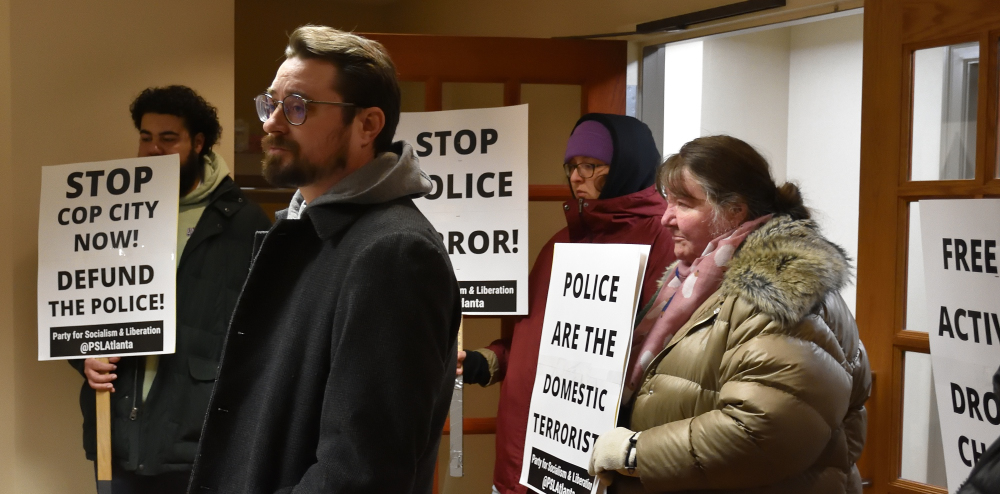
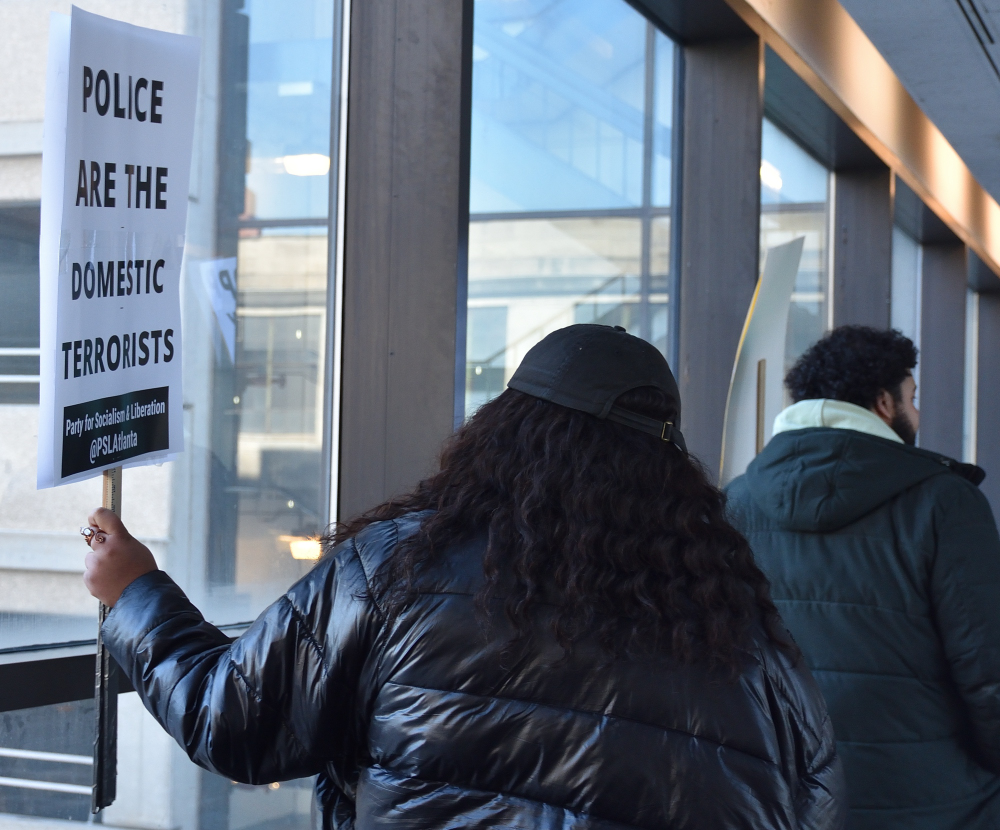
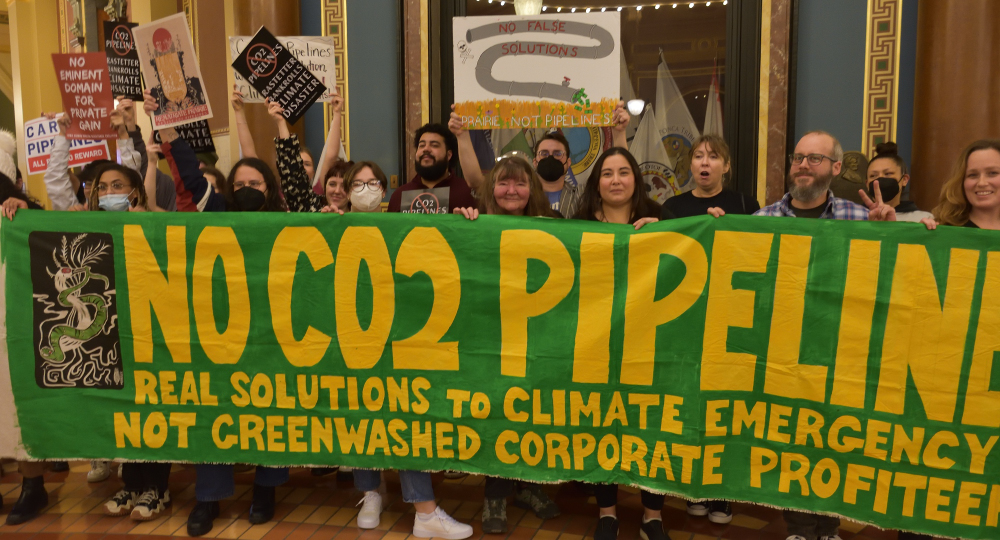
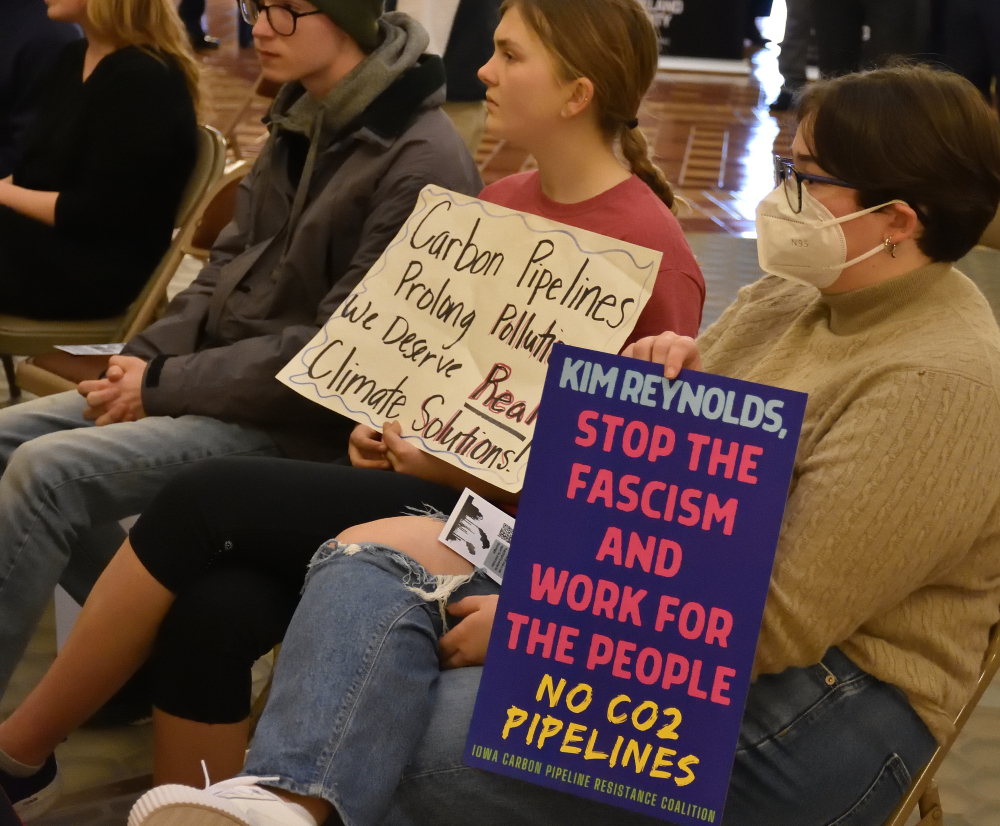
“Cop City” is a proposed extensive facility to train police and firefighters. To also train police from other states. This is in direct opposition to growing calls to reform policing. This photo was from our action to support “No Cop City” in Des Moines on January 31, 2023. (See: https://quakersandreligioussocialism.com/2023/01/31/stop-cop-city-solidarity/)
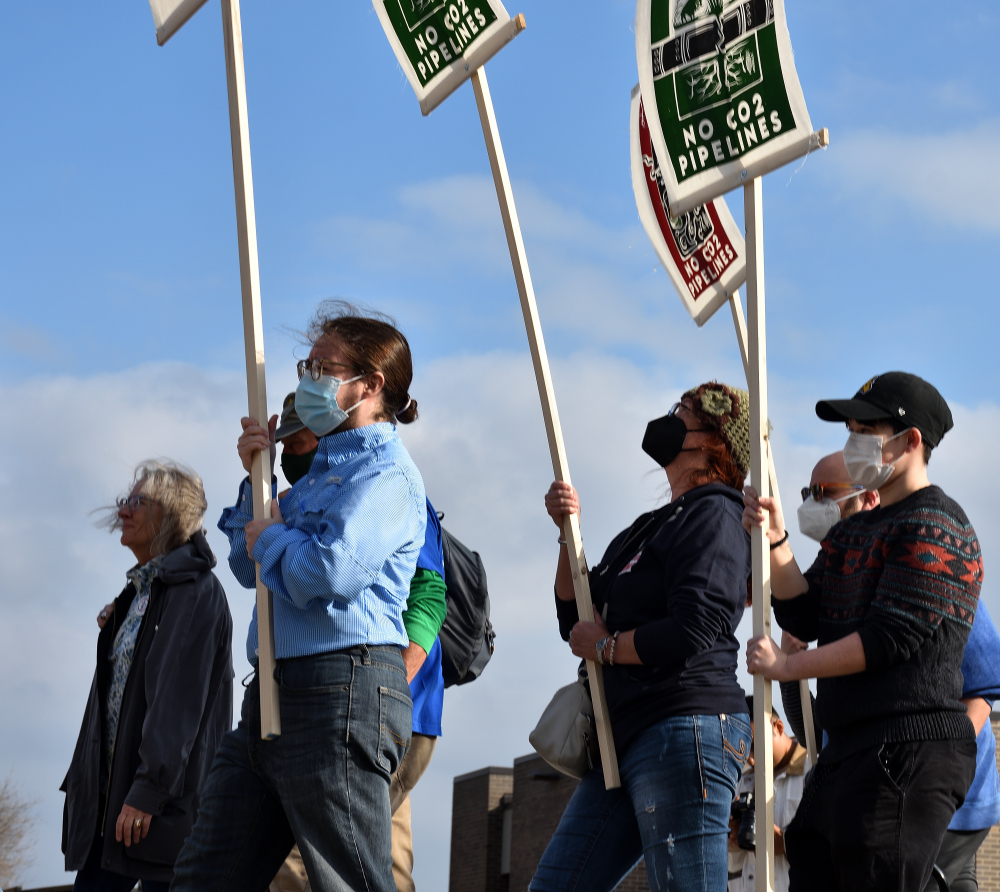
Activists search for multiple ways to bring attention to injustices. In 2013 the Keystone Pledge of Resistance targeted the application for the Keystone XL pipeline to cross the US-Canada border. This decision was solely in the hands of President Obama. After months of organizing and rallies against the pipeline, Obama decided to deny the permit. This was the first major win in the fight against the fossil fuel industry.
There are many reasons to oppose “Cop City”, but perhaps the most significant is the need to stop militarizing policing in this country.
Before any lasting peace may be achieved, however, the Stop Cop City movement must reverse the current state system that militarized police against its own citizens. This gave rise to the construction of Cop City in the first place.
Other efforts have failed, and there is now a call to bring national attention to Nationwide Insurance Company, one of the companies insuring the Cop City project. Without valid insurance, construction cannot occur. Plans are being made for a solidarity action in Des Moines.
As has been noted previously, the APF (Atlanta Police Foundation) cannot build Cop City alone–they rely on a hired support network of architects, engineers, contractors, and others to build it for them. One of the most critical pillars of this support structure is insurance. Without a valid insurance policy covering APF’s liability in the event of injury to workers or damage to property, construction cannot occur.
A Certificate of Insurance dated February 24, 2023 shows two companies providing insurance to the APF: the first is Scottsdale Insurance Co., a subsidiary of the well-known Fortune 500 company Nationwide; the second is Accident Fund General Insurance Company, a much smaller agency based in Lansing, Michigan. The broker for the policy is Amanda Surface from Correll Insurance Group, a small insurance company based out of South Carolina.
A controversial police training facility needs more than $30 million from Atlanta taxpayers. But during more than seven hours of public comment at a packed city council meeting on Monday, hundreds of locals expressed unanimous opposition to the project.
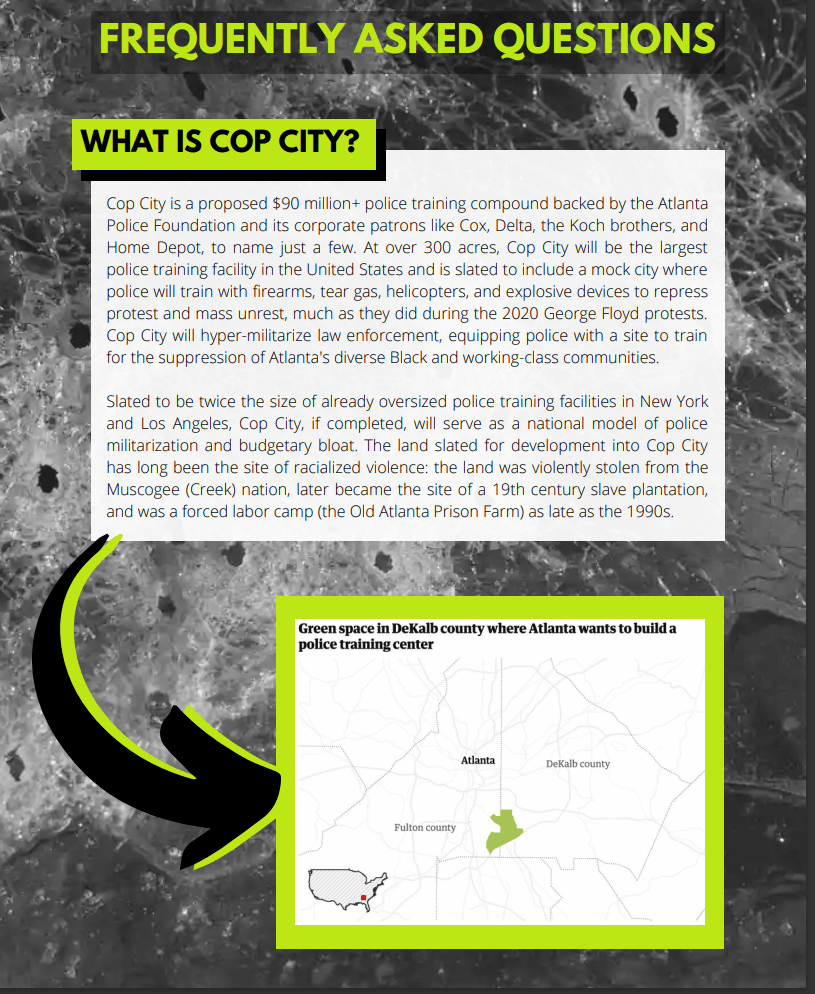
The Atlanta Public Safety Training Center—called “Cop City” by challengers—is a proposed $90 million, 85-acre police training ground slated for construction in Atlanta’s South River Forest. The project has seen opposition from environmental, racial justice, and indigenous rights activists, who argue that the project will cut down a forest on historically Native American land and fuel aggressive policing. After a series of protester arrests, and the killing of one activist by police, the project is now close to breaking ground. And opposition is louder than ever.
“I’ve been to City Hall for some years now,” Micah Herskind, an Atlanta-based community organizer who attended the Monday meeting, told The Daily Beast. “But until the Monday city council hearing, “I’ve never seen the line at the door, even, of where the public comment sign up is. It was out the door, around the whole second floor, winding down the stairs, and then eventually went out through the building, through the security line. I’ve never seen anything like it. And not only did masses of people show up, they showed up literally 100 percent against Cop City. We did a complete tally of public comments. 100 percent of commenters were against Cop City.”
Before any lasting peace may be achieved, however, the Stop Cop City movement must reverse the current state system that militarized police against its own citizens. This gave rise to the construction of Cop City in the first place. We must not only use any available means to cause public and digital disruption of complacency such as transforming social media into platforms of social education and change, creating community gardens and forums to exchange food and information, marching, joining grassroots networks dedicated to charity and social justice, donating money and time to those networks and building Martin Luther King Jr.’s vision of beloved communities. We will create a place that empowers one another and turns the tide against open militarization.
We must direct our eyes beyond our present obstacle — Cop City — and into the heart of racial and capital hierarchy, which causes these state-led attacks on Americans. To the soon-to-be-ex-mayor Andre Dickens, ex-mayor Bottoms and the APD’s corporate cronies, we are Atlanta.
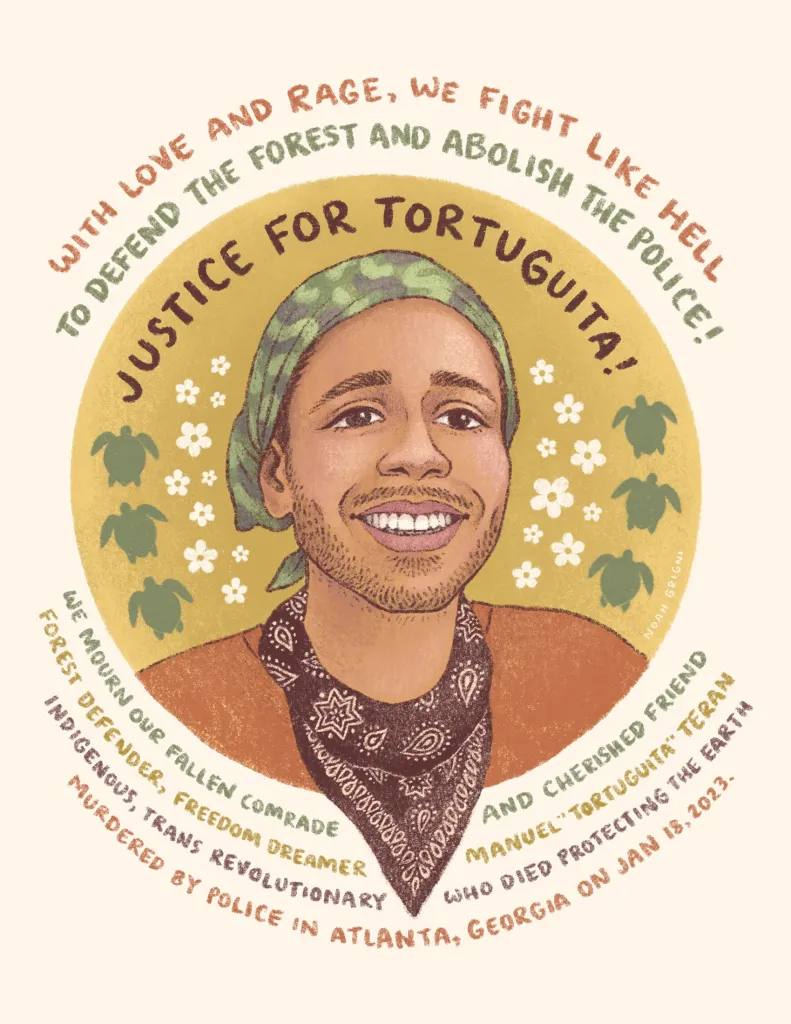
In the words of our forest defenders, “we are nature defending itself. We are seeds, building our root systems. Alone we go fast, together we go far.” And in the words of our late friend and sibling Tortuguita, “Fear is the mind killer.”
After the police murdered Tortuguita, @nationwide, through their subsidiary Scottsdale Insurance, agreed to insure Cop City. Call them today and demand that they #CutTheContract:
These companies are trying to profit off of environmental racism and police violence. But if they do the right thing and #CutTheContract, construction of Cop City would have to stop. pic.twitter.com/Ia79hB0MuT
The publication of MUTUAL AID MONTHLY relates to one of our Points of Unity, political consciousness.
We work to raise the political consciousness of our communities. Part of political education is connecting people’s lived experiences to a broader political perspective. Another component is working to ensure that people can meet their basic needs. It is difficult to organize for future liberation when someone is entrenched in day-to-day struggle.from Points of Unity, Des Moines Mutual Aid
Political ignorance is one of the main reasons this country is falling into chaos and authoritarianism. People would be less susceptible to falling for cults of personality and understand the threats to freedom posed by culture wars if they had a better education, including critical thinking skills. You might think of sharing MUTUAL AID MONTHLY with others in furtherance of their/your political consciousness. As a resource to stimulate discussions.
Yesterday at our Des Moines Mutual Aid food giveaway, I received a copy of this month’s edition of the Des Moines Mutual Aid Monthly, the third edition available. Below are the three editions that have been published thus far.
Are you part of the mainstream, or on the margins?
Reference is often made to marginalized groups or peoples. My friend Jed Walsh recently wrote, “I’m tired of being in the margins of a Quakerism that’s clinging to the status quo, and hoping to find other places to practice faith and spirituality where I can feel more aligned with others.“
I hadn’t thought of myself in terms of being on the margins until I read that. Quakers are usually on the margins of society, almost by default. But Jed brought into focus that he and I are on the margins of Quakerism today.
The Mainstream and Margins exercise below might be helpful for those in the mainstream to learn about those of us on the margins and what our concerns are.
Thus mainstream/margin invites curiosity and flexibility, asking the question what is going on in this group now. Organizers then make thoughtful choices about when a mainstream needs assistance in recognizing and re-negotiating its relationship with one of its margins.
One of the great things about Mutual Aid is the intense focus on preventing hierarchies, with the intent to prevent anyone from being marginalized.
The following describes the Mainstream and Margins exercise.
The goals of the exercise are:
To assist participants to identify with both marginal and mainstream roles that they play in society.
To boost awareness of the oppressive characteristics of the mainstream role.
To gain hope through identifying how they can support social change while in a mainstream role.
To practice the skills of an ally.
Activist and nonviolence trainer Daniel Hunter has come up with a helpful exercise called Mainstream and Margins. This is great for activist groups because it doesn’t rely on jargon or overly complicated theories, so it can be used in groups with a diversity of viewpoints or education levels. It also overcomes the mistake of presenting relatively static identity characteristics like age, gender, or religion as though they automatically explain group dynamics. Note, though, that the exercise is challenging and so is best done with a skilled facilitator.
No matter how homogeneous a group or an organization believes itself to be, a careful look shows that some characteristics are marginalized. A group known for vigorous and noisy debates has some quiet members. An organization which believes itself to be bureaucratically efficient has a couple of members who would love to cut corners. A solemn and highly disciplined group includes a few who, out of sight, love to party. The mainstream of a group sets the tone, sets the communication style, and gets to have its own preferences accepted by the margins. Awareness of this dynamic creates choice points for organizers and facilitators who may or may not cooperate with the system. …
Rather than viewing oppression as static (i.e. this group is always oppressed), organizers and activists can be aware of the complexities of this unique group. E.g. while society oppresses women in the larger society, an activist group might have a mainstream of women who unintentionally marginalize non-women in the group. …
Thus mainstream/margin invites curiosity and flexibility, asking the question what is going on in this group now. Organizers then make thoughtful choices about when a mainstream needs assistance in recognizing and re-negotiating its relationship with one of its margins. The mainstream is not about numbers—but it is about who has their interest recognized. So, for example, even in a group where most of the group has chronic medical conditions, the norm might be: we don’t acknowledge our conditions. …
Instead of making value judgments about how oblivious the mainstream is, accept it as one accepts the law of gravity. Then go ahead and assist the margins to express themselves and assist the mainstream to hear them.
Instead of a checklist of diversity items to look for—e.g. race, class, gender, sexual orientation—you can look freshly at each group to see how is mainstream behavior playing out.
The exercise, then, is about what is normal and accepted within a group and what is marginalized. All groups will marginalize behaviours and ideas, and that can be beneficial (e.g. respect is mainstream, screaming at each other is marginalized) so long as it’s done with enough communication and space given to know what the margins are and to hear from them. For conversations about the mainstream and margins to go well, groups need to create conditions of enough safety and trust that people feel able and ready to speak up.
We invented this in response to trainers asking us: what do you do with a group that is genuinely clueless about its racism (sexism/homophobia/etc.)? We found it works with low-consciousness groups and has tremendous value for experienced activist groups, too.
Previously, in Spiritual Activism, I referred to an article from the Pachamama Alliance, part one of a three-part series, Spirit in Action. Following is a continuation of what Pat McCabe said during Part 1.
Pat talks about learning how to let go of what is thought of as “rational” and “logical”. It used to irritate me when people would suggest that scientists (like me) have trouble believing in spirituality, implying since things of the Spirit could not be proven by the scientific method, we might not believe in the Spirit. I have heard medical colleagues say the (scientific) complexities we work so hard to understand convince them there must be a higher power.
But as she says, “Spirit rationale is different from academic rationale.”
The Challenge of Embracing Spiritual Wisdom
Pat (McCabe) made it clear that listening to and being guided by spirit is challenging work that takes practice.
As Pat pointed out, spirit rationale is different from academic rationale, which is why it can be so difficult to know how to listen to spirit. She went on to describe her own personal journey of learning how to let go of what is typically thought of as “rational” and “logical,” and instead embrace the wisdom of spirit. She acknowledged that she didn’t learn to do so of her own accord. Rather, Pat learned how to do this through what she calls “forced surrender” during a time when she was experiencing loss in her life. Despite the difficulties she was experiencing, Pat continued to engage in ceremony, through which she was able to learn how to be in a state of receptivity and trust spirit to guide her.
the consciousness that is the root cause of injustice for the planet is the same consciousness that is the root cause of injustice for people. And this consciousness is connected to the ways in which humanity has claimed supremacy over the planet and all life while placing everything—including each other—in a hierarchy
Reverend Deborah Johnson
Part two of the Spirit in Action series is a conversation with Reverend Deborah Johnson. I really appreciate her description of the root cause of injustice for the planet being the same consciousness that is the root of injustice for people. And that root cause is hierarchy, which comes from the concept of supremacy.
This is why I’m so invested in Mutual Aid because it is about having no hierarchy. Which avoids many of the problems that occur in groups organized with hierarchies. Problems related to power relationships and authority.
How Relationships Are at the Center of Spirit and Justice
Rev. D (Reverend Deborah Johnson) began the conversation by reframing Pachamama Alliance’s 3-part mission around environmental sustainability, spiritual fulfillment, and social justice.
She reflected on how people often relate to the three parts of the mission as three “pillars,” but this actually reinforces a sense of separation between sustainability, spirit, and justice. As Rev. D put it, “pillars” by definition are separate and do not intersect. But she sees sustainability, spirit, and justice as innately interdependent, inseparable parts that can’t exist outside of their connection to the whole.
Rev. D went on to explain how the consciousness that is the root cause of injustice for the planet is the same consciousness that is the root cause of injustice for people. And this consciousness is connected to the ways in which humanity has claimed supremacy over the planet and all life while placing everything—including each other—in a hierarchy.
Rev. D made it clear that relationships are at the center of spirit and at the center of justice, and that injustice for the planet and social injustice are the result of “poor relationships” rooted in these constructs of supremacy and hierarchy.
Rev. D then discusses why many people do not have spiritual fulfillment today.
She explained how many people relate to spiritual fulfillment as a “byproduct” that comes as a result of achieving justice and environmental sustainability. But, Rev. D is encouraging everyone to think the inverse, that starting with spiritual fulfillment is what leads to justice for people and for the environment.
She went on to explain why many people today feel a lack of spiritual fulfillment. As Rev. D put it, people see widespread environmental degradation and social injustice, and wonder how they could have “any kind of spiritual fulfillment in a world like this.” She described this experience as people making their connection to spirit conditioned upon “what humanity is doing in its amnesia, in its lack of recognition of relationship.”
Rev. D warned that obtaining spiritual fulfillment won’t be possible if it’s dependent on human behavior in this way. Instead, Rev. D asserted that starting with spiritual fulfillment and the belief in the inherent interconnectedness of all life—and putting that into action—is the pathway to achieving justice for people and the planet.
Wednesday’s recording of Resilience and Possibility is ready for you to review or share. It is the third–and final–in a series around spirit in action. Our discussion touched on the relationship between inner peace and activism, and how spiritual practice increases our capacity to bring clarity and love to our activism as we push back against injustice.
We used a recording of Rev. angel Kyodo Williams as inspiration to delve deeper into how we can use spirit to further our commitment to bring forth more justice and sustainability into the world. Enjoy!
I grew up in Quaker communities, which defined my justice work for much of my life.
Then a decade ago, I was led to work in communities outside Quaker meetings.
(NOTE: “To be led” is a way of expressing Spiritual leadings).
These experiences have taught me quite different approaches to justice work.
These new perspectives also show me many of us Quakers, particularly White Quakers, need to change how we think about and do justice work.
Spirituality and social justice are often viewed as separate entities, but they can be deeply intertwined. Spirituality refers to a person’s relationship with the divine or higher power, while social justice is concerned with ensuring that all individuals have equal access to basic human rights and opportunities. Individuals tend to fall along the spectrum between emphasis on spirituality versus emphasis on social justice. There are some who do not believe they need to engage in social justice work.
Spiritual activism is a practice that brings together the otherworldly and inward-focused work of spirituality and the outwardly focused work of activism (which focuses on the conditions of the material or physical world). It is most often described as being separate from organized religion or dogma, but rather as activism that is generally egalitarian, particularly in service for people who are oppressed or marginalized, as well as for the Earth and all living things1.
Some of these blog posts take days to write. Sometimes when things feel unfinished, a missing piece will appear. From the Spirit, or something someone else wrote or did. I came across the following this morning.
On October 5, Diné Ceremonial Leader Woman Stands Shining (Pat McCabe) joined the global Pachamama Alliance community for a conversation on spirit in action. Pat McCabe is a mother, activist, writer, artist, international speaker, ceremonial leader, voice for global peace and healing, and long-time advisor to Pachamama Alliance.
During the call, Pat offered many insights around what it means to take action while being guided by spirit, drawing from both her Diné background and the Lakota spiritual tradition. She shared key learnings from her own personal journey around this inquiry, while illuminating important nuances around the concepts of agency and intellect.
The Importance of Surrendering to Spirit
As Pat was reflecting on how to take action while being guided by spirit, she explained that the first step is to surrender to the unknown.
What Pat meant by this was to let go of the need to know everything and the need to have the answer—or even the idea that one can know everything. She explained that when one is at the limits of what one knows, that’s when spirit reaches into the mind and body to present something new.
One of the ways this is experienced in some of the spiritual communities Pat is a part of is through fasting. During these fasts, participants must go 4 days without food or water as they engage in ceremony.* Pat described how it doesn’t feel humanly possible to complete this fast, unless one embraces the unknown and the possibility of failure. This is what allows one to keep going even if the way forward is unclear. And as Pat put it, it is at this point that spirit comes to meet you and carry you the rest of the way.
What these ceremonies have taught Pat is to surrender her will to spirit so that the door to mystery opens, and a different kind of logic and perspective reveals itself.
*Pachamama Alliance is not promoting fasting or other similar activities, especially without the guidance of experts. Please consider consulting with your physician or other medical professionals if activities like this are of interest to you.
it is at this point that spirit comes to meet you and carry you the rest of the way.
One example of my spiritual activism was when I became involved in the Kheprw Institute, a Black youth mentoring community in Indianapolis. That coincided with becoming involved with the Quaker Social Change Ministry (QSCM) model for justice work.
Quaker Social Change Ministry (QSCM)
At that time, I learned about a new American Friends Service Committee (AFSC) program. My friend Lucy Duncan oversaw the program. The Quaker meeting I was attending in Indianapolis, North Meadow Circle of Friends, participated.
Training such as this can be an important part of learning to work for justice. As another example, in 2013, I was trained as an Action Lead in the Keystone Pledge of Resistance, which was about teaching local people how to participate in civil disobedience. Experienced activists from the Rainforest Action Network (RAN) traveled to twenty-five cities, providing a weekend of training in each city.
Working in diverse communities has given me new perspectives about Quakers and justice work and has led to questions.
What role does spirituality play for people and groups not involved in organized religion?
How are Quakers involved in justice work today?
How are justice concerns identified?
What are the primary justice concerns of Quakers, individually and of Quaker meetings?
Are Quaker meetings doing justice work as a meeting?
How do Friends work to address those justice concerns?
What are the different ways to work for justice?
How do Quakers balance spiritual life and doing justice work?
How do we support each other, and the meeting’s justice work?
How do we hold each other accountable?
How do Quaker individuals and meetings deal with historic injustices Quakers were involved in?
How do Quakers engage with those who have been subjected to historic injustices Quakers were part of?
How do we identify and work to heal from trauma?
Quakers
I grew up in the Bear Creek Quaker community near Earlham, Iowa. Raised on farms, we then began to move often as Dad moved through the Farm Bureau/Farm Service system. Most of these places didn’t have Quaker meetings. I attended Scattergood Friends (boarding) high school and then Earlham College, a Quaker college.
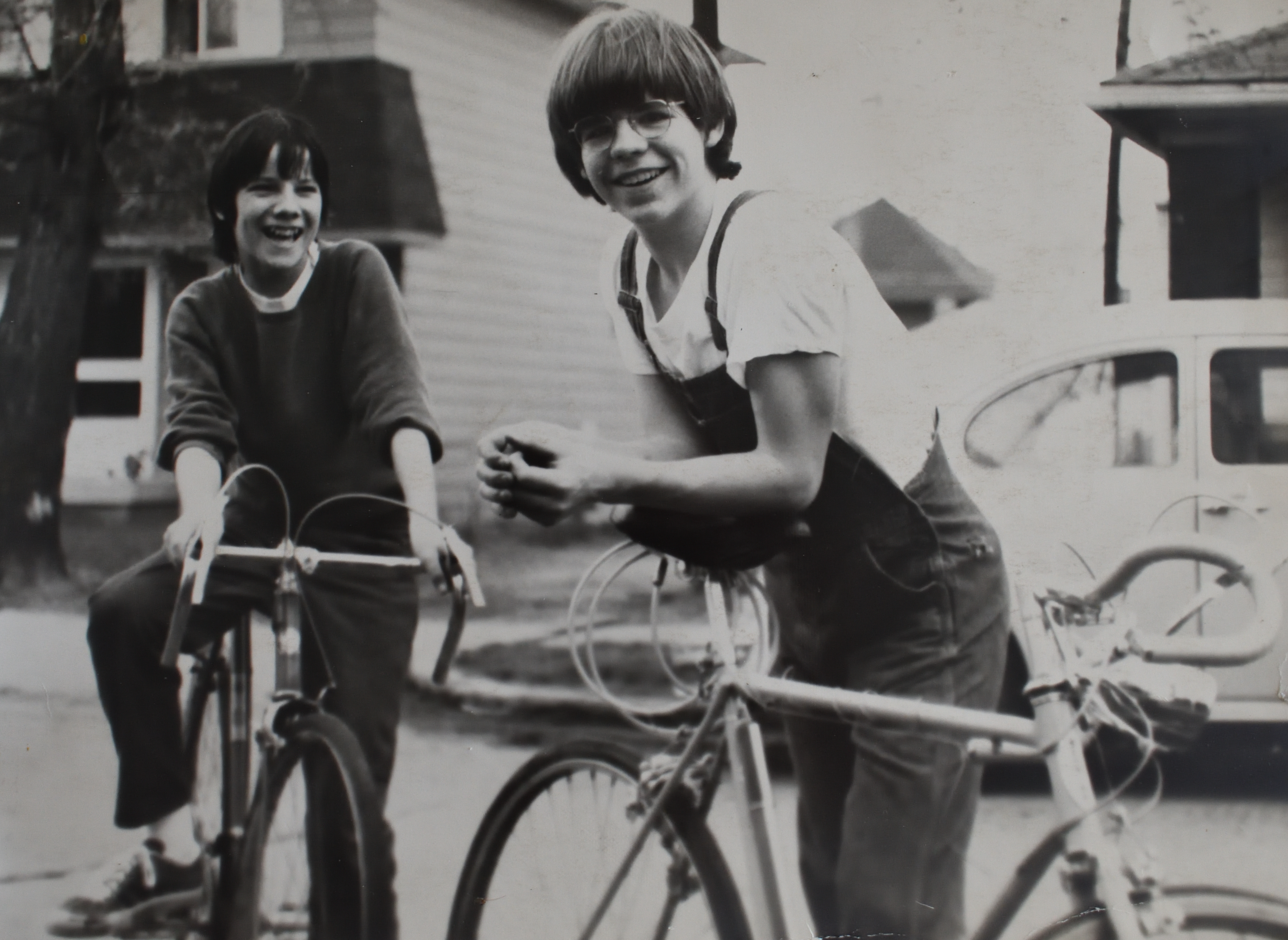
After one year at Earlham, I moved to Indianapolis to join the Friends Volunteer Service Mission (VSM). This was in the early 1970’s, at the time of the Vietnam War. VSM was a project to provide meaningful work for young men doing alternative service for the Selective Service System. Although being a draft resister meant I refused to do alternative service “officially”, as far as the Selective Service System was concerned, I was led to join VSM to learn about doing justice work in communities. VSM had a model of doing one year of work in a job that would qualify as alternative service, saving enough money to support yourself to work in the community for the second year. Living in the community, I had time to see what community needs I might work on during that second year. During the first year I received on-the-job training at Methodist Hospital as a respiratory therapy technician. I spent my time outside my work in the hospital with kids in the neighborhood. There were no youth programs in that part of inner-city Indianapolis. I spent my second year continuing to work with the kids. Playing sports, taking bicycle trips, teaching how to work in a photo darkroom, etc.
So, at an early age (20), I began to learn about community organizing and spirit-led justice work. I was led to this work while praying and working to discern how I would respond to the requirement to register for the Selective Service System and whether to accept doing alternative service. These are related to the broader issues of peace and living in a violent and militaristic country. Learning what the Quaker way would be for me.
Although I returned to Iowa after completing the two years at VSM, I missed the kids so much that I returned to Indianapolis. I continued to do things with youth as I did at VSM while I continued my education. I enjoyed working as a respiratory therapy technician during my first year at VSM. When I returned to Indianapolis, I found a job at the Indiana University Medical Center as a respiratory therapy technician. I obtained a degree in Respiratory Care from Indiana University and became a Registered Respiratory Therapist (RRT).
So, this leading to join VSM led to my career path in medicine, and my path of justice work.
Community building
I have been blessed to be led to new communities of people over the past decade or so. These experiences taught me more about justice work. And have taught me some different answers to questions such as these:
Who is the community?
How to identify what issues to work on?
How to address the issue(s)?
How to measure progress?
Accountability?
How to heal?
In the community
The following are some of the communities I have been/am now involved with.
The youth mentoring community, the Kheprw Institute, in Indianapolis.
The environmental/pipeline resistance communities in Indianapolis and Iowa.
Being trained as an Action Lead in the Keystone Pledge of Resistance in 2013, I received invaluable training in activism. That was also my first experience in being part of an Internet community, learning ways to support each other remotely. This included monthly phone calls with everyone involved.
In 2016 there was national/international support of those at Standing Rock opposing the Dakota Access pipeline.
Locally, in Indianapolis, we were able to use our training and experience from the Keystone Pledge of Resistance to organize and train people to oppose the DAPL.
This included my first experiences of being with Indigenous peoples at public rallies.
In 2017 I retired and returned to Iowa and began to look for environmental activists to work with here. The Internet was helpful in finding groups and events. I had heard of Ed Fallon’s work related to climate justice. We communicated via email, then in February 2017, I met Ed when he organized a group of us to go to Minneapolis the weekend the Super Bowl was played there, to hold a rally at the US Bank headquarters, because of their support of DAPL.
Sept 1-8, 2018, I participated in the First Nation-Farmer Climate Unity March organized by Bold Iowa (Ed Fallon and others) and Indigenous Iowa (Sikowis Nobiss and others). A group of about thirty native and nonnative people walked and camped along the path of the Dakota Access pipeline, from Des Moines to Fort Dodge). https://firstnationfarmer.com/
The intention of the First Nation-Farmer march was to create the time and space for us to get to know each other, to begin to develop some trust so we could work together. That worked exceedingly well, and various combinations of us have done many things since.
Last year the Buffalo Rebellion was formed as a coalition of many of the climate/social justice groups and people in the Midwest.
For the past three years most of my justice work has been with Des Moines Mutual Aid, where I’ve made a number of close friends.
Choosing the work
There are so many injustices, so many people suffering. How do you decide what to do?
As a spiritual person, as a Quaker, seeking spiritual guidance is fundamental to discerning what I am led to do. One reason I’m writing this post is that I’ve been wondering what role spirituality plays in the lives of many of my friends who are deeply involved in justice work. One’s spirituality can be expressed by one’s work in the world, and these friends work tirelessly for justice. But I don’t know what they think or believe regarding spirituality.
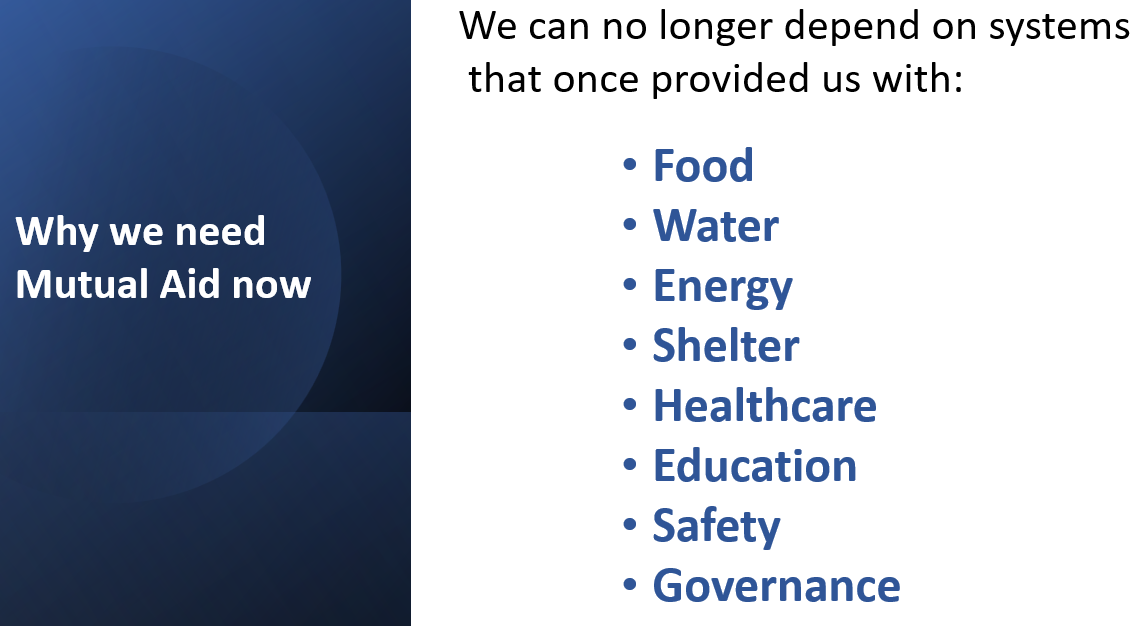
One important aspect of Mutual Aid is that most Mutual Aid communities focus on providing for people’s basic necessities, such as food and shelter. For example, my Mutual Aid community provides free food every week for those who come to us. Others in my Mutual Aid community care for houseless people in Des Moines. The gratification of helping those in need helps attract others to participate.
There are many historical examples of tragedies that occurred when well-intentioned people attempted to provide help to those in need. Unfortunately, too often, support came/comes from dominant groups who view solutions as controlling those deemed to need help. Another way of assimilating other peoples into their own (dominant) worldview. I use assimilate intentionally because one example is of white settler-colonists forcibly removing Indigenous children from their families and taking them to residential schools to learn how to live in white society. These schools were awful institutions where abuse and deaths of children occurred. And the trauma to their families and communities is still passed from generation to generation.
I’ve been exploring how Artificial Intelligence can help as a research assistant. Following is the response when I asked for a table summarizing the advantages and disadvantages of spirit-led social justice work. But I must say I am very concerned about the impact AI is having and will have in replacing human jobs.
My friends at the Great Plains Action Society (GPAS) continue their years of work providing Indigenous leadership on a number of fronts.
Missing and Murdered Indigenous Women and Girls
First, we want to recognize that today (5/5/2023) is National Day of Awareness for Missing and Murdered Indigenous Women and Girls. On May 2, the City of Iowa City declared its first Day of Awareness for Missing and Murdered Indigenous Women. The proclamation was accepted by Sikowis Nobiss, our Executive Director. It was through her work on the Iowa City Truth and Reconciliation Commission that she was empowered to advocate for this proclamation. It was inspired by the first MMIW proclamation in Iowa made last year by the City of Sioux City, which was influenced by the work of Trisha Etringer, our Siouxland Project Director. This year, Trisha accepted the second proclamation made by the City of Sioux City on May 1 and is currently working towards a state wide proclamation for 2024.
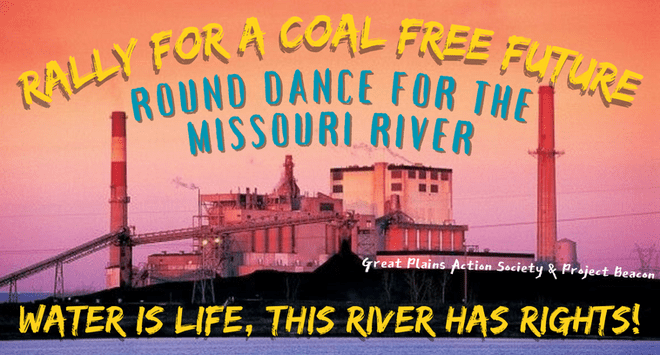
Several environmental organizations have been working to get MidAmerican to shut down their coal burning power plants in Iowa. Today there will be a protest and round dance during the Berkshire Hathaway shareholder meeting today. MidAmerican is a subsidiary of Berkshire Hathaway.
Next, we want all our friends and relatives to know that we are fighting for the health and well-being of the nation’s two mightiest rivers–the Missouri and the Mississippi. Iowa is the only state bordered completely on the East and West borders by these rivers, making it a special place and one that needs to be protected. Over the next week, we will be on both banks carrying out important events to fight for what is right.
Two of the nation’s oldest and dirtiest coal plants, owned by the subsidiary of Berkshire Hathaway–MidAmerican, sit on the Missouri River and are situated in the largely Indigenous corridor between Sioux City, Winnebago, and Omaha reservations. They have already been polluting our air, water, and soil and now one of the plants is lobbying to release their toxic coal ash into the Missouri, which is directly north of the Winnebago and Omaha reservations. So we have partnered with Project Beacon and the Clean Up MidAm Coalition for a protest and round dance during the Berkshire Hathaway shareholder meeting in Omaha to demand that they shut down these coal plants! Please join us tomorrow, May 6th at 11:45am, on the Corner of Cass Street and 10th Street. Great Plains Action Society
Relatives in Omaha, Lincoln, Sioux City, Omaha Nation, and Winnebago Nation–Join Great Plains Action Society and Project Beacon for a Round Dance in Omaha during the Berkshire Hathaway shareholder meeting to demand that they shut down their MidAmerican coal plants! We will be joined by Douglas Esau, who will bring his hand drum. The larger rally is being organized by the Clean Up MidAm Coalition.
The event is taking place on the SE corner of the Big Lot Parking B of the CHI Health Care Event center. On the Corner of Cass Street and 10th Street. There is a map in the discussion of this event page.
PARKING WILL NOT BE EASY AS THERE WILL BE A LOT OF FOLKS IN THE AREA THAT DAY! You will need to find parking in lots or ramps in the downtown area OR if you feel like taking a scenic walk you can park on the Council Bluffs side of the river at Tom Hanafan River’s Edge Park and and walk across the Bob Kerrey Pedestrian Bridge to the event site–it’s about a 20 minute walk.
Two of the nation’s oldest and dirtiest coal plants are situated in the corridor between Sioux City, Winnebago, and Omaha reservations, polluting our air, water, and soil. Now, they want to start releasing their toxic coal ash directly into the sacred waters of the Missouri River and we are here to say NO!
We are offering $50 gas cards to the first 25 Indigenous folks driving from over an hour away–such as Lincoln, Sioux City, and the reservations. We encourage carpooling! Sign up here for a gas card; https://docs.google.com/…/1FAIpQLSdCje8fXwYHgl…/viewform
There will also be lunch available for everyone! Email Sikowis@greatplainsaction.org for questions.
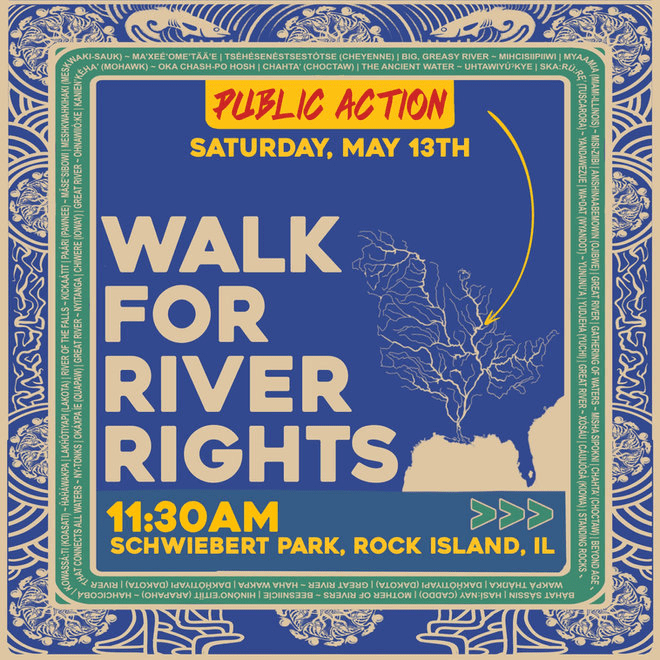
Next week, May 11-14, in the Quad Cities of IA and IL, we are hosting the first Mississippi River Summit with 40 BIPOC leaders and specialists joining us to talk about their respective fights to keep the water safe and healthy and to work towards Rights of Nature.Great Plains Action Society has ties to BIPOC folks at the headwaters all the way to the Gulf of Mexico and we have invited them to Iowa for an important reason! Iowa is the number one contributor to the ‘Dead Zone’ in the Gulf of Mexico and the most biologically colonized state in the country because of Big-Ag, CAFOs (concentrated animal feed operations), meatpacking plants, ethanol production, and general disregard for the land. The time will be utilized for grassroots assessments, specialist lectures, a tour of the Mississippi, and community-building exercises. On May 13th, at 11:30 AM at the Schwiebert Riverfront Park, Summit attendees will join the Quad Cities community for a Walk for River Rights in solidarity as One River community advocating for Rights of Nature for the Mississippi River and for the rights of all communities whose lives are supported by the waters. If you’d like to learn more, visit our event page linked here.
We truly appreciate your participation in our advocacy and frontline efforts and need your support to continue. Please consider making a donation to help support Great Plains Action Society and allow us to continue organizing for the health and safety of Indigenous communities and our lands.
Recently, we discussed our peace and justice work at my Quaker meeting. I explained my vision of creating a Mutual Aid community to guide our justice work. And included examples of what the meeting is already doing that are Mutual Aid.
I felt we had a good discussion. I didn’t have answers to some of the questions raised. I believe those questions would be answered as we got experience with implementation. But the meeting is clearly not ready to begin working on Mutual Aid.
As I was preparing for this discussion, I knew it would be difficult to distill my more than three years of experience with Des Moines Mutual Aid (DMMA).
Paradigm shift: an important change that happens when the usual way of thinking about or doing something is replaced by a new and different way
Mutual Aid represents a paradigm shift in Quaker’s thinking about spirituality and justice work. How can I help people make this shift happen? What is the Spirit asking of us?
I have no doubt that the Spirit leads me to continue with my involvement with Des Moines Mutual Aid. My friends there know I hope to bring spirituality into the work of Mutual Aid, so I’ll give them an update on our meeting at Bear Creek.
One paradigm shift from my past comes to mind. In the early 1970’s I moved to Indianapolis and was horrified by the foul air from auto exhaust. I was led to live without a car as a result. But I had no success in convincing anyone else to give up their car. So here we are now, facing ever increasing environmental chaos.
During the years’ long struggles with my meeting about cars, which was difficult since many meeting members lived in rural settings, one Friend asked if I had invited the meeting into my concerns about cars. And I realized I had not done so. When I did invite the meeting to join me in our common concerns about fossil fuels, one thing we developed was a concept we called Ethical Transportation (see below).
So, I applied that idea to invite the meeting into Mutual Aid work. I often share my experiences at Des Moines Mutual Aid with the meeting. Our discussion this past weekend is another step that will lead to Mutual Aid. As more communities and people are impacted by environmental and social chaos, we will naturally turn to the idea of Mutual Aid for disaster relief.
I am impressed with the Great Plains Action Society’s Mechanism of Engagement. Mutual Aid is one of the Methods in the model. I wonder what such a model would look like for Quakers. Maybe that is part of the way forward, for my Quaker meeting to become more oriented toward Mutual Aid.
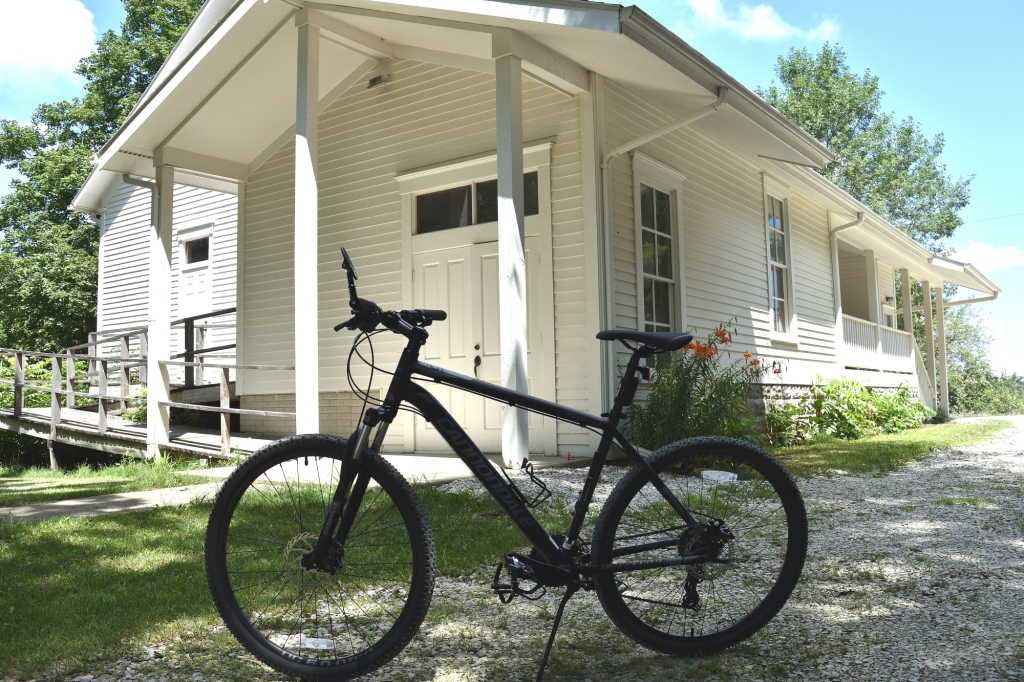
Radically reducing fossil fuel use has long been a concern of Iowa Yearly Meeting (Conservative). A previously approved Minute urged us to reduce our use of personal automobiles. We have continued to be challenged by the design of our communities that makes this difficult. This is even more challenging in rural areas. But our environmental crisis means we must find ways to address this issue quickly. Friends are encouraged to challenge themselves and to simplify their lives in ways that can enhance their spiritual environmental integrity. One of our meetings uses the term “ethical transportation,” which is a helpful way to be mindful of this. Long term, we need to encourage ways to make our communities “walkable”, and to expand public transportation systems. These will require major changes in infrastructure and urban planning. Carpooling and community shared vehicles would help. We can develop ways to coordinate neighbors needing to travel to shop for food, attend meetings, visit doctors, etc. We could explore using existing school buses or shared vehicles to provide intercity transportation. One immediately available step would be to promote the use of bicycles as a visible witness for non-fossil fuel transportation. Friends may forget how easy and fun it can be to travel miles on bicycles. Neighbors seeing families riding their bicycles to Quaker meetings would have an impact on community awareness. This is a way for our children to be involved in this shared witness. We should encourage the expansion of bicycle lanes and paths. We can repair and recycle unused bicycles and make them available to those who have the need.
It quickly became apparent there are major positive and negative aspects of AI. I share the grave concerns of many about the dangers of AI. The ultimate being robots with AI learning how to “take over” the world. Perhaps deciding humans need to be eliminated.
On the other hand, AI is an astounding tool for research. (See: My new friend, AI).
One blog I follow is written by Sheila Kennedy, a retired law professor from Indiana University. Today she wrote “Asking ChatGPT”. ChatGPT is one application interface for Artificial Intelligence. Most AI applications allow you to interact with them without charge for a limited number of uses.
I asked copy.ai, the AI application I use, to list free artificial intelligence applications for you. I encourage you to try one of them out. The response:
There are several free artificial intelligence applications available. Some of the best options include TensorFlow, Scalenut, Anyword, Smith.ai, UserWay, Lityx, neuroflash, and Equally AI. Here are the URLs for each of these applications:
While my son and I were discussing the absolutely mind-blowing abilities of this new technology, I asked him to ask ChatGPT a rather more pedestrian question: “Are young people today more politically engaged than young people 30 years ago? Include any statistical indicators (for example, voter turnout).
(My question was prompted by Lester’s predictable, stubborn dismissal of any suggestion that young people today might be more politically engaged or less self-involved than he is convinced they are.)
That response was also lengthy, but here are the relevant portions:
The pressing issues facing today’s youth, such as climate change, economic inequality, and social justice, have motivated many to become more politically engaged. These issues have spurred activism and participation in protests, which can be seen as an indicator of increased political engagement.
There are several statistical indicators that can be used to measure political engagement, including voter turnout, political party membership, and involvement in political organizations. However, these indicators may not provide a complete picture of political engagement, as they often focus on formal political participation and may not capture informal engagement, such as activism or online discussions.
Voter Turnout: Voter turnout among young people has historically been lower than older age groups. However, recent elections in various countries have shown an increase in youth voter turnout. For example, in the 2018 US midterm elections, voter turnout among 18-29-year-olds increased to 36% from 20% in the 2014 midterms, according to the United States Census Bureau. Similarly, the 2020 US Presidential election saw a significant increase in youth voter turnout.
Political Party Membership: Although party membership has declined overall in many Western countries, some parties have reported an increase in young members. For example, in the UK, the Labour Party saw a surge in youth membership in 2015-2017 under Jeremy Corbyn’s leadership.
Involvement in Political Organizations: Young people today are often engaged in various political organizations or advocacy groups, such as climate change movements like the Sunrise Movement in the US or Extinction Rebellion in the UK.
While these indicators suggest an increase in political engagement among young people, it is essential to keep in mind that these trends can vary depending on the political climate and specific issues driving engagement. Additionally, increased political engagement does not always translate into increased political influence, as young people may still face barriers in having their voices heard or making an impact on policy decisions.
The entire response took three minutes.
It’s possible that humans are no longer necessary….
I was hoping AI might give me some ideas to express my outrage at the actions taken at the Tennessee legislature yesterday. I’m working through the ethical implications of how to separate AI responses from my own writing. I plan to consult AI and use the response as I would any other research, then writing in my own words.
In this case though, as an example of what an AI response looks like, the following was totally written by copy.ai
The Intersection of Gun Violence, Democracy, and Systemic Racism in Nashville
As tensions continue to rise in Nashville, the issues of gun violence, democracy, and systemic racism have begun to intersect in a way that is causing concern for many. The recent ousting of two young legislators, along with the predominantly young age of the protesters, suggests that a backlash may be developing.
Gun Violence in Nashville
Gun violence has long been a problem in Nashville, with the city seeing a significant uptick in shootings over the past year. According to the Metro Nashville Police Department, there were 1,096 shooting incidents in 2020, compared to 800 in 2019. This increase in gun violence has put a strain on the city’s resources and has left many residents feeling unsafe.
Democracy and Systemic Racism
The issue of democracy and systemic racism has also been a point of contention in Nashville. The recent ousting of two young legislators, who were seen as progressive voices in the state government, has sparked outrage among many residents.
Many believe that their ousting was politically motivated and that it was a way for the more conservative members of the government to silence progressive voices. This has led to protests in Nashville, with many young people taking to the streets to voice their concerns about democracy and systemic racism.
Intersection of Issues
The fact that the two ousted legislators are young, as are many of the protesters, suggests that the issues of gun violence, democracy, and systemic racism are beginning to intersect. Many young people in Nashville are concerned about their safety in a city that has seen a sharp increase in shootings. At the same time, they are also concerned about the state of democracy in their state and the country as a whole.
The intersection of these issues has created a sense of urgency among many young people in Nashville. They see the need for change and are willing to take to the streets to demand it. However, there is also concern that this could lead to a backlash from those who oppose these progressive changes.
Conclusion
The intersection of gun violence, democracy, and systemic racism in Nashville is a complex issue that will require a multifaceted approach to address. It is clear that young people in the city are feeling the effects of these issues and are ready to demand change. However, it is also important to consider the potential for backlash and to find ways to address these issues that are inclusive and effective for all residents of Nashville.
With many tools becoming available to work with Artificial Intelligence (AI), I thought I’d see how this could help me with research for thought and writing. Many things I think and write about have little documentation.
Spirituality and Mutual Aid has been frustrating to explore because I’ve found little information so far.
I was pleasantly surprised at what the copy.ai Artificial Intelligence interface uncovered in response to my questions. I was really surprised at what was discovered when I asked about groups incorporating spirituality into Mutual Aid”. One answer was:
LANDBACK Friends is a Quaker community that discusses mutual aid and spirituality. They suggest that mutual aid can be a spiritual practice, and that it is a way to build peaceful, abolitionist communities. [4]
This is the chat I had with copy.ai about Spirituality and Mutual Aid:
Spirituality and Mutual Aid
Mutual aid is a practice of community support and solidarity, and spirituality can be a powerful tool in practicing mutual aid. Spiritual beliefs and practices can provide a sense of purpose, meaning, and connection to something greater than oneself, which can motivate and sustain mutual aid efforts.
Many spiritual traditions prioritize the values of compassion, generosity, and service to others, which align with the principles of mutual aid. For example, in Christianity, the concept of “love thy neighbor” is a central tenet that encourages Christians to care for one another and help those in need. In Buddhism, the practice of “metta” or loving-kindness meditation is a way to cultivate a sense of compassion and empathy towards all beings, which can inspire acts of mutual aid.
Spiritual practices can also provide a sense of grounding and resilience in the face of adversity. Practices such as prayer, meditation, and mindfulness can help individuals cope with stress and trauma and provide a sense of inner peace and strength. This can be especially important for those who are participating in mutual aid efforts, as they may be dealing with challenging situations and emotions.
In addition, spirituality can inspire a sense of interconnectedness and unity among people, regardless of their backgrounds or beliefs. This can promote a sense of solidarity and mutual support that is essential for successful mutual aid efforts.
Overall, spirituality can play an important role in mutual aid by providing a sense of purpose, grounding, resilience, and connection. By incorporating spiritual practices and beliefs into mutual aid efforts, individuals and communities can deepen their sense of commitment to helping others and building stronger, more resilient communities.
Groups incorporating spirituality into Mutual Aid
One group that incorporates spirituality into mutual aid is the Catholic left, which has been practicing spiritual mutual aid since Vatican II. This takes place at the grassroots level of the church, where people gather in egalitarian house churches and prayer groups and consecrate the Eucharist communally or at the hands of a person who would be denied ordination by the Catholic hierarchy. [1]
Another example is the mutual aid group “Higher Power” in Northern California, which is a culturally adapted 12-step program for Latinos with substance use problems and other mental health concerns. This group incorporates spirituality and cultural adaptation into their recovery methods. [2][3]
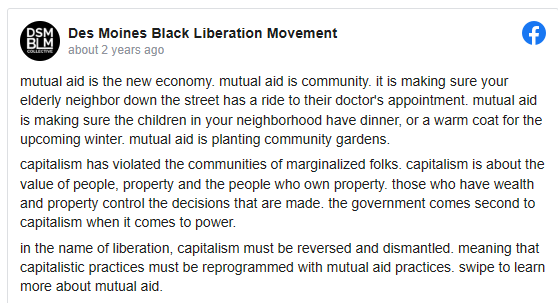
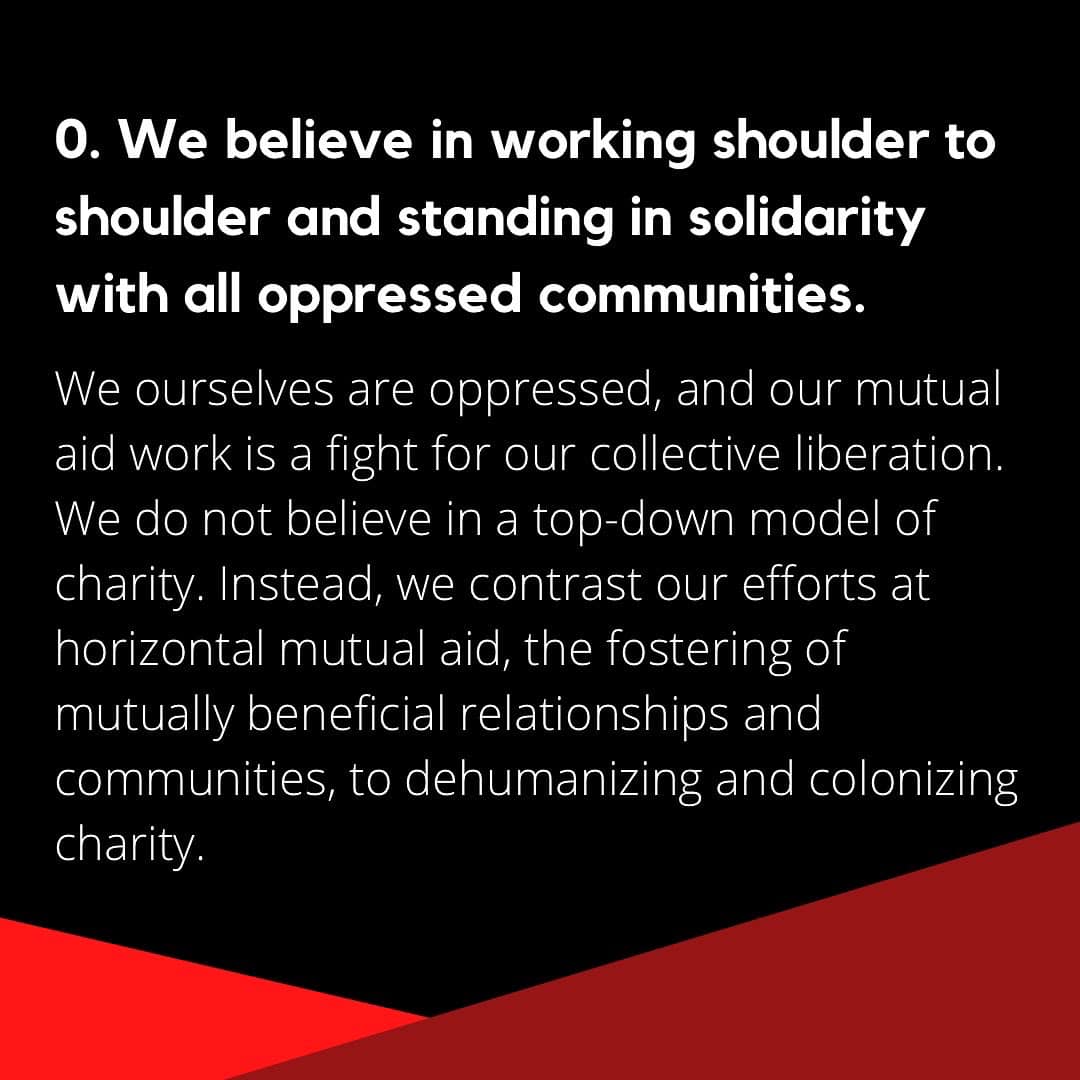
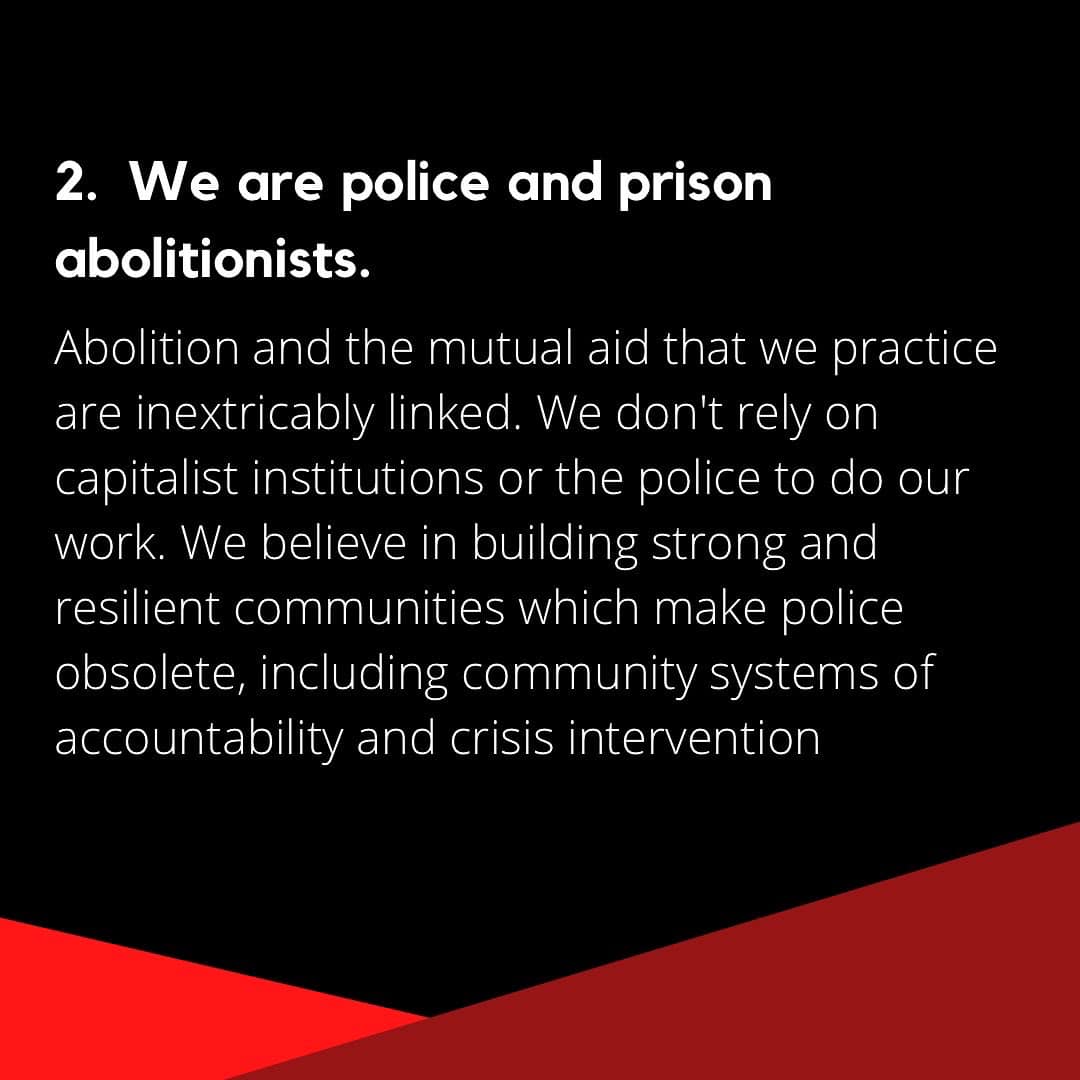
LANDBACK Friends is a Quaker community that discusses mutual aid and spirituality. They suggest that mutual aid can be a spiritual practice, and that it is a way to build peaceful, abolitionist communities. [4]






















 Quakers and Mutual Aid