I’m heeding the suggestion that it isn’t good for young people to continuously hear proclamations of near-term extinction. And nobody really knows what will happen as we move further into environmental devastation and chaos.
But there are many things we do know about our evolving environmental disaster.
Daily breaking high temperature records for large areas of the world is directly linked to increasing greenhouse gases in the atmosphere. As are the increasingly frequent and severity of storms. And the increasing severity of drought conditions over larger areas of land. All of which will increasingly stress, or cause failures of power, water, and waste management infrastructure.
And yet, the Biden administration is aggressively pressuring oil companies to increase oil and natural gas production and releasing millions of barrels of crude oil from the Strategic Petroleum Reserve. A dangerous, disastrous disconnect.
WASHINGTON, D.C.—The U.S. Department of Energy’s (DOE) Office of Fossil Energy and Carbon Management (FECM) today announced an additional Notice of Sale of up to 40.1 million barrels of crude oil from the Strategic Petroleum Reserve (SPR). This Notice of Sale is part of President Biden’s announcement on March 31, 2022, to release one million barrels of crude oil a day for six months to address the significant global supply disruption caused by Putin’s war on Ukraine and help stabilize volatile energy costs for American families.
New funding for fossil fuel exploration and production infrastructure is delusional.
U.N. Secretary−General António Guterres
U.N. Secretary−General António Guterres warned Tuesday of a “dangerous disconnect” between what scientists and citizens are demanding to curb climate change, and what governments are actually doing about it.
Guterres said global greenhouse gas emissions need to drop by 45% this decade, but are currently forecast to increase by 14%.
“We are witnessing a historic and dangerous disconnect: science and citizens are demanding ambitious and transformative climate action,” he said at a climate conference in Austria. “Meanwhile many governments are dragging their feet. This inaction has grave consequences.”
“New funding for fossil fuel exploration and production infrastructure is delusional,” he said in a video message to the Austrian World Summit, initiated by former California Gov. Arnold Schwarzenegger. “It will only further feed the scourge of war, pollution and climate catastrophe.”
Guterres urged countries to instead end all coal use by 2040, with rich nations doing so by 2030, and focus on replacing fossil fuels with renewable sources of energy, such as solar and wind power.
“Renewables are the peace plan of the 21st century,” he said.
The Department of the Interior has released the first volume of the Federal Indian Boarding School Initiative Report. Interior Secretary Deb Haaland first announced the creation of the Initiative last June, with a primary goal of investigating the loss of human life and the lasting consequences of these schools.
This report, and ongoing news of locating the remains of Native children on the grounds of numerous Indian residential schools has brought attention to Quakers’ role in these institutions in North America.
There are calls for Friends to respond in many ways. To educate ourselves about this history. To seek ways for healing and reparations. To research and publish our own meeting’s history.
But I’m concerned that Friends will follow a common pattern of only working within their meetings. When this is a time we need to reach out to Native peoples.
And I am concerned that many Quakers are not aware of attitudes we could be bringing to this work. In the same the way so many white Quakers have trouble understanding white supremacy and privilege related to racial justice, many are also unaware of how deeply we are immersed in this colonized society. Colonization and white supremacy are the foundation of forced assimilation of native children. And the ideas behind the land theft and genocide of native peoples.
We need to decolonize ourselves. If not, we risk doing more harm than good.
My spiritual vision is of Quakers building personal relationships with native peoples when we are invited to do so. I have been blessed to experience this for the past couple of years while working with my local Mutual Aid community. This diverse community includes a number of native people. It was a Spirit led opportunity that connected me with an Indigenous organizer who is involved in Mutual Aid. We got to know each other over several months of email exchanges (this during the COVID crisis). When I thought we knew each other well enough, I asked if it would be appropriate for me to join this Mutual Aid work, and he said yes. But it wasn’t until I’d been involved for several months that he said, “welcome to the community”. Although I had invited myself to join this work, I wasn’t really part of the community until that moment.
I was blessed to find this community was not only another way to build friendships with native people, but also taught me what a Mutual Aid community is. Based on these experiences, I believe Mutual Aid is a model for how Friends can be involved in work outside the meetinghouse. Mutual Aid is a way we can decolonize ourselves.
What I think is needed in this moment is to show up at events and causes being led by Indigenous peoples near us
Mutual Aid is all about replacing vertical hierarchies with a flat, or horizontal hierarchy. This removes the power structures among members of the community and nearly eliminates friction, in my experience.
An essential part of the truth and healing process should be doing this work together as a Mutual Aid community, with its emphasis on inclusivity and rejecting dominant relationships. It is important that attitudes and practices of superiority not be brought to the work of healing from policies that are based on dominance and colonization.
“We sought to show the power our communities possess when we come together unified under the belief and knowledge that what we do today is both work to heal past generations and lift the spirits of our future generations.”
Mutual Aid focuses on meeting community needs now, in the moment. The food project I’m involved with distributes food to those in need every week. Those working with the houseless camps take food and propane tanks there. It is the experience of meeting needs in the present that brings us joy and attracts new members. That also affects our interactions with those who come for the food. We realize it is the failure of capitalism that leaves them hungry. We all know we ourselves might need such help in the future.
There are many suggestions of things Quakers might do related to the Indian Boarding Schools.
What I think is needed in this moment is to show up at events and causes being led by Indigenous peoples near us. Most Quaker meetings and many individuals have such relationships to build upon.
It would be good to have a place to share such information. The following are a few examples that I’m aware of:
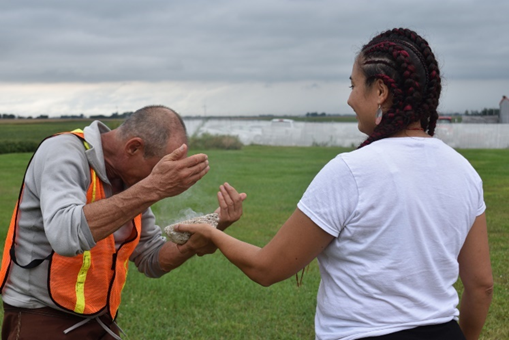
attend powwows and events such as the Prairie Awakening/Prairie Awoke ceremony at the Kuehn Conservation Area.
show up for public events and demonstrations such as
Missing and Murdered Indigenous Relatives (MMIR)
Indigenous Peoples Day
Racist monuments and mascots
Reproductive justice
Pipeline resistance
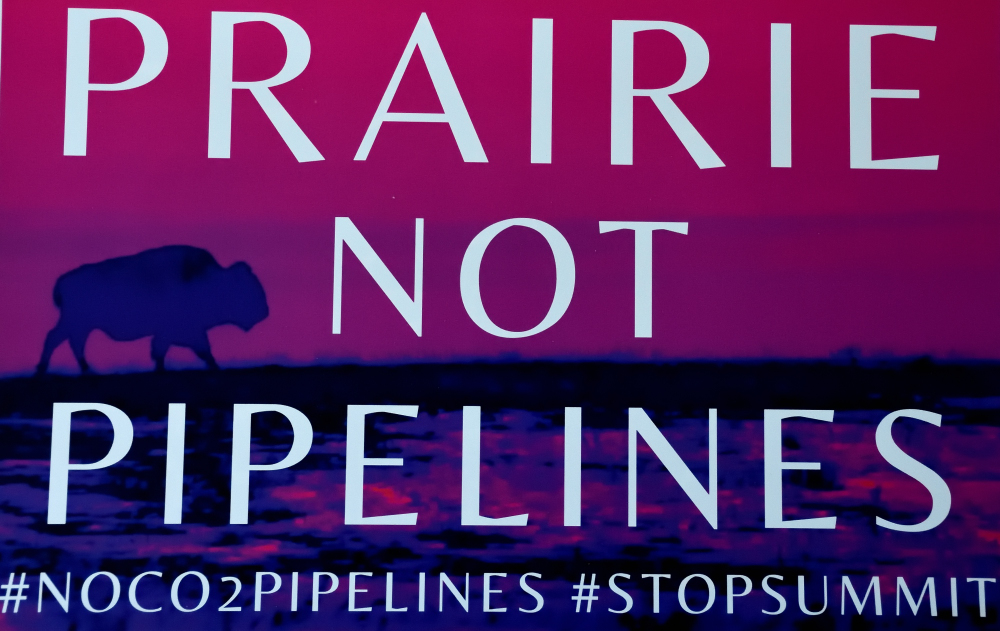
Carbon pipelines
Other fossil fuel pipelines
There are two general guidelines for interacting with communities.
Don’t expect oppressed peoples to educate you. We shouldn’t add to their burden. I kept this in mind when I was getting to know the native person who was teaching me about Mutual Aid. But he encouraged me to learn from him. He was training me.
The idea behind the two row wampum is two groups, such as Native people and white people, agree to travel together but separately. Neither interfering in the affairs of the other.
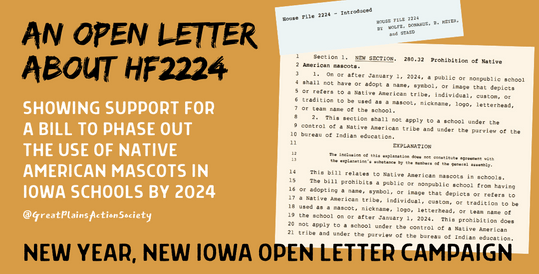
One interesting campaign of the Great Plains Action Society that specifically asks for our support is open letters. These letters express Indigenous people’s views on various topics and are meant to help supporters contact people who have the power to make decisions related to the topic. For example:
Recently, four Iowa Democrats have introduced a bill to phase out the use of Native American mascots in Iowa schools by 2024. Great Plains Action Society’s Director of Operations, Trisha Etringer, was quoted in an article in which she expressed her support for this proposed legislation, which reflects our organization as a whole. This letter is to celebrate this step in the right direction, and to provide more information about the issue at hand. With this Open Letter Campaign, we will be calling upon you to join us in communicating to the people in power that we need to be working toward a New Iowa. Unfortunately, that will often mean calling people out for failing to act, or for acting in harmful ways. Fortunately, in this case, it means asking you to send your support and encouragement to those that are fighting the difficult battles on behalf of our children.
There are many things Quakers should be doing in our own meetings related to the Indian Boarding Schools. But I think it is most important to support things native people are asking of us now.
I recently discovered papers written by Zhiwa Woodbury, so I don’t yet know how much I will agree with him as I read more. But I agree with the following excerpt. This paragraph strikes a chord in me now, as I am trying to make sense of what is going on in the world today. I recently returned to the concept of sensemaking in Where are we now?
We have a stark choice between our own eventual extermination or a near term transformation. Such a transformation of human culture and the global economy will not come about without a simultaneous shift in collective consciousness. Trauma always raises questions of identity, whether considered at the scale of the individual, a culture, or now with the climate crisis, at the scale of an entire species. The choices we humans are making now – and will continue to make – in response to this spiritual emergency will determine whether we engender spiritual emergence, the messy rebirth of our species, or instead we repeat the kind of Great Dying that once wiped out 95% of all life on the planet, and took 10 million years for the biosphere to recover. My purpose in writing this book is to offer guidance and succor to all who those natural healers and existential professionals in the world, all those who hear the cries of the Earth, and all those advocating for climate sanity in every arena of life, so that we may attend Gaia’s bedside and serve as her spiritual midwives in planetary hospice. Whether Gaia is now dying, just ill, or about to give birth is largely dependent on how we, as a species, respond to her signals and attend to her needs
I do believe we are in a spiritual emergency and need a shift in collective consciousness. I often write about spiritual poverty. We spoke about this, too, last night during our weekly (Quaker) Spiritual Sharing Small Group.
We need to be advocating for climate sanity in every arena of life.
I always hesitate to bring this up, but I think we need to speak from our own experience. When I moved to Indianapolis in 1971, I was so horrified by the clouds of smog (before catalytic converters) I decided to live without a car. I know others have done so. But the point is, that was one way of advocating for climate sanity. It is heart wrenching to think of what a different world we would be living in today if fifty years ago we had decided to prioritize mass transit systems. And worked to build our cities and towns as walkable communities.
That was then. What do we do, advocate for, now? Our society clearly continues to refuse to think, let alone do anything about our deepening environmental catastrophe.
Rather than close coal burning plants, more are being built. Rather than stop further fossil fuel pipelines and other infrastructure, more is being built. Crazy schemes like carbon capture are being built. Some of what is captured is used to frack more oil from the ground.
Militaries are the worst polluters. The war in Ukraine and military operations globally need to be stopped immediately. The war in Ukraine is war against Mother Earth.
“CLIMATEWIRE | Greenhouse gases trapped 49 percent more heat in 2021 than in 1990, as emissions continued to rise rapidly, according to NOAA.
“Our data show that global emissions continue to move in the wrong direction at a rapid pace,” said NOAA Administrator Rick Spinrad.
NOAA found that carbon dioxide, the most plentiful and long-lived gas, expanded at the most rapid rate over the last 10 years. But the most potent global warmer also broke records: methane increased more than it has since at least the early 1980s, when NOAA began its current measuring record. The methane emitted in 2021 was 15 percent greater than in the 1984-2006 period, and 162 percent greater than preindustrial levels, NOAA found.”
Record Methane Spike Boosts Heat Trapped by Greenhouse Gases. NOAA’s Annual Greenhouse Gas Index finds that greenhouse gases trapped nearly 50 percent more head last year than they did in 1990 by John Fialka, Scientific American, June 1, 2022
“We have a stark choice between our own eventual extermination or a near term transformation. Such a transformation of human culture and the global economy will not come about without a simultaneous shift in collective consciousness.”
We are continuing to make this choice now and it’s for our eventual extermination.
What will it take to make the other choice, for a near term transformation? What would this shift in collective consciousness to transform human culture and the global economy be?
This shift in collective consciousness requires a response to our spiritual emergency. Returning to Indigenous ways, the idea of LANDBACK, would be part of a response. For Quakers, fortifying our Spiritual awareness, and acting on what that reveals, could be part of a response. The radical reimagining of our lives, our culture by the concepts of Mutual Aid could also be part of a response.
I was a little surprised when I wrote:
The reason I have been led to experiences with Native people and my Mutual Aid community is because the stories, the value structures I find there are closer to my values than those of White people in general in this country.
And most radical is to change, or return to how we look for and interpret our stories. To embrace spirituality in ourselves and our communities.
Although we rarely speak of it, our shared spirituality is what I have found to be the deepest connection with my Native American and Mutual Aid friends.
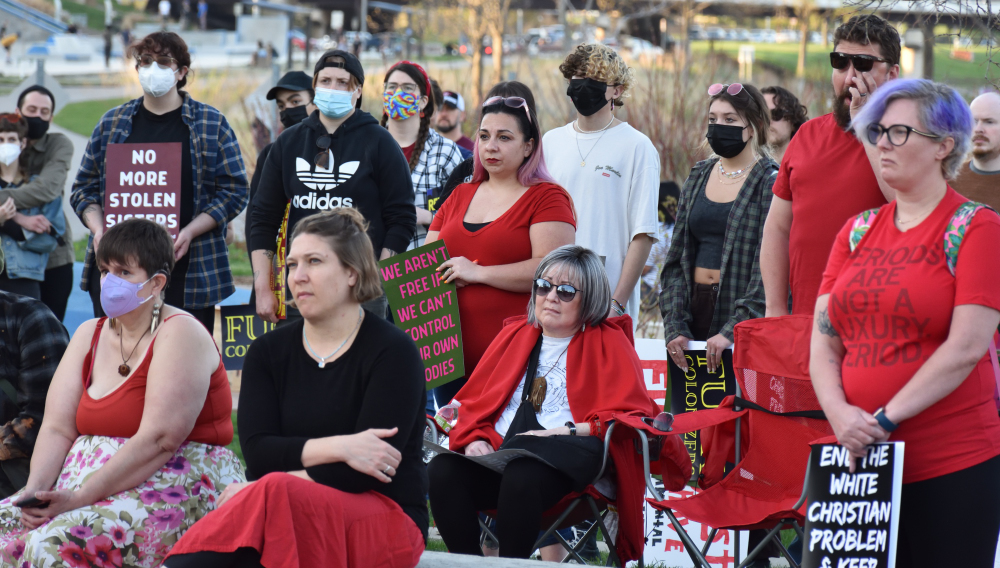
I wrote about the Rally for Reproductive Justice at the Iowa Women of Achievement bridge in downtown Des Moines last Friday. The event was a case study of how I hope and pray we find our way toward the goal of Beloved community. This is urgent now as the systems we have depended on continue to collapse around us.
White Christian problem
I’m always uncomfortable talking about myself but being asked to take photos at this event represents one principle of how we can work together. White males represent/perpetuate the systems of dominance that we must get rid of. Being a white male, I work to avoid those attributes in what I do.
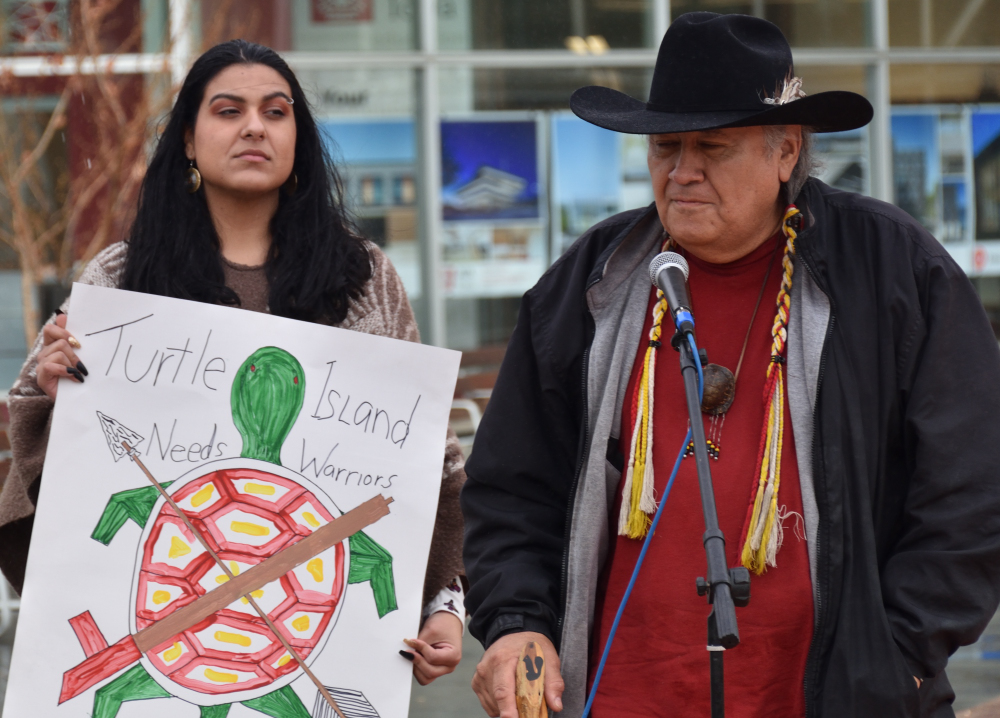
White people need to wait to be invited into this work. So, I was honored that one of my friends, Sikowis Nobiss, of the Great Plains Action Society asked me to take photos at the rally. It takes a long time for this trust to develop. I’ve been working with the Great Plains Action Society for five years.
Sikowis Nobiss
There were several signs at the gathering like the one below that say “end the white Christian problem and keep abortions legal”. White supremacy is at the root of systems of dominance and oppression. White Christians should work to liberate themselves from their systems of dominance and oppression. In the process, helping liberate those oppressed by those systems.
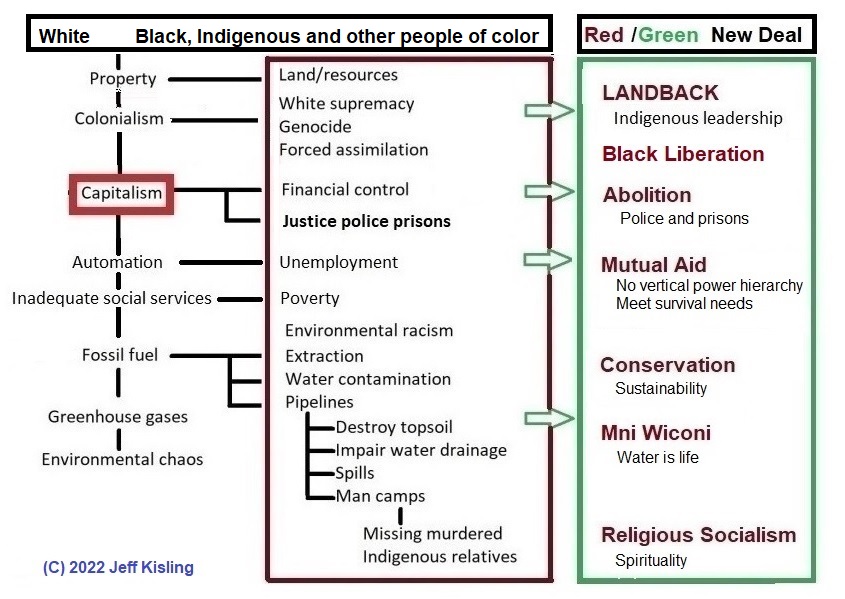
I’m going to try to explain how the principles of the Red/Green New Deal in the diagram above were represented at the Reproductive Justice event. The Green New Deal (GND) represents the idea of modeling bold initiatives to address environmental disaster on the New Deal of the 1930’s.
The Red New Deal stands for Indigenous led Green New Deal. This is represented in the diagram above as LANDBACK.
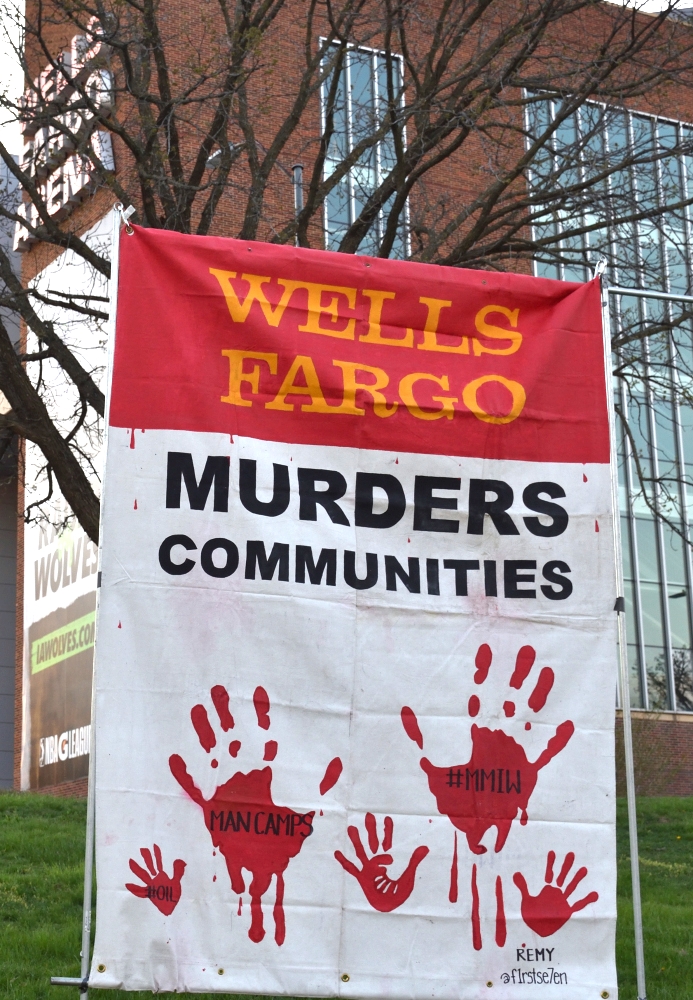
The Reproductive Justice rally was supported by the many justice organizations in Iowa listed in this graphic. My friend Sikowis Nobiss of the Great Plains Action Society was one of the main organizers (and who asked me to take photos). Other Indigenous friends included Mahmud Fitil who took video via a drone, Donnielle Wanatee, who gave prayers, and Ronnie James of Des Moines Mutual Aid who setup the Wells Fargo Kills Communities banner. Our gathering was just across the street from the Wells Fargo Arena.
NOTE: I have another blog which is about LANDBACK titled LANDBACK Friends.
It is the reclamation of everything stolen from the original Peoples.
Land
Language
Ceremony
Medicines
Kinship
It is a relationship with Mother Earth that is symbiotic and just, where we have reclaimed stewardship. It is bringing our People with us as we move towards liberation and embodied sovereignty through an organizing, political and narrative framework. It is a catalyst for current generation organizers and centers the voices of those who represent our future. It is recognizing that our struggle is interconnected with the struggles of all oppressed Peoples. It is a future where Black reparations and Indigenous LANDBACK co-exist. Where BIPOC collective liberation is at the core. It is acknowledging that only when Mother Earth is well, can we, her children, be well. It is our belonging to the land – because – we are the land. We are LANDBACK!
BIPOC stands for Black, Indigenous, and other people of color. White supremacy is the attempt of White people to dominate those who are not white, i.e. BIOPC people. Much of what I’ve been writing about regarding Indigenous peoples applies to black and other people of color. The obvious differences relate to the history of enslavement and continued injustices related to skin color.
From the LANDBACK Manifesto (above): “It is a future where Black reparations and Indigenous LANDBACK co-exist. Where BIPOC collective liberation is at the core.” This is represented by Black Liberation in the diagram above.
One of the main organizations involved in the Rally for Reproductive Justice was Des Moines Black Liberation. The concept of black liberation represents moving beyond the concept of Black Lives Matter.
Today abolition commonly refers to abolition of police and prisons. The public lynching of so many unarmed Black and other people of color appear relentlessly because of news and bystander videos. There are incredible inequities of prison populations and long sentences of BIPOC people compared to white people. Prisons are abused to keep BIPOC people off the streets.
There are numerous examples of the success of dispatching mental health personnel instead of police where appropriate.
Mutual Aid has been my focus for justice work for the past several years. While Des Moines Mutual Aid is not listed in the organizations supporting the Rally for Reproductive Justice, several of us were at the Rally. One thing they did while I was taking photos was set up this banner calling attention to missing and murdered Indigenous relatives (MMIR).
The Rally for Reproductive Justice was in solidarity with the annual day of awareness about MMIR that is observed at this time. The Wells Fargo banner calls attention to the bank’s financing fossil fuel projects. Pipelines are often intentionally built near native communities. Violence against native peoples occurs from the men in the camps at the construction sites. The Wells Fargo Arena is just across the street from where the rally was held.
The color red is associated with MMIR. Many in the crowd at the rally wore red, and the Women of Achievement bridge was lit in red for the same reason.
Bridge lit in red in support of missing and murdered Indigenous relatives
As shown in the graphic above, Mutual Aid is about getting rid of vertical hierarchies, which is fundamental for building Beloved communities. There won’t be power structures of superiority, dominance, and oppression if we commit to the framework of Mutual Aid.
Conservation
For healing for Mother Earth to occur, it is essential to dramatically reduce extraction and consumption of resources. We must act in a manner that will be best for the next seven generations.
My friend Donnielle Wanatee offered prayers during the Rally.
Donnielle Wanatee
That briefly covers what is included in the graphic above (Red/Green New Deal).
I wanted to mention there were people at the rally to sign for those with hearing impairments.
One of the other organizations supporting the Rally was Iowa CCI (Citizens for Community Improvement) that I’ve just begun to become involved with. One of my friends is Jake Grobe, who is the Climate Justice Organizer for Iowa CCI. Jake and I often see each other at the Des Moines Mutual Aid food giveaway each Saturday morning.
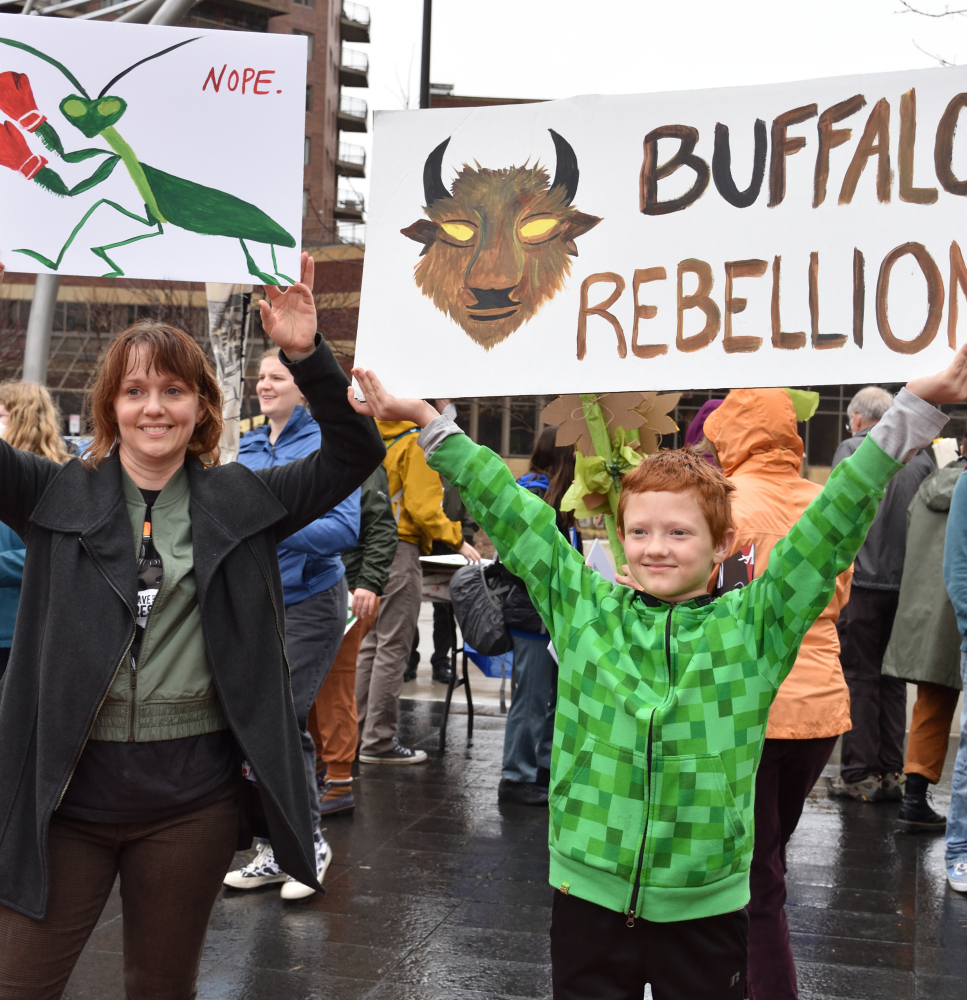
Jake and Sikowis are two of the people who did a great deal of work creating a new coalition, the Buffalo Rebellion. This coalition will do much to help us build the future we want. The Buffalo Rebellion recently held an intense Climate Summit that I was blessed to attend, to build a network of climate and justice advocates.
Sikowis Nobiss and Jake Grobe
As my Mutual Aid friends and I left the Rally we said, “I’ll see you in the morning” where we’ll be at our food giveaway.
[References to Quakers here pertain to White Quakers. There is little diversity among Quakers in this country.]
There are several reasons I’m led to revisit this today.
Our Quaker meetings have dwindling numbers of attenders. Most of those remaining are elderly and white. Many meetings do not have new people joining.
I continue to hear stories from people of color, or those identifying as non-binary in gender or sexual orientation not being welcome in some Quaker meetings.
Those of us working outside our Quaker communities are often blessed to find beloved communities.
I wish others in our Quaker meetings would join these communities.
Despite the many wonderful aspects of these ‘external’ communities, I sometimes sense a lack of spiritual support for one another there.
There are many who don’t express their spirituality publicly, or in ways “organized” religions do.
Quaker presence will not be fully welcome in these communities until we come to terms with our own racism.
We know that those of us who are white must confront racism in ourselves and in the institutions we care about—our faith communities, our schools, our neighborhoods, our families, our Congress.
People ask me if I believe in god… I tell them I pray to creator. They tell me Jesus died for me… I tell them my ancestors did. They say I will burn in hell for not following the Bible, but it has been used as weapon to colonize and murder my people… for me it’s spirituality over religion. I don’t hate people for going to church, but I do hate what the churches have done to us… before colonization we had our own ways and ceremonies, I choose the path of my ancestors.
Indigenous
For a long time, I’ve been in significant spiritual distress. I’ve been learning a great deal from my Native friends and working in Mutual Aid communities. And they tell me the way white people can best support them is by embracing and teaching others about LANDBACK.
I caused conflicts in my Quaker meeting because I wanted them to join me in the work of Mutual Aid and LANDBACK. Despite my efforts to explain this, they haven’t had the experiences that would make them understand all of this, yet.
At the same time I felt I was letting my Native friends down, because I wasn’t making some of the changes I wanted to make in my life that could be an example of how white people can join the work with Mutual Aid and LANDBACK.
As environmental chaos deepens, with the resulting collapse of the colonial capitalist economic system and the political systems propping up white supremacy fail, we will have no choice but to find alternatives. Ideally those would be Mutual Aid and LANDBACK. This is a powerful incentive to embrace these concepts now.
Mutual Aid and LANDBACK
In the same way I can’t understand the involvement of many Quakers in the slave trade, and having enslaved people, I can’t understand Quaker’s involvement in forced assimilation of native children.
What does this mean for Quakers today? No matter what we say about justice for BIPOC (Black, Indigenous, and other people of color) folks, those words are empty as long as we continue to take advantage of colonial capitalism and white supremacy.
The news of 215 Kamloops Native children buried on the grounds of a residential school shocked non-native people, who did not know how many of these residential schools existed in the lands called the United States and Canada. Did not know tens of thousands of Native children were forcibly removed from their families and taken to these institutions where thousands were abused in many ways. Thousands killed or died. Though the stated reason for doing this was to assimilate Native children into white society for their benefit, the real intent was to quell Indigenous resistance to the theft of their land by white settler colonists.
The growing numbers of remains found at other schools has re-opened deep wounds in Native communities. Many have been triggered by these atrocities. One of my Native friends wrote that she was NOT OK. Another told me, “I’m trying not to be enraged in my mourning.”
A Native friend also told me, “The church is the church’s past, which is its future. It continues to see my people as obstacles in its endless conquest. To be blunt, there is too much damage that the church profits from and needs to protect to have any future there.” Vigorous attempts are made to hide it, but history does not lie. He also told me, regarding what I had been telling him about my efforts with Quakers, “I wish you the best. I imagine it’s a hard struggle.”
I cannot face my BIPOC friends if I don’t continue to seek the Spirit, and act on the leadings I am given. Writing is one thing I am led to do.
“Don’t make orphans stand here covered in the blood of our parents and explain to you how this all came to be without doing something about it. “
I am so grateful to my BIPOC friends for teaching me that Mutual Aid and LANDBACK are alternatives to colonial capitalism and white superiority. LANDBACK is how to restore Native lands and leadership.
As environmental chaos deepens, with the resulting collapse of the colonial capitalist economic system and the political systems propping up white supremacy, we will have no choice but to find alternatives. Ideally those would be Mutual Aid and LANDBACK. This is a powerful incentive to embrace these concepts now.
I wrote the following epistle that is modeled from ‘An Epistle to Friends Concerning Military Conscription’
An Epistle to Friends Regarding Community, Mutual Aid and LANDBACK
Dear Friends,
The measure of a community is how the needs of its people are met. No one should go hungry, or without shelter or healthcare. Yet in this country known as the United States millions struggle to survive. The capitalist economic system creates hunger, houselessness, illness that is preventable and despair. A system that requires money for goods and services denies basic needs to anyone who does not have money. Black, Indigenous, and other people of color (BIPOC) are disproportionately affected. Systemic racism. The capitalist system that supports the white materialistic lifestyle is built on stolen land and genocide of Indigenous peoples, and the labor of those who were enslaved in the past or are forced to live on poverty wages today.
Capitalism is revealed as an unjust, untenable system, when there is plenty of food in the grocery stores, but men, women and children are going hungry, living on the streets outside. White supremacy violently enforces the will of wealthy white people on the rest of us.
It has become clear to some of us who are called Friends that the colonial capitalist economic system and white supremacy are contrary to the Spirit and we must find a better way. We conscientiously object to and resist capitalism and white supremacy.
capitalism has violated the communities of marginalized folks. capitalism is about the value of people, property and the people who own property. those who have wealth and property control the decisions that are made. the government comes second to capitalism when it comes to power.
in the name of liberation, capitalism must be reversed and dismantled. meaning that capitalistic practices must be reprogrammed with mutual aid practices. Des Moines Black Liberation Movement
Mutual Aid
How do we resist? We rebuild our communities in ways not based upon money. Such communities thrive all over the world. Indigenous peoples have always lived this way. White people once did so in this country. Mutual Aid is a framework that can help us do this today.
The concept of Mutual Aid is simple to explain but can result in transformative change. Mutual Aid involves everyone coming together to find a solution for problems we all face. This is a radical departure from “us” helping “them”. Instead, we all work together to find and implement solutions. To work together means we must be physically present with each other. Mutual Aid cannot be done by committee or donations. We build Beloved communities as we get to know each other. Build solidarity. An important part of Mutual Aid is creating these networks of people who know and trust each other. When new challenges arise, these networks are in place, ready to meet them.
Another important part of Mutual Aid is the transformation of those involved. This means both those who are providing help, and those receiving it.
With Mutual Aid, people learn to live in a community where there is no vertical hierarchy. A community where everyone has a voice. A model that results in enthusiastic participation. A model that makes the vertical hierarchy required for white supremacy impossible.
Commonly there are several Mutual Aid projects in a community. The initial projects usually relate to survival needs. One might be a food giveaway. Another helping those who need shelter. Many Mutual Aid groups often have a bail fund, to support those arrested for agitating for change. And accompany those arrested when they go to court.
LANDBACK
The other component necessary to move away from colonial capitalism and white supremacy is LANDBACK.
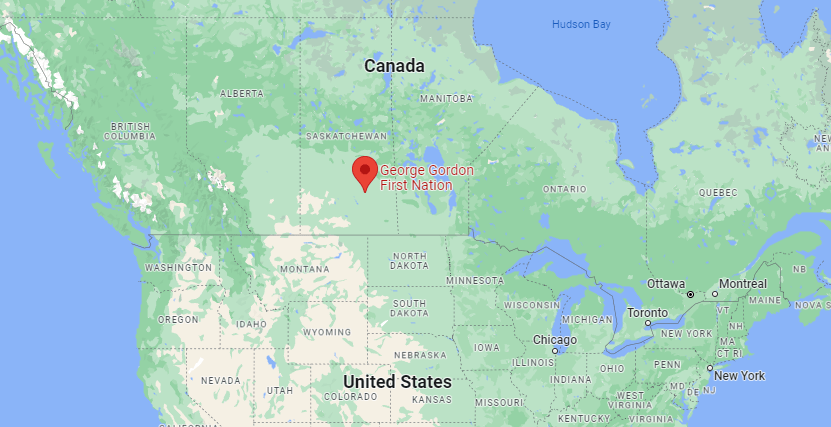
But the idea of “landback” — returning land to the stewardship of Indigenous peoples — has existed in different forms since colonial governments seized it in the first place. “Any time an Indigenous person or nation has pushed back against the oppressive state, they are exercising some form of landback,” says Nickita Longman, a community organizer from George Gordon First Nation in Saskatchewan, Canada.
The movement goes beyond the transfer of deeds to include respecting Indigenous rights, preserving languages and traditions, and ensuring food sovereignty, housing, and clean air and water. Above all, it is a rallying cry for dismantling white supremacy and the harms of capitalism.
Returning the Land. Four Indigenous leaders share insights about the growing landback movement and what it means for the planet, by Claire Elise Thompson, Grist, February 25, 2020
What will Friends do?
It matters little what people say they believe when their actions are inconsistent with their words. Thus, we Friends may say there should not be hunger and poverty, but as long as Friends continue to collaborate in a system that leaves many without basic necessities and violently enforces white supremacy, our example will fail to speak to mankind.
Let our lives speak for our convictions. Let our lives show that we oppose the capitalist system and white supremacy, and the damages that result. We can engage in efforts, such as Mutual Aid and LANDBACK, to build Beloved community. To reach out to our neighbors to join us.
We must begin by changing our own lives if we hope to make a real testimony for peace and justice.
We remain, in love of the Spirit, your Friends and sisters and brothers,
Note: Modeled from ‘An Epistle to Friends Concerning Military Conscription’
I wrote a series of posts related to Whiteness and Quakers:
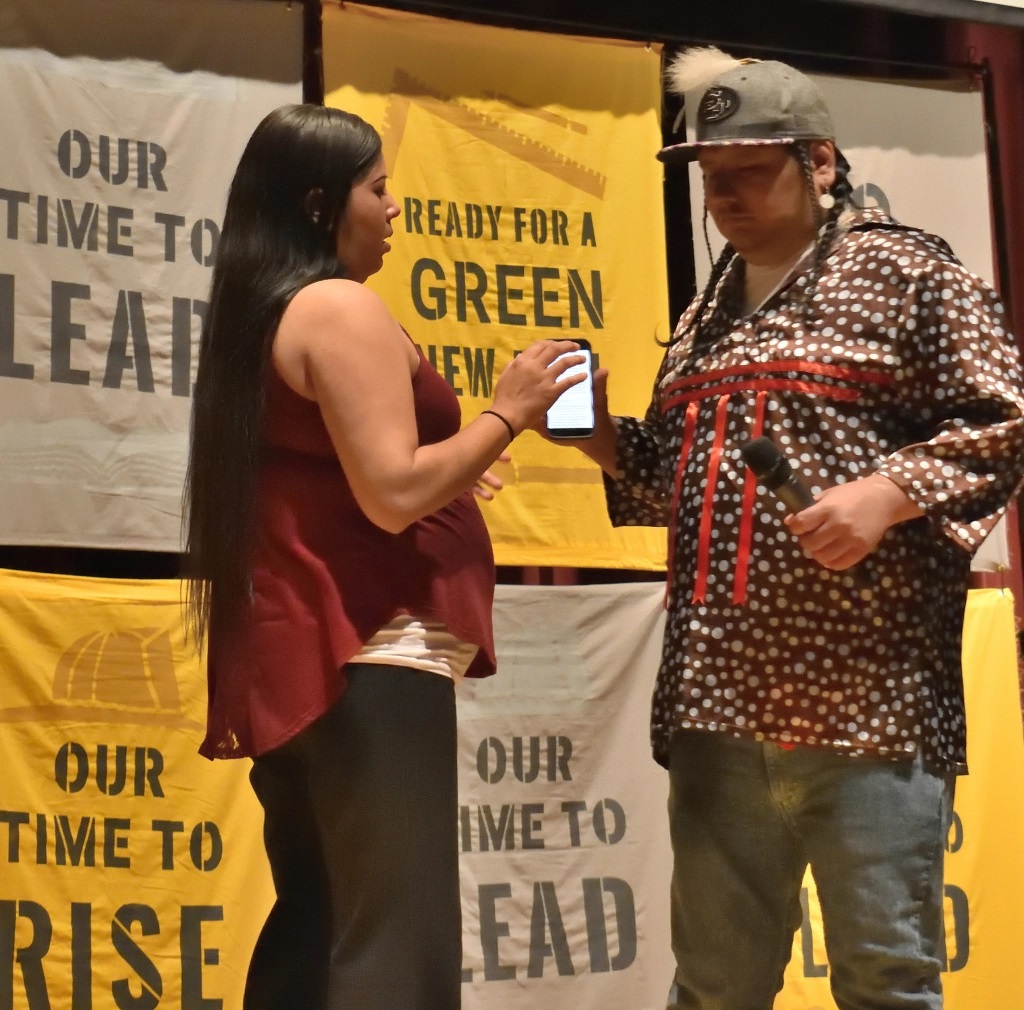
The Sunrise Movement was launched as a national campaign for a Green New Deal (GND) in 2017. From the beginning I heard my native friends talk about the importance of a GND to be Indigenous led. In 2019 Sunrise’s Green New Deal tour began with a stop in Des Moines. There my friends Trisha Cax-Sep-Gu-Wiga Etringer and Lakasha Yooxot Likipt spoke about Indigenous leadership as a requirement for a GND. https://landbackfriends.com/2021/09/01/indigenous-led-green-new-deal/
Last weekend’s Climate Summit of the newly formed Buffalo Rebellion provided an opportunity for organizations and people to come together to share what is being done to address the climate crisis. And lay the groundwork for working together, focusing on action related to the racial and economic consequences of environmental devastation. That requires taking on entrenched white supremacy, systemic racism and rapacious capitalism.
We believe that we must address the root of climate change, insatiable corporate greed and white supremacy, to make change happen. This will require a multi-racial movement of working people struggling together to upend politics as usual.
Buffalo Rebellion
… what if the question all water protectors and land defenders asked was, why don’t we just overturn the system that makes development a threat in the first place? This system, again, is capitalism. Rather than taking an explicitly conservationist approach, the Red Deal instead proposes a comprehensive, full-scale assault on capitalism, using Indigenous knowledge and tried-and-true methods of mass mobilization as its ammunition. In this way, it addresses what are commonly thought of as single issues like the protection of sacred sites—which often manifest in specific uprisings or insurrections—as structural in nature, which therefore require a structural (i.e., non-reformist reform) response that has the abolition of capitalism via revolution as its central goal. We must be straightforward about what is necessary. If we want to survive, there are no incremental or “non-disruptive” ways to reduce emissions. Reconciliation with the ruling classes is out of the question. Market-based solutions must be abandoned. We have until 2050 to reach net-zero carbon emissions. That’s it. Thirty years. The struggle for a carbon-free future can either lead to revolutionary transformation or much worse than what Marx and Engels imagined in 1848, when they forewarned that “the common ruin of the contending classes” was a likely scenario if the capitalist class was not overthrown. The common ruin of entire peoples, species, landscapes, grasslands, waterways, oceans, and forests—which has been well underway for centuries—has intensified more in the last three decades than in all of human existence.
The Red Nation, The Red Deal (pp. 21-22). Common Notions. Kindle Edition.
My Mutual Aid community models many Green/Red New Deal concepts.
I’m of the firm opinion that a system that was built by stolen bodies on stolen land for the benefit of a few is a system that is not repairable. It is operating as designed, and small changes (which are the result of huge efforts) to lessen the blow on those it was not designed for are merely half measures that can’t ever fully succeed.
So the question is now, where do we go from here? Do we continue to make incremental changes while the wealthy hoard more wealth and the climate crisis deepens, or do we do something drastic that has never been done before? Can we envision and create a world where a class war from above isn’t a reality anymore?”
Ronnie James, Des Moines Mutual Aid, Great Plains Action Society
I am grateful for many things this morning. For the waters falling from the sky. For my Mutual Aid friends who demonstrate what a Beloved community is. For the Buffalo Rebellion, growing a movement for climate action that centers racial and economic justice. Thankful for my Quaker communities. I give thanks to the Spirit.
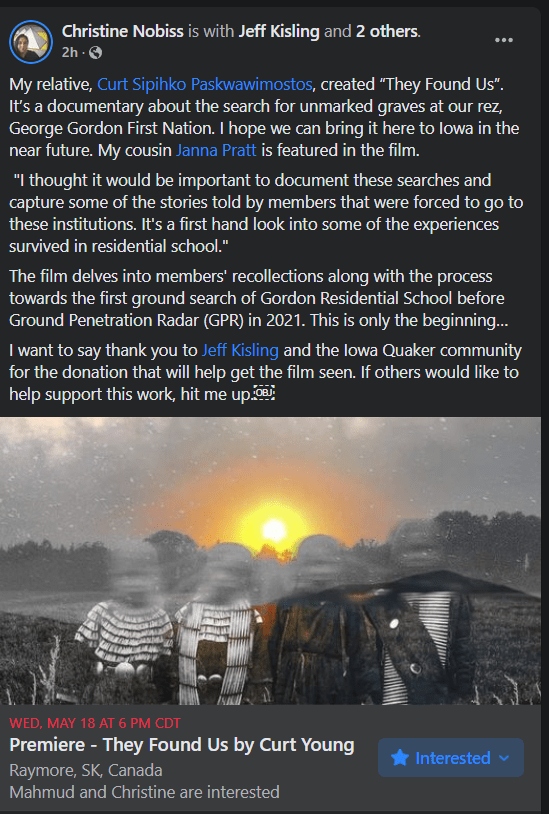
I am grateful for my Indigenous friends. Humbled by the grace they have shown me and other white people as we seek ways to heal from the horrendous history of white supremacy and forced assimilation, abuse, and death of thousands of Native children. As we search for ways to deal with the present, ongoing injustices. The intergenerational trauma. Ripping open deep wounds as the remains of children are located. As the title of this new documentary says, “They Found Us”.
Growing up I heard references to Quakers who worked in the residential schools. I was told they were helping the Native children adjust to living in white society. I didn’t have the awareness to question why that was not a good thing.
I’ve had a life-long concern about environmental devastation. I grew up on farms. When I moved to Indianapolis in 1970, I was horrified by the dense, noxious fumes from every tailpipe, making it difficult to even see. This was before catalytic converters hid the damage being done. I was led to refuse to own a car.
It was obvious Indigenous peoples lived in sustainable ways.
To pull this all together, here is the link to a recent blog post, Midwest Quakers and Native Peoples, which describes how I was blessed to become friends with Indigenous folks in the Midwest and the history of some of the work we’ve done together. It also talks about the Indian Residential Schools and includes a letter from Curt Young, member of George Gordon First Nation, describing the documentary he created, “They Found Us”. Sikowis is also a member of George Gordan First Nation.
“I thought it would be important to document these searches and capture some of the stories told by members that were forced to go to these institutions. It’s a first hand look into some of the experiences survived in residential school.”
Curt Sipihko Paskwawimostos, creator of “They Found Us”.
Sikowis (Christine) Nobiss is one of my close Indigenous friends. We’ve discussed the residential schools, briefly, a few times. I was glad she felt she could ask me if Quakers would help pay for expenses to travel with the film for viewing in a number of communities. She later told me it was difficult for her to ask for funds.
I am clerk of the Peace and Social Concerns Committee of Iowa Yearly Meeting (Conservative). Our committee has a budget of $1,100 to support justice work. In the past we sent $50 or $100 to a number of such organizations. Someone suggested instead sending a larger amount for one or two projects. We decided to do that but didn’t have a project in mind when we were meeting last summer.
I believed the Spirit would show us the way. The request for “They Found Us” seemed to be what we were waiting for. Our committee met to discuss and unanimously approve this. I’m grateful and humbled for that, as well.
Additional funds would be helpful. Please contact me if you are interested. jakislin@outlook.com
I’m reflecting and praying about what happened this past weekend during the Climate Summit of the newly formed Buffalo Rebellion, a new coalition of Iowa organizations that are growing a movement for climate action that centers racial and economic justice.
Buffalo Rebellion is a new coalition of Iowa organizations that are growing a movement for climate action that centers racial and economic justice. The Earth Day Rally will be an afternoon of honoring Mother Earth through sharing stories and visions for climate justice and taking action together for a world that puts people and the planet before profits for a few.
Following the Earth Day Rally, Buffalo Rebellion will be holding two days of immersive training to develop 100 grassroots leaders who will build local teams to take on climate justice issues in their community and come together to create a thriving state-wide movement.
Formed in 2021, Buffalo Rebellion is comprised of seven Iowa organizations: Great Plains Action Society, DSM Black Liberation Movement, Iowa Migrant Movement for Justice, Sierra Club Beyond Coal, Cedar Rapids Sunrise Movement, SEIU Local 199, and Iowa CCI.
Extremely thankful for this community we built this weekend. Looking forward to fighting for the future alongside all of you. Thank you to the organizers, and big love to the participants. Keep an eye out for Buffalo Rebellions next move.
How do you build a coalition? You bring together organizations and people who have demonstrated they are effective at building community and organizing for change. And who are aligned in their purpose.
My experience is there are a small number of people and organizations who shoulder justice work in a city or geographical area. Which means they are acquainted with each other. A given individual often belongs to multiple organizations.
But these groups often don’t work together. Building a coalition is how to remedy that. The organizations listed above are growing a movement for climate action that centers racial and economic justice. That is our common purpose. Rapidly evolving environmental chaos is an existential threat that requires radical action now.
Centering on racial and economic justice is crucial for many reasons. Blatant environmental racism is seen over and over again by the location of hazardous infrastructure in Black, Indigenous and other people of color (BIPOC) communities. Conversely, solar panels are not often seen there.
There are many aspects of economic injustice as well. Those economically disadvantaged also tend to live in areas of environmental hazards. And supply the labor for jobs such as coal, oil, and tar sands mining, while white capitalists receive (steal) the profits.
Building a coalition requires us to know and trust each other. And to learn about each other’s work. Tools that we can bring to our organizations. Or know who has expertise we can turn to for help.
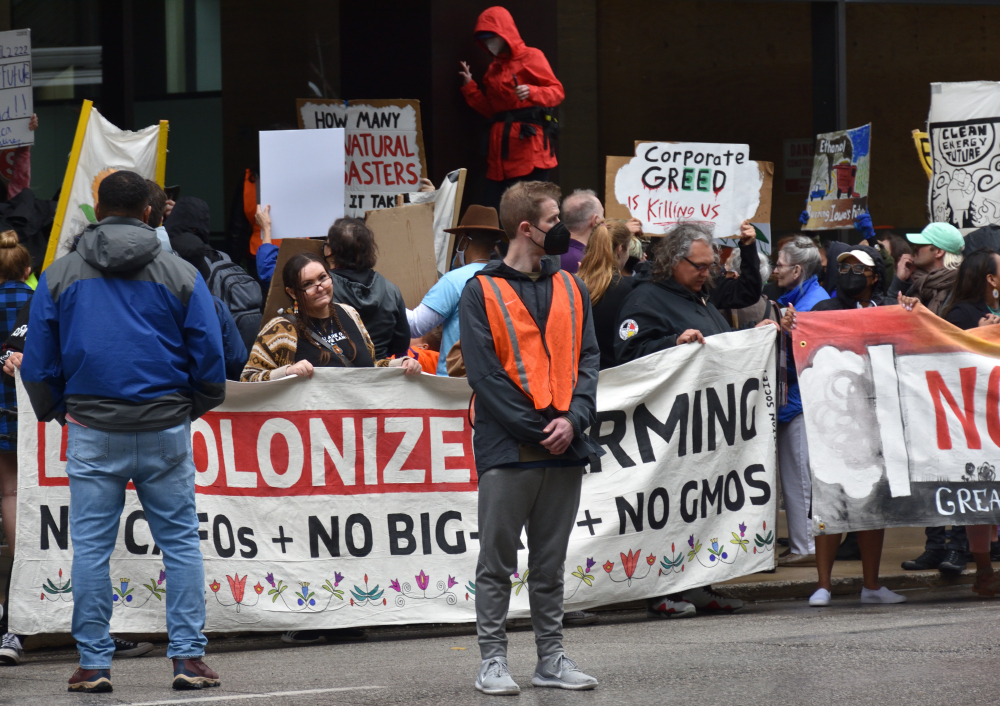
This past weekend of Buffalo Rebellion meetings and action went a long way in beginning to accomplish these goals. It was important to have the action of marching to the offices of MidAmerican Energy. Demonstrating how direct actions work.
The many excellent presentations shared the tools and knowledge of experts in our coalition. The following table of presentations gives an idea of what was done.
Community Building & Storytelling
Cedar Rapids Sunrise
End-Stage Iowa, Indigenous Land Stewardship & the Green (Red) New Deal
Great Plains Action Society (GPAS), Iowa Citizens Community Improvement (ICCI)
NoDAPL Reunion Panel
Fundamentals of Organizing (Starting an Issue Based Campaign and Fundraising 101)
DSM Black Liberation, ICCI, Sierra Club Beyond Coal
Police, Prison, & Military Abolition for Climate Justice
DSM Black Liberation Movement
Lobbying: Get Your Local Green New Deal Passed into Law
Cedar Rapids Sunrise
Migration in Iowa and Big-Ag
Iowa Migrant Movement for Justice
Art and Activism
Say Poetry, DSM Black Liberation Movement
Frontline Tactical Methods to Protect the Land: From Direct Actions and Resistance Camps
Landscapes: The Kinship of Climate, Wildness, and Community
Mutual Aid: Bail Funds, Court Solidarity, and Incarceration Support in Resistance Movements
GPAS, DSM Mutual Aid
Linking the Origins of Iowa’s Contemporary Environmental Problems to the Extractive Nature of White Settlement
Ending White Supremacy in Climate Organizing
CPAS, DSM Black Liberation Movement, Sierra Club Beyond Coal
Launching the Movement: Strategic Applications of Drones for Grassroots Actions
GPAS
Building Power with Public Narrative
Cedar Rapids Sunrise, ICCI, DSM People’s Town Hall
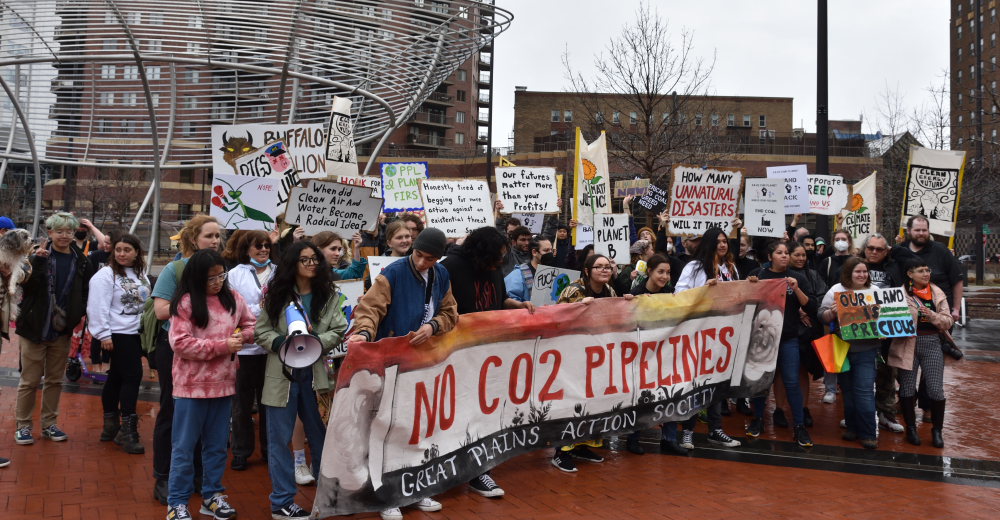
Damn Lies and C02 pipelines
Science and Environmental Health Network
Deep Canvassing
ICCI, DSM People’s Town Hall
Urban Farming and Community Fridges
Sweet Tooth Farms
Bird-Dogging 101
Cedar Rapids Sunrise, ICCI, DSM Black Liberation Movement
For example, this is the presentation by my friend Ronnie James of Des Moines Mutual Aid and Great Plains Action Society.
Mutual Aid: Bail Funds, Court Solidarity, and Incarceration Support in Resistance Movements
– Ronnie James, DSM Mutual Aid & Great Plains Action Society
An introduction to the how and why of supporting frontliners that suffer arrest during Movement activities. Instruction will cover the reason for, creation of, and implementation of a Bail Fund. We will also touch on the main phases of the arrest and court process: Arrest, Pre-Trial, Trial, Post-Trial, Sentencing, and Incarceration, and some of the avenues of support the defendant will require during these phases. We will discuss the role of the Defense Committee, and how they compare and contrast with the Legal Defense Team. Finally, there will be a brief summary of how this works in Des Moines, Iowa in the present moment.
The goal of this weekend of immersive training was to develop grassroots leaders who will build local teams to take on climate justice issues in their community and come together to create a thriving state-wide movement. I think that was accomplished.
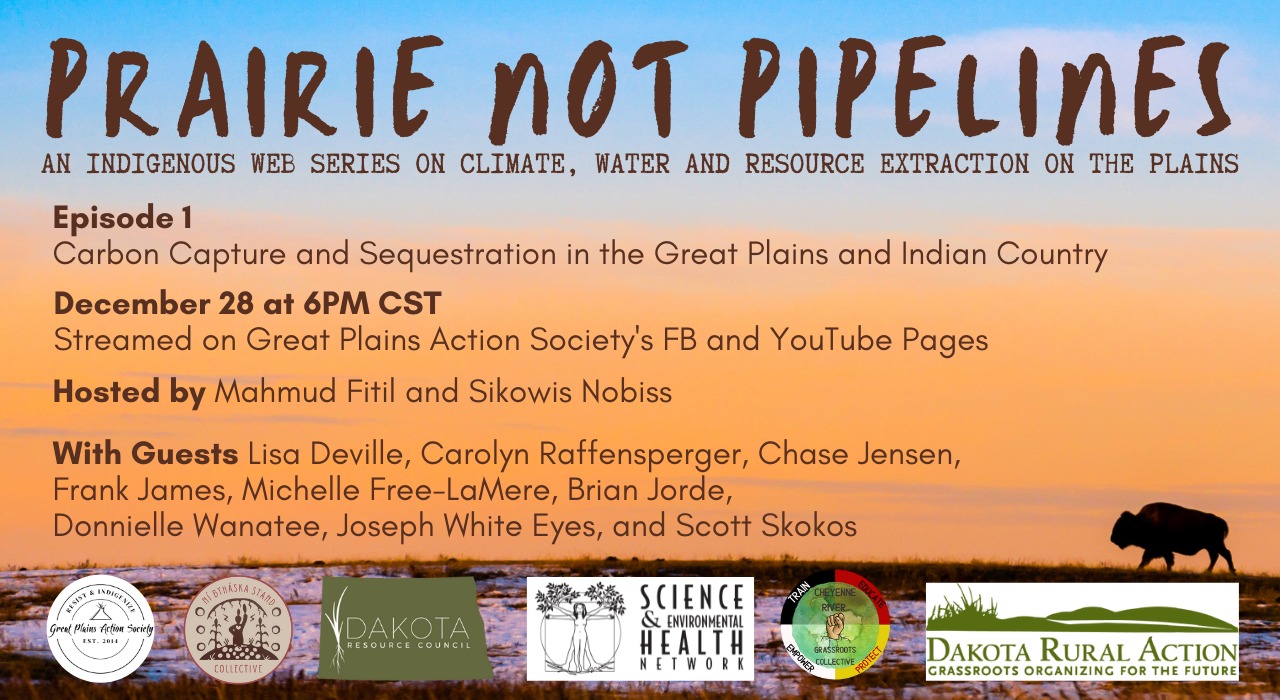
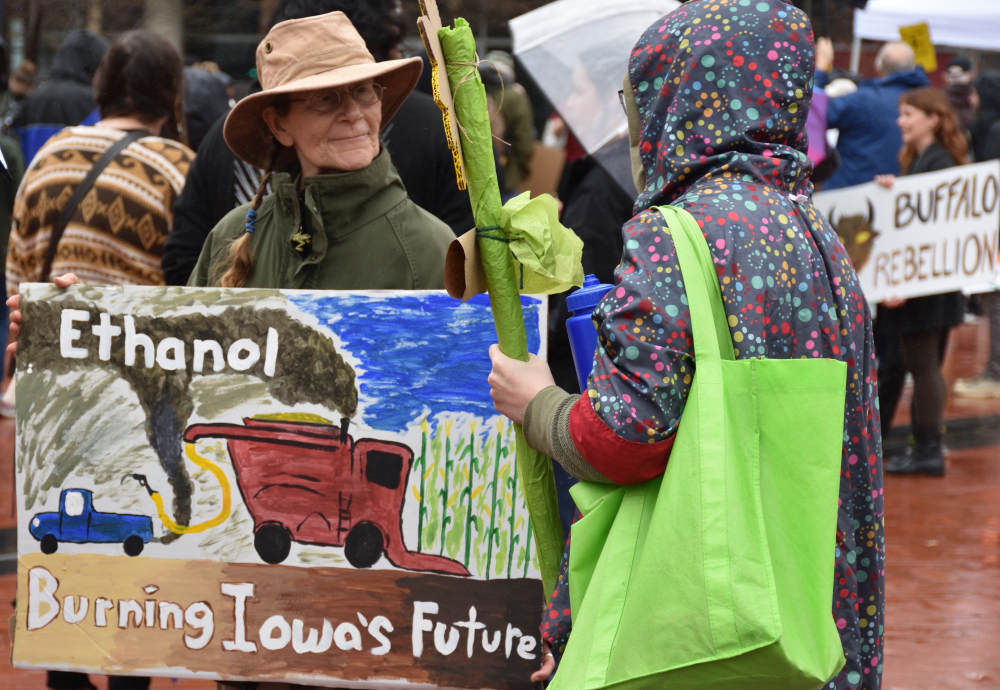
Carbon Capture and Storage (CCS) is not the answer to the climate emergency. CCS is unproven, dangerous and delays real solutions to the climate crisis such as energy conservation, regenerative agriculture and renewable energy
The Iowa Sierra Club, Science and Environmental Health Network, Iowa Food and Water Watch, and Great Plains Action Society are all a part of the Iowa Carbon Pipeline Resistance Coalition.
Mahmud gave an excellent presentation at the Buffalo Rebellion Climate Summit this past weekend, “Launching the Movement: Strategic Applications of Drones for Grassroots Actions” during which he discussed and showed drone videos that documented the damage from leaking pipelines, damaged oil rail cars and toxic ethanol plant waste.
The state requires the hazardous liquid pipeline permit because carbon dioxide in large concentrations can cause illness and asphyxiation.
Donnelle Eller, Des Moines Register
The following article about carbon capture pipelines was published in the Des Moines Register today.
A company that wants to build a controversial carbon capture pipeline across Iowa should tell residents in its path how much danger they face in the event of a leak, the state’s consumer advocate says.
Summit Carbon Solutions should provide an analysis assessing the pipeline’s risk along with the company’s emergency response plan before regulators consider the company’s request for a hazardous liquid pipeline permit, Jennifer Easler, Iowa’s consumer advocate, wrote in a motion filed this month with the Iowa Utilities Board.
The state requires the hazardous liquid pipeline permit because carbon dioxide in large concentrations can cause illness and asphyxiation.
Mahmud and Sikowis Nobiss organized a gathering at the offices of Summit Carbon Solutions in Ames. Following are some of the photos I took at that event.
I took these photos at last weekend’s Buffalo Rebellion Climate Summit.
I was searching for a way to describe what WE experienced during OUR Buffalo Rebellion Climate Summit this weekend. A moment reminiscent of the times of the civil rights and anti-war movements which brought together thousands of people and created change. This weekend a coalition of people and organizations came together to rise to the challenges of rapidly evolving environmental devastation and collapse of the systems of capitalism and white supremacy.
As I wondered whether to write “what WE experienced” versus “what I experienced” I realized this was emblematic of what the Buffalo Rebellion is about. Dare WE hope? In its simplest expression, we need to change from “I” to “We” in all we do.
Those of us who have been working to protect Mother Earth are more aware than the general public of the breadth and depth of damage being done. More alarmed, more discouraged after years of work with little apparent progress.
The COVID pandemic made us more isolated and made it difficult to safely do our organizing work. Although our Des Moines Mutual Aid community never stopped distributing free food every week. We strictly enforced wearing masks and gloves and attempted to maintain social distancing by limiting the number of volunteers.
As an example of how long some of us have been working to protect our environment, fifty years ago I was led to refuse to own a car. I’m not aware of that changing other people’s lives.
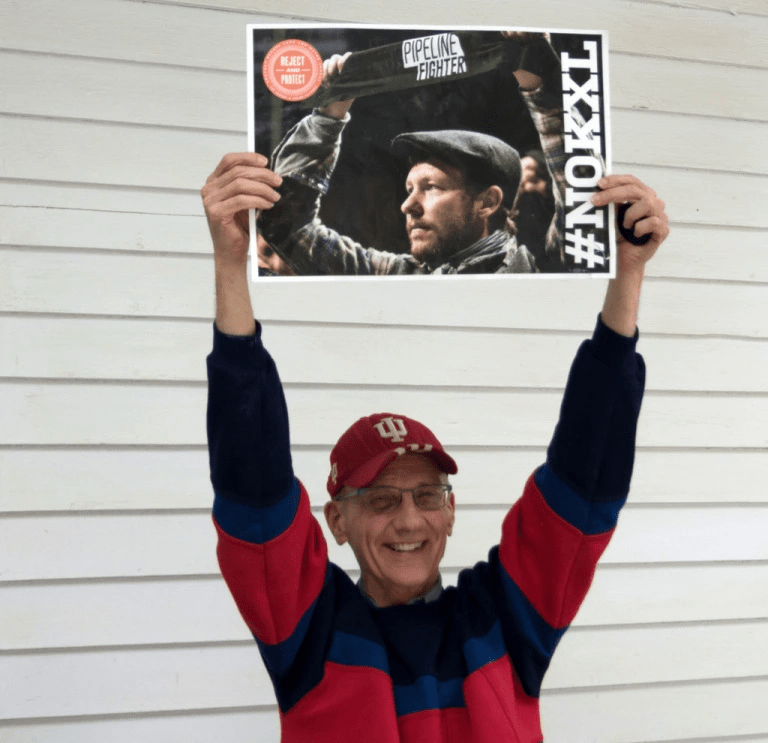
In 2013 the Keystone XL pipeline struggles began to bring some people and organizations together. One group was known as the Cowboy-Indian Alliance.
What little I learned about native cultures showed peoples who lived with far more integrity than I was able to. When I first became engaged with fossil fuel and pipeline resistance in 2013, I began to hear stories of Indigenous peoples working to protect the water. The Cowboy-Indian Alliance came together to oppose the Keystone XL pipeline. I was honored to be given this poster from the 2014 Harvest the Hope concert. [See: The Cowboy and Indian Alliance.]
It was clear to me and others that nonnative folks needed not only to join with Indigenous peoples but be led by them. How to make that happen?
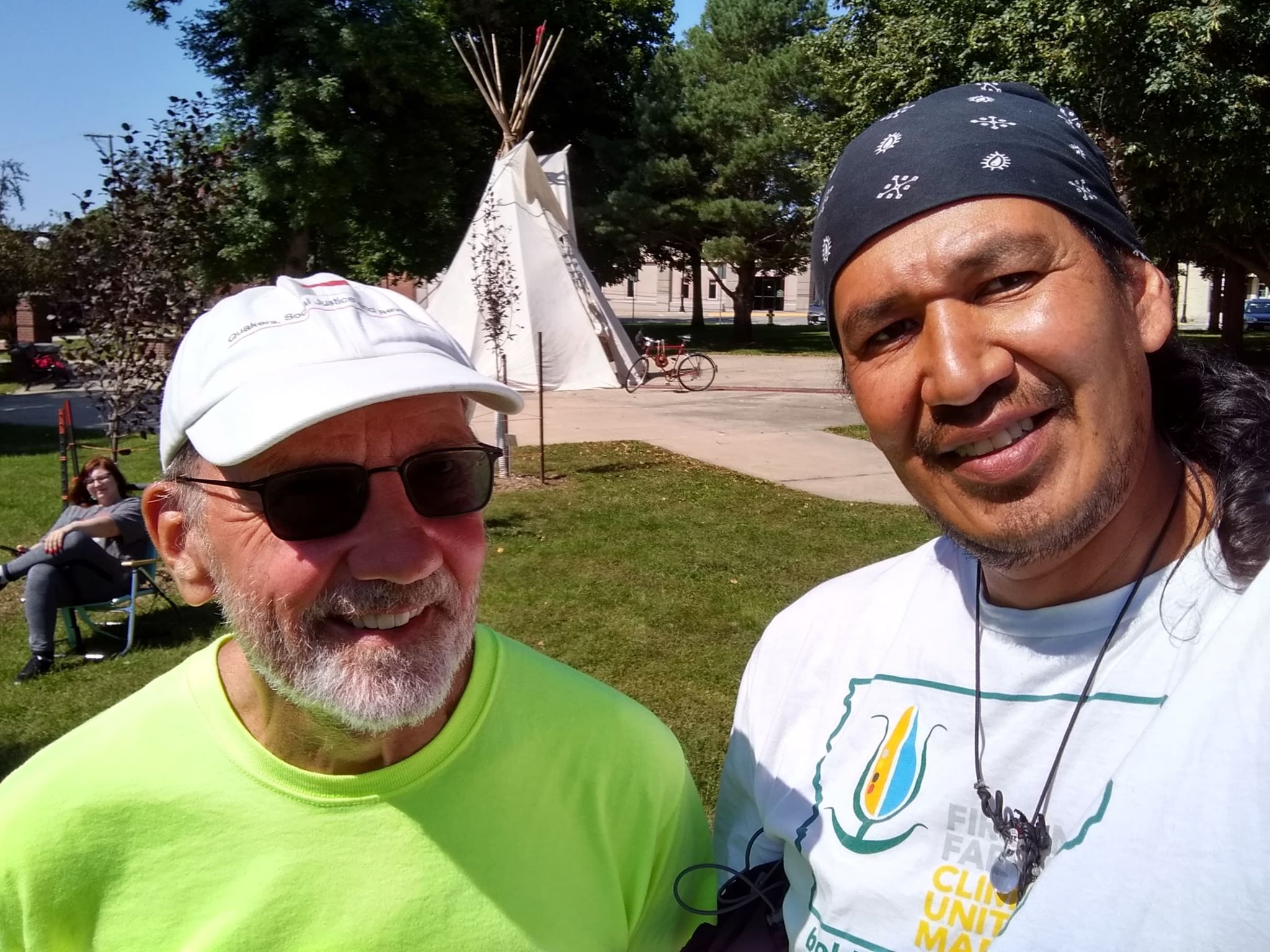
Indigenous Iowa and Bold Iowa organized the First Nation-Farmer Climate Unity March in 2018, with the intent of providing a small group of native and nonnative people the time to get to know each other, so we could begin to work on issues of common interest and concern. We walked and camped for eight days along the path of the Dakota Access pipeline from Des Moines to Fort Dodge, Iowa, ninety-four miles. [see stories and photos from that sacred journey here: First Nation Famer Climate Unity March]
A number of us worked on various projects together since, strengthening our friendships. A number of those on that March are involved in the new coalition, the Buffalo Rebellion. That includes Sikowis Nobiss, Mahmud Fitil, Trisha Entringer, Donnielle Wanatee, Miriam Kashia, Peter Clay and me.
I plan to write a lot about the Buffalo Rebellion but wanted to begin with this introduction.
I believe the answer to the question posed by this post, Dare WE hope? is yes.






















 Quakers and Mutual Aid