Recently, we discussed our peace and justice work at my Quaker meeting. I explained my vision of creating a Mutual Aid community to guide our justice work. And included examples of what the meeting is already doing that are Mutual Aid.
I felt we had a good discussion. I didn’t have answers to some of the questions raised. I believe those questions would be answered as we got experience with implementation. But the meeting is clearly not ready to begin working on Mutual Aid.
As I was preparing for this discussion, I knew it would be difficult to distill my more than three years of experience with Des Moines Mutual Aid (DMMA).
Paradigm shift: an important change that happens when the usual way of thinking about or doing something is replaced by a new and different way
Mutual Aid represents a paradigm shift in Quaker’s thinking about spirituality and justice work. How can I help people make this shift happen? What is the Spirit asking of us?
I have no doubt that the Spirit leads me to continue with my involvement with Des Moines Mutual Aid. My friends there know I hope to bring spirituality into the work of Mutual Aid, so I’ll give them an update on our meeting at Bear Creek.
One paradigm shift from my past comes to mind. In the early 1970’s I moved to Indianapolis and was horrified by the foul air from auto exhaust. I was led to live without a car as a result. But I had no success in convincing anyone else to give up their car. So here we are now, facing ever increasing environmental chaos.
During the years’ long struggles with my meeting about cars, which was difficult since many meeting members lived in rural settings, one Friend asked if I had invited the meeting into my concerns about cars. And I realized I had not done so. When I did invite the meeting to join me in our common concerns about fossil fuels, one thing we developed was a concept we called Ethical Transportation (see below).
So, I applied that idea to invite the meeting into Mutual Aid work. I often share my experiences at Des Moines Mutual Aid with the meeting. Our discussion this past weekend is another step that will lead to Mutual Aid. As more communities and people are impacted by environmental and social chaos, we will naturally turn to the idea of Mutual Aid for disaster relief.
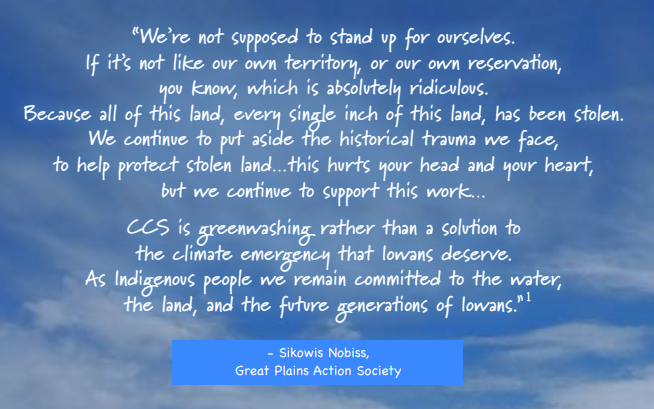
I am impressed with the Great Plains Action Society’s Mechanism of Engagement. Mutual Aid is one of the Methods in the model. I wonder what such a model would look like for Quakers. Maybe that is part of the way forward, for my Quaker meeting to become more oriented toward Mutual Aid.
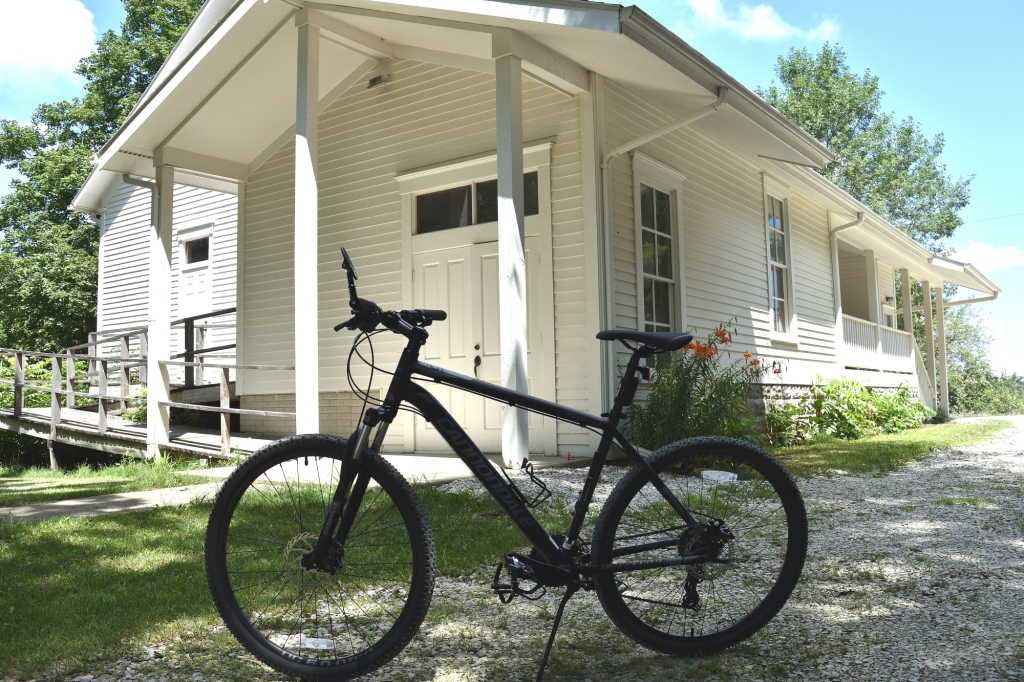
Radically reducing fossil fuel use has long been a concern of Iowa Yearly Meeting (Conservative). A previously approved Minute urged us to reduce our use of personal automobiles. We have continued to be challenged by the design of our communities that makes this difficult. This is even more challenging in rural areas. But our environmental crisis means we must find ways to address this issue quickly. Friends are encouraged to challenge themselves and to simplify their lives in ways that can enhance their spiritual environmental integrity. One of our meetings uses the term “ethical transportation,” which is a helpful way to be mindful of this. Long term, we need to encourage ways to make our communities “walkable”, and to expand public transportation systems. These will require major changes in infrastructure and urban planning. Carpooling and community shared vehicles would help. We can develop ways to coordinate neighbors needing to travel to shop for food, attend meetings, visit doctors, etc. We could explore using existing school buses or shared vehicles to provide intercity transportation. One immediately available step would be to promote the use of bicycles as a visible witness for non-fossil fuel transportation. Friends may forget how easy and fun it can be to travel miles on bicycles. Neighbors seeing families riding their bicycles to Quaker meetings would have an impact on community awareness. This is a way for our children to be involved in this shared witness. We should encourage the expansion of bicycle lanes and paths. We can repair and recycle unused bicycles and make them available to those who have the need.
How can Friends achieve the 2022 theme of World Quaker Day, “Becoming the Quakers the World Needs,” while functioning in a blatantly and politically corrupt, racialized world?
Black Quaker Project
Introduction
These are times of upheaval, with greater changes rapidly approaching. Times of uncertainty and fear. These are also times of opportunity. Can we use this collapse to envision and build more just communities?
I believe we can. But first, we need to understand the injustices the capitalist economic system is based upon. And use this understanding to guide the development of mutual aid communities. which reject capitalism.
It is difficult to escape the status quo. But that is the only way we can protect and heal Mother Earth and build communities for future generations. The status quo in this country is about preserving the capitalist economic system and White superiority. Maintaining the status quo will only deepen environmental devastation and collapse. And collapse of the systems built on capitalism.
The eyes of the future are looking back at us, and they are praying for us to see beyond our own time. They are kneeling with hands clasped that we might act with restraint, that we might leave room for the life that is destined to come.
Terry Tempest Williams
The Seventh Generation Principle is based on an ancient Haudenosaunee (Iroquois) philosophy that the decisions we make today should result in a sustainable world seven generations into the future.
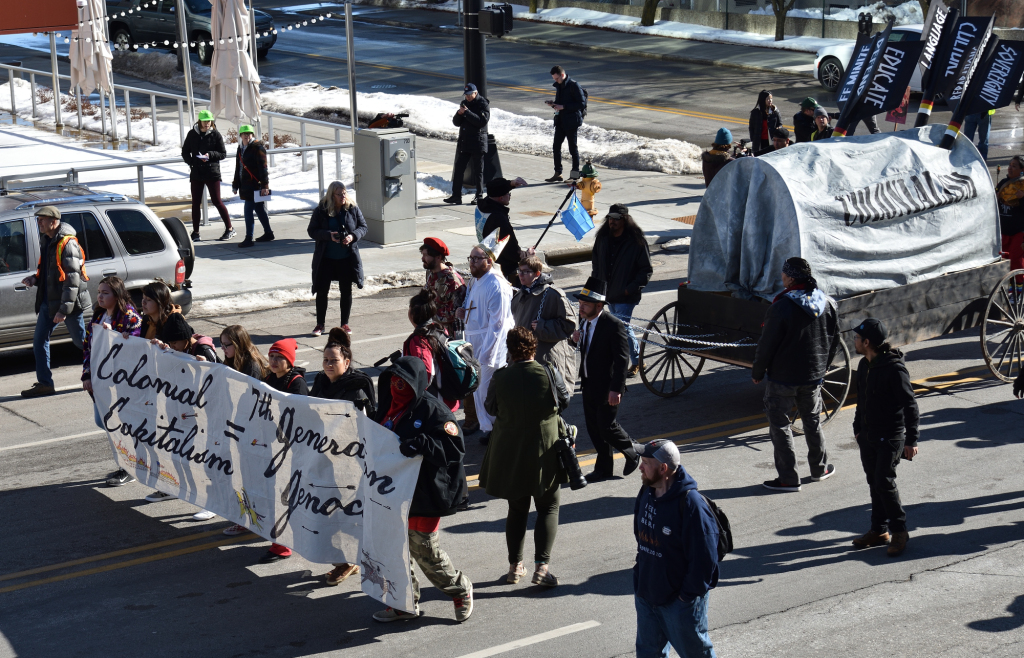
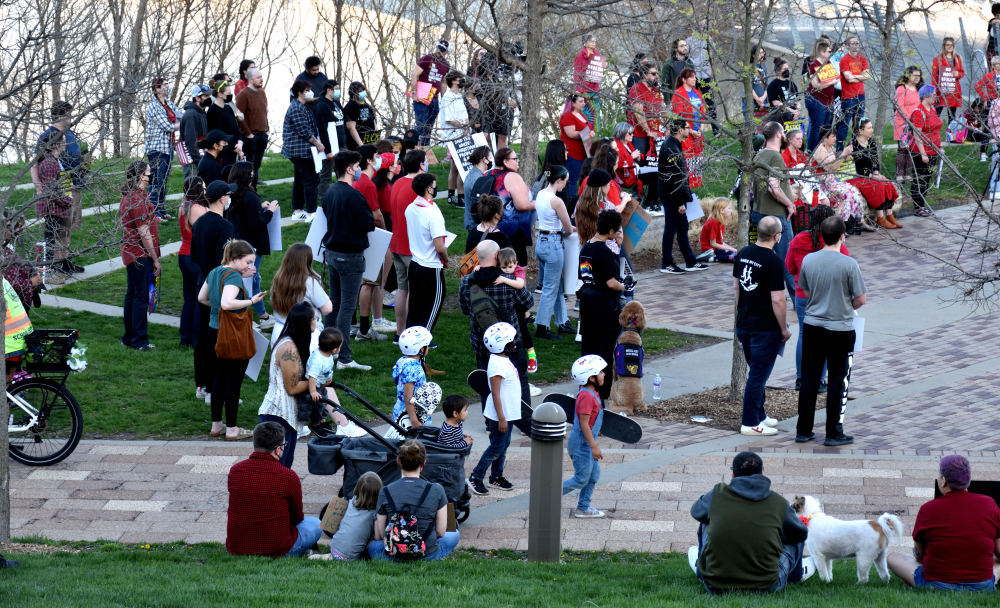
Climate Justice March, Des Moines, Iowa
Then
Environment
I’ve had my own experiences of looking back and trying to help people “to see beyond our own time“. Over fifty years ago, I moved to Indianapolis, a big change for a farm boy. I was not prepared for the noxious clouds of auto exhaust enshrouding the city. I was led to live without a car. Of course, that was not the status quo.
Looking back to that time, I feel sorrow for what might have been. How different the world would be if we had rejected the car culture in this country. Our cities and towns would have been built to be walkable. Land would not be covered by asphalt and concrete. Most importantly, we would have been able to live in a sustainable manner and would not be on a path toward extinction.
Looking back now, who doesn’t wish we had rejected the car culture in this country? Wish we had not let banks and fossil fuel companies rape the earth?
If those who lived prior to the rise of the car culture could have visited our world today, to see the disastrous consequences we are dealing with now, I believe many people who lived then would have chosen to live a different (sustainable) lifestyle.
Capitalism
Wealth is attended with power, by which bargains and proceedings, contrary to universal righteousness, are supported; and hence oppression, carried on with worldly policy and order, clothes itself with the name of justice and becomes like a seed of discord in the soul.
John Woolman, “A Plea for the Poor.”
As the sign in the photo above says, Colonial Capitalism = 7th Generation Genocide
Despite trying every way I could think of, regardless of my prayers, I was not able to convince others to give up their car. People chose convenience over care for Mother Earth and future generations.
It is the same when I urge others to build alternatives to capitalism. Those who are comfortable economically strongly resist any suggestion to abandon capitalism. Capitalism is the materialism Martin Luther King warned about. “The giant triplets of racism, materialism and militarism”.
How has hunger for millions become acceptable? Houselessness? Lack of access to medical care? Police brutality? Locking people away for years for nonviolent crime? Profligate consumption of nonrenewable fossil fuels? Poisoning water?
As Americans honor King on his birthday, it is important to remember that the civil rights icon was also a democratic socialist, committed to building a broad movement to overcome the failings of capitalism and achieve both racial and economic equality for all people.
Capitalism “has brought about a system that takes necessities from the masses to give luxuries to the classes,” King wrote in his 1952 letter to Scott. He would echo the sentiment 15 years later in his last book, Where Do We Go From Here: Chaos or Community?: “Capitalism has often left a gap of superfluous wealth and abject poverty [and] has created conditions permitting necessities to be taken from the many to give luxuries to the few.”
In his famous 1967 Riverside Church speech, King thundered, “When machines and computers, profit motives and property rights are considered more important than people, the giant triplets of racism, materialism and militarism are incapable of being conquered.”
“What good is having the right to sit at a lunch counter,” King is widely quoted as asking, “if you can’t afford to buy a hamburger?” In King’s view, the Greensboro lunch counter sit-ins, the voter registration drives across the South and the Selma to Montgomery march comprised but the first phase of the civil rights movement. In Where Do We Go From Here, King called the victories of the movement up that point in 1967 “a foothold, no more” in the struggle for freedom. Only a campaign to realize economic as well as racial justice could win true equality for African-Americans. In naming his goal, King was unflinching: the “total, direct, and immediate abolition of poverty.”
What will the eyes of the future see when they look back upon us today? How will they feel about the state of the world we are leaving them?
What are we willing to do now to make the world a better place for ourselves and future generations?
Will we:
Radically reduce our fossil fuel consumption?
Continue to build renewable energy infrastructure?
Resist false solutions such as carbon capture?
Reject capitalism?
Reject White superiority?
Build Mutual Aid communities?
There is an urgent need for reflection on these questions. And to seek and implement ways to answer them.
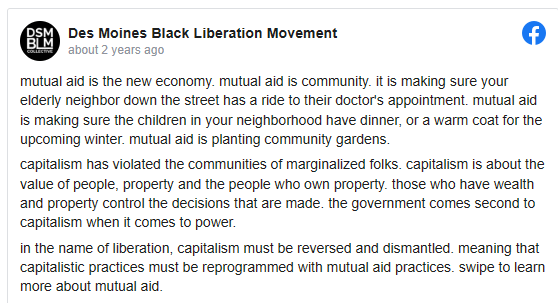
mutual aid is the new economy. mutual aid is community. it is making sure your elderly neighbor down the street has a ride to their doctor’s appointment. mutual aid is making sure the children in your neighborhood have dinner, or a warm coat for the upcoming winter. mutual aid is planting community gardens.
capitalism has violated the communities of marginalized folks. capitalism is about the value of people, property and the people who own property. those who have wealth and property control the decisions that are made. the government comes second to capitalism when it comes to power.
in the name of liberation, capitalism must be reversed and dismantled. meaning that capitalistic practices must be reprogrammed with mutual aid practices.
Des Moines Black Liberation
“Quakers will only be truly prophetic when they risk a great deal of their accumulated privilege and access to wealth. Prophets cannot have a stake in maintaining the status quo. Any attempt to change a system while benefiting and protecting the benefits received from the system reinforces the system. Quakers as much as anyone not only refuse to reject their white privilege, they fail to reject the benefits they receive from institutionalized racism, trying to make an unjust economy and institutionalized racism and patriarch more fair and equitable in its ability to exploit. One cannot simultaneously attack racist and patriarchal institutions and benefit from them at the same time without becoming more reliant upon the benefits and further entrenching the system. Liberalism at its laziest.”
Scott Miller
How can Friends achieve the 2022 theme of World Quaker Day, “Becoming the Quakers the World Needs,” while functioning in a blatantly and politically corrupt, racialized world? In engagement with this exciting theme, offered by the Friends World Committee for Consultation (FWCC), the Black Quaker Project would like to remind Friends of the tools at our disposal to challenge those aspects of society which we wish to change and to see changed. Our fractured societies are further divided by enormous gaps of inequality in almost every imaginable category—psychological, social, political, cultural, economic. How might we, as Quakers, achieve justice, equity, and peace under these circumstances?
I grew up in Quaker communities, which defined my justice work for much of my life.
Then a decade ago I was led to engage with a number of communities, working outside Quaker meetings. By engagement I mean spending significant time in these communities. These experiences have taught me decidedly different approaches to justice work. These new perspectives convince me that Quakers, particularly White Quakers, need to change how we think about and do justice work.
My perspectives include:
The need to advocate for Indigenous leadership to help protect and heal Mother Earth.
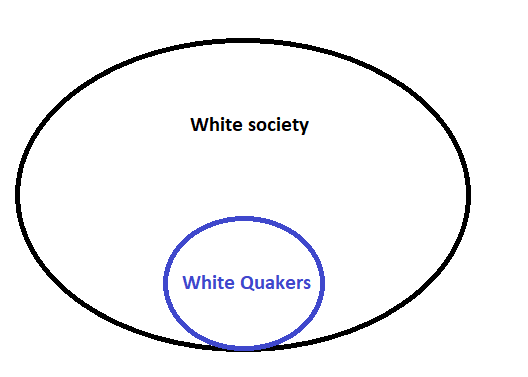
Black, Indigenous and other people of color (BIPOC) do not see any distinction between White Quakers and other White people in this country.
The capitalist economic system is fundamentally unjust.
Capitalism transfers great wealth to the wealthy by exploiting and oppressing those who aren’t.
Capitalism impoverishes millions of people
Capitalism is economic slavery
Capitalism treats natural resources as commodities to be exploited for profit
Capitalist systems do not feel the need to conserve resources
Police and prisons must be abolished.
The criminal justice system enforces the policies of the White dominant culture.
The criminal justice system violently targets BIPOC people
It is inhumane to lock people in cages.
White Quakers are settler-colonists. We continue to live on and profit from Indigenous lands.
The involvement of some White Quakers in the native boarding schools and how to begin healing related to that, is crucial for authentic relations between White Quakers and native peoples.
I have witnessed the multigenerational trauma affecting Indigenous people today.
Increasingly, as environmental chaos worsens, responding to the disastrous consequences will consume our attention and resources.
Black, Indigenous and other people of color (BIPOC) do not see any distinction between White Quakers and other White people in this country.
The most significant new perspectives are about the capitalist economic system. I hadn’t been as aware of many of the injustices fueled by capitalism prior to spending time in oppressed communities. Now I have witnessed the devastating effects of capitalism in these communities.
The nearly universal resistance to my attempts to convince White people to build systems not based upon capitalism is because the system works for them.
Capitalism is an unjust system. A different system is required. Mutual Aid is such a system.
Justice cannot be attained by incremental changes to an unjust system.
Accelerating environmental chaos is increasingly disrupting life as we know it. Which means, among other things, that the current political and economic systems in this country will continue to collapse. Now is the time to envision and build alternatives such as mutual aid.
Justice cannot be attained within an unjust system
Our Quaker Queries recognize the injustices of our capitalist economic system.
‘We are part of an economic system characterized by inequality and exploitation. Such a society is defended and perpetuated by entrenched power. “
The advice also says “we envision a system of social and economic justice that ensures the right of every individual to be loved and cared for…”
Faith and Practice, Iowa Yearly Meeting (Conservative)
This is well summarized by my friend Ronnie James. We work together at Des Moines Mutual Aid.
I’m of the firm opinion that a system that was built by stolen bodies on stolen land for the benefit of a few is a system that is not repairable. It is operating as designed, and small changes (which are the result of huge efforts) to lessen the blow on those it was not designed for are merely half measures that can’t ever fully succeed.
So the question is now, where do we go from here? Do we continue to make incremental changes while the wealthy hoard more wealth and the climate crisis deepens, or do we do something drastic that has never been done before? Can we envision and create a world where a class war from above isn’t a reality anymore?”
Ronnie James, Des Moines Mutual Aid
This is a simplified schematic of the consequences of White dominance (Red), and the alternatives for a transition to justice and disaster preparedness (Green).
Implementing the transition to a more just society will be impeded by
Environmental chaos
Corrupt and failing institutions
Authoritarianism
This diagram shows the current systems in the column labeled White. The column under Black, Indigenous and other people of color shows the injustices resulting from the current systems. The Red/Green New Deal shows how we can address these injustices. The solid red column indicates the challenges to moving to systems of justice, sustainability, and resilience.
Yesterday, April 4th, was the anniversary of the assassination of Martin Luther King, Jr. Every year there is a solemn gathering at the Kennedy-King Park in downtown Indianapolis to commemorate the speech that Bobby Kenndy gave there in 1968, announcing King’s death. This was in the days before cell phones, and that was the first time most in the crowd heard the news. The Indianapolis police pleaded with him not to go to that neighborhood, fearing they could not protect him from the crowd. Indianapolis was one of the few major cities in the country where riots did not occur that night.
That event in Indianapolis was supposed to have been a campaign stop for Kennedy’s Presidential bid. Kennedy received the news on the plane to Indianapolis. There was no time to prepare a speech. The video at the end of this is the extemporaneous speech Kennedy gave that night.
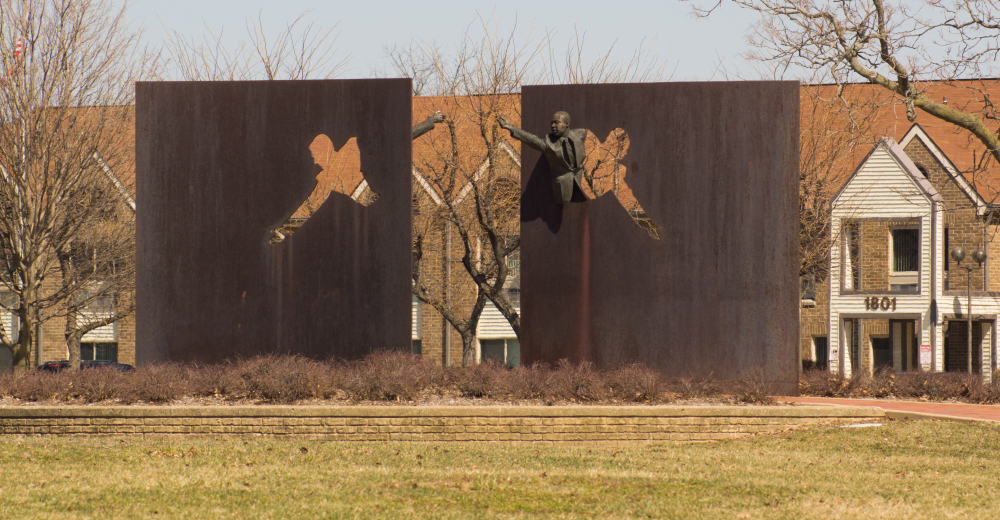
There is a remarkable sculpture at the Kennedy-King Park symbolizing the connections between Martin Luther King, Jr, and Robert Kennedy.
(c)Jeff Kisling, Kennedy-King Park, Indianapolis, IN
Martin Luther King has been an important part of my life. I was coming of age during his time, a Junior at Scattergood Friends School when he was killed. I had so much trouble trying to sort out what I should do about the Vietnam War. Martin Luther King was criticized by people in the civil rights movement when he began to speak out against the war, but that was a great help to me.
These days I’m working to replace capitalism by building mutual aid communities. Martin Luther King, Jr.’s work was as much about economics and poverty as it was about racial equality.
“I am much more socialistic in my economic theory than capitalistic,” Martin Luther King admitted to Coretta Scott, concluding that “capitalism has outlived its usefulness.”
Speaking at a staff retreat of the SCLC in 1966, King said that “something is wrong … with capitalism” and “there must be a better distribution of wealth” in the country. “Maybe,” he suggested, “America must move toward a democratic socialism.”
For King, the only solution to America’s crisis of poverty was the redistribution of wealth. In a 1961 speech to the Negro American Labor Council, King declared, “Call it democracy, or call it democratic socialism, but there must be a better distribution of wealth within this country for all God’s children.”
Although seldom recognized, Martin Luther King Jr. was anti-war. His politics should be applied to demand an end to NATO and the war in Ukraine, say activists.
“We are here, honoring the legacy of Dr. Martin Luther King Jr.,” said co-executive director of The People’s Forum, Claudia De La Cruz, to a crowd of hundreds gathered in Times Square, in front of the US Army Recruiting Station, on January 14. “We are here to reclaim his legacy and say: no to war.”
The organizers and workers mobilized to demand an end to NATO and a peaceful resolution to the ongoing war in Ukraine. The rally and march was organized by the Act Now to Stop War and End Racism (ANSWER) Coalition, a US anti-war organization, and the People’s Forum. Activists raised slogans to demand a peaceful resolution of the war through negotiations rather than continued US weapons funding. Banners read “Money for our needs/Not the war machine” and “No to NATO/Yes to peace”.
With Congress passing a massive spending bill in December, containing over $44 billion in US aid to Ukraine, the United States is now set to spend over $100 billion total on the Russia–Ukraine War. Activists are demanding that these billions be used instead to fund public services, such as education, jobs and healthcare.
…
“We have to continue to fight for integration, collaboration, negotiations, because that’s been the only way of resolving conflict. War is a tool of our enemy,” said De La Cruz, in closing, to the crowd assembled inside The People’s Forum. “The only legit war is class war.”
I’m of the firm opinion that a system that was built by stolen bodies on stolen land for the benefit of a few is a system that is not repairable. It is operating as designed, and small changes (which are the result of huge efforts) to lessen the blow on those it was not designed for are merely half measures that can’t ever fully succeed.
So the question is now, where do we go from here? Do we continue to make incremental changes while the wealthy hoard more wealth and the climate crisis deepens, or do we do something drastic that has never been done before? Can we envision and create a world where a class war from above isn’t a reality anymore?”
Ronnie James
The major threat of Martin Luther King Jr to us is a spiritual and moral one. King’s courageous and compassionate example shatters the dominant neoliberal soul-craft of smartness, money and bombs. His grand fight against poverty, militarism, materialism and racism undercuts the superficial lip service and pretentious posturing of so-called progressives as well as the candid contempt and proud prejudices of genuine reactionaries. King was neither perfect nor pure in his prophetic witness – but he was the real thing in sharp contrast to the market-driven semblances and simulacra of our day.
Martin Luther King Jr turned away from popularity in his quest for spiritual and moral greatness – a greatness measured by what he was willing to give up and sacrifice due to his deep love of everyday people, especially vulnerable and precious black people. Neoliberal soul craft avoids risk and evades the cost of prophetic witness, even as it poses as “progressive”.
If King were alive today, his words and witness against drone strikes, invasions, occupations, police murders, caste in Asia, Roma oppression in Europe, as well as capitalist wealth inequality and poverty, would threaten most of those who now sing his praises.
Today, 50 years later the US imperial meltdown deepens. And King’s radical legacy remains primarily among the awakening youth and militant citizens who choose to be extremists of love, justice, courage and freedom, even if our chances to win are that of a snowball in hell! This kind of unstoppable King-like extremism is a threat to every status quo!
Don’t you find there are periods of rapid change interspersed among long plateaus in your life? Although those plateaus are becoming fewer and lasting shorter periods of time.
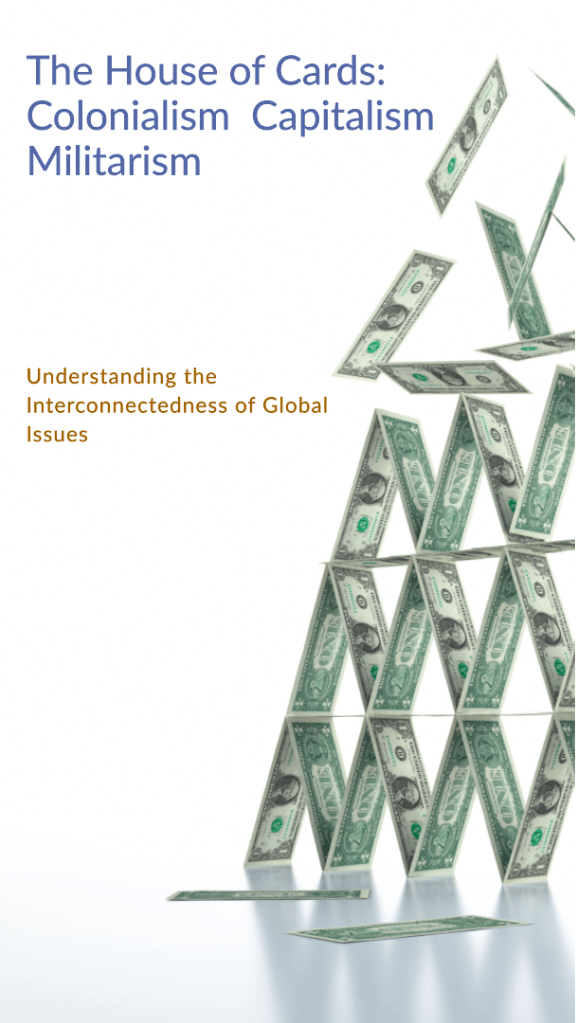
The last three years have been a time of momentous change, both in my life, and in the world. I’m trying to explain what has been happening to me, because these experiences convince me we must all make similar changes if we are going to make the major adjustments needed to try to mitigate deepening environmental damage. The world has been spiraling out of control these past three years, dramatically impacting all our communities and individual lives. I think of these changes as related to the idea of a house of cards. The cards in this case being dollars of the capitalist economy.
(c)2023 Jeff Kisling
Foundational Stories
I was born into a rural Iowa Quaker community and have been a Quaker all my life. I attended Scattergood Friends School, a Quaker boarding high school on a farm in Eastern Iowa.
Recently I was challenged to consider what my foundational stories are, how they began, how they changed over time, and what they are now. I’ve been writing this series of blog posts about these stories, which are related to the intersections between my Quaker faith, protecting Mother Earth, and photography. You can read my foundational stories here: https://quakersandreligioussocialism.com/foundational-stories/
I spent my entire adult life in Indianapolis. I arrived in 1970 to spend two years in a Quaker community organizing project, Friends Volunteer Service Mission. To support myself financially, I received on-the-job training to be a respiratory therapy technician. I later obtained a degree in Respiratory Therapy, and a career in neonatal respiratory therapy, and then thirty years doing research in infant lung development and disease in Indianapolis at Riley Hosptial for Children, Indiana University Medical Center. I retired and returned to Iowa in the summer of 2017.
Part of the Mother Earth piece of my foundational stories was “driven” by a spiritual leading that showed me I could not contribute to the pollution from owning a personal automobile, so I didn’t. That had all kinds of repercussions.
Although my leading to try to live without a personal automobile grew over time, the actual decision came about abruptly. I had a couple of used cars but felt increasingly uncomfortable having one. When my car was totaled in an accident, I took the opportunity to see if I could live without a car in the city. It took some time to work out the bus schedules, especially because I was working all kinds of hours and on weekends. And I had to learn how to shop such that I could carry everything home.
But because we derive our sense of identity and socioeconomic status from work embedded in a profit driven economy, transformative day-to-day self-sufficient activities, when they are applied in an urban or suburban setting, give rise to second set of intangible sociocultural barriers that involve taking significant social risks. Peter Lipman the former (founding) chair of Transition Network and Common Cause Foundation encourages us to take these social and cultural risks. But what exactly are the more difficult risks needed to move us in the right direction? It is important to identify intangible socioeconomic challenges in order to side-step them.
…
In short, our identities are tied up in what we do for a living and how we do what we do for a living must radically change. Because, let’s be honest, living and working, having lifestyles and livelihoods that are truly regenerative and sustainable look nothing like how most of us currently live and work.
It was difficult for us (environmentalists) to find pressure points, places where we could call attention to the existential threats of environmental chaos from burning fossil fuels. In 2013, activists recognized the application for approval of the Keystone XL Pipeline as such an opportunity. This decision was solely up to President Obama, allowing us a focus for our efforts. I was trained as an Action Lead in the Keystone Pledge of Resistance in 2013. There I learned many skills related to community organizing. Four of us trained about forty people in the Indianapolis community, and organized many demonstrations and actions against fossil fuel companies and the banks that fund them. https://jeffkisling.com/2018/06/05/lessons-learned-from-the-keystone-pledge-of-resistance/
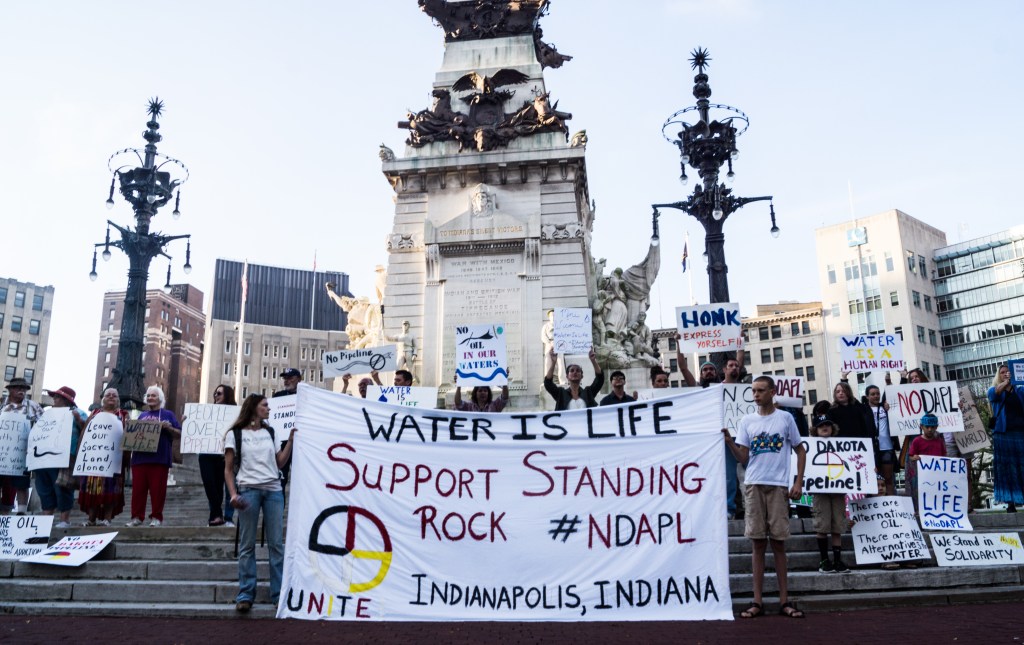
We were able to train others in those skills later when the White Pines Wilderness Academy in Indianapolis wanted to bring attention to the dangers of the Dakota Access Pipeline (DAPL).
Wet’suwet’en peoples
I was always looking for news about fossil fuels and our environment. This blog post from 1/14/2020 describes my discovery of the Wet’suwet’en peoples and their struggles against the Coastal GasLink (CGL) liquid natural gas pipeline being constructed through their pristine territory in British Columbia.
I have just begun to learn about the Wet’suwet’en people. A friend of mine from the First Nation-Farmer Climate Unity March traveled to the Unist’ot’en camp about 4 years ago and found it to be a life-changing experience. I also asked other friends I made during the March about this, and they indicated support for these people.
You may wonder why I am trying to learn and write about the Wet’suwet’en people now. The literal answer is I saw this article recently: Hereditary First Nation chiefs issue eviction notice to Coastal GasLink contractors. TC Energy says it signed agreements with all 20 elected First Nations councils along pipeline’s path. Joel Dryden · CBC News · Posted: Jan 05, 2020.
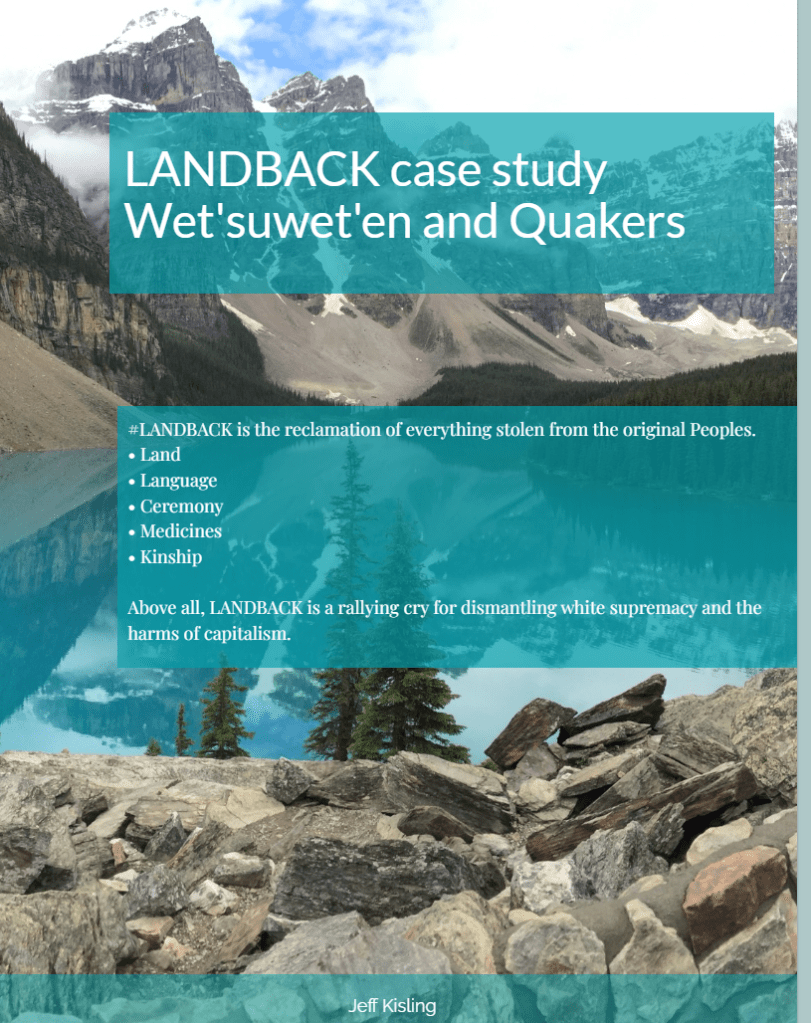
I wrote this booklet about the Wet’suwet’en struggles, including some videos of confrontations with Royal Canadian Mounted Police (RCMP). Assault rifles trained on unarmed youth.
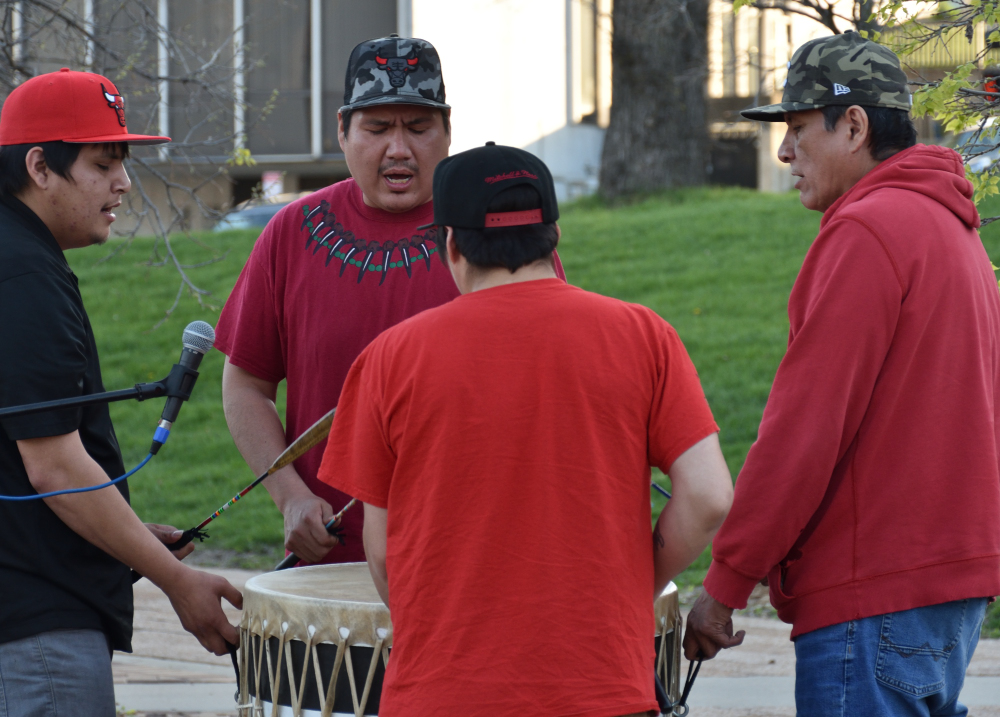
The title THREE YEARS LATER refers to my introduction to Des Moines Mutual Aid a little over three years ago. I took the photo below on Feb 7, 2020, when a small group of us organized a vigil in support of the Wet’suwet’en. I know the Spirit led Ronnie James, from Des Moines Mutual Aid, to join us. He was surprised that anyone outside his circle knew what was happening to the Wet’suwet’en. Ronnie is an Indigenous organizer working with the Great Plains Action Society (GPAS), and as such was interested to see if these were people who could become allies.
That meeting changed my life in many ways, all stemming from what I was learning from Ronnie and others about Mutual Aid, which has become the focus of my justice work since.
Over the years I’ve enjoyed documenting justice actions photographically. I like the challenge of an ever-moving group of people, the varieties of signs, the reactions of the people and the public. But for the past several years posting photos of demonstrations is discouraged if people’s faces are visible. Which police sometimes later use to bring charges against those people.
Ronnie and I are both part of Des Moines Mutual Aid’s free food project. The Wet’suwet’en being part of our history, we continue to support them. Because of COVID and people wearing masks, we were comfortable taking this photo during one of our Mutual Aid gatherings for the food project.
Des Moines Mutual Aid supports Wet’suwet’en peoples’ struggle again Coastal GasLink natural gas pipeline
Three Years Later
And yet, three years later, the Wet’suwet’en peoples’ struggles continue.
FOR IMMEDIATE RELEASE March 29, 2023 Contact: Jennifer Wickham, Media Coordinator, Gidim’ten Checkpoint, yintahaccess@gmail.com, 778-210-0067
URGENT MEDIA ADVISORY: RCMP C-IRG Raid Wet’suwet’en Village Site, Make 5 Arrests
WET’SUWET’EN TERRITORY (Smithers, BC) – This morning, a large force of RCMP C-IRG raided a Gidimt’en village site and arrested five land and water defenders, mostly Indigenous women, including Gidimt’en Chief Woos’ daughter. The raid accompanied a search warrant for theft under $5000 with no clear relation to the Gidimt’en village site.
In the days leading to this police action, RCMP C-IRG have been found patrolling Wet’suwet’en traplines and cultural use areas, harassing and intimidating Wet’suwet’en members and disrupting constitutionally protected Wet’suwet’en cultural activities. Members of a private security firm hired by Coastal Gaslink pipeline, Forsythe, have also escalated harassment and surveillance efforts against Wet’suwet’en members in recent days.
Both the RCMP’s C-IRG unit and Forsythe are named as defendants in an ongoing lawsuit launched by Wet’suwet’en members, which alleges that police and private security have launched a coordinated campaign of harassment and intimidation in an effort to force Wet’suwet’en people to abandon their unceded territories.
Sleydo’, spokesperson for Gidimt’en Checkpoint, said:
“This harassment and intimidation is exactly the kind of violence designed to drive us from our homelands. The constant threat of violence and criminalization for merely existing on our own lands must have been what our ancestors felt when Indian agents and RCMP were burning us out of our homes as late as the 50s in our area. The colonial project continues at the hands of industry’s private mercenaries–C-IRG”
The arrests come days before Indigenous delegates are set to arrive at Royal Bank of Canada’s Annual General Meeting to oppose expansion of fossil fuels without consent on their territories, including Wet’suwet’en Hereditary Chiefs who oppose RBC’s funding of the Coastal Gaslink pipeline.
Wet’suwet’en Hereditary Chief Na’Moks offered the following:
“This is harassment, and exactly what Royal Bank of Canada is funding. Ahead of its shareholder meeting next week, RBC continues to fund corporate colonialism, and displace Indigenous peoples from our lands at gunpoint – all for a fracked gas pipeline we cannot afford now or in the future. In the context of the theft of our ancestral land, alleging stolen saws and clothing is outrageous.”
All of creation is divine and interdependent: air, water, soil, and all that lives and grows. Since human beings are part of this fragile and mysterious web, whenever we pollute or neglect the earth we pollute and neglect our own wellsprings. Developing a keen awareness of our role in the universe is essential if we are to live peacefully within creation.
The way we choose to live each day‑‑as we manufacture, package, purchase and recycle goods, use resources, dispose of water, ‑design homes, plan families and travel‑affects the present and future of life on the planet. The thought and effort we give to replenishing what we receive from the earth, to keeping informed and promoting beneficial legislation on issues which affect the earth, to envisioning community with environmental conscience, are ways in which we contribute to the ongoing health of the planet we inhabit.
Preserving the quality of life on Earth calls forth all of our spiritual resources. Listening to and heeding the leadings of the Holy Spirit can help us develop qualities which enable us to become more sensitive to all life
QUERY
What are we doing about our disproportionate use of the world’s resources?
Do we see unreasonable exploitation in our relationship ‑with the rest of creation?
How can we nurture reverence and respect for life? How I can we become more fully aware of our interdependent relationship with the rest of creation?
To what extent are we aware of all life and the role we play? What can we do in our own lives and communities to address environmental concerns?
Faith and Practice, Iowa Yearly Meeting (Conservative)
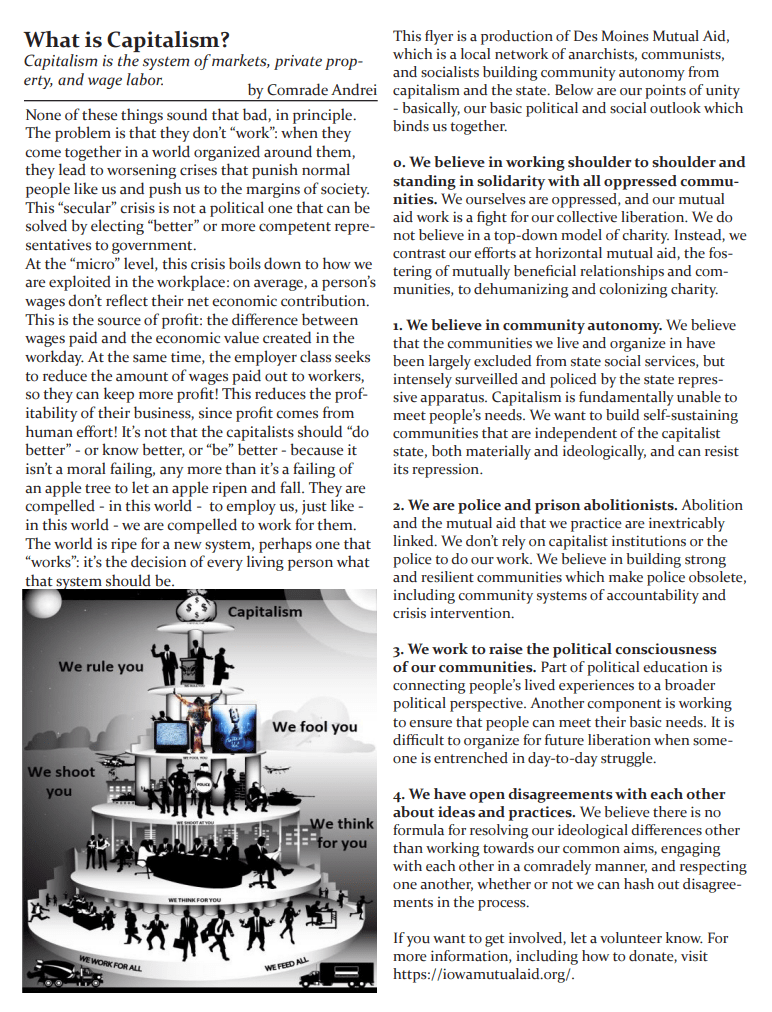
One of the principles of Mutual Aid is political education. As part of this education, found below is the March 2023 edition of MUTUAL AID MONTHLY, A Production of Des Moines Mutual Aid. You can download it using the DOWNLOAD button on the PDF file display window at the end.
“This flyer is a production of Des Moines Mutual Aid, which is a local network of anarchists, communists, and socialists building community autonomy from capitalism and the state. Below are our points of unity – basically, our basic political and social outlook which binds us together.”
Des Moines Mutual Aid
This is a good description of Des Moines Mutual Aid. We are a network of anarchists, communists, and socialists. Understanding these terms applied to a community I belong to has been part of my political education. My life has been a rebellion against capitalism and the state. But am I an anarchist, communist and/or socialist? I learned that those are parts of me. It’s a step to not only learn what you are not, but also what you are. It’s easy enough to say I’m not a capitalist, but am I a so-called enemy of the state? Yes, I am, in the nonviolent sense. The state is becoming increasingly oppressive and authoritarian. But I’ve learned that even when the capitalist system was “working”, it was and is still a system built on supremacy, violence, abuse, and oppression.
Several years ago, I changed the name of this blog to QUAKERS AND RELIGIOUS SOCIALISM as part of my evolving political education.
I learned about the Democratic Socialists of America’s (DSA) Religious Socialism Committee from my friend Fran Quigley, director of the Health and Human Rights Clinic at Indiana University McKinney School of Law and a religioussocialism.org editorial team member.
Fran wrote in response to a blog post I had written, The Evil of Capitalism, December 31, 2020.
This post of yours struck me close to home. I too have become fully convinced of the evils of capitalism. Moreover, I have come to the conclusion that my faith dictates that I work to replace it. Turns out I am far from alone, so I’ve been devoting much of my time this past year to the Religion and Socialism Committee of the DSA, www.religioussocialism.org
I like the Points of Unity of Des Moines Mutual Aid. I like the emphasis on the positive, “our basic political and social outlook which binds us together“. We are tightly bound together. I often hear my friends say how much they look forward to being together, working alongside each other, being directly connected to those who come for help. And knowing there is no judgement, because we are all aware that we might one day need help ourselves. I like the stories of those putting together boxes of food tell me they once came for food, themselves. I like the expectation that anyone of us should take food ourselves. It took me a while to realize my mistake in not taking any food. (As a result, my friends now know of my sweet tooth.)
One of our principles of unity is: We have open disagreements with each other about ideas and practices. “We believe there is no formula for resolving our ideological differences other than working towards our common aims, engaging with each other in a comradely manner, and respecting one another whether or not we can hash out disagreements in the process.”
The publication of MUTUAL AID MONTHLY relates to another of our Points of Unity, political consciousness.
We work to raise the political consciousness of our communities. Part of political education is connecting people’s lived experiences to a broader political perspective. Another component is working to ensure that people can meet their basic needs. It is difficult to organize for future liberation when someone is entrenched in day-to-day struggle.
from Points of Unity, Des Moines Mutual Aid
Political ignorance is one of the main reasons this country is falling into chaos and authoritarianism. People would be less susceptible to falling for cults of personality and understand the threats to freedom posed by culture wars if they had a better education, including critical thinking skills. You might think of sharing MUTUAL AID MONTHLY with others in furtherance of their/your political consciousness. As a resource to stimulate discussions.
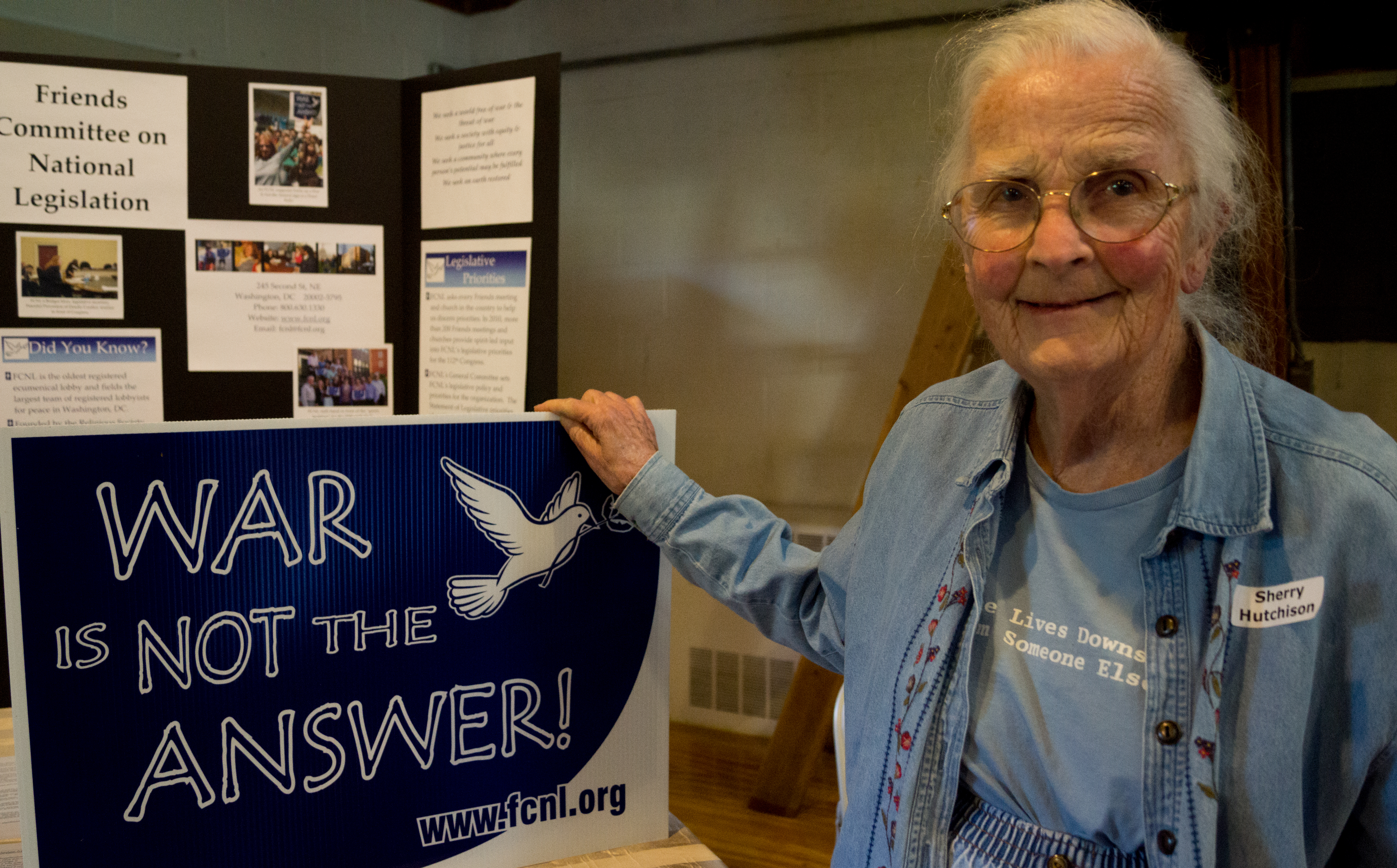
The Policy Committee of the Friends Committee on National Legislation (FCNL) is asking Quaker meetings for input for a statement about reproductive justice and abortion.
In the interest of time, I have not yet converted this to a blog post. You should be able to read and/or download “Quakers, Abortion, and the White Christian Problem” using the link below. We plan to discuss this at my Quaker meeting this weekend.
I began collecting various statements about abortion from my Yearly Meeting. Reproductive justice has always been a concern of Indigenous people in this country, so I also included some writings from my Indigenous friends. As can be seen in this document, young people, and especially my Indigenous friends see abortion as a problem of White Christians. I’m wondering what my White Quaker Friends think about that. Does that change how White Friends think and act about reproductive justice? Isn’t this an opportunity to build community amongst all of us?
DISCLAIMER: I am the author of this, and it is not an official publication of any group or organization.
Simultaneously, as the climate warms, as storms and disasters worsen, as infrastructure crumbles, and as more and more people are left jobless and houseless, the true reason the political class pumps ever more resources into militarization is being revealed: It’s not to protect against some so-called “crime wave” the corporate media constantly fear mongers about, but instead to police the very collapse of capitalism itself.
There are many efforts emerging to address the racism, militarism, and violence of policing in this country. These efforts are growing because they are at the intersection of capitalism, white supremacy, racism, militarism, authoritarianism, ongoing environmental devastation, and police and prison abolition.
A monumental struggle is currently taking place in the Weelaunee Forest in DeKalb County near Atlanta, Georgia.
The local government plans to level 85 acres of the forest to build a $90 million police training facility. The natural environment that would be lost is not only a precious recreational resource for Atlanta residents, but a crucial bulwark protecting against flooding and other climate change-related disasters, which are on the rise. Despite city leaders’ commitment to ramming the project through undemocratically, a decentralized campaign known as #StopCopCity is fighting back.
The movement is connecting police and prison abolition with environmental justice, and uniting organizations and individuals from across the political spectrum in demanding the city divert resources away from militarization and towards fighting climate change and protecting Black and brown lives.
The threat of a militarized megadevelopment, and the intersectional, multiracial coalition mobilizing to resist it, bear some striking parallels with the recently-opened police academy in Garfield Park, Chicago — and the youth-led #NoCopAcademy campaign that fought its construction nearly six years ago.
Simultaneously, as the climate warms, as storms and disasters worsen, as infrastructure crumbles, and as more and more people are left jobless and houseless, the true reason the political class pumps ever more resources into militarization is being revealed: It’s not to protect against some so-called “crime wave” the corporate media constantly fear mongers about, but instead to police the very collapse of capitalism itself.
Keeping poor and working people at bay while their communities are dismantled, their lands are poisoned, and their lives deemed insignificant can only be achieved through brute force. We are witnessing the robber barons barricade themselves in, sealed away from the catastrophes they created, with the same resources they stole from the people on the other side of the wall.
No Cop City Anywhere. Chicago’s #NoCopAcademy campaign and #StopCopCity in Atlanta are part of the same movement: to end violent policing, protect the environment and defend Black and brown lives by BENJI HART, In These Times, FEBRUARY 22, 2023
As one example, solidarity is being built to support cities facing proposed construction of huge police training facilities. Some of these projects are referred to as No Cop City(Atlanta), No Cop Academy (Chicago), and Detroit Cop City (Detroit).
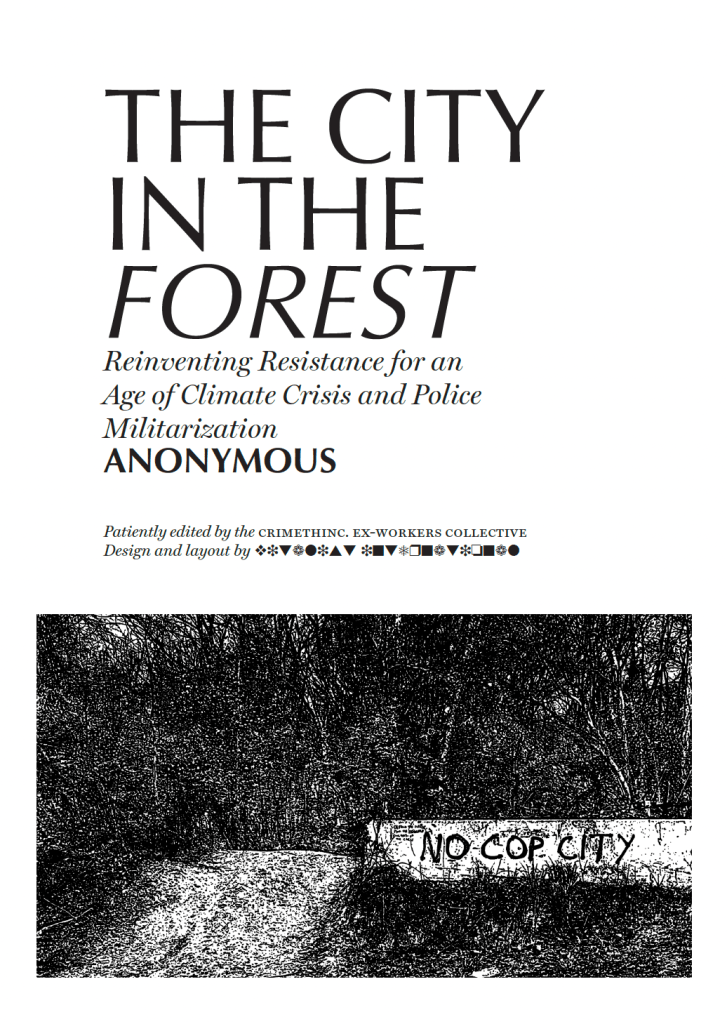
Since april 2021, police abolitionists and environmentalists have been engaged in a furious struggle to prevent the destruction of a precious stretch of forest in Atlanta, Georgia, where the government aims to build a police training compound and facilitate the construction of a giant soundstage for the film industry. In this essay, participants in the movement chronicle a year of action, tracing the movement’s victories and setbacks and exploring the strategies that inform it. This campaign represents a crucial effort to chart new paths forward in the wake of the George Floyd Rebellion, linking the defense of the land that sustains us with the struggle against police.
CRIMETHINC. EX-WORKERS COLLECTIVE CrimethInc. is a rebel alliance—a decentralized network pledged to anonymous collective action—a breakout from the prisons of our age. We strive to reinvent our lives and our world according to the principles of self-determination and mutual aid. www.crimethinc.com | USA, May 2022
Environmental Justice
The term “environmental justice” recognizes that environmental “bads” are not distributed evenly. Over generations, the effects of systematic racism concentrate environmental “bads” among the marginalized. Specifically, those cumulative effects concentrate the “bads” among people of color.
In June 2022, Kwame Olufemi of Community Movement Builders told 11Alive News, “If you know anything about Atlanta at (all) then you know the places that flood the most are on the south side … In destroying the forest they’re going to exasperate those issues they’ve already had with peoples town flooding … It’s clearly not for us, it’s not for our community, and it’s going to be adverse to us and our people.”
“Cop City is a catalyst for further nationwide militarization of the police and the continued expansion of the surveillance state,” Defend the Atlanta Forest argues. “This development would remove a natural barrier to flooding and pollution for communities downstream … These [effects] would primarily affect BIPOC [Black, Indigenous, and People of Color] communities in Dekalb County that the city has chosen to ignore.”
The campaign to defend the forest in Atlanta, Georgia has become one of the most vibrant movements of the post-Trump era, interweaving environmentalism, abolitionism, and the fight against gentrification. Yet as police shift to employing lethal violence and indiscriminate terrorism charges, it has reached a critical juncture. Participants explore how this struggle has developed over the past year, reflecting on the practices that have given it strength and analyzing the challenges before it.
Our society is at a crisis point. Decades of escalating economic pressure have created rampant inequality and desperation. Rather than addressing the root causes of these, politicians across the political spectrum continue channeling more and more money to police, relying on them to suppress unrest by force alone. This dependance has enabled police departments and their allies to consume a vast amount of public resources. Meanwhile, driven by the same economic pressures, catastrophic climate change is generating hurricanes, forest fires, droughts, and widespread ecological collapse.
In this context, starting in April 2021, a bold movement set out to defend a forest in Atlanta, Georgia, where local politicians and corporate profiteers want to build a police training compound and a soundstage for the film industry. The training compound, known as Cop City, would be the largest police training facility in the United States. It would devastate the South River Forest, also known as Weelaunee Forest in honor of the Muscogee Creek people who lived there until they were deported in the Trail of Tears.
The Forest in the City. Two Years of Forest Defense in Atlanta, Georgia, Crimethinc, 2023-02-22
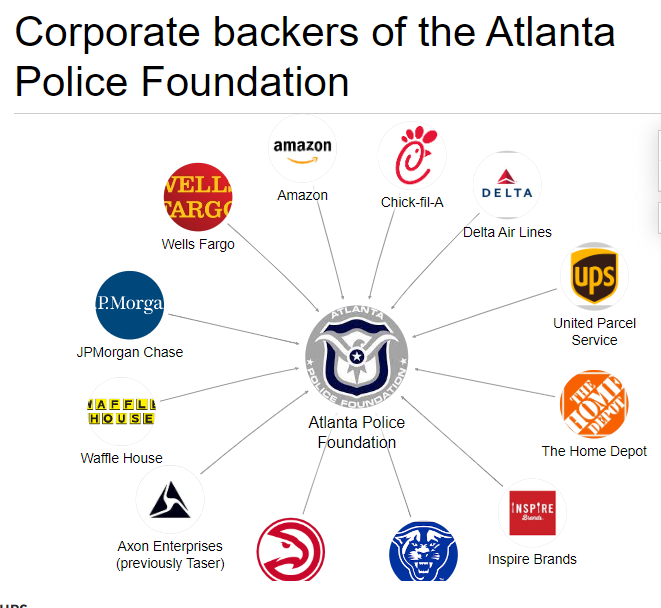
The Atlanta Police Foundation has plans–backed by $60 million in corporate funding and $30 million in taxpayer money–to build an enormous police training facility over the city’s Weelaunee Forest.
Activists and forest defenders are calling the plan “Cop City,” as it will include a mock village (complete with a nightclub), a Black Hawk helipad, an emergency vehicle driving course, dozens of firing ranges, and an area for explosives training.
The neighborhoods that surround the forest are largely made up of lower-income Black residents. Cop City will decimate green space, which is already so rare in BIPOC communities, and replace it with a playground for the police to practice warfare tactics.
Communities of color live with police-induced trauma every day. Now this Atlanta community will feel and hear the presence of a training facility where cops learn new ways to enact violence against Black and Brown communities, right in their own backyard.
In addition to the terror of an ever-present police force, Cop City is an environmental racism nightmare. The Weelaunee Forest provides ecological relief for the people of Atlanta. It offsets stormwater runoff, which might otherwise push unwanted sediment into the drinking water. The mere presence of trees helps to keep the city cool during the long, hot, humid summers, and improves air quality by reducing carbon dioxide released into the air.
Cop City has been gaining nationwide attention, and for good reason. The city of Atlanta, its police force, and its corporate sponsors are actively cooperating to increase police power, at a time when police departments are under scrutiny for abusing that power.
Cop City will do irreparable harm to the city of Atlanta, and inspire more play villages for cops across the country. But there’s hope. Cop City does not have the full funding necessary to scale the project from private entities, meaning there is still time to put pressure on these investors to halt all funding to the Atlanta Police Foundation and APF Support Inc.
Dozens of protesters made their way through downtown Detroit Friday afternoon before halting to a stop in the middle of Congress and Griswold, blocking traffic and prompting angry drivers to blare their horns.
“Stop Cop City!” the crowd chanted. “I am…a revolutionary!”
The march followed a rally with members of the Michigan Environmental Justice Coalition, Michigan Liberation, Detroit Will Breathe and several other social and environmental justice groups in a show of solidarity with protesters in the Atlanta area. For nearly two years, organizers and activists in Georgia have been protesting against “Cop City,” an 85-acre, $90 million police training center being developed in a forested area near Atlanta. In recent weeks, the “Stop Cop City” movement has spread across the country after an environmental protester defending the Georgia forest was killed by state police, and more than a dozen protesters were arrested.
In Detroit, protesters Friday spoke in opposition to a similar situation in Michigan – the expansion of Camp Grayling, a military training facility in the northern part of the state. Last year, the Michigan Department of Natural Resources began notifying locals that the National Guard wants to lease 162,000 acres of state-owned land across several counties, more than doubling its current training grounds, reported Bridge Michigan. The Guard said it needs the land to make Camp Grayling a destination for year-round cyber, electronic and space warfare training.
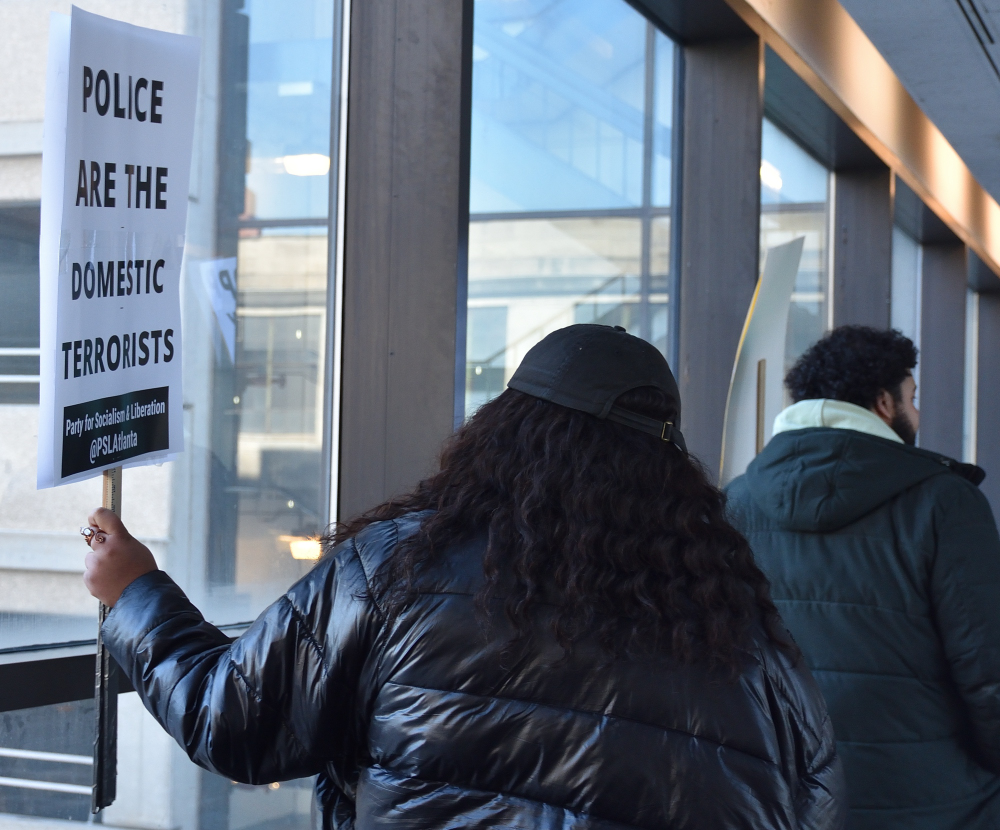
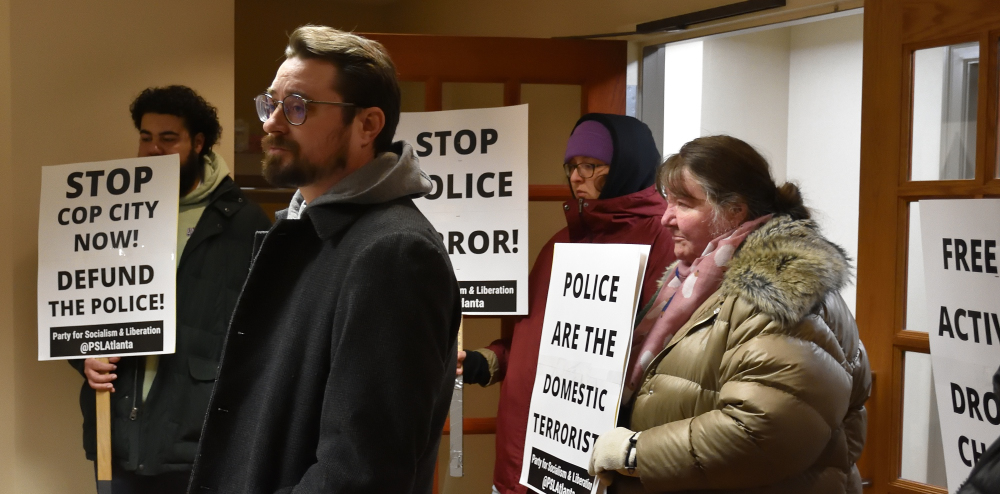
This morning (1/31/2023) a number of people who are involved in justice work in central Iowa gathered at the offices of the law firm that represents Corporation Services Company. Which in turn represents U.S. Multifamily Capital Markets at Cushman and Wakefield. John O’Neill is the President of U.S. Multifamily Capital Markets. He sits on the executive committee board for the Atlanta Police Foundation, which is building “Cop City” in Atlanta. Where Manuel Teran (Tortuguita) was killed by police who were clearing tree sitters from the proposed construction area.
Following are some of the photos I took at our action that morning.
It’s clear what it means when the establishment proposes dramatically expanding the militarization of police as their response to police brutality and killings.
There is a web of interconnections between the killing of Manuel Esteban Paez Terán (Tortuguita), who was resisting the plan to build “Cop City” in Atlanta, resistance to a police academy in Chicago, and the epidemic of violence and killing by police in this country.
Thursday, January 31, we had an action, “Stop Cop City” Solidarity in Des Moines.
My friend Jon Krieg, who works at the American Friends Service Committee (AFSC), recently told me about the resistance to a proposal for a police training facility in Chicago, similar to “Cop City” in Atlanta. https://nocopacademy.com/
Debbie Southorn works for the American Friends Service Committee in Chicago, where she supports community efforts and youth organizing to end policing and reimagine community safety. In 2012, she co-founded the Chicago chapter of Black & Pink, currently serves on the National Committee of the War Resisters League, and is a Board Member of the Chicago Freedom School. She’s written about policing and white supremacy for outlets including Truthout, In These Times, and The Intercept.
Sophia: What is the cop academy? What do you want people to know about it? Why is it dangerous?
Debbie: In July of 2017, the mayor of Chicago, Rahm Emanuel, announced his plans to spend at least $95 million on a new cop academy on the west side of Chicago. He has been heralding this project as an important step towards reform of the police department, saying that this building will provide a clean slate for the Chicago Police Department (CPD). There are so many reasons why this is dangerous. We know that this isn’t about having a kinder, gentler Chicago police department.
This facility is being built so that the police department can have an expanded shooting range, so that they can do more mock raids. This is not about de-escalation and anti-bias training. They are trying to say that this is a response to the scathing Department of Justice report which delineated the realities of racism and violence that are plaguing this department. The report was issued in response to the killing of Laquan McDonald and the subsequent cover-up.
PART ONE: No Cop Academy: What you should know about Chicago’s proposed police academy by the American Friends Service Committee, Nov 19, 2018
From 2017-2019, Chicago Black youth powerfully organized and led an effort against the construction of a $95 million dollar cop academy, and demanded the city of Chicago fund youth and communities instead. This upcoming documentary chronicles the explosive #NoCopAcademy campaign through those who lived it. “Real community safety comes from fully-funded schools and mental health centers, robust after-school and job-training programs, and social and economic justice. We want investment in our communities, not expanded resources for police.” #NoCopAcademy
#NoCopAcademy is a grassroots campaign launched by Assata’s Daughters, Black Lives Matter – Chicago, People’s Response Team, For The People Artists Collective, and many more grassroots organizations to mobilize against Rahm Emanuel’s plans to spend $95 million for a massive training center for Chicago police in West Garfield Park on the city’s West Side. We refuse any expansion of policing in Chicago, and demand accountability for decades of violence. Instead, we demand resources for schools and youth. This video offers the unique perspective of students who attend school one block away from the current cop academy, and young people who live adjacent to the site of the proposed expanded cop academy. What does it feel like to go to school next to cops every day? What would it feel like to have a shooting range, live scenario trainings, and a swimming pool for police next door to your high school gymnasium? What would you really need to feel safe in your neighborhood? In addition to centering the experiences that Black youth and youth of color have had with police in their communities, this piece goes the extra step by highlighting the ways young people are at the forefront of one of the most pressing issues in Chicago. The youth organizing team of #NoCopAcademy are organizing meetings, engaging their neighbors, meeting with City Council, engaged in direct action – all to demand an end to the violences that Black young people have experienced at the hands of the police and the city alike, and to demand schools for kids, not cops.
Protesters who oppose a police training facility in West Garfield Park were escorted from a City Council committee meeting on Tuesday. (Note: This video was originally published on May 22, 2018)
Police training facility protesters. Chicago Sun-Times
Police killing of Tyre Nichols should remind us of five lessons from 2020 In the face of normalized police violence and ongoing systemic racism, Mary Zerkel of the Chicago Peacebuilding Program writesabout why we need to keep pushing for community safety for all beyond policing. Lessons from 2020 include:
Reformist reforms don’t work.
We need police out of traffic stops.
We need police out of mental health response.
Police must stop targeting social justice organizers.
We need alternatives to police response to keep all community members safe.
Yes, policing is still deadly. The police killing of Tyre Nichols remind us: Let’s not forget the lessons of 2020 by MARY ZERKEL, American Friends Service Committee, JAN 31, 2023































 Quakers and Mutual Aid