Friends Committee on National Legislation

The Friends Committee on National Legislation (FCNL) is a national, nonpartisan organization that lobbies Congress for peace, justice, and environmental stewardship.

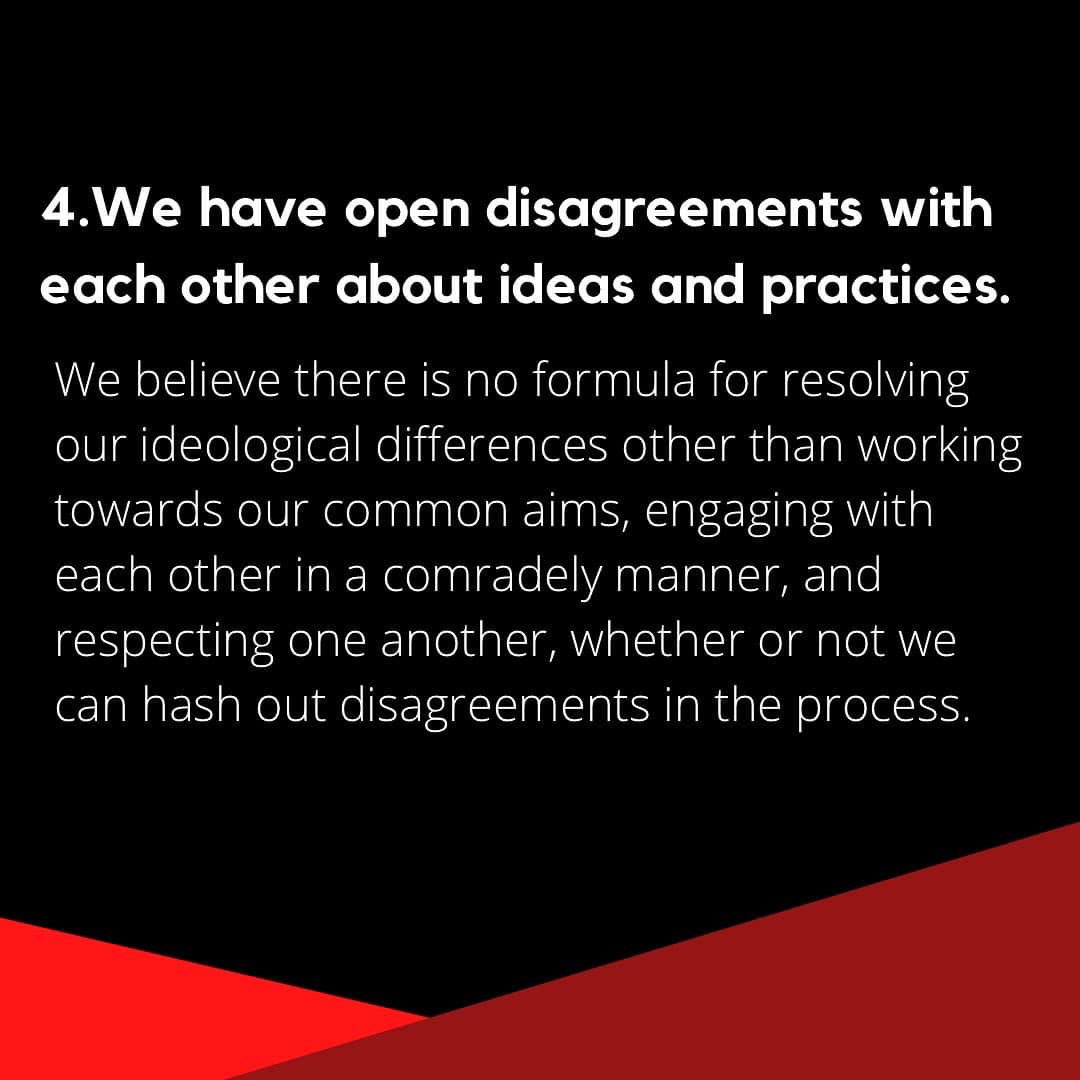
FCNL has an 80-year-old history of bringing the concerns of Quakers and Quaker meetings to the US Congress. The following four principles guide this work.

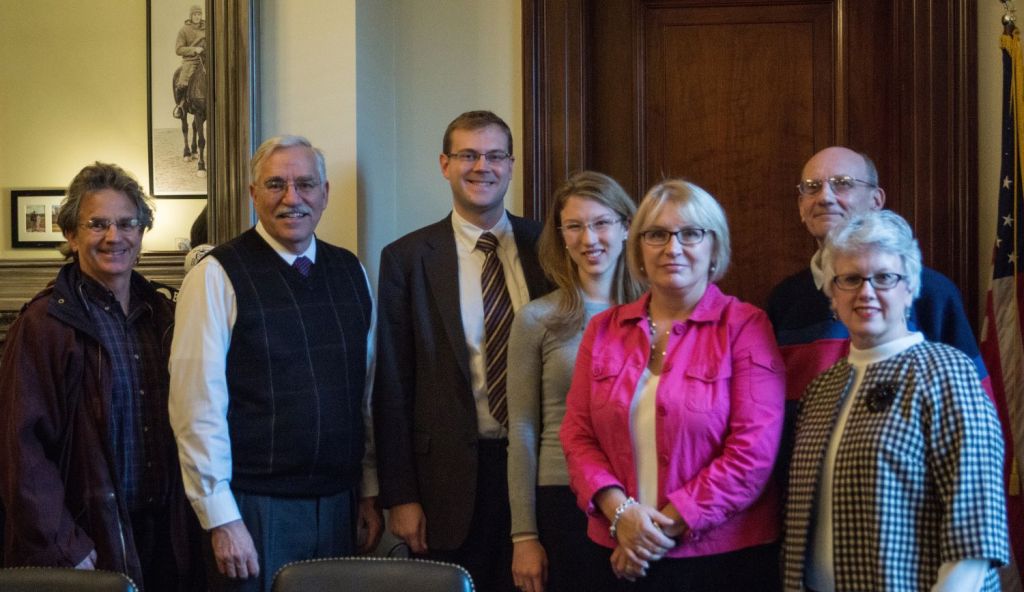
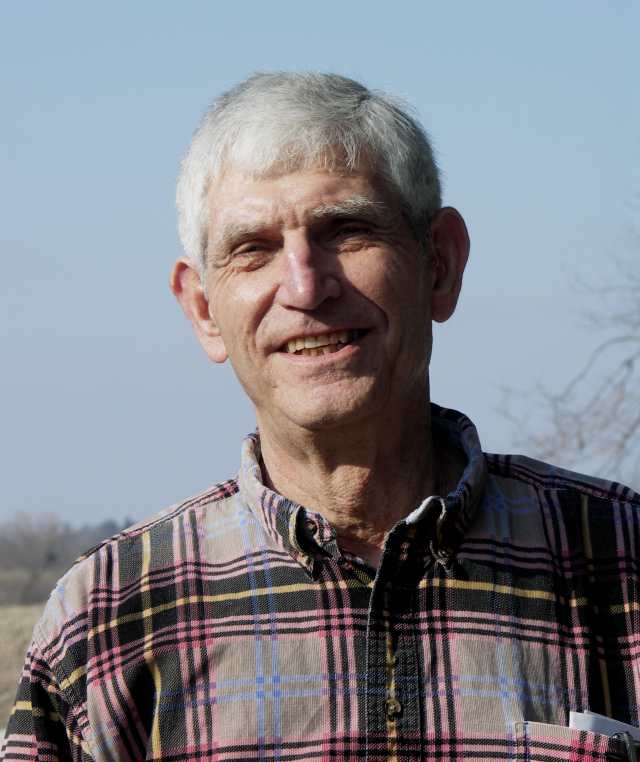
I have been blessed to be involved in the work of FCNL in a number of ways over the years. For nine years I was a member of the General Committee, which meets annually to help determine what priorities FCNL’s lobbyists should bring to Congress. One of the unique aspects of FCNL’s approach is to train Quakers and others how to lobby Congress themselves. I’m second from the right at this visit to a Congressperson’s office.

Training sessions for FCNL Advocacy are provided online monthly. The next session will be January 18, 2024. You can register here: Intro to Advocacy with FCNL


Following are several updates I’d like to share about FCNL’s work.


Addressing Patterns of Racial Wounding and Racial Justice in Quaker Communities

Join FCNL’s Lauren Brownlee and Zenaida Peterson, both members of the Steering Committee of the Quaker Coalition for Uprooting Racism, online for Pendle Hill’s First Monday lecture on Jan. 8, 2024.

Members of the Steering Committee of the Quaker Coalition for Uprooting Racism believed they had a responsibility to name the pain from patterns of white supremacy culture and racism that they have experienced, witnessed, and heard throughout the Religious Society of Friends and associated organizations. To that end, they created a guide with examples of harm and interventions towards racial justice. This guide, inspired by the work of Tema Okun and several Quaker institutions, points to the ways that they see white supremacy culture weaving its way into Quaker culture and suggests methods to disrupt it.

In this lecture, Lauren Brownlee and Zenaida Peterson will share ways that the guide has been and can be used in Quaker communities.

You can view that guide here: https://friendsgc.wpenginepowered.com/wp-content/uploads/2023/08/Racial-Wounding-and-Racial-Justice-In-Quaker-Communities-Guide.pdf

Register for the event here: https://pendlehill.org/events/addressing-patterns-of-racial-wounding-and-racial-justice-in-quaker-communities/


Virtual Witness Wednesday Silent Reflection

FCNL hosts a Virtual Witness Wednesday Silent Reflection. This event is in line with the Quaker practice of silent worship. It’s an opportunity for participants to join virtually via Zoom or by phone for a period of shared reflection.

I’ve been attending Witness Wednesday for several years, (including yesterday) and find it to be a powerful way to reflect on faith, peace, and justice work. I highly recommend it. Simply use this link to attend online any Wednesday at 4:15 pm Central time. http://fcnl.org/ww-stream


Spring Lobby Weekend

Spring Lobby Weekend brings hundreds of young adults to Washington, DC, where they learn about a specific issue, and then actually go to their Congressional offices to lobby related to that issue.

Several years ago my good friend Rezadad Mohammadi attended one spring lobby weekend. The next year he organized a group of fellow students at Simpson College to attend, successfully obtaining funding from the College to help with expenses. If you know of young adults who might be interested, please share this with them.

In March 2024, hundreds of young adults will gather again for Spring Lobby Weekend—our young adult advocacy conference and day of action. This year, we’ll be lobbying Congress to address the harmful legacy of the Indian Boarding School era.

We know that our strength comes from the stories we tell and the community we build, so we hope that you will join us March 16-19, 2024—in Washington, D.C. or online—to advocate for change!

Please check this page for more updates in the coming weeks. If you are not already signed up for our Young Adult Program updates, please sign up here to receive emails about Spring Lobby Weekend 2024.

https://www.fcnl.org/events/spring-lobby-weekend-2024


Reproductive Health Care and Abortion

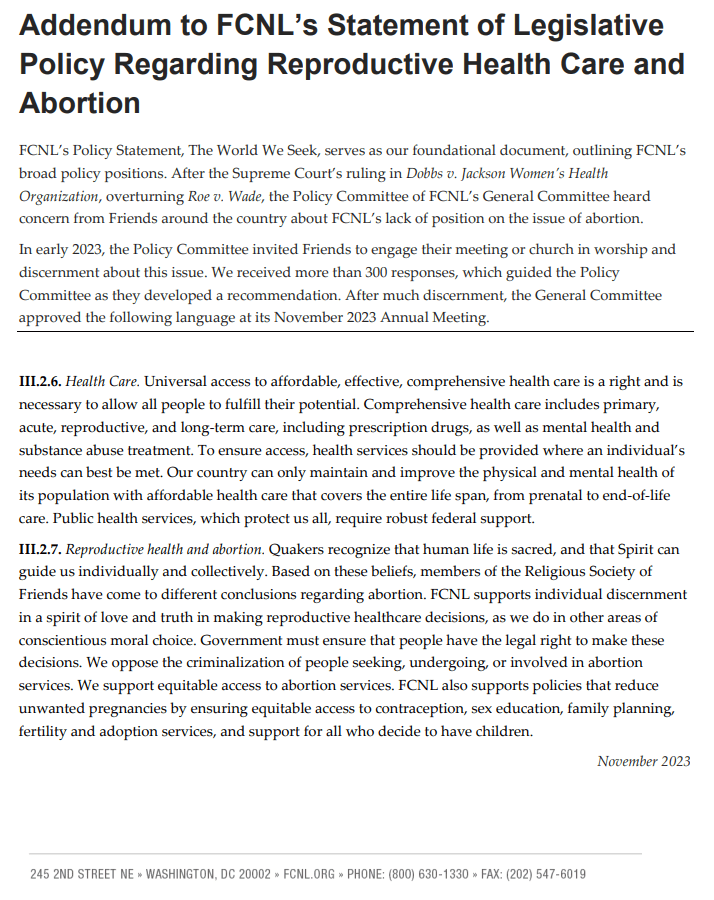
In an example of how FCNL engages with Quaker communities in this country, FCNL asked Quaker meetings about their views regarding reproductive health and abortion. This came about because there are different beliefs about abortion among Quakers, so FCNL did not have a policy related to that. But with the recent national debate about abortion, FCNL asked Quakers to share what they thought about this issue today. Following is the statement that came out of this national discussion among Quakers.

The War in Israel-Palestine

Working for peace has always been a fundamental belief among Quakers. “We seek a world free of war and the threat of war” is one of the guiding principles of FCNL.

We are heartbroken by the violence in Israel and Palestine. As Quakers, we deeply mourn the loss of all lives and pray for those who have lost loved ones due to this latest escalation. We unequivocally condemn Hamas’ attacks and inhumane treatment of civilians and call for the release of all hostages. We also condemn Israel’s indiscriminate bombing of Gaza that has claimed thousands of civilian lives. More war and weapons won’t bring peace. In the face of growing violence, lawmakers must push for a permanent ceasefire and address the root causes underlying this explosion of violence.

https://www.fcnl.org/issues/middle-east-iran/israelpalestine/israel-palestine-war

Following is a statement calling for a ceasefire from the national Quaker organizations.

https://www.fcnl.org/sites/default/files/2023-10/quaker-statement-10-17-23.pdf

Indigenous Land Acknowledgement

As we bear witness and lobby in solidarity with Native Americans, we also honor the Nacotchtank tribe on whose ancestral land the FCNL, FCNL Education Fund, and Friends Place on Capitol Hill buildings stand. They are also known as the Anacostans, the Indigenous people who lived along the banks of the Anacostia River, including in several villages on Capitol Hill and what is now Washington, D.C. By the 1700s, the Nacotchtank tribe had merged with other tribes like the Pamunkey and the Piscataway, both of which still exist today.

Prayers, Light and Action

Yesterday a dear friend had just found out that my mom had died, and said she was sending prayers. I sincerely thanked her.

This morning I woke up at 5 am and noticed there was a lot of moonlight. It was so bright, I thought I’d try to capture it with my camera, with little success. But I couldn’t go back to sleep, and I kept looking at the light. I remember another early morning when I was led to walk to Picnic Point for photos and was blessed with a spectacular sunrise. You can see those photos on my photography website:
https://jeffkislingphotography.wpcomstaging.com/2023/11/15/picnic-point-madison-wisconsin/

On that same site, there are several other albums of photos from Picnic Point. Some are in the rain, fog, or snow. I long ago learned some of my best photos were taken in such challenging conditions. There’s something about the difficulty or sacrifice that makes for extraordinary images.

So I was eager to leave at 5 am in 28-degree temperatures, hoping I would find difficult conditions again. Of course, it was completely dark, and I had no idea if there would be clouds obscuring the sunrise.

I was blessed to witness another extraordinary dawn. Those photos will also appear in the photo album link above when I finish editing all 155 of them.

I’m convinced my friend’s prayers led to the early light which awakened me and led me out into the dawn. Because prayers are not a static thing. They can lead us to act, and lead us into amazing journeys. I am thankful for the prayers.

Vision Quest

As a new year begins

We are facing unprecedented challenges. Meaning we need to find new paths.

  • What are we called to do?
  • Where do we look for help?

Ancestors

  • What things do we admire about our ancestors?
  • Are we living up to the lessons they provide?
  • What mistakes did they make that we can learn from?

Spirituality

  • How can we deepen faith?  
  • What gets in the way of finding that spiritual guidance?
  • Do we have the courage to follow where our faith leads us?
  • How do we support each other to express that courage?
  • How do we facilitate and learn from the expression of spirituality in the wider community?

Comfortable

  • What are the dangers of being comfortable? I don’t believe we should be comfortable with so many things as they are now. Because so much is rooted in injustice.

Collapse

It is clear the world we grew up in is no longer. The environment is rapidly becoming increasingly chaotic. Economic and political systems are failing. Physical and social infrastructure is breaking down.

Centralized systems of government and the economy will collapse for lack of resources and the infrastructure to provide them.

Increasingly we will all be forced to reckon with disasters of all kinds. We will have no choice.

Migration

What needs to be done to prepare for climate migration.

  1. Climate Action: Urgent global and national climate action is needed to mitigate the effects of climate change.
  2. Infrastructure Development: Communities need to prepare for an influx of migrants by developing physical infrastructure such as affordable housing and transport routes.
  3. Social Services Expansion: Communities will need to expand healthcare, education services, and create new jobs to accommodate the increasing population.
  4. Recognition and Support: Recognizing climate migrants and focusing on larger processes that facilitate resilience—like access to education, housing, jobs, and healthcare—is crucial.
  5. Cultural Sensitivity: Communities will also have to address increased cultural diversity and potential tensions between new settlers and the local population.
  6. Climate Havens: Some communities with certain geographical pre-conditions can become ‘climate havens’ for climate refugees. These communities have access to fresh water, are sufficiently far away from the seaside, have an adequate height above sea level, and currently have a colder climate.

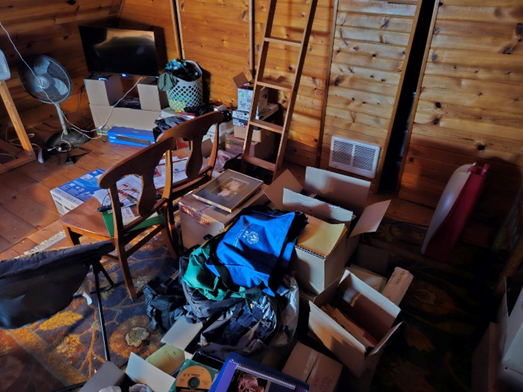
I have become a migrant myself. Having been living with my mom to care for her, I recently needed to find a new place to live when she died. The following photos show what my possessions have been reduced to. Almost all of those boxes contain books. The plastic bags contain my clothing.  

This is helping me understand what will be happening to so many very shortly. What has happened to so many already. People won’t be able to move many possessions. Transportation will be limited, and we may not know where we will end up.

When I was hungry, you gave me food

The Making of a Spiritual Anarchist

I recently came across a series of articles by Barnabas Smith on medium.com titled The Making of a Spiritual Anarchist. One of them was When I Was Hungry, You Gave Me Food.

The phrase below, “after my time on the bench,” relates to Barnabas’ punishment for not getting good grades. His father made him sit on the bench outside his father’s store, hoping to give him a different perspective on the importance of a good education. I know, that begs the question of what a good education is. The store was in a part of the city where there were people living on the street.

After my time on the bench, I decided to take matters into my own hands. If the city wouldn’t take care of its citizens and churches weren’t going to take care of their neighbors, then I would do what I could. As a high schooler, it wasn’t much.

I started by buying two meals when I ate out and giving the extra away. After graduating high school, I started inviting people to have lunch with me instead. To me, if taking care of someone was also taking care of Jesus, wouldn’t it be better to have lunch with him and treat him as a friend?

I did help a few churches organize their outreach programs. If they were willing to put their time and money into the community, I figured it was best to help them do it right. And by right I mean, by treating the people they were seeking to serve as people and not a project. To see them as human beings fully loved by God and not as souls to save from God’s wrath. It was hit or miss on how the outreaches actually lived up to this.

I didn’t know at the time, but my disregard and distrust of the necessity of institutions was a hallmark of anarchism. I was simply trying to do my part to help my community. I wasn’t radicalized in college or by reading Marx. I was awakened to the needs of the people around me. My neighbors. People who the powers that be saw as unimportant.

When I Was Hungry, You Gave Me Food. The Making of a Spiritual Anarchist, Part 2 by Barnabas Smith, medium.com, Sept 18, 2023


31 “When the Son of Man comes in his glory, and all the angels with him, he will sit on his glorious throne. 32 All the nations will be gathered before him, and he will separate the people one from another as a shepherd separates the sheep from the goats. 33 He will put the sheep on his right and the goats on his left.

34 “Then the King will say to those on his right, ‘Come, you who are blessed by my Father; take your inheritance, the kingdom prepared for you since the creation of the world. 35 For I was hungry and you gave me something to eat, I was thirsty and you gave me something to drink, I was a stranger and you invited me in, 36 I needed clothes and you clothed me, I was sick and you looked after me, I was in prison and you came to visit me.’

37 “Then the righteous will answer him, ‘Lord, when did we see you hungry and feed you, or thirsty and give you something to drink? 38 When did we see you a stranger and invite you in, or needing clothes and clothe you? 39 When did we see you sick or in prison and go to visit you?’

40 “The King will reply, ‘Truly I tell you, whatever you did for one of the least of these brothers and sisters of mine, you did for me.’

Matthew 25


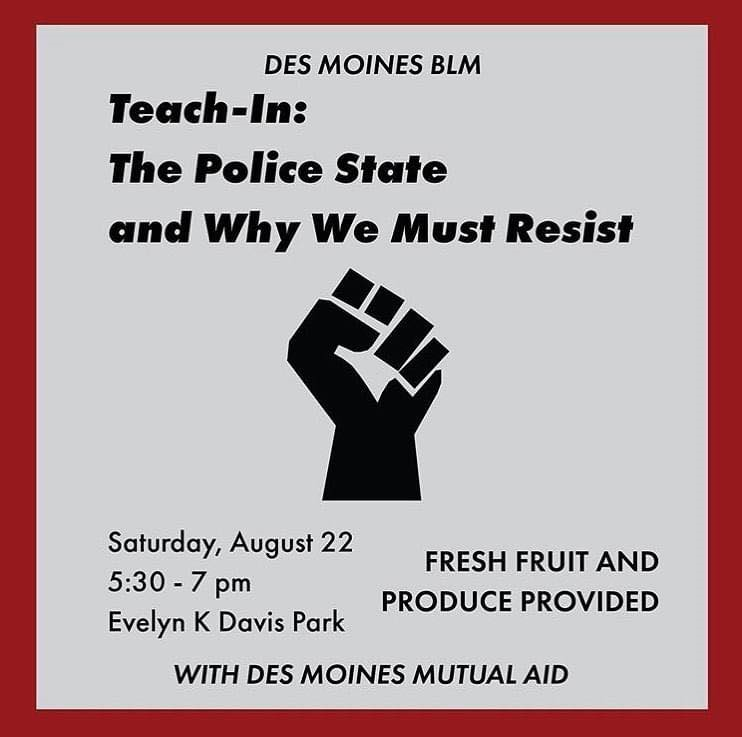
If you’ve read other articles I’ve written you know I was profoundly changed when the Spirit connected me with the people at Des Moines Mutual Aid about four years ago. Barnabas’s article distills a few things I’ve learned or questioned as a result of my experiences there.

  • Why are so few churches feeding, clothing, and providing shelter to those in need?
    • Sending money somewhere doesn’t count.
  • When they do, why do so many dehumanize those they are trying to help?
    • I say “trying” because how helpful is treating those in need this way?
  • Mutual Aid groups across the country and the world are doing these things and treating our neighbors as ourselves.

There is a large collection of articles about spirituality in The Anarchist Library. https://theanarchistlibrary.org/category/topic/spirituality

The second question

What questions do you ask these days? Ask yourself or others? Are you brave enough to ask anything at all? Such as what can we do about accelerating authoritarianism? Runaway global burning? Why is the US complicit in the Israeli carpet bombing of Gaza? These things can only happen if authority is not questioned. There is a palpable sense of fear for anyone to question empire today. People who question are beaten, jailed, killed.

Yesterday I wrote about asking the right questions. As a spiritual person, I have been, and believe I will continue to receive answers from the Spirit or Inner Light. I appreciate the spirituality of the following.

From my career in medical research, the first thing I learned was the most important thing is to ask the right questions.

So, during a recent discussion about Quakers and the Indian Boarding Schools, I recognized the significance of the question that was asked, “how can we decolonize ourselves?” Prior to that, we were lost as we tried to understand our ancestor’s involvement in those institutions. It seemed the subtext of the question is “is it even possible to decolonize ourselves?” Which I tried to answer yesterday.

That question immediately brought to mind something that I had heard the Indigenous spiritual leader, Arkan Lushwala, say.

The answer to “what can I do?”

“Everywhere people ask, “what can we do?”
The question, what can we do, is the second question.
The first question is “what can we be?”
Because what you can do is a consequence of who you are.
Once you know what you can be, you know what you can do.”

Arkan Lushwala

Speaking about what is happening on Earth right now,
many of the conditions of life that we used to take for granted,
now are really out of balance.
Hopefully we still have time to get back into balance
so life may continue.
I travel around the world and meet people and talk to people
from all different cultures.
And everywhere people ask, “what can we do?”
The question, what can we do, is the second question.
The first question is “what can we be?”
Because what you can do is a consequence of who you are.
Once you know what you can be, you know what you can do,
and we cannot afford wasting time;
we have little time.
We need to be precise now.
When someone sincerely asks, “what can I do?”
my humble answer,
the only answer that I find in my heart to be sincere is,
“First find out what you can be.”
Action is extremely necessary at this time.
This is not a time just to talk about it.
The most spiritual thing now is action.
To do something about what’s happening.
To go help where help is needed.
To stand up when we need to stand up,
and protect what is being damaged.
And still, this action needs to be born
from a place in ourselves that has real talent,
real intelligence, real power,
real connection to the heart of the Earth,
to universal wisdom,
so, our actions are not a waste of time.
So, our actions are precise,
our actions are in harmony with the movement,
the sacred movement,
of that force that wants to renew life here on Earth
and make it better for the following generations.

Arkan Lushwala


Arkan says we are facing life threatening situations related to environmental damage.  We are facing such severe challenges that we cannot solve them only by ourselves.

We must move beyond thinking and talking. Action now is essential.

Action is spiritual.

We need to practice trying to reach our sacred space. We need a higher universal intelligence to help solve these problems.

We must open a sacred space for prayer so we may be open to the warrior spirit.

The importance of prayer.

  • We pray as a form of connecting to other forms of communication
  • We need to be aware of what is happening in the moment, elevate ourselves, move closer to the sacred
  • I first have to reach deep into my own heart

You start praying while you are also listening. I become aware of, remembering, what I pray about at that moment. We need to rely on our own ancient indigenous memory. Stop being isolated. Fully become part of the earth and water and plants and air. This is an immense source of knowledge about these problems.

I am in front of the sacred fire of all who are listening. Let’s say that I am thinking now. I am remembering. The notion of intelligence and to understand refers to memory. Intelligence means learning, but also achieving that state in your mind when you are remembering. The air that we are breathing carries the memories of the ages, the movement of energy. Deepest intelligence in our culture is memory. There are always memories of the ages in all that surrounds us.

The state of being, the prayer, makes us open to receiving. If we are really open, and not blocking ourselves, and connected to what is around us, with our eyes, breath, sensations, and feeling that arrive in our heart, through our antenna, if we are open in this way while we are doing something, our action is being infused with guidance or instructions. There is something there that is watching what you are doing and helping guide you. Sometimes we need the help of the elders or others to understand these experiences.

We ask for help. When we put ourselves in that elevated space, that makes it much easier for us to receive help. Help is always there but we often miss the messages.

If I am open and receptive to other frequencies and the higher state of my being, I’ll have much more help in my work.

The correct way is not to take credit, but the joy is the moment itself, by feeling integrated to life while you are doing the action.

When we sit with others in a circle, when we all change the state of our being together, we move up to the sacred together. Working with others in community, much, much more can be accomplished.

If a person expresses an experience that is from a sacred space of high resonance, I am activated by that. It resonates in my own heart and mind and spirit, and it triggers my memory, too. by the presence of something sacred.

We sit in a circle and witness someone remembering. We receive the same spirit together. Our individual self and agenda slips away. Joining our hearts. Mother Earth is the One, all of us become the One together. A lot of wisdom comes south. We are all impressed by the presence of something sacred.


It is becoming clearer and clearer, with every passing day, that walking a prayerful, peaceful spiritual path is the only way forward to a just, sustainable, and harmonious world.”

Prophecies, Unprecedented Change and the Emergence of a New Global Civilization, 2017-2020, WALKING THE RED ROAD·TUESDAY, DECEMBER 20, 2016

Asking the right questions

Today there is a lot of attention on what were called the Indian Boarding Schools in the U.S. and Canada. This is in large part because of the uncovering of remains of children on the grounds of many of those institutions using ground-penetrating radar. These searches began in order to document the known history of native children dying or being killed at these schools. Thousands of remains have been found, and the searches continue.

Stories about this are beginning to be told in many mainstream news articles, films, and books.

The National Native American Boarding School Healing Coalition (NABS) is an excellent source of information.

The New York Times recently published this extensive multimedia story, ‘WAR AGAINST THE CHILDREN’. The Native American boarding school system — a decades-long effort to assimilate Indigenous people before they ever reached adulthood — robbed children of their culture, family bonds and sometimes their lives. By Zach Levitt, Yuliya Parshina-Kottas, Simon Romero and Tim Wallace, The New York Times, Aug. 30, 2023

The Department of the Interior is investigating under the leadership of Secretary Deb Haaland, an enrolled member of the Laguna Pueblo.

Quaker Indian Boarding Schools

This is causing a lot of soul-searching in Quaker communities because some of those institutions were run by Quakers. My friend Paula Palmer published the article Quaker Indian Boarding Schools. Facing Our History and Ourselves, in Friends Journal, October 1, 2016

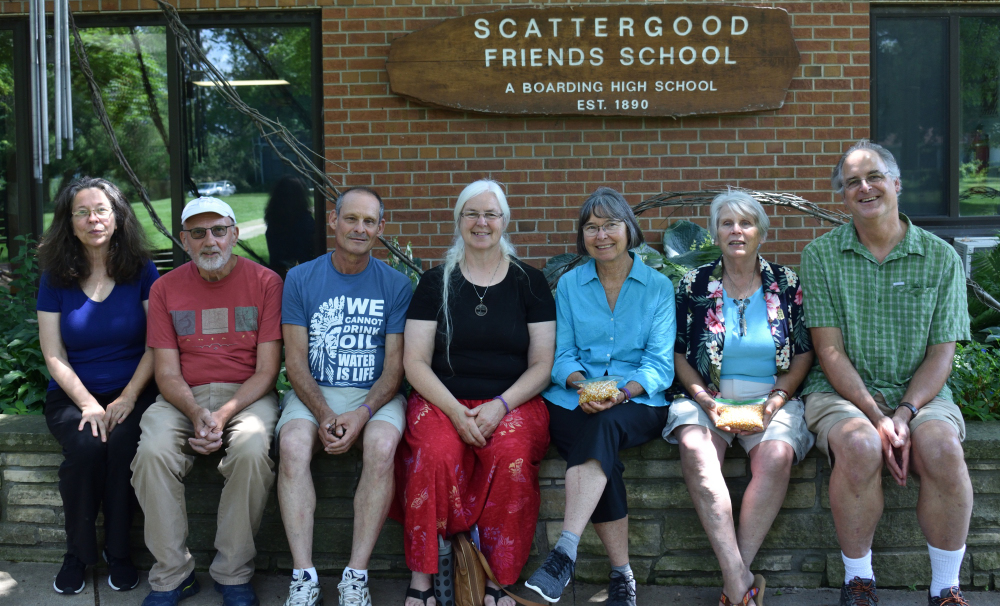
In this image at Scattergood Friends School are those of us who helped Paula Palmer (third from the right) give presentations and workshops related to her work, Toward Right Relationship with Native Peoples.

I was ignorant of this history until about a decade ago. But since then, this has become a focus of my prayers and work. I’ve written a lot about what I’ve been learning. https://quakersandreligioussocialism.com/forced-assimilation/.

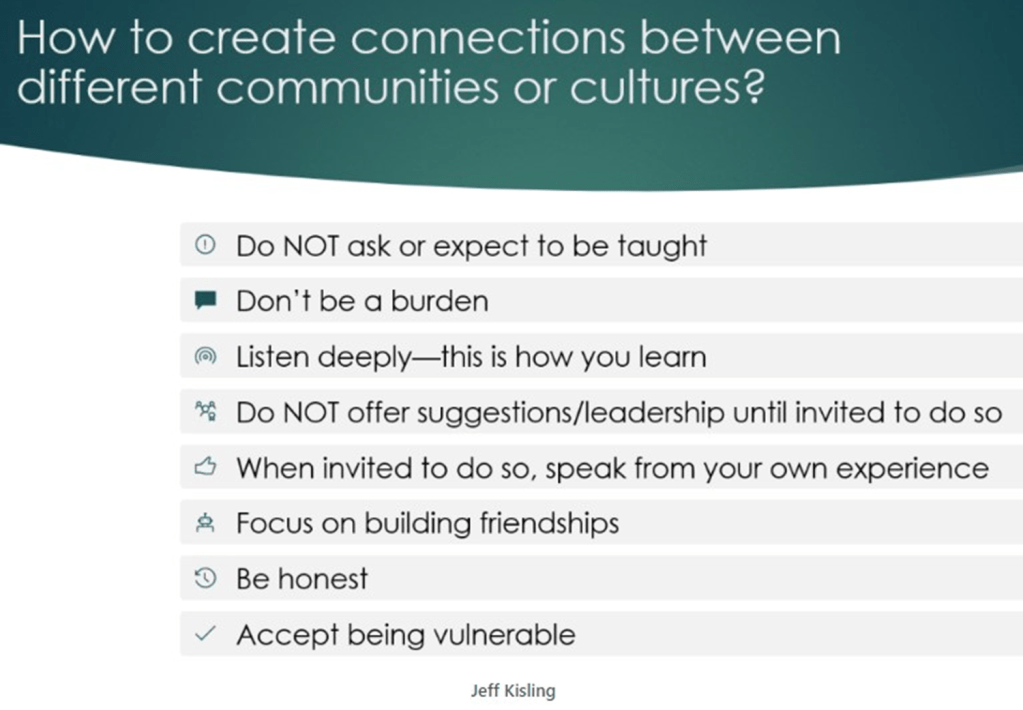
I’ve sought opportunities to find ways to build relationships with Indigenous people because we cannot begin to heal until we all come together and begin to know one another. This is a list of what I have learned from spending time in Black, Indigenous, and other people of color (BIPOC) communities. Offered in the hope that many more people begin to make these connections.

This takes a real commitment to spend a lot of time in diverse communities. Until I recently moved from Iowa, I joyfully participated in our (Des Moines Mutual Aid) free food project every Saturday morning for over three years. Over that time I heard every one of my friends say these Saturday mornings were the highlight of their week. Every person became a close friend.

This takes a real commitment to keep showing up, even when we make mistakes, which I did, and you undoubtedly will. But showing our vulnerabilities is an important part of building trust. Showing we are willing to risk awkwardness.


How do we decolonize ourselves?

During a recent discussion, a Friend asked, how do we decolonize ourselves? I believe this is one of the right questions to ask. This changes the focus from what our ancestors might have done and directs it to “what we can do now?” The question correctly begins from the point that we are colonized.

Decolonizing Quakers

A group of North American Friends, Decolonizing Quakers explores these questions and offers resources for our education.

The Stories We Weren’t Told

Many Quakers have learned that our Quaker ancestors and predecessors had good relationships with the Indigenous peoples who were on this continent when Quakers arrived from England and other European lands. We have read about how William Penn was respectful of the Native people and offered to pay “rent” for the land occupied by the new settlement that became Philadelphia. We have heard about Quaker missionaries who went out to “help” Native children learn the ways of European Christians.

There are threads of truth in these stories and others that we tell ourselves, but those small threads are too weak to tie together a benign story. As we look with open eyes at the history that white, European, Christian settlers and Indigenous peoples walked through since the time of “first contact,” we can’t help but see a different picture. In truth, we must acknowledge that Quakers participated in — and sometimes led — attempts to force Indigenous people to assimilate into an inflexible mold that fit the vision that Quakers shared with other white, European, Christian settlers.

This website offers resources to help all of us set aside the myths that come between us — as settlers and Indigenous peoples –and to find joy in knowing all our relatives better and more honestly.

Decolonizing Quakers https://www.decolonizingquakers.org/

Mutual Aid is a way to decolonize ourselves

A fundamental part of the answer to how we can decolonize ourselves is to understand that colonization is a hierarchy of power. In the simplest terms, in our society, White supremacy. To decolonize ourselves, we must work to eliminate hierarchies and their resulting power structures.

It was a leading of the Spirit that connected me with Ronnie James, an Indigenous organizer who is part of the Great Plains Action Society (GPAS) nearly four years ago. His work on Mutual Aid is supported by GPAS. Mutual Aid is a key method of the Great Plains Action Society’s Mechanism of Engagement. (https://quakersandreligioussocialism.com/mutual-aid/)

There is often a tepid response when I talk about Mutual Aid. The key to understanding the radical nature of Mutual Aid is showing this is not just another social justice idea. Mutual Aid is a fundamentally different way to live and relate to each other. There are hierarchies in even the most progressive organizations. Which means they perpetuate dominance, which leads to oppression.

Mutual Aid is a total break from that. It is a revolutionary way to be.


In the Midwest you can find information on the Iowa Mutual Aid Network website: https://iowamutualaid.org/

Origins of T-MAPs

As global chaos erupts in so many ways and places, I feel pressure (on myself) to write about that, as I would have in the past.

(There is information below about a Friends Committee on National Legislation event, Calling for a Ceasefire: Israel-Palestine Briefing.)

Instead, I’m led to continue to write about transformative mutual aid practices (T-MAPs) because we need to support each other, especially in perilous times like these.


T-MAPS and Mutual Aid

Some time ago, at our Des Moines Mutual Aid food project, one of my friends asked how I was doing. Which turned into an opportunity to share about T-MAPs. She agreed that no one asks how those of us doing justice work are doing. At least, no one outside our Mutual Aid community, where checking in with each other is an important part of our work together.


The Icarus Project

T-MAPs was originally dreamed up in the early years of The Icarus Project (TIP), a community of people working at the intersection of mental health and social justice. Over the years, TIP has created peer-based mental health support groups, alternative publications and educational resources, and new language outside the conventional “mental illness” paradigm. One tool developed by TIP, which has partly inspired T-MAPs, is called Mad Maps. Mad Maps began as creative and supportive conversations on the Icarus website about strategies for friends and strangers to communicate about how to take better care of each other. Mad Maps has evolved into a set of guides on navigating different topics like intergenerational trauma and madness and oppression.

https://tmapscommunity.net/the-origins-of-this-tool/

The Icarus Project is now the Fireweed Collective.

Fireweed Collective offers mental health education and mutual aid through a Healing Justice and Disability Justice lens. We support the emotional wellness of all people and center QTBIPOC folks in our internal leadership, programs, and resources.

Our work seeks to disrupt the harm of systems of abuse and oppression, often reproduced by the mental health system. Our model for understanding ‘severe mental illness’ is community and relationship-based and divests from the prison industrial complex and psych wards.

Healing Justice (HJ) is a framework rooted in racial justice, disability justice, and economic justice. Healing Justice provides us with tools we can use to interrupt the systems of oppression that impact our mental health. Fireweed Collective uses HJ as a guide to help redefine what medicine is, and increase who has access to it.

We are honored to be a part of a larger community of organizations guided by the  principles of Healing Justice:

  • responding to and intervening in generational trauma and violence (Kindred)  
  • collective practices that can impact and transform the consequences of oppression (Kindred)
  • imagining a generative and co-created future (Healing By Choice!)
  • being in right relationship with ourselves, each other, and the land (Healing By Choice)
  • centering disability justice, people of color, and economic justice (Leah Lakshmi Piepzna-Samarasinha’s history of healing justice)
Fireweed Collective

Calling for a Ceasefire

Yesterday, at our weekly FCNL Witness Wednesday Silent Reflection, we considered the following:

Prompt:
“An individual has not started living until he can rise above the narrow confines of his individualistic concerns to the broader concerns of all humanity.”
– Martin Luther King, Jr.

Query:
How can we best serve as witnesses and holders of humanity in times of great and increasing pain? How can we witness and hold joy and solidarity in moments of humanity’s grief?

You can join this weekly reflection at 4:15 pm Central time here:  fcnl.org/ww-stream

Calling for a Ceasefire: Israel-Palestine Briefing

When:Wednesday, October 25, 6:30 PM Eastern

In war, civilians always pay the highest price. As the crisis in Israel and Palestine deepens following the attack by Hamas on Israel and Israel’s retaliatory violence, our voices are needed.

As Quakers and advocates for peace, we have an important role to play in advocating for a ceasefire to prevent the tragic loss of more innocent Palestinian and Israeli lives. On Oct. 25, we will gather as a community in grief and action. Join FCNL’s Bridget Moix, Hassan El-Tayyab, and Odeliya Matter, and Joyce Ajlouny, General Secretary for the American Friends Service Committee, for insights into what is happening in Israel-Palestine, the response from U.S. lawmakers, and what we can do as advocates to respond.

https://act.fcnl.org/event/quaker-welcome-center-events-watch-home/3221/signup/


Transformative Mutual Aid Practices Part 2

Today, October 18, 2023, the world seems to be falling into chaos on so many levels. Beyond the increasing threats of environmental devastation, there is the complete dysfunction of the US Congress. Economic stresses are increasing as prices for everything are skyrocketing. Wars in Ukraine and the Middle East threaten to draw more countries into their conflicts. And killing thousands of people, of children.

I usually write about those things. But now it’s overwhelming to even try to figure out which of these many threats and injustices to write about, let alone what to say about them.

As I often say, I try to discern what the Spirit is leading me to say. Recently, I’ve been led to revisit Transformative Mutual Aid Practices (T-MAPs). The subject is relevant to help us deal with all these stresses in our lives. And a framework to support each other.

[A note to people of faith. From what I’ve been learning about T-MAPs, I don’t think faith is talked about specifically. Rather, you can include that in the parts of T-MAPs related to what gives you support. I think T-MAPs can be helpful for faith groups, such as Quaker meetings, as a better way to do justice work and communal care.]

Mutual Aid

I’m not always successful in explaining why my focus for the past four years has been on Mutual Aid (and Transformative Mutual Aid Practices). One is my lived experiences working in my Mutual Aid community. Not only of the many ways this community serves the survival needs of our community (our neighbors and ourselves) but also how powerful this is in our own lives and care for each other.

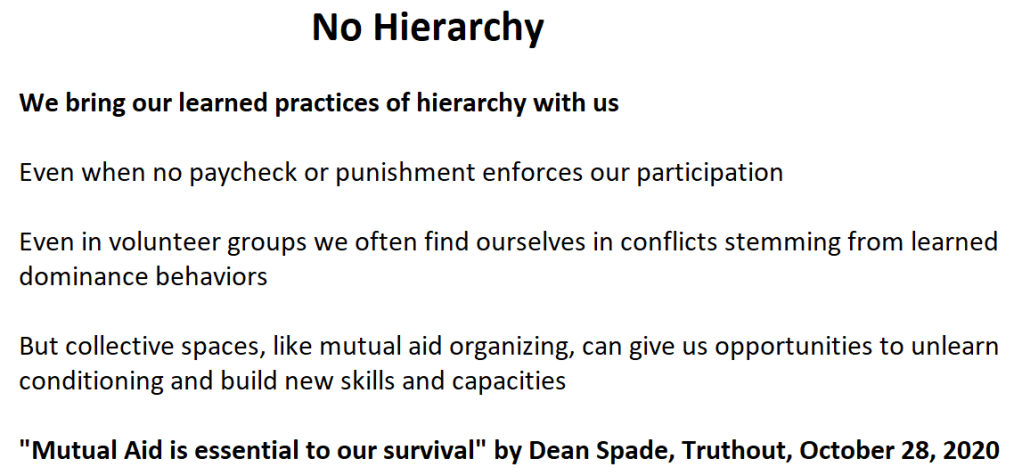
This is so because Mutual Aid is about a completely different way of thinking and being. The root of injustices in our society is the hierarchical structure of everything involved in our economic, political, and, usually, social structures. All hierarchies are power relationships and enforce a model of domination. The heart of Mutual Aid is a focus on preventing hierarchical structures. Mutual Aid is not just another approach to living and working in a community. It is about changing the very basis of how communities work.

These quotes are from “Mutual Aid Is Essential to Our Survival Regardless of Who Is in the White House. Mutual aid is inherently anti-authoritarian, demonstrating how we can organize human activity without coercion” by Dean Spade, truthout, Oct 27, 2020. Dean Spade is the author of the essential manual about mutual aid, “Mutual Aid. Building Solidarity During This Crisis (and the Next)“.


T-MAPs

Transformative Mutual Aid Practices (T-MAPs) are a set of tools that provide space for building a personal “map” of wellness strategies, resilience practices, unique stories, and community resources. Creating a T-MAP will inspire you to connect your struggle to collective struggles. When we make and share our T-MAPs with others they become potent tools for healing and liberation.

The acronym T-MAPs stands for Transformative Mutual Aid Practices

Transformation
We understand that we’re always in a process of transformation and growth; we’re not just in a process of ‘recovery’ or going back to some state of health (that we may have never known). As our lives change, it’s helpful to leave tracks for ourselves about where we’ve been and where we want to be going. T-MAPs help facilitate this process.

Mutual Aid
We also understand that just working on our own “self-care” isn’t enough; we also need mutu aid. Most simply, mutual aid is when people help each other. Historically, mutual aid has been a way that people have self-organized to create interdependent networks of support. People might help each other with things as basic as growing food and building barns or as abstract as education and mental health support.


Practice
When we think about how personal and community change happens, it’s pretty clear to us that the only way to grow and evolve is to intentionally practice what we want to see happen in our lives. Practice might be as simple as not getting on our smart phone as soon as we wake up in the morning, or as intentional and deliberate as a daily sitting meditation practice. Practice that happens with groups of people has the potential to change the world.

T-MAPS. Transformative Mutual Aid Practices


The mental health of all members (of your group) should be supported in an ongoing way. Go around the circle so that comrades can indicate to the group if:

▪ they would like others to reach out to them for a period of time or in an ongoing way, and how
▪ they would be willing to reach out to others who ask for that support
▪ they are currently unable to provide support to others
▪ they would like people to hang out with when they are not feeling well
▪ they are available to hang out with others to decrease their isolation during difficult times
▪ etc

A Call for Prefigurative Mental Health Support and Communal Care Within Radical Groups and Organizations

Additional resources:


Creative Commons License

 T-MAPs is licensed by Jacks McNamara and Sascha DuBrul under a Creative Commons Attribution-NonCommercial-NoDerivatives 4.0 International License.

Dangers of lack of diversity in Quaker meetings today

Diversity can refer to many things, such as race, ethnicity, gender, sexuality, class, age, ability, and faith background. Both the state of Iowa and our Quaker meetings in the Midwest have very little racial and other types of diversity. This does not reflect the diversity of the wider society nor the diversity in Quaker history and values.

Reasons why Friends need to confront their lack of diversity now

This is a topic that generates significant emotional reactions for numerous reasons. Perhaps one of the most basic is knowing we are not doing what our ancestors had done, what they would probably be doing if alive today.
If we are converging on history and practice, we are missing the point. If we are depending on institutions to create a new society or usher in the Kingdom, then we are deceived. These will not bring the radically egalitarian and Spirit-filled communities that God fostered among early Friends. These are forms, and Friends must follow the Spirit.

I’ve met others who need a Spirit-led Society. We share this vision, and we share the disappointment of being drowned out in meeting by classism, ageism, and racism. Some of us wonder if Quakerism isn’t all that different from the rest of liberal religion. From what we’ve seen, it isn’t apocalyptic. It isn’t radical. It doesn’t sound like Fox or look like Jesus. It works at incremental transformation while simultaneously shushing those who need the system overthrown.

Hye Sung Francis, Seeking a People

  • Many of our Quaker meetings are small and growing smaller.
    • A significant number of Friends are elderly
    • We are failing to attract new members
    • Members are leaving their (Quaker) meetings because
      • Their justice work is not understood or supported
      • They see the harm done to Black, Indigenous, and other people of color (BIPOC) in their meetings.
      • They are frustrated by the meeting’s lack of understanding and involvement around their privilege
      • And the lack of engagement and support for BIPOC communities.
  • Many meetings fail to engage with justice groups that are doing good work, such as Mutual Aid communities.
  • Friends need to engage with Indigenous peoples now

Most White Friends fail to understand their privileges and the consequences.

  • There are a range of justice activities by (Quaker) meeting members. Much of that relates to Friends’ long history of opposing war and violence. But because of our lack of diversity, we fail to understand many other significant and often insidious forms of violence, such as sexual, emotional, psychological, spiritual, cultural, verbal, economic, symbolic, and gender-based violence.
  • Most male Friends are unaware of gender inequality and violence.
  • Much of what passes for justice work are committee meetings, political letter writing, and financial support of Quaker justice organizations such as the Friends Committee on National Legislation and the American Friends Service Committee. That is not enough.
  • Lack of connections with Indigenous peoples is a significant problem for Friends today.
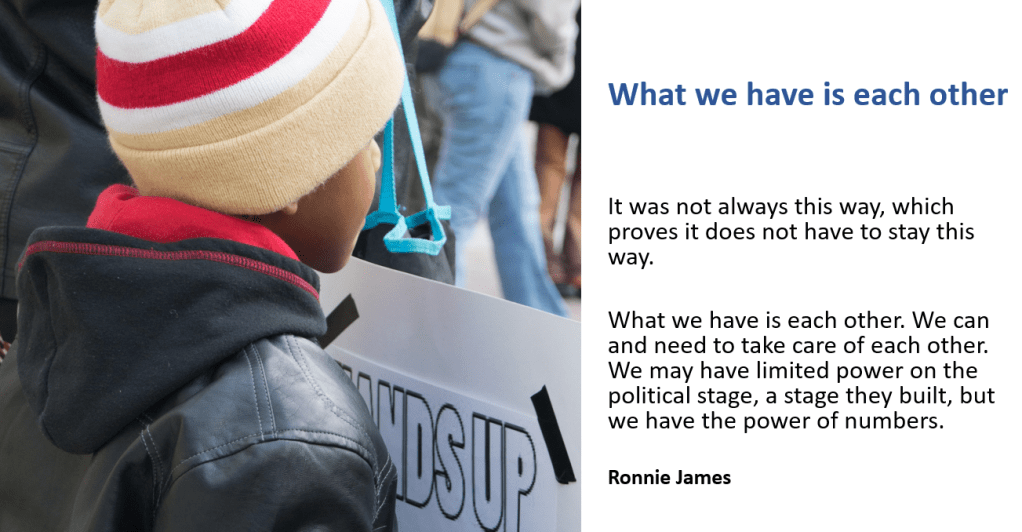
    • Friends are unaware of their ancestors’ settler colonization, including the theft of native lands. Many Friends don’t believe the land they occupy today is stolen land.
    • Unaware of the ongoing crisis of Missing and Murdered Indigenous Relatives. And how this is tied to the construction of fossil fuel pipelines.
    • Just becoming aware of Friends’ involvement with the forced assimilation of native children. Of the many forms of abuse and deaths of thousands of children at those institutions.
    • Friends often don’t have the depth of spiritual awareness of all our relations that we can learn from Indigenous peoples.
  • Structural violence is embedded in the social and economic systems that produce and maintain inequalities and injustices. It is often invisible or rationalized by the dominant groups that benefit from it.
  • Symbolic violence is a form of power exerted through cultural and symbolic means rather than direct physical force. It reinforces social hierarchies and inequalities by imposing the norms and values of the dominant group on the subordinate group. It is often unconsciously accepted by both parties and can be expressed through various practices such as language, representation, body language, and self-presentation. The concept was developed by sociologist Pierre Bourdieu.
    • This is a significant reason why Friends need to support and create Mutual Aid communities which address these very injustices related to symbolic violence.
    • This makes me more aware that Mutual Aid is an expression of nonviolence.


MLK understood — or would have — that all the following things are forms of violence. People forced to “crowdfund” healthcare — to beg their neighbors for pennies for medicine. A workplace culture where being abused and berated by your boss is totally normal. Incomes not rising for half a century — while costs skyrocket to absurd levels. The average American dying in debt. Being forced to choose between healthcare and your life savings. Having to give up your home because you want to educate your kids.

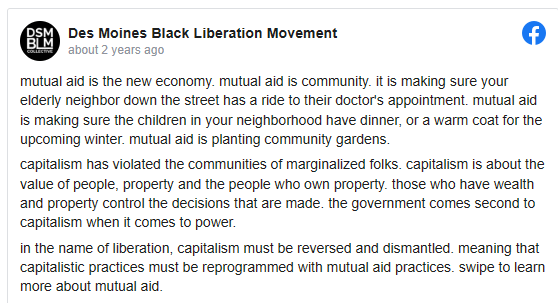
All these things are forms of violence. Violence runs deep. It isn’t just mobs of fascists smearing feces on the walls — though it is also that. It’s what Americans do to one another as everyday interaction — and shrug off as normal. Mental, emotional, social, cultural violence makes up the very fabric of everyday American life. It’s the poisonous residue of slavery. And it’s profoundly traumatic. It has lacerated the American mind, and made violence a legitimate solution to every social problem. But these forms of all-pervasive violence are what a capitalist society is limited to, because everything is competition, rivalry, and ultimately, domination and subjugation.
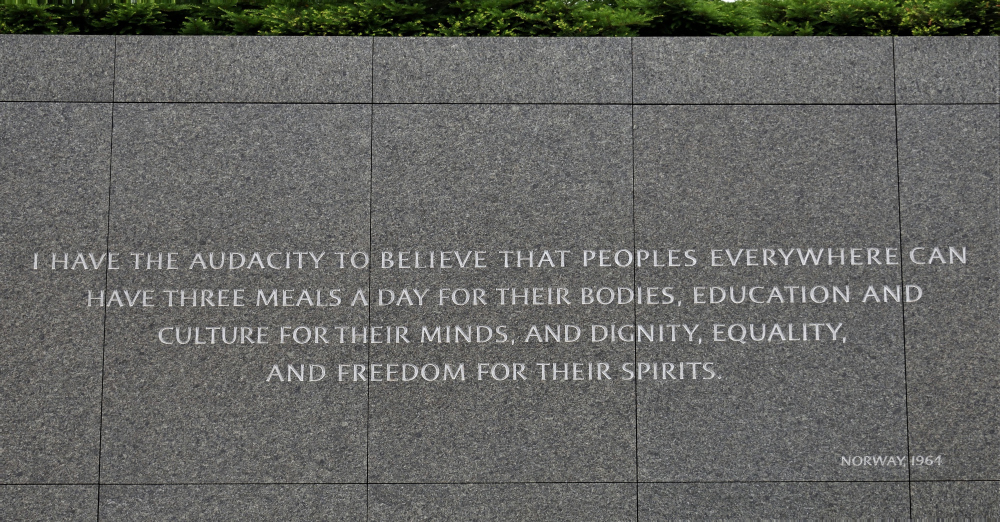
Americans Don’t Understand What Violence Really Is by umair haque, Eudaimonia and Co, January 17, 2022

This lack of diversity has numerous consequences

  • Excluding or marginalizing people who do not fit the dominant norms or expectations of Quaker culture
  • Limiting the perspectives and experiences that inform Quaker discernment and action
  • Missing out on the richness and joy of learning from and celebrating differences
  • Failing to live up to the Quaker testimonies of equality, peace, and justice

For a long time, I had prayed that my Quaker community would engage with communities like my Mutual Aid community, thinking that would be mutually beneficial. But the clashes and the lack of lived experience with diverse communities of many White Friends have changed that. Now, I feel I need to protect my justice communities from the injuries they would experience from White Friends. It’s not that White Friends wouldn’t try to do what they thought would be helpful, but their lack of knowledge of oppression always results in harm.

For years, I’ve envisioned Quakers and oppressed people working together. But we (White Quakers) have to have enough experience in communities outside our meetinghouses to understand what is happening in these communities. To have a valid perspective. Until that happens, Friends will show they cannot be trusted, and we will be unable to cross the divide.

Over the years I’ve built this list of things I’ve learned from my experiences. I hope White Friends who haven’t yet had experiences outside their meetinghouse would keep these things in mind.

By far the most important is to not offer suggestions until the community trusts you enough to ask you for your input. When you are invited to do so, speak from your own experience. Do not talk about things in the abstract. It’s perfectly fine to say you don’t know the answer to a question. This honesty, this vulnerability is crucial. I like to keep in mind “we don’t know what it is that we don’t know.”

Time

It will take much longer than you expect to see this trust begin to develop. I’d been involved with the Kheprw Institute in Indianapolis for three years before I was asked to teach the kids there about photography.


Quakers are pretty white, and that comes with quite a bit of power and privilege. A Quaker in Omaha, Nebraska is going to have probably more weight in what they say to a legislator than a Black Lives Matter activist in Brooklyn, New York. I think there’s a need for Quakers to step out of their meeting and away from a lot of these phenomenal institutions that they’ve created and speak to individuals in an interfaith setting (from Black churches or Black Lives Matter) and have a cross-cultural understanding of what that experience is like because you’ll find that it’s very different, and I think the more we can do of that the more effective we’ll be in addressing these problems. These exchanges and fusion coalitions are what I think it’s going to take, not only for Friends to be effective in dismantling these systems of racism, classism, and white supremacy in American society, but also for all of us to better address these problems in our country.

José Santos Woss (FCNL), Quaker Faith and Justice Reform, QuakerSpeak video

This is another graphic I’ve been working on for years to put things in context.

International Day of Peace

September 21 is the International Day of Peace.

Each year the International Day of Peace (IDP) is observed around the world on 21 September. The UN General Assembly has declared this as a day devoted to strengthening the ideals of peace, through observing 24 hours of non-violence and cease-fire. Never has our world needed peace more.

This year’s theme is Actions for Peace: Our Ambition for the #GlobalGoals. It is a call to action that recognizes our individual and collective responsibility to foster peace. Fostering peace contributes to the realization of the Sustainable Development Goals (SDGs) and achieving the Sustainable Development Goals will create a culture of peace for all.

2023 Theme Actions for peace: Our ambition for the #GlobalGoals


For some time the Spirit has been calling my attention to peace in many different ways.

  • I was led to take the photo below of the peace symbol on a coffee mug
  • I’ve been concerned but not surprised to learn of the heavy military recruitment of teens in public schools today
  • That made me turn my attention to conscientious objection. I discovered my Quaker meeting, Bear Creek Friends, had done significant work on conscientious objector counseling years ago. I had not known about that because I was living in Indianapolis at that time
  • I’m thinking of the stories my late friend, Iowa Quaker Don Laughlin collected, Young Quaker Men Facing War and Conscription. Some of the topics in that document include:
    • Richmond Anti-Draft Declaration of 1948 Advices on Conscription and War
    • 1968 Richmond Declaration on the Draft and Conscription that I was involved in writing
    • Don Laughlin and Roy Knight were among those who wrote and signed An Epistle to Friends Concerning Military Conscription
    • My story about my struggles to become a draft resister
    • My Scattergood School classmate’s story of his imprisonment for draft resistance: The Barrett Family’s Peace Testimony by Daniel Barrett
    • The Moral Integrity of Muhammid Ali
  • I remember the day of the National Moratorium to End the War in Vietnam, October 15, 1969, when the entire student body of Scattergood Friends School had a peace march from the school to the University of Iowa (about twelve miles) to participate in actions there
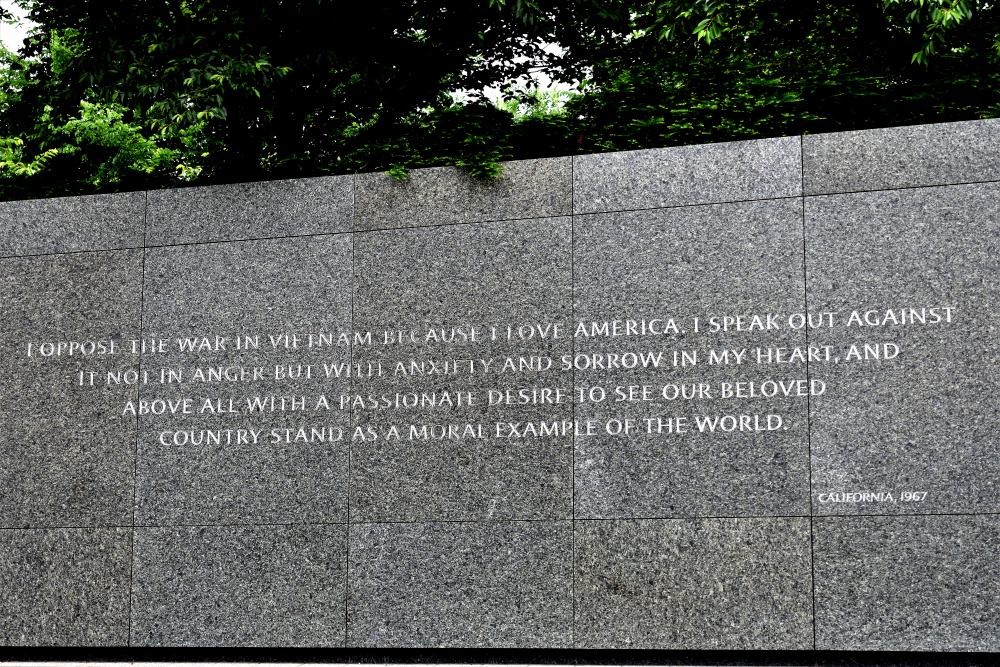
  • I’m reminded of Martin Luther King’s brave stance against the Vietnam War despite objections from his community
  • I was led to read the wonderful book Don’t Think Twice by Alison Lohans, which is a novel about the peace activities of a family set in the time of the Vietnam War. Alison and I have exchanged messages about this.
  • Yesterday, during our weekly Friends Committee on National Legislation (FCNL) Witness Wednesday Silent Reflection we considered the following prompt and query.
  • During my three years of experience with Des Moines Mutual Aid, I’ve become MUCH more aware of the internal war of the state against us.

FCNL’s Witness Wednesday Silent Reflection 9/20/2023

Prompt

“If, however, the peace testimony is the outward evidence of God’s work among us, then committing to it will lead us into prayerful sacrifice and radical solidarity with victims of violence. The cause of peace will encourage us to take unpopular stands for unpopular causes, because our faith is in a God who does not allow us to use violence even for a noble cause. We will be led to share our faithfulness to the Lamb and His war in a spirit of love and humility, inviting others into a new way of living.”

–Adria Gulizia, “Do Friends Still Need the Peace Testimony?” (Aug. 2022)

Query: How do you live a commitment to peace? How do you invite others into a new way of living?


I don’t know why I was prompted to take this photo of a coffee cup yesterday

An Epistle to Friends Concerning Military Conscription

Dear Friends,

It has long been clear to most of us who are called Friends that war is contrary to the spirit of Christ and that we cannot participate in it.  The refusal to participate in war begins with a refusal to bear arms.  Some Friends choose to serve as noncombatants within the military.  For most of us, however, refusal to participate in war also involves refusal to be part of the military itself, as an institution set up to wage war.  Many, therefore, become conscientious objectors doing alternative service as civilians, or are deferred as students and workers in essential occupations.

Those of us who are joining in this epistle believe that cooperating with the draft, even as a recognized conscientious objector, makes one part of the power which forces our brothers into the military and into war.  If we Friends believe that we are special beings and alone deserve to be exempted from war, we find that doing civilian service with conscription or keeping deferments as we pursue our professional careers are acceptable courses of action.   But if we Friends really believe that war is wrong, that no man should become the executioner or victim of his brothers, then we will find it impossible to collaborate with the Selective Service System.  We will risk being put in prison before we help turn men into murderers.

It matters little what men say they believe when their actions are inconsistent with their words.  Thus we Friends may say that all war is wrong, but as long as Friends continue to collaborate in a system that forces men into war, our Peace Testimony will fail to speak to mankind.

Let our lives speak for our convictions.  Let our lives show that we oppose not only our own participation in war, but any man’s participation in it.  We can stop seeking deferments and exemptions, we can stop filling out Selective Service forms, we can refuse to obey induction and civilian work orders.  We can refuse to register, or send back draft cards if we’ve already registered.

In our early history we Friends were known for our courage in living according to our convictions.  At times during the 1600’s thousands of Quakers were in jails for refusing to pay any special respect to those in power, for worshiping in their own way, and for following the leadings of conscience.  But we Friends need not fear we are alone today in our refusal to support mass murder.  Up to three thousand Americans severed their relations with the draft at nation-wide draft card turn-ins during 1967 and 1968.  There may still be other mass returns of cards, and we can always set our own dates.

We may not be able to change our government’s terrifying policy in Vietnam.  But we can try to change our own lives.  We must be ready to accept the sacrifices involved if we hope to make a real testimony for Peace.  We must make Pacifism a way of life in a violent world.

We remain, in love of the Spirit, your Friends and brothers,

Don Laughlin Roy Knight Jeremy Mott Ross Flanagan Richard Boardman James Brostol George LakeyStephen Tatum Herbert Nichols Christopher Hodgkin Jay Harker Bob Eaton Bill Medlin Alan & Peter Blood

We organized a draft conference at Scattergood Friends School in 1969