The Friends Committee on National Legislation (FCNL) is a national, nonpartisan organization that lobbies Congress for peace, justice, and environmental stewardship.
FCNL has an 80-year-old history of bringing the concerns of Quakers and Quaker meetings to the US Congress. The following four principles guide this work.
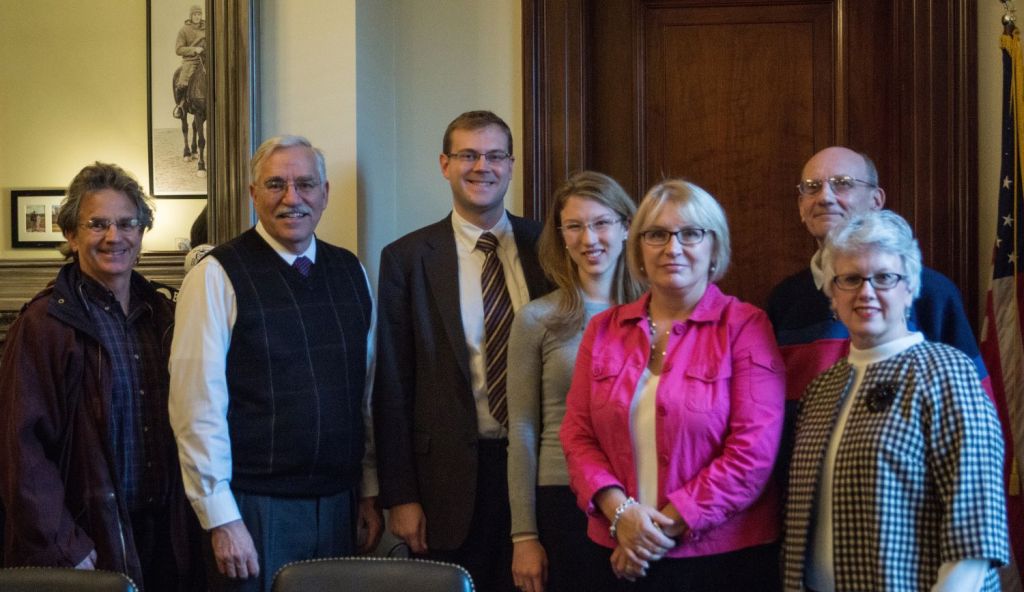
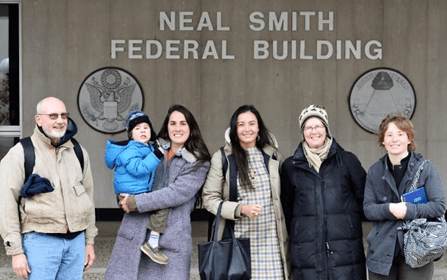
I have been blessed to be involved in the work of FCNL in a number of ways over the years. For nine years I was a member of the General Committee, which meets annually to help determine what priorities FCNL’s lobbyists should bring to Congress. One of the unique aspects of FCNL’s approach is to train Quakers and others how to lobby Congress themselves. I’m second from the right at this visit to a Congressperson’s office.
Training sessions for FCNL Advocacy are provided online monthly. The next session will be January 18, 2024. You can register here: Intro to Advocacy with FCNL
Following are several updates I’d like to share about FCNL’s work.
Join FCNL’s Lauren Brownlee and Zenaida Peterson, both members of the Steering Committee of the Quaker Coalition for Uprooting Racism, online for Pendle Hill’s First Monday lecture on Jan. 8, 2024.
Members of the Steering Committee of the Quaker Coalition for Uprooting Racism believed they had a responsibility to name the pain from patterns of white supremacy culture and racism that they have experienced, witnessed, and heard throughout the Religious Society of Friends and associated organizations. To that end, they created a guide with examples of harm and interventions towards racial justice. This guide, inspired by the work of Tema Okun and several Quaker institutions, points to the ways that they see white supremacy culture weaving its way into Quaker culture and suggests methods to disrupt it.
In this lecture, Lauren Brownlee and Zenaida Peterson will share ways that the guide has been and can be used in Quaker communities.
FCNL hosts a Virtual Witness Wednesday Silent Reflection. This event is in line with the Quaker practice of silent worship. It’s an opportunity for participants to join virtually via Zoom or by phone for a period of shared reflection.
I’ve been attending Witness Wednesday for several years, (including yesterday) and find it to be a powerful way to reflect on faith, peace, and justice work. I highly recommend it. Simply use this link to attend online any Wednesday at 4:15 pm Central time. http://fcnl.org/ww-stream
Spring Lobby Weekend brings hundreds of young adults to Washington, DC, where they learn about a specific issue, and then actually go to their Congressional offices to lobby related to that issue.
Several years ago my good friend Rezadad Mohammadi attended one spring lobby weekend. The next year he organized a group of fellow students at Simpson College to attend, successfully obtaining funding from the College to help with expenses. If you know of young adults who might be interested, please share this with them.
In March 2024, hundreds of young adults will gather again for Spring Lobby Weekend—our young adult advocacy conference and day of action. This year, we’ll be lobbying Congress to address the harmful legacy of the Indian Boarding School era.
We know that our strength comes from the stories we tell and the community we build, so we hope that you will join us March 16-19, 2024—in Washington, D.C. or online—to advocate for change!
Please check this page for more updates in the coming weeks. If you are not already signed up for our Young Adult Program updates, please sign up here to receive emails about Spring Lobby Weekend 2024.
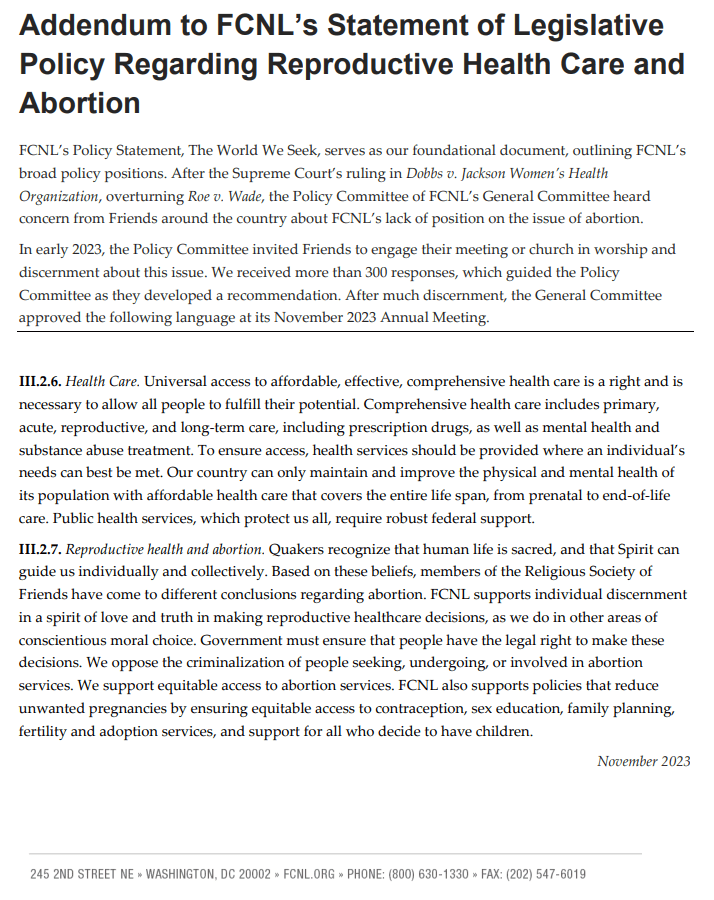
In an example of how FCNL engages with Quaker communities in this country, FCNL asked Quaker meetings about their views regarding reproductive health and abortion. This came about because there are different beliefs about abortion among Quakers, so FCNL did not have a policy related to that. But with the recent national debate about abortion, FCNL asked Quakers to share what they thought about this issue today. Following is the statement that came out of this national discussion among Quakers.
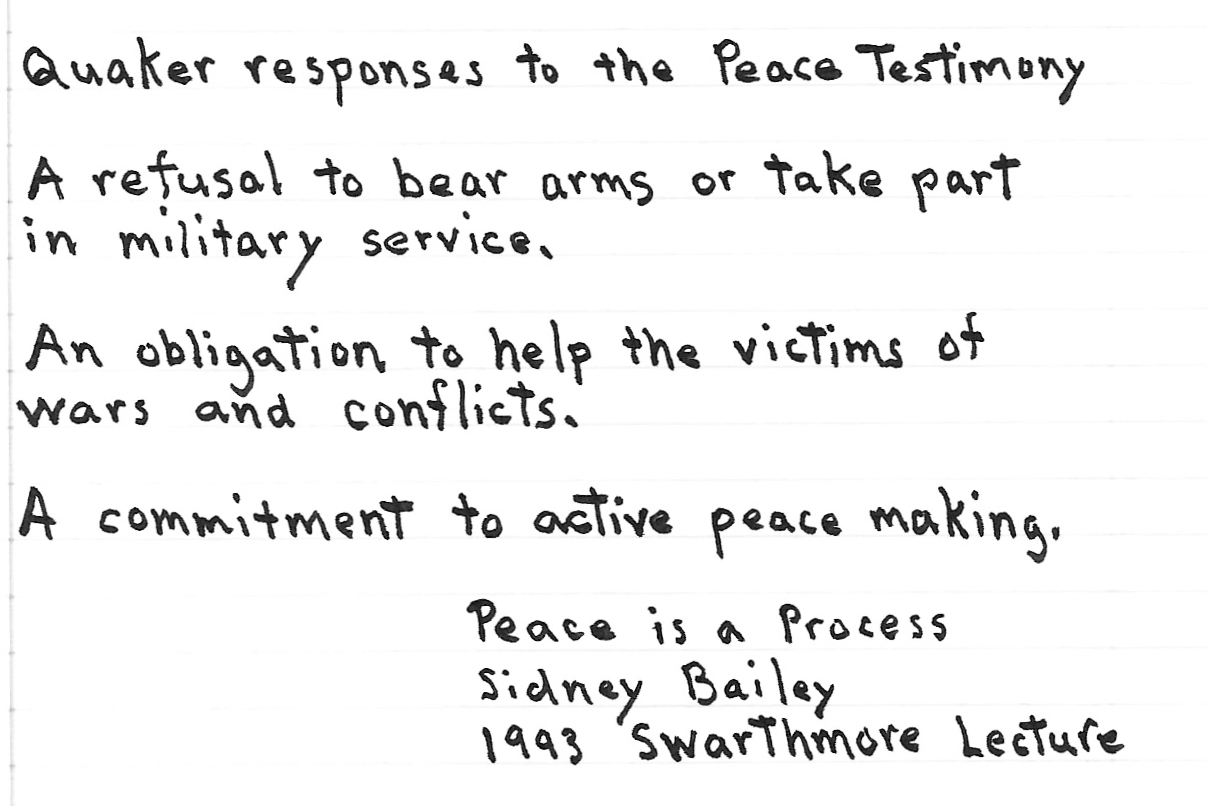
Working for peace has always been a fundamental belief among Quakers. “We seek a world free of war and the threat of war” is one of the guiding principles of FCNL.
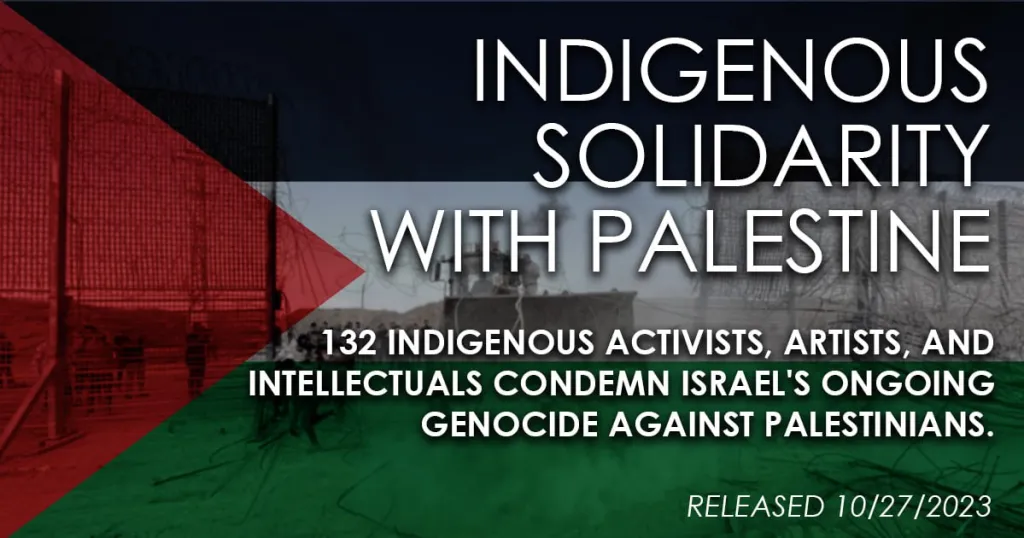
We are heartbroken by the violence in Israel and Palestine. As Quakers, we deeply mourn the loss of all lives and pray for those who have lost loved ones due to this latest escalation. We unequivocally condemn Hamas’ attacks and inhumane treatment of civilians and call for the release of all hostages. We also condemn Israel’s indiscriminate bombing of Gaza that has claimed thousands of civilian lives. More war and weapons won’t bring peace. In the face of growing violence, lawmakers must push for a permanent ceasefire and address the root causes underlying this explosion of violence.
As we bear witness and lobby in solidarity with Native Americans, we also honor the Nacotchtank tribe on whose ancestral land the FCNL, FCNL Education Fund, and Friends Place on Capitol Hill buildings stand. They are also known as the Anacostans, the Indigenous people who lived along the banks of the Anacostia River, including in several villages on Capitol Hill and what is now Washington, D.C. By the 1700s, the Nacotchtank tribe had merged with other tribes like the Pamunkey and the Piscataway, both of which still exist today.
Glory to God in the highest, and on earth peace, good will toward men.
Luke 2:14
I am deeply distressed by the dichotomy between ‘peace on earth, good will toward men’ and the blatant opposition to that by the forces of global dominance. I cannot fathom the massacre in Gaza and the silence of the people in this country. The overwhelming majority of people in other countries are not silent.
This has been the pattern that began when the Europeans landed. The enslavement of those brought here from Africa continues with economic injustice and mass incarceration. White settler colonialism continues as Indigenous lands remain occupied today.
The rapid rise of authoritarianism is the next stage of dominance over us all.
The silence is astounding.
That silence is ruthlessly enforced, not only against opposition to war but also for the rape of Mother Earth. Or for a reckoning about past injustices such as the Indian schools of forced assimilation or structural racism.
I told my Quaker meeting I have this sense of being threatened by simply writing about these things. Which is proof that authoritarianism is working. Quelling dissent. I wonder if I might be imprisoned one day.
All we are saying is give peace a chance.
John Lennon
The message of Christmas has traditionally involved prayers for goodwill toward all and “peace on Earth,” but through their opposition to ceasefire in Gaza, most Western Christians are affirming the opposite values: that violence, weapons and destruction are the only response to real and perceived enemies.
The U.S. Christian Palestinian communities that I am a part of are truly puzzled at the behavior of the many Western Christians who seem to see no dissonance between the message of love and peace that is at the heart of our shared religion, and their backing for Israeli’s military assault against Palestinian civilians, which has killed more than 20,000 people in Gaza alone within the last three months.
Anytime an attack occurs, or lives are lost, we are called to choose between two worldviews in our response. One worldview holds that violence, bombings and brutal force is the only method available and should be pursued relentlessly until the enemy is vanquished, regardless of the cost in lives and destruction for civilians on both sides.
But an alternative worldview insists on the way of peace, reconciliation, justice and tolerance.
United States diplomats once again held up a vote on a watered-down United Nations Security Council resolution on Wednesday aimed at bringing more aid and relief to civilians in the besieged Gaza Strip as reports of starvation, mass killings, and other war crimes allegedly committed by the Israeli military continue to pile up.
Despite massive international support for a ceasefire at the UN, on December 8, the U.S. blocked a previous attempt by the Security Council to leverage international law and secure a humanitarian ceasefire so more aid can enter Gaza.
whitewash: deliberately attempt to conceal unpleasant or incriminating facts about (someone or something):
Sadly, but importantly, white settler colonists such as me are learning a great deal about the genocide of native peoples, in large part facilitated by the institutions of forced assimilation. Sometimes referred to as Indian boarding or residential schools, though school is a misnomer, an example of whitewashing. The remains of thousands of native children are being located on the grounds of these institutions in this country and Canada.
My friends at the Great Plains Action Society provide the following messages and resources related to Truthsgiving. The pledge to reject colonial holidays that perpetuate dangerous stereotypes and whitewashed history is included below.
The following was written by my friend Ronnie James.
Doing Truth When The World Is Upside Down
To walk a path of Doing The Truth is a battle with a very young culture. Telling the truth is comparably easy, we have our oral histories, art and traditions created and carried on, histories printed by those that found a way to the presses. We can recount the stories and lessons that survived colonialism.
But to do the truth, to live a life that enforces what we once had, a life and culture that made a millennia of humanity possible to thrive, is to be at war with what has defined and destroyed this world for too long.
We, those that conspire to live the truth, have chosen to honor our histories of cooperation. We know, with all that we have, that a world of competition and conquest is the opposite of how we gained the knowledges that propelled our abilities to create the sciences and the art and architecture of beautiful societies that our ancestors built, and we draw our strength from that to continue, to create, a world our future generations can thrive in.
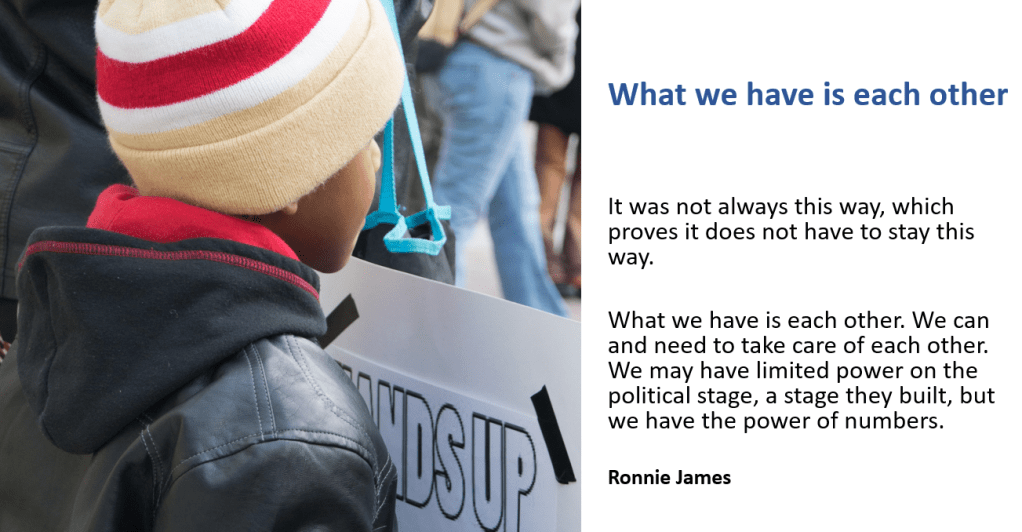
It has only been a very short time that the world has been this way, which is the proof that it doesn’t have to stay this way.
On November 26, Great Plains Action Society organized a webinar to educate folks about the mythology of Thanksgiving and celebrate the spirit of Truthsgivng by reporting on the many ways that one can resist colonial-capitalism and whitewashed history through the revolutionary act of mutual aid and truth-telling.
Take the Pledge
Truthsgiving, Day of Mourning, Anti-Thanksgiving Resources
“The following resources are available so that folks can learn more about Indigenous perspectives on Thanksgiving, the land they live on, how to be a good ally, and how they can decolonize their minds in order to abolish personal and institutionalized white supremacy.” https://www.truthsgiving.org/resources
Today there is a lot of attention on what were called the Indian Boarding Schools in the U.S. and Canada. This is in large part because of the uncovering of remains of children on the grounds of many of those institutions using ground-penetrating radar. These searches began in order to document the known history of native children dying or being killed at these schools. Thousands of remains have been found, and the searches continue.
Stories about this are beginning to be told in many mainstream news articles, films, and books.
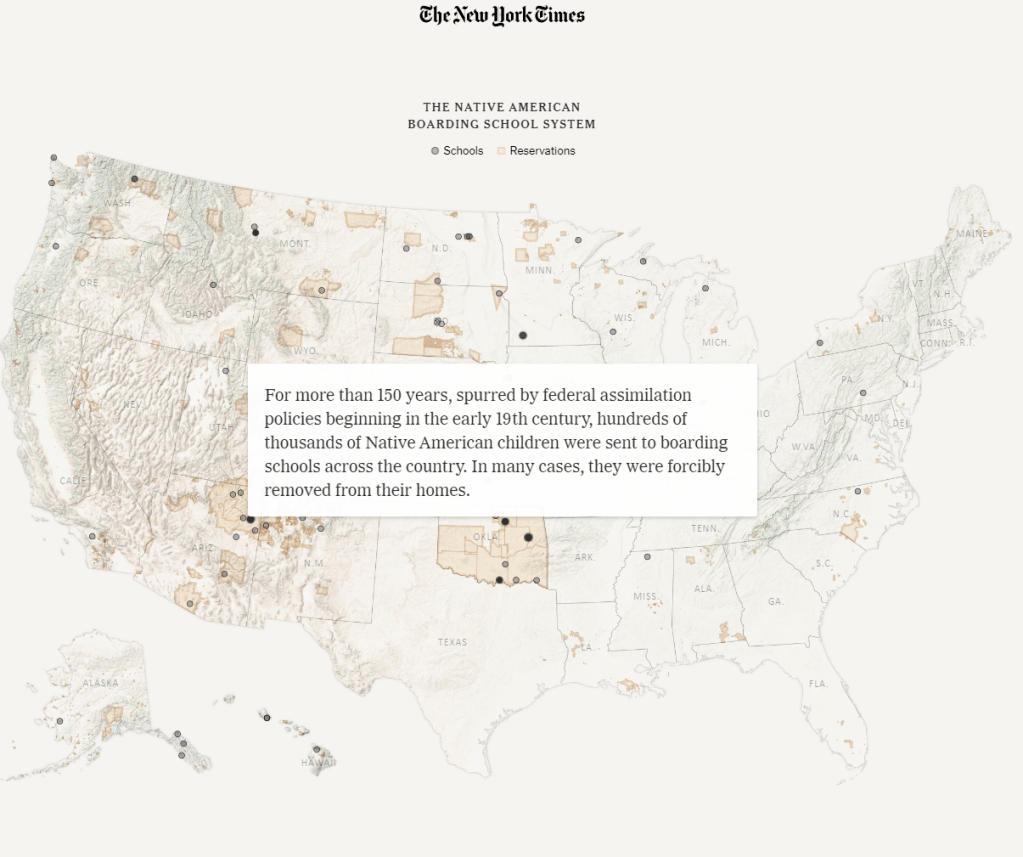
The New York Times recently published this extensive multimedia story, ‘WAR AGAINST THE CHILDREN’. The Native American boarding school system — a decades-long effort to assimilate Indigenous people before they ever reached adulthood — robbed children of their culture, family bonds and sometimes their lives. By Zach Levitt, Yuliya Parshina-Kottas, Simon Romero and Tim Wallace, The New York Times, Aug. 30, 2023
The Department of the Interior is investigating under the leadership of Secretary Deb Haaland, an enrolled member of the Laguna Pueblo.
Quaker Indian Boarding Schools
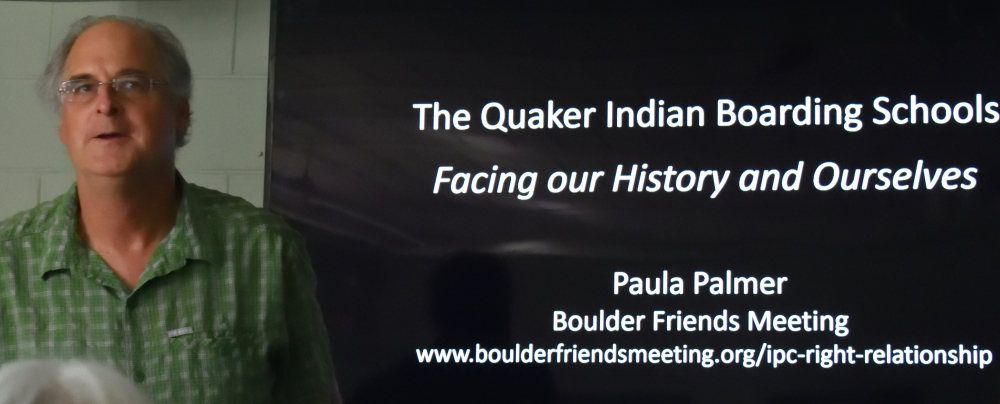
This is causing a lot of soul-searching in Quaker communities because some of those institutions were run by Quakers. My friend Paula Palmer published the articleQuaker Indian Boarding Schools. Facing Our History and Ourselves, in Friends Journal, October 1, 2016
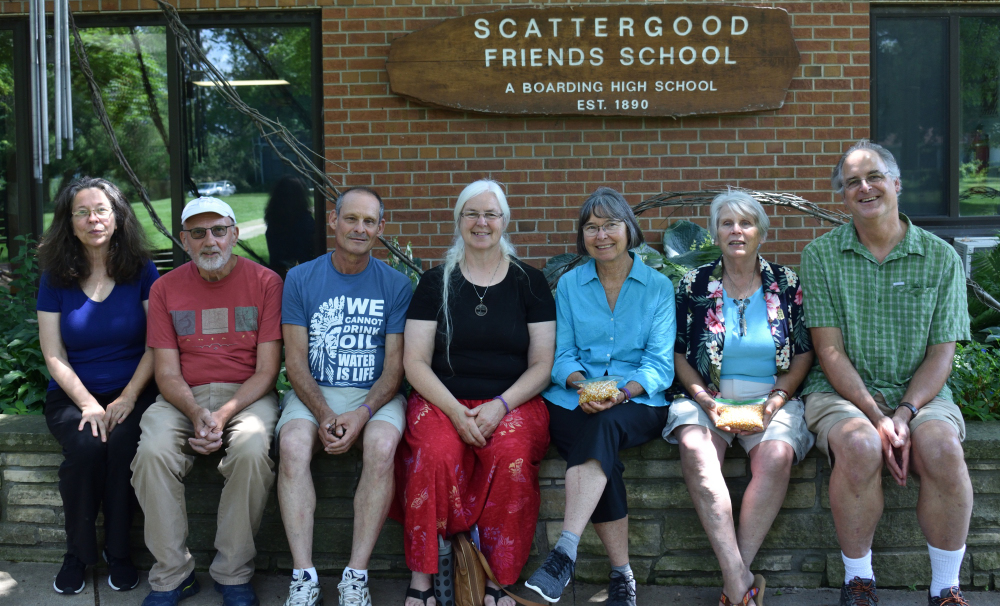
In this image at Scattergood Friends School are those of us who helped Paula Palmer (third from the right) give presentations and workshops related to her work,Toward Right Relationship with Native Peoples.
I’ve sought opportunities to find ways to build relationships with Indigenous people because we cannot begin to heal until we all come together and begin to know one another. This is a list of what I have learned from spending time in Black, Indigenous, and other people of color (BIPOC) communities. Offered in the hope that many more people begin to make these connections.
This takes a real commitment to spend a lot of time in diverse communities. Until I recently moved from Iowa, I joyfully participated in our (Des Moines Mutual Aid) free food project every Saturday morning for over three years. Over that time I heard every one of my friends say these Saturday mornings were the highlight of their week. Every person became a close friend.
This takes a real commitment to keep showing up, even when we make mistakes, which I did, and you undoubtedly will. But showing our vulnerabilities is an important part of building trust. Showing we are willing to risk awkwardness.
How do we decolonize ourselves?
During a recent discussion, a Friend asked, how do we decolonize ourselves? I believe this is one of the right questions to ask. This changes the focus from what our ancestors might have done and directs it to “what we can do now?” The question correctly begins from the point that we are colonized.
A group of North American Friends, Decolonizing Quakers explores these questions and offers resources for our education.
The Stories We Weren’t Told
Many Quakers have learned that our Quaker ancestors and predecessors had good relationships with the Indigenous peoples who were on this continent when Quakers arrived from England and other European lands. We have read about how William Penn was respectful of the Native people and offered to pay “rent” for the land occupied by the new settlement that became Philadelphia. We have heard about Quaker missionaries who went out to “help” Native children learn the ways of European Christians.
There are threads of truth in these stories and others that we tell ourselves, but those small threads are too weak to tie together a benign story. As we look with open eyes at the history that white, European, Christian settlers and Indigenous peoples walked through since the time of “first contact,” we can’t help but see a different picture. In truth, we must acknowledge that Quakers participated in — and sometimes led — attempts to force Indigenous people to assimilate into an inflexible mold that fit the vision that Quakers shared with other white, European, Christian settlers.
This website offers resources to help all of us set aside the myths that come between us — as settlers and Indigenous peoples –and to find joy in knowing all our relatives better and more honestly.
A fundamental part of the answer to how we can decolonize ourselves is to understand that colonization is a hierarchy of power. In the simplest terms, in our society, White supremacy. To decolonize ourselves, we must work to eliminate hierarchies and their resulting power structures.
It was a leading of the Spirit that connected me with Ronnie James, an Indigenous organizer who is part of the Great Plains Action Society (GPAS) nearly four years ago. His work on Mutual Aid is supported by GPAS. Mutual Aid is a key method of the Great Plains Action Society’s Mechanism of Engagement. (https://quakersandreligioussocialism.com/mutual-aid/)
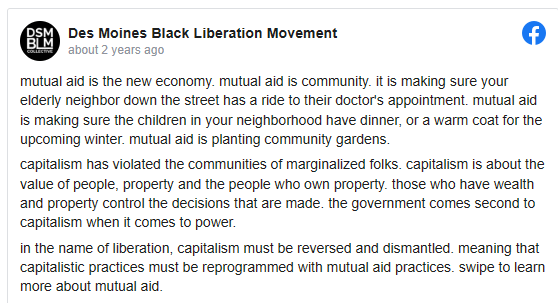
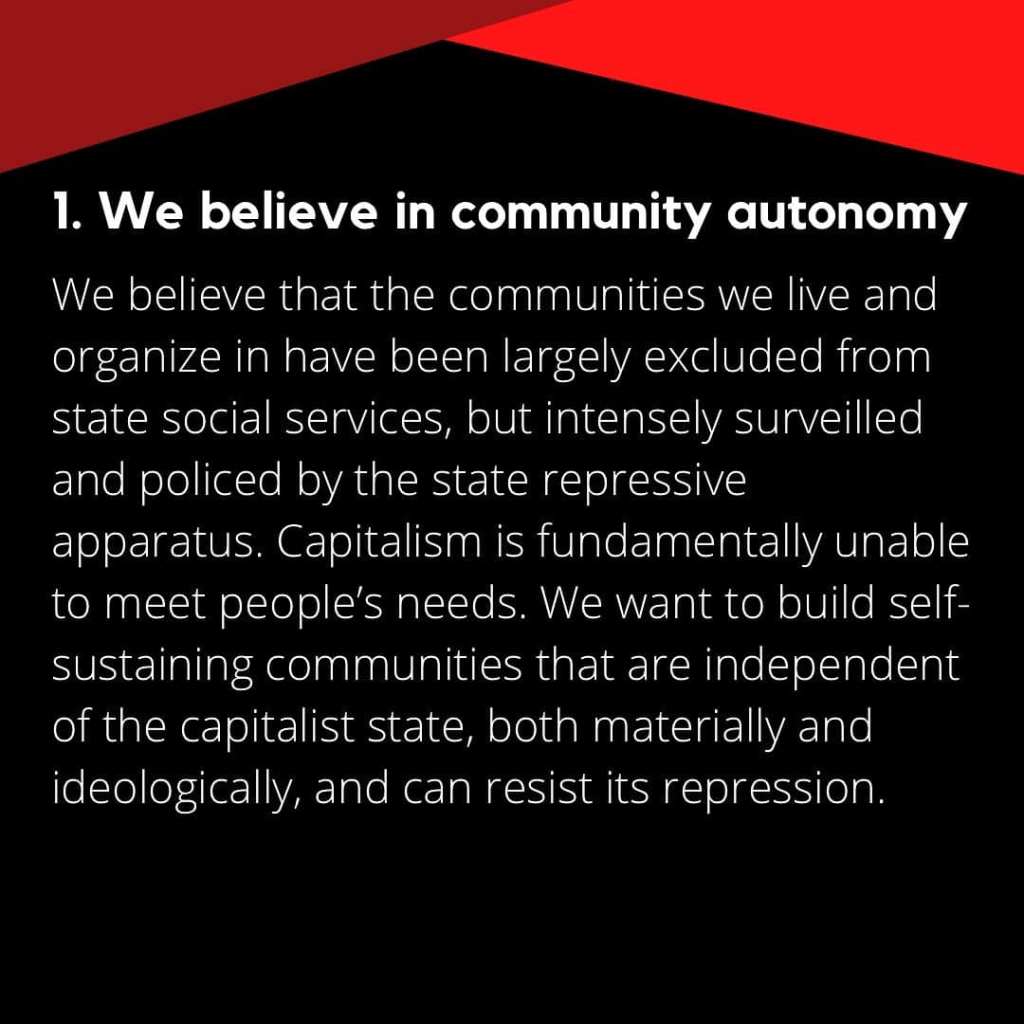
There is often a tepid response when I talk about Mutual Aid. The key to understanding the radical nature of Mutual Aid is showing this is not just another social justice idea. Mutual Aid is a fundamentally different way to live and relate to each other. There are hierarchies in even the most progressive organizations. Which means they perpetuate dominance, which leads to oppression.
Mutual Aid is a total break from that. It is a revolutionary way to be.
In the Midwest you can find information on the Iowa Mutual Aid Network website: https://iowamutualaid.org/
A taboo against a subject or activity is a social custom to avoid doing that activity or talking about that subject, because people find them embarrassing or offensive.
I got to the part where he began to explain why it is taboo to talk about our civilization’s meltdown.
You see, right now, at this juncture in human history, a New Set of Taboos have emerged. Taboos exist for a reason—to hide truths we’d rather not see the light of day, because they’re too uncomfortable, painful, shameful, difficult, or challenging. As we do that, social bonds rupture. And so taboos, while they hide Issues that We Have to Face, do so precisely because they keep our tribes and hierarchies intact. There’s a form of short-term stability in them, even if the price, over the long-term, is steep, as it has been for so many civilizations before us.
What are the New Taboos of the Age of Extinction? Well, we’re not supposed to discuss How Bad Things Really Are. In what way? In almost any way. Economically—how our economies are sputtering out. Hey, billionaires are getting richer! Whee! Socially—how predators of the human soul and body both are skyrocketing to power, from abusers of women, to Manfluencers leading young men to become…abusers. How our social contracts have been ripped apart by crackpots who think nobody should have anything. Biologically–how life on the planet is undergoing a literal mass extinction. And—hey, what exactly are we going to do about climate change, and do you think the summer a decade from now is going to…be…pretty…let alone…survivable…for many?
He goes on to describe in detail the taboos we are facing and their many profound, negative, consequences. But you get the idea as soon as it is put in the context of taboo.
Just in the last few months, high-temperature records have been broken multiple times, around the globe. Extreme drought has made it hopeless to even plant crops, which means famine will be increasing. Water supplies for cities and states are drying up. Out-of-control wildfires pollute the air for hundreds of miles. Prices of everything are skyrocketing at the same time many people are losing their jobs to automation and artificial intelligence.
To talk about police brutality. Prisons that function to remove Black men and women from society. Structural racism.
The party in control of the US Congress is nonfunctional. The President of the other party is war-mongering. The expansion of NATO increases the threat felt by Russia. We are pouring billions of dollars into Ukraine as a proxy for this country’s war machine. It is taboo to point out that a small fraction of the military budget could completely fund all social programs.
It is taboo to talk about the rapid rise of Authoritarianism.
It is taboo to even talk about the theft of land from Indigenous peoples, the epidemic of Missing and Murdered Indigenous relatives, and the horrors of the institutions of forced assimilation of native children.
And just now the widening war in the Middle East. It is taboo to even suggest Israel’s policies of apartheid had anything to do with that.
In our Quaker communities, it is taboo to talk about continued racism, involvement with the Indian boarding schools, the abolition of police and prisons, or allowing conveniences to stop us from confronting our use of fossil fuels. To suggest there is anything wrong with capitalism and hierarchies of power.
The minute you even start talking about any of this stuff seriously? Repeatedly? Urgently? You’re met with the Greatest Wall in Human History. It’s not made of bricks or stone. But of something far stronger. Hegemony and ideology. Power. Conformity and social pressure
Diversity can refer to many things, such as race, ethnicity, gender, sexuality, class, age, ability, and faith background. Both the state of Iowa and our Quaker meetings in the Midwest have very little racial and other types of diversity. This does not reflect the diversity of the wider society nor the diversity in Quaker history and values.
Reasons why Friends need to confront their lack of diversity now
This is a topic that generates significant emotional reactions for numerous reasons. Perhaps one of the most basic is knowing we are not doing what our ancestors had done, what they would probably be doing if alive today.
If we are converging on history and practice, we are missing the point. If we are depending on institutions to create a new society or usher in the Kingdom, then we are deceived. These will not bring the radically egalitarian and Spirit-filled communities that God fostered among early Friends. These are forms, and Friends must follow the Spirit.
I’ve met others who need a Spirit-led Society. We share this vision, and we share the disappointment of being drowned out in meeting by classism, ageism, and racism. Some of us wonder if Quakerism isn’t all that different from the rest of liberal religion. From what we’ve seen, it isn’t apocalyptic. It isn’t radical. It doesn’t sound like Fox or look like Jesus. It works at incremental transformation while simultaneously shushing those who need the system overthrown.
Hye Sung Francis, Seeking a People
Many of our Quaker meetings are small and growing smaller.
A significant number of Friends are elderly
We are failing to attract new members
Members are leaving their (Quaker) meetings because
Their justice work is not understood or supported
They see the harm done to Black, Indigenous, and other people of color (BIPOC) in their meetings.
They are frustrated by the meeting’s lack of understanding and involvement around their privilege
And the lack of engagement and support for BIPOC communities.
Many meetings fail to engage with justice groups that are doing good work, such as Mutual Aid communities.
Friends need to engage with Indigenous peoples now
For truth and healing related to Friends’ involvement with the institutions of forced assimilation
Most White Friends fail to understand their privileges and the consequences.
There are a range of justice activities by (Quaker) meeting members. Much of that relates to Friends’ long history of opposing war and violence. But because of our lack of diversity, we fail to understand many other significant and often insidious forms of violence, such as sexual, emotional, psychological, spiritual, cultural, verbal, economic, symbolic, and gender-based violence.
Most male Friends are unaware of gender inequality and violence.
Much of what passes for justice work are committee meetings, political letter writing, and financial support of Quaker justice organizations such as the Friends Committee on National Legislation and the American Friends Service Committee. That is not enough.
Lack of connections with Indigenous peoples is a significant problem for Friends today.
Friends are unaware of their ancestors’ settler colonization, including the theft of native lands. Many Friends don’t believe the land they occupy today is stolen land.
Unaware of the ongoing crisis of Missing and Murdered Indigenous Relatives. And how this is tied to the construction of fossil fuel pipelines.
Just becoming aware of Friends’ involvement with the forced assimilation of native children. Of the many forms of abuse and deaths of thousands of children at those institutions.
Friends often don’t have the depth of spiritual awareness of all our relations that we can learn from Indigenous peoples.
Structural violence is embedded in the social and economic systems that produce and maintain inequalities and injustices. It is often invisible or rationalized by the dominant groups that benefit from it.
Symbolic violence is a form of power exerted through cultural and symbolic means rather than direct physical force. It reinforces social hierarchies and inequalities by imposing the norms and values of the dominant group on the subordinate group. It is often unconsciously accepted by both parties and can be expressed through various practices such as language, representation, body language, and self-presentation. The concept was developed by sociologist Pierre Bourdieu.
This is a significant reason why Friends need to support and create Mutual Aid communities which address these very injustices related to symbolic violence.
This makes me more aware that Mutual Aid is an expression of nonviolence.
MLK understood — or would have — that all the following things are forms of violence. People forced to “crowdfund” healthcare — to beg their neighbors for pennies for medicine. A workplace culture where being abused and berated by your boss is totally normal. Incomes not rising for half a century — while costs skyrocket to absurd levels. The average American dying in debt. Being forced to choose between healthcare and your life savings. Having to give up your home because you want to educate your kids.
All these things are forms of violence. Violence runs deep. It isn’t just mobs of fascists smearing feces on the walls — though it is also that. It’s what Americans do to one another as everyday interaction — and shrug off as normal. Mental, emotional, social, cultural violence makes up the very fabric of everyday American life. It’s the poisonous residue of slavery. And it’s profoundly traumatic. It has lacerated the American mind, and made violence a legitimate solution to every social problem. But these forms of all-pervasive violence are what a capitalist society is limited to, because everything is competition, rivalry, and ultimately, domination and subjugation.
Americans Don’t Understand What Violence Really Is by umair haque, Eudaimonia and Co, January 17, 2022
This lack of diversity has numerous consequences
Excluding or marginalizing people who do not fit the dominant norms or expectations of Quaker culture
Limiting the perspectives and experiences that inform Quaker discernment and action
Missing out on the richness and joy of learning from and celebrating differences
Failing to live up to the Quaker testimonies of equality, peace, and justice
For a long time, I had prayed that my Quaker community would engage with communities like my Mutual Aid community, thinking that would be mutually beneficial. But the clashes and the lack of lived experience with diverse communities of many White Friends have changed that. Now, I feel I need to protect my justice communities from the injuries they would experience from White Friends. It’s not that White Friends wouldn’t try to do what they thought would be helpful, but their lack of knowledge of oppression always results in harm.
For years, I’ve envisioned Quakers and oppressed people working together. But we (White Quakers) have to have enough experience in communities outside our meetinghouses to understand what is happening in these communities. To have a valid perspective. Until that happens, Friends will show they cannot be trusted, and we will be unable to cross the divide.
Over the years I’ve built this list of things I’ve learned from my experiences. I hope White Friends who haven’t yet had experiences outside their meetinghouse would keep these things in mind.
By far the most important is to not offer suggestions until the community trusts you enough to ask you for your input. When you are invited to do so, speak from your own experience. Do not talk about things in the abstract. It’s perfectly fine to say you don’t know the answer to a question. This honesty, this vulnerability is crucial. I like to keep in mind “we don’t know what it is that we don’t know.”
Time
It will take much longer than you expect to see this trust begin to develop. I’d been involved with the Kheprw Institute in Indianapolis for three years before I was asked to teach the kids there about photography.
Quakers are pretty white, and that comes with quite a bit of power and privilege. A Quaker in Omaha, Nebraska is going to have probably more weight in what they say to a legislator than a Black Lives Matter activist in Brooklyn, New York. I think there’s a need for Quakers to step out of their meeting and away from a lot of these phenomenal institutions that they’ve created and speak to individuals in an interfaith setting (from Black churches or Black Lives Matter) and have a cross-cultural understanding of what that experience is like because you’ll find that it’s very different, and I think the more we can do of that the more effective we’ll be in addressing these problems. These exchanges and fusion coalitions are what I think it’s going to take, not only for Friends to be effective in dismantling these systems of racism, classism, and white supremacy in American society, but also for all of us to better address these problems in our country.
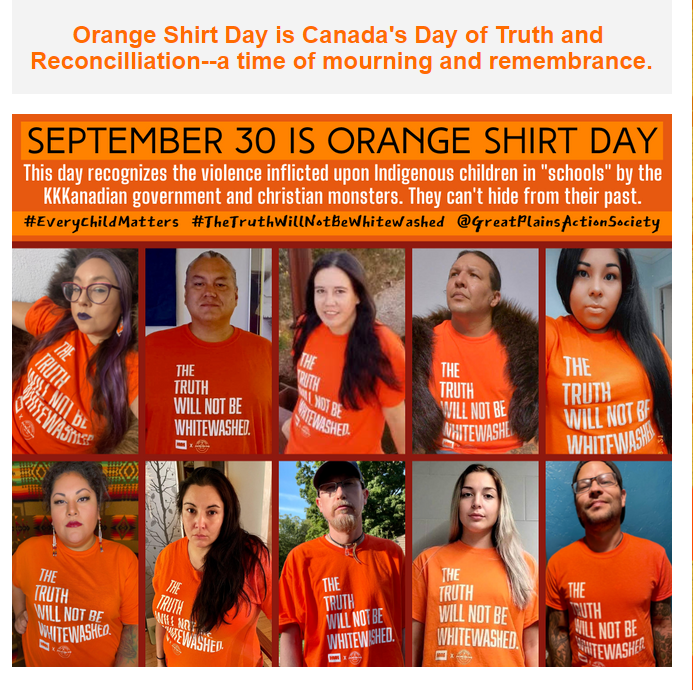
In the story below, the Great Plains Action Society (GPAS) tells what Orange Shirt Day is about. Many of my friends are in this photo. I’m wearing an orange shirt today.
Tansi Friends,
Today is September 30 – “National Day for Truth and Reconciliation,” a statutory Canadian holiday, better known as “Orange Shirt Day.” This holiday was intended to educate people and promote awareness in Canada about the Indian residential school system and the impact it has had on Indigenous communities for over a century. The use of the orange shirt is attributed to Phyllis Jack Webstad. She was sentenced to St. Joseph Mission Residential School when she was six years old. On her first day there her clothes were taken from her, including a new orange shirt given to her by her grandmother. She never saw that shirt again. The story resonated with thousands and became a symbol of the violence that Indigenous children faced in these internment camps called schools.
Recently, thousands of unmarked graves have been uncovered on the grounds of around 10 residential schools in Canada. There were over 490 residential schools (boarding schools in the U.S.) between the United States and Canada. The New York Times reported on this last summer, and while we are thankful for the coverage, it doesn’t nearly represent the pain and suffering this is causing in our community. Also, trying to quantify the number of graves that have been found is not ever going to tell the truth. The truth is that many children’s bodies will never be found as they were hidden or cremated. There were also many children that tried to run home but died of starvation or exposure. And then there are those that died from suicide and addiction because of the pain they could not overcome.
Great Plains Action Society has felt this pain firsthand, as many of our close family members attended these schools, and we are rising to meet the needs of our communities. Last year, in Sioux City, we hosted a large community feast and ceremony to honor nine children whose bodies were reMatriated back to Sicangu Oyate lands from the grounds of the Carlisle Boarding School. We have also raised funds to help one of our relatives, Curt Young, show his film, They Found Us, about the search for children’s bodies at the George Gordon First Nation. If we can raise enough funding, we would like to get his film shown throughout Iowa and the Midwest.
The Missing and Murdered Indigenous Relatives crisis largely exists because of the reprercussions of boarding schools. We have been working to support families directly impacted by colonial violence (like what was experienced in these schools) with financial support to travel to court, child care, community gatherings, and covering ceremonial/memorial expenses while continuing all of our other work, including mutual aid, political engagement action, and fighting for our earth. We are dedicated to providing whatever our community needs to grow, survive, and thrive.
Please support our work to end the MMIR crisis and help heal those affected by boarding schools (aka, internment camps for children)
Ay hai kitatamihin,
Sikowis (Fierce), aka, Christine Nobiss, she/her Plains Cree/Saulteaux, George Gordon First Nation Executive Director, Great Plains Action Society sikowis@greatplainsaction.org
In the story above, my friend Sikowis Nobiss tells about a relative, Curt Young, and his film “They Found Us.” This link is to a blog post about Iowa Yearly Meeting (Conservative)’s donation to help support the showing of this film. https://quakersandreligioussocialism.com/2023/01/29/they-found-us-2/
This is a very disturbing 3D graphic related to “They Found Us.” Moving the mouse around the image changes the perspective.
My relative, Curt Sipihko Paskwawimostos, created “They Found Us”. It’s a documentary about the search for unmarked graves at our rez, George Gordon First Nation. I hope we can bring it here to Iowa in the near future. My cousin Janna Pratt is featured in the film.
“I thought it would be important to document these searches and capture some of the stories told by members that were forced to go to these institutions. It’s a first hand look into some of the experiences survived in residential school.”
The film delves into members’ recollections along with the process towards the first ground search of Gordon Residential School before Ground Penetration Radar (GPR) in 2021. This is only the beginning…
I want to say thank you to Jeff Kisling and the Iowa Quaker community for the donation that will help get the film seen. If others would like to help support this work, hit me up.
Sikowis (Christine) Nobiss
Paula Palmer wrote an article in Friends Journal that extensively discusses her ministry related to what are called Indian Boarding Schools.
The Native American boarding school system — a decades-long effort to assimilate Indigenous people before they ever reached adulthood — robbed children of their culture, family bonds and sometimes their lives.
Beyond the vast federal system, this new list also sheds light on boarding schools that operated without federal support. Religious organizations ran at least 105 schools; many were Catholic, Presbyterian or Episcopalian, but smaller congregations such as the Quakers ran schools of their own.
Following are stories about the documentary They Found Us by Curt Sipihko Paskwawimostos who is a member of George Gordon First Nation. My friend Christine Nobiss is also a member and has been working to get funds to support the video. The documentary is about the search for unmarked graves at their rez, George Gordon First Nation.
If you click on this image, you will see a remarkable and powerful 3D image that can be moved using your mouse. In an eerie and disturbing way, you find the children.
Well my documentary They Found us got a nomination for best documentary Althens Film Freeway fest. If I win I will be put in for best movie of the year. We’re I would be going to Athens Greece for the film fest Let’s just see what happens Curt Sipihko Paskwawimostos
As described in the following letter, the project was originally for a compilation of Elder’s narratives. But during the initial interviews, the findings of the 215 bodies outside the Kamloops residential school changed the direction of the documentary. To focus on the process that George Gordon’s First Nation was undertaking related to the unmarked graves or bodies at the GGFN reserve’s residential school.
March 27, 2022
This letter in regards to a request for financial support for a documentary title “They Found Us”, to support community presentations of this film that I produced.
My name is Curt Young and I a member of the George Gordon’s First Nation. I am a descendant of Mike Longman, along with my mother Longman-Young; both members of this nation. The development of this documentary was an intent for myself to learn more about my maternal familial lineage, as I had not grown up on GGFN and wanted more connections to my cultural heritage. I applied for the “Peoples Investment Grant”, while residing in Calgary and was a successful candidate. These funds were intended to financially support a compilation of Elder’s narratives, however, during the initial interviews, the findings of the 215 bodies outside of the Kamloops residential schools, inspired myself to change the direction of the documentary. I decided to focus more on the process that GGFN reserve’s undertaking of a ground search outside of the local residential school; to see if there were any unmarked graves or bodies buried there.
Over the past year, I have made three trips to GGFN to obtain footage of the community’s initial activities related to the ground search of the area. Aside from the footage of the community, I also have compiled interviews from GGFN members, and other Indigenous people, including leaders and Elders, that have shared their own narratives and experience with residential schools. The budget that I was provided by the grant I received was allocated to travel costs associated with these trips to GGFN, along with the rental of video technological equipment, necessary to create the documentary. I have spent time and effort into producing this documentary and have been promoting it through various online platforms, along with connections I have within Indigenous communities, both urban and rural. I have much interest in public showings of this documentary, particularly since June is coming up, with it being National Indigenous Peoples month. One showing that I have confirmed is the first week of June; at Fort Calgary. Although I am quite excited for the interest and opportunities, I would like to honour my home community and acknowledge the stories that are compiled in my documentary, by having the first public showing of “They Found Us” on GGFN.
In order for myself to bring the documentary to GGFN I am requesting funds to support my travel, accommodation and honorarium for traditional drummers and possibly a dancer to create a healing and culturally safe space for a community show. My first showing that I have booked for this documentary is June 4, 2022, thus, I am asking to have funds to showcase the documentary on GGFN prior to this date.
History of involvement of Iowa Yearly Meeting (Conservative) Friends
My relative, Curt Sipihko Paskwawimostos, created “They Found Us”. It’s a documentary about the search for unmarked graves at our rez, George Gordon First Nation. I hope we can bring it here to Iowa in the near future. My cousin Janna Pratt is featured in the film.
“I thought it would be important to document these searches and capture some of the stories told by members that were forced to go to these institutions. It’s a first hand look into some of the experiences survived in residential school.”
The film delves into members’ recollections along with the process towards the first ground search of Gordon Residential School before Ground Penetration Radar (GPR) in 2021. This is only the beginning…
I want to say thank you to Jeff Kisling and the Iowa Quaker community for the donation that will help get the film seen. If others would like to help support this work, hit me up.
Sikowis (Christine) Nobiss
During the 2017 annual sessions of Iowa Yearly Meeting (Conservative) there was panel discussion about building bridges with native peoples. The panel consisted of Peter Clay, an Iowa Friend, Donnielle Wanatee from the Meskwaki Settlement, and Sikowis (Christine) Nobiss, one of the most active Indigenous leaders in the Midwest. All three have played a large role in my connections with Native Americans since.
In February 2018, I was part of a group who went to Minneapolis to protest US Bank’s funding of oil pipelines. Sikowis spoke at that gathering.
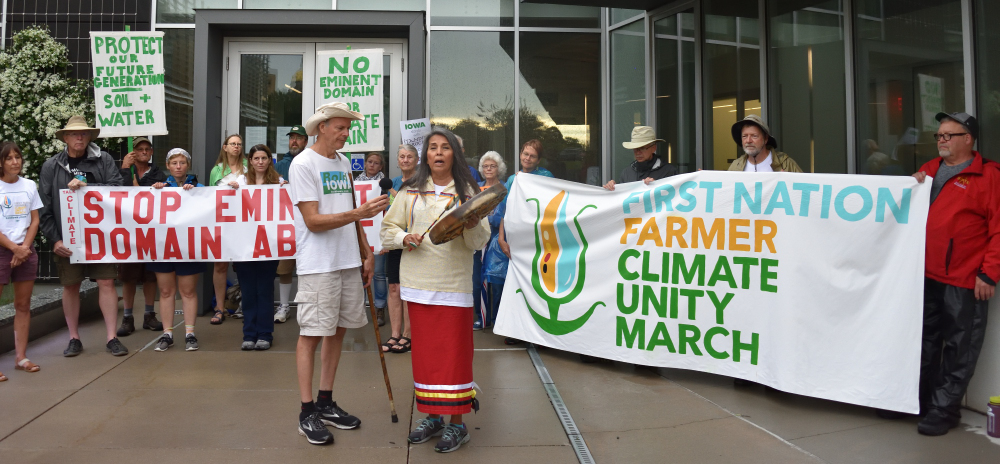
I began to get to know Sikowis when she and I were among a small group of native and non-native people who walked and camped for eight days along the route of the Dakota Access pipeline, from Des Moines to Fort Dodge, Iowa. Iowa Friend Peter Clay was also on this First Nation-Farmer Climate Unity March. Jon Krieg (AFSC) joined us for the first day. And my Scattergood School roommate Lee Tesdell participated in one of the evening discussions during the March. Another Iowa Yearly Meeting Friend, Liz Oppenheimer, organized a time of worship sharing and prayer among Friends each morning, supporting our sacred journey.
Last year I was clerk of Iowa Yearly Meeting (Conservative)’s Peace and Social Concerns Committee. The committee had a small budget to support organizations doing justice work. Last year we were led to a choice of rather than giving token amounts to a number of organizations, to instead see if an opportunity arose to give the entire budget to make an impact on the work that presented itself. I believe because of our discussions about the residential schools, Sikowis asked if Quakers could support showings of the film “They Found Us” that had been made about the residential school of her nation, the George Gordon First Nation. Our Peace and Social Concerns Committee gladly agreed to donate our budget to this.
What follows is a history of the development of relationships among people of the Great Plains Action Society (GPAS) and some Quakers in the Midwest. I’ve had a lifelong concern for our environment and always wanted to learn more about Indigenous peoples and their spiritual and sustainable ways of living. But I hadn’t known how to make that happen. My intention in writing this is to share my recent experiences, and show various ways I’ve found to make such connections, so you might make your own.
Friends are involved with Indigenous peoples in a number of ways in the Midwest. Many members of my Quaker meeting have been involved in the annual Prairie Awakening/Prairie Awoke celebration at the Kuehn Conservation Area for many years. Other Friends have lobbied legislators. Friends are involved with Friends Peace Team’s program Toward Right Relationship with Native Peoples.
The reason for my focus on the Great Plains Action Society is because of the many friends I have there, and the many wonderful things they do. Things I have been led to join in, when appropriate for a white person.
As a Quaker I know that everything is grounded in faith and I believed that was true for Indigenous peoples, too. I was truly blessed when opportunities started to appear about seven years ago that began to teach me about these things. What follows is an account of how I have been led on this journey thus far.
[NOTE: this is not about calling attention to myself. At the end of this post is a statement about humility.]
Fundamentally, relationships can only be made by spending a lot of time together over an extended period. And only when this is something you are led to do. It doesn’t work if you are only doing this out of a sense of obligation and/or not able or willing to spend a lot of time in the endeavor. And White people, such as I, must constantly guard against bringing along an attitude of White superiority. I find it helpful to try to move outside myself, to evaluate the situation I’m in and what I’m doing from a distance. The less we say and the more deeply we listen, the better. You will often feel vulnerable. That’s part of the process, how you grow, and how relationships deepen.
It is urgent now to develop relationships to support each other as environmental devastation will continue to collapse economic, political, and social systems. The only choices will be to return to Indigenous ways or violent tribalism.
Damage to Mother Earth from extreme extractive industries and fossil fuel infrastructure is a focus of much of the work of Indigenous peoples, and of the new coalition, the Buffalo Rebellion. It is because of these shared concerns that I began to make connections. I was trained as an Action Lead in the Keystone Pledge of Resistance in 2013 and have been involved in resistance to the Keystone XL, Dakota Access, and Coastal Gaslink pipelines. And now against carbon (CO2) pipelines.
TRUTHSGIVING
The concept of truthsgiving is why I’m writing this extended article. To share the truths that I have been learning. My intention is to show the variety of ways we can become involved, or more involved, in building relationships with native peoples. And to show the reasons why the Mutual Aid work that has been my focus for the past three years is so important.
It is time for Quakers, for everyone to acknowledge the atrocities of the Indian Boarding Schools. Which must begin with truth telling. “The Truth will not be Whitewashed” calls out those, not only many Quakers but most White people who don’t want to face these truths. Locating the remains of thousands of children on the grounds of Indian Boarding Schools in this country and Canada is bringing attention to these atrocities. And opening wounds.
Truthsgiving is a concept of my friend, Sikowis Nobiss, who is the founder of the Great Plains Action Society (GPAS). GPAS created the website TRUTHSGIVING. The Truth will not be Whitewashed. The Truthsgiving Collective includes GPAS, Des Moines Mutual Aid, and others.
Truthsgiving is an ideology that must be enacted through truth telling and mutual aid to discourage colonized ideas about the thanksgiving mythology—not a name switch so we can keep doing the same thing. It’s about telling and doing the truth on this day so we can stop dangerous stereotypes and whitewashed history from continuing to harm Indigenous lands and Peoples, as well as Black, Latinx, Asian-American and all oppressed folks on Turtle Island.
Mutual Aid comes up frequently in these stories because this is the framework to escape the colonial capitalist system that is oppressing all of us now. Mutual Aid communities exist all over. You can search for “mutual aid” on the Internet and social media platforms. The website Iowa Mutual Aid Network is an excellent resource. https://iowamutualaid.org/
Dean Spade has written an excellent book, Mutual Aid, Building Solidarity During This Crisis (And the Next).
Mutual Aid is important because it provides an alternative to the capitalism and white superiority that mainstream society is built upon. Mutual aid can help us Walk a Path of Doing the Truth as my friend Ronnie James wrote in “Doing Truth When the World is Upside Down.”
Mutual Aid is important because it truly builds community. These are troubled times with many people in despair, feeling hopeless. Mutual Aid communities help people help each other and restore a sense of self-worth. Opportunities to make a difference.
I’ve often written about my first meeting with Ronnie James as being Spirit led. February 2020, I posted an event to support the Wet’suwet’en peoples who were trying to stop a pipeline from being built through their territory. I didn’t expect anyone to attend who wasn’t already involved in this issue. Thank God, literally, Ronnie James, an Indigenous organizer, saw the event and joined us. He was surprised anyone beyond those he knew was aware of the struggles of the Wet’suwet’en. That meeting changed my life. It makes me sad to think I would have missed everything that came from this meeting if it had not occurred.
Queries about Mutual Aid
How are we working to deal with existing chaos and preparing for further collapse?
Do we provide for everyone’?
What is our relationship with Mother Earth? Do we honor and conserve the resources we use?
What systems of dominance, of vertical hierarchies are we involved in?
Do we work to ensure there aren’t vertical hierarchies in our communities, in our relationships with all our relatives?
Do we have the courage to follow what the Spirit is saying to us? To not force those messages to conform to our existing beliefs and practices.
How do we connect with communities beyond our Quaker meetings? What are we learning about spiritual connections beyond our meetinghouses? Are we sharing these spiritual lessons with others?
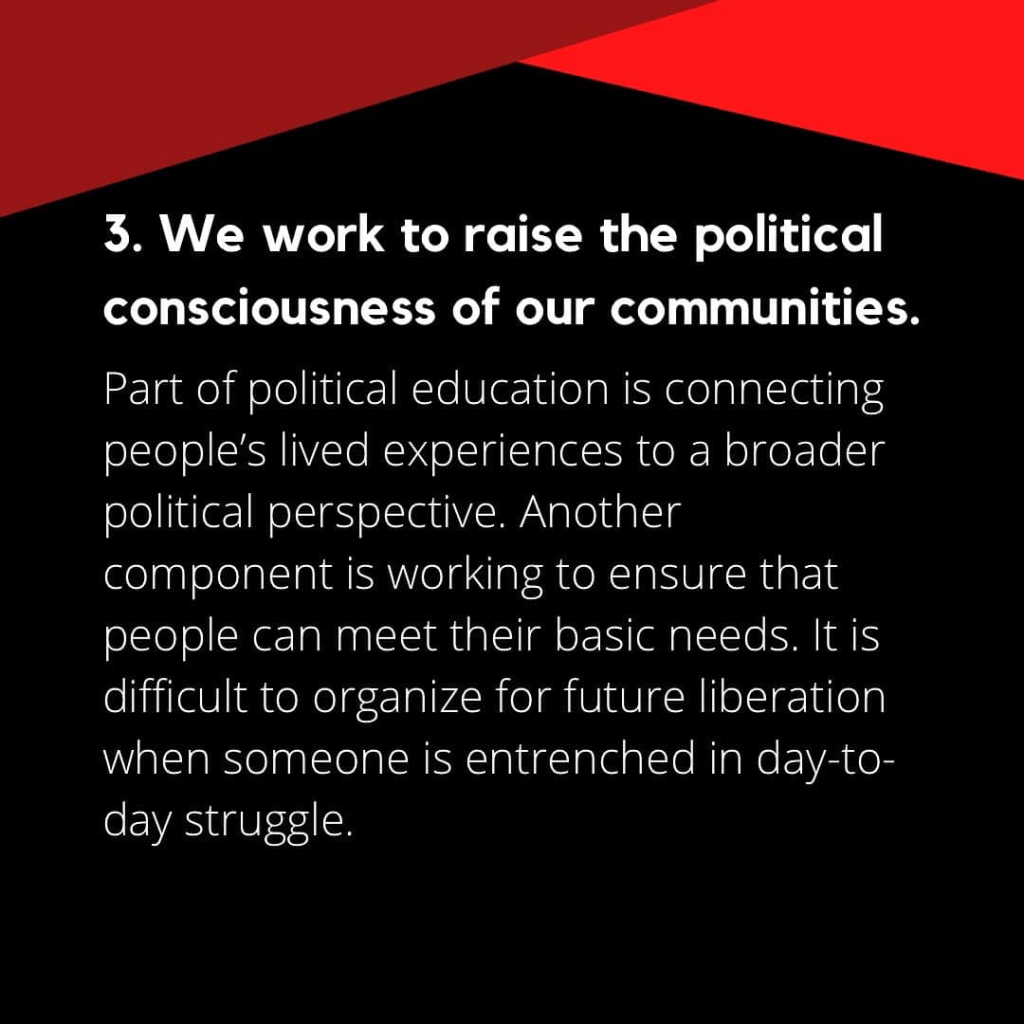
There is an aspect of self-determination and ethical engagement in organizing to meet our peoples’ material needs. There is a collective emotional lift in doing something worthwhile for our peoples’ benefit, however short-lived that benefit might be. These spaces become intergenerational, diverse places of Indigenous joy, care and conversation, and these conversations can be affirming, naming, critiquing, as well as rejecting and pushing back against the current systems of oppression. This for me seems like the practice of movement-building that our respective radical practices have been engaged with for centuries.
Maynard, Robyn; Simpson, Leanne Betasamosake. Rehearsals for Living (Abolitionist Papers) (p. 39). Haymarket Books. Kindle Edition.
Building Relationships
What follows are some of my stories about how such relationships developed. It takes time to build these relationships, which is why it is important to begin now.
Guidelines
I begin with some general guidelines that I, as a White person, have learned about making connections with communities of Black, Indigenous, and other people of color (BIPOC).
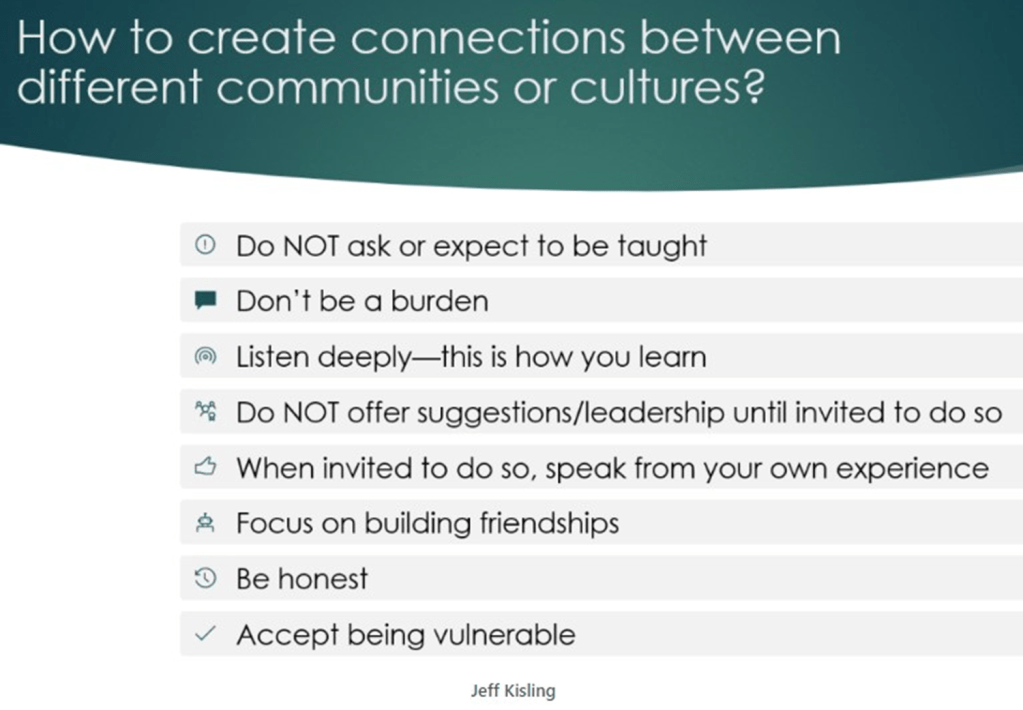
This graphic summarizes some of what I have learned from my own experience. I learned much of this during the years I spent in the Kheprw Institute youth mentoring community in Indianapolis. A community of people of color. And these guidelines have been very helpful in the context of the last five years as I was led to connect with my Indigenous friends.
I also learned a great deal from participation in the American Friends Service Committee’s (AFSC) Quaker Social Change Ministry program and recommend it. https://www.afsc.org/quakersocialchange
Don’t be a burden
From that initial meeting, Ronnie and I began to exchange text messages. Related to “don’t be a burden”, text messaging is far less intrusive than phone conversations, for example.
Do NOT ask or expect to be taught
This can be one of those gray areas. There is a difference between expecting to be taught and accepting what someone is offering to teach you. Ronnie was/is very generous with his time and encouragement. He is what I would call a very effective organizer. He recognized our Wet’suwet’en vigil would be a chance to find allies for the work he does. Since then, I’ve seen how often, and how well he writes to educate others. And he always shows up. In the nearly three years I’ve known him, he and I have rarely missed being at our weekly food giveaway. And those times when he isn’t there, it is often because of other things related to his activism. He is involved in many things besides our food project.
Listen deeply-this is how you learn
Think about what is being said. Learn the language, so to speak. Pay attention to body language and facial expressions. This is hard when people are wearing face masks, which are always required at our food project. No face mask, no participation. This is done to reduce the chance of any of us passing the virus on to others.
Observe common tasks and help do them. For example, every Saturday morning tables need to be set up outside, where the food boxes will be put for distribution. So do that if there is idle time. You don’t need to ask for permission. It is expected that you will use your own initiative. Because of everyone being aware of what needs to be done, and doing it, our work is done really efficiently. As Ronnie says, at the end of the hour you will be tired, sweaty and felling good. And that’s true.
Do NOT offer suggestions/leadership until invited to do so
It can take a long time (months) to understand all that is involved in the work you are participating in. It has taken a lot of work, trial and error, for those involved in the community you are connecting with to get things to function well.
The rest of the list is self-explanatory. Accepting being vulnerable is likely the most difficult part of this. You are being vulnerable just by doing what it takes to join in the work, to show up. When uncomfortable things happen, they are often not your fault. Try not to take things personally.
Great Plains Action Society and Iowa Yearly Meeting (Conservative)
A number of Friends (Quakers) in the Midwest have had opportunities to work with the Great Plains Action Society (GPAS) and the people who are part of that organization. My first connection was being present at a panel discussion at Iowa Yearly Meeting (Conservative) about building bridges with Native Americans in 2017. Sikowis (Christine) Nobiss, Donnielle Wanatee and Peter Clay were on the panel. (See: Iowa Panel Looks at Building Bridges with Native Americans | American Friends Service Committee)
Great Plains Action Society (GPAS)
Sikowis was involved in Indigenous Iowa, and Seeding Sovereignty, then moved on to establish the Great Plains Action Society (GPAS). My friends Ronnie James, Trisha Cax-Sep-Gu-Wiga Etringer, Mahmud Fitil, Regina Tsosie, Foxy and Alton Onefeather, and Jessica Engelking are among the people of GPAS.
I only mention that I took this photo as an example of building relationships. With time, people learn what you have to offer. During the Buffalo Rebellion Climate Conference we were all attending, there was a spontaneous opportunity for a group photo of GPAS. I was glad to be asked to take the photo.
photo: Jeff Kisling
History
Resist and Indigenize
GPAS started to build in 2014 and became an official non-profit in 2017 with two full-time staff, two part-time staff, and two youth interns. Founder, Sikowis Nobiss, who started organizing over twenty-five years ago during the Burnt Church Indigenous fisheries crisis in New Brunswick, Canada, saw that Iowa needed more Indigenous voices to speak up for the Earth. During the NoDAPL resistance movement in 2016, she created a platform for Great Plains Action Society to empower Indigenous voices in Iowa concerning extreme resource extraction perpetuated by the fossil fuel industry. During this fight, GPAS worked tirelessly in both Iowa and North Dakota, bridging the gap between Indigenous communities and rural landowners. This led GPAS to form Little Creek Camp, an Indigenous-led resistance hub in Iowa and to finally register as a 501(c)4 that is 100% Indigenous run. Our efforts have truly brought the voice and actions of Indigenous Peoples to the forefront of Iowa’s climate movement, which is much needed in the most biologically colonized state in the country and the number one contributor to the dead zone in the Gulf of Mexico due to colonial-capitalist farming practices. By uplifting traditional Indigenous ecological knowledge, we are making it clear that Iowa needs to rematriate prairie, bring back first foods and increase Indigenous land stewardship.
“We are a collective of Indigenous organizers of the Great Plains working to resist and Indigenize colonial institutions, ideologies, and behaviors. Our homelands are located in the vast grassland of Turtle Island, situated between the Rocky Mountains and the Mississippi River and stretching from the Northern Tundra to the Gulf of Mexico.”
Great Plains Action Society Mission Statement
Great Plains Action Society addresses the trauma Indigenous Peoples and our Earth have faced and works to prevent further colonial-capitalist violence through education, direct action, cultural revival, mutual aid, and political change.
Gatherings and actions
What follows is a history of my experiences with my Indigenous friends. Although each episode is with at least one person who is part of the Great Plains Action Society (GPAS), many are not official GPAS actions or events.
US Bank, Super Bowl weekend, 2/3/2018
February 3, 2018, Super Bowl weekend, Ed Fallon organized a van trip to Minneapolis to call attention to USBank’s funding of fossil fuel projects. USBank’s headquarters are in Minneapolis, and the game was played at the USBank stadium. Sikowis, Donnielle, Trisha and I were among those who attended.
Missing and Murdered Indigenous Relatives MMIR
One lesson I learned from the trip to Minneapolis was to be aware of the interrelationships among justice issues. The epidemic of the kidnapping and murder of Indigenous women, men and children is something I had not known about prior to getting to know native people. But this happens to a shocking number of people. I heard a story about a family member from a new friend on the First Nation-Farmer Climate Unity March.
This is yet another consequence of building pipelines. Many are built near native lands–another example of environmental racism. The “man camps” of pipeline construction workers are thus found near native lands. Adding to the problem was that native law enforcement could not arrest nonnative people. Recent Federal legislation that several of us lobbied for has changed that.
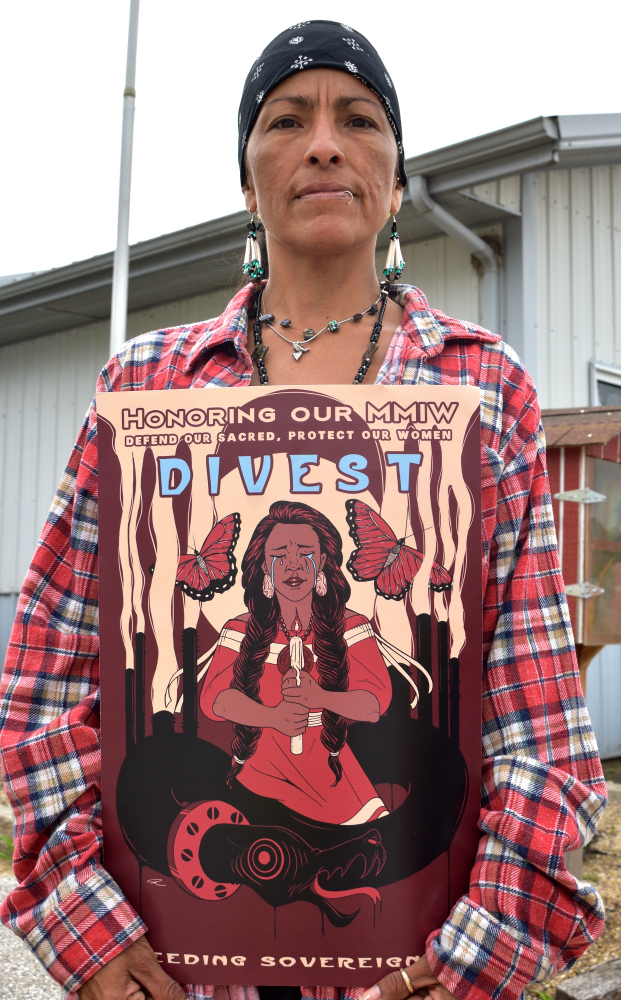
When in Minneapolis, Sikowis Nobiss and Donnielle Wanatee both spoke about MMIR. During the First Nation-Farmer Climate Unity March, Foxy Onefeather carried this sign.
Foxy Onefeather on the First Nation-Farmer Climate Unity March
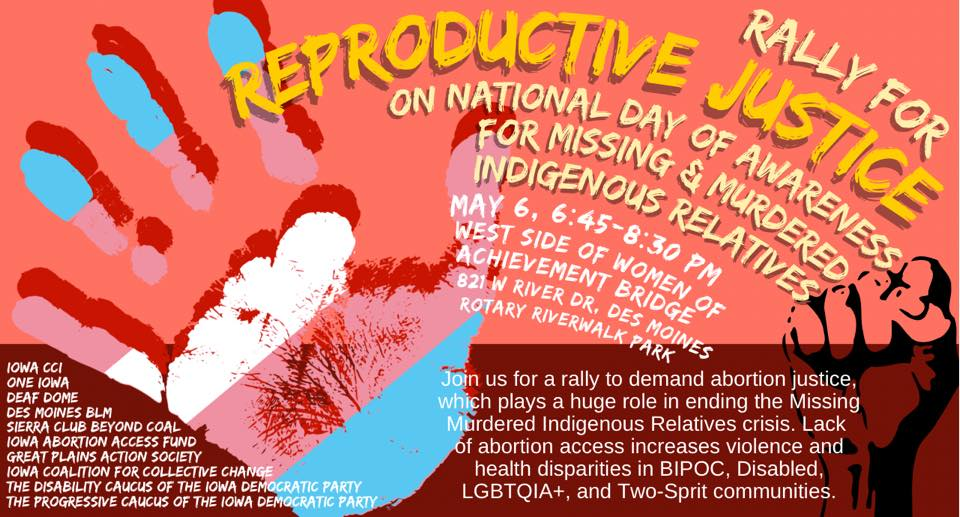
This spring, MMIR was part of a GPAS rally for reproductive justice.
This sign was erected at the event, with the Wells Fargo Arena in the background. Wells Fargo is one of the banks that fund pipelines.
September 1 – 8, 2018, Sikowis, Donnielle, Trisha, Mahmud, Regina, Peter Clay (Iowa Quaker) and I and others participated in the First Nation-Farmer Climate Unity March. We walked and camped together from Des Moines to Fort Dodge (ninety-four miles) along the path of the Dakota Access pipeline.
Some Iowa Quakers had worship sharing each morning of the March to support us. Also, each evening there was a discussion on various topics. My friend and Scattergood Friends School schoolmate and member of Iowa Yearly Meeting (Conservative), Lee Tesdell, talked about his progressive agricultural practices. Sikowis had something to say about Indigenous agriculture.
Lee Tesdell speaks during First Nation-Farmer Climate Unity March, 2018
The purpose of the March was to create a community of native and non-native people who began to know and trust each other so we could work on things of common concern. That was really successful, and we have done many things together since.
One of the first was when several of us from the March, including Sikowis (in the center of this photo), Iowa Quakers Shazi and Fox Knight, and I lobbied Senator Grassley’s staff to support several bills related to native concerns.
Sunrise, Green New Deal, Des Moines, 2019
The Sunrise Movement was launched as a national campaign for a Green New Deal (GND) in 2017. From the beginning I heard my native friends talk about the importance of a GND to be Indigenous led. In 2019 Sunrise’s Green New Deal tour began with a stop in Des Moines. There my friends Trisha Cax-Sep-Gu-Wiga Etringer and Lakasha Yooxot Likipt spoke about Indigenous leadership as a requirement for a GND.
Trisha, Lakasha and I at Sunrise Green New Deal Tour, Des Moines, 2019
National Network Assembly, summer 2019
The summer of 2019 Sikowis suggested I attend the National Network Assembly at the Des Moines YMCA Camp near Boone, Iowa, that she helped organize. I was aware that if I wanted to build on relationships with native peoples, I should respond when invited to do something like this. I don’t usually attend conferences, but seeing this as one of those opportunities, I did attend. And I got a lot out of it. This was a conference for justice organizers.
As I began to discuss above, in early 2020, I began to hear about the struggles of the Wet’suwet’en peoples in British Columbia, as they worked to prevent the construction of a liquid natural gas pipeline (Costal GasLink) through their pristine lands and waters. There was little being written about this in the mainstream media, so supporters were asked to write about what was happening on our social media platforms.
This photo is from a post about a rally I organized to support the Wet’suwet’en in Des Moines on February 7, 2020. Iowa Friend Peter Clay attended.
As I wrote earlier, I’m sure my meeting with Ronnie James was spirit-led. We’ve become good friends in the three years since this Wet’Suwet’en rally. Ronnie is one of the people involved in GPAS, the person who leads the Mutual Aid efforts.
We are both at the food project almost every Saturday morning. Although it doesn’t take much space here, DMMA is the focus of my justice work. And I have found it to be healing. At the end of this is A Love Letter to Y’all about the work of DMMA.
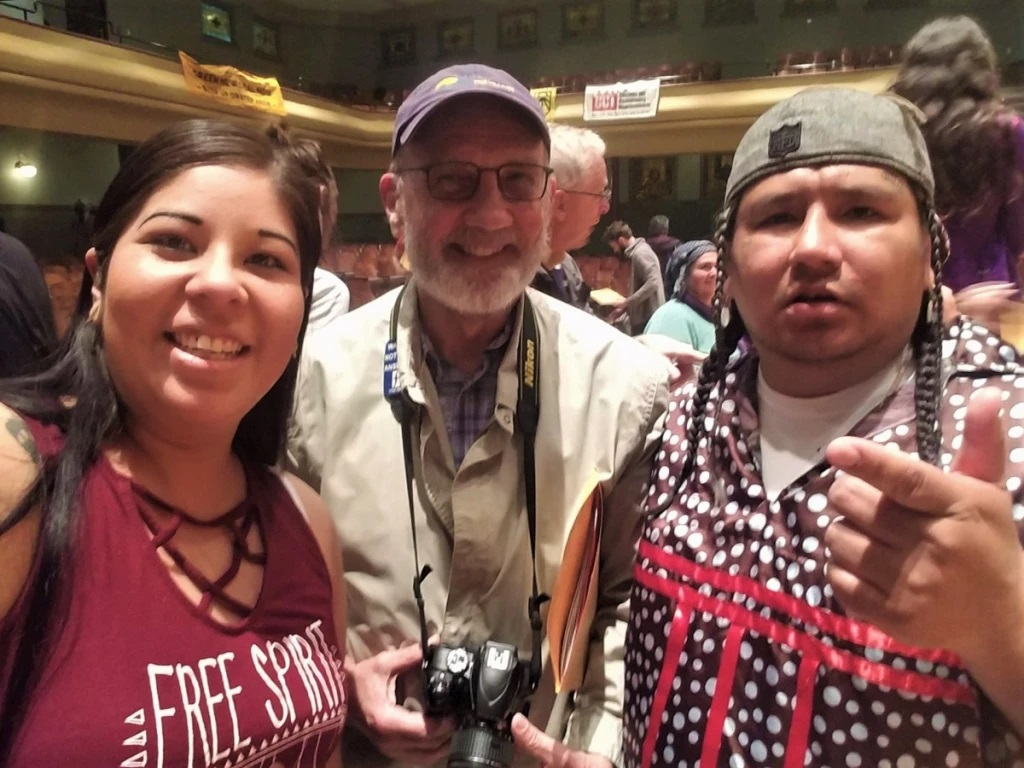
As often happens, once people know I love photography, I get invited to events for that purpose (even though I’d want to go, anyway). This photo of Sikowis was taken at last year’s Indigenous People’s Day. She’s holding a Great Plains Action Society bag.
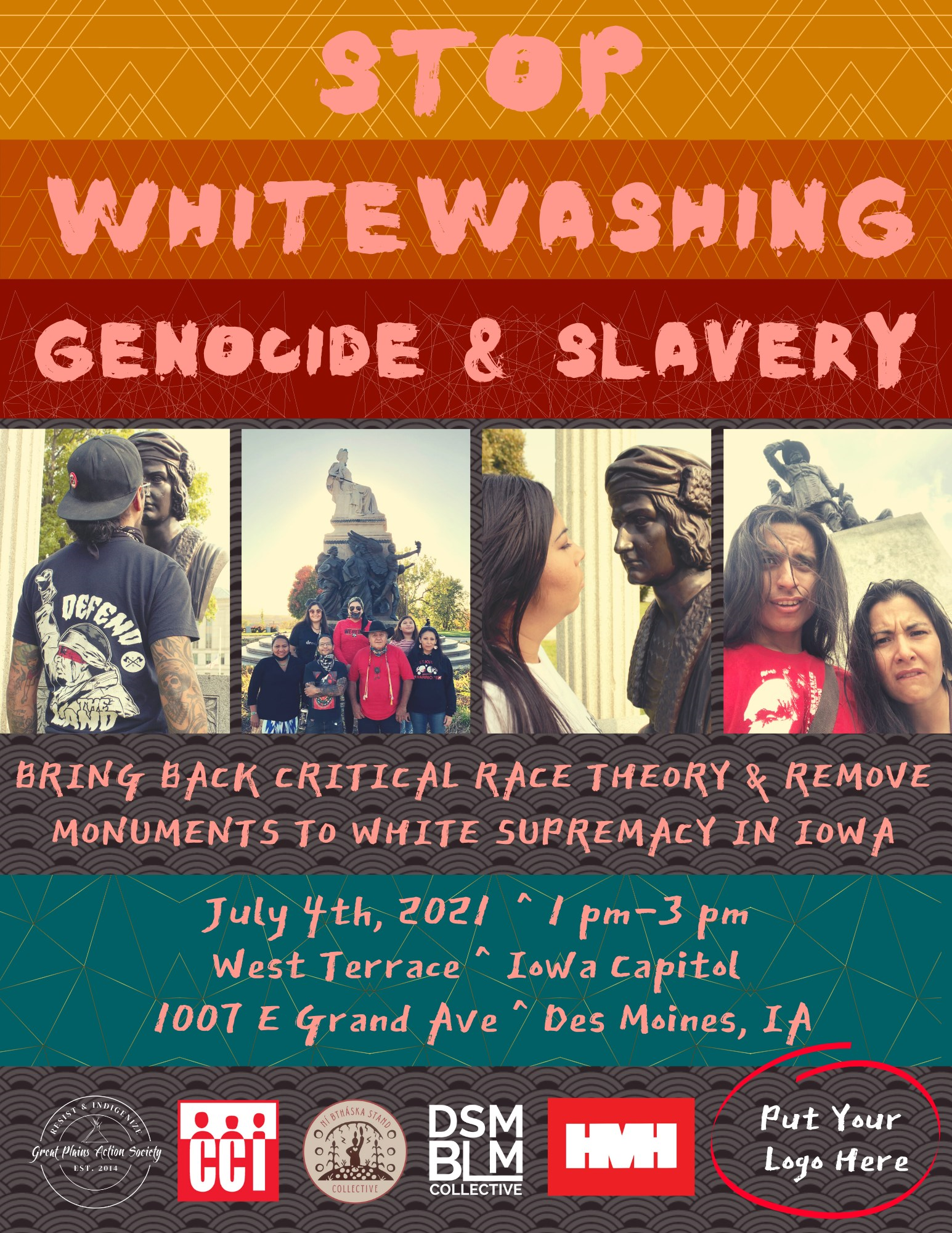
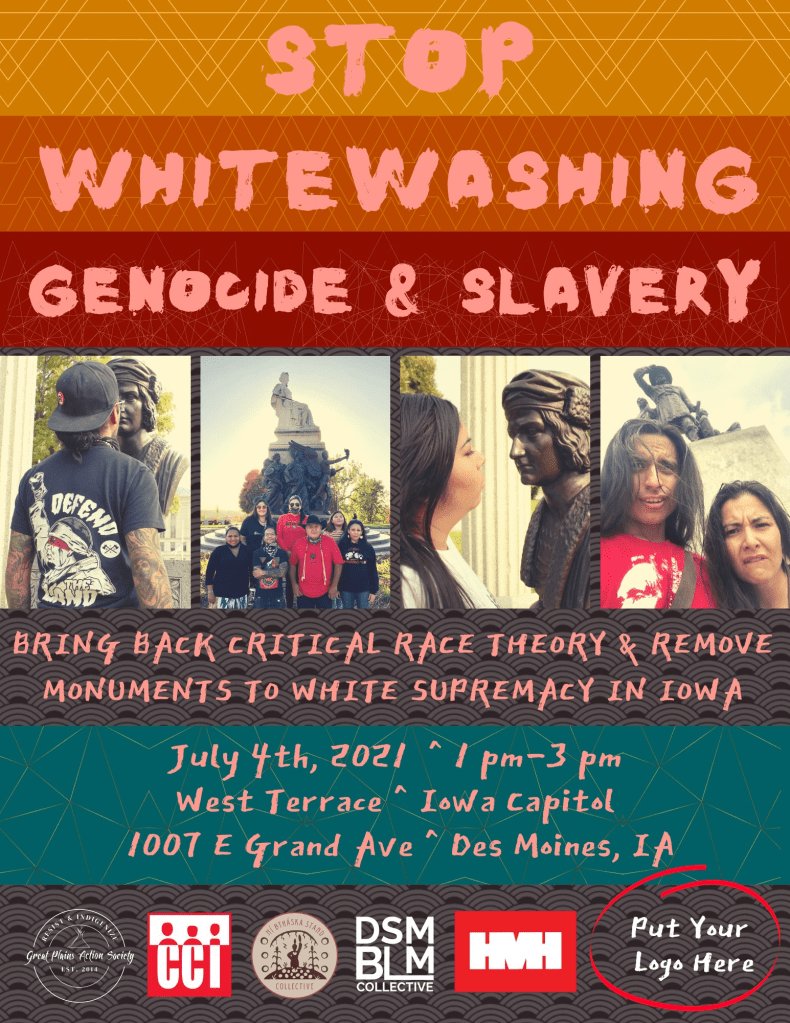
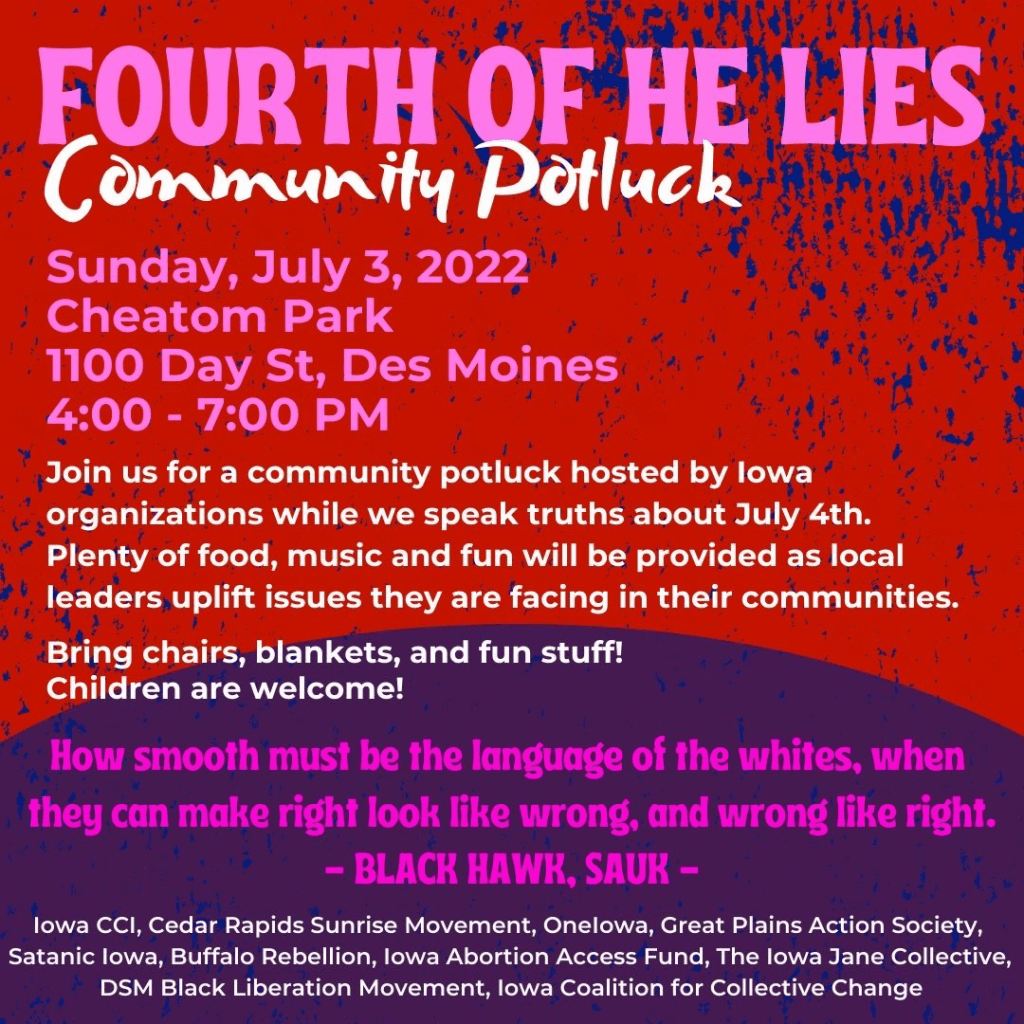
Another event where I took photos was a gathering on the State Capitol grounds related to racist statues. On July 4th, 2020 and 2021 we gathered for the “Fourth of He Lies”. In this photo on one of those days, Sikowis is speaking at the Pioneer statue. Ronnie James and Donnielle Wanatee also attended.
December 2021 Summit Carbon pipeline
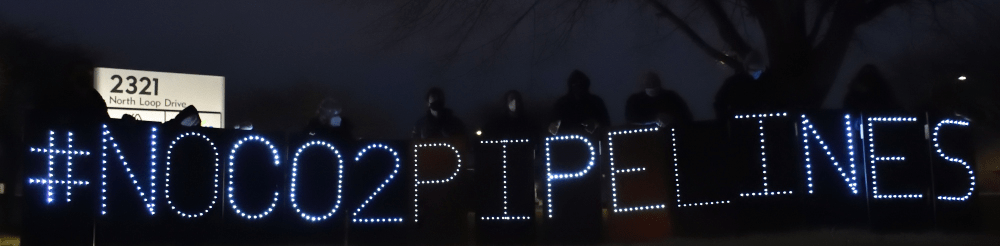
Last December, Sikowis asked me to come to Ames to take photos of a rally at the office of Summit Carbon, one of the companies that want to build a CO2 pipeline.
Buffalo Rebellion
I’m blessed to have been invited to join the newly formed Buffalo Rebellion, a new coalition of Iowa organizations that are growing a movement for climate action that centers racial and economic justice. Peter Clay, my friend and also a member of Iowa Yearly Meeting (Conservative) was also invited.
Buffalo Rebellion is a new coalition of Iowa organizations that are growing a movement for climate action that centers racial and economic justice. The Earth Day Rally will be an afternoon of honoring Mother Earth through sharing stories and visions for climate justice and taking action together for a world that puts people and the planet before profits for a few.
Following the Earth Day Rally, Buffalo Rebellion will be holding two days of immersive training to develop 100 grassroots leaders who will build local teams to take on climate justice issues in their community and come together to create a thriving state-wide movement.
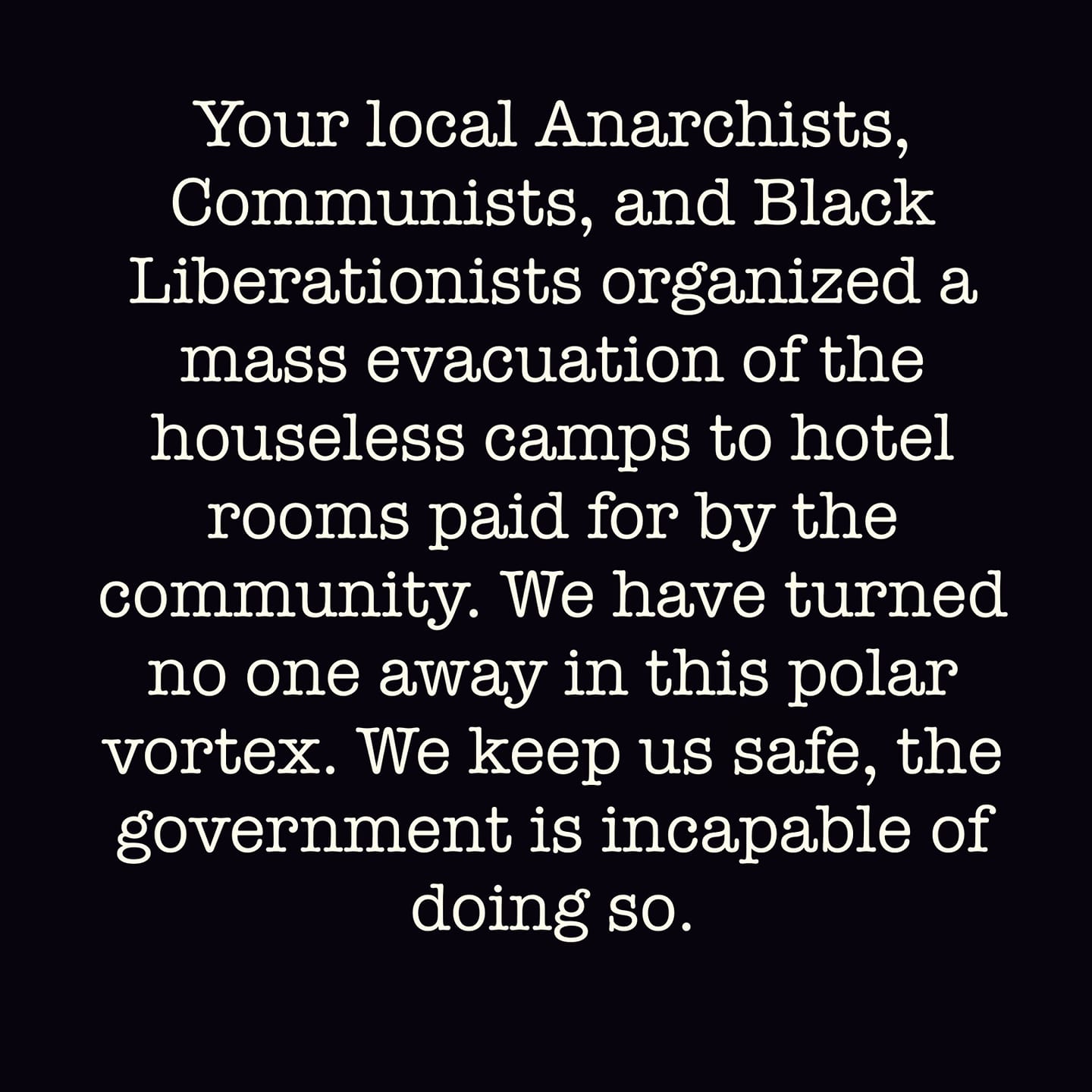
Formed in 2021, Buffalo Rebellion is comprised of seven Iowa organizations: Great Plains Action Society, DSM Black Liberation Movement, Iowa Migrant Movement for Justice, Sierra Club Beyond Coal, Cedar Rapids Sunrise Movement, SEIU Local 199, and Iowa CCI.
Iowa Citizens for Community Improvement (Iowa CCI)
Iowa Citizens for Community improvement is very active in environmental and many other concerns and a member of the Buffalo Rebellion. “We talk, we act, we get it done” is their motto. I’ve participated in several environment related actions led by my friend Jake Grobe, ICCI’s Climate Justice Organizer. He has focused on getting MidAmerican Energy to close their five coal burning plants in Iowa. And Jake is very active in the resistance to carbon (CO2) pipelines.
This is a photo I took of Sikowis and Jake at this summer’s Earth Day Rally in Des Moines. After the speakers we marched to the offices of MidAmerican Energy.
In an example of interconnections, the mural below is by GPAS and made during the First Nation Farmer-Climate Unity March in 2018. In another connection, Jake often comes to our Mutual Aid food project.
Sikowis Nobiss and Jake Grobe at Earth Day Rally 2022
The Buffalo Rebellion coalition in action
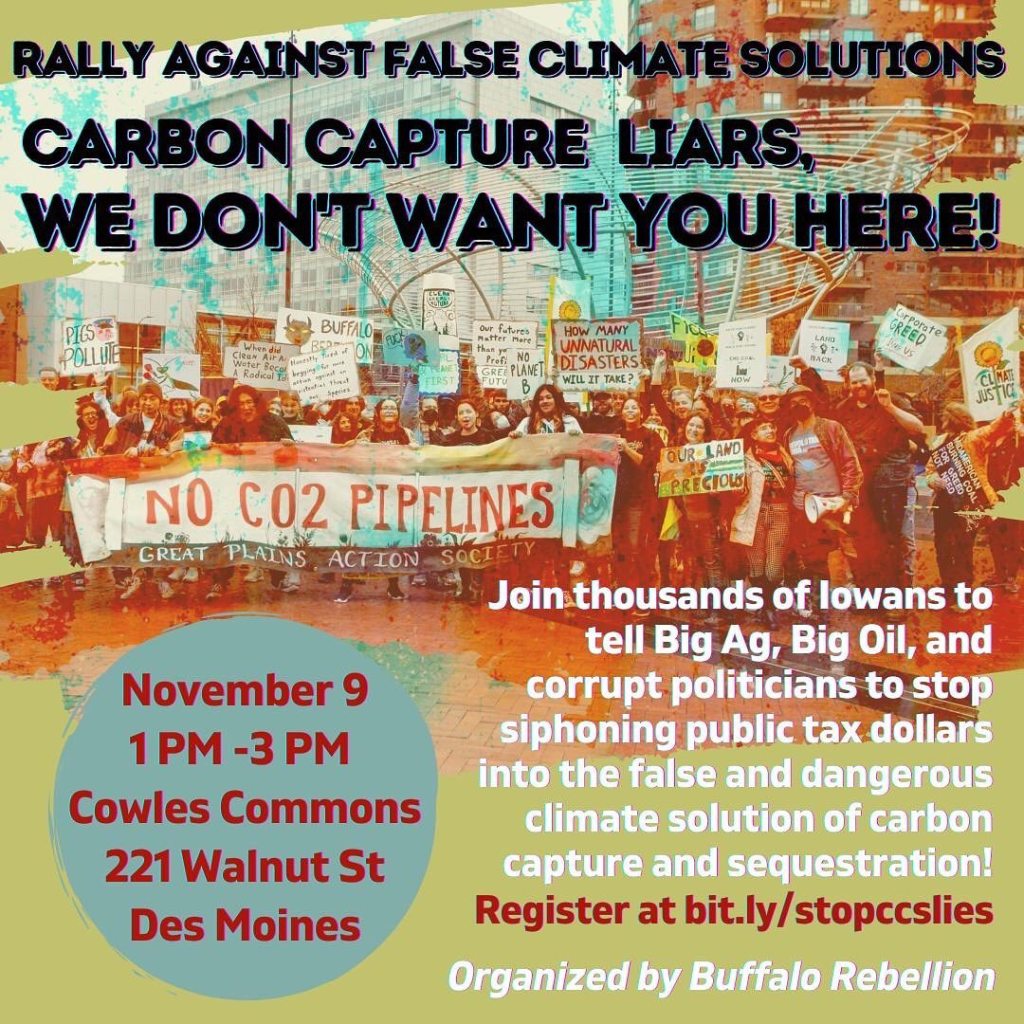
The resistance to carbon pipelines continues. This flyer and the photo I took below are about an action by the Buffalo Rebellion at the time a national meeting of those promoting carbon pipelines was occurring in Des Moines. In the photo Jake is speaking using a bullhorn, in the street that we blocked temporarily to call attention to the pipeline meeting. He said these people (in the cars) are impatient and angry, but we’re angry and inpatient, too, at the decades of inaction to respond to climate devastation.
Jake Grobe (ICCI) speaks against carbon pipelines in Des Moines, Nov 2022
Forced Assimilation/Indian Boarding Schools and Quakers
One of the tensions between Indigenous peoples and Quakers is the tragic history of forced assimilation of over 100,000 native children in the Indian residential schools. And the deaths and abuses that occurred there. Some Friends were involved in such schools. Several times I was led to speak about this with Sikowis, Ronnie and other Indigenous friends. We could not develop much of a relationship if this went unacknowledged. It is important to not do this until you have a relationship with who you talk to about this.
This became personal when one of my friends introduced me to his teenage son. I could not imagine the conversations they must have had about forced assimilation. Continue to have as the remains of thousands of children are located on the grounds of so many of the sites of forced assimilation.
Last year I was clerk of Iowa Yearly Meeting (Conservative)’s Peace and Social Concerns Committee. The committee had a small budget to support organizations doing justice work. Last year we were led to a choice of rather than giving token amounts to a number of organizations, to instead see if an opportunity arose to give the entire budget to make an impact on the work that presented itself. I believe because of our discussions about the residential schools, Sikowis asked if Quakers could support showings of the film “They Found Us” that had been made about the residential school of her nation, the George Gordon First Nation. Our Peace and Social Concerns Committee gladly agreed to donate our budget to this. https://quakersandreligioussocialism.com/2022/04/13/they-found-us/
Great Plains Action Society has felt this pain firsthand, as many of our close family members attended these schools, and we are rising to meet the needs of our communities. Last year, in Sioux City, we hosted a large community feast and ceremony to honor nine children whose bodies were reMatriated back to Sicangu Oyate lands from the grounds of the Carlisle Boarding School. We have also raised funds to help one of our relatives, Curt Young, show his film, They Found Us, about the search for children’s bodies at the George Gordon First Nation. If we can raise enough funding, we would like to get his film shown throughout Iowa and the Midwest.
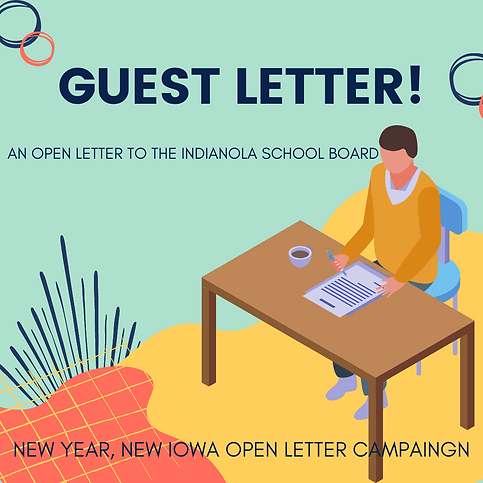
A fundamental principle of justice work is to make sure that your (i.e. ally) work is directed by those impacted by injustice. “Nothing about us without us.” Great Plains Action Society’s Open Letter Campaign is such an opportunity, an invitation for non native peoples to support their work.
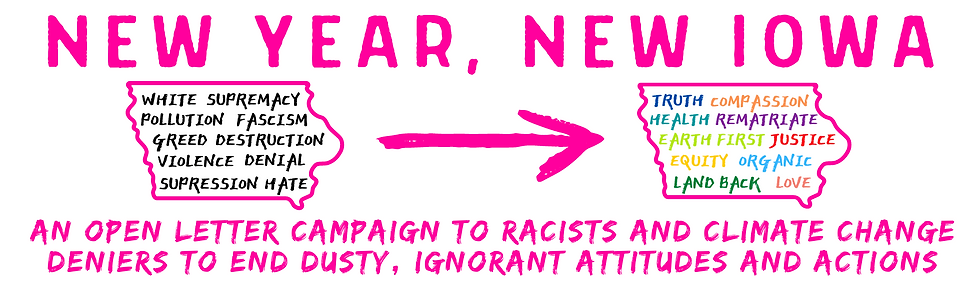
Resolutions are not just for January! As we are gathering momentum for the daunting work 2022 has in store for us, we would like to invite you to join us in ushering in a New Year/New Iowa. Things need to change. The harm we are doing to the environment is devastating. The attack on truth in public education is a contributing factor to our attempted erasure. The ongoing use of racist mascots harms children, and perpetuates dehumanization. Iowa has a lot of issues. The work we need to do to make Iowa better is not going to be easy. But it can be done, and the best chance we have is working together. And that is why we are coming to you with our Open Letter Campaign.
Over the course of 2022, we will be sharing with you Open Letters we’re addressing to those who are in positions of power. We’re doing this in the format of an Open Letter for a few reasons. First, these issues are important, and this is an opportunity to explain the issues to a broader audience. The more people who understand what is going on, the better. Second, we need numbers. We are mighty, but we are few. The more people we have putting pressure on those with power, the more likely we are to see results. And finally, it’s something that you can do that doesn’t require much of you. Although it’s only February, 2022 can already feel exhausting. The thought of having to leave home to do things can be overwhelming, even frightening as COVID is still a very real threat. But this is something you can do from home, without investing energy you are probably running low on. Working with us can be as simple as tweeting out a hashtag. But it can be more too, if you’d like. It’s an opportunity to write the words that express your frustration and join them in an agitated choir. This is a chance to remind yourself that you deserve to be heard and that you are capable of taking action that affects change.
We have always appreciated when allies and accomplices approach us to ask how they can be of help. Things can be complicated, and it is considerate to be mindful of how one engages. This is absolutely a situation that we request your help with. We need your voices to make something happen. Our land, our water, our children are under attack. The truth is under attack. We need to stand strong together to create the change that so desperately needs to happen. This Open Letter Campaign is a means for us to unite our voices to call for change. You are welcome to use the words we share, or to express your own. If all you have it in you to do is share an article or use a hashtag, every little bit helps. If you have letters of your own you’d wish to share with us, we’d love to hear from you! Again, we look forward to putting our voices together with you, to call for the New Year/New Iowa we so desperately need. Thank you.
The New year, New Iowa Open Letter Campaign is led by Jessica Engelking. If you have ideas or thoughts to share, please contact her at jengelking@greatplainsaction.org
We look forward to putting our voices together with you, to call for the New Year/New Iowa we so desperately need. Thank you.
Ronnie James once lived in Indianola. He wrote about his experiences with the Indianola School board when he asked them to stop using native imagery for their sports teams. Knowing I am a photographer and live in Indianola, he asked me to take some photos of that imagery, which I was glad to do.
3. Truth and Healing with Friends
Jessica Engelking of the Great Plains Action Society is the contact person for the Open Letters campaign. Fortunately, I met Jessica when we both attended the Buffalo Rebellion Climate Justice Summit this summer. A lot of networking occurred at the summit.
When she asked what Quakers were doing related to the Indian Boarding Schools, I was very glad to share the Friends Committee on National Legislation’s letter writing tools. And specifically, to the one to support the establishment of a Truth and Healing Commission on Indian Boarding Schools. This became one of the Open Letters of the GPAS.
Support the Establishment of a Truth and Healing Commission on Indian Boarding Schools: Friends Committee on National Legislation (FCNL)
As children are returning to school, we are reminded that school has not always been a safe place for Native children. For many years, Native children were taken from their homes and placed in government and religious run institutions with the aim of stripping away their Native language, culture, and identity. We are only now beginning the painful process of bringing home the children left in unmarked graves at the boarding schools they were sent to (U.S. report identifies burial sites linked to boarding schools for Native Americans). We are still working on healing the damage of boarding school and intergenerational trauma (American Indian Boarding Schools Haunt Many : NPR). Healing from the damage caused by the boarding school system will require effort by not just those harmed, but the institutions that did the harming. There is great work being done by our comrades at the Friends Committee On National Legislation (Native Americans | Friends Committee On National Legislation). For this edition of our Open Letter Campaign, we are directing you to a letter from our friends at FCNL to help you in urging your representatives to support the Truth and Healing Commission on Indian Boarding School Policies in the United States Act (S. 2907/H.R. 5444).
The following is courtesy our much appreciated Quaker friends
As another way to encourage the passage of this legislation, David and Jean Hansen of Ames Meeting, Iowa Yearly Meeting (Conservative) and my friend activist Rodger Routh, and I went to the Des Moines office of US Senator Joni Ernst. Jessica Engelking of the GPAS had planned to attend but was unable to do so.
Lobbying US Senator Ernst to support legislation to create a Truth and Healing Commission on Indian Boarding Schools
Great Plains Action Society addresses the trauma Indigenous Peoples and our Earth have faced and works to prevent further colonial-capitalist violence through education, direct action, cultural revival, mutual aid, and political change. We believe that Indigenous ideologies and practices are the antitheses of colonial capitalism, and we deploy these tools to fight and build on our vision–tools that are deeply embedded in a culture of resistance.
Indigenous Peoples in the US and around the world have created a culture of resistance, built on the frontlines, that is now a way of life. It can be found in our dancing, singing, clothing, art, and in our political motivations. For instance, the American Indian Movement (A.I.M.) song was created out of the Red Power Movement and is sung at many of our cultural events and in our movement spaces, which are often one and the same. It began with the need to protect our homes and way of life from settler invaders, colonial militias, and imperialist governments. There is over a 500-year history of Indigenous resistance to the violent nature of colonial-capitalist genocidal and extractive practices. As stewards of the land, our ancestors saw right away that settler invaders, who were directly harming us, were also harming the environment and throwing the ecosystem off balance. The resistance is ongoing as long as genocide and colonization are perpetuated by the nation-state and its settler citizens. To be in a constant state of resistance is traumatic, hence why we suffer from intergenerational and historical trauma. Yet, it is necessary to protect our land, our people, and our ways from colonial-capitalist forces.
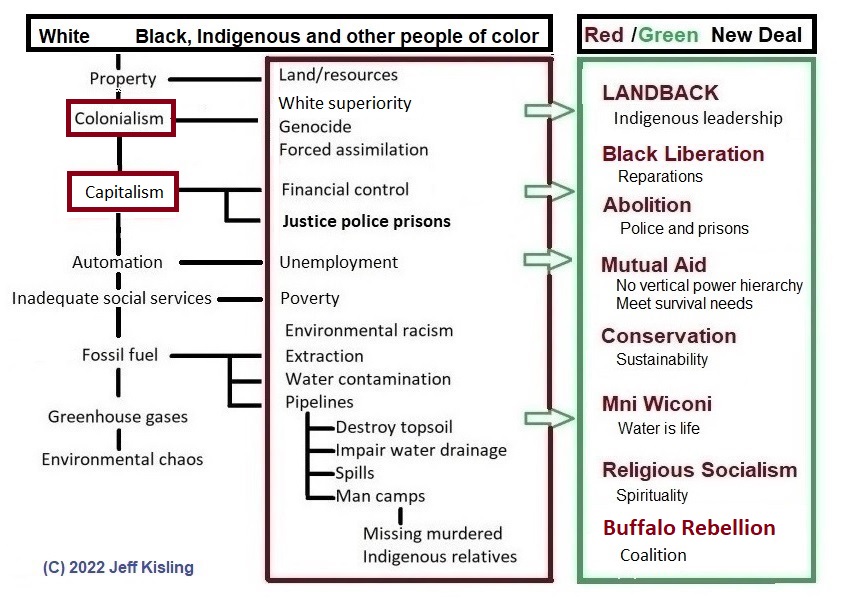
I’ve been working on this graphic for several years, to visualize the connections I see. Mutual Aid and the Buffalo Rebellion are part of this.
A Love Letter to Y’all (a thread)
One year ago yesterday Des Moines Mutual Aid participated in a march protesting the potential for war or increased hostilities with Iran that followed the fallout of the assassination of Qassem Soleimani by drone strike in Baghdad.
This was our first “public” event since adopting the name Des Moines Mutual Aid, a name we gave our crew during our growing work with our relatives at the houseless camps throughout the city and our help with coordinating a weekly free grocery store that has a 50 year history, founded by the Des Moines Chapter of The Black Panther Party For Self Defense.
A year ago we started laying the foundation for work we had no idea what was coming.
As we were adjusting our work with the camps and grocery re-distribution in response to the Covid-19 pandemic, both that continued to grow in need and importance, the police continued their jobs and legacy of brutality and murder.
This nation exploded in righteous rage in response to the pig murders of Breonna Taylor and George Floyd.
DMMA realized we were in a position to organize a bail fund to keep our fighters out of jail, both to keep the streets alive as a new phase of The Movement was being born, and because jails are a hotspot of Covid-19 spread.
Not to mention the racial and economic oppression that is the cash bail system.
In the past year DMMA has expanded it’s work in multiple directions and gained many partners and allies.
We partnered with the Des Moines Black Liberation Movement (@DesMoinesBLM) to create the DSM BLM Rent Relief initiative to help keep families in their homes in the midst of a pandemic and the winter.
The camp work has grown exponentially, but is being managed with our collaboration with Edna Griffin Mutual Aid (@egma_dsm), DSM Black Liberation Movement (@DesMoinesBLM), and The Great Plains Action Society (@PlainsAction).
The bail fund remains successful because of desire from the public and a partnership with Prairielands Freedom Fund (@prairielandsff) (formerly The Eastern Iowa Community Bond Project).
The weekly free food store has maintained itself, carrying on the legacy it inherited.
Every one of our accomplishments are directly tied to the support of so many people donating time, talent, and funds to the work. We are overwhelmed with all of your support and hope you feel we are honoring what we promised.
All of these Mutual Aid projects are just a few of many that this city has created in the last year in response to the many crises we face, not only confronting the problems and fulfilling the needs directly in front of us, but creating a sustainable movement that will be capable of responding to what’s next and shaping our collective futures as we replace the systems that fail us.
These last 12 months have been wild and a real test of all of our capabilities to collectively organize.
But it is clear that we as a city have what it takes to do what is needed in 2021, no matter what crisis is next.
We need to be careful when we talk about humility. The kind of humility this work brings isn’t the kind that would have us reject or repress our gifts. This kind of false humility leads us to oppress each other in the name of preventing pridefulness. This happens far too often. Real, life-giving humility means living up to the light that we have been given without judgment of how bright or dim that light is. False humility is hiding this light under a bushel for fear of jealousy or judgment. The challenge is to be faithful right where we are—no more, no less. This takes courage. To be faithful, we have to make space.





















 for the film fest






















 Quakers and Mutual Aid