T-MAPs and my own story

Sometimes, I miss what is most obvious. I’ve been writing (a lot) about T-MAPs (https://quakersandreligioussocialism.com/t-maps/)

Yesterday (T-MAPs and YOUR own story) I said ‘I sense that I’ve written enough about Transformative Mutual Aid Practices (T-MAPs).’

This morning, I was feeling chaotic, I guess I might say. I won’t present the long list of my concerns. I’m sure we share many of them, especially related to the potential for global war. You might see where this is going. I realized I needed to revisit MY OWN Transformative Mutual Aid Practice document, which I had created less than a year ago. (That’s the obvious thing I realized this morning).

I can see what I did previously because when you use the online tool, you can choose to have your answers emailed to you. The alternative is to download the sections, print them, and write your answers on the forms.

I moved the conclusion to this beginning because it summarizes why T-MAPs can be a tool for Mutual Aid.

Conclusion – T-MAPs as a Tool for Mutual Aid

We hope the process of completing your T-MAP has given you new insights into your own story and inspiration to engage in this process with others. It’s a living document – you can keep revising it and adding to it as you gain more ideas and visions. While T-MAPs can help you map your individual transformation and growth, we think it’s more powerful as a collective practice. T-MAPs is a tool that is designed to be developed in groups, shared with groups, and practiced in groups. Our vision is that T-MAPs and tools like it will play an important role in evolving the ability of creative activist movements and mental health support networks to communicate with each other and build the kinds of stronger, more effective communities and forms of resistance that our current historical moment requires.
By reflecting deeply on our own experiences and developing a stronger connection with ourselves and what’s important to us, we can become more comfortable sharing that knowledge; we can learn from each other and more easily collaborate with one another. By having a better awareness of each other’s personal struggles, it’s easier to understand our similarities and differences and navigate them with respect, love, and understanding. T-MAPs is really our attempt to help operationalize mutual aid.

Crisis = Opportunity

Taking the time to articulate basic needs and desires about wellness and support when someone is in a clear head space can make an enormous difference when any kind of crisis emerges. Having others who already know what your needs and desires are can turn crisis into an opportunity for growth and transformation, for building solidarity and grounded friendship. Understood and articulated, our weaknesses can actually become our strengths.
At the same time, by opening up space to talk about life lessons and personal stories it can become easier to talk about collective dynamics, and things that are often challenging to talk about in groups, like power and larger structures that affect all of us in different ways depending on our social location, like race and class and gender and ability. While there are many ways that our differences can end up separating us, if we can learn to talk about the difference our stories can actually bring us together and raise levels of awareness. T-MAPs is an invitation to a collective practice of transformation and growth. Skillfully facilitated, a group using these questions can evolve to trust and support each other in the hard times on the horizon.


T-MAPs Section 1: Connection and Vision

The purpose of this first section is to help ground us in our strength and resilience before we undertake the T-MAPs process. To reframe the conversation so that it’s not starting from the premise that we are sick and need fixing; instead, we are reminded of what we are like when we’re well — how it feels and how we relate to the world around us. Taking the time to think about these things is generative:  this is less like a form to fill out where we already know the answers and more a starting point to prompt our imaginations.

This is the format of the tool. To introduce each topic and provide checkboxes to help you answer the question, in this case, How do I feel when I’m most alive? And then a free-form box to describe your own experiences.

These were my answers at that time:

There are more pages in this section, but I think you get the idea.


Section 2: Wellness Practices

This section is designed to guide us in building our wellness toolkit – to identify what practices and supports help us manage stress, avoid crisis, and stay grounded and healthy. Once we’ve developed these lists, it is good to return to them on a daily basis and potentially share them with others in our lives. If we notice we’re slipping off track, we can return to this toolbox to help us remember how to get back on course.

My answers
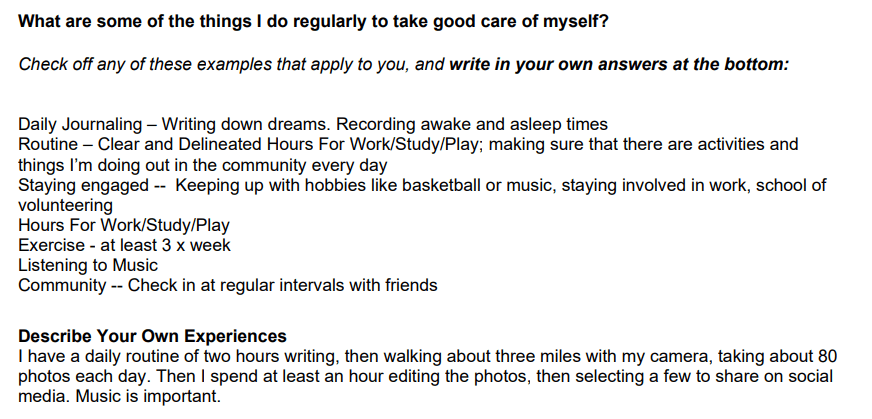
And, again, there are multiple questions in this section.


Section 3: Life Lessons and Personal Stories

Where we come from and how we tell stories about ourselves is so important. In this section we have a series of questions to help you think about your own personal story and find good language for it. Society has so many expectations and frameworks for understanding your life that might not fit at all, or might fit in some ways but not others. There is an incredible power in creating a personal narrative of your life that fits well for you.

This section has two parts – the first is on understanding your journey with mental health and emotional distress, and the second on social and cultural context as it informs mental health. If you don’t identify as someone who’s been through intense mental health struggles and and/or the diagnosis process, some of the questions in the first half might not feel like they apply – it’s fine to skip them. In the second half of this section, some of these questions might be new to you – you might not have thought a lot about your cultural or class background, for example – and that’s ok. Consider these questions a starting point for your explorations.

How I understand the story of my journey with mental health:
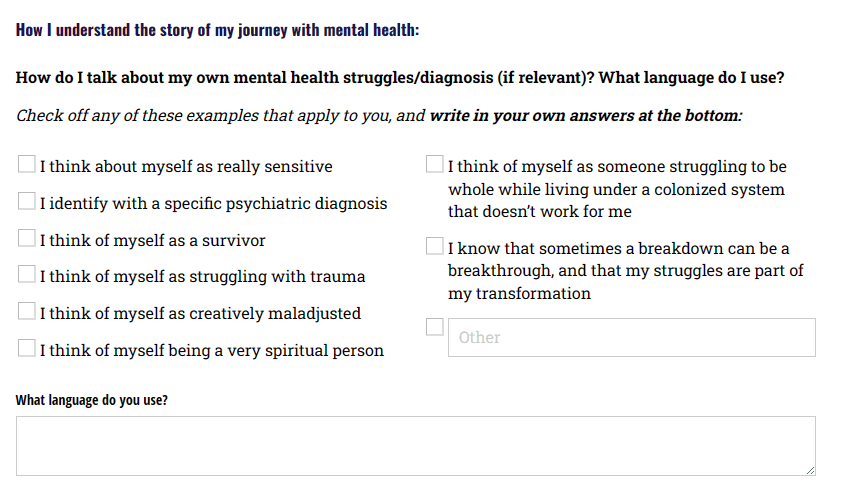
My answers

I think of myself as creatively maladjusted
I think of myself being a very spiritual person
I think of myself as someone struggling to be whole while living under a colonized system that doesn’t work for me

What language do you use?
I think of myself being a very spiritual person. My spirituality is a very important part of my mental health. And language is important because in my culture we don’t have good ways to express spirituality.
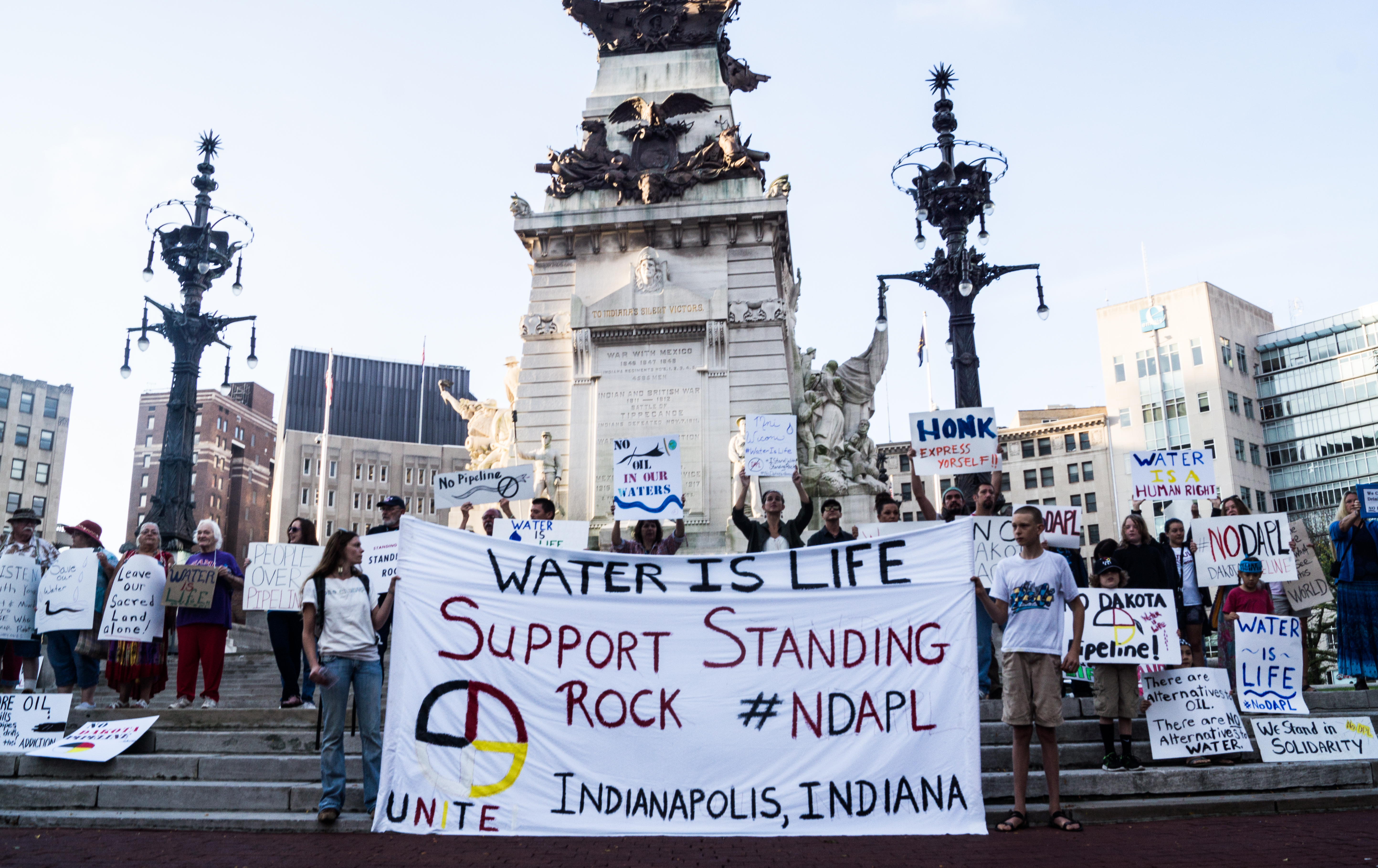
I have been learning a lot about settler colonialism from my Indigenous friends. While I continue to learn of all the ways I benefit from white superiority, life as a Quaker has meant many struggles against white dominance. At 18 years of age, I became a draft resister. I was led to live my life without a car for environmental reasons. I’ve spent the past decade working to protect the water, working against pipelines.
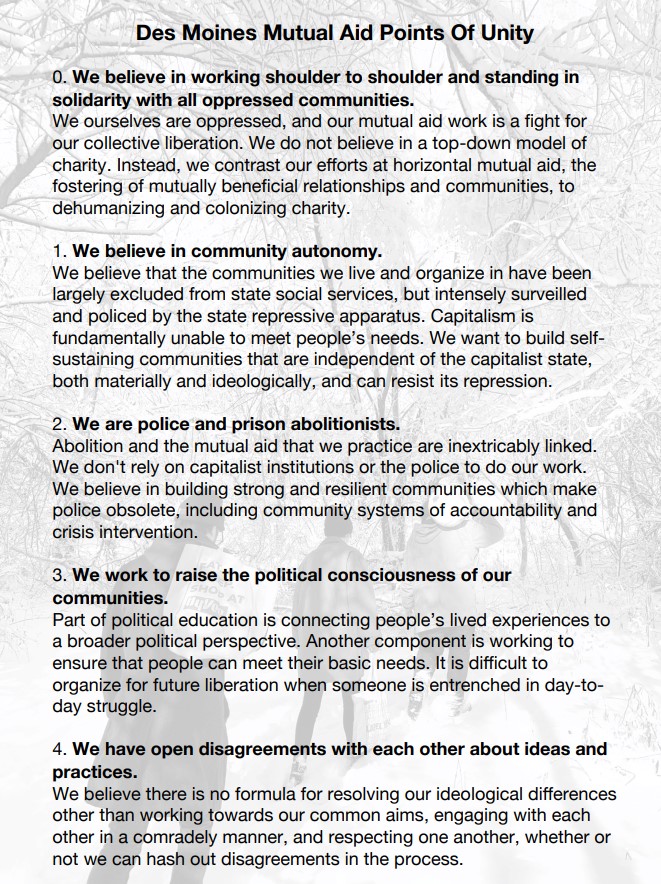
I’ve found a home in my Mutual Aid community that works against systems of dominance and hierarchy.

If I’ve been through serious crisis, what were some of the early indications that I was struggling? How did it all happen?
There has always been something different about me
The truth is I never really felt like I fit in

Add your own:
Quakers used to be referred to as a peculiar people, often refusing to accept the norms of the culture we live in. Living without a car was one of the most visible expressions of that. That periodically created real crisis for me, because it was not only a struggle to live without a car, but this caused conflict with my fellow Quakers, the people I looked to for support, and to be examples of faith in the wider community.
And as I learned more about racism during the years I spent in a Black youth mentoring community, it became a real conflict to find so many Quakers had no idea of their white privileges, and the ways racism was part of their lives.
Over the past five years of making and developing friendships with Indigenous people, I’m learning much more about the multigeneration traumas they, and their ancestors have from the genocide of their people as their land was stolen and millions were killed as White people moved across the country.
Again, white Quakers were involved in some of this when they were involved in the forced assimilation of native children. Native children were kidnapped from their homes and taken to institutions where horrendous things were done to try to erase their Indigenous culture and become more like white people.
Over 100,000 children were forced to go to these institutions where there was widespread physical, sexual, and psychological abuse. Thousands died. It is a struggle to be with my Indigenous friends, knowing of this history, as it must be for them to have me in their presence. And it has been another source of significant trauma to me to not only know that, but once again for so many White friends to work so hard to refuse to think about this history, let alone do anything they can to begin any process of healing.
And over the past three years as part of my Mutual Aid community, I see more clearly the systems of white dominance at every level. Learn more about these things in myself. And struggle again to get other white Quakers to understand this and do something about it.
In fairness I must say there are white Quakers who do acknowledge these things and are working to improve them


Section 4: Slipping off the tracks

The point of this section is to map out what is hard for us, what we struggle with, and help us develop the self-knowledge to be able to figure out what to do about it. This section is often the hardest one to fill out because it asks us to think about hard times, but the information we gather is really useful in our journey. Often unresolved things from our past can make us feel unsafe or upset in the present – this is called getting triggered. Sometimes our triggers contain useful information about what needs to heal in us, and what we need to express. If you find yourself getting triggered or overwhelmed as you complete your map, take a break and do one of the practices in your wellness toolkit. It can also help to do the T-MAPs process with other people and realize you are not alone.
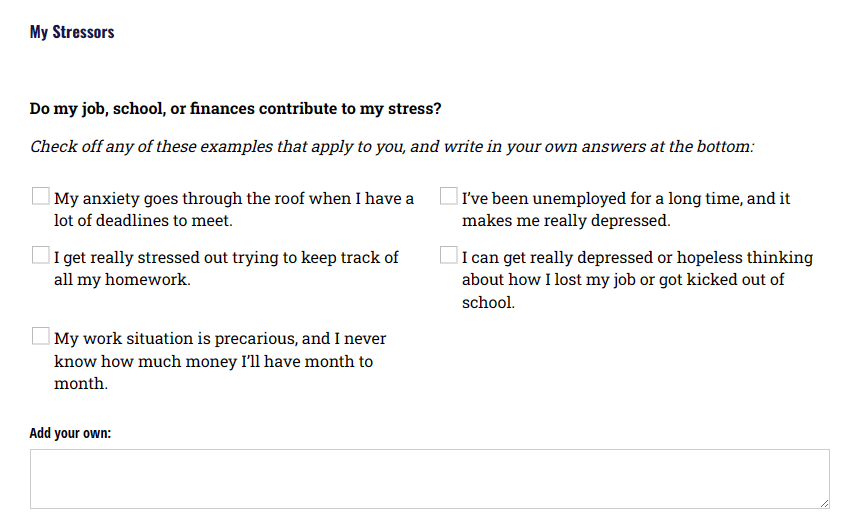
My answers

Add your own:
My stressors relate to conflicts that arise from my spiritual guidance and trying to get Quakers and/or others to understand that guidance and follow it with me. Or for certain guidance, finding out how to implement it, and then do it myself.
I realize this isn’t much compared to the awful things many people have gone, are going through.


Section 5: Support

One of the main benefits of making an T-MAPs document is being able to get clarity on the things that are important to us and being able to share it with other people. In this section, we identify the people, services, and resources that are the most important sources of support for us. This helps us remember where we can turn when things get hard, and who to stay in touch with along the way

My answers

In this section, we are asked questions about who our support people and networks are.


Prefigurative Mental Health Support

What is the condition of your mental health today? I’ve been thinking about this more recently when I read this quote.

“Everyone is depressed. It’s not just you. It’s everywhere and everyone. It is the state of the world.”

Tracy Collins

Until recently, I had not allowed myself to pay attention to my mental health. I grew up when there was a significant stigma related to mental health.

I recently read that a hallmark of White supremacy is individualism, wanting to fix things on your own. That had been my approach until very recently. I think it’s only fair to say that was because I had so little success getting others to join my work. But, difficult as it is to admit, I can now see that was largely because of my White supremacy approach.

One of the many benefits of being in my Mutual Aid community has been becoming aware of that. And learning ways to deal with my White supremacy.


Prefigurative politics

Prefigurative politics is based on the idea that the means and the ends of social change are interconnected and that the way we organize ourselves in the present should reflect the kind of society we want to create in the future. I’ve experienced prefigurate politics in practice in my Mutual Aid community. So, prefigurative mental health support means applying Mutual Aid principles to mental health care. Which means rejecting hierarchies.

Without changing the most molecular relationships in society — notably, those between men and women, adults and children, whites and other ethnic groups, heterosexuals and gays (the list, in fact, is considerable) — society will be riddled by domination even in a socialistic ‘classless’ and ‘non-exploitative’ form. It would be infused by hierarchy even as it celebrated the dubious virtues of ‘people’s democracies,’ ‘socialism’ and the ‘public ownership’ of ‘natural resources.’ And as long as hierarchy persists, as long as domination organises humanity around a system of elites, the project of dominating nature will continue to exist and inevitably lead our planet to ecological extinction.

Toward an Ecological Society (1980). Murray Bookchin

Prefigurative mental health

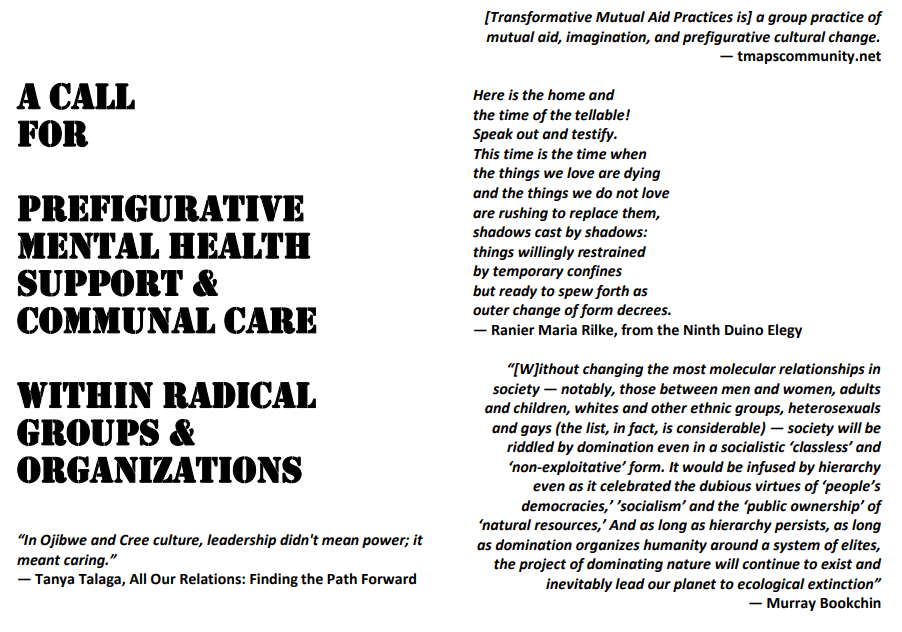
The zine below has a lengthy mental health and communal care-related list. Here are a few.

  • Many of us experienced childhood and adolescent traumas and continue to experience traumas based on our individual intersectionalities
  • We understand the mechanics of the harms and traumas inflicted by the prevailing social order’s oppressive and exploitative systems
  • We must recondition ourselves towards caring for each other; communal care is ongoing radical action
  • Alone we are vulnerable, but together we are strong; therefore, genuine community is paramount
  • We acknowledge that the architecture of capitalist society is colonizing white supremacy culture; it is an architecture of domination, abuse and exclusion
  • We focus intensely on the concept and practice of mutual aid
  • We endeavor to decolonize our thinking, group interactions, and architecture of group processes
  • We center acting in solidarity across groups in ways that build unity through diversity
  • We emphasize prefiguration within our organizations as necessary to counteract the abuses of prevailing society and manifest community and liberatory ways of being and living
  • When we do not prefigure communal care into our group structures and routines, we unconsciously recreate the alienation, racism, homophobia and transphobia, hierarchical ableisms, and neuro-homogeneities of capitalist society, along with their negative effects
  • If we don’t practice solidarity with our own comrades, we cannot expect to practice solidarity with others
  • Knowing what we know about how prevailing society operates to oppress, exploit, and traumatize vulnerable people, a group or org that does not actively engage and support the mental and emotional wellbeing of its members is not revolutionary
  • Many folx who show up to our groups do not stay because they sense the group is non-supportive or unsafe for their being

A Call for Prefigurative Mental Health Support and Communal Care Within Radical Groups and Organizations


Quakers, abortion, and the white Christian problem

The Policy Committee of the Friends Committee on National Legislation (FCNL) is asking Quaker meetings for input for a statement about reproductive justice and abortion.

In the interest of time, I have not yet converted this to a blog post. You should be able to read and/or download “Quakers, Abortion, and the White Christian Problem” using the link below. We plan to discuss this at my Quaker meeting this weekend.

I began collecting various statements about abortion from my Yearly Meeting. Reproductive justice has always been a concern of Indigenous people in this country, so I also included some writings from my Indigenous friends. As can be seen in this document, young people, and especially my Indigenous friends see abortion as a problem of White Christians. I’m wondering what my White Quaker Friends think about that. Does that change how White Friends think and act about reproductive justice? Isn’t this an opportunity to build community amongst all of us?

DISCLAIMER: I am the author of this, and it is not an official publication of any group or organization.


Transformative Mutual Aid Practices

This was a morning when I didn’t seem to be led to write anything. Then, as I was searching using the keywords prefigurative and mutual aid I found references to Transformative Mutual Aid Practices.

I’ve just recently become aware of traumas I hadn’t known I was suffering from. My Des Moines Mutual Aid community practices many of the things listed below. This awareness of healing comes from experiencing our care for each other, including those who come for the food.

I’ve heard Indigenous friends speak of the intergeneration traumas in their communities.

My Quaker meeting has recently discussed healing.

So, I was interested to see this zine, A Call for Prefigurative Mental Health Support and Communal Care Within Radical Groups and Organizations. Creative Commons licensing allows sharing material from this zine.

.

This zine has a lengthy list of things related to mental health and communal care. Here are a few.
  • Many of us experienced childhood and adolescent traumas and continue to experience traumas based on our individual intersectionalities
  • We understand the mechanics of the harms and traumas inflicted by the prevailing social order’s oppressive and exploitative systems
  • We must recondition ourselves towards caring for each other; communal care is ongoing radical action
  • Alone we are vulnerable, but together we are strong; therefore, genuine community is paramount
  • We acknowledge that the architecture of capitalist society is colonizing white supremacy culture; it is an architecture of domination, abuse and exclusion
  • We focus intensely on the concept and practice of mutual aid
  • We endeavor to decolonize our thinking, group interactions, and architecture of group processes
  • We center acting in solidarity across groups in ways that build unity through diversity
  • We emphasize prefiguration within our organizations as necessary to counteract the abuses of prevailing society and manifest community and liberatory ways of being and living
  • When we do not prefigure communal care into our group structures and routines, we unconsciously recreate the alienation, racism, homophobia and transphobia, hierarchical ableisms, and neuro-homogeneities of capitalist society, along with their negative effects
  • If we don’t practice solidarity with our own comrades, we cannot expect to practice solidarity with others
  • Knowing what we know about how prevailing society operates to oppress, exploit, and traumatize vulnerable people, a group or org that does not actively engage and support the mental and emotional wellbeing of its members is not revolutionary
  • Many folx who show up to our groups do not stay because they sense the group is non-supportive or unsafe for their being

A Call for Prefigurative Mental Health Support and Communal Care Within Radical Groups and Organizations


What can prefigurative community care that supports the mental health and wellbeing of all members look like?

1. Create space for an in-depth group discussion focused on the concept of your collective as an organism with a life of its own. Talk about your group as an organism that can flourish with everyone’s nurturance or get sick and die from everyone’s lack of care. The objective is to create group consciousness and ownership, and to arrive at and agree to incorporating new features that will consistently support the mental and emotional health of members.
    2. In addition to your regular monthly meeting, commit to a regular monthly restorative gathering for wellbeing. This is for members only. It could potentially serve as a welcoming way for prospective members to dip their toe in, as opposed to their first engagement being a meeting or an action. In organizing circles, more often than not the more powerful, demonstrative, or vocal members guide their groups, narrowing opportunities for other modes of expression, communication, and consciousness to emerge. Monthly nurturance counterbalances that tendency. The focus here is on creating a predictable format for restorative connection, communal care, and wellbeing among comrades.

    Based on years of creating group cohesion and deep trust among vulnerable students from disparate backgrounds, the author recommends a specific format: a regular relaxed gathering where individuals enjoy solo projects alongside each other (when two or more people work on one project, it tends to disrupt the group dynamic). Each member brings a relatively quiet activity that they will work on, such as creative writing, drawing, crafting, reading, planning or visioning, designing, etc. At the start, folx will want to greet each other and it’s interesting to get to know each other through hearing what everyone else is going to work on. Once y’all get started, talking will become secondary to the texture or feel of the group-as-relaxed, meaning that talk should not be allowed to take over the ability of everyone to generally stay focused on their activity. This container fosters individual and collective nervous system soothing, group nurturance, authentic group communication, divergent group thinking, and organic group relations. Relaxing, restoring, and recreating together is very powerful medicine.

    Many of us only experience each other in supercharged situations like intense meetings, protests, street outreach, and community work. Our groups attempt to balance those experiences out by having social gatherings such as potlucks, bar karaoke, and game nights, which have their own place. However, social containers do not foster egalitarian ommunity-building or the types of experiences required to build the trust comrades need in order to open up and be vulnerable with each other. In addition, social gatherings often reenact the ableisms and other -isms present in dominant society. This monthly gathering allows members to relax and encourages other parts of their beings to emerge within the safety of the calm group in ways that round out both the individual and the group experience. It fosters care of the self via meaningful recreation; it cultivates group consciousness and group heart via the commitment to be more patient, open, and authentic with each other; it provides an antidote to alienation and isolation, restoring the communal bonds that dominant capitalist society strips away.

    A Call for Prefigurative Mental Health Support and Communal Care Within Radical Groups and Organizations

    My foundational stories: 1980’s to 2000’s

    This is a continuation of a series of posts about the evolution of my foundational stories, which are related to the intersection between my Quaker faith, protecting Mother Earth, and photography. The dates in the title are approximations of this time when many things seem to have reached a plateau.

    I moved from one rented apartment to another, all in Indianapolis. The criteria were being on a city bus route and close enough to the children’s hospital that I could run to and/or from there because I preferred that to riding the bus. And within walking distance of a grocery store, and laundromat. None of the places had air conditioning. These things were what protecting Mother Earth looked like then.

    I didn’t do much with photography during this time before digital photography.

    There wasn’t a Quaker meeting in any of these neighborhoods. This being the times before Zoom, which meant I didn’t have much contact with Quakers. The exceptions being attending Iowa Yearly Meeting (Conservative) each summer. And making monthly trips to Scattergood Friends School for the several years I was on the School Committee.

    But there were two other things going on that occupied my time and efforts during those years. This was the time my godchildren were growing up. Roller-skating was the main source of fun and social interaction for kids in the neighborhood. We would go there nearly every Wednesday, Friday, and Saturday night. They were at an age when they couldn’t be left alone, so I spent a lot of time there myself. We also went to the Indianapolis Zoo almost every weekend. And Brandon was very active in baseball from the age of four until about fifteen.


    The second major thing going on during these years was my career at Riley Hospital for Children. I recently wrote an extensive story about my experiences at Riley.
    (see: https://tinyurl.com/mrxsy7fv)

    Quakerism played a pivotal role in leading me to work at Riley. It was my Quaker faith to oppose the military draft that led me to join VSM in Indianapolis. I previously wrote about my time at Friends Volunteer Service Mission (VSM), including being trained on the job in respiratory therapy at Methodist Hospital.

    I left the hospital to work full time with the kids for my second year at the VSM project.

    After that I got another job in respiratory therapy, this time at the Indiana University Medical Center/Indiana University School of Medicine (IUSM). I became aware of the role of respiratory therapists at Riley Hospital for Children, part of the IUSM, and transferred there.

    I really enjoyed working with the babies in the NICU at Riley. Since they could not tell you how they felt, we had to become very adept at observing them, knowing what signs to look for, what they meant, and how to intervene to fix problems. We had to assess skin color and perfusion, and respiratory patterns. Listen to breath sounds. And interpret the readings from the various monitors and other equipment attached to the baby.

    Me in the Neonatal Intensive Care Unit (publicly published photo)

    I frequently cupped my hand around the baby’s head to communicate care.  We don’t take photos of patients without their parent’s permission. This photo was part of an article published about Riley Hospital. (That’s me in the photo.) 

    Rich Schreiner, director of the NICU, and I edited the book, Practical Neonatal Respiratory Care. My brother, Randy, a graphic artist and drew these pictures of the Hope self-inflating bag for the book.


    Working in a research hospital, I was involved in work we published in numerous articles about neonatal care, and then the research studies we performed in the Infant Pulmonary Function Lab. A bibliography of these publications follows:


    Faith played a role several times in my continued path related to respiratory therapy and research. Faith led me to apply to work in the Infant Pulmonary Function Lab that was just being established at Riley. Not only did I not know much about research, but the new job, funded by grants, would require a fifty percent pay cut.

    Faith gave me confidence that was sorely needed as I began to learn how to write computer software to read, display, and do calculations from the many signals being read by instruments involved in our research studies. These signals had to not only be collected at a rate of 200 samples per second for each channel, but also displayed in real time. Every data point and all the calculated results were also stored in databases we created.

    One of the major contributions our Infant Pulmonary Function Lab made was the development of a system to measure the diffusion of gases in the lung. It took a concerted effort of all of us in the lab, for three years, to develop the DLCO (diffusion of carbon monoxide in the lung) test. Ours was then the only lab in the world that could make these measurements.

    That allowed us, for example, to document the changes of a newly defined disease, pulmonary interstitial glycogenosis.


    Appreciating and using the ideas of a classical physiological study and combining this with the results of modern molecular biology, they demonstrated how, at the crossroads of two completely different scientific fields, an added value is created that brings forward in understanding one of the most fascinating phenomena in respiratory medicine: lung growth and repair.

    Obviously, “classical” and anatomical studies have been regularly used to confirm anatomical and pathological concepts, using lung function data to assess growth of the lungs and airways in healthy children, children with asthma, or preterm infants. However the study by CHANG, et.al. is far more advanced because it introduces new applications of novel infant lung function techniques and incorporates these with classic physiological concepts while combining them with advanced subtyping of progenitor cells.

    Standing on shoulders, Peter J.F.M. Merkus, Paediatric Pneumonology, 2014

    Wicked problems and sensemaking

    I have so many questions.

    • How can the government do everything it can to increase oil production and exports, when our extinction is assured if greenhouse gas emissions are not radically decreased immediately?
    • How could the atrocities and utter destruction have happened? In Ukraine, Syria, Afghanistan, Iraq, United States?
    • Wouldn’t nonviolent responses against the invasion of Ukraine have been better, even if that meant Russian occupation for a time?
    • How can sanctions be a good thing when they result in the impoverishment of millions of people?
    • Why is it possible for everyone to buy and carry a gun?
    • Why do culture wars prevent teachers from teaching?
    • How did we allow healthcare workers to be overwhelmed by COVID cases?
    • How is it possible for so many prescription drugs to be too expensive?
    • Why have we allowed the militarization of police?
    • Why do millions of men, women and children live in poverty? So many without shelter? So many hungry?
    • Racism?
    • How can the military budget greatly exceed all other government programs combined?
    • How can the government control women’s choices? So many choices of all of us?

    These questions stem from the difficulty of making sense of what’s going on today. Which reminds me of the concepts of wicked problems and sensemaking that James Allen writes about. I try to refrain from using so many quotes, but the entire article is well worth reading.

    One thing he writes about makes more sense to me now from my experiences with Mutual Aid. What he writes here is a good description of Mutual Aid.

    Something important happens when we gather in pursuit of a common goal. First we form rituals that help us relate to and negotiate each other, everything from a civic tradition that allows anyone with a voice to be respectfully heard, to sharing food and music in the local town hall every Friday night, to a labour system that fairly distributes the burden of work. Then, those rituals that stand the test of time become embedded in daily life. The ritual activities themselves and the good they produce help a community identity take root. As identity strengthens, so too does our sense of connectedness — our sense of affection, responsibility and obligation — to one another. When this happens, we then share a greater capacity for coherence and cooperation. And where we share greater capacity for coherence and cooperation there is also greater resilience: the ability to mobilise skills and resources to support the emergence of collective intelligence in response to crisis, enable rapid adaptation and ensure the continuity of the most important functions and structures of the community. This coherent togetherness and the collective intelligence that emerges out of it is the source of human strength and ingenuity. Within it lies our ability to transition from one evolutionary niche to another, even against the odds.

    Pontoon Archipelago or: How I Learned to Stop Worrying and Love Collapse. By James Allen, originally published by Medium, June 18, 2019

    …there remains the most existential risk of them all: our diminishing capacity for collective sensemaking. Sensemaking is the ability to generate an understanding of world around us so that we may decide how to respond effectively to it. When this breaks down within the individual, it creates an ineffective human at best and a dangerous one at worst. At the collective level, a loss of sensemaking erodes shared cultural and value structures and renders us incapable of generating the collective wisdom necessary to solve complex societal problems like those described above. When that happens the centre cannot hold.

    The jumping-off point for this essay is a regrettable acceptance that a forthcoming energy descent combined with multiple ecological crises will force massive societal transformation this century. It’s hardly a leap to suggest that, with less abundant cheap energy and the collapse of the complex political and economic infrastructure that supports our present way of life, this transformation is likely to include the contraction and relocalisation of some (if not most) aspects our daily lives.

    The problems before us are emergent phenomena with a life of their own, and the causes requiring treatment are obscure. They are what systems scientists call wicked problems: problems that harbour so many complex non-linear interdependencies that they not only seem impossible to understand and solve, but tend to resist our attempts to do so. For such wicked problems, our conventional toolkits — advocacy, activism, conscientious consumerism, and ballot casting — are grossly inadequate and their primary utility may be the self-soothing effect it has on the well-meaning souls who use them.

    If we are to find a new kind of good life amid the catastrophes these myths have spawned, then we need to radically rethink the stories we tell ourselves. We need to dig deep into old stories and reveal their wisdom, as well as lovingly nurture the emergence of new stories into being.

    Pontoon Archipelago or: How I Learned to Stop Worrying and Love Collapse. By James Allen, originally published by Medium, June 18, 2019