It was predictable that ridiculous schemes would appear now that the public can no longer ignore environmental chaos beginning to occur in so many, increasingly devastating ways. Learning the cause of these climate catastrophes is greenhouse gas emissions from burning fossil fuels, the public is desperately calling for ways to reduce those emissions now.
The common theme is the demand to reduce emissions without affecting their lifestyles that are dependent upon energy that is produced by burning fossil fuels.
That is impossible. Not nearly enough renewable energy capacity could be built to meet the demand.
The idea of sucking carbon dioxide from the atmosphere sounds good, but it is not. The amount of carbon dioxide that could be removed this way is miniscule. And to deal with even that small amount would involve unproven and dangerous technology. Pipelines would be required to transport the carbon hundreds of miles in most cases, to places where it would be pumped into underground rock formations. And no one knows how long it would be before the carbon begins to leak out of those formations.
As with the Keystone XL, Dakota Access and other pipelines, significant environmental damages would occur if the carbon pipelines were built. Eminent Domain would be used to force farmers to allow construction of pipelines through their fertile lands.
These pipelines have the added danger of harming or killing people and animals if they leak. This occurred in Satartia, Mississippi, in 2020. See Carbon Pipeline Opposition.
Kathy Stockdale says she has the unlucky distinction of having two of three planned carbon capture pipelines across Iowa proposing to run through the 550-acre Hardin County farm her family has owned for a century.
Summit Carbon Solutions’ $4.5 billion project would run between her and her son, Kurtis’, homes, while Navigator CO2 Ventures’ $3 billion pipeline would cut across a nearby field.
“This land is part of us. We’ve worked hard to make improvements,” said Stockdale, 71, adding that she feels “like my property rights are being taken away.”
Stockdale was among about 100 Iowans Tuesday who joined what was billed as a “people’s public hearing” at the Iowa Capitol. They called on lawmakers to impose stronger restrictions on the pipeline developers’ use of eminent domain to force unwilling landowners to sell access to their property for their projects.
Carbon Capture and Storage (CCS) is not the answer to the climate emergency. CCS is unproven, dangerous and delays real solutions to the climate crisis such as energy conservation, regenerative agriculture and renewable energy.
Join us in standing against private corporations for private gain and corrupt governments in Iowa as these pipelines are headed to tribal lands in Nebraska, South Dakota, and North Dakota, following the DAPL easement.
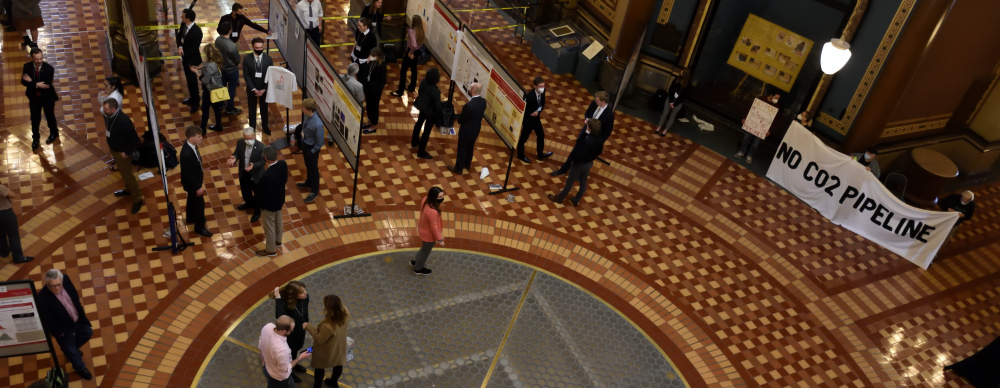
Organizations and landowners were at the Iowa State Capitol rotunda yesterday (3:30-6:00) to let our legislators know that Iowans won’t stand for the abuse of eminent domain!
With only a few short weeks left in the legislative session, we need to show our legislators how crucial it is that they take meaningful action right now.
We will hear from experts, landowners, impacted Iowans, Indigenous folks, and legislators as they address concerns about Iowa’s three proposed carbon pipelines—Summit, Navigator, and Wolf.
This event is hosted by Iowa Sierra Club, Science and Environmental Health Network, Iowa Food and Water Watch, and Great Plains Action Society—who are all a part of the Iowa Carbon Pipeline Resistance Coalition.
Organizations and landowners are at the Iowa State Capitol rotunda today to let our legislators know that Iowans won't stand for the abuse of eminent domain! pic.twitter.com/pVK3VawzJL
Cuba Prepares for Disaster by Don Fitz caught my attention for several reasons. Reading the article and watching the video below, I’m astonished by what Cuba has been doing for decades related to our changing climate. The work there implements many of the things I’ve been learning from Mutual Aid and Indigenous ways. Cuba is a model for the way I believe we must change to deal with oncoming environmental chaos. And although Cubans might not call it Mutual Aid, what they have done, are doing, is consistent with the concepts of Mutual Aid.
For Cuba to implement global environmental protection and degrowth policies it would need to receive financing both to research new techniques and to train the world’s poor in how to develop their own ways to live better. Such financial support would include …
Reparations for centuries of colonial plunder.
Reparations for the 1961 Bay of Pigs invasion, multiple attacks which killed Cuban citizens, hundreds of attempts on Fidel’s life, and decades of slanderous propaganda: and,
In the video Cuba’s Life Task, Orlando Rey also observes that “There must be a change in the way of life, in our aspirations. This is a part of Che Guevara’s ideas on the ‘new man.’ Without forming that new human, it is very difficult to confront the climate issue.”
Since Rio de Janeiro [Earth Summit in 1992] the words of our commander-in-chief Fidel Castro provide evidence of the actions and concern for human beings.
An important biological species is at risk of disappearing due to the rapid and progressive elimination of its natural habitat: mankind… It must be said that consumer societies are chiefly responsible for this appalling environmental destruction… They have poisoned the seas and the rivers. They have polluted the air… The forests are disappearing. The deserts are expanding… Third World countries cannot be blamed for all this; yesterday’s colonies and today nations exploited and plundered by an unjust international economic order. The solution cannot be to prevent the development of those who need it the most. In reality, everything that contributes to underdevelopment and poverty today is a flagrant violation of the environment… If we want to save humanity from this self-destruction, wealth and available technologies must be distributed better throughout the planet… Stop transferring to the Third World lifestyles and consumer habits that ruin the environment… Pay the ecological debt, not the foreign debt. Eradicate hunger and not humanity Tomorrow will be too late to do what we should have done a long time ago. Thank you.
Fidel Castro, Earth Summit, 1992
The main value of the speech was to put environmental problems in their socioeconomic context. The environmental issue has been detached from its origins in capitalist development, from the foundations of a system that, based on excessive consumption, on unequal production and consumption patterns, created the present situation.
From the video Cuba’s Life Task: Combatting Climate Change
Cuba has a system of civil protection established since the early 1960s following Hurricane Flora [1963] which caused major losses of human and animal lives, and economic damage. It is organized so that the moment there is a threat that phenomenon comes under permanent vigilance and various stages are established with mechanisms for protection and evacuation. Cuban Civil Defense adopts a systemic approach. The function is to protect the population, their resources, the economy, and the environment against natural, technological, and sanitary threats. Not just disasters, but also war, or the consequences of climate change.
The political organizations and organizations of the masses, made up of the population, are part of the Civil Defense system. When there is a situation or event, they join the health brigades activated in the Popular Councils in the defense zones, they support the lineworker – specialists who establish the vital systems related to energy – the neighborhood clean-up, after damage incurred during the event, including to building structures.
They contribute to local efforts. This guarantees several things; first, that there is protection at the neighborhood level, and second, that there is complete knowledge, because those neighbors know where the most vulnerable people and the most unprotected buildings are. That secures the process.
Every year in May before the hurricane season begins, we have an annual exercise, ‘Meteoro’, in which the population practice for disaster situations. Initially it was focused on tropical cyclones and hurricanes, but it has been broadened to prepare the population for droughts and earthquakes.
Recently we had a meeting about climate change in Cuba and Puerto Rico, and we saw that the number of people who died from Hurricane Irma was 10 in Cuba and 3,000 in Puerto Rico.
People die here from meteorological events too, but loss of life is minimal.
This whole process of relocating people who reside in high risk, vulnerable settlements. is financed by the state. This is one of the complexities to speeding up this process. It is not dependent on the ability of each citizen, the state assumes that responsibility and it requires substantial resources that the state has to allocate among its many expenses. But it is a state priority to carry out these relocations. New settlements and communities have been built, new buildings in existing communities. We have also learned that it is not only a physical issue of rebuilding houses. You have to relocate a whole way of life, rebuild a setting where people have social services, medical services, educational services, job opportunities. This is more complex when the community’s work is linked to the coast, as with fishing communities. We have concluded that relocating communities is an extreme measure against natural, technological, and sanitary threats. Not just disasters, but also war, or the consequences of climate change.
We can do it. What is our big problem? The worst problem is the [US] blockade. That is why we cannot advance any faster. Martí, Fidel, Raúl, Díaz-Canel…Long live free Cuba!
It is more than 60 years of the [US] blockade, which was greatly tightened by the Trump administration causing a lot of damage, and Biden, despite what he said in his electoral campaign, has still done nothing to loosen those measures. The country is in a very difficult situation as, although many do not think so, persecution is real. Remove the genocidal blockade against the Cuban people!
It is very difficult in conditions of poverty or deep economic and social inequality to advance a climate agenda.
One problem today is that you cannot convert the world’s energy matrix, with current consumption levels, from fossil fuels to renewable energies. There are not enough resources for the panels and wind turbines, nor the space for them. There are insufficient resources for all this.
If you automatically made all transportation electric tomorrow, you will continue to have the same problems of congestion, parking, highways, heavy consumption of steel and cement.
There must be a change in the way of life, in our aspirations.
This is part of the debate about socialism, part of Che Guevara’s ideas on the ‘new man’.
Without forming that new human, it is very difficult to confront the climate issue. I believe that a plan like Tarea Vida needs to be supported by a socialist system. It requires a vision that not directed towards profit, or self-interest. It must be premised on social equity and rejecting inequality. A plan of this nature requires a different social system, and that is socialism.
Perhaps the three most important lessons learned are: political will, communication to translate results, and training young people. From my point of view, these are the most important achievements in Cuba. My message to this climate change conference is a message of social inclusion
I also place Cuba’s disaster response system in conversation with these emergent practices of mutual aid
With the global and local effects of COVID-19 bearing down on us and without any clear expectation of when it might end, it’s as important as ever to take care of our communities. In this episode, we talk about the importance of mutual aid, the history of these networks, and why – if you haven’t before – now is the time to seriously consider getting involved with them.
…We talked about this in an earlier episode about social work in Cuba and the way that model was really rooted more in community organizing and almost somewhat of a mutual aid, at least from what I understood from what we read at that time of basically the community was supporting each other, but then the social worker’s job was actually to almost be the liaison with the state to get stuff that the community needed in order to facilitate that support.
This research comprises a literature review of both humanitarian organization-oriented and social science-oriented sources. In drawing from both NGO and local analyses, I hope to locate practices that could foster a less colonial approach to disaster response. I also place Cuba’s disaster response system in conversation with these emergent practices of mutual aid: in many ways, what theorists learned in the aftermath of the Haiti disaster was already implemented, in a top-down manner, by the Cuban government, which is highly successful at limiting damage and human casualties from disasters (Castellanos Abella, 2008).
Ever since I wrote yesterday’s post, I knew something wasn’t right. Trying to think things through in public can be disconcerting. Hopefully, there is some value in showing the process. Making mistakes is how we learn and grow.
I’ve been praying and thinking about all the things I’m learning in my Mutual Aid community for a long time. I’ve been wondering what sustains my friends in this work. Sometimes difficult work. My Mutual Aid community is definitely an example of Beloved community. We feel and share the love. Never have I seen anger. This is part of what sustains us.
And the joy of being able to provide food to our community is a large part, too. I wrote that sentence carefully, to demonstrate an important part of Mutual Aid. It is NOT us helping them. We are all in this together. A friend recently told me at one time she needed food. Now she is so happy to help distribute food.
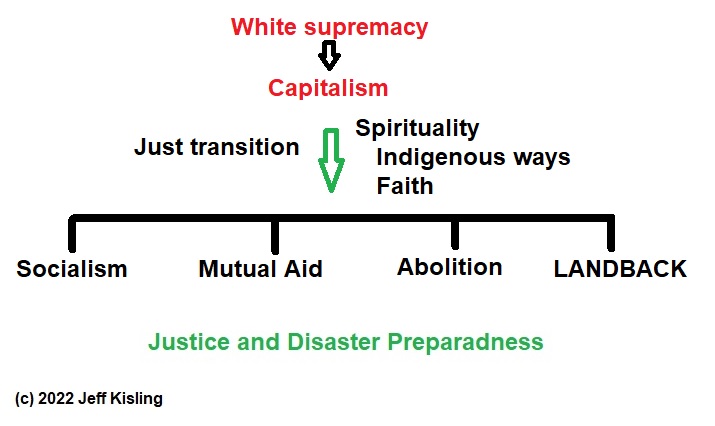
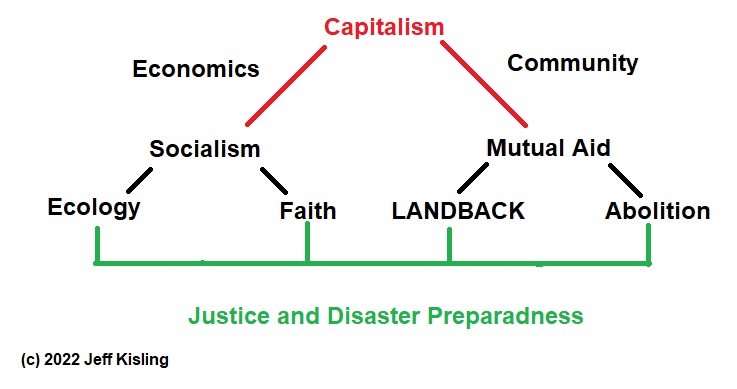
Returning to yesterday’s post, Justice and Disaster Preparedness, I tried to simplify the main concepts I think are important for making a transition to the communities we want, need to create. I was trying to figure out where faith fit. I put it under Socialism because I’ve been learning about religious socialism. That and other problems made me decide to scrap that diagram. Following is today’s version.
Socialism, Mutual Aid, Abolition, and LANDBACK each have a role in building Beloved communities. Especially regarding disaster preparedness.
Spirituality is what will help us make the just transition to communities needed to prepare for the present and coming disasters.
Spirituality can be expressed in many ways. But there is only one Creator or God.
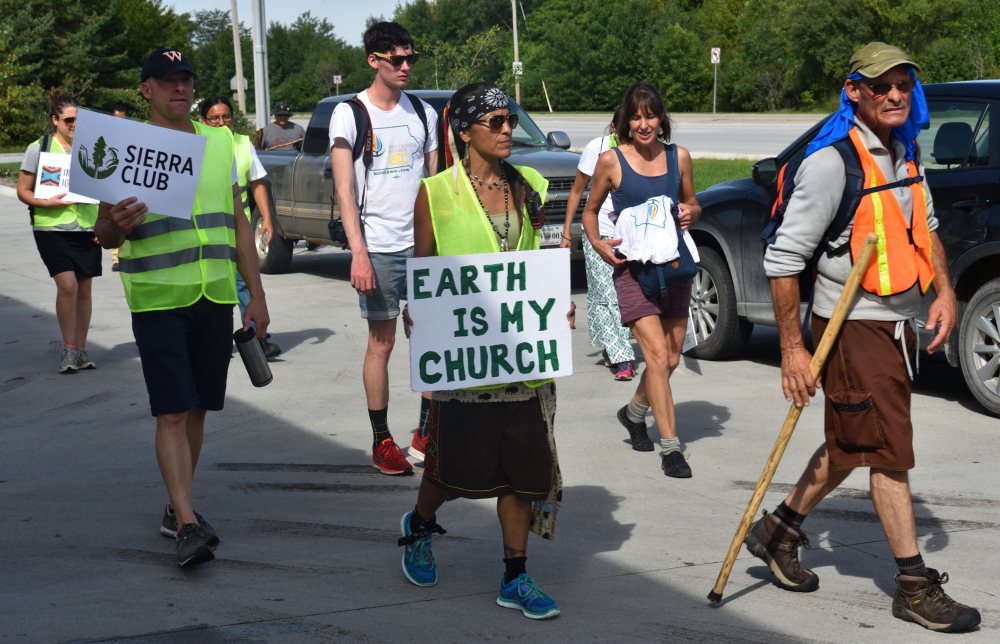
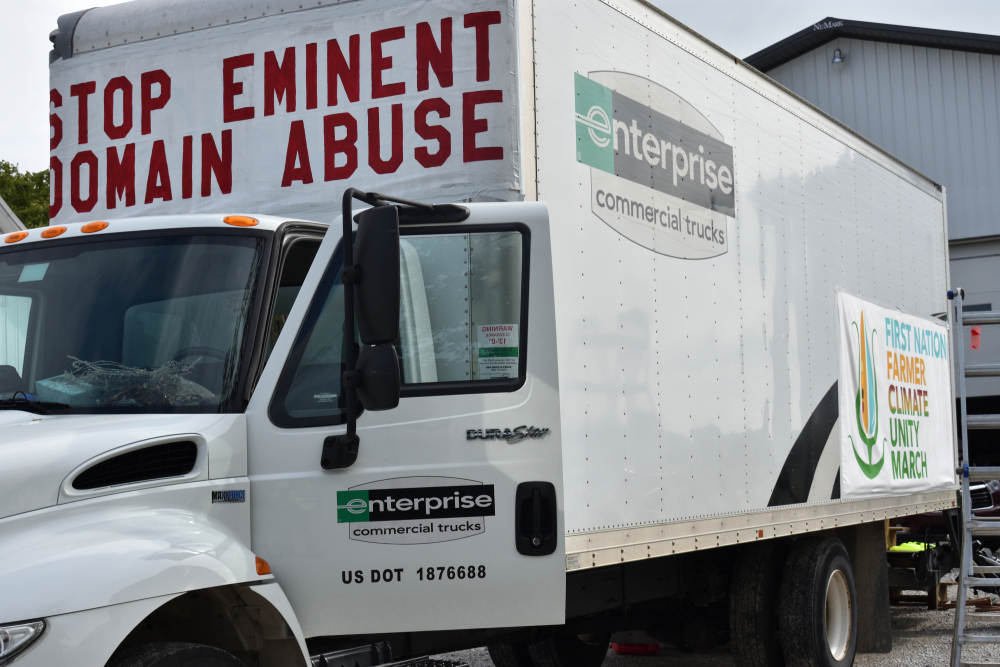
I love the EARTH IS MY CHURCH sign my friends Alton and Foxy Onefeather carried during our First Nation Farmer Climate Unity March.
First Nation Farmer Climate Unity March September 1-8, 2018
Watching the tragedy of war unfolding in Ukraine makes real the future I fear we are moving into. Are already experiencing in many ways.
Fear not only as a noun, “an unpleasant emotion caused by the belief that someone or something is dangerous”, but also as a verb, “to be afraid of.”
I can’t imagine anyone watching the stories from Ukraine, and not thinking about how tenuous our own lives are. Seeing people’s lives destroyed in an instant. Injury or death of loved ones. Loss of shelter and infrastructure. No water, power, medicines, food, community.
What would we do in a similar situation?
We might find out sooner than we think. We are facing numerous crises ourselves.
Environmental chaos
Economic collapse
Political collapse
War
Domestic extremism and armed conflict
There have been warnings about these things for decades, with little effect. But now we are seeing everything on that list happening to various degrees. And each negatively impacts the others.
Following is a new diagram I’m working on to show relationships among systems. The reason justice is in today’s title is because so many of our current systems have injustices embedded in them. As we prepare for disasters, not addressing injustice would mean:
Not benefiting from the wisdom and skills of those we don’t have relationships with now. Because of the mistrust between us.
Bringing these injustices and conflicts into the disaster relief communities.
We have three choices:
We can just react to what is coming at us. Go into survival mode.
We can prepare for disaster locally.
We can work for justice as part of disaster preparedness.
Descriptions of the systems in the diagram: ecosocialism, LANDBACK, abolition and Mutual Aid follow.
I believe faith is an important part of this. This morning I thought faith was going to be the subject, but found this background needed to be covered first.
Ecosocialism
Ecosocialism brings together two complementary ways of thinking about humans and the environment they live in. The “eco-” in ecosocialism comes from the science of ecology and its emphasis on the complex and dynamic interactions among the living and non-living components within an ecosystem. In particular ecologists understand how the life-supporting functions within an ecosystem can be disrupted by the behavior of one organism, for example, humans.
But ecology lacks a social analysis; it has no way of understanding how economic and political forces drive human behavior and social change.
Ecosocialists start with the premise that environmental degradation and social injustice stem from the same source: a world where profit is the highest goal. We believe that the emancipation of people from capital and its masters goes hand-in-hand with the emancipation of the earth and its biosphere from the cancer of capitalism.
The criminal justice system is violent and harmful: The UK’s prison population has risen by 90% in the last two decades, bringing the number to over 90,000. At the time of writing we are 156 days into 2018 and already we have seen at least 129 deaths in prison, immigration detention centres and at the hands of the police. As the effects of neoliberalism and austerity deepen each day, increasing numbers of people find themselves made disposable by our economic system and structural inequality, targeted by the agencies of the criminal justice system simply for being homeless, experiencing poor mental health or being born in a different country.
The criminal justice system does not reduce social harm: Policing, courts and the prison system are presented to us by politicians and the media as solutions to social problems. Yet, as the prison population has soared, we have continued to seen violence and harm in our society on a massive scale. Violence against women and girls is endemic, racism and the far right are on the rise in Britain and rates of murder and violent assaults are beginning to increase again. As politicians continue to scapegoat those with the least power in society, the conditions of structural violence that so often precede interpersonal violence remain in place.
We can build a world based on social justice, not criminal justice: All over the world, communities are coming together to build real solutions to societal problems. These solutions lie outside of the criminal justice system, in preventing harm through building a better society. By bringing together groups and organisations working for social justice, we want to demonstrate and strengthen the links between prison abolition and wider struggles for housing, health, education, and environment; and for economic, racial, gender, sexual and disability justice.
I have no idea how high gas prices will go or how long they will remain high.
“High” is a relative term. Shouldn’t gas prices reflect the environmental damage from both the horrendous destruction of the land and water from fossil fuel extraction and the many and extensive damages from burning fossil fuels?
What I find fascinating today is hearing so many people saying if gas prices go much higher, they will walk or take public transportation! Exactly what should have been done decades ago. I always thought there should have been high government gas taxes to try to drive this behavior modification.
Thinking of the impacts on those who are impoverished, this population tends not to have personal automobiles. Are already using public transportation. Similar to food subsidies there might be a need for something similar for transportation.
Most of us have gotten used to remote video/audio conferencing because of the pandemic. If gas prices remain high or go even higher, that will probably result in a return to that. It is likely even more people will work remotely.
This has the potential to significantly reduce fossil fuel emissions.
I love this story about Barry Lopez.
How could we convince lawmakers to pass laws to protect wilderness? Lopez argued that wilderness activists will never achieve the success they seek until they can go before a panel of legislators and testify that a certain river or butterfly or mountain or tree must be saved, not because of its economic importance, not because it has recreational or historical or scientific value, but because it is so beautiful. His words struck a chord in me. I left the room a changed person, one who suddenly knew exactly what he wanted to do and how to do it. I had known that love is a powerful weapon, but until that moment I had not understood how to use it. What I learned on that long-ago evening, and what I have counted on ever since, is that to save a wilderness, or to be a writer or a cab driver or a homemaker—to live one’s life—one must reach deep into one’s heart and find what is there, then speak it plainly and without shame.
Reid, Robert Leonard. Because It Is So Beautiful . Counterpoint. Kindle Edition.
We can’t put a price on beauty. I hadn’t thought of it this way, but if we believe in preserving beauty, wouldn’t it have been amazing if we demanded any resource mining could not be done if it harmed the beauty?
Instead, there are hundreds of square miles of filthy pits from tar sands extraction. Instead, the tops of mountains were blown off.
Likewise, a price cannot be put on all the damage done by burning fossil fuels.
And there is the incomprehensible situation of an energy returned on investment of only 3:1 for tar sands mining. The unit of energy it takes to extract tar sands produces only 3 units of energy. In other words, it takes almost as much energy to mine tar sands as the energy produced. Unbelievable.
I’m horrified by all the consequences of the Russian invasion of Ukraine.
There are many aspects beyond the actual fighting that I’m having trouble understanding or believing. Not much of which is being covered in the mainstream media. Vitally important issues that should inform decisions being made now, and in the future.
This confusion has been expressed as the fog of war.
The fog of war is the uncertainty in situational awareness experienced by participants in military operations. The term seeks to capture the uncertainty regarding one’s own capability, adversary capability, and adversary intent during an engagement, operation, or campaign.
Access to fossil fuel sources has been and will continue to be a major part of all wars and conflicts.
It is past time to stop fossil fuel emissions. That is the existential global threat. Nothing else will matter as our environmental catastrophe rapidly worsens.
And yet what is informing political decisions in this country is the impact on gas prices. Capitalism.
Releasing strategic oil reserves is an example of the kind of decisions being made now that are absolutely wrong. Burning fossil fuels is indefensible as our environmental catastrophe accelerates. But that hasn’t slowed down fossil fuel emissions, yet.
As Jade Begay says, the current conflict will drive up domestic oil and gas development.
This makes it clear that not only are oil and gas used to carry out war but are also a root cause for exponential climate change. Second, as an organizer who is actively working to shut down fossil fuel infrastructure, I am hyper aware that this conflict will potentially drive up domestic oil and gas development, onshore and offshore gas leasing, and/or potentially roll back recent wins when it comes to fossil fuels, thus contributing to an increase in carbon emissions. Finally, I’d be remiss to not mention the impact that militaries have on the climate, when it comes to the U.S., our military is the single largest institutional polluter in the world, which creates more greenhouse emissions than 140 other countries.
Jade Begay. Climate justice campaign director for the NDN Collective, said Russia’s oil and gas money allowed it to pay for the invasion, according to an article in Indian Country Today.
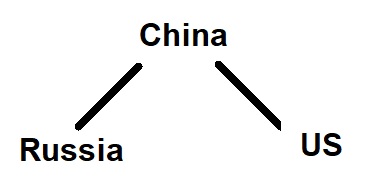
There is this triangle between Russia, China and the US, where China buys Russian oil for its economy. And the US buys products from China. Which means Russian profits come indirectly from the US economy. Which means the US is helping to financing the war in Ukraine.
Another part of the fog of war is a strengtheningrelationship between Russia and China.
Releasing strategic oil reserves is an example of the kind of decisions being made now that are absolutely wrong. Burning fossil fuels is indefensible as our environmental catastrophe accelerates.
Indigenous communities have a unique perspective on Ukraine’s tragic and horrific situation. They understand what it’s like to be invaded by a colonial power. They see the war not only as an attack on human rights, but an attack on Mother Earth.
Is what is happening in the Arctic another part of the fog of war? Indigenous people above the Arctic Circle are wary of what Russia’s attacks foreshadow, according to the Indian Country Today article Monitoring the Arctic in Russian invasion of Ukraine.
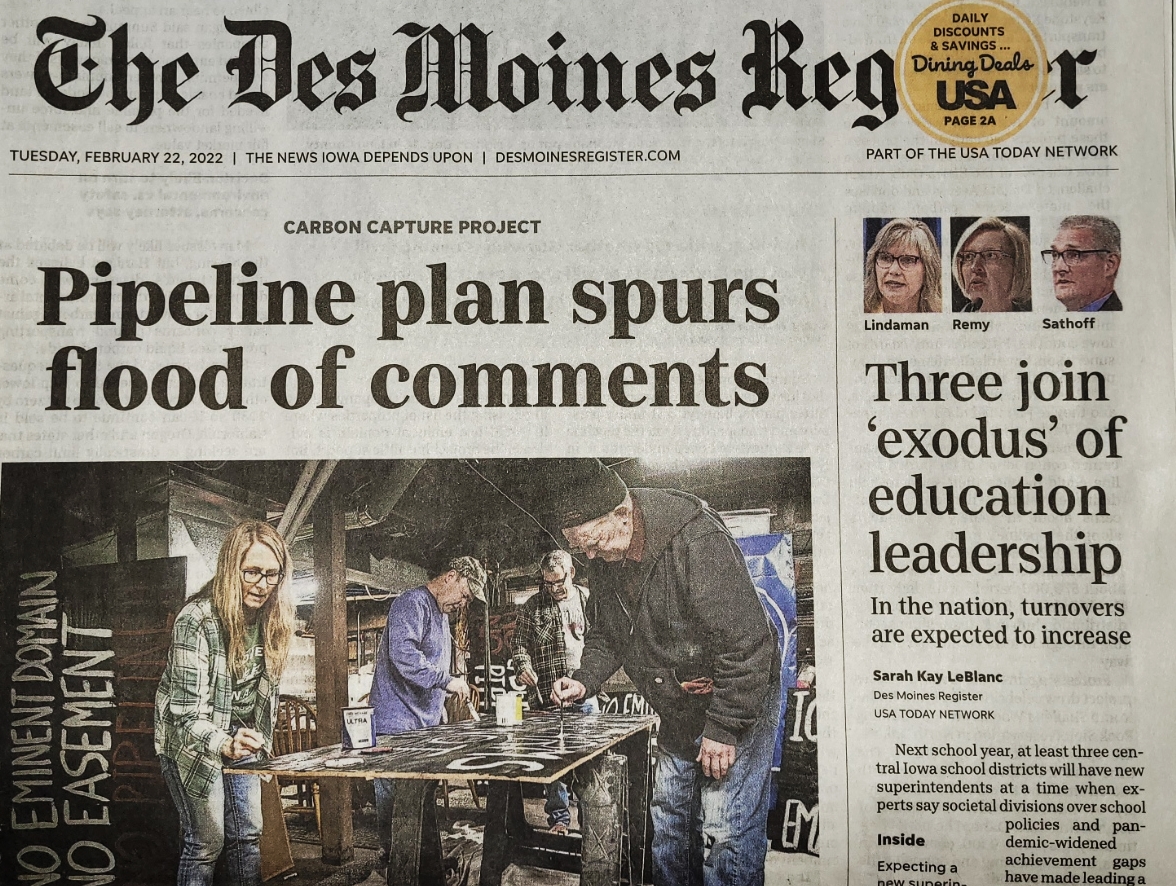
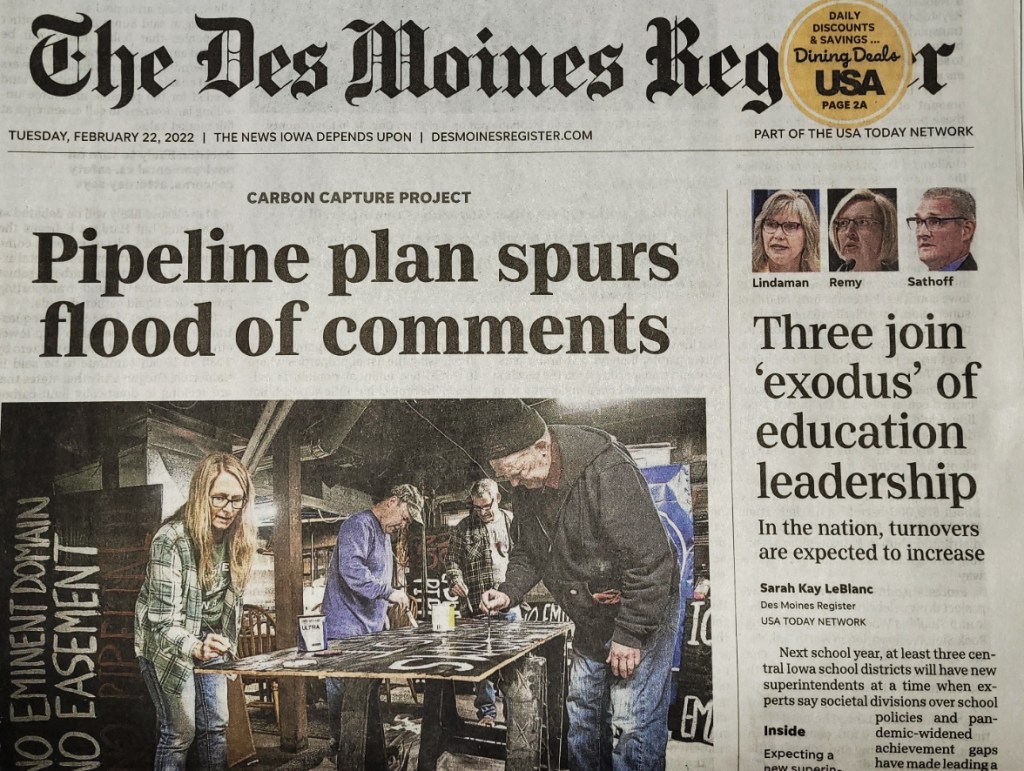
WOW. This is the front page of today’s Des Moines Register and part of that story can be found below.
After years of resisting pipelines, beginning in 2013 with the Keystone Pledge of Resistance, I am cautiously optimistic we might stop these carbon pipelines. Clearly there is much more attention paid to, and resistance from large numbers of people. Landowners suffered in many ways from being forced by the abuse of eminent domain for construction of the Dakota Access pipeline. Now they know and won’t easily allow this to happen again.
There are a lot of pieces to learn about these new concepts, including different ways the carbon dioxide (CO2) that is captured is used. My friends Rodger Ruth and Mahmud Fitil have an excellent discussion about these pipelines in the video at the end of this.
One of the unique and extreme dangers of these new CO2 pipelines is what happens when the CO2 leaks. The carbon in these pipelines is under high pressure. When there is a rupture there is an explosion and then the rapid release of vast amounts of carbon dioxide, which displaces oxygen in the air. People and other living beings immediately become disorientated. Nonelectric vehicles stop working because there is not enough oxygen to burn the gas in the engines. The deaths of large numbers of people could occur if such a rupture happened in a highly populated area. First responders become disoriented as well. This video is about a carbon explosion that occurred in Satartia, Mississippi, in 2020. https://www.facebook.com/FWWIA/videos/6717059531697606
Sequestration (CCS) involves shipping the captured carbon, hence the need for the pipelines, to areas where there are rock formations to inject the carbon into. This is an unproven idea and many of us are skeptical that carbon won’t escape.
Even worse is the use of recovering fuel by injecting the carbon into diffuse pockets underground, to force the oil to the surface the same way water is injected for fracking.
It really is tortured logic to say CO2 is being removed from the atmosphere to decrease greenhouse gas concentrations, and then use that CO2 to extract more oil to burn, adding MORE greenhouse gases.
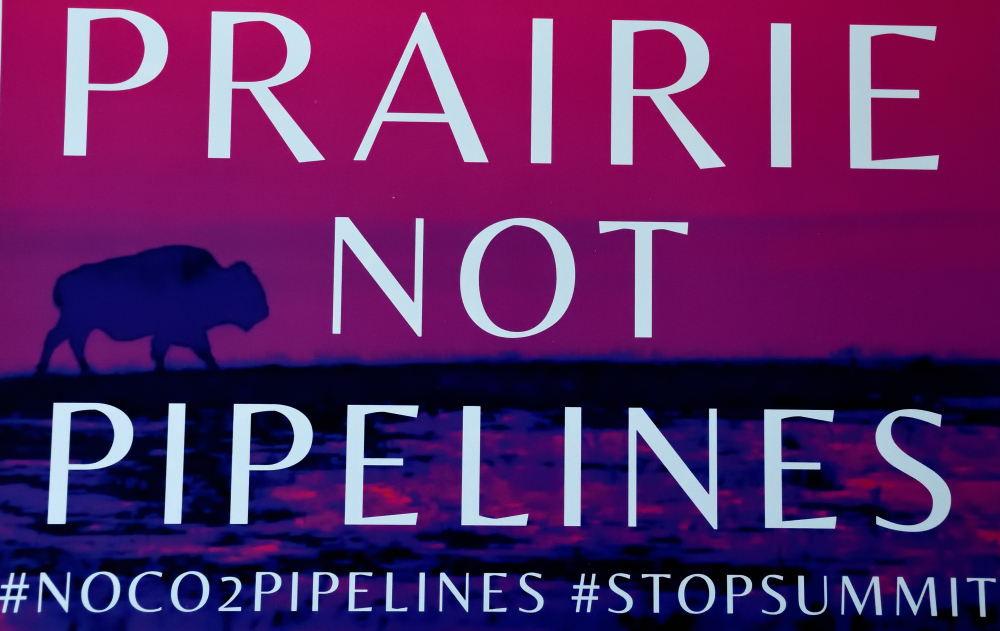
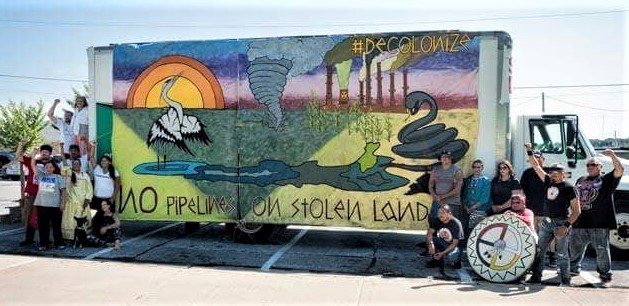
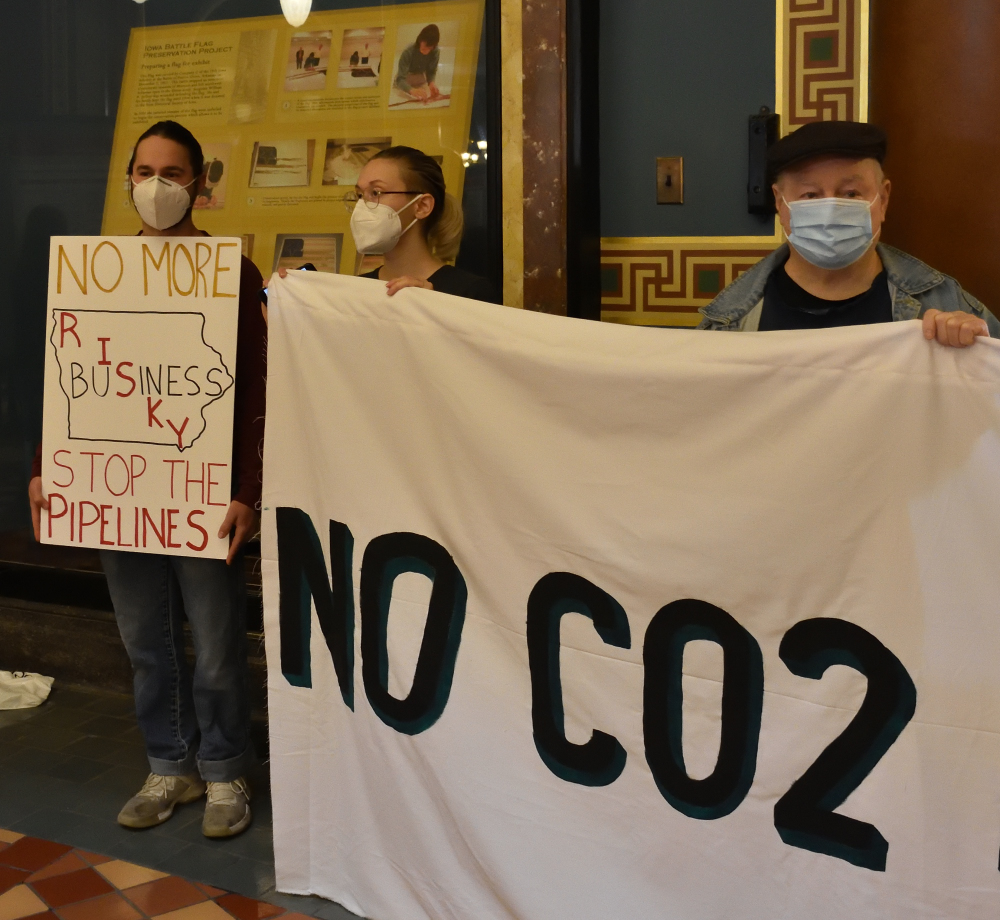
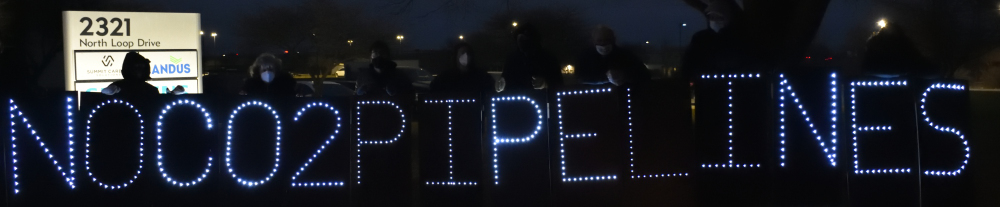
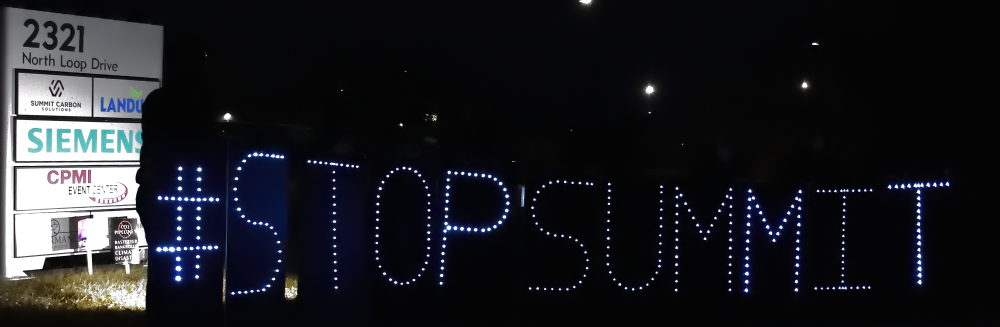
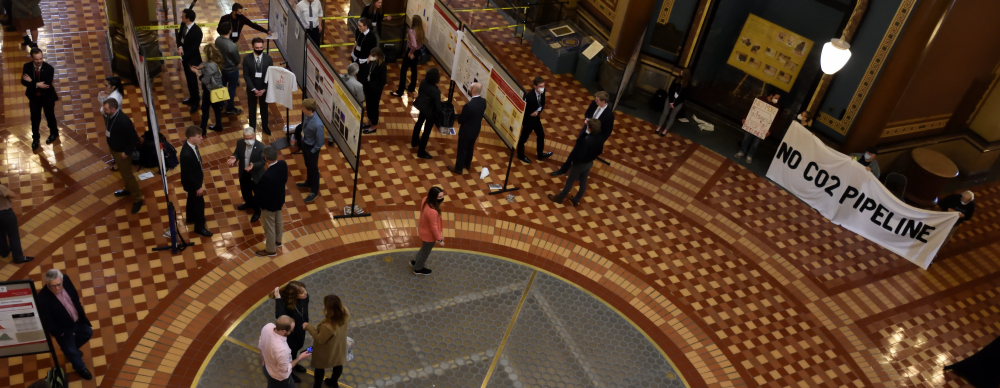
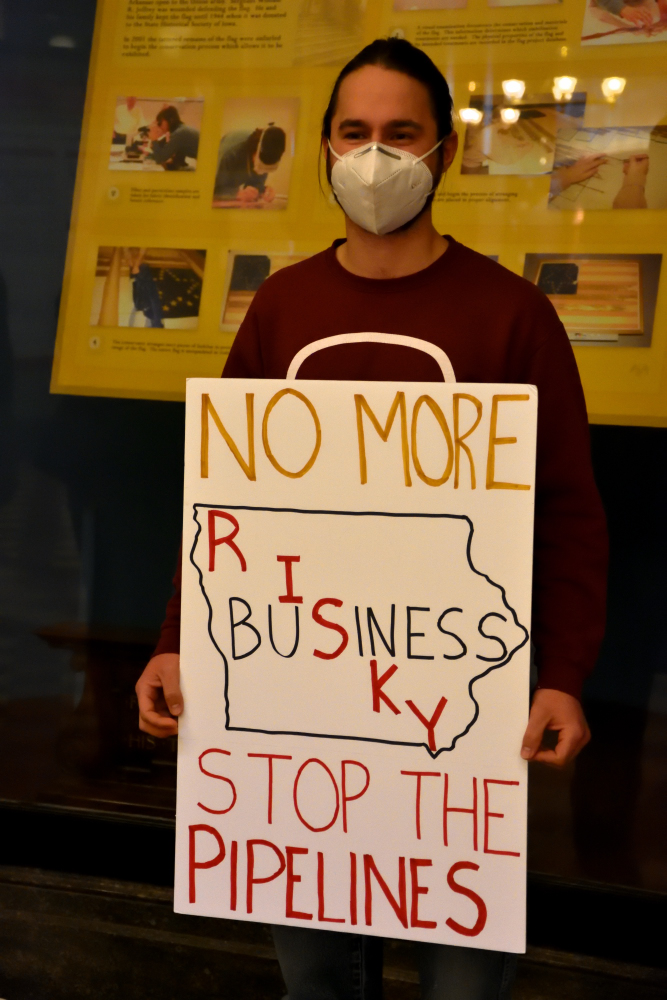
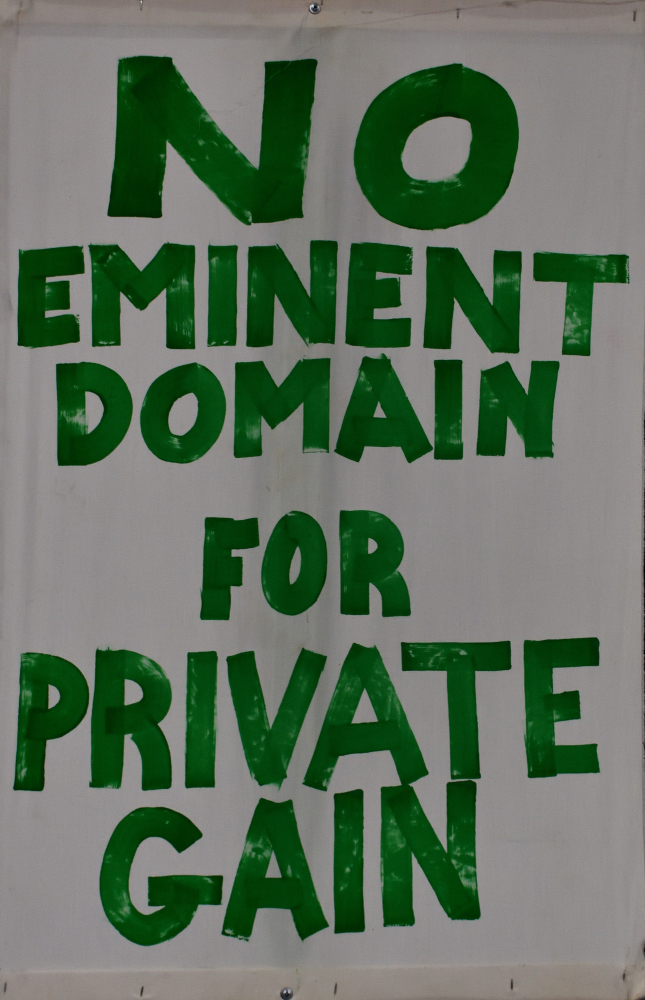
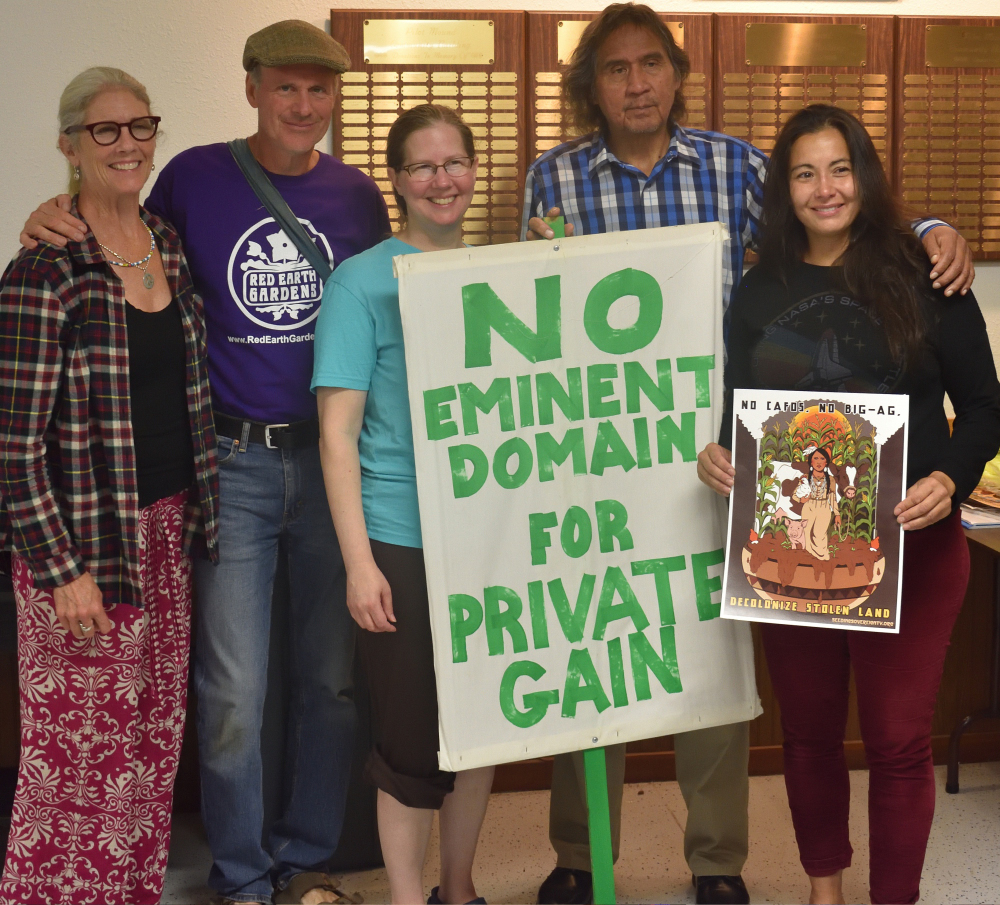
Following are some photos from various events to call attention to carbon pipelines and why they should not be built.
These are from an event by my friends Sikowis Nobiss and Mahmud Fitil at the headquarters of Summit Carbon Solutions in Ames, Iowa, one of the companies involved in CO2 pipeline construction.
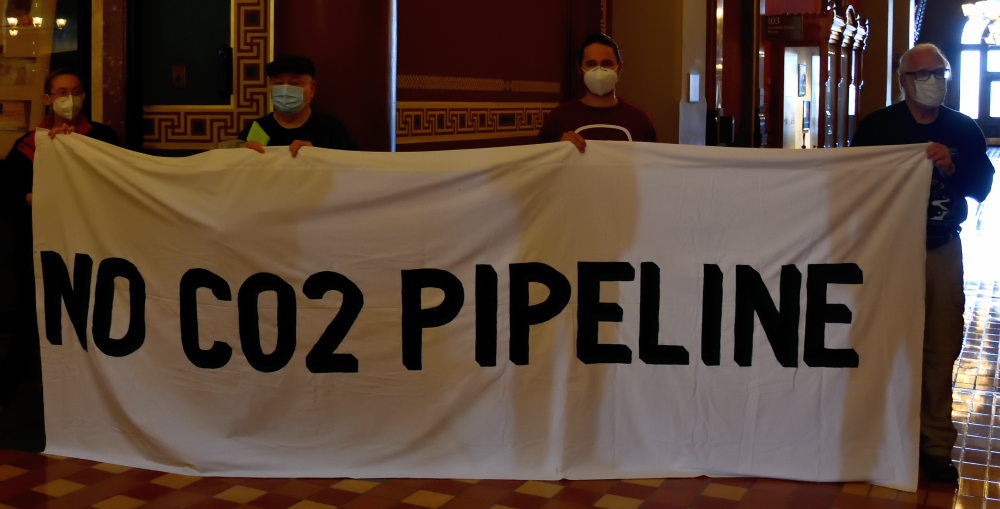
Yesterday some people from the Catholic Worker House(s) held this banner and talked with people at the Iowa State Capitol.
The first carbon capture pipeline proposal to make its way to Iowa regulators is drawing more early opposition in the state than the Dakota Access crude oil pipeline, which grabbed national attention in 2016 and 2017, when Hollywood stars joined Native Americans in monthslong protests.
So far, Summit Carbon Solutions’ proposal to build a $4.5 billion carbon capture pipeline in Iowa has drawn 750 comments, according to Don Tormey, the Iowa Utilities Board spokesman. The comments — mostly in opposition — are double the number the Dakota Access project had received roughly a month after filing its permit request with state regulators in 2015, a Des Moines Register review shows.
And opposition is growing. Organizers say hundreds of Iowa landowners are banding together to fight Summit’s project and two other carbon capture pipeline proposals. They’re refusing to sell easements for the pipelines and pledging to battle the companies in court, if necessary.
Dubbed the Iowa Easement Team, the group says it has hired Domina Law, a Nebraska firm that helped stop the Keystone XL pipeline, which would have transported Canadian crude oil from Alberta to refineries in Texas. It declined to say exactly how many Iowa landowners are part of the effort.
“I’ve been kind of amazed at the amount of resistance we’ve seen to these projects” so early in the process, said Wally Taylor, an attorney for the Iowa Chapter of the Sierra Club, which challenged Dakota Access and opposes the more recent carbon capture projects.
In the submitted comments, farmers, landowners and county and state officials are challenging Summit’s likely use of eminent domain to force unwilling landowners to sell access for the 680-mile pipeline, which would cross 29 Iowa counties. Fifteen county boards of supervisors have filed statements of opposition to the use of eminent domain.
“These are Republican Trump voters, and they’re just mad about these pipelines,” Taylor said.
Eminent domain is once again an issue as more pipelines are proposed to go through the state. These are called CO2 or Carbon pipelines. These pipelines should not be built, for many reasons. But the issue today is about the abuse of eminent domain for any reason. There will be an event related to this at the Iowa State Capitol from 12-1 pm.
Today there will be an event at the Iowa State Capitol from 12-1 pm
If you are concerned about the great threat that carbon pipeline projects in Iowa bring to the land and water and the use of eminent domain for private corporate gain, join us at the Iowa State Capitol from 12-1pm!
This is a weekly gathering for folks to meet as well as let lawmakers know that people from all walks of life are standing together, united in saying, “Protect our land and water!” “No eminent domain for private gain!” and “NO CARBON PIPELINES!”
People will gather in the rotunda at 12 noon. All are welcome! Add your voice and make a difference!
At the same time another group of my friends were at the Iowa State Capitol in support of Bill 2160
A coalition of environmentalists and land owners is seeking a meeting with Governor Kim Reynolds, hoping she’ll intervene and block the Iowa Utilities Board from granting eminent domain so carbon pipeline developers can acquire land from reluctant property owners.
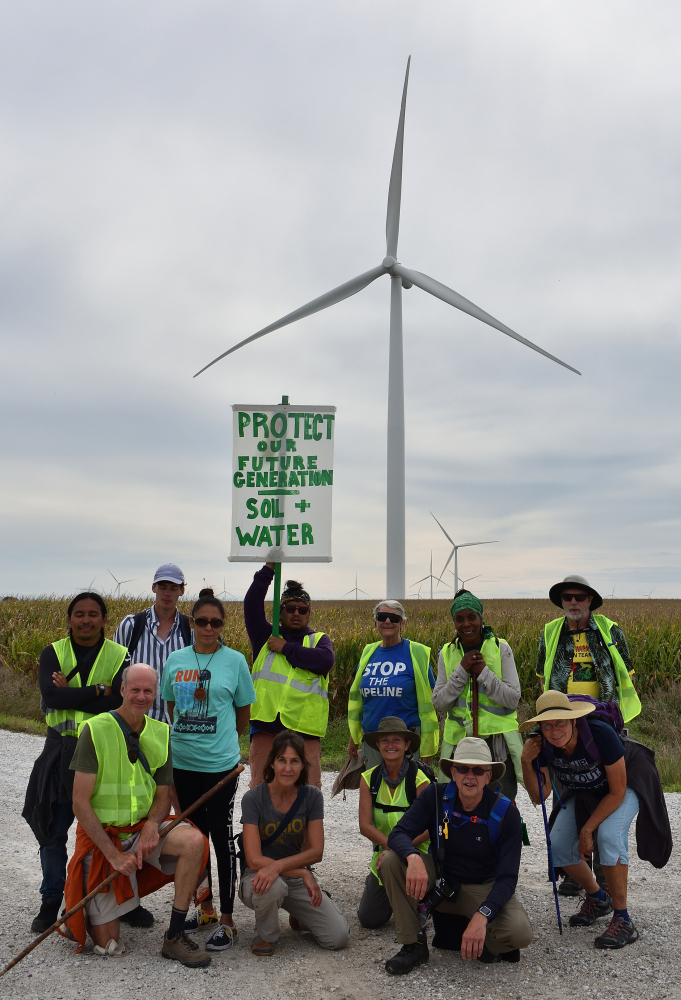
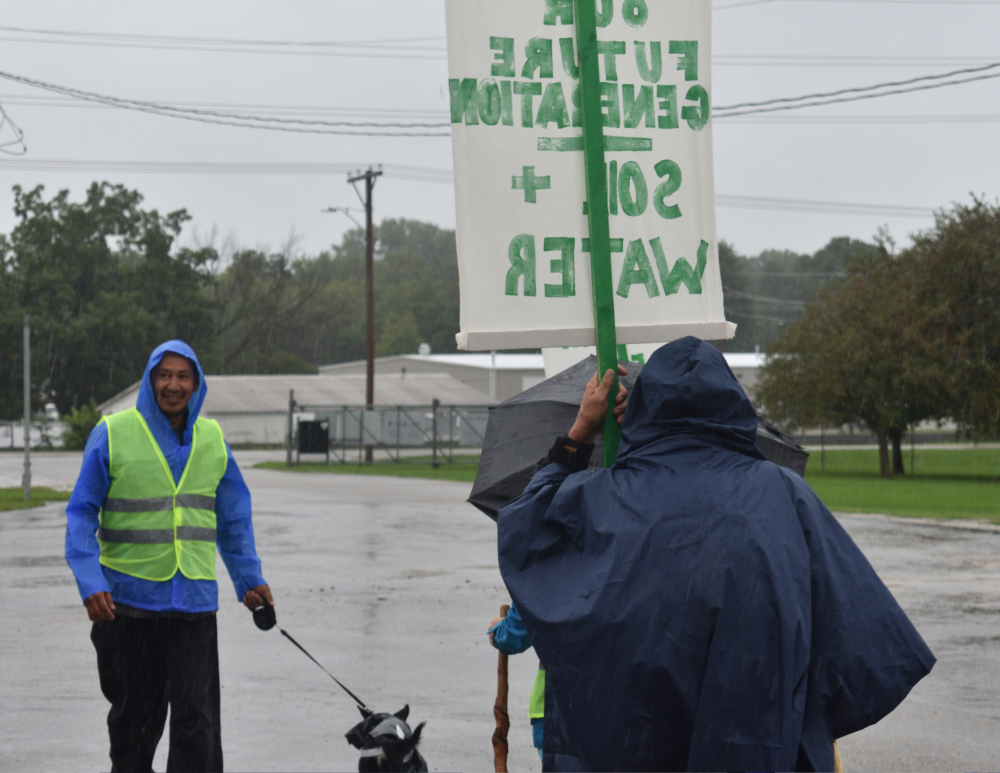
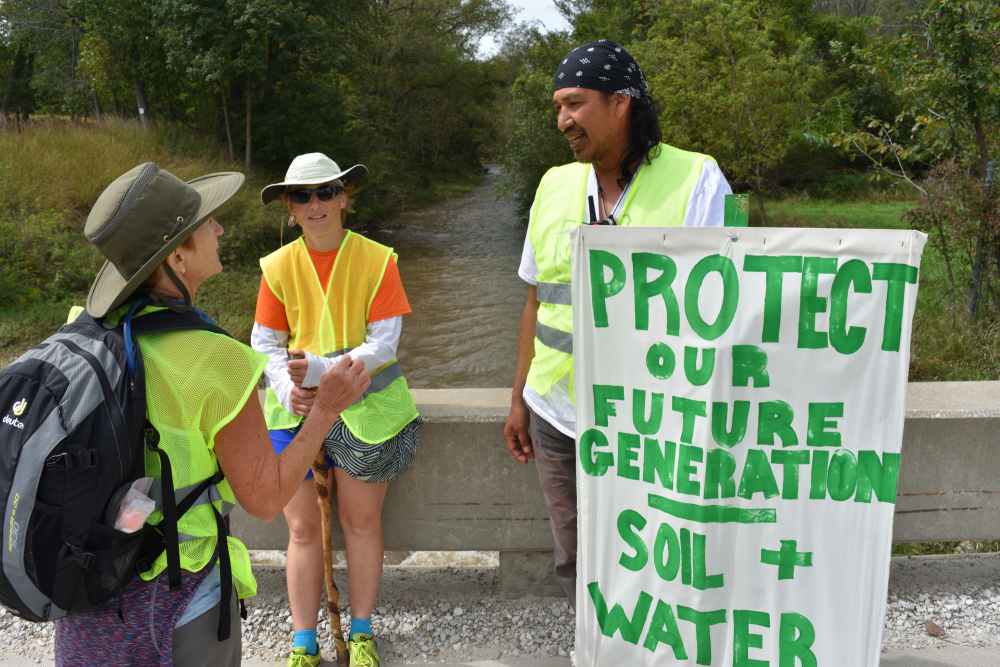
The abuse of eminent domain was one of the reasons a group of us walked and camped for ninety-four miles along the route of the Dakota Access pipeline in 2018, as seen in these photos.
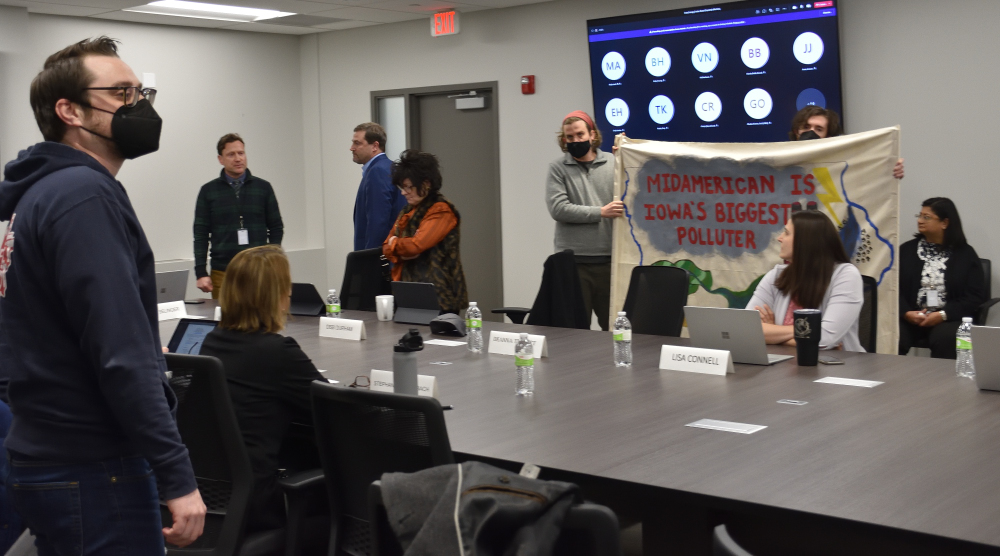
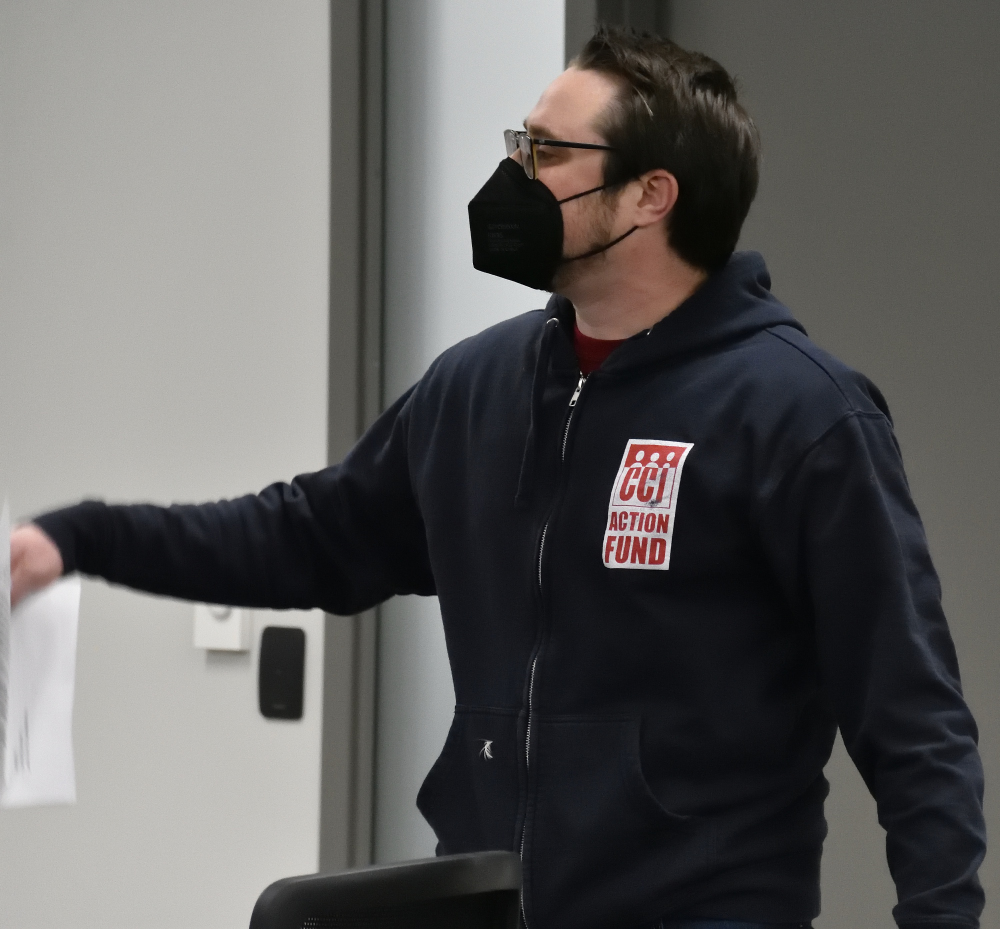
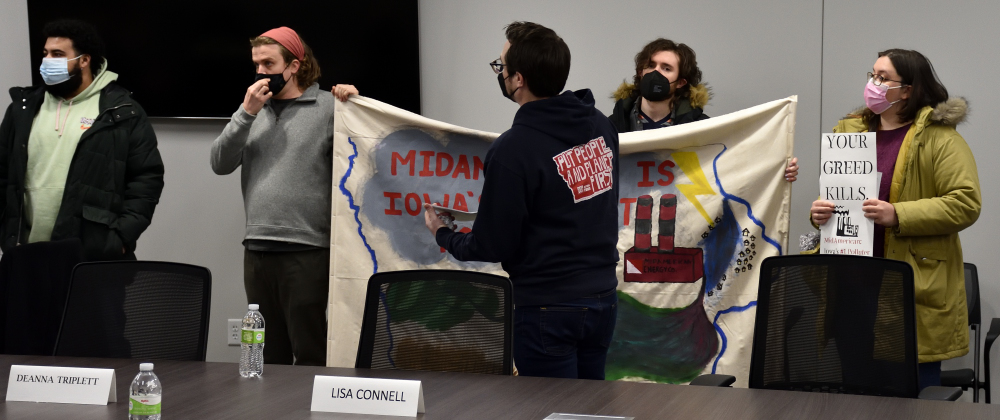
I was talking with my friend Jake Grobe, of Iowa Citizens for Community Improvement (ICCI) recently as we were working at the Des Moines Mutual Aid free food project. (see: Des Moines Mutual Aid Networking). He knows I am a photographer and asked me to take photos at the Iowa Energy Center Meeting yesterday. The reason for going to the meeting is MidAmerican’s CEO Kelcey Brown has refused multiple requests to meet with ICCI and she was going to be at this meeting.
Jake is ICCI’s Climate Justice Organizer. From his bio: He believes that climate justice is an intersectional fight for racial, economic, and social justice. “Humanity confronts a great dilemma: to continue on the path of capitalism, depredation, and death, or to choose the path of harmony with nature and respect for life.”
“Climate justice is an intersectional fight for racial, economic, and social justice” is the premise of Religious Socialism. https://quakersandreligioussocialism.com/
Jake said, “our climate justice team organized this action. We had the intention of shutting down the meeting if we were ignored and did because these coal plants are a leading contributor to the climate crisis which is an existential threat to everything we love.”
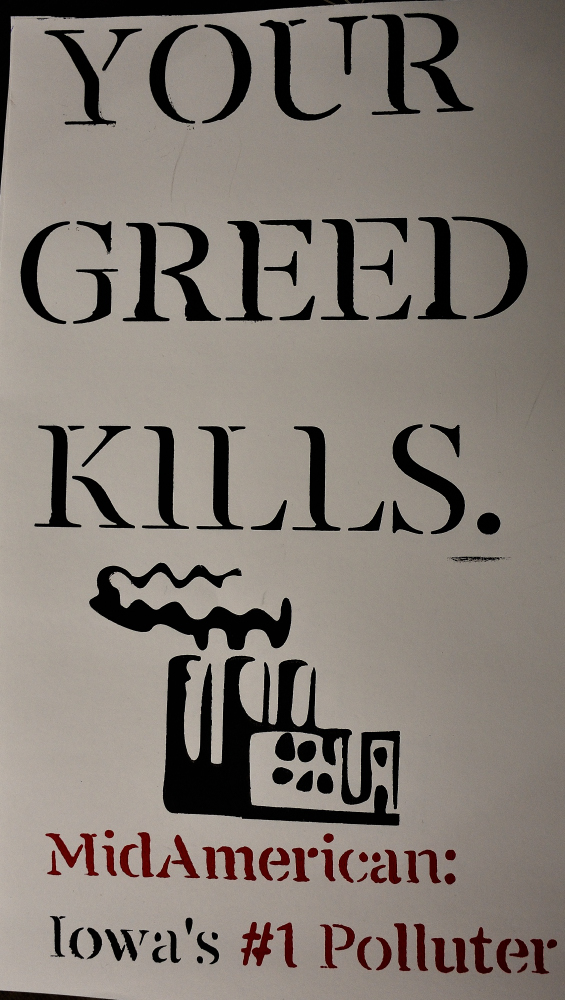
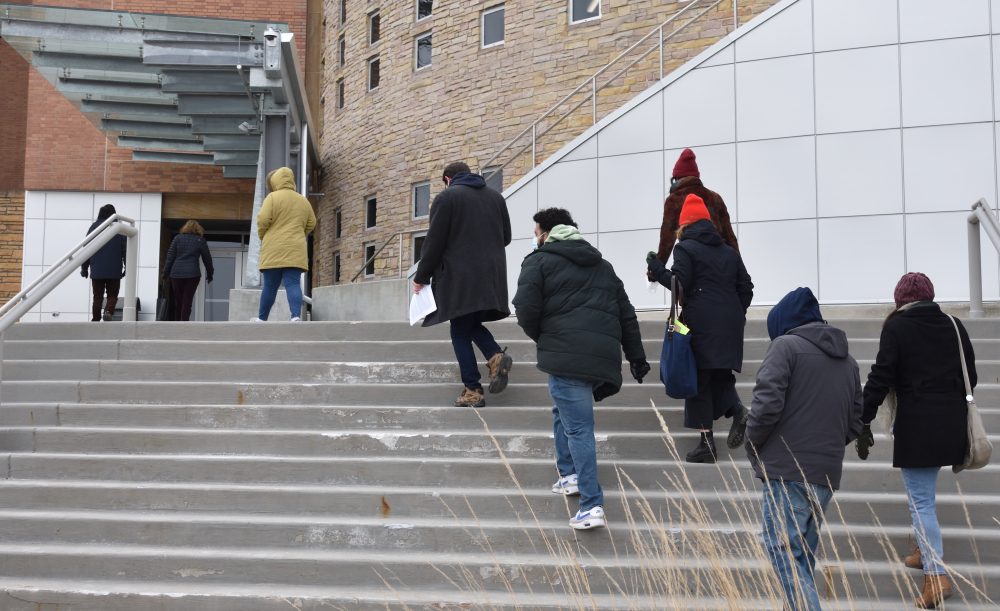
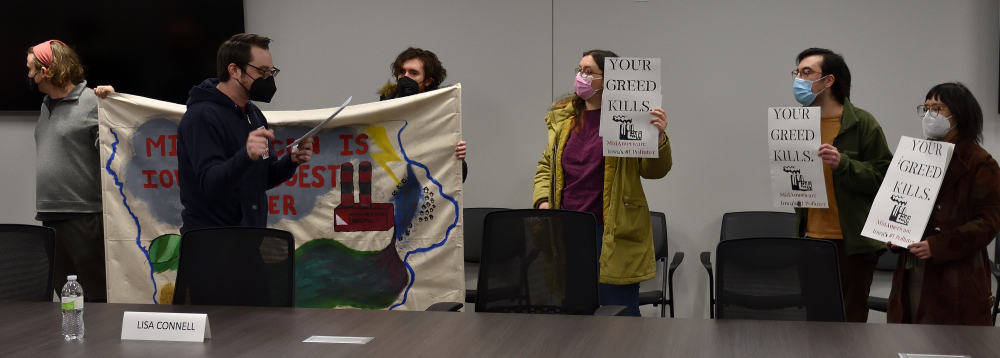
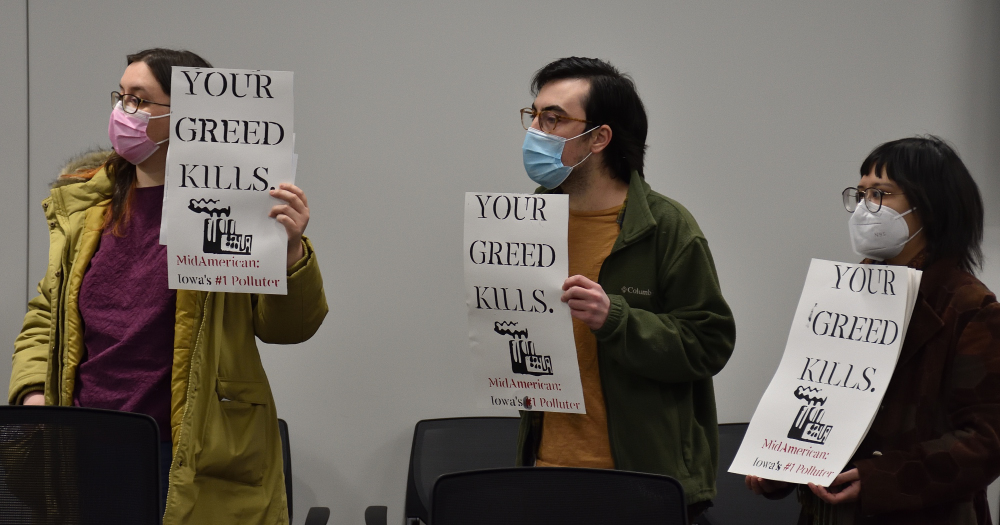
There were handouts (below) and signs. And preparation prior to going into the building together. Jake summarized the intention of the meeting, the issues, and what the action would be if the board did not address their coal power plants. Including leaving as a group if the police were called. No arrests were planned. The police were called and showed up right after we walked out of the building.
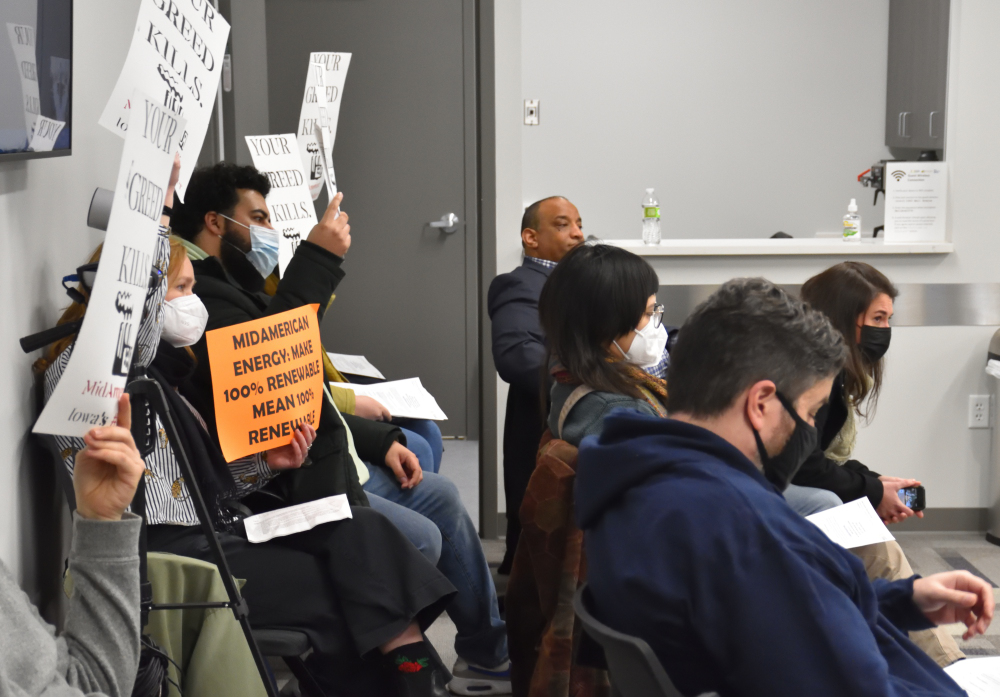
Our group entered the conference room quietly. Signs were kept out of sight by hiding them under coats. When the meeting asked if anyone wished to speak during public comments, four people from our group raised their hand (who had prepared ahead of time what they would say). Each person was allotted two and a half minutes.
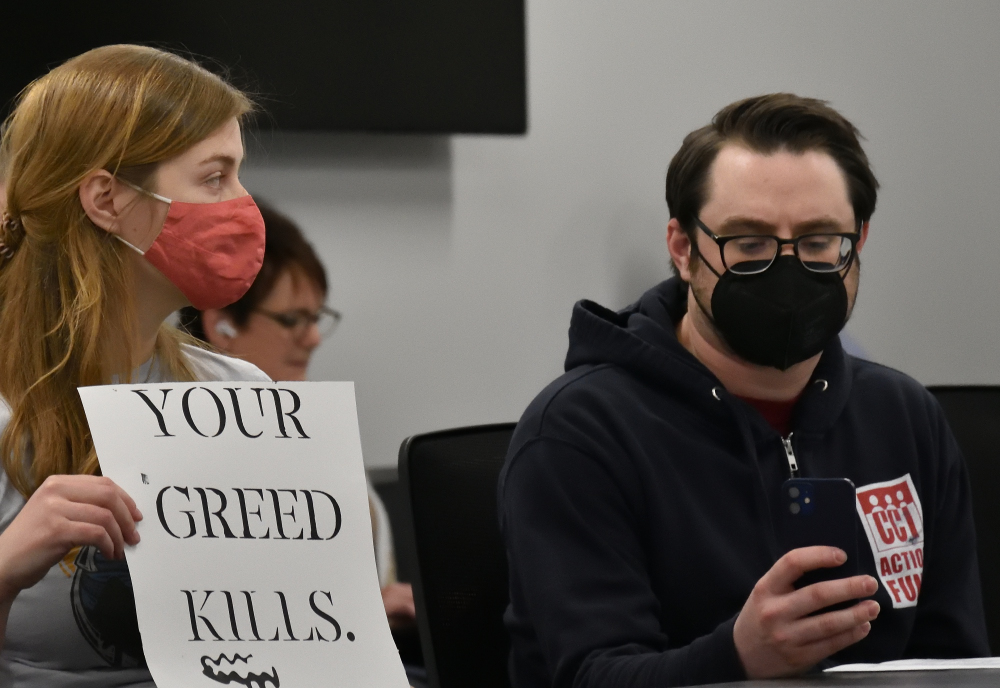
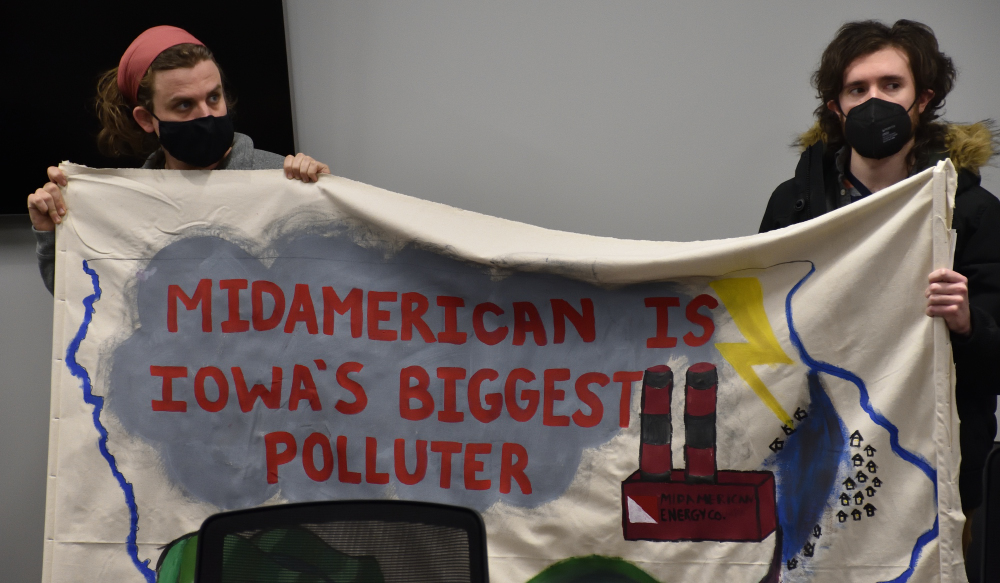
When the first person began speaking, the signs “Your Greed Kills. MidAmerican Iowa’s #1 Polluter” were uncovered and passed among us. But everyone listened quietly with some finger snapping to support certain comments.
When the time for public comments had expired, Jake continued to speak. Asking Kelcey Brown to explain why MidAmerican was not going to shut down their five coal plants, raising many of the points in the handout below. Kelcey Brown said something like thanks for your comments and then didn’t respond when Jake made the ask that she meet with us to discuss our demands. When he kept going after that she briskly walked out.
Jake continued to speak over calls from the board that the time for public comments was over. He spoke about the existential threat of greenhouse gas emissions. Asking if members of the board weren’t worried how their own children would be affected. He pointed out MidAmerican’s development of wind power wouldn’t matter if they continued burning coal until 2049.
This made me think of the term, going into the belly of the beast, meaning “being in the middle of a very bad situation or a dangerous place.” Also, “speaking truth to power.”
Humanity confronts a great dilemma: to continue on the path of capitalism, depredation, and death, or to choose the path of harmony with nature and respect for life.
Jake Grobe
The issue of CO2 pipelines came up, which we are definitely against.
Jake and a few others in our group continued to ask questions. After some time, the board adjourned, and we were told it was time to leave. Jake said a few more things, then asked us if we were ready to go. In the preparation Jake said we would leave on our own terms, and we did.
Katie Bryan, ICCI’s communication director called me prior to the action to make sure I knew there might be some intervention at the meeting. And we discussed how I would get the photos to her. She also suggested if possible, sharing photos as the action was occurring. Not being adept at either using my phone camera, or using twitter, I did manage to send her the photo that she was able to use in the tweets below.
Proud to stand alongside my @iowacci comrades today to demand that MidAmerican Energy shut down all of their coal-burning power plants in Iowa. https://t.co/uyYSzpogwq
Kelcey Brown, CEO of Mid-american, has ignored community members for months reaching out for a meeting. So what do we do? Show up to their meeting. Take up space and demand they shut down their coal plants. We cannot wait any longer. https://t.co/wy9Bmsec2Zpic.twitter.com/offMQk1aW9
No utility shut offs and utility bill relief for working people who don’t qualify for LIHEAP
Reinvest into energy efficiency programs above pre-2018 levels
Facts
MidAmerican Energy is the single biggest carbon polluter in the state
They own five coal-powered plants to generate electricity and plan to keep burning coal until 2049
A report of MidAmerican’s electricity generation in 2020 shows that all the electricity they generated from coal was in excess of Iowa’s needs
In fact, nearly a third of all the electricity they generated was sold to other utilities out of the state for $124.3 million
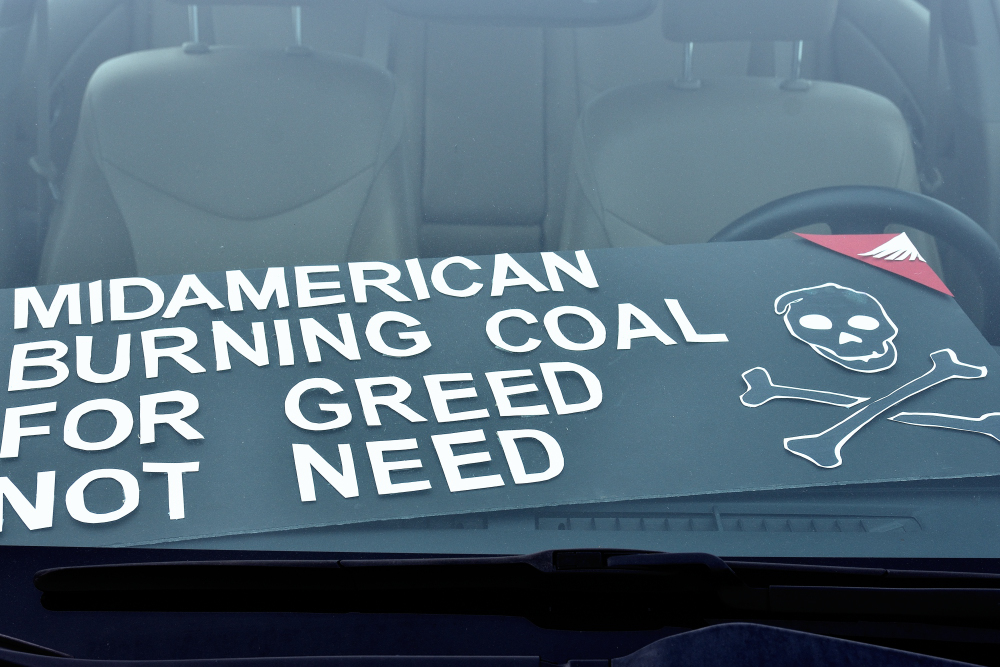
It’s clear that MidAmerican Energy is burning coal for greed, not for need. And we’re paying the price.
In 2020, the excess coal generation in Iowa sent 16,977,124 tons of carbon dioxide into the atmosphere, representing economic harm ranging from $865 million to $2.58 billion.
Sponsoring a *small* fleet of electric buses in our city is a greenwashing scheme and an empty gesture when you consider that in order to offset the last two years of MidAm’s C02 emissions, they’d have to electrify 193,000 buses!
MidAmerican Energy is making working families pay more to keep their homes warm
In 2018, MidAmerican spent over $100,000 dollars to lobby Republicans in the Iowa state legislature to pass a bill that made massive cuts to energy efficiency programs
This included $9,000 to State Rep. Gary Carlson who spearheaded the bill, $16,000 to Republican Senate Majority Leader Jack Whitver, $11,5000 to Republican Senate president Jake Chapman, $10,000 to Republican House Majority Leader Pat Grassley, and $10,000 to Kim Reynolds since 2018
Since that bill passed, working families are getting less help to weatherize their homes to keep them warm in the winter and cool in the summer
MidAmerican Energy reported kilowatt-hour savings for 2020 that were 64% lower than what the utility achieved the year before the law took effect.
Now, MidAmerican customers are paying twice as much for their heat and 61,000 Iowan families have been forced to apply for utility assistance because they can’t pay their bills!
Meanwhile – MidAmerican is on track to make over a billion in yearly profits, another record year!
This is corporate greed and political corruption at it’s finest!
MidAmerican Energy could save ratepayers over $1 billion by retiring their coal fleet by 2030
Study published by Synapse Energy Economics, a nationally recognized energy analytics firm
Recent expert analysis shows that retiring MidAm’s coal fleet by 2030 and replacing it with solar, wind, battery storage, and energy efficiency would save ratepayers $1.2 billion through 2040, while creating high-quality jobs for Iowans.
$1.2 billion is their conservative estimate! — In the likely scenario that high gas prices continue and we finally see a national tax on carbon emissions, MidAm would save $5 billion by retiring its coal fleet by 2030 instead of allowing it to remain online indefinitely!!!!
That same scenario would also reduce carbon emissions by 318 million tons by 2040!
When the captive customers of MidAmerican pay for their power, they certainly are not agreeing to health impacts or death as a part of the deal. Yet, MidAmerican corporate greed results in 5 to 13 Iowans dying per year and increases the health care costs of Iowans by $64,681,145 to $145,675,343.
MidAmerican Energy is poisoning Iowa’s water
MidAmerican has coal plants and stores ash on the banks of the Missouri, Des Moines, and Mississippi rivers, at least 3 sites have been found to be polluting groundwater above federal advisory levels
MidAmerican emissions are worsening the climate crisis which is making droughts worse and drying up Iowa’s waterways. Hotter temperatures combined with lesser water flow is increasing blue-green algae blooms which make the water toxic. This has gotten so bad, that the major water sources for the Des Moines metro area have been untappable at times during the last two summers.
These videos tell the story of the most recent persecution of the Wet’suwet’en peoples by the Canadian government and the militarized Royal Canadian Mounted Police. They speak eloquently for themselves.
They point out what has been obvious to anyone watching the trucker protests the double standard of how the RCMP treat them versus the state sanctioned violence against Indigenous peoples.
Two warnings. There are scenes of police violence. And the song at the end of the first video includes words not appropriate for children but are for the message given.
Today, February 14th 2022, a day that we honour and remember all our relatives that go missing and are found murdered, our land defenders are attending court for upholding Wet’suwet’en law.
We live by our ancestors teachings and the laws that have been in place forever. We will defend our lives and way of living, as all those that came before have done, so that our children will not have to fight the same battles.
We are so grateful that so many nations and allies have stood with us. Their bravery and conviction will always be remembered. Today we stand united before a court that refuses to recognize its’ own rulings. Today we also support our Likhtsamisyu and Gitxan relatives as they appear in the same court for also upholding Wet’suwet’en law. We are all one.
This is a first appearance for all those that were arrested on November 18/19 2021. There are two others facing charges that were arrested and violently removed from Coyote Camp on Cas Yikh yintah appearing today as well.
The criminalization of our people and the blatant racism of the so-called justice system is especially pronounced now as we see how non-indigenous people are treated. The violence used against Indigenous women protecting Indigenous land is intentional. The kid gloves used in Ottawa is intentional. We will not allow this to continue for our children to grow up with.
For more information please visit yintahaccess.com on how to support and current campaigns.
Follow our social media pages for updates on today’s court and future proceedings.
Misiyh.
Following is some history related to support from various groups in Iowa for the Wet’suwet’en struggles.
January 26, 2020
Bear Creek Friends (Quaker) meetinghouse is in the Iowa countryside. Many members have been involved in agriculture and care about protecting Mother Earth. A number of Friends have various relationships with Indigenous peoples. Some Friends have worked to protect water and to stop the construction of fossil fuel pipelines in the United States, such as the Keystone XL and Dakota Access pipelines.
We are concerned about the tensions involving the Wet’suwet’en Peoples, who are working to protect their water and lands in British Columbia. Most recently they are working to prevent the construction of several pipelines through their territory. Such construction would do severe damage to the land, water, and living beings.
Bear Creek Friends Meeting, of Iowa Yearly Meeting (Conservative) approved sending the following letter to British Columbia Premier, John Horgan.
John Horgan. PO BOX 9041 STN PROV GOVT VICTORIA, BC V8W 9E1. Email premier@gov.bc.ca
John Horgan,
We’re concerned that you are not honoring the tribal rights and unceded Wet’suwet’en territories and are threatening a raid instead.
We ask you to de-escalate the militarized police presence, meet with the Wet’suwet’en Hereditary Chiefs, and hear their demands:
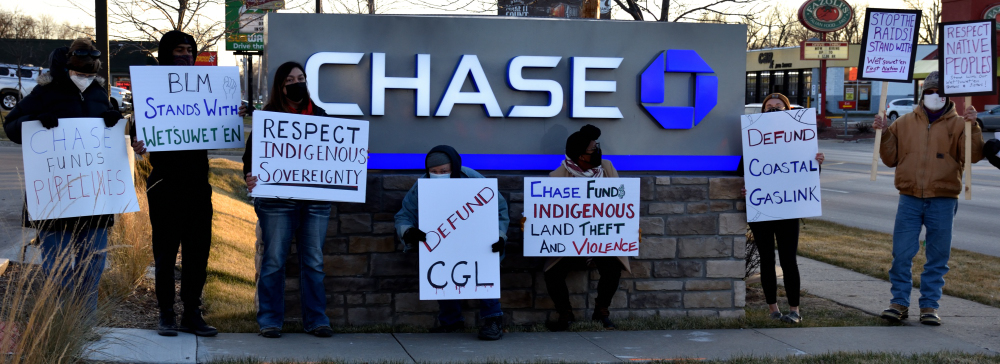
That the province cease construction of the Coastal Gaslink Pipeline project and suspend permits.
That the United Nations Declaration on the Rights of Indigenous Peoples (UNDRIP) and tribal rights to free, prior and informed consent (FPIC) are respected by the state and RCMP.
That the Royal Canadian Mounted Police (RCMP) and associated security and policing services be withdrawn from Wet’suwet’en lands, in agreement with the most recent letter provided by the United Nations Committee on the Elimination of Racial Discrimiation’s (CERD) request.
That the provincial and federal government, RCMP and private industry employed by Coastal GasLink (CGL) respect Wet’suwet’en laws and governance system, and refrain from using any force to access tribal lands or remove people.
Bear Creek Monthly Meeting of Friends (Quakers) 19186 Bear Creek Road, Earlham, Iowa, 50072
February 7, 2020
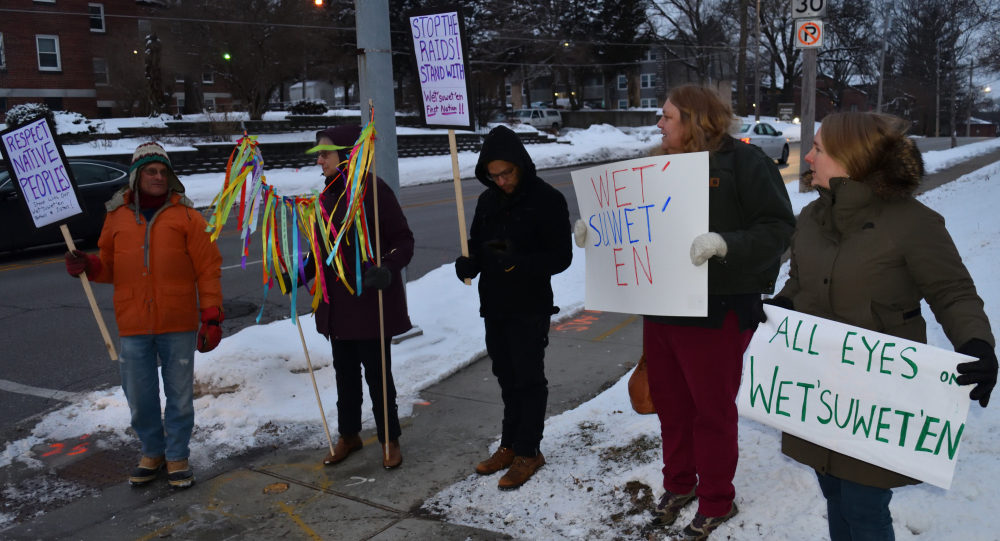
Several of us gathered in Des Moines, Iowa, for a vigil in solidarity with the Wet’suwet’en peoples. Our friends at Bold Iowa and Iowa Citizens for Community Improvement (ICCI) helped notify people about our vigil.































 Quakers and Mutual Aid