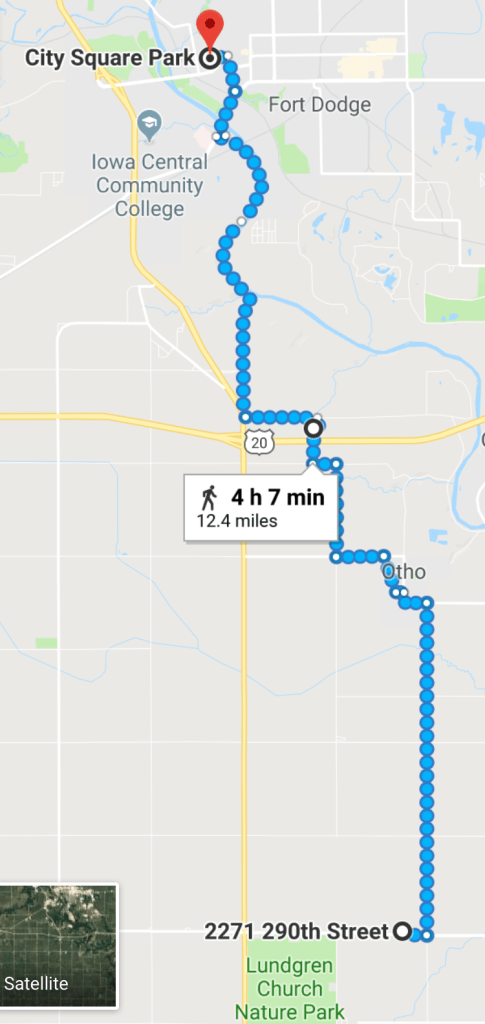
Eighth and final day. September 8, 2018. Walk 12.4 miles from Otho to the end of the march at Fort Dodge, Iowa.
It was cold when we awoke this morning at 6:00 a.m. and broke camp in the dark. I didn’t want to get out of the sleeping bag. But this was the big day, one we were both looking forward to, and not. Fortunately, hot coffee was ready. Last night we talked about the need to get going early, because people would be expecting us to arrive in Fort Dodge by 1:30 pm. Many of us were skeptical that we could leave early enough to walk the 12.4 miles to get there in time, but we managed to do so.
One way this will be an interesting day for me is because my camera battery finally died. I thought it would last and hadn’t brought my battery charger. So, the photos of this final day of the march were taken with my cell phone camera.
Before we started walking, we had a nice ceremony where we gave the money we had collected to Alton and Foxy as a gift for their upcoming wedding. Fintan decorated the envelope.
Alton and Foxy didn’t know about the money we collected for their upcoming wedding
Many times I heard people talking about how sad they will be when the March is finished. Many friendships had been made, as you can see from all the smiles in the photos.
Among my many new friends were Matt and Alton, so I was glad to have the selfie Alton took of us, and the photo Miriam took of Matt and I. Matt and I talked much of this final day of the March. Since the end of the March we have chatted via Messenger. I’m glad we’re keeping in touch. He is editing more of the video he took during the March and I look forward to seeing them.
Alton and IMatt and I
We had a police escort through downtown Fort Dodge. At the City Square Park the tipi had been set up.
Foxy and Donnielle
Arriving at park in Fort Dodge
I was amazed by the huge mural that hung on the side of the gear truck. Several people had been working on this all during the week.
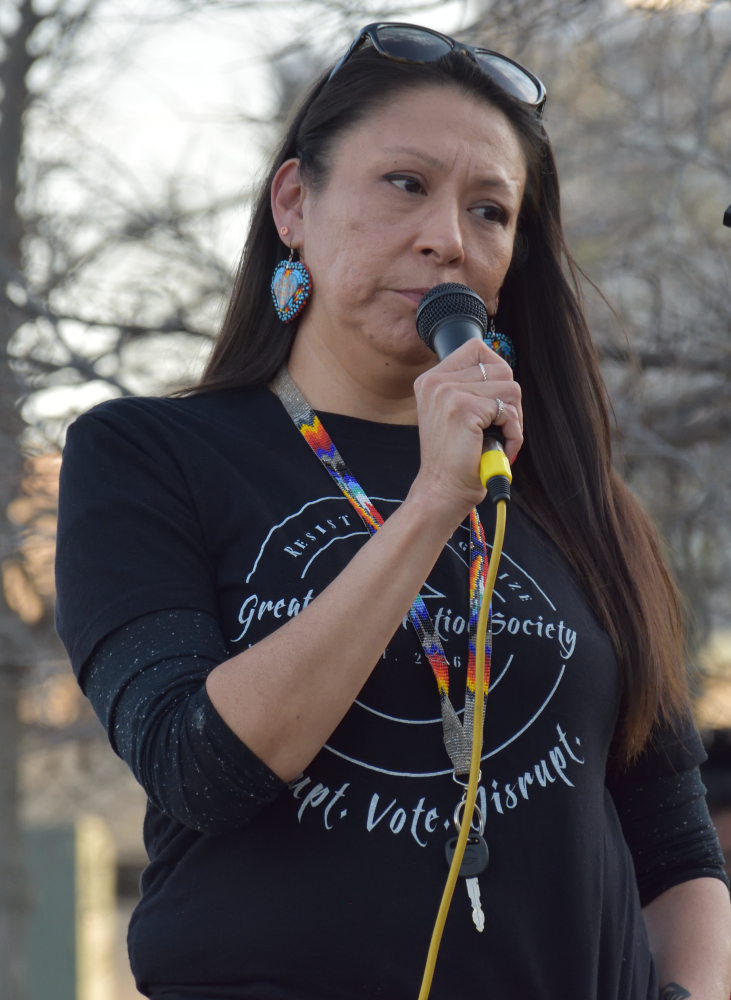
Sikowis (Christine) Nobiss
Donnielle EWanatee
Drummers played and sang the “Mni Wiconi Song.” According to The Messenger newspaper, the English translation of the lyrics is:
“Grandmother earth gives life The water is sacred The water that gives life is sacred DAPL is very bad The Nation needs to take heart and be brave.”
The Messenger published a nice summary of the March and celebration, with photos, including one of my bandaged foot and shoes. “Many steps. One journey”, September 10, 2018.
The band Brutal Republic performed. All of their equipment was being powered by the solar system that had accompanied us all week. My brother Randy, who was there to give me a ride home, thought they sounded really good and would have like to stay for a while. But I was way too tired to enjoy it.
During the week we came to understand how much work was involved in planning and guiding this March, and are very grateful. So many people contributed in so many ways.
I hope we can be together again soon. As our environmental chaos gets worse, I think a combination of the knowledge and wisdom of Indigenous people and progressive farmers, thinkers and activists will be crucial.
Two-eyed seeing “recognizes the benefits of seeing from one eye with the strengths of Indigenous ways of knowing, from the other eye the strengths of the Western ways of knowing, and using both of these eyes together to create new forms of understanding and insight.”
Elder Albert Marshall (Mi’kmaq, Eskasoni First Nation) from Urban Tribes, edited by Lisa Charleyboy and Mary Beth Leatherdale
Day 7, September 7, 2018. 11.7 miles from Dayton to Otho, Iowa.
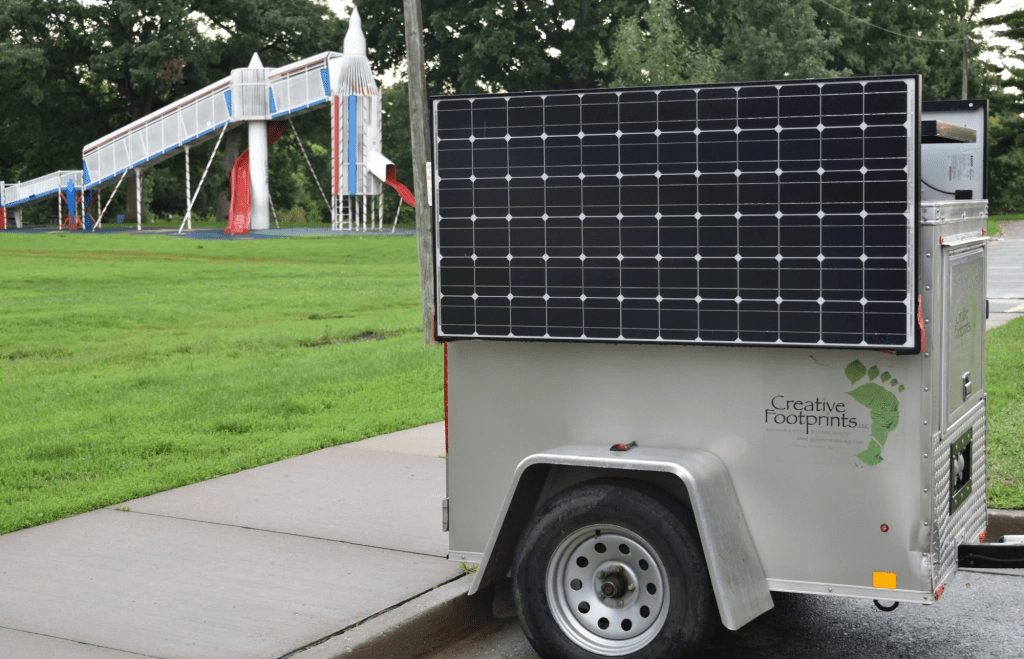
Yesterday evening the solar panel unit was set up because there wasn’t any electricity available in the park. The power strip was full of cell phone power connections. It was nice to see solar power in action. Electricity that didn’t come from fossil fuel.
Solar panels
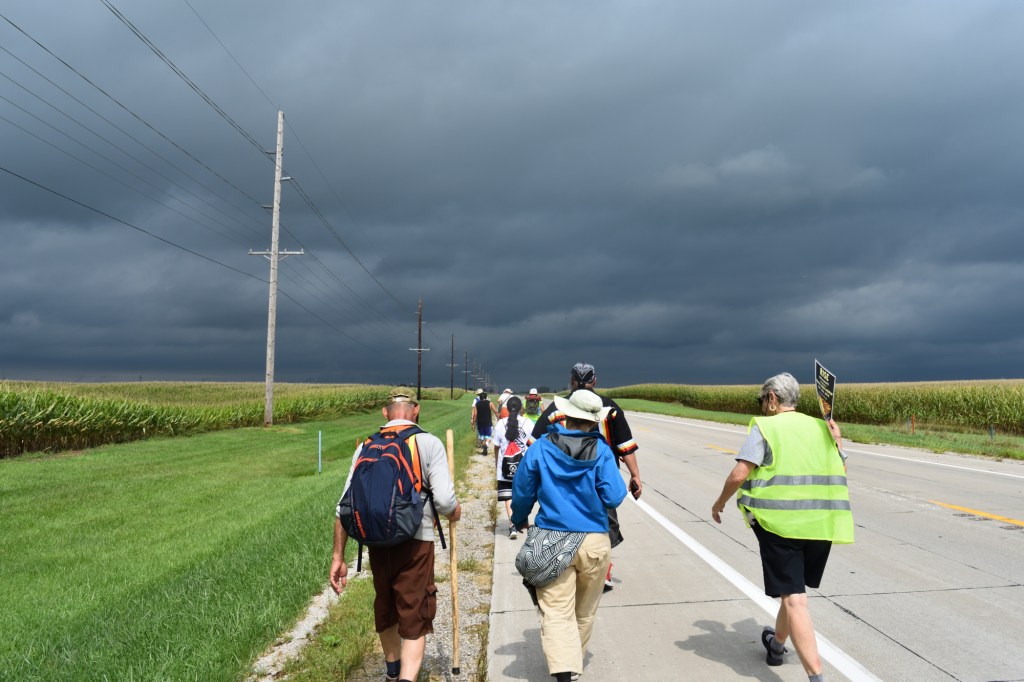
It was cool when we broke camp, but a pretty pleasant day to march, with the sun coming out soon after we started. Since much of the route today wasn’t on busy roads, we were able to walk side by side and share more stories.
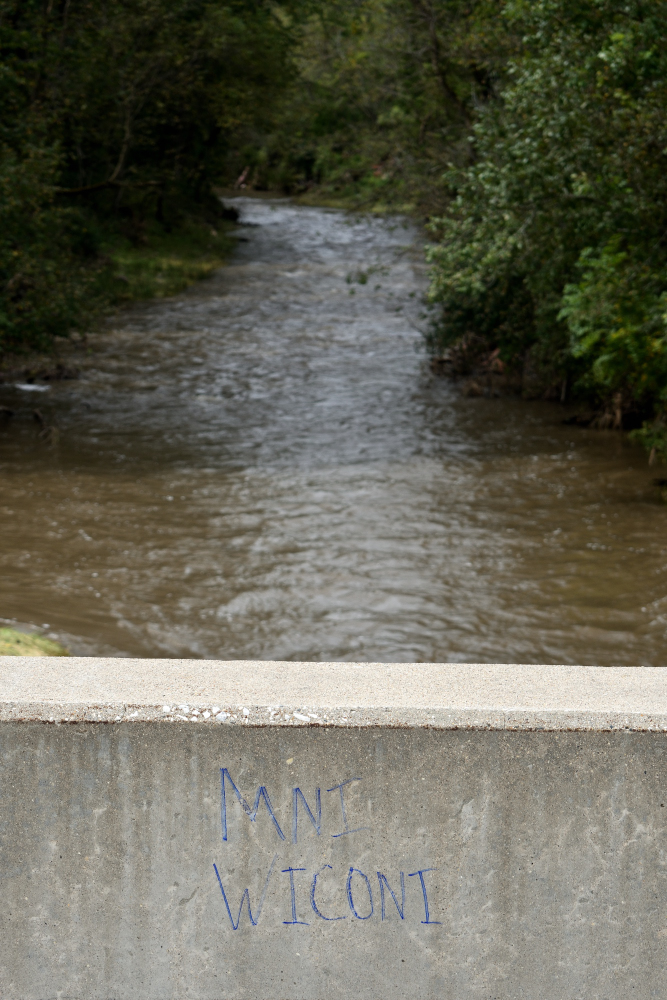
I don’t know if someone just made the name up, but this very steep hill was called ‘suicide hill’. At the bottom was a creek. On the wall of the bridge someone had previously written ‘Mni Wiconi”, Water Is Life.
Also near that creek, Manape showed us wild grapes growing alongside the road, and the fragrance of them when they were crushed.
The last part of the day’s walk was past a field of wind turbines. I didn’t notice sound coming from them as we walked past, but that night as we were sitting around the bonfire there was a noticeable “whoosh” sound. We camped near the turbines.
After dinner it was dark. We sat around a bonfire. Trisha Etringer led a very interesting discussion about decolonization.
Then Manape spoke about sovereignty, and especially sovereignty of yourself. And how he came to the conclusion that he should give up both his United States citizenship and tribal membership to achieve his own sovereignty.
I think we were all feeling sad that this sacred journey would be coming to an end at Ford Dodge tomorrow. I heard numerous comments about that. I was certainly feeling that way.
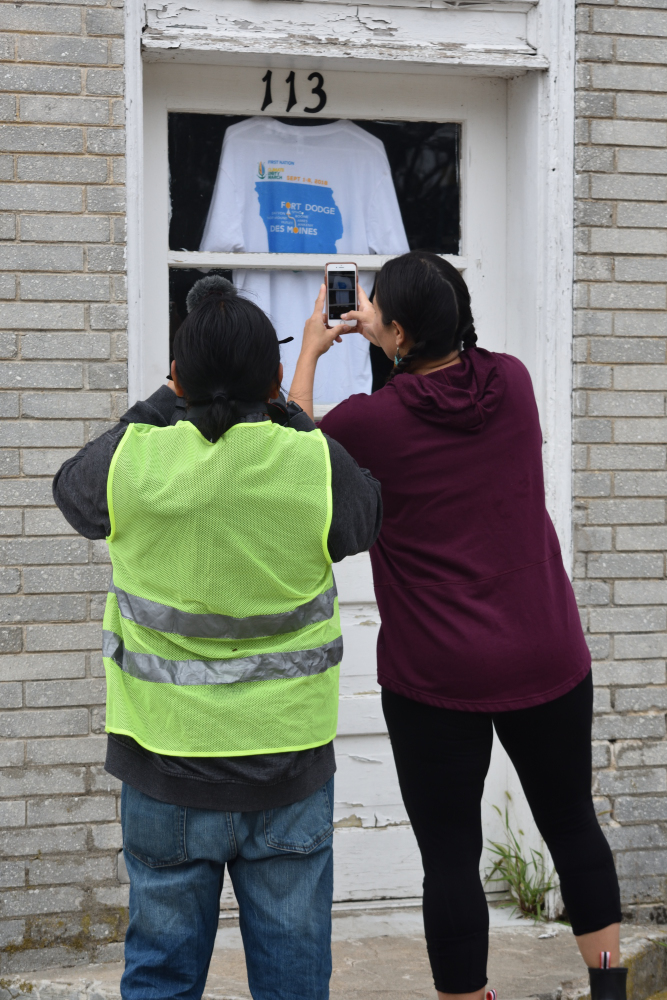
Day 6 of the First Nation-Farmer Climate Unity March began with another awesome breakfast by Lyssa Wade. As we were waiting to start walking we saw one of the March tee-shirts hanging in the window across the street.
Matthew Lone Bear and Sikowis see the March tee shirt
I was again reminded of my reliance on cell phone and Internet access when I couldn’t check the weather, news or email that morning. I hoped my family wasn’t worried that I hadn’t been able to connect with them while we were in Pilot Mound.
Rather than getting more difficult with each passing day, it is getting easier to cover the miles (fortunately!), even now that I’m walking on a blistered foot and my backup shoes.
This was another day of sharing stories and getting to know each other better. I’ll let the photos tell today’s story.
After setting up my tent once we arrived at Oak Park in Dayton, I spent most of the rest of the day at the public golf course’s country club, which was adjacent to the park. I had two days of photos and writing to catch up on. Unfortunately I missed the evening presentation.
The folks at the country club were very nice, allowing us to sit in the club where there was internet service available (which didn’t extend as far as the campground). They also invited those who wanted to use their showers.
Did it come overnight or did it come on slow? It’s out of our hands and it’s out of control I don’t think that this Is the world we used to know
Alan Walker & Winona Oak
Environmental catastrophe is upon us
In years past, those of us who came to believe we could never reduce greenhouse emissions and began to talk about adaptation to evolving hostile conditions were stigmatized as alarmists. And while I wrote about this daily and organized and participated in numerous environmental campaigns and events, I rarely wrote how terrible the dangers were and would become. People quickly grew tired of hearing about these things.
Now I regret that. Fifty years ago, if those of us who advocated living without cars had convinced a critical mass to join us, we would not be in the situation we are now.
I’ve begun reading the new book, “Hothouse Earth” by Bill McGuire, He writes, “there is now no chance of dodging a grim future of perilous, all-pervasive, climate breakdown.” I agree.
The crucial point, he (Bill McGuire) argues, is that there is now no chance of us avoiding a perilous, all-pervasive climate breakdown. We have passed the point of no return and can expect a future in which lethal heatwaves and temperatures in excess of 50C (120F) are common in the tropics; where summers at temperate latitudes will invariably be baking hot, and where our oceans are destined to become warm and acidic. “A child born in 2020 will face a far more hostile world that its grandparents did,” McGuire insists.
In this respect, the volcanologist, who was also a member of the UK government’s Natural Hazard Working Group, takes an extreme position. Most other climate experts still maintain we have time left, although not very much, to bring about meaningful reductions in greenhouse gas emissions. A rapid drive to net zero and the halting of global warming is still within our grasp, they say.
Such claims are dismissed by McGuire. “I know a lot of people working in climate science who say one thing in public but a very different thing in private. In confidence, they are all much more scared about the future we face, but they won’t admit that in public. I call this climate appeasement and I believe it only makes things worse. The world needs to know how bad things are going to get before we can hope to start to tackle the crisis.”
There is now no chance of dodging a grim future of perilous, all-pervasive, climate breakdown.
Bill McGuire, Hothouse Earth
This book takes as its starting premise, then, the notion that, practically, there is now no chance of dodging a grim future of perilous, all-pervasive, climate breakdown. It is no longer a matter of what we can do to avoid it, but of what we should expect in the decades to come, how we can adapt to a hothouse world with more extreme weather and what we can do to stop a bleak situation deteriorating even further.
I ought to make clear here that the terms ‘hothouse Earth’ or ‘greenhouse Earth’ are used formally, in a definitive sense, to describe the state of our planet in the geological past when global temperatures have been so high that the poles have been ice-free. A hothouse state, however, is not required for hothouse conditions, which are already becoming far more commonplace, and fast becoming the trademark of our broken climate. What I mean by hothouse Earth, then, is not an ice-free planet, but a world in which lethal heatwaves and temperatures in excess of 50°C (122°F) in the tropics are nothing to write home about; a world where winters at temperate latitudes have dwindled to almost nothing and baking summers are the norm; a world where the oceans have heated beyond the point of no return and the mercury climbing to 30°C+ (86°F+) within the Arctic Circle is no big deal.
The climate catastrophe was born not from “mankind” but from the slave plantation, the settler town, the prison, the reservation. It is unsurprising, then, that the solutions being forwarded by those in power are more of the same— the border wall, the immigration detention centre, the refugee camp, the open-pit mine. For us to live in anything that I hope we can one day call freedom, it is necessary to put a swift end to the death-drive-disguised-as-worldview—the murderous episteme that is being imposed on us by the master/settler/CEO.
Maynard, Robyn; Simpson, Leanne Betasamosake. Rehearsals for Living (Abolitionist Papers) (p. 29). Haymarket Books. Kindle Edition.
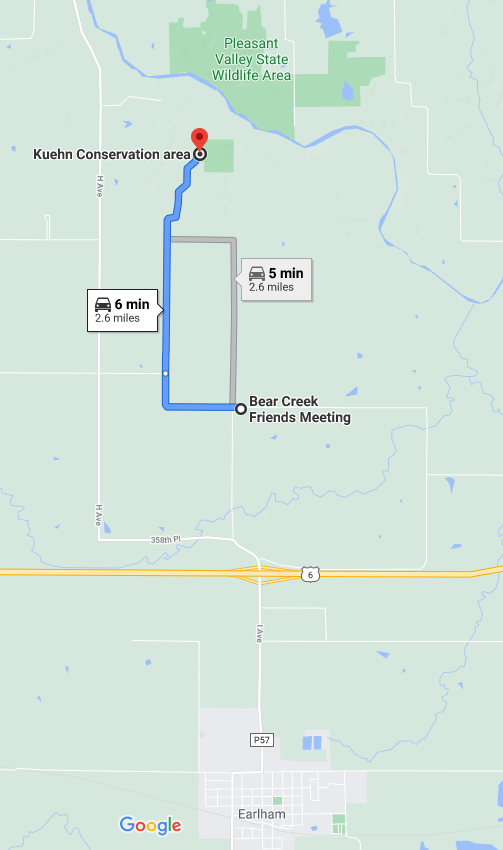
Saturday September 10 3:00 – 9:00 PM Central time Kuehn Conservation Area
“Much can be learned by watching children at play”
Prairie Awakening-Prairie Awoke 2022’s theme is youth, recognizing the challenges we face, seeking hope and healing for the future.
The Meskwaki Nation will be featured with a youth drum group and dancers, Dallas Chief Eagle will share his Hoop Dance presentation with audience participation around a bonfire, plus more traditional drums and dancers in regalia. A rehabilitated raptor and tagged migrating monarchs will be released.
Bring your lawn chair for sitting together in the tallgrass prairie arena, remembering, and visioning a hopeful tomorrow.
The event is free. Concessions will be available on-site.
Slideshow of my photos of Prairie Awakening 2017
Prairie Awakening / Prairies Awoke 2017 Jeff Kisling
This is the fourth anniversary of the First Nation-Farmer Climate Unity March that occurred September 1-8, 2018.
One of the main goals of the March was to create a community of native and nonnative people who began to get to know and trust each other. I’m in the process of writing about the many things that happened as a result of this March. That is taking a while since so much has happened. While I continue that, I thought I’d review some of what happened during the March.
This is the continuation of a series of posts about the evolution of my foundational stories, which are related to the intersection between my Quaker faith, protecting Mother Earth, and photography. Up to this point the stories have been from my life in Indianapolis, and about protecting the water and Mother Earth from the Keystone and Dakota Access pipelines, and all the implications of that.
My reason for doing this is because our world has changed dramatically, in many ways, in my lifetime. And I want to see if I’m doing the best I can today to prepare for increasingly dystopian times. Although it’s taking longer than I planned to get there, it is an important part of the process for me to reflect on the ways my foundational stories have evolved.
Transitions
At the end of June 2017, I retired from my career doing research in the Infant Pulmonary Function Lab at Riley Hospital for Children and returned to Iowa, where I had grown up, and where my parents still lived.
It was difficult to move away from the many friends and communities I had developed relationships with over my five decades in Indianapolis. And it was difficult to leave a career I loved. Every day brought significant challenges to the scientific software development and medical engineering I was doing. In a lab where most of us had worked together for thirty years.
It was a Spirit-led decision to retire.
Another thing that made this move difficult was knowing I would be living in a small community that didn’t have a public transit system. Living without a car was part of my foundational story, impacting my life in so many ways. And I’d been agitating others to give up their cars. I walked whenever possible in Indianola. But the justice work I eventually found often meant borrowing my parents’ car to drive to Des Moines.
My friends in Indianapolis heard about my plans to use a bicycle as much as possible when they asked about my plans for retirement. I was very touched when a large number of people contributed to help me buy a good bicycle for this purpose, including my co-workers at Riley Hospital for Children, and friends from North Meadow Circle of Friends, and my friends at the Kheprw Institute (KI). In addition, Dr. Robert Tepper, a lifelong friend and the Director of the Infant Pulmonary Function Lab where I spent most of my career, gave me a great backpack designed to be used with bicycles, which included a sleeve to carry a laptop computer. The backpack is designed to hold the pack away from one’s back, keeping sweat away from the pack itself.
I had hoped to build up the stamina to ride my bicycle to Des Moines, about fifteen miles. And perhaps even the forty miles, one way, to Bear Creek meeting!
The following PDF (which can be downloaded) describes the three-day, forty-mile journey I undertook in September 2017 (two months after moving to Iowa).
My Quaker meeting, Bear Creek Friends, has struggled to figure out how to reduce fossil fuel transportation when so many Friends live in rural areas or towns without public transit. We wrote the following Minute, which was approved by our yearly meeting, Iowa Yearly Meeting (Conservative) in 2017. And below is a pamphlet from Friends World Committee for Consultation (FWCC), which had asked meetings to submit their work on sustainability.
Ethical Transportation
Radically reducing fossil fuel use has long been a concern of Iowa Yearly Meeting (Conservative). A previously approved Minute urged us to reduce our use of personal automobiles. We have continued to be challenged by the design of our communities that makes this difficult. This is even more challenging in rural areas. But our environmental crisis means we must find ways to address this issue quickly.
Friends are encouraged to challenge themselves and to simplify their lives in ways that can enhance their spiritual environmental integrity. One of our meetings uses the term “ethical transportation,” which is a helpful way to be mindful of this.
Long term, we need to encourage ways to make our communities “walkable”, and to expand public transportation systems. These will require major changes in infrastructure and urban planning.
Carpooling and community shared vehicles would help. We can develop ways to coordinate neighbors needing to travel to shop for food, attend meetings, visit doctors, etc. We could explore using existing school buses or shared vehicles to provide intercity transportation.
One immediately available step would be to promote the use of bicycles as a visible witness for non-fossil fuel transportation. Friends may forget how easy and fun it can be to travel miles on bicycles. Neighbors seeing families riding their bicycles to Quaker meetings would have an impact on community awareness. This is a way for our children to be involved in this shared witness. We should encourage the expansion of bicycle lanes and paths. We can repair and recycle unused bicycles, and make them available to those who have the need.
Minute approved by Iowa Yearly Meeting (Conservative) 2017
[Note: This is a continuation of a series of posts about the evolution of my foundational stories, which are related to the intersection between my Quaker faith, protecting Mother Earth, and photography. The following occurred when I was living in Indianapolis.]
The previous post described how those of us trained to bring attention to the Keystone XL pipeline connected with Joshua Taflinger and Brandi Herron of the White Pines Wilderness Academy. They wanted to support those at Standing Rock who were praying to stop construction of the Dakota Access pipeline (DAPL).
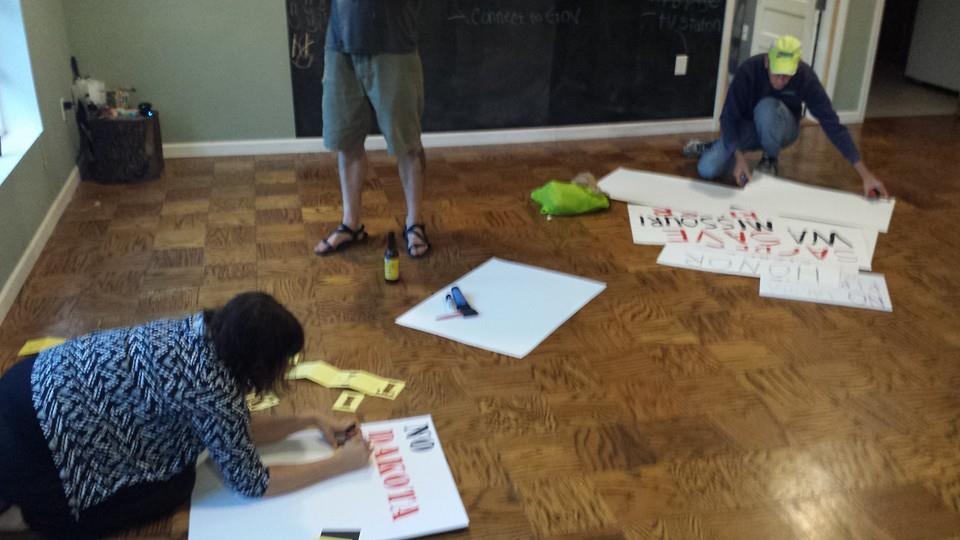
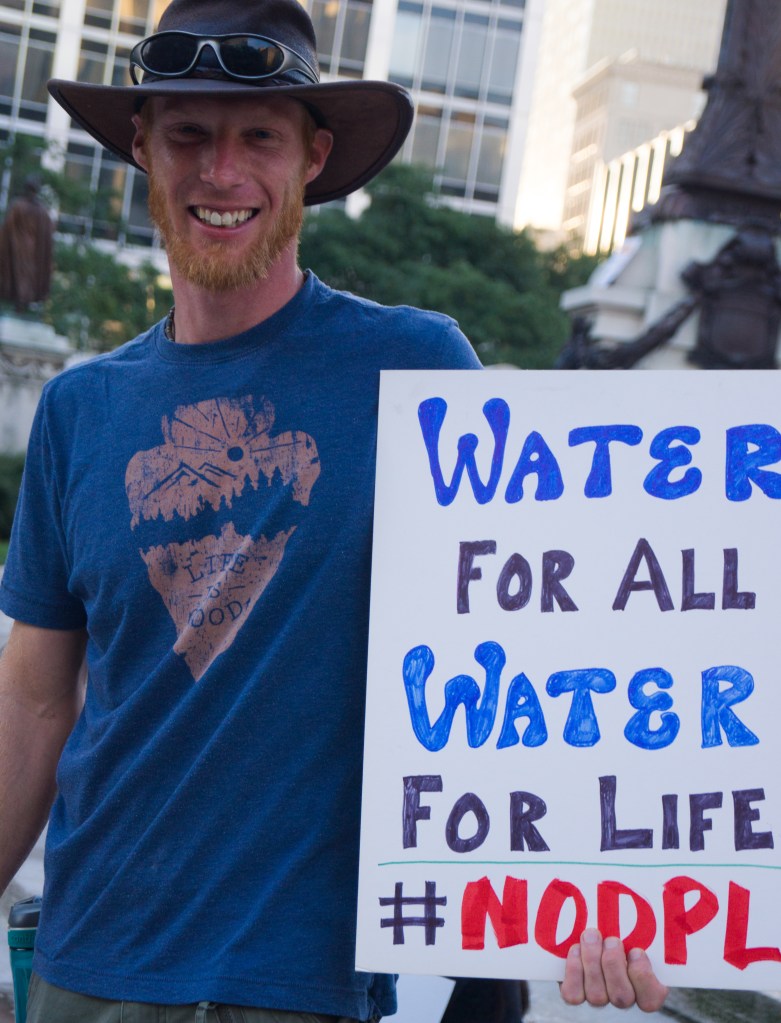
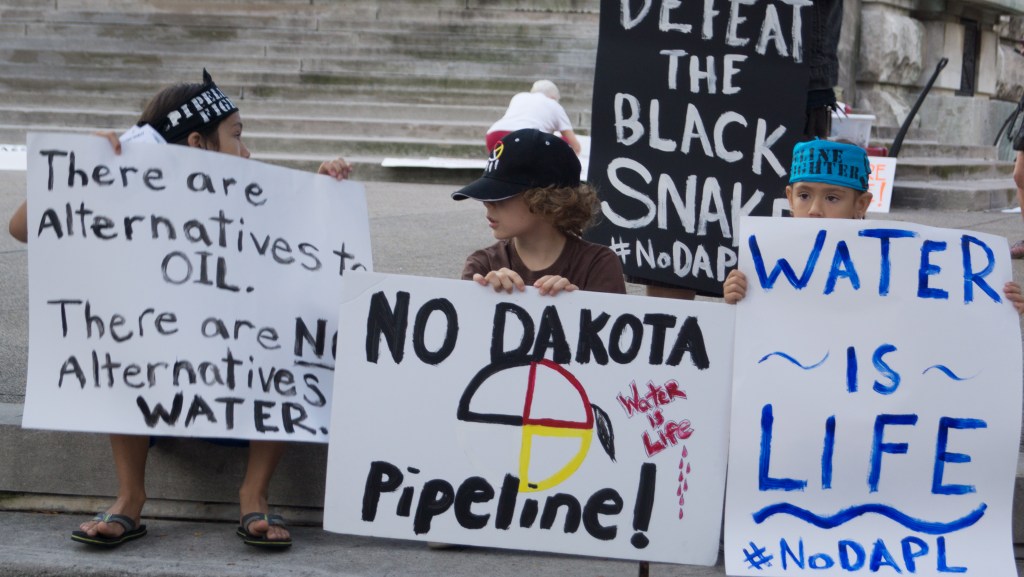
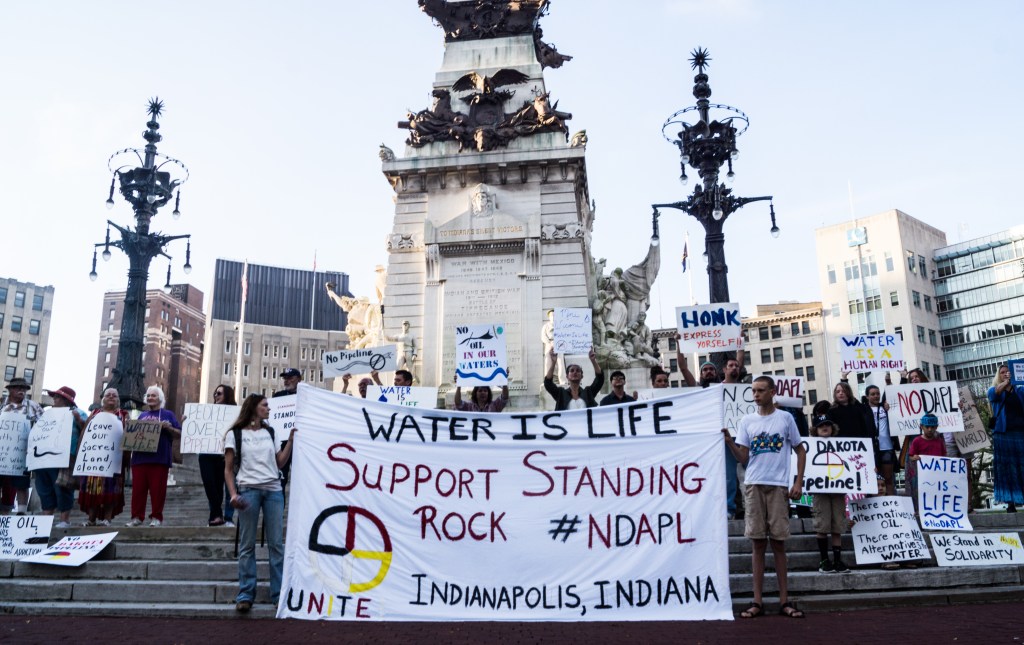
This photo was taken the first time we gathered at the Wilderness Academy, 9/8/2016. They had already made that great sign that was brought to all our gatherings, including the first one on the Circle in downtown Indianapolis the next day. The second photo from the same evening shows me inside the Academy making additional signs. The next morning sign making supplies were brought downtown where people made more of them.
Gathering at White Pines Wilderness Academy to plan first action related to the Dakota Access Pipeline, Indianapolis
Me making NODAPL signs at White Pines Wilderness Academy
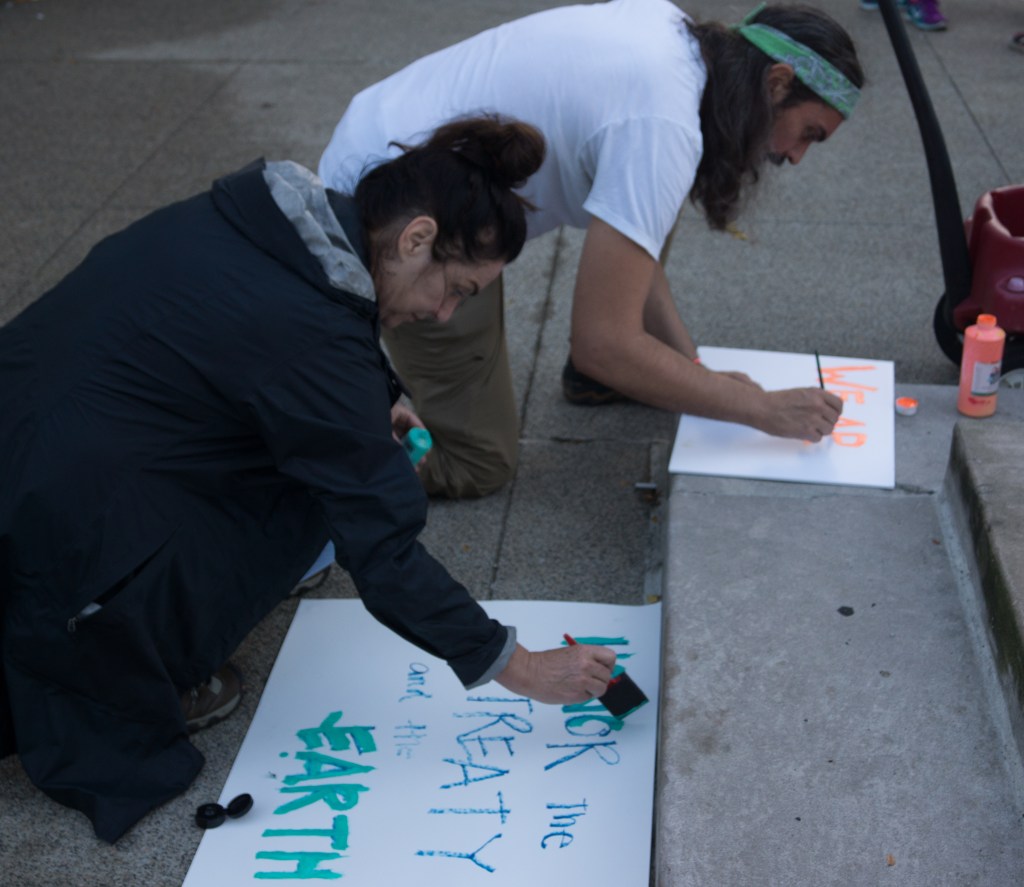
Making signs at a gathering in downtown Indianapolis
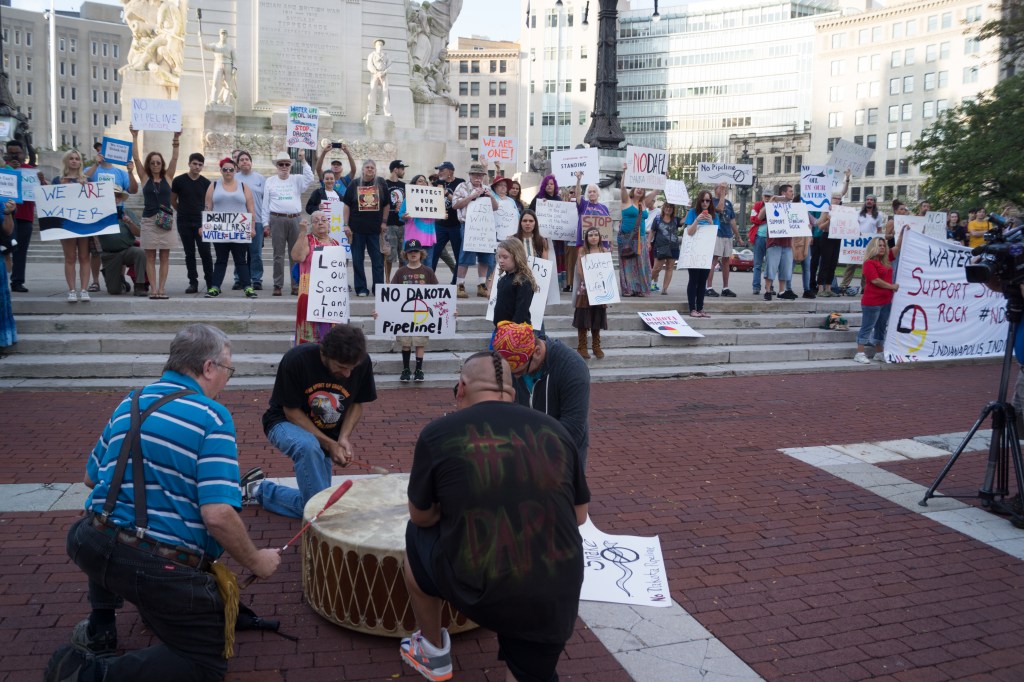
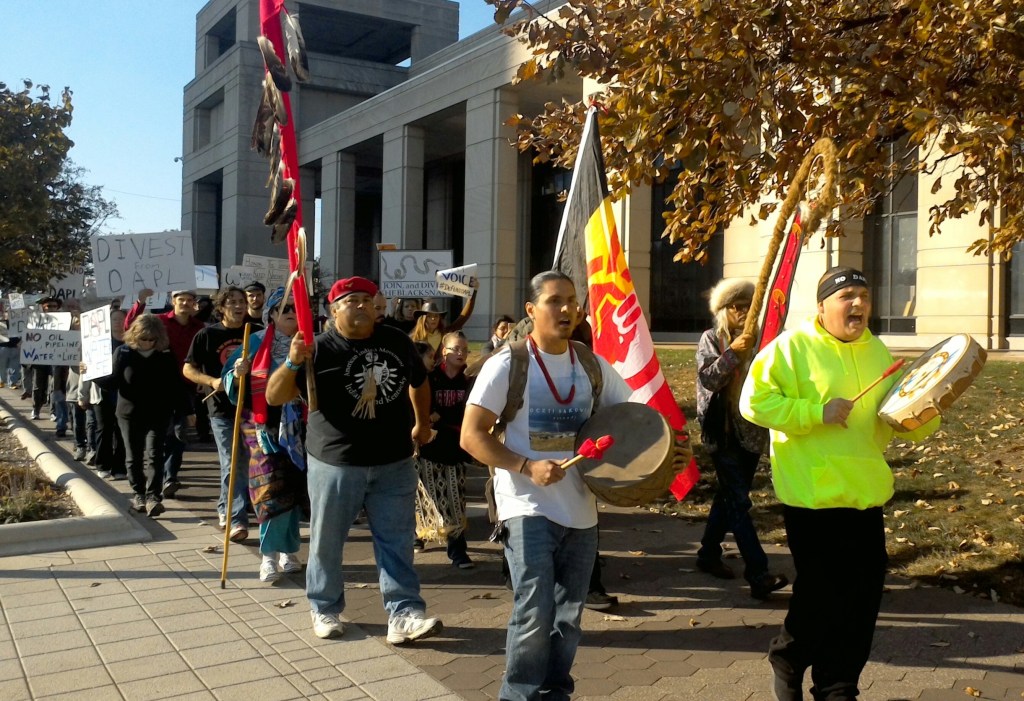
That gathering downtown on 9/9/206 was the first time Native Americans joined us. Sage was burned and there was drumming.
Burning sage
Drummers on the Circle, downtown Indianapolis
These are some photos from that gathering. Joshua is in the first photo.
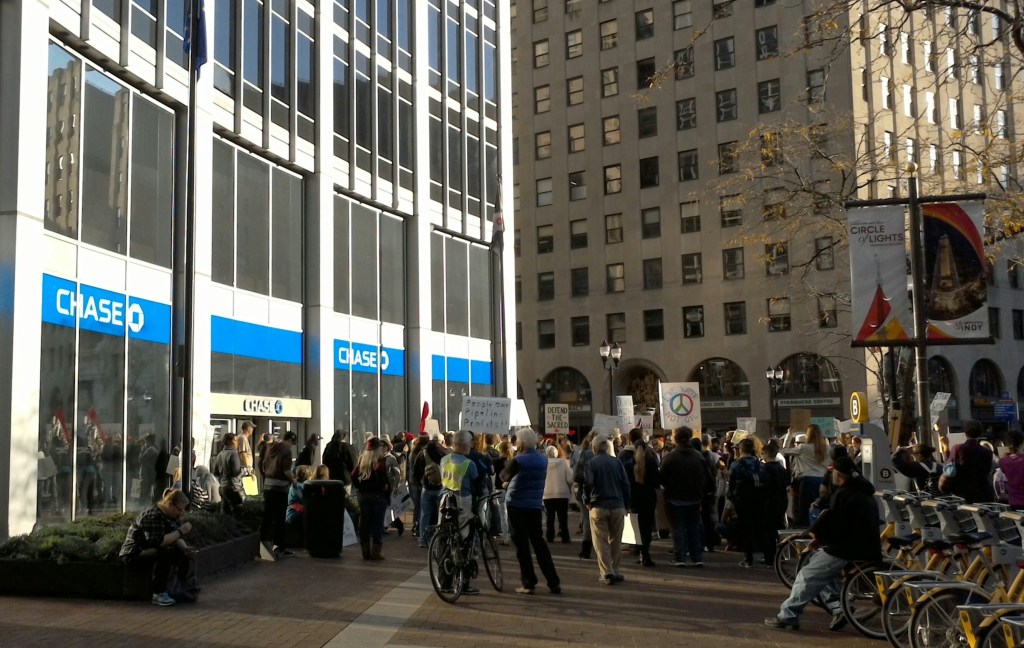
On November 15, 2016, we gathered to go to the two banks in Indianapolis that were involved in funding DAPL, which were PNC and Chase. We stood outside each bank in silence as those who had accounts went in to close them. $110,000 was withdrawn that day.
JpegJpegJpeg
I had my own experiences when I was living in Indianapolis, at the downtown Chase bank, where I closed my account.
Divestment is a strategy that has been used in many instances related to funding fossil fuel projects. In November 2015, several of us went to the Indianapolis offices of Morgan Stanley. We had a polite conversation with the manager about funding coal projects.
On February 3, 2018, Super Bowl weekend, Ed Fallon organized a van trip to Minneapolis to call attention to USBank’s funding of fossil fuel projects. USBank’s headquarters are in Minneapolis, and the game was played at the USBank stadium.
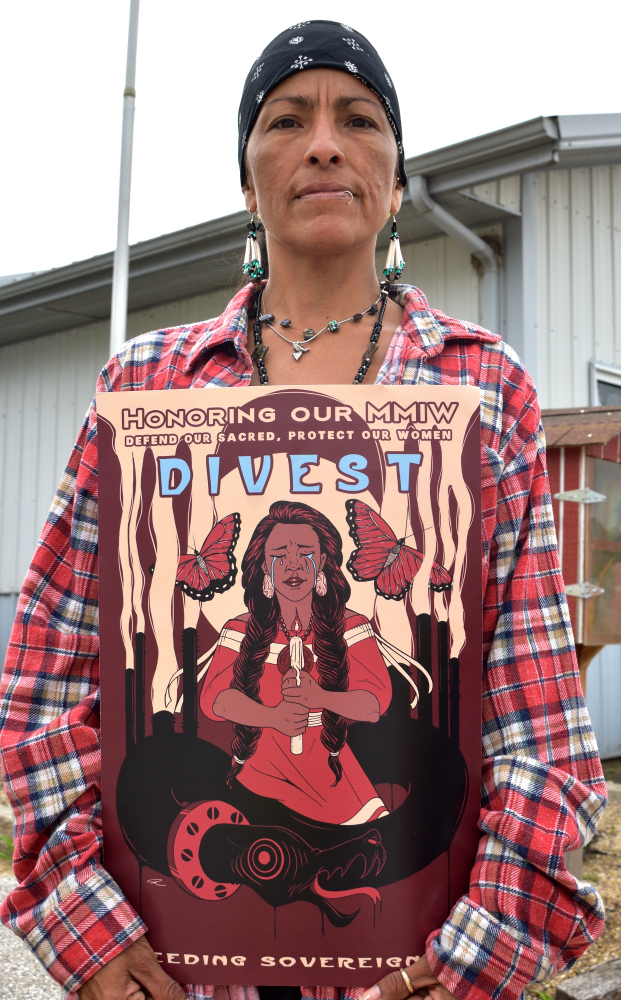
Although we had communicated by email, this was the first time I met Ed. Among the others involved were Sikowis (Christine) Nobiss and Donnielle Wanatee. It was a beautiful day with falling snow.
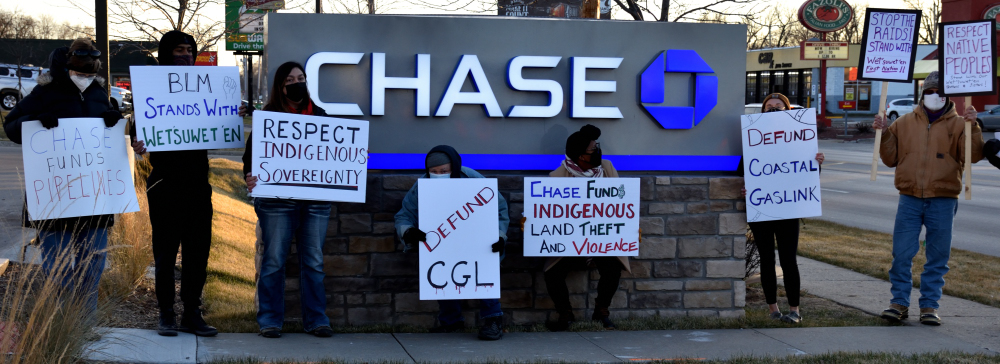
Defunding projects continue to this day. This was a gathering at a Chase bank in Des Moines in December 2021. Peter Clay and Jon Krieg were present.
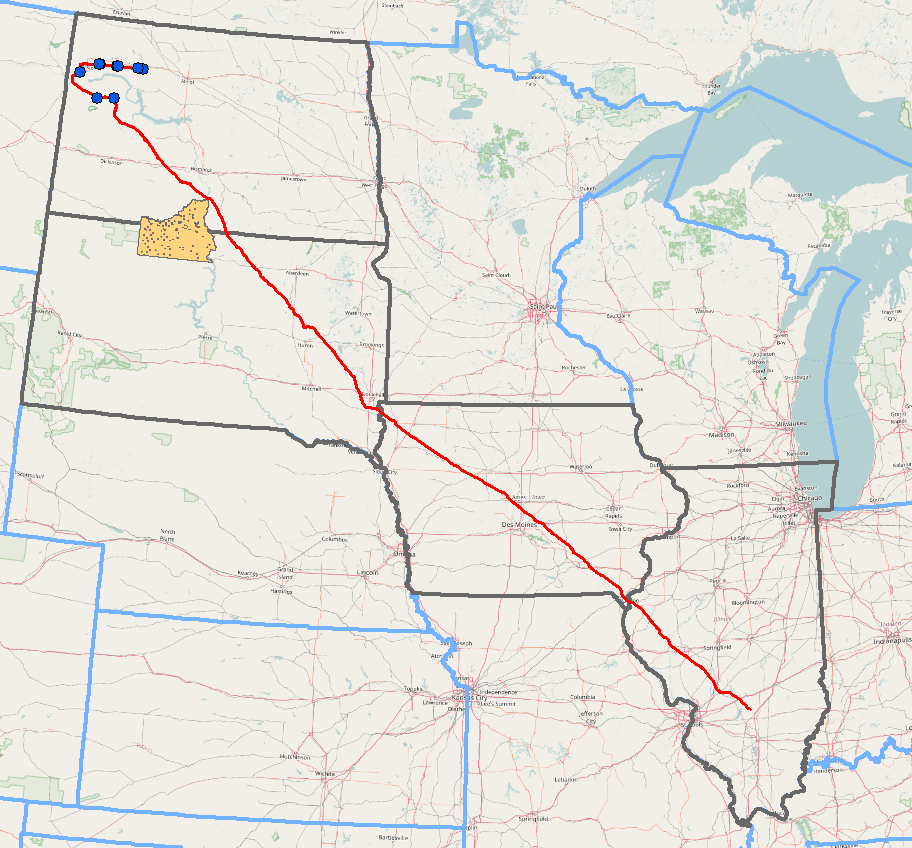
The Keystone pipeline resistance ended with President Obama’s denial of the pipeline’s permit. But then we began to hear about the construction of the Dakota Access Pipeline (DAPL). In one of the most transparent, egregious examples of environmental racism, the route of the pipeline was changed when people in Bismarck, North Dakota, objected to the original plan for DAPL to cross the Missouri River just upstream from them, fearing contamination of their water. So, the route was changed to cross beneath Lake Oahe (Missouri River), at the edge of the border of the Standing Rock Indian Reservation (orange in the map below).
Dakota Access Pipeline route (Standing Rock Indian Reservation is shown in orange)
That new route stimulated months of prayers and ceremonies by hundreds of Native American tribes and thousands of people.
By late September, (2016) NBC News reported that members of more than 300 federally recognized Native American tribes were residing in the three main camps, alongside an estimated 3,000 to 4,000 additional pipeline resistance demonstrators. Several thousand more gathered at the camps on weekends.[7][34][35]
In a recent post (Keystone Pledge of Resistance) I described how Jim Poyser, Ted Wolner, and I were trained to design peaceful, nonviolent civil disobedience actions. And how we trained about fifty people in Indianapolis to participate in such actions.
A Spirit-led connection was made when Jim was talking with Joshua Taflinger about the Dakota Access Pipeline (DAPL). Jim lived near Joshua’s White Plains Wilderness Academy. Joshua wanted to know what he could do locally to bring attention to the Dakota Access pipeline. I say ‘bring attention’ rather than protest, because one of the first things I learned from those opposing DAPL was the difference between protesting and being a water protector.
Water protector was about an integral, Spiritual connection with Mother Earth, and all things human and nonhuman.
Bringing attention to the Dakota Access pipeline (DAPL) in downtown, Indianapolis
Jim told Joshua about the Keystone Pledge of Resistance, and those of us who had been trained to organize public gatherings and actions. And told Joshua we would be glad to support similar efforts to call attention to the dangers of DAPL. We were all excited about helping Joshua and White Plains Wilderness Academy, glad our experience could be useful.
Before getting into what we did related to DAPL, I’d like to express how working with Joshua and his wife Brandi, made me aware of the concept of spiritual warriors.
It may seem odd for a Quaker to speak about warriors. But what I mean by warriors is what Chief Sitting Bull said.
For us, warriors are not what you think of as warriors. The warrior is not someone who fights, because no one has the right to take another’s life. The warrior, for us, is one who sacrifices himself for the good of others. His task is to take care of the elderly, the defenseless, those who cannot provide for themselves and above all, the children, the future of humanity.
Warriors today are forging different ways to live together, returning to Indigenous ways to live in community. Mutual Aid is an alternative to our broken systems. Members of Mutual Aid communities are working for the abolition of police and prisons. To escape the colonial capitalist system. Feeding the hungry and finding shelter for the houseless. Collecting clothing.
The following from Joshua, is another example of radically rethinking our stories.
I am inspired to share with you all more directly a post I wrote, because I consider you an established and effective nature/spiritual warrior and believe that there is a need for the perspectives shared in the attached post to be more common thought in the minds of the many.
If you feel truth from this writing, and are inspired, I highly encourage you to re-write your own version, in your own words/perspectives, and post to your network.
With the intention of helping us all wake up, with awareness, clarity, and direction.
..spreading and weaving reality back into the world….
What has risen to the surface at Standing Rock is a physical/spiritual movement. Learn how to quiet your mind. To find the silent receptive space to receive guidance. To learn to adapt and follow the pull of synchronicity to guide you to where you will find your greatest support and strength.
What I have found in my time praying in the indigenous earth-based ways, is that it’s not about putting your hands together and talking to God…. It’s about quieting and connecting with the baseline of creation, of nature. Tuning into the frequency and vibration of the natural world, the nature spirits. The beings and entities that have been in existence, for all of existence, the examples and realities of sustainability and harmony.
It’s about becoming receptive to these things. Being open and flowing with them. The spirit guides us, but we have to make ourselves receptive to feel, sense, and respond to this guidance.
Joshua Taflinger
Each Warrior of the Light contains within him the spark of God. His destiny is to be with other Warriors, but sometimes he will need to practice the art of the sword alone; this is why, when he is apart from his companions, he behaves like a star. He lights up his allotted part of the Universe and tries to point out galaxies and worlds to all those who gaze up at the sky. The Warrior’s persistence will soon be rewarded. Gradually, other Warriors approach , and they join together to form constellations, each with their own symbols and mysteries.
Coelho, Paulo. Warrior of the Light: A Manual (p. 89). HarperCollins. Kindle Edition
There comes a time when all life on Earth is in danger. Great barbarian powers have arisen.
Although these powers spend their wealth in preparations to annihilate one another, they have much in common: weapons of unfathomable destructive power, and technologies that lay waste our world. In this era, when the future of sentient life hangs by the frailest of threads, the Shambhala warriors appear.
The warriors have no home. They move on the terrain of the barbarian powers. Great courage is required, both moral and physical, for they must go into the heart of the barbarian powers to dismantle their weapons, into the places where the weapons are created, into the corridors of power where decisions are made.
The Shambhala warriors are armed only with the weapons of compassion and insight. Both are necessary. Compassion gives them the energy to move forward, not to be afraid of the pain of the world. Fueled by compassion, warriors engage with the world, step forward and act. But by itself compassion burns with too much passion and exhausts us, so the second weapon is needed — insight into the interdependence of all phenomena.
With that wisdom we see that the battle is not between “good guys” and “bad guys,” because the line between good and evil runs through every human heart. And with insight into our profound interrelatedness, we discern right action, knowing that actions undertaken with pure intent have repercussions throughout the web of life, beyond what can be measured or discerned.
Together these two weapons sustain the warriors: the recognition and experience of our pain for the world and the recognition and experience of our radical interconnectedness with all life.
Adapted from Dugu Choegyal, as recounted by Joanna Macy
The Spiritual Warrior is a person who challenges the dreams of fear, lies, false beliefs, and judgments that create suffering and unhappiness in his or her life. It is a war that takes place in the heart and mind of a man or woman. The quest of the Spiritual Warrior is the same as spiritual seekers around the world.
This is a continuation of a series of posts about the evolution of my foundational stories, which are related to the intersection between my Quaker faith, protecting Mother Earth, and photography.
Much of my justice work for the past twenty years has been and continues to be related to pipelines because they are the critical infrastructure needed to transport oil and natural gas from where they are mined, to the refineries. And against proposed “carbon” pipelines to transport carbon dioxide to storage facilities. Pipelines are usually hundreds of miles long, often traveling through fragile ecosystems and/or rivers and lakes.
It is at the construction sites that activists can resist the pipelines. Or, in the case of the Keystone XL pipeline, prevent the approval of the pipeline permit required to cross the US/Canadian border.
The stories related to each pipeline are so long that they require separate articles for each. I learned a great deal about designing and training for different ways to resist pipelines. And developed deep friendships with many amazing people. These are some of the stories related to the Keystone XL pipeline. We were able to stop its construction.
The (Keystone XL pipeline) project was delayed for the past 12 years due to opposition from U.S. landowners, Native American tribes and environmentalists.
Looking back over the past fifty years, it is obvious the industrial world made a fundamental error by the unrestrained use of fossil fuels. We would not be experiencing evolving environmental chaos and social collapse today if not for those tragic decisions. We disregarded the indigenous wisdom of considering the effects our actions would and are having on future generations.
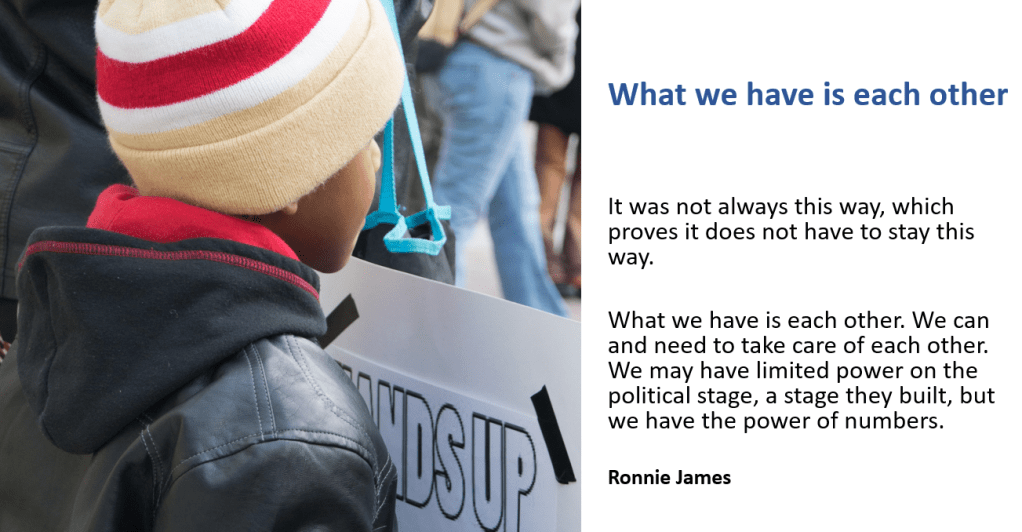
But as my friend Ronnie James, an Indigenous organizer says, “it was not always this way, which proves it does not have to stay this way.”
It is sad to realize young people today have little idea of what life was like just a few decades ago, in the times before rampant fossil fuel consumption.
I’ve written many times about living my life without a car. And my futile efforts to get even one other person to give up theirs. To say I was discouraged is an understatement. (See the story about Cars as Weapons of Mass Destruction at the end of this article).
But then I found some hope. One of the benefits of the emerging use of the Internet was a way to learn about what others were doing and organizing like-minded people to work together. I discovered the Keystone Pledge of Resistance on the Internet.
Keystone Pledge of Resistance
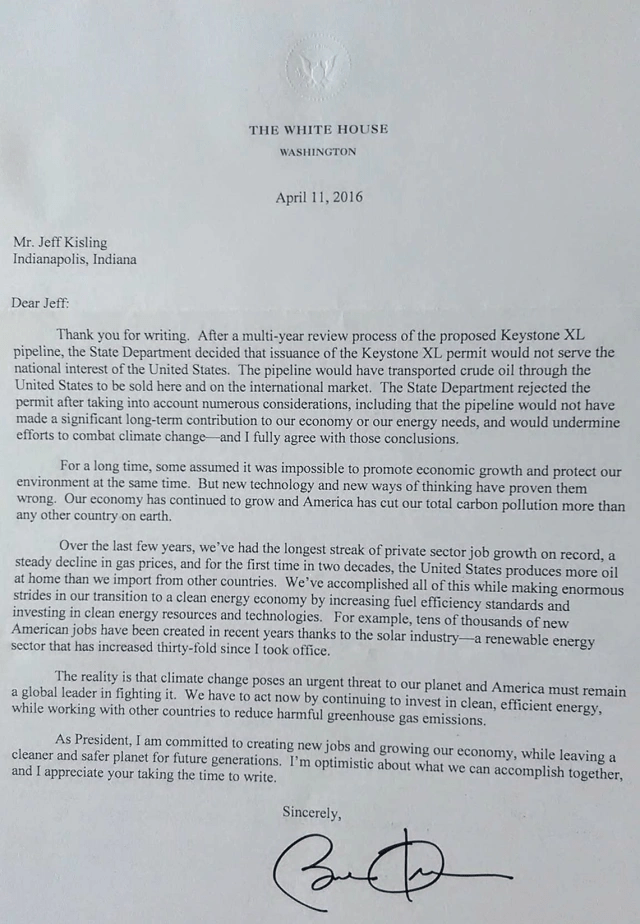
The Keystone Pledge of Resistance was an Internet campaign designed to put pressure on President Obama to deny the permit for the Keystone XL pipeline, which would carry the thick tar sands oil from Canada to the refineries on the Gulf of Mexico.
Environmentalists were having a difficult time persuading the public and industry to transition away from fossil fuels. The environmental organizations Rainforest Action Network (RAN), CREDO, and The Other 98% recognized the Keystone decision as an opportunity to both raise awareness about the dangers of tar sands and possibly even stop the construction of the pipeline. President Obama alone would decide whether to approve the pipeline’s permit, required because it would cross the US-Canada border.
“I pledge, if necessary, to join others in my community, and engage in acts of dignified, peaceful civil disobedience that could result in my arrest in order to send the message to President Obama and his administration that they must reject the Keystone XL pipeline.”
97,236 activists signed the Pledge.
The brilliant part was also collecting the contact information of those who signed, creating a grass roots network.
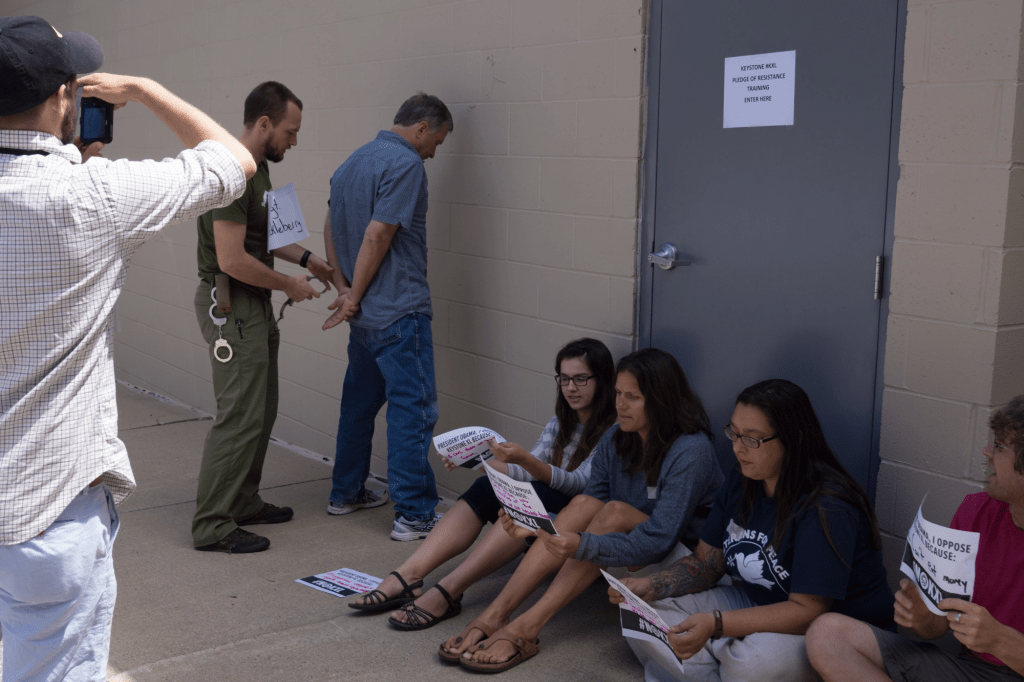
The website also asked if you were willing to lead in organizing an action in your community, which I did. The Rainforest Action Network identified the twenty-five cities that had the most people who had signed the Pledge and spent the summer of 2013 going to those cities to train Action Leaders. Indianapolis was not one of those twenty-five, but Des Moines, Iowa, was. Todd and Gabe held our training session at Iowa Citizens for Community Improvement. The syllabus took 8 hours to complete, with discussion about the pipeline, dangers of fossil fuels, theory of nonviolent resistance, legal aspects, all the necessary roles (media, police liaison, jail support and how to organize an action and train others to participate. Role playing was another part. Below we experience being handcuffed. The second day of the training involved the participants doing the training we received the day before.
Practicing being handcuffed for civil disobedience.
I returned to Indianapolis where three others, Jim Poyser, Ted Wolner, Wayne Moss, and I designed a nonviolent direct action at the Federal Building in Indianapolis. (We didn’t have to execute the action because President Obama denied the permit).
Jim Poyser, Ted Wolner and Jeff Kisling, Keystone Pledge of Resistance organizers, Indianapolis
Over the next several months we held training sessions for local people who had signed the Pledge, eventually training about 50 people. Nationwide about four hundred action leaders trained nearly 4,000 people. President Obama was made aware of this nonviolent “army” and its plans. All this was done in the open.
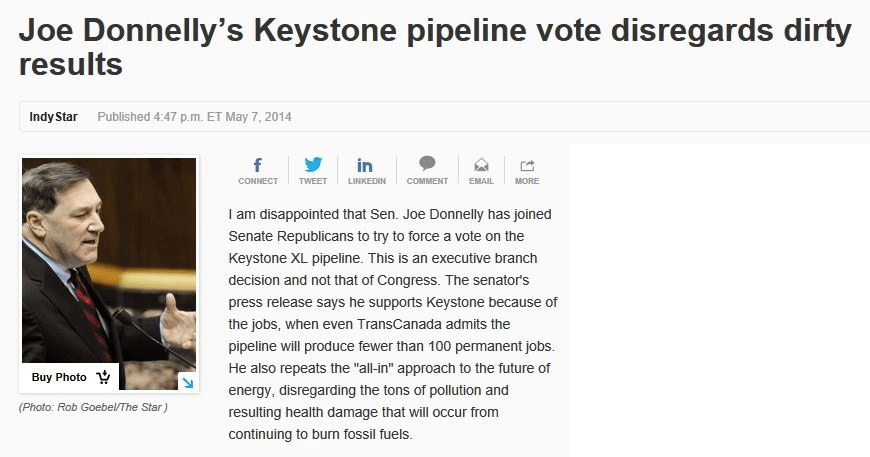
We used other opportunities to raise awareness about the Keystone Pipeline, fossil fuels and the effects of greenhouse gas emissions. The Indianapolis Star published this letter to the editor I wrote. Senator Donnelly had been talking about the jobs the pipeline would create. In reality less the fifty full-time jobs would be created. After this editorial, he didn’t talk about jobs again.
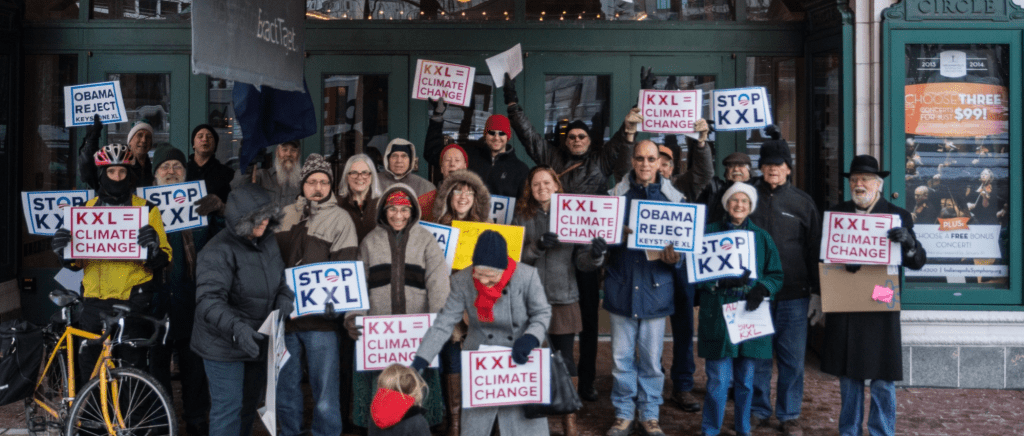
We also held multiple demonstrations related to the pipeline. Quakers from the North Meadow Circle of Friends often participated.
Stop the Keystone pipeline, downtown Indianapolis
The Kheprw Institute (KI), a Black youth mentoring community I was involved with, allowed us to hold a public meeting about the Keystone Resistance. Each of the Action Leaders spoke about why we were willing to risk arrest to stop the pipeline.
Kheprw Institute, Indianapolis
In addition, my friend Derek Glass created this video about KXL from some of my photos and a script I wrote.
November 6, 2015, President Obama rejected the Keystone XL pipeline permit. Then on one of the first days of the Trump administration (January 2020) the pipeline permit was approved. Finally, the Biden administration revoked the permit, and TC Energy gave up on building the pipeline.
Keystone XL was halted (2021) by owner TC Energy after U.S. President Joe Biden this year revoked a key permit needed for a U.S. stretch of the 1,200-mile project.
The Keystone XL pipeline was expected to carry 830,000 barrels per day of Alberta oil sands crude to Nebraska.
The project was delayed for the past 12 years due to opposition from U.S. landowners, Native American tribes and environmentalists.
In summary, the Keystone Pledge of Resistance and actions against other pipelines and fossil fuel projects played a significant role in my foundational stories.
Protecting Mother Earth
Besides the greenhouse gas emissions from burning the oil transported in the Keystone and other pipelines, construction of pipelines disturbs the topsoil where the pipeline is constructed, often excellent soil in Iowa. Drainage systems are destroyed. And the clay that gets mixed in with the topsoil when the pipeline trench is refilled means the fields no long drain water well.
Photography
I learned a lot about taking photos as I documented our many actions related to the pipelines. And later used those photos when I wrote stories about the actions. You can see of some of those photos related to the Keystone pipeline resistance here: https://tinyurl.com/KeystoneResistance
I should note these days I don’t take photos at events that don’t have a public permit because law enforcement uses such photos to identify who was present.
Quaker
It was my Quaker faith that led me to be trained as an Action Lead in the Keystone Pledge of Resistance. Members of the Quaker meeting I attended in Indianapolis participated in demonstrations against the Keystone and Dakota Access pipelines.
Additionally, following are several reports and Minutes that were approved by my Quaker Yearly Meeting, Iowa (Conservative) over the years.
The following Minute was approved by Iowa Yearly Meeting (Conservative) in 2017.
Radically reducing fossil fuel use has long been a concern of Iowa Yearly Meeting (Conservative). A previously approved Minute urged us to reduce our use of personal automobiles. We have continued to be challenged by the design of our communities that makes this difficult. This is even more challenging in rural areas. But our environmental crisis means we must find ways to address this issue quickly.
Friends are encouraged to challenge themselves and to simplify their lives in ways that can enhance their spiritual environmental integrity. One of our meetings uses the term “ethical transportation,” which is a helpful way to be mindful of this.
Long term, we need to encourage ways to make our communities “walkable”, and to expand public transportation systems. These will require major changes in infrastructure and urban planning.
Carpooling and community shared vehicles would help. We can develop ways to coordinate neighbors needing to travel to shop for food, attend meetings, visit doctors, etc. We could explore using existing school buses or shared vehicles to provide intercity transportation.
One immediately available step would be to promote the use of bicycles as a visible witness for non-fossil fuel transportation. Friends may forget how easy and fun it can be to travel miles on bicycles. Neighbors seeing families riding their bicycles to Quaker meetings would have an impact on community awareness. This is a way for our children to be involved in this shared witness. We should encourage the expansion of bicycle lanes and paths. We can repair and recycle unused bicycles, and make them available to those who have the need.
Although we have tried to find ways to promote environmental concerns, such as supporting Environmental Protection Agency (EPA) regulations, engaging with the Occupy Movement, and protesting the Keystone XL Pipeline, it has become increasingly clear that traditional approaches to creating political change are not working well. Civil liberties are being eroded, making it more difficult to petition for change. We have been trying to understand a system of irresponsible actions on the part of policy makers across the developed world related to the environment and our changing climate. It is painful to conclude that concern for each other and the environment has largely been replaced with protecting and promoting economic growth and profit without regard to the environmental consequences.
Report of the Earthcare Subcommittee, Iowa Yearly Meeting (Conservative) 2012
ENVIRONMENTAL STATEMENT OF CONCERN Addendum to Peace and Social Concerns Committee Report 2013 [It was agreed in business session that this statement was too long to be read and discussed and that instead it could be used as a resource and as background material to the minute proposed by the Peace and Social Concerns Committee and approved by the yearly meeting on Seventh Day.]
Every good that we can do, every good that we can imagine doing, will be for naught if we do not address climate change.
Van Jones, Rebuild the Dream, February 2013
We, members of Iowa Yearly Meeting (Conservative) of the Religious Society of Friends (Quakers), are dismayed at the damage that has been done, and continues to be done, to our environment.
The widespread availability of refined fossil fuels began to revolutionize societies worldwide early in the last century. Progress came to be defined as the development and use of a vast array of products and devices to make work and living tasks easier or to do things that weren’t possible before. Initially the industrial revolution resulted in widespread employment, but eventually human labor was largely replaced with work done by machines, which were either directly powered by gasoline or indirectly by electricity which was usually produced by fossil fuel.
One huge effect of this was the migration from the farm to the city. Very inexpensive gasoline and the availability of personal automobiles led to urban development that assumed people would travel some distance from their homes to get to work, school, grocery stores and other businesses. That requires the use of significantly greater volumes of fossil fuel for daily life and a sprawling infrastructure of highway, water, waste, and electrical systems, and emergency and other services.
A culture evolved that changed priorities to material consumption and convenience. Business profits from that became the key drivers of economic and political policies. This move to cities tended to disconnect people’s close relationship with nature, and environmental consequences of these changes were purposely minimized. Businesses did not want protecting the environment to impact profits, so subsidies (tax incentives, price controls, favorable trade regulations, etc.) were employed to hide the true costs of energy and water production. Environmental concerns were not the priority when they conflicted with profits. We didn’t have ways to understand, quantitate, and price environmental damage.
There are three major problems we are now facing as a result of this:
We are passing the point of peak oil production. Supplies of this nonrenewable resource are dwindling, and it will be much harder to extract the fossil fuel supplies that are left (such as tar sands). Energy return on energy investment (EROEI, or EROI) is an important concept, being the ratio of the amount of usable acquired energy divided by the energy expended to produce that energy. Hydroelectric power has an EROEI of 100. In the early days of easy oil extraction, oil’s EROEI was about 100, but has been falling steadily, and was 19 by 2006. Tar sands’ is making it hard to justify extracting it.
Our economic system is dependent on continual growth. We are reaching limits to available resources to sustain that growth. Much of industry has replaced human and animal labor with fossil fuels and is not prepared for rapidly increasing costs and decreasing supplies of energy and water. Widespread unemployment is the root of many social problems and injustices today. Through tax laws and business regulations, this economic system is facilitating greater inequities in the distribution of wealth.
Greenhouse gas (GHG) emissions are increasing. Carbon dioxide (CO2), primarily from burning fossil fuel, and methane (from animal digestive gases and released from thawing frozen deposits) trap heat in the atmosphere. That is what has kept earth air temperatures moderate. But rapidly increasing atmospheric greenhouse gas concentrations are increasing the atmospheric temperature. The consequences include melting ice caps, which results in less sunlight reflected off the ice and more heat absorbed by the earth’s surface, rising ocean water levels from the melting ice, and release of methane deposits that had been frozen, further increasing greenhouse gases in the atmosphere. These changes also affect ocean currents and are thought to be contributing to changing weather patterns. Warmer air holds more water. Less water returned to the earth as rain and changing precipitation patterns are contributing to desertification of some areas of the earth.
The two major ways CO2 is removed from the atmosphere (known as carbon sinks) are by:
Photosynthesis of plants: Chlorophyll combines CO2 from the air with water to produce sugar and oxygen. Destruction of forests decreases this carbon sink, reducing CO2 removal (as well as decreasing oxygen production).
Absorption into the ocean: CO2 combines with water to form carbonic acid. Increasing atmospheric CO2 leads to increased CO2 absorbed into the ocean, resulting in abnormal acidification of the ocean, which damages coral reefs and other marine life.
Unfortunately, the rate at which carbon sinks remove CO2 is significantly slower than the rate at which CO2 is being added. It is estimated that it takes about 100 years to remove CO2 after it has been added to the atmosphere. The over 14 TONS of CO2 dumped into the atmosphere by the U.S. alone in a 24 hour period will remain there for nearly 100 years, unless ways are found to increase CO2 extraction. For example, some progress is being made in developing artificial photosynthesis, but the impact this could have on CO2 removal is not yet known.
Public education is required so that informed personal decisions and economic policies can be made. Protecting and restoring our environment must become the primary goal of political and economic policies. Addressing greenhouse gas emissions and preserving our water and food supplies must become our overriding principles. As a case in point, it is crucial that the Keystone pipeline to transport tar sands oil from Canada to the U.S. Gulf Coast not be built. CO2 from burning tar sands oil must not be added to the atmosphere, and the very high risk of contamination of the Ogallala aquifer, the primary water supply for many f the Great Plains states, cannot be justified. The construction of the Keystone pipeline has become the defining issue for our future direction. Ecocide refers to the destructive impact of humans upon the environment, leading to human extinction. Many believe we must immediately stop greenhouse gas emissions if we are to have any chance of avoiding ecocide. Construction of the Keystone pipeline will both signal that environmental concerns will continue to be systematically denied and likely assure that ecocide will occur. Some Friends are engaging with others in acts of civil disobedience to try to stop construction of the Keystone pipeline and raise awareness of the consequences of building it. This is seen as an opportunity to make others aware of the climate catastrophe that continued fossil fuel extraction and use represents.
Similarly, hydraulic fracturing (fracking) for buried natural gas inserts toxic chemicals into the earth that are polluting drinking water supplies.
Approved Minute: Iowa Yearly Meeting (Conservative) opposes the practices of both tar sands extraction and hydraulic fracturing.
Conservation (reducing use and recycling) is one of the most efficient and readily available ways to conserve energy and other resources.
Simple supply and demand will inevitably result in rapid and dramatic increases in the cost of fossil fuel products and water. Because so many sectors of the present economy rely on cheap energy and water, severe stress, and possibly even collapse of this system, will occur. Widespread travel will significantly decrease as result of both the scarcity and cost of fossil fuels. Transoceanic transport of food and other goods will cease. Changing weather patterns, droughts, desertification, pollution, and increased energy costs will increase the cost of water, since a great deal of energy is needed for water distribution. Distribution of goods, especially food, will be severely impacted. Social unrest will result.
In broad terms, a cultural shift is required to reverse what led to this point. The recent cultural shift toward secular materialism does not reflect Friends’ values. In addition, we are faced with the moral travesty of consuming nonrenewable resources and the additional environmental damage done in the process, knowing at least some of the catastrophic effects this will have on future generations. Since this cultural and economic model is not sustainable, as it fails, we have an opportunity to help move toward a more nearly equal and socially just society. We should examine our own lives, and how our lifestyle could be changed.
Two minutes have been approved by the yearly meeting (2008, 2012) that address these issues. As they state, one of our goals is to reduce the use of or get rid of personal automobiles. It is obviously significantly more efficient to share public transportation vehicles, more and more of which use alternatives to fossil fuels. Each time we think of travel, we should consider alternatives to using a car, such as walking, bicycling, or using public transportation. Bicycles in particular can easily cover significant distances without great effort and are at the same time good exercise, as well as being enjoyable to ride. Adult tricycles are available for those who need the extra stability. Various devices can be used to help carry things like groceries. Pedal-powered trolleys can be found in more and more cities. We can encourage shared bicycle systems in our communities and the development of bicycle paths through city streets. Friends meetings should encourage bicycling, including providing bicycle racks and perhaps offering help with bicycle maintenance. This can be a visible witness.
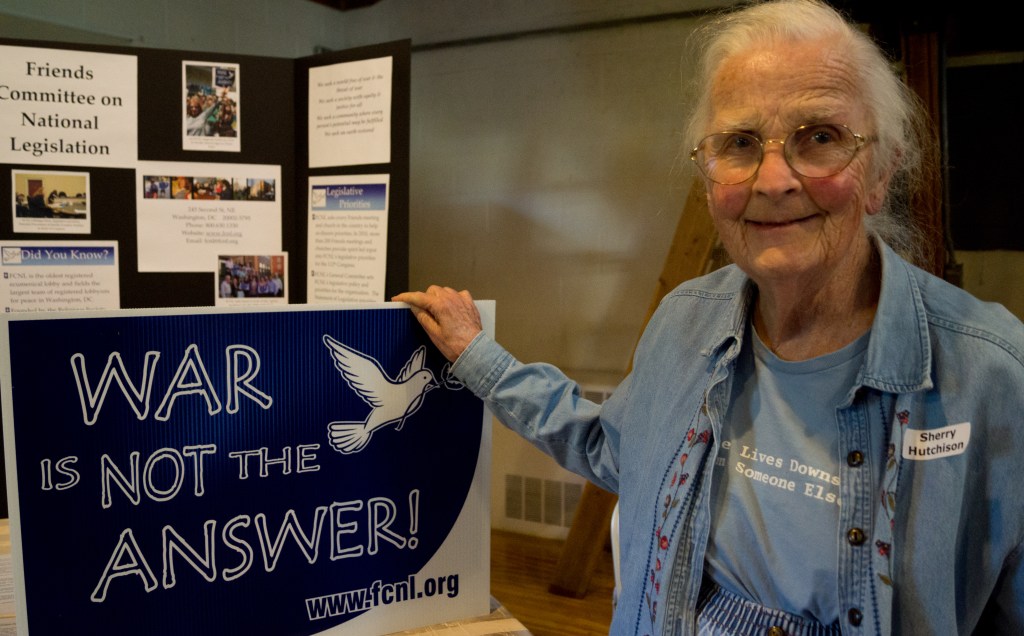
Jeff Kisling and Sherry Hutchison, co-clerks Peace and Social Concerns Committee
Sustainable Indiana staff include John Gibson, Jim Poyser, Shannon Anderson, Judy Voss and Richard Clough. They have appeared in many of my blog posts, because they are involved in so many environmental efforts. John and Jim were very active in the Keystone Pledge of Resistance, and they have all been involved in Indiana Moral Mondays and many other projects.
“Sustainable Indiana 2016 is a Indiana Bicentennial Legacy Project of Earth Charter Indiana. Our mission has been to collect and celebrate stories of people who are taking the lead on a sustainable future in Indiana. This book contains some of those stories, for Hoosiers and by Hoosiers, to serve as a guide to a future that gives us a deeper and healthier connection to our environment and each others.”






























 Quakers and Mutual Aid