Ever since I wrote yesterday’s post, I knew something wasn’t right. Trying to think things through in public can be disconcerting. Hopefully, there is some value in showing the process. Making mistakes is how we learn and grow.
I’ve been praying and thinking about all the things I’m learning in my Mutual Aid community for a long time. I’ve been wondering what sustains my friends in this work. Sometimes difficult work. My Mutual Aid community is definitely an example of Beloved community. We feel and share the love. Never have I seen anger. This is part of what sustains us.
And the joy of being able to provide food to our community is a large part, too. I wrote that sentence carefully, to demonstrate an important part of Mutual Aid. It is NOT us helping them. We are all in this together. A friend recently told me at one time she needed food. Now she is so happy to help distribute food.
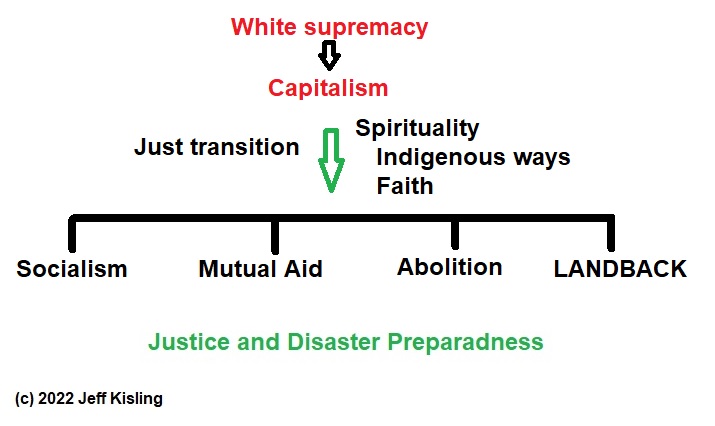
Returning to yesterday’s post, Justice and Disaster Preparedness, I tried to simplify the main concepts I think are important for making a transition to the communities we want, need to create. I was trying to figure out where faith fit. I put it under Socialism because I’ve been learning about religious socialism. That and other problems made me decide to scrap that diagram. Following is today’s version.
Socialism, Mutual Aid, Abolition, and LANDBACK each have a role in building Beloved communities. Especially regarding disaster preparedness.
Spirituality is what will help us make the just transition to communities needed to prepare for the present and coming disasters.
Spirituality can be expressed in many ways. But there is only one Creator or God.
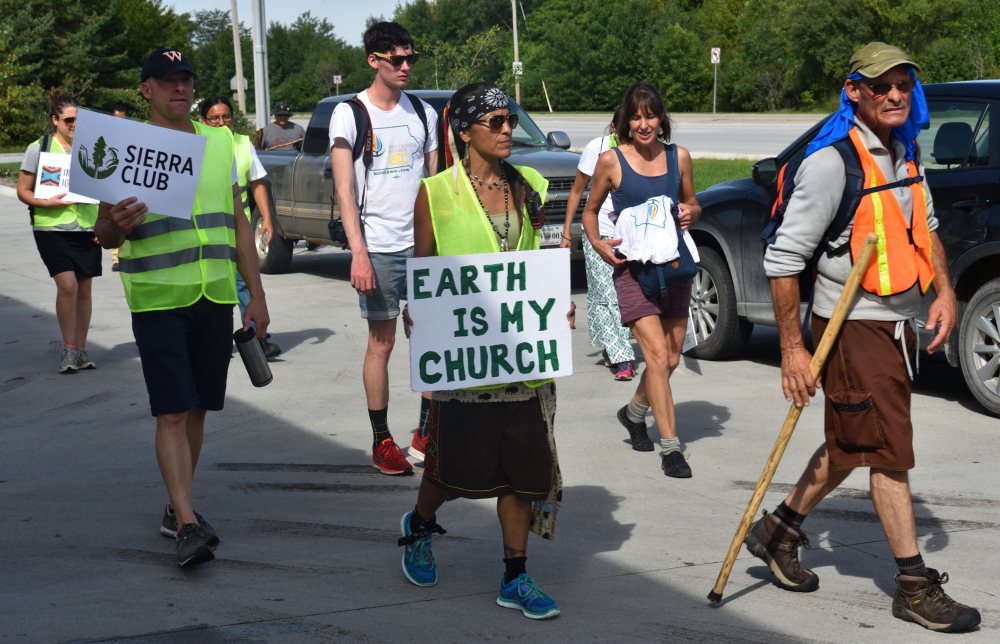
I love the EARTH IS MY CHURCH sign my friends Alton and Foxy Onefeather carried during our First Nation Farmer Climate Unity March.
First Nation Farmer Climate Unity March September 1-8, 2018
Watching the tragedy of war unfolding in Ukraine makes real the future I fear we are moving into. Are already experiencing in many ways.
Fear not only as a noun, “an unpleasant emotion caused by the belief that someone or something is dangerous”, but also as a verb, “to be afraid of.”
I can’t imagine anyone watching the stories from Ukraine, and not thinking about how tenuous our own lives are. Seeing people’s lives destroyed in an instant. Injury or death of loved ones. Loss of shelter and infrastructure. No water, power, medicines, food, community.
What would we do in a similar situation?
We might find out sooner than we think. We are facing numerous crises ourselves.
Environmental chaos
Economic collapse
Political collapse
War
Domestic extremism and armed conflict
There have been warnings about these things for decades, with little effect. But now we are seeing everything on that list happening to various degrees. And each negatively impacts the others.
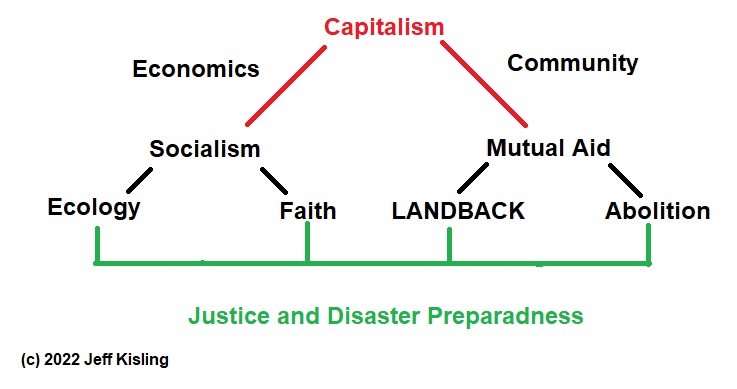
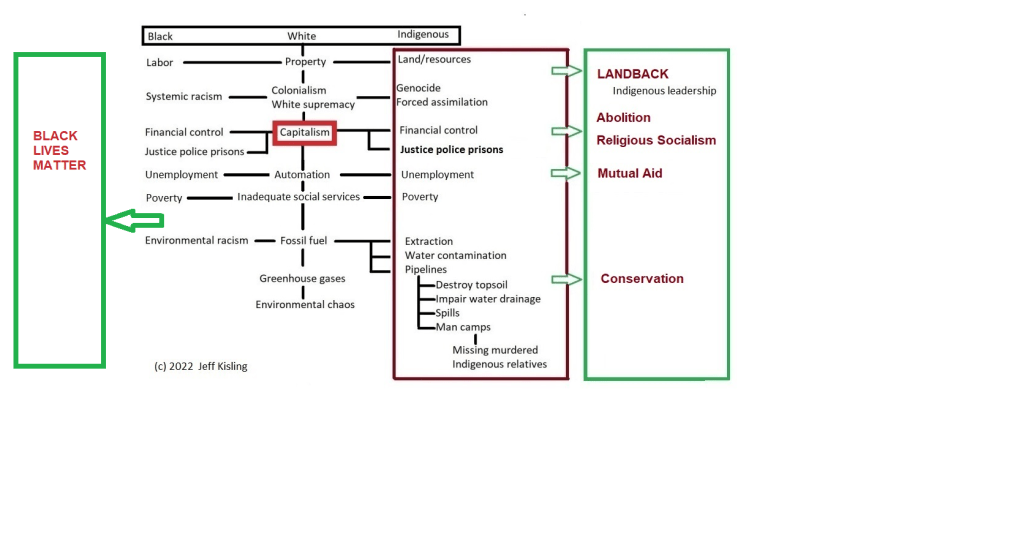
Following is a new diagram I’m working on to show relationships among systems. The reason justice is in today’s title is because so many of our current systems have injustices embedded in them. As we prepare for disasters, not addressing injustice would mean:
Not benefiting from the wisdom and skills of those we don’t have relationships with now. Because of the mistrust between us.
Bringing these injustices and conflicts into the disaster relief communities.
We have three choices:
We can just react to what is coming at us. Go into survival mode.
We can prepare for disaster locally.
We can work for justice as part of disaster preparedness.
Descriptions of the systems in the diagram: ecosocialism, LANDBACK, abolition and Mutual Aid follow.
I believe faith is an important part of this. This morning I thought faith was going to be the subject, but found this background needed to be covered first.
Ecosocialism
Ecosocialism brings together two complementary ways of thinking about humans and the environment they live in. The “eco-” in ecosocialism comes from the science of ecology and its emphasis on the complex and dynamic interactions among the living and non-living components within an ecosystem. In particular ecologists understand how the life-supporting functions within an ecosystem can be disrupted by the behavior of one organism, for example, humans.
But ecology lacks a social analysis; it has no way of understanding how economic and political forces drive human behavior and social change.
Ecosocialists start with the premise that environmental degradation and social injustice stem from the same source: a world where profit is the highest goal. We believe that the emancipation of people from capital and its masters goes hand-in-hand with the emancipation of the earth and its biosphere from the cancer of capitalism.
The criminal justice system is violent and harmful: The UK’s prison population has risen by 90% in the last two decades, bringing the number to over 90,000. At the time of writing we are 156 days into 2018 and already we have seen at least 129 deaths in prison, immigration detention centres and at the hands of the police. As the effects of neoliberalism and austerity deepen each day, increasing numbers of people find themselves made disposable by our economic system and structural inequality, targeted by the agencies of the criminal justice system simply for being homeless, experiencing poor mental health or being born in a different country.
The criminal justice system does not reduce social harm: Policing, courts and the prison system are presented to us by politicians and the media as solutions to social problems. Yet, as the prison population has soared, we have continued to seen violence and harm in our society on a massive scale. Violence against women and girls is endemic, racism and the far right are on the rise in Britain and rates of murder and violent assaults are beginning to increase again. As politicians continue to scapegoat those with the least power in society, the conditions of structural violence that so often precede interpersonal violence remain in place.
We can build a world based on social justice, not criminal justice: All over the world, communities are coming together to build real solutions to societal problems. These solutions lie outside of the criminal justice system, in preventing harm through building a better society. By bringing together groups and organisations working for social justice, we want to demonstrate and strengthen the links between prison abolition and wider struggles for housing, health, education, and environment; and for economic, racial, gender, sexual and disability justice.
The more I experience being part of a Mutual Aid community, the more I learn about Mutual Aid, the more I am convinced Mutual Aid is how we should all live. I just realized that might be the only way we can live, survive.
I recently learned the term prefigurative politics which is to model the organization and social relationships that the group is advocating. Mutual Aid groups do this.
Mutual Aid is about replacing the vertical hierarchies of power with a flat or horizontal hierarchy where we all have a voice.
I’ve been thinking a lot about Mutual Aid and war as Russia invades Ukraine. Dictatorships like Putin’s Russia represent the ultimate vertical hierarchy. But all nation states are built on vertical hierarchies.
I’ve been wondering how Mutual Aid can be applied to global powers waging war.
Our world, that has been colonized by imperialist white supremacist capitalist patriarchy, runs because of the oppressive and exploitative forms of power
Thus, to liberate ourselves and each other from this system, one of our main tasks is to confront hierarchy and hierarchical forms of power.
Mutual aid is a form of prefigurative politics, aimed at abolishing hierarchy and hierarchical forms of power in the world by first living out these principles ourselves, bringing new ways of relating to each other into being
Mutual Aid: Non-Hierarchy in Practice by Tammy Gan, Bad Activist
Rather than feeling helpless in the face of war, we should be creating our own communities of Mutual Aid, of peace. That will take us out of imperialist white supremacist capitalist patriarchy so we will not be contributing the conditions for the next war.
To address one aspect of war, creating our own Mutual Aid communities would put us in the position of being able to welcome refugees.
mutual aid aims to: form the structure of a new society within the shell of the old; embody the forms of social relations, decision-making, culture and human experience that are its ultimate goal
Beyond our personal experiences, our world, that has been colonised by imperialist white supremacist capitalist patriarchy, runs because of the oppressive and exploitative forms of power.
For our world, as is, to run, there must be an inherent valuing of some bodies over others. This is what we mean when we talk about “racial capitalism”, the idea that capitalism emerged, as Cedric Robinson argued, on the grounds of a civilisation based on racial hierarchy. Racism, in designating and ideologically convincing people that some people are inferior to others, allows for a system of extraction (capitalism) to exploit Black and brown people, while white people carry this out, or benefit from this system, thereby never abolishing it. So hierarchy (racial or otherwise) is the foundation that maintains our structures and system.
Thus, to liberate ourselves and each other from this system, one of our main tasks is to confront hierarchy and hierarchical forms of power.
Confronting, is different from attempting to appeal to the people who are in power (e.g. solely depending on billionaires, or politicians), or striving to obtain the kind of power that we’re subjected to (think #girlboss feminism). Instead, confronting means to transform hierarchical forms of power into other forms of power. We must have “power of our own”: moving away from power-over to power-with. This is where spaces and projects that attempt to create that new world, starting from rethinking our relationships, come into play.
Mutual aid is a form of prefigurative politics, aimed at abolishing hierarchy and hierarchical forms of power in the world by first living out these principles ourselves, bringing new ways of relating to each other into being. Specifically, mutual aid aims to: form the structure of a new society within the shell of the old; embody the forms of social relations, decision-making, culture and human experience that are its ultimate goals (i.e. to practice what it wants to see, now); and continuously experiment, and be reflexive through trial and error.
And if the wreckage of this inheritance will not be complete; if notwithstanding the crimes committed during this “civilized” war [ World War I ], we may still be sure that the teachings and traditions of human solidarity will, after all, emerge intact from the present ordeal, it is because, by the side of the extermination organized from above, we see thousands of those manifestations of spontaneous mutual aid.
Preface to the 1914 edition of Peter Kropotkin, Mutual Aid: A Factor of Evolution (London: Heinemann, 1914).
Food Not Bombs
When a billion people go hungry each day, how can we spend another dollar on war? Food Not Bombs is an all-volunteer movement that recovers food that would otherwise be discarded, and shares free vegan and vegetarian meals with the hungry in over 1,000 cities in 65 countries in protest to war, poverty, and destruction of the environment. We are not a charity but dedicated to taking nonviolent direct action. Our movement has no headquarters or positions of leadership and we use the process of consensus to make decisions. We also provide food and supplies to the survivors of natural disasters, and people participating in occupations, strikes, marches and other protests.
As grocery stores empty out and food shortages loom, food-sharing projects like Food Not Bombs (FNB) take on new urgency. FNB volunteers collect food from bakeries, grocery stores, and restaurants, cook together, and share meals and groceries in public spaces with whomever comes. Volunteers also take part in nonviolent direct action to change the social structures that produce hunger. FNB-like initiatives have already appeared in restaurants that offer free meals to laid-off workers and in grocery-delivery networks. There’s an increasing need for flexible, mobile, horizontal approaches to food distribution.
Eight anti-nuclear activists formed the first FNB group on May 24, 1980 at the Occupation Attempt of the Seabrook Nuclear Power Station in Cambridge, MA. Their basic insight was that hunger is unnecessary in a country that spends millions on weapons of mass destruction.
Prefigurative politics are the modes of organization and social relationships that strive to reflect the future society being sought by the group. According to Carl Boggs, who coined the term, the desire is to embody “within the ongoing political practice of a movement […] those forms of social relations, decision-making, culture, and human experience that are the ultimate goal”.[1]
I’m trying to sort out confused feelings about war and peace through a split screen of foreign versus domestic.
I was caught off guard by the Russian invasion of Ukraine. It was unrealistic to think there wouldn’t be another war between nations anytime soon.
But we haven’t had peace in this country, either.
I had forgotten Martin Luther King, Jr, was outside a California prison, which was holding Vietnam War protesters when he said, “there can be no justice without peace, and there can be no peace without justice.” December 14, 1967.
So, there is this dichotomy of war between nations versus domestic injustices. Domestic injustices mean there is no peace here.
This quote from Muhammad Ali relates to this.
Under no conditions do we take part in war and take the lives of other humans.
It is in the light of my consciousness as a Muslim minister and my own personal convictions that I take my stand in rejecting the call to be inducted. I do so with the full realization of its implications. I have searched my conscience.
Man, I ain’t got no quarrel with them Vietcong…they never called me ______.
Muhammad Ali
I’ve been blessed to have become part of numerous oppressed communities in this country. Where there are so many injustices. Where there is so much violence, much of it state sanctioned.
The scenes and stories from Ukraine are devastating to see. And while it is good to see the response of so many who want to help, I wish there were similar responses to our own domestic tragedies.
A friend this morning tells me others have noted similar disparities in the response to the plight of Palestinians. He said, “Once again I am reminded of how ‘White’ my thinking is.”
And there are the dispiriting stories of racial discrimination in support among the Ukrainian refugees.
My experiences with Mutual Aid have convinced me that is a way to peace.
The recent past shows us that mutual aid is not only a tool of survival, but also a tool of revolution.
Ronnie James
The first, and possibly the most important, is that it was not always this way, which proves it does not have to stay this way.
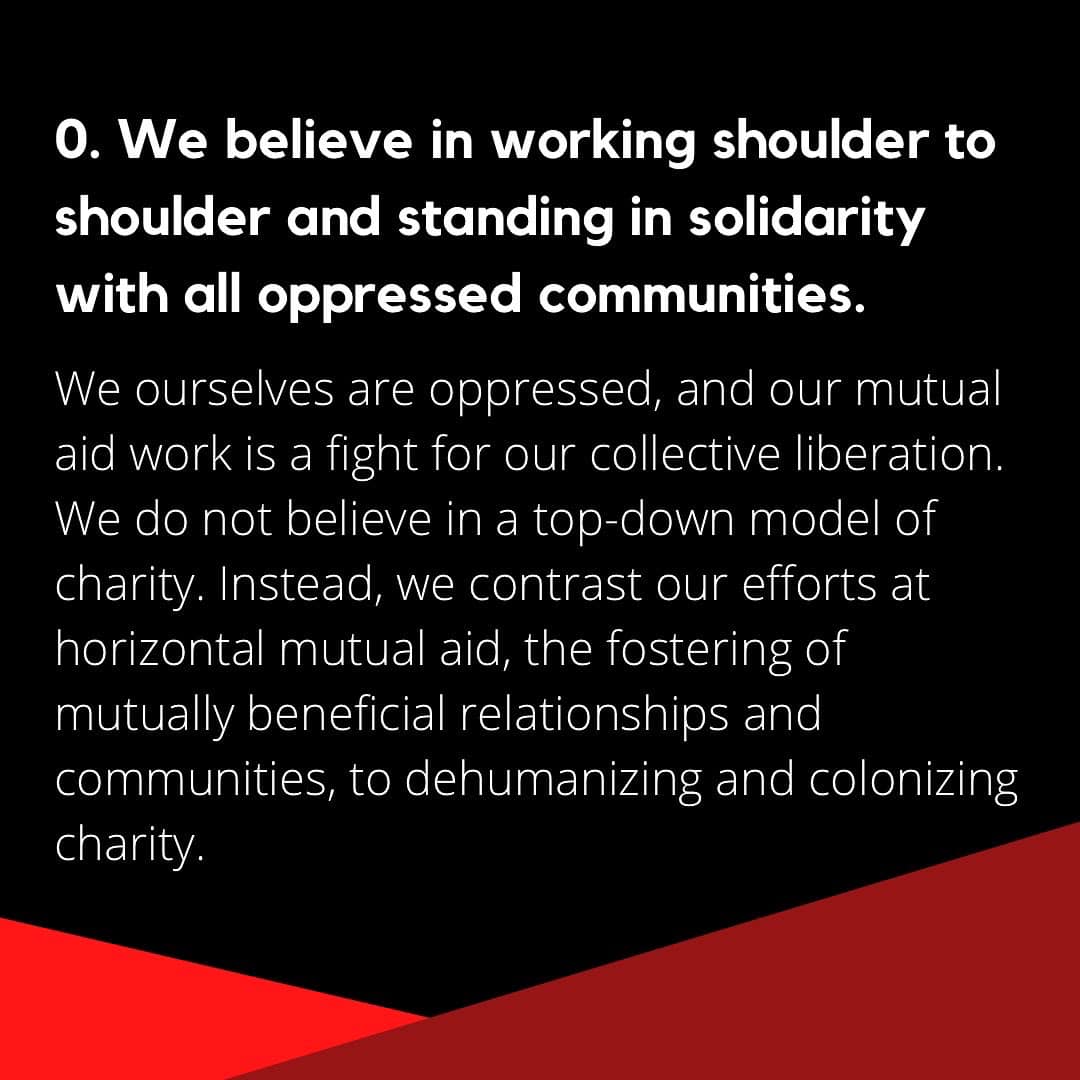
What we have is each other. We can and need to take care of each other. We may have limited power on the political stage, a stage they built, but we have the power of numbers.
Those numbers represent unlimited amounts of talents and skills each community can utilize to replace the systems that fail us. The recent past shows us that mutual aid is not only a tool of survival, but also a tool of revolution. The more we take care of each other, the less they can fracture a community with their ways of war. Organized groups like The American Indian Movement and the Black Panther Party for Self Defense showed that we can build not only aggressive security forces for our communities, but they also built many programs that directly responded to the general wellbeing of their communities. This tradition began long before them and continues to this day. Look into the Zapatistas in Southern so-called Mexico for a current and effective example.
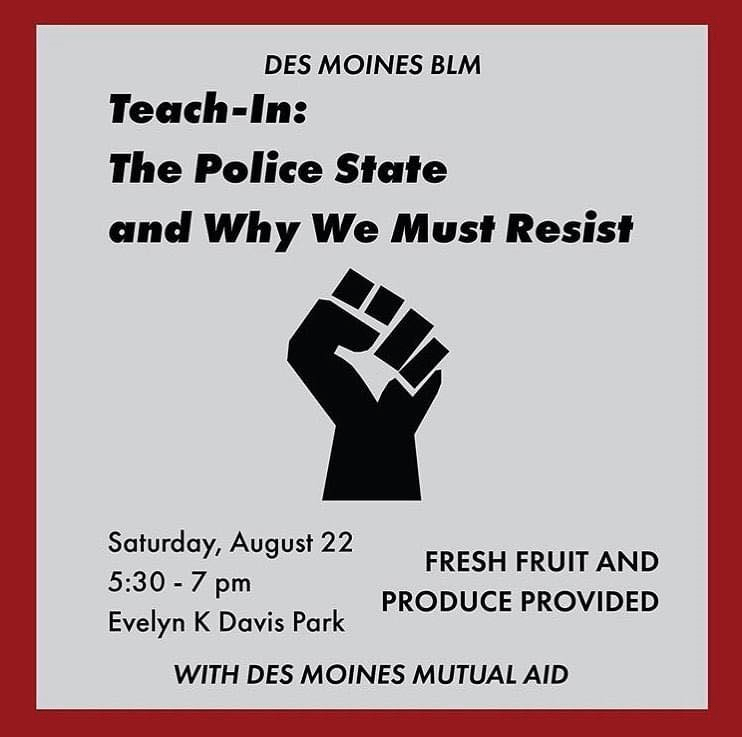
Ronnie James, The Police State and Why We Must Resist
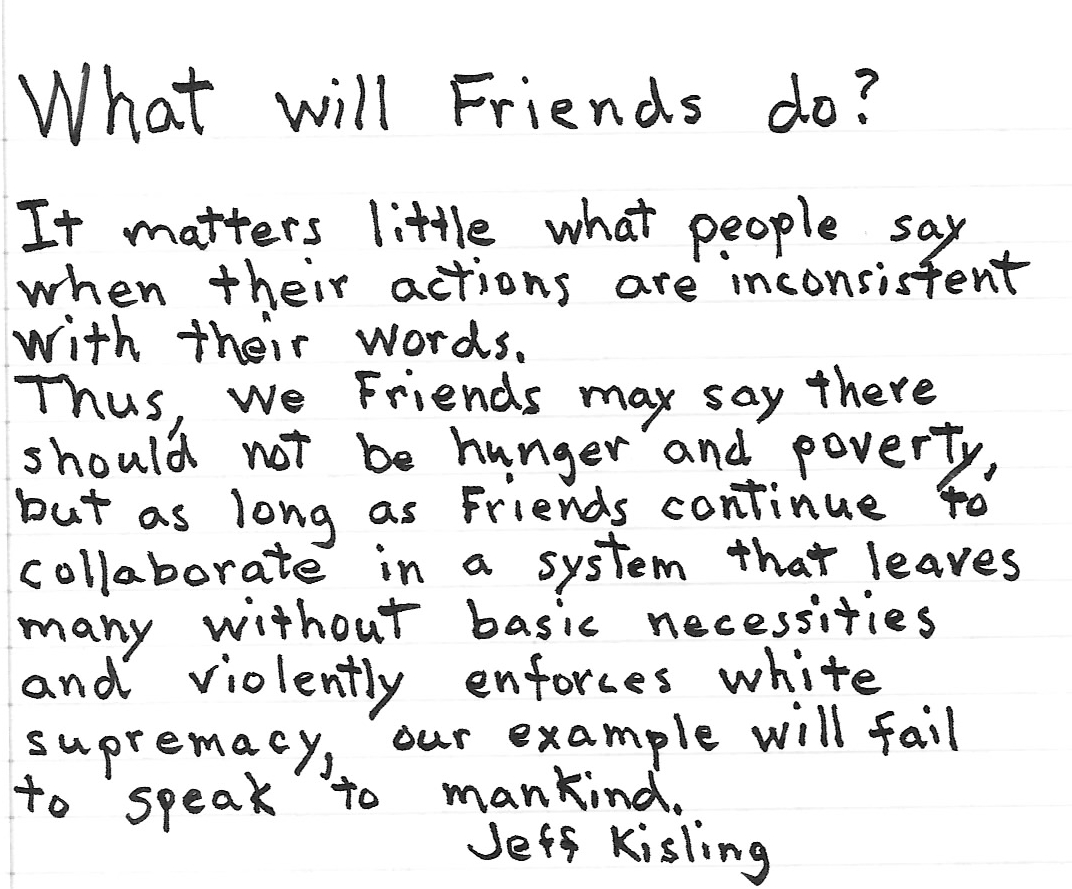
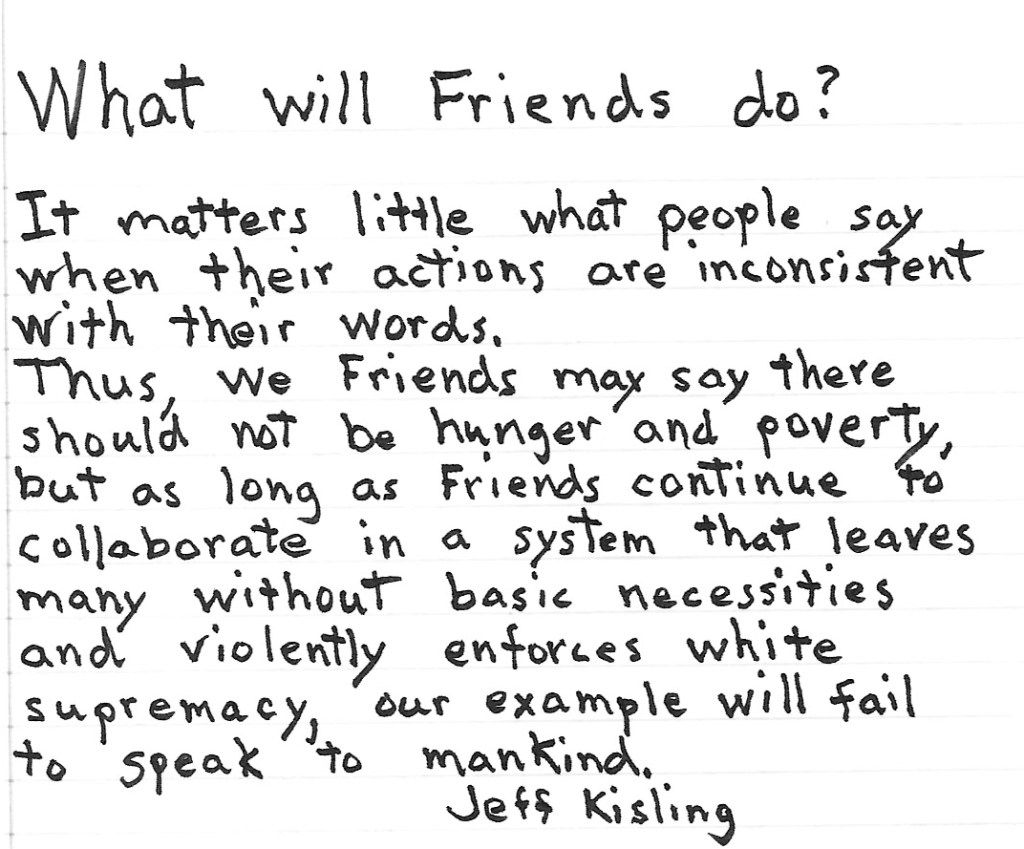
The two major themes of justice work I have been forced to spend so much time and effort on are trying to convince White people to understand their privileges, and why capitalism is so wrong and must end. Capitalism is the system that enforces White supremacy and power, enforces racism. Capitalism is economic slavery of those of any race who are of a certain class, i.e. struggling for basic necessities. Which is ironic because the enslavement of people of color, and the theft of land and natural resources from native peoples was and continues to be the foundation of White supremacy and capitalism.
A system that requires money for any purchase or service is morally reprehensible because that denies anyone without money to obtain basic necessities. How have we accepted millions of children going hungry? Millions denied food, housing, education, healthcare? I am so invested in the work of Des Moines Mutual Aid because we are doing what we can to feed the hungry and provide shelter for the houseless.
I’m always looking for other sources that can express this better. Because this message is critical. The following is from the interview “Bree Newsome Bass: ‘Capitalism Has to Collapse’” by Kelly Hayes, Truthout, January 20, 2022.
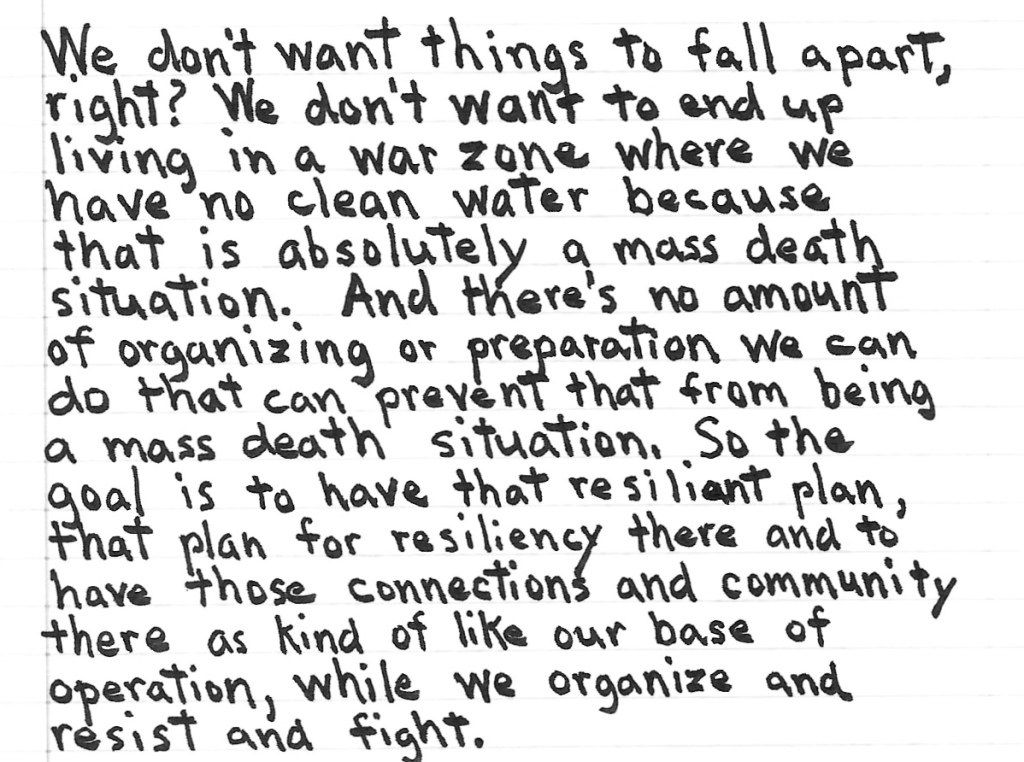
“So, the goal is to have that resilient plan, that plan for resiliency there and to have those connections and community there as kind of like our base of operation, while we organize and resist and fight.”
As I’ve been saying and doing, those resiliency connections and community are Mutual Aid.
On a personal note, I have an indirect connection to Bree. My friend Todd Zimmer, who trained me to be an Action Leader in the Keystone Pledge of Resistance in 2013 and led the Change the Course training I attended in Louisville, was then working for the Rainforest Action Network. Much of that training focused on nonviolent civil disobedience, direct action planning and execution.
Todd also helped organize the act of civil disobedience by Bree Newsome, who was arrested after she scaled the flagpole to remove the confederate flag at the South Carolina State House June 28, 2015.
The NAACP praised Newsome as a “courageous young woman” and asked for leniency from prosecutors.
“We commend the courage and moral impulse of Ms. Newsome as she stands for justice like many NAACP activists including Henry David Thoreau, Dr. Martin Luther King Jr. and numerous Americans who have engaged in civil disobedience,” it said. “The NAACP calls on state prosecutors to consider the moral inspiration behind the civil disobedience of this young practitioner of democracy.”
“On June 28, in the early hours of the morning, 30-year-old helmeted activist Bree Newsome scaled the flagpole at the South Carolina State House and cut down the controversial Confederate flag, which was first raised there in 1961, almost 100 years after the Civil War.”
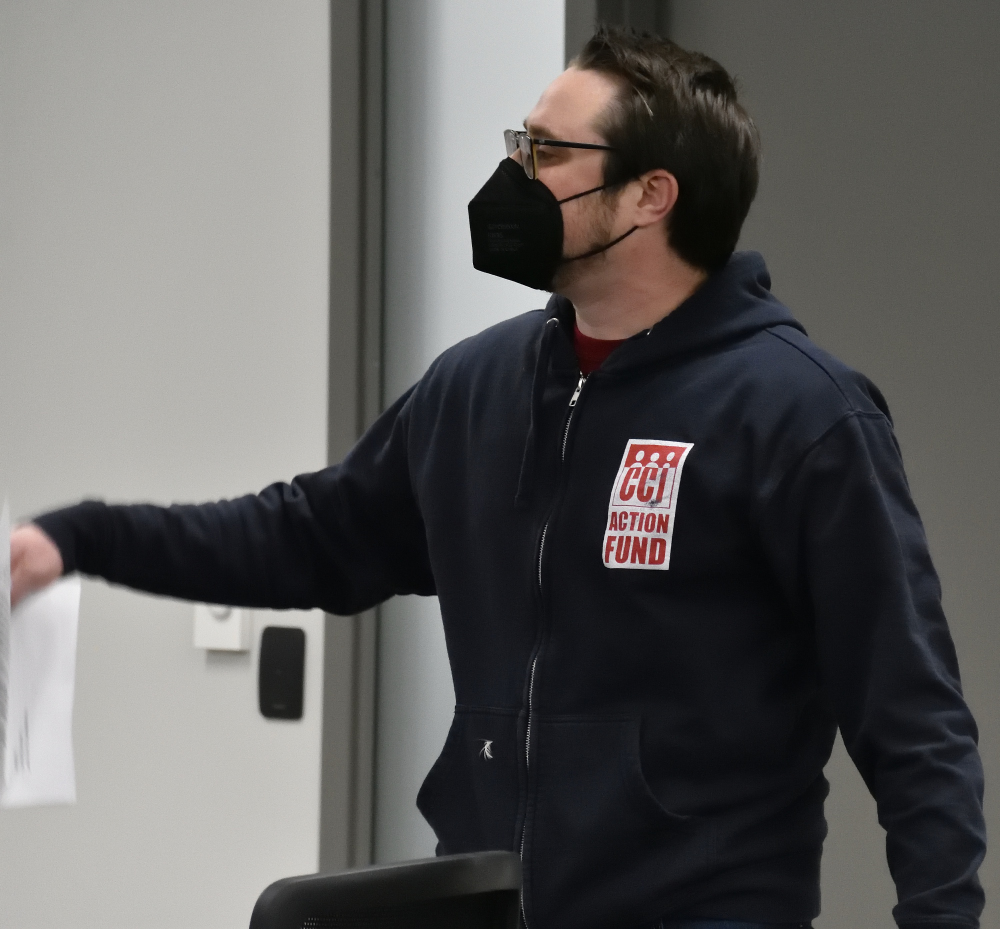
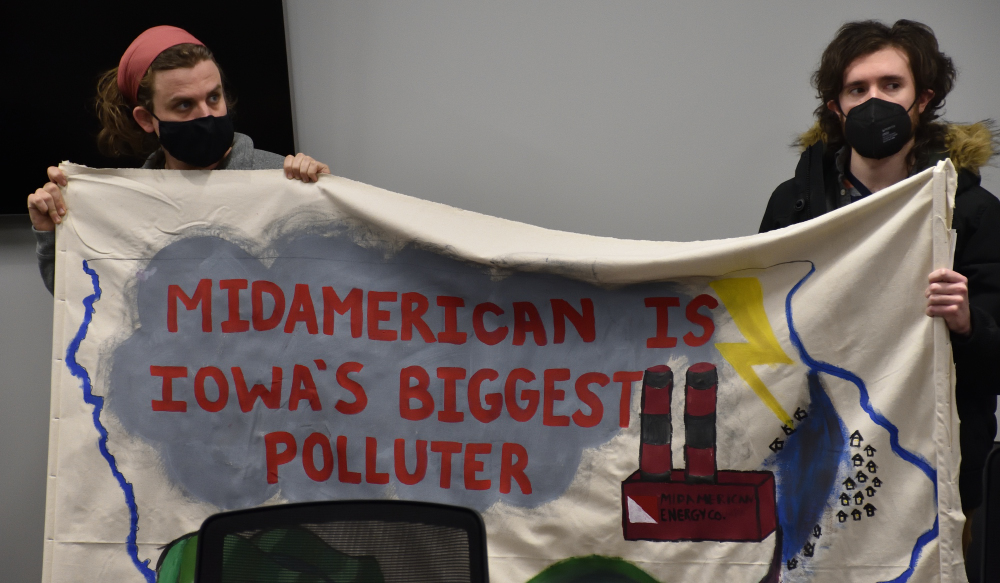
I was talking with my friend Jake Grobe, of Iowa Citizens for Community Improvement (ICCI) recently as we were working at the Des Moines Mutual Aid free food project. (see: Des Moines Mutual Aid Networking). He knows I am a photographer and asked me to take photos at the Iowa Energy Center Meeting yesterday. The reason for going to the meeting is MidAmerican’s CEO Kelcey Brown has refused multiple requests to meet with ICCI and she was going to be at this meeting.
Jake is ICCI’s Climate Justice Organizer. From his bio: He believes that climate justice is an intersectional fight for racial, economic, and social justice. “Humanity confronts a great dilemma: to continue on the path of capitalism, depredation, and death, or to choose the path of harmony with nature and respect for life.”
“Climate justice is an intersectional fight for racial, economic, and social justice” is the premise of Religious Socialism. https://quakersandreligioussocialism.com/
Jake said, “our climate justice team organized this action. We had the intention of shutting down the meeting if we were ignored and did because these coal plants are a leading contributor to the climate crisis which is an existential threat to everything we love.”
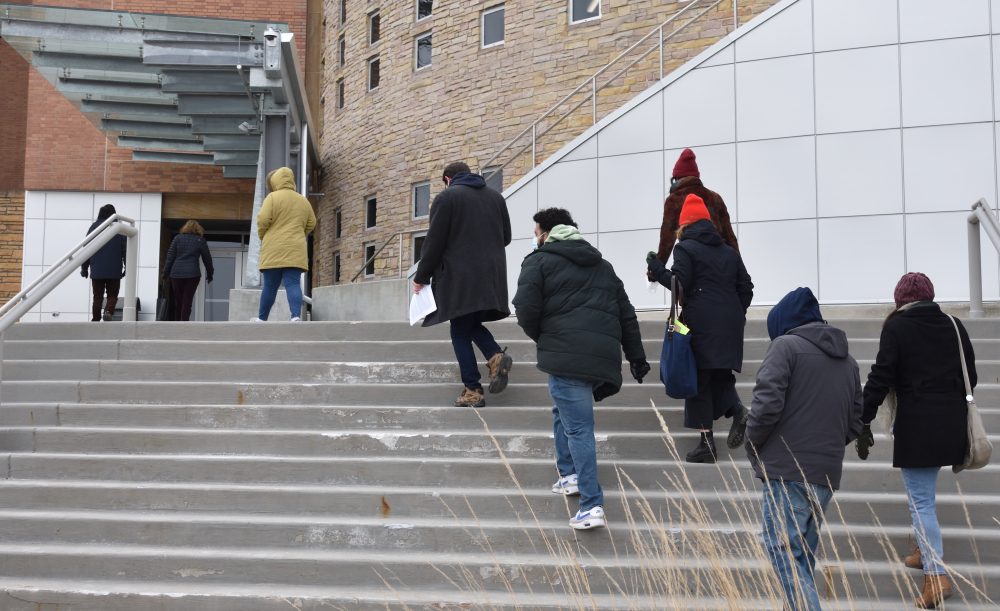
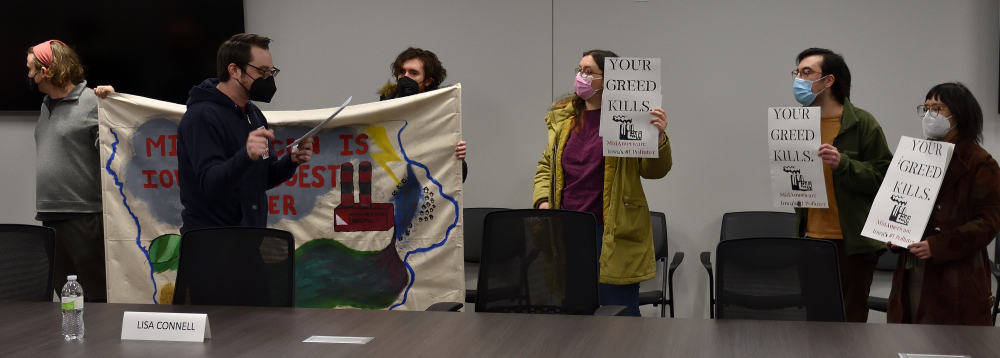
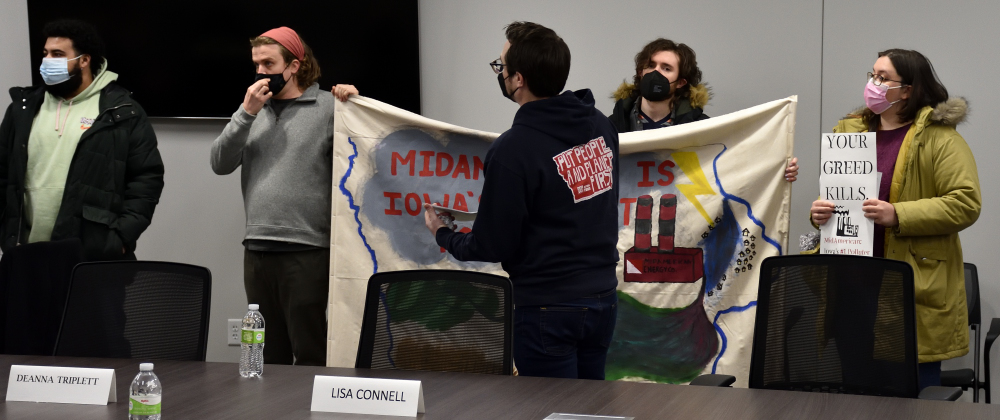
There were handouts (below) and signs. And preparation prior to going into the building together. Jake summarized the intention of the meeting, the issues, and what the action would be if the board did not address their coal power plants. Including leaving as a group if the police were called. No arrests were planned. The police were called and showed up right after we walked out of the building.
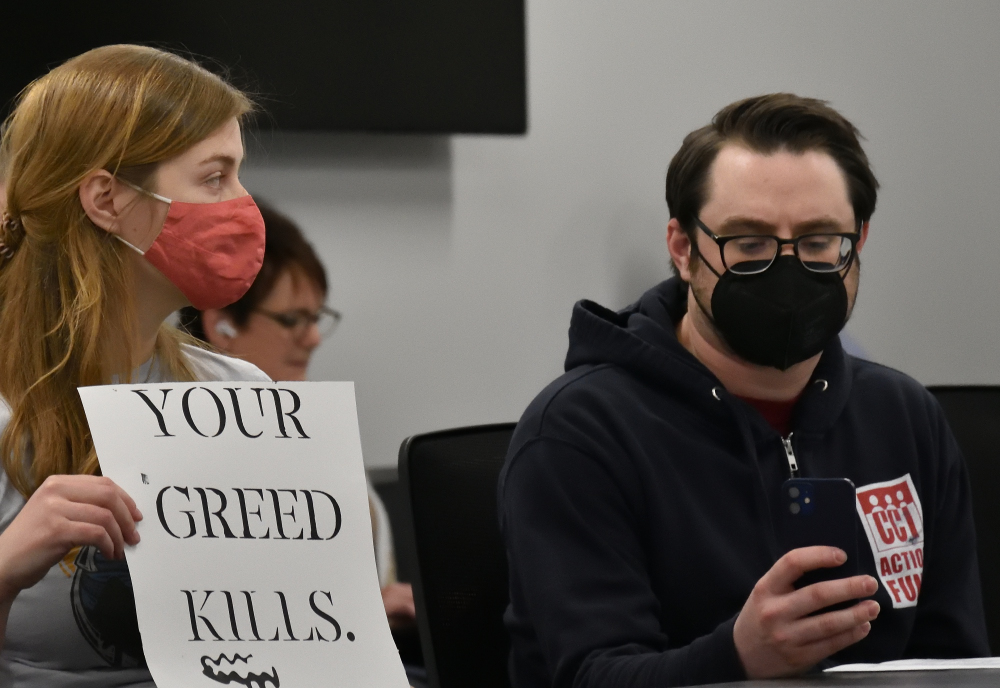
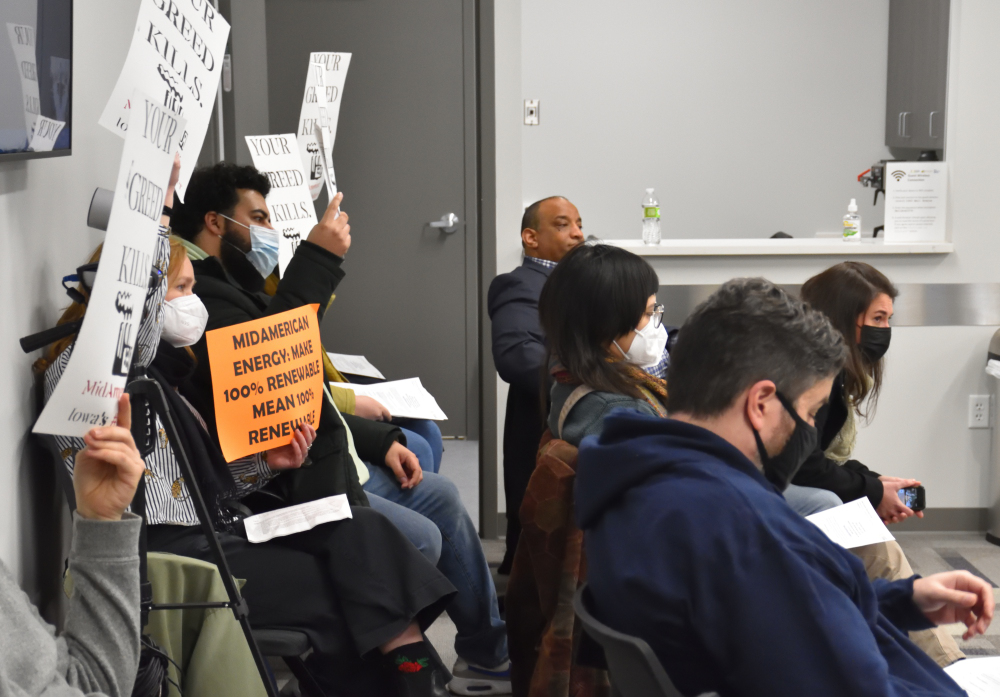
Our group entered the conference room quietly. Signs were kept out of sight by hiding them under coats. When the meeting asked if anyone wished to speak during public comments, four people from our group raised their hand (who had prepared ahead of time what they would say). Each person was allotted two and a half minutes.
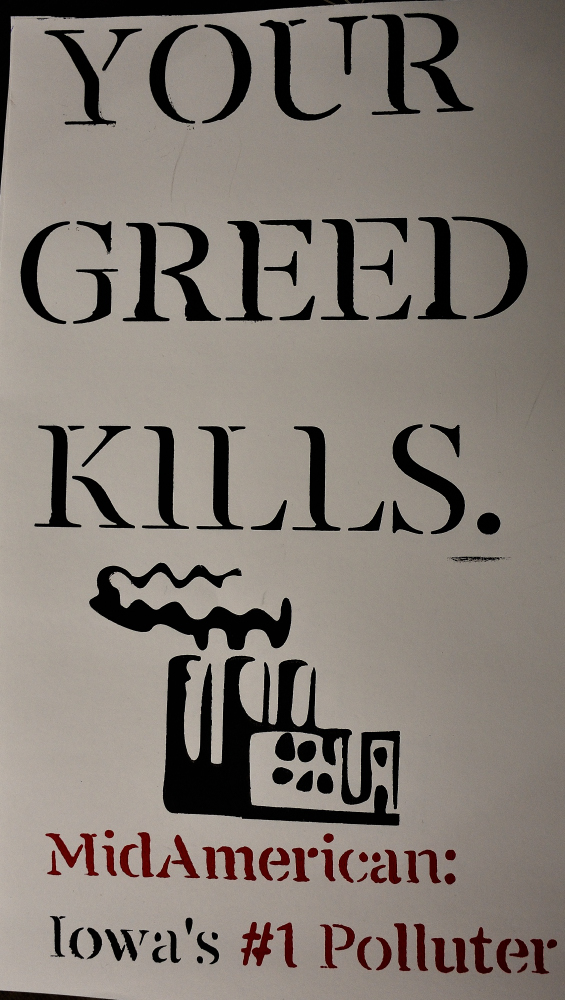
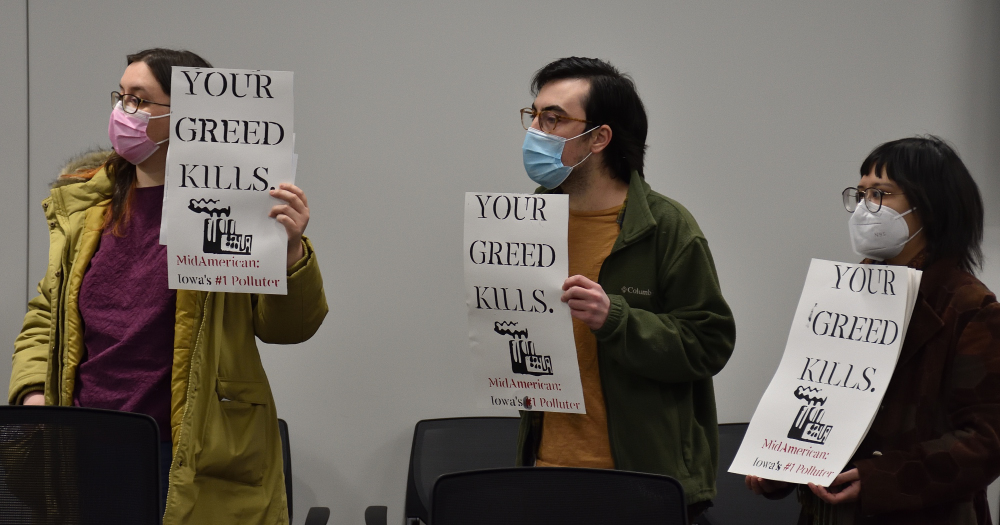
When the first person began speaking, the signs “Your Greed Kills. MidAmerican Iowa’s #1 Polluter” were uncovered and passed among us. But everyone listened quietly with some finger snapping to support certain comments.
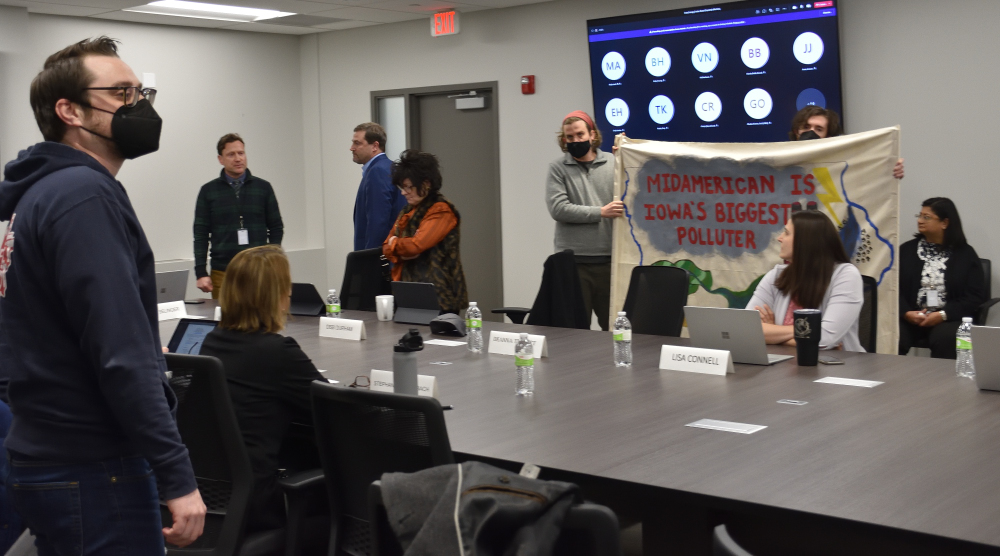
When the time for public comments had expired, Jake continued to speak. Asking Kelcey Brown to explain why MidAmerican was not going to shut down their five coal plants, raising many of the points in the handout below. Kelcey Brown said something like thanks for your comments and then didn’t respond when Jake made the ask that she meet with us to discuss our demands. When he kept going after that she briskly walked out.
Jake continued to speak over calls from the board that the time for public comments was over. He spoke about the existential threat of greenhouse gas emissions. Asking if members of the board weren’t worried how their own children would be affected. He pointed out MidAmerican’s development of wind power wouldn’t matter if they continued burning coal until 2049.
This made me think of the term, going into the belly of the beast, meaning “being in the middle of a very bad situation or a dangerous place.” Also, “speaking truth to power.”
Humanity confronts a great dilemma: to continue on the path of capitalism, depredation, and death, or to choose the path of harmony with nature and respect for life.
Jake Grobe
The issue of CO2 pipelines came up, which we are definitely against.
Jake and a few others in our group continued to ask questions. After some time, the board adjourned, and we were told it was time to leave. Jake said a few more things, then asked us if we were ready to go. In the preparation Jake said we would leave on our own terms, and we did.
Katie Bryan, ICCI’s communication director called me prior to the action to make sure I knew there might be some intervention at the meeting. And we discussed how I would get the photos to her. She also suggested if possible, sharing photos as the action was occurring. Not being adept at either using my phone camera, or using twitter, I did manage to send her the photo that she was able to use in the tweets below.
Proud to stand alongside my @iowacci comrades today to demand that MidAmerican Energy shut down all of their coal-burning power plants in Iowa. https://t.co/uyYSzpogwq
Kelcey Brown, CEO of Mid-american, has ignored community members for months reaching out for a meeting. So what do we do? Show up to their meeting. Take up space and demand they shut down their coal plants. We cannot wait any longer. https://t.co/wy9Bmsec2Zpic.twitter.com/offMQk1aW9
No utility shut offs and utility bill relief for working people who don’t qualify for LIHEAP
Reinvest into energy efficiency programs above pre-2018 levels
Facts
MidAmerican Energy is the single biggest carbon polluter in the state
They own five coal-powered plants to generate electricity and plan to keep burning coal until 2049
A report of MidAmerican’s electricity generation in 2020 shows that all the electricity they generated from coal was in excess of Iowa’s needs
In fact, nearly a third of all the electricity they generated was sold to other utilities out of the state for $124.3 million
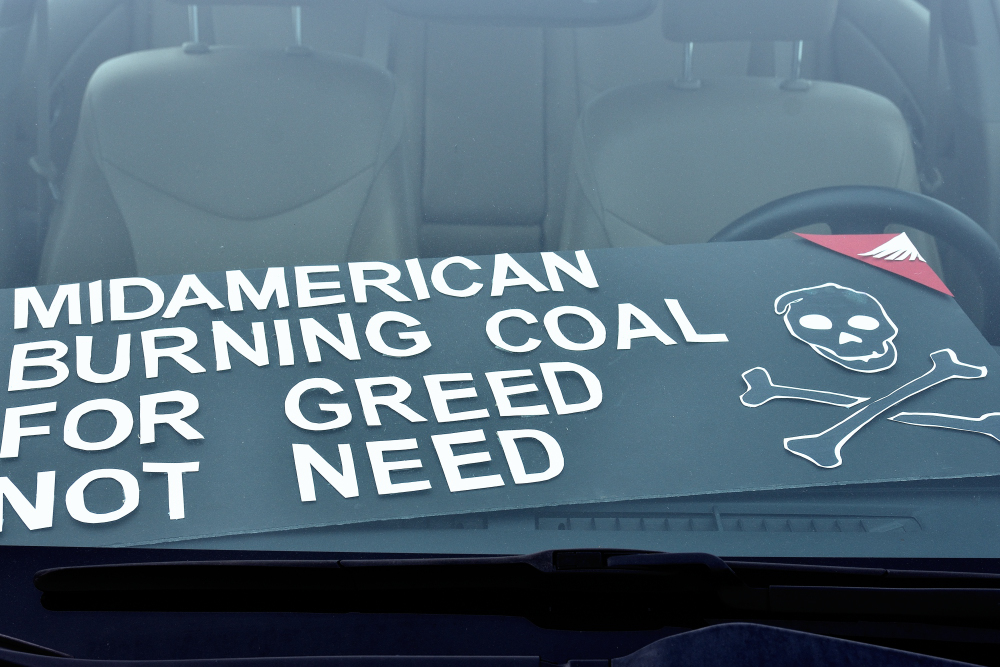
It’s clear that MidAmerican Energy is burning coal for greed, not for need. And we’re paying the price.
In 2020, the excess coal generation in Iowa sent 16,977,124 tons of carbon dioxide into the atmosphere, representing economic harm ranging from $865 million to $2.58 billion.
Sponsoring a *small* fleet of electric buses in our city is a greenwashing scheme and an empty gesture when you consider that in order to offset the last two years of MidAm’s C02 emissions, they’d have to electrify 193,000 buses!
MidAmerican Energy is making working families pay more to keep their homes warm
In 2018, MidAmerican spent over $100,000 dollars to lobby Republicans in the Iowa state legislature to pass a bill that made massive cuts to energy efficiency programs
This included $9,000 to State Rep. Gary Carlson who spearheaded the bill, $16,000 to Republican Senate Majority Leader Jack Whitver, $11,5000 to Republican Senate president Jake Chapman, $10,000 to Republican House Majority Leader Pat Grassley, and $10,000 to Kim Reynolds since 2018
Since that bill passed, working families are getting less help to weatherize their homes to keep them warm in the winter and cool in the summer
MidAmerican Energy reported kilowatt-hour savings for 2020 that were 64% lower than what the utility achieved the year before the law took effect.
Now, MidAmerican customers are paying twice as much for their heat and 61,000 Iowan families have been forced to apply for utility assistance because they can’t pay their bills!
Meanwhile – MidAmerican is on track to make over a billion in yearly profits, another record year!
This is corporate greed and political corruption at it’s finest!
MidAmerican Energy could save ratepayers over $1 billion by retiring their coal fleet by 2030
Study published by Synapse Energy Economics, a nationally recognized energy analytics firm
Recent expert analysis shows that retiring MidAm’s coal fleet by 2030 and replacing it with solar, wind, battery storage, and energy efficiency would save ratepayers $1.2 billion through 2040, while creating high-quality jobs for Iowans.
$1.2 billion is their conservative estimate! — In the likely scenario that high gas prices continue and we finally see a national tax on carbon emissions, MidAm would save $5 billion by retiring its coal fleet by 2030 instead of allowing it to remain online indefinitely!!!!
That same scenario would also reduce carbon emissions by 318 million tons by 2040!
When the captive customers of MidAmerican pay for their power, they certainly are not agreeing to health impacts or death as a part of the deal. Yet, MidAmerican corporate greed results in 5 to 13 Iowans dying per year and increases the health care costs of Iowans by $64,681,145 to $145,675,343.
MidAmerican Energy is poisoning Iowa’s water
MidAmerican has coal plants and stores ash on the banks of the Missouri, Des Moines, and Mississippi rivers, at least 3 sites have been found to be polluting groundwater above federal advisory levels
MidAmerican emissions are worsening the climate crisis which is making droughts worse and drying up Iowa’s waterways. Hotter temperatures combined with lesser water flow is increasing blue-green algae blooms which make the water toxic. This has gotten so bad, that the major water sources for the Des Moines metro area have been untappable at times during the last two summers.
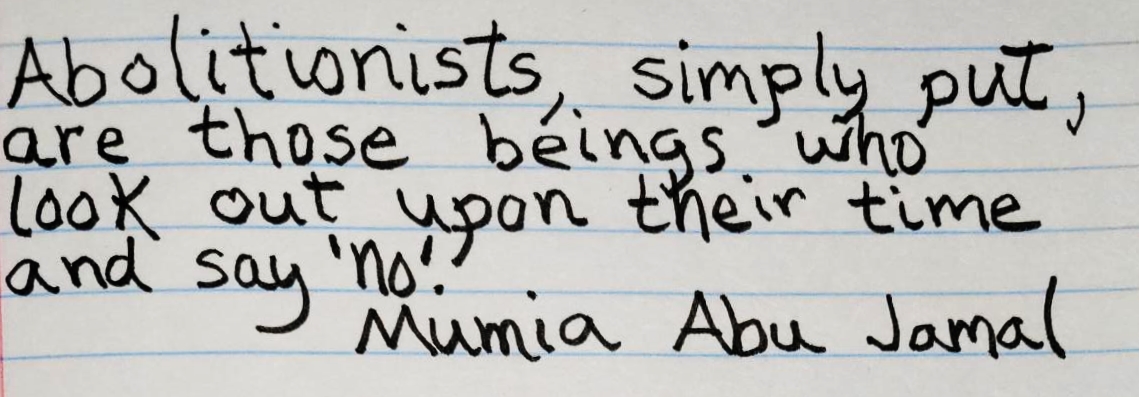
For most of my life I understood abolition to mean abolishing slavery. I often heard about that in my Quaker community. The story is that Quakers were involved in the underground railroad, helping freedom seekers escape from where they were enslaved.
But my friend Lucy Duncan writes about myths and avoiding uncomfortable truths.
We White Quakers like to revel in our myths about ourselves. These include “we were all abolitionists”; “we all worked on the Underground Railroad”; and “none of us were slaveholders.”
Often there are kernels of truth in myths, but the truth is more complex. Myths exist to veil the complexity and contradictions of our history, to obfuscate the differences between who we think we are and who we really are and have been. Often we want to take credit for the courageous few among us in order to absolve us from the uncomfortable reckoning with our past and our present. These myths protect our sense of innocence and goodness, but at what cost? Our failure to interrogate uncomfortable truths keeps us from living up to the promise of our faith, one that centers uncovering truth as foundational to our communal religious life.
There are many stories of white Friends today refusing to reckon with our past, and what racial justice requires of us now.
Today abolition more commonly refers to abolishing police and prisons. I’ve joined in the work of Quakers for Abolition Network and contributed to an article about this in the Western Friend, https://westernfriend.org/issue/94. I participate in the Central Iowa Democratic Socialists of America’s prison letter writing efforts and am taking two courses related to abolition.
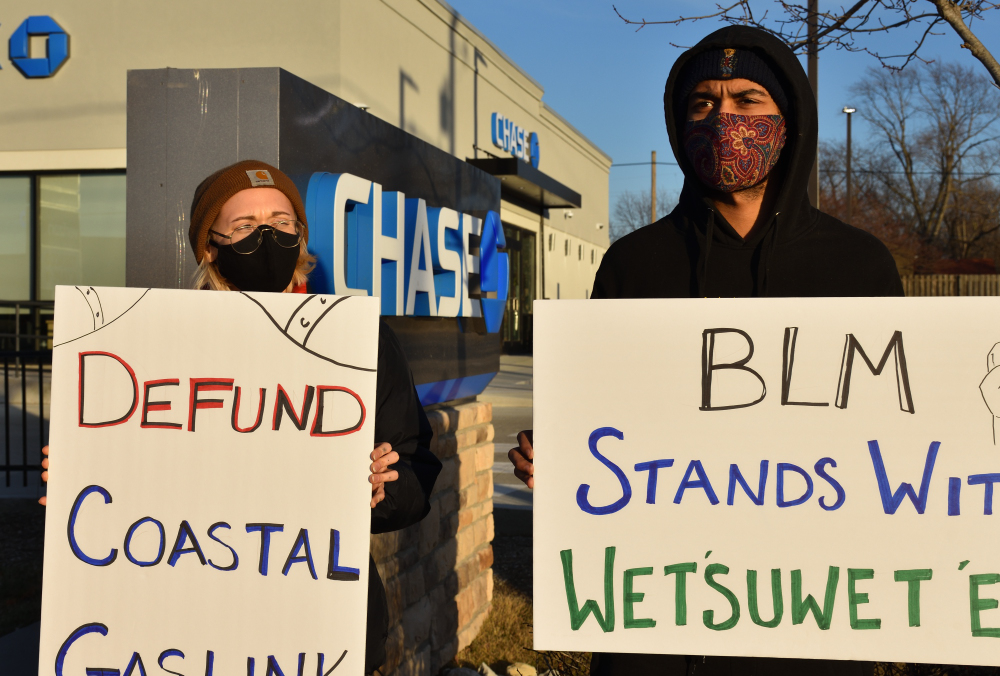
As I was praying about what to write today, I was thinking about the terrible abuses the Wet’suwet’en peoples in British Columbia are suffering from the heavily militarized Royal Canadian Mounted Police. The state sanctioned violence to enforce construction of the Coastal GasLink pipeline through their sacred and pristine lands and water. Yesterday I wrote about stopping the criminalization of Indigenous land defenders. And I realized this is another case that calls for the abolition of police and prisons.
That led to making the connection to the entire history of colonization of so-called North America to abolition. To the global colonization of Indigenous peoples. To the need for abolition of colonization and supremacy worldwide. Including repudiation of the Doctrine of Discovery.
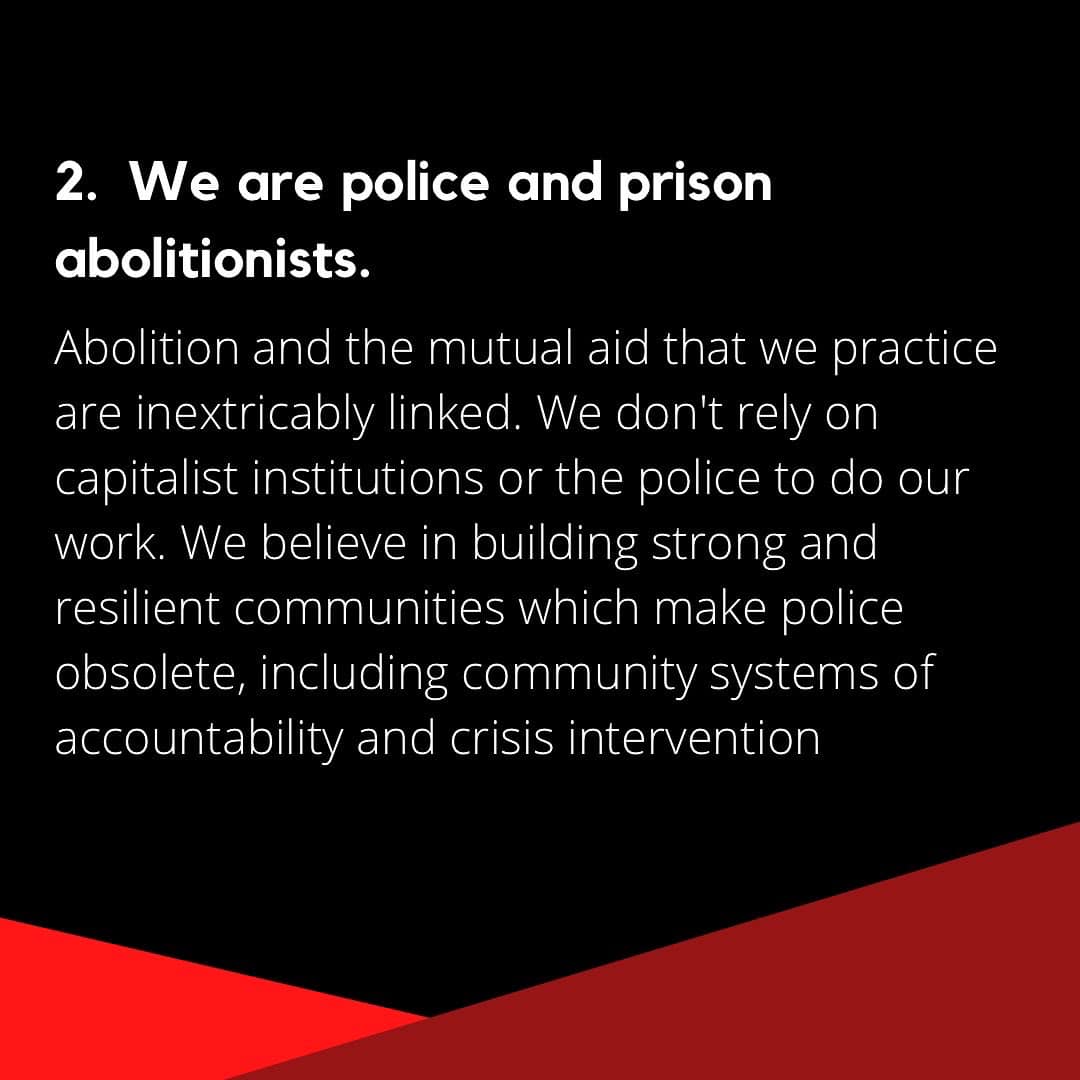
Abolition is about ending systems of control over populations. That is why my friends and I are working to create Mutual Aid communities. Mutual Aid is about replacing vertical hierarchies with horizontal group structures. There can be no control from above if there is no vertical hierarchy.
“What would it look like to finally and fully abolish slavery?” It would look like Mutual Aid.
What would it mean for us to take seriously and collectively as a Religious Society a call to finish the work of abolition, hand in hand and side by side with those affected and their loved ones? What would it mean for us to stand fully with the calls to abolish the police and fully fund community needs instead? What would it mean to reckon with our past complicity with harm and fully dedicate ourselves to the creation of a liberating Quaker faith that commits to build the revolutionary and healing faith we long to see come to fruition? What would it look like to finally and fully abolish slavery?
I write almost daily about Mutual Aid. Mainly because I’ve experienced what an effective and moral way this is for people to care for each other.
One of the most common reasons Mutual Aid communities come into being is in response to disasters. Yesterday’s post, Usefulness of Mutual Aid Against Our Failing Government, was about one of many unfolding disasters.
My lifelong experience has shown people will do anything they can to avoid acknowledging, let alone doing anything about disasters. I’ve often shared, many times and many ways, my inability to convince a single person that I know of, to give up their cars. The farm boy moving to the big city (Indianapolis) and being horrified by the clouds of noxious fumes visibly shooting out of the exhaust pipe of every car. This was in the early 1970’s, before catalytic converters hid the exhaust. I learned how quickly people stop listening to warnings like that.
So here we are. I don’t need to enumerate all the consequences we now see from refusing to deal with greenhouse gas emissions. People can no longer deny the environmental chaos. And yet they continue to refuse to do anything about it. Rather than work to reduce greenhouse gas emissions, emissions continue to climb. People are beginning to panic, to demand someone, somehow fix the problem. Even asking people to think about their children, and their children’s children, hasn’t worked, which is truly shameful.
Now it is far too late. The time lag between the time a certain amount of greenhouse gas enters the atmosphere, and when the warming that results from that amount are seen, is over 10 years. The loss of ice means sunlight that once reflected off it, is absorbed instead by the exposed dark water. The oceans have already absorbed enormous amounts of heat but are now heat saturated. Which has been fueling worsening hurricanes, extreme rainfall, and flooding. Another environmental disaster is the rapid increase in methane concentrations. Massive amounts of methane are frozen beneath the ice but are now being released as water temperatures rise.
Methane is the second most abundant anthropogenic GHG after carbon dioxide (CO2), accounting for about 20 percent of global emissions. Methane is more than 25 times as potent as carbon dioxide at trapping heat in the atmosphere.
Severe drought will impact food production, hydroelectric power systems, and clean, or ANY water supplies.
Electrical power supplies and grids will fail. Try to imagine having no water or electricity.
I knew this environmental chaos would trigger the collapse of our economic, political and social systems, which don’t have near the resources or will to recover from these cascading problems.
Unfortunately, there are other disasters that I didn’t anticipate, or how they are evolving.
Although there are predictions of disease from microbes released from melting permafrost, I didn’t foresee the distrust of science. Or that public health would botch the response to the current pandemic.
I didn’t think about how people would blame increasing fuel prices on efforts to switch to electric vehicles, which many can’t afford.
I didn’t anticipate the polarization of the Supreme Court. I thought we might always be able to count on the balance of power from that branch of government.
I thought the governmental collapse would be from inability to deal with environmental chaos. What I didn’t foresee were politicians and parties actively subverting what we have called the democratic process. The naked grab for power and not even a pretense of working for the people. Of armed groups intimidating state governments. Threats to election workers.
Support for the armed insurrection of the US Capital. To the normalization of political violence.
Of the mounting evidence of the political crimes of the last president. Of the even greater polarization and violence likely to occur when the case is presented to the public. Between those who demand justice, and those of the large political base of the last president.
I don’t think any of this is news to people today.
What prompts this now is my belief that we will never again have a free and fair election. Not even looking to the 2014 presidential election, but this year’s midterm elections. There will not be even a semblance of a functioning government when there is conflict regarding who won the elections at all levels. Social safety nets, Social Security and other benefits could cease.
And who will control the military? How will all of this affect the standing of this country on the global stage? Couldn’t this political chaos be exploited by other countries militarily? Of course other countries will have these problems themselves.
I admit I could be wrong about some of this. But most of these things are playing out now.
That is why I believe it is urgent for us to prepare for disaster. Building Mutual Aid communities is the way to do so.
There are times when I’m afraid to write certain things. When I fear those I care about will be hurt by what I write. Afraid they will think poorly of me.
That was the case yesterday when I wrote “what this means for me is I don’t worry about the dysfunction of the political system. The culture and identity wars.”
For me this means rethinking whether we can influence government, which no longer serves us. Trying to engage with government officials has been one of the main ways Quakers and many others have worked for change. In earlier times, remarkable changes sometimes resulted.
I know many Friends will disagree when I say I believe this is no longer true.
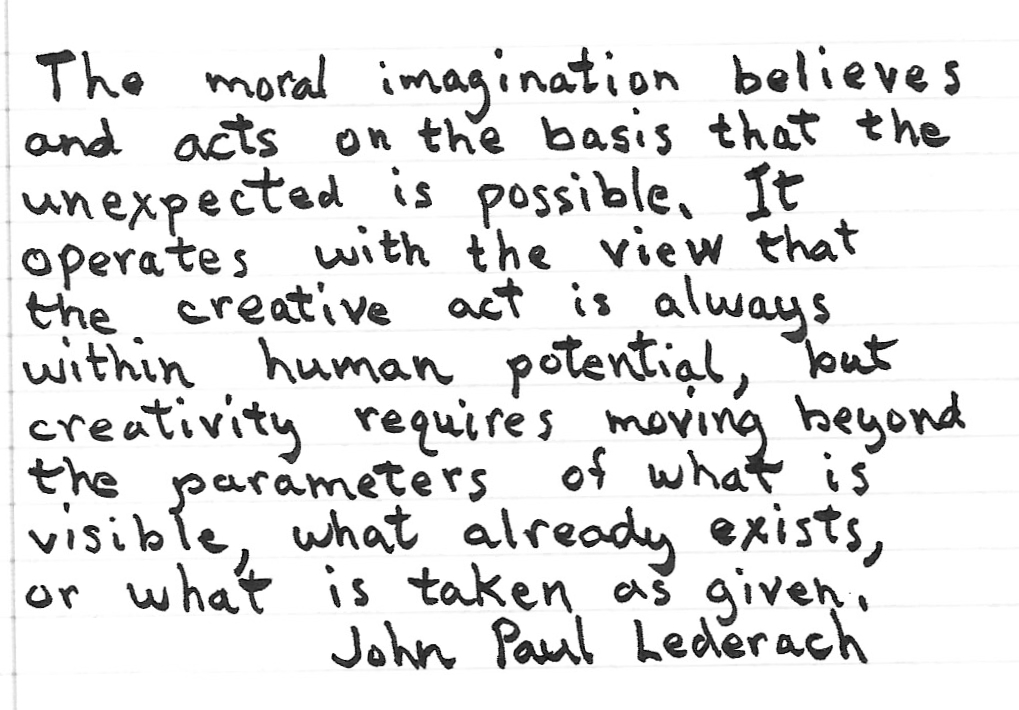
Previously I wrote we need to rethink the stories we tell ourselves. Let go of the stories we have discovered were not, or no longer are true. Rethink stories of our past, of other cultures. To seek and really listen for Spiritual guidance. Act on that guidance. Question everything. Create new stories.
What I pay attention to, what I can actually help with are the survival needs of my community.
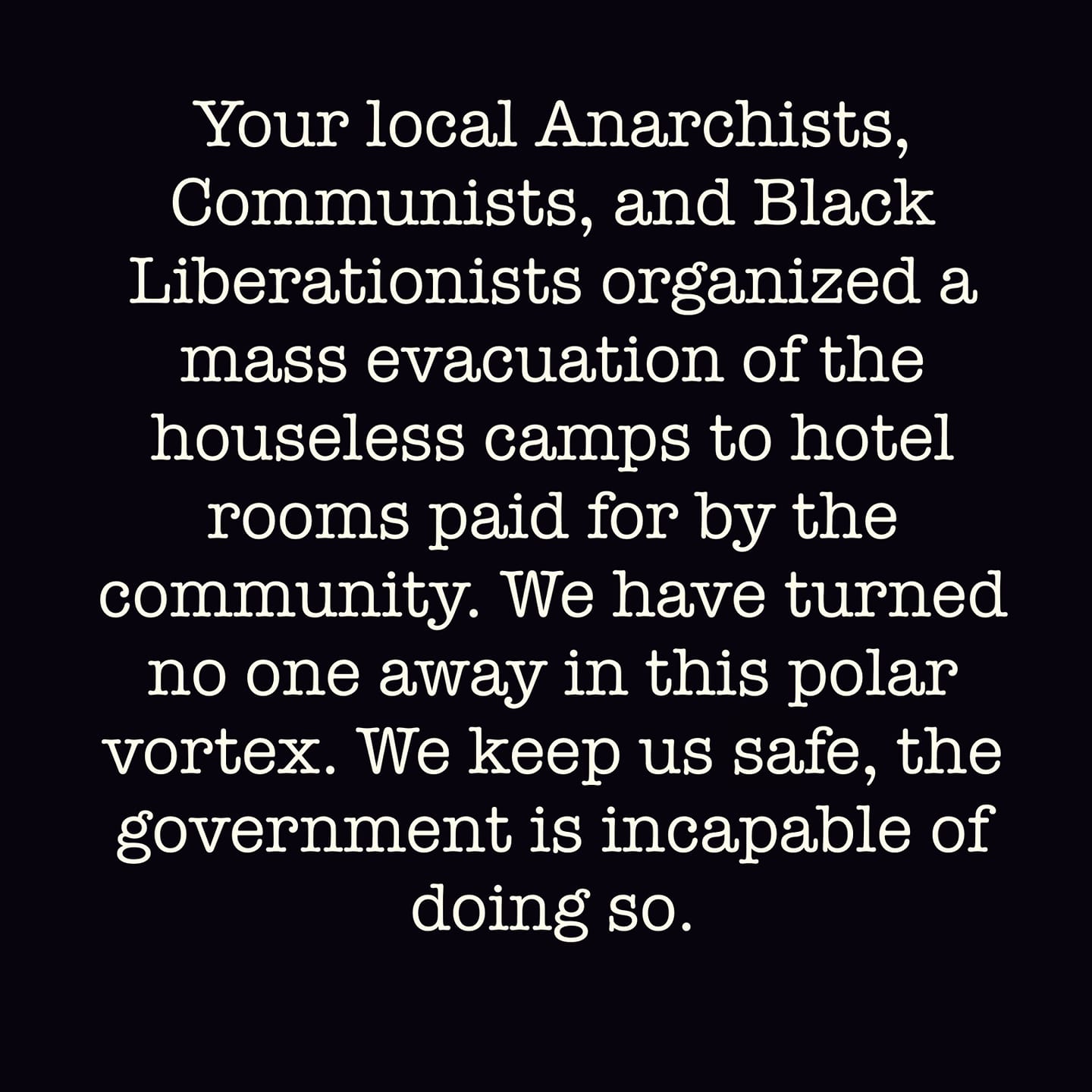
Your local Anarchists, Communists, and Black Liberations organized a mass evacuation of the houseless camps to hotel rooms paid for by the community. We have turned no one away in this polar vortex. We keep us safe, the government is incapable of doing so.
Des Moines Mutual Aid
The Mutual Aid work I’m most involved with is the free food project, which is a continuation of the Black Panther program mentioned below, that has existed in Des Moines since that time in the early 1970’s. I was there this morning. The wind chill was -11. Several of us mentioned we couldn’t see because our masks (which everyone wears) fogged up our glasses. Each time we would laugh about that. As always, we enjoyed being and working together.
We have only so much of ourselves that we can invest in work for justice. We can’t afford to waste that on things that will not result in change. The effort put into ineffective processes is effort that will not be available for other things, such as Mutual Aid.
I would ask what your stories are.
What is your justice work?
What has that work accomplished?
Have you developed deep, new friendships? New community?
Does that work excite and fulfill you?
Too little attention is paid to how justice work affects those doing the work. Too often I see those who want to make a difference go from committee meeting to meeting. Too often feeling dissatisfaction and fatigue. That isn’t going to do anyone any good.
That’s what Jason Laderas meant when he wrote mutual aid focuses on the root of community problems, rather than their symptoms. We bring the Beloved community into existence when we realize that with Mutual Aid, we are that community.
mutual aid focuses on the root of community problems, rather than their symptoms.
Jason Laderas
Now more than ever, it is clear to me that there is not much of a difference between the Democrats and Republicans in America.
While the Democrats may seem to favor human rights more than the Republicans, they have failed to deliver the type of change that could transform our society and lift millions out of suffering.
This whole two-party system is a facade. Neither party has the average person’s interests in mind. It’s about what benefits the billionaire corporations the most; it’s about serving the wealthy elite and leaving everyone else behind.
It’s not surprising that during this past year of COVID-19, where millions of people became unemployed, thousands of people died and millions were at risk of eviction, that the billionaires in the United States gained about 1.3 trillion since March of last year, according to inequality.org.
It doesn’t surprise me because this is just how our capitalist system is supposed to be working — the rich are getting richer, and the poor are getting poorer.
For far too long, our government has failed to vastly improve our material conditions. While people of other countries have enjoyed monthly government payments to help deal with COVID-19, the U.S. has only issued three direct payments.
It really makes me think, are we really the best country in the world?
If we cannot depend on our elected officials to deliver change that is going to benefit the overwhelming majority of this country, it is self-explanatory that the people may have to take matters into their own hands.
All massive changes in the history of America have started with everyday people banding together for a cause that they believe in. It does not start with the government. In the push for civil rights for Black people in the ’60s, change came to be with grassroots organizing.
The same can be applied to the changes that we want today. Since we cannot depend on our government, we have to depend on each other.
The Usefulness of Mutual Aid Against Our Failing Government, By Jason Laderas, slice of culture,
If we cannot depend on our elected officials to deliver change that is going to benefit the overwhelming majority of this country, it is self-explanatory that the people may have to take matters into their own hands.
Jason Laderas
One of the most famous examples of mutual aid is the Free Breakfast for Children Program of the Black Panthers. The Panthers took notice that poor black children often could not learn to the best of their ability because of poverty and hunger, so they took it upon themselves to feed the children.
They served free breakfast and lunch daily, also intaking donations from other organizations within the community like churches and other businesses.
This program spread all around the Black Panther chapters across America, eventually reaching 36 cities by 1971. In 1969, 20,000 children were fed across America through this program.
It was admitted during a 1969 U.S. Senate hearing in California, that the Panthers did a better job of feeding poor children than the state did.
The Black Panthers breakfast program is a prime example of just how mutual aid can benefit communities. They took notice that the government was not doing their job to adequately educate, feed and house Black people in America, so they did it themselves.
The Usefulness of Mutual Aid Against Our Failing Government, By Jason Laderas, slice of culture,
I feel so much sorrow for the pain I see all around.
“Bridge Over Trouble Water” came to me today as an expression of how to “ease your mind”. I believe Mutual Aid can be a bridge over troubled water for us.
we need to radically rethink the stories we tell ourselves
James Allen
Simply put, Mutual Aid is a radical departure from the structures most of us live with. Structures based upon vertical hierarchies, where those above control those below. Structures causing so much harm today.
Mutual Aid works with no hierarchy. Everyone in the community has a voice and is expected to think for themselves. To use their creativity to figure out what needs to be done, then do it. Not wait for someone to tell them what to do. To be active, not passive.
The problems before us are emergent phenomena with a life of their own, and the causes requiring treatment are obscure. They are what systems scientists call wicked problems: problems that harbour so many complex non-linear interdependencies that they not only seem impossible to understand and solve, but tend to resist our attempts to do so. For such wicked problems, our conventional toolkits — advocacy, activism, conscientious consumerism, and ballot casting — are grossly inadequate and their primary utility may be the self-soothing effect it has on the well-meaning souls who use them.
If we are to find a new kind of good life amid the catastrophes these myths have spawned, then we need to radically rethink the stories we tell ourselves. We need to dig deep into old stories and reveal their wisdom, as well as lovingly nurture the emergence of new stories into being.
How do we rethink the stories we tell ourselves? We let go of the stories we have discovered to be untrue. Rethink stories of our past, of other cultures. To seek and really listen for Spiritual guidance. Act on that guidance. Question everything.
What this means for me is I don’t worry about the dysfunction of the political system. The culture and identity wars. What I pay attention to, what I can actually help with are the survival needs of my community. Every week I join my Mutual Aid friends to distribute food to those in need. Others in this Mutual Aid community help those who need shelter. These things get done NOW. Done in a way that doesn’t stigmatize those in need, who have been failed by systems that should be helping them. We know we ourselves might someday need the help of our Mutual Aid community. As my friend Ronnie James says:
I’m of the firm opinion that a system that was built by stolen bodies on stolen land for the benefit of a few is a system that is not repairable. It is operating as designed, and small changes (which are the result of huge efforts) to lessen the blow on those it was not designed for are merely half measures that can’t ever fully succeed.
So the question is now, where do we go from here? Do we continue to make incremental changes while the wealthy hoard more wealth and the climate crisis deepens, or do we do something drastic that has never been done before? Can we envision and create a world where a class war from above isn’t a reality anymore?”
our conventional toolkits — advocacy, activism, conscientious consumerism, and ballot casting — are grossly inadequate and their primary utility may be the self-soothing effect it has on the well-meaning souls who use them
James Allen
Bridge Over Troubled Water
When you’re weary, feeling small, When tears are in your eyes I will dry them all I’m on your side Oh when times get rough And friends just can’t be found
Like a bridge over troubled water I will lay me down Like a bridge over troubled water I will lay me down
When you’re down and out When you’re on the street When evening falls so hard I will comfort you I’ll take your part Oh when darkness comes And pain is all around
Like a bridge over troubled water I will lay me down Like a bridge over troubled water I will lay me down
Sail on, silver girl Sail on by Your time has come to shine All your dreams are on their way See how they shine Oh if you need a friend I’m sailing right behind
Like a bridge over troubled water I will ease your mind Like a bridge over troubled water I will ease your mind

















 Quakers and Mutual Aid