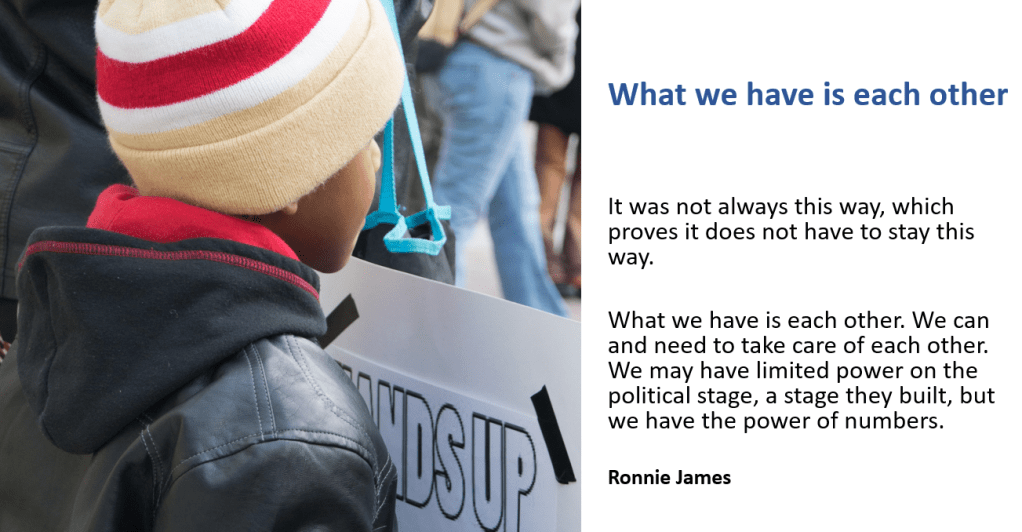
As I was doing more research about truthsgiving, I came upon this beautiful statement by my good friend Ronnie James. As it says on the TRUTHSGIVING The Truth Will Not Be Whitewashed website, Ronnie is an Indigenous organizer and activist in the Mutual Aid tradition in central Iowa.
To walk a path of Doing The Truth is a battle with a very young culture. Telling the truth is comparably easy, we have our oral histories, art and traditions created and carried on, histories printed by those that found a way to the presses. We can recount the stories and lessons that survived colonialism.
But to do the truth, to live a life that enforces what we once had, a life and culture that made a millennia of humanity possible to thrive, is to be at war with what has defined and destroyed this world for too long.
We, those that conspire to live the truth, have chosen to honor our histories of cooperation. We know, with all that we have, that a world of competition and conquest is the opposite of how we gained the knowledges that propelled our abilities to create the sciences and the art and architecture of beautiful societies that our ancestors built, and we draw our strength from that to continue, to create, a world our future generations can thrive in.
It has only been a very short time that the world has been this way, which is the proof that it doesn’t have to stay this way.
I was truly blessed to meet Ronnie a couple of years ago. It was the Spirit that led to our meeting. He came to a vigil we were holding related to the Wet’suwet’en peoples, who have been working tirelessly to prevent the construction of the Coastal GasLink pipeline through their pristine territory in British Columbia.
Since that time, he has patiently mentored me about Mutual Aid. That now includes my participation in Des Moines Mutual Aid’s weekly food giveaway, the Saturday Panther Pantry. That is in reference to the Black Panther Party that originated the Free Breakfast Program in 1970 in Des Moines and other cities. I have only missed showing up for our food giveaway a couple of times over the past two years. I agree with the sentiment I’ve heard from my comrades, that these Saturday mornings are the highlight of our week.
So, I work with a dope crew called Des Moines Mutual Aid, and on Saturday mornings we do a food giveaway program that was started by the Panthers as their free breakfast program and has carried on to this day. Anyways, brag, brag, blah, blah.
So, I get to work, and I need to call my boss, who is also a very good old friend, because there is network issues. He remembers and asks about the food giveaway which is cool and I tell him blah blah it went really well. And then he’s like, “hey, if no one tells you, I’m very proud of what you do for the community” and I’m like “hold on hold on. Just realize that everything I do is to further the replacing of the state and destroying western civilization and any remnants of it for future generations.” He says “I know and love that. Carry on.”
Ronnie James
Doing Truth
I love the title of Ronnie’s post above, Doing Truth When the World Is Upside Down.
I’m so frustrated with how much time and effort is spent talking about problems without determining correct solutions. And/or wasting time trying to implement incorrect solutions. Instead of “Doing the Truth.”
Mutual Aid is a framework that can guide us “to walk a path of Doing the Truth.”
Mutual Aid is a framework that can guide us “to walk a path of Doing the Truth.”
As a person of faith, I look for spiritual guidance for my work. But this has been consistent with Mutual Aid as a framework for doing justice work.
“Mutual Aid is not only a tool of survival, but also a tool of revolution.”
For many years I’ve been praying, thinking, writing, and discussing how we can prepare for an increasingly dystopian future. In an article in Friends Journal, Donald McCormick asks “why is there no vision for the future of Quakerism?” I wrote about my vision in the article What is your vision for the future?
The increasing threats from environmental devastation and chaos lead me to share more of my vision, which has been evolving over the past several years. It’s taken me a long time to write this article, I think because I haven’t found resources available to check on what I’m saying here.
I’ve always believed the greatest problem to solve is how communities of the future organize and govern themselves. We’ll have to do things differently because our present systems are collapsing. Which is often not a bad thing since those systems are based on colonialism and capitalism.
Spirituality
Spirituality is especially important now as we experience increasing environmental chaos, which will contribute to further social, economic, and political collapse. We will have no choice but to band together for the survival of us all. The alternative is tribalism with its violence, destruction and death.
We will need the help of those who know survival skills that we don’t. It takes time to build the trust necessary for these connections. It is urgent to do this now. It is by the Spirit that we can engage with everyone around us, of all cultures, identities, ethnicities.
Spirituality can show us how to live with integrity now. How to be examples to others. This is how change happens.
The Creator can help us heal the wounds of the past. And the wounds that will be inflicted in the future.
The Spirit can guide us through the coming chaos.
It is by the Spirit we create connections among diverse peoples.
At my first meeting with the KI community, I was asked a number of questions. When I said I was a Quaker, one of the adults (the group was mainly teenagers) spoke about the history of Quakers related to the underground railroad. When she finished, all eyes turned to me. I said I was glad my ancestors did that, it was the right thing to do, but we try not to take credit for things we have not done ourselves. When I was asked to speak more about that, I wasn’t sure what to say. I remember clearly that an answer came from the Spirit, which told me to not only say that Quakers believe there is that of God in everyone, but to also look into the eyes of each one there and say, “and that includes you”. Each person smiled at me when I did that. That ended the questioning, and I was welcomed into the community. We had this spiritual basis for our work together.
But that was just the first step. Trust was built, but slowly. With permission, I invited members of my Quaker community to engage with KI’s monthly book discussions. This was one way we began to get to know each other. But it was two years after this introduction before I was invited to teach a class on photography for KI.
Kheprw Institute, Indianapolis
First Nation-Farmer Climate Unity March
Because of my lifelong commitment to care for our environment, I’d always wanted to learn about Indigenous peoples and their sustainable lives. I jumped at the opportunity to do so when I heard about theFirst Nation-Farmer Climate Unity March in 2018. The intention was to build a community of native and nonnative people by walking and camping together along the route of the Dakota Access pipeline from Des Moines to Fort Dodge, Iowa (94 miles). Many long hours walking together, for eight days, along empty Iowa gravel roads was very effective in creating the beginnings of trust. There were about fifteen native and fifteen nonnative people, which allowed each of us the opportunity to share stories with every other person.
I’d hoped there would be ways to learn more about their spirituality, and to share some about my own. But I knew there was a huge barrier between us related to Friends’ involvement in the institutions of forced assimilation of native children. It is uncomfortable to admit this, but at the time I wondered how much awareness there was about the Indian Boarding Schools. I was soon to learn how profound that trauma was, and how it was passed from generation to generation. Is a deep wound today in every Indigenous person I know. I discuss this in detail in White Quakers and Native Peoples and other writings.
I didn’t know if, or how, the occasion might occur to talk about this during the March. Or whether I should.
But I vividly remember when the Spirit told me to say, “I know Quakers were involved in the Indian boarding schools and I’m sorry that happened” to the native person I was getting to know the best early in the March. I was worried saying that would upset him, open wounds. But he just nodded his head, and we kept walking together. But later in the day he said, “I want to tell you a story”, and proceeded to tell me a story related to him and his mother and the boarding schools.
At various times the Spirit led me to bring this up with each of my native friends. Every one of them and their families have had traumatic experiences related to forced assimilation. And the removal of native children from their homes continues in the guise of child welfare.
This is something that should not be taken lightly. A certain level of connection and trust is important. This is not about us (White people) and what we would like to see or do. There should be clear spiritual guidance.
I’ve found my Indigenous friends to be deeply spiritual. I like the sign, Earth is my church, carried by my friends Foxy and Alton Onefeather during the March. That says a lot about why I feel my friends are spiritual, their reverence of all things human and nonhuman. And their practices such as smudging, putting down tobacco, expressing thanks to the Creator each time they speak in public. Their humbleness. One friend often says “we are just pitiful people” during her prayers.
In the four years since that March, various combinations of us have had numerous opportunities to work together.
And yet again, that trust has been built, is being built slowly.
Foxy Onefeather holds sign on First Nation-Farmer Climate Unity March (2018)
Spiritual guidance
Quakers believe our lives must be guided by the Spirit. But far too often people haven’t found, or don’t try to discern that spiritual guidance. They try to figure out how to do justice work on their own or in conjunction with like-minded people. with the best of intentions. That phrase usually indicates not listening to those affected by injustice. And indicates not having discerned what their faith is trying to tell them.
And that often results in unintended, harmful consequences. A common phrase to keep in mind is nothing about us without us. This is especially challenging for White people who are accustomed to their privileges. Often not even aware of those privileges. We would not need to qualify what our intentions were if we were following the leadership of the communities facing injustice.
One horrific example of best intentions gone wrong were the Indian boarding schools. A policy of forced assimilation of native children into White culture was thought by many to be a way to help Indian children adjust to the enveloping White society. But tens of thousands of children suffered physical, emotional, and sexual abuse. Thousands died. Genocide. And that trauma has been passed to each following generation, including todays. Every one of my native friends has been affected.
This is an example of difficulties in making connections between different communities and/or cultures. With this horrific history, and ongoing trauma, how can a bridge ever be built between these two cultures, White and Indigenous? Or between White and BIPOC people and communities? (Black, Indigenous and other people of color)
But for others, especially in the government and military, this policy and horror was exactly what they intended.
Mutual Aid
The Spirit also led me to become involved in a Mutual Aid community. And led me to be involved in efforts to abolish police and prisons. I’ve written extensively about these things on my website Quakers and Religious Socialism, Intersection of Mutual Aid, Abolition and Socialism.
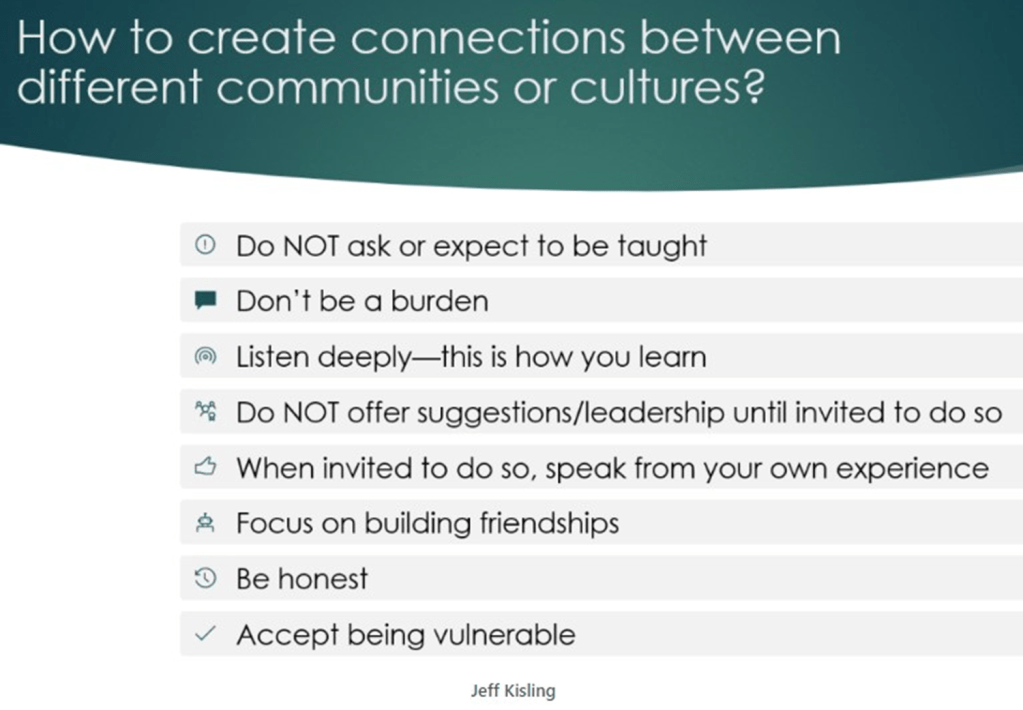
How to create connections between different communities or cultures
Returning to Donald McCormick’s question, “why is there no vision for the future of Quakerism?” I’ve tried to express my answer here. In these increasingly trying times, spiritual guidance is crucial. Sharing this with others is a gift Quakers have to offer. But we need to understand the history and concepts of oppression. Of Quakers’ role in oppression. And discern how the Spirit is leading us.
Frontline communities are figuring out how to live when the systems that are supposed to serve them no longer do, if they ever did. White communities will look to these communities and their solutions for our own survival.
I was recently surprised when a Quaker friend said I had a way of finding and connecting with oppressed communities. Which made me realize something I hadn’t expressed before, which is we must seek out these communities ourselves. Be guided to these communities by the Spirit. Search for these opportunities. Searching social media is usually very useful. And we can learn what our Friends and friends are doing and join those efforts.
Following is a list of things I have been learning from my experiences related to making connections between different communities and/or cultures.
When I say I pray each morning, seeking what to write, I do spend time in quietness. But I also research what my sources are saying.
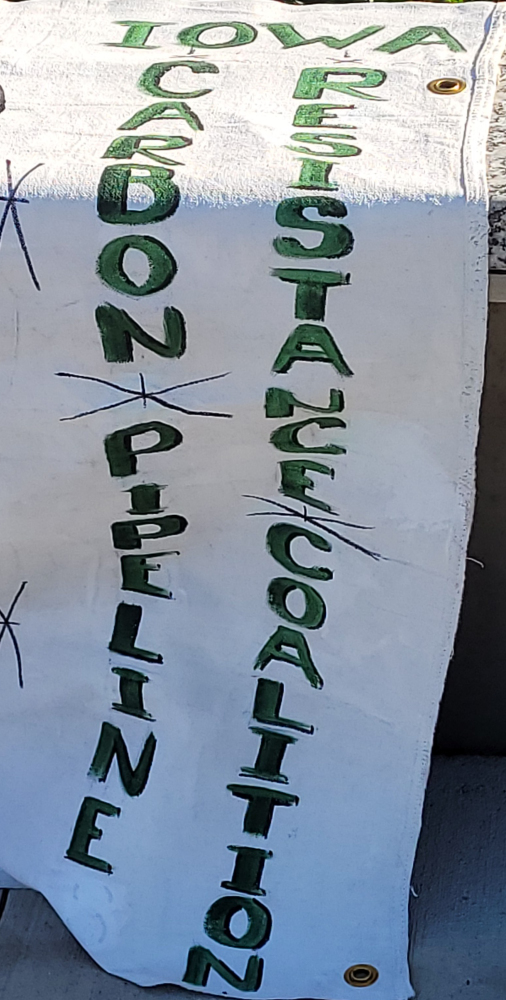
I came across this photo I took in 2013 that I found on the Iowa Citizens for Community Improvement’s (ICCI) website. The photo was taken at ICCI’s offices during the two days of training for leaders in the Keystone Pledge of Resistance. Where I learned so much about community organizing.
Keystone Pledge of Resistance training, Iowa Citizens for Community Improvement, Des Moines, Iowa 2013
This reminds me we have been working on pipeline resistance for ten years. We defeated the Keystone XL pipeline, but not the Dakota Access pipeline. It also looks like the Coastal GasLink pipeline in British Columbia, on Wet’suwet’en lands, will be completed.
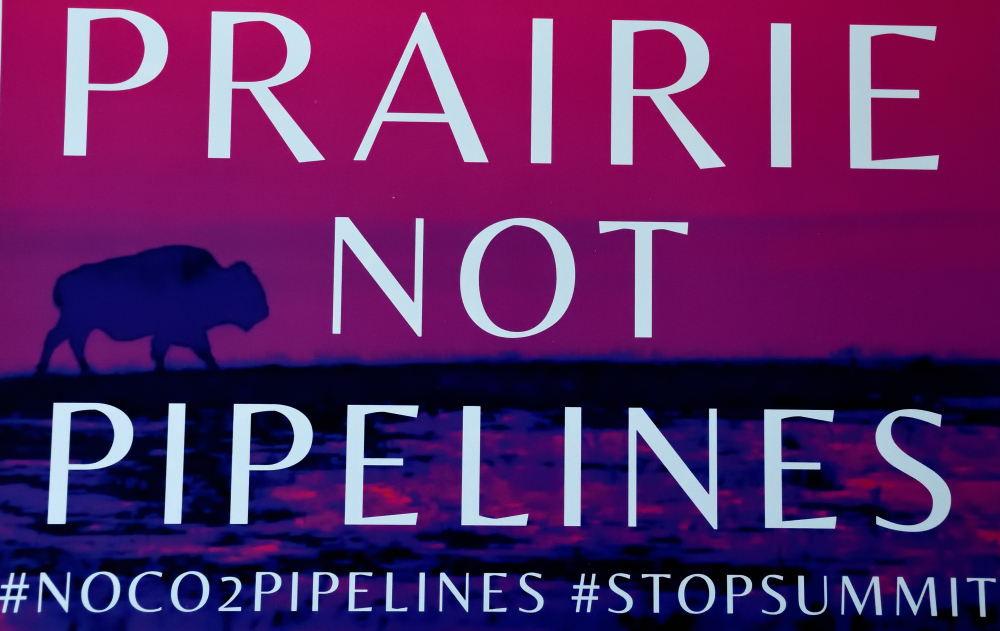
Now we are faced with the “false climate solutions” of several proposed carbon (CO2) pipelines in Iowa. The liquified carbon dioxide in these pipelines is a hazardous material that can be lethal when ruptures occur. If that happens in a densely populated area, there could be many deaths.
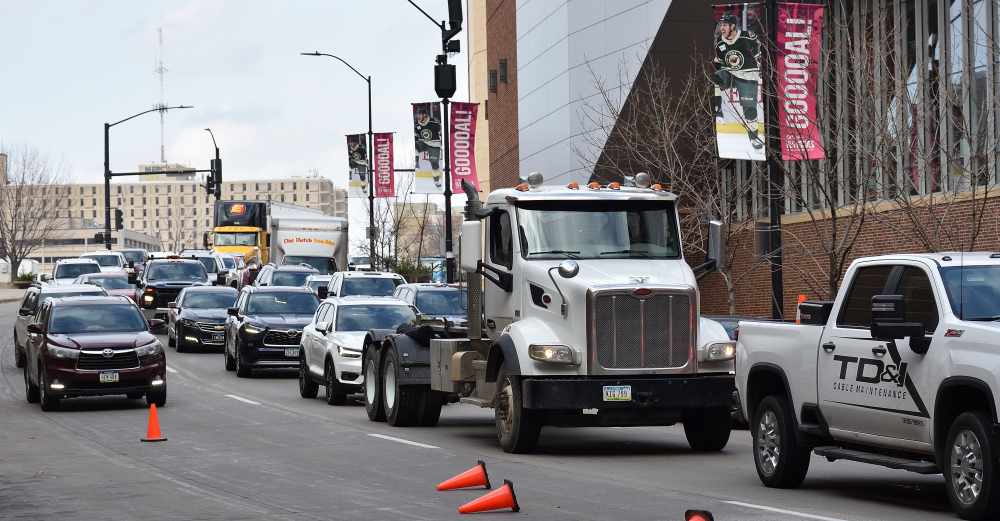
Part of that rally was blocking Third Street, in front of the Iowa Event Center, where the carbon pipeline supporters were meeting, for about twenty minutes.
Blocking traffic on third street in front of the Iowa Event Center.Jake Grobe, ICCI and Buffalo Rebellion organizer
In this photo my friend Jake Grobe says “yes, these people stuck in traffic are impatient and angry. But so are we. How long have we waited for action on real climate solutions?”
That is demonstrated by the time span between this photo, and the one above, taken in 2013.
The images of the latest environmental catastrophe, Hurricane Nicole, are really stunning. And, of course, the erosion of beach fronts will only worsen. As another warning, the article below was published just today.
SHARM EL-SHEIKH, Egypt — Nations will likely burn through their remaining carbon budget in less than a decade if they do not significantly reduce greenhouse gas pollution, a new study shows, causing the world to blow past a critical warming threshold and triggering catastrophic climate impacts.
Running throughout (Lopez’s book) Horizon is the question of human survival. The multiple threats we now face, especially the very real possibility of climate disaster, expose the tensions between human aspiration and ecological reality. Perhaps what is most needed, Lopez suggests, is for us to lament what we’ve destroyed, but also to praise and love the world we still have. “Mystery,” he writes, “is the real condition in which we live, not certainty.”
Bahnson: You’ve confronted the darkness you see on the horizon with anthropogenic climate change. How do you talk about this with audiences? People need to know what’s coming, yet if you overwhelm them with depressing news, they might freeze. How do you strike the balance between educator and artist?
Lopez: Whenever I speak in public, I write out a new talk. I begin by stipulating, with a modulated voice, that things are way worse than we imagine. And I offer some examples: the collapse of pollinating insect populations; the rise of nationalism; belligerent and ignorant narcissists like Donald Trump; methane gas spewing out of the Siberian tundra. You’re saying to everybody, “Let’s take off the rose-colored glasses now and see what our dilemma really is.” And then the second part of the talk is an evocation of the healing that is necessary and possible, a gradual elevation of the human spirit. It’s about the mobilization that is needed and which is within our reach. Then people know you’ve spoken truthfully, and you have evoked in each person a desire to help, to take care of their families, to have self-regard. I see this pattern in every talk I give. To remember, geographically, exactly where you are speaking that night, and to know whether there might be a full moon outside the building; to offer that sense of immediacy and groundedness; to underscore the specificity of the moment; and to be sure that you implicate yourself in the trouble. It all helps in these situations. If you attempt any version of “I know, and you don’t” or “This is not my fault” or “I am the holy messenger, and you’re the fools,” the evening ends in darkness. You have to be in it with them.
“And then the second part of the talk is an evocation of the healing that is necessary and possible, a gradual elevation of the human spirit. It’s about the mobilization that is needed and which is within our reach. Then people know you’ve spoken truthfully, and you have evoked in each person a desire to help, to take care of their families, to have self-regard”
I have experienced this healing with my Des Moines Mutual Aid community.
“You have to be in it with them” is the core concept of Mutual Aid. Perhaps more accurately stated, “we are all in this together”.
Please build Mutual Aid communities where you are.
Yesterday I wrote about the video of the interview of Friend Mary Mendenhall (included below). She told of the Quakers who left the United States because of their opposition to war and the military draft. That migration and the development of the Monteverde community in Costa Rica, where they settled, is an example of Quakers living in a manner consistent with their beliefs.
I also wrote about attending the Friends National Conference on War and Conscription in 1968. I had forgotten there was a similar declaration in 1948. One of the statements in that declaration is “We realize that the basic task in peacemaking is to fill the spiritual void in our civilization.” I’ve often prayed about what I call the Spiritual poverty that exists today and how Quakers could help fill that void.
The basic task in peacemaking is to fill the spiritual void in our civilization
Richmond Declaration Against the Draft, 1948
A statement in the 1968 declaration is “we acknowledge our complicity in these evils in ways sometimes silent and subtle, at times painfully apparent.” That declaration also includes a call for affirmation of action.
AFFIRMATION OF ACTION
We commit ourselves to validate our witness by visible changes in our lives, though they may involve personal jeopardy. We cannot rest until we achieve a truly corporate witness in the effort to oppose an end conscription. Let us hold each other in the Light which both reveals our weaknesses and strengthens us to overcome them.
I believe we were led to talk about Mary Mendenhall at Bear Creek meeting last Sunday. And that I was led to write about other stories related to Quakers and peacemaking yesterday. That I was led to remember the 1948 declaration against the draft.
I was especially struck by the Affirmation of Action part of the 1968 declaration. There is a similar admonition in a statement about racial justice of Iowa Yearly Meeting (Conservative). “Each person is urged to take a careful look at their life, to identify where one is benefiting from this, and work to correct that. We urge Friends to speak out against the injustices and violence occurring today.“
We urge Friends to speak out against the injustices and violence occurring today.
Declaration on the Draft and Conscription: Richmond 1968
Among the injustices and violence today are attacks, physical and otherwise, against Black, Indigenous, and other people of color (BIPOC). And the all-out assault against Mother Earth.
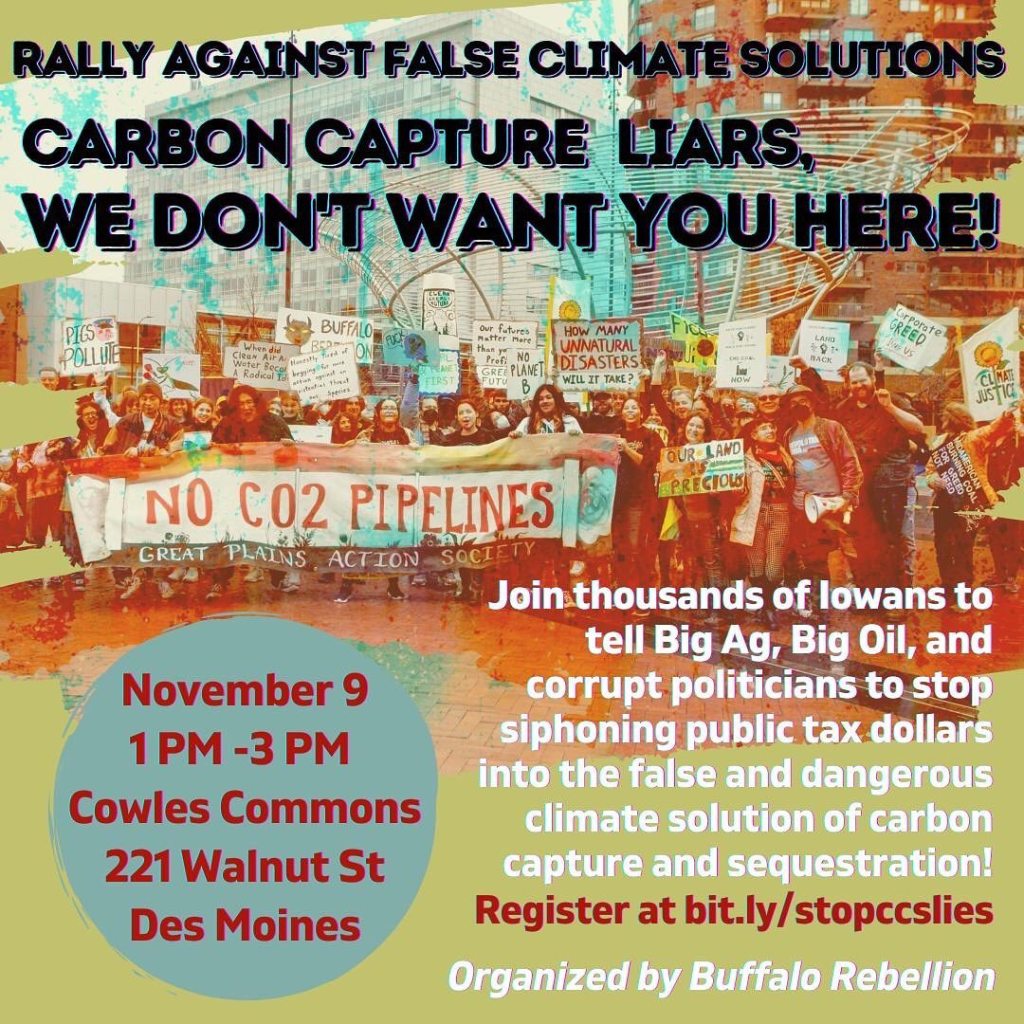
All of this relates to my Des Moines Mutual Aid community, and to the Buffalo Rebellion I’m part of. There will be a rally against carbon capture and the pipelines needed to transport the carbon. An important part of the Buffalo Rebellion, including tomorrow’s rally, is the leadership of Indigenous peoples in the Midwest.
This is an opportunity for Friends to speak out against the injustices and violence occurring today.
Did you hear? The corporations vying to get rich from building carbon capture pipelines across Iowa will be meeting at a convention right here in Des Moines Nov 8-9!
People from Minnesota, Illinois, Nebraska, and all four corners of Iowa will be there to say “NO CO2 PIPELINES! NO MORE FALSE CLIMATE SOLUTIONS!”
1pm rally at Cowles Commons 1:30pm March to Iowa Event Center 2:00pm Protest outside the carbon capture convention
Whether you’re Black, White, Indigenous, rural or urban, we are ALL feeling the impacts of climate change ramping up in Iowa and around the world.
Big corporations that have significantly polluted our land, air, and water are scrambling to find “solutions”—false ones— in attempt to cover up the environmental damage they inflict on our state. And they’re trying to use our tax-payer dollars to do it.
CO2 pipelines are being pitched as the golden ticket to end greenhouse gas emissions from ethanol, fertilizer, and coal plants.
The problem?
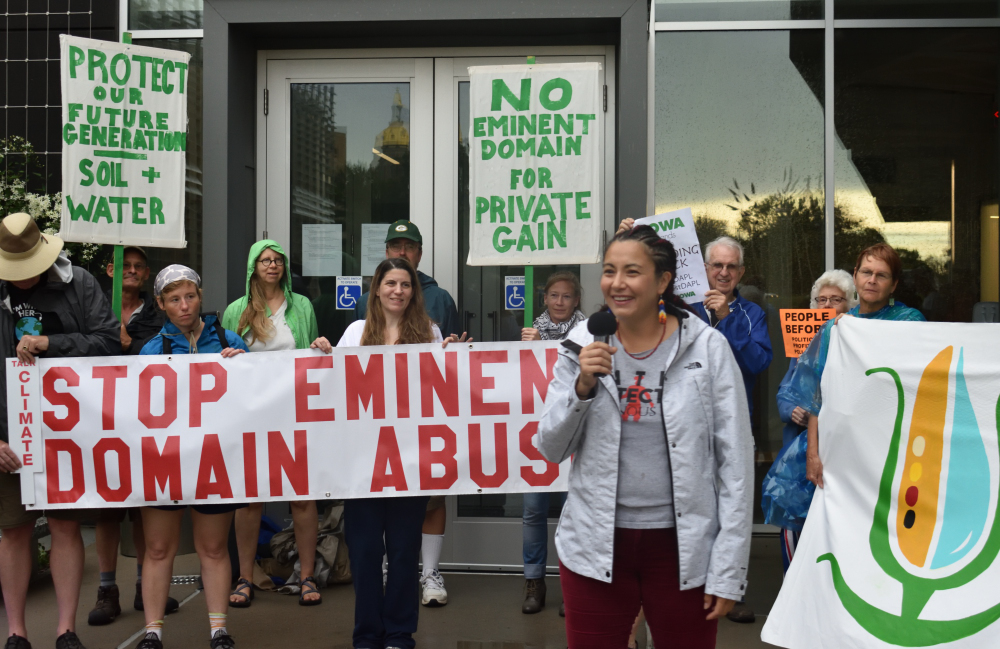
–Carbon capture projects have never actually reduced greenhouse emissions. –They bolster industries that capitalize off dirty energy and destructive agricultural practices –CO2 pipeline leaks are extremely dangerous and public entities are not equipped to respond. –Pipeline developers are bankrolling Governor Kim Reynolds to use eminent domain to seize land in order to enrich private corporations.
Richmond Declaration Against the Draft, 1948 Advices on Conscription and War: By the Religious Society of Friends in the United States, Richmond, Indiana, 1948
We realize that the basic task in peacemaking is to fill the spiritual void in our civilization by replacing the fear that now cripples all our efforts with a faith in the Eternal Power by which God unites and sustains those who pursue His Will; and we extend our fellowship to all those of other persuasions who share this faith.
In humility and repentance for past failures, we call upon all Friends to renew the springs and sources of our spiritual power in our meetings for worship; to examine our possessions, to see if there be any seed of war in them/ and to live heroically in that life and power that takes away the occasion of all wars and strife.
Declaration on the Draft and Conscription: Richmond 1968
We call on Friends Everywhere to recognize the oppressive burden of militarism and conscription. We acknowledge our complicity in these evils in ways sometimes silent and subtle, at times painfully apparent. We are under obligation as children of God and members of the Religious Society of Friends to break the yoke of that complicity.
As Friends we have for many years been granted privileged status within the draft system. This has often blinded us to the evil of the draft itself, and the treatment of those not so privileged. We are grateful for all those who by resolutely resisting the draft have quickened our conscience. We are called into the community of all who suffer for their refusal to perform unconscionable acts.
We reaffirm the “Advices on Conscription and War” adopted at Richmond in 1948. We realize in 1968 that our testimony against conscription is strengthened by refusing to comply with the Selective Service law. We also recognize that the problem of paying war taxes has intensified; this compels us to find realistic ways to refuse to pay these taxes.
We recognize the evil nature of all forms of conscription, and its inconsistency with the teachings and examples of Christ. Military conscription in the United States today undergirds the aggressive foreign policies and oppressive domestic policies which rely on easy availability of military manpower. Conscription threatens the right and responsibility of every person to make decisions in matters of conscience. Friends opposing war should refuse any kind of military service; Friends opposing conscription should refuse to cooperate with the Selective Service System.
We call for the abolition of the Selective Service System and commit ourselves to work with renewed dedication to abolish it. We shall oppose attempts to perpetuate or extend conscription, however constructive the alleged purpose, by such a system as National Service. We do not support efforts at draft reform; the issue is not equal treatment under compulsion, but freedom from compulsion.
We recognize how difficult it is to work through these complex issues, and to bear the burden of decision and action. We hold in love and respect each member of our Society as he follows where conscience leads. We know there are spiritual resources available to those who would be faithful.
AFFIRMATION OF ACTION
We commit ourselves to validate our witness by visible changes in our lives, though they may involve personal jeopardy. We cannot rest until we achieve a truly corporate witness in the effort to oppose an end conscription. Let us hold each other in the Light which both reveals our weaknesses and strengthens us to overcome them.
Declaration on the Draft and Conscription: Richmond 1968. Friends National Conference on the Draft and Conscription, October 11-13, 1968
An Epistle to Friends Concerning Military Conscription
Dear Friends,
It has long been clear to most of us who are called Friends that war is contrary to the spirit of Christ and that we cannot participate in it. The refusal to participate in war begins with a refusal to bear arms. Some Friends choose to serve as noncombatants within the military. For most of us, however, refusal to participate in war also involves refusal to be part of the military itself, as an institution set up to wage war. Many, therefore, become conscientious objectors doing alternative service as civilians, or are deferred as students and workers in essential occupations.
Those of us who are joining in this epistle believe that cooperating with the draft, even as a recognized conscientious objector, makes one part of the power which forces our brothers into the military and into war. If we Friends believe that we are special beings and alone deserve to be exempted from war, we find that doing civilian service with conscription or keeping deferments as we pursue our professional careers are acceptable courses of action. But if we Friends really believe that war is wrong, that no man should become the executioner or victim of his brothers, then we will find it impossible to collaborate with the Selective Service System. We will risk being put in prison before we help turn men into murderers.
It matters little what men say they believe when their actions are inconsistent with their words. Thus we Friends may say that all war is wrong, but as long as Friends continue to collaborate in a system that forces men into war, our Peace Testimony will fail to speak to mankind.
Let our lives speak for our convictions. Let our lives show that we oppose not only our own participation in war, but any man’s participation in it. We can stop seeking deferments and exemptions, we can stop filling out Selective Service forms, we can refuse to obey induction and civilian work orders. We can refuse to register, or send back draft cards if we’ve already registered.
In our early history we Friends were known for our courage in living according to our convictions. At times during the 1600’s thousands of Quakers were in jails for refusing to pay any special respect to those in power, for worshiping in their own way, and for following the leadings of conscience. But we Friends need not fear we are alone today in our refusal to support mass murder. Up to three thousand Americans severed their relations with the draft at nation-wide draft card turn-ins during 1967 and 1968. There may still be other mass returns of cards, and we can always set our own dates.
We may not be able to change our government’s terrifying policy in Vietnam. But we can try to change our own lives. We must be ready to accept the sacrifices involved if we hope to make a real testimony for Peace. We must make Pacifism a way of life in a violent world.
We remain, in love of the Spirit, your Friends and brothers,
Don Laughlin Roy Knight Jeremy Mott Ross Flanagan Richard Boardman James Brostol George Lakey Stephen Tatum Herbert Nichols Christopher Hodgkin Jay Harker Bob Eaton Bill Medlin Alan & Peter Blood.
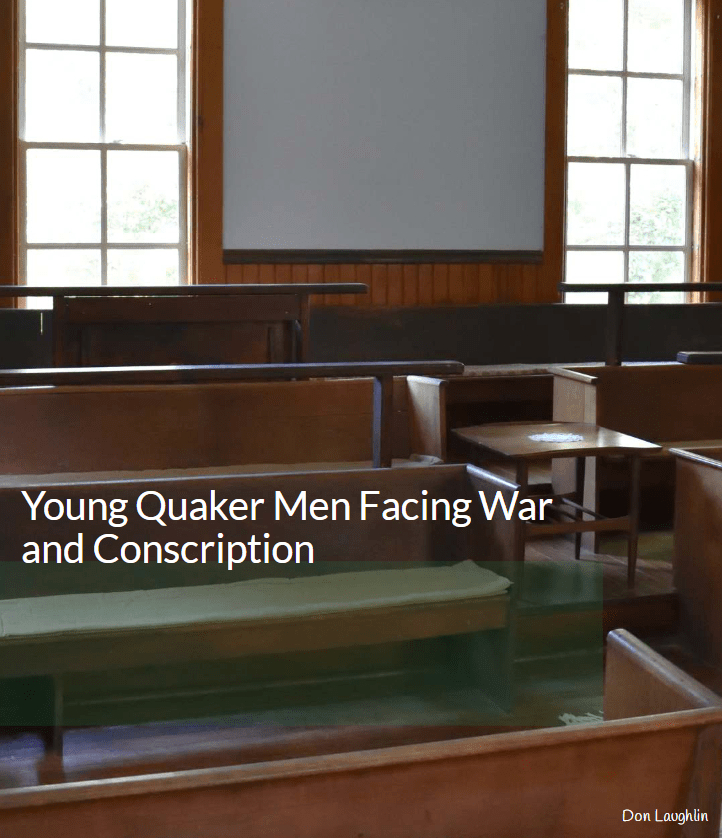
Don Laughlin and Roy Knight, among those who signed that Epistle, were members of Iowa Yearly Meeting (Conservative). Both were imprisoned for their refusal to participate in the military draft. As were a number of other Quakers. Don collected some of those stories, which can be found here:
As I was sitting in the dark this morning praying about what to write, I noticed the light from the sunrise reflecting on the clouds in front of my windows. So, I went out to take some photos. Photography has been one of the threads of my lifelong foundational stories.
On my way to Mutual Aid Saturday I stopped at Easter Lake, even though it was raining heavily. So, I rolled down the window and shot the photos from within the car.
Easter Lake, Des Moines, Iowa
I usually avoid the subject, but American politics is in the news as the Midterm elections approach. The Republican party is no longer participating in the democratic means of governance. That is such a radical departure, and the damage can only be minimized by not electing those politicians.
But even if the Democrats win control of the Senate and House, they will continue to be beholden to corporate financial influence and White superiority. Continue to use armed forces throughout the world. Or as one of the most glaring failures, will continue to support the fossil fuel industry. For example, releasing millions of barrels of oil from the Strategic Petroleum Reserves and supporting carbon (CO2) pipelines.
Whatever happens in the election, our political, economic, and social systems will continue to fail, and fail completely in the face of environmental catastrophe and chaos.
I see all of this through my experiences with Mutual Aid, which is as much about building beloved communities as it is about supporting people’s survival needs. It is important to build Mutual Aid communities now in preparation for continued collapse.
There will continue to be a need to transition from the current, dominant systems of governance to alternatives such as Mutual Aid. This process is referred to as “dual power”.
Dual Power
How do we effectively build political space where direct democracy, mutual aid, solidarity, and an ecologically sustainable human existence can prevail? To start with, we need to be able to provide for our immediate needs. In doing so, we must organize to seize control of powerful nodes of production, reproduction, and realization while simultaneously cultivating models of the society we wish to live in.
Dual power is a strategy that builds liberated spaces and creates institutions grounded in direct democracy. Together these spaces and institutions expand into the ever widening formation of a new world “in the shell of the old.” As the movement grows more powerful, it can engage in ever larger confrontations with the ruling class—and ultimately a contest for legitimacy against the institutions of capitalist society.
In our view, dual power is comprised of two component parts: (1.) building counter-institutions that serve as alternatives to the institutions currently governing production, investment, and social life under capitalism, and (2.) organizing through and confederating these institutions to build up a base of grassroots counter-power which can eventually challenge the existing power of capitalists and the State head-on. In the short term, such a strategy helps win victories that improve working people’s standard of living, helps us meet our needs that are currently left unaddressed under capitalism, and gives us more of a say over our day-to-day lives.
Dual Power: A Strategy To Build Socialism In Our Time, DECEMBER 31, 2018 – CAUCUS STATEMENT. DSA LIBERTARIAN SOCIALIST CAUCUS
Building counter-institutions
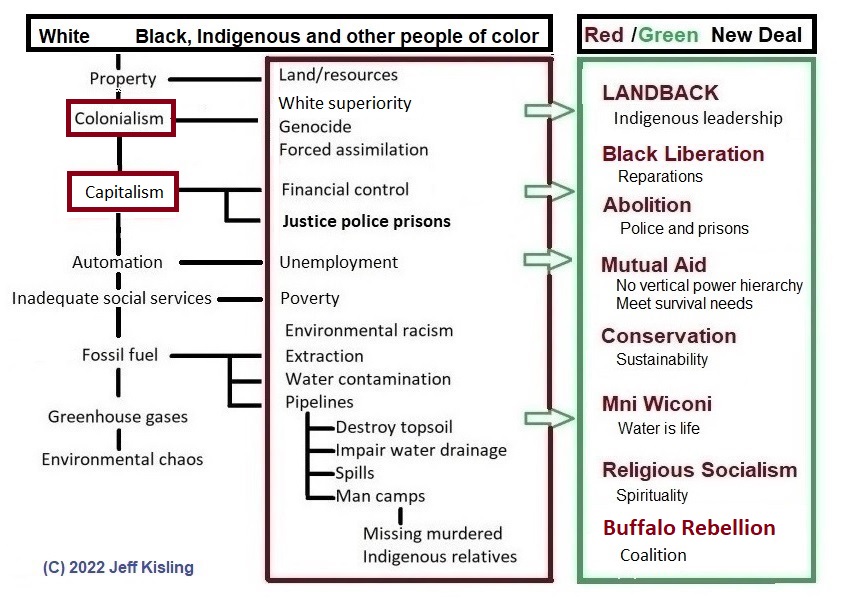
In this graphic the concepts under Red/Green New Deal are counter-institutions that are being built now.
Confederating counter-institutions
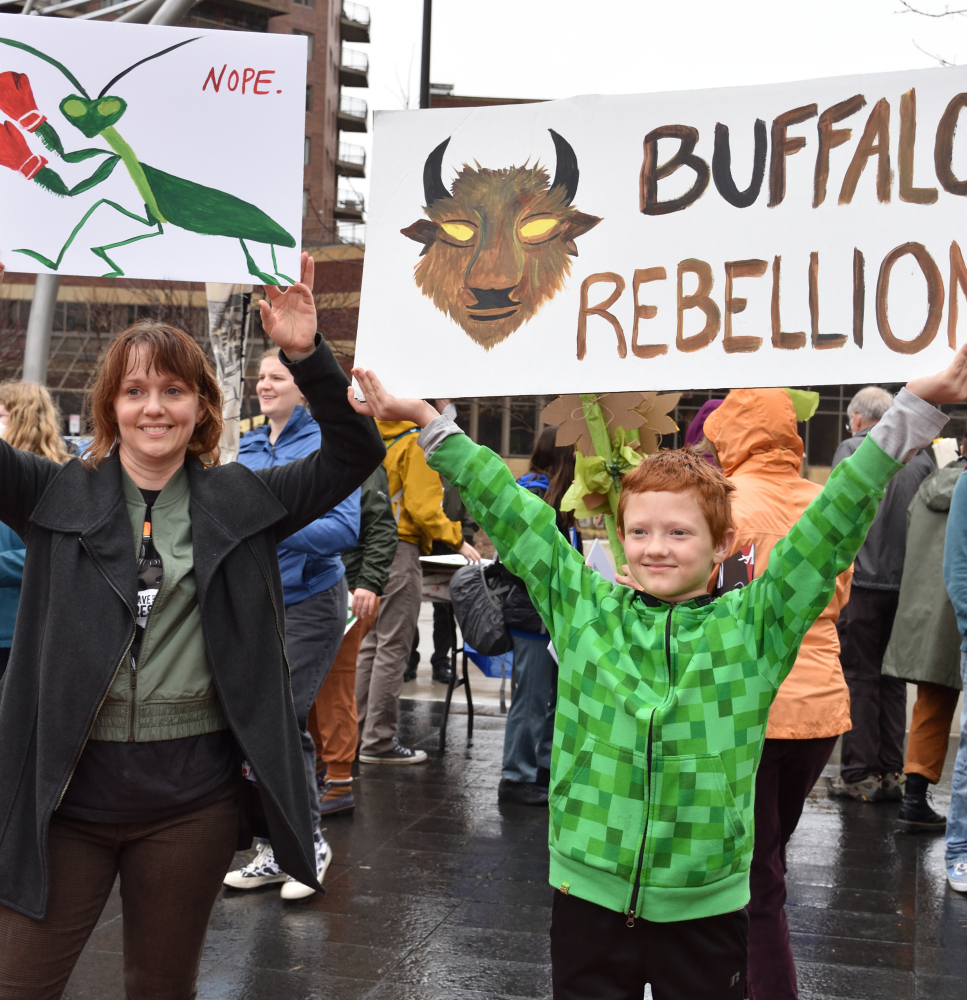
Buffalo Rebellion
The recently formed Buffalo Rebellion is an example of confederating counter-institutions.
Buffalo Rebellion is a new coalition of Iowa organizations that are growing a movement for climate action that centers racial and economic justice. The Earth Day Rally will be an afternoon of honoring Mother Earth through sharing stories and visions for climate justice and taking action together for a world that puts people and the planet before profits for a few.
Following the Earth Day Rally, Buffalo Rebellion will be holding two days of immersive training to develop 100 grassroots leaders who will build local teams to take on climate justice issues in their community and come together to create a thriving state-wide movement.
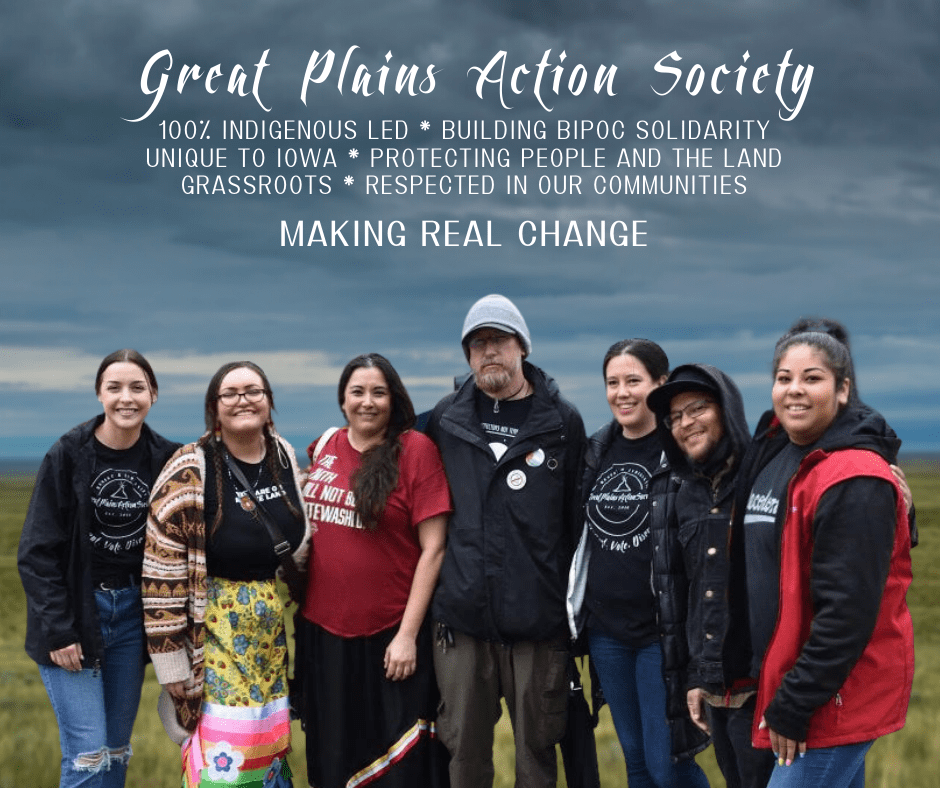
Formed in 2021, the Buffalo Rebellion is comprised of seven Iowa organizations: Great Plains Action Society, DSM Black Liberation Movement, Iowa Migrant Movement for Justice, Sierra Club Beyond Coal, Cedar Rapids Sunrise Movement, SEIU Local 199, and Iowa CCI
I believe that world-ending and world-making can occur, are occurring, have always occurred, simultaneously. Given that racial and ecological violence are interwoven and inextricable from one another, more now than ever, Black and Indigenous communities—who are globally positioned as “first to die” within the climate crisis—are also on the front lines of world-making practices that threaten to overthrow the current (death-making) order of things. Put otherwise, our communities, quite literally the post-apocalyptic survivors of world-endings already, are best positioned to imagine what this may be. This, after all, is the radical promise (if as of yet unachieved) that was and is extended to us by the world-making projects of abolition and decolonization.
Maynard, Robyn; Simpson, Leanne Betasamosake. Rehearsals for Living (Abolitionist Papers) (p. 31). Haymarket Books. Kindle Edition.
But it’s not just that mutual aid can ease material conditions or help striking workers so that they have more power against the bosses. Its assault on the existing power structure runs much deeper. Consider this: if mutual aid can meet the food needs of everyone in a city without them having to pay for the food, what’s the point of paying for food in the first place? Start asking questions like this, and you can quickly start to unravel the capitalist economy itself in that local area. Capitalism is based upon a network of institutions that draw their power from control and exclusion. Free access is capitalism’s poison. By building up the capacity to universally provide resources on a non-market basis, we plant the seeds for capitalism’s ultimate destruction.
In all this, we must remember that mutual aid runs not from the socialist movement to the grateful workers but is something workers do for each other on an egalitarian basis. We must work to ensure our mutual aid raises each other up as opposed to charity which hands down from “on high.”
Dual Power: A Strategy To Build Socialism In Our Time, DECEMBER 31, 2018 – CAUCUS STATEMENT. DSA LIBERTARIAN SOCIALIST CAUCUS
[My foundational stories are related to the intersections between my Quaker faith, protecting Mother Earth, and photography. My faith led me to try to share my spiritual experiences and show my love for the beauty of Mother Earth through photography.]
I’ve been praying and struggling for many days to discern how to express the state of my Quaker faith today. Quakerism is the faith community I was born into and have remained in. I was raised in a White Quaker family and community. I had a Spiritual experience at the Bear Creek Meetinghouse when I was about ten years old, an experience that I have drawn upon for the rest of my life. I attended Scattergood Friends School, a Quaker high school, and Earlham College, a Quaker institution.
One of the reasons I accepted the challenge of reflecting on my foundational stories is because of my crisis of faith now.
I think it is common for people to be disappointed by their faith community at various times, for a variety of reasons. That has been true for me. Coming of age during the Vietnam War I wished more young men had resisted the draft. I wish we all had done more to reign in the use of fossil fuels. And that White people like myself had worked, harder to acknowledge our complicity in the oppression of Black, Indigenous, and other people of color (BIPOC), of various gender identities, and certain social and economic classes. I wish we were working harder now on acknowledging and trying to heal these injustices.
This country was built on the historical injustices of the institution of slavery, and the genocide and removal of Indigenous peoples from their lands. And the forced assimilation of native children in institutions where they were often physically and sexually abused, where thousands of children were killed or died.
Many people, including Quakers today question how complicit our ancestors were in these injustices. There were White Quakers who were involved in the slave trade, and who enslaved Black men, women, and children. Our ancestors were settler colonists. As are we who are now living on these lands. Quakers were involved in the Indian residential schools.
being involved with others in wrongdoing
complicity
These issues often generate significant emotional responses. I don’t have all the answers. But I have had spiritual and community experiences that I am led to speak and work from today. Many of these experiences have led me to understand we are living in a country, a society of structural racism and white superiority. As much as many of us White Quakers wish it weren’t so, our skin color automatically gives us many significant advantages in this country.
Our mainstream social, economic, and political systems are predicated on White superiority and dominance. I say mainstream because many people, including myself, are building alternative systems today. I’ve been deeply involved in Mutual Aid for a couple of years and believe this to be part of the answer. Mutual Aid is included in the following graphics.
NOTE: White supremacy is different from white superiority. “White supremacy or white supremacism is the belief that white people are superior to those of other races and thus should dominate them.”
I’ve also seen in the lives of my friends what I once thought of as isolated historical traumas have been passed from generation to generation. They profoundly affect the lives of people today. What does that mean for White Quakers now?
“…capitalism and colonialism created structures that have disrupted how people have historically connected with each other and shared everything they needed to survive. As people were forced into systems of wage labor and private property, and wealth became increasingly concentrated, our ways of caring for each other have become more and more tenuous.”
Dean Spade, Mutual Aid: Building Solidarity During This Crisis (and the Next) (Kindle Locations 111-121). Verso
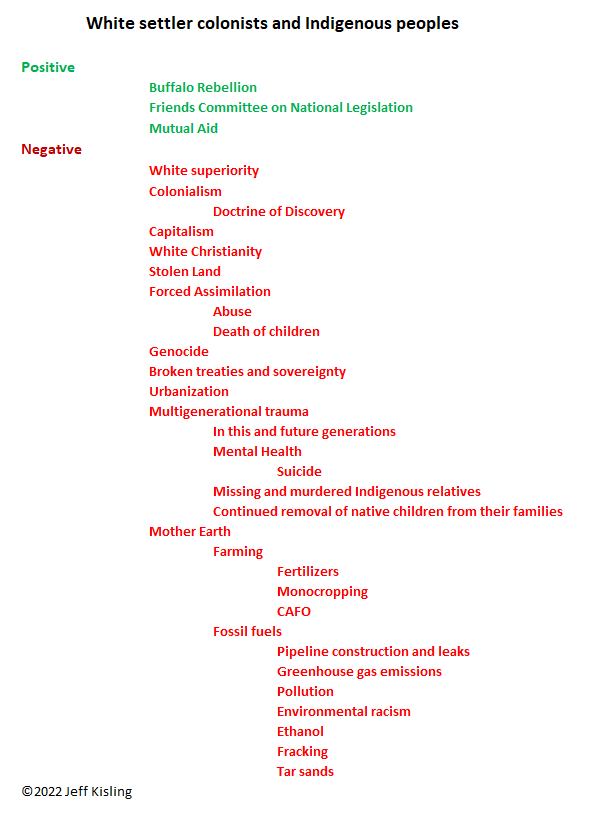
Following is another way of looking at the relationships between White settler colonists and Indigenous peoples. White Quakers need to acknowledge that when our ancestors came to these Indigenous lands, they were settler colonists. And since we are still occupying these lands, we are settler colonists, too. Some White Quakers were involved in the forced assimilation of Indigenous children. We are implicated in most of the “negative” things listed below.
Acknowledgement of wrongs is the necessary first step in the healing process.
On the positive side are Mutual Aid, the Buffalo Rebellion, and the Friends Committee on National Legislation (FCNL). I’ve written a lot about my experiences with Mutual Aid https://quakersandreligioussocialism.com/mutual-aid/
I’m fortunate to be part of the Buffalo Rebellion, a newly formed Green New Deal coalition in Iowa formed to protect the planet by demanding change from politicians and convincing the public that climate should be a priority. Buffalo Rebellion, is a coalition of grassroots, labor, and climate justice organizations growing a movement to pass local, state, and national policies that create millions of family-sustaining union jobs—ensuring racial and gender equity and taking action on climate at the scale and scope the crisis demands. It was formed in November 2021 and consists of:
The Friends Committee on National Legislation (FCNL) has years of experience advocating for legislation related to Native American affairs. Recently FCNL has been supporting legislation to form a Truth and Healing Commission related to the Indian Boarding Schools. I’ve been blessed to have many years of experience with FCNL and have been working with my native friends in creating connections with FCNL, including several visits to our US Senators.
[My foundational stories are related to the intersections between my Quaker faith, protecting Mother Earth, and photography. My faith led me to try to share my spiritual experiences and show my love for the beauty of Mother Earth through photography.]
Yesterday I described where my story related to photography is at this time. Today I write about where I am regarding protecting Mother Earth. The beginning of my stories about protecting Mother Earth and the water can be found here: Foundational stories about care for Mother Earth.
Concern for Mother Earth has been a constant in my life. I was 20 years old when I moved to Indianapolis and was horrified by the thick, noxious exhaust from cars. I couldn’t be part of that and have lived without a car since then (1970).
My foundational stories now
Protecting Mother Earth
It took a while for me to become comfortable with the term Mother Earth. But vocabulary can affect how you feel about something. Having Earth as your Mother describes a living relationship. This is one of the many things I’ve learned from my Indigenous friends.
It is a dichotomy that today, despite knowing the many ways our environment and so many other things are collapsing, I have more hope than I’ve had for years. That’s because of the coalitions of people coming together to heal each other and Mother Earth. We can’t be so paralyzed with fear about what may be coming that we don’t enjoy the beauty all around us.
Following are some ways I’m involved in protecting Mother Earth now.
Last night I participated in a meeting of the Buffalo Rebellion, which I’m proud to be a part of. This coalition of environmental activists is one of the things that gives me hope. Realizing we are all working on similar things, this coalition is being built to empower our work and support one another. Last night someone remarked that we’ve all suffered trauma and are all in need of healing.
Following is a description of the Buffalo Rebellion, including a link to a recording of my friend Sikowis Nobiss describing it.
The topic this month is on a newly formed Green New Deal coalition in Iowa called Buffalo Rebellion formed to protect the planet by demanding change from politicians and convincing the public that climate should be a priority. Buffalo Rebellion, is a coalition of grassroots, labor, and climate justice organizations growing a movement to pass local, state, and national policies that create millions of family-sustaining union jobs—ensuring racial and gender equity and taking action on climate at the scale and scope the crisis demands. It was formed in November 2021 and consists of:
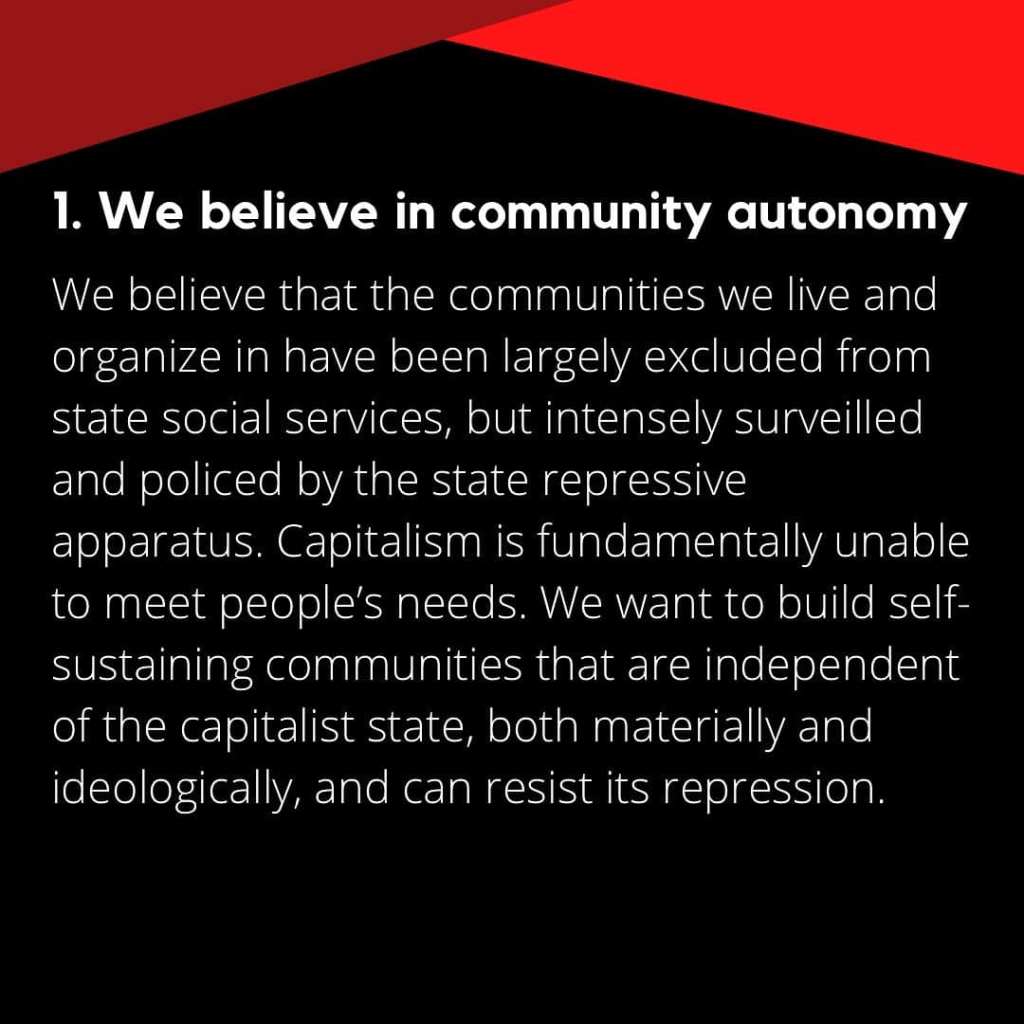
The root causes of what we are fighting against are capitalism and colonialism
The subject of last night’s gathering (at Iowa CCI and via Zoom) was CO2 (carbon) pipelines, the latest man-made environmental threat. Iowa is at the center of this problem because most of the ethanol plants are located here, because ethanol is produced from corn, and releases carbon emissions in the process. The carbon dioxide in the carbon pipelines is a hazardous material and could cause deaths if there is a rupture. A CO2 pipeline in Satartia, Mississippi ruptured last year, sickening dozens of people. First responders’ vehicles could not run because of the absence of oxygen. READ: “The Gassing Of Satartia” (Huffington Post, August 2021)
Sikowis talked about what is below the crust of the earth also being a sacred space, and we don’t know what disturbing that with pipelines and fracking will cause.
The only way to address fossil fuel emissions is to stop burning fossil fuels.
Des Moines Mutual Aid has been the focus of my work for the past couple of years. How is this related to the protection of Mother Earth?
Being in a Mutual Aid community, we support each other and help each other heal.
Mutual Aid members are encouraged to use critical thinking to anticipate and solve problems. And immediately implement solutions, not waiting for permission from anyone.
Mutual Aid is about eliminating vertical hierarchies and the damage those hierarches do to a community. And how they harm Mother Earth.
Mutual Aid communities are explicitly local. There is no need for fossil fuel transportation and energy production. Our Mutual Aid communities are or will be “walkable”.
Our Mutual Aid communities are an example to others of how we can escape capitalism and colonialism that are the root causes of injustice
Our Mutual Aid practices are about sustainability and protection of Mother Earth
“These spaces become intergenerational, diverse places of Indigenous joy, care and conversation, and these conversations can be affirming, naming, critiquing, as well as rejecting and pushing back against the current systems of oppression”. Maynard, Robyn; Simpson, Leanne Betasamosake.
“…capitalism and colonialism created structures that have disrupted how people have historically connected with each other and shared everything they needed to survive. As people were forced into systems of wage labor and private property, and wealth became increasingly concentrated, our ways of caring for each other have become more and more tenuous.”Dean Spade
Ronnie James, Des Moines Mutual Aid
…in Nishnaabeg thinking, knowledge is mobilized, generated, and shared by collectively doing. It’s more than that, though. There is an aspect of self-determination and ethical engagement in organizing to meet our peoples’ material needs. There is a collective emotional lift in doing something worthwhile for our peoples’ benefit, however short-lived that benefit might be. These spaces become intergenerational, diverse places of Indigenous joy, care and conversation, and these conversations can be affirming, naming, critiquing, as well as rejecting and pushing back against the current systems of oppression. This for me seems like the practice of movement-building that our respective radical practices have been engaged with for centuries.
Maynard, Robyn; Simpson, Leanne Betasamosake. Rehearsals for Living (Abolitionist Papers) (p. 39). Haymarket Books. Kindle Edition.
In another example of how our work is interrelated, my Mutual Aid friends support the Wet’suwet’en.
The Wet’suwet’en peoples have been struggling for years to prevent the construction of the Coastal GasLink liquified natural gas pipeline from being built through their pristine, unceded lands.
There was one particularly significant Spirit-led event in my life related to the Wet’suwet’en. When I first became involved with the Wet’suwet’en peoples was when they were asking allies to spread the news about their struggles, since there was no mainstream media coverage.
In February 2020, some of us were already planning to be at Friends House in Des Moines. We decided to hold a vigil for the Wet’suwet’en on the street in front of Friends House prior to that meeting. I created an event announcement on Facebook, that was shared by my friend Ed Fallon or Bold Iowa, an Iowa Citizens for Community Improvement.
As anticipated just those few of us who were planning to attend the meeting at Friends House anyway showed up. But the Spirit-led part of this is that Ronnie James, who I didn’t know at the time, joined us. Ronnie is an Indigenous organizer with twenty years of experience. He was surprised anyone in Iowa knew about the Wet’suwet’en peoples, so he came to see who was attending, a good organizing technique.
Ronnie and I began to exchange messages over the next couple of months. I was intrigued with the stories he was telling me about Des Moines Mutual Aid community he was involved with. When I felt we had begun to know each other well enough, I tentatively asked if I could attend the food giveaway that Ronnie/Des Moines Mutual Aid held every Saturday morning. This was a continuation of a variation of the Black Panther Party’s free school breakfast program in Des Moines from the 1970’s.
I thought I would just attend a time or two to see how that worked. Instead, I’ve been there almost every Saturday morning for over two years now, and Ronnie is one of my best friends. One of the many good things about Mutual Aid is how it attracts and keeps people engaged.
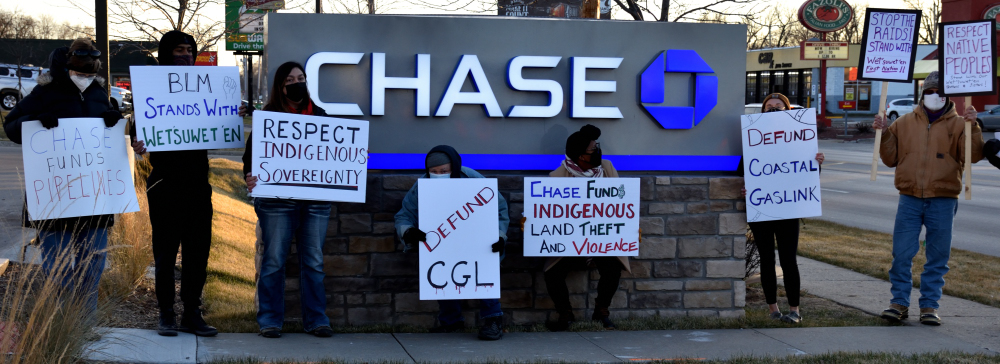
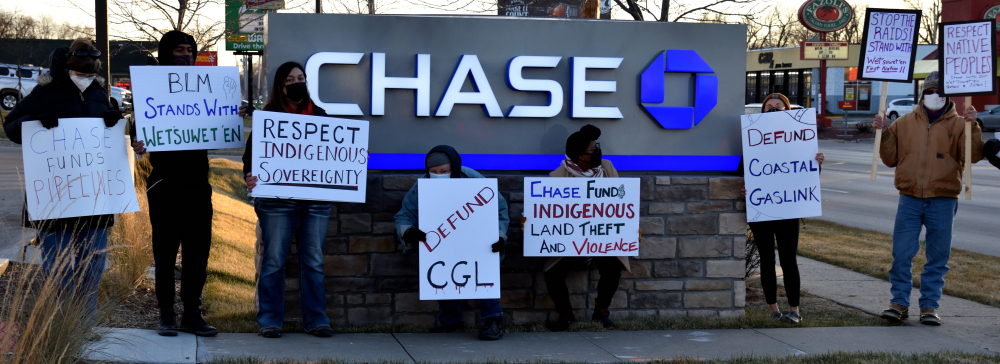
I continue to do what I can to support the Wet’suwet’en. We are presently organizing another gathering at Chase bank to call attention to their funding fossil fuel projects. Some others from the Buffalo Rebellion will be involved.
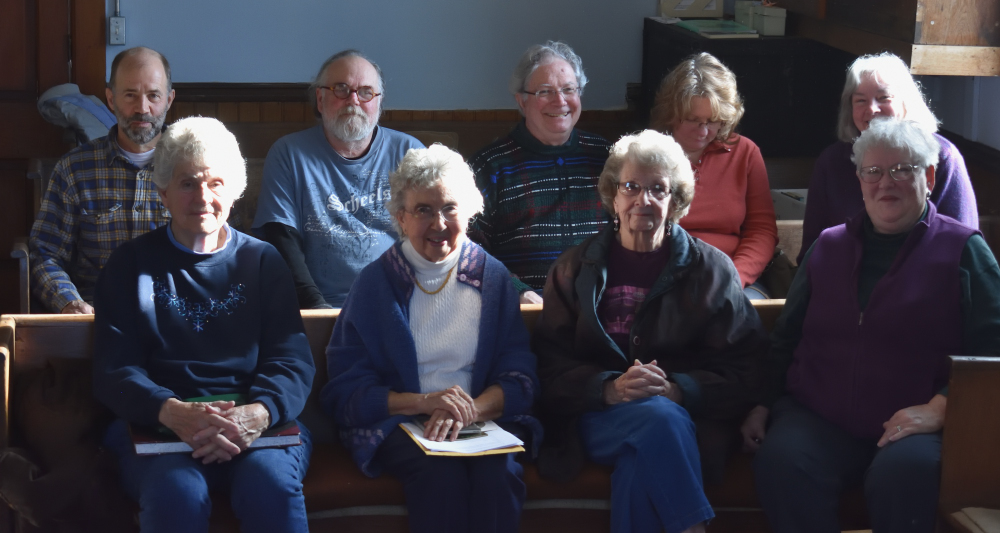
Bear Creek Friends Meeting
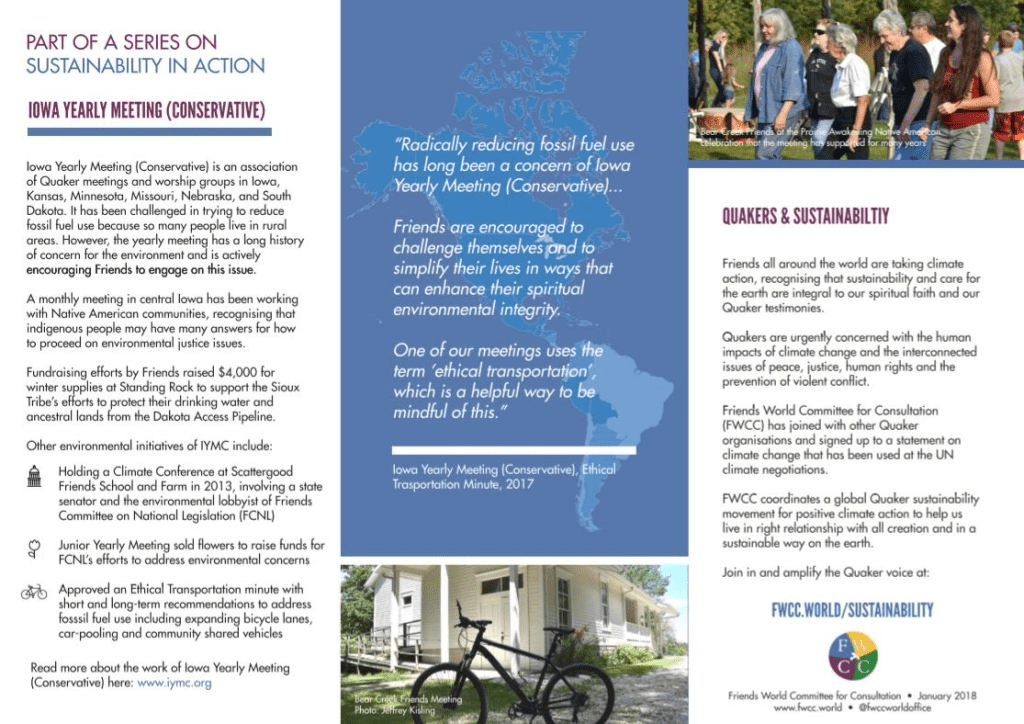
The small, rural Quaker meeting I’m a member of continues today to try to find ways we can help protect Mother Earth. This is one way to bring a Spiritual approach to these problems which I believe is very important.
Members of the meeting have supported the annual Prairie Awakening/Prairie Awoke ceremony that takes place at the Kuehn Conservation Area, just a few miles from the meetinghouse.
Bear Creek Friends Meeting
It is difficult to reduce fossil fuel use in rural areas.
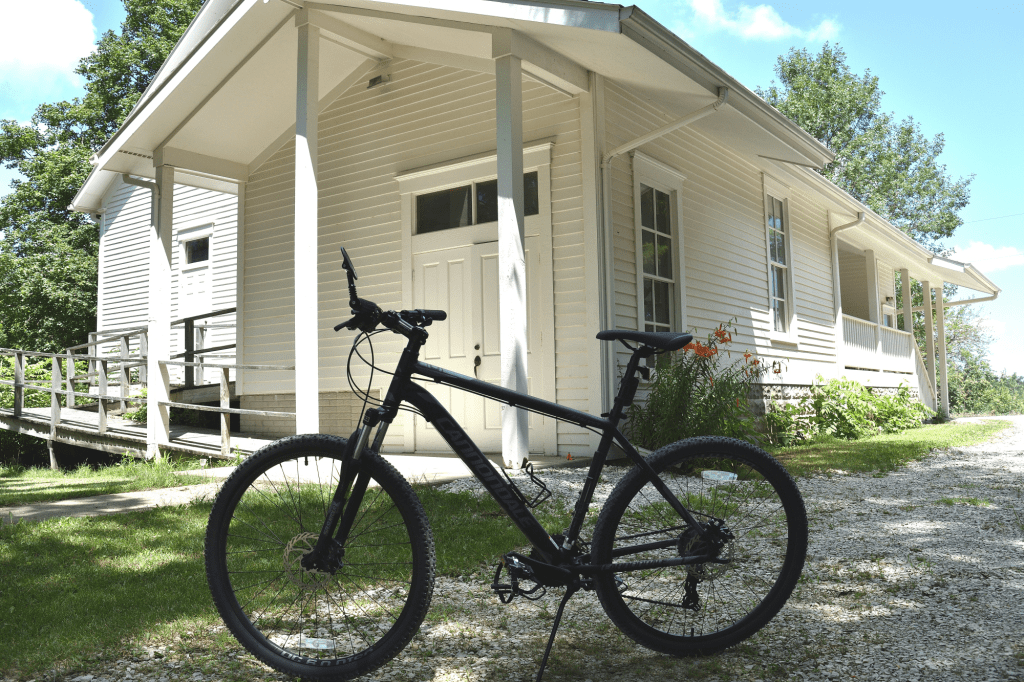
One thing we realized we could do was encourage more use of bicycles, since many members lived close to the meetinghouse just north of Earlham, Iowa. And encourage Friends in urban meetings to use bicycles when possible.
The Minute we wrote, and that was approved by Iowa Yearly Meeting of Friends (Conservative) was referred to as a Minute on “Ethical Transportation”.
Radically reducing fossil fuel use has long been a concern of Iowa Yearly Meeting (Conservative). A previously approved Minute urged us to reduce our use of personal automobiles. We have continued to be challenged by the design of our communities that makes this difficult. This is even more challenging in rural areas. But our environmental crisis means we must find ways to address this issue quickly.
Friends are encouraged to challenge themselves and to simplify their lives in ways that can enhance their spiritual environmental integrity. One of our meetings uses the term “ethical transportation,” which is a helpful way to be mindful of this.
Long term, we need to encourage ways to make our communities “walkable”, and to expand public transportation systems. These will require major changes in infrastructure and urban planning.
Carpooling and community shared vehicles would help. We can develop ways to coordinate neighbors needing to travel to shop for food, attend meetings, visit doctors, etc. We could explore using existing school buses or shared vehicles to provide intercity transportation.
One immediately available step would be to promote the use of bicycles as a visible witness for non-fossil fuel transportation. Friends may forget how easy and fun it can be to travel miles on bicycles. Neighbors seeing families riding their bicycles to Quaker meetings would have an impact on community awareness. This is a way for our children to be involved in this shared witness. We should encourage the expansion of bicycle lanes and paths. We can repair and recycle unused bicycles, and make them available to those who have the need.
Minute approved by Iowa Yearly Meeting (Conservative) 2017
As often happens, when I sat down to write this morning, I wasn’t sure what the subject would be. I’m aware of looking forward to being with my Mutual Aid friends this morning. I know they feel the same from comments I’ve heard over the past couple of years. I’ve heard my friends say this is the best part of their week.
In contrast, I sense so many people don’t have much joy in their lives. So many things are going wrong, things we could once rely on, we no longer can. We are entering a time of collapse. There is a general malaise, a fear for our future, the feeling we have no control, a spiritual poverty.
What’s the most effective way to voluntarily get billions of people to the point they are capable of exercising the skills below?
How do we get the timing right: Not so early that there’s not yet a sense of urgency, but not so late that we’re trying to do it in an environment of chaos?
How might we begin to identify, improve the competencies of, and empower the right people to do the mentoring, teaching, training, demonstrating, connecting, modelling, and other hands-on imparting of knowledge and skills needed to make it happen?
How can we make this new, crucial learning easier, and fun?
What caught my attention is how can we make this new learning fun? I think of endless committee meetings related to justice work, for example, and how they were not fun. And usually not effective. My friend Alvin at the Kheprw Institute always asks, “what actually changed as a result of what was done?”
Those of us who have organized rallies and marches know how difficult it is to get people to participate. If participating in something isn’t fun in the sense of being enjoyable, exciting, fulfilling, and meaningful, there will be little enthusiasm for people to participate and they won’t.
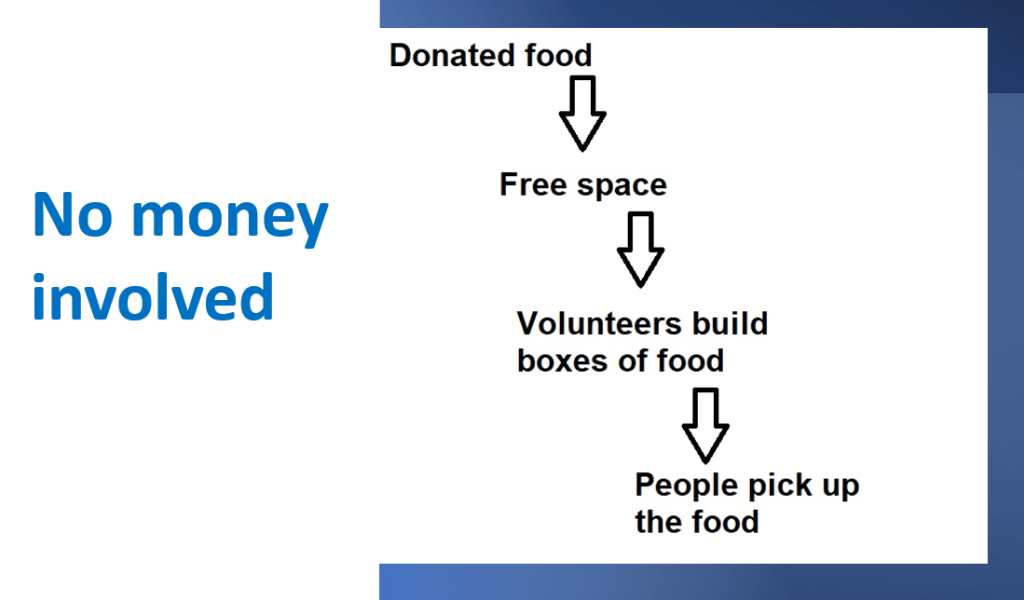
Our Mutual Aid work is fun and effective. We enjoy working together to put boxes of food together and enjoy our interactions with those who come for food. We are meeting an immediate survival need. But it does require a commitment to be present as often as possible. And it is very physical work. I remember when Ronnie was explaining this to me, he said at the end of the food distribution you were tired, sweaty, and feeling good. And so it was.
That is captured in this quote. “There is an aspect of self-determination and ethical engagement in organizing to meet our peoples’ material needs. There is a collective emotional lift in doing something worthwhile for our peoples’ benefit, however short-lived that benefit might be.“
You and your relations, my friend, are (still) busy building a different world at the end of this one. This is something I’ve emphasized over and over again in my own work. I cherish the belief and practice that it is never enough to just critique the system and name our oppression. We also have to create the alternative, on the ground and in real time. In part, for me, because Nishnaabeg ethics and theory demand no less. In part because in Nishnaabeg thinking, knowledge is mobilized, generated, and shared by collectively doing. It’s more than that, though. There is an aspect of self-determination and ethical engagement in organizing to meet our peoples’ material needs. There is a collective emotional lift in doing something worthwhile for our peoples’ benefit, however short-lived that benefit might be. These spaces become intergenerational, diverse places of Indigenous joy, care and conversation, and these conversations can be affirming, naming, critiquing, as well as rejecting and pushing back against the current systems of oppression. This for me seems like the practice of movement-building that our respective radical practices have been engaged with for centuries.
Maynard, Robyn; Simpson, Leanne Betasamosake. Rehearsals for Living (Abolitionist Papers) (p. 39). Haymarket Books. Kindle Edition.
I imagine you have experienced this. As I think of this in my life, I remember how significant it was at Scattergood Friends School when we did our assigned, rotating crews together. Such as preparing meals, baking bread, pruning trees in the orchard, even laundry crew that did the laundry for the entire student body. We had to have name tags sewn into every piece of our clothing so the laundry crew could separate everything out when the clothes were dry.
We experience this when we respond to community needs, such as weather disasters.
This is why I urge us to create our own, local Mutual Aid communities. Perhaps as important as providing essential resources to people is the experience of doing something meaningful. People have a desperate yearning to feel they are doing something worthwhile, something that fulfills their need to feel appreciated.
Collapse is coming at us far more quickly than we had anticipated.
In response to Pollard’s questions (above), the right timing is now. The way to get billions of volunteers to engage is to build Mutual Aid communities everywhere now, in part because Mutual Aid work is fun, meaningful, satisfying.
Soft skills
Critical thinking
Group facilitation
Helping people cope
Preparing healthy food
Caring for the young, old, and sick
Imaginative, reflective and creative skills
Mentoring
Listening, noticing and attention skills
Conversation
Community-building
Hard skills (that require some specific technical knowledge/experience
Growing and harvesting food
Making and repairing clothing and shelter from the elements
Accessing clean, safe water
Weaving, fabric-making, pottery and other crafting skills tha that make life much more pleasant and comfortable
Medical, medicinal, and injury-healing knowledge and skills
Food preservation
Bicycle construction and repair
Basic engineering skills
Ecological skills
Decommissioning-nuclear reactors and petrochemical sites
I’m reading a book about the lives of people in the most polluted, least educated, most disadvantaged, and most dangerously toxic (and most conservative) part of Louisiana (more about that in an upcoming article). What emerges from the author’s study is that (1) these people are living in a ‘world’ that is already in a very advanced state of economic and ecological collapse, one that may foretell what the rest of us in ‘affluent’ nations will soon face; (2) they are far more of a ‘community’ than most people living in cities could claim; and (3) they are not particularly interested in paternalistic ‘grief professionals’ ‘coaching’ them on how to manage the massive grief and other emotions they and their families have been dealing with for generations.
But capitalism and colonialism created structures that have disrupted how people have historically connected with each other and shared everything they needed to survive. As people were forced into systems of wage labor and private property, and wealth became increasingly concentrated, our ways of caring for each other have become more and more tenuous. Today, many of us live in the most atomized societies in human history, which makes our lives less secure and undermines our ability to organize together to change unjust conditions on a large scale. We are put in competition with each other for survival, and we are forced to rely on hostile systems— like health care systems designed around profit, not keeping people healthy, or food and transportation systems that pollute the earth and poison people— for the things we need. More and more people report that they have no one they can confide in when they are in trouble. This means many of us do not get help with mental health, drug use, family violence, or abuse until the police or courts are involved, which tends to escalate rather than resolve harm. In this context of social isolation and forced dependency on hostile systems, mutual aid— where we choose to help each other out, share things, and put time and resources into caring for the most vulnerable— is a radical act.
Dean Spade. Mutual Aid: Building Solidarity During This Crisis (and the Next) (Kindle Locations 111-121). Verso.
This is a continuation of an article I recently wrote about critical skills to prepare for collapse. It is telling that the idea of collapse is more widely accepted, but not surprising as the signs are appearing in so many ways. Rather than being something environmentalists just talk about, the actual damage is occurring everywhere.
But simply applying critical thinking to a problem or situation doesn’t necessarily mean you arrive at the best solution. The more you know about the situation you are facing, the better. Which is why banning books and all the other restrictions being placed on education is so tragic. It also explains why that is being done. Those working to control us don’t want us to have that knowledge. They want us to be dependent on what they want and say.
The point of critical thinking is that as you learn more, you can integrate that into your knowledge base and make better decisions. Which is going to be crucial in the face of the rapid and dramatic changes that will be, already are occurring.
And there are many situations that involve our values, which are not subject to critical thinking.
Several people have asked me why I put ‘critical thinking’ on this list. My sense, from reading works like the Davids’ The Dawn of Everything and Peter Brody’s The Other Side of Eden is that what most distinguishes our civilization from most prehistoric and indigenous ones is that, before education became something that we ‘did’ to people, most people naturally acquired this essential skill, by facing the many existential challenges that life outside our synthetic, infantilizing, prosthetic, standardized culture presented to them every day. In short, they learned how to learn because they had to; they didn’t have to be ‘taught’.
My experience has been that, given that it is no longer a prerequisite for survival, critical thinking is now something that has to be specifically nurtured in people, which probably happens most often by parents’ encouragement. Lacking that, there’s a natural propensity, I think, for simplification and uncritical reaction. But if you’re taught the value and importance of critical thinking, I think you figure out this process of weighing and assessing and challenging what the world throws at you.
But I’m not so sure about this. Maybe, just as we can learn to make our own clothes and grow much of our own food if and when we have to (as millions discovered during the Great Depression), we can also learn to learn, to think critically, to challenge unsupported rhetoric, to think for ourselves instead of relying on increasingly-incompetent media to tell us what we should and should not believe.
When it begins to dawn on us, in five years or twenty-five, that we are going to have to quickly instill the above (see the article) currently rare skills in many or even most of our people, how might we go about it? As pessimistic as I am, I just can’t believe it’s already too late to do so.
So I’m thinking about these questions:
What’s the most effective way to voluntarily get billions of people to the point they are capable of exercising the above skills?
How do we get the timing right: Not so early that there’s not yet a sense of urgency, but not so late that we’re trying to do it in an environment of chaos?
How might we begin to identify, improve the competencies of, and empower the right people to do the mentoring, teaching, training, demonstrating, connecting, modelling, and other hands-on imparting of knowledge and skills needed to make it happen?
How can we make this new, crucial learning easier, and fun?
‘How Do We Teach the Critical Skills Needed to Face Collapse?” by Dave Pollard, How To save the world, September 10, 2022.
So I don’t see any top-down ‘professional’ answer to developing the above essential skills in the coming decades, not even the skill of ‘helping people cope’ with collapse. I think the answer has to emerge bottom up, from within each community as that community establishes itself.
‘How Do We Teach the Critical Skills Needed to Face Collapse?” by Dave Pollard, How To save the world, September 10, 2022.
So, we arrive at my experience with Mutual Aid. A future article will discuss how Mutual Aid is providing skills and developing communities to face collapse.
The invasion of Ukraine by Russia has dominated the news for six months now. There is news about two new developments.
The Russian draft to force men into the military
The use of weaponized drones
Russian conscription brings back memories of the draft in this country for the Vietnam War.
I came of age during the Vietnam War years. Organized a draft conference, walked with the entire student body of Scattergood Friends School (all sixty of us) fourteen miles into Iowa City during the Moratorium to End the War in Vietnam, became a draft resister. The entire country was in an uproar. Young men and their families lived in fear of induction based on a lottery system. Over 58,000 Americans were killed.
A key component to the sustenance of the permanent war state was the creation of the All-Volunteer Force. Without conscripts, the burden of fighting wars falls to the poor, the working class, and military families. This All-Volunteer Force allows the children of the middle class, who led the Vietnam anti-war movement, to avoid service. It protects the military from internal revolts, carried out by troops during the Vietnam War, which jeopardized the cohesion of the armed forces.
NO WAY OUT BUT WAR By Chris Hedges, Scheer Post. May 23, 2022. Permanent War Has Cannibalized The Country. It Has Created A Social, Political, And Economic Morass.
I’ve often despaired at the absence of an antiwar movement since our plunge into a ‘war on terror’ that is an excuse to have military presence and conflict in any place politicians define a threat.
There were three restraints to the avarice and bloodlust of the permanent war economy that no longer exist. The first was the old liberal wing of the Democratic Party, led by politicians such as Senator George McGovern, Senator Eugene McCarthy, and Senator J. William Fulbright, who wrote The Pentagon Propaganda Machine. The self-identified progressives, a pitiful minority, in Congress today, from Barbara Lee, who was the single vote in the House and the Senate opposing a broad, open-ended authorization allowing the president to wage war in Afghanistan or anywhere else, to Ilhan Omar now dutifully line up to fund the latest proxy war. The second restraint was an independent media and academia, including journalists such as I.F Stone and Neil Sheehan along with scholars such as Seymour Melman, author of The Permanent War Economy and Pentagon Capitalism: The Political Economy of War. Third, and perhaps most important, was an organized anti-war movement, led by religious leaders such as Dorothy Day, Martin Luther King Jr. and Phil and Dan Berrigan as well as groups such as Students for a Democratic Society (SDS). They understood that unchecked militarism was a fatal disease.
NO WAY OUT BUT WAR By Chris Hedges, Scheer Post. May 23, 2022. Permanent War Has Cannibalized The Country. It Has Created A Social, Political, And Economic Morass.
An anti-war demonstration against Israeli militarism
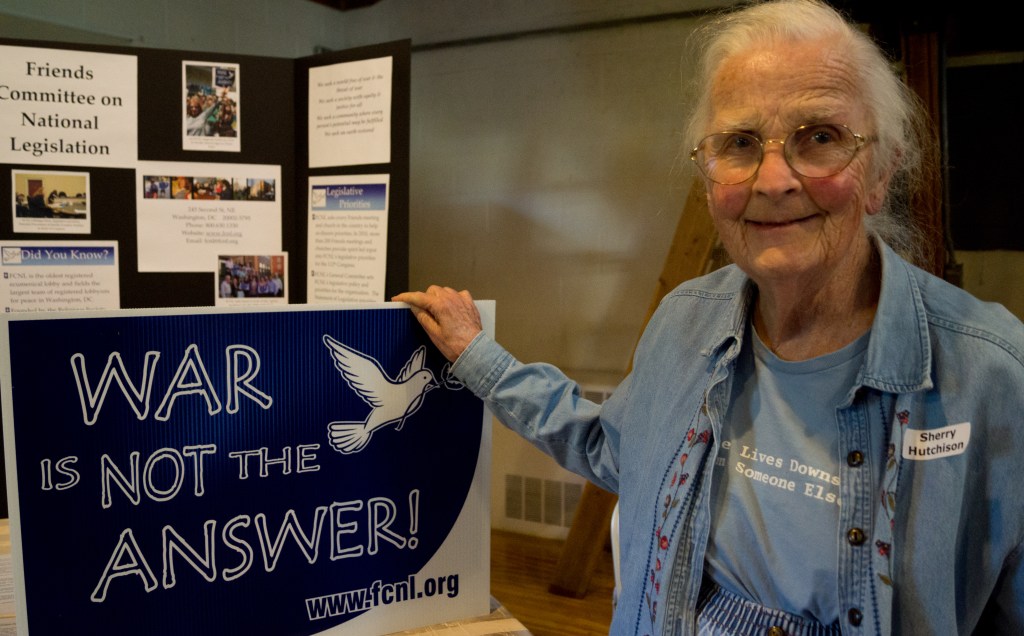
This photo was taken during a demonstration to bring attention to Israeli militarism. Christine Ashley, then head of Scattergood Friends School, offered to take the Iowa Yearly Meeting (Conservative) Peace and Social Concerns Committee to Iowa City for this demonstration in 2014. This occurred at the time when we were holding our annual sessions at the school. The sign I’m holding is from an American Friends Service Committee (AFSC) campaign to call attention of military spending and its consequences. That is a picture of a drone on the sign. You can see a War Is Not the Answer sign in the background, as well as a button on my camera strap, which I have been wearing for many years.
The peace and social concerns committee asks the clerk of Iowa Yearly Meeting (Conservative) to mail the following letter to our Congressional delegations.
Jeff Kisling and Sherry Hutchison, co-clerks [Note: the photo below is of Sherry Hutchison]
The Israeli government, with U.S. aid, now has the most powerful military in the Middle East. In 2008 Israel attacked Gaza, with 1400 civilian casualties. In 2013 Israel attacked Lebanon, with 750 civilian casualties. Currently Israel is engaging in a massive military siege of Palestine, with over 800 civilian deaths so far. All three of these Israel assaults have involved devastating destruction of schools, hospitals, power plants, and other infrastructure.
Tragically, we the American taxpayers are paying for this human rights travesty. Israel receives 9.9 million U.S. dollars each day in military aid from us. This makes it our largest aid recipient in the world. While Americans are struggling to make ends meet and our government struggles to maintain our own infrastructure, we are subsidizing Israel to conduct activities in direct opposition to international law.
We ask that no more military aid be given to the Israeli government.
Iowa Yearly Meeting (Conservative) 2014
Sherry Hutchison
Drone terrorism
Recently Russia has begun to use weaponized drones against Ukraine. I remember how devastated I was when I learned of how people, how the children in Iraq and Afghanistan were terrorized by the sounds of drones circling overhead. Knowing an attack could be triggered at any moment, with untold numbers of civilian casualties. Death by remote control.
In a recent news story, a reporter from NBC News spoke about this, about how unnerving it was to hear the sounds of the drones overhead.
It was fascinating to learn how a drone strike helped trigger the formation of Des Moines Mutual Aid, which has been the focus of my work for the past two years.
One year ago today (January 2021) Des Moines Mutual Aid participated in a march protesting the potential for war or increased hostilities with Iran that followed the fallout of the assassination of Qassem Soleimani by drone strike in Baghdad.
This was our first “public” event since adopting the name Des Moines Mutual Aid, a name we gave our crew during our growing work with our relatives at the houseless camps throughout the city and our help with coordinating a weekly free grocery store that has a 50 year history, founded by the Des Moines Chapter of The Black Panther Party For Self Defense.
A year ago we started laying the foundation for work we had no idea what was coming. As we were adjusting our work with the camps and grocery re-distribution in response to the Covid-19 pandemic, both that continued to grow in need and importance, the police continued their jobs and legacy of brutality and murder.
This nation exploded in righteous rage in response to the pig murders of Breonna Taylor and George Floyd. DMMA realized we were in a position to organize a bail fund to keep our fighters out of jail, both to keep the streets alive as a new phase of The Movement was being born, and because jails are a hotspot of Covid-19 spread. Not to mention the racial and economic oppression that is the cash bail system.
In the past year DMMA has expanded its work in multiple directions and gained many partners and allies.
We partnered with the Des Moines Black Liberation Movement to create the DSM BLM Rent Relief initiative to help keep families in their homes in the midst of a pandemic and the winter.
The camp work has grown exponentially, but is being managed with our collaboration with Edna Griffin Mutual Aid, DSM Black Liberation Movement, and The Great Plains Action Society.
The bail fund remains successful because of desire from the public and a partnership with Prairielands Freedom Fund (formerly The Eastern Iowa Community Bond Project).
The weekly free food store has maintained itself, carrying on the legacy it inherited.
Every one of our accomplishments are directly tied to the support of so many people donating time, talent, and funds to the work. We are overwhelmed with all of your support and hope you feel we are honoring what we promised.
All of these Mutual Aid projects are just a few of many that this city has created in the last year in response to the many crises we face, not only confronting the problems and fulfilling the needs directly in front of us, but creating a sustainable movement that will be capable of responding to what’s next and shaping our collective futures as we replace the systems that fail us.
These last 12 months have been wild and a real test of all of our capabilities to collectively organize. But it is clear that we as a city have what it takes to do what is needed in 2021, no matter what crisis is next.























 Quakers and Mutual Aid