Finally, some national attention is being given to the terrible history of Indian Boarding Schools in this country. Many object to characterizing these institutions of forced assimilation as “schools”.
There is a long and complicated history related to the policies and implementation of forced assimilation in the United States and Canada.
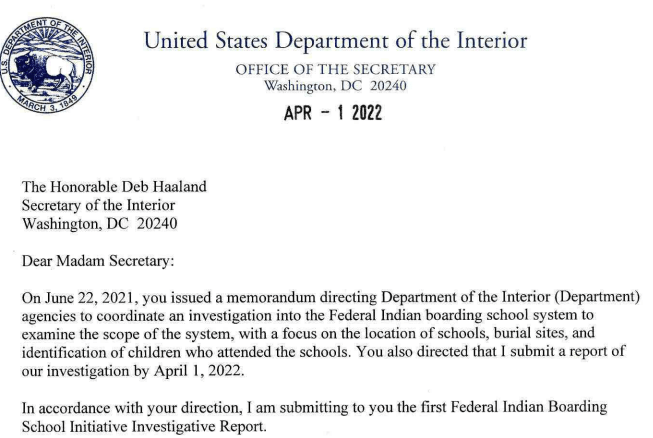
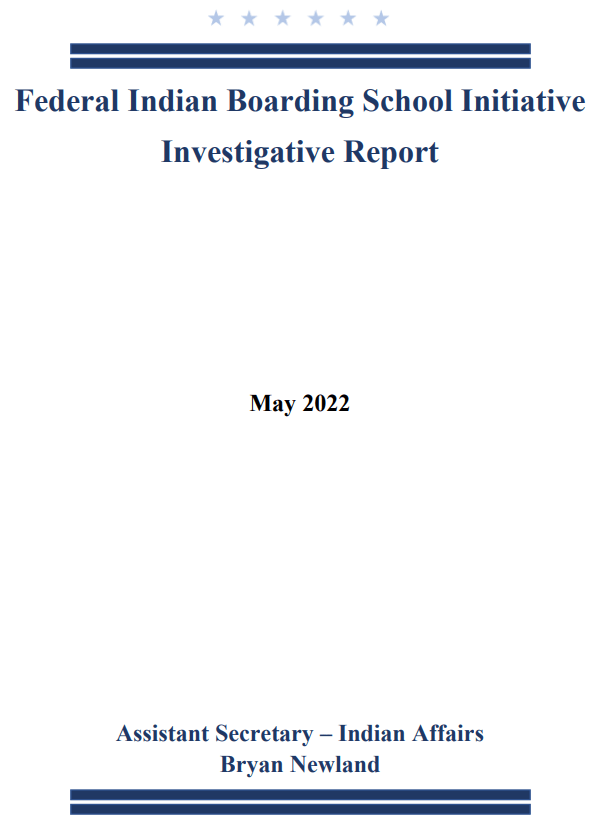
Federal Indian Boarding School Initiative Investigative Report
As my friend Bobby Trice describes here, White Quakers were involved in some of these schools.
Quakers Grapple with Legacy of Indian Boarding Schools
The recent discovery of 215 graves at the Kamloops Indian Residential School, in Canada’s Tk’emlups te Secwepemc First Nations territory, has re-centered a widespread reckoning with past government cultural assimilation policies. Some Quakers are responding by reflecting, learning about Friends’ complicity in running Indian Boarding Schools, and starting to tell the truth about this history.
Following FCNL’s tradition of witnessing in solidarity with Native Americans, we are amplifying the efforts of Native advocates to formalize this truth-telling process in current legislation. It’s vital to ground these efforts in an honest history of the Religious Society of Friends’ oppression of Indigenous people in North America.
Such oppression, rooted in white supremacy, has led to systemic discrimination and inequity that permeates our society today.
Starting with the Indian Civilization Act of 1819, the United States government systematically enacted cultural assimilation laws targeting Native Americans. The implementation of these policies led to Christian churches working with the government to found hundreds of boarding schools for Indigenous children.
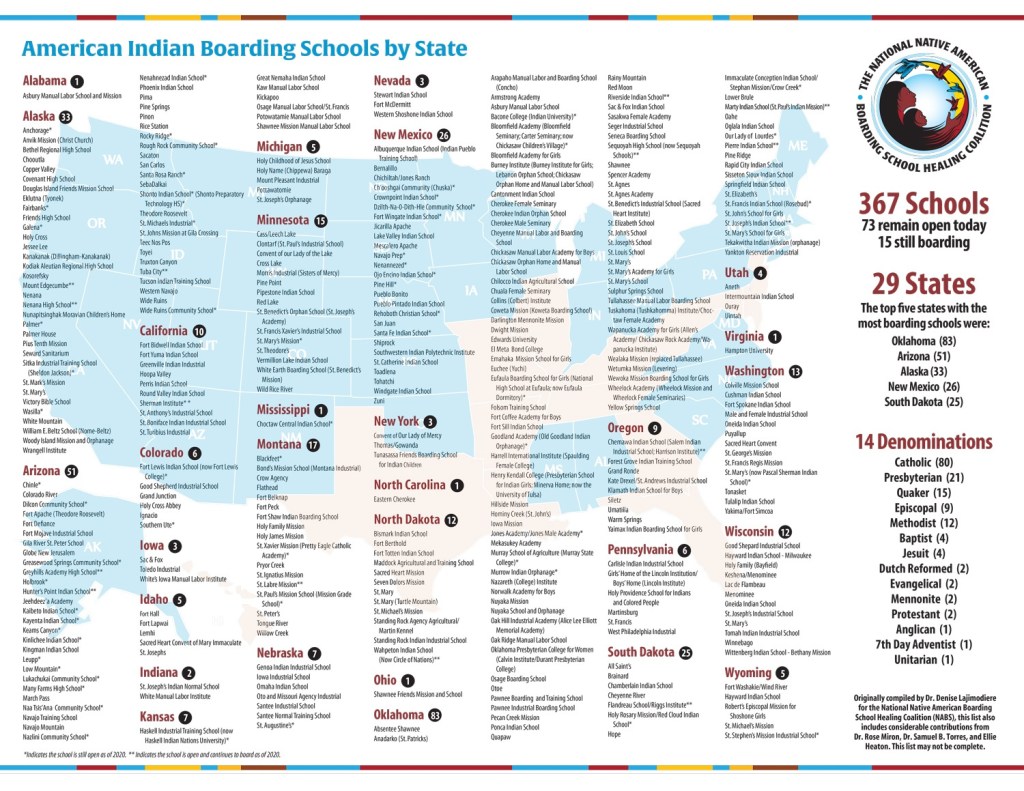
Quakers ran more than 30 Indian boarding schools. The students faced cruel practices of child labor, forced assimilation, and physical punishments. In an 1869 letter, Friend Edward Shaw from Richmond, Indiana, wrote that Quakers participated “to protect, to Civilize, and to Christianize our Red Brethren.”
“For far too long, the truth of cultural genocide led by European-Americans at Indian boarding schools has remained hidden in secrecy and ignored,” said FCNL General Secretary Diana Randall. “Christian churches, including Quakers, carry this burden of transgression against Indigenous people.”
“The consequences of federal Indian boarding school policies—including the intergenerational trauma caused by the family separation and cultural eradication inflicted upon generations of children as young as 4 years old — are heartbreaking and undeniable,” Haaland said in a statement. “We continue to see the evidence of this attempt to forcibly assimilate Indigenous people in the disparities that communities face. It is my priority to not only give voice to the survivors and descendants of federal Indian boarding school policies, but also to address the lasting legacies of these policies so Indigenous Peoples can continue to grow and heal.”
The Federal Indian Boarding School Initiative Investigative Report, May 2022, has just been released. The forced assimilation of Indigenous children has been a deep concern of mine. There is a long history regarding Quaker involvement in this. I hope Friends will be led to share what they know with their friends and neighbors. The general public knows little about this tragic history. For healing to begin, the truth must be told and acknowledged. The purpose of this post is to share some resources related to the Indian Boarding Schools in this country. (I don’t think it is right to call these institutions “schools”, but to search for information, that is how they were referred to in the past.)
The Friends Committee on National Legislation (FCNL) says one thing we can do now is remind our members of Congress of their responsibility to tribal nations and urge them to support the Truth and Healing Commission on Indian Boarding School Policies in the United States Act (S. 2907/H.R. 5444). https://fcnl.quorum.us/campaign/35660/
What can be done to heal the damage done to native communities by colonists, including Quakers? As Paula Palmer shares, it begins with telling the truth.
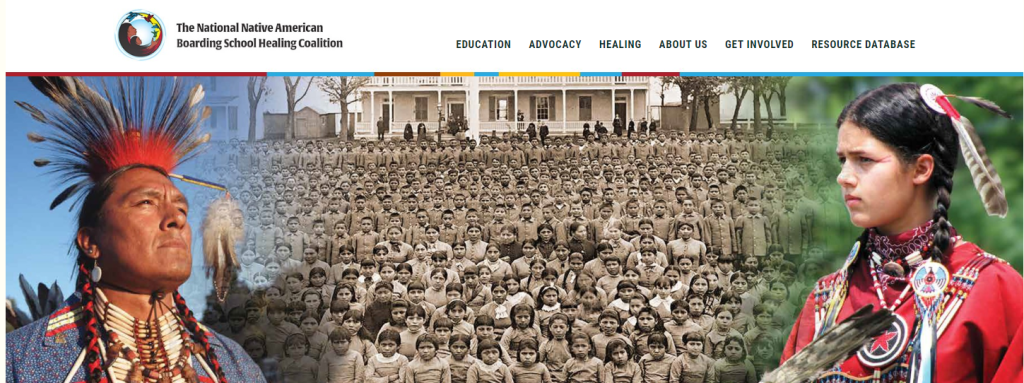
The National Native American Boarding School Healing Coalition says that for healing to occur, the full truth about the boarding schools and the policy of forced assimilation must come to light in our country, as it has in Canada. The first step in a truth, reconciliation, and healing process, they say, is truth telling. A significant piece of the truth about the boarding schools is held by the Christian churches that collaborated with the federal government’s policy of forced assimilation. Quakers were among the strongest promoters of this policy and managed over 30 schools for Indian children, most of them boarding schools, during the nineteenth and early twentieth centuries. The coalition is urging the churches to research our roles during the boarding school era, contribute this research to the truth and reconciliation process, and ask ourselves what this history means to us today.
Following is a recent video from PBS NewsHour, of Judy Woodruff interviewing Interior Secretary Deb Haaland about forced assimilation.
Like Canada, America has a painful history of creating boarding schools to assimilate Native American children, leading to trauma, abuse and death. For more than 150 years, Indigenous children were taken from their families and forced into far away boarding schools. But now there’s a reckoning and a new federal investigation underway. Judy Woodruff discusses it with Interior Secretary Deb Haaland.
Letter Writing May: Acknowledging the Trauma of Indian Boarding Schools
From the Friends Committee on National Legislation (FCNL)
“Native organizations are not asking us to judge our Quaker ancestors. They are asking, ‘Who are Friends today? Knowing what we know now, will Quakers join us in honest dialogue? Will they acknowledge the harm that was done? Will they seek ways to contribute toward healing processes that are desperately needed in Native communities?’” – Paula Palmer, Friends Journal
It is long overdue for our country to acknowledge the trauma inflicted by Indian Boarding Schools in the 19th and early 20th centuries. Christian churches often collaborated with the government to create hundreds of these schools around the country with the goal of assimilating Native children into white society. Quakers were among the religious bodies that ran these boarding schools, causing unspeakable harm to Native children and communities.
Today, Congress can pass legislation that would begin to seek truth and healing for the Native communities that are still affected by this trauma. Friends today are working with tribal nations to advance this congressional effort to formally investigate boarding school policy and develop recommendations for future action.
Increasingly, more members of Congress are signing on to co-sponsor this legislation. Your voices are vital in continuing the momentum to push this effort forward. While the wrongs committed at these boarding schools can never be made right, this truth and healing commission can begin a process of working to right the relationship with tribal nations.
Please act using the accompanying letter template, call script, and this email template. Add 2‐4 sentences letting your legislator know why you are personally concerned.
Then, call Congress at 202‐224‐3121 and ask to be connected to your representative’s and senators’ offices. Leave a message if they do not pick up or if you are calling after office hours.
I also hope you will join FCNL’s Quaker Changemaker event on May 25 at 6:30 p.m. EDT, “Seeking Truth, Healing, and Right Relationship: Quakers and the Legacy of Indian Boarding Schools.”
Your letters, emails, and phone calls to Congress matter now more than ever.
We ask Friends to continue contacting their elected officials using our materials. Please share this call to action with your community email lists and organize virtual gatherings for collective advocacy.
Learn more and get training from FCNL staff at fcnl.org/lobbyfromhome. In peace, Emma HulbertProgram Assistant Quaker Outreach
[References to Quakers here pertain to White Quakers. There is little diversity among Quakers in this country.]
There are several reasons I’m led to revisit this today.
Our Quaker meetings have dwindling numbers of attenders. Most of those remaining are elderly and white. Many meetings do not have new people joining.
I continue to hear stories from people of color, or those identifying as non-binary in gender or sexual orientation not being welcome in some Quaker meetings.
Those of us working outside our Quaker communities are often blessed to find beloved communities.
I wish others in our Quaker meetings would join these communities.
Despite the many wonderful aspects of these ‘external’ communities, I sometimes sense a lack of spiritual support for one another there.
There are many who don’t express their spirituality publicly, or in ways “organized” religions do.
Quaker presence will not be fully welcome in these communities until we come to terms with our own racism.
We know that those of us who are white must confront racism in ourselves and in the institutions we care about—our faith communities, our schools, our neighborhoods, our families, our Congress.
People ask me if I believe in god… I tell them I pray to creator. They tell me Jesus died for me… I tell them my ancestors did. They say I will burn in hell for not following the Bible, but it has been used as weapon to colonize and murder my people… for me it’s spirituality over religion. I don’t hate people for going to church, but I do hate what the churches have done to us… before colonization we had our own ways and ceremonies, I choose the path of my ancestors.
Indigenous
For a long time, I’ve been in significant spiritual distress. I’ve been learning a great deal from my Native friends and working in Mutual Aid communities. And they tell me the way white people can best support them is by embracing and teaching others about LANDBACK.
I caused conflicts in my Quaker meeting because I wanted them to join me in the work of Mutual Aid and LANDBACK. Despite my efforts to explain this, they haven’t had the experiences that would make them understand all of this, yet.
At the same time I felt I was letting my Native friends down, because I wasn’t making some of the changes I wanted to make in my life that could be an example of how white people can join the work with Mutual Aid and LANDBACK.
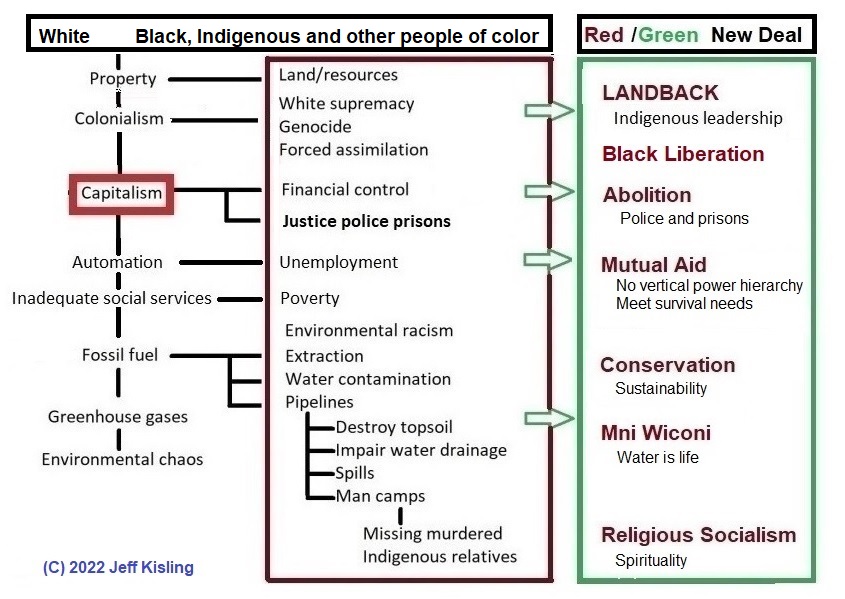
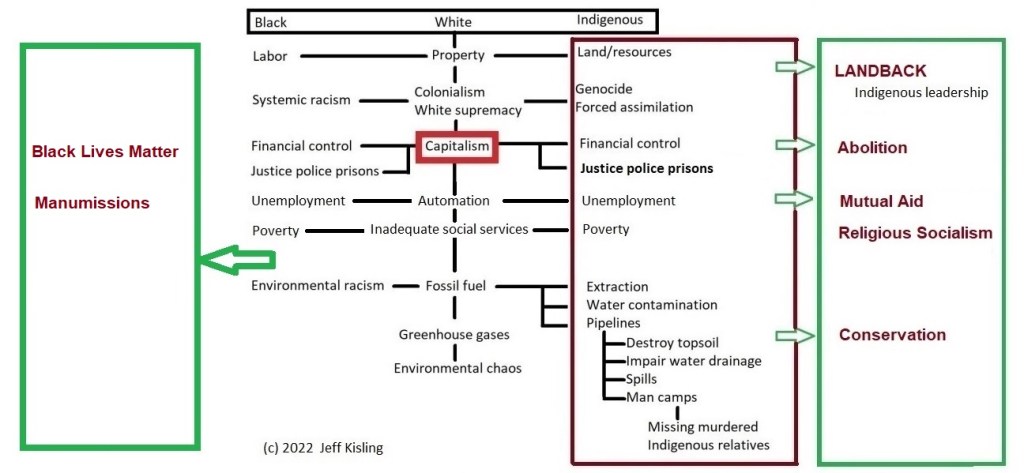
As environmental chaos deepens, with the resulting collapse of the colonial capitalist economic system and the political systems propping up white supremacy fail, we will have no choice but to find alternatives. Ideally those would be Mutual Aid and LANDBACK. This is a powerful incentive to embrace these concepts now.
Mutual Aid and LANDBACK
In the same way I can’t understand the involvement of many Quakers in the slave trade, and having enslaved people, I can’t understand Quaker’s involvement in forced assimilation of native children.
What does this mean for Quakers today? No matter what we say about justice for BIPOC (Black, Indigenous, and other people of color) folks, those words are empty as long as we continue to take advantage of colonial capitalism and white supremacy.
The news of 215 Kamloops Native children buried on the grounds of a residential school shocked non-native people, who did not know how many of these residential schools existed in the lands called the United States and Canada. Did not know tens of thousands of Native children were forcibly removed from their families and taken to these institutions where thousands were abused in many ways. Thousands killed or died. Though the stated reason for doing this was to assimilate Native children into white society for their benefit, the real intent was to quell Indigenous resistance to the theft of their land by white settler colonists.
The growing numbers of remains found at other schools has re-opened deep wounds in Native communities. Many have been triggered by these atrocities. One of my Native friends wrote that she was NOT OK. Another told me, “I’m trying not to be enraged in my mourning.”
A Native friend also told me, “The church is the church’s past, which is its future. It continues to see my people as obstacles in its endless conquest. To be blunt, there is too much damage that the church profits from and needs to protect to have any future there.” Vigorous attempts are made to hide it, but history does not lie. He also told me, regarding what I had been telling him about my efforts with Quakers, “I wish you the best. I imagine it’s a hard struggle.”
I cannot face my BIPOC friends if I don’t continue to seek the Spirit, and act on the leadings I am given. Writing is one thing I am led to do.
“Don’t make orphans stand here covered in the blood of our parents and explain to you how this all came to be without doing something about it. “
I am so grateful to my BIPOC friends for teaching me that Mutual Aid and LANDBACK are alternatives to colonial capitalism and white superiority. LANDBACK is how to restore Native lands and leadership.
As environmental chaos deepens, with the resulting collapse of the colonial capitalist economic system and the political systems propping up white supremacy, we will have no choice but to find alternatives. Ideally those would be Mutual Aid and LANDBACK. This is a powerful incentive to embrace these concepts now.
I wrote the following epistle that is modeled from ‘An Epistle to Friends Concerning Military Conscription’
An Epistle to Friends Regarding Community, Mutual Aid and LANDBACK
Dear Friends,
The measure of a community is how the needs of its people are met. No one should go hungry, or without shelter or healthcare. Yet in this country known as the United States millions struggle to survive. The capitalist economic system creates hunger, houselessness, illness that is preventable and despair. A system that requires money for goods and services denies basic needs to anyone who does not have money. Black, Indigenous, and other people of color (BIPOC) are disproportionately affected. Systemic racism. The capitalist system that supports the white materialistic lifestyle is built on stolen land and genocide of Indigenous peoples, and the labor of those who were enslaved in the past or are forced to live on poverty wages today.
Capitalism is revealed as an unjust, untenable system, when there is plenty of food in the grocery stores, but men, women and children are going hungry, living on the streets outside. White supremacy violently enforces the will of wealthy white people on the rest of us.
It has become clear to some of us who are called Friends that the colonial capitalist economic system and white supremacy are contrary to the Spirit and we must find a better way. We conscientiously object to and resist capitalism and white supremacy.
capitalism has violated the communities of marginalized folks. capitalism is about the value of people, property and the people who own property. those who have wealth and property control the decisions that are made. the government comes second to capitalism when it comes to power.
in the name of liberation, capitalism must be reversed and dismantled. meaning that capitalistic practices must be reprogrammed with mutual aid practices. Des Moines Black Liberation Movement
Mutual Aid
How do we resist? We rebuild our communities in ways not based upon money. Such communities thrive all over the world. Indigenous peoples have always lived this way. White people once did so in this country. Mutual Aid is a framework that can help us do this today.
The concept of Mutual Aid is simple to explain but can result in transformative change. Mutual Aid involves everyone coming together to find a solution for problems we all face. This is a radical departure from “us” helping “them”. Instead, we all work together to find and implement solutions. To work together means we must be physically present with each other. Mutual Aid cannot be done by committee or donations. We build Beloved communities as we get to know each other. Build solidarity. An important part of Mutual Aid is creating these networks of people who know and trust each other. When new challenges arise, these networks are in place, ready to meet them.
Another important part of Mutual Aid is the transformation of those involved. This means both those who are providing help, and those receiving it.
With Mutual Aid, people learn to live in a community where there is no vertical hierarchy. A community where everyone has a voice. A model that results in enthusiastic participation. A model that makes the vertical hierarchy required for white supremacy impossible.
Commonly there are several Mutual Aid projects in a community. The initial projects usually relate to survival needs. One might be a food giveaway. Another helping those who need shelter. Many Mutual Aid groups often have a bail fund, to support those arrested for agitating for change. And accompany those arrested when they go to court.
LANDBACK
The other component necessary to move away from colonial capitalism and white supremacy is LANDBACK.
But the idea of “landback” — returning land to the stewardship of Indigenous peoples — has existed in different forms since colonial governments seized it in the first place. “Any time an Indigenous person or nation has pushed back against the oppressive state, they are exercising some form of landback,” says Nickita Longman, a community organizer from George Gordon First Nation in Saskatchewan, Canada.
The movement goes beyond the transfer of deeds to include respecting Indigenous rights, preserving languages and traditions, and ensuring food sovereignty, housing, and clean air and water. Above all, it is a rallying cry for dismantling white supremacy and the harms of capitalism.
Returning the Land. Four Indigenous leaders share insights about the growing landback movement and what it means for the planet, by Claire Elise Thompson, Grist, February 25, 2020
What will Friends do?
It matters little what people say they believe when their actions are inconsistent with their words. Thus, we Friends may say there should not be hunger and poverty, but as long as Friends continue to collaborate in a system that leaves many without basic necessities and violently enforces white supremacy, our example will fail to speak to mankind.
Let our lives speak for our convictions. Let our lives show that we oppose the capitalist system and white supremacy, and the damages that result. We can engage in efforts, such as Mutual Aid and LANDBACK, to build Beloved community. To reach out to our neighbors to join us.
We must begin by changing our own lives if we hope to make a real testimony for peace and justice.
We remain, in love of the Spirit, your Friends and sisters and brothers,
Note: Modeled from ‘An Epistle to Friends Concerning Military Conscription’
I wrote a series of posts related to Whiteness and Quakers:
Following are Native American updates from the Friends Committee on Legislation (FCNL).
Seeking Truth, Healing, and Right Relationship: Quakers and the Legacy of Indian Boarding Schools MAY 25, 2022, 5:30 – 6:30 PM Central, ONLINE
FCNL and Friends advocate in solidarity with Indigenous peoples. Yet, historically, Quakers played a role in colonization and the cultural genocide of Native people through the operation of more than 30 Indian boarding schools. With legislation now before Congress to investigate the legacy of Indian boarding schools, how are Friends communities engaging to address Quaker complicity in these atrocities?
Join us on Weds. May 25 at 6:30 p.m. EDT to learn how FCNL and F/friends are reckoning with this history and advocating in solidarity with Native communities.
In conversation with Paula Palmer and Jerilyn DeCoteau, FCNL’s Congressional Advocate for Native American Advocacy Portia Kay^nthos Skenandore-Wheelock will discuss FCNL’s work to build support for the bipartisan Truth and Healing Commission on Indian Boarding School Policies in the United States Act (S. 2907/H.R. 5444). Paula and Jerilyn will share from their expertise and experience co-directing Towards Right Relationship with Native Peoples with Friends Peace Teams. Director of Quaker Leadership Alicia McBride will moderate the conversation.
Reauthorize FVPSA with Critical Support for Tribal Domestic Violence Programs
The Family Violence Prevention and Services Improvement Act (FVPSA) is the primary federal grant program for domestic violence shelter and supportive services. This is especially significant for tribal communities, which deal with domestic and sexual violence at unparalleled rates.
FVPSA will help all tribes provide culturally appropriate and life-saving prevention and treatment resources for their citizens by funding domestic violence programs, shelters, hotlines, resource centers in Alaska and Hawaii, and tribal coalitions. In short, FVPSA is a key piece of legislation to address the crisis of Missing and Murdered Indigenous People.
The House passed their bill (H.R. 2119) in October 2021, but the Senate has yet to vote on their version (S. 1275).
Remind your senators of their responsibility to tribal nations and urge them to pass the Family Violence Prevention and Services Improvement Act.
Historic Funding for Tribal Nations in FY 2023 Budget Proposal
For the first time in history, the president’s budget process included direct consultations with tribal nations. As a result, President Joe Biden’s FY 2023 budget proposal includes increased funding for tribal nations and programs. Notably, it would also significantly invest in the stabilization of the entire tribal healthcare system.
By recategorizing Indian Health Service (IHS) funding as mandatory rather than discretionary spending, IHS funding would automatically keep pace with increasing healthcare costs and population growth. This change would gradually close longstanding shortfalls, address backlogs and inequities, and modernize record systems. The budget proposal recommends $9.1 billion in mandatory funding for tribal healthcare.
“This proposal is a historic step forward towards securing adequate, stable, and predictable funding to improve the overall health status of American Indians and Alaska Natives,” said IHS Acting Director Elizabeth Fowler. “It also ensures we never repeat the disproportionate impacts experienced during the pandemic…and acknowledges the need to implement long-term solutions to address IHS funding challenges, which contribute to the stark health disparities faced by American Indian and Alaska Native people.”
Other wins in the budget proposal include increased funding for tribal programs in general, Violence Against Women Act programs, and the Federal Indian Boarding School Initiative.
Interior Department Reverses Nearly 50 Year Obstacle to Tribal Water Rights
On April 7, Interior Secretary Deb Haaland reversed the Morton Moratorium, a 1975 memorandum directing the Bureau of Indian Affairs to disapprove tribal regulation of water use on reservations. With this change, tribes requiring secretarial approval of tribal water codes will be able to better regulate and protect waters on tribal lands.
“If we are to truly support tribal self-determination, we cannot be afraid to review and correct actions of the past that were designed to create obstacles for tribal nations,” said Haaland. The Interior Department will hold tribal consultations for guidance on an improved review process for tribal water codes.
I am grateful for many things this morning. For the waters falling from the sky. For my Mutual Aid friends who demonstrate what a Beloved community is. For the Buffalo Rebellion, growing a movement for climate action that centers racial and economic justice. Thankful for my Quaker communities. I give thanks to the Spirit.
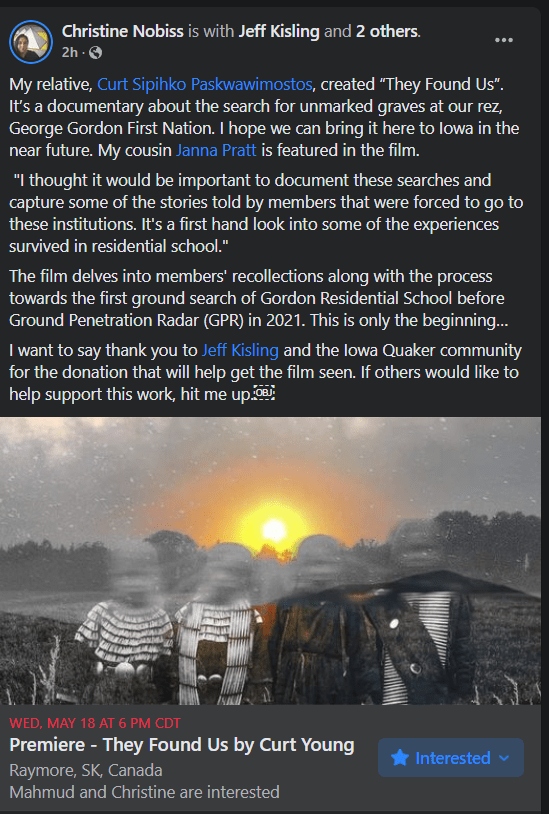
I am grateful for my Indigenous friends. Humbled by the grace they have shown me and other white people as we seek ways to heal from the horrendous history of white supremacy and forced assimilation, abuse, and death of thousands of Native children. As we search for ways to deal with the present, ongoing injustices. The intergenerational trauma. Ripping open deep wounds as the remains of children are located. As the title of this new documentary says, “They Found Us”.
Growing up I heard references to Quakers who worked in the residential schools. I was told they were helping the Native children adjust to living in white society. I didn’t have the awareness to question why that was not a good thing.
I’ve had a life-long concern about environmental devastation. I grew up on farms. When I moved to Indianapolis in 1970, I was horrified by the dense, noxious fumes from every tailpipe, making it difficult to even see. This was before catalytic converters hid the damage being done. I was led to refuse to own a car.
It was obvious Indigenous peoples lived in sustainable ways.
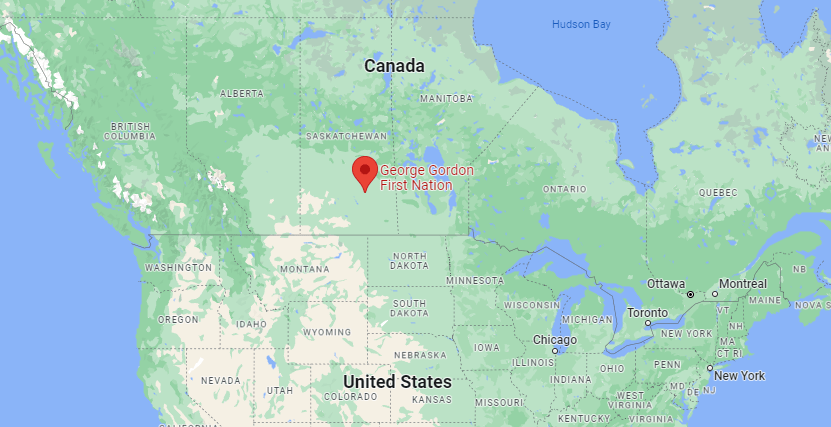
To pull this all together, here is the link to a recent blog post, Midwest Quakers and Native Peoples, which describes how I was blessed to become friends with Indigenous folks in the Midwest and the history of some of the work we’ve done together. It also talks about the Indian Residential Schools and includes a letter from Curt Young, member of George Gordon First Nation, describing the documentary he created, “They Found Us”. Sikowis is also a member of George Gordan First Nation.
“I thought it would be important to document these searches and capture some of the stories told by members that were forced to go to these institutions. It’s a first hand look into some of the experiences survived in residential school.”
Curt Sipihko Paskwawimostos, creator of “They Found Us”.
Sikowis (Christine) Nobiss is one of my close Indigenous friends. We’ve discussed the residential schools, briefly, a few times. I was glad she felt she could ask me if Quakers would help pay for expenses to travel with the film for viewing in a number of communities. She later told me it was difficult for her to ask for funds.
I am clerk of the Peace and Social Concerns Committee of Iowa Yearly Meeting (Conservative). Our committee has a budget of $1,100 to support justice work. In the past we sent $50 or $100 to a number of such organizations. Someone suggested instead sending a larger amount for one or two projects. We decided to do that but didn’t have a project in mind when we were meeting last summer.
I believed the Spirit would show us the way. The request for “They Found Us” seemed to be what we were waiting for. Our committee met to discuss and unanimously approve this. I’m grateful and humbled for that, as well.
Additional funds would be helpful. Please contact me if you are interested. jakislin@outlook.com
I pray and think about the past a lot. I cannot feel it, but I see some of the impacts of trauma from the past on my friends’ lives today. The intergenerational trauma. A number of White Quakers in the past were involved in the institution of slavery, the theft of land from Indigenous peoples, and/or the forced assimilation of Native children.
This morning I came across the term “intergenerational transformative justice”. “As we deal with the uncomfortable truths of our White Quaker ancestors, we release them from the amber in which our myths have captured them. “
The myths we tell ourselves and the lies those myths uphold are embedded in our contemporary faith practice. When we believe and perpetuate falsehoods about ourselves, it not only disconnects us from the truth, it also limits our ability to act with full integrity today. Telling the truth about ourselves and our White Quaker ancestors grounds us in reality, in a sense of the complexity of our identity. It allows us to create a different future, not built from delusion and half of the story but from an honest and grounded reckoning with who we are and who we have been. My friend Mila Hamilton calls this “intergenerational transformative justice.” As we deal with the uncomfortable truths of our White Quaker ancestors, we release them from the amber in which our myths have captured them. As we allow them to become the full, flawed humans they were, we also free ourselves to reckon with our present, which arises from their past, and to tell the full truth of who we are.
Friends Journal senior editor Martin Kelley speaks to my friend, Quaker preservationist Avis Wanda McClinton about her work as a community liaison to Haverford College’s “Manumitted: The People Enslaved by Quakers.”
A manumission is a legal document that promises to free someone who is enslaved. In this context, we’re talking about American chattel slavery. Manumission has existed in many different forms of slavery, generally referring to the freeing of an enslaved person. But in this context, it’s specifically in the Americas with stolen African people.
Manumissions are often standard sizes of paper, maybe half sheets at times. It might be a normal-sized piece of paper with two manumissions, one on the top and another on the bottom.
They are promising to free someone, either immediately or in the future. There aren’t a lot of details on whether that promise was ever fully completed or not. These records were turned over to the yearly meetings and the quarterly meetings, which is why we have them. And so at least in that regard, there was some sort of process that Quaker members would go through, in order to demonstrate to their meeting that they were in agreement with the rules.
I had forgotten Bayard Rustin had been incarcerated for draft resistance. He joins the list of those who have written about their prison experiences such as Henry David Thoreau and Martin Luther King, Jr.
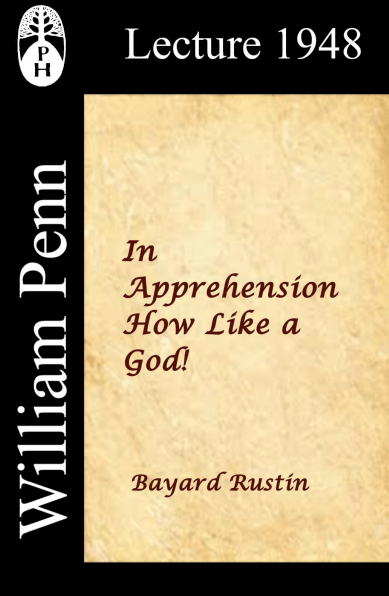
In March 1948, Bayard T. Rustin, in his capacity as secretary of FOR’s Racial-Industrial Department, was honored with the opportunity to deliver the William Penn Lecture as part of the Young Friends Movement of Philadelphia Yearly Meeting. Since its inception in 1916, the William Penn Lecture had been given by several Quaker luminaries. The lecture, titled “In Apprehension How Like a God” (drawing on Shakespeare’s Hamlet), touched on many Quaker values but, more importantly, the moral and pragmatic lessons Rustin had learned while incarcerated for two years in Kentucky and Pennsylvania federal prisons for refusing induction into the military.
In his lecture, Rustin reminded Friends of the need to uphold their moral responsibility with integrity as individuals and within the broader community whenever witnessing and confronting domestic or global social injustices. Rustin implored Friends toward consistency and truthfulness in the face of violence, war, and oppression.
In the magazine, Ithaca College’s Carlos Figueroa looks back at an important talk Bayard Rustin gave to the young Friends association in Philadelphia in 1948. It was a pivotal moment in a life that contained so many: Rustin had spent the early 1940s organizing with the Fellowship of Reconciliation and was recently released from a prison term for violating the Selective Service Act. This was his opportunity to lay out a pacifist politics for the Cold War era:
Rustin explicitly sought to persuade others into considering civil disobedience as a social democratic strategy for pursuing structural and policy change. Rustin advocated for a humanitarian, communal, and moralistic approach to change, thus disregarding an individual’s political affiliation, geographic location, or government system.
Rustin explicitly sought to persuade others into considering civil disobedience as a social democratic strategy for pursuing structural and policy change.
From the introduction of the QuakerSpeak video below: As a gay African-American, civil rights activist Bayard Rustin faced discrimination his entire life—sometimes, Walter Naegle reminds us, among his fellow Friends. Walter, Rustin’s partner and companion in his final decades, discusses his vital contributions to Quaker testimony of peace, integrity and equality.
“Bayard believed in the oneness of the human family, in the brotherhood and sisterhood of all people,” Walter says. “He believed in the power of nonviolence which comes out of that belief in the oneness of all people.… He saw everybody as equal in the eyes of the divine.”
“I put my life on pause, rewound, now I’m pressing play. The come up, grinding until the sun up, knowing it could all be gone if one person puts their guns up. A black Quaker no savior, I’m on my Bayard Rustin to convince all the skeptics and get people to just trust em.”
Sterling Duns
I’m reminded of a teach-in by my friend Ronnie James, The Police State and Why We Must Resist. “As bleak as this is, there is a significant amount of resistance and hope to turn the tide we currently suffer under.”
I’ve been working on this post for days, which is unusual. Not quite sure how these seemingly disparate parts fit together. In part because there will increasingly be direct actions related to environmental devastation. I’ll be attending a Climate Summit this weekend, which will include training for and participation in direct action.
The purpose of this brief history is background for a request from Sikowis (Christine) Nobiss for funds to support the documentary “They Found Us” that’s being done about her reservation’s residential school. George Gordon First Nation had the longest running residential school, which didn’t close until 1996.
During the 2017 annual sessions of Iowa Yearly Meeting (Conservative) there was panel discussion about building bridges with native peoples. The panel consisted of Peter Clay, an Iowa Friend, Donnielle Wanatee from the Meskwaki Settlement, and Sikowis (Christine) Nobiss, one of the most active Indigenous leaders in the Midwest. All three have played a large role in my connections with Native Americans since.
In February 2018, I was part of a group who went to Minneapolis to protest US Bank’s funding of oil pipelines. Sikowis spoke at that gathering.
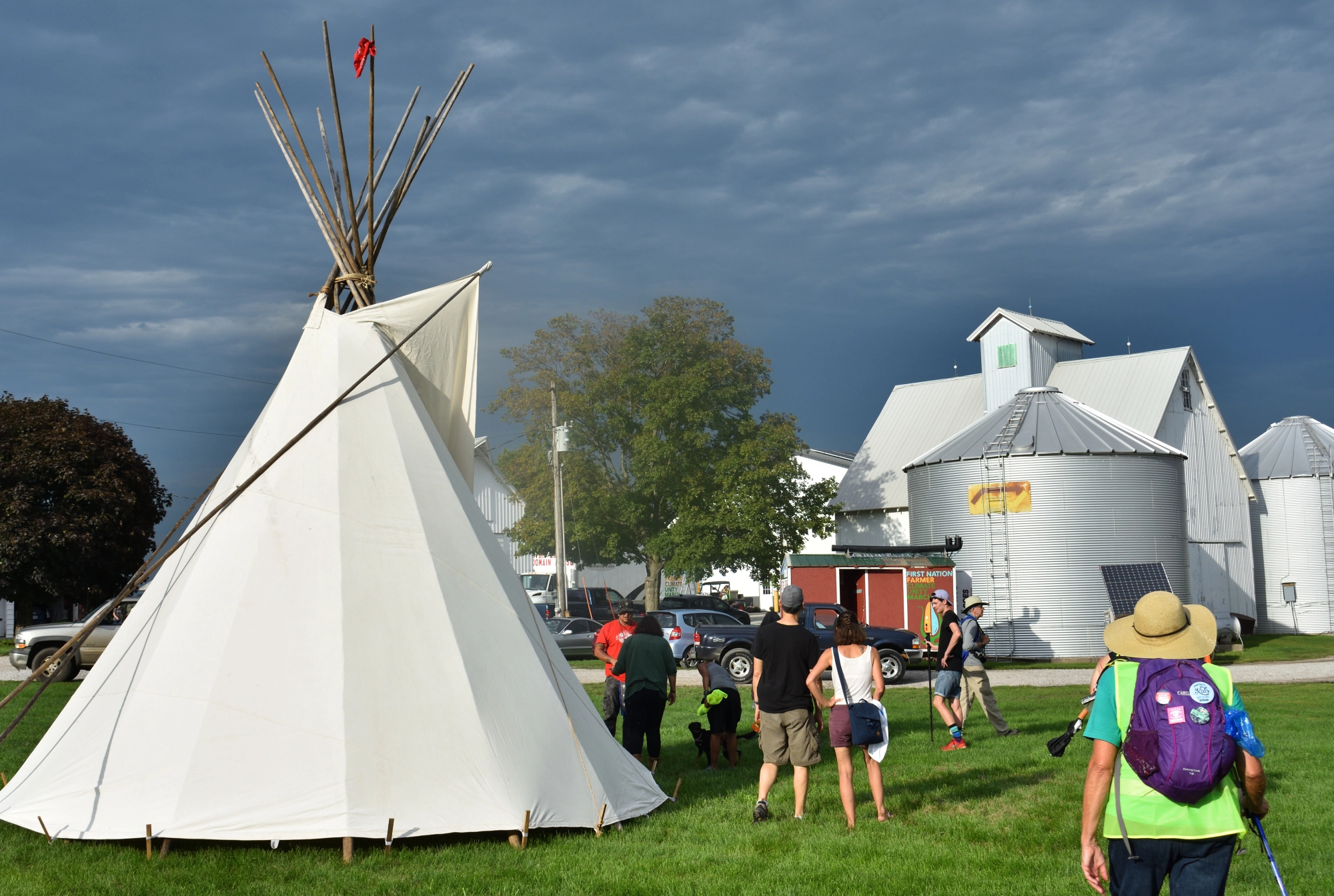
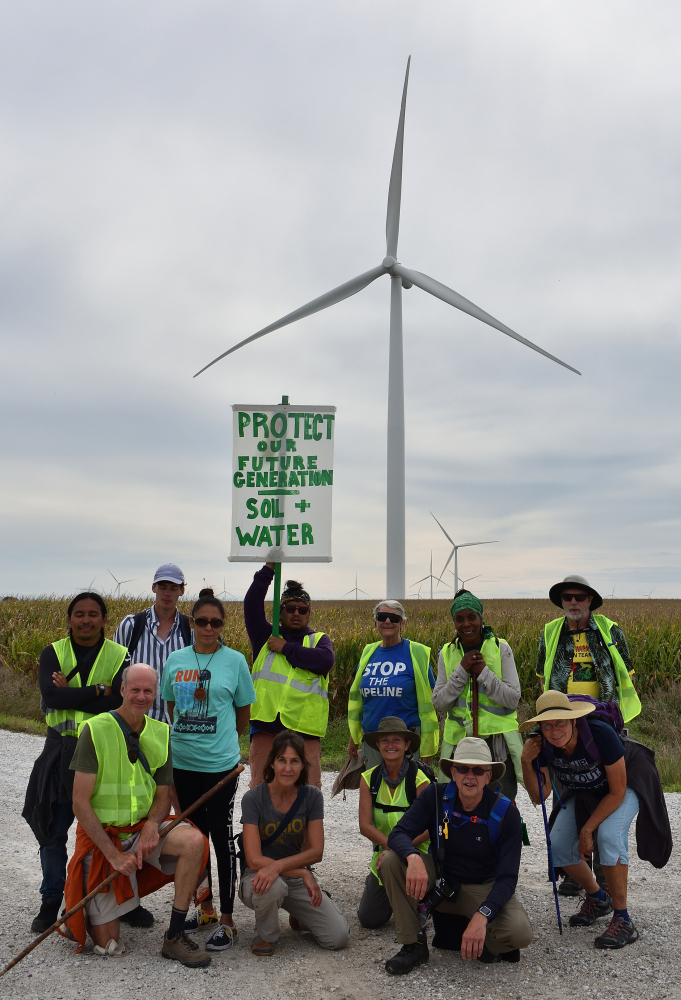
I began to get to know Sikowis when she and I were among a small group of native and non-native people who walked and camped for eight days along the route of the Dakota Access pipeline, from Des Moines to Fort Dodge, Iowa. Iowa Friend Peter Clay was also on this First Nation-Farmer Climate Unity March. Jon Krieg (AFSC) joined us for the first day. And my Scattergood School roommate Lee Tesdell participated in one of the evening discussions during the March. Another Iowa Yearly Meeting Friend, Liz Oppenheimer, organized a time of worship sharing and prayer among Friends each morning, supporting our sacred journey.
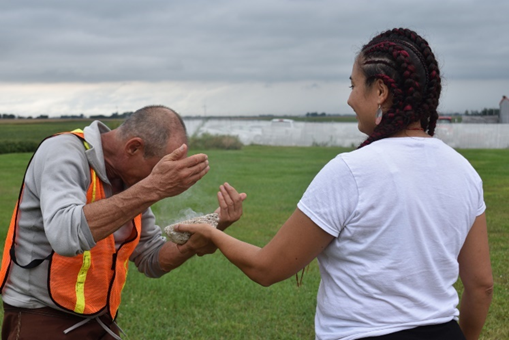
In this photo during the March Sikowis is holding the bowl Peter Clay is smudging from.
The purpose of the March was to create a community of native and non-native people who began to know and trust each other so we could work on things of common concern. That was highly successful, and we have done a number of things together since.
One of the first was when several of us from the March, including Sikowis (in the center of this photo), Iowa Friends Shazi and Fox Knight, and I lobbied Senator Grassley’s staff to support several bills related to native concerns.
Lobbying Iowa Senator Grassley about native legislation
The summer of 2019 Sikowis suggested I attend the National Network Assembly at the Des Moines YMCA Camp near Boone, Iowa, that she helped organize. I was aware that if I wanted to build on relationships with native peoples, I should wait to be invited. Seeing this as one of those opportunities, I did attend.
In early 2020, I began to hear about the struggles of the Wet’suwet’en peoples in British Columbia, as they worked to prevent the construction of a liquid natural gas pipeline (Costal GasLink) through their pristine lands and waters. There was little being written about this in the mainstream media, so supporters were asked to write about what was happening on our social media platforms.
This photo is from a post about a rally I organized to support the Wet’suwet’en in Des Moines on February 7, 2020. Iowa Friend Peter Clay attended.
I’m convinced the Spirit led Ronnie James to come to this rally. Ronnie is an Indigenous organizer with twenty years of experience. He was surprised anyone in Iowa knew about the Wet’suwet’en, so he came to see who we were. Since that day Ronnie has been patiently mentoring me about Des Moines Mutual Aid. Including helping me become involved in the food giveaway project. We’ve become good friends.
This relates to my relationship with Sikowis because Ronnie is a member of the Great Plains Action Society (GPAS) that she organized for Indigenous activism in the Midwest. Several other friends I made during the First Nation-Farmer Climate Unity March also work at Great Plains Action Society.
As often happens, once people know I love photography, I get invited to events for that purpose (even though I’d want to go, anyway). This photo of Sikowis was taken at last year’s Indigenous People’s Day. She’s holding a Great Plains Action Society bag.
Sikowis Nobiss
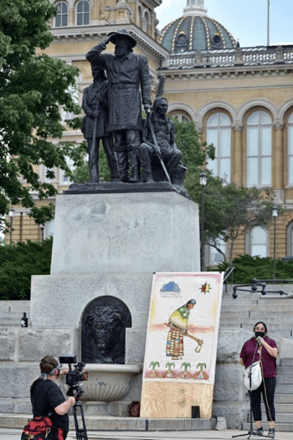
Another event where I took photos was a gathering on the State Capitol grounds related to racist statues. In this photo Sikowis is speaking at the Pioneer statue.
Sikowis Nobiss
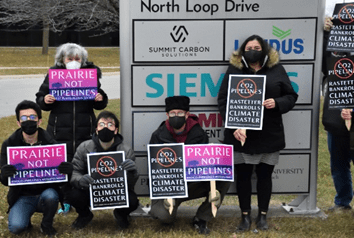
Last December, Sikowis asked me to come to Ames for a rally at the office of Summit Carbon, one of the companies that want to build a CO2 pipeline.
Residential institutions of forced assimilation
The legacy of what are sometimes called Indian Boarding Schools has been a concern of mine for years. The involvement of Quakers in establishing and teaching in these institutions has become a source of tension and conflict among Quakers today. I think my past ignorance about these institutions was common for Quakers, thinking Friends involved in those schools were doing the best they could to help native children assimilate into mainstream American society. Not critically thinking why that would be a good thing. But we began to learn more about the great harm this did to native children and their families. And that was before learning about the widespread emotional, physical and sexual abuse of the children.
I was led to make this something I needed to learn more about. And share what I was learning with Quakers and others. Friend Paula Palmer, who has become a friend of mine, was called to a ministry related to these institutions and Quaker’s involvement in them. Peter Clay and I helped organize events among Iowa Friends, Conservative and FUM, when Paula came to the Midwest.
Prior to the First Nation-Farmer Climate Unity March I was unsure whether I should bring up the subject of forced assimilation, especially as I had learned more about trauma from those institutions being passed from generation to generation. I had hoped to learn about Indigenous spirituality on the March but didn’t see how that could happen without acknowledging Quakers’ involvement in forced assimilation.
Matthew and I began to get to know each other early in the March because he was shooting video of the same things I was taking photos of. We shared quite a bit about this common interest. I believe it was the second day of the March as we were walking and talking together that the Spirit led me to tell him I knew about the Quaker involvement in the residential schools, and I was sorry for what had happened. Of course, I had no idea how he would react. But all he did was nod his head, and we continued to walk and talk together. I didn’t say anything else about that.
But just a few hours later he said he wanted to tell me a story. It involved a traumatic incident related to his mother and the residential schools. I was so grateful he felt he could share that with me. We didn’t talk about that any further.
Since then, when it seemed appropriate, I brought up Quaker involvement in the boarding schools with each of my native friends. Each one had personal experiences related to the schools. I believe that it was an important part of our developing friendships that we shared these stories.
Sikowis told me briefly of family members who had experienced traumas from those institutions. We had that brief discussion several years ago.
I believe this is in part why she invited me to ask Quakers if we would help support making a documentary about her reservation’s (George Gordon First Nation) residential school.
Iowa Yearly Meeting (Conservative)’s Peace and Social Concerns Committee has an annual budget to support peace and justice work. This year it was decided that rather than give token amounts to various peace and justice organizations, we might discern to invest a larger sum, for a more significant impact, to an organization or project. But we didn’t know what that would be.
This request from Sikowis is an opportunity to build on Iowa Yearly Meeting (Conservative)’s relationship with Indigenous peoples in the Midwest. An opportunity to begin truth and healing.
I’m pleased the Peace and Social Concerns Committee unanimously supports using our budget to support the documentary that’s being done about the George Gordon First Nation’s residential school.
March 27, 2022
This letter in regards to a request for financial support for a documentary title “They Found Us”, to support community presentations of this film that I produced.
My name is Curt Young and I a member of the George Gordon’s First Nation. I am a descendant of Mike Longman, along with my mother Longman-Young; both members of this nation. The development of this documentary was an intent for myself to learn more about my maternal familial lineage, as I had not grown up on GGFN and wanted more connections to my cultural heritage. I applied for the “Peoples Investment Grant”, while residing in Calgary and was a successful candidate. These funds were intended to financially support a compilation of Elder’s narratives, however, during the initial interviews, the findings of the 215 bodies outside of the Kamloops residential schools, inspired myself to change the direction of the documentary. I decided to focus more on the process that GGFN reserve’s undertaking of a ground search outside of the local residential school; to see if there were any unmarked graves or bodies buried there.
Over the past year, I have made three trips to GGFN to obtain footage of the community’s initial activities related to the ground search of the area. Aside from the footage of the community, I also have compiled interviews from GGFN members, and other Indigenous people, including leaders and Elders, that have shared their own narratives and experience with residential schools. The budget that I was provided by the grant I received was allocated to travel costs associated with these trips to GGFN, along with the rental of video technological equipment, necessary to create the documentary. I have spent time and effort into producing this documentary and have been promoting it through various online platforms, along with connections I have within Indigenous communities, both urban and rural. I have much interest in public showings of this documentary, particularly since June is coming up, with it being National Indigenous Peoples month. One showing that I have confirmed is the first week of June; at Fort Calgary. Although I am quite excited for the interest and opportunities, I would like to honour my home community and acknowledge the stories that are compiled in my documentary, by having the first public showing of “They Found Us” on GGFN.
In order for myself to bring the documentary to GGFN I am requesting funds to support my travel, accommodation and honorarium for traditional drummers and possibly a dancer to create a healing and culturally safe space for a community show. My first showing that I have booked for this documentary is June 4, 2022, thus, I am asking to have funds to showcase the documentary on GGFN prior to this date.
My friend Sikowis (Christine) Nobiss is raising money for a documentary that’s being done about her reservation’s residential school. George Gordon First Nation had the longest running residential school, not closing until 1996.
My relative is working to raise funds for his documentary on elders and the history of the residential school at George Gordon First Nation, which is my nation. He needs to make multiple trips throughout the plains and to GGFN and set up viewing events for the documentary, which will cost around $7,000 CAD. If there are any folks in your community interested in helping him attain this goal, please let me know. Thank you.
As described in the following letter, the project was originally for a compilation of Elder’s narratives. But during the initial interviews, the findings of the 215 bodies outside the Kamloops residential school changed the direction of the documentary. To focus on the process that George Gordon’s First Nation was undertaking related to the unmarked graves or bodies at the GGFN reserve’s residential school.
March 27, 2022
This letter in regards to a request for financial support for a documentary title “They Found Us”, to support community presentations of this film that I produced.
My name is Curt Young and I a member of the George Gordon’s First Nation. I am a descendant of Mike Longman, along with my mother Longman-Young; both members of this nation. The development of this documentary was an intent for myself to learn more about my maternal familial lineage, as I had not grown up on GGFN and wanted more connections to my cultural heritage. I applied for the “Peoples Investment Grant”, while residing in Calgary and was a successful candidate. These funds were intended to financially support a compilation of Elder’s narratives, however, during the initial interviews, the findings of the 215 bodies outside of the Kamloops residential schools, inspired myself to change the direction of the documentary. I decided to focus more on the process that GGFN reserve’s undertaking of a ground search outside of the local residential school; to see if there were any unmarked graves or bodies buried there.
Over the past year, I have made three trips to GGFN to obtain footage of the community’s initial activities related to the ground search of the area. Aside from the footage of the community, I also have compiled interviews from GGFN members, and other Indigenous people, including leaders and Elders, that have shared their own narratives and experience with residential schools. The budget that I was provided by the grant I received was allocated to travel costs associated with these trips to GGFN, along with the rental of video technological equipment, necessary to create the documentary. I have spent time and effort into producing this documentary and have been promoting it through various online platforms, along with connections I have within Indigenous communities, both urban and rural. I have much interest in public showings of this documentary, particularly since June is coming up, with it being National Indigenous Peoples month. One showing that I have confirmed is the first week of June; at Fort Calgary. Although I am quite excited for the interest and opportunities, I would like to honour my home community and acknowledge the stories that are compiled in my documentary, by having the first public showing of “They Found Us” on GGFN.
In order for myself to bring the documentary to GGFN I am requesting funds to support my travel, accommodation and honorarium for traditional drummers and possibly a dancer to create a healing and culturally safe space for a community show. My first showing that I have booked for this documentary is June 4, 2022, thus, I am asking to have funds to showcase the documentary on GGFN prior to this date.















 Quakers and Mutual Aid