And that has made all the difference

This morning my spirit was restless. I wasn’t led to what to write. Those who know me know I have a pretty rigid practice of trying to write first thing in the morning. If I don’t, I can rarely write later in the day. I get distracted by the busy-ness of life. And it doesn’t work to try to force myself to write if I’m not clear about what the subject might be.

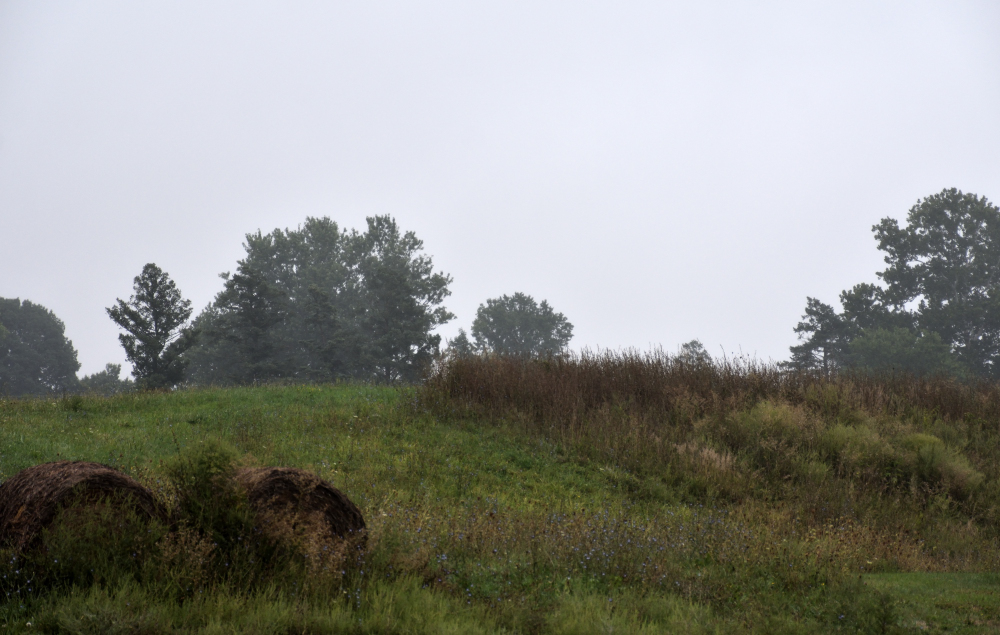
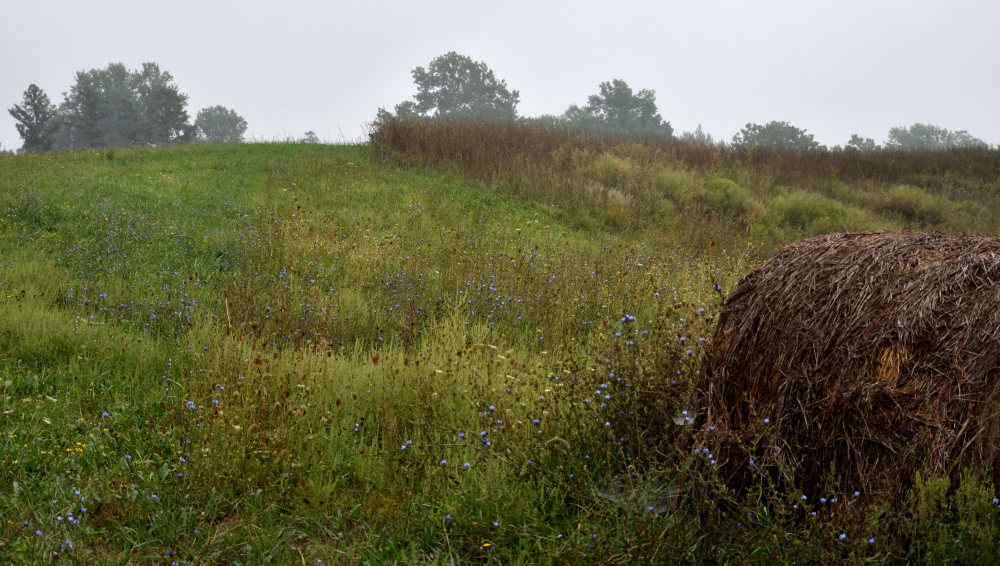
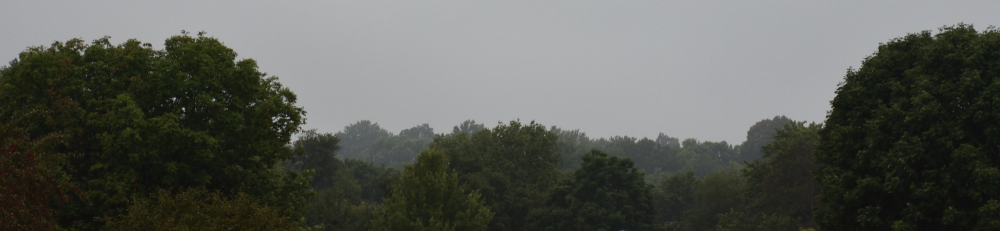
It was a little foggy out this morning and I loved to try to capture photos of that. Even though, or perhaps because, such images are a challenge to capture. So, I took the photography/nature path instead of trying to write. Some of today’s photos are at the end of this.

My Spirit was happy as we traveled together.

I had taken the phrase “the road not taken” literally. Often as I hike and walk, I’m presented with a choice of which way to go.

But of course, that can apply to many other choices. The two roads at the beginning of this day were writing or walking.

I took the road less traveled by, and that has made all the difference.

There have been many times taking the road less traveled by made “all the difference” in my life. Deciding to resist the draft, joining Friends Volunteer Service, choosing to work in neonatal intensive care, and then doing research in the Infant Pulmonary Function Lab. Learning computer programming. Being on the General Committee of FCNL. Connecting with the Kheprw Institute. Joining communities to protect the water including the Keystone Pledge of Resistance and Dakota Access pipeline. Getting in a van of fifteen people I didn’t know to go the Minneapolis on a snowy day to cut off the head of the black snake. Walking and camping ninety four miles with native and nonnative people. Learning to be clerk of peace and social concerns, and more recently Bear Creek Friends meeting. Joining Des Moines Mutual Aid. Many of those were difficult choices for a variety of reasons at the time. But every time they made all the difference.


Two roads diverged in a yellow wood,

And sorry I could not travel both
And be one traveler, long I stood
And looked down one as far as I could
To where it bent in the undergrowth;

Then took the other, as just as fair,
And having perhaps the better claim,
Because it was grassy and wanted wear;
Though as for that the passing there
Had worn them really about the same,

And both that morning equally lay
In leaves no step had trodden black.
Oh, I kept the first for another day!
Yet knowing how way leads on to way,
I doubted if I should ever come back.

I shall be telling this with a sigh
Somewhere ages and ages hence:
Two roads diverged in a wood, and I—
I took the one less traveled by,
And that has made all the difference

Robert Frost, The Road Not Taken

This reminded me of a story told by my late Quaker friend Eldon Morey.


An Established Travel Plan Suddenly Re-routed

The year was 1972.  June was begun and Eldon’s classes at the University of South Dakota that spring had concluded.  The Moreys and their two small children were en route on Highway 385 from north of Hot Springs, South Dakota headed to Rapid City. It was a long overdue vacation following two years of intense graduate study by Eldon and night-work at the Vermilion Hospital by Karen as an Emergency Room Nurse.  Money was in short supply, so the trip was a tenting excursion with reservations and a documented travel plan which had been formulated over several months.  The Rapid City Public Campground was free.  Midway between Hot Springs and Deadwood they planned to turn on Highway 16 which goes to Rapid City.  Deadwood farther to the northwest was scheduled to be visited after a short stay in Rapid City.

As they approached the turn to Highway 16, it suddenly occurred to Eldon they might change their travel plan and continue on Number 385 directly to Deadwood. So he immediately blurted-out, “Would anyone rather go directly to Deadwood and we can see Rapid City during our return trip to southeastern South Dakota?”  Karen was amazed such a sudden thought had entered Eldon’s thinking.  Such a change would nullify the dates of their camping reservations and confuse their friends who had been given a schedule of their plans should they need to be contacted.  Karen, therefore, remained silent.  The children were too small to have opinions.  By then Eldon had made the turn to Highway 16.  But, lacking family response he immediately turned the car around and re-entered Highway 385 going north.  They were headed to Deadwood!

They arrived at Deadwood in time to participate in the final public tour of the “Gold Mine” at Lead, the adjoining city.  They then searched for the campground where they had reservations for the next evening.  There was plenty of room at the campground and they soon had their tent set and an evening meal cooking. All was well.  The children were tired so all four of them took to their sleeping bags as darkness settled.

Soon thereafter it began to rain.  Oh my, how it rained.  It rained so hard the inside of the tent was coated with moisture from the condensation in the air.  Never-the-less, they slept soundly.  The rain stopped when breakfast time arrived.  So they opened the tent vents, hung the opened sleeping bags on the clothesline to dry and made breakfast.  Everything was dry and packed to resume car travel by 10 o’clock.

As they were entering the car, a fellow camper happened to walk past them.  “Oh,” he said, “I see you are leaving the campground!”  “Yes,” Eldon said, “We’re going back to Deadwood for a “look around,” and then we’ll head to Rapid City.  “Rapid City?,” the man questioned.  “You can’t go to Rapid City!”  “Why not?” Eldon replied.  “You don’t know, do you?” the man responded.

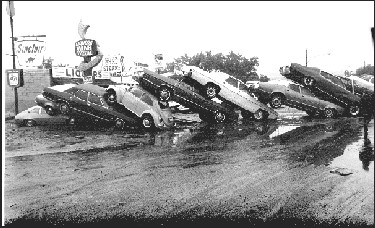
“Rapid City during the night of June 9-10, 1972 experienced one of the worst floods in the history of South Dakota.   Fifteen inches of extreme rainfall over six hours sent Rapid Creek and other waterways overflowing…  The Canyon Lake Dam became clogged with debris and failed, resulting in 238 deaths and 3,057 injuries… There were over 1,335 homes and 5,000 automobiles destroyed” (Wikipedia). They later were told a 12 foot high wall of water rushed down Rapid Creek through the center of Rapid City where the campground was located.  Everyone in the campground was drowned”

Four or five years ago Karen and Eldon visited Rapid City for the first time since the flood more than 38 years earlier.  In the Campground Park was a brass plated obelisk with the names of those people who perished the night of the flood while camping there.  There were more than thirty names on that monument.  It was a very sobering moment because the Morey’s knew their family’s four names would have been there had they not been re-directed.

A couple of years ago while en-route to Yearly Meeting, they stopped in Oelwein to visit Eldon’s aunt and his cousins. Don Avenson, one of his cousins, and he were talking about Quakerism.  Don is a former Speaker of the Iowa House of Representatives and a past Candidate for Governor.  Eldon told him the story of the Rapid City Flood and explained that many “Traditional Quakers”  are strongly “convinced” that the Divine Spirit sometimes provides “Leadings” which guide people.   Don’s comment was, “If I had been redirected to avoid Rapid City during the night of June 9, 1972, I would be a Quaker too!”   (Check Google for detailed information and photographs of the “Rapid City Flood of 1972”.)

Eldon Morey, An Established Travel Plan Suddenly Re-routed


Foggy morning 9/4/2022
First Nation-Farmer Climate Unity March Anniversary

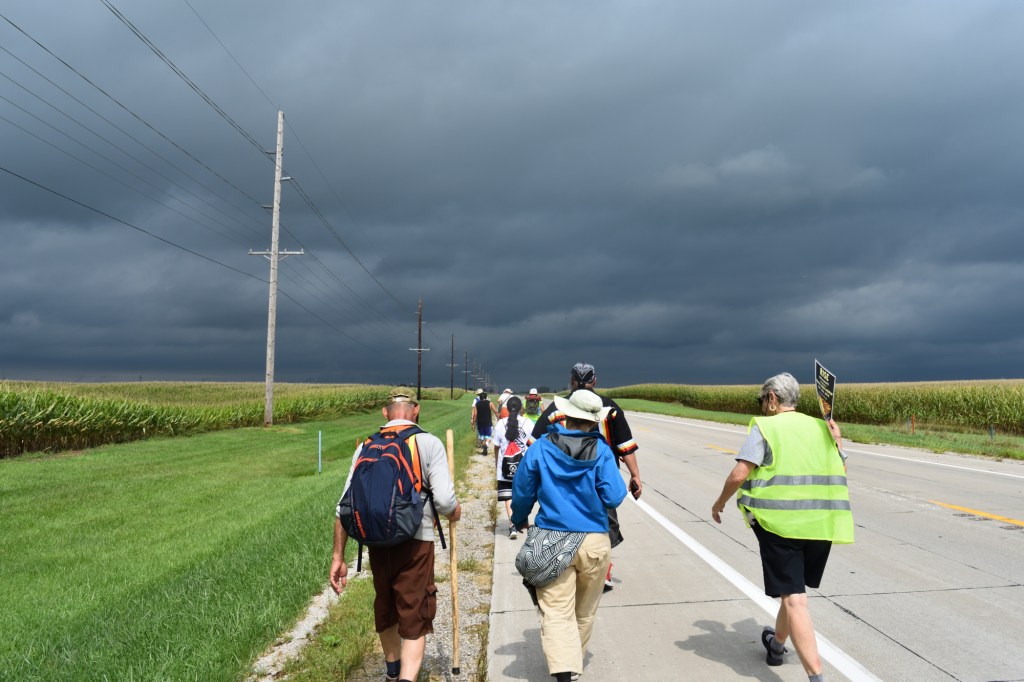
This is the fourth anniversary of the First Nation-Farmer Climate Unity March that occurred September 1-8, 2018.

One of the main goals of the March was to create a community of native and nonnative people who began to get to know and trust each other. I’m in the process of writing about the many things that happened as a result of this March. That is taking a while since so much has happened. While I continue that, I thought I’d review some of what happened during the March.


The First Nation Farmer Climate Unity March website contains extensive stories, photos, and videos.

You can view the Introduction here: https://firstnationfarmer.com/2020/04/02/introduction/

Following are stories about the first night before leaving and the first day of the March.


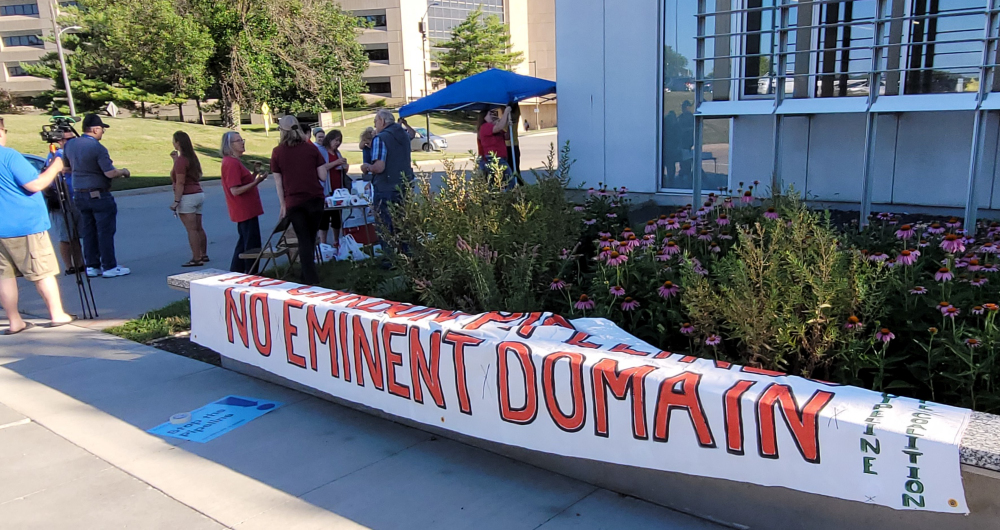
Regina Tsosie sings at the press conference at the Iowa Utilities Board regarding the improper use of eminent domain for the Dakota Access Pipeline


Rodger Routh video – Ankeny camp

Truth and Healing Commission follow up

Here are some ways you can learn more about establishing a Truth and Healing Commission on Indian Boarding Schools. And how you can add your voice to support this.

My friend Rodger Routh joined us to discuss this legislation with Senator Joni Ernst’s staff in Des Moines. And created this video to share with you about that visit.

Below that is a table of links to other articles I’ve written about this.

You can really help by using the letter template from the Friends Committee on National Legislation (FCNL) that will help you write your own letter of support. And will deliver your letter to your legislators.

Video by Rodger Routh who also lobbyed with us

Truth and Healing Commission on Indian Boarding Schools Act text
Practicing hope
Finding Accomplices, continued
Senator Ernst and Indian Boarding Schools Commission
Senator Grassley and Indian Boarding Schools Commission

Send your letter supporting the establishment of a truth and healing commission on Indian Boarding Schools using this template.

Support the Establishment of a Truth and Healing Commission on Indian Boarding Schools

It is long overdue for the United States to acknowledge the historic trauma of the Indian boarding school era. In the 19th and early 20th centuries, Christian churches collaborated with the government to create hundreds of boarding schools for Native American children. The conditions at these schools, some of them Quaker-run, were unspeakable.

Now we must work with tribal nations to advance congressional efforts to establish a federal commission to formally investigate boarding school policy and develop recommendations for the government to take further action. Although the wrongs committed at these institutions can never be made right, we can start the truth, healing, and reconciliation process for the families and communities affected as we work to right relationship with tribal nations.

Remind your members of Congress of their responsibility to tribal nations and urge them to support the Truth and Healing Commission on Indian Boarding School Policies in the United States Act (S. 2907/H.R. 5444).

Send your letter supporting the establishment of a truth and healing commission on Indian Boarding Schools.


https://mailchi.mp/nabshc.org/nabs-requesting-your-story-6167240?e=7a79e79445

7 Weeks of Action for 7 Generations! Uplifting S.2907/H.R.5444, the Truth and Healing Commission on Indian Boarding Schools Policies Act

Please Join us on September, Tuesday 13, 2022 at 3pm ET, 2pm CT, 1pm MT, 12pm PT, 11am AK & 10am HI. To learn more about the Truth and Healing Commission on Indian Boarding School Policies and how to help get it passed.
You can learn more about the commission here:
www.boardingschoolhealing.org/truthcommission

To help us to provide more events like this, please donate as you are able:
https://boardingschoolhealing.org/about-us/donate/


Senator Ernst and Indian Boarding Schools Commission

Jeff Kisling, Jean and David Hansen and Rodger Routh. Photo credit Rodger Routh

This morning Jean and David Hansen, Rodger Routh and I met with John Hollinrake, Regional Director for Iowa Republican Senator Joni Ernst. Several others had planned to join us but didn’t make it.

We expressed our appreciation for Senator Ernst voting for the Violence Against Women Act (VAWA).

I asked John if he was familiar with the Indian Boarding Schools. He indicated he had read the information I had sent from Friends Committee on National Legislation (FCNL) in emails prior to this meeting. Some of the great support we received from FCNL

John listened attentively and took notes as we told our stories and why we hope Senator Ernst will cosponsor and vote for the Truth and Healing Commission on Indian Boarding School Policies in the United States Act (S. 2907/H.R. 5444).

I spoke of why this was important to me, in part because of Quaker involvement with the residential schools.

Jean spoke from her Indigenous background, sharing from family experiences at those schools. She also spoke about the work of Quakers in those times trying to influence those emerging policies.

David spoke of hearing stories of Quakers helping in the residential schools, presented as good work. Most Friends I know were told similar stories. Now that he has been learning the truth about these institutions of forced assimilation, and the intergenerational traumas that occurred, he wants people to know the truth, and work toward healing, which is the purpose of the Truth and Healing Commission on Indian Boarding School Policies in the United States Act.

Rodger spoke of his Catholic upbringing, and the involvement of the Catholic church in many such schools in the lands called the U.S. and Canada.

John Hollinrake thanked us for coming but had no comment as to whether the Senator will co-sponsor the legislation. I followed up by emailing thanks to Mr. Hollinrake.

And submitted a Lobby Visit Report to FCNL.

We left the FCNL document “Co-sponsor the Truth and Healing Commission on Indian Boarding School Policies in the U.S. Act” with John.


We appreciated having these talking points from FCNL.


In the 19th and early 20th centuries, Christian churches collaborated with the government to create hundreds of boarding schools for Native American children. The conditions at these schools were unspeakable. Although the wrongs committed at these institutions can never be made right, we can start the truth, healing, and reconciliation process for all of us. The August congressional recess is an opportunity to educate your member of congress on the Truth and Healing Commission on Indian Boarding School Policies Act. Join us for this special training to learn how you can ensure your voice is heard during August recess.


Finding Accomplices, Continued

One of the primary reasons I embarked upon this journey about the evolution of my foundational stories was to encourage people who hadn’t been much involved in justice work to change that.

  • Injustices abound. The victims should be supported while working to address the root causes of the injustice.
  • We should search our own lives to see if and how we are contributing to injustice.
  • Spiritual guidance often leads to justice work.
  • If others observe our Spirit guided work, they may join our Quaker communities.

It is discouraging to see attendance of our Quaker meeting diminish as Friends die or move away, and few new people join. Many Friends do justice work, but that is often unseen by people in the community. This is a time of great spiritual poverty, and Quaker meetings for worship could be what some seekers are looking for. For seekers to find us, we need to be seen in our communities. And doing justice work is a way for that to happen.

The reason I’m thinking about all this now is because a group of us will be meeting with Senator Ernst’s staff in Des Moines to talk about the Truth and Healing Commission on Indian Boarding School Policies in the United States Act (S. 2907/H.R. 5444).
(See: https://quakersandreligioussocialism.com/2022/08/29/practicing-hope/)

There is a web of interrelationships among Native and non-native peoples in the Midwest that presents opportunities to work together to learn and publish the truth about Indian Boardings Schools. There are parts of this that are only appropriate for each community to work on separately. But hopefully these Congressional visits will be the beginning of further work together.

This began with an appeal from Friends Committee on National Legislation (FCNL) for us to ask our Senators to support that legislation (S. 2907). And specifically, to do this during their current recess when they would be in Iowa.

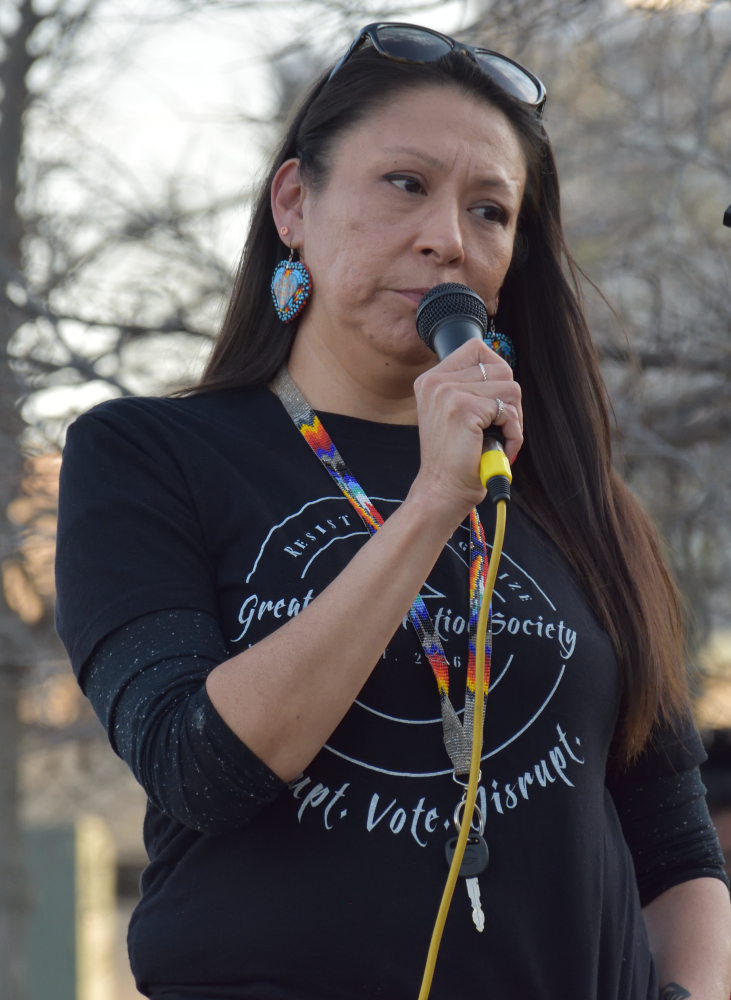
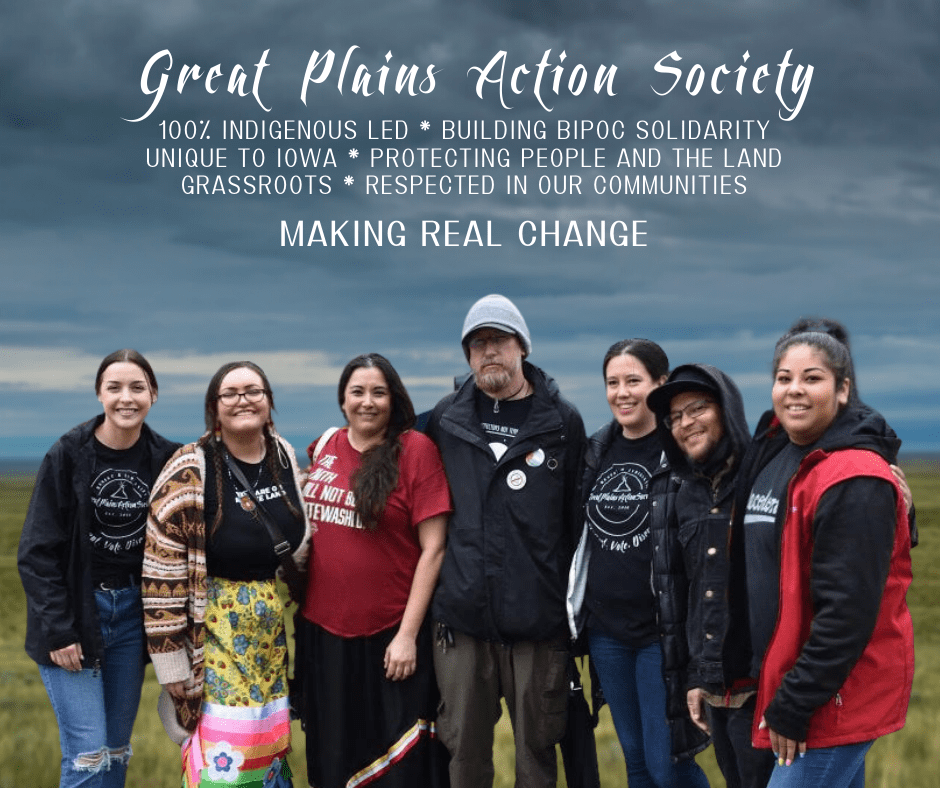
I know my friend Sikowis Nobiss is interested in supporting legislation related to Native Americans, so I contacted her about this. She put me in touch with Jessica Engelking, who is also part of the Great Plains Action Society. Fortunately, I met Jessica when we were attending the Buffalo Rebellion conference recently. Some of the networking that occurred there. Others at that conference included my friends Peter Clay, Sikowis, Mahmud Fitil, Ronnie James, Miriam Kashia and Jake Grobe.

When Jessica asked what Quakers have been doing related to our role in some of the residential schools, I shared FCNL’s decades of advocacy for Native Americans. We began to work together to arrange visits to our Senators about the truth and healing commission act, and included Jessica Bahena, FCNL’s National Organizer, who is FCNL’s contact related to this legislation in our planning.

Over the past several years there have been changes in how I do justice work. What hasn’t changed is the I’ve tried to be obedient to what the Spirit is telling me to do.

Most of my life I did justice work within the framework of Quaker meetings, communities, and organizations, such as FCNL. For about 8 years I was clerk of Iowa Yearly Meeting (Conservative)’s Peace and Social Concerns Committee. At our annual sessions a month ago, someone else took over that responsibility.

The Quaker involvement in the Indian Boarding Schools has long been a concern of mine. When I learned about this appeal from FCNL, I wanted to work on that. But no longer being on the Peace and Social Concerns Committee, I wasn’t thinking about working in the context of that committee, although I did contact the clerk of the committee in case they wanted to become involved.


Mutual Aid

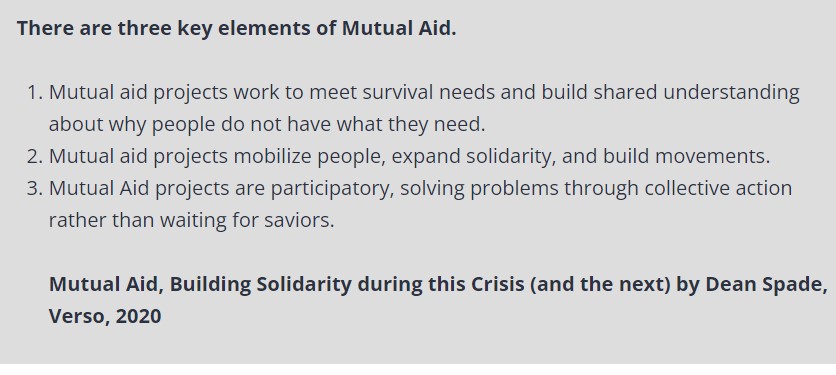
For the past two years I’ve been working in the Des Moines Mutual Aid community. This has answered a deep need in my life to find accomplices who are doing justice work in a way that focuses on root causes of injustice and builds community. (See: Mutual Aid PDF)

I’d like to explore the possibility of Native Americans and White people working together on these traumatic problems. At first, I thought the Mutual Aid part would just be an interesting possibility to frame this work, but the more I think about it, the more important I think it could be, for making our work together avoid the problems of hierarchy, who’s in charge.

Mutual Aid

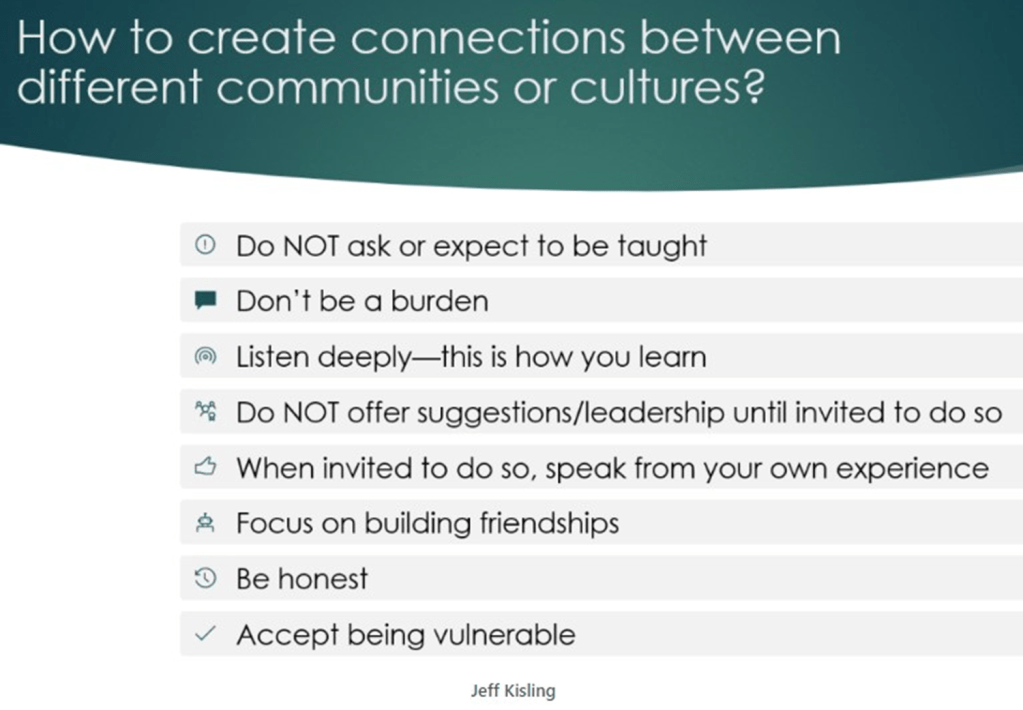
It is common to feel vulnerable when we meet new people, in new organizations and communities. But we need to venture out of our meetinghouses more often. I’ve been blessed to have found numerous communities to work with over the years. What follows are guidelines I’ve discovered that can help you as you begin to work with other communities or cultures.


Practicing Hope

I keep returning to the question, “are we really listening for that still small voice during our prayers, and meeting for worship? Do we practice hope?” Or do we force what we hear to conform to our current worldview? Do we do a sort of reinterpretation of what we hear? If we heard “give up all your possessions”, would we?

I sign my email messages “practicing hope”.


People often mistake hope for a feeling, but it’s not. It’s a mental discipline, an attentional practice that you can learn. Like any such discipline, it’s work that takes time, which you fail at, succeed, improve, fail at again, and build over years inside yourself.

Hope isn’t just looking at the positive things in this world, or expecting the best. That’s a fragile kind of cheerfulness, something that breaks under the weight of a normal human life. To practice hope is to face hard truths, harder truths than you can face without the practice of hope. You can’t navigate dark places without a light, and hope is that light for humanity’s dark places. Hope lets you study environmental destruction, war, genocide, exploitative relations between peoples. It lets you look into the darkest parts of human history, and even the callous entropy of a universe hell bent on heat death no matter what we do. When you are disciplined in hope, you can face these things because you have learned to put them in context, you have learned to swallow joy and grief together, and wait for peace.

IT IS BITTER TEA THAT INVOLVES YOU SO: A SERMON ON HOPE by Quinn Norton, April 30, 2018

I don’t remember reading what that quote referred to, so I read that this morning.

When Hypoc was through meditating with St. Gulik, he went there into the kitchen where he busied himself with preparing the feast and in his endeavor, he found that there was some old tea in a pan left standing from the night before, when he had in his weakness forgot about its making and had let it sit steeping for 24 hours. It was dark and murky and it was Hypoc’s intention to use this old tea by diluting it with water. And again in his weakness, chose without further consideration and plunged into the physical labor of the preparations. It was then when deeply immersed in the pleasure of that trip, he had a sudden loud clear voice in his head saying “it is bitter tea that involves you so.” Hypoc heard the voice, but the struggle inside intensified, and the pattern, previously established with the physical laboring and the muscle messages coordinated and unified or perhaps coded, continued to exert their influence and Hypoc succummed to the pressure and he denied the voice.

And again he plunged into the physical orgy and completed the task, and Lo as the voice had predicted, the tea was bitter.

From Page 37 of the Pricipia Discordia, 5th edition

Hypoc succummed to the pressure and he denied the voice.

During this morning’s prayers I was thinking that still small voice must have been ignored when grave wrongs were done, are being done. The focus of my prayers these past few years relate to the genocide of indigenous peoples. And the forced assimilation that was a large part of that.

Quaker involvement in the Indian Boarding Schools evokes strong emotions among Friends today. Deep trauma in Indigenous communities that are experiencing multigenerational trauma. Where wounds have been ripped open by locating the remains of children who died or were killed in those institutions. Grief for those not yet found.

But the process of “thinking” is problematic. Thinking involves the brain, with logic and knowledge. That still small voice is not about thinking.

Logically (thinking), from today’s vantage point, forced assimilation and genocide were absolutely wrong.

We don’t know what that still small voice led the Quakers in those days to do. We can’t judge them because we don’t know what they heard. But we can’t leave it at that. We have a responsibility to find the truth of what occurred in those “schools”. We must know the truth so healing can begin. Healing for Indigenous peoples and for Quakers.

This tragedy should lead us to re-evaluate our own lives today. To hear what that still small voice is saying to us. And to do what it is saying.

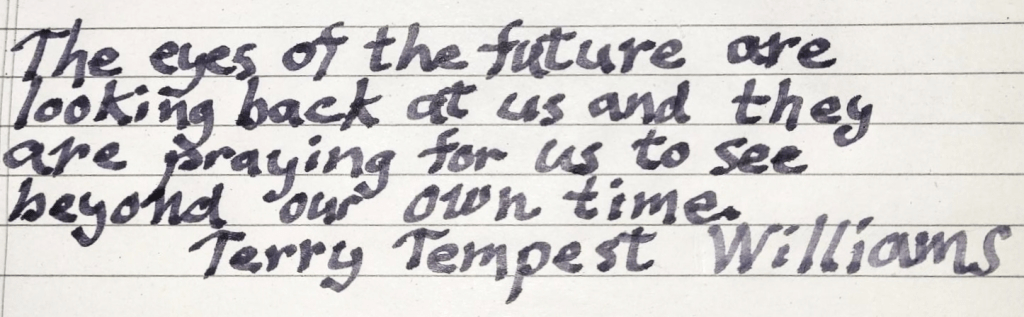
What will future generations think about when they look back at what we have done, are doing now?


Addressing the Legacy of Indian Boarding Schools

This document from the Friends Committee on National Legislation is about addressing the legacy of Indian Boarding Schools.

  • Minute your concern and commitment to action, including your support for this bill in your monthly meeting, Friends church, and/or yearly meeting.
    • This year’s report of the Peace and Social Concerns Committee of Iowa Yearly Meeting (Conservative) can be found below, which supports the bill.
  • Share your statement(s) with FCNL at Quakers@fcnl.org. We are compiling them on our website and can help you relay them to your members of Congress and the media: fcnl.org/NativeAmerican
    • Our Peace and Social Concerns Report has been sent to FCNL
  • Write your members of Congress about your concern: fcnl.org/BoardingSchools. You can customize FCNL campaign letters and send them directly to Congress from any Internet-connected device. Invite Friends in your community to contact their officials as well
    • We are making appoints with Iowa Senators Ernst and Grassley to discuss the Truth and Healing Commission on Indian Boarding School Policies in the United States Act (S. 2907/H.R. 5444) We are working with the (Indigenous) Great Plains Action Society on this.


Foundational stories: Transitions

This is the continuation of a series of posts about the evolution of my foundational stories, which are related to the intersection between my Quaker faith, protecting Mother Earth, and photography. Up to this point the stories have been from my life in Indianapolis, and about protecting the water and Mother Earth from the Keystone and Dakota Access pipelines, and all the implications of that.

My reason for doing this is because our world has changed dramatically, in many ways, in my lifetime. And I want to see if I’m doing the best I can today to prepare for increasingly dystopian times. Although it’s taking longer than I planned to get there, it is an important part of the process for me to reflect on the ways my foundational stories have evolved.

Transitions

At the end of June 2017, I retired from my career doing research in the Infant Pulmonary Function Lab at Riley Hospital for Children and returned to Iowa, where I had grown up, and where my parents still lived.

It was difficult to move away from the many friends and communities I had developed relationships with over my five decades in Indianapolis. And it was difficult to leave a career I loved. Every day brought significant challenges to the scientific software development and medical engineering I was doing. In a lab where most of us had worked together for thirty years.

It was a Spirit-led decision to retire.

Another thing that made this move difficult was knowing I would be living in a small community that didn’t have a public transit system. Living without a car was part of my foundational story, impacting my life in so many ways. And I’d been agitating others to give up their cars. I walked whenever possible in Indianola. But the justice work I eventually found often meant borrowing my parents’ car to drive to Des Moines.

My friends in Indianapolis heard about my plans to use a bicycle as much as possible when they asked about my plans for retirement. I was very touched when a large number of people contributed to help me buy a good bicycle for this purpose, including my co-workers at Riley Hospital for Children, and friends from North Meadow Circle of Friends, and my friends at the Kheprw Institute (KI). In addition, Dr. Robert Tepper, a lifelong friend and the Director of the Infant Pulmonary Function Lab where I spent most of my career, gave me a great backpack designed to be used with bicycles, which included a sleeve to carry a laptop computer. The backpack is designed to hold the pack away from one’s back, keeping sweat away from the pack itself.

I had hoped to build up the stamina to ride my bicycle to Des Moines, about fifteen miles. And perhaps even the forty miles, one way, to Bear Creek meeting!

The following PDF (which can be downloaded) describes the three-day, forty-mile journey I undertook in September 2017 (two months after moving to Iowa).


Bear Creek Friends Meeting

My Quaker meeting, Bear Creek Friends, has struggled to figure out how to reduce fossil fuel transportation when so many Friends live in rural areas or towns without public transit. We wrote the following Minute, which was approved by our yearly meeting, Iowa Yearly Meeting (Conservative) in 2017. And below is a pamphlet from Friends World Committee for Consultation (FWCC), which had asked meetings to submit their work on sustainability.


Ethical Transportation
 
 Radically reducing fossil fuel use has long been a concern of Iowa Yearly Meeting (Conservative).  A previously approved Minute urged us to reduce our use of personal automobiles.  We have continued to be challenged by the design of our communities that makes this difficult.  This is even more challenging in rural areas.  But our environmental crisis means we must find ways to address this issue quickly.
 
 Friends are encouraged to challenge themselves and to simplify their lives in ways that can enhance their spiritual environmental integrity. One of our meetings uses the term “ethical transportation,” which is a helpful way to be mindful of this.
 
 Long term, we need to encourage ways to make our communities “walkable”, and to expand public
transportation systems.  These will require major changes in infrastructure and urban planning.
 
 Carpooling and community shared vehicles would help.  We can develop ways to coordinate neighbors needing to travel to shop for food, attend meetings, visit doctors, etc.  We could explore using existing school buses or shared vehicles to provide intercity transportation.  
 
 One immediately available step would be to promote the use of bicycles as a visible witness for non-fossil fuel transportation.  Friends may forget how easy and fun it can be to travel miles on bicycles.  Neighbors seeing families riding their bicycles to Quaker meetings would have an impact on community awareness.  This is a way for our children to be involved in this shared witness.  We should encourage the expansion of bicycle lanes and paths.  We can repair and recycle unused bicycles, and make them available to those who have the need.

Minute approved by Iowa Yearly Meeting (Conservative) 2017

Foundational Stories: DAPL beginnings

[Note: This is a continuation of a series of posts about the evolution of my foundational stories, which are related to the intersection between my Quaker faith, protecting Mother Earth, and photography. The following occurred when I was living in Indianapolis.]

The previous post described how those of us trained to bring attention to the Keystone XL pipeline connected with Joshua Taflinger and Brandi Herron of the White Pines Wilderness Academy. They wanted to support those at Standing Rock who were praying to stop construction of the Dakota Access pipeline (DAPL).

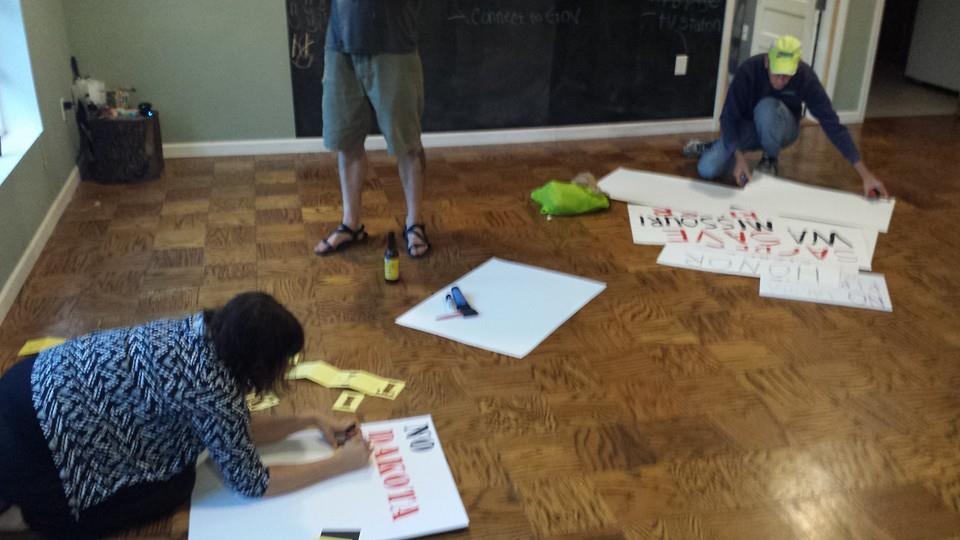
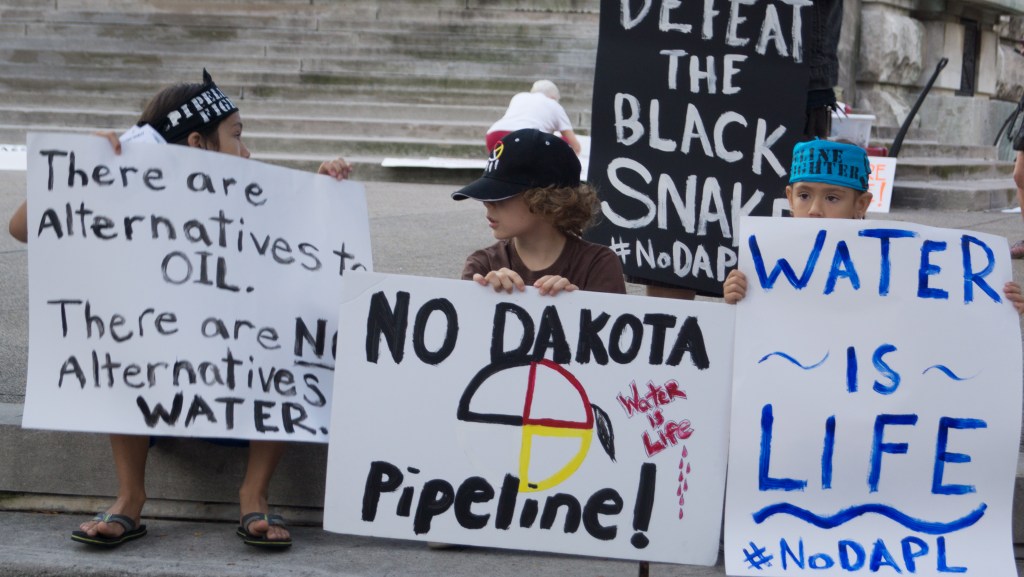
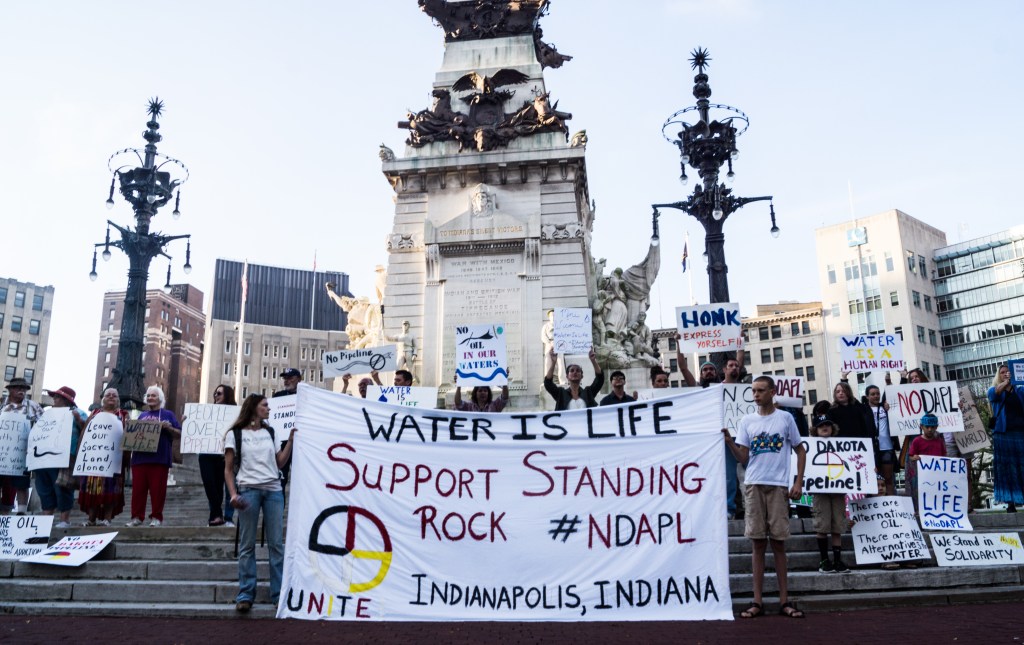
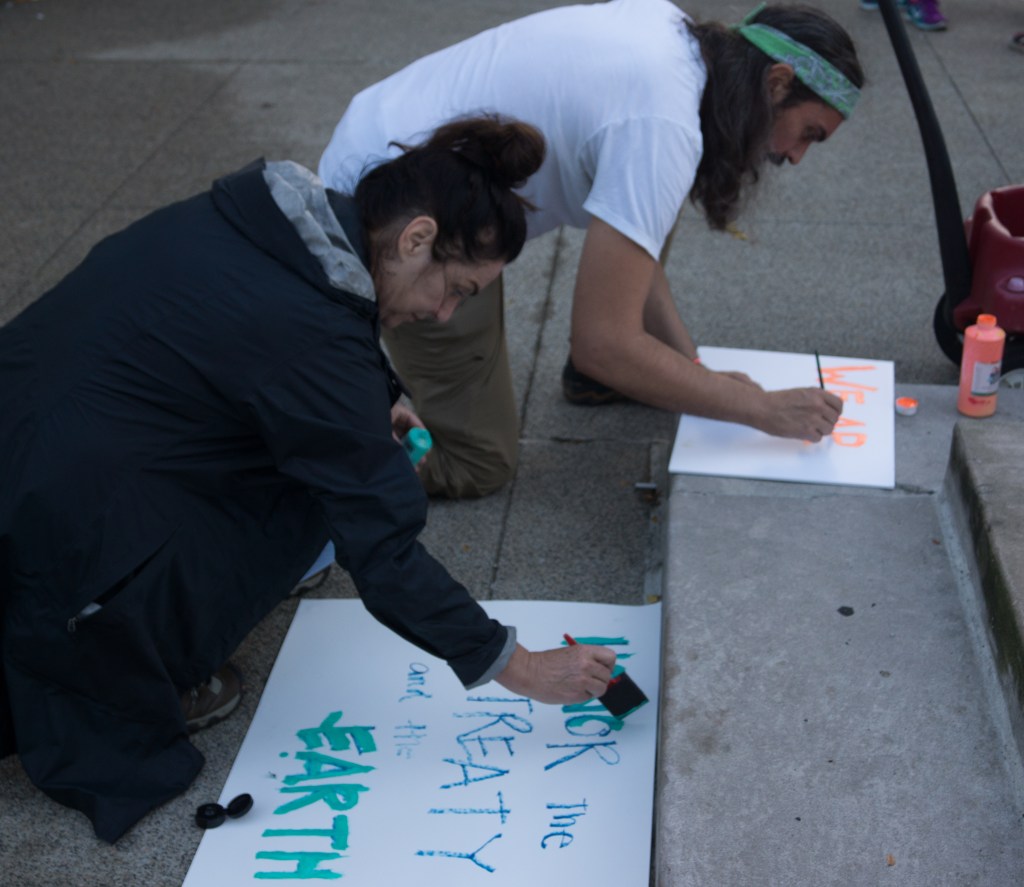
This photo was taken the first time we gathered at the Wilderness Academy, 9/8/2016. They had already made that great sign that was brought to all our gatherings, including the first one on the Circle in downtown Indianapolis the next day. The second photo from the same evening shows me inside the Academy making additional signs. The next morning sign making supplies were brought downtown where people made more of them.

Gathering at White Pines Wilderness Academy to plan first action related to the Dakota Access Pipeline, Indianapolis
Me making NODAPL signs at White Pines Wilderness Academy

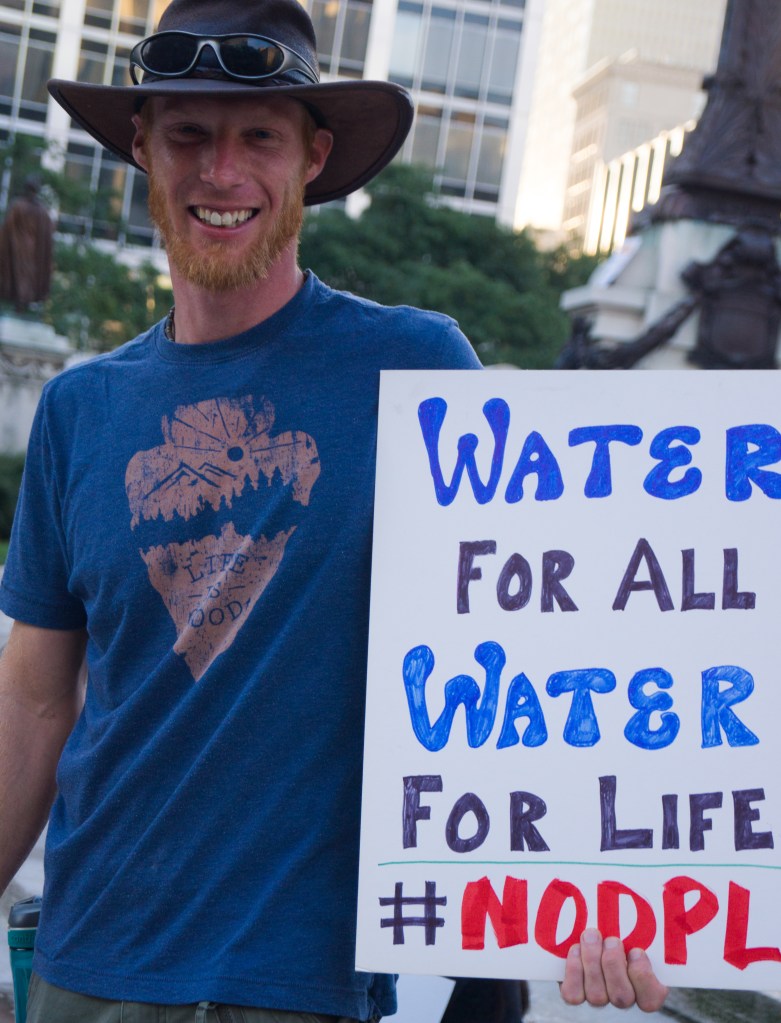
Making signs at a gathering in downtown Indianapolis

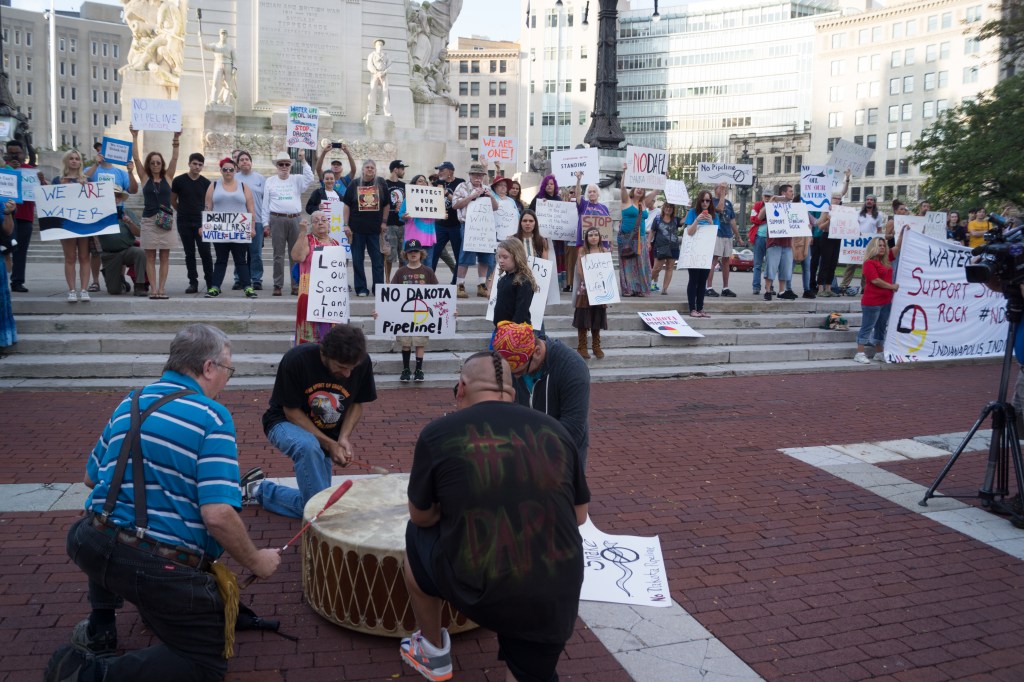
That gathering downtown on 9/9/206 was the first time Native Americans joined us. Sage was burned and there was drumming.

Burning sage

Drummers on the Circle, downtown Indianapolis

These are some photos from that gathering. Joshua is in the first photo.


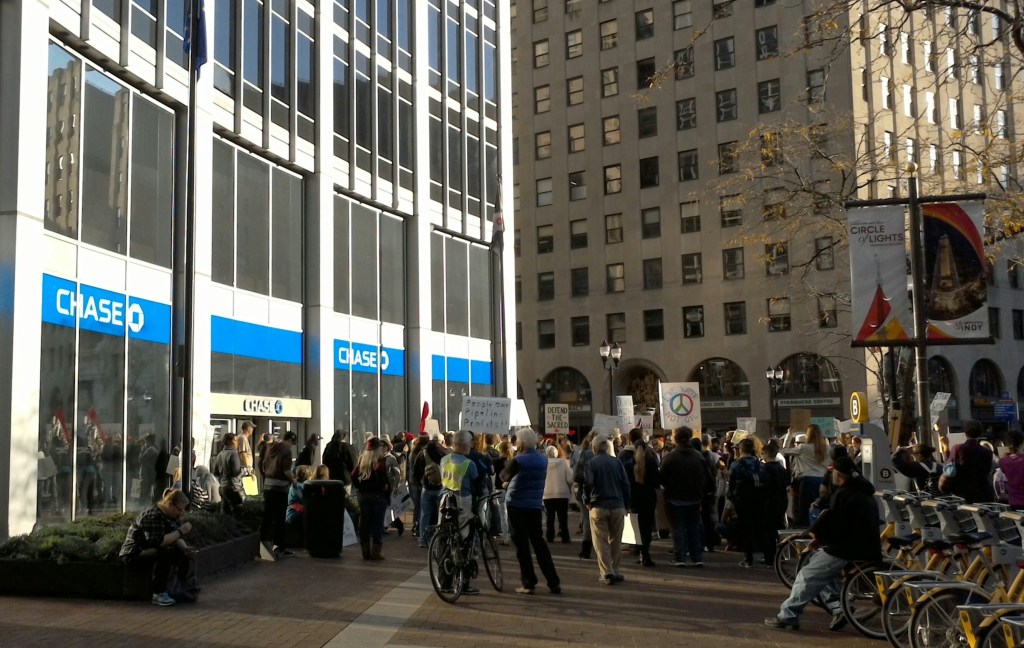
On November 15, 2016, we gathered to go to the two banks in Indianapolis that were involved in funding DAPL, which were PNC and Chase. We stood outside each bank in silence as those who had accounts went in to close them. $110,000 was withdrawn that day.


I had my own experiences when I was living in Indianapolis, at the downtown Chase bank, where I closed my account.


Divestment is a strategy that has been used in many instances related to funding fossil fuel projects. In November 2015, several of us went to the Indianapolis offices of Morgan Stanley. We had a polite conversation with the manager about funding coal projects.


On February 3, 2018, Super Bowl weekend, Ed Fallon organized a van trip to Minneapolis to call attention to USBank’s funding of fossil fuel projects. USBank’s headquarters are in Minneapolis, and the game was played at the USBank stadium.

Although we had communicated by email, this was the first time I met Ed. Among the others involved were Sikowis (Christine) Nobiss and Donnielle Wanatee. It was a beautiful day with falling snow.


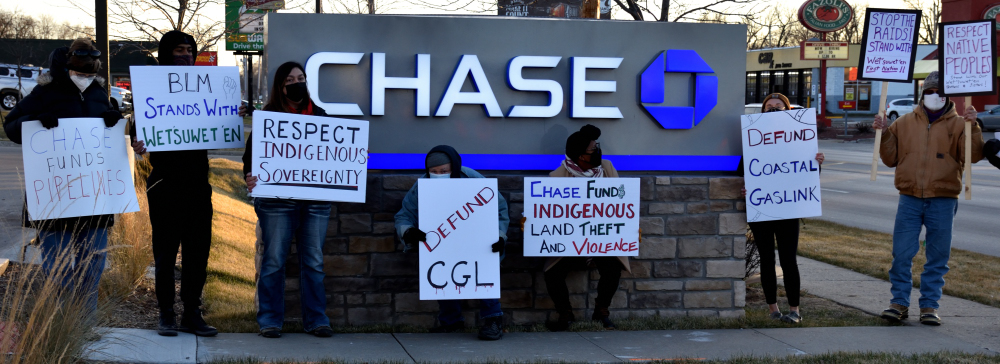
Defunding projects continue to this day. This was a gathering at a Chase bank in Des Moines in December 2021. Peter Clay and Jon Krieg were present.

Des Moines, December 2021

Foundational stories: Spiritual Warriors

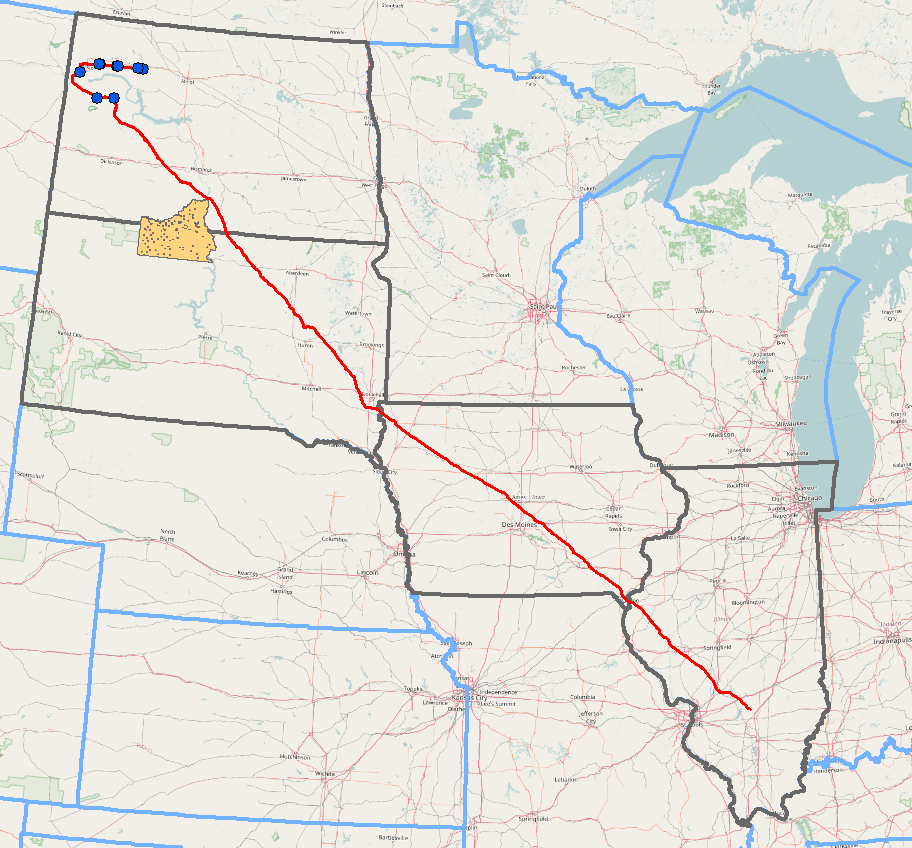
The Keystone pipeline resistance ended with President Obama’s denial of the pipeline’s permit. But then we began to hear about the construction of the Dakota Access Pipeline (DAPL). In one of the most transparent, egregious examples of environmental racism, the route of the pipeline was changed when people in Bismarck, North Dakota, objected to the original plan for DAPL to cross the Missouri River just upstream from them, fearing contamination of their water. So, the route was changed to cross beneath Lake Oahe (Missouri River), at the edge of the border of the Standing Rock Indian Reservation (orange in the map below).

By NittyG – Own work, CC BY-SA 4.0, https://commons.wikimedia.org/w/index.php?curid=52776844

Dakota Access Pipeline route (Standing Rock Indian Reservation is shown in orange)

That new route stimulated months of prayers and ceremonies by hundreds of Native American tribes and thousands of people.

By late September, (2016) NBC News reported that members of more than 300 federally recognized Native American tribes were residing in the three main camps, alongside an estimated 3,000 to 4,000 additional pipeline resistance demonstrators. Several thousand more gathered at the camps on weekends.[7][34][35]

Dakota Access Pipeline protests

DAPL support begins in Indianapolis

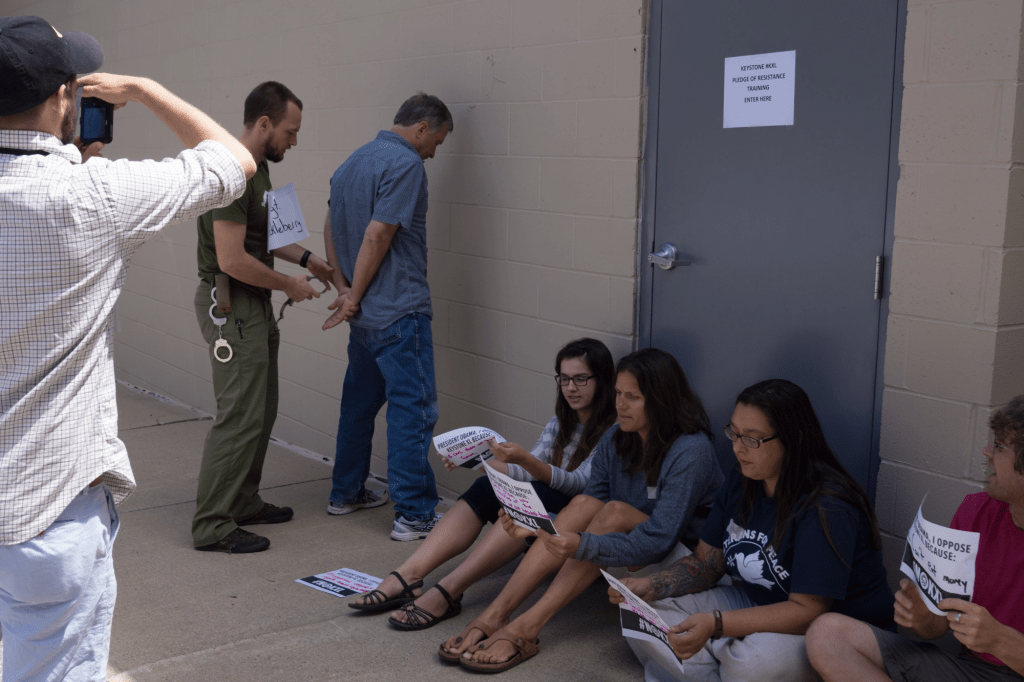
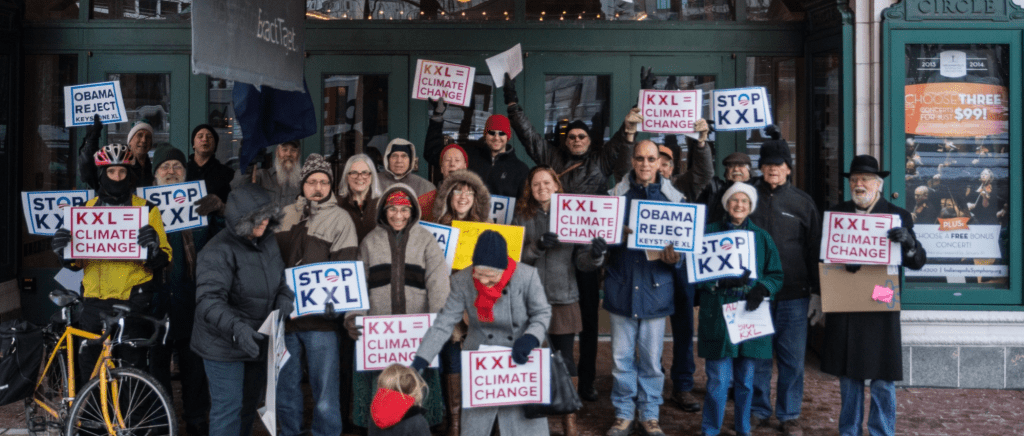
In a recent post (Keystone Pledge of Resistance) I described how Jim Poyser, Ted Wolner, and I were trained to design peaceful, nonviolent civil disobedience actions. And how we trained about fifty people in Indianapolis to participate in such actions.

A Spirit-led connection was made when Jim was talking with Joshua Taflinger about the Dakota Access Pipeline (DAPL). Jim lived near Joshua’s White Plains Wilderness Academy. Joshua wanted to know what he could do locally to bring attention to the Dakota Access pipeline. I say ‘bring attention’ rather than protest, because one of the first things I learned from those opposing DAPL was the difference between protesting and being a water protector.

Water protector was about an integral, Spiritual connection with Mother Earth, and all things human and nonhuman.

Bringing attention to the Dakota Access pipeline (DAPL) in downtown, Indianapolis

Jim told Joshua about the Keystone Pledge of Resistance, and those of us who had been trained to organize public gatherings and actions. And told Joshua we would be glad to support similar efforts to call attention to the dangers of DAPL. We were all excited about helping Joshua and White Plains Wilderness Academy, glad our experience could be useful.

Before getting into what we did related to DAPL, I’d like to express how working with Joshua and his wife Brandi, made me aware of the concept of spiritual warriors.


It may seem odd for a Quaker to speak about warriors. But what I mean by warriors is what Chief Sitting Bull said.

For us, warriors are not what you think of as warriors. The warrior is not someone who fights, because no one has the right to take another’s life. The warrior, for us, is one who sacrifices himself for the good of others. His task is to take care of the elderly, the defenseless, those who cannot provide for themselves and above all, the children, the future of humanity.

Chief Sitting Bull

Warriors today are forging different ways to live together, returning to Indigenous ways to live in community. Mutual Aid is an alternative to our broken systems. Members of Mutual Aid communities are working for the abolition of police and prisons. To escape the colonial capitalist system. Feeding the hungry and finding shelter for the houseless. Collecting clothing.


The following from Joshua, is another example of radically rethinking our stories.

I am inspired to share with you all more directly a post I wrote, because I consider you an established and effective nature/spiritual warrior and believe that there is a need for the perspectives shared in the attached post to be more common thought in the minds of the many.

If you feel truth from this writing, and are inspired, I highly encourage you to re-write your own version, in your own words/perspectives, and post to your network.

With the intention of helping us all wake up, with awareness, clarity, and direction.

..spreading and weaving reality back into the world….

What has risen to the surface at Standing Rock is a physical/spiritual movement. Learn how to quiet your mind. To find the silent receptive space to receive guidance. To learn to adapt and follow the pull of synchronicity to guide you to where you will find your greatest support and strength.

What I have found in my time praying in the indigenous earth-based ways, is that it’s not about putting your hands together and talking to God…. It’s about quieting and connecting with the baseline of creation, of nature. Tuning into the frequency and vibration of the natural world, the nature spirits. The beings and entities that have been in existence, for all of existence, the examples and realities of sustainability and harmony.

It’s about becoming receptive to these things. Being open and flowing with them. The spirit guides us, but we have to make ourselves receptive to feel, sense, and respond to this guidance.

Joshua Taflinger


Each Warrior of the Light contains within him the spark of God. His destiny is to be with other Warriors, but sometimes he will need to practice the art of the sword alone; this is why, when he is apart from his companions, he behaves like a star. He lights up his allotted part of the Universe and tries to point out galaxies and worlds to all those who gaze up at the sky. The Warrior’s persistence will soon be rewarded. Gradually, other Warriors approach , and they join together to form constellations, each with their own symbols and mysteries. 

Coelho, Paulo. Warrior of the Light: A Manual (p. 89). HarperCollins. Kindle Edition


There comes a time when all life on Earth is in danger. Great barbarian powers have arisen.

Although these powers spend their wealth in preparations to annihilate one another, they have much in common: weapons of unfathomable destructive power, and technologies that lay waste our world. In this era, when the future of sentient life hangs by the frailest of threads, the Shambhala warriors appear.

The warriors have no home. They move on the terrain of the barbarian powers. Great courage is required, both moral and physical, for they must go into the heart of the barbarian powers to dismantle their weapons, into the places where the weapons are created, into the corridors of power where decisions are made.

The Shambhala warriors are armed only with the weapons of compassion and insight. Both are necessary. Compassion gives them the energy to move forward, not to be afraid of the pain of the world. Fueled by compassion, warriors engage with the world, step forward and act. But by itself compassion burns with too much passion and exhausts us, so the second weapon is needed — insight into the interdependence of all phenomena.

With that wisdom we see that the battle is not between “good guys” and “bad guys,” because the line between good and evil runs through every human heart. And with insight into our profound interrelatedness, we discern right action, knowing that actions undertaken with pure intent have repercussions throughout the web of life, beyond what can be measured or discerned.

Together these two weapons sustain the warriors: the recognition and experience of our pain for the world and the recognition and experience of our radical interconnectedness with all life.

Adapted from Dugu Choegyal, as recounted by Joanna Macy


The Spiritual Warrior is a person who challenges the dreams of fear, lies, false beliefs, and judgments that create suffering and unhappiness in his or her life. It is a war that takes place in the heart and mind of a man or woman. The quest of the Spiritual Warrior is the same as spiritual seekers around the world.  

www.toltecspirit.com/four-agreements/characteristics-of-a-spiritual-warrior/.


My foundational stories: Humility

I feel awkward when writing stories of my life because I was raised to believe we should not call attention to ourselves. I’m feeling this now as I continue to write my foundational stories.

A friend of mine expresses this awkwardness by saying, “anyways, brag, brag, blah, blah”. But we both tell our stories to pass on lessons we’ve learned that might be helpful to others. And in the spirit of Mutual Aid (that we are both involved in), might lead others to share their stories with us. To build a community library of our stories. My mom has worked to gather such a library of stories, the Quaker Stories project. https://quakerstories.wordpress.com/


Dear reader

I offer you this essay in the hope that you may find something within it that will keep you buoyed in the years ahead. It reflects my own attempt to understand the converging crises in our near future, and to grapple with the question of what I might be able to offer that will be useful in that future.

It was the birth of my first child that catalysed a sense of urgency to take the idea-threads I had been tracing for some years now and to weave them into a relatively coherent whole. As any conscientious parent will testify, there are few things that will sharpen one’s focus on the future than a deeply felt sense of responsibility for a new being.

If we are to find a new kind of good life amid the catastrophes these myths have spawned, then we need to radically rethink the stories we tell ourselves. We need to dig deep into old stories and reveal their wisdom, as well as lovingly nurture the emergence of new stories into being.

Pontoon Archipelago or: How I Learned to Stop Worrying and Love Collapse. By James Allen, originally published by Medium, June 18, 2019

So, this is me radically rethinking the stories I tell myself (and you). We are being forced to nurture the emergence of new stories into being because of the catastrophes that are ever worsening because of environmental devastation and social collapse.


It’s not who our ancestors were, or how many committees we serve on, or whether we’ve read John Woolman’s journal that places us in the living stream of Friends. It’s through living our own authentic journey of faithfulness that we can become Children of Light. Without this, we are claiming an inheritance not our own. You can know the motion of thieves is present when you find yourself feeling humble, authentic, and vulnerable. We need to be careful when we talk about humility. The kind of humility this work brings isn’t the kind that would have us reject or repress our gifts. This kind of false humility leads us to oppress each other in the name of preventing pridefulness. This happens far too often. Real, life-giving humility means living up to the light that we have been given without judgment of how bright or dim that light is. False humility is hiding this light under a bushel for fear of jealousy or judgment. The challenge is to be faithful right where we are—no more, no less. This takes courage. To be faithful, we have to make space.

Prophets, Midwives, and Thieves: Reclaiming the Ministry of the Whole by Noah Baker Merrill

 I hope that in this year to come, you make mistakes. Because if you are making mistakes, then you are making new things, trying new things, learning, living, pushing yourself, changing yourself, changing your world. You’re doing things you’ve never done before, and more importantly, you’re doing something.

Neil Gaiman