Hope

With so much pain, strife, isolation, and fear of greater troubles to come, many are bewildered, scared, and don’t believe things will get better. Hope for improvement fades, especially when the tools that had occasionally worked for change, such as political lobbying, have been completely corrupted.

Hope for financial stability is threatened by rapidly increasing prices of nearly everything in conjunction with flat income and increasing unemployment. Millions are being pushed closer to, into poverty. Many people feel their self-worth is tied to their financial worth.

And the greatest threats, the multiple aspects of rapidly escalating environmental chaos, are almost impossible to ignore, though many still try. Once that begins to be accepted, there is the realization that there is no way to change the weather. Hopeless.

Faith was once the primary source of hope for many. For years, the trend of turning away from organized religion has continued. Of course, organized religion is just one way to express faith.

The accelerating trend towards a more secular America represents a fundamental change in the national character, one that will have major ramifications for politics and even social cohesion.

U.S. Church Membership Falls Below Majority for First Time by Jeffrey M Jones, Gallup, March 29, 2021

Hopelessness is toxic. Diminishing the sense of self-worth. Affecting personal mental health and relationships. Encouraging search for a savior which means embracing authoritarian politics. Mistrust of, violence against “others” who are portrayed as the reason for our hopelessness.

The approach of a new year often stimulates reflections on the past year. Some consider resolutions to make positive changes for the new year. But in the face of all these challenges, what is there to hope for?

Mutual Aid

My past three years of experience with Des Moines Mutual Aid has not only given me hope but also helped me begin to heal from traumas I hadn’t known I was suffering from. https://quakersandreligioussocialism.com/mutual-aid/

Because living with hopelessness is traumatic. Witnessing the hardships of so many people because of capitalism is traumatic. Seeing and feeling the damage to Mother Earth is traumatic.

These Points of Unity eloquently express what Mutual Aid is about. Basically, it is the system of capitalism that has trapped so many people in hopelessness. Has destroyed their sense of self-worth. Has created a system to give power to those at the top of the hierarchy, the rich. And in the process has deeply damaged Mother Earth by recklessly extracting resources with the sole intent of increasing wealth of the rich.

Points of Unity. Des Moines Mutual Aid

  • We believe in working shoulder to shoulder and standing in solidarity with all oppressed communities
    We ourselves are oppressed, and our mutual aid work is a fight for our collective liberation. We do not believe in a top-down model of charity. Instead, we contrast our efforts at horizontal mutual aid, the fostering of mutually beneficial relationships and communities, to dehumanizing and colonizing charity.
  • We believe in community autonomy.
    We believe that the communities we live and organize in have been largely excluded from state social services, but intensely surveilled and policed by the state repressive apparatus. Capitalism is fundamentally unable to meet people’s needs. We want to build self-sustaining communities that are independent of the capitalist state, both materially and ideologically, and can resist its repression.
  • We are police and prison abolitionists.
    Abolition and the mutual aid that we practice are inextricably linked. We don’t rely on capitalist institutions or the police to do our work. We believe in building strong and resilient communities which make police obsolete, including community systems of accountability and crisis intervention.
  • We work to raise the political consciousness of our communities.
    Part of political education is connecting people’s lived experiences to a broader political perspective. Another component is working to ensure that people can meet their basic needs. It is difficult to organize for future liberation when someone is entrenched in day-to-day struggle.
  • We have open disagreements with each other about ideas and practices.
    We believe there is no formula for resolving our ideological differences other than working towards our common aims, engaging each other in a comradely manner, and respecting one another, whether or not we can hash out disagreements in the process.

The principle of raising political consciousness is the purpose of this blog post about hope. When we show people their situation is the result of the capitalist system they are in, they can then begin to have hope as they build caring communities outside the capitalist model.

The website for Iowa Mutual Aid Network shows the expanding number of mutual aid communities in the state, and the variety of work they are doing.


https://iowamutualaid.org/

My hope is that many more people will become engaged with Mutual Aid communities so we can pull people out of the traumas from capitalism. I hope you will consider becoming involved in Mutual Aid to begin your own healing. I hope you make mistakes.


I hope that in this year to come, you make mistakes. Because if you are making mistakes, then you are making new things, trying new things, learning, living, pushing yourself, changing yourself, changing your world. You’re doing things you’ve never done before, and more importantly, you’re doing something.

Neil Gaiman

I often sign my emails “practicing hope” because I practice this mental discipline.

People often mistake hope for a feeling, but it’s not. It’s a mental discipline, an attentional practice that you can learn. Like any such discipline, it’s work that takes time, which you fail at, succeed, improve, fail at again, and build over years inside yourself.

Hope isn’t just looking at the positive things in this world, or expecting the best. That’s a fragile kind of cheerfulness, something that breaks under the weight of a normal human life. To practice hope is to face hard truths, harder truths than you can face without the practice of hope. You can’t navigate dark places without a light, and hope is that light for humanity’s dark places. Hope lets you study environmental destruction, war, genocide, exploitative relations between peoples. It lets you look into the darkest parts of human history, and even the callous entropy of a universe hell bent on heat death no matter what we do. When you are disciplined in hope, you can face these things because you have learned to put them in context, you have learned to swallow joy and grief together, and wait for peace.

IT IS BITTER TEA THAT INVOLVES YOU SO: A SERMON ON HOPE by Quinn Norton, April 30, 2018

Dakota 38 + 2

I’ve written about this atrocity a number of times. There are stories such as this that should only be told by those the story is about. The title page of the video described below says “this film was created in line with Native healing practices.”

As this message from Native News Online says, “But we also feel that there are several times each year where we should be remembering the historic events that brought us here today. That is why we are sharing this story in a standalone newsletter with you on this somber day of remembrance. Because history needs to be told so it is not forgotten.”

To our readers: 

Today is a day that is always remembered in Indian Country. On the day after Christmas some 160 years ago, the largest single-day mass execution in the United States occurred in Mankato, Minnesota.  It is often referred to as the “Dakota 38+2” for the 38 Dakota warriors and two others who were hanged in Mankato.   

As journalists, part of our job is to “write the first draft of history” with stories about what is happening among Native Americans in contemporary times.  But we also feel that there are several times each year where we should be remembering the historic events that brought us here today. That is why we are sharing this story in a standalone newsletter with you on this somber day of remembrance. Because history needs to be told so it is not forgotten. 

Thayék gde nwéndëmen – We are all related.

Levi Rickert
Editor & Publisher 

Native News Online

The amazing video about this history, Dakota 38, is based on the vision of Jim Miller, a Native spiritual leader. “This film was created in line with Native healing practices. In honoring this ceremony, we are screening and distributing “Dakota 38″ as a gift rather than for sale. This film was inspired by one individual’s dream and is not promoting any organization or affiliated with any political or religious groups. It was simply created to encourage healing and reconciliation.” Smooth Feather

Please note the video is age-restricted and only available on YouTube.
Search for Dakota 38
https://www.youtube.com/results?search_query=dakota+38

Composers Jay McKay and Jay Parrotta spent three years fusing sound and visuals into a cinematic experience that takes the viewer onto the Northern Plains and through a relentless pounding blizzard. Sound has the ability to transport, and the mix of chants, drums and melody is spellbinding.

In the spring of 2005, Jim Miller, a Native spiritual leader and Vietnam veteran, found himself in a dream riding on horseback across the great plains of South Dakota. Just before he awoke, he arrived at a riverbank in Minnesota and saw 38 of his Dakota ancestors hanged. At the time, Jim knew nothing of the largest mass execution in United States history, ordered by Abraham Lincoln on December 26, 1862. “When you have dreams, you know when they come from the creator… As any recovered alcoholic, I made believe that I didn’t get it. I tried to put it out of my mind, yet it’s one of those dreams that bothers you night and day.”

Now, four years later, embracing the message of the dream, Jim and a group of riders retrace the 330-mile route of his dream on horseback from Lower Brule, South Dakota to Mankato, Minnesota to arrive at the hanging site on the anniversary of the execution. “We can’t blame the wasichus anymore. We’re doing it to ourselves. We’re selling drugs. We’re killing our own people. That’s what this ride is about, is healing.” This is the story of their journey- the blizzards they endure, the Native and Non-Native communities that house and feed them along the way, and the dark history they are beginning to wipe away.

This film was created in line with Native healing practices. In honoring this ceremony, we are screening and distributing “Dakota 38″ as a gift rather than for sale. This film was inspired by one individual’s dream and is not promoting any organization or affiliated with any political or religious groups. It was simply created to encourage healing and reconciliation.

Smooth Feather

history needs to be told so it is not forgotten

Native News Online


The day after Christmas, Dec. 26, 1862, President Abraham Lincoln ordered the largest execution in United States history — the hanging of 38 Dakota men. At the heart of this is the genocide and land theft of the tribal nations by the white settler-colonialists. #LANDBACK

“Today, all the people of the region continue to be affected by this traumatic event. We take the youth on the ride, so that they may connect with their culture in a more physical way. By being apart of the ride they are connecting themselves with their ancestors and their horse relatives. It is through the ride that they are able to see the beauty in the history and their culture.” SUNKTANKA


The Dakota 38 Plus 2 Memorial Ride is a ride that honors the 38 Dakota men who were hung in Mankato in December of 1862. The ride began from the vision of a Dakota elder and warrior. In this vision riders would ride from Crow Creek, SD to Mankato, MN. Ever since then the ride has continued to happen annually from the beginning year December 2005 to present collecting supporters and new riders along the way.

My name is Winona Goodthunder. My Dakota name is Wambde Ho Waste Win, Eagle Woman with a Good Voice. I have ridden in this ride since 2006, the second year. I was in eighth grade when I started. As the years have gone by the riders that we’ve met every year have become a part of a new kind of family. We are all different even though we are all somehow related. Those of us who are from the Lower Sioux region are used to different types of living than those who come from Canada, Nebraska, South Dakota, and other parts of the world. The differences that we have are forgotten when we come to this ride. We get up early in the morning to get our horses ready together. We ride all day together, and we eat together at night. It is then that our differences merge and we teach each other. The thing that seems to bind us the most is the fact that we can laugh. Humor may not be what is expected on a memorial ride, but it is encouraged for it is stressed that this ride is for forgiveness.

Although our group goes only for the last four days it is enough to establish that sense of family amongst each other. It is from these riders that I’ve learned most about my culture. I have read books, but they cannot foster the feeling that one gets when they are living in an experience such as the ride.

Winona Goodthunder


I have watched this video, “Dakota 38”, many times. My friend and roommate from Scattergood Friends School, Lee Tesdell, teaches in Mankato, and has spoken about this history with me.

The photography and especially the story, are just excellent and very moving. I’ve been learning how trauma is passed from generation to generation. The events shown in the film “Dakota 38” occurred in 1862.

“Today, all the people of the region continue to be affected by this traumatic event.” SUNKTANKA


Forgive Everyone Everything

FORGIVE EVERYONE EVERYTHING is inscribed on a bench in Reconciliation Park, Mankato, Minnesota, where the ride ends. The photo of the memorial shows a list of the names of the 38 Dakota men who were all hanged at the same time in what is now Mankato, Minnesota. A raised wooden platform, with 38 nooses along the sides, was constructed. It is said nearly 4,000 people witnessed this, the largest execution in U.S. history, on December 26, 1862.

As to who needs to be forgiven, there are many answers to that. 

At the heart of this is the genocide and land theft of the tribal nations by the white settler-colonialists. 

More specifically this history came about as the Dakota were forced into smaller and smaller areas of land, to the point they could not sustain themselves.

#LANDBACK
This image has an empty alt attribute; its file name is 96766751_rTnbZmN48yVXBZxfPoiyqOQl6MjM_fEEZFr6jKZWb54.jpg
https://foursquare.com/v/reconciliation-park/4d86396a509137040938a75b
NAMES OF THE EXECUTED INDIANS

#1 was to be TA-TAY-ME-MA but he was reprieved because of his age and questions related to his innocence

  1. Plan-doo-ta, (Red Otter.)
  2. Wy-a-tah-ta-wa, (His People.)
  3. Hin-hau-shoon-ko-yag-ma-ne, (One who walks clothed in an Owl’s Tail.)
  4. Ma-za-bom-doo, (Iron Blower.)
  5. Wak-pa-doo-ta, (Red Leaf.)
  6. Wa-he-hua, _.
  7. Sua-ma-ne, (Tinkling Walker.)
  8. Ta-tay-me-ma, (Round Wind) — respited.
  9. Rda-in-yan-ka, (Rattling Runner.)
  10. Doo-wau-sa, (The Singer.)
  11. Ha-pau, (Second child of a son.)
  12. Shoon-ka-ska, (White Dog.)
  13. Toon-kau-e-cha-tag-ma-ne, (One who walks by his Grandfather.)
  14. E-tay-doo-tay, (Red Face.)
  15. Am-da-cha, (Broken to Pieces.)
  16. Hay-pe-pau, (Third child of a son.)
  17. Mah-pe-o-ke-na-jui, (Who stands on the Clouds.)
  18. Harry Milord, (Half Breed.)
  19. Chas-kay-dau, (First born of a son.)
  20. Baptiste Campbell, _.
  21. Ta-ta-ka-gay, (Wind Maker.)
  22. Hay-pin-kpa, (The Tips of the Horn.)
  23. Hypolite Auge, (Half-breed.)
  24. Ka-pay-shue, (One who does not Flee.)
  25. Wa-kau-tau-ka, (Great Spirit.)
  26. Toon-kau-ko-yag-e-na-jui, (One who stands clothed with his Grandfather.)
  27. Wa-ka-ta-e-na-jui, (One who stands on the earth.)
  28. Pa-za-koo-tay-ma-ne, (One who walks prepared to shoot.)
  29. Ta-tay-hde-dau, (Wind comes home.)
  30. Wa-she-choon, (Frenchman.)
  31. A-c-cha-ga, (To grow upon.)
  32. Ho-tan-in-koo, (Voice that appears coming.)
  33. Khay-tan-hoon-ka, (The Parent Hawk.)
  34. Chau-ka-hda, (Near the Wood.)
  35. Hda-hin-hday, (To make a rattling voice.)
  36. O-ya-tay-a-kee, (The Coming People.)
  37. Ma-hoo-way-ma, (He comes for me.)
  38. Wa-kin-yan-wa, (Little Thunder.)

Prefigurative societies and mutual aid

I recently wrote about the article, Prefigurative Societies in movement by Marina Sitrin, Popular Resistance, December 21, 2022. It begins “something new is happening – something new in content, depth, breadth and global consistency. Societies around the world are in movement.”

[Note: I try to avoid using so many quotations, to speak from my own experience instead. But as this is new to me, these quotes are how I’m beginning to understand prefigurative societies. A bibliography can be found below.]

I immediately identified with the idea of prefigurative politics or societies because mutual aid communities model prefigurative societies. Both of these concepts emphasize rejecting vertical hierarchies.
(See: https://quakersandreligioussocialism.com/2022/12/23/prefigurative-politics/).

What has been taking place in disparate places around the world is part of a new wave that is both revolutionary in the day-to-day sense of the word, as well as without precedent with regard to consistency of form, politics, scope and scale. The current frameworks provided by the social sciences and traditional left to understand these movements have yet to catch up with what is new and different about them. Specifically, the theoretical frameworks for Protest and Social Movements are not sufficient to understand the emergent horizontal and prefigurative practices. I suggest we think beyond these frames, and do so first by listening to, and with, those societies and groups organizing from below – and to the left.


People from below are rising up, but rather than going towards the top – ‘from the bottom up’, they are moving as the Zapatistas suggested, ‘From below and to the left, where the heart resides.’
Power over, hierarchy and representation are being rejected, ideologically and by default, and in the rejection mass horizontal assemblies are opening new landscapes with the horizon of autonomy and freedom.

Prefigurative Societies in movement by Marina Sitrin, Popular Resistance, December 21, 2022

I’m glad to be learning about this way of looking at justice movements because this captures what my Mutual Aid community is like. Helps me better understand the work we (Des Moines Mutual Aid) are doing. And suggests ways to expand justice networks.

From the beginning of my experiences with Des Moines Mutual Aid (DMMA) I knew I was in a special place. My experiences with DMMA began before I first went to the food distribution project, when Ronnie James joined us at a vigil I had organized in support of the Wet’suwet’en peoples, who are trying to stop the construction of a natural gas pipeline through their beautiful territories. I was impressed that he made the effort to join us, and that he knew of the Wet’suwet’en struggles.

I was grateful when he patiently taught me about mutual aid over several months of text messages. And then agreed to show me the free food project. I don’t know that ‘show’ is the right word. I don’t remember that we spoke about a commitment to continued participation. I planned to just see the work in person and that would be all. That the experience might help me create a mutual aid community near me.

Instead, I’ve attended almost every week for nearly three years. One of the principles of Mutual Aid is to draw people into the work.

Mutual aid is essential to building social movements. People often come to social movement groups because they need something: eviction defense, childcare, social connection, health care, or help in a fight with the government about something like welfare benefits, disability services, immigration status, or custody of their children. Being able to get help in a crisis is often a condition for being politically active, because it’s very difficult to organize when you are also struggling to survive. Getting support through a mutual aid project that has a political analysis of the conditions that produced your crisis also helps to break stigma, shame, and isolation. Under capitalism, social problems resulting from exploitation and the maldistribution of resources are understood as individual moral failings, not systemic problems. Getting support at a place that sees the systems, not the people suffering in them, as the problem can help people move from shame to anger and defiance. Mutual aid exposes the failures of the current system and shows an alternative. This work is based in a belief that those on the front lines of a crisis have the best wisdom to solve the problems, and that collective action is the way forward.

Dean Spade. Mutual Aid: Building Solidarity During This Crisis (and the Next) (Kindle Locations 163-171). Verso.

Prefigurative societies in movement captures the dynamic nature of these societies. Prefigurative politics is expressed graphically by the cover of this book that I’m beginning to read.


“The old pattern of social action began with a strike in a workplace, backed by a general strike and demonstrations. In the new pattern of action, the mobilization starts in the spaces of everyday life and survival (markets, neighbourhoods) putting … societies in movement, self-articulated from within. And not laying siege, as transpired under colonialism two centuries ago, but rather boring from within until cracks emerge …” 

Raul Zibechi

If we want to reach a future society with different basic institutions than we have now, these institutions need to be developed – at least to some degree – before we get there. In other words, achieving fundamental social change requires us to prefigure that change in the here-and-now. Prefigurative Politics is the politics of doing that.

What is Prefigurative Politics? How large scale social change happens Paul Raekstad and Eivind Dahl

“Today, around the world, people resort to alternative forms of autonomous organization to give their existence a meaning again, to reflect human creativity’s desire to express itself as freedom. These collectives, communes, cooperatives and grassroots movements can be characterized as people’s self-defense mechanisms against the encroachment of capitalism, patriarchy and the nation-state.”

Kurdish scholar-activist Dilar Dirk

The movements emerge from necessity. Using horizontal assemblies and forms of self-organization overlooking for their needs to be met by those with institutional power. This is sometimes due to their demands on the government or institutions falling on deaf ears, and other times is a part of an initial vision of self-organization and horizontalism. The participants in these movements have generally not been politically active, and most identify as a grandmother, daughter or sister, neighbour. They do not organize with party or union structures and do not seek representative formations. They come together in assembly forms, not out of any ideology, but because being in a circle is the best way for people to see and hear one another. They strive for horizontalism because they do not want to replicate those structures where power is something wielded. They do not begin talking about taking over power but through their grounded organising, they end up creating new theories and practices of what it means to change the world.

Prefigurative Societies in movement by Marina Sitrin, Popular Resistance, December 21, 2022

Bibliography

Prefigurative Politics WikiPediahttps://en.wikipedia.org/wiki/Prefigurative_politics
Paul Raekstad and Eivind Dahl
What is Prefigurative Politics?
https://theanarchistlibrary.org/library/paul-raekstad-and-eivind-dahl-prefigurative-politics
University of Virginia. Louisiana Lightseyhttps://globalsouthstudies.as.virginia.edu/key-issues/prefigurative-politics
Prefigurative Societies in movement by Marina Sitrin, Popular Resistance, December 21, 2022https://popularresistance.org/prefigurative-societies-in-movement/
Prefigurative Politics. Building tomorrow today. by Paul Raekstad and Sofa Saio Gradin
Prefigurative Politics, P2PF Wikihttps://wiki.p2pfoundation.net/Prefigurative_Politics
Prefigurative Politics, Catastrophe, And Hopehttps://itsgoingdown.org/prefigurative-politics-catastrophe-and-hope/

Prefigurative politics

Fleeting thoughts often return to my consciousness. One of my life’s goals has been to catch those thoughts or prayers before they disappear. Because when they reappear, they are significant. Perhaps that gap is needed for the thought to incubate. For me to become ready to accept the thought.

In the early days of being in my Mutual Aid community, a fleeting thought was “this reminds me of the way Quakers used to be”. And “I wish Quakers today were like this”.

What about Quakers changed? Why are we no longer the way we used to be? In part it is because we have become too invested in the status quo.

Quakers have always believed we should let our lives speak. How we live should reflect our spirituality. What is the way we live now saying?

But my fleeting thoughts reveal our methods of resistance and social change are no longer effective. The society we (White Quakers) grew up in, the State, is itself unjust.

As my friend and Mutual Aid mentor, Ronnie James, wrote:

I’m of the firm opinion that a system that was built by stolen bodies on stolen land for the benefit of a few is a system that is not repairable. It is operating as designed, and small changes (which are the result of huge efforts) to lessen the blow on those it was not designed for are merely half measures that can’t ever fully succeed.

So the question is now, where do we go from here? Do we continue to make incremental changes while the wealthy hoard more wealth and the climate crisis deepens, or do we do something drastic that has never been done before? Can we envision and create a world where a class war from above isn’t a reality anymore?”

Ronnie James

Prefigurative politics

Yesterday I learned of a new (to me) concept, prefigurative politics. Returning to fleeting thoughts, my Mutual Aid community is an example of prefigurative politics. When my thought was “I wish Quakers today were like this”, I’m realizing I mean embracing the concepts of prefigurative politics, for example, Mutual Aid.


Something new is happening – something new in content, depth, breadth and global consistency. Societies around the world are in movement. Since the early 1990s millions of people have been organizing similarly, and in ways that defy definitions and former ways of understanding social movements, protest and resistance. There is a growing global movement of refusal – and simultaneously, in that refusal is a creative movement. Millions are shouting No!, as they manifest alternatives in its wake.

Prefigurative Societies in movement by Marina Sitrin, Popular Resistance, December 21, 2022


Prefigurative politics are the modes of organization and social relationships that strive to reflect the future society being sought by the group. According to Carl Boggs, who coined the term, the desire is to embody “within the ongoing political practice of a movement […] those forms of social relations, decision-making, culture, and human experience that are the ultimate goal”.[1] Besides this definition, Leach also gave light to the definition of the concept stating that the term “refers to a political orientation based on the premise that the ends a social movement achieves are fundamentally shaped by the means it employs, and that movement should therefore do their best to choose means that embody or prefigure the kind of society they want to bring about”. [2]

Prefigurative politics, Wikipedia
  1.  Boggs, Carl. 1977. Marxism, Prefigurative Communism, and the Problem of Workers’ Control. Radical America 11 (November), 100; cf. Boggs Jr., Carl. Revolutionary Process, Political Strategy, and the Dilemma of Power. Theory & Society 4,No. 3 (Fall), 359-93.
  2. Leach, D. K. (2013). Prefigurative politics. The Wiley-Blackwell encyclopedia of social and political movements, 1004-1006.


With God on Our Side

I often don’t know what I’ll write when I sit in quiet prayer. I didn’t think I’d be led to listen to a Bob Dylan song this morning.

I know I’m not the only one feeling heartsick these days. For so many reasons. But it has been more than I can bear to watch the pomp and circumstance of the visit of Ukraine President Volodymyr Zelensky to this country. The dichotomy of the adulation of a Congress that resists the smallest sums for the basic necessities for millions of people it is supposed to represent. And yet lavishly sends billions upon billions of dollars to Ukraine for war. Warmongers.

So now as I’m leavin’
I’m weary as Hell
The confusion I’m feelin’
Ain’t no tongue can tell
The words fill my head
And they fall to the floor
That if God’s on our side
He’ll stop the next war

With God on Our Side, Bob Dylan

That is a jarring juxtaposition to the idea of Christmas, Joy to the World, Peace on Earth.

But likely the gravest consequence of war now is this potentially mortal blow to Mother Earth. Militaries are the greatest source of greenhouse gas emissions.

Perhaps the best argument for peace on earth now is the protection and healing of Mother Earth. Including the immediate cessation of all military operations.

Despite all that, I have hope. Another Bob Dylan song is ‘The Times They Are A-Changin’. That is what I see in my Mutual Aid community.


The last U.S. ambassador to the Soviet Union before it collapsed, Jack Matlock, wrote last week: “Since President Putin’s major demand is an assurance that NATO will take no further members, and specifically not Ukraine or Georgia, obviously there would have been no basis for the present crisis if there had been no expansion of the alliance following the end of the Cold War, or if the expansion had occurred in harmony with building a security structure in Europe that included Russia.”

But excluding Russia from security structures, while encircling it with armed-to-the-teeth adversaries, was a clear goal of NATO’s expansion. Less obvious was the realized goal of turning Eastern European nations into customers for vast arms sales.

Bob Dylan and the Ukraine crisis by Norman Solomon, Nation of Change, February 23, 2022

“With God on Our Side”

Oh, my name—it ain’t nothin’
My age—it means less
The country I come from
Is called the Midwest
I’s taught and brought up there
The laws to abide
And that the land that I live in
Has God on its side

Oh, the history books tell it
They tell it so well
The cavalries charged
The Indians fell
The cavalries charged
The Indians died
Oh, the country was young
With God on its side

The Spanish-American
War had its day
And the Civil War too
Was soon laid away
And the names of the heroes
I’s made to memorize
With guns in their hands
And God on their side

The First World War, boys
It came and it went
The reason for fighting
I never did get
But I learned to accept it
Accept it with pride
For you don’t count the dead
When God’s on your side

The Second World War
Came to an end
We forgave the Germans
And then we were friends
Though they murdered six million
In the ovens they fried
The Germans now too
Have God on their side

I’ve learned to hate the Russians
All through my whole life
If another war comes
It’s them we must fight
To hate them and fear them
To run and to hide
And accept it all bravely
With God on my side

But now we got weapons
Of chemical dust
If fire them we’re forced to
Then fire them we must
One push of the button
And a shot the world wide
And you never ask questions
When God’s on your side

Through many dark hour
I’ve been thinkin’ about this
That Jesus Christ
Was betrayed by a kiss
But I can’t think for you
You’ll have to decide
Whether Judas Iscariot
Had God on his side

So now as I’m leavin’
I’m weary as Hell
The confusion I’m feelin’
Ain’t no tongue can tell
The words fill my head
And they fall to the floor
That if God’s on our side
He’ll stop the next war

“With God on Our Side” Bob Dylan


Moraine Park, Long’s Peak, Rocky Mountain National Park, Colorado. Jeff Kisling

INDIGENOUS COMMUNITIES RISE TO RESIST CARBON PIPELINES

NOTE: I am truly blessed to have many Indigenous friends, many who are involved in the Great Plains Action Society (GPAS), including the founder Sikowis Nobiss. As a White person I’ve tried hard to learn how to appropriately engage with my friends. I’ve made mistakes.
I’ve written a lot about my experiences, hoping other White people might benefit.
(See: http://bit.ly/3FIx6yd)


This is a continuation of a series of posts related to The Great Carbon Boondoggle report about proposed carbon pipelines in the Midwest, and the resistance to them.

The first paragraph of the following section of the report highlights the environmental racism common to pipeline projects in this country. The original route of the Dakota Access pipeline was changed after the people of Bismarck, North Dakota raised concerns about the impact on their drinking water. The new route was near the Standing Rock Reservation.

Environmental racism is one of the reasons Des Moines Black Liberation Collective is part of the Buffalo Rebellion. (See: bit.ly/3PL3G79)


INDIGENOUS COMMUNITIES RISE TO RESIST THE PIPELINE

The proposed route for Summit’s pipeline will pass near several Native American reservations and cities with high Indigenous populations across the Midwest. This has sparked massive resistance from frontline communities, all too familiar with the devastation these projects bring. While the landowners’ opposition has garnered most of the media coverage, Indigenous groups are firmly against the pipeline. Great Plains Action Society (GPAS), a non-profit advocating for Indigenous communities throughout the Midwest, opposes the Midwest Carbon Express, stating it “only serves the interests of the fossil fuel industry.” GPAS is working alongside area tribes, including the Ho-chunk (Winnebago) and Umonhon (Omaha) Nations, to mobilize against the project.

On June 2, 2022, the Winnebago Tribe of Nebraska — which has reservations in Dakota County, Nebraska, and Woodbury County, Iowa — requested that the Iowa Utilities Board (IUB), the US Army Corps of Engineers and the two counties, conduct independent environmental impact studies of the pipeline. The request was filed given Summit’s proposed pipeline route comes near their land and the Missouri River. On October 6, 2022, the IUB denied the request, stating, “IUB will consider specific environmental issues raised by the IUB and the parties in the Summit Carbon docket as part of the public evidentiary hearing and in consideration of whether to grant Summit Carbon a hazardous liquid pipeline permit.” [35] The decision follows the precedent set by the IUB in 2015 during approval for the Dakota Access Pipeline, where the regulatory body found “no explicit legal requirement, in statute or in rules, for an independent environmental impact report as a part of the permit proceeding.” [36]

The Great Carbon Boondoggle, Inside the Struggle to Stop Summit’s CO2 Pipeline, The Oakland Institute

The IUB’s rejection of an independent environmental impact study on the project has heightened fears of the devastation that would occur in the event of a pipeline rupture. According to the Iowa Chapter of Physicians for Social Responsibility, in the case of a rupture, “extremely cold liquid CO2 forms a cloud that settles on the ground and displaces oxygen — potentially sickening or killing people and animals for miles around and rendering internal combustion engines inoperable.” [37]
In February 2020, a carbon pipeline in Yazoo County, Mississippi, exploded and immediately impacted residents of the nearby small town of Sartia. Just minutes after the explosion, people passed out up to three quarters of a mile away from the pipeline. “I thought I was gonna die,” said Linda Garrett, a Sartia resident. [38] The explosion led to 45 people being hospitalized and the evacuation of 300 residents. Following the rupture, the Yazoo County Emergency Management Agency Director, who oversaw the response effort, warned, “We got lucky…If the wind blew the other way, if it’d been later when people were sleeping, we would have had deaths.” [39]

For some Winnebago tribe members, the question is not if the pipeline will rupture but when. “Pipelines break all the time as you are putting manmade material against Mother Nature, something we cannot control.” [42] A rupture could be catastrophic, especially if it occurred near tribal lands with limited response resources. “I like to think we are resourceful on the reservation but when the pipeline breaks, how are we going to be able to get people the help that they need? We don’t have the capacity as first responders and emergency personnel to protect our people in that situation.” [43]
Given the lack of experience dealing with large-scale carbon pipeline ruptures, even larger urban areas are currently unprepared, as they lack the necessary special equipment and emergency response training. [44] With majority of the Indigenous people living outside the reservation land and in nearby cities that will be near the proposed pipeline route, they too will be in danger in case of a rupture. Sikowis Nobiss, Executive Director for GPAS, also noted the danger a rupture will pose to farmworkers, “There are areas with large groups of migrant workers and it is doubtful they be given the necessary protective equipment in case of a pipeline rupture. So far, nobody is talking to them about this project and their communities are unaware of the dangers.”

Indigenous communities have also raised concerns with the project degrading the land and disturbing sacred ceremonial and burial sites. [45]

Indigenous communities, rightfully, are also sounding the alarm on the impact an influx of transient pipeline construction workers will have. In the past “man-camps” — built for out of state workers for large construction, fossil fuel, or natural resource extraction projects — have led to increased risk of violence towards Indigenous communities. [49] The former UN Special Rapporteur on the Rights of Indigenous Peoples, James Anaya, corroborated, “Indigenous women have reported that the influx of workers into Indigenous communities as a result of extractive projects also led to increased incidents of sexual harassment and violence, including rape and assault.” [50]

Calling for a “reduction and phasing out of fossil fuels as a wider part of a just transition,” GPAS challenges CCS projects like the Midwest Carbon Express for delaying necessary action. Sikowis Nobiss, Executive Director for GPAS, has called for necessary investments to restore prairie across Iowa and the Midwest. “The colonial capitalist model sees our prairie land as ‘empty trash’ when in fact restoring it would control erosion and sequester lots of carbon — solving many of the biggest issues caused by Big Ag.” [54] Indigenous communities have experience resisting past pipeline projects and are building from it in resisting Summit. “Carbon pipelines are nothing new to us. Standing Rock educated us on how to build power within our own communities — but not only that — it taught us how to build that resistance against the pipeline route,” said Etringer. [55] Mobilization of Indigenous communities against the project stems from a commitment to protect the land despite historical injustices. Sikowis Nobiss explained what is driving these efforts: “We continue to put aside the historical trauma we face to help protect stolen land… this hurts your head and your heart, but we continue to support this work.” [56]


Great Plains Action Society’s Statement on C02 Pipelines

Great Plains Action Society is firmly opposed to proposed carbon capture and sequestration or storage (CCS) projects (aka, CO2 Pipelines) such as Summit’s Midwest Carbon Express, Navigator’s Heartland Greenway, and Wolf Carbon Solutions’ ADM pipelines. The reasons for our opposition are numerous, however, our greatest concern is that CCS only serves the interests of the fossil fuel industry and that the government will sanction further land theft and harm to communities on Indigenous territories. Carbon capture and sequestration is by design a way to prolong the usage of fossil fuels while reducing CO2 emissions. Amidst this climate emergency, we must demand a reduction and phase out fossil fuels as a wider part of a just transition. 

We are also concerned about intense water usage as drought and warmer temperatures are greatly affecting access to clean water. Fossil fuel companies have known that their products were contributing to climate change for over forty years and now they see CCS as a government bail-out with many governmental subsidies providing just the type of perverse incentive for CCS operators to manipulate the system. Additionally, there are the same concerns present with other pipeline projects in the area regarding degradation of the land, disturbance of sacred ceremonial and burial sites. CO2 pipelines are also dangerous because when they rupture, they can spread over 1300 ft in under 4 min making it impossible to breathe and for vehicles to drive. First responders are not at all prepared to deal with such a catastrophe and many have been pushing back C02 pipelines for this reason alone. Furthermore, Indigenous communities will inevitably face encroachment on to treaty land, including environmentally racist moves on behalf of individual states to make sure that CCS does not negatively affect wealthy, white communities with influential power.

CCS is greenwashing rather than a solution to the climate emergency that Iowans deserve, as Indigenous people, we remain committed to the water, the land, and the future generations of Iowans.  

http://bit.ly/3PLkhrN


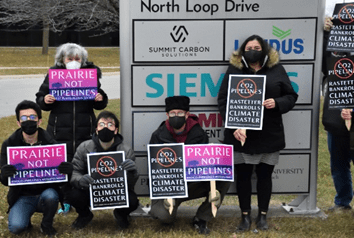
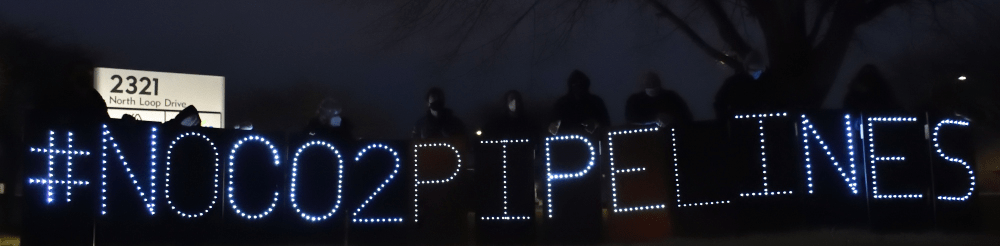
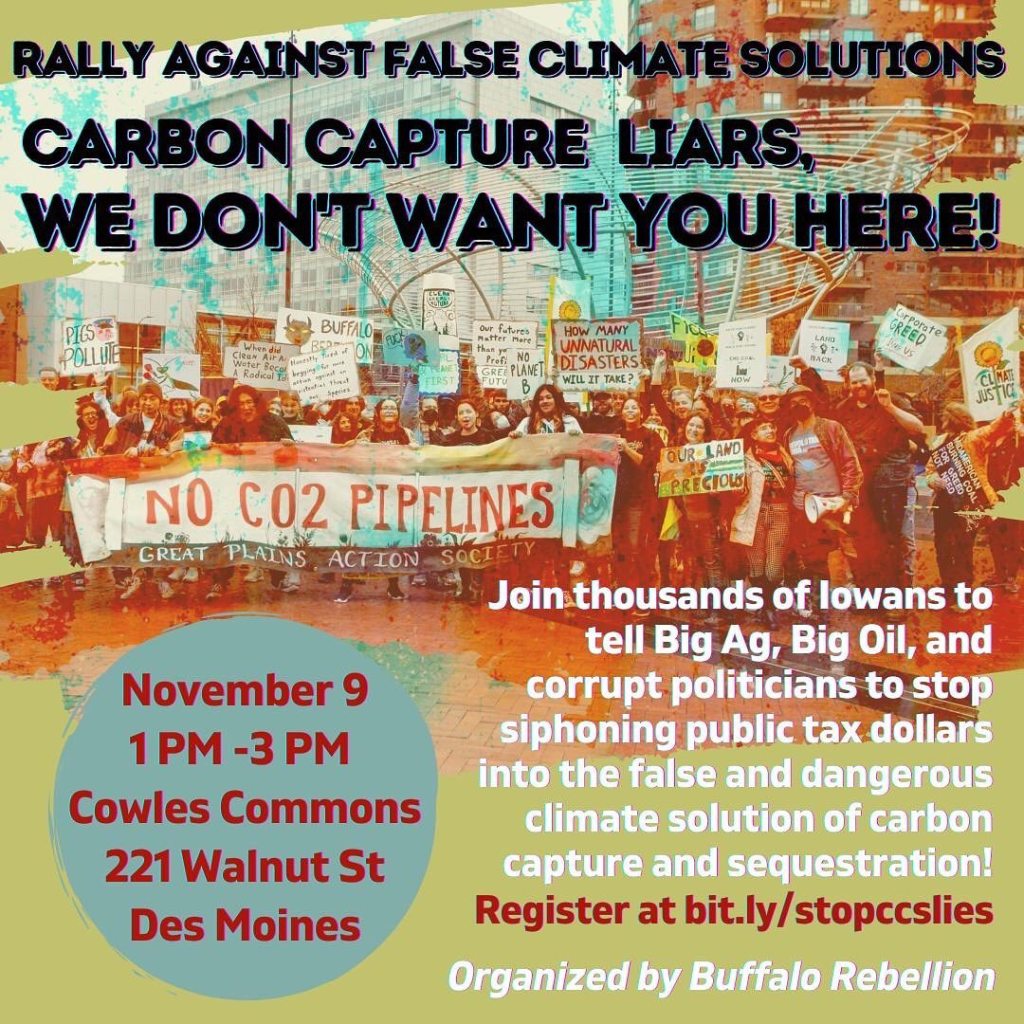
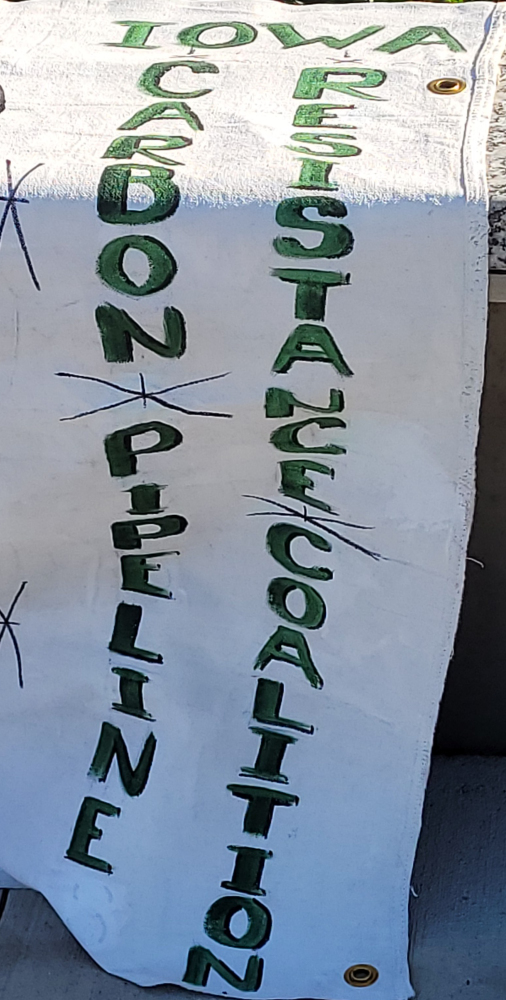
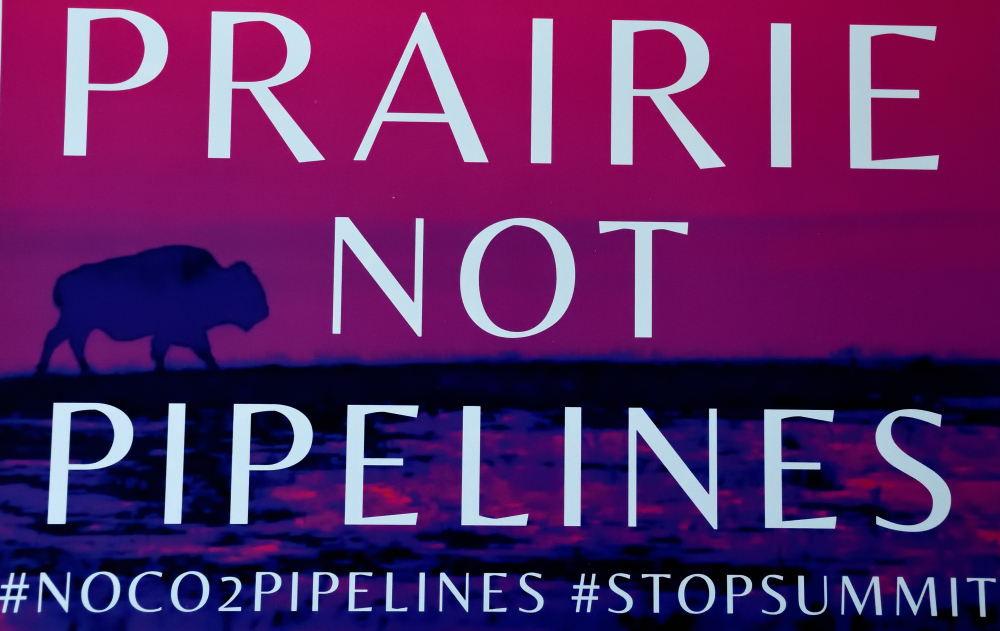
Here are some photos I’ve taken related to our Buffalo Rebellion’s carbon pipeline resistance.


Endnotes

35 Iowa Utilities Board. “IUB Addresses Request for Environmental Impact Study on Proposed Summit Carbon Solutions CO2 Pipeline.” Press Release. October 6, 2022.
https://iub.iowa.gov/press-release/2022-10-06/iub-addresses-request-environmental-impact-study-proposed-summit-carbon
36 Eller, D. “Iowa pipeline regulators reject tribe’s request for environmental impact study.” Des Moines Register, October 10, 2022.
https://www.desmoinesregister.com/story/money/business/2022/10/10/winnebago-tribe-loses-bid-require-summit-carbon-pipeline-iowa-environmental-impact-study/69545547007/

37 Zegart, D et al. Fact Sheet: CO2 Pipeline Safety. Iowa Chapter Physicians for Social Responsibility, September 14, 2022.
https://psriowa.org/PDFs/ccs2022/2022-09-14_fact_sheet_co2_pipeline_safety.pdf
38 Warden, B. “Residents near CO2 pipeline rupture in Mississippi share their story.” DakotaNewsNow, October 6, 2022.
https://www.dakotanewsnow.com/2022/10/06/residents-near-co2-pipeline-rupture-mississippi-share-their-story/
39 Zegart, D. “The Gassing of Sartia.” HuffPost, August 26, 2021.
https://www.huffpost.com/entry/gassing-satartia-mississippi-co2-pipeline_n_60ddea9fe4b0ddef8b0ddc8f

42 Direct communication with Trisha Etringer, Operations and Missing and Murdered Indigenous Relatives Director, Great Plains Action Society. October 11, 2022.
43 Ibid.
44 Iowa Sierra Club Chapter. “Carbon Pipelines: A Disaster Waiting to Happen.” Webinar. September 19, 2021. https://www.youtube.com/watch?v=1K_w5VzBZ6s
45 Great Plains Action Society. “No CO2 Pipelines.”
https://www.greatplainsaction.org/ccs?fbclid=IwAR3-8F-0Db5iijQl95YhMf_AhiI44yzbUrJafW3UH6fmzfXRbh9D8hJJCjs
49 Great Plains Action Society. “The Impact of CO2 Pipelines and ‘Mancamp Construction.” Webinar. September 19, 2022
https://www.facebook.com/GreatPlainsActionSociety/videos/623167659476503
50 Great Plains Action Society. “UN PFII Intervention on Man-Camps and Violence in Indigenous Communities.” May 3, 2019.
https://www.greatplainsaction.org/single-post/un-pfii-intervention-on-man-camps-and-violence-in-indigenous-communities
54 Direct communication with Sikowis Nobiss, Executive Director, Great Plains Action Society. October 13, 2022.
55 Direct communication with Trisha Etringer, Operations and Missing and Murdered Indigenous Relatives Director, Great Plains Action Society. October 11, 2022.
56 Direct communication with Sikowis Nobiss, Executive Director, Great Plains Action Society. October 13, 2022.


The Great Carbon Boondoggle

Publisher: The Oakland Institute is an independent policy think tank bringing fresh ideas and bold action to the most pressing social, economic, and environmental issues. This work is licensed under the Creative Commons Attribution 4.0
International License (CC BY-NC 4.0). You are free to share, copy, distribute, and transmit this work under the following conditions:
Attribution: You must attribute the work to the Oakland Institute and its authors.
Non-Commercial: You may not use this work for commercial purposes.

ACKNOWLEDGEMENTS
This report was authored by Andy Currier, Eve Devillers, and Frédéric Mousseau and draws from the previous Oakland Institute publication: The Midwest Carbon Express: A False Solution to the Climate Crisis.
Special thanks to the landowners and Indigenous community members who shared their experiences. Several remain anonymous to protect their identities

The Great Carbon Boondoggle, Inside the Struggle to Stop Summit’s CO2 Pipeline, The Oakland Institute

Pipeline Resistance: Landowner Harassment and Field Damage

Yesterday I wrote an introduction to one of the key elements of the Buffalo Rebellion’s work that was discussed during a recent community call via Zoom, i.e. carbon (CO2) pipeline resistance. The call was to build upon this new coalition’s first year of work together, and plans for the future. Resistance to the proposed carbon pipelines has been and will continue to be a focus of the Rebellion.

During the community call I learned about a new report from the Oakland Institute titled The Great Carbon Boondogglewhich focuses on the resistance to Summit’s carbon pipeline here in the Midwest. The Introduction to the report was the subject of yesterday’s blog post: Buffalo Rebellion Community Call: Carbon Pipeline Resistance.

The next part of the report is FALSE PROMISES & HARASSMENT OF LANDOWNERS.

Who owns the land?

Before getting into that, we must continue to raise awareness about who owns the land. There is a long and complex history of ways Indigenous peoples globally were forced to cede (give up power or territory) their lands to settler colonists. There is a growing movement to return lands to native peoples. #LANDBACK

Settler colonialism is a structure that perpetuates the elimination of Indigenous people and cultures to replace them with a settler society.[1][2]  Some, but not all, scholars argue that settler colonialism is inherently genocidal.[3] It may be enacted by a variety of means ranging from violent depopulation of the previous inhabitants to less deadly means such as assimilation or recognition of Indigenous identity within a colonial framework.[4]

https://en.wikipedia.org/wiki/Settler_colonialism


For the purposes of discussions related to pipelines now, landowner refers to those with legal title within the colonial framework of this country. The next section of the report is FALSE PROMISES & HARASSMENT OF LANDOWNERS. As that title suggests, there is usually an adversarial relationship between pipeline companies and landowners.

Starting in the summer of 2021, Summit Carbon Solutions began pursuing landowners in Iowa to sign voluntary easements — ceding parts of their land — so it could construct the Midwest Carbon Express. In August, Summit announced it had reached agreements with 1,400 landowners to obtain 2,200 tracts of land across the entire Midwest.[14] In Iowa, while Summit claims to have received easements from 700 landowners for 1,200 parcels of land,[15] it has acquired only an estimated 40 percent of the land needed for the pipeline route in the state.[16] On August 5, 2022, the company announced plans to begin filling for eminent domain against landowners.[17]

Landowners in Iowa, approached by Summit for voluntary easements, allege that the company has resorted to “harassment” tactics.[18] Despite informing Summit they were not interested, the company has failed to respect their decision. “My experience over the last year has been nothing short of a scenario of elder abuse, domestic terrorism, and psychological warfare,” one farmer shared.[19] Another landowner was called at least once a week over a three-month period by land agents, while others have received numerous emails, letters, and unannounced visits by land agents. When turned down, several land agents reportedly threatened that the land would be taken by eminent domain eventually and landowners might as well sign now. One farmer alleged “Good faith negotiations is not what is happening. They are exerting their will on the farmers and landowners. Preying on the elderly and widowed who don’t know any better.” [20]

The Great Carbon Boondoggle

First Nation-Farmer Climate Unity March

I first learned about the harassment of landowners during the First Nation-Farmer Climate Unity March. One of the people on the March was a landowner and told stories of harassment by the land agents of the Dakota Access pipeline. Harassing her son as he walked home from school. Shining bright lights on her house during the night. We were walking along the route of the Dakota Access Pipeline during that March, from Des Moines to Fort Dodge, Iowa. Each time we walked over the pipeline, we stopped and held hands in a circle. Several people, including the landowner, broke down in tears. It was very emotional.

Emotions evoked as we stood over the Dakota Access Pipeline

The First Nation-Farmer Climate Unity March was a precursor to the Buffalo Rebellion. The intent was for a small group of native and nonnative people to get to know each other as we walked and camped for eight days during that ninety-four mile sacred journey. So we could begin to know and trust each other, which would make it possible for us to work together on issues of common concern. That was very successful, and we have worked together on various things since. A number of us are part of the Buffalo Rebellion now.


In pursuit of voluntary easements, Summit is making promises that farmers believe it cannot fulfill. Many worry that if they sell portions of their land for the pipeline, construction will result in long term damage to their remaining farm. The company acknowledges that the construction will likely impact farming on areas of land adjacent to the pipeline and commits to cover lost crop yields — 100 percent the first year, 80 percent the second and 60 percent the third — and that it will pay to cover any other damages. [24] For farmers, these assurances are insufficient. One farmer with hilly land and particularly erodible soil, who invested lots of time and money in building terraces to retain water
in the soil, shared, “They’re going to be digging these trenches right through our terraces, which will destroy them. And they’re going to have to be redone. And they say they’ll do that…but it took us years to get them the way we want them.” Multiple farmers interviewed shared fears that once soil is dug up to make way for the pipeline, replacing it will not be as simple as Summit claims, given the complex nature of soil structure.

Another potential impact the pipeline may have on farmland concerns damage to drainage tiles, which play a crucial role in moderating the level of water held by the soil. While Summit maintains it will comply with requirements relating to land restoration — including temporary and permanent tile repair — farmers fear that damage to drainage tiles will lead to sinkholes in the soil on other areas of their land. A pervasive lack of trust in Summit to provide the necessary financial resources to repair drainage tile to the standard they require is common among many farmers.

A farmer explained, “My grandfather and my great uncle dug the tile on that farm by hand… And when they come in and say, oh, we’re gonna put this pipeline through here, we’re gonna fix the tile, though, that is not something that happens. You do not cut through tile, and have it fixed to the functionality it was before.” Another farmer remarked: “When you lay tile, the best practice is to never disturb it. And they’re going to, you know, rip the stuff wide open… Summit might say they’ll go the whole nine yards and repair your tile and put your dirt back just perfect. But there’s no way that they can promise that and back it up.”

These fears are informed in part by the damage caused by the Dakota Access Pipeline (DAPL), built through Iowa in 2017. Farmers, whose land DAPL crosses, shared that as a result of heavy machinery and digging, the soil composition has been “forever altered” and that “no amount of money is worth what they did to this ground.” [25] Damage to drainage tiles have also impacted crop yields for farmers, justifying fears raised by the potential impact of the Midwest Carbon Express. These claims are not just anecdotal. Research conducted by Iowa State University found that in the two years following completion of DAPL, yields of corn fell by 15 percent while soybean yields dropped 25 percent on land impacted by pipeline construction. [26] Concerns of lower crop yields, beyond the timeframe Summit will reimburse farmers, remain widespread among landowners.

The Great Carbon Boondoggle

During the First Nation-Famer Climate Unity March we saw the damage from construction of DAPL affecting water drainage from the fields.

Field drainage damaged by Dakota Access pipeline, First Nation-Farmer Climate Unity March, 2018
Standing water, not draining because of damage from the Dakota Access pipeline construction. First Nation-Farmer Climate Unity March, 2018

Endnotes

14 Summit Carbon Solutions. “Summit Carbon Solutions Partners with Over 700 Iowa Landowners To Sign More Than 1,200 Voluntary Easements.” Press Release. August 5, 2022.
https://summitcarbonsolutions.com/summit-carbon-solutions-partners-with-over-700-iowa-landowners-to-sign-more-than-1200-voluntary-easements
15 Ibid.
16 Food and Water Watch. “Summit Plans to File For Eminent Domain Against Landowners on 60% of IA Carbon Pipeline Route.” Press Release. August 5, 2022.
https://www.foodandwaterwatch.org/2022/08/05/summit-plans-to-file-for-eminent-domain-against-landowners-on-60-of-ia-carbon-pipeline-route/.
17 Ibid.
18 Direct communication with several Iowa farmers, names withheld. August 2022.
19 Direct communication with Iowa farmer, name withheld. August2022.
20 Ibid.
21 Beach, J. “Landowners facing lawsuits over surveyor access for Summit Carbon pipeline in North Dakota, South Dakota.” AgWeek, September 7, 2022. https://www.agweek.com/news/landowners-facing-lawsuits-over-surveyor-access-for-summit-carbon-pipeline-in-north-dakota-south-dakota
22 Ibid.
23 Direct communication with farmers in Iowa. August–October 2022.
24 Summit Carbon Solutions. “Frequently Asked Questions.”
https://summitcarbonsolutions.com/frequently-asked-questions/
25 “Dakota Access Pipeline: 18 Months Later.” The Gazette, August 17, 2021
https://www.thegazette.com/iowa-ideas/dakota-access-pipeline-18-months-later/
26 Brooker, J. “Pipelines keep robbing the land long after the bulldozers leave.” Grist, January 7, 2022.
https://grist.org/energy/new-research-shows-sustained-damage-to-agricultural-land-near-pipelines/


Publisher: The Oakland Institute is an independent policy think tank bringing fresh ideas and bold action to the most pressing social, economic, and environmental issues. This work is licensed under the Creative Commons Attribution 4.0
International License (CC BY-NC 4.0). You are free to share, copy, distribute, and transmit this work under the following conditions:
Attribution: You must attribute the work to the Oakland Institute and its authors.
Non-Commercial: You may not use this work for commercial purposes.

ACKNOWLEDGEMENTS
This report was authored by Andy Currier, Eve Devillers, and Frédéric Mousseau and draws from the previous Oakland Institute publication: The Midwest Carbon Express: A False Solution to the Climate Crisis.
Special thanks to the landowners and Indigenous community members who shared their experiences. Several remain anonymous to protect their identities

The Great Carbon Boondoggle, Inside the Struggle to Stop Summit’s CO2 Pipeline, The Oakland Institute

Buffalo Rebellion Community Call: Carbon Pipeline Resistance

Care for Mother Earth and all our relations is why the Buffalo Rebellion coalition was formed. Most of us have been fighting against fossil fuels for many years. In 2013 I was one of about four thousand people in this country trained as Action Leads in the Keystone XL Pledge of Resistance. That pipeline was defeated.

There is a renewed urgency as greenhouse gas concentrations continue to rise. All climate models show we must dramatically decrease greenhouse gas emissions. We have already crossed or will soon cross many environmental tipping points.

Those who had refused to face these truths can no longer do so as the rapidly evolving environmental chaos impacts their families, homes and communities. Kills and injures their friends and neighbors. Suddenly there is a public cry for solutions now, desperately hoping for someone, somehow to stop the environmental violence.

As always, the fossil fuel industry sees opportunities for great profit. Radically reducing burning fossil fuels cannot be done without significantly impacting the lifestyles of those who have wantonly consumed far more than their share of energy. The search is on for some sort of magical solution.

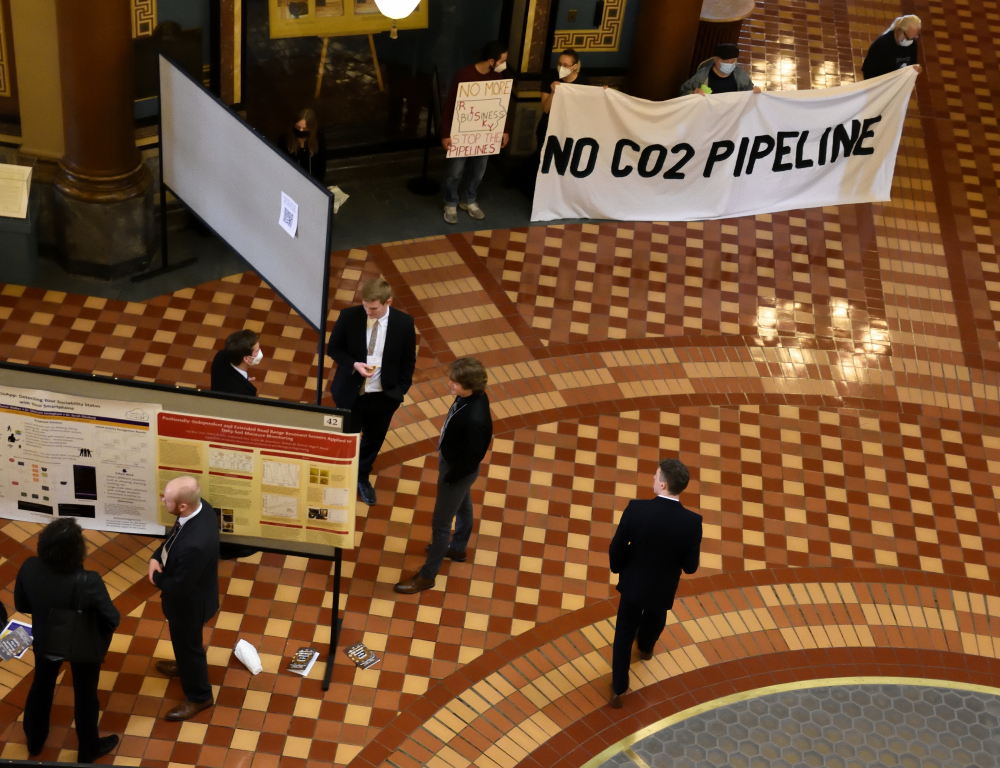
During the recent Buffalo Rebellion Community Call I’ve been writing about, carbon (CO2) pipelines were a focus of attention. Our coalition has had several public demonstrations against these pipelines.
(See: https://quakersandreligioussocialism.com/?s=carbon)


Jake Grobe, Iowa Citizens for Community Improvement. Buffalo Rebellion action

Oakland Institute

The Great Carbon Boondoggle

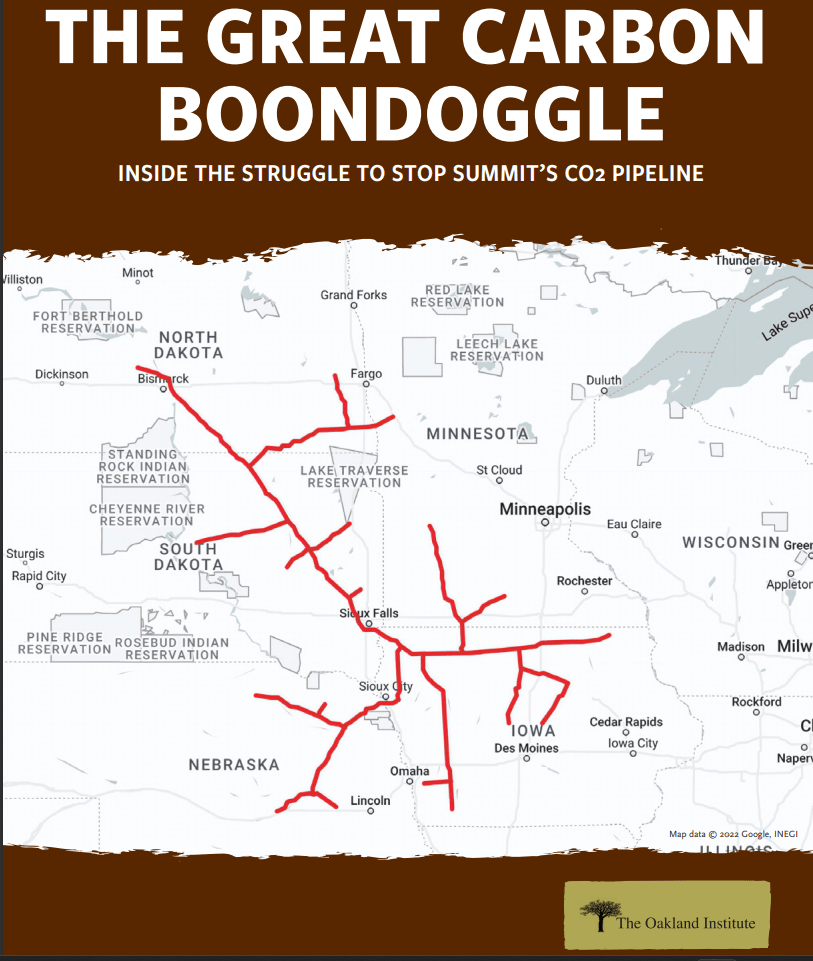
During the community call I learned about a new report from the Oakland Institute titled The Great Carbon Boondoggle, which focuses on the resistance to Summit’s CO2 (carbon) pipeline here in the Midwest. Summit is one of three proposed CO2 pipelines, so far, to be built in the Midwest. The plan is to deliver this report to Iowa Governor Reynolds.

Boondoggle: work or activity that is wasteful or pointless but gives the appearance of having value:

Even a school child would think this idea is crazy. To suck a little CO2 from the air, compress it into a liquid, pump it under pressure (1,000 psi) through hundreds of miles of pipeline to be buried in rock formations. And hope the CO2 doesn’t eventually escape, nullifying the whole thing. This idea of the CO2 remaining where it is deposited is unproven. What has been proven is how hazardous, life threatening it is when the pipeline ruptures.

There is a lot of greenwashing going on. In a situation like this it is helpful if we (pipeline resisters) speak with a consistent message. So, I’m going to use this report to discuss carbon capture and storage. It is great that the Oakland Institute gives permission to share their work.

Map courtesy of Pipeline Fighters, pipelinefighters.org

The report opens with a statement from my friend, Sikowis Nobiss.


NOTE: The following graphic is from Summit Carbon Solutions with an emphasis on safety and permanent storage. There has already been an accident with significant harm to those in the area of the rupture. And there is no proof that the CO2 will remain where it is stored permanently.


Despite these claims, a diverse coalition of Indigenous organizations, farmers, and environmentalists have banded together to stop the project. Opposition has grown across the Midwest in 2022, as Summit attempted to secure the necessary permits and land to begin construction in Iowa. After Summit failed to obtain voluntary easements for the land to build the pipeline in Iowa, it requested the Iowa Utilities Board (IUB) to grant eminent domain for the company to take land from the landowners unwilling to voluntarily cede to the pipeline. While the timeline remains uncertain, the IUB will ultimately determine the fate of the project. The Great Carbon Boondoggle

(See: https://quakersandreligioussocialism.com/?s=carbon)


Why Is Carbon Capture & Storage A False Climate Solution?


The promoters of the Midwest Carbon Express fail to reckon with the growing body of evidence exposing CCS as a false climate solution. CCS projects have systematically overpromised and underdelivered. Despite billions of taxpayer dollars spent on CCS to date, the technology has failed to significantly reduce CO2 emissions, as it has “not been proven feasible or economic at scale.” [27]

Crucially, the ability to capture and safely contain CO2 permanently underground has not been proven, a dangerous uncertainty given CO2 must be stored underground for thousands of years without leaking to effectively reduce emissions. [28]

It also risks permanently contaminating underground aquifers and poisoning precious drinking water for nearby communities.[29]

Additionally, applying CCS to industrial sources such as ethanol plants requires the creation of massive infrastructure and transportation of carbon to storage sites, and injecting it underground poses new environmental, health, and safety hazards in communities targeted for CCS infrastructure. As carbon capture infrastructure needs to be built near emitting sites, facilities would further impact those already burdened by industrial pollution. [30]

In many cases, this disproportionately impacts lower-income,Indigenous, Black, and Brown communities—furthering a vicious cycle of environmental racism.[31] To date, CCS has primarily been used to prop up the ineffective and environmentally unsustainable fossil fuel energy system. In the US, a dozen carbon capture plants are in operation—the majority of which are attached to ethanol, natural gas processing, or fertilizer plants—which generate emissions that are high in CO2. [32] Over 95 percent of the CO2 captured by these plants is currently used for enhanced oil recovery (EOR)—where instead of storing the captured CO2, it is injected into depleted underground oil reservoirs to boost oil production in wells.[33]

There are legitimate concerns that investing billions in carbon capture infrastructure to lower emissions from fossil fuels and ethanol production will reduce incentives for investors and policymakers to transition towards more sustainable and effective solutions. These include investing in wind or solar energy sources, phasing out of industrial agricultural production, developing infrastructure and services such as public transport. [34]

The Great Carbon Boondoggle


It is disturbing that the Biden Administration is strongly supporting Carbon Capture and Storage.

The Biden administration has hailed CCS and carbon pipelines as vital infrastructure to meet climate targets and claimed that the US needs 65,000 additional miles of pipeline by 2050. [3] The Infrastructure Investment and Jobs Act signed in November 2021 provides over eight billion dollars as federal grants, loans, and loan guarantees for carbon storage and pipelines.[4] In 2022, President Biden signed the Inflation Reduction Act (IRA), which substantially increased the already abundant tax credits for CCS projects and made it easier for projects to qualify for these credits.[5] This flood of public money has resulted in over 40 CCS projects announced in 2021 alone. [6]
In Midwestern US, Archer-Daniel Midlands (ADM), Summit Carbon Solutions, and Navigator CO2 Ventures are currently advancing three major CCS projects. The Great Carbon Boondoggle


Endnotes

[3] Douglas, L. “U.S. carbon pipeline proposals trigger backlash over potential land seizures.” Reuters, February 7, 2022.
https://www.reuters.com/business/environment/us-carbon-pipeline-proposals-trigger-backlash-over-potential-land-seizures-2022-02-07
[4] Department of Energy. “Fact Sheet: The Infrastructure Investment and Jobs Act – Opportunities to Accelerate Deployment in Fossil Energy and Carbon Management Activities.” September 29, 2022.
https://www.energy.gov/fecm/articles/fact-sheet-infrastructure-investment-and-jobs-act-opportunities-accelerate-deployment
October 10, 2022).
[5] Gibson Dunn. “The Inflation Reduction Act Includes Significant Benefits for the Carbon Capture Industry.” August 12, 2022.
https://www.gibsondunn.com/the-inflation-reduction-act-includes-significant benefits-for-the-carbon-capture-industry/
[6] Paul, S. “Global carbon capture projects surge 50% in 9 months–research.” Reuters, October 11, 2021. https://www.reuters.com/business/sustainable-business/global-carbon-capture-projects-surge-50-9-months-research-2021-10-12


[27] Center for International Environmental Law. Confronting the Myth of Carbon-Free Fossil Fuels: Why Carbon Capture Is Not a Climate Solution. July, 2021.
https://www.ciel.org/wp-content/uploads/2021/07/Confronting-the-Myth-of-Carbon-Free-Fossil-Fuels.pdf
[28] Center for International Environmental Law. Carbon Capture and Storage: An Expensive and Dangerous Plan for Louisiana. June 25, 2021.
https://www.ciel.org/wp-content/uploads/2021/07/Confronting-the-Myth-of-Carbon-Free-Fossil-Fuels.pdf
[29] Physicians for Social Responsibility. “Danger Ahead: The Public Health Disaster That Awaits From Carbon Capture and Sequestration (CCS).” February 10, 2022.
https://www.ciel.org/carbon-capture-and-storage-an-expensive-and-dangerous-proposition-for-louisiana-communities/
[30] Ibid.
[31] For example, in Louisiana, proposed CCS infrastructure would impact Black and Brown, lower-income communities living in “Cancer Alley,” the industrial region named after decades of poor air and water quality from industrial pollution increased cancer rates and other health risks. Ibid.
[32] Kusnetz, N. “Fossil Fuel Companies Are Quietly Scoring Big Money for Their Preferred Climate Solution: Carbon Capture and Storage.” Inside Climate News, August 17, 2021.
https://insideclimatenews.org/news/17082021/carbon-capture-storage-fossil-fuel-companies-climate/
[33] Iowa Chapter of Physicians for Social Responsibility. Fact Sheet: Low Carbon Standard, Ethanol and Carbon Capture. August 24, 2022. https://psriowa.org/event_ccs2022.html
[34] Ibid.


Publisher: The Oakland Institute is an independent policy think tank bringing fresh ideas and bold action to the most pressing social, economic, and environmental issues. This work is licensed under the Creative Commons Attribution 4.0
International License (CC BY-NC 4.0). You are free to share, copy, distribute, and transmit this work under the following conditions:
Attribution: You must attribute the work to the Oakland Institute and its authors.
Non-Commercial: You may not use this work for commercial purposes.

ACKNOWLEDGEMENTS
This report was authored by Andy Currier, Eve Devillers, and Frédéric Mousseau and draws from the previous Oakland Institute publication: The Midwest Carbon Express: A False Solution to the Climate Crisis.
Special thanks to the landowners and Indigenous community members who shared their experiences. Several remain anonymous to protect their identities

The Great Carbon Boondoggle, Inside the Struggle to Stop Summit’s CO2 Pipeline, The Oakland Institute

Buffalo Rebellion Community Call: Great Plains Action Society and Mutual Aid

Recently I wrote about our Buffalo Rebellion Community Call. That post focused on all the things Jaylen Cavil told us about the work of the Des Moines Black Liberation Collective. https://quakersandreligioussocialism.com/2022/12/14/buffalo-rebellion-community-call-des-moines-black-liberation/

Also, during that call, my friend Sikowis spoke of some of the extensive work of the Great Plains Action Society (GPAS).

She recently wrote Great Plains Action Society’s Theory of Change.

Great Plains Action Society addresses the trauma Indigenous Peoples and our Earth have faced and works to prevent further colonial-capitalist violence through education, direct action, cultural revival, mutual aid, and political change. We believe that Indigenous ideologies and practices are the antitheses of colonial capitalism, and we deploy these tools to fight and build on our vision–tools that are deeply embedded in a culture of resistance. 

It began with the need to protect our homes and way of life from settler invaders, colonial militias, and imperialist governments. There is over a 500-year history of Indigenous resistance to the violent nature of colonial-capitalist genocidal and extractive practices. As stewards of the land, our ancestors saw right away that settler invaders, who were directly harming us, were also harming the environment and throwing the ecosystem off balance. The resistance is ongoing as long as genocide and colonization are perpetuated by the nation-state and its settler citizens. To be in a constant state of resistance is traumatic, hence why we suffer from intergenerational and historical trauma. Yet, it is necessary to protect our land, our people, and our ways from colonial-capitalist forces.

Great Plains Action Society’s Theory of Change written by Sikowis Nobiss


Colonial capitalism

I’ve been learning a lot about colonial capitalism from my friends at GPAS.

  • I have had almost no success in getting my White friends to understand that capitalism is one of the root causes of injustice in this country today. Most of them are so invested in capitalism they cannot, or don’t want, to imagine and work toward alternatives.
  • The initial colonization in this country’s past occurred five hundred years ago. Making it easy for colonial settler citizens today to ignore that history and believe it is their privilege to continue to occupy these lands they have settled on.
  • Now when I look at photos of my ancestors, I view them as settlers. And know I am a settler, too.
  • I am learning that Indigenous ideologies and practices are the antithesis of colonial capitalism.
  • Mutual Aid is a central concept of Indigenous ideologies as Sikowis further explains in the Theory of Change (see below)

Climate parade, Des Moines, photo: Jeff Kisling

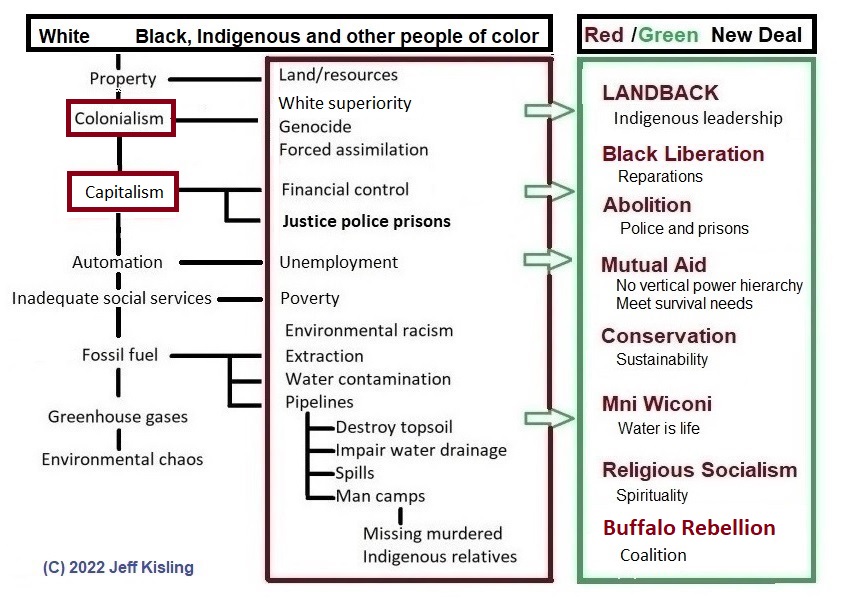
This is a diagram I’ve been working on to visualize the relationships among these concepts. Including colonial capitalism, Black Liberation, Mutual Aid and the Buffalo Rebellion. (See: https://quakersandreligioussocialism.com/)


Mutual Aid

As I wrote earlier, Jaylen Cavil of Des Moines Black Liberation Collective, spoke about the collaboration of Des Moines BLM with Des Moines Mutual Aid. He said Mutual Aid is the alternative to the capitalist system that drains all the resources that should be invested in our people and communities.

This part of the Des Moines Black Liberation Collective website shows some of these relationships. https://www.desmoinesblm.org/mutualaid

https://www.desmoinesblm.org/mutualaid

Sikowis writes about Mutual Aid in Great Plains Action Society’s Theory of Change.

When we imagine a strong political infrastructure, societies built on compassion, and a regenerative economy, we see a focus on relationships and community. Contrary to this county’s notion of independent thought and action, we recognize the importance of relationships and community as the foundation for true democracy. Indigenous traditional societies and cultures are collectivist in nature and we find this to be a critical way of being as we face down the climate emergency and increased societal polarization caused by the adversarial structures of our current governing systems. Radical individualism only benefits the wealthy.

Unfortunately, we have a long struggle ahead of us–but we are up for the challenge. We have no choice. And so, we organize from the bottom up through grassroots and frontline efforts and we are informed by the communities that we serve and are a part of. This work has made it very clear that mutual aid is necessary for achieving our decolonized vision as radical love helps heal and activate more folks on the ground to get culturally, civically, and politically engaged. By empowering BIPOC, 2SLGBTQIA+, and Disabled folks to get involved in change-making, we are building faith in disenfranchised communities that currently lack trust in governmental institutions. Only through mutual aid and community-based organizing will we be able to increase genuine interest in social and climate justice matters, which affect everyday people. We also aim to get out the vote and increase political engagement as most of the big change we seek always comes down to legislation–even at the frontlines. 

Great Plains Action Society’s Theory of Change written by Sikowis Nobiss


I am very glad to learn more about how Sikowis and GPAS see Mutual Aid. She described GPAS’s financial support of the work Ronnie James does at Des Moines Mutual Aid (DMMA). Ronnie is a member of GPAS’s staff and has become a very good friend of mine. Ronnie is in the middle of this photo I took on the day we met in February 2020, at a vigil to support the Wet’suwet’en peoples’ resistance to the Costal GasLink pipeline construction on their lands. Our meeting was Spirit led and changed my life. Most of my justice work since that meeting has been related to Des Moines Mutual Aid.


GPAS’s Theory of Change highlights several important aspects of Mutual Aid.

  • Indigenous traditional societies and cultures are collectivist in nature and we find this to be a critical way of being as we face down the climate emergency and increased societal polarization caused by the adversarial structures of our current governing systems
  • And so, we organize from the bottom up through grassroots and frontline efforts and we are informed by the communities that we serve and are a part of.
    • This is a fundamental principle of justice work. Something I learned about when involved in Quaker Social Change Ministry (See: https://jeffkisling.com/2021/03/15/afsc-quaker-social-change-ministry/)
    • Far too often White people’s approach to justice work was not informed by the communities they were trying to serve. Which often did more harm than good as a result.
  • This work has made it very clear that mutual aid is necessary for achieving our decolonized vision as radical love helps heal and activate more folks on the ground to get culturally, civically, and politically engaged.
    • As I was learning more about the injustices of colonial capitalism, I wondered what the alternative would be. Mutual Aid is that alternative. Fundamental to Mutual Aid is the replacement of today’s hierarchical systems such as political, social, and economic systems with a framework that actively works against such hierarchies. Hierarchies that capital colonialism is based upon. Hierarchies enforce systems of dominance.
  • Only through mutual aid and community-based organizing will we be able to increase genuine interest in social and climate justice matters, which affect everyday people
    • In these times of apathy and hopelessness, Mutual Aid invites people to do work that has an immediate impact when providing things required for survival, such as food, shelter, protective equipment during a pandemic, etc. Generates feelings of self-worth and a desire to help.