Foundational stories: Spiritual Warriors

The Keystone pipeline resistance ended with President Obama’s denial of the pipeline’s permit. But then we began to hear about the construction of the Dakota Access Pipeline (DAPL). In one of the most transparent, egregious examples of environmental racism, the route of the pipeline was changed when people in Bismarck, North Dakota, objected to the original plan for DAPL to cross the Missouri River just upstream from them, fearing contamination of their water. So, the route was changed to cross beneath Lake Oahe (Missouri River), at the edge of the border of the Standing Rock Indian Reservation (orange in the map below).
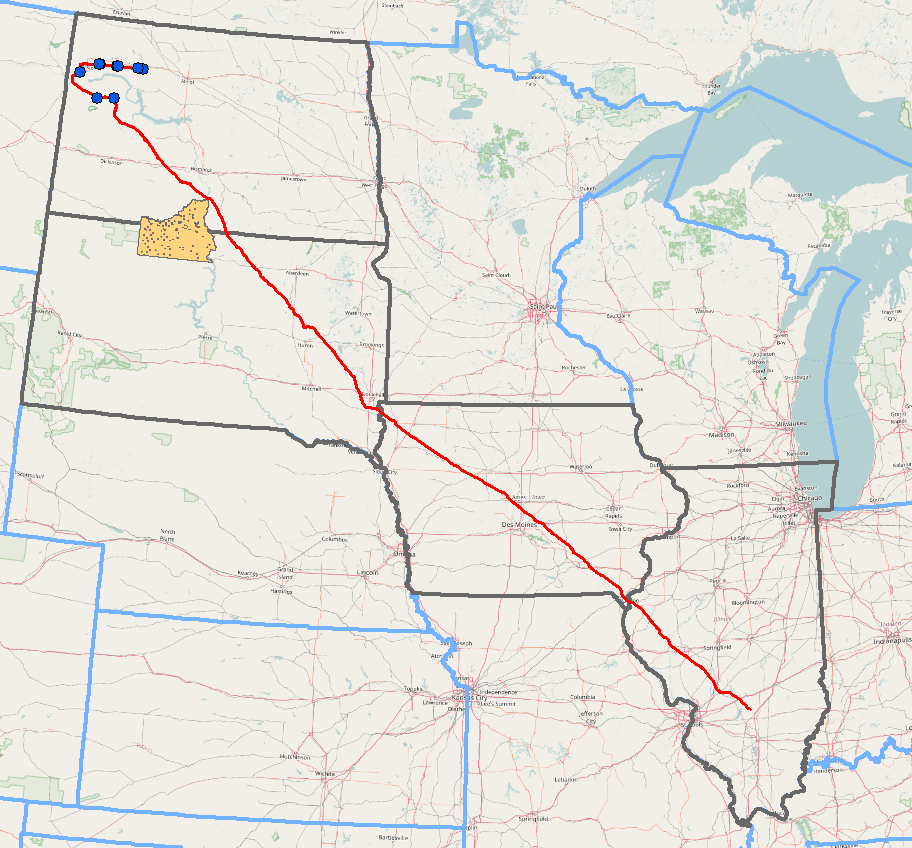
By NittyG – Own work, CC BY-SA 4.0, https://commons.wikimedia.org/w/index.php?curid=52776844

Dakota Access Pipeline route (Standing Rock Indian Reservation is shown in orange)

That new route stimulated months of prayers and ceremonies by hundreds of Native American tribes and thousands of people.

By late September, (2016) NBC News reported that members of more than 300 federally recognized Native American tribes were residing in the three main camps, alongside an estimated 3,000 to 4,000 additional pipeline resistance demonstrators. Several thousand more gathered at the camps on weekends.[7][34][35]

Dakota Access Pipeline protests

DAPL support begins in Indianapolis

In a recent post (Keystone Pledge of Resistance) I described how Jim Poyser, Ted Wolner, and I were trained to design peaceful, nonviolent civil disobedience actions. And how we trained about fifty people in Indianapolis to participate in such actions.

A Spirit-led connection was made when Jim was talking with Joshua Taflinger about the Dakota Access Pipeline (DAPL). Jim lived near Joshua’s White Plains Wilderness Academy. Joshua wanted to know what he could do locally to bring attention to the Dakota Access pipeline. I say ‘bring attention’ rather than protest, because one of the first things I learned from those opposing DAPL was the difference between protesting and being a water protector.

Water protector was about an integral, Spiritual connection with Mother Earth, and all things human and nonhuman.

Bringing attention to the Dakota Access pipeline (DAPL) in downtown, Indianapolis

Jim told Joshua about the Keystone Pledge of Resistance, and those of us who had been trained to organize public gatherings and actions. And told Joshua we would be glad to support similar efforts to call attention to the dangers of DAPL. We were all excited about helping Joshua and White Plains Wilderness Academy, glad our experience could be useful.

Before getting into what we did related to DAPL, I’d like to express how working with Joshua and his wife Brandi, made me aware of the concept of spiritual warriors.


It may seem odd for a Quaker to speak about warriors. But what I mean by warriors is what Chief Sitting Bull said.

For us, warriors are not what you think of as warriors. The warrior is not someone who fights, because no one has the right to take another’s life. The warrior, for us, is one who sacrifices himself for the good of others. His task is to take care of the elderly, the defenseless, those who cannot provide for themselves and above all, the children, the future of humanity.

Chief Sitting Bull

Warriors today are forging different ways to live together, returning to Indigenous ways to live in community. Mutual Aid is an alternative to our broken systems. Members of Mutual Aid communities are working for the abolition of police and prisons. To escape the colonial capitalist system. Feeding the hungry and finding shelter for the houseless. Collecting clothing.


The following from Joshua, is another example of radically rethinking our stories.

I am inspired to share with you all more directly a post I wrote, because I consider you an established and effective nature/spiritual warrior and believe that there is a need for the perspectives shared in the attached post to be more common thought in the minds of the many.

If you feel truth from this writing, and are inspired, I highly encourage you to re-write your own version, in your own words/perspectives, and post to your network.

With the intention of helping us all wake up, with awareness, clarity, and direction.

..spreading and weaving reality back into the world….

What has risen to the surface at Standing Rock is a physical/spiritual movement. Learn how to quiet your mind. To find the silent receptive space to receive guidance. To learn to adapt and follow the pull of synchronicity to guide you to where you will find your greatest support and strength.

What I have found in my time praying in the indigenous earth-based ways, is that it’s not about putting your hands together and talking to God…. It’s about quieting and connecting with the baseline of creation, of nature. Tuning into the frequency and vibration of the natural world, the nature spirits. The beings and entities that have been in existence, for all of existence, the examples and realities of sustainability and harmony.

It’s about becoming receptive to these things. Being open and flowing with them. The spirit guides us, but we have to make ourselves receptive to feel, sense, and respond to this guidance.

Joshua Taflinger


Each Warrior of the Light contains within him the spark of God. His destiny is to be with other Warriors, but sometimes he will need to practice the art of the sword alone; this is why, when he is apart from his companions, he behaves like a star. He lights up his allotted part of the Universe and tries to point out galaxies and worlds to all those who gaze up at the sky. The Warrior’s persistence will soon be rewarded. Gradually, other Warriors approach , and they join together to form constellations, each with their own symbols and mysteries. 

Coelho, Paulo. Warrior of the Light: A Manual (p. 89). HarperCollins. Kindle Edition


There comes a time when all life on Earth is in danger. Great barbarian powers have arisen.

Although these powers spend their wealth in preparations to annihilate one another, they have much in common: weapons of unfathomable destructive power, and technologies that lay waste our world. In this era, when the future of sentient life hangs by the frailest of threads, the Shambhala warriors appear.

The warriors have no home. They move on the terrain of the barbarian powers. Great courage is required, both moral and physical, for they must go into the heart of the barbarian powers to dismantle their weapons, into the places where the weapons are created, into the corridors of power where decisions are made.

The Shambhala warriors are armed only with the weapons of compassion and insight. Both are necessary. Compassion gives them the energy to move forward, not to be afraid of the pain of the world. Fueled by compassion, warriors engage with the world, step forward and act. But by itself compassion burns with too much passion and exhausts us, so the second weapon is needed — insight into the interdependence of all phenomena.

With that wisdom we see that the battle is not between “good guys” and “bad guys,” because the line between good and evil runs through every human heart. And with insight into our profound interrelatedness, we discern right action, knowing that actions undertaken with pure intent have repercussions throughout the web of life, beyond what can be measured or discerned.

Together these two weapons sustain the warriors: the recognition and experience of our pain for the world and the recognition and experience of our radical interconnectedness with all life.

Adapted from Dugu Choegyal, as recounted by Joanna Macy


The Spiritual Warrior is a person who challenges the dreams of fear, lies, false beliefs, and judgments that create suffering and unhappiness in his or her life. It is a war that takes place in the heart and mind of a man or woman. The quest of the Spiritual Warrior is the same as spiritual seekers around the world.  

www.toltecspirit.com/four-agreements/characteristics-of-a-spiritual-warrior/.

My foundational stories: Humility

I feel awkward when writing stories of my life because I was raised to believe we should not call attention to ourselves. I’m feeling this now as I continue to write my foundational stories.

A friend of mine expresses this awkwardness by saying, “anyways, brag, brag, blah, blah”. But we both tell our stories to pass on lessons we’ve learned that might be helpful to others. And in the spirit of Mutual Aid (that we are both involved in), might lead others to share their stories with us. To build a community library of our stories. My mom has worked to gather such a library of stories, the Quaker Stories project. https://quakerstories.wordpress.com/


Dear reader

I offer you this essay in the hope that you may find something within it that will keep you buoyed in the years ahead. It reflects my own attempt to understand the converging crises in our near future, and to grapple with the question of what I might be able to offer that will be useful in that future.

It was the birth of my first child that catalysed a sense of urgency to take the idea-threads I had been tracing for some years now and to weave them into a relatively coherent whole. As any conscientious parent will testify, there are few things that will sharpen one’s focus on the future than a deeply felt sense of responsibility for a new being.

If we are to find a new kind of good life amid the catastrophes these myths have spawned, then we need to radically rethink the stories we tell ourselves. We need to dig deep into old stories and reveal their wisdom, as well as lovingly nurture the emergence of new stories into being.

Pontoon Archipelago or: How I Learned to Stop Worrying and Love Collapse. By James Allen, originally published by Medium, June 18, 2019

So, this is me radically rethinking the stories I tell myself (and you). We are being forced to nurture the emergence of new stories into being because of the catastrophes that are ever worsening because of environmental devastation and social collapse.


It’s not who our ancestors were, or how many committees we serve on, or whether we’ve read John Woolman’s journal that places us in the living stream of Friends. It’s through living our own authentic journey of faithfulness that we can become Children of Light. Without this, we are claiming an inheritance not our own. You can know the motion of thieves is present when you find yourself feeling humble, authentic, and vulnerable. We need to be careful when we talk about humility. The kind of humility this work brings isn’t the kind that would have us reject or repress our gifts. This kind of false humility leads us to oppress each other in the name of preventing pridefulness. This happens far too often. Real, life-giving humility means living up to the light that we have been given without judgment of how bright or dim that light is. False humility is hiding this light under a bushel for fear of jealousy or judgment. The challenge is to be faithful right where we are—no more, no less. This takes courage. To be faithful, we have to make space.

Prophets, Midwives, and Thieves: Reclaiming the Ministry of the Whole by Noah Baker Merrill

 I hope that in this year to come, you make mistakes. Because if you are making mistakes, then you are making new things, trying new things, learning, living, pushing yourself, changing yourself, changing your world. You’re doing things you’ve never done before, and more importantly, you’re doing something.

Neil Gaiman

My foundational stories: Keystone Pledge of Resistance

This is a continuation of a series of posts about the evolution of my foundational stories, which are related to the intersection between my Quaker faith, protecting Mother Earth, and photography.

Much of my justice work for the past twenty years has been and continues to be related to pipelines because they are the critical infrastructure needed to transport oil and natural gas from where they are mined, to the refineries. And against proposed “carbon” pipelines to transport carbon dioxide to storage facilities. Pipelines are usually hundreds of miles long, often traveling through fragile ecosystems and/or rivers and lakes.

It is at the construction sites that activists can resist the pipelines. Or, in the case of the Keystone XL pipeline, prevent the approval of the pipeline permit required to cross the US/Canadian border.

The stories related to each pipeline are so long that they require separate articles for each. I learned a great deal about designing and training for different ways to resist pipelines. And developed deep friendships with many amazing people. These are some of the stories related to the Keystone XL pipeline. We were able to stop its construction.

The (Keystone XL pipeline) project was delayed for the past 12 years due to opposition from U.S. landowners, Native American tribes and environmentalists.

Keystone pipeline officially canceled after Biden revokes key permit. CNBC, JUN 9, 2021

Protecting Mother Earth

Looking back over the past fifty years, it is obvious the industrial world made a fundamental error by the unrestrained use of fossil fuels. We would not be experiencing evolving environmental chaos and social collapse today if not for those tragic decisions. We disregarded the indigenous wisdom of considering the effects our actions would and are having on future generations.

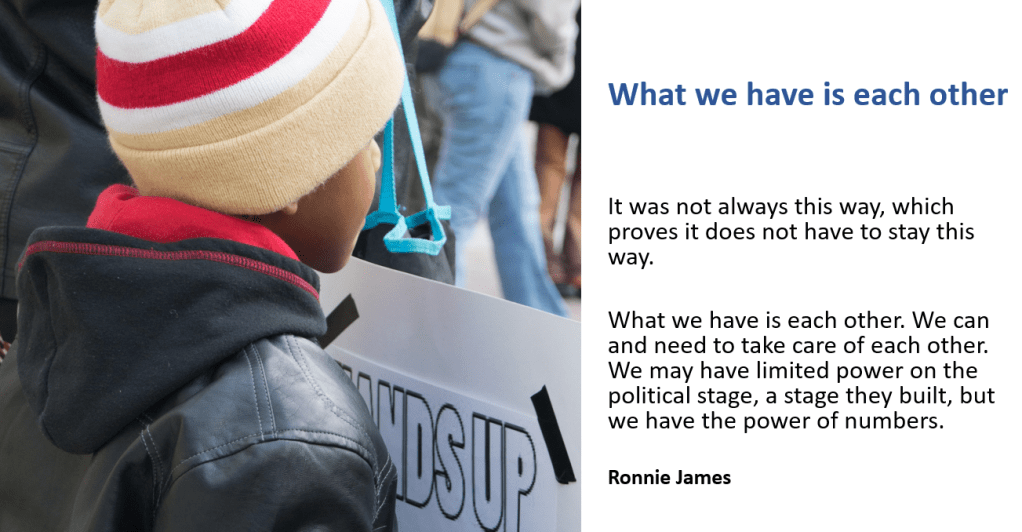
But as my friend Ronnie James, an Indigenous organizer says, “it was not always this way, which proves it does not have to stay this way.”

It is sad to realize young people today have little idea of what life was like just a few decades ago, in the times before rampant fossil fuel consumption.


I’ve written many times about living my life without a car. And my futile efforts to get even one other person to give up theirs. To say I was discouraged is an understatement. (See the story about Cars as Weapons of Mass Destruction at the end of this article).

But then I found some hope. One of the benefits of the emerging use of the Internet was a way to learn about what others were doing and organizing like-minded people to work together. I discovered the Keystone Pledge of Resistance on the Internet.

Keystone Pledge of Resistance

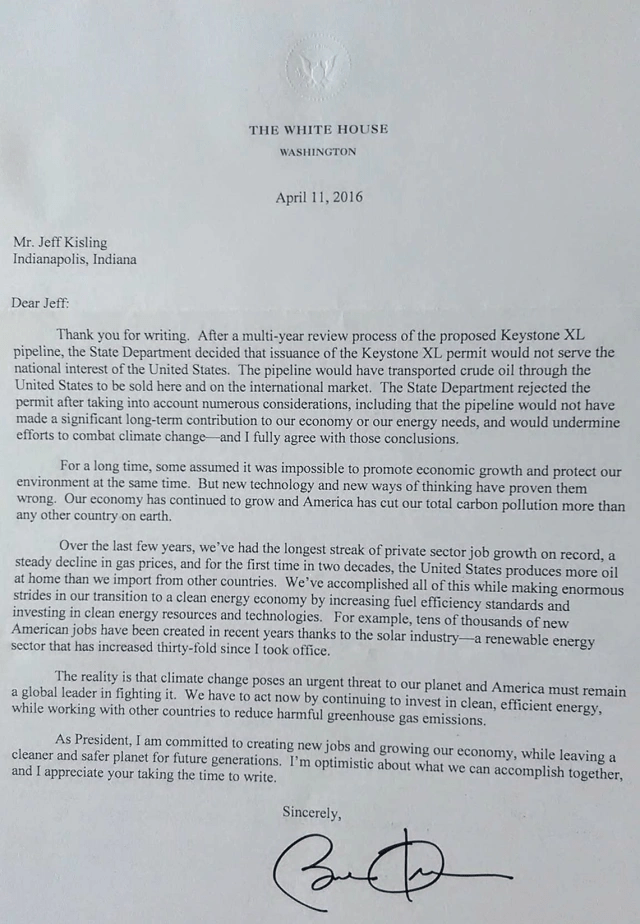
The Keystone Pledge of Resistance was an Internet campaign designed to put pressure on President Obama to deny the permit for the Keystone XL pipeline, which would carry the thick tar sands oil from Canada to the refineries on the Gulf of Mexico.

Environmentalists were having a difficult time persuading the public and industry to transition away from fossil fuels. The environmental organizations Rainforest Action Network (RAN), CREDO, and The Other 98% recognized the Keystone decision as an opportunity to both raise awareness about the dangers of tar sands and possibly even stop the construction of the pipeline. President Obama alone would decide whether to approve the pipeline’s permit, required because it would cross the US-Canada border.

The Pledge was posted on the Internet for people to sign.

“I pledge, if necessary, to join others in my community, and engage in acts of dignified, peaceful civil disobedience that could result in my arrest in order to send the message to President Obama and his administration that they must reject the Keystone XL pipeline.”

97,236 activists signed the Pledge.

Keyston resist

The brilliant part was also collecting the contact information of those who signed, creating a grass roots network.

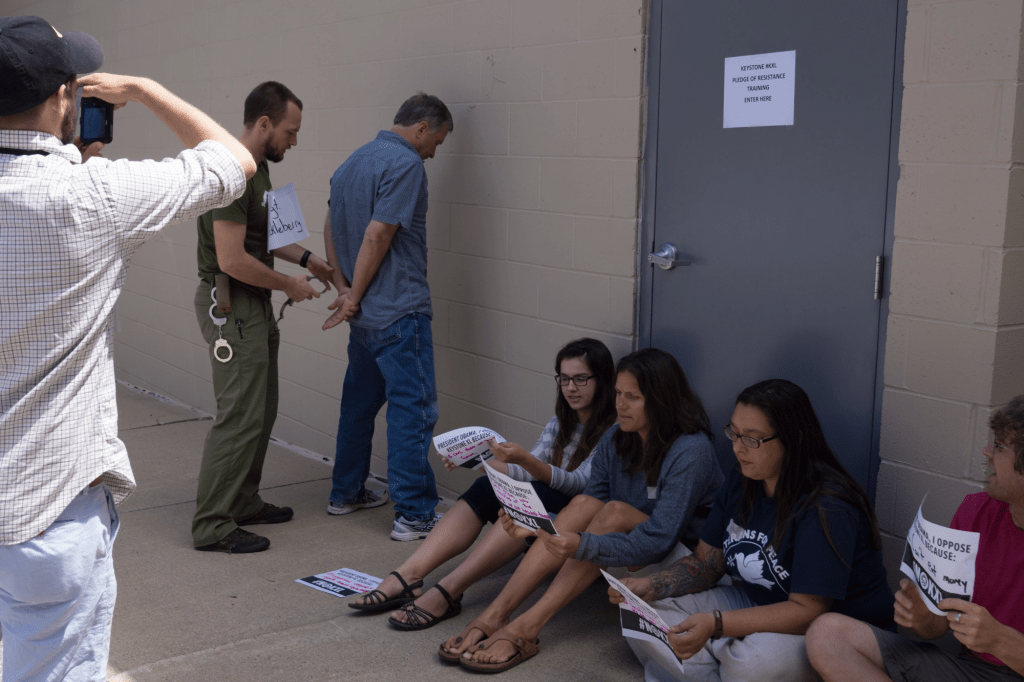
The website also asked if you were willing to lead in organizing an action in your community, which I did. The Rainforest Action Network identified the twenty-five cities that had the most people who had signed the Pledge and spent the summer of 2013 going to those cities to train Action Leaders. Indianapolis was not one of those twenty-five, but Des Moines, Iowa, was. Todd and Gabe held our training session at Iowa Citizens for Community Improvement. The syllabus took 8 hours to complete, with discussion about the pipeline, dangers of fossil fuels, theory of nonviolent resistance, legal aspects, all the necessary roles (media, police liaison, jail support and how to organize an action and train others to participate. Role playing was another part. Below we experience being handcuffed. The second day of the training involved the participants doing the training we received the day before.

You can see the syllabus for this training here: KXL_Pledge_Participant_Guide

Practicing being handcuffed for civil disobedience.

I returned to Indianapolis where three others, Jim Poyser, Ted Wolner, Wayne Moss, and I designed a nonviolent direct action at the Federal Building in Indianapolis. (We didn’t have to execute the action because President Obama denied the permit).


Jim Poyser, Ted Wolner and Jeff Kisling, Keystone Pledge of Resistance organizers, Indianapolis

Over the next several months we held training sessions for local people who had signed the Pledge, eventually training about 50 people. Nationwide about four hundred action leaders trained nearly 4,000 people. President Obama was made aware of this nonviolent “army” and its plans. All this was done in the open.

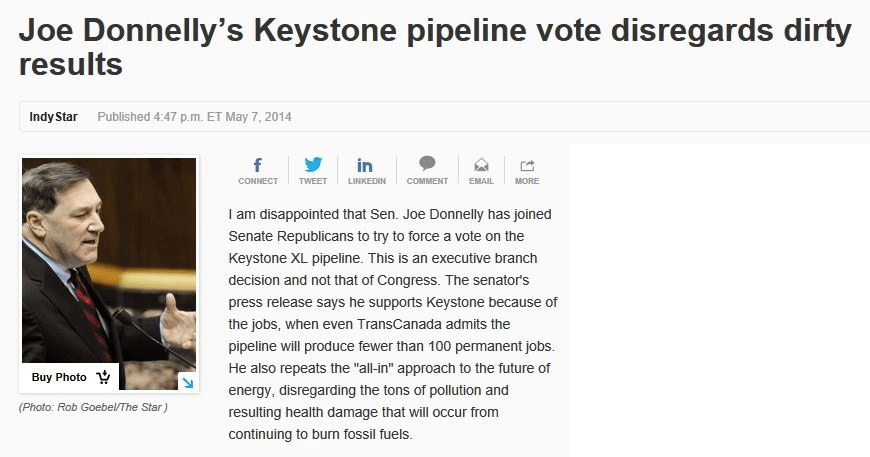
We used other opportunities to raise awareness about the Keystone Pipeline, fossil fuels and the effects of greenhouse gas emissions. The Indianapolis Star published this letter to the editor I wrote. Senator Donnelly had been talking about the jobs the pipeline would create. In reality less the fifty full-time jobs would be created. After this editorial, he didn’t talk about jobs again.

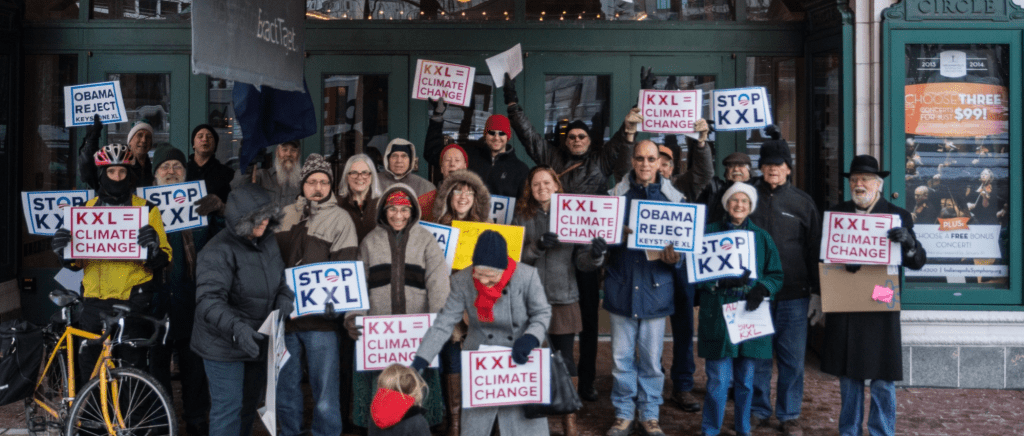
We also held multiple demonstrations related to the pipeline. Quakers from the North Meadow Circle of Friends often participated.

Stop the Keystone pipeline, downtown Indianapolis

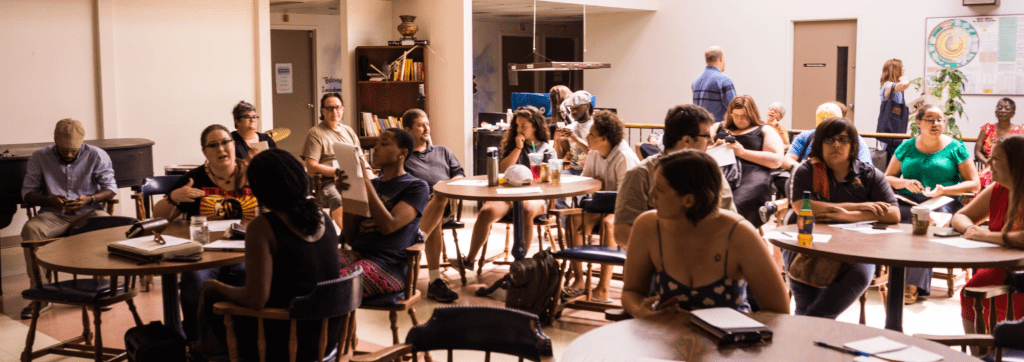
The Kheprw Institute (KI), a Black youth mentoring community I was involved with, allowed us to hold a public meeting about the Keystone Resistance. Each of the Action Leaders spoke about why we were willing to risk arrest to stop the pipeline.

Kheprw Institute, Indianapolis

In addition, my friend Derek Glass created this video about KXL from some of my photos and a script I wrote.


November 6, 2015, President Obama rejected the Keystone XL pipeline permit. Then on one of the first days of the Trump administration (January 2020) the pipeline permit was approved. Finally, the Biden administration revoked the permit, and TC Energy gave up on building the pipeline.

  • Keystone XL was halted (2021) by owner TC Energy after U.S. President Joe Biden this year revoked a key permit needed for a U.S. stretch of the 1,200-mile project.
  • The Keystone XL pipeline was expected to carry 830,000 barrels per day of Alberta oil sands crude to Nebraska.
  • The project was delayed for the past 12 years due to opposition from U.S. landowners, Native American tribes and environmentalists.

Keystone pipeline officially canceled after Biden revokes key permit. CNBC, JUN 9, 2021


A Bear Creek Friend gave me this sign which meant a lot to me.

A more detailed account of my years of work in resistance to the Keystone XL pipeline can be found here: Lessons Learned from the Keystone Pledge of Resistance.


Summary

In summary, the Keystone Pledge of Resistance and actions against other pipelines and fossil fuel projects played a significant role in my foundational stories.

Protecting Mother Earth

Besides the greenhouse gas emissions from burning the oil transported in the Keystone and other pipelines, construction of pipelines disturbs the topsoil where the pipeline is constructed, often excellent soil in Iowa. Drainage systems are destroyed. And the clay that gets mixed in with the topsoil when the pipeline trench is refilled means the fields no long drain water well.

Photography

I learned a lot about taking photos as I documented our many actions related to the pipelines. And later used those photos when I wrote stories about the actions. You can see of some of those photos related to the Keystone pipeline resistance here: https://tinyurl.com/KeystoneResistance

I should note these days I don’t take photos at events that don’t have a public permit because law enforcement uses such photos to identify who was present.

Quaker

It was my Quaker faith that led me to be trained as an Action Lead in the Keystone Pledge of Resistance. Members of the Quaker meeting I attended in Indianapolis participated in demonstrations against the Keystone and Dakota Access pipelines.

Additionally, following are several reports and Minutes that were approved by my Quaker Yearly Meeting, Iowa (Conservative) over the years.


The following Minute was approved by Iowa Yearly Meeting (Conservative) in 2017.

 Radically reducing fossil fuel use has long been a concern of Iowa Yearly Meeting (Conservative). A previously approved Minute urged us to reduce our use of personal automobiles. We have continued to be challenged by the design of our communities that makes this difficult. This is even more challenging in rural areas. But our environmental crisis means we must find ways to address this issue quickly.

Friends are encouraged to challenge themselves and to simplify their lives in ways that can enhance their spiritual environmental integrity. One of our meetings uses the term “ethical transportation,” which is a helpful way to be mindful of this.

Long term, we need to encourage ways to make our communities “walkable”, and to expand public transportation systems. These will require major changes in infrastructure and urban planning.

Carpooling and community shared vehicles would help. We can develop ways to coordinate neighbors needing to travel to shop for food, attend meetings, visit doctors, etc. We could explore using existing school buses or shared vehicles to provide intercity transportation.

One immediately available step would be to promote the use of bicycles as a visible witness for non-fossil fuel transportation. Friends may forget how easy and fun it can be to travel miles on bicycles. Neighbors seeing families riding their bicycles to Quaker meetings would have an impact on community awareness. This is a way for our children to be involved in this shared witness. We should encourage the expansion of bicycle lanes and paths. We can repair and recycle unused bicycles, and make them available to those who have the need.


Although we have tried to find ways to promote environmental concerns, such as supporting Environmental Protection Agency (EPA) regulations, engaging with the Occupy Movement, and protesting the Keystone XL Pipeline, it has become increasingly clear that traditional approaches to creating political change are not working well. Civil liberties are being eroded, making it more difficult to petition for change.
We have been trying to understand a system of irresponsible actions on the part of policy makers across the developed world related to the environment and our changing climate. It is painful to conclude that concern for each other and the environment has largely been replaced with protecting and promoting economic growth and profit without regard to the environmental consequences.

Report of the Earthcare Subcommittee, Iowa Yearly Meeting (Conservative) 2012

ENVIRONMENTAL STATEMENT OF CONCERN
Addendum to Peace and Social Concerns Committee Report 2013

[It was agreed in business session that this statement was too long to be
read and discussed and that instead it could be used as a resource and as
background material to the minute proposed by the Peace and Social
Concerns Committee and approved by the yearly meeting on Seventh
Day.]


Every good that we can do, every good that we can imagine
doing, will be for naught if we do not address climate change.

Van Jones, Rebuild the Dream, February 2013


We, members of Iowa Yearly Meeting (Conservative) of the Religious Society of Friends (Quakers), are dismayed at the damage that has been done, and continues to be done, to our environment.

The widespread availability of refined fossil fuels began to revolutionize societies worldwide early in the last century. Progress came to be defined as the development and use of a vast array of products and devices to make work and living tasks easier or to do things that weren’t
possible before. Initially the industrial revolution resulted in widespread employment, but eventually human labor was largely replaced with work done by machines, which were either directly powered by gasoline or indirectly by electricity which was usually produced by fossil fuel.

One huge effect of this was the migration from the farm to the city. Very inexpensive gasoline and the availability of personal automobiles led to urban development that assumed people would travel some distance from their homes to get to work, school, grocery stores and other businesses. That requires the use of significantly greater volumes of fossil fuel for daily life and a sprawling infrastructure of highway, water, waste, and electrical systems, and emergency and other services.

A culture evolved that changed priorities to material consumption and convenience. Business profits from that became the key drivers of economic and political policies. This move to cities tended to disconnect people’s close relationship with nature, and environmental consequences
of these changes were purposely minimized. Businesses did not want protecting the environment to impact profits, so subsidies (tax incentives, price controls, favorable trade regulations, etc.) were employed to hide the true costs of energy and water production. Environmental concerns were not the priority when they conflicted with profits. We didn’t have
ways to understand, quantitate, and price environmental damage.

There are three major problems we are now facing as a result of this:

  1. We are passing the point of peak oil production. Supplies of this nonrenewable resource are dwindling, and it will be much harder to extract the fossil fuel supplies that are left (such as tar sands). Energy return on energy investment (EROEI, or EROI) is an important concept, being the ratio of the amount of usable acquired energy divided by the energy expended to
    produce that energy. Hydroelectric power has an EROEI of 100. In the early days of easy oil extraction, oil’s EROEI was about 100, but has been falling steadily, and was 19 by 2006. Tar
    sands’ is making it hard to justify extracting it.
  2. Our economic system is dependent on continual growth. We are reaching limits to available resources to sustain that growth. Much of industry has replaced human and animal
    labor with fossil fuels and is not prepared for rapidly increasing costs and decreasing supplies of energy and water. Widespread unemployment is the root of many social problems and injustices today. Through tax laws and business regulations, this economic
    system is facilitating greater inequities in the distribution of wealth.
  3. Greenhouse gas (GHG) emissions are increasing. Carbon dioxide (CO2), primarily from burning fossil fuel, and methane (from animal digestive gases and released from thawing
    frozen deposits) trap heat in the atmosphere. That is what has kept earth air temperatures moderate. But rapidly increasing atmospheric greenhouse gas concentrations are increasing the atmospheric temperature. The consequences include melting ice caps, which results in less sunlight reflected off the ice and more heat absorbed by the earth’s surface, rising ocean water levels from the melting ice, and release of methane deposits that had
    been frozen, further increasing greenhouse gases in the atmosphere. These changes also affect ocean currents and are thought to be contributing to changing weather patterns. Warmer air holds more water. Less water returned to the earth as rain and changing precipitation patterns are contributing to desertification of some areas of the earth.

The two major ways CO2 is removed from the atmosphere (known as carbon sinks) are by:

  1. Photosynthesis of plants: Chlorophyll combines CO2 from the air with water to produce sugar and oxygen. Destruction of forests decreases this carbon sink, reducing CO2 removal (as well as decreasing oxygen production).
  2. Absorption into the ocean: CO2 combines with water to form carbonic acid. Increasing atmospheric CO2 leads to increased CO2 absorbed into the ocean, resulting in abnormal
    acidification of the ocean, which damages coral reefs and other marine life.

Unfortunately, the rate at which carbon sinks remove CO2 is significantly slower than the rate at which CO2 is being added. It is estimated that it takes about 100 years to remove CO2 after it has been added to the atmosphere. The over 14 TONS of CO2 dumped into the atmosphere by the U.S. alone in a 24 hour period will remain there for nearly 100 years, unless ways are found to increase CO2 extraction. For example, some progress is being made in developing artificial
photosynthesis, but the impact this could have on CO2 removal is not yet known.

Public education is required so that informed personal decisions and economic policies can be made. Protecting and restoring our environment must become the primary goal of political and economic policies. Addressing greenhouse gas emissions and preserving our water and food supplies must become our overriding principles. As a case in point, it is crucial that the Keystone pipeline to transport tar sands oil from Canada to the U.S. Gulf Coast not be built. CO2 from burning tar sands oil must not be added to the atmosphere, and the very high risk of contamination of the Ogallala aquifer, the primary water supply for many f the Great Plains states, cannot be justified. The construction of the Keystone pipeline has become the defining issue for our future direction. Ecocide refers to the destructive impact of humans upon the
environment, leading to human extinction. Many believe we must immediately stop greenhouse gas emissions if we are to have any chance of avoiding ecocide. Construction of the Keystone pipeline will both signal that environmental concerns will continue to be systematically
denied and likely assure that ecocide will occur. Some Friends are engaging with others in acts of civil disobedience to try to stop construction of the Keystone pipeline and raise awareness of the
consequences of building it. This is seen as an opportunity to make others aware of the climate catastrophe that continued fossil fuel extraction and use represents.

Similarly, hydraulic fracturing (fracking) for buried natural gas inserts toxic chemicals into the earth that are polluting drinking water supplies.

Approved Minute:
Iowa Yearly Meeting (Conservative) opposes the practices of both tar sands extraction and hydraulic fracturing.

Conservation (reducing use and recycling) is one of the most efficient and readily available ways to conserve energy and other resources.

Simple supply and demand will inevitably result in rapid and dramatic increases in the cost of fossil fuel products and water. Because so many sectors of the present economy rely on cheap energy and water, severe stress, and possibly even collapse of this system, will occur. Widespread travel will significantly decrease as result of both the scarcity and cost of fossil fuels. Transoceanic transport of food and other goods will cease. Changing weather patterns, droughts, desertification, pollution, and increased energy costs will increase the cost of water, since a great deal of energy is needed for water distribution. Distribution of goods, especially food, will be severely impacted. Social unrest will result.

In broad terms, a cultural shift is required to reverse what led to this point. The recent cultural shift toward secular materialism does not reflect Friends’ values. In addition, we are faced with the moral travesty of consuming nonrenewable resources and the additional environmental
damage done in the process, knowing at least some of the catastrophic effects this will have on future generations. Since this cultural and economic model is not sustainable, as it fails, we have an opportunity to help move toward a more nearly equal and socially just society. We should examine our own lives, and how our lifestyle could be changed.

Two minutes have been approved by the yearly meeting (2008, 2012) that address these issues. As they state, one of our goals is to reduce the use of or get rid of personal automobiles. It is obviously significantly more efficient to share public transportation vehicles, more and more of which use alternatives to fossil fuels. Each time we think of travel, we should consider alternatives to using a car, such as walking, bicycling, or using public transportation. Bicycles in particular can easily cover significant distances without great effort and are at the same time good exercise, as well as being enjoyable to ride. Adult tricycles are available for those who need the extra stability. Various devices can be used to help carry things like groceries. Pedal-powered trolleys can be found in more and more cities. We can encourage shared bicycle systems in our communities and the development of bicycle paths through city streets. Friends meetings should encourage bicycling, including providing bicycle racks and perhaps offering help with bicycle maintenance. This can be a visible witness.

Jeff Kisling and Sherry Hutchison, co-clerks
Peace and Social Concerns Committee


Sustainable Indiana staff include John Gibson, Jim Poyser, Shannon Anderson, Judy Voss and Richard Clough.  They have appeared in many of my blog posts, because they are involved in so many environmental efforts.  John and Jim were very active in the Keystone Pledge of Resistance, and they have all been involved in Indiana Moral Mondays and many other projects.

“Sustainable Indiana 2016 is a Indiana  Bicentennial Legacy Project of Earth Charter Indiana.  Our mission has been to collect and celebrate stories of people who are taking the lead on a sustainable future in Indiana.  This book contains some of those stories, for Hoosiers and by Hoosiers, to serve as a guide to a future that gives us a deeper and healthier connection to our environment and each others.”

They were kind enough to include one of my stories, Cars as Weapons of Mass Destruction in the Transportation chapter.

My foundational stories: 1980’s to 2000’s

This is a continuation of a series of posts about the evolution of my foundational stories, which are related to the intersection between my Quaker faith, protecting Mother Earth, and photography. The dates in the title are approximations of this time when many things seem to have reached a plateau.

I moved from one rented apartment to another, all in Indianapolis. The criteria were being on a city bus route and close enough to the children’s hospital that I could run to and/or from there because I preferred that to riding the bus. And within walking distance of a grocery store, and laundromat. None of the places had air conditioning. These things were what protecting Mother Earth looked like then.

I didn’t do much with photography during this time before digital photography.

There wasn’t a Quaker meeting in any of these neighborhoods. This being the times before Zoom, which meant I didn’t have much contact with Quakers. The exceptions being attending Iowa Yearly Meeting (Conservative) each summer. And making monthly trips to Scattergood Friends School for the several years I was on the School Committee.

But there were two other things going on that occupied my time and efforts during those years. This was the time my godchildren were growing up. Roller-skating was the main source of fun and social interaction for kids in the neighborhood. We would go there nearly every Wednesday, Friday, and Saturday night. They were at an age when they couldn’t be left alone, so I spent a lot of time there myself. We also went to the Indianapolis Zoo almost every weekend. And Brandon was very active in baseball from the age of four until about fifteen.


The second major thing going on during these years was my career at Riley Hospital for Children. I recently wrote an extensive story about my experiences at Riley.
(see: https://tinyurl.com/mrxsy7fv)

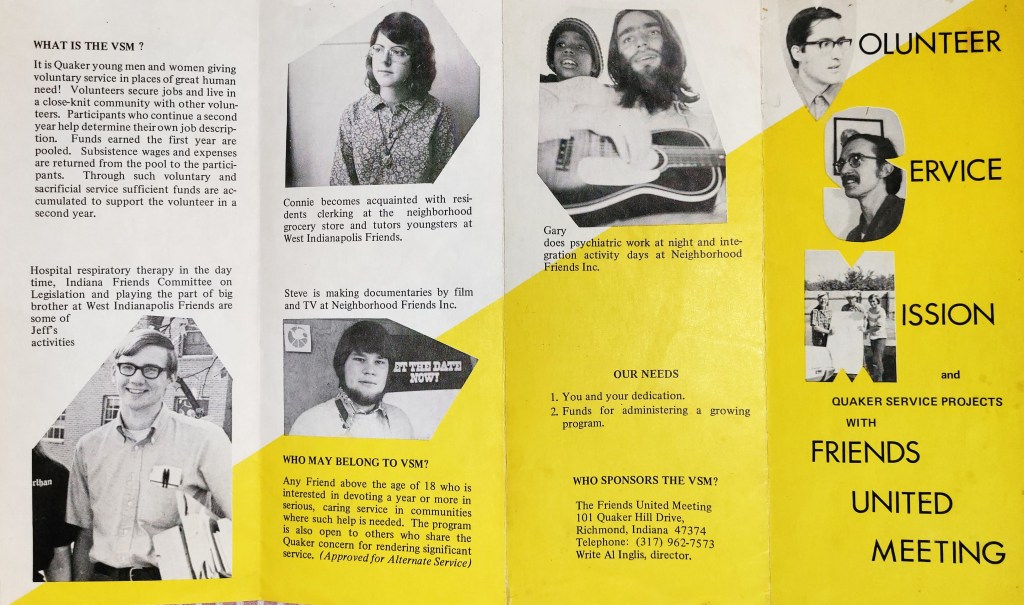
Quakerism played a pivotal role in leading me to work at Riley. It was my Quaker faith to oppose the military draft that led me to join VSM in Indianapolis. I previously wrote about my time at Friends Volunteer Service Mission (VSM), including being trained on the job in respiratory therapy at Methodist Hospital.

I left the hospital to work full time with the kids for my second year at the VSM project.

After that I got another job in respiratory therapy, this time at the Indiana University Medical Center/Indiana University School of Medicine (IUSM). I became aware of the role of respiratory therapists at Riley Hospital for Children, part of the IUSM, and transferred there.

I really enjoyed working with the babies in the NICU at Riley. Since they could not tell you how they felt, we had to become very adept at observing them, knowing what signs to look for, what they meant, and how to intervene to fix problems. We had to assess skin color and perfusion, and respiratory patterns. Listen to breath sounds. And interpret the readings from the various monitors and other equipment attached to the baby.

Me in the Neonatal Intensive Care Unit (publicly published photo)

I frequently cupped my hand around the baby’s head to communicate care.  We don’t take photos of patients without their parent’s permission. This photo was part of an article published about Riley Hospital. (That’s me in the photo.) 

Rich Schreiner, director of the NICU, and I edited the book, Practical Neonatal Respiratory Care. My brother, Randy, a graphic artist and drew these pictures of the Hope self-inflating bag for the book.


Working in a research hospital, I was involved in work we published in numerous articles about neonatal care, and then the research studies we performed in the Infant Pulmonary Function Lab. A bibliography of these publications follows:


Faith played a role several times in my continued path related to respiratory therapy and research. Faith led me to apply to work in the Infant Pulmonary Function Lab that was just being established at Riley. Not only did I not know much about research, but the new job, funded by grants, would require a fifty percent pay cut.

Faith gave me confidence that was sorely needed as I began to learn how to write computer software to read, display, and do calculations from the many signals being read by instruments involved in our research studies. These signals had to not only be collected at a rate of 200 samples per second for each channel, but also displayed in real time. Every data point and all the calculated results were also stored in databases we created.

One of the major contributions our Infant Pulmonary Function Lab made was the development of a system to measure the diffusion of gases in the lung. It took a concerted effort of all of us in the lab, for three years, to develop the DLCO (diffusion of carbon monoxide in the lung) test. Ours was then the only lab in the world that could make these measurements.

That allowed us, for example, to document the changes of a newly defined disease, pulmonary interstitial glycogenosis.


Appreciating and using the ideas of a classical physiological study and combining this with the results of modern molecular biology, they demonstrated how, at the crossroads of two completely different scientific fields, an added value is created that brings forward in understanding one of the most fascinating phenomena in respiratory medicine: lung growth and repair.

Obviously, “classical” and anatomical studies have been regularly used to confirm anatomical and pathological concepts, using lung function data to assess growth of the lungs and airways in healthy children, children with asthma, or preterm infants. However the study by CHANG, et.al. is far more advanced because it introduces new applications of novel infant lung function techniques and incorporates these with classic physiological concepts while combining them with advanced subtyping of progenitor cells.

Standing on shoulders, Peter J.F.M. Merkus, Paediatric Pneumonology, 2014

My foundational stories: 1970’s

My previous post was a description of the beginnings of my foundational stories, which related to the intersection between my Quaker faith, protecting Mother Earth, and photography. The intention of this series of articles is to show how these foundational stories changed over time.

The beginnings of the stories were about my struggles and eventual decision to resist the draft. Although I wasn’t prosecuted for that felony offense, there were other consequences. During the time it took for my family to adjust to my intention to resist the draft, I joined the Friends Volunteer Service Mission (VSM) in inner city Indianapolis in 1971. This was a Quaker part of my foundational story.

Quaker

VSM was set up to provide alternative service work for conscientious objectors. The two-year program involved working at the type of job that qualifies for alternative service, most often in a hospital. And saving enough money from that job to support yourself to work full time in the community. Others, not doing alternative service, were also able to apply.

VSM was impactful in my life in two ways. The work I found was in respiratory therapy, then called “inhalation therapy”. I received on-the-job training to do this work during my first year at VSM. After my VSM experience, I obtained a degree in respiratory therapy and worked for about five years as a neonatal respiratory therapist. And for the rest of my career worked in an infant pulmonary function research lab.

VSM was also where I began to learn important (foundational) lessons about community organizing, Quaker faith in action. Others at VSM did what I thought of as traditional organizing, which included many meetings about setting up a neighborhood health clinic or trying to prevent the construction of an interstate highway through the local community.

I quickly found I didn’t like that type of community organizing. And felt a little guilty that I didn’t. But I eventually discovered what kind of community organizing I was led to do. During my first year at VSM I spent a lot of time with the kids in the neighborhood. The VSM house was next to Second Friends Church, which had a nice yard where we played games like capture the flag. One of our VSM projects involved setting up a basketball hoop in front of the garage of the church.

There were no programs for kids in the neighborhood and I really enjoyed working with them. When thinking about what to do during my second year at VSM, it became clear I should continue to work with the kids full time. We organized a 4-H club, went swimming, and rode bicycles to shopping centers, where we played “wall ball” on the walls at the back of the stores.

This would determine my approach to social justice work for the rest of my life. What was important was being in the communities where the work was to be done. And to focus on building friendships.


Photography

At VSM, there became another way photography became important in my life. I knew how to set up a basic darkroom and did that in the VSM house bathroom. Photography became one of the kids’ favorite things to do. We would ride around the city on bicycles with a couple of (film) cameras. Then develop the negatives and print the photos. I can still see the wonder in their faces as the image gradually appeared on the paper (in the red light of the darkroom).

Now, fifty years later, on two separate occasions, kids from that time found me on Facebook. They both talked about those darkroom experiences.


Protecting Mother Earth and photography

During this time in Indianapolis (early 1970’s) I didn’t have a car, simply because I couldn’t afford one. So, riding a bicycle everywhere, including to the hospital for work, was my routine.

But moving to Indianapolis had a major (foundational) impact on me, which influenced the rest of my life. I couldn’t believe how foul the air was. I saw clouds of fumes pouring out of the exhaust of every car. This was before the availability of catalytic converters, which cut out the visibility of the exhaust, but didn’t stop the greenhouse gas emissions. No one was talking about global warming and greenhouse gases then.

But I had a profound vision of clouds of pollution blocking the view of my beloved mountains. Specifically, obscuring Long’s Peak in this photo I took and developed around the time I moved to Indianapolis. That horrific vision stayed with me the rest of my life. As a consequence, I refused to have a personal automobile for the rest of my life. (Protecting Mother Earth).

Long’s Peak, Rocky Mountain National Park, Colorado

These are more of the ways my foundational stories are about the intersection between my Quaker faith, protecting Mother Earth, and photography.

Our foundational stories: Beginning

Recently I heard a Quaker friend speak about returning to the beginning of a foundational story in our lives. And then think about how that story changed as we grew older. And how we view it today.

That was amazing because I had begun to do just that before she spoke. My foundational story is related to the intersection between my Quaker faith, protecting Mother Earth, and photography. This combination has remained a powerful, yet evolving, influence throughout my life.

I’m praying about my foundational story for several reasons. Thinking of how drastically our world has changed since the beginning of my story. And wondering how I might be most helpful or effective now. Because my Quaker faith, care for Mother Earth, and photography have always been about doing what I’m led to do to help all my relations.

I often think of this quote:

If we are to find a new kind of good life amid the catastrophes these myths have spawned, then we need to radically rethink the stories we tell ourselves. We need to dig deep into old stories and reveal their wisdom, as well as lovingly nurture the emergence of new stories into being.

Pontoon Archipelago or: How I Learned to Stop Worrying and Love Collapse. By James Allen, originally published by Medium, June 18, 2019

So, this is me radically rethinking the stories I tell myself (and you). We are being forced to nurture the emergence of new stories into being because of the catastrophes that are ever worsening because of environmental devastation.

As I explain in the following, there have been times when I’ve kept a record of what I was thinking and feeling, documenting my foundational stories. Of course, I didn’t have a way to share what I was writing in my journal at the beginning of my story. That is one difference in how my story has changed, now that there are so many ways to share writings on the Internet. This has stimulated me to write nearly daily blog posts for more than the past five years. I don’t know how many people read them. Although the main reason has always been for me to think through, pray about, what was going on at the time.

Now I have ways to share what I was learning about spirituality with others. Some of this might be helpful for the declining number of those involved in organized religion. This is the Quaker piece of my story.


I began a journal in 1969 when I was a senior at Scattergood Friends School. (see: journal). This is my first journal entry.

Sept 29, 1969

Journal, Sept 29, 1969

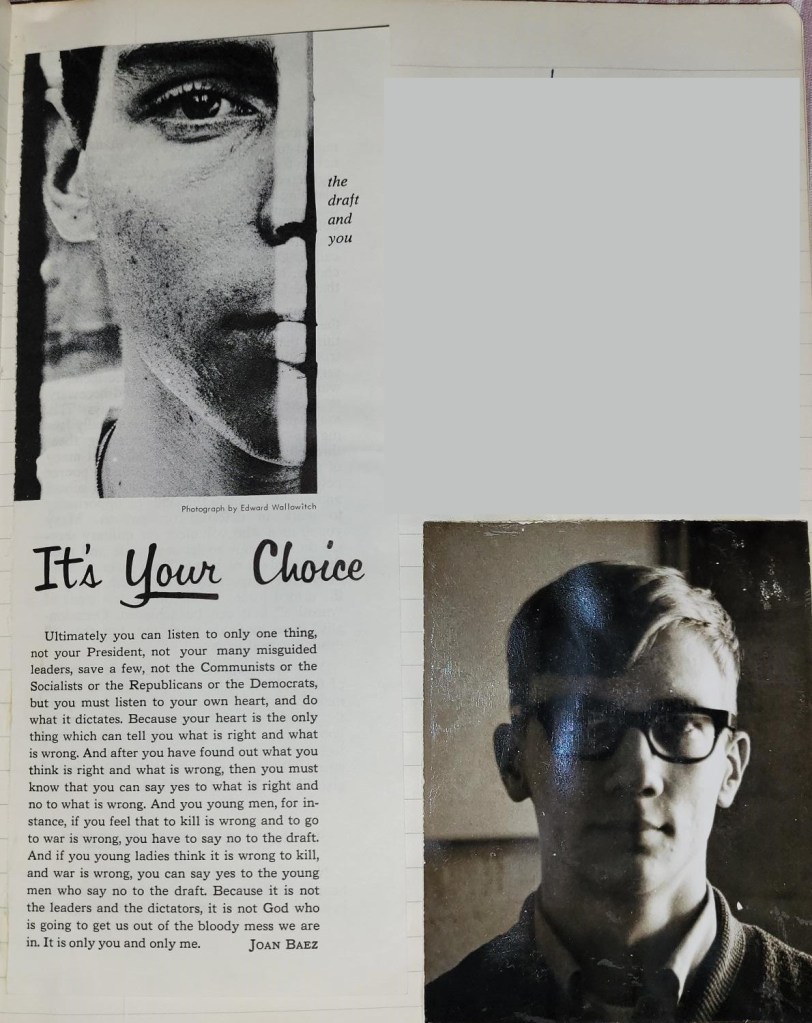
I sometimes included printed material in my journal. The following, It’s Your Choice, was written by Joan Baez, a folk singer and peace advocate. Which includes a photo of half of a young man’s face. I put a photo of myself at the time on the right-hand page of the journal entry for November 6, 1969. (Photography as part of my foundational story). Getting close to my eighteenth birthday, Nov. 21, 1969, when I would have to decide whether to register for the draft.

I would disagree with one thing she wrote. I believed it WAS God who was going to get us out of the bloody mess we were in, the Vietnam War.

Journal, Nov 6, 1969

It’s your choice
Ultimately you can listen to only one thing, not your President, not you many misguided leaders, save a few, not the Communists or the Socialists or the Republicans or the Democrats, but you must listen to your own heart, and do what is dictates. Because your heart is the only thing which can tell you what is right and what is wrong. After you have found out what you think is right and what is wrong, then you must know that you can say yes to what is right and no to what is wrong. And you young men, for instance, if you feel that to kill is wrong and to go to war is wrong, you have to say no to the draft. And if you young ladies think it is wrong to kill, and war is wrong, you can say yes to the young men who say no to the draft. Because it is not the leaders and the dictators, it is not God who is going to get us out of the bloody mess we are in. It is only you and only me.

Joan Baez

Mother Earth

Anyone who has farmed is intimately connected to our environment. The first ten years of my life we lived on dairy farms. I took the beauty for granted and remember much of the time was taken up with hard work. We had a large pond with a narrow strip of land through the middle, dividing it in half. There were many times I was so frustrated when I got the herd of cows moving around the pond, heading to the barn for milking, when half of them would turn back, going the wrong way down that narrow strip on the pond. And of course, when I went to get them, others would turn around, going along the side of the pond. One day it was so muddy I stepped out of my boots and that was the last straw. I went to the house in tears, without the cows.

In those days (1950’s) living on the farm usually meant living with very little money. But my parents were able to rent small campers that we loaded with food and went camping for two weeks. We usually went to National Parks. One of the first was Rocky Mountain National Park, which immediately became our favorite.

Photography

As a teenager I was blessed to be led to photography. I was a lifeguard at the YMCA in Marshalltown, Iowa, one summer. To show appreciation (we didn’t get paid) we were taken to the YMCA in Racine, Wisconsin, where we were taught to scuba dive in the swimming pool there.

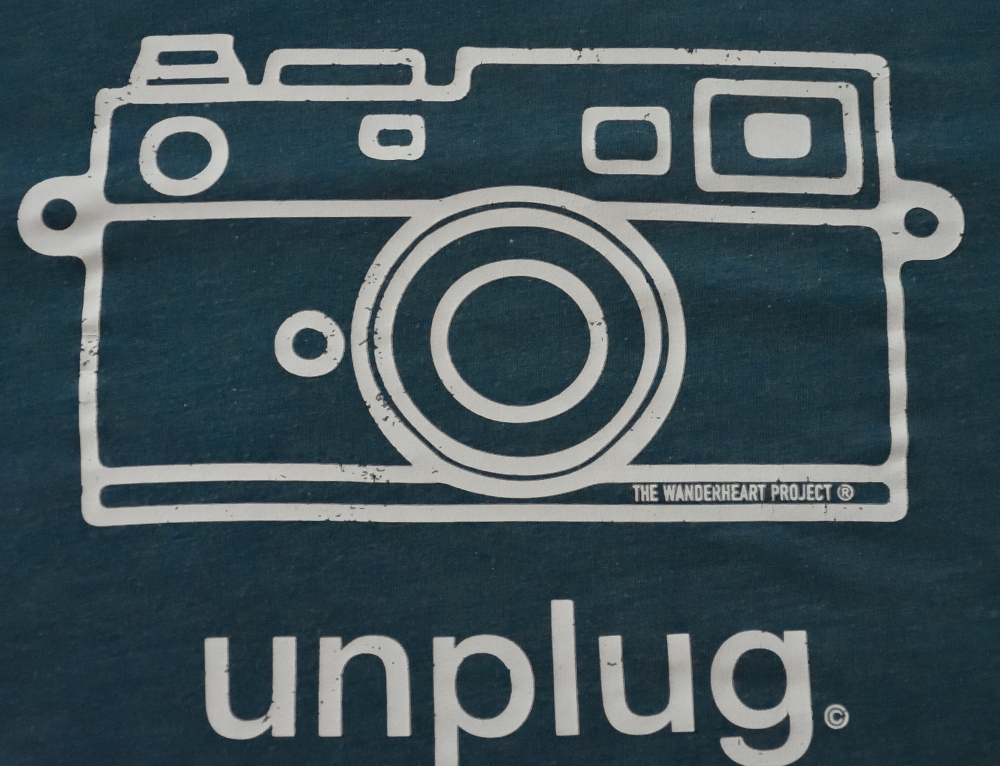
On the way home, we stopped in downtown Chicago. I was amazed to find a camera so inexpensive; I could buy it with the small amount of cash I had with me. In those days cameras didn’t have automatic focus or built-in light meters. So, you used a standalone light meter to see what settings were needed for the shutter speed and aperture, and manual set those on the camera. The focus was also set manually. The camera looked like this picture on a tee shirt I have.

I don’t know why I was so drawn to photography. My mother and brother were artists. I couldn’t draw or paint well, though I didn’t spend much time practicing. This is my portrait of my best friend, Randy Porter.

Part of it was the science of photography. My career was to be computer programming and medical research. But the exacting process of film and paper development was often frustrating. For example, the temperature of all the chemicals and water bath could not vary more than one degree without causing problems in creating the negative of the film. I developed this photo of Long’s Peak in a darkroom.

Long’s Peak, Rocky Mountain National Park, Colorado Jeff Kisling

I wrote a lengthy story about photography in my life: Jeffrey Allen Kisling Photography

Quaker Faith

I was born into a Quaker family and community, Bear Creek Friends, near Earlham, Iowa. So, I grew up seeing how faith was an integral part of people’s lives.

Bear Creek Friends Meeting near Earlham, Iowa

Attending Scattergood Friends School, a co-ed Quaker boarding high school, continued my Quaker education. Not so much intellectually, but in the way we worked together, and made decisions in community. We rotated through a crew system, where we prepared meals, baked bread, cleaned, did laundry, raised pigs, and did other work on the farm.

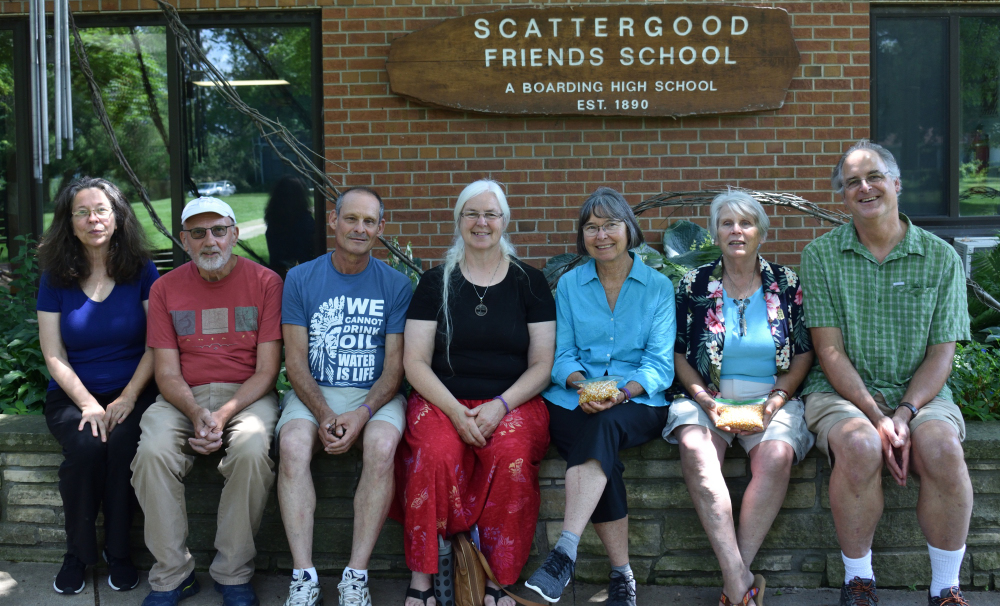
Scattergood Friends School

It’s not at all that we were indoctrinated. In fact, what we value is how we are challenged to examine our beliefs and whether we are living those in our lives. We have a spiritual practice of reflecting on questions, or queries, about our lives at that moment.

Queries related to peace and nonviolence:

  • What are we doing to educate ourselves and others about the causes of conflict in our own lives, our families and our meetings? Do we provide refuge and assistance, including advocacy, for spouses, children, or elderly persons who are victims of violence or neglect?
  • Do we recognize that we can be perpetrators as well as victims of violence? How do we deal with this? How can we support one another so that healing may take place?
  • What are we doing to understand the causes of war and violence and to work toward peaceful settlement of differences locally, nationally, and internationally? How do we support institutions and organizations that promote peace?
  • Do we faithfully maintain our testimony against preparation for and participation in war?

The first time I was really challenged in my faith was while a senior at Scattergood. All eighteen-year-old boys were required to register with the Selective Service System (military draft). That was consequential because the draft at that time was inducting boys into the armed forces, where many were sent to the war in Vietnam.

Quakers could apply for conscientious objector status, which would allow you to spend two years working as a civilian, most often in hospitals. Many of us found doing so was still participating in the military and refused to cooperate with the draft. To refuse was a felony offense.

I was convinced becoming a conscientious objector was wrong for me. But I struggled with the idea of facing time in prison. There were over a dozen Quaker men who refused to cooperate in the 1950’s when there was a peacetime draft. And they were imprisoned. Muhammad Ali also refused to be drafted. That showed me there are people who act according to their beliefs, no matter the consequences. Without their example, I imagine I might not have resisted the draft myself. I did refuse to cooperate but was not prosecuted for that.

Quakers don’t believe in proselytizing, instead believing the way they lived their lives might be an example for others. Like those who resisted the draft mentioned above.

Together

My faith led me to try to share my spiritual experiences and show my love for the beauty of Mother Earth through photography. These three things, together, concern for Mother Earth, photography, and faith, came into play in many ways, and at various times during my life. I love this quotation, which pulls these things together.

(Barry) Lopez could not have known the effect he was having on one impressionable member of the audience. Yet I believe he established a connection with me that evening—a thin strand in the elaborate web that is community—by describing a path that was utterly new to me, and by suggesting that, as others had walked that path, it was safe for me to do so as well. This all happened in the space of a few seconds, as he mulled over the central question plaguing the men and women at the conference, namely: How could we convince lawmakers to pass laws to protect wilderness? Lopez argued that wilderness activists will never achieve the success they seek until they can go before a panel of legislators and testify that a certain river or butterfly or mountain or tree must be saved, not because of its economic importance, not because it has recreational or historical or scientific value, but because it is so beautiful.

His words struck a chord in me. I left the room a changed person, one who suddenly knew exactly what he wanted to do and how to do it. I had known that love is a powerful weapon, but until that moment I had not understood how to use it. What I learned on that long-ago evening, and what I have counted on ever since, is that to save a wilderness, or to be a writer or a cab driver or a homemaker—to live one’s life—one must reach deep into one’s heart and find what is there, then speak it plainly and without shame.

Reid, Robert Leonard. Because It Is So Beautiful: Unraveling the Mystique of the American West. Counterpoint. Kindle Edition.

HOW ACTIVISM LABOUR DEFIES CAPITALISM

It only takes one doom scroll through social media to see there is no shortage of injustice in the world. But there is also no shortage of people who have dedicated themselves to dismantle systems of violence and advance justice through activism.

With how deeply entrenched injustice is in our society, the work to dismantle injustice is a full-time job. Despite the hours put in, this job does not fit a capitalist and colonial view of labour.

HOW ACTIVISM LABOUR DEFIES CAPITALISM By Gabriela Calugay-Casuga, Rabble.ca., August 9, 2022

I’m intrigued to have come across the idea of Community Supported Organizer (CSO) this morning.

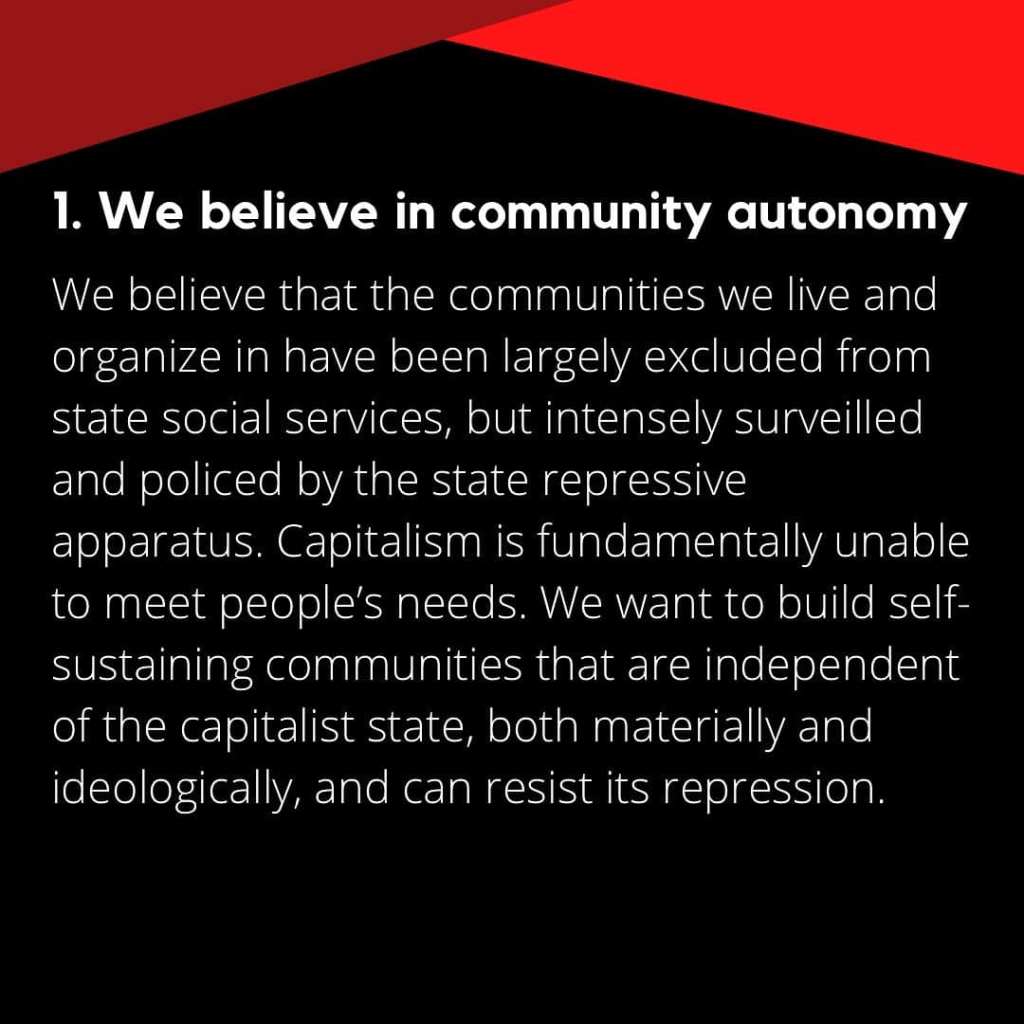
I’m so often impressed by the dedication, sacrifice and skills of my friends involved in activism. I learn about some of the things they are involved in when I’m at our (Des Moines Mutual Aid) weekly food giveaway. This networking is one of the advantages of being involved in this community. The following summary describes some of what has been accomplished by Des Moines Mutual Aid over the past two years.

Ronnie James

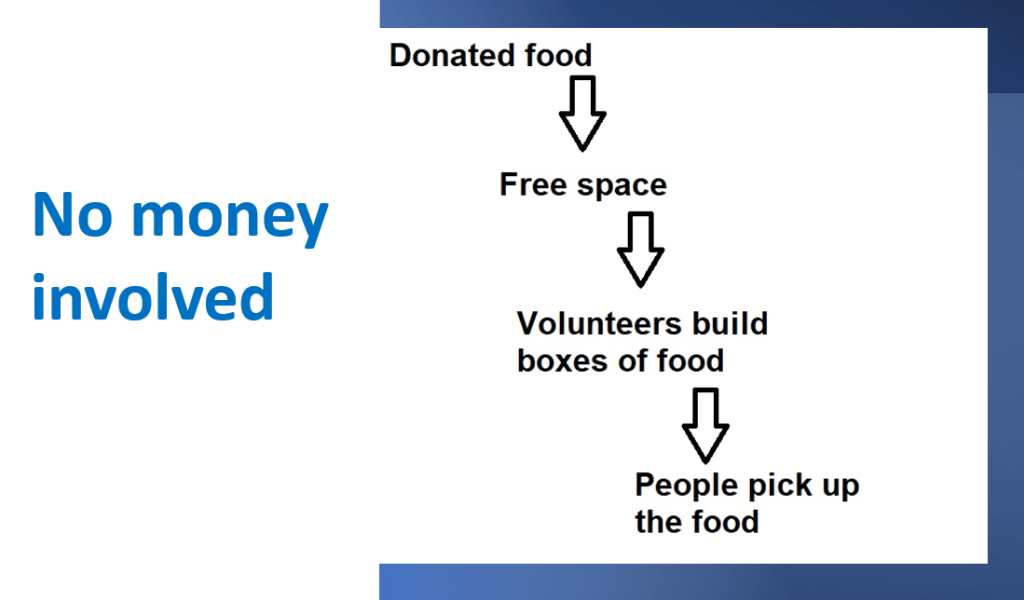
One of the basic principles of Mutual Aid is to replace the capitalist economic system. The following shows no money is involved in our food distribution project. Of course, someone pays to make the food that is donated. But this is food that would otherwise not be used. In a local community it is possible to have the food produced without money when the farmers are supported in nonmonetary ways by the community.


But as we work to replace capitalism, we remain in that economic system for the time being.

In this context of social isolation and forced dependency on hostile systems, mutual aid— where we choose to help each other out, share things, and put time and resources into caring for the most vulnerable— is a radical act.

Dean Spade. Mutual Aid: Building Solidarity During This Crisis (and the Next) (Kindle Locations 119-120). Verso.

Mutual Aid Will Help Communities Thrive

Part of the answer is community care and mutual aid, according to Jones. She said that many mutual aid networks popped up during the pandemic, but this type of support can continue outside of COVID-19 lockdowns. She said that every person has different capacities and needs. Finding the ways those capacities and needs fit together will create a support system that can continue to dismantle cycles of injustice.

Grove said that if every community does work to identify its needs, then folks in positions of privilege can come together to support those who do unpaid but necessary work.

“A lot of forest defenders lost their cars, lost their homes, lost everything because they saw that this is a fight worth fighting,” Grove said. “The next task was figuring out what the needs are of people that come off these frontlines. Sometimes it’s financial, like you just need to get a roof over your head.”

Jones said that mutual aid work also reveals that activism is not some exclusive thing that only a few people can engage in. Anyone can support the struggle for justice, Jones said.

“There’s this idea that there’s a class of people that ‘do activism,’” Jones said, “but that’s not a mass movement. A mass movement is when everybody has the skills and capacity, everybody is called upon to do what they can, everybody gives what they can, everybody is empowered and given the ability and resources to do that.”

HOW ACTIVISM LABOUR DEFIES CAPITALISM By Gabriela Calugay-Casuga, Rabble.ca., August 9, 2022


CSO = A New Model for Supporting Autonomous Agents of Change

Backbone Campaign’s Community Supported Organizer (CSO) pilot program is a nascent but promising innovation in funding social change work. Backbone designed this model to work similarly to Community Supported Agriculture (CSAs). CSAs create a stable funding source for local farmers through a synergistic relationship with community members who pledge support.  In return, the CSA member receive a share of the harvest and a deeper connection to the farm and the food they eat. We believe that the CSO model presents a new way to support our most talented change agents, establish meaningful connection to the work being done, and a deep pride in the harvest.

Being a CSO provides a way for a self-directed change agent to be innovative and responsive to emergent opportunities. They are not constrained by an organizational bureaucracy directed from afar.  They are not locked into an inflexible plan or narrow mission.  A CSO is accountable only to a diverse community of sustaining donors from whom they crowd source recurring donations. This community benefits from a CSO’s increased skill and capacity gained through their immersion in the work and their access to training, skill shares, reflection, mentorship and tactical tools that Backbone Campaign provides.  We all enjoy the harvest of accelerated positive change and mounting victories.

We believe that the CSO concept can help further empower autonomous activists and organizers around the country to dedicate themselves more fully to the work they are doing in their communities. This will help lead us faster to the positive and just changes we strive to see happen in our world.

Backbone Campaign


Patreon

I don’t know much about patreon, but have used it to support Matè Farrakhan Muhammad, co-founder of the Des Moines Black Liberation Movement.

TheBlackArtivist is the creative engine of Matè Farrakhan Muhammad, a Des Moines based activist and artist who co-founded the Des Moines Black Liberation Movement. TheBlackArtivist seeks to explore, educate, and radicalize us as human beings against the oppressive forces which seek to destroy our futures and steal our joy.

https://www.patreon.com/theblackartivist/posts


Vertical power

umair haque is the only author I read almost every day. He explores problems we face in more depth than other writers I’m aware of. Issues related to civilization, politics, economics, and our environment.

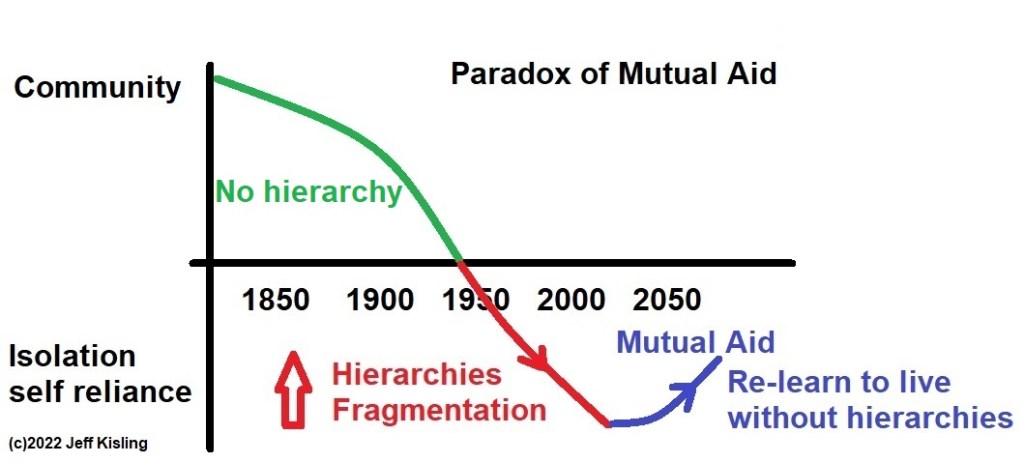
Still, I was surprised when a recent article focused on “vertical power“, and how that inevitably leads to authoritarianism. He defines “vertical power” as every stratum of society occupying its position on a hierarchy.

If you look closely at America, you will see a society of vertical power. One whose sole organizing force is vertical power. What do I mean by “vertical power”? I mean that every stratum of society occupies its position on a hierarchy, and each struggles to keep the next down, instead of lift any other up. Vertical power is power over, vertical power systems maximize power over — and so American life is now one great power struggle over the next person, everyone locked in mortal combat with everyone else.

Vertical power allows us only two rules in life. Punch the next person down, so they stay down. And obey the next person up, so they don’t hurt you.

Why America Collapsing Into Authoritarianism Was Inevitable by umair haque, Eudaimonia and Co, 8/7/2022

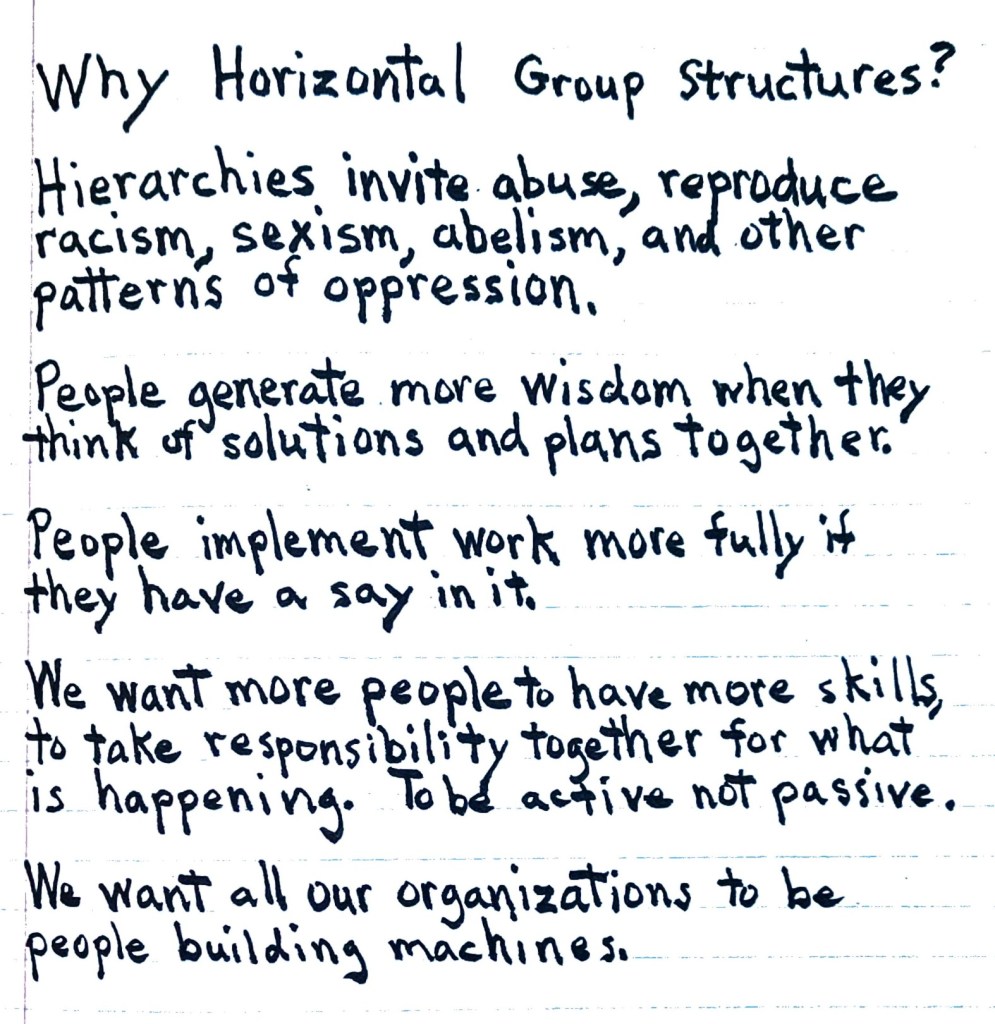
Those who know about Mutual Aid know it is based on escaping vertical hierarchies by building communities without such hierarchies. Communities described as having flat, horizontal, or no hierarchy.

Modern societies need a very different kind of power. Horizontal power. What is horizontal power? It is genuine self-governance and self-directedness. It is power to, power in, not power over. The power to realize one’s self, to fulfill one’s possibilities.

The problem is that America does not do horizontal power. It does not understand it, have any affinity for it, or believe that it can exist, really. It never has. It is deeply uncomfortable with the idea of horizontal power — precisely because it is so attached to its history of vertical power. Why don’t white people want black people to rise? Why don’t people in cities care about people in rural areas — and vice versa? Why don’t people lift each other up? America is obsessed with vertical power.

Why America Collapsing Into Authoritarianism Was Inevitable by umair haque, Eudaimonia and Co, 8/7/2022

As he says, this country is deeply uncomfortable with the idea of horizontal power. But Mutual Aid communities offer the opportunity to experience horizontal power. I have found participating in a Mutual Aid community fulfills a great yearning to do meaningful work with like-minded people. To build Beloved communities together.

When I first heard about Mutual Aid, I thought I would go to a local Mutual Aid project, the free food giveaway, just to see how that worked. Instead, I found the home I’d been looking for, and have returned nearly every Saturday morning since for the past two years.

Des Moines Mutual Aid
Ronnie James on Mutual Aid

Trying to face environmental meltdown

I’m still working on my foundational story. It is taking much longer than expected. I’ve been following a recent suggestion to examine my foundational story at its beginning, how it has evolved along the way, and what it is now.

Much of my foundational story is about care for Mother Earth. I lived my entire adult life without owning a car, being able to do so in part because of the barely adequate city bus system in Indianapolis. I don’t keep bringing this up for self-promotion. Rather, to point out everyone living in the early 1970’s could see the damage being done by the clouds of noxious fumes coming out of tailpipes. Since then, catalytic converters hid the visible damage, but the greenhouse gases continue to spew out.

We each made a choice.

  • either stop the pollution
  • or deem fouling the air with automobile exhaust an acceptable choice for our convenience

If we had decided to tackle the pollution and greenhouse gases then, we would not be in this environmental catastrophe now.

No one knows what the future holds, but it is no longer possible to hide the consequences of greenhouse gas emissions. High temperature records are broken daily. We see shrinking lakes and rivers, violent storms, flooding, and forest fires.

I’ve studied and prayed about this my whole life. I’m broken down by the continuous stress of knowing. At times I’ve felt like giving up. Wanting to stop thinking about all of this.

I don’t have a plan for what to do when water stops flowing from the faucet. When the grocery stores no longer have food. When no one picks up the trash. When there is no gas for cars and trucks. When hospitals close. When houses are destroyed by fires, winds, or floods. When there is no Internet. No electricity.

But I do have two tools to help me make a plan. For some hope.

  • My Quaker faith and faith community
  • And my Mutual Aid accomplices, who are not just making plans but implementing solutions now

People often mistake hope for a feeling, but it’s not. It’s a mental discipline, an attentional practice that you can learn. Like any such discipline, it’s work that takes time, which you fail at, succeed, improve, fail at again, and build over years inside yourself.

Hope isn’t just looking at the positive things in this world, or expecting the best. That’s a fragile kind of cheerfulness, something that breaks under the weight of a normal human life. To practice hope is to face hard truths, harder truths than you can face without the practice of hope. You can’t navigate dark places without a light, and hope is that light for humanity’s dark places. Hope lets you study environmental destruction, war, genocide, exploitative relations between peoples. It lets you look into the darkest parts of human history, and even the callous entropy of a universe hell bent on heat death no matter what we do. When you are disciplined in hope, you can face these things because you have learned to put them in context, you have learned to swallow joy and grief together, and wait for peace.

IT IS BITTER TEA THAT INVOLVES YOU SO: A SERMON ON HOPE by Quinn Norton, April 30, 2018

Our country is primed for an overthrow of power within rapidly shifting currents. The land has seen devastation over the winter’s long night, but now sings songs of rebirth inside the blossoms of the cherry tree. At least in this hemisphere. The people…well, we’re all a little worn out thanks to a heavy hitting astrological and planetary realignment. Does anyone else feel like they’ve hardly had a moment to process and catch a breath before Mercury went Gatorade? Again? We’re being tested. Within each survivor is a warrior. Can we captain this ship through unknown waters? Are we braver than our fears? Will we earn a seat at the table, our place as a future ancestor? Oh, hell yes.

Nahko Bear

When I realized this, I felt even more hopeless, but, thankfully, my Quakerism led me to another definition, which is also in the dictionary. In addition to defining hope in terms of desire, expectation, and fulfillment, most dictionaries provide a secondary, archaic definition based on faith. This older and much less common meaning is about trusting life, without the expectation of attaining particular outcomes any time soon. This type of hope has a quiet but unshakeable faith in whatever happens and in the human capacity to respond to it constructively. It is a positive, but not necessarily optimistic, attitude to life that does not depend on external conditions or circumstances.

I call this “intrinsic hope” because it comes from deep inside us. Václav Havel, former president of Czechoslovakia, said in Disturbing the Peace that hope “is a dimension of the soul, and it’s not essentially dependent on some particular observation of the world or estimate of the situation. . . . It is an orientation of the spirit, and orientation of the heart; it transcends the world that is immediately experienced, and is anchored somewhere beyond its horizons.” To me, intrinsic hope is also that of God in everyone; the inner light; the quiet, still voice; and the experience of the Great Mystery.

A Quaker Perspective on Hope By Kate Davies, Friends Journal, September 1, 2018

Mutual Aid and Ways of War

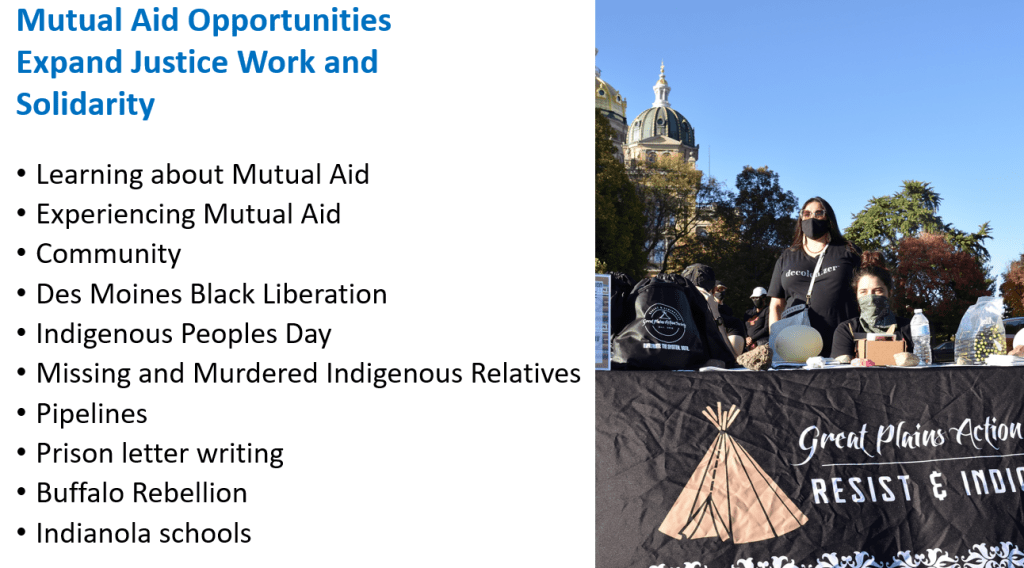
The reason I haven’t published anything for a while is because I’ve been working on a presentation about Mutual Aid that I plan to give when my Quaker yearly meeting, Iowa Yearly Meeting (Conservative) meets this week. It’s been helpful for me to organize my thoughts about Mutual Aid, something that’s become the center of my peace and justice work for over two years. I’m glad to have this opportunity to share this work.

I don’t plan to talk about everything on this list of all that is going wrong now. But it is alarming to see how many of these have escalated recently.


  • Collapse of capitalism
  • Severe drought, floods, heat result in massively diminished food production and famine
  • White supremacy
  • Spiritual poverty
  • Fascism/authoritarianism
  • Broken political system
  • Media as propaganda
  • Domestic terrorism. Armed militias.
  • Militarized police
  • Global militarism
  • Movements of millions of climate refugees
  • Punishment-oriented judicial system
  • Prisons
  • Education discourages critical thinking
  • Continued commodifying all natural resources
  • Continued fossil fuel extraction and burning
  • Factory farming
  • Broken healthcare

Instead, I plan to use this slide about how we can no longer depend on so many systems now. We’re being forced to find alternatives, and Mutual Aid can be the solution. I hope the presentation will result in more Quakers and others getting involved in Mutual Aid work.


One of the things I’ve been praying about is this statement by my good friend and Mutual Aid comrade, Ronnie James.


Coming of age in the last 1960’s, during the Vietnam War, I saw and was part of the massive antiwar movement in this country. For the past several decades I’ve wondered what happened to the antiwar movement

Then we began to see war coming to the streets of our cities.

  • In 2014, we saw militarized police and tanks in the streets of Furguson, Missouri, following the killing of Michael Brown. Friends of mine from Indianapolis went there during the prolonged unrest. A Quaker friend went.
  • In 2016 the violent attacks of militarized police against the peoples peacefully gathered at Standing Rock were broadcast across the world.
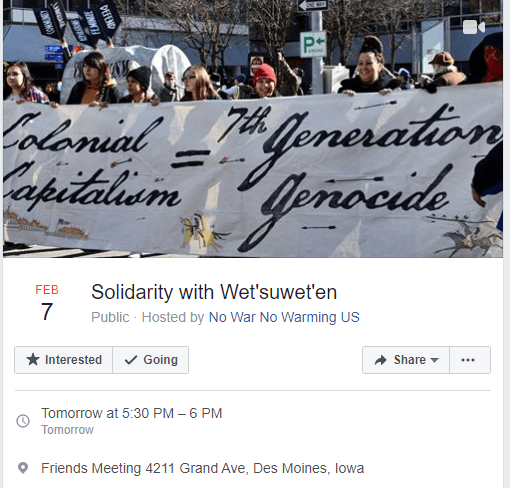
  • At the beginning of 2020, I saw the violent invasion of Wet’suwet’en lands by the militarized Royal Canadian Mounted Police (RCMP). And learned similar invasions occurred in previous years.
  • Also in January 2020, “Des Moines Mutual Aid participated in a march protesting the potential for war or increased hostilities with Iran that followed the fallout of the assassination of Qassem Soleimani by drone strike in Baghdad.”
  • Then the world watched in horror as Derek Chauvin killed George Floyd by pressing on his neck for nine and a half minutes on May 25, 2020. Prolonged nationwide protests occurred in many cities, including Des Moines. Des Moines Mutual Aid established a bail fund that kept every protestor out of jail.
  • Now, militarized police responses have occurred at every protest against so many, ongoing police murders.
  • The war is now on the streets of this country, in the communities of the oppressed.
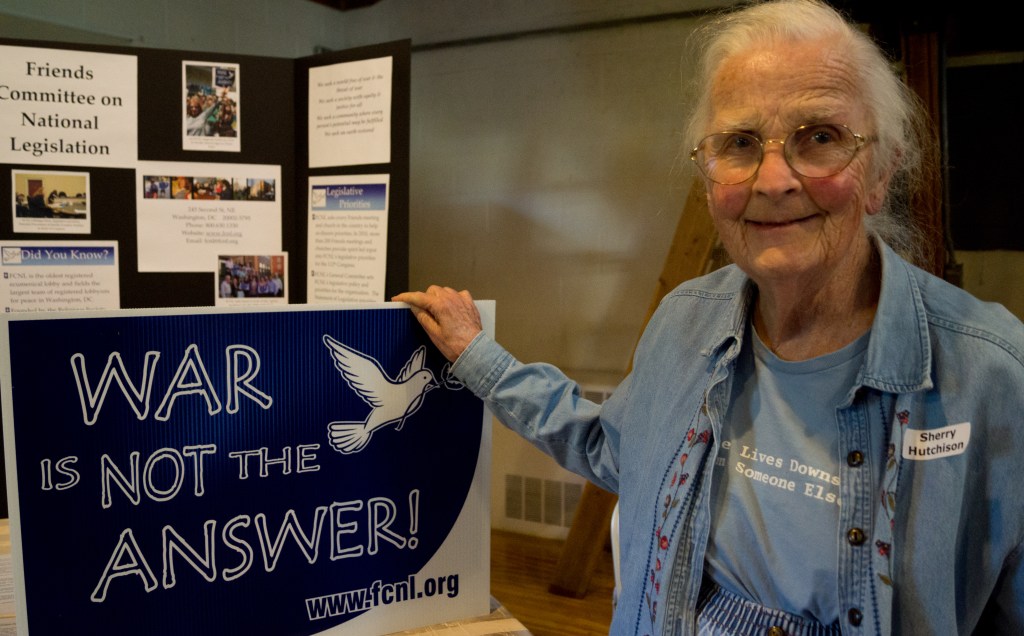
  • Now I think of FCNL’s “War is Not the Answer” signs being about these domestic wars.

I agree with Ronnie, “the more we take care of each other, the less they can fracture a community with their ways of war.” Mutual Aid is how we can take care of each other.


Mutual Aid is how we can work for peace and justice now.


War is Not the Answer

These words were taken from Martin Luther King Jr.’s speech, Beyond Vietnam: A Time to Break Silence, delivered April 4, 1967 at the Riverside Church in New York.

The message – War is Not the Answer – and the signs went viral. FCNL and Friends saw the potency and popularity of the message grew and spread, and the rest is history. With the increasing prospect for an endless war with Iran, War is Not the Answer, has become more relevant.

Friends and other people of faith act when they see broken systems. As we stand on the precipice of another war, Friends are mobilizing across the country to demand Congress halt the spiral into all-out war.

FCNL has distributed more than 2,000,000 “War is Not the Answer” bumper stickers and yard signs since 2002. Demands for the sign are increasing so we are making it available free online for you to download and print. If you’d like to purchase a lawn sign or bumper sticker, you can do so here.

https://www.fcnl.org/resources/war-not-answer

Sherry Hutchison