It was predictable that ridiculous schemes would appear now that the public can no longer ignore environmental chaos beginning to occur in so many, increasingly devastating ways. Learning the cause of these climate catastrophes is greenhouse gas emissions from burning fossil fuels, the public is desperately calling for ways to reduce those emissions now.
The common theme is the demand to reduce emissions without affecting their lifestyles that are dependent upon energy that is produced by burning fossil fuels.
That is impossible. Not nearly enough renewable energy capacity could be built to meet the demand.
The idea of sucking carbon dioxide from the atmosphere sounds good, but it is not. The amount of carbon dioxide that could be removed this way is miniscule. And to deal with even that small amount would involve unproven and dangerous technology. Pipelines would be required to transport the carbon hundreds of miles in most cases, to places where it would be pumped into underground rock formations. And no one knows how long it would be before the carbon begins to leak out of those formations.
As with the Keystone XL, Dakota Access and other pipelines, significant environmental damages would occur if the carbon pipelines were built. Eminent Domain would be used to force farmers to allow construction of pipelines through their fertile lands.
These pipelines have the added danger of harming or killing people and animals if they leak. This occurred in Satartia, Mississippi, in 2020. See Carbon Pipeline Opposition.
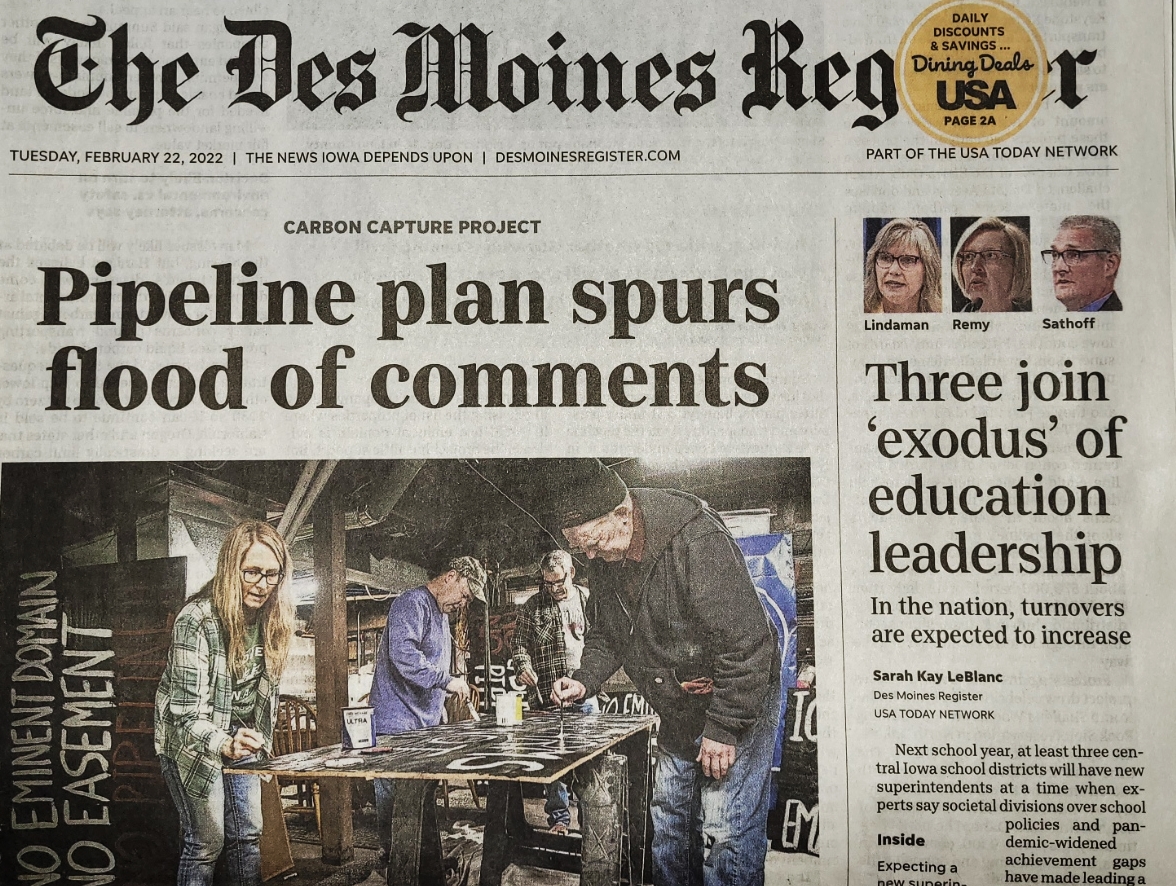
Kathy Stockdale says she has the unlucky distinction of having two of three planned carbon capture pipelines across Iowa proposing to run through the 550-acre Hardin County farm her family has owned for a century.
Summit Carbon Solutions’ $4.5 billion project would run between her and her son, Kurtis’, homes, while Navigator CO2 Ventures’ $3 billion pipeline would cut across a nearby field.
“This land is part of us. We’ve worked hard to make improvements,” said Stockdale, 71, adding that she feels “like my property rights are being taken away.”
Stockdale was among about 100 Iowans Tuesday who joined what was billed as a “people’s public hearing” at the Iowa Capitol. They called on lawmakers to impose stronger restrictions on the pipeline developers’ use of eminent domain to force unwilling landowners to sell access to their property for their projects.
Carbon Capture and Storage (CCS) is not the answer to the climate emergency. CCS is unproven, dangerous and delays real solutions to the climate crisis such as energy conservation, regenerative agriculture and renewable energy.
Join us in standing against private corporations for private gain and corrupt governments in Iowa as these pipelines are headed to tribal lands in Nebraska, South Dakota, and North Dakota, following the DAPL easement.
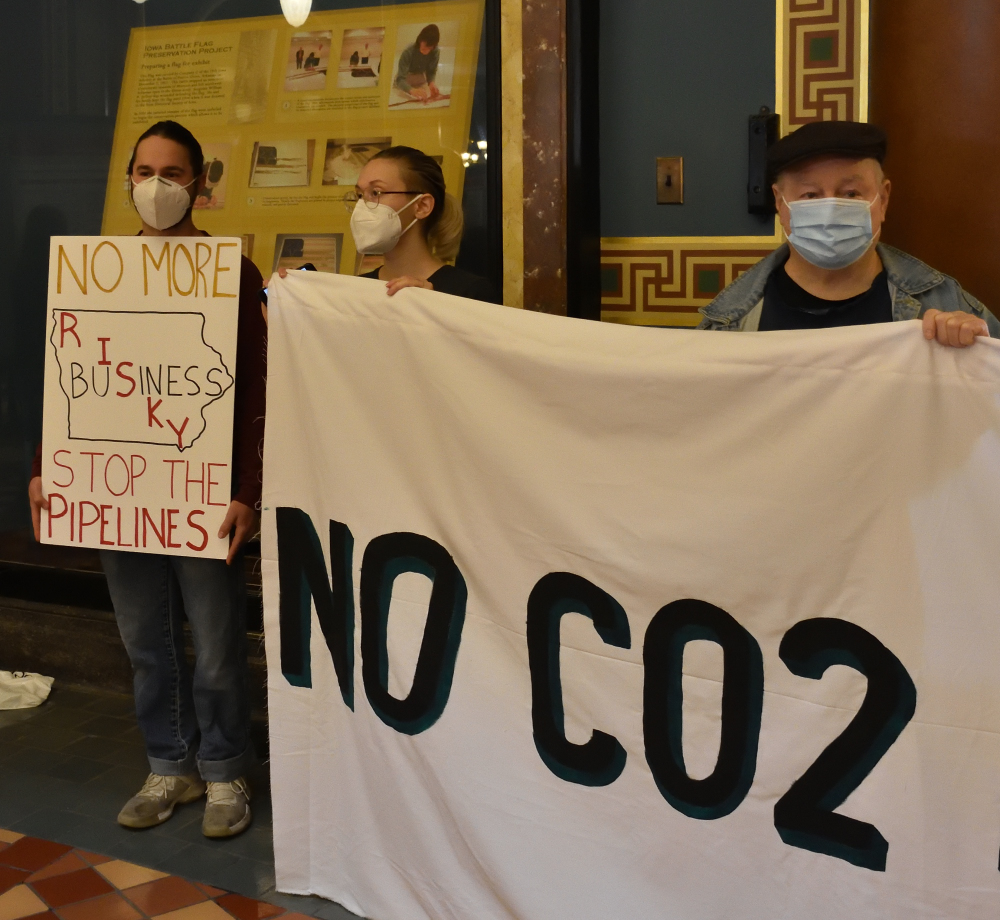
Organizations and landowners were at the Iowa State Capitol rotunda yesterday (3:30-6:00) to let our legislators know that Iowans won’t stand for the abuse of eminent domain!
With only a few short weeks left in the legislative session, we need to show our legislators how crucial it is that they take meaningful action right now.
We will hear from experts, landowners, impacted Iowans, Indigenous folks, and legislators as they address concerns about Iowa’s three proposed carbon pipelines—Summit, Navigator, and Wolf.
This event is hosted by Iowa Sierra Club, Science and Environmental Health Network, Iowa Food and Water Watch, and Great Plains Action Society—who are all a part of the Iowa Carbon Pipeline Resistance Coalition.
Organizations and landowners are at the Iowa State Capitol rotunda today to let our legislators know that Iowans won't stand for the abuse of eminent domain! pic.twitter.com/pVK3VawzJL
Cuba Prepares for Disaster by Don Fitz caught my attention for several reasons. Reading the article and watching the video below, I’m astonished by what Cuba has been doing for decades related to our changing climate. The work there implements many of the things I’ve been learning from Mutual Aid and Indigenous ways. Cuba is a model for the way I believe we must change to deal with oncoming environmental chaos. And although Cubans might not call it Mutual Aid, what they have done, are doing, is consistent with the concepts of Mutual Aid.
For Cuba to implement global environmental protection and degrowth policies it would need to receive financing both to research new techniques and to train the world’s poor in how to develop their own ways to live better. Such financial support would include …
Reparations for centuries of colonial plunder.
Reparations for the 1961 Bay of Pigs invasion, multiple attacks which killed Cuban citizens, hundreds of attempts on Fidel’s life, and decades of slanderous propaganda: and,
In the video Cuba’s Life Task, Orlando Rey also observes that “There must be a change in the way of life, in our aspirations. This is a part of Che Guevara’s ideas on the ‘new man.’ Without forming that new human, it is very difficult to confront the climate issue.”
Since Rio de Janeiro [Earth Summit in 1992] the words of our commander-in-chief Fidel Castro provide evidence of the actions and concern for human beings.
An important biological species is at risk of disappearing due to the rapid and progressive elimination of its natural habitat: mankind… It must be said that consumer societies are chiefly responsible for this appalling environmental destruction… They have poisoned the seas and the rivers. They have polluted the air… The forests are disappearing. The deserts are expanding… Third World countries cannot be blamed for all this; yesterday’s colonies and today nations exploited and plundered by an unjust international economic order. The solution cannot be to prevent the development of those who need it the most. In reality, everything that contributes to underdevelopment and poverty today is a flagrant violation of the environment… If we want to save humanity from this self-destruction, wealth and available technologies must be distributed better throughout the planet… Stop transferring to the Third World lifestyles and consumer habits that ruin the environment… Pay the ecological debt, not the foreign debt. Eradicate hunger and not humanity Tomorrow will be too late to do what we should have done a long time ago. Thank you.
Fidel Castro, Earth Summit, 1992
The main value of the speech was to put environmental problems in their socioeconomic context. The environmental issue has been detached from its origins in capitalist development, from the foundations of a system that, based on excessive consumption, on unequal production and consumption patterns, created the present situation.
From the video Cuba’s Life Task: Combatting Climate Change
Cuba has a system of civil protection established since the early 1960s following Hurricane Flora [1963] which caused major losses of human and animal lives, and economic damage. It is organized so that the moment there is a threat that phenomenon comes under permanent vigilance and various stages are established with mechanisms for protection and evacuation. Cuban Civil Defense adopts a systemic approach. The function is to protect the population, their resources, the economy, and the environment against natural, technological, and sanitary threats. Not just disasters, but also war, or the consequences of climate change.
The political organizations and organizations of the masses, made up of the population, are part of the Civil Defense system. When there is a situation or event, they join the health brigades activated in the Popular Councils in the defense zones, they support the lineworker – specialists who establish the vital systems related to energy – the neighborhood clean-up, after damage incurred during the event, including to building structures.
They contribute to local efforts. This guarantees several things; first, that there is protection at the neighborhood level, and second, that there is complete knowledge, because those neighbors know where the most vulnerable people and the most unprotected buildings are. That secures the process.
Every year in May before the hurricane season begins, we have an annual exercise, ‘Meteoro’, in which the population practice for disaster situations. Initially it was focused on tropical cyclones and hurricanes, but it has been broadened to prepare the population for droughts and earthquakes.
Recently we had a meeting about climate change in Cuba and Puerto Rico, and we saw that the number of people who died from Hurricane Irma was 10 in Cuba and 3,000 in Puerto Rico.
People die here from meteorological events too, but loss of life is minimal.
This whole process of relocating people who reside in high risk, vulnerable settlements. is financed by the state. This is one of the complexities to speeding up this process. It is not dependent on the ability of each citizen, the state assumes that responsibility and it requires substantial resources that the state has to allocate among its many expenses. But it is a state priority to carry out these relocations. New settlements and communities have been built, new buildings in existing communities. We have also learned that it is not only a physical issue of rebuilding houses. You have to relocate a whole way of life, rebuild a setting where people have social services, medical services, educational services, job opportunities. This is more complex when the community’s work is linked to the coast, as with fishing communities. We have concluded that relocating communities is an extreme measure against natural, technological, and sanitary threats. Not just disasters, but also war, or the consequences of climate change.
We can do it. What is our big problem? The worst problem is the [US] blockade. That is why we cannot advance any faster. Martí, Fidel, Raúl, Díaz-Canel…Long live free Cuba!
It is more than 60 years of the [US] blockade, which was greatly tightened by the Trump administration causing a lot of damage, and Biden, despite what he said in his electoral campaign, has still done nothing to loosen those measures. The country is in a very difficult situation as, although many do not think so, persecution is real. Remove the genocidal blockade against the Cuban people!
It is very difficult in conditions of poverty or deep economic and social inequality to advance a climate agenda.
One problem today is that you cannot convert the world’s energy matrix, with current consumption levels, from fossil fuels to renewable energies. There are not enough resources for the panels and wind turbines, nor the space for them. There are insufficient resources for all this.
If you automatically made all transportation electric tomorrow, you will continue to have the same problems of congestion, parking, highways, heavy consumption of steel and cement.
There must be a change in the way of life, in our aspirations.
This is part of the debate about socialism, part of Che Guevara’s ideas on the ‘new man’.
Without forming that new human, it is very difficult to confront the climate issue. I believe that a plan like Tarea Vida needs to be supported by a socialist system. It requires a vision that not directed towards profit, or self-interest. It must be premised on social equity and rejecting inequality. A plan of this nature requires a different social system, and that is socialism.
Perhaps the three most important lessons learned are: political will, communication to translate results, and training young people. From my point of view, these are the most important achievements in Cuba. My message to this climate change conference is a message of social inclusion
I also place Cuba’s disaster response system in conversation with these emergent practices of mutual aid
With the global and local effects of COVID-19 bearing down on us and without any clear expectation of when it might end, it’s as important as ever to take care of our communities. In this episode, we talk about the importance of mutual aid, the history of these networks, and why – if you haven’t before – now is the time to seriously consider getting involved with them.
…We talked about this in an earlier episode about social work in Cuba and the way that model was really rooted more in community organizing and almost somewhat of a mutual aid, at least from what I understood from what we read at that time of basically the community was supporting each other, but then the social worker’s job was actually to almost be the liaison with the state to get stuff that the community needed in order to facilitate that support.
This research comprises a literature review of both humanitarian organization-oriented and social science-oriented sources. In drawing from both NGO and local analyses, I hope to locate practices that could foster a less colonial approach to disaster response. I also place Cuba’s disaster response system in conversation with these emergent practices of mutual aid: in many ways, what theorists learned in the aftermath of the Haiti disaster was already implemented, in a top-down manner, by the Cuban government, which is highly successful at limiting damage and human casualties from disasters (Castellanos Abella, 2008).
I refused to have a car for the nearly fifty years I lived in Indianapolis, initially for environmental reasons. That was possible by walking, running, and using the city bus system. Moving to Indianola, Iowa, which doesn’t have public transportation, has made it necessary to use my parent’s car for long distance travel. I still walk in town. But I always feel bad when I drive.
We usually drove the forty miles in each direction to attend Bear Creek Meeting on Sundays. But that ended with the pandemic, for now.
It’s a testament to how important Mutual Aid is to me that I drive to Des Moines every Saturday morning.
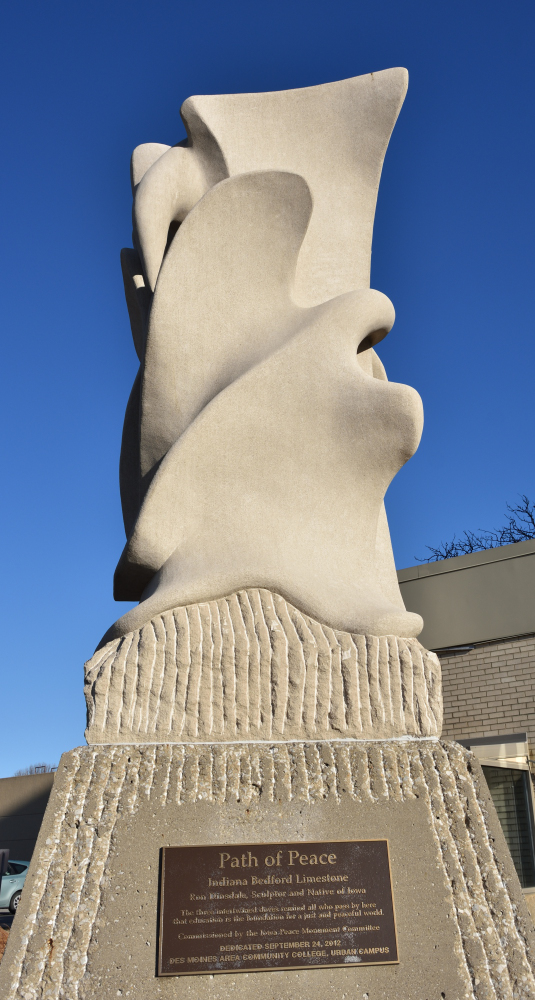
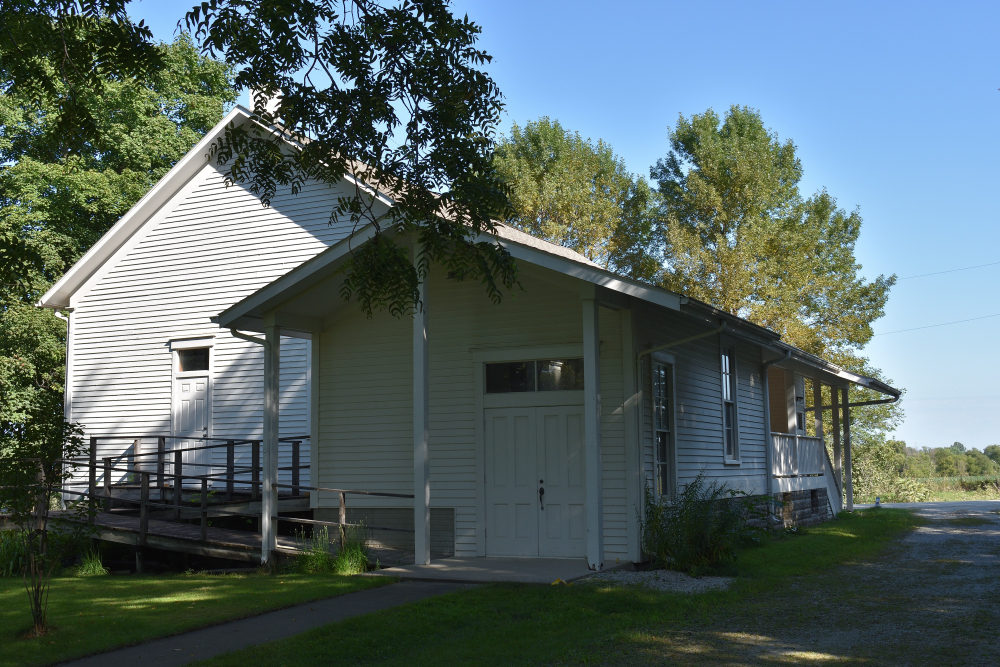
I try to make the most of each trip by taking photographs on the way in, or out of Des Moines, sometimes both. I leave a little early to have time for that. Yesterday I left later than usual and wondered if I had time to stop somewhere. I drove past the usual places, like Ewing Park and Easter Lake, but as I neared the church where our food project was done, I saw I did have about ten minutes to spare. The sculpture, “Path of Peace” was nearby. My dad, Burt Kisling, and Chuck Day were involved in having the sculpture installed on the Des Moines Area Community College campus.
I’m grateful for this video by my friend Rodger Routh.
Dedicated to peace and peacemakers, a ten-ton limestone sculpture, named “Path of Peace,” by Ron Dinsdale, portrays of three doves. It was installed on May 10, 2012 near Interstate 235 just south of Des Moines Area Community College’s Urban Campus. The sculpture was created out of a solid 14-ton block of Indiana Bedford limestone, one of the materials used to construct the Iowa State Capital in the late 1880s (between 1871 and 1886). This sculpture was supported by the Urban DMACC Campus, the Des Moines City Council, and the Iowa State Department of Transportation, as the first “I-235 Corridor Gateway Sculpture.”
This article addresses a weakness of Mutual Aid that I’ve been aware of, which is “to the extent that mutual aid is an activity resulting in products and services, financed by groups of workers who exist because they (or a large enough share of them) sell their labor power to the enemy class for a wage, mutual aid is the redistribution of a share of those wages.”
But there is much more to Mutual Aid than providing products and services. As Jenots says below, “one of the central tasks of mutual aid is less about doing something for the sake of doing something, and more about thinking and noticing.” Des Moines Mutual Aid is very skilled at noticing and responding.
At present most of the food we distribute comes from sources that paid for the materials and labor to make it. We got it because its freshness date had expired. I envisioned a time when wheat, for example, was grown by farmers who gave it to those who make bread, which is distributed without charge. The farmers and bakers would be among those who received the bread. This is not as naive as it might seem, because capitalism is collapsing. We need to be thinking about and working toward what we want to replace it.
As Jenots goes on to say, “it is clear what the main weakness in this is: all (class-independent) mutual aid activity is constrained by the wages of its participants and donors.”
Mutual aid is not infrastructure for running away or carving out a small plot of land – literal or figurative, it is infrastructure for driving a spear into the heart of capital and sustaining an effort to do so. Mutual aid is a basis for preparedness for future revolutionary events, including for the allocation of all of the skills and capabilities whose aims will be redirected from profit-making to something else as a result of the widespread clarity gained in a revolutionary situation. Even though we can say little in detail about a coming revolution, we know that it will be a conflict between classes, and that will mean strain on dependencies between those classes. To the extent we now depend on the enemy class for the organization of the production of goods and services (and in many ways, we do), someday we won’t be able to anymore. However, the fight will no longer belong only to `we unhappy few,’ these early-to-consciousness revolutionaries, with our meager skillsets. It will become everyone’s domain…
The task of revolutionary mutual aid is to re-link production with distribution when and where capitalist social relations no longer do….
One of the central tasks of mutual aid is less about doing something for the sake of doing something, and more about thinking and noticing – understanding the trajectory capitalism is taking in order to understand the needs it will create and the means, methods, technique, skills, expertise, etc. which finally become available to us as they are expelled from capitalism.
Yesterday I was struck by all the interconnected relationships among my friends at Des Moines Mutual Aid.
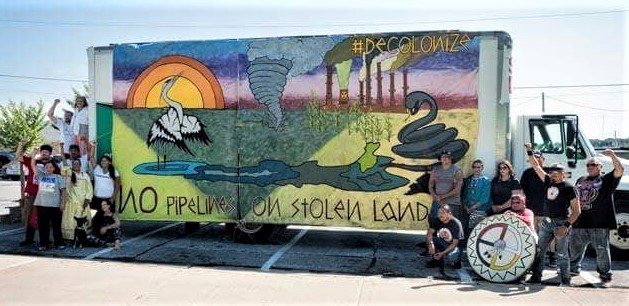
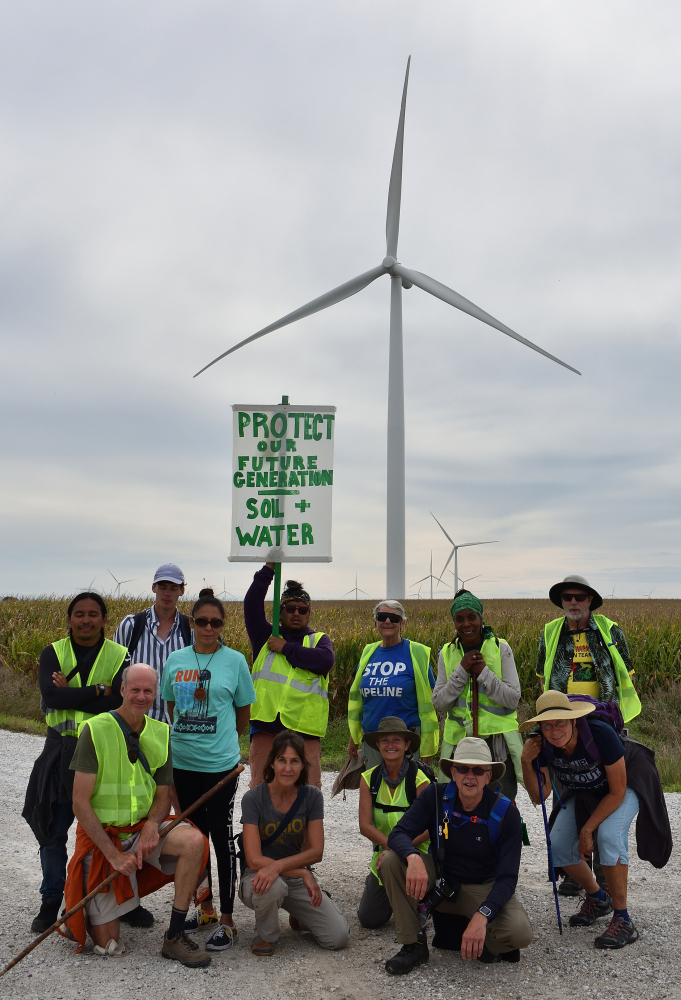
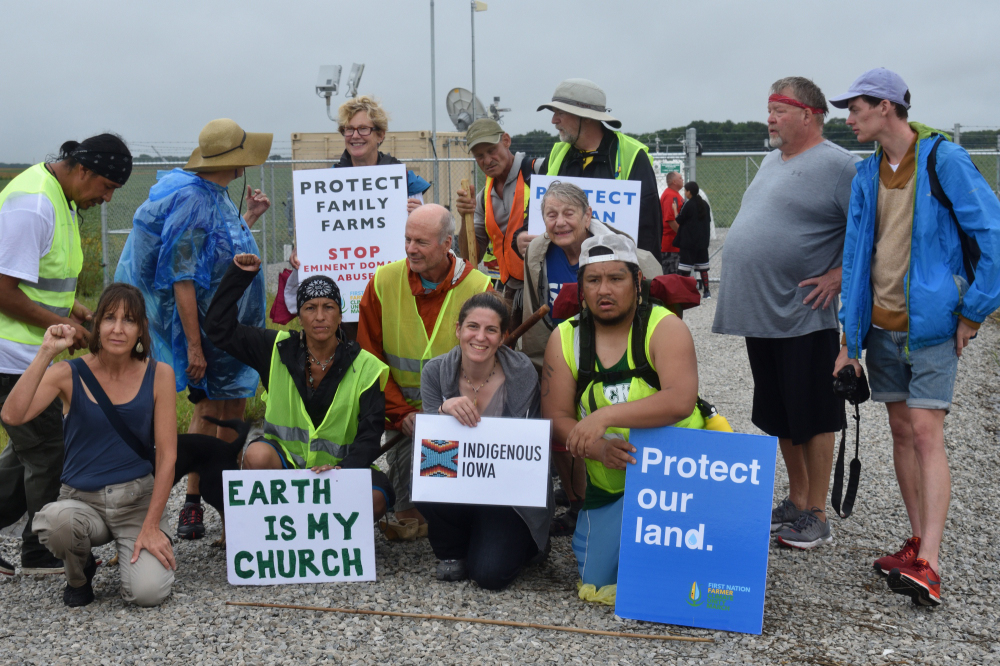
I was happy to see my friend Donnielle at Mutual Aid for the first time yesterday. She and I were part of the First Nation-Farmer Climate Unity March, September 1-8, 2018. A small group of native and non-native people walked and camped along the path of the Dakota Access pipeline, from Des Moines to Fort Dodge, Iowa (ninety-four miles). One of the main purposes of that walk was to create a group of people who began to get to know each other so we could work on issues of common interest and concern. That really worked and many of us have worked together in many ways since. One of the first things several of us did together, was to lobby Senator Grassley’s staff to support a couple of bills related to safety of Indigenous women. That was in 2018. The renewal of the Violence Against Women Act was just passed and includes those tribal protections. The photo below at the Neal Smith Federal Building was taken the day of the meeting with Senator Grassley’s staff.
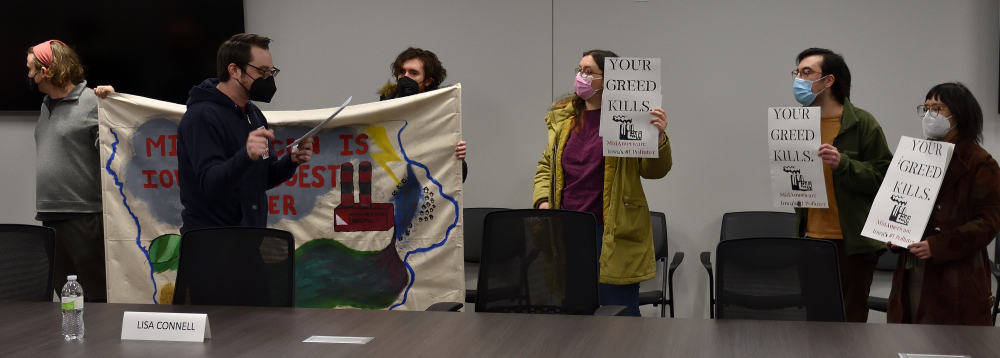
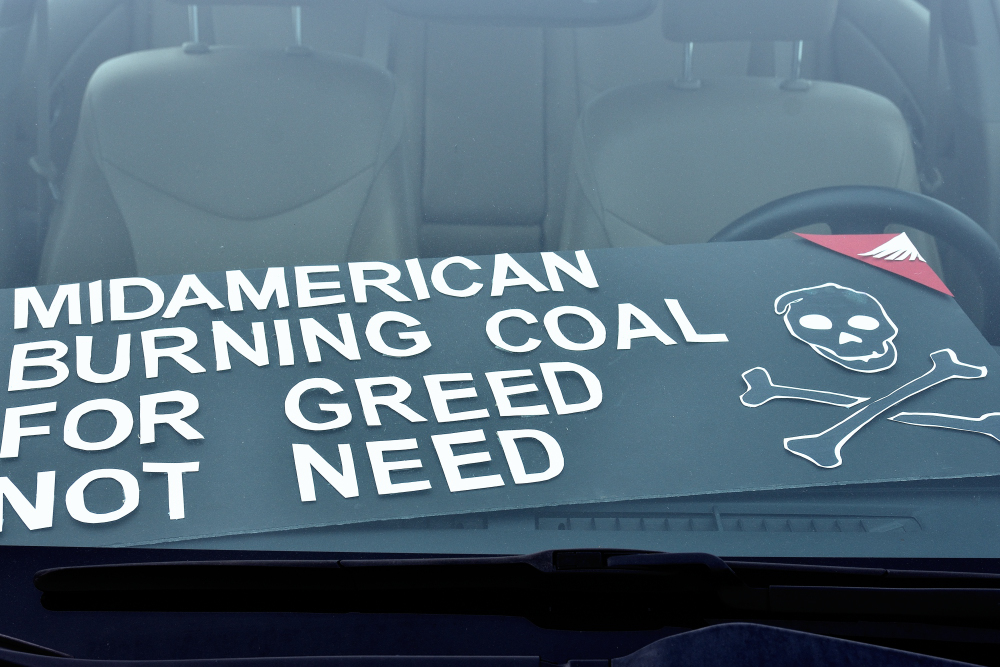
Jake, the climate justice advocate from Iowa Citizens for Community Improvement (ICCI) was also there. Two weeks ago, I attended a board meeting of the Iowa Energy Center Board, having been asked to take photos there. Jake organized a group of us to attend the board meeting to try to get MidAmerican to shut down their five coal burning plants. We have since learned our presence there has had some effect. He also asked me to write a letter to the editor about the same issue, which I did. Yesterday Donnielle asked Jake about an upcoming city council meeting where MidAmerican’s franchise with the city will be discussed.
Jade was at Mutual Aid, as usual. She organizes the prison letter writing project of Central Iowa Democratic Socialists of America, which I have joined. A friend of mine in Indianapolis, a professor at the law school there, got me involved in Religious Socialism, part of DSA, hence the name of this blog.
And as usual, my good friend Ronnie was at Mutual Aid. I had told him about some transgender people who were looking for support. Yesterday we talked about that some more, and he gave me a couple of suggestions that I passed along.
My small Quaker meeting is also part of this networking. Some members have been supporters of ICCI for years. It is this meeting that is looking into how we might support the trans people. And I will be speaking about Mutual Aid during the annual gathering of Quakers this summer.
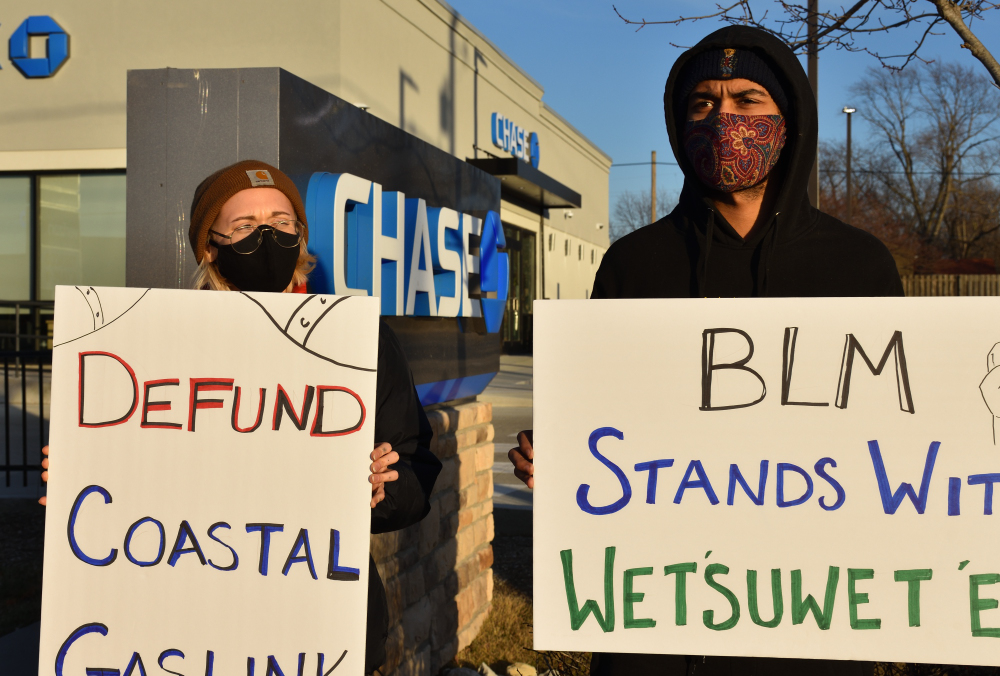
Other connections include supporting the Wet’suwet’en peoples as they try to stop the construction of the Costal GasLink pipeline through their pristine territory in British Columbia. In the photo below you can see Des Moines Black Lives Matter is helping us stand with the Wet’suwet’en.
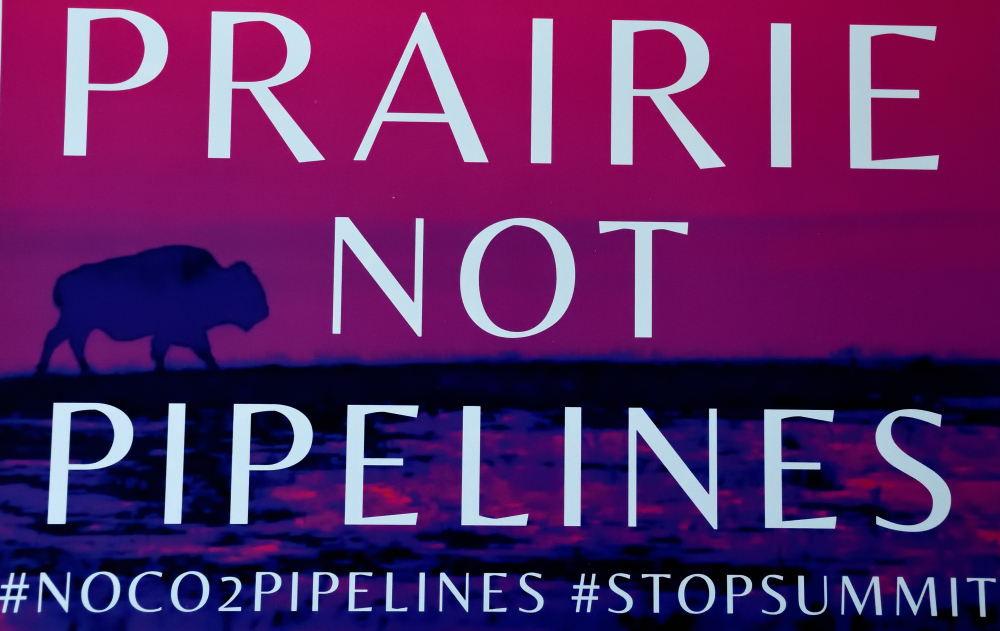
The signs about Prairies Not Pipelines and #NOCO2PIPELINES was organized by my friend Sikowis, who also walked on the First Nation-Famer Climate Unity March.
It is both disgusting and ironic to learn Congress decided to leave money for free meals out of the recent spending package. Ironic because I’m getting ready to leave to join my Mutual Aid friends for our weekly free food distribution. This has continued since the Black Panthers’ free breakfast program started in Des Moines and other cities across the country, in the 1970’s.
Public schools have been serving all students free meals since the COVID-19 pandemic first disrupted K-12 education. In March 2022, Congress rejected calls to keep up the federal funding required to sustain that practice and left that money out of a US$1.5 trillion spending package that President Joe Biden signed into law on March 11, 2022. We asked food policy expert Marlene Schwartz to explain why free meals make a difference and what will happen next.
What are the advantages of making school meals free to everyone?
In my view, the biggest advantage to universal school meals is that more students actually eat nutritious school meals. Following the regulations that emerged from the 2010 Healthy Hunger-Free Kids Act, the nutritional quality of school meals improved significantly, and a recent study found that schools typically provide the healthiest foods that children eat all day.
There are important logistical benefits to universal school meals. Families don’t have to fill out any paperwork to establish their eligibility for free or reduced-price meals. And cafeteria staff can focus on serving the meals if they don’t need to track payments.
The office of Senate Minority Leader Mitch McConnell, R-Ky., did not immediately respond to reports that he is against funding and extending school nutrition waivers.
Kate Waters, a Department of Agriculture spokeswoman, said Wednesday that the agency is “disappointed” in the lack of action by Congress, but that it will “continue to do everything we can to support leaders running these programs during this difficult time.”
Earlier this week, Agriculture Secretary Tom Vilsack told The Washington Post that “the failure of Republicans to respond to this means that kids are going to have less on their plates.”
School meal programs in ‘financial peril‘ after spending bill snub, advocates say. Temporary changes that allowed schools to keep feeding children during the pandemic are set to expire unless Congress acts. By Erik Ortiz, NBC News, March 9, 2022
Once again, the government fails to take care of we the people.
Jeff Kisling
What we have is each other. We can and need to take care of each other. We may have limited power on the political stage, a stage they built, but we have the power of numbers.
Those numbers represent unlimited amounts of talents and skills each community can utilize to replace the systems that fail us. The recent past shows us that mutual aid is not only a tool of survival, but also a tool of revolution. The more we take care of each other, the less they can fracture a community with their ways of war.
Amid the horrifying situation of the Russian invasion of Ukraine, I was concerned every time I heard that Ukrainian men aged 18 – 60 were banned from leaving the country.
I studied war resistance and conscientious objection extensively while a student at Scattergood Friends School. All males in the US were required to register for the draft at the time of their eighteenth birthday. I was a Senior at Scattergood then (1969). I went through the process of applying for and was granted conscientious objector status while I tried to prepare my family for my decision to turn in my draft cards. Which I did.
This is a bit ironic because Iowa Yearly Meeting (Conservative)’s Peace and Social Concerns Committee discussed conscientious objector counseling at our recent meeting. That was brought up in part related to the war in Ukraine. Also, as an opportunity to engage our youth in discussions related to war and peace. And because of the writings of a member of the yearly meeting. John Griffith and Draft Resistance.
Ukrainian President Volodymyr Zelensky has ordered a general military mobilization.
In a declaration signed late Thursday, Zelensky said that “in order to ensure the defense of the state, maintaining combat and mobilization readiness of the Armed Forces of Ukraine and other military formations,” a broad-based mobilization was ordered, including in the capital, Kyiv and all Ukraine’s major cities. It ordered the “conscription of conscripts, reservists for military service, their delivery to military units and institutions of the Armed Forces of Ukraine” and other state security services.
At the same time, Ukraine has banned all-male citizens 18-60 years old from leaving the country, according to the State Border Guard Service.
The statement said that following the introduction of martial law in Ukraine, a temporary restriction had been imposed.
“In particular, it is forbidden for men aged 18-60, Ukraine citizens, to leave the borders of Ukraine,” the statement said. “This regulation will remain in effect for the period of the legal regime of martial law. We ask the citizens to take this information into consideration.”
A New York Times podcast tells the story of an animator named Tyhran, who unsuccessfully tried to cross the border into Poland.
I can’t imagine myself doing military stuff […] I have no experience in it. I’m afraid of holding a gun […] I cannot imagine myself holding a gun.
Tyhran says he was shamed at the border by guards and others seeking to cross, but may try again to cross illegally.
They are bombing and people are dying. Everyone is running […] They are not going to stop. They just want to destroy.
In Ukraine, the Men Who Must Stay and Fight. As hundreds of thousands of citizens flee the Russian advance, the country’s government has ordered men ages 18 to 60 to remain. New York Times podcast, March 1, 2022
The International Covenant on Civil and Political Rights guarantees freedom of thought, conscience and religion or belief. Although it does not specifically guarantee a right to conscientious objection to military service, the UN Human Rights Committee has confirmed this right derives from the protection under the convention.
This means that if a person’s conscience, religion or beliefs conflict with an obligation to use lethal force against other people, their right to conscientious objection to military service must be protected.
Some human rights can be suspended or limited during a public emergency. But the right to freedom of conscience is specifically excluded from this category.
The government of Ukraine should cancel its ban on men leaving the country. To maintain it will violate the freedom of conscience of any man who wishes to flee due to a conscientious objection to killing others.
In relation to LGBTQI+ people, the ban could also be regarded as preventing people with a well founded fear of persecution from fleeing to seek refuge outside Ukraine.
More broadly, repealing the departure ban would protect Ukraine from allegations it is failing to protect civilians, as required by international humanitarian law. It is one thing to conscript men into military service, providing training and appropriate equipment (although, even in that case, a right to conscientious objection must be respected).
It is another thing entirely to prevent civilians from escaping a war zone.
People ask me if I believe in god… I tell them I pray to creator. They tell me Jesus died for me… I tell them my ancestors did. They say I will burn in hell for not following the Bible, but it has been used as weapon to colonize and murder my people… for me it’s spirituality over religion. I don’t hate people for going to church, but I do hate what the churches have done to us… before colonization we had our own ways and ceremonies, I choose the path of my ancestors.
Indigenous
I find myself in a spiritual crisis regarding Christianity. I realize being a Christian and professing to be a Christian are often not the same.
The Christianity I cannot be part of is the weaponized version of a religion. One that created and enforced the doctrines of discovery which gave permission to steal indigenous lands and instructed killing the people living on them. That codified white supremacy and empire. That drove global colonization.
One that raised great wealth from stolen lands and labor. And then built ostentatious churches in the midst of profound poverty.
One that tore native children from their families and took them far away, to places of forced assimilation where every kind of abuse was visited upon them. Where thousands died or were killed. And their families were often not even told of their deaths. Where other children were sometimes forced to dig the graves. The trauma passed from generation to generation. An open wound in Indigenous communities to this day that I have witnessed in my native friends. A wound that has been ripped open with the verification of the remains of thousands of native children. With many more places that haven’t been scanned yet.
Part of the reason for my crisis is reading “American Holocaust: Columbus and the Conquest of the New World” by David Stannard. Recent scholarship has revealed sophisticated Indigenous communities in the Americas prior to the arrival of white men. And much larger numbers of Indigenous people, millions more than previously thought. Meaning millions more deaths occurred.
American holocaust.
The destruction of the Indians of the Americas was, far and away, the most massive act of genocide in the history of the world.
Stannard, David E. American Holocaust: Columbus and the Conquest of the New World. Oxford University Press. Kindle Edition.
More often than we realize, in ways we don’t recognize, white Quakers continue to benefit from the American Holocaust. Continue white domination.
We made a small step in learning about land acknowledgements. But those are empty statements if we don’t take the next steps. We need actions, not more words.
The reason I write and talk so much about my experiences with Mutual Aid is because that gets to the root causes of white supremacy. Mutual Aid exemplifies what Christianity is supposed to be. Mutual Aid is a means to begin decolonization.
As painful as it is, I know out of my confusion and distress, I will be led to a better place.
Real radicalism implores us to tell the whole ugly truth, even when it is inconvenient.
Brittney Cooper, Eloquent Rage: A Black Feminist Discovers Her Superpower (2018)
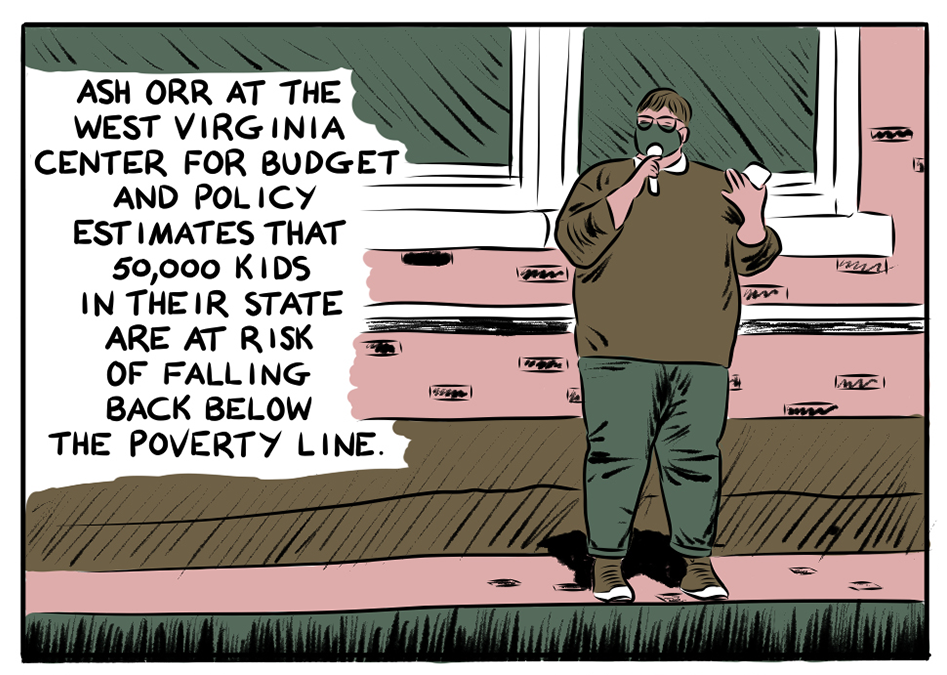
Now, as advocates and policymakers pursue options for keeping the expanded CTC in effect, we wanted to add another approach. Because number-crunching and political analysis aren’t for everyone, we asked Graphic Journalist Nhatt Nichols to lend her pad and pen to this issue, as she did previously with other American Rescue Plan projects.
Check out the comic below to catch up on what the expanded CTC has done for rural families and what’s at stake going forward.
This article first appeared on The Daily Yonder and is republished here under a Creative Commons license.
I just sat down after taking two letters to prison pen-pals to the mailbox and saw the article Abolitionist Efforts to Trangress the Prison Walls by Jaden Janak, Hood Communist, March 10, 2022. I don’t like to include too many quotes in my writing, but this article touches on many things I’ve been learning, much which is about Mutual Aid.
Through a close reading of Black Communist trans prisoner Alyssa V. Hope’s legal efforts and writings, this article unearths how a pen-pal relationship transformed into a comprehensive abolitionist community. This case study provides an example of how abolitionists are grappling with the need to support the material needs of marginalized communities while still building otherwise possible worlds separate from a failing welfare state. Mutual aid projects, like the one formed by Hope’s supporters, showcase that otherwise possible worlds are not only possible, but they are being created right now before us.
… it was not always this way, which proves it does not have to stay this way.
What we have is each other. We can and need to take care of each other. We may have limited power on the political stage, a stage they built, but we have the power of numbers.
Those numbers represent unlimited amounts of talents and skills each community can utilize to replace the systems that fail us. The recent past shows us that mutual aid is not only a tool of survival, but also a tool of revolution. The more we take care of each other, the less they can fracture a community with their ways of war
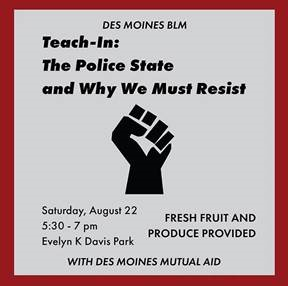
Ronnie James, The Police State and Why We Must Resist
The focus of the Transgress the Prison Walls article is on the writings of political prisoners, but much applies to prison pen-pal relationships with anyone who is incarcerated. I’ve become involved in the prison letter writing project of the Central Iowa Democratic Socialists of America. Not surprisingly, I found several of my Des Moines Mutual Aid friends are also involved.
I wrote the following based upon a sample letter.
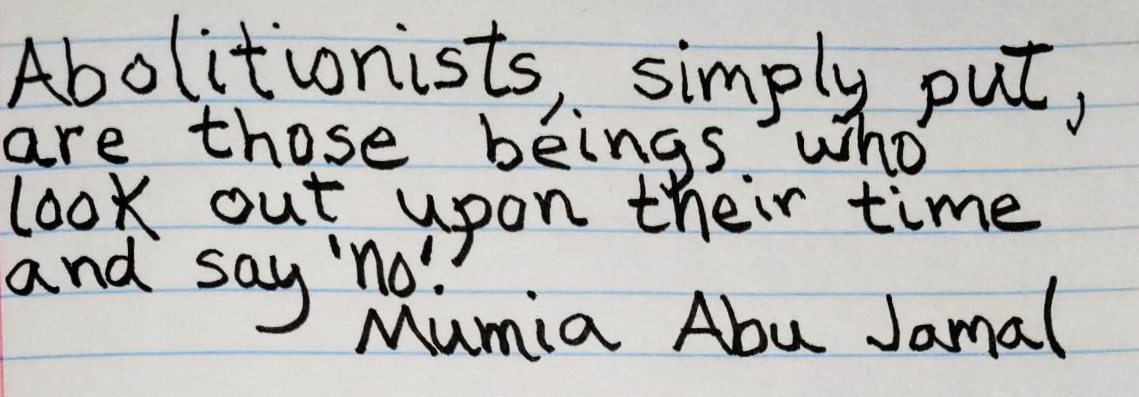
As abolitionist organiser and theorist Mariame Kaba writes, “The work of abolition insists that we foreground the people who are behind the walls… That we transform the relationships we have with each other so that we can really create new forms of safety and justice in our communities.” (Duda/Kaba 2017) This solidarity takes many forms such as written correspondence via pen-pal pro-grams
More than a one-way exchange of sympathy, abolitionist solidarity operationalises mutual aid as a foundational modality for community building. Abolitionist mutual aid recognises the necessity of meeting immediate communal needs while also addressing deeper causes of violence: mechanisms of control, management, and punishment that structure everyday life (Spade 2020, 9). Historically, mutual aid communities have taken many forms including the 1969 Free Breakfast programs of the Black Panther Party in the United States and the maroon communities formed by free and escaped en-slaved people (Nelson 2011). In the 1950s and 1960s, health providers routinely refused Black patients and relegated Black people to sub-standard facilities (ibid., 24). To protest this treatment and provide for their community, the Black Panther Party of Oakland and other chapters around the nation and world opened People’s Free Medical Clinics that provided quality medical services free of charge to Black community members (ibid., 79). Mutual aid work, like that of the Black Panther Party, is not top-down charity. Rather, mutual aid projects “are an integrated part of our lives… and [they] cultivate a shared analysis of the root causes of the problem.” (Spade 2020, 28f.) Even as the welfare state continues to crumble, communities work together to meet each other’s needs while creating new relations of accountability and care in the state’s absence.
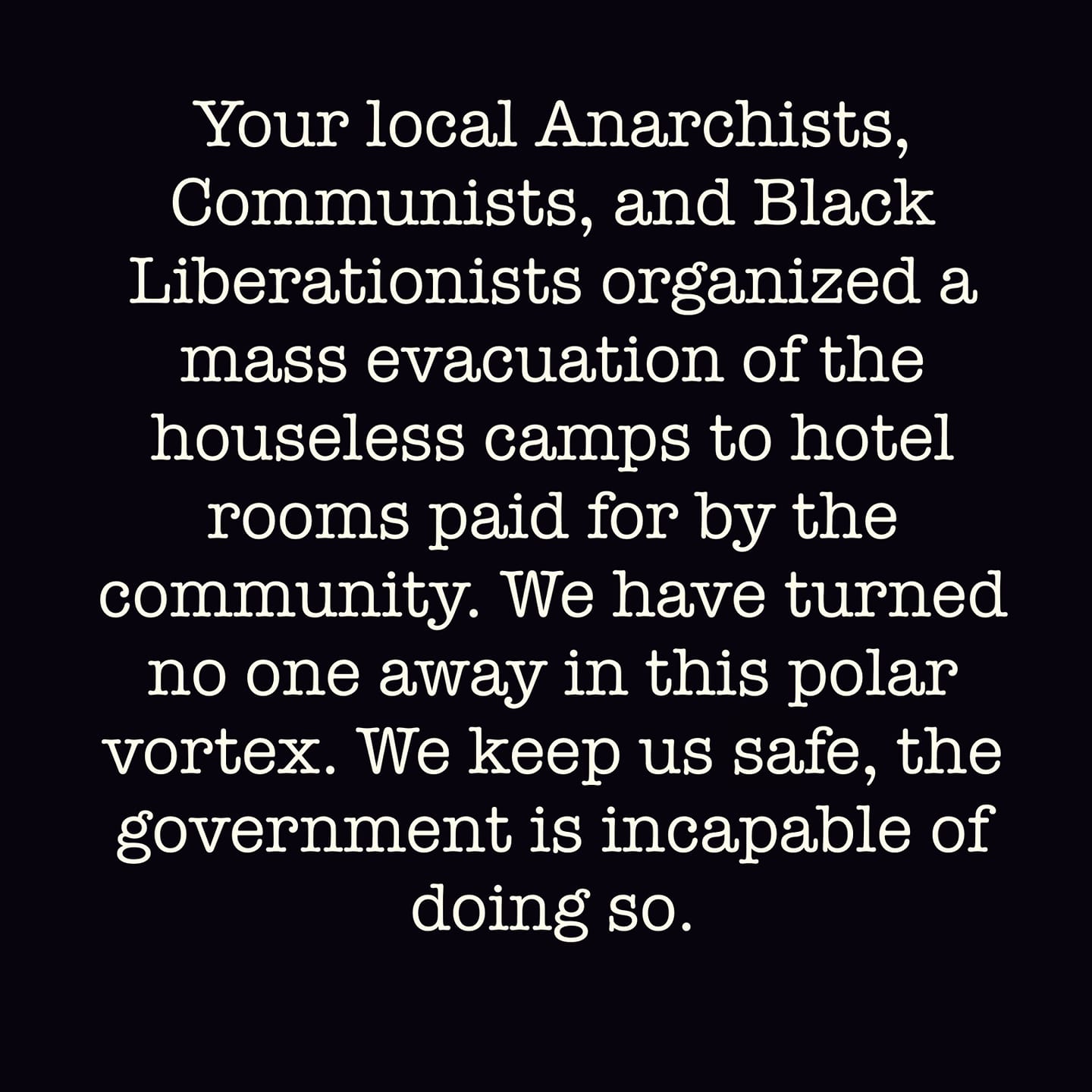
So, I work with a dope crew called Des Moines Mutual Aid, and on Saturday mornings we do a food giveaway program that was started by the Panthers as their free breakfast program and has carried on to this day. Anyways, brag, brag, blah, blah.
So, I get to work and I need to call my boss, who is also a very good old friend, because there is network issues. He remembers and asks about the food giveaway which is cool and I tell him blah blah it went really well. And then he’s like, “hey, if no one tells you, I’m very proud of what you do for the community” and I’m like “hold on hold on. Just realize that everything I do is to further the replacing of the state and destroying western civilization and any remnants of it for future generations.” He says “I know and love that. Carry on.”


























 Quakers and Mutual Aid