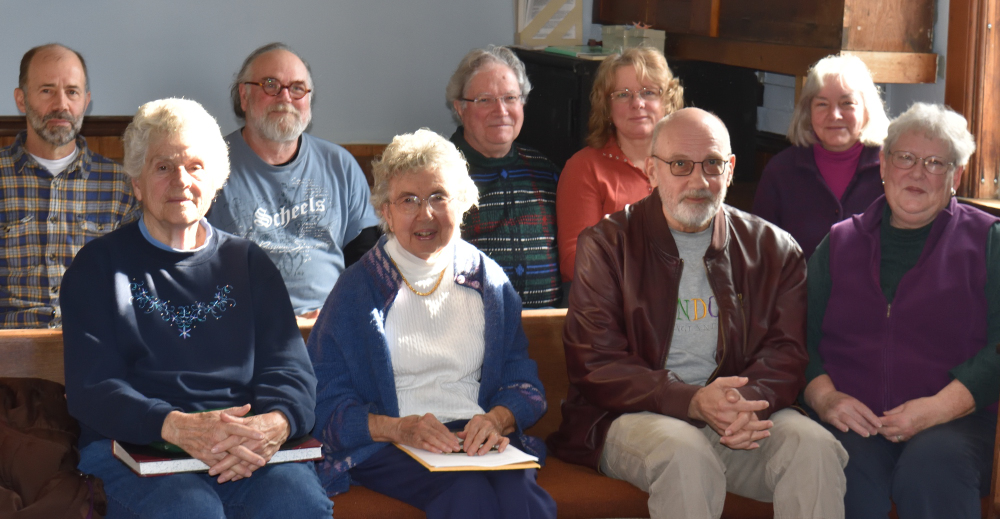
This morning at our meeting of Bear Creek Friends, we approved sending the following message to Quakers in Kyiv and were very relieved to receive the following response from them.
You’re our friends, the best friends on the planet, those who send kind and deep words. We are happy to have you with us and believe that God will make a miracle and stop the war.
Welcome to the page of Ukrainian supporters of Quakerism. Religious Society of Friends is a Protestant Christian church, known for its humanistic orientation, human rights and environmental guidelines, etc. The Quaker prayer meeting is first and foremost a time of peace. This is an hour free from unnecessary words. Quakers in the world have different currents. We, the Quakers of Kyiv, belong to the liberal trend without the well-known religious speechifying and lexicon. Seekers of friendship, peace, truth, and equality are cordially invited to the meeting, following the Spirit’s guidance in affairs, ready for the hour of silent worship. Details on messenger: m.me/QuakersKyivUkraine by e-mail: quakers@ukr.net
Monteverde Friends SchoolMonteverde Friends SchoolBear Creek FriendsBear Creel Friends meetinghouse
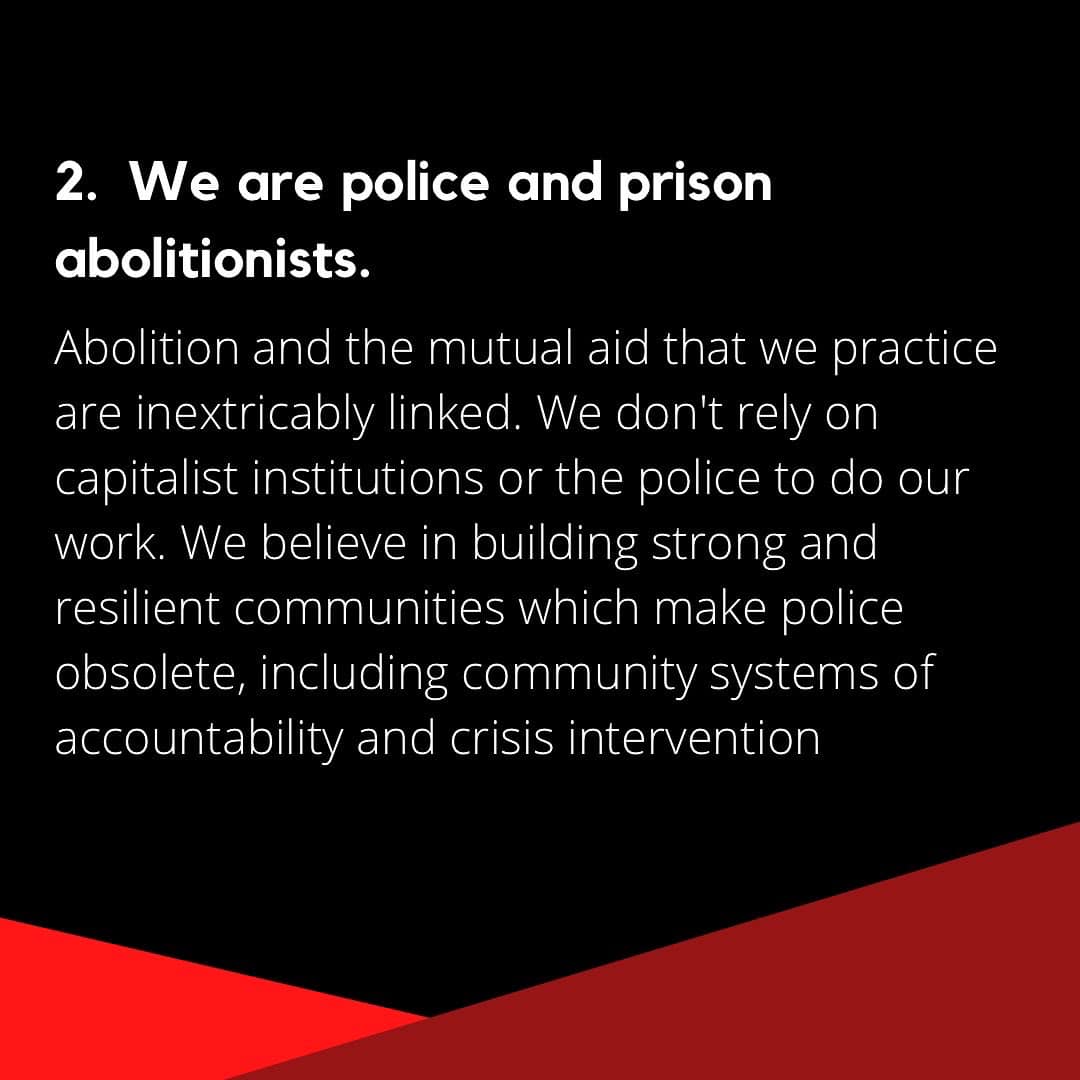
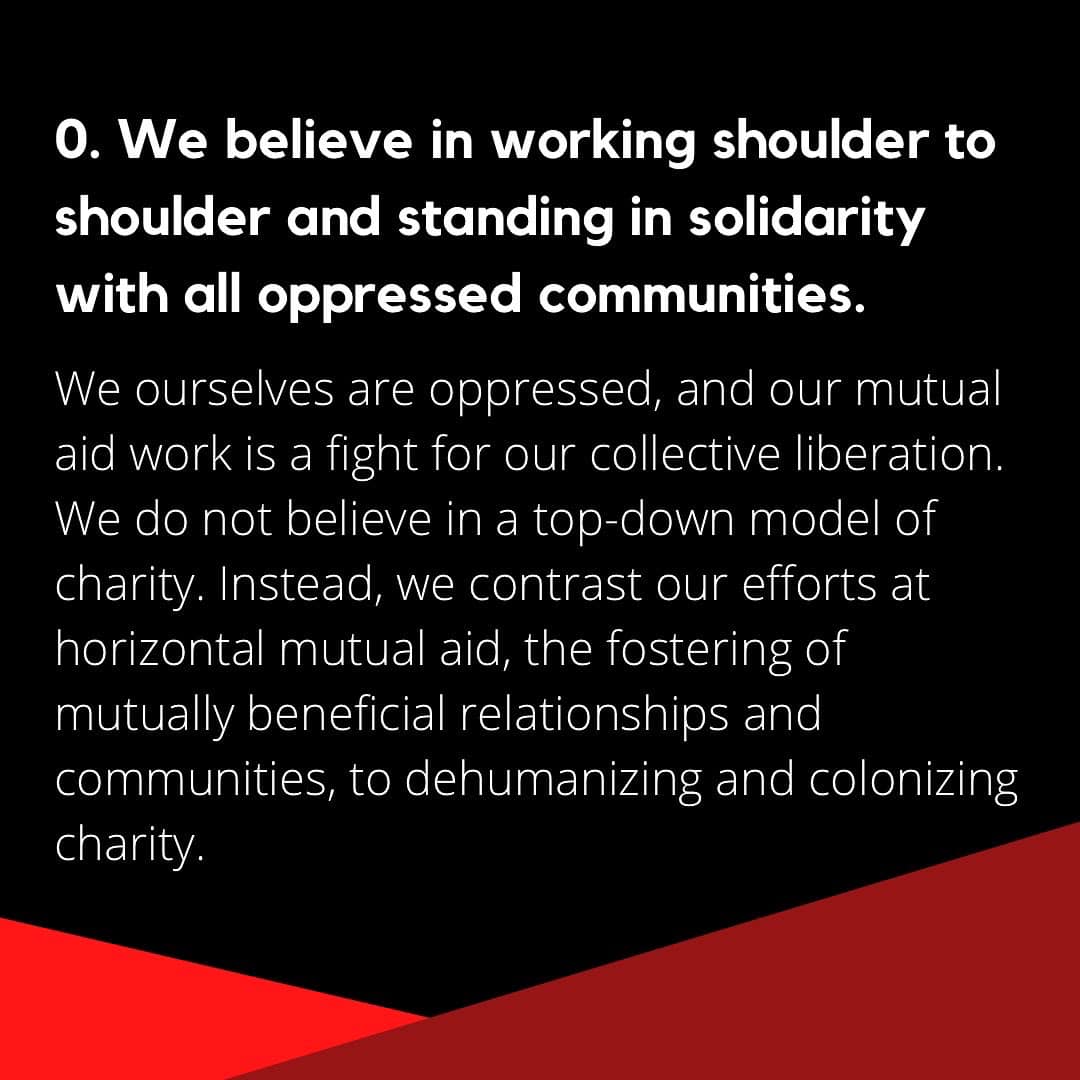
The more I experience being part of a Mutual Aid community, the more I learn about Mutual Aid, the more I am convinced Mutual Aid is how we should all live. I just realized that might be the only way we can live, survive.
I recently learned the term prefigurative politics which is to model the organization and social relationships that the group is advocating. Mutual Aid groups do this.
Mutual Aid is about replacing the vertical hierarchies of power with a flat or horizontal hierarchy where we all have a voice.
I’ve been thinking a lot about Mutual Aid and war as Russia invades Ukraine. Dictatorships like Putin’s Russia represent the ultimate vertical hierarchy. But all nation states are built on vertical hierarchies.
I’ve been wondering how Mutual Aid can be applied to global powers waging war.
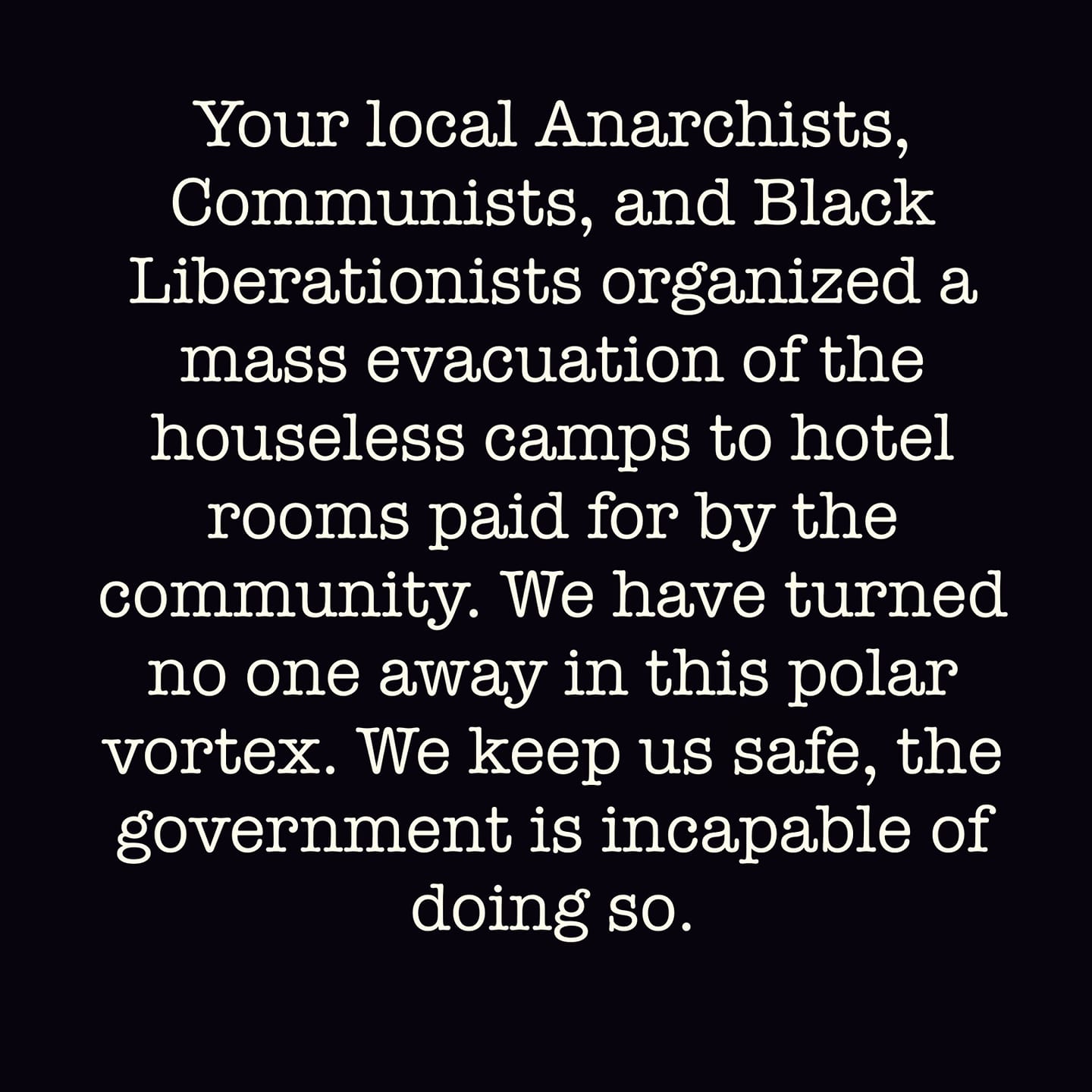
Our world, that has been colonized by imperialist white supremacist capitalist patriarchy, runs because of the oppressive and exploitative forms of power
Thus, to liberate ourselves and each other from this system, one of our main tasks is to confront hierarchy and hierarchical forms of power.
Mutual aid is a form of prefigurative politics, aimed at abolishing hierarchy and hierarchical forms of power in the world by first living out these principles ourselves, bringing new ways of relating to each other into being
Mutual Aid: Non-Hierarchy in Practice by Tammy Gan, Bad Activist
Rather than feeling helpless in the face of war, we should be creating our own communities of Mutual Aid, of peace. That will take us out of imperialist white supremacist capitalist patriarchy so we will not be contributing the conditions for the next war.
To address one aspect of war, creating our own Mutual Aid communities would put us in the position of being able to welcome refugees.
mutual aid aims to: form the structure of a new society within the shell of the old; embody the forms of social relations, decision-making, culture and human experience that are its ultimate goal
Beyond our personal experiences, our world, that has been colonised by imperialist white supremacist capitalist patriarchy, runs because of the oppressive and exploitative forms of power.
For our world, as is, to run, there must be an inherent valuing of some bodies over others. This is what we mean when we talk about “racial capitalism”, the idea that capitalism emerged, as Cedric Robinson argued, on the grounds of a civilisation based on racial hierarchy. Racism, in designating and ideologically convincing people that some people are inferior to others, allows for a system of extraction (capitalism) to exploit Black and brown people, while white people carry this out, or benefit from this system, thereby never abolishing it. So hierarchy (racial or otherwise) is the foundation that maintains our structures and system.
Thus, to liberate ourselves and each other from this system, one of our main tasks is to confront hierarchy and hierarchical forms of power.
Confronting, is different from attempting to appeal to the people who are in power (e.g. solely depending on billionaires, or politicians), or striving to obtain the kind of power that we’re subjected to (think #girlboss feminism). Instead, confronting means to transform hierarchical forms of power into other forms of power. We must have “power of our own”: moving away from power-over to power-with. This is where spaces and projects that attempt to create that new world, starting from rethinking our relationships, come into play.
Mutual aid is a form of prefigurative politics, aimed at abolishing hierarchy and hierarchical forms of power in the world by first living out these principles ourselves, bringing new ways of relating to each other into being. Specifically, mutual aid aims to: form the structure of a new society within the shell of the old; embody the forms of social relations, decision-making, culture and human experience that are its ultimate goals (i.e. to practice what it wants to see, now); and continuously experiment, and be reflexive through trial and error.
And if the wreckage of this inheritance will not be complete; if notwithstanding the crimes committed during this “civilized” war [ World War I ], we may still be sure that the teachings and traditions of human solidarity will, after all, emerge intact from the present ordeal, it is because, by the side of the extermination organized from above, we see thousands of those manifestations of spontaneous mutual aid.
Preface to the 1914 edition of Peter Kropotkin, Mutual Aid: A Factor of Evolution (London: Heinemann, 1914).
Food Not Bombs
When a billion people go hungry each day, how can we spend another dollar on war? Food Not Bombs is an all-volunteer movement that recovers food that would otherwise be discarded, and shares free vegan and vegetarian meals with the hungry in over 1,000 cities in 65 countries in protest to war, poverty, and destruction of the environment. We are not a charity but dedicated to taking nonviolent direct action. Our movement has no headquarters or positions of leadership and we use the process of consensus to make decisions. We also provide food and supplies to the survivors of natural disasters, and people participating in occupations, strikes, marches and other protests.
As grocery stores empty out and food shortages loom, food-sharing projects like Food Not Bombs (FNB) take on new urgency. FNB volunteers collect food from bakeries, grocery stores, and restaurants, cook together, and share meals and groceries in public spaces with whomever comes. Volunteers also take part in nonviolent direct action to change the social structures that produce hunger. FNB-like initiatives have already appeared in restaurants that offer free meals to laid-off workers and in grocery-delivery networks. There’s an increasing need for flexible, mobile, horizontal approaches to food distribution.
Eight anti-nuclear activists formed the first FNB group on May 24, 1980 at the Occupation Attempt of the Seabrook Nuclear Power Station in Cambridge, MA. Their basic insight was that hunger is unnecessary in a country that spends millions on weapons of mass destruction.
Prefigurative politics are the modes of organization and social relationships that strive to reflect the future society being sought by the group. According to Carl Boggs, who coined the term, the desire is to embody “within the ongoing political practice of a movement […] those forms of social relations, decision-making, culture, and human experience that are the ultimate goal”.[1]
I’m trying to sort out confused feelings about war and peace through a split screen of foreign versus domestic.
I was caught off guard by the Russian invasion of Ukraine. It was unrealistic to think there wouldn’t be another war between nations anytime soon.
But we haven’t had peace in this country, either.
I had forgotten Martin Luther King, Jr, was outside a California prison, which was holding Vietnam War protesters when he said, “there can be no justice without peace, and there can be no peace without justice.” December 14, 1967.
So, there is this dichotomy of war between nations versus domestic injustices. Domestic injustices mean there is no peace here.
This quote from Muhammad Ali relates to this.
Under no conditions do we take part in war and take the lives of other humans.
It is in the light of my consciousness as a Muslim minister and my own personal convictions that I take my stand in rejecting the call to be inducted. I do so with the full realization of its implications. I have searched my conscience.
Man, I ain’t got no quarrel with them Vietcong…they never called me ______.
Muhammad Ali
I’ve been blessed to have become part of numerous oppressed communities in this country. Where there are so many injustices. Where there is so much violence, much of it state sanctioned.
The scenes and stories from Ukraine are devastating to see. And while it is good to see the response of so many who want to help, I wish there were similar responses to our own domestic tragedies.
A friend this morning tells me others have noted similar disparities in the response to the plight of Palestinians. He said, “Once again I am reminded of how ‘White’ my thinking is.”
And there are the dispiriting stories of racial discrimination in support among the Ukrainian refugees.
My experiences with Mutual Aid have convinced me that is a way to peace.
The recent past shows us that mutual aid is not only a tool of survival, but also a tool of revolution.
Ronnie James
The first, and possibly the most important, is that it was not always this way, which proves it does not have to stay this way.
What we have is each other. We can and need to take care of each other. We may have limited power on the political stage, a stage they built, but we have the power of numbers.
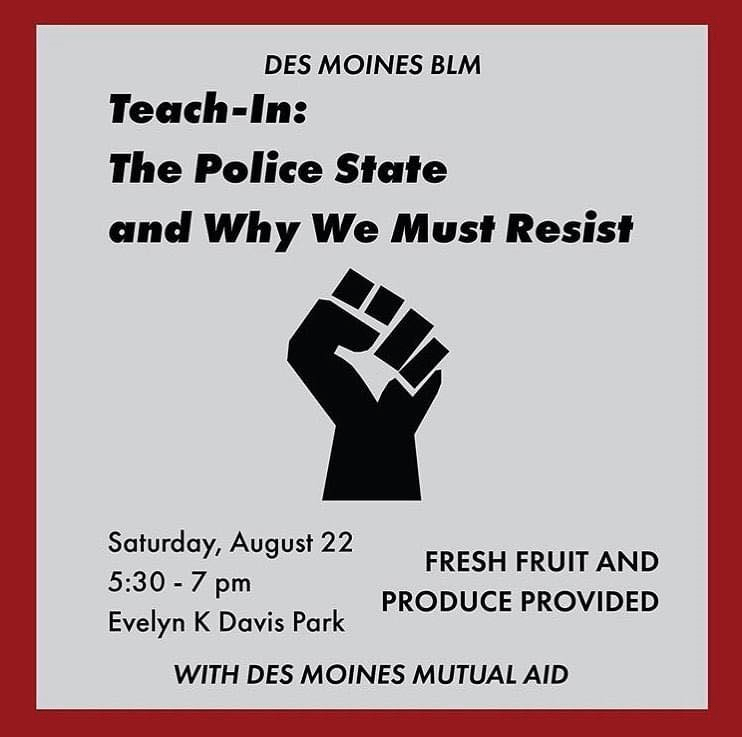
Those numbers represent unlimited amounts of talents and skills each community can utilize to replace the systems that fail us. The recent past shows us that mutual aid is not only a tool of survival, but also a tool of revolution. The more we take care of each other, the less they can fracture a community with their ways of war. Organized groups like The American Indian Movement and the Black Panther Party for Self Defense showed that we can build not only aggressive security forces for our communities, but they also built many programs that directly responded to the general wellbeing of their communities. This tradition began long before them and continues to this day. Look into the Zapatistas in Southern so-called Mexico for a current and effective example.
Ronnie James, The Police State and Why We Must Resist
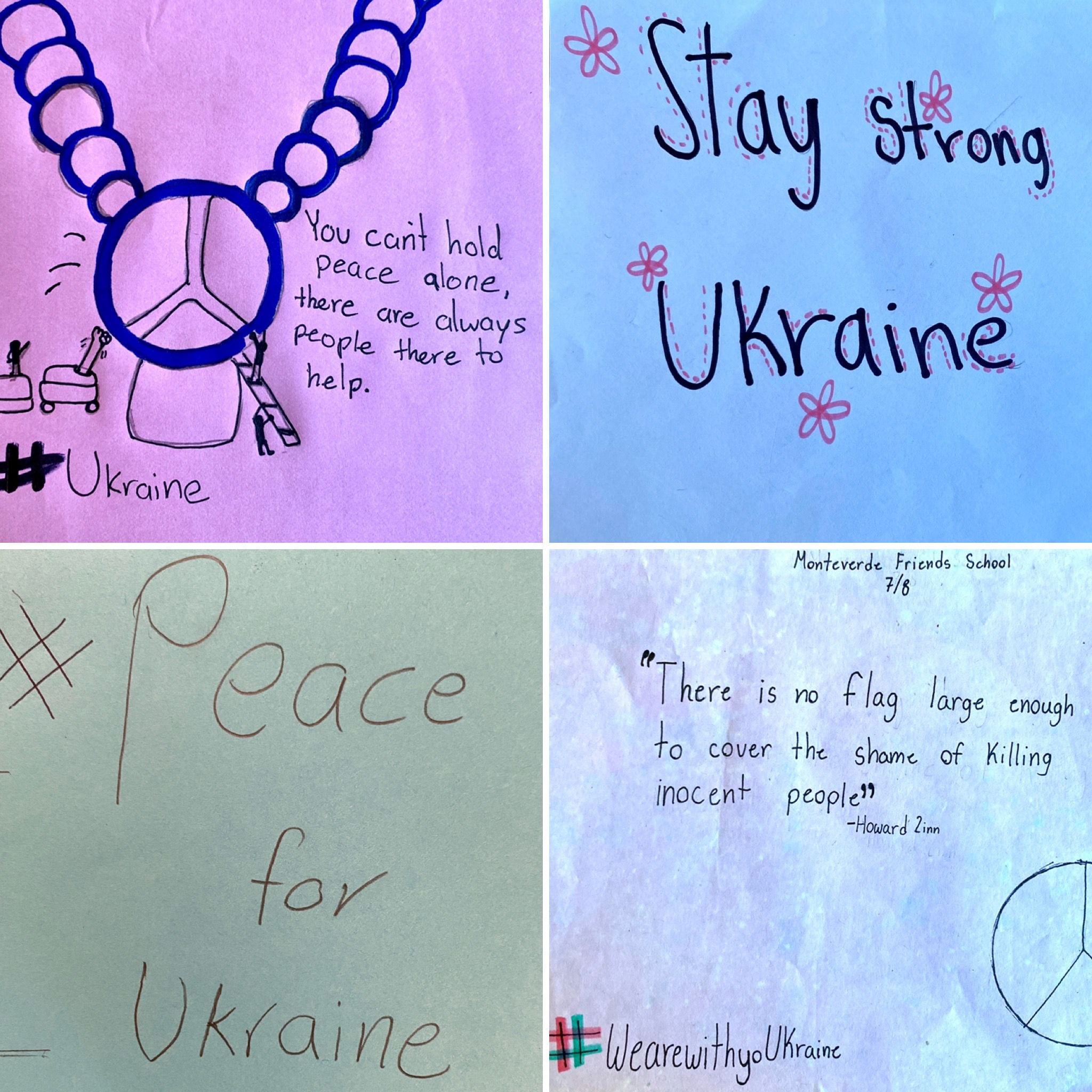
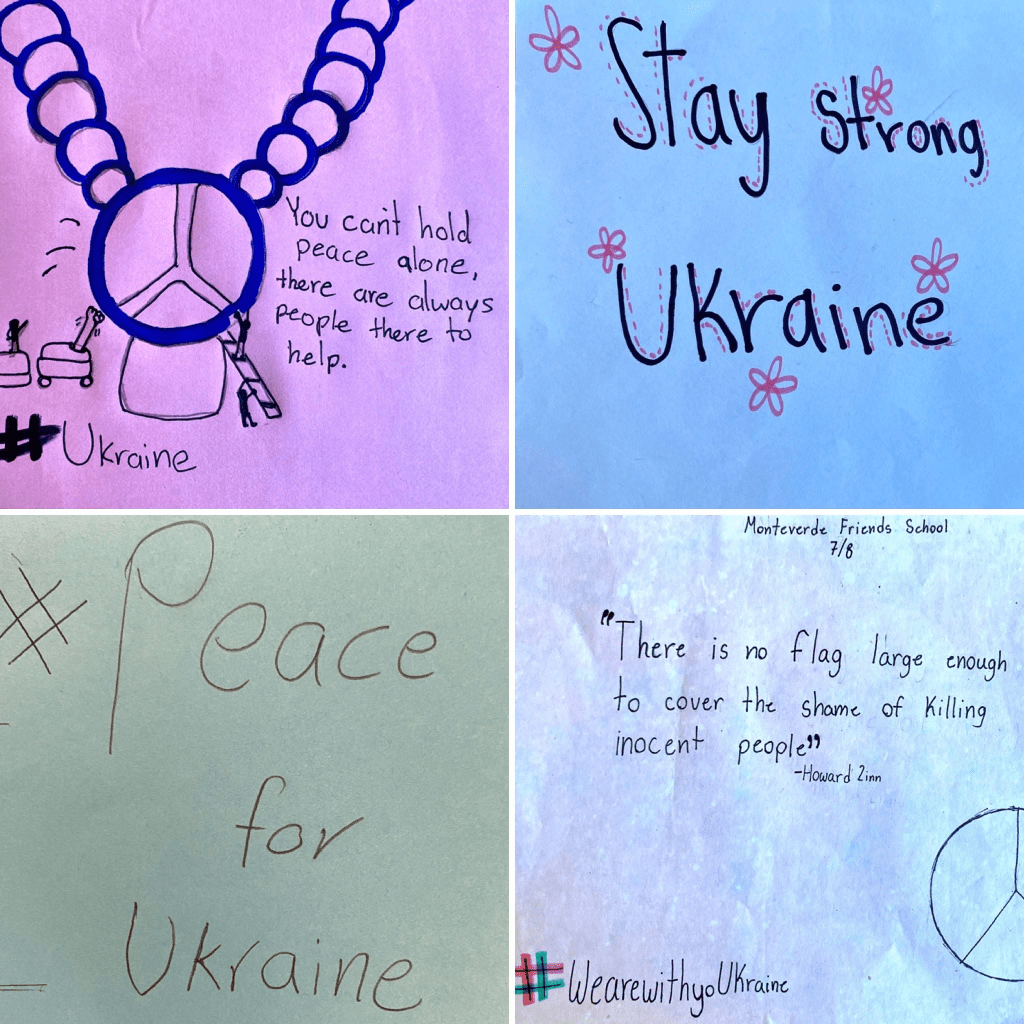
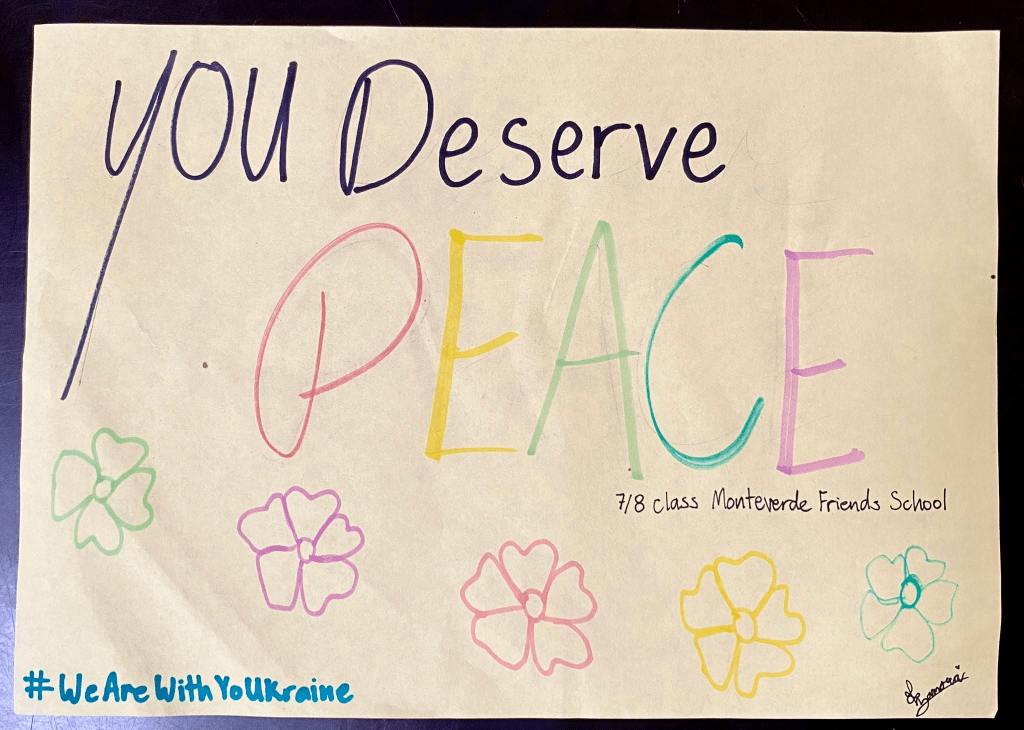
Posters of support 7/8 grade students at Monteverde Friends School in Costa Rica. sent to Ukraine Quakers.
There will be a ZOOM meeting for worship sharing related to Ukraine at 7:00 pm Central on Thursday, March 3. Everyone is welcome. Email me for the link. jakislin@outlook.com
Welcome to the page of Ukrainian supporters of Quakerism. Religious Society of Friends is a Protestant Christian church, known for its humanistic orientation, human rights and environmental guidelines, etc. The Quaker prayer meeting is first and foremost a time of peace. This is an hour free from unnecessary words. Quakers in the world have different currents. We, the Quakers of Kyiv, belong to the liberal trend without the well-known religious speechifying and lexicon. Seekers of friendship, peace, truth, and equality are cordially invited to the meeting, following the Spirit’s guidance in affairs, ready for the hour of silent worship. Details on messenger: m.me/QuakersKyivUkraine by e-mail: quakers@ukr.net
February 25, 2022
Despite everything, we prepare for silent prayer worship on Sunday at 10:30 Kyiv Time EET Eastern European Time UTC/GMT +2 hours We did it and we’ll do it again!
If you are unable to enter this conference due to the limited number of participants, there will be an opportunity behind this link to enter: https://zoom.us/j/95573361111 Passcode: d02uNj
February 24, 2022
Dear Friends!
We don’t know anything about how our traditional meeting of worship will go. It is not clear whether the Internet and electricity will be available, whether we will be in the capital or evacuated.
Today all Kyiv people were warned that the city will be bombed. And that all citizens should be ready to hear the sound of sirens go to the bomb shelter.
We don’t lose our temper. God and your prayers help us.
This is the kind of lovely support we get from Costa Rica.(see the following from Monteverde Friends School.)
When I contacted Monteverde Friends School for permission to share the signs from the students, Ellen told me, “The post with the 7/8 class posters for the people of Ukraine has already gone to over 11,000 people, with 112 shares on the post. “
The post with the 7/8 class posters for the people of Ukraine has already gone to over 11,000 people, with 112 shares on the post.
MCC has worked in Ukraine since our beginnings in 1920, opening soup kitchens to provide relief to thousands of starving families. Our current projects include relief, peace, health and education.
Since the beginning of the conflict in eastern Ukraine, MCC has worked with partners to assist internally displaced people (IDPs) and to build peace. The UNHCR reports there are some 1.8 million IDPs and conflict-affected people in Ukraine.
“We pray that hard hearts of conquest will be softened. We pray that the very best practices of peace will prevail among leaders. We pray gratefully that your spirit of healing and hope is present.” Rick Cober Bauman and Ann Graber Hershberger, executive directors of MCC, share a prayer for peace in Ukraine. We invited you to pray, give and advocate for peace for our global neighbours in Ukraine.
It is devastating to see the images and hear the stories of the Russian invasion into Ukraine. It is disheartening to feel helpless. Good to see the efforts many governments are attempting for nonviolent means to end the war.
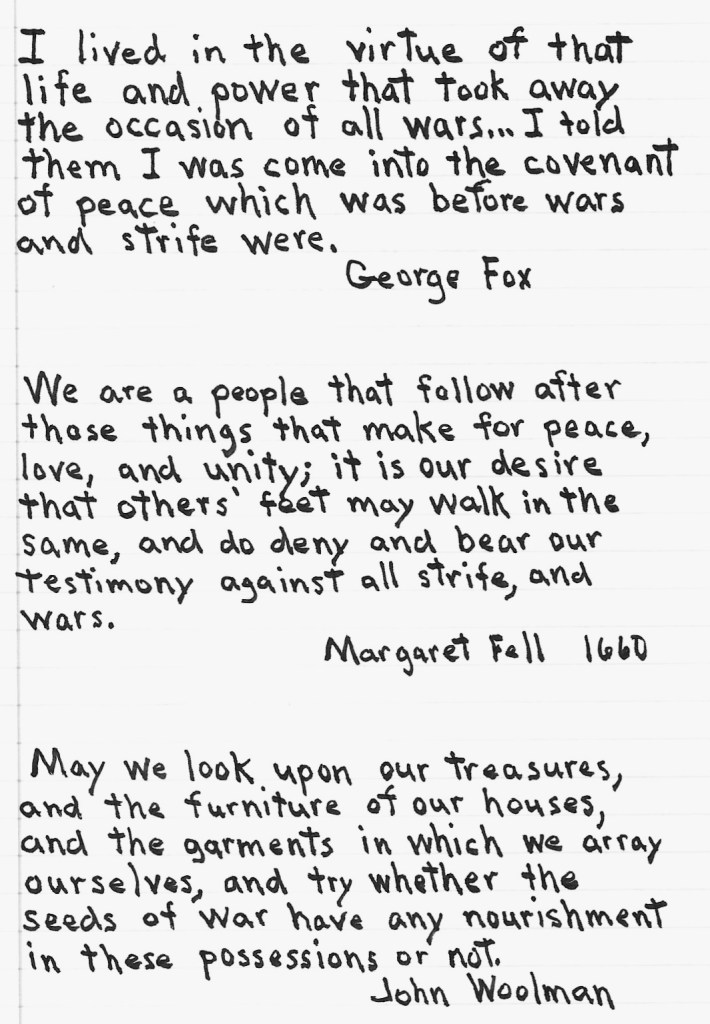
I’ve been praying about the statements below from early Friends admonishing us to look at ourselves, to explore what in our lives might contain the seeds of war.
I don’t say this to call attention to myself because my carbon footprint is many times greater than that of those who live in less industrialized countries. But it was a crystal-clear spiritual message that led me to live without owning a car. This was in 1975. Think of what might have been if all Friends had done so then. Such an example by thousands of Friends would have influenced others to do the same, I believe.
Would have resulted in good mass transit systems.
Would have dramatically slowed fossil fuel emissions and at least slowed the accelerating environmental catastrophe.
Might have prevented multiple wars for oil.
Might have meant the Dakota Access and other pipelines would not have been built.
Might have meant our children would have a livable future.
I can’t believe the Spirit did not say this to everyone. Did Friends not hear the message? Or if they did hear it, they must have decided to ignore it. On further reflection, I don’t know what the Spirit is saying to anyone else. Again, I’m not saying I’m blameless.
This time of war is an opportunity to listen to the Spirit, to that still small voice. To support each other. During our meetings for worship. To hold worship sharing meetings. And act on that spiritual guidance. Either individually and/or together as a meeting. To make a “commitment to active peace making” as Sidney Bailey says below.
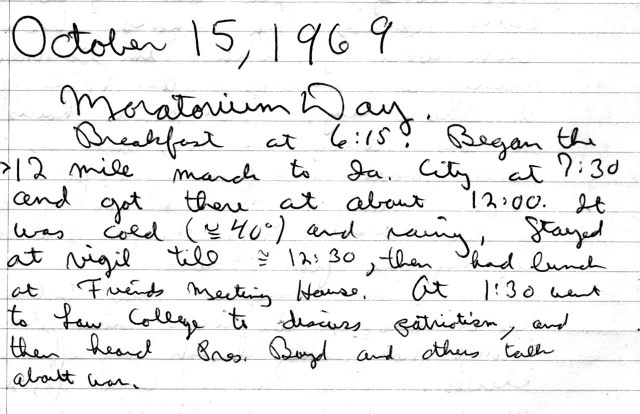
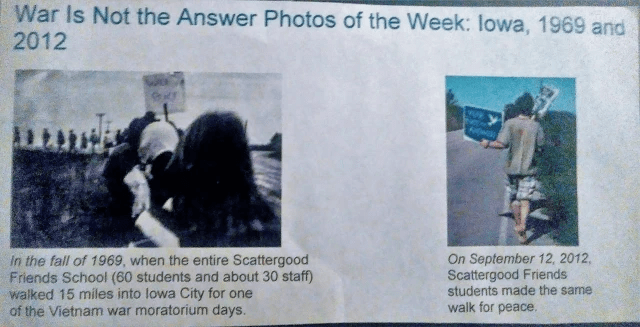
I’ve been feeling unanchored by the Russian invasion of Ukraine. I came of age during the Vietnam War and was involved in draft conferences, a twelve-mile peace walk from Scattergood Friends School to the University of Iowa, during the Moratorium to End the War in Vietnam, and conscientious objection that led to draft resistance.
Entire Scattergood Friends School peace walk, twelve miles to Iowa City
One of the scariest things three of us Scattergood students did, as suggested by our history and government teacher, Bob Berquist, was to go into the small town of West Branch, Iowa, near the school to ask people what they thought about the war. We just walked up to random houses and knocked on the door. What a wise thing he taught us. Instead of the angry defense of the war we expected, universally everyone was upset about the war.
All those years since, I’m sorry to say, I’ve become numb to the stories of the United States’s violence in so many countries. Death by remote control, armed drones, and the civilian casualties from them. One of the worst things I learned was how terrorized the people, the children were from the sounds of the drones overhead.
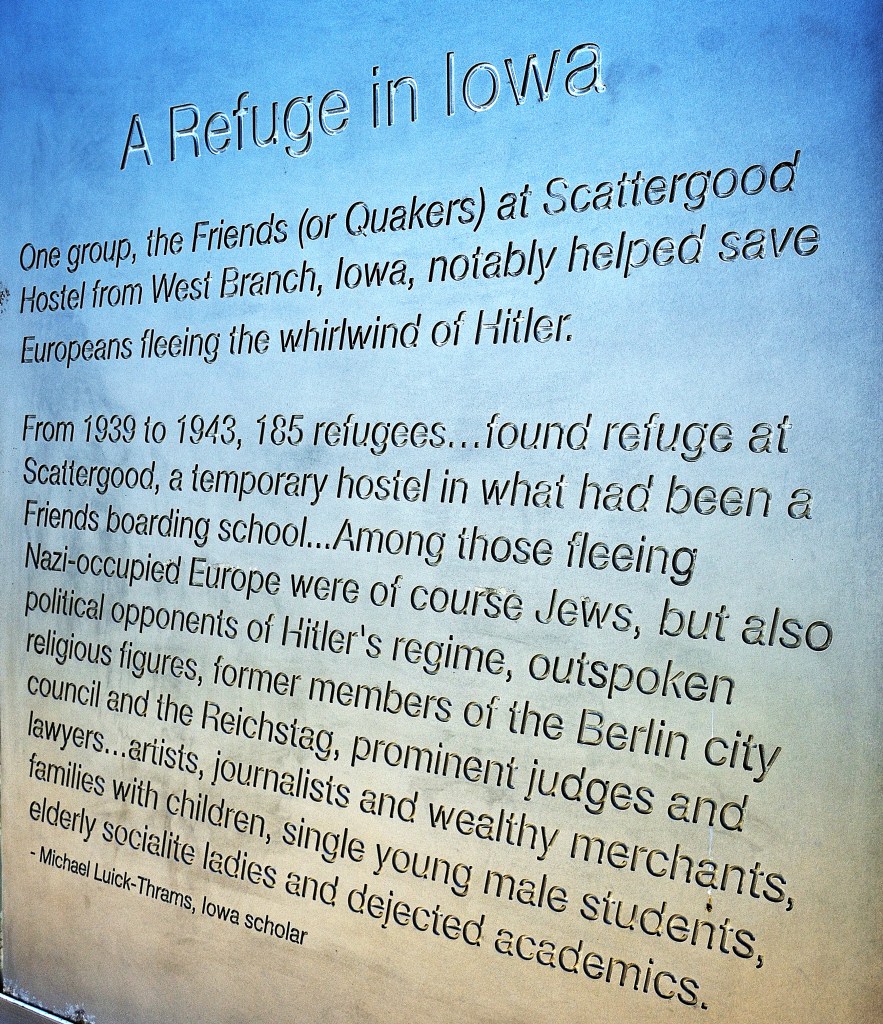
As I wrote yesterday, as I prayed about war and what I could do, I was led to the video describing the time when Scattergood Friends School was a hostel for people, refugees, fleeing from their countries during the second world war. In that video, below, Michael Luick-Thrams tells the history of the Scattergood Hostel. That was the subject of his book, Out of Hitler’s Reach: The Scattergood Hostel for European Refugees, 1939-43. That story makes me wonder if there might be ways for us to help refugees from the current war.
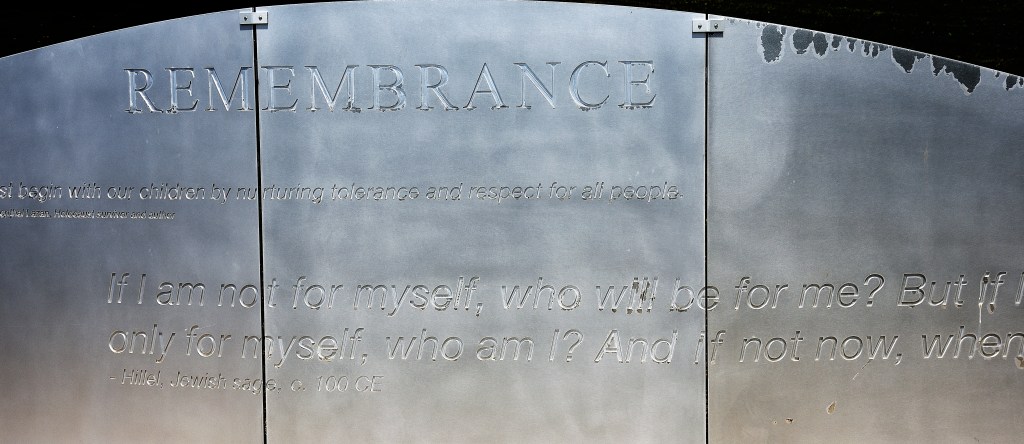
I finally found these photos I’d planned to use in yesterday’s post. They were taken at the Iowa Holocaust Memorial. Which includes a quote by Michael Luick-Thrams.
Constructed during the summer of 2013, the Iowa Holocaust Memorial is situated outdoors on the grounds of the West Terrace at the State Capitol, near the corner of East Grand Avenue and East 7th Street in Des Moines. With four walls of aluminum engraved with inscriptions and photographs, and arrayed in an artistic design, the memorial was established to commemorate the millions, including six million Jews, murdered by the Nazis and their collaborators during World War II in Europe; to express gratitude to the Iowans who, as members of the U.S. armed forces, participated in the liberation of the concentration camps in 1945; and in honor of the survivors who came to Iowa.
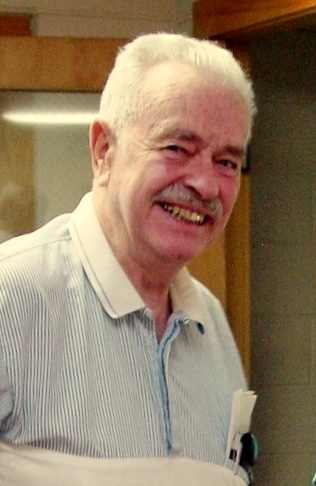
The following describes Michael’s recent work, a bus tour about the social and political struggles of the First World War and the inter-war years. My friend, Leo Ko, accompanied the tour. Leo is from Afghanistan and a graduate of Scattergood Friends School, too. He gave me a tour of the exhibit last summer when the bus was at the Living History Farm in Des Moines, Iowa.
The “BUS-eum History Tour” will visit to present the exhibit “Hidden or Forbidden No More: Prequels to the ‘Greatest Generation,’ 1914-39.”
“Hidden or Forbidden No More” will feature five sub-stories: Kickin’ the Kaiser; The Killer: 1918 Flu Pandemic; The Klan: America’s White Cancer; Cow Wars: Farmer Rebellions; and Whiskey Cookers.
The traveling exhibit was curated by Iowa-raised Dr. Michael Luick-Thrams.
“That period — the First World War through the inter-war years — saw various social and political struggles, both abroad, but moreover at home,” Luick-Thrams said. “Not only did we fight Germany twice, but in the U.S. various factions warred with each other.”
‘Hidden or Forbidden No More’ exhibit to highlight issues relevant to Iowa ‘BUS-eum History Tour’ rolling into Fort Museum Thursday by MICHAELA FRERICHS, The Messenger, August 17, 2021.
I feel this strong tension to be doing something about the war in Ukraine. But I don’t know what that would be. What is the Spirit calling me, calling us to do? I was glad to come upon Clarence Pickett’s quote, at the time of World War II, because I have been feeling paralyzed. Not only from the war in Ukraine, but from so many things that make it feel like everything is falling apart. COVID, state sanctioned violence, political polarization, and the increasing environmental chaos to name just a few.
“The world was breaking loose in so many places that it was difficult to know how to think about one’s responsibilities…it was important in such a time not to become simply paralyzed by the quantity of the need.”
Clarence Pickett
I have been thinking about Quaker’s response to Nazism and World War II. I know the Scattergood Hostel story because many of my relatives and I attended Scattergood, a Quaker boarding high school.
In addition to assisting those still in Europe, the Quakers helped newly arrived refugees adjust to life in the United States. The AFSC established a series of workshops and hostels to help refugees learn English and prepare for their new lives, including Sky Island Hostel in Nyack, New York; the Haverford Cooperative Workshop in Haverford, Pennsylvania; and the Quaker Hill Hostel in Richmond, Indiana. The largest and longest-running hostel was Scattergood, in West Branch, Iowa, where more than 185 refugees lived between 1940 and 1943. Working with the Joint, Hertha Kraus traveled to Havana, Cuba, in 1939 to found the Finca Paso Seco hostel, where refugees could learn agricultural trades.
Michael Luick-Thrams has written a lot about the Scattergood Hostel, including the book, Out of Hitler’s Reach: The Scattergood Hostel for European Refugees, 1939-43. See more about Michael’s work here: https://www.traces.org/
In this video Michael tells the Scattergood Hostel story.
With the rising rhetoric and tensions regarding the Russian invasion of Ukraine, I’m asking myself, again, what does it mean to work for peace? A question I’ve returned to repeatedly over the course of my life. My answer to that question has changed over time. Following is some history of working for peace. But I intend to write how I see working for peace has changed, what that means today, soon.
As I was coming of age in the late 1960’s, at the time of the war in Vietnam, I continuously studied and thought about war and peace. On his eighteenth birthday, every male in the US was required to register with the Selective Service System, which recruited for the armed services. I was born into a Quaker community and attending Scattergood Friends (Quaker) boarding school at that time.
Because of their work for peace, Quakers, the Brethren, and Mennonites were known as historic peace churches. Young men who were members of one of those religious organizations could apply for conscientious objector (CO) status with the Selective Service System. If approved, they would spend two years working in civilian jobs for the public good. Most often in hospitals or mental health institutions.
Those who didn’t belong to one of the historic peace churches could apply for CO status, but that usually wasn’t granted to them. That was blatantly unjust. Similarly, those attending college were routinely granted a student deferment, allowing them to finish their studies. Yet another injustice for those who weren’t students.
Conscientious objector status and student deferments were transparent efforts to quiet resistance to the draft. A number of young men refused to accept those alternatives. Refusing to register with the Selective Service System or returning your draft card made you a draft resister. If convicted, the sentence was a felony conviction and usually a prison sentence.
The peacetime draft was implemented in 1940. Not long after, some Quaker families left the country and established the Monteverde community in Costa Rica.
About dozen men and their families in my Quaker community remained in this country but believed they could not participate in the draft. Which meant refusing to register or returning their draft cards if they had registered but came to believe that was wrong.
It took some time for my family to come to terms with my decision to resist the draft. I initially applied for and was granted conscientious objector status. When my family finally accepted my decision, I turned in my draft cards.
I wasn’t arrested, but Daniel Barrett, who attended Scattergood Friends School with me, was arrested and imprisoned.
My Quaker friend and mentor, Don Laughlin, collected many stories of Quaker responses to several wars, including Danniel’s and mine. Don resisted the draft and was imprisoned. When I heard of his project and offered to help, which meant I had those stories when Don died. You can read those stories here:
This morning I saw a message from a Friend who suggested we begin to offer conscientious objector, or draft counseling, as was done during the Vietnam War.
I wanted to share the story of how Muhammad Ali was an inspiration to me as I struggled with my draft decision.
Muhammad Ali was one of the most significant influences in my life, at a difficult time in my life. Approaching my 18th birthday, when I would have to decide what I was going to do about registering with the Selective Service System, I saw Muhammad Ali take a very public, very unpopular stand against the Vietnam War.
He said: “Under no conditions do we take part in war and take the lives of other humans.”
“It is in the light of my consciousness as a Muslim minister and my own personal convictions that I take my stand in rejecting the call to be inducted. I do so with the full realization of its implications. I have searched my conscience.”
“Man, I ain’t got no quarrel with them Vietcong…they never called me n_____.”
It was very clear what the consequences of that decision could be, and yet he would not be persuaded to change his position, knowing he was jeopardizing his boxing career.
I was impressed by his clear vision of the universal struggle of every person for peace and freedom, and every person’s responsibility to the world community, no matter their religion, race or country.
He helped me make my decision to refuse to participate in the draft, and therefore, the Vietnam War. And continued to be an inspiration in the days that followed.
I read this Epistle to Friends Concerning Military Conscription many times as I was praying and thinking about draft resistance, and since.
An Epistle to Friends Concerning Military Conscription
Dear Friends,
It has long been clear to most of us who are called Friends that war is contrary to the spirit of Christ and that we cannot participate in it. The refusal to participate in war begins with a refusal to bear arms. Some Friends choose to serve as noncombatants within the military. For most of us, however, refusal to participate in war also involves refusal to be part of the military itself, as an institution set up to wage war. Many, therefore, become conscientious objectors doing alternative service as civilians, or are deferred as students and workers in essential occupations.
Those of us who are joining in this epistle believe that cooperating with the draft, even as a recognized conscientious objector, makes one part of the power which forces our brothers into the military and into war. If we Friends believe that we are special beings and alone deserve to be exempted from war, we find that doing civilian service with conscription or keeping deferments as we pursue our professional careers are acceptable courses of action. But if we Friends really believe that war is wrong, that no man should become the executioner or victim of his brothers, then we will find it impossible to collaborate with the Selective Service System. We will risk being put in prison before we help turn men into murderers.
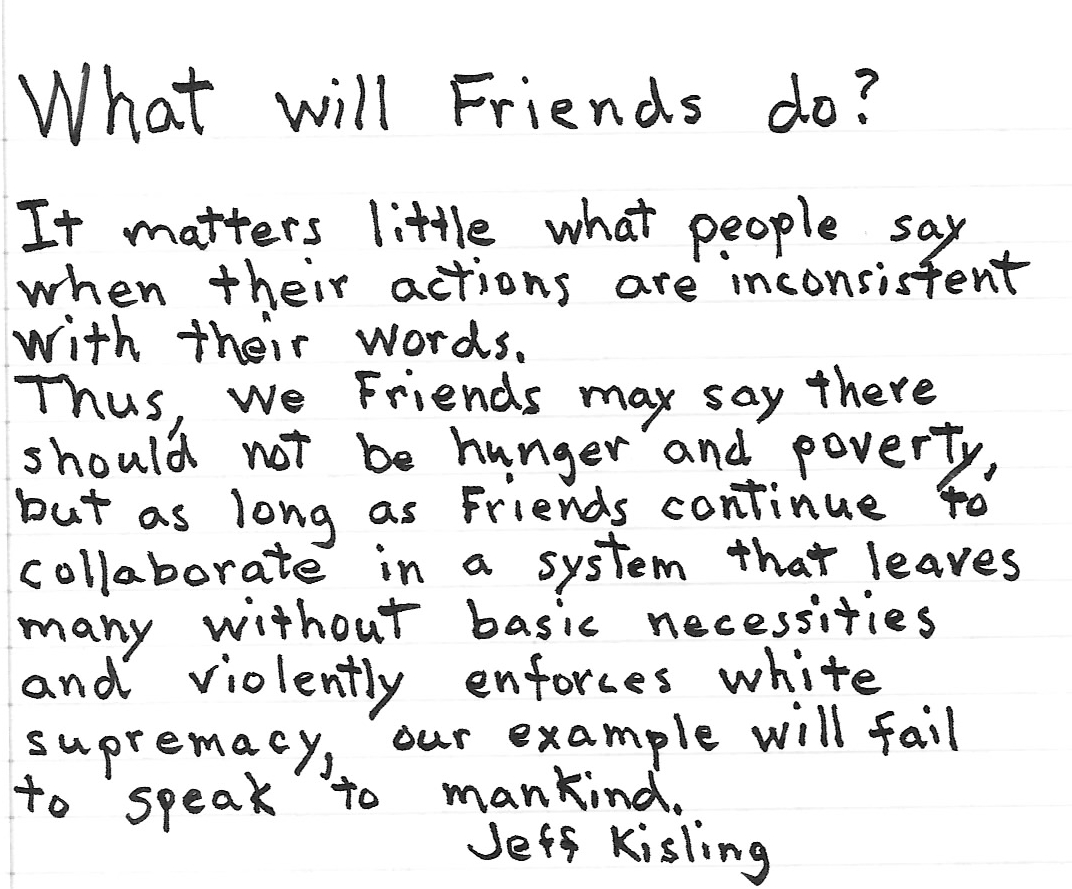
It matters little what men say they believe when their actions are inconsistent with their words. Thus we Friends may say that all war is wrong, but as long as Friends continue to collaborate in a system that forces men into war, our Peace Testimony will fail to speak to mankind.
Let our lives speak for our convictions. Let our lives show that we oppose not only our own participation in war, but any man’s participation in it. We can stop seeking deferments and exemptions, we can stop filling out Selective Service forms, we can refuse to obey induction and civilian work orders. We can refuse to register or send back draft cards if we’ve already registered.
In our early history we Friends were known for our courage in living according to our convictions. At times during the 1600’s thousands of Quakers were in jails for refusing to pay any special respect to those in power, for worshiping in their own way, and for following the leadings of conscience. But we Friends need not fear we are alone today in our refusal to support mass murder. Up to three thousand Americans severed their relations with the draft at nation-wide draft card turn-ins during 1967 and 1968. There may still be other mass returns of cards, and we can always set our own dates.
We may not be able to change our government’s terrifying policy in Vietnam. But we can try to change our own lives. We must be ready to accept the sacrifices involved if we hope to make a real testimony for Peace. We must make Pacifism a way of life in a violent world.
We remain, in love of the Spirit, your Friends and brothers,
Don Laughlin Roy Knight Jeremy Mott Ross Flanagan Richard Boardman James Brostol George Lakey Stephen Tatum Herbert Nichols Christopher Hodgkin Jay Harker Bob Eaton Bill Medlin Alan & Peter Blood
Roy Knight, John Griffith, and Don Laughlin were among the members of my yearly meeting, Iowa Yearly Meeting (Conservative) who resisted the draft. Don and Roy signed the epistle above.
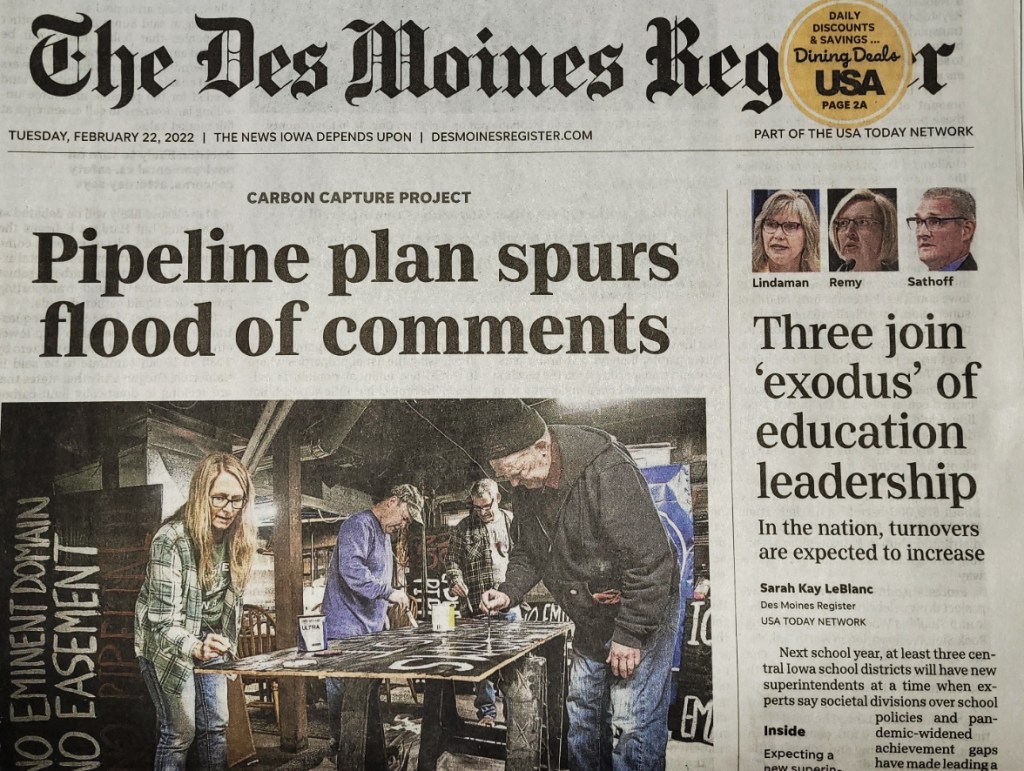
WOW. This is the front page of today’s Des Moines Register and part of that story can be found below.
After years of resisting pipelines, beginning in 2013 with the Keystone Pledge of Resistance, I am cautiously optimistic we might stop these carbon pipelines. Clearly there is much more attention paid to, and resistance from large numbers of people. Landowners suffered in many ways from being forced by the abuse of eminent domain for construction of the Dakota Access pipeline. Now they know and won’t easily allow this to happen again.
There are a lot of pieces to learn about these new concepts, including different ways the carbon dioxide (CO2) that is captured is used. My friends Rodger Ruth and Mahmud Fitil have an excellent discussion about these pipelines in the video at the end of this.
One of the unique and extreme dangers of these new CO2 pipelines is what happens when the CO2 leaks. The carbon in these pipelines is under high pressure. When there is a rupture there is an explosion and then the rapid release of vast amounts of carbon dioxide, which displaces oxygen in the air. People and other living beings immediately become disorientated. Nonelectric vehicles stop working because there is not enough oxygen to burn the gas in the engines. The deaths of large numbers of people could occur if such a rupture happened in a highly populated area. First responders become disoriented as well. This video is about a carbon explosion that occurred in Satartia, Mississippi, in 2020. https://www.facebook.com/FWWIA/videos/6717059531697606
Sequestration (CCS) involves shipping the captured carbon, hence the need for the pipelines, to areas where there are rock formations to inject the carbon into. This is an unproven idea and many of us are skeptical that carbon won’t escape.
Even worse is the use of recovering fuel by injecting the carbon into diffuse pockets underground, to force the oil to the surface the same way water is injected for fracking.
It really is tortured logic to say CO2 is being removed from the atmosphere to decrease greenhouse gas concentrations, and then use that CO2 to extract more oil to burn, adding MORE greenhouse gases.
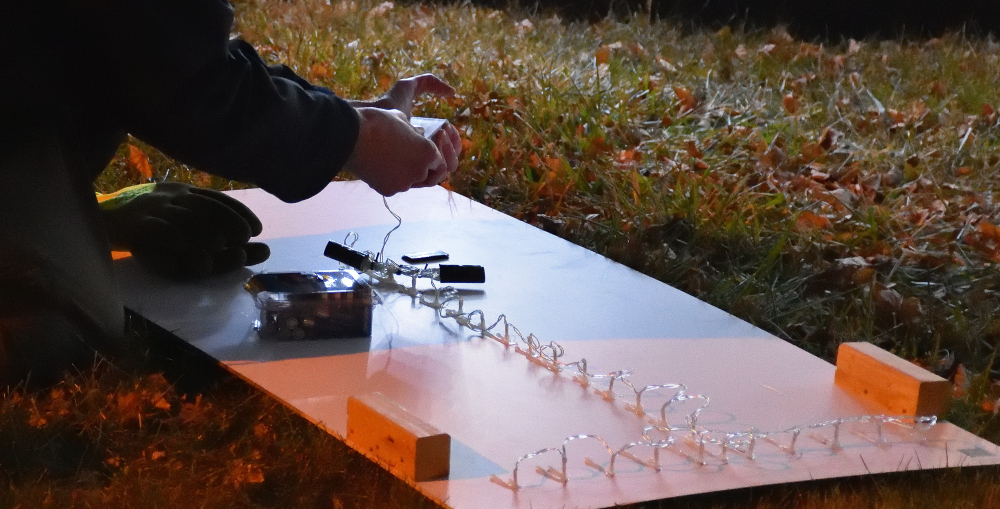
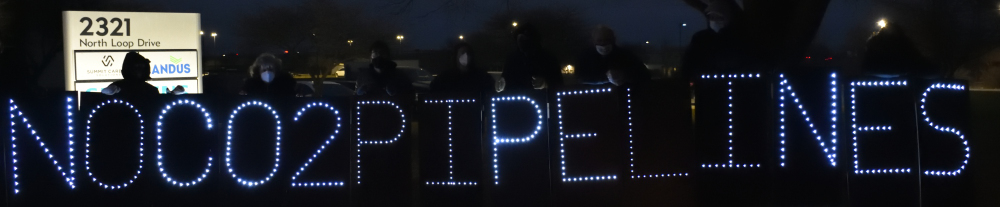
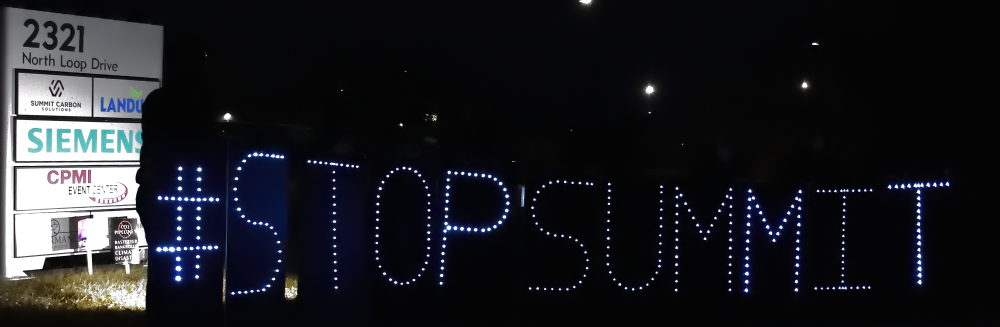
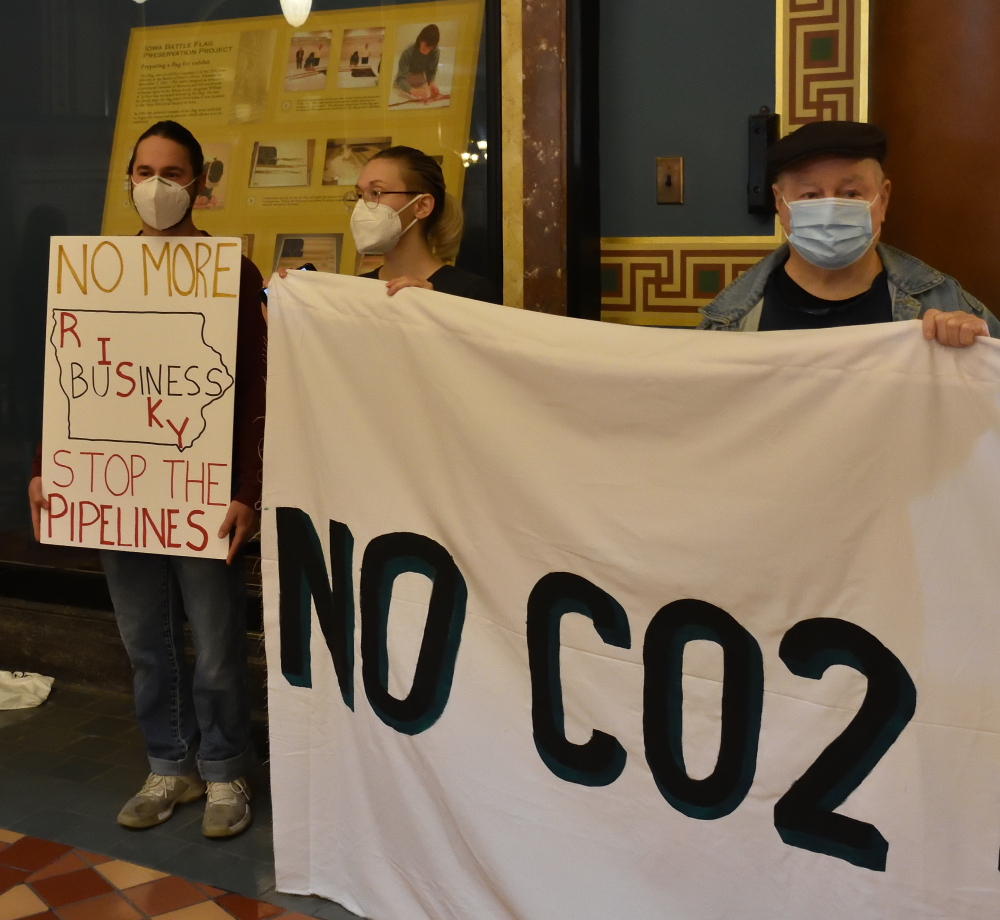
Following are some photos from various events to call attention to carbon pipelines and why they should not be built.
These are from an event by my friends Sikowis Nobiss and Mahmud Fitil at the headquarters of Summit Carbon Solutions in Ames, Iowa, one of the companies involved in CO2 pipeline construction.
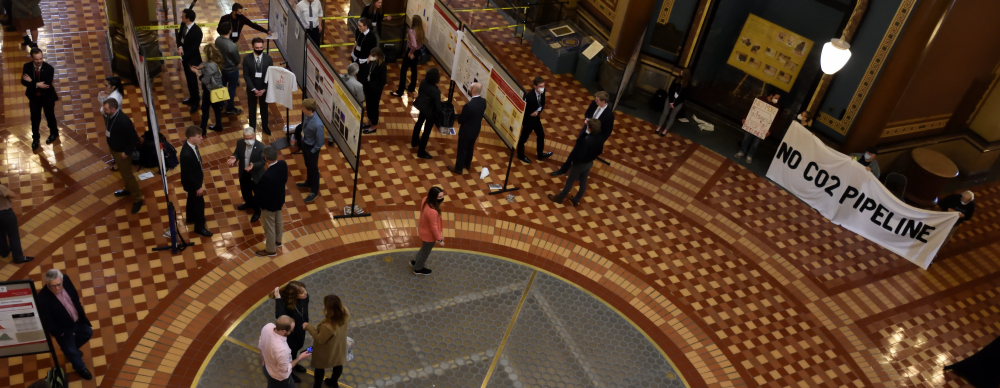
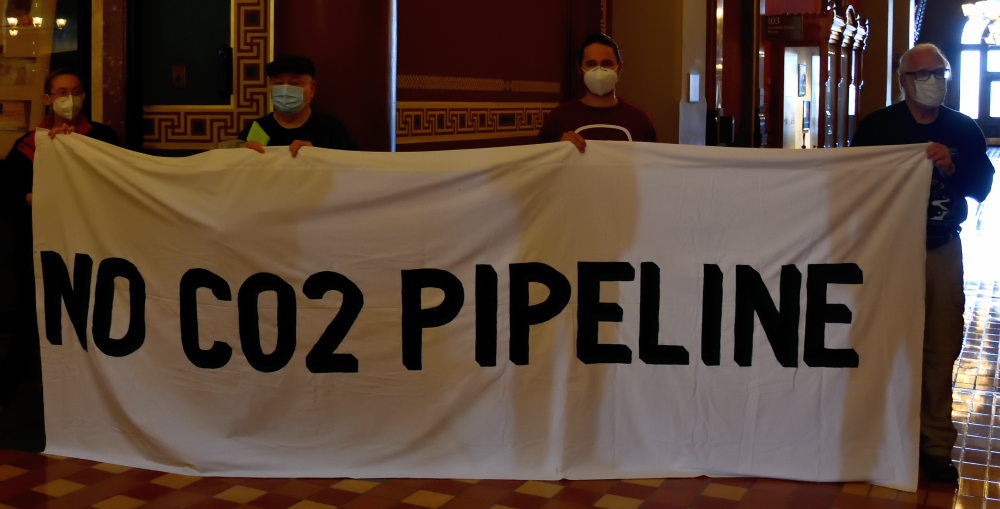
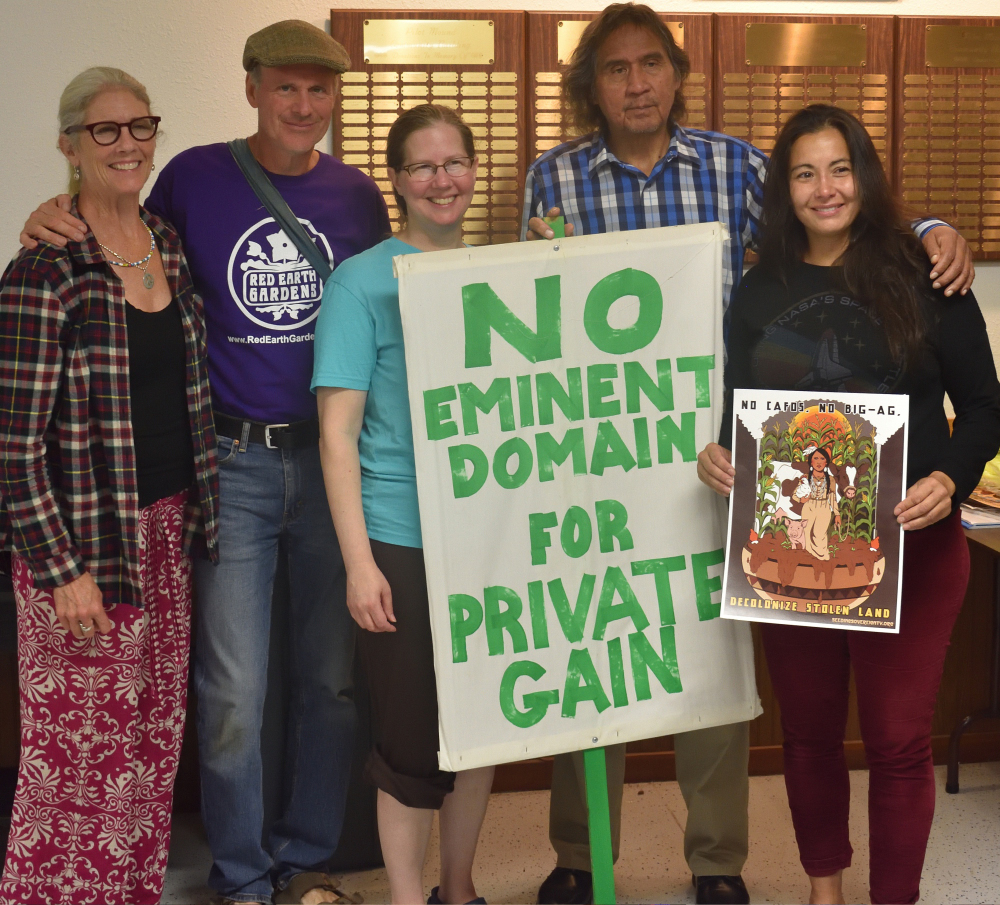
Yesterday some people from the Catholic Worker House(s) held this banner and talked with people at the Iowa State Capitol.
The first carbon capture pipeline proposal to make its way to Iowa regulators is drawing more early opposition in the state than the Dakota Access crude oil pipeline, which grabbed national attention in 2016 and 2017, when Hollywood stars joined Native Americans in monthslong protests.
So far, Summit Carbon Solutions’ proposal to build a $4.5 billion carbon capture pipeline in Iowa has drawn 750 comments, according to Don Tormey, the Iowa Utilities Board spokesman. The comments — mostly in opposition — are double the number the Dakota Access project had received roughly a month after filing its permit request with state regulators in 2015, a Des Moines Register review shows.
And opposition is growing. Organizers say hundreds of Iowa landowners are banding together to fight Summit’s project and two other carbon capture pipeline proposals. They’re refusing to sell easements for the pipelines and pledging to battle the companies in court, if necessary.
Dubbed the Iowa Easement Team, the group says it has hired Domina Law, a Nebraska firm that helped stop the Keystone XL pipeline, which would have transported Canadian crude oil from Alberta to refineries in Texas. It declined to say exactly how many Iowa landowners are part of the effort.
“I’ve been kind of amazed at the amount of resistance we’ve seen to these projects” so early in the process, said Wally Taylor, an attorney for the Iowa Chapter of the Sierra Club, which challenged Dakota Access and opposes the more recent carbon capture projects.
In the submitted comments, farmers, landowners and county and state officials are challenging Summit’s likely use of eminent domain to force unwilling landowners to sell access for the 680-mile pipeline, which would cross 29 Iowa counties. Fifteen county boards of supervisors have filed statements of opposition to the use of eminent domain.
“These are Republican Trump voters, and they’re just mad about these pipelines,” Taylor said.
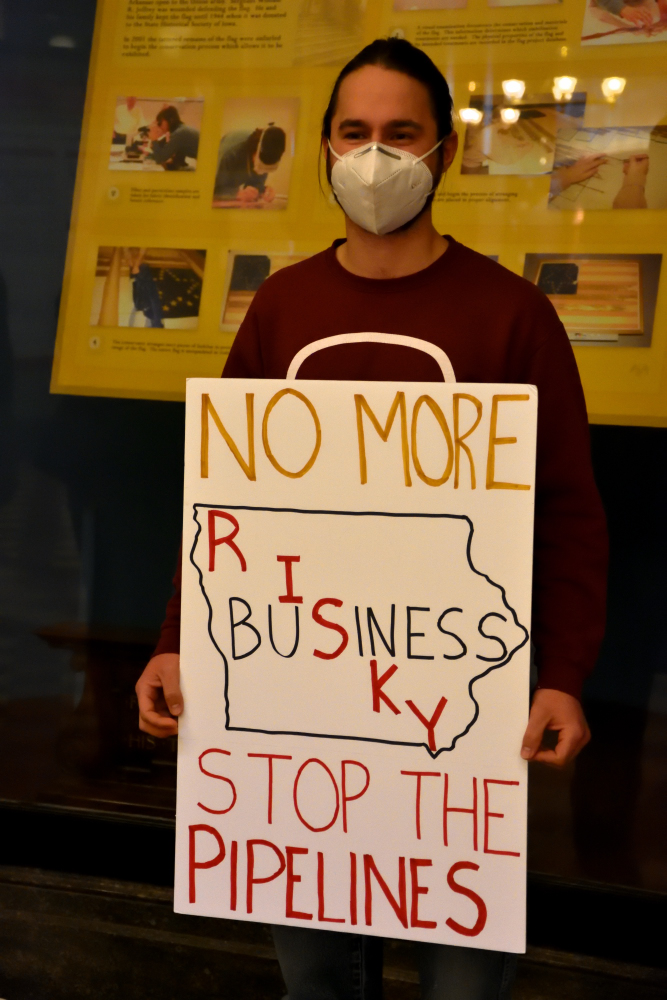
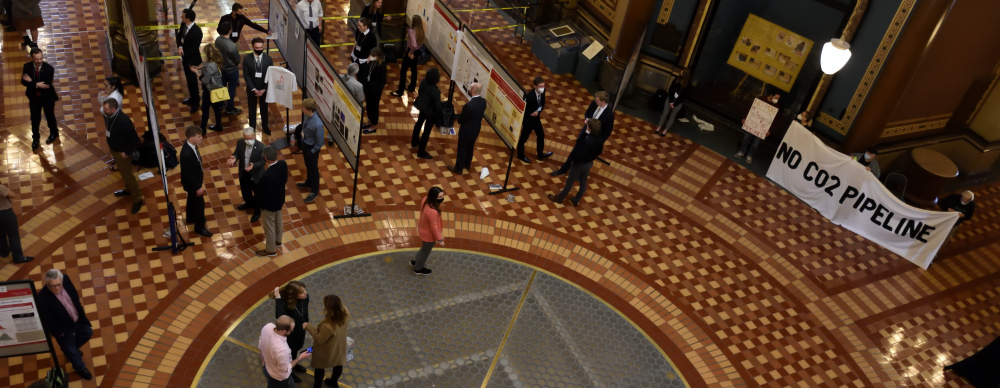
Eminent domain is once again an issue as more pipelines are proposed to go through the state. These are called CO2 or Carbon pipelines. These pipelines should not be built, for many reasons. But the issue today is about the abuse of eminent domain for any reason. There will be an event related to this at the Iowa State Capitol from 12-1 pm.
Today there will be an event at the Iowa State Capitol from 12-1 pm
If you are concerned about the great threat that carbon pipeline projects in Iowa bring to the land and water and the use of eminent domain for private corporate gain, join us at the Iowa State Capitol from 12-1pm!
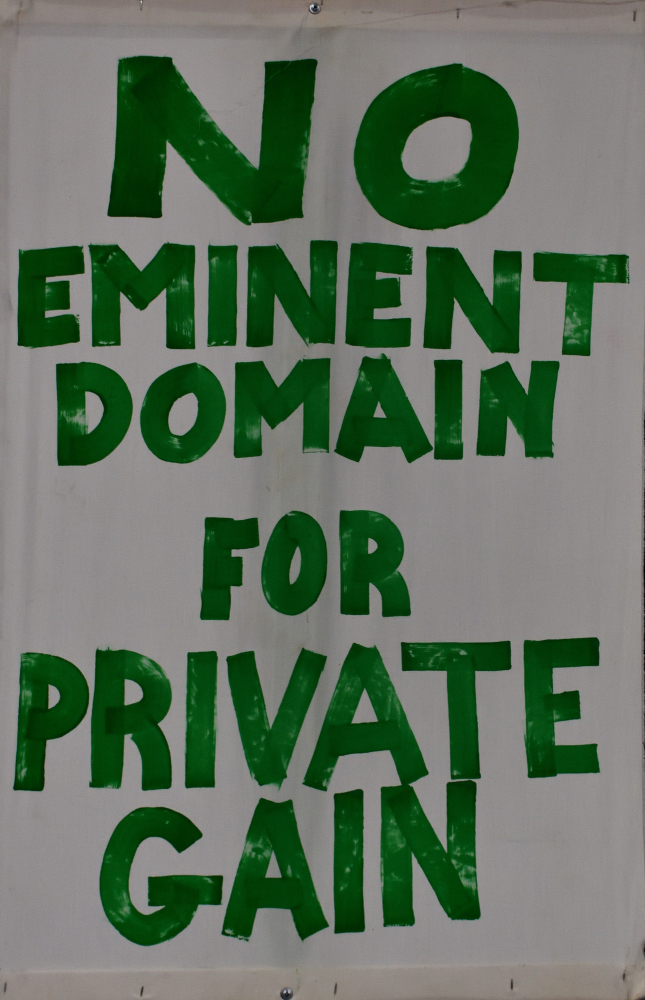
This is a weekly gathering for folks to meet as well as let lawmakers know that people from all walks of life are standing together, united in saying, “Protect our land and water!” “No eminent domain for private gain!” and “NO CARBON PIPELINES!”
People will gather in the rotunda at 12 noon. All are welcome! Add your voice and make a difference!
At the same time another group of my friends were at the Iowa State Capitol in support of Bill 2160
A coalition of environmentalists and land owners is seeking a meeting with Governor Kim Reynolds, hoping she’ll intervene and block the Iowa Utilities Board from granting eminent domain so carbon pipeline developers can acquire land from reluctant property owners.
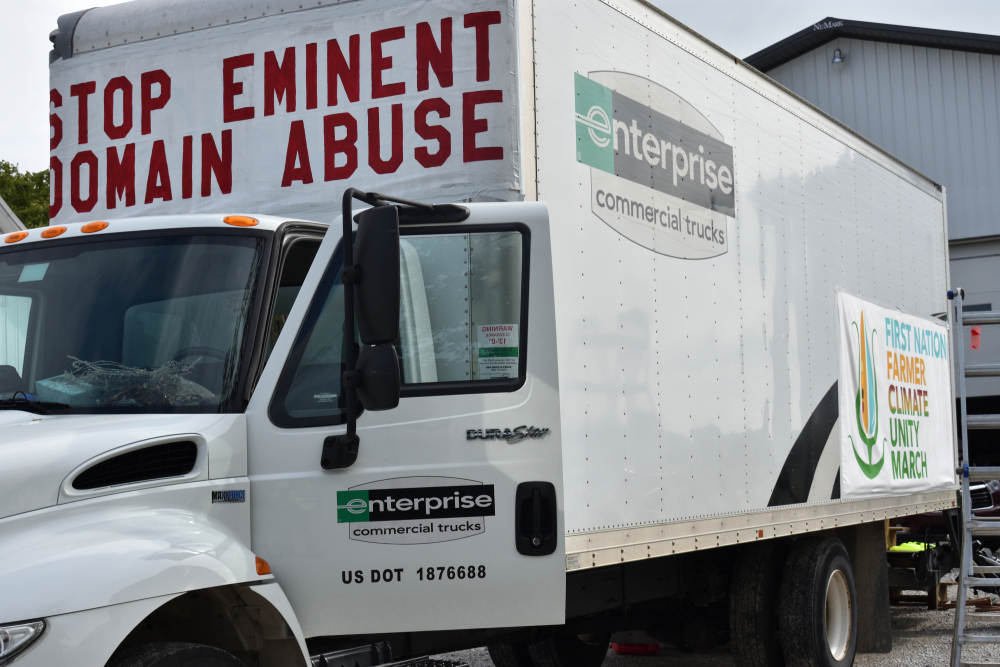
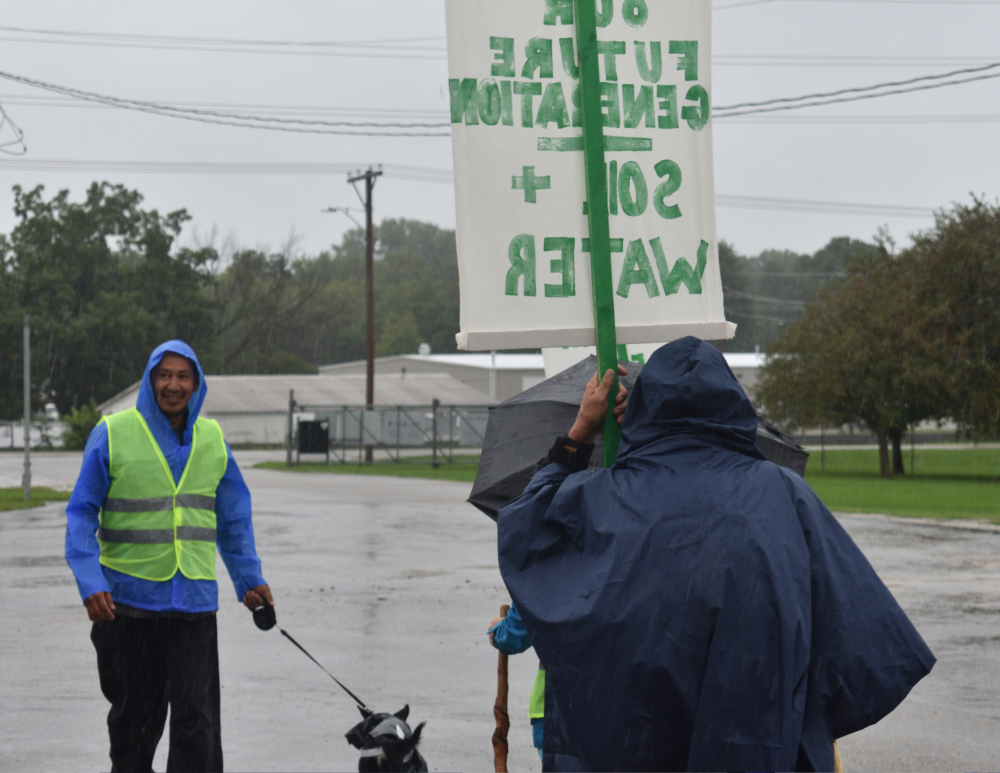
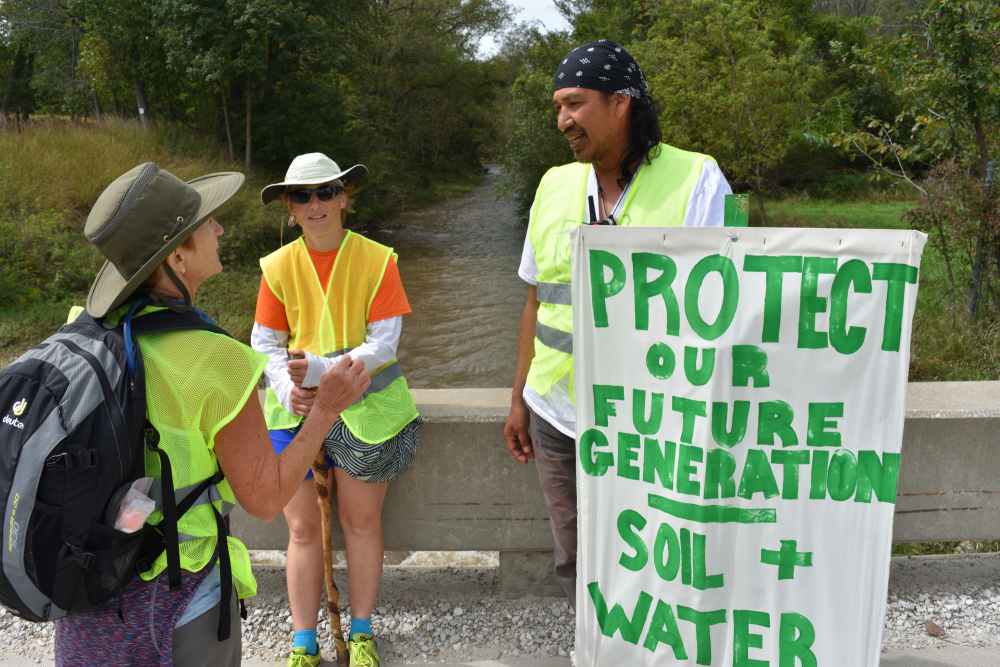
The abuse of eminent domain was one of the reasons a group of us walked and camped for ninety-four miles along the route of the Dakota Access pipeline in 2018, as seen in these photos.

























 Quakers and Mutual Aid