Hierarchy and Quakers

This morning I’m struggling to understand why so few people engage in civic responsibilities, or the many injustices we face. I’m writing in terms of my faith community, Quakers. It is telling that I must explain when I say “Quakers” I mean white Quakers unless otherwise specified. Historically there was so little diversity among Friends in this country that nearly all Quakers were white. Tragically that hasn’t changed much today. Something is wrong.

I’m struggling to understand why more white Quakers in this country aren’t engaged to:

  • stop the rise of authoritarianism
  • agitate for peace
  • support Black Lives Matter
  • work for healing and reconciliation related to the Indian residential schools and the children abused or killed there
  • work for LANDBACK
  • help those who are impoverished, houseless and hungry
  • protect the water
  • protect Mother Earth from the rape of resource extraction
  • protect women
  • protect those who are LGBTQ
  • speak to spiritual needs

Why this profound, widespread malaise?

I’m pondering these things now in the context of putting beliefs into action, to work on matters of justice and peace.

Historically Friends have worked for peace. A number of Quaker men and their families chose to face imprisonment for refusing to participate in war, militarism, and the peacetime draft.

Historically, Quakers were also credited for work related to race. And yet, relatively few white Friends were actually involved in things like the Underground Railroad. Today we sometimes see Friends suggest they deserve some credit for what abolitionist Friends did. Which is wrong.

Indeed, some Friends were involved in the institution of slavery in the early days of this country’s colonialism. Our ancestors were settler colonists, building farms and communities on land stolen from Indigenous peoples. Some white Quakers were involved in the policies and implementation of forced assimilation of Indigenous children. Genocide.

Many white Friends today struggle to understand white superiority and privilege. Which means they continue to act as if they are privileged. And means Black, Indigenous, and other people of color (BIPOC) don’t want to be associated with these Friends.

I know it is upsetting for white Friends to be reminded of these things. But that unease is nothing compared to the harm that was and continues to be done. Such trauma is passed from generation to generation. People today are deeply affected by this trauma. Both the victims and the perpetrators. For example, the growing numbers of the remains of native children located on the grounds of the institutions of forced assimilation are profoundly disturbing. Where is the outrage from white people, white Friends?

We must bring these things to light to understand why they happened. Whether they continue today. And ensure they don’t happen again. As the beginning of processes of truth, reconciliation, repatriation, and healing.

I intentionally use the phrase ‘bring these things to light’ because the Light, or Inner Light is one way we speak of spiritual guidance.

I’ve been blessed to have made friends in several different communities over the past few years. What I am learning is giving me new insight. One is being reminded that white Quakers have not spent significant time in communities outside the meetinghouse. Building relationships in oppressed communities by being present there is the most important thing we must do if we want to be effective allies. Nothing else we do will be meaningful if we don’t have these relationships.

From my Indigenous friends I’ve seen traumas that most white Quakers often don’t know about, let alone experience. My friends have relatives, some still living, who were in those institutions of forced assimilation. Some who have family members who are among the missing and murdered Indigenous relatives, related to the man camps at the sites of pipeline construction.

I’ve seen their love of the land as we walked together for ninety-four miles over eight days. They pointed out the changes in vegetation. The water standing in fields disturbed by the Dakota Access pipeline.

Another community I am blessed to belong to is Des Moines Mutual Aid, a diverse community that includes some Indigenous friends. Here I’ve been learning about the fundamental differences between a community based on a flat or horizontal hierarchy, and the vertical hierarchies that structure everything white people are involved in.

Learning this has revealed to me why white Quakers have been unable to understand or do anything about the problems of white supremacy. Why non-white people don’t become involved in our white Quaker communities.

As I wrote yesterday, it was interesting, but not surprising, to hear this also expressed as part of the Indigenous worldview.

A key principle is to live in balance and maintain peaceful internal and external relations.

This is linked to the understanding that we are all connected to each other.

The hierarchical structure of western world views that places humans on top of the pyramid, does not exist. The interdependency with all things, promotes a sense of responsibility and accountability.

https://www.coursera.org/learn/indigenous-canada

This new awareness of the vertical hierarchies of white culture in general, and our white Quaker communities specifically, has given me insight into the list of things at the beginning of this that white Quakers have not in general been able, or perhaps willing, to engage with.

I’ve been very discouraged about Friends’ lack of engagement in a number of things over the years. Have I lost faith in what we will do? Does it mean Friends have lost faith in what they could do? Have they lost faith more generally? Do we believe we can discern the Inner Light? Will we do what the Light reveals?

What can we be?

  • We can be driven by the Inner Light.
  • We can dismantle vertical hierarchies.
  • We can be present in our wider communities.

Regarding the following, I recently wrote about calligraphy – a sacred tradition What follows is definitely not calligraphy. I was having more trouble getting ink to flow than getting any writing done. But it has been interesting to use a felt tip pen to write by hand.

Des Moines Mutual Aid

Des Moines Mutual Aid

Indigenous Worldview

I’ve begun the course Indigenous Canada offered by University of Alberta. This is a Massive Open Online Course (MOOC) from the Faculty of Native Studies that explores Indigenous histories and contemporary issues in Canada. I’ve already learned a great deal and recommend it. This is a free course described at the end of this post. https://www.coursera.org/learn/indigenous-canada

For years I’ve been praying for ways to bring about Beloved community. I’ve gone through many iterations of this diagram to help me visualize our current circumstances and what might be done to move toward such a community.

I’ve been blessed to become friends with and learn from Indigenous people. A common thread throughout my life has been to protect Mother Earth. For a long time, I looked for opportunities to make such connections because it was obvious that native peoples had always lived and continued to live in ways that protect Mother Earth.

The physical infrastructure of Beloved community was easy to see, but what I had trouble with was spirituality and governance, which are tightly bound together. I could see that Beloved community would not work with the mindset of capitalism and dominance. White people would have to learn to abandon those systems.

Two years ago I was blessed to become involved in a local Mutual Aid group which has been transformative. This is a model that teaches how to reject capitalism and dominance. A key is to leave the vertical hierarchies of power and decision making and instead use a flat or horizontal structure that gives everyone a voice. And encourages critical thinking and self-motivation. https://landbackfriends.com/mutual-aid/

I was fascinated to see this discussed in the Indigenous Worldviews course. “The hierarchical structure of western world views that places humans on top of the pyramid, does not exist. The interdependency with all things, promotes a sense of responsibility and accountability.”

Indigenous ways of knowing are based on the idea that individuals are trained to understand their environment, according to teachings found in stories.

These teachings are developed specifically to describe the collective lived experiences and date back thousands of years.

The collective experience is made up of thousands of individual experiences, and these experiences come directly from the land and help shape the codes of conduct for Indigenous societies.

A key principle is to live in balance and maintain peaceful internal and external relations.

This is linked to the understanding that we are all connected to each other.

The hierarchical structure of western world views that places humans on top of the pyramid, does not exist. The interdependency with all things, promotes a sense of responsibility and accountability.

Thriving in the harsh Arctic climate, Inuit people relied heavily upon each other for survival.

Each person had value and contributed to the community.

This reliance established codes of ethics and behaviors, or Maligait. Maligait has many meanings and translations, but to Inuit people it means, things that had to be done, and includes four main principles:

  • work for the common good
  • respect all living things
  • preserve harmony and balance
  • plan and prepare for the future

The hierarchical structure of western world views that places humans on top of the pyramid, does not exist.

Indigenous Canada is a 12-lesson Massive Open Online Course (MOOC) from the Faculty of Native Studies that explores Indigenous histories and contemporary issues in Canada. From an Indigenous perspective, this course explores key issues facing Indigenous peoples today from a historical and critical perspective highlighting national and local Indigenous-settler relations. Topics for the 12 lessons include the fur trade and other exchange relationships, land claims and environmental impacts, legal systems and rights, political conflicts and alliances, Indigenous political activism, and contemporary Indigenous life, art and its expressions.

Thank you for signing up for Indigenous Canada. This course examines the historical and contemporary lives, identities, cultural expressions, rights, and goals of Indigenous peoples in Canada. In this course, we have worked to bring Indigenous voices and perspectives to inform your learning experience.

The course material will be covered in twelve modules. Each module offers a series of videos communicating Indigenous experiences of history and current events. Topics covered include: the fur trade and exchange relationships, land claims and environmental impacts, legal systems and rights, Indigenous political activism, and contemporary Indigenous life, art, and its expressions. Together, these modules provide a basic familiarity with Indigenous perspectives as well as Indigenous/non-Indigenous relations.

We are excited to have you with us and be a participant in these learnings. Spread the word of this unique education experience by telling a family member, a friend, or a colleague. We hope that Indigenous Canada will serve you well and offer new insights.
Thank you and take care,
Dr. Paul Gareau

https://www.coursera.org/learn/indigenous-canada

Survivors of Carbon pipeline explosion tell their stories

Last night I listened to the horrifying stories of three people who survived the explosion of a carbon pipeline in Satartia, Missisippi. One survivor suffered significant memory loss. Another has worsening asthma.

Food and Water Watch Iowa and the Iowa Chapter of Sierra Club sponsored the event. Dan Zegart, who wrote the HUFFPOST article referenced below, described his research into the pipeline explosion and he interviewed three of the survivors during this event.

You can watch the recording of this here: https://fb.watch/aLKtjH1eyf/

What you can do:

The Iowa Chapter of Sierra Club has linked this phone number to the offices of leaders in the Iowa legislature: 888-793-4597

House leader Pat Grassley is a farmer from New Hartford, and Senator Jake Chapman is from Adel in Dallas County, He is an EMT.

You can ask your U.S. Representative to support Representative Ro Khanna’s  End Polluter Welfare for Enhanced Oil Recovery Act


U.S. Representative Ro Khanna also spoke during this event. He is sponsoring the End Polluter Welfare for Enhanced Oil Recovery Act.

December 13, 2021 Press Release

Washington, DC – December 13, 2021 – Today, Representatives Ro Khanna (CA-17), Chair of the House Oversight Subcommittee on the Environment, Raúl Grijalva (AZ-03), Chair of the House Natural Resources Committee, and Mike Quigley (IL-05), member of the House Committee on Appropriations, introduced the End Polluter Welfare for Enhanced Oil Recovery Act to repeal a tax giveaway that enables the fossil fuel industry to profit off capturing carbon emissions and using them to increase oil production. 

RELEASE: KHANNA, GRIJALVA, QUIGLEY ANNOUNCE LEGISLATION TO REPEAL FOSSIL FUEL SUBSIDY FOR ENHANCED OIL RECOVERY

It was just after 7 p.m. when residents of Satartia, Mississippi, started smelling rotten eggs. Then a greenish cloud rolled across Route 433 and settled into the valley surrounding the little town. Within minutes, people were inside the cloud, gasping for air, nauseated and dazed.

Some two dozen individuals were overcome within a few minutes, collapsing in their homes; at a fishing camp on the nearby Yazoo River; in their vehicles. Cars just shut off, since they need oxygen to burn fuel. Drivers scrambled out of their paralyzed vehicles, but were so disoriented that they just wandered around in the dark.

The Gassing Of Satartia. A CO2 pipeline in Mississippi ruptured last year, sickening dozens of people. What does it forecast for the massive proposed buildout of pipelines across the U.S.? By Dan Zegart, HUFFPOST, August 26, 2021

Carbon Capture and Storage/Sequestration (CCS) is not the answer to climate change. Contrary to its proponents claims CCS is unproven, dangerous and delays real solutions to the climate crisis such as simple energy conservation, regenerative agriculture and renewable energy. Currently two such CCS Pipeline projects are being proposed for the state of Iowa — Summit Carbon Solutions’ ‘Midwest Carbon Express’ and Navigator CO2 Ventures LLC. We are a broad coalition of everyday concerned Iowans, Tribal citizens, environmentalists, lawyers and scientists who examen and share the science of CCS, S well as strategies for protecting Iowa’s water, land, communities and the future generations of Iowans in order to empower all stakeholders to make the case for good public policy

Carbon (CCS) Pipeline Resistance Coalition – Iowa

Join us Monday to hear victims and first responders share their experiences from the Satartia, Mississippi carbon pipeline rupture.The corporations pushing these projects on us are lying about the risks. Carbon is an odorless, colorless gas that can spread miles in mere minutes. Unlike the Satartia rupture, the Iowa pipelines will not have an added odorant. You might not even know something was wrong before being asphyxiated by the gas.Even if you did notice something off, it wouldn’t matter. There isn’t an emergency management crew in this state capable of addressing a mass carbon gassing. Your vehicle won’t run without oxygen. You will pass out. You might start foaming at the mouth. You may have seizures. You cannot escape it. And you won’t even see it coming.This is literally a fight for our lives. Are you willing to fight with us?

Food and Water Watch Iowa

 Iowa Citizens for Community Improvement (Iowa CCI) members say everyday Iowans will fight back and resist any attempt to build a corporate oil and gas pipeline in Iowa that could threaten air and water quality and contribute to catastrophic climate change.

“Any attempt to build an oil and natural gas pipeline in Iowa will be met with resistance,” said Gary Larsen, an independent family farmer and Iowa CCI member with a wind turbine on his farm outside of Exira in Audubon county.  “Catastrophic climate change is already impacting Iowa and we have to start keeping fossil fuels in the ground where they belong instead of threatening the air, water, and land of thousands of everyday Iowans just so a few energy corporations can profit.”

“We need to start conserving energy and taxing these big corporations for the pollution they cause so we can reinvest in alternative energy like wind and solar power.”

Iowa CCI is a statewide, grassroots people’s action group that uses community organizing to win public policy that puts communities before corporations and people before profits, politics, and polluters.   

Iowa CCI members pledge to fight corporate plan to build another environmentally dangerous oil and gas pipeline in Iowa

My friends Rodger Ruth and Mahmud Fitil have an excellent discussion about these pipelines in this video.

CO2 Pipeline Dangers

After nearly a decade of work to resist the Keystone XL, Dakota Access, Coastal GasLink and other fossil fuel pipelines it is so discouraging to witness plan for an entirely new type of pipeline. These pipelines go by several names, including CO2, or Carbon pipelines. They have the potential to do so much damage, represent grave dangers and have already done so.

My friends Rodger Ruth and Mahmud Fitil have an excellent discussion about these pipelines in the video at the end of this.

But I want to tell you about an event tonight. The carbon in these pipelines is under high pressure. When there is a rupture there is an explosion and then the rapid release of vast amounts of carbon dioxide, which displaces oxygen in the air. People immediately become disorientated. Vehicles stop working because there is not enough oxygen to burn the gas in the engines. The deaths of large numbers of people could occur if such a rupture happened in a highly populated area. First responders become disoriented as well. That is what will be discussed in this webinar.

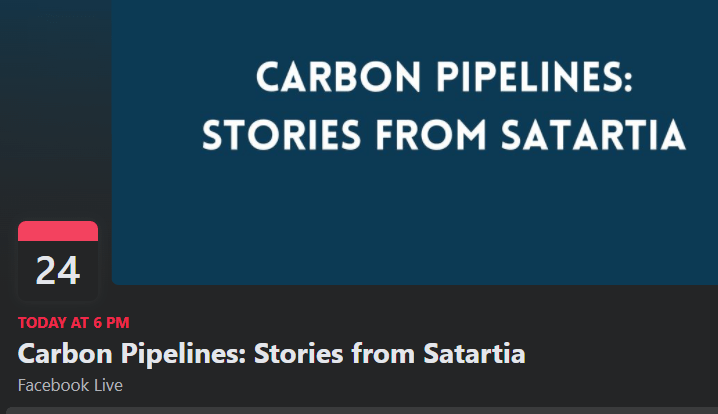
Such an explosion and those consequences actually happened in Satartia, Mississippi, and will be the discussion of a webinar tonight.

https://www.facebook.com/events/930148724538738/

Join us Monday, January 24, for a webinar hosted by Food & Water Watch and the Iowa Chapter of the Sierra Club, featuring stories from first responders and residents of Satartia, Mississippi, site of the 2020 carbon pipeline rupture, moderated by Dan Zegart, the investigative journalist who broke the story nationally in 2021

Event by Food & Water Watch Iowa and Iowa Chapter Sierra Club
https://www.facebook.com/events/930148724538738/

Thich Nhat Hanh Dies at 95

Thich Nhat Hanh, a Vietnamese Buddhist monk who was one of the world’s most influential Zen masters, spreading messages of mindfulness, compassion and nonviolence has died.

Thich Nhat Hanh began writing and speaking out against the war in Vietnam and in 1964 published a poem called “Condemnation” in a Buddhist weekly. It reads in part:

Whoever is listening, be my witness:
I cannot accept this war.
I never could I never will.
I must say this a thousand times before I am killed.
I am like the bird who dies for the sake of its mate,
dripping blood from its broken beak and crying out:
“Beware! Turn around and face your real enemies
— ambition, violence hatred and greed.”

“Condemnation” by Thich Nhat Hanh

His connection with the United States began in the early 1960s, when he studied at Princeton University and later lectured at Cornell and Columbia. He influenced the American peace movement, urging the Rev. Dr. Martin Luther King Jr. to oppose the Vietnam War.

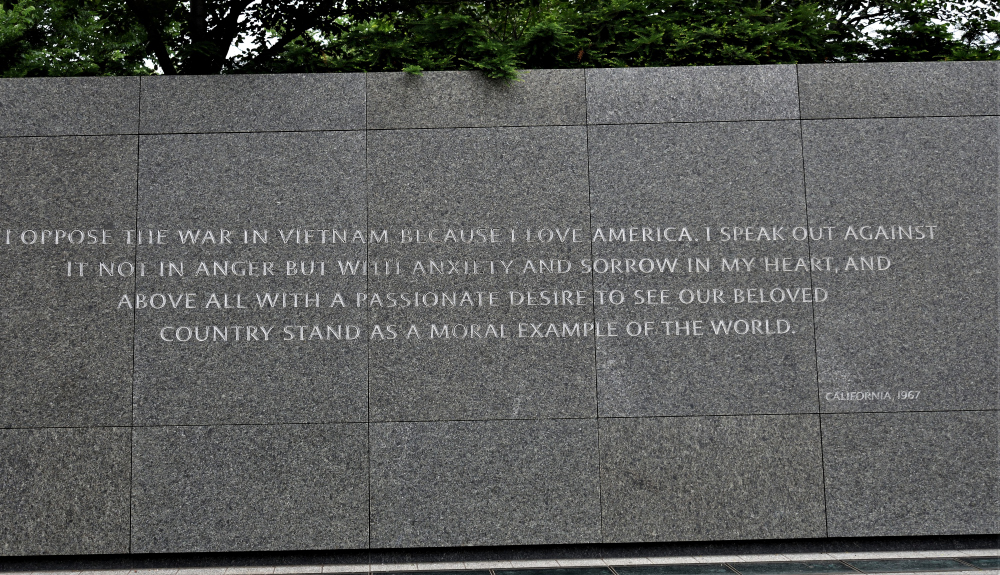
I oppose the war in Vietnam because I love America. I speak out against it not in anger but with anxiety and sorrow in my heart, and above all with the passionate desire to see our beloved country stand as a moral example of the world.
Martin Luther King, Jr.

I was aware of the teachings of both Thich Nhat Hanh and Martin Luther King, Jr, as I struggled with my decision to resist the war in Vietnam in the late 1960’s while a student at the Quaker boarding school, Scattergood Friends School.

I was also influenced by the Quakers in my community who worked for peace. Many of whom were imprisoned for their refusal to participate in war, during the many wars in our history. Who resisted militarism in this country even when we were not at war.

The late Don Laughlin, my friend, mentor, and a Quaker, collected these stories. They are unfortunately relevant today as Russia threatens to invade Ukraine.

This is the link to those stories. Young Quaker Men Facing War and Conscription

New paths for faith and justice

Much of my work and writing last year has been related to Mutual Aid. This has solidified my conclusions that our hope now is to continue and expand Mutual Aid projects across the county and world.

The greatest driver to build mutual aid groups is we will soon have no choice. It is increasingly clear our political system has failed us. Capitalism has failed us. Our healthcare industry is failing despite the valiant efforts of front-line health workers. And most of all, environmental chaos will rapidly worsen.

It has seemed our faith bodies are failing us, too. Where is the church in helping us through these increasingly trying times?

We can take advantage of skills that we cultivate within our faith spaces—such as mindfulness, active listening and servant leadership—to build multi-faith, multi-tendency, and multi-generational coalitions for systemic change

Ty Kiatathikom

For example, I’ve worked my entire adult life to convince Quakers to stop owning personal automobiles. And failed to do so. I’m aware this could be related to mistakes I’ve made in communicating.

I’ve been discouraged, but not surprised, at the lack of response I’ve been getting when trying to convince people of the evils and failure of capitalism. (See Evils of Capitalism). But I know it will require spiritual guidance to help us through the coming times. I still have faith the Inner Light will show us the way.

I am intrigued by the idea of Religious Socialism that my friend Fran Quigley told me about. Fran is director of the Health and Human Rights Clinic at Indiana University McKinney School of Law and has published the book Religious Socialism: Faith in Action for a Better World.

In the following Lucy Duncan writes “What would it mean to reckon with our past complicity with harm and fully dedicate ourselves to the creation of a liberating Quaker faith that commits to build the revolutionary and healing faith we long to see come to fruition? What would it look like to finally and fully abolish slavery?”

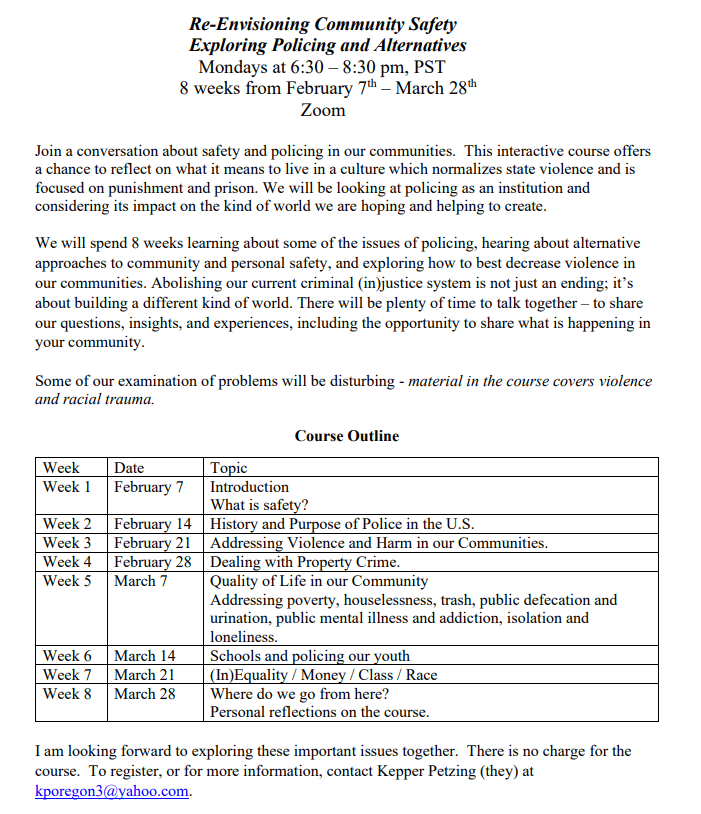
Ty Kiatathikom writes about Religious Socialism. And there is information about an eight-week course, “Re-Envisioning Community Safety. Exploring Policing and Alternatives”.

Early Friends understood the Inner Light not only as a beacon shining from each person’s soul but also as a searchlight exposing the knots and blocked or wounded places in ourselves, the spaces requiring reckoning and real repair. I would argue that these stories of White Quaker complicity (which do not in any way diminish the stories of individual and collective Quaker courage) implicate us in the harms of slavery and incarceration in deep ways. They implicate us as perpetrators but also as wounded ourselves.

As Wendell Berry so eloquently put it, we carry the mirror image of the harm we’ve caused in our souls. This “hidden wound” is ever present and disrupts our ability to be fully intact, fully grounded, and human. We render ourselves in some ways obscure to our own history and to a full knowing of who we are.

I tell the stories of early White Quaker relationships to slavery because slavery was never really abolished. If we can reckon with the full truth of our connection to slavery and its afterlives, perhaps we can begin the healing necessary to fulfill the promise of the Religious Society of Friends of Truth. 

We as White Quakers like to think of ourselves as ahead or better than dominant culture, but we have been complicit in a system and mindset that are ubiquitous. Claiming the full truth of our history and committing to repair the harms done are deeply spiritual acts of healing our own wounds of disconnection. I would argue it is the pathway upon which we can, perhaps for the first time, discover and invigorate our faith with its full promise.

What would it mean for us to take seriously and collectively as a Religious Society a call to finish the work of abolition, hand in hand and side by side with those affected  and their loved ones? What would it mean for us to stand fully with the calls to abolish the police and fully fund community needs instead? What would it mean to reckon with our past complicity with harm and fully dedicate ourselves to the creation of a liberating Quaker faith that commits to build the revolutionary and healing faith we long to see come to fruition? What would it look like to finally and fully abolish slavery?

A Quaker Call to Abolition and Creation by Lucy Duncan, Friends Journal, April 1, 2021

Where do religious socialists fit into that struggle?

Every religion teaches the power of redemption. In every faith, there are stories about human beings redeeming and being redeemed. Siddhartha Gautama renounces his status as a prince to live and die as an ascetic, and in doing so, escapes from the cycle of life and death entirely. The Abrahamic religions call on their adherents to answer for their misdeeds by doing virtuous acts and asking forgiveness from God. Universally, our faiths extol the importance of understanding that our actions in this life define us and carry us on over to the next, and that no person is ever beyond redemption for their vilest act.

We can take advantage of skills that we cultivate within our faith spaces—such as mindfulness, active listening and servant leadership—to build multi-faith, multi-tendency, and multi-generational coalitions for systemic change. Relationship-building is a foundational step in birthing a revolutionary culture, and abolitionist culture is no different. As religious socialists, we have the potential—and therefore the responsibility—to nourish the culture that connects us within and without prison walls. 

One example of religiously informed abolitionist organizing is Abolition Apostles, a national jail and prison ministry based in New Orleans. Serving thousands of incarcerated people across the country, Abolition Apostles connects them with pen pals, material support, and advocacy for their parole and re-entry. 

We cannot claim to live in a moral society until we have achieved the permanent abolition of the prison-industrial complex. The words echo in religious and socialist texts: Hebrews 13.3: Remember those who are in prison as though you were in prison with them; the Dhammapada: Whoever, being pure, forbears with punishment, bondage, and abuse, having the strength of endurance, having an army of strengths, that one I say is a brahmin;  Eugene Debs: While there is a lower class, I am in it, while there is a criminal element, I am of it, and while there is a soul in prison, I am not free

WHILE THERE IS A SOUL IN PRISON: REMEMBERING ATTICA, COMMITTING TO ABOLITION by Ty Kiatathikom, religioussocialism.org

Dear Friends,

From October through December 2021, I led a course for Friends from Multnomah Friends Meeting and West Hills Friends Church (both in Portland, OR) based on the Mennonite Church, USA curriculum about police abolition. https://www.mennoniteusa.org/abolition-curriculum-intro/  
This Portland Quaker gathering was sponsored by Multnomah’s Peace and Social Concerns Committee and Friends for Racial Justice. 

After spending nine weeks exploring these issues and obtaining feedback from course participants, I feel led to widen the discussion to a broader community. I am hoping that additional Friends will join me for an exploration of this topic – and that Friends will forward this opportunity to friends who are not Quakers who may be interested.

Below is the course announcement. Unfortunately, the timing of the course (6:30 – 8:30 pm PST) only works for West Coast, or possibly Mountain Time people. 

Please get in touch if you have questions, suggestions, or are interested in participating.

Gratefully,

Kepper Petzing (they)

kporegon3@yahoo.com

An Epistle to Friends Regarding Religious Socialism

Religious Socialism is fundamentally about the many injustices that are consequences of the capitalist economic system. It is difficult to come to terms with the evils of this system we dwell in. But we must have the moral courage to reject capitalism.

But our moral lag must be redeemed; when scientific power outruns moral power, we end up with guided missiles and misguided men. When we foolishly maximize the minimum and minimize the maximum we sign the warrant for our own day of doom. It is this moral lag in our thing-oriented society that blinds us to the human reality around us and encourages us in the greed and exploitation which creates the sector of poverty in the midst of wealth. Again, we have diluted ourselves into believing the myth that Capitalism grew and prospered out of the protestant ethic of hard work and sacrifice, the fact is that Capitalism was built on the exploitation and suffering of black slaves and continues to thrive on the exploitation of the poor – both black and white, both here and abroad. If Negroes and poor whites do not participate in the free flow of wealth within our economy, they will forever be poor, giving their energies, their talents and their limited funds to the consumer market but reaping few benefits and services in return. The way to end poverty is to end the exploitation of the poor, ensure them a fair share of the government services and the nation’s resources. I proposed recently that a national agency be established to provide employment for everyone needing it. Nothing is more socially inexcusable than unemployment in this age. In the 30s when the nation was bankrupt it instituted such an agency, the WPA, in the present conditions of a nation glutted with resources, it is barbarous to condemn people desiring work to soul sapping inactivity and poverty. I am convinced that even this one, massive act of concern will do more than all the state police and armies of the nation to quell riots and still hatreds. The tragedy is our materialistic culture does not possess the statesmanship necessary to do it.

Martin Luther King, Jr. The Three Evils of Society, August 31, 1967, National Conference on New Politics, Chicago

Capitalism was built on the exploitation and suffering of black slaves and continues to thrive on the exploitation of the poor

Martin Luther King, Jr

Following is An Epistle to Friends Regarding Religious Socialism I wrote based upon An Epistle to Friends Concerning Military Conscription’

An Epistle to Friends Regarding Religious Socialism

Dear Friends,

The measure of a community is how the needs of its people are met. No one should go hungry, or without shelter or healthcare. Yet in this country known as the United States millions struggle to survive. The capitalist economic system creates hunger, houselessness, illness that is preventable and despair. A system that requires money for goods and services denies basic needs to anyone who does not have money. Black, Indigenous, and other people of color (BIPOC) are disproportionately affected. Systemic racism. The capitalist system that supports the white materialistic lifestyle is built on stolen land and genocide of Indigenous peoples, and the labor of those who were enslaved in the past or are forced to live on poverty wages today.

Capitalism is revealed as an unjust, untenable system, when there is plenty of food in the grocery stores, but men, women and children are going hungry, living on the streets outside. White supremacy violently enforces the will of wealthy white people on the rest of us.

It has become clear to some of us who are called Friends that the colonial capitalist economic system and white supremacy are contrary to the Spirit and we must find a better way. We conscientiously object to and resist capitalism and white supremacy.

capitalism has violated the communities of marginalized folks. capitalism is about the value of people, property and the people who own property. those who have wealth and property control the decisions that are made. the government comes second to capitalism when it comes to power.

in the name of liberation, capitalism must be reversed and dismantled. meaning that capitalistic practices must be reprogrammed with mutual aid practices. 

Des Moines Black Liberation Movement

Mutual Aid

How do we resist? We rebuild our communities in ways not based upon money. Such communities thrive all over the world. Indigenous peoples have always lived this way. Generations of white people once did so in this country. Mutual Aid is a framework that can help us do this today.

The concept of Mutual Aid is simple to explain but can result in transformative change. Mutual Aid involves everyone coming together to find a solution for problems we all face. This is a radical departure from “us” helping “them”. Instead, we all work together to find and implement solutions.  To work together means we must be physically present with each other. Mutual Aid cannot be done by a committee or donations. We build Beloved communities as we get to know each other. Build solidarity. An important part of Mutual Aid is creating these networks of people who know and trust each other. When new challenges arise, these networks are in place, ready to meet them.

Another important part of Mutual Aid is the transformation of those involved. This means both those who are providing help, and those receiving it.

With Mutual Aid, people learn to live in a community where there is no vertical hierarchy. A community where everyone has a voice. A model that results in enthusiastic participation. A model that makes the vertical hierarchy required for white supremacy impossible.

Commonly there are several Mutual Aid projects in a community. The initial projects usually relate to survival needs. One might be a food giveaway. Another helping those who need shelter. Many Mutual Aid groups often have a bail fund, to support those arrested for agitating for change. And accompany those arrested when they go to court.

LANDBACK

The other component necessary to move away from colonial capitalism and white supremacy is LANDBACK.

But the idea of “landback” — returning land to the stewardship of Indigenous peoples — has existed in different forms since colonial governments seized it in the first place. “Any time an Indigenous person or nation has pushed back against the oppressive state, they are exercising some form of landback,” says Nickita Longman, a community organizer from George Gordon First Nation in Saskatchewan, Canada.

The movement goes beyond the transfer of deeds to include respecting Indigenous rights, preserving languages and traditions, and ensuring food sovereignty, housing, and clean air and water. Above all, it is a rallying cry for dismantling white supremacy and the harms of capitalism.

Returning the Land. Four Indigenous leaders share insights about the growing landback movement and what it means for the planet, by Claire Elise Thompson, Grist, February 25, 2020

What will Friends do?

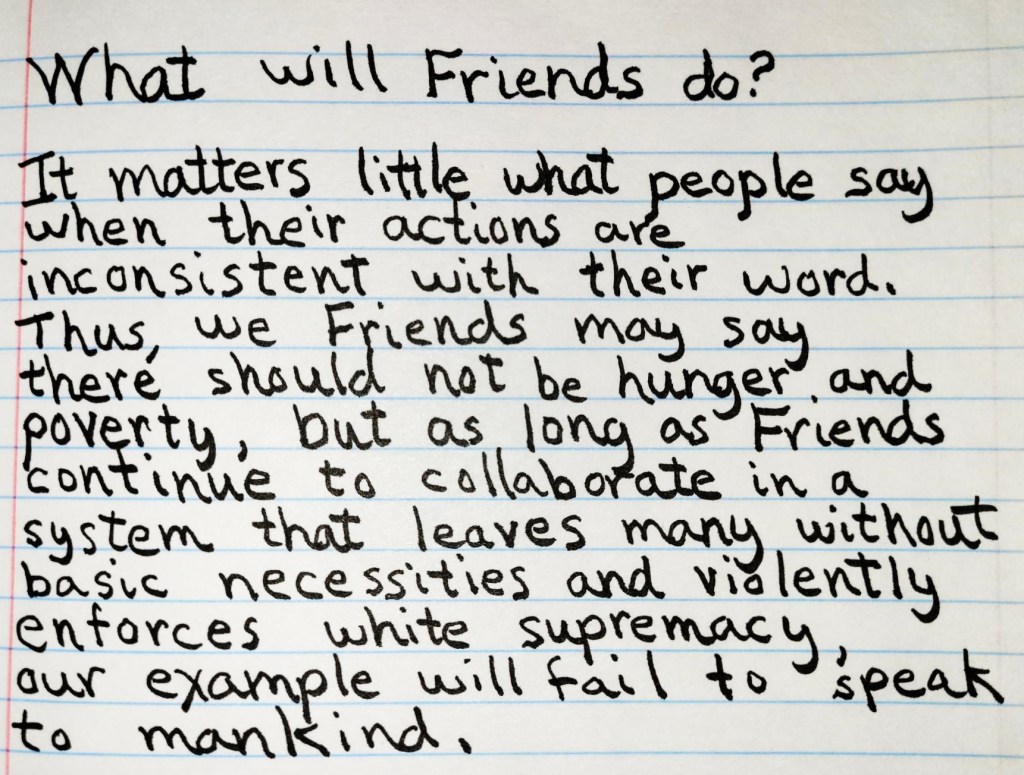
It matters little what people say they believe when their actions are inconsistent with their words.  Thus, we Friends may say there should not be hunger and poverty, but as long as Friends continue to collaborate in a system that leaves many without basic necessities and violently enforces white supremacy, our example will fail to speak to mankind.

Let our lives speak for our convictions.  Let our lives show that we oppose the capitalist system and white supremacy, and the damages that result.  We can engage in efforts, such as Religious Socialism, Mutual Aid and LANDBACK, to build Beloved community. To reach out to our neighbors to join us.

We must begin by changing our own lives if we hope to make a real testimony for peace and justice.

We remain, in love of the Spirit, your Friends and sisters and brothers,

Why Religious Socialism now?

I first heard about Religious Socialism at the end of 2020, when my friend Fran Quigley wrote in response to the blog post I had written, The Evil of Capitalism. Fran is the director of the Health and Human Rights Clinic at Indiana University McKinney School of Law and a religioussocialism.org editorial team member. He wrote “This post of yours struck me close to home. I too have become fully convinced of the evils of capitalism. Moreover, I have come to the conclusion that my faith dictates that I work to replace it.”

He told me about his involvement with the Democratic Socialists of America’s (DSA) Religion and Socialism Committee. I was interested in what I learned, but was involved in other things at the time, primarily Mutual Aid.

I’ve had trouble getting Quakers interested in being involved in Mutual Aid. And I haven’t often raised religion when with my Mutual Aid friends, some of whom are Indigenous. The horrors of the institutions of forced assimilation, which some Quakers were involved in, are receiving much needed attention now.

I have also been involved in the Quakers for Abolition Network. So, when I saw the Central Iowa DSA event related to their prison letter writing project, I became involved. Not surprisingly several of my Mutual Aid friends were involved as well. I joined the Democratic Socialists of America.

A few days ago, our prison letter writing group met via Zoom to discuss additional things we could do related to incarceration. I mentioned Fran and the DSA’s Religious Socialism group and suggested that might be a way to get faith communities involved.

I’ve begun reading Fran’s book, Religious Socialism: Faith in Action for a Better World.

I created a WordPress site, Quakers and Religious Socialism.
https://quakersandreligioussocialism.com/

And the Facebook group, Quakers and Religious Socialism.  https://www.facebook.com/groups/470800671285294

Faith, Abolition, and Socialism

Faith, Abolition, and Socialism w/ Linda Sarsour & Rev. Andrew Wilkes

Join DSA members Linda Sarsour and Rev. Andrew Wilkes for an exciting and informative discussion about the roles of people of faith in the current campaign for abolition of policing as we have known it. This event is hosted by DSA’s Religion and Socialism Working Group.

My introduction to Religious Socialism

I learned about the Democratic Socialists of America’s (DSA) Religious Socialism Committee from my friend Fran Quigley, director of the Health and Human Rights Clinic at Indiana University McKinney School of Law and a religioussocialism.org editorial team member.

Fran wrote in response to a blog post I had written, The Evil of Capitalism, December 31, 2020.

This post of yours struck me close to home. I too have become fully convinced of the evils of capitalism. Moreover, I have come to the conclusion that my faith dictates that I work to replace it. Turns out I am far from alone, so I’ve been devoting much of my time this past year to the Religion and Socialism Committee of the DSA, www.religioussocialism.org . 

And, as part of a book project on religious socialism, I have published several articles profiling activists from different faith and spiritual traditions who feel called to advocate for a socialist society.  (Examples, if you are interested: a Catholic socialist, a Jewish rabbi socialist, a Black Presbyterian minister socialist, a Liberation Theologian Lutheran minister/professor,  Muslim socialists , a Buddhist socialist and a Black Baptist minister socialist.  I also co-wrote with longtime Religion and Socialism activist Maxine Phillips a short, one-stop primer on the argument for Christian socialism: https://mphbooks.com/democratic-socialists/ )  April 22, 2021

Among the things he shared with me is an article he wrote about sometimes negative views about socialism.

I will be interested to know if you get any negative response to your socialism discussion. U.S. Americans of a certain age, especially those of us who can remember the Cold War, often have some knee-jerk resistance to the term. I recently wrote about that a bit in this article profiling a Black Presbyterian woman minister who is a socialist: https://jacobinmag.com/2020/12/angela-cowser-institute-for-christian-socialism

Of course, identifying as a socialist can create some challenges in that organizing. For example, Ray Sells, the retired Methodist minister, is not as excited about her embrace of socialism.

“I don’t see the reason to use that word,” he says. “It just turns off so many people from the start. Why can’t we just advocate for things like affordable housing and good public education without putting on a label with all those negative connotations?”

When Cowser is told about Sells’s objection, she nods in understanding. But her experience is that talking about socialism in faith communities is less problematic than Sells and others expect — especially when the conversation is with younger Americans, who polls show prefer socialism over capitalism on average, and black Americans, who similar polls show are likely to hold favorable views of socialism.

“I actually don’t get much pushback on it,” she says. She points out that church communities with strong tithing and aid cultures and healthy union workplaces are already quite socialist, as are many American institutions like public schools, infrastructure, and public safety.

“Plus, the biblical basis for socialism is just undeniable. Just look at the early books of Acts, where the body of believers responded to poverty — and a very gendered poverty — by organizing money and resources for the benefit of poor people,” she says. “And the Jubilee platform in Deuteronomy lays out the whole program for a sharing economy where no one person can be strong without the community being strong.”

To Rev. Angela Cowser, “the Biblical Basis for Socialism Is Undeniable”
BY FRAN QUIGLEY, Jacobin, 12/25/2020
Rev. Angela Cowser, a cofounder of the Institute for Christian Socialism, argues that a society rooted in the dictates of the Gospel would look radically different from the one we have now. There is a name for what that change should look like: socialism.