Queries about our future

The recent passing of another of our elders brings new urgency to understanding why we are not attracting new attenders to our Quaker meetings and what to do about that.

“I’m so afraid of climate change. I just turned 17 not so long ago and I’m afraid I’ll never get to grow up because of the way our Earth is going.

“Most of my friends and family are apathetic, such as my parents who don’t like me talking about this stuff since they feel we can’t really change anything. My mom thinks it’s completely irreversible. I hate holding it all inside all the time. …

“I guess what I really wanna hear is it’s all gonna be ok even though it’s probably not the truth. I’m just scared. I’d appreciate any positive news or insight from those who feel the same way and how you manage it while doing everything you can. Thanks for reading.”

I’m a teen and I’m really scared for my future

A pair of recent articles by Steve Genco is about what to say to a 17-year-old terrified about their future and poses some queries. These questions are relevant to the future of us all.

  • What predictions can you rely on?
  • What will give your life meaning?
  • What skills and mental habits will you need?
  • How will you live?

What Can You Tell a 17 Year Old Who’s Afraid of Dying from Climate Change? Part 1 by Steve Genco, Aug 29, 2023, Medium

The article lists the following predictions we can rely on:

  • It’s going to get hotter
  • The weather is going to get more unpredictable and more extreme
  • Natural disasters are going to arrive at greater and greater frequency
  • Economic inequality (income and wealth) is going to get worse
  • We will continue depleting the natural world
  • The effects of climate change will be unevenly distributed around the planet
  • We will run out of oil and gas

What will give your life meaning?

Psychologists Edward Deci and Richard Ryan began developing what they called Self-Determination Theory (SDT) in the 1970s. SDT emerged out of Deci’s interest in intrinsic motivation

Deci began searching for the underlying needs that intrinsically motivated behavior seemed to fulfill. He and Ryan discovered three motivators that appeared to represent basic or innate psychological needs

  • A need for autonomy: People need to feel self-directed and in control of our actions. We are more motivated to pursue activities we voluntarily and freely choose for ourselves, as opposed to activities we feel are imposed on us by other people or external circumstances.
  • A need for competence: People need to feel accomplished and capable. We are more motivated to pursue activities we feel competent to accomplish. We are also motivated to pursue activities that allow us to increase our competence through practice and repetition.
  • A need for belonging: People need to feel connected to others. We are more motivated to pursue activities that make us feel closer to others and that can be pursued in a supportive social context. This need is called relatedness by Deci and Ryan.

Throughout their research, Deci and Ryan studied how the goals people pursue on a daily basis and throughout their lives fulfill basic needs and contribute (or not) to personal wellbeing. In these studies, they found compelling evidence that:
placing strong relative importance on intrinsic aspirations was positively associated with well-being indicators such as self-esteem, self-actualization, and the inverse of depression and anxiety, whereas placing strong relative importance on extrinsic aspirations was negatively related to these well-being indicators.

What skills and mental habits will you need?

So, how do you create a life of autonomy, competence, and belonging? You plan your life around goals and activities that make you more self-sufficient, knowledgeable, and socially connected.

In a world of cascading climate crises, shortages, and social and political unrest, people who can think for themselves, have useful practical skills, and are connected to a like-minded community, are going to have significant advantages over the cult followers, the totally-unprepared, and the socially isolated.

What Can You Tell a 17 Year Old Who’s Afraid of Dying from Climate Change? Part 2 by Steve Genco, Aug 29, 2023, Medium

How will you live?

  • Think global, act local
  • Stay mobile
  • Embrace simplicity
  • Learn how to repair/reuse/recycle
  • Don’t tie your happiness to material accumulation

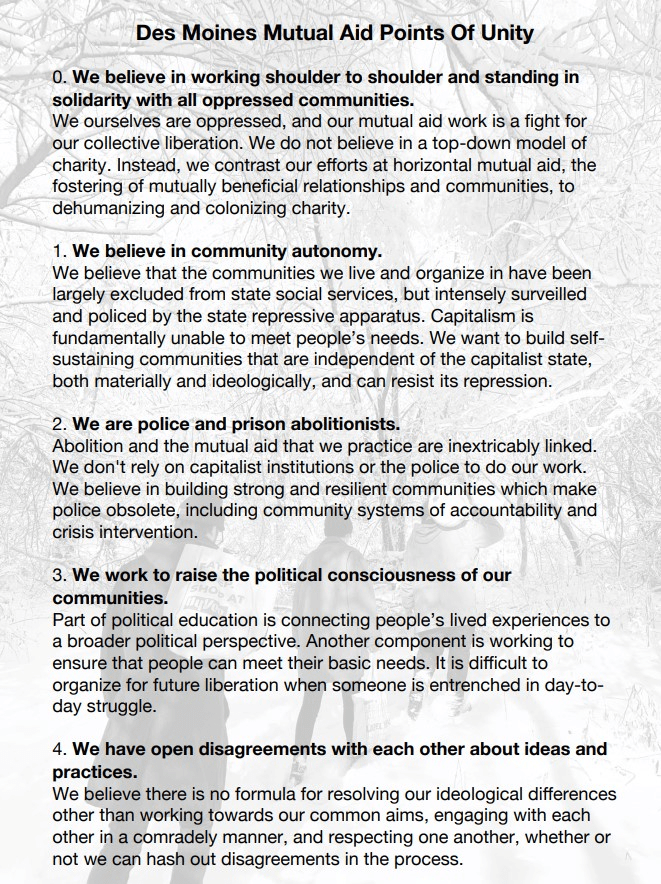
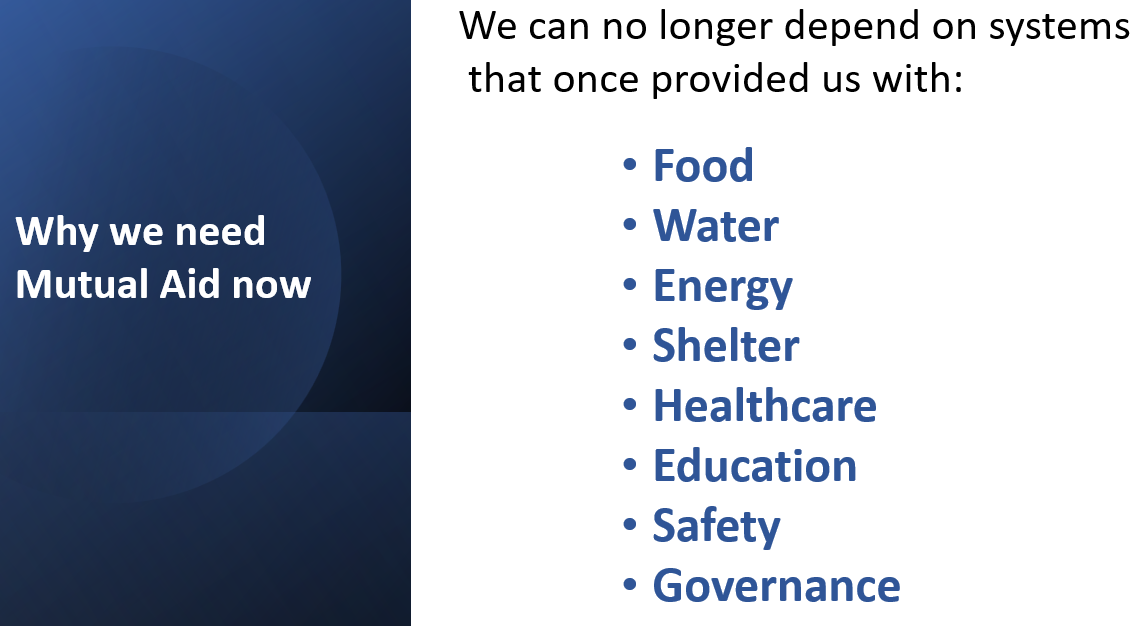
The needs for autonomy, competence, and belonging are exactly what Mutual Aid is about. These are the Points of Unity of my Des Moines Mutual Aid community.

Mutual Aid Points of Unity

We believe in working shoulder to shoulder and standing in solidarity with all oppressed communities.

We ourselves are oppressed, and our mutual aid work is a fight for our collective liberation. We do not believe in a top-down model of charity. Instead, we contrast our efforts at horizontal mutual aid, the fostering of mutually beneficial relationships and communities, to dehumanizing and colonizing charity.

We believe in community autonomy.

We believe that the communities we live and organize in have been largely excluded from state social services, but intensely surveilled and policed by the state repressive apparatus. Capitalism is fundamentally unable to meet people’s needs. We want to build self-sustaining communities that are independent of the capitalist state, both materially and ideologically, and can resist its repression.

We are police and prison abolitionists.

Abolition and the mutual aid that we practice are inextricably linked. We don’t rely on capitalist institutions or the police to do our work. We believe in building strong and resilient communities which make police obsolete, including community systems of accountability and crisis intervention.

We work to raise the political consciousness of our communities.

Part of political education is connecting people’s lived experiences to a broader political perspective. Another component is working to ensure that people can meet their basic needs. It is difficult to organize for future liberation when someone is entrenched in day-to-day struggle.

We have open disagreements with each other about ideas and practices.

We believe there is no formula for resolving our ideological differences other than working towards our common aims, engaging with each other in a comradely manner, and respecting one another whether or not we can hash out disagreements in the process.


Much of the above will be uncomfortable for many Friends because it involves rejecting the status quo. I contend that is why we are not attracting new attenders. If we don’t do so voluntarily these changes will be forced upon us as the status quo continues to collapse.

I believe we are in a time of great spiritual poverty. Friends have a precious gift to offer those needing a spiritual home. But the two will never be connected if Friends continue isolating themselves in their meetinghouses and cling to the status quo. We need to be police and prison abolitionists, find alternatives to capitalism, block the development of fossil fuel infrastructure, reject empire and militarism, and promote and follow the leadership of Indigenous peoples.


When Protest is a Crime

As our politics are making a hard turn to the right, as the US Congress, the US Supreme Court, and multiple states pass legislation based upon White supremacy and authoritarianism, protest is how we who disagree with these trends were once able to try to make our voices heard. But authoritarianism cannot allow questioning its authority and violently suppresses protest and other civil liberties. Tensions will only increase if authoritarianism deepens. Will only increase because of the accelerating urgency to respond to increasing environmental devastation and chaos.

A pair of articles have just been published about Indigenous views of “when protest is a crime”. Part 1 is the Standing Rock effect, and part 2 is about the efforts to Stop Cop City from being constructed in Atlanta.

I’ve been learning about Indigenous views from my friends at the Great Plains Action Society (GPAS) and Des Moines Mutual Aid (DMMA). On GPAS’s Mechanism of Engagement graphic are direct action (protest) and mutual aid. The articles below are about direct action. I’ve been learning mutual aid is a way for a community to care for each other, especially when the government does not.

The audio episodes and transcripts below are available on OUTSIDE/IN. A SHOW ABOUT THE NATURAL WORLD AND HOW WE USE IT. The host is Nate Hegyi.


When protest is a crime, part 1: the Standing Rock effect

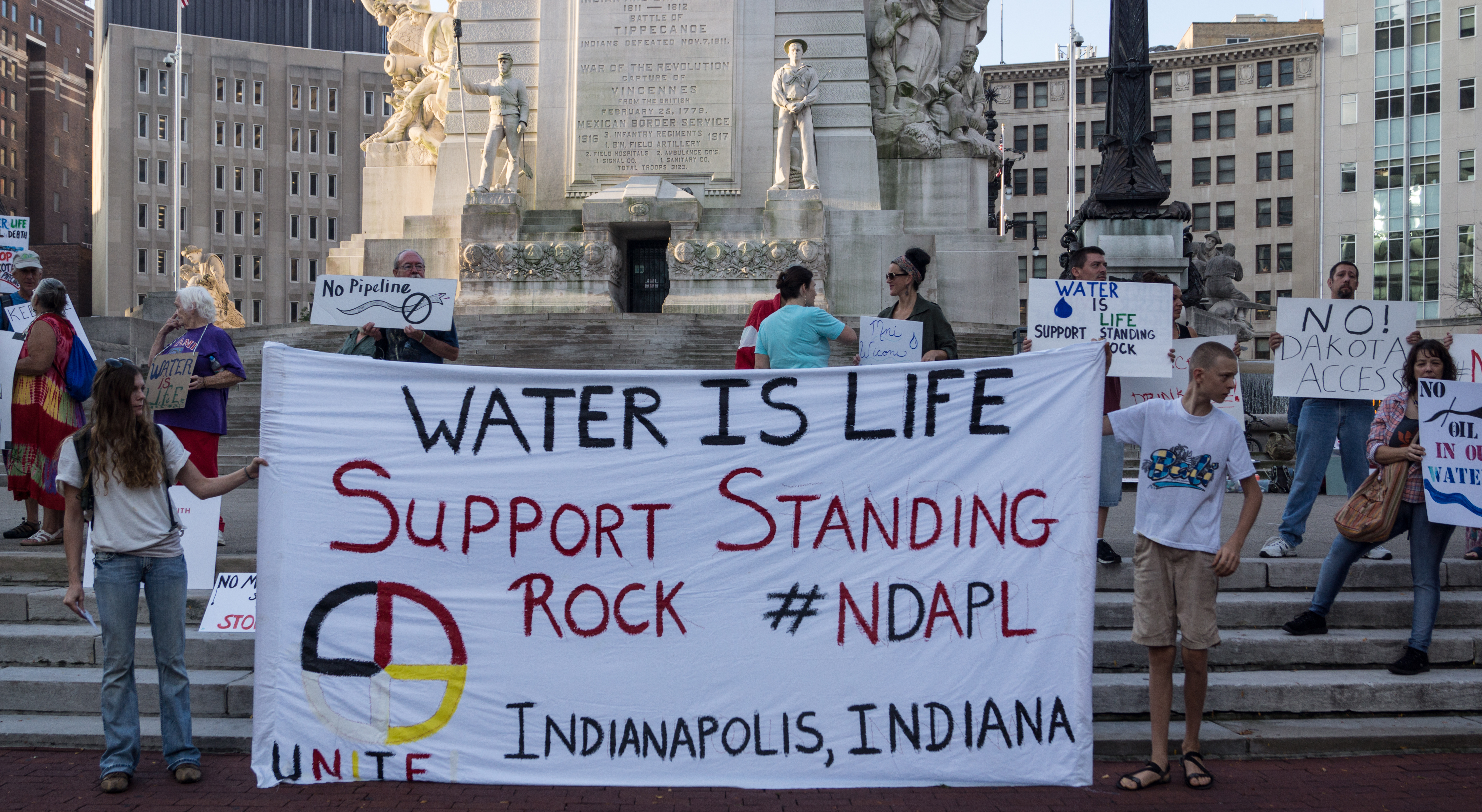
When members of the Oceti Sakowin gathered near the Standing Rock Reservation to protest the Dakota Access Pipeline, they decided on a strategy of nonviolent direct action. No violence… against people.

But sabotage of property – well, that’s another question entirely.

Since the gathering at Standing Rock, anti-protest legislation backed by the fossil fuel industry has swept across the country.

What happened? When is environmental protest considered acceptable… and when is it seen as a threat?

This is the first of two episodes exploring the changing landscape of environmental protest in the United States, from Standing Rock to Cop City and beyond.

http://outsideinradio.org/shows/when-protest-is-a-crime-part-1


Nate Hegyi: There are certain moments that become part of our collective story. Flash points. When our past and our future feel like they’re talking to each other. Standing Rock was a moment like that.

Chase Iron Eyes: The smell of fire, of campfire, permeated the entire Oceti Sakowin camp.

Nate Hegyi: That’s Chase Iron Eyes. He’s an attorney, and a member of the Oglala Sioux and Standing Rock Nations, though he says these are colonial names.

Chase Iron Eyes: Yeah, I would say Oceti Sakowin or Sioux Nation.

Nate Hegyi: The protesters, including Chase, first gathered in 2016. They were there to stop DAPL, the Dakota Access Pipeline. Because pipelines spill. Because millions of people depend on the integrity of the Missouri River. Because even when a pipeline works as intended, the result… is more greenhouse gas emissions. But the main reason why Chase and members of the Sioux Nation were camping at Standing Rock was: they were defending their sovereignty.

Chase Iron Eyes: We had been disallowed from expressing our sovereign identity in that territory since 1889. That’s when the state of North Dakota and South Dakota were admitted to statehood.

Nate Hegyi: It was the largest gathering of Indigenous people in recent history. People came from all over.

Chase Iron Eyes: Tens of thousands of people cycled through that camp. This is why one elder called it an ongoing international spiritual monument.


Producer Justine Paradis takes it from here.

Lesley Wood: Most protests are extremely straightforward, and sometimes even boring.

Justine Paradis: This is Lesley Wood. She researches the dynamics between policing and social movements.

Lesley Wood: Um. But some protests are not.

The activists at Standing Rock described the protest as a nonviolent, direct action.

And, historically, “direct action” can mean a lot of things.

Lesley Wood: it can be something like if we want better health care, we have to set up clinics…

It’s saying we’re not going to ask for the government to solve the problems… We’re going to do it ourselves.

Justine Paradis: Direct action as a strategy often comes after trying to participate in the democratic process – and finding it unresponsive. And it might involve acts of civil disobedience: deliberately breaking a law, like stopping traffic, or maybe because the law itself is unjust, like sitting at a segregated lunch counter. Speaking generally, that’s very different from a permitted, police-protected protest, the kind Lesley calls “marching in a circle.”

Lesley Wood: There’s no political threat posed by them… the idea that you have a right to protest, but only in certain ways and in certain places doesn’t really understand what protest is trying to do, which is on the fundamental say the system isn’t working. And to show that it’s not working. To impose some sort of potential cost to the system.

http://outsideinradio.org/shows/when-protest-is-a-crime-part-1


When protest is a crime, part 2: city in a forest

After the gathering at Standing Rock, legislators across the United States passed laws in the name of “protecting critical infrastructure,” especially pipelines. 

At the same time, attacks on the electrical grid have increased almost 300%. But that threat isn’t coming from environmental activists. 

It’s coming from neo-Nazis. 

This is the second episode in our series examining the landscape of environmental protest in the United States, from Standing Rock to Cop City and beyond. Listen to the first episode here.

As the space for protest in the United States shrinks, this year marked a major escalation: the first police killing of an environmental protestor in the United States, plus the arrests of dozens of people at protests under the charge of domestic terrorism.

https://outsideinradio.org/shows/when-protest-is-a-crime-part-2


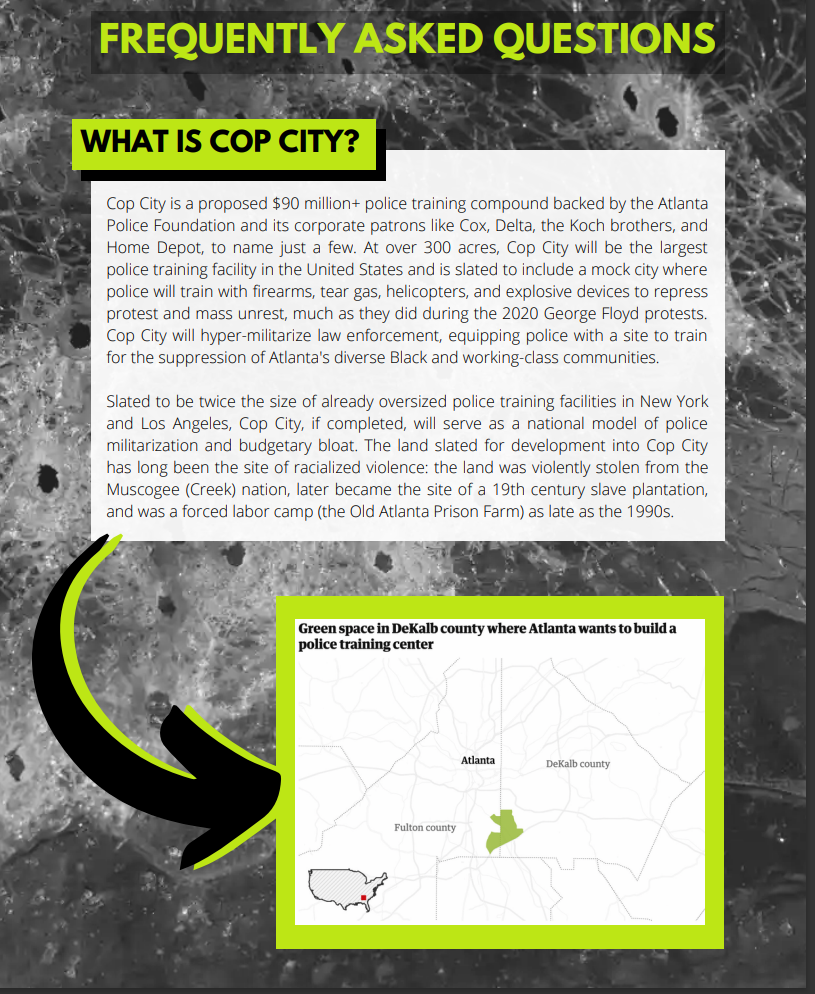
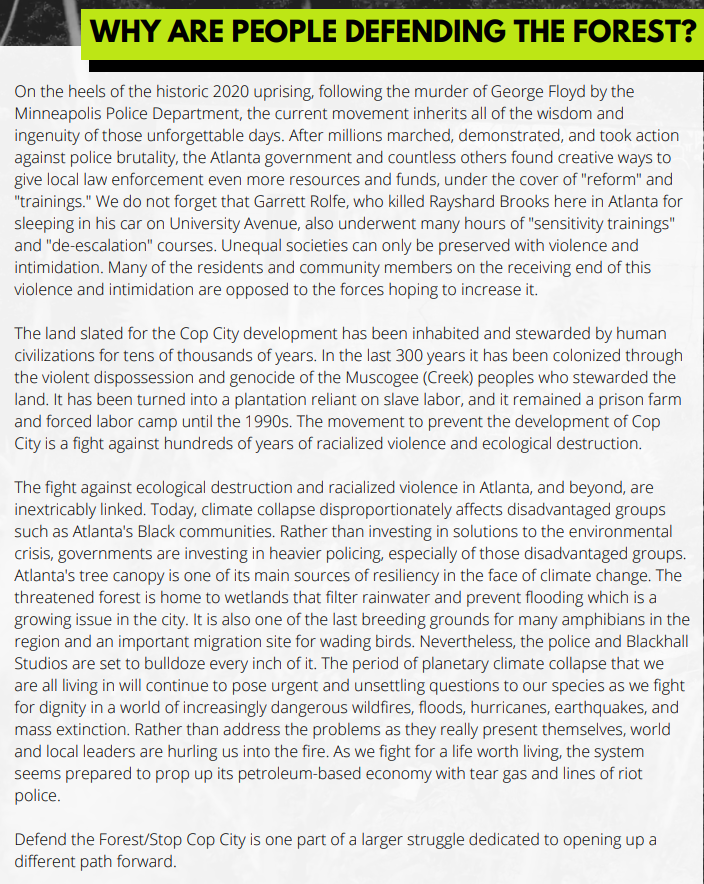
The Atlanta Police Foundation is planning a “public safety training facility” on at least 85 acres of this forest in southeast Atlanta. Their plan includes a mock city for training police in, essentially, urban warfare – complete with a mock convenience store, nightclub, a motel/apartment building, a gas station.

Activists call it Cop City.

Justine Paradis: There are a lot of reasons people are opposed to Cop City.

Because of the environment, for one: trees are good for air and water, and cooling things down, which is especially important in a hotter climate.

And then there’s the fact that this project would be an expansion and investment in the police.

The Weelaunee Forest is in a majority Black neighborhood. And this is only about a year after people were marching in the streets calling for a defunding of the police.

Reverend Keyanna Jones at Atlanta City Council on March 6, 2023: …we don’t want Cop City. I live in East Atlanta. I don’t want Cop City. I got five black children. I don’t want Cop City. I like breathing clean air. I don’t want Cop City… I don’t want black Black Hawk helicopters landing around the corner from my house. I don’t want Cop City.

Justine Paradis: In the decisive meeting to approve the project, 70% of comments were opposed – but the Atlanta City Council approved it anyway.

That was in September 2021.

After that, a group of activists moved into the forest to try to prevent this project from happening. They called themselves “forest defenders.”

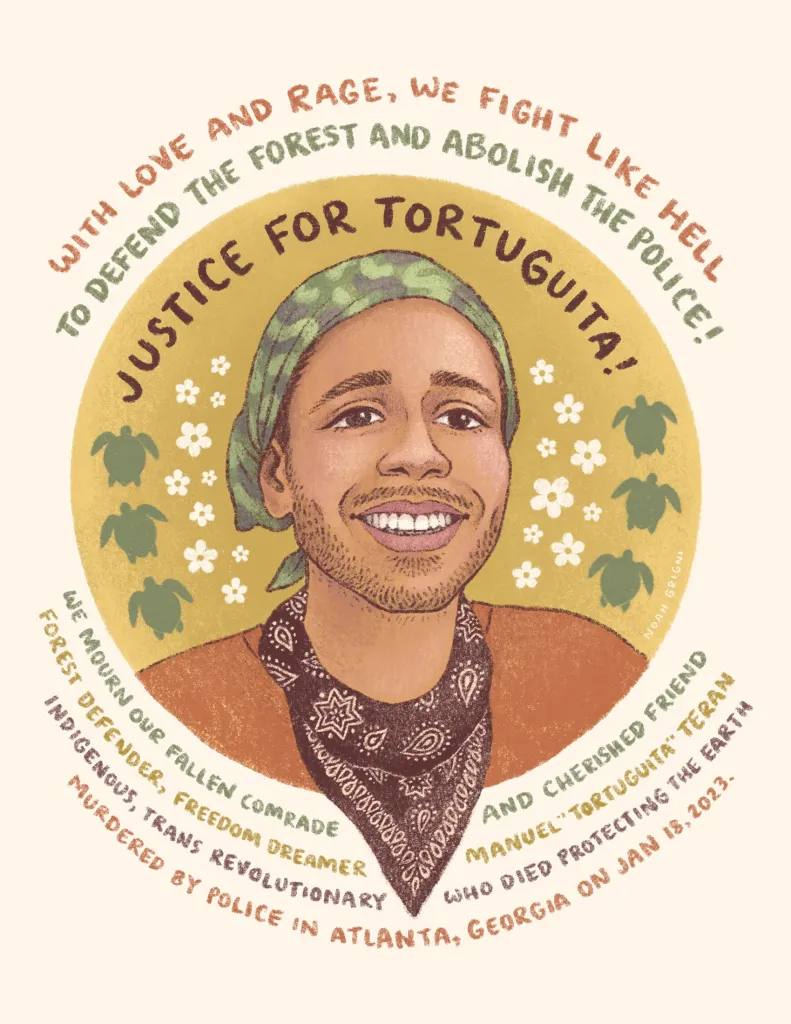
They’d been living there for over a year – in tents and tree platforms – when police raided the camp. During one of those raids, law enforcement killed a forest defender, a Venezuelan Indigenous person who went by the name Tortuguita. They shot them at least 57 times. This was the first police killing of an environmental protestor in the United States.

https://outsideinradio.org/shows/when-protest-is-a-crime-part-2


Risks of Environmental Activism

As a follow-up to yesterday’s post about bail funds, a fellow Quaker abolitionist told me about the Atlanta Solidarity Fund.

Support the Atlanta Solidarity Fund as its organizers face targeted political repression.
The National Bail Fund Network is collecting donations for the Atlanta Solidarity Fund on a temporary basis as of May 31, 2023.
All funds raised here will be used to support bail and legal defense funds of those being arrested and prosecuted in Atlanta.
The National Bail Fund Network is made up of over 90 local community-based bail and bond funds that free people from local jails and immigration detention centers. More information at bit.ly/localbailfunds

Atlanta Solidarity Fund


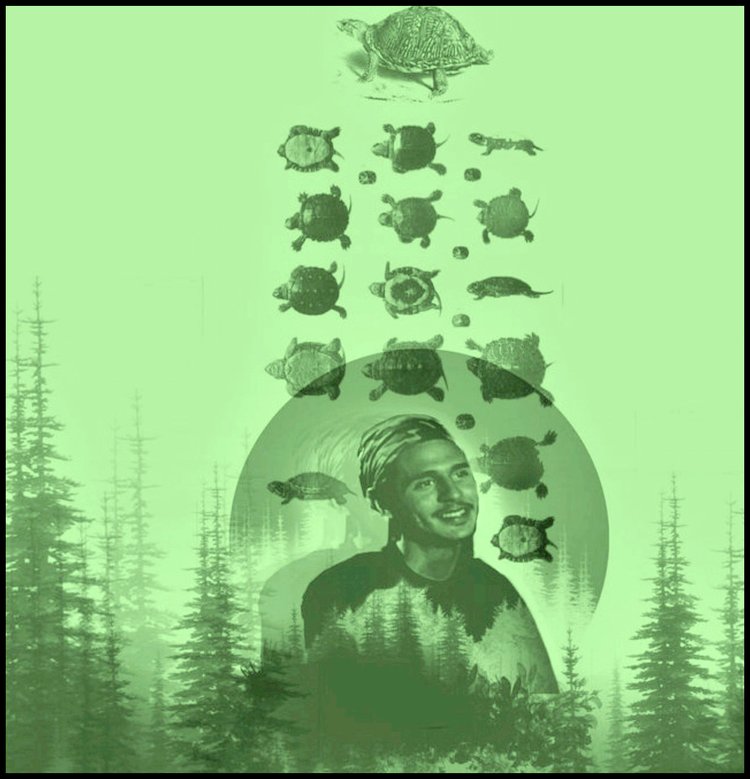
There are, of course, risks to being involved in activism. Manuel Esteban Paez Terán also known as Tort or Tortuguita (Little Turtle), was a tree-sitter in the Atlanta forest and was killed by police on January 18, 2023. You can read the moving tributes to Tort here: Memories of Tort.

During our latest demonstration related to Stop Cop City, someone made turtles for us to pin on our shirts in remembrance of Tortuguita.

The issue of environmental activism is becoming increasingly urgent and dangerous in the face of the climate crisis. According to a report by Global Witness, more than 1,700 environmental activists have been killed “trying to protect their land and resources” over the past decade. In 2020 alone, a record number of 227 people were murdered around the world for defending their environment and land rights. (see: https://en.wikipedia.org/wiki/List_of_environmental_killings)


Indigenous resistance

It’s important that enterprising reporters cover Native issues in the right way. Today, I’m happy to highlight a solid example of such reporting. When protest is a crime, part one: the Standing Rock effect is the first of a multi-part podcast from the talented team at Outside/In, a division of New Hampshire Public Radio. It examines the criminalization of protest in America through the lens of Indigenous resistance. Both my father, Lakota Law co-director Chase Iron Eyes, and I sat down with reporter and producer Justine Paradis to lend our perspectives. I encourage you to listen to what we had to say.

Wopila tanka — thank you for being a part of our resistance.
Tokata Iron Eyes, Organizer
The Lakota People’s Law Project

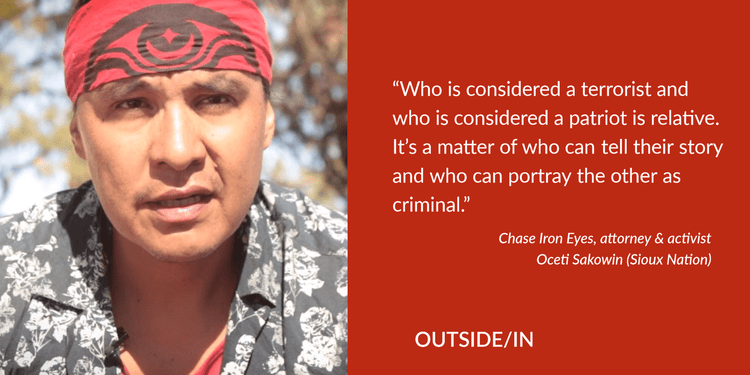
“Who is considered a terrorist and who is considered a patriot is relative. It’s a matter of who can tell their story and who can portray the other as criminal,” said Chase Iron Eyes, an attorney and activist and member of the Oceti Sakowin (Sioux Nation). Photo by Treetops Productions on Wikimedia Commons (CC BY 3.0).


Not the first time the people were betrayed

Weelaunee Forest was the historic home of Muscogee Creek peoples for untold generations. In the 1830s they were forcibly removed by the U.S. military on the Trail of Tears; and the land, some 3,500 acres, was transferred to the hands of enslaving plantation elites. Enslaved Africans toiled their lives away and were undoubtedly buried there.

Then in 1918, during the Jim Crow era, the Bureau of Prisons and the nearby Atlanta federal penitentiary bought over 1,000 acres for a prison farm to grow crops to feed inmates. Mainly Black prisoners, convicted of low-level “crimes” like vagrancy, loitering and public drunkenness, labored for free in horrible living conditions and were subjected to brutal treatment. It is believed their unmarked graves lie among the trees that cover the Atlanta Prison Farm’s acres.

In 1965 the city of Atlanta appears to have acquired the property, which is the largest existing expanse of green space in the area. The Atlanta Prison Farm was finally closed in 1995.

The killing of Forest Defender Tortuguita in Atlanta by Dianne Mathiowetz, Workers World, January 24, 2023


#StopCopCity

Bail Fund Arrests

Have you ever joined a peaceful protest? Aren’t freedom of speech, freedom of assembly worth protecting?

Clamping down on such freedoms is essential for any movement toward authoritarianism. And sadly this country is rapidly moving in that direction. These are times that call for peaceful protest.

Yesterday I wrote about polycrisis. One of the examples of risks that are commonly associated with polycrisis is the crisis of democracy.

Crisis of Democracy includes issues of corruption, political polarization, decreasing institutional legitimacy, and rising authoritarianism. Falling rates of democratic participation and the diminishing health of democracies exacerbate most other systemic risks, as misalignment between political elites and the public interest make progress on urgent issues less likely. 

The global polycrisis reflects a civilizational crisis that calls for systemic alternatives by Zack Walsh, Omega, June 1, 2023

These days it is hard to be shocked by almost anything, but I am truly shocked to learn about the latest attacks on those who are trying to stop the construction of Cop City in Atlanta. Shocked to learn of the arrest of several people whose crime was organizing a bail fund

Bail Funds

Bail funds are an important part of many activist communities. Many of us who engage in public protests might hesitate to do so if there wasn’t a bail fund. Especially if civil disobedience is planned.

ON WEDNESDAY MORNING, a heavily armed Atlanta Police Department SWAT team raided a house in Atlanta and arrested three of its residents. Their crime? Organizing legal support and bail funds for protesters and activists who have faced indiscriminate arrest and overreaching charges in the struggle to stop the construction of a vast police training facility — dubbed Cop City — atop a forest in Atlanta.

In a joint operation with the Georgia Bureau of Investigation, or GBI, Atlanta cops charged Marlon Scott Kautz, Adele Maclean, and Savannah Patterson — all board members of the Atlanta Solidarity Fund — with “money laundering” and “charity fraud.”

The arrests are an unprecedented attack on bail funds and legal support organizations, a long-standing facet of social justice movements, according to Lauren Regan, executive director of the Civil Liberties Defense Center.

“This is the first bail fund to be attacked in this way,” Regan, whose organization has worked to ensure legal support for people resisting Cop City, told me. “And there is absolutely not a scintilla of fact or evidence that anything illegal has ever transpired with regard to Atlanta fundraising for bail support.”

ATLANTA POLICE ARREST ORGANIZERS OF BAIL FUND FOR COP CITY PROTESTERS. Part of a brutal crackdown on dissent against the police training facility, the SWAT raid and charges against the protest bail fund are unprecedented by Natasha Lennard, The Intercept, May 31, 2023


The fund also aimed to highlight the need for bail reform and challenge the current system that disproportionately affects low-income individuals and communities of color


The organizers of the bail fund sought to provide financial support to protesters who might not otherwise be able to afford bail, allowing them to continue participating in the movement and maintain their freedom while awaiting trial. The fund also aimed to highlight the need for bail reform and challenge the current system that disproportionately affects low-income individuals and communities of color.

The arrest of bail fund organizers is not only an injustice to them, but also a threat to democracy and social justice. It is part of a larger effort to silence and suppress the voices of those who oppose police brutality, racial injustice, environmental destruction, and corporate greed. It is also part of a larger pattern of criminalizing solidarity and mutual aid, which are essential for building strong and resilient communities.


Des Moines Mutual Aid

The campaign to defend the forest in Atlanta, Georgia has become one of the most vibrant movements of the post-Trump era, interweaving environmentalism, abolitionism, and the fight against gentrification. Yet as police shift to employing lethal violence and indiscriminate terrorism charges, it has reached a critical juncture. Participants explore how this struggle has developed over the past year, reflecting on the practices that have given it strength and analyzing the challenges before it.

The Forest in the City. Two Years of Forest Defense in Atlanta, Georgia by CrimethInc., 2/22/2023

Against terrorism charges

Who is a terrorist? One sentiment is “One Man’s Terrorist another Man’s Freedom Fighter“. I’m surprised to learn there is not a widely accepted definition of terrorism. And that lack of definition facilitates the ability of governments to define those who criticize them as terrorists. And to incarcerate or kill them. As they killed forest defender Manuel “Tortuguita” Terán.

In terms of their overall organization and movement strategy, the Cop City protests are in many ways a far cry from the Civil Rights Movement of the ’60s. But it’s still worth asking: if MLK got arrested in Atlanta today during a political demonstration, would he be charged as a domestic terrorist? And would those who lionize him today have remained silent?

The Terrorism Charges Against Cop City Protesters Are Ominous by Ryan Zickgraf, Jacobin, Jan 27, 2023

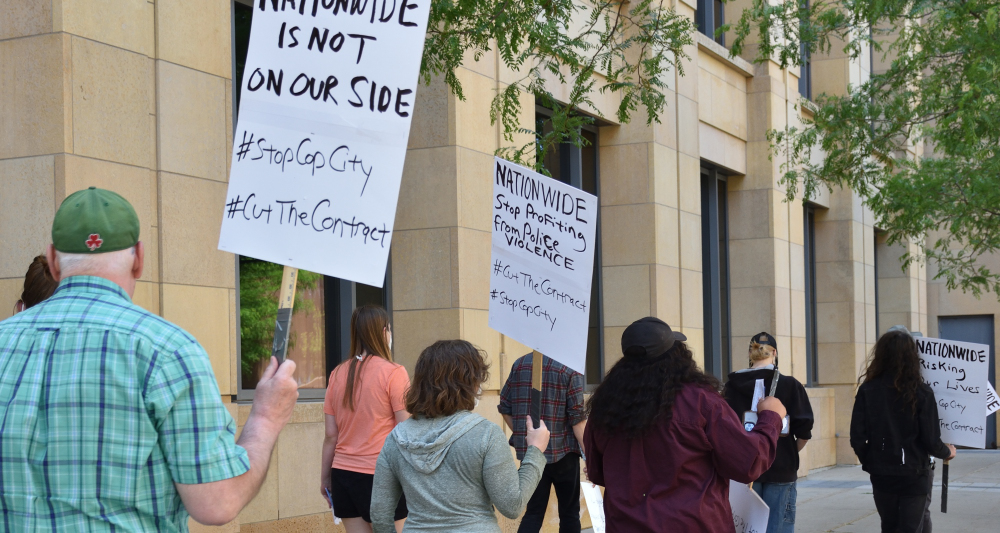
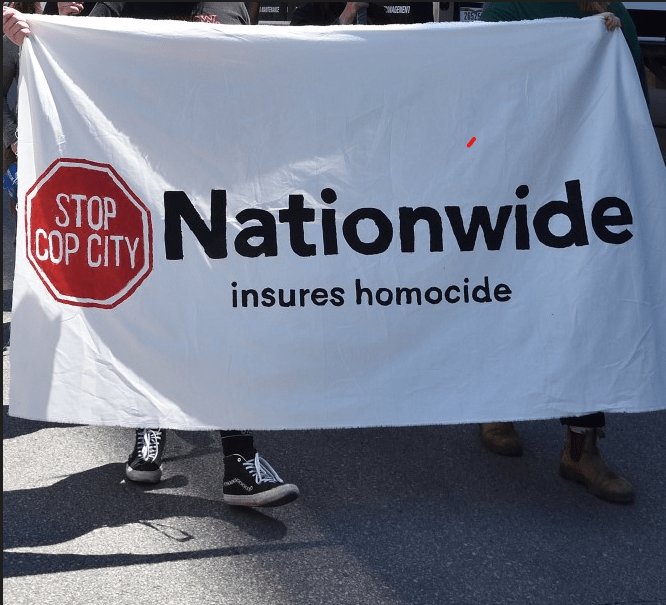
Friday I participated in a demonstration calling for Nationwide insurance company to cut their contract to insure the construction of Cop City.
See: #StopCopCity activists shouldn’t be tried as terrorists

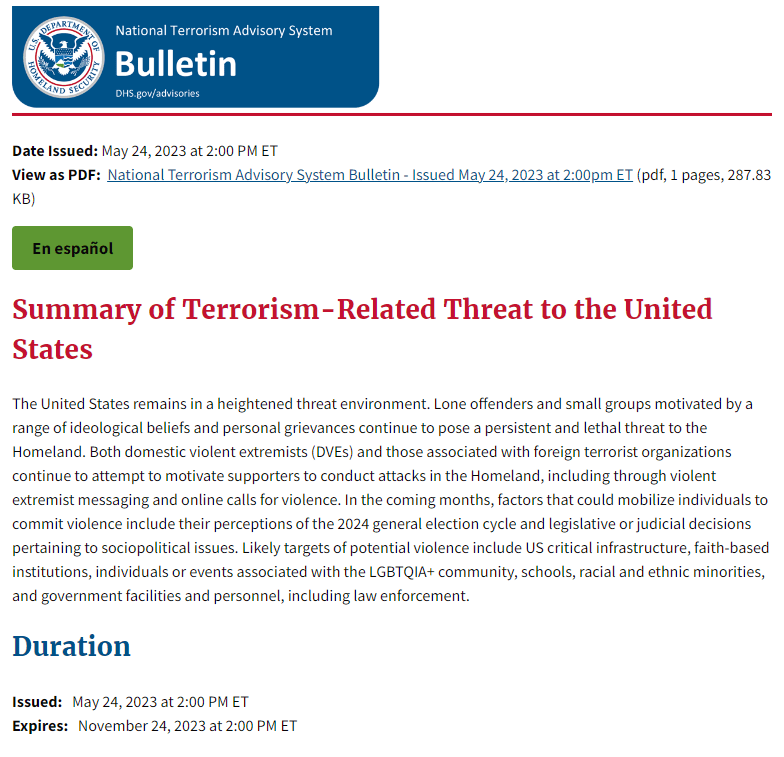
After that, I read the following from the Department of Homeland Security.

“Since spring of 2022, alleged DVEs (Domestic Violent Extremists) in Georgia have cited anarchist violent extremism, animal rights/environmental violent extremism, and anti-law enforcement sentiment to justify criminal activity in opposition to a planned public safety training facility in Atlanta. Criminal acts have included an alleged shooting and assaults targeting law enforcement and property damage targeting the facility, construction companies, and financial institutions for their perceived involvement with the planned facility”

Summary of Terrorism-Related Threat to the United States, Department of Homeland Security


Defining terrorism

In 1988 two European scholars Alex Schmid and Albert Jongman produced one of the more robust definitions of terrorism. They did this by surveying 200 leading academics in the field of terrorism studies. The research asked each expert to define terrorism.

Terrorism is some form of purposive and planned violence that has a political, religious, or ideological motivation. It is intended to coerce or intimidate and is targeted at civilians or government. Legislation prohibiting terrorism ought to have extra-territorial effect.

One man’s freedom fighter… can we ever define terrorism? by Fergal Davis, The Conversation, January 7, 2013

extra-territorial – (of a law or decree) valid outside a country’s territory

Extra-territorial is part of the definition to preclude a definition of terrorism pertaining to a local political situation. Such as local opposition to Cop City. That is, supporters of Stop Cop City would not be classified as terrorists by this definition.


Escalation of charges

Protesters against a massive police militarization complex in Atlanta have been slapped with domestic terrorism charges for throwing bottles and breaking windows. That should be deeply worrisome for anyone who values the right to dissent.

Can you be charged with terrorism for throwing bottles or breaking a window of a bank? You can in Atlanta, where the state of Georgia has slapped serious domestic terrorism charges on eleven people who’ve been demonstrating since December against the construction of a massive police militarization complex known as Cop City.

Governor Brian Kemp justified the severe punishment on Twitter, saying, “Violence and unlawful destruction of property are not acts of protest. They are crimes that will not be tolerated in Georgia and will be prosecuted fully.” On Thursday, Kemp signed an executive order declaring a state of emergency and authorizing the deployment of a thousand National Guard troops to arrest Cop City protesters. The state of emergency lasts two weeks, until February 9.

Kemp’s definition of “prosecuting fully” has changed since 2020. During the George Floyd protests that filled the streets of downtown Atlanta, most protesters arrested were taken to the city jail for offenses that included disorderly conduct, burglary, and criminal property damage.

Now, two years later, Georgia authorities are trumping up property crimes and relatively minor vandalism by Cop City political demonstrators as acts of terrorism. If convicted, the activists could face up to thirty-five years in prison — which in the state of Georgia is a punishment similar to second-degree murder.

The Terrorism Charges Against Cop City Protesters Are Ominous by Ryan Zickgraf, Jacobin, Jan 27, 2023


Atlanta, Georgia – 66 environmental, human rights, and civil liberties organizations sent a letter to Georgia prosecutors urging them to drop domestic terrorism charges against Stop Cop City/Defend the Atlanta Forest protesters. The charges represent a draconian escalation seemingly intended to chill First Amendment protected activity.

The letter reads, in part:

Civil disobedience and disruptive activism are part of the American protest tradition. From the Boston Tea Party to the civil rights movement, Americans have long drawn on civil disobedience tactics akin to the occupation of the Atlanta forest by the Stop Cop City protesters. Based on the information contained in the arrest warrants, many of the people charged with domestic terrorism are accused only of trespassing or other minor crimes. In all cases, application of the domestic terrorism statute is an escalatory intimidation tactic and a draconian step that seems intended to chill First Amendment protected activity.

66 ORGANIZATIONS URGE THAT DOMESTIC TERRORISM CHARGES BE DROPPED by Defending Rights and Dissent, March 8, 2023


Critics of domestic terrorism laws, including some civil rights groups, oppose them “because of the risk of politicization because they can be used against politically disfavored groups by the government,” Patrick Keenan, a professor of law at the University of Illinois, said.

A 2017 Georgia law defines domestic terrorism as a felony intended to kill or harm people; “disable or destroy critical infrastructure, a state or government facility, or a public transportation system”; “intimidate the civil population or any of its political subdivisions”; and change or coerce state policy or affect the conduct of government “by use of destructive devices, assassination, or kidnapping.” Conviction carries a maximum sentence of 35 years in prison.

The allegations against the protesters include trespassing, resisting arrest, throwing rocks and glass bottles and damaging property, including setting fire to a police car. Authorities have also said they found “explosive devices, gasoline, and road flares” in an area in the forest where protesters had makeshift treehouses.

Georgia Gov. Brian Kemp, a Republican, has called the protesters “militant activists” and said “we will bring the full force of state and local law enforcement down on those trying to bring about a radical agenda through violent means.”

Arrests in Atlanta ‘Cop City’ protests raise concerns over domestic terrorism charges. Critics of such laws, including civil rights groups, say they can be politicized and used against marginalized groups or those disliked by government. By Danielle Silva, NBC News, Jan 29, 2022


#StopCopCity activists shouldn’t be tried as terrorists

One of the key tactics of authoritarianism is to brutally suppress dissent.

I’ve been writing about the huge proposed police training facility in Atlanta.
(See: https://quakersandreligioussocialism.com/?s=%22cop+city%22)

This project has generated a great deal of opposition, in part because it furthers the advancement of violent, militarized policing. Just the opposite of what so many of us are working toward, an end to the carceral systems in this country.

The campaign to defend the forest in Atlanta, Georgia has become one of the most vibrant movements of the post-Trump era, interweaving environmentalism, abolitionism, and the fight against gentrification. Yet as police shift to employing lethal violence and indiscriminate terrorism charges, it has reached a critical juncture. Participants explore how this struggle has developed over the past year, reflecting on the practices that have given it strength and analyzing the challenges before it.

The Forest in the City. Two Years of Forest Defense in Atlanta, Georgia by CrimethInc., 2/22/2023

I came of age at the time this country was in the midst of significant unrest related to the war in Viet Nam, and racial injustice. Looking back at the late 1960s, it looks like a different world. A world where dissent and free speech were protected. In the decades since then, I’ve been involved in many acts of protest. It was known that law enforcement was keeping track of this dissent. But most of us didn’t fear the police then. We White people, anyway.

Nonviolent civil disobedience, where an arrest is likely, is a tactic to bring attention to injustice. Those involved in intentional disobedience did so to demonstrate how much we were willing to risk to bring attention to injustice. The Keystone Pledge of Resistance involved training people to hold acts of nonviolent disobedience to stop the approval of the permit for the Keystone XL pipeline to cross the US-Canada border. President Obama denied that permit.

Not one of the activists I know condone any use of violence.

Some activists have decided the threats from increasing greenhouse gas emissions, leading to increasing environmental chaos, are such an existential threat that they had to break the law.

The defense of necessity may apply when an individual commits a criminal act during an emergency situation in order to prevent a greater harm from happening. In such circumstances, our legal system typically excuses the individual’s criminal act because it was justified, or finds that no criminal act has occurred. Although necessity may seem like a defense that would be commonly invoked by defendants seeking to avoid criminal charges, its application is limited by several important requirements:

  • The defendant must reasonably have believed that there was an actual and specific threat that required immediate action
  • The defendant must have had no realistic alternative to completing the criminal act
  • The harm caused by the criminal act must not be greater than the harm avoided
  • The defendant did not himself contribute to or cause the threat

Only if all of these requirements are met, will the defense of necessity be applicable.

The Necessity Defense in Criminal Law Cases


I’ve learned to be careful to not include people’s faces when I take photos at justice events, having learned law enforcement looks at photos to identify people for arrest.

Recent efforts to criminalize protests in the United States have been observed in various states. For instance, 20 states have passed laws that criminalize protesting, including on infrastructure such as pipelines. Since 2016, as many as 225 anti-protest bills have been introduced in 45 states, with over 100 introduced since the Black Liberation demonstrations in June 2020. According to the US Protest Law Tracker, 51 bills were under consideration in 24 state legislatures as of February 2021.

These efforts to criminalize protest have raised concerns about the potential infringement on the right to peaceful assembly. The US Protest Law Tracker provides a comprehensive overview of state and federal legislation introduced since January 2017 that restricts the right to peaceful assembly.

Returning to authoritarianism, recent years have seen the escalation of charges against peaceful protesters. Even so, I was shocked yesterday to learn that those who protest to stop cop city have been designated a terrorism-related threat. I learned that protesters might be considered domestic violent extremists (DVEs).

“Since spring of 2022, alleged DVEs (Domestic Violent Extremists) in Georgia have cited anarchist violent extremism, animal rights/environmental violent extremism, and anti-law enforcement sentiment to justify criminal activity in opposition to a planned public safety training facility in Atlanta. Criminal acts have included an alleged shooting and assaults targeting law enforcement and property damage targeting the facility, construction companies, and financial institutions for their perceived involvement with the planned facility”

Summary of Terrorism-Related Threat to the United States, Department of Homeland Security


Atlanta police on Monday charged 23 people with state domestic terrorism charges, a day after officers detained dozens of people following a violent clash at the proposed construction site of what has been dubbed “Cop City” – a $90m police and firefighter training center in a forest near Atlanta.

Atlanta police charge 23 with domestic terrorism amid ‘Cop City’ week of action. Move follows violent weekend clash at proposed construction site of Georgia police training facility in forest by Edwin Rios, The Guardian, March 6, 2023

THREE ACTIVISTS INVOLVED in the Defend Atlanta Forest movement are facing charges of felony intimidation of an officer of the state and misdemeanor stalking for placing flyers on mailboxes in a neighborhood in Bartow County, Georgia, about 40 miles from Atlanta. The detainees were held for days in solitary confinement, a lawyer working on the case and a relative of one of the activists told The Intercept.

The flyer, according to the lawyer, named a police officer who lives in the area where the activists were arrested and alleged he was connected to the killing in January of forest defender Manuel “Tortuguita” Terán during a multi-agency raid on the Atlanta Forest protest encampment.

Julia Dupuis, an activist named Charley who asked that their last name be withheld for security concerns, and an activist named Wednesday were arrested at a gas station outside the town of Cartersville on Friday. According to their lawyer, Lyra Foster, the activists drove once through the neighborhood and placed flyers on numerous mailboxes without exiting their vehicle or approaching any residents. Foster said Wednesday was a passenger in the car and not posting flyers.

If found guilty, they could each face up to 20 years in prison.

“They were not handing out flyers, they were actually extremely careful in trying to avoid doing anything illegal,” Foster told The Intercept. “They posted the flyers on mailboxes, they did not even get out of the van to put flyers on the doors, and did not open the mailboxes because they thought that was potentially illegal.”

“They posted the flyers on mailboxes, they did not even get out of the van to put flyers on the doors.”

The attorney added that the activists “certainly had no intention to intimidate the officer” and “were trying to spread awareness about the police killing.”

Activists face felonies for distributing flyers on “Cop City” protester killing. The activists face 20 years in prison for handing out flyers that identified a cop they said was linked to the killing of a protester in the Atlanta forest by Natasha Lennard and Akela Lacy, The Intercept, May 2, 2023


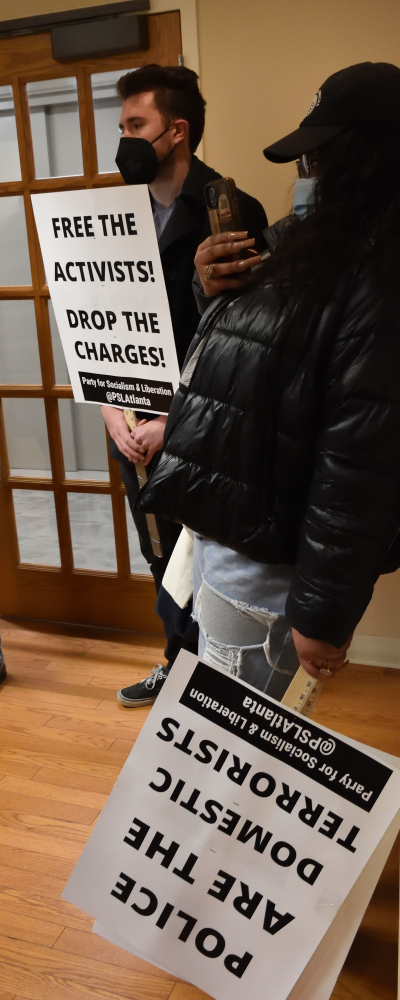
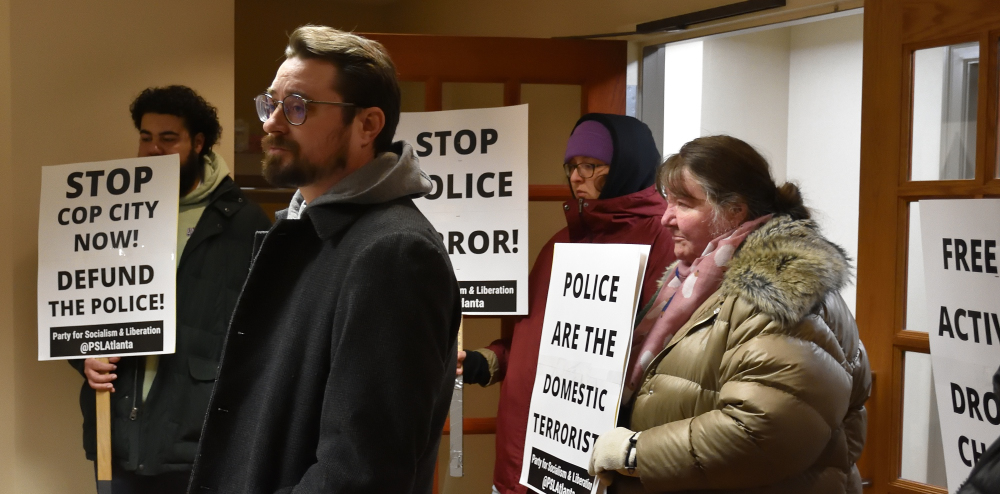
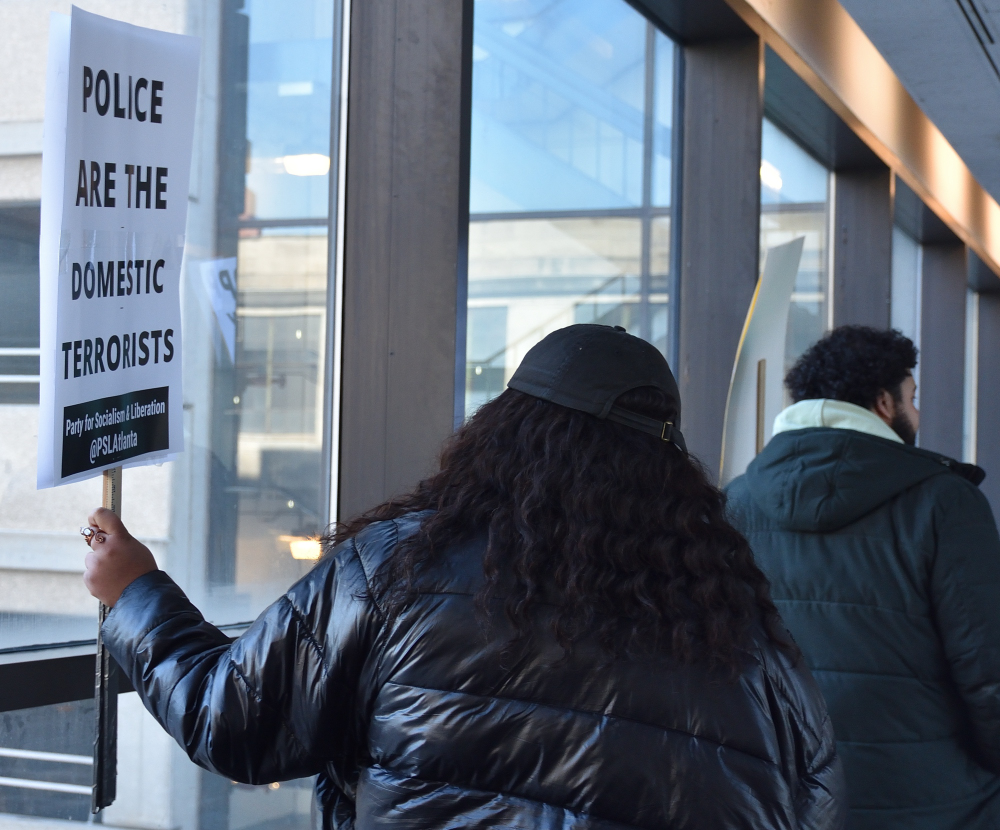
Yesterday a group of us concerned about “Cop City” and policing in general, carried signs and a banner calling attention to the Nationwide Insurance company’s insurance coverage for the construction of “Cop City”. In light of the escalation of charges for protesting, I am not including any photos with people’s faces visible. “Insures Homicide” refers to the police killing of Manuel Esteban Paez Terán (Tortuguita) who was tree-sitting in the forest.
(See: https://quakersandreligioussocialism.com/?s=Tortuguita+ )

For more information about Nationwide, see: https://quakersandreligioussocialism.com/2023/05/24/nationwide-insures-cop-city/

Future sacrificed for policing

It’s kind of heartbreaking to read “The Atlanta City Design“, and to see the aspirations of a city “Aspiring to the Beloved Community”. And then find those goals usurped by designing a huge police training facility in a forested area of the city.

1 Equity
Our challenge for Equity is the continuous, contentious, and often unappreciated work of ensuring that all the benefits of Nature, Access, Ambition, and Progress accrue fairly
to everyone.
2 Progress
Our challenge for Progress is to protect people and places with meaning from the market forces that will otherwise overrun them.
3 Ambition
Our challenge for Ambition is to leverage the disruption of change to unlock new opportunities for people to do what they want with their lives.
4 Access
Our challenge for Access is to update our hub of transportation for a new generation while also building a sense of community and place.
5 Nature
Our challenge for Nature is to protect and expand the ecological value of our watersheds, forest, and habitat in the face of rapid urbanization.

The Atlanta City Design


In 2017, the South River Forest was designated as one of four major city “lungs” in a report titled “The Atlanta City Design,” put together by Atlanta’s city-planning department. The report’s lead author was Ryan Gravel, a Georgia Tech alum whose graduate thesis led to the creation of the city’s ballyhooed BeltLine greenway. Gravel and his co-authors envision the South River Forest as a great urban park and conservation corridor. The city council formally adopted the plan, and Gravel began working with the Nature Conservancy to make it a reality; in March of last year, a two-hundred-acre parcel surrounding a drained lake three miles south of the prison farm, which could have become another landfill, was approved for permanent preservation.

Then, the following month, Mayor Keisha Lance Bottoms, a Democrat, made an announcement: the area around the prison farm was going to be the site of a sprawling training facility for police and firefighters. This, Gravel said, was “a big surprise.” Many people in Atlanta were startled by the news—including Joe Santifer, who told me that he’d already been bothered by the police presence in the forest. For decades, the Atlanta P.D. has operated a firing range there, and, on his forest strolls, Santifer had begun hearing gunfire. Even from a distance, he said, it “sounds like a battleground.” He e-mailed a complaint to the city, and, a few days later, he got a response: “Call 911.”

The New Fight Over an Old Forest in Atlanta. The plans for an enormous police-training center—dubbed Cop City by critics—have ignited interest in one of Atlanta’s largest remaining green spaces. By Charles Bethea, The New Yorker, August 3, 2022


The A.P.F. (Atlanta Police Foundation), which was founded in 2003, is one of many police foundations created in the past two decades. These private nonprofits typically channel corporate money into policing initiatives, expanding police budgets and, in some cases, producing apparent conflicts of interest. Some of Atlanta’s most influential people—the C.E.O.s of Waffle House and of the Atlanta Hawks, V.P.s from the Home Depot and Delta Air Lines—sit on the A.P.F.’s board; Coca-Cola and Cox Enterprises, a media conglomerate based in Atlanta, are among the corporations that have acknowledged their contributions to the foundation. Cox’s C.E.O., Alex Taylor, is the chair of fund-raising for the training facility. Cox owns the city’s largest newspaper, the Journal-Constitution, which has published a number of editorials in favor of the facility and has only sometimes disclosed its owner’s contributions to the A.P.F.

Atlanta’s city council solicited public comment on the facility in September of last year, and received more than seventeen hours of remarks—including a few minutes from Joe Santifer. “I said the location isn’t congruent with the neighborhood,” he told me. “It’s outsized for the number of officers that Atlanta has, and the process has been rushed.” Santifer said that he’d also listened to most of the other remarks, which were recorded, and that “about seventy per cent” were opposed to the development. (A crowdsourced tally reached the same conclusion.) The other thirty percent, he said, “were mimicking what they had been told—that this was gonna solve Atlanta’s crime problem and the problem with low morale in the police force.” Santifer began researching alternative sites, including a dilapidated mall in southwest Atlanta and a few industrial properties­. He also took to social media to alert his neighbors to what was going on.

The New Fight Over an Old Forest in Atlanta. By Charles Bethea, The New Yorker, August 3, 2022


Stop Building Obsolete

Obsolete what?

We seem to be in a split-screen moment. Despite growing resignation that environmental chaos will only worsen, we still refuse to make changes that will stop making it worse. That is, we continue to build:

  • Fossil fuel infrastructure
    • gas (fossil fuel) stations
    • highways/bridges/parking structures
    • airports
    • oil rigs
    • pipelines
    • coal mining
    • fracking
    • plastics
    • anything gas powered
      • automobiles, trucks, ships, planes, and trains
      • military equipment
      • lawn mowers, chainsaws, leaf blowers
  • Buildings damaged by storms and erosion on shorelines are rebuilt in the same place
  • Criminal system
    • prisons
      • we need to abolish carceral systems of injustice
    • police training facilities

Before any lasting peace may be achieved, however, the Stop Cop City movement must reverse the current state system that militarized police against its own citizens. This gave rise to the construction of Cop City in the first place.

Andrew Benzinger

How to Stop

  1. Research the project
  2. Who are the decision-makers?
  3. What are ways to influence decision-makers?
    • Engage in dialog
    • Are there laws or regulations that apply?
      • Political lobbying
      • Bring attention to violations of laws/regulations
  4. Build coalitions and networks
  5. Mobilize public opinion
    • Use media, social media, events, campaigns, and other tools to raise awareness, educate and persuade the public about your issue.
    • Encourage people to express their views and take action in support of your cause.

Nationwide Insures Cop City

“Cop City” is a proposed extensive facility to train police and firefighters. To also train police from other states. This is in direct opposition to growing calls to reform policing. This photo was from our action to support “No Cop City” in Des Moines on January 31, 2023.
(See: https://quakersandreligioussocialism.com/2023/01/31/stop-cop-city-solidarity/)


Activists search for multiple ways to bring attention to injustices. In 2013 the Keystone Pledge of Resistance targeted the application for the Keystone XL pipeline to cross the US-Canada border. This decision was solely in the hands of President Obama. After months of organizing and rallies against the pipeline, Obama decided to deny the permit. This was the first major win in the fight against the fossil fuel industry.

There are many reasons to oppose “Cop City”, but perhaps the most significant is the need to stop militarizing policing in this country.

Before any lasting peace may be achieved, however, the Stop Cop City movement must reverse the current state system that militarized police against its own citizens. This gave rise to the construction of Cop City in the first place.

GUEST COLUMN: How the Stop Cop City movement persists in the face of the police state by Andrew Benzinger

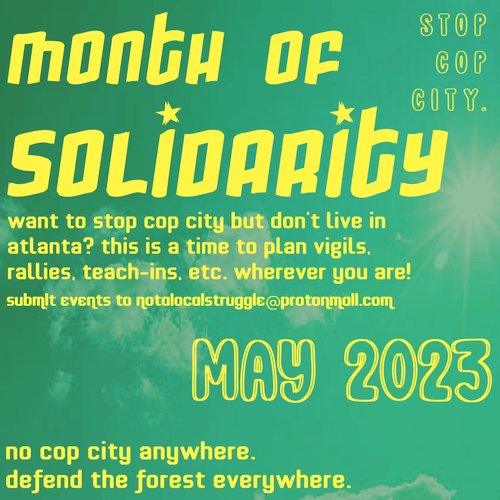
Other efforts have failed, and there is now a call to bring national attention to Nationwide Insurance Company, one of the companies insuring the Cop City project. Without valid insurance, construction cannot occur. Plans are being made for a solidarity action in Des Moines.

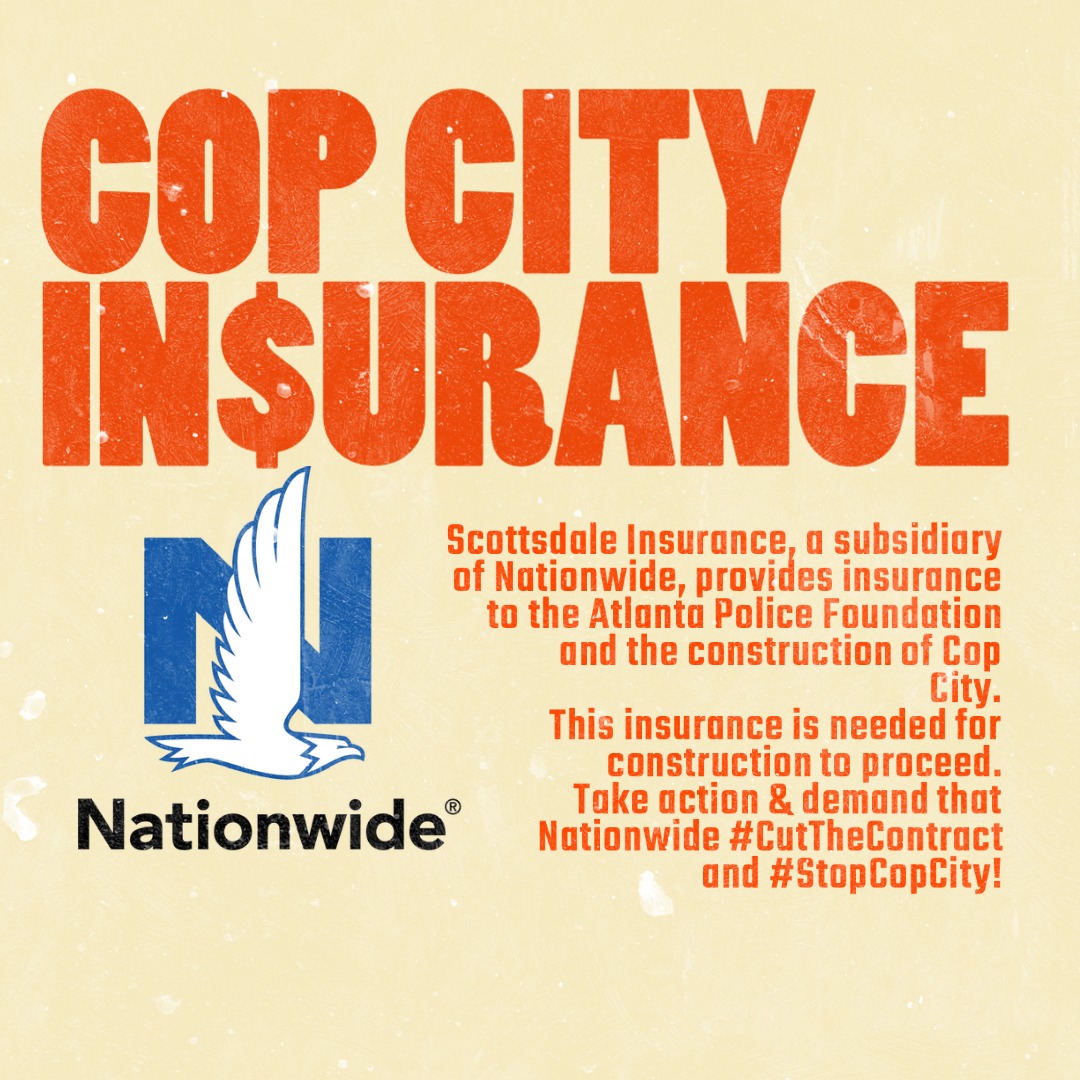
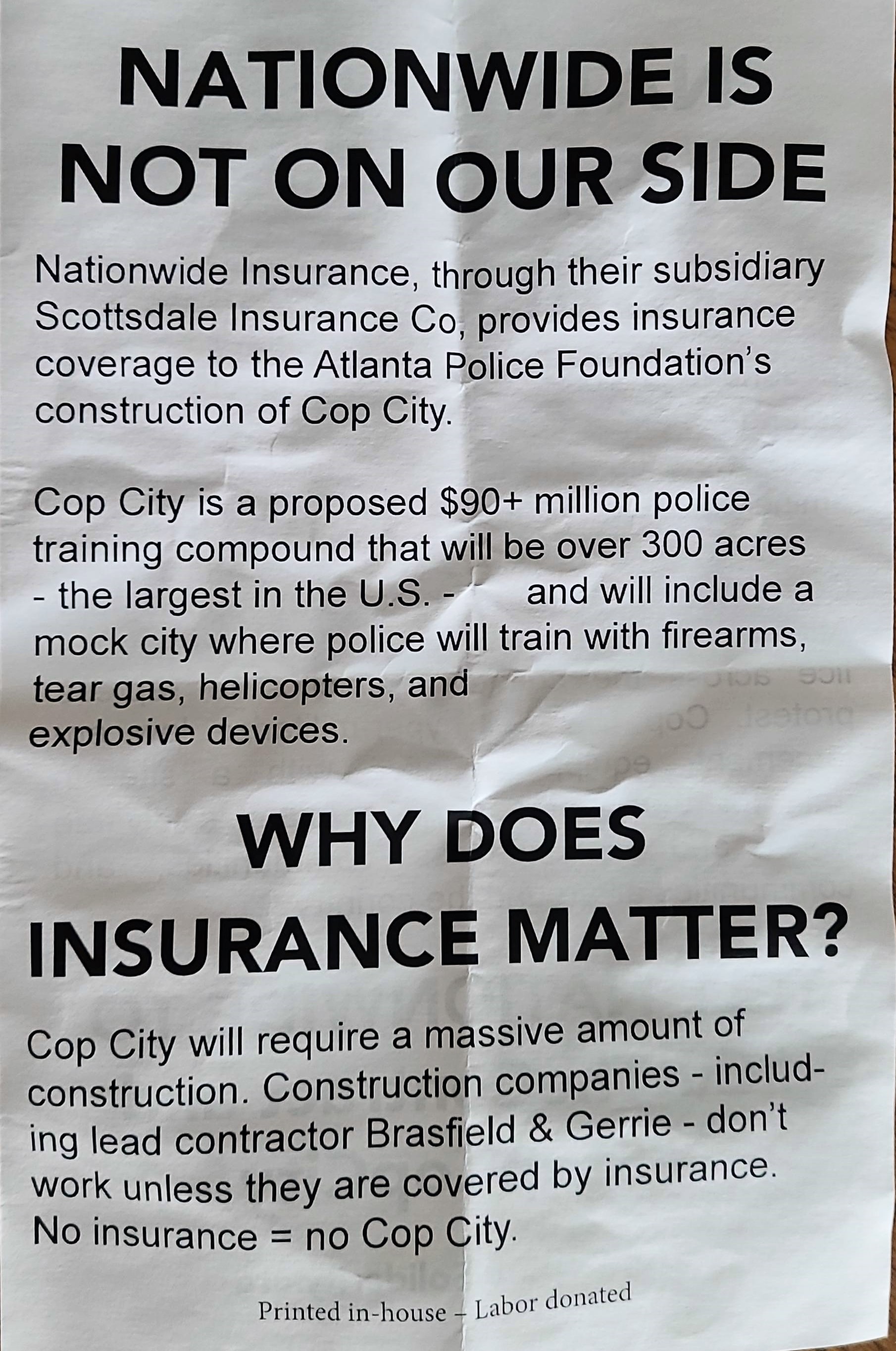
As has been noted previously, the APF (Atlanta Police Foundation) cannot build Cop City alone–they rely on a hired support network of architects, engineers, contractors, and others to build it for them. One of the most critical pillars of this support structure is insuranceWithout a valid insurance policy covering APF’s liability in the event of injury to workers or damage to property, construction cannot occur.

A Certificate of Insurance dated February 24, 2023 shows two companies providing insurance to the APF: the first is Scottsdale Insurance Co., a subsidiary of the well-known Fortune 500 company Nationwide; the second is Accident Fund General Insurance Company, a much smaller agency based in Lansing, Michigan. The broker for the policy is Amanda Surface from Correll Insurance Group, a small insurance company based out of South Carolina.

https://www.srycampaign.org/2023/03/26/meet-the-insurance-providers-behind-cop-city/

A controversial police training facility needs more than $30 million from Atlanta taxpayers. But during more than seven hours of public comment at a packed city council meeting on Monday, hundreds of locals expressed unanimous opposition to the project.

The Atlanta Public Safety Training Center—called “Cop City” by challengers—is a proposed $90 million, 85-acre police training ground slated for construction in Atlanta’s South River Forest. The project has seen opposition from environmental, racial justice, and indigenous rights activists, who argue that the project will cut down a forest on historically Native American land and fuel aggressive policing. After a series of protester arrests, and the killing of one activist by police, the project is now close to breaking ground. And opposition is louder than ever.

“I’ve been to City Hall for some years now,” Micah Herskind, an Atlanta-based community organizer who attended the Monday meeting, told The Daily Beast. “But until the Monday city council hearing, “I’ve never seen the line at the door, even, of where the public comment sign up is. It was out the door, around the whole second floor, winding down the stairs, and then eventually went out through the building, through the security line. I’ve never seen anything like it. And not only did masses of people show up, they showed up literally 100 percent against Cop City. We did a complete tally of public comments. 100 percent of commenters were against Cop City.”

Atlanta Activists Are Racing to Stop $33.5 Million ‘Cop City’ Funding by Kelly Weill, The Daily Beast, May 16, 2023

Before any lasting peace may be achieved, however, the Stop Cop City movement must reverse the current state system that militarized police against its own citizens. This gave rise to the construction of Cop City in the first place. We must not only use any available means to cause  public and digital disruption of complacency such as transforming social media into platforms of social education and change, creating community gardens and forums to exchange food and information, marching, joining grassroots networks dedicated to charity and social justice, donating money and time to those networks and building Martin Luther King Jr.’s vision of beloved communities. We will create a place that empowers one another and turns the tide against open militarization. 

We must direct our eyes beyond our present obstacle — Cop City — and into the heart of racial and capital hierarchy, which causes these state-led attacks on Americans. To the soon-to-be-ex-mayor Andre Dickens, ex-mayor Bottoms and the APD’s corporate cronies, we are Atlanta. 

In the words of our forest defenders, “we are nature defending itself. We are seeds, building our root systems. Alone we go fast, together we go far.” And in the words of our late friend and sibling Tortuguita, “Fear is the mind killer.”

Viva Tortuguita!

GUEST COLUMN: How the Stop Cop City movement persists in the face of the police state by Andrew Benzinger, Guest Columnist, The Red and Black, Mar 30, 2023 Updated Apr 12, 2023

Mainstream and Margins

Are you part of the mainstream, or on the margins?

Reference is often made to marginalized groups or peoples. My friend Jed Walsh recently wrote, “I’m tired of being in the margins of a Quakerism that’s clinging to the status quo, and hoping to find other places to practice faith and spirituality where I can feel more aligned with others.

I hadn’t thought of myself in terms of being on the margins until I read that. Quakers are usually on the margins of society, almost by default. But Jed brought into focus that he and I are on the margins of Quakerism today.
The Mainstream and Margins exercise below might be helpful for those in the mainstream to learn about those of us on the margins and what our concerns are.

Thus mainstream/margin invites curiosity and flexibility, asking the question what is going on in this group now. Organizers then make thoughtful choices about when a mainstream needs assistance in recognizing and re-negotiating its relationship with one of its margins.

One of the great things about Mutual Aid is the intense focus on preventing hierarchies, with the intent to prevent anyone from being marginalized.


The following describes the Mainstream and Margins exercise.

The goals of the exercise are:

  • To assist participants to identify with both marginal and mainstream roles that they play in society.
  • To boost awareness of the oppressive characteristics of the mainstream role.
  • To gain hope through identifying how they can support social change while in a mainstream role.
  • To practice the skills of an ally.

Activist and nonviolence trainer Daniel Hunter has come up with a helpful exercise called Mainstream and Margins. This is great for activist groups because it doesn’t rely on jargon or overly complicated theories, so it can be used in groups with a diversity of viewpoints or education levels. It also overcomes the mistake of presenting relatively static identity characteristics like age, gender, or religion as though they automatically explain group dynamics. Note, though, that the exercise is challenging and so is best done with a skilled facilitator.

No matter how homogeneous a group or an organization believes itself to be, a careful look shows that some characteristics are marginalized. A group known for vigorous and noisy debates has some quiet members. An organization which believes itself to be bureaucratically efficient has a couple of members who would love to cut corners. A solemn and highly disciplined group includes a few who, out of sight, love to party. The mainstream of a group sets the tone, sets the communication style, and gets to have its own preferences accepted by the margins. Awareness of this dynamic creates choice points for organizers and facilitators who may or may not cooperate with the system. …

Rather than viewing oppression as static (i.e. this group is always oppressed), organizers and activists can be aware of the complexities of this unique group. E.g. while society oppresses women in the larger society, an activist group might have a mainstream of women who unintentionally marginalize non-women in the group. …

Thus mainstream/margin invites curiosity and flexibility, asking the question what is going on in this group now. Organizers then make thoughtful choices about when a mainstream needs assistance in recognizing and re-negotiating its relationship with one of its margins. The mainstream is not about numbers—but it is about who has their interest recognized. So, for example, even in a group where most of the group has chronic medical conditions, the norm might be: we don’t acknowledge our conditions. …

Instead of making value judgments about how oblivious the mainstream is, accept it as one accepts the law of gravity. Then go ahead and assist the margins to express themselves and assist the mainstream to hear them.

Instead of a checklist of diversity items to look for—e.g. race, class, gender, sexual orientation—you can look freshly at each group to see how is mainstream behavior playing out.

The exercise, then, is about what is normal and accepted within a group and what is marginalized. All groups will marginalize behaviours and ideas, and that can be beneficial (e.g. respect is mainstream, screaming at each other is marginalized) so long as it’s done with enough communication and space given to know what the margins are and to hear from them. For conversations about the mainstream and margins to go well, groups need to create conditions of enough safety and trust that people feel able and ready to speak up.

Being a Quaker, Being an Activist by Canadian Friends Service Committee, 2023

“Mainstream and Margin,” Training for Change, https://www.trainingforchange.org/training_tools/mainstream-margin

Daniel Hunter, “Mainstream/Margin in Groups: A Practical Approach to AntiOppression Work,” Training for Change, 2009, https://www.trainingforchange.org/wp-content/uploads/2017/11/Mainstream-Margin-in-Groups.pdf

We invented this in response to trainers asking us: what do you do with a group that is genuinely clueless about its racism (sexism/homophobia/etc.)? We found it works with low-consciousness groups and has tremendous value for experienced activist groups, too.

Training for Change