Do you and/or a group you belong to have a vision of how to move into the near future?
I say NEAR future because huge changes, on many levels, are occurring at an accelerating rate. And my sense is most people are feeling increasingly helpless and hopeless.
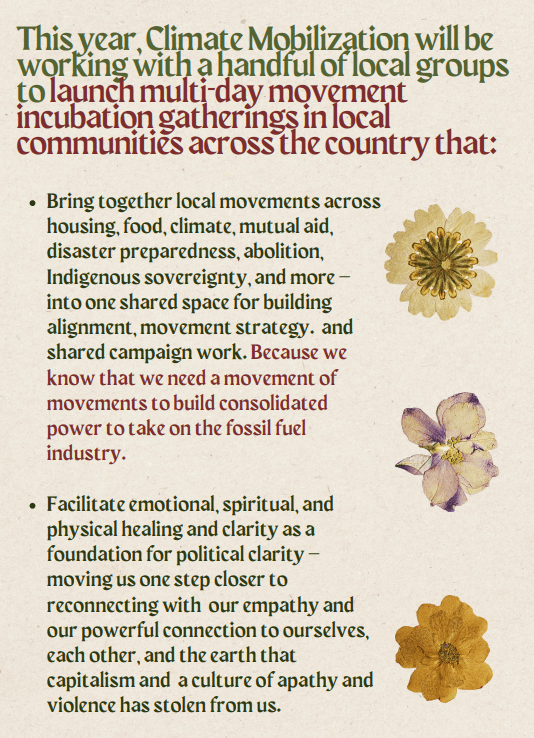
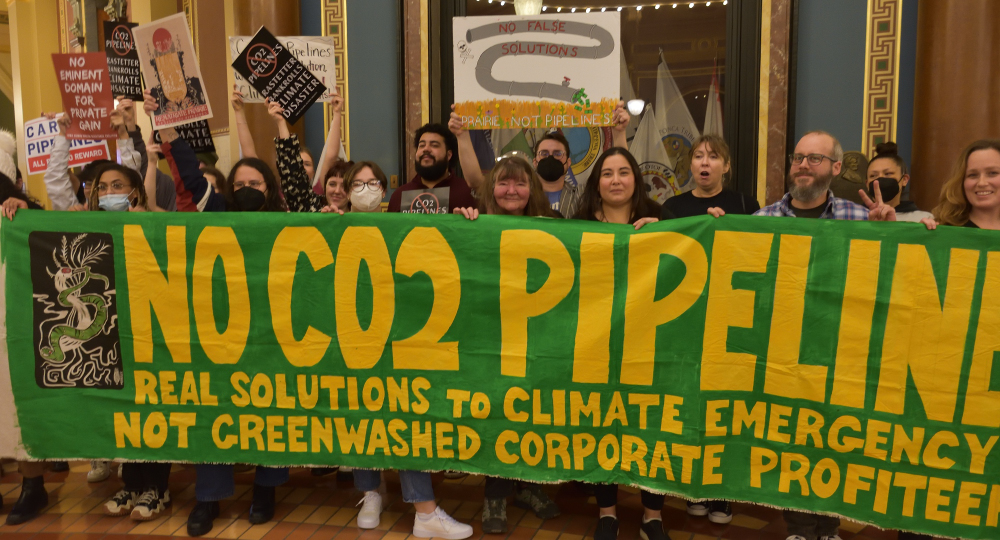
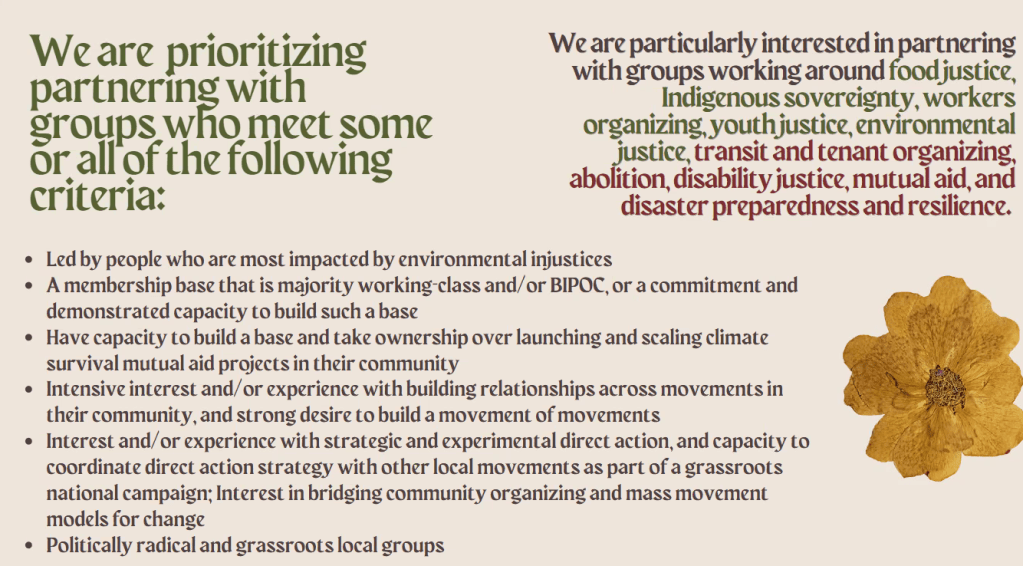
Recently I’ve been in contact with the Climate Mobilization Network, which has re-evaluated their strategies to address our climate emergency. “We are incubating local movements rooted in healing, community care, and climate survival mutual aid that asserts our needs in the face of climate disaster.”
Why We Decide to Pause and Transform our Strategy
Congressional failure to take meaningful action on climate
The slow pace of local climate programs where policy change is severely limited by what’s considered politically possible
Rising inequality amid continued neoliberalism
Escalating climate disasters that are hitting global and US-based frontline communities the hardest and will continue accelerating rapidly!
And widespread cultural and generational concern about climate change has not yet been tapped into effectively by a mass movement.
This collective visioning, movement incubation and learning gathering will equip you with space for reflection, new ideas, inspiration, and next steps to participate in this new campaign.
Together we will build relationships and explore:
How survival and mutual aid programs can grow the movement
New, creative approaches to taking action against fossil fuels
Ways to integrate healing into our work
And how to create space for reflection, intentionality and strategic clarity
“Quakers will only be truly prophetic when they risk a great deal of their accumulated privilege and access to wealth. Prophets cannot have a stake in maintaining the status quo. Any attempt to change a system while benefiting and protecting the benefits received from the system reinforces the system. Quakers as much as anyone not only refuse to reject their white privilege, they fail to reject the benefits they receive from institutionalized racism, trying to make an unjust economy and institutionalized racism and patriarch more fair and equitable in its ability to exploit. One can not simultaneously attack racist and patriarchal institutions and benefit from them at the same time without becoming more reliant upon the benefits and further entrenching the system. Liberalism at its laziest.”
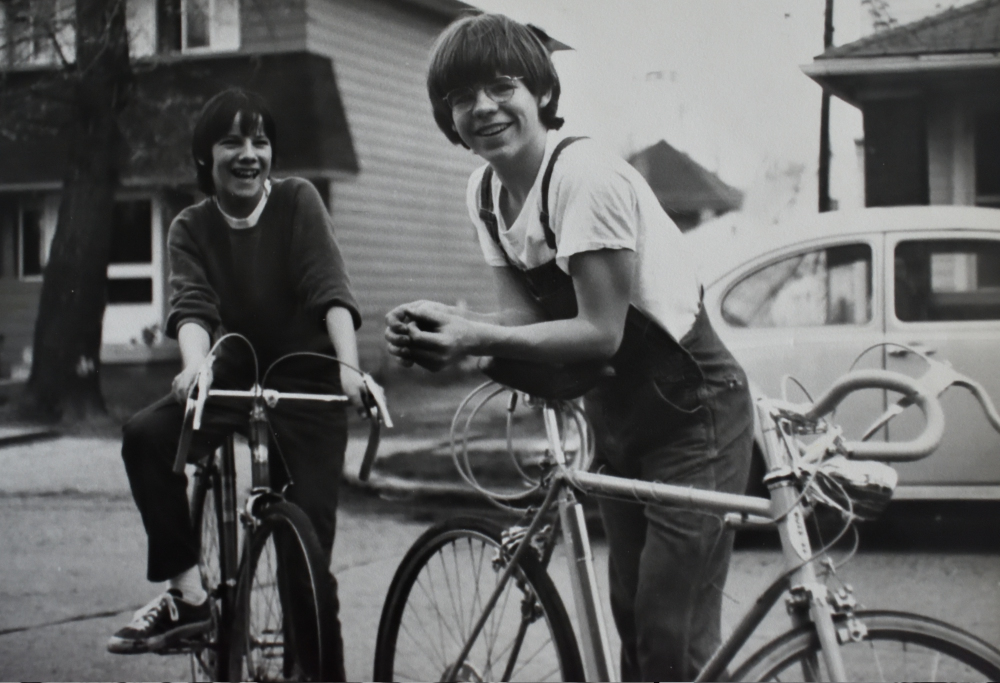
It is humbling to realize mistakes I’ve made over the course of many years. In the 1970’s, when I moved to Indianapolis, the foul air from automobile exhaust convinced me I could not add to the environmental damage, and I was led by the Spirit to live without a car since. People of faith believe our actions should reflect our convictions. And while a life without a car was right for me, I could not convince others to do the same. This was a source of contention with my Quaker meeting. This is a significant challenge for people living in rural areas, as was the case with many of the meeting members.
There was a breakthrough of sorts when a Quaker friend asked if I had invited the (Quaker) meeting into this concern, and I realized I had not done so. That led us to consider, together, what could be done, i.e. what would be possible for us to do in the current circumstances. And led to the Minute we called Ethical Transportation (see below).
While riding bicycles might not seem that significant, the importance is that it is a concrete thing that could be done. My error in pleading for people to give up their cars was not working, in part because I hadn’t shared ways to make the transition. I knew it was possible, if not often inconvenient, to do so where mass transit is available.
But I hadn’t fully realized “living and working, having lifestyles and livelihoods that are truly regenerative and sustainable look nothing like how most of us currently live and work.”
I’m exploring these things now as I advocate for the adoption of Mutual Aid. Being involved in Mutual Aid for three years has given me the experience to speak from. It was the Spirit that led me to Des Moines Mutual Aid. And that leads me to advocate for Quakers and others to adopt Mutual Aid. This time, I’m trying to envision practical ways to transition to the Mutual Aid model.
Capitalism is destroying our environment (because it is based upon fossil fuels), and the hierarchies of capitalism enforce structures of superiority, privilege, and oppression. Historically Quakers have worked for justice, against injustice. Capitalism is a profoundly unjust system. At the end of this is a Quaker statement about economic justice.
The concept of dual power means transitioning from current circumstances to desired change. I am hoping my Quaker meeting will support my leading to explore how Mutual Aid can be used to support our justice work. And how Mutual Aid can support our spirituality, and connections with others in the communities our meetings are located in.
Living and working, having lifestyles and livelihoods that are truly regenerative and sustainable look nothing like how most of us currently live and work.
Kim Kendall
Living and working, having lifestyles and livelihoods that are truly regenerative and sustainable look nothing like how most of us currently live and work.
When we are told we need to cut fossil fuel emissions in half by 2030 we not only need to completely reorganize our energy systems (deep decarbonization), we also need to completely reorganize our day-to-day lives. When thoughtful authors speak of the need for “the deep transformation” of our values and sense of connection to Earth, the need for transformative or “quantum” social change, what exactly are they getting at? What would that transformation look like on a day-to-day basis for the majority of us? And what is getting in the way?
I hear a lot of vague talk about the need for a shift in our spiritual orientation and economic goals in order to move forward more sustainably and grapple with the inevitable stressors fueled by the climate crisis. Some authors also refer to the greater levels of happiness we could experience living more simply. Gratefully these latter authors are coming close to describing the changes that the large majority of us need to make implied in the idea of living more simply. But notions of increased happiness and simplicity while helpful, are not sufficient to get us going, because they omit reference to practical strategies that are available to us and overlook significant sociocultural barriers in our way.
Against the Economic Grain: Addressing the Social Challenges of Sustainable Livelihoods by Kim Kendall, Resilience.org, January 27, 2023
Ethical transportation
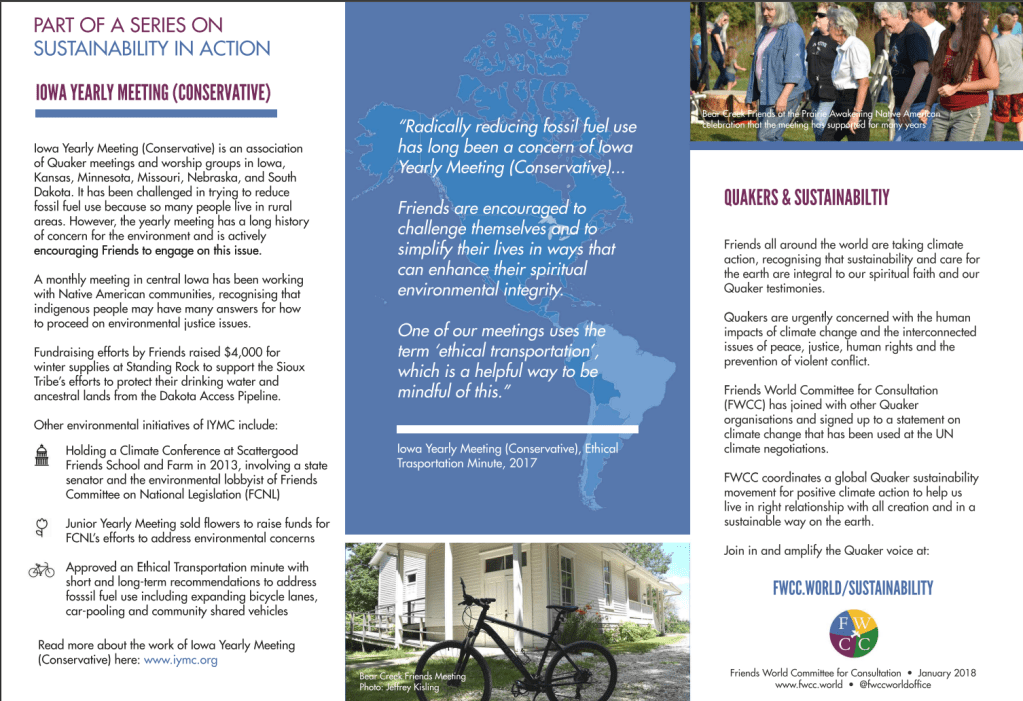
Radically reducing fossil fuel use has long been a concern of Iowa Yearly Meeting (Conservative). A previously approved Minute urged us to reduce our use of personal automobiles. We have continued to be challenged by the design of our communities that makes this difficult. This is even more challenging in rural areas. But our environmental crisis means we must find ways to address this issue quickly.
Friends are encouraged to challenge themselves and to simplify their lives in ways that can enhance their spiritual environmental integrity. One of our meetings uses the term “ethical transportation,” which is a helpful way to be mindful of this.
Long term, we need to encourage ways to make our communities “walkable”, and to expand public transportation systems. These will require major changes in infrastructure and urban planning.
Carpooling and community shared vehicles would help. We can develop ways to coordinate neighbors needing to travel to shop for food, attend meetings, visit doctors, etc. We could explore using existing school buses or shared vehicles to provide intercity transportation.
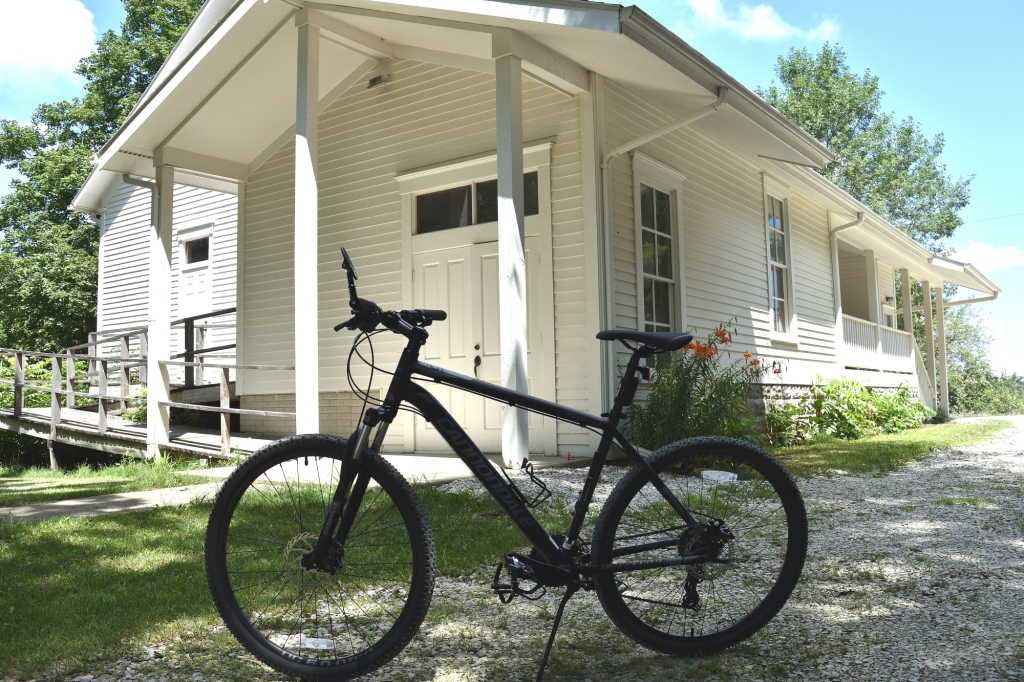
One immediately available step would be to promote the use of bicycles as a visible witness for non-fossil fuel transportation. Friends may forget how easy and fun it can be to travel miles on bicycles. Neighbors seeing families riding their bicycles to Quaker meetings would have an impact on community awareness. This is a way for our children to be involved in this shared witness. We should encourage the expansion of bicycle lanes and paths. We can repair and recycle unused bicycles, and make them available to those who have the need.
May we look upon our treasures, the furniture of our houses, and our garments, and try whether the seeds of war have nourishment in these our possessions. John Woolman, A Word of Remembrance and Caution to the Rich published posthumously, 1793
I will never adjust myself to economic conditions that will take necessities from the many and give luxuries to the few. Martin Luther King, Jr., speaking in Cleveland Heights, Ohio, [St Paul’s Episcopal Church] 1963
Friends’ historical testimony has included the message that all people are equal, and deserve to share equally in the blessings of creation. The world is far from this ideal, and most in Iowa Yearly Meeting (Conservative) have benefited from global and local inequalities, however inadvertently. But we also suffer spiritually and otherwise because of the injustice in which we participate.
Friends believe that we should live in ways that do not “sow seeds of war.” Many are called to act in quiet or public ways to promote lifestyle choices, policies, laws, and treaties that will ensure the basic human rights of all people, including the rights to safe and healthy places to live and work. Historically, Friends have been able to help correct major injustices such as slavery, inhumane conditions for prisoners, and inequality in the treatment of women. The magnitude of current problems caused by economic injustice does not excuse Friends from the struggle against it, but makes obedience to God’s call all the more necessary.
Friends are reminded that there can be no peace without justice, and to live simply, so others may simply live. Many Friends find seeds of war and injustice in their lifestyles. Friends are challenged to participate constructively in the economy by supporting fair trade, choosing investments with attention to their social impact, and purchasing products produced under safe and healthy conditions. What each can do individually may not seem like much, but, guided by the Spirit and added to the efforts of others, it can make a difference.
The Book of Discipline ofIowa Yearly Meeting of Friends (Conservative) Religious Society of Friends
Will the existential threat of environmental devastation ever be taken seriously by capitalist countries?
Approval of the Willow Project is just the latest decision that will result in the emission of tons of carbon dioxide into the atmosphere. Another recent decision by the Biden administration was the release of millions of barrels of oil from the Strategic Petroleum Reserve solely to bring down gas prices.
The administration’s justifications were the valid leases of ConocoPhillips and that the courts would block the rejection of the project. One point is what are “valid rights on the land” in regard to Indigenous peoples?
As long as capitalism is the economic model of a country, fossil fuels will continue to be burned to drive that economy. Which is why we need to move to models such as Mutual Aid where profits are not the goal of society as soon as possible.
The Biden administration was limited by legal restraints in reviewing the Willow oil project, according to a White House official who said the company had valid rights on the land because of decades-old leases.
The administration was convinced the courts would have blocked an outright rejection of the Willow project and potentially imposed fines on the government, said the official, who spoke about the White House’s considerations on the condition of anonymity.
Biden approves Willow Project. What to know about the move to allow oil drilling in Alaska by Sarah Elbeshbishi, USA Today, March 15, 2023
Instead of sticking to his own climate goals and listening to the people of the Village of Nuiqsut and the millions of us who got #StopWillow to nearly one billion views on TikTok, he let the fossil fuel industry win.
The Willow Project is a dangerous climate bomb — an $8 billion fossil fuel infrastructure project in Alaska, which would emit over 287 metric tons of carbon dioxide into the atmosphere, threaten Indigenous Alaska Native communities and destroy wild landscapes north of the Arctic Circle.
We’re living through an unprecedented climate crisis that will wreak havoc upon the lives of billions of people across the world, and for generations to come. We can’t afford any more drilling on our land.
The decision on Willow is shameful and a devastating blow to our generation. And it’s a reminder that the fossil fuel industry still holds so much power over us and our future. But if we can build enough people power, we know that together, we can defeat them.
We are the generation of a Green New Deal and we will keep fighting for our planet and our futures.
Sunrise Movement
We are the generation of a Green New Deal and we will keep fighting for our planet and our futures.
Sunrise Movement
The Biden administration on Monday announced that it is approving the largest-ever proposed oil drilling project on U.S. public lands, in a direct repudiation of research warning that new fossil fuel development must cease to preserve a safe climate.
The Interior Department approved ConocoPhillips Alaska’s Willow project, located in one of the fastest-warming regions of the world. If completed, this project would produce the equivalent of an estimated 263 million tons of carbon dioxide over 30 years. This is about the same as building 20 new gas plants and running them for the same time period; burning 8.8 billion pounds of coal every year for 30 years; or adding 1.7 million cars to the road.
Willow is not just an “environmentalist” concern. HEATED analyzed 30 national news stories about the Willow project and found that 75 percent framed its importance as primarily political by Arielle Samuelson and Emily Atkin, HEATED, March 15, 2023
Quakers have a long history of working for justice and social change. But what do we (Quakers) do when we realize change is necessary now? Throughout our history we have been led to see we are implicated in injustice. “Led” means the Spirit has shown what the injustices are, and what changes should be made. Most commonly, individuals discern what change is needed, and over time they and the Spirit convince others.
As my friend Lucy Duncan writes, “we as White Quakers like to think of ourselves as ahead or better than dominant culture, but we have been complicit in a system and mindset that are ubiquitous.”
The myths we tell ourselves and the lies those myths uphold are embedded in our contemporary faith practice. When we believe and perpetuate falsehoods about ourselves, it not only disconnects us from the truth, it also limits our ability to act with full integrity today. Telling the truth about ourselves and our White Quaker ancestors grounds us in reality, in a sense of the complexity of our identity. It allows us to create a different future, not built from delusion and half of the story but from an honest and grounded reckoning with who we are and who we have been. My friend Mila Hamilton calls this “intergenerational transformative justice.” As we deal with the uncomfortable truths of our White Quaker ancestors, we release them from the amber in which our myths have captured them. As we allow them to become the full, flawed humans they were, we also free ourselves to reckon with our present, which arises from their past, and to tell the full truth of who we are.
…
We as White Quakers like to think of ourselves as ahead or better than dominant culture, but we have been complicit in a system and mindset that are ubiquitous. Claiming the full truth of our history and committing to repair the harms done are deeply spiritual acts of healing our own wounds of disconnection. I would argue it is the pathway upon which we can, perhaps for the first time, discover and invigorate our faith with its full promise.
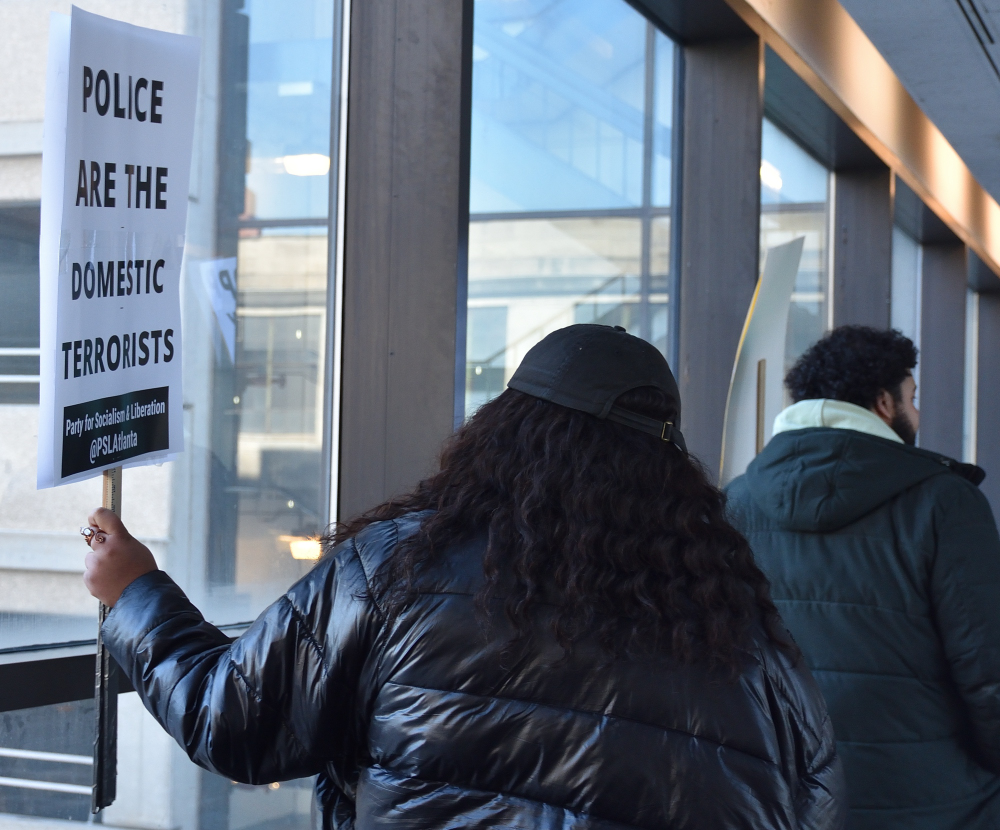
What would it mean for us to take seriously and collectively as a Religious Society a call to finish the work of abolition, hand in hand and side by side with those affected and their loved ones? What would it mean for us to stand fully with the calls to abolish the police and fully fund community needs instead? What would it mean to reckon with our past complicity with harm and fully dedicate ourselves to the creation of a liberating Quaker faith that commits to build the revolutionary and healing faith we long to see come to fruition? What would it look like to finally and fully abolish slavery?
It can take a long time for change to occur. Personally, I’ve been working since the early 1970’s to convince Friends to consider my spiritual leading to drastically reduce our carbon footprint, including not having an automobile.
Most of our values, beliefs and assumptions regarding livelihoods need to be radically transformed in order to move into activities that are sustainable. If this transition is ever to occur, we must be able to visualize and share the details of these alternative occupations and embrace new social metrics to support those occupations.
I try to imagine myself making a move into a livelihood that would be fundamentally sustainable like the critical but overlooked work done by a young man I know who shuttles vegetable waste from homes in his neighborhood to a small composting center in his community by bicycle. He then sells and delivers by bike finished compost to neighbors with gardens. If I chose to move into this “career” my friends would think I had lost my mind. My friends might ridicule me. Certainly, they would worry about me! And worse, some people, perhaps even including my spouse, might simply think they no longer had anything in common with me. It’s like giving up alcohol in an alcohol inundated world. You stand outside, you are not one of the groups any longer. In reality, I would need to build an entirely new social network with different values and notions of success, a network that would respect my choices and understand their importance. Because living and working, having lifestyles and livelihoods that are truly regenerative and sustainable look nothing like how most of us live and work now. The cultural transition and change in our values and the metrics we use to measure our sense of success, therefore our identities, is hard to imagine, not to mention implement.
Nevertheless, I have interviewed people with very low carbon livelihoods and lifestyles, highly moral people who work and live outside of mainstream jobs and careers. And guess what? They did indeed initially have to suffer social backlash from family and friends for their lifestyle and work choices.
Against the Economic Grain: Addressing the Social Challenges of Sustainable Livelihoods by Kim Kendall, Resilience.org, January 27, 2023
One of the things I appreciate in our spiritual practice is for the Quaker meeting to use questions to consider where we are today in our faith. For example, the following are the queries related to social and economic justice.
“For when I was hungry you gave me food, when thirsty you gave me drink, when I was a stranger you took me into your home, when naked you clothed me, when in prison you visited me.” Matthew 25:35‑36
ADVICE
We are part of an economic system characterized by inequality and exploitation. Such a society is defended and perpetuated by entrenched power.
Friends can help relieve social and economic oppression and injustice by first seeking spiritual guidance in our own lives. We envision a system of social and economic justice that ensures the right of every individual to be loved and cared for; to receive a sound education; to find useful employment; to receive appropriate health care; to secure adequate housing; to obtain redress through the legal system; and to live and die in dignity. Friends maintain historic concern for the fair and humane treatment of persons in penal and mental institutions.
Wide disparities in economic and social conditions exist among groups in our society and among nations of the world. While most of us are able to be responsible for our own economic circumstances, we must not overlook the effects of unequal opportunities among people. Friends’ belief in the Divine within everyone leads us to support institutions which meet human needs and to seek to change institutions which fail to meet human needs. We strengthen community when we work with others to help promote justice for all.
QUERIES
How are we beneficiaries of inequity and exploitation? How are we victims of inequity and exploitation? In what ways can we address these problems?
What can we do to improve theconditions in our correctional institutions and to address the mental and social problems of those confined there?
How can we improve our understanding of those who are driven to violence by subjection to racial, economic or political injustice? In what ways do we oppose prejudice and injustice based on gender, sexual orientation, class, race, age, and physical, mental and emotional conditions? How would individuals benefit from a society that values everyone? How would society benefit?
“We are part of an economic system characterized by inequality and exploitation. Such a society is defended and perpetuated by entrenched power. How are we beneficiaries of inequity and exploitation? How are we victims of inequity and exploitation? In what ways can we address these problems?”
Injustice cannot be addressed as long as we are involved in the system of injustice, in this case, capitalism. As my good friend Ronnie James says:
I’m of the firm opinion that a system that was built by stolen bodies on stolen land for the benefit of a few is a system that is not repairable. It is operating as designed, and small changes (which are the result of huge efforts) to lessen the blow on those it was not designed for are merely half measures that can’t ever fully succeed.
So, the question is now, where do we go from here? Do we continue to make incremental changes while the wealthy hoard more wealth and the climate crisis deepens, or do we do something drastic that has never been done before? Can we envision and create a world where a class war from above isn’t a reality anymore?”
Ronnie James
The following is a diagram I’ve been working on for several years to visualize unjust systems and possible alternatives. On the left is capitalism, built on colonialism. The red vertical bar indicates forces that interfere with making changes. Failing and corrupt institutions, authoritarianism, and environmental chaos. If we can move past those resistances, we can build communities for a viable and just future.
I’ve been part of a Mutual Aid community for the past three years. That experience convinces me the Mutual Aid is a vital component of a more just future for us all. It is a way to escape the capitalist economic system, which I’ve written about extensively. (See: https://quakersandreligioussocialism.com/mutual-aid/ )
I’ve had a lifelong struggle to call attention to this country’s flagrant disregard for the need to protect nonrenewable sources of energy and the mounting environmental devastation from our greenhouse gas emissions. Obviously, these are also global issues. We are depleting fossil fuel supplies of the entire world. And our gigantic fossil fuel emissions affect the world.
It is often pointed out that those nations with the lowest emission are most affected by the environmental damage done by “developed” countries.
I haven’t learned enough about these global impacts. This recent paper, Eight Contradictions in the Imperialist ‘Rules-Based Order’ that I’ve been writing about is helping with my education. (See: https://quakersandreligioussocialism.com/?s=imperialism )
Eight Contradictions in the Imperialist ‘Rules-Based Order’
The contradiction between moribund imperialism and an emerging successful socialism led by China.
The contradiction between the ruling classes of the narrow band of imperialist G7 countries and the political and economic elite of capitalist countries in the Global South.
The contradiction between the broad urban and rural working class and sections of the lower petty bourgeoisie (collectively known as the popular classes) of the Global South versus the US-led imperial power elite.
The contradiction between advanced rent-seeking finance capital versus the needs of the popular classes, and even some sections of capital in non-socialist countries, regarding the organisation of societies’ requirements for investment in industry, environmentally sustainable agriculture, employment, and development.
The contradiction between the popular classes of the Global South and their domestic political and economic power elites.
The contradiction between US-led imperialism versus nations strongly defending national sovereignty.
The contradiction between the millions of discarded working-class poor in the Global North versus the bourgeoisie who dominate these countries.
The contradiction between Western capitalism versus the planet and human life.
The eighth contradiction summarizes the fundamental contradiction, the contradiction between Western capitalism versus the planet and human life.
The inexorable path of this system is to destroy the planet and human life, threaten nuclear annihilation, and work against the needs of humanity to collectively reclaim the planet’s air, water, and land and stop the nuclear military madness of the United States. Capitalism rejects planning and peace. The Global South (including China) can help the world build and expand a ‘zone of peace’ and commit to living in harmony with nature.
With these changes in the political landscape, we are witnessing the rise of an informal front against the US-dominated imperialist system. This front is constituted by the convergence of:
Popular sentiment that this violent system is the main enemy of the people of the world.
Popular desires for a more just, peaceful, and egalitarian world.
The struggle of socialist or nationalist governments and political forces for their sovereignty.
The desires of other Global South countries to reduce their dependence on this system.
The main forces against the US-dominated imperialist system are the peoples of the world and the socialist and nationalist governments. However, there must be space provided for integrating governments that wish to reduce their dependency on the imperialist system.
The world currently stands at the beginning of a new era in which we will witness the end of the US global empire. The neoliberal system is deteriorating under the weight of numerous internal contradictions, historical injustices, and economic unviability. Without a better alternative, the world will descend into even greater chaos. Our movements have revived hope that something other than this social torment is possible.
What do you know about China? I’m beginning to learn how little I know. I’m just beginning to learn about socialism with Chinese characteristics, so I don’t know how successful socialism is there.
I recently wrote about a new text called Eight Contradictions in the Imperialist ‘Rules-Based Order’, (see: Contradictions of the Imperialist ‘Rules-Based Order’). I have been increasingly concerned about this country’s militarism and authoritarianism. Increasing poverty and failure to address anything related to increasingly severe climate chaos. And the choice that MUST be made between protecting our environment versus continuation of military operations and war.
The world currently stands at the beginning of a new era in which we will witness the end of the US global empire. The neoliberal system is deteriorating under the weight of numerous internal contradictions, historical injustices, and economic unviability.
Vijay Prashad, Tricontinental: Institute for Social Research
…leaders in the Global South have been making the case to halt the warmongering over Ukraine and against China. As Namibia’s Prime Minister Saara Kuugongelwa-Amadhila said, ‘We are promoting a peaceful resolution of that conflict so that the entire world and all the resources of the world can be focused on improving the conditions of people around the world instead of being spent on acquiring weapons, killing people, and actually creating hostilities’.
The first of the Eight Contradictions in the Imperialist ‘Rules-Based Order’ is the contradiction between moribund imperialism and an emerging successful socialism led by China.
This contradiction has intensified because of the peaceful rise of socialism with Chinese characteristics. For the first time in 500 years, the Atlantic imperialist powers are confronted by a large, non-white economic power that can compete with them. This became clear in 2013 when China’s GDP in purchasing power parity (PPP) overtook that of the United States. China accomplished this in a much shorter period than the West, with a significantly larger population and without colonies, enslaving others, or military conquest. Whilst China stands for peaceful relations, the US has become increasingly bellicose.
The US has led the imperialist camp since World War II. Post-Angela Merkel and with the advent of the Ukraine military operation, the US strategically subordinated dominant sections of the European and Japanese bourgeoisie. This has resulted in weakening intra-imperialist contradictions. The US first permitted and then demanded that both Japan (the third-largest economy in the world) and Germany (the fourth-largest economy) – two fascist powers during World War II – greatly increase their military expenditure. The result has been the ending of Europe’s economic relationship with Russia, damage to the European economy, and economic and political benefits for the US. Despite the capitulation of most of Europe’s political elite to full US subordination, some large sections of German capital are heavily dependent on trade with China, much more than on their US counterparts. The US, however, is now pressuring Europe to downgrade its ties to China.
The US has led the imperialist camp since World War II. Post-Angela Merkel and with the advent of the Ukraine military operation, the US strategically subordinated dominant sections of the European and Japanese bourgeoisie. This has resulted in weakening intra-imperialist contradictions. The US first permitted and then demanded that both Japan (the third-largest economy in the world) and Germany (the fourth-largest economy) – two fascist powers during World War II – greatly increase their military expenditure. The result has been the ending of Europe’s economic relationship with Russia, damage to the European economy, and economic and political benefits for the US. Despite the capitulation of most of Europe’s political elite to full US subordination, some large sections of German capital are heavily dependent on trade with China, much more than on their US counterparts. The US, however, is now pressuring Europe to downgrade its ties to China.
More importantly, China and the socialist camp now face an even more dangerous entity: the consolidated structure of the Triad (the United States, Europe, and Japan). The US’s growing internal social decay should not mask the near absolute unity of its political elite on foreign policy. We are witnessing the bourgeoisie placing its political and military interests over its short-term economic interests.
The centre of the world economy is shifting, with Russia and the Global South (including China) now accounting for 65% of the world’s GDP (measured in PPP). From 1950 until the present, the US share of the global GDP (in PPP) has fallen from 27% to 15%. The growth of the US’s GDP has also been declining for more than five decades and has now fallen to only around 2% per year. It has no large new markets in which to expand. The West suffers from an ongoing general crisis of capitalism as well as the consequences of the long-term tendency of the rate of profit to decline.
I had not known about socialism with Chinese characteristics.
Socialism with Chinese characteristics
Socialism with Chinese characteristics (Chinese: 中国特色社会主义; pinyin: Zhōngguó tèsè shèhuìzhǔyì) is a set of political theories and policies of the Chinese Communist Party (CCP) that are seen by their proponents as representing Marxism–Leninism adapted to Chinese circumstances and specific time periods, consisting of Deng Xiaoping Theory, Three Represents (Jiang Zemin), Scientific Outlook on Development (Hu Jintao), and Xi Jinping Thought on Socialism with Chinese Characteristics for a New Era.
Have your views about our environmental situation changed? It is more difficult to deny environmental damage in the face of all kinds of climate chaos occurring globally.
Did you know the U.S. Military emits more carbon dioxide than many nations?
This leads to an existential paradox. If we are ever going to begin to mitigate greenhouse gas emissions, we must end military operations. Could this be a path to peace? Or will imperialism continue to feed increasing environmental devastation?
The new document described below, “Eight Contradictions in the Imperialist ‘Rules-Based Order’” identifies conflicts between imperialist nations and the rest of the world.
"The bottom line is that this money that is used to buy weapons to enable Russia and Ukraine to kill one another could be better utilised to promote development – in Ukraine, Africa, Asia, and in Europe itself."
The Bulletin of the Atomic Scientists has now moved the Doomsday Clock to 90 seconds to midnight, the closest it has been to the symbolic time of the annihilation of humanity and the Earth since 1947. This is alarming, which is why leaders in the Global South have been making the case to halt the warmongering over Ukraine and against China. As Namibia’s Prime Minister Saara Kuugongelwa-Amadhila said, ‘We are promoting a peaceful resolution of that conflict so that the entire world and all the resources of the world can be focused on improving the conditions of people around the world instead of being spent on acquiring weapons, killing people, and actually creating hostilities’.
In line with the alarm from the Doomsday Clock and assertions from people such as Kuugongelwa-Amadhila, the rest of this newsletter features a new text called Eight Contradictions in the Imperialist ‘Rules-Based Order’(which you can download as a PDF here). It was drafted by Kyeretwie Opoku (the convenor of the Socialist Movement of Ghana), Manuel Bertoldi (Patria Grande /Federación Rural para la producción y el arraigo), Deby Veneziale (senior fellow, Tricontinental: Institute for Social Research), and me, with inputs from senior political leaders and intellectuals from across the world. We are offering this text as an invitation to a dialogue. We hope that you will read, circulate, and discuss it.
We are now entering a qualitatively new phase of world history. Significant global changes have emerged in the years since the Great Financial Crisis of 2008. This can be seen in a new phase of imperialism and changes in the particularities of eight contradictions.
Eight Contradictions in the Imperialist ‘Rules-Based Order’
The contradiction between moribund imperialism and an emerging successful socialism led by China.
The contradiction between the ruling classes of the narrow band of imperialist G7 countries and the political and economic elite of capitalist countries in the Global South.
The contradiction between the broad urban and rural working class and sections of the lower petty bourgeoisie (collectively known as the popular classes) of the Global South versus the US-led imperial power elite.
The contradiction between advanced rent-seeking finance capital versus the needs of the popular classes, and even some sections of capital in non-socialist countries, regarding the organisation of societies’ requirements for investment in industry, environmentally sustainable agriculture, employment, and development.
The contradiction between the popular classes of the Global South and their domestic political and economic power elites.
The contradiction between US-led imperialism versus nations strongly defending national sovereignty.
The contradiction between the millions of discarded working-class poor in the Global North versus the bourgeoisie who dominate these countries.
The contradiction between Western capitalism versus the planet and human life.
In my mind, Indigenous nations, Indigenous homespaces, Indigenous homelessness must be engaged in a radical and complete overturning of the nation-state’s political formations and a refusal of racial capitalism. My vision to create Nishnaabeg futures and presences must structurally refuse and reject the structures, processes and practices that end Indigenous life, Black life and result in environmental desecration. This requires societies that function without policing, prisons, and property.
Nishnaabeg formations of nationhood mean a radical overturning of the current conditions and configurations within which we live—an absolute refusal of capitalism.
Maynard, Robyn; Simpson, Leanne Betasamosake. Rehearsals for Living (Abolitionist Papers) (p. 125). Haymarket Books. Kindle Edition.
I previously began to describe the Cecosesola Co-op (See: http://bit.ly/3mrdtop). I had been doing research to find examples of large mutual aid communities when I started to see stories about Cecosesola. This InfoGraphic from Venequelanalysis shows there are one thousand three hundred people involved.
On September 29, 2022, Cecosesola received the Right Livelihood Award, a Swedish prize often known as the “Alternative Nobel Prize.” This award honors people and organizations that encourage social change. According to a statement issued by the Right Livelihood Foundation, the prize was given to Cecosesola for “establishing an equitable and cooperative economic model as a robust alternative to profit-driven economies.”
In what follows, we talk to three of the cooperative’s associates – Lizeth Vargas, Ender Duarte, and Gustavo Salas – about their project which serves hundreds of thousands of people and is a model for non-hierarchical organizational practices.
An Alternative to Capitalist Hierarchies: A Conversation with the Cecosesola Co-op. A Venezuelan cooperative network that recently received the “Alternative Nobel Prize” tells its story By Cira Pascual Marquina – Venezuelanalysis, Nov 20th 2022.
maps.google.com
Can you tell us the story of Cecosesola?
Gustavo Salas: Cecosesola was born in the 1960s when the Centro Gumilla [a Catholic investigation center for social action] promoted the organizing of cooperatives in the most precarious barrios of Barquisimeto [Lara state, center-western Venezuela]. That is when poor, working-class people began to set aside a bit of money every month to build their own cooperatives.
In other countries, co-ops have a middle-class base, but many Venezuelan cooperatives have a working-class one: that is, co-ops here often begin to take shape in the poorest barrios.
The first cooperatives in Barquisimeto were founded by people with a great deal of commitment to social work and community work. They eventually came together in Cecosesola, a co-op center or a co-op of co-ops [the acronym stands for Central Cooperativa de Servicios Sociales de Lara]. The first Cecosesola project was one that addressed an immediate need of the people: funerary services.
An Alternative to Capitalist Hierarchies: A Conversation with the Cecosesola Co-op. A Venezuelan cooperative network that recently received the “Alternative Nobel Prize” tells its story By Cira Pascual Marquina – Venezuelanalysis, Nov 20th 2022.
This first iteration of building the community didn’t succeed. Interestingly, it was a bus boycott that re-initiated Cecosesola, which brings to mind the Montogomery bus boycott of 1955-56.
National coverage of the boycott and King’s trial resulted in support from people outside Montgomery. In early 1956 veteran pacifists Bayard Rustin and Glenn E. Smiley visited Montgomery and offered King advice on the application of Gandhian techniques and nonviolence to American race relations. Rustin, Ella Baker, and Stanley Levison founded In Friendship to raise funds in the North for southern civil rights efforts, including the bus boycott. King absorbed ideas from these proponents of nonviolent direct action and crafted his own syntheses of Gandhian principles of nonviolence. He said: “Christ showed us the way, and Gandhi in India showed it could work” (Rowland, “2,500 Here Hail”).
On 5 June 1956, the federal district court ruled in Browder v. Gayle that bus segregation was unconstitutional, and in November 1956 the U.S. Supreme Court affirmed Browder v. Gayle and struck down laws requiring segregated seating on public buses. The court’s decision came the same day that King and the MIA were in circuit court challenging an injunction against the MIA carpools. Resolved not to end the boycott until the order to desegregate the buses actually arrived in Montgomery, the MIA operated without the carpool system for a month. The Supreme Court upheld the lower court’s ruling, and on 20 December 1956 King called for the end of the boycott; the community agreed. The next morning, he boarded an integrated bus with Ralph Abernathy, E. D. Nixon, and Glenn Smiley. King said of the bus boycott: “We came to see that, in the long run, it is more honorable to walk in dignity than ride in humiliation. So … we decided to substitute tired feet for tired souls, and walk the streets of Montgomery”
Montgomery Bus Boycott, Stanford University, The Martin Luther King, Jr. Research and Education Institute
A few years after the foundation of Cecosesola, in 1974, there was a feeling of dissatisfaction brewing among workers and members. Enthusiasm and hopes had vanished, and Cecosesola was now closer to a capitalist enterprise than a social movement or a community-based organization.
As it happens, Cecosesola was immersed in an internal debate. At the time, people of Barquisimeto were on the streets en masse, protesting a hike in bus fares. That is when the Cecosesola bases, those who were pushing to reinstate the original grassroots logic of the organization saw an opportunity to rekindle the cooperative project. Following Cecosesola’s early footsteps and grassroots mission, we built a transportation project that would keep fares down. There were no bosses in this project, which thus reactivated our on-the-ground work. In the end, we ended up assuming many transport routes in Barquisimeto.
Even though the transportation initiative was associated with Cecosesola, it didn’t reproduce the existing hierarchical order. The project became an opportunity to reorganize things and do away with bosses. In fact, the transport initiative would hold massive meetings on a regular basis, and all 300 associated workers would participate in each meeting!
In the beginning, the whole thing was very chaotic: collective decision-making isn’t easy when society is completely based on hierarchies. However, as the transport project became consolidated, it began to leave its imprint on Cecosesola. Eventually, we displaced the conventional top-down model with a system of direct participation that integrates workers and associates alike.
That is how Cecosesola, including its funerary services, was returned to the community, to its origins. Now we have an open administration without intermediation and with direct participation.
An Alternative to Capitalist Hierarchies: A Conversation with the Cecosesola Co-op. A Venezuelan cooperative network that recently received the “Alternative Nobel Prize” tells its story By Cira Pascual Marquina – Venezuelanalysis, Nov 20th 2022.
What are the principles behind Cecosesola’s modus operandi?
Ender Duarte: Rather than principles set out on paper, we have a set of ideas or principles that organize and regulate our day-to-day practices.
Our key ideas are mutuality, respect, and transparency, which are all important to building relationships of trust. In other words, mutual care and solidarity are our driving forces.
These practices guide our day-to-day activities, be they funerary services, healthcare, or food production and distribution. If we break away from our fundamentals, we would break the relationships of trust that we have been developing with so much care and love.
As we work, we are doing away with relations based on exploitation and domination. Ours is an organization without bosses. Over the years we have learned that the ever-present shadow of hierarchies can only be abolished with mutual respect and trust.
An Alternative to Capitalist Hierarchies: A Conversation with the Cecosesola Co-op. A Venezuelan cooperative network that recently received the “Alternative Nobel Prize” tells its story By Cira Pascual Marquina – Venezuelanalysis, Nov 20th 2022.
What are the main teachings that Cecosesola can share with people about how to make a better world?
Gustavo Salas: If we want to transform our society, we have to do away with hierarchies. When Cecosesola was born, it generated a great deal of enthusiasm and passion. However, when a conventional, top-down administration emerged, that flower wilted. The hierarchical structure separated people from the organization and they went back home. Why? Even when a boss or leader figure has good intentions, the other vanishes: he or she is erased.
When Cecosesola was re-initiated, we did so by going back to the basics. We rebuilt an organization where everyone has a voice and everyone counts. If we really want to live in a more just society, we have to break away from the prevailing logic, and we have to find new organizational models.
Capitalist enterprises are not a model for us; the same goes for governmental enterprises. At Cecosesola we are exploring a new model based on mutuality. The model works, so now we are working hard to perfect it.
An Alternative to Capitalist Hierarchies: A Conversation with the Cecosesola Co-op. A Venezuelan cooperative network that recently received the “Alternative Nobel Prize” tells its story By Cira Pascual Marquina – Venezuelanalysis, Nov 20th 2022.
When I’m overwhelmed with complexity and questions, I try to express things visually. Following is the most recent iteration of something I’ve been working on for years.
The most recent change is the red line, representing how failing and corrupt institutions, authoritarianism, and environmental chaos, are blocking solutions like LANDBACK, Black Liberation, Abolition, and Mutual Aid. The forces being used by empire to crush dissent are escalating rapidly.
I still believe Mutual Aid, Abolition, and all the pieces of the Red/Green New Deal are how we will continue to build just communities. Those are the ways we will address the rising forces of injustice. But rather than just the goal of the Red/Green New Deal, they are also the means by which we defeat the forces of empire.
Authoritarianism
It has been apparent for decades that rapidly escalating environmental chaos would overwhelm the resources of our government and society. What I hadn’t given enough attention to was how rapidly authoritarianism would spread.
That is exactly what the idea is here, as it is with all these laws. It’s not just just about bloggers or kids or books. It’s about a strategy. That strategy is blitzkrieg. Again, a classic fascist maneuver. See how hard and fast these laws and bills are coming? You can scarcely catch your breath before there’s another one. The very same day news broke of the “we’re going to keep a file on you if you write about us” bill, news also broke of a bill to give women the death penalty for the crime of…miscarriages.
The point is to overwhelm the system, society, institutions. Sure, maybe all these bills won’t pass. But a few just might. And where they do, they set precedents. Those precedents are like cracks in a dam, that open whole fissures, and eventually — the deluge. This crackpot legislator, tomorrow, can point to that precedent, in that state. This lunatic lawyer can use to it to appeal, when a court strikes down some law.
The idea here is to accelerate. Propose a thousand crackpot bills. Pass maybe three. But those three become precedents, footholds, spearheads, for nine. And those nine become fifty. And those fifty become…and so it goes. This is a classic form of destabilizing democracy, loved by fanatics and extremists, who’ve failed at using hard power — open violence, like Jan 6th. They resort to a kind of blitzkrieg from the ground up, where a top down approach — storming Congress — failed. Accelerate the breakdown of democracy. Just one crackpot bill passes — and the precedent is set for another hundred.
The question is, how are we living today? Are we comfortable with a status quo based upon white superiority, materialism, militarism, and oppression, i.e. empire? To do nothing is to support this status quo.
This collective visioning, movement incubation and learning gathering will equip you with space for reflection, new ideas, inspiration, and next steps to participate in this new campaign.
Together we will build relationships and explore:
How survival and mutual aid programs can grow the movement
New, creative approaches to taking action against fossil fuels
Ways to integrate healing into our work
And how to create space for reflection, intentionality and strategic clarity
During my life I’ve changed course many times. Sometimes a change was forced upon me, sometimes a voluntary change. Sometimes both.
I grew up on farms and in small towns in rural Iowa. I hadn’t lived in any cities prior to moving to Indianapolis in 1971. That was a culture shock. I had a tough time seeing how many cars there were and could see and smell the auto exhaust (prior to catalytic converters). I had a Spiritual vision of my beloved Rocky Mountains hidden in clouds of exhaust. That vision played a huge role in the rest of my life.
In one way you might say my vision was wrong. The Rocky Mountains have not, yet, been hidden by smog. Although they are engulfed with greenhouse gases.
In the late sixties we traveled to California. As we approached Los Angeles, our eyes began to water, and we coughed a lot. We were told we would get used to it. And the mountains and hills around Los Angeles were veiled in auto exhaust.
I’d always had objections to people owning personal automobiles. Why own a complex machine that sits idle most of the time? Vast amounts of land became covered by highways. Those in large cities routinely sat in traffic for a long time each day. All the traffic and parking infrastructure, and police. Interstate highways cut through the middle of communities. Little or no mass transit was being created.
I’d also always been interested in science. I learned how fossil fuels were formed, how long that took. And, most importantly, that meant fossil fuel sources needed to be protected, because they were not renewable. Our profligate waste of fossil fuels was energy stolen from future generations.
When I first moved to Indianapolis, it was to join the Friends Volunteer Service Mission (VSM). There, wages from one year of working were saved to support yourself to do service work in that neighborhood the second year. So, there was no money for a car. At the end of those two years, I tried to avoid having a car. But the Metro city bus schedule did not always extend to the hours I was working, nor always run in the neighborhoods I lived in. When someone in the neighborhood offered to sell me his used car for $50, I bought it.
Necessary Evil?
But all this weighed on me spiritually. I knew it was not right to have a fossil fuel-based society/economy. And yet, I began to think having a car was a “necessary evil”, as so many people told me. But how could “evil” be “right”?
After a few years, my car was involved in a traffic accident. Fortunately, no one was hurt, but the car was totaled.
I clearly remember a Spiritual leading, telling me that this was an opportunity to find an alternative to a necessary evil. I had put a lot of prayer and thinking into my discomfort in having a car all during the time I had one.
I had been making some changes that made this look possible now. I moved nearer downtown, since that is where the Medical Center where I was doing research was located. I had to be within walking or running distance of work in case the bus schedule changed. Or more commonly, to get to work on the weekends when the bus schedule was scaled back.
I also made sure a laundromat and grocery store were within walking distance. I had been learning how to shop in a way that I could carry everything home.
Opportunities
My grandmother, Lorene Standing, said the will of God is often revealed in a series of small steps. The above is an illustration of that. With the pieces now in place, I wondered if the accident provided a new opportunity to try to live without a car. I remember a feeling of unease, whether I could really do this. At the same time, there was a much greater awareness that this might be the time. If not, I feared I would fall into the trap of owning a car. There was the fallback possibility, to get a car if this experiment didn’t work out.
Many adventures resulted from making the decision to give up a car. It lifted the burden of the spiritual weight of having a car. It showed me and others that having a car was not a necessary evil. A witness.
Just because you can’t make a difficult choice at one point in your life, doesn’t mean the opportunity won’t come around again.
Changing Course
At the beginning I said sometimes change is forced upon us, sometimes a voluntary choice, sometimes both. Perhaps what we thought was forced upon us was actually a spiritual leading. If that is true, shouldn’t we be paying more attention to the Spirit in our lives?
How did we get here?
I often reflect upon how I don’t know what I’ll end up writing on any given day. I thought I’d be writing about a Zoom meeting I attended that was hosted by Climate Mobilization, an organization that has been going through changes in their approach to call attention to our climate emergencies. I’ve been following their work for years.
Tuesday night was an introduction to Climate Mobilization’s change of course that I’ll be writing more about. I was fascinated to see the emergence of a national/international plan to prepare for climate survival. And to see the pieces that have been coming together for me over the past five years are the same that Climate Mobilization has been going through.






















 Quakers and Mutual Aid