[My foundational stories are related to the intersections between my Quaker faith, protecting Mother Earth, and photography. My faith led me to try to share my spiritual experiences and show my love for the beauty of Mother Earth through photography.]
Having finally written about where things stand now, I’ve been led to see the process doesn’t end there.
What’s next?
Photography
As mentioned, photography is one part of my foundational stories. Photography is usually a Spiritual exercise for me. Something that soothes my spirit. And a way to share beauty with others. I’m about to go out into the pouring rain this morning. I like to capture raindrops on plants. Not so much getting cold and wet, but that’s part of it.
There are so many things to discuss and do about where to go from here. What follows is just one example of something that can be done now. Doing is the significant part.
Faith
Only the Creator knows what’s next. Faith has been and continues to be where I seek guidance. What role does faith play in the lives of others? How do we make Spiritual connections, build Spiritual communities?
What (more) can we do to acknowledge past and/or current injustices? What are we called to do about these injustices?
Mother Earth
Mother Earth is severely damaged and the many, severe consequences are increasingly widespread and catastrophic.
We cannot achieve a sustainable and just society unless we change to
Simpler lifestyles, much less production and consumption, much less concern with luxury, affluence, possessions and wealth.
Small, highly self-sufficient local economies, largely independent of the global economy.
More cooperative and participatory ways, enabling people in small communities to take control of their own development.
A new economy, one that has no growth, is not driven by profit or market forces, produces much less than the present economy, and is provides sufficient for satisfactory lifestyles for all.
Some very different values, especially frugality, self-sufficiency, giving, sharing and cooperating, and the rejection of acquisitiveness and competition.
The Simpler Way: Working for transition from consumer society to a simpler, more cooperative, just and ecologically sustainable society. https://thesimplerway.info/
Now?
Most of the world is overwhelmed by so many pressing problems. Rather than working on solutions, there seems to be a global malaise. My experience and Spiritual guidance have been to focus on a specific problem. One thing you can actually do.
As an example, I’ve been led to support the Wet’suwet’en peoples’ call for international acts of solidarity on February 5th as they continue their years long work to stop the construction of the Coastal GasLink pipeline through their pristine lands. Armed Royal Canadian Mounted Police have provided protection for the construction, and much of the pipeline is complete. There is great urgency now because drilling under the river has begun.
You can learn more about the Wet’suwet’en from this eBook I just completed: https://designrr.site?i=gzmf&t=2bb0c9 To be an ally you must understand the history and issues.
[My foundational stories are related to the intersections between my Quaker faith, protecting Mother Earth, and photography. My faith led me to try to share my spiritual experiences and show my love for the beauty of Mother Earth through photography.]
I’ve been praying and struggling for many days to discern how to express the state of my Quaker faith today. Quakerism is the faith community I was born into and have remained in. I was raised in a White Quaker family and community. I had a Spiritual experience at the Bear Creek Meetinghouse when I was about ten years old, an experience that I have drawn upon for the rest of my life. I attended Scattergood Friends School, a Quaker high school, and Earlham College, a Quaker institution.
One of the reasons I accepted the challenge of reflecting on my foundational stories is because of my crisis of faith now.
I think it is common for people to be disappointed by their faith community at various times, for a variety of reasons. That has been true for me. Coming of age during the Vietnam War I wished more young men had resisted the draft. I wish we all had done more to reign in the use of fossil fuels. And that White people like myself had worked, harder to acknowledge our complicity in the oppression of Black, Indigenous, and other people of color (BIPOC), of various gender identities, and certain social and economic classes. I wish we were working harder now on acknowledging and trying to heal these injustices.
This country was built on the historical injustices of the institution of slavery, and the genocide and removal of Indigenous peoples from their lands. And the forced assimilation of native children in institutions where they were often physically and sexually abused, where thousands of children were killed or died.
Many people, including Quakers today question how complicit our ancestors were in these injustices. There were White Quakers who were involved in the slave trade, and who enslaved Black men, women, and children. Our ancestors were settler colonists. As are we who are now living on these lands. Quakers were involved in the Indian residential schools.
being involved with others in wrongdoing
complicity
These issues often generate significant emotional responses. I don’t have all the answers. But I have had spiritual and community experiences that I am led to speak and work from today. Many of these experiences have led me to understand we are living in a country, a society of structural racism and white superiority. As much as many of us White Quakers wish it weren’t so, our skin color automatically gives us many significant advantages in this country.
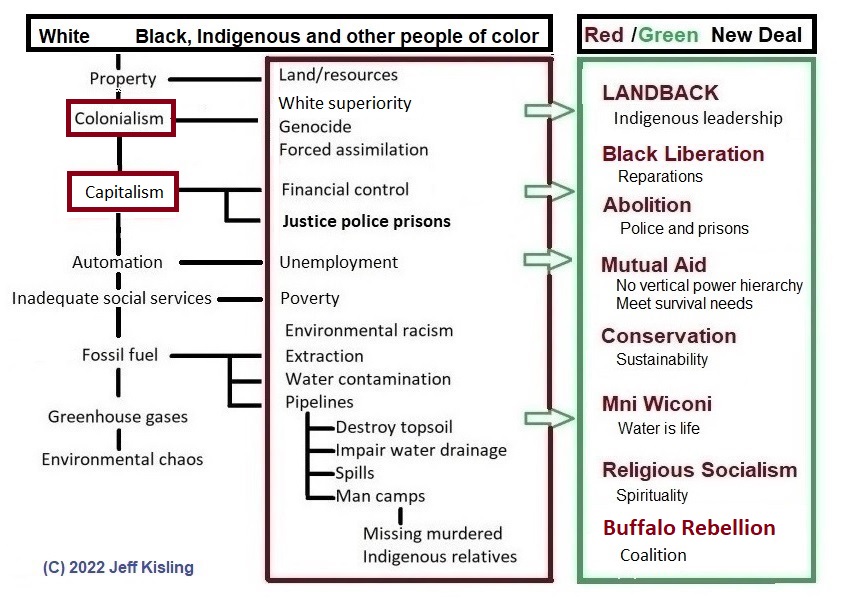
Our mainstream social, economic, and political systems are predicated on White superiority and dominance. I say mainstream because many people, including myself, are building alternative systems today. I’ve been deeply involved in Mutual Aid for a couple of years and believe this to be part of the answer. Mutual Aid is included in the following graphics.
NOTE: White supremacy is different from white superiority. “White supremacy or white supremacism is the belief that white people are superior to those of other races and thus should dominate them.”
I’ve also seen in the lives of my friends what I once thought of as isolated historical traumas have been passed from generation to generation. They profoundly affect the lives of people today. What does that mean for White Quakers now?
“…capitalism and colonialism created structures that have disrupted how people have historically connected with each other and shared everything they needed to survive. As people were forced into systems of wage labor and private property, and wealth became increasingly concentrated, our ways of caring for each other have become more and more tenuous.”
Dean Spade, Mutual Aid: Building Solidarity During This Crisis (and the Next) (Kindle Locations 111-121). Verso
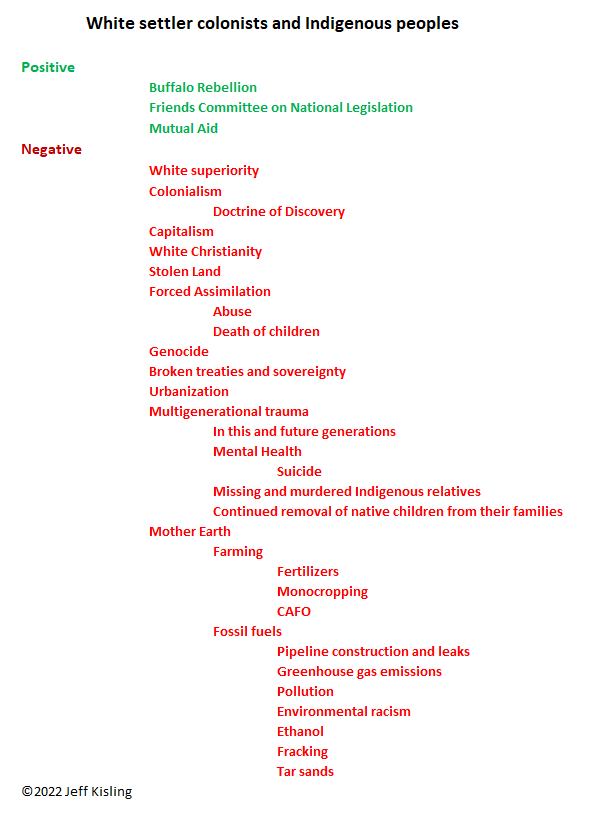
Following is another way of looking at the relationships between White settler colonists and Indigenous peoples. White Quakers need to acknowledge that when our ancestors came to these Indigenous lands, they were settler colonists. And since we are still occupying these lands, we are settler colonists, too. Some White Quakers were involved in the forced assimilation of Indigenous children. We are implicated in most of the “negative” things listed below.
Acknowledgement of wrongs is the necessary first step in the healing process.
On the positive side are Mutual Aid, the Buffalo Rebellion, and the Friends Committee on National Legislation (FCNL). I’ve written a lot about my experiences with Mutual Aid https://quakersandreligioussocialism.com/mutual-aid/
I’m fortunate to be part of the Buffalo Rebellion, a newly formed Green New Deal coalition in Iowa formed to protect the planet by demanding change from politicians and convincing the public that climate should be a priority. Buffalo Rebellion, is a coalition of grassroots, labor, and climate justice organizations growing a movement to pass local, state, and national policies that create millions of family-sustaining union jobs—ensuring racial and gender equity and taking action on climate at the scale and scope the crisis demands. It was formed in November 2021 and consists of:
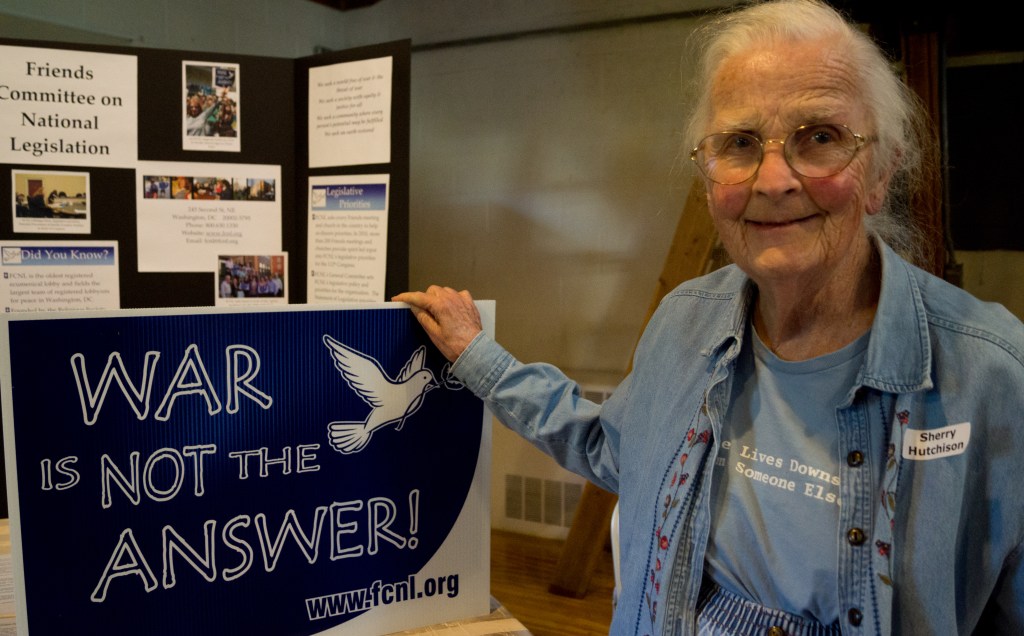
The Friends Committee on National Legislation (FCNL) has years of experience advocating for legislation related to Native American affairs. Recently FCNL has been supporting legislation to form a Truth and Healing Commission related to the Indian Boarding Schools. I’ve been blessed to have many years of experience with FCNL and have been working with my native friends in creating connections with FCNL, including several visits to our US Senators.
[My foundational stories are related to the intersections between my Quaker faith, protecting Mother Earth, and photography. My faith led me to try to share my spiritual experiences and show my love for the beauty of Mother Earth through photography.]
Yesterday I described where my story related to photography is at this time. Today I write about where I am regarding protecting Mother Earth. The beginning of my stories about protecting Mother Earth and the water can be found here: Foundational stories about care for Mother Earth.
Concern for Mother Earth has been a constant in my life. I was 20 years old when I moved to Indianapolis and was horrified by the thick, noxious exhaust from cars. I couldn’t be part of that and have lived without a car since then (1970).
My foundational stories now
Protecting Mother Earth
It took a while for me to become comfortable with the term Mother Earth. But vocabulary can affect how you feel about something. Having Earth as your Mother describes a living relationship. This is one of the many things I’ve learned from my Indigenous friends.
It is a dichotomy that today, despite knowing the many ways our environment and so many other things are collapsing, I have more hope than I’ve had for years. That’s because of the coalitions of people coming together to heal each other and Mother Earth. We can’t be so paralyzed with fear about what may be coming that we don’t enjoy the beauty all around us.
Following are some ways I’m involved in protecting Mother Earth now.
Last night I participated in a meeting of the Buffalo Rebellion, which I’m proud to be a part of. This coalition of environmental activists is one of the things that gives me hope. Realizing we are all working on similar things, this coalition is being built to empower our work and support one another. Last night someone remarked that we’ve all suffered trauma and are all in need of healing.
Following is a description of the Buffalo Rebellion, including a link to a recording of my friend Sikowis Nobiss describing it.
The topic this month is on a newly formed Green New Deal coalition in Iowa called Buffalo Rebellion formed to protect the planet by demanding change from politicians and convincing the public that climate should be a priority. Buffalo Rebellion, is a coalition of grassroots, labor, and climate justice organizations growing a movement to pass local, state, and national policies that create millions of family-sustaining union jobs—ensuring racial and gender equity and taking action on climate at the scale and scope the crisis demands. It was formed in November 2021 and consists of:
The root causes of what we are fighting against are capitalism and colonialism
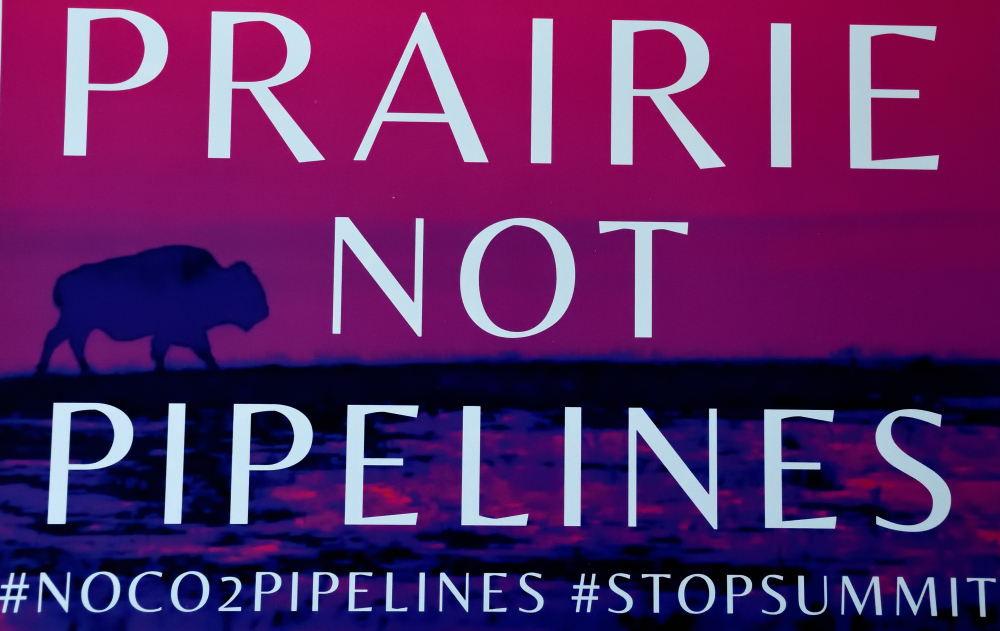
The subject of last night’s gathering (at Iowa CCI and via Zoom) was CO2 (carbon) pipelines, the latest man-made environmental threat. Iowa is at the center of this problem because most of the ethanol plants are located here, because ethanol is produced from corn, and releases carbon emissions in the process. The carbon dioxide in the carbon pipelines is a hazardous material and could cause deaths if there is a rupture. A CO2 pipeline in Satartia, Mississippi ruptured last year, sickening dozens of people. First responders’ vehicles could not run because of the absence of oxygen. READ: “The Gassing Of Satartia” (Huffington Post, August 2021)
Sikowis talked about what is below the crust of the earth also being a sacred space, and we don’t know what disturbing that with pipelines and fracking will cause.
The only way to address fossil fuel emissions is to stop burning fossil fuels.
Des Moines Mutual Aid has been the focus of my work for the past couple of years. How is this related to the protection of Mother Earth?
Being in a Mutual Aid community, we support each other and help each other heal.
Mutual Aid members are encouraged to use critical thinking to anticipate and solve problems. And immediately implement solutions, not waiting for permission from anyone.
Mutual Aid is about eliminating vertical hierarchies and the damage those hierarches do to a community. And how they harm Mother Earth.
Mutual Aid communities are explicitly local. There is no need for fossil fuel transportation and energy production. Our Mutual Aid communities are or will be “walkable”.
Our Mutual Aid communities are an example to others of how we can escape capitalism and colonialism that are the root causes of injustice
Our Mutual Aid practices are about sustainability and protection of Mother Earth
“These spaces become intergenerational, diverse places of Indigenous joy, care and conversation, and these conversations can be affirming, naming, critiquing, as well as rejecting and pushing back against the current systems of oppression”. Maynard, Robyn; Simpson, Leanne Betasamosake.
“…capitalism and colonialism created structures that have disrupted how people have historically connected with each other and shared everything they needed to survive. As people were forced into systems of wage labor and private property, and wealth became increasingly concentrated, our ways of caring for each other have become more and more tenuous.”Dean Spade
Ronnie James, Des Moines Mutual Aid
…in Nishnaabeg thinking, knowledge is mobilized, generated, and shared by collectively doing. It’s more than that, though. There is an aspect of self-determination and ethical engagement in organizing to meet our peoples’ material needs. There is a collective emotional lift in doing something worthwhile for our peoples’ benefit, however short-lived that benefit might be. These spaces become intergenerational, diverse places of Indigenous joy, care and conversation, and these conversations can be affirming, naming, critiquing, as well as rejecting and pushing back against the current systems of oppression. This for me seems like the practice of movement-building that our respective radical practices have been engaged with for centuries.
Maynard, Robyn; Simpson, Leanne Betasamosake. Rehearsals for Living (Abolitionist Papers) (p. 39). Haymarket Books. Kindle Edition.
In another example of how our work is interrelated, my Mutual Aid friends support the Wet’suwet’en.
The Wet’suwet’en peoples have been struggling for years to prevent the construction of the Coastal GasLink liquified natural gas pipeline from being built through their pristine, unceded lands.
There was one particularly significant Spirit-led event in my life related to the Wet’suwet’en. When I first became involved with the Wet’suwet’en peoples was when they were asking allies to spread the news about their struggles, since there was no mainstream media coverage.
In February 2020, some of us were already planning to be at Friends House in Des Moines. We decided to hold a vigil for the Wet’suwet’en on the street in front of Friends House prior to that meeting. I created an event announcement on Facebook, that was shared by my friend Ed Fallon or Bold Iowa, an Iowa Citizens for Community Improvement.
As anticipated just those few of us who were planning to attend the meeting at Friends House anyway showed up. But the Spirit-led part of this is that Ronnie James, who I didn’t know at the time, joined us. Ronnie is an Indigenous organizer with twenty years of experience. He was surprised anyone in Iowa knew about the Wet’suwet’en peoples, so he came to see who was attending, a good organizing technique.
Ronnie and I began to exchange messages over the next couple of months. I was intrigued with the stories he was telling me about Des Moines Mutual Aid community he was involved with. When I felt we had begun to know each other well enough, I tentatively asked if I could attend the food giveaway that Ronnie/Des Moines Mutual Aid held every Saturday morning. This was a continuation of a variation of the Black Panther Party’s free school breakfast program in Des Moines from the 1970’s.
I thought I would just attend a time or two to see how that worked. Instead, I’ve been there almost every Saturday morning for over two years now, and Ronnie is one of my best friends. One of the many good things about Mutual Aid is how it attracts and keeps people engaged.
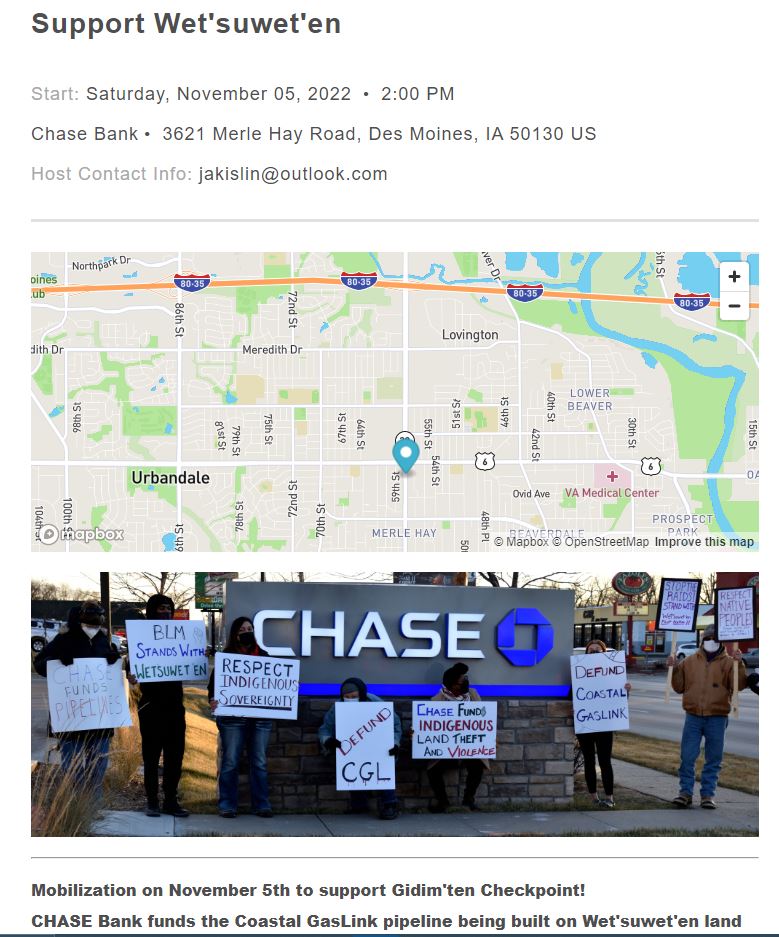
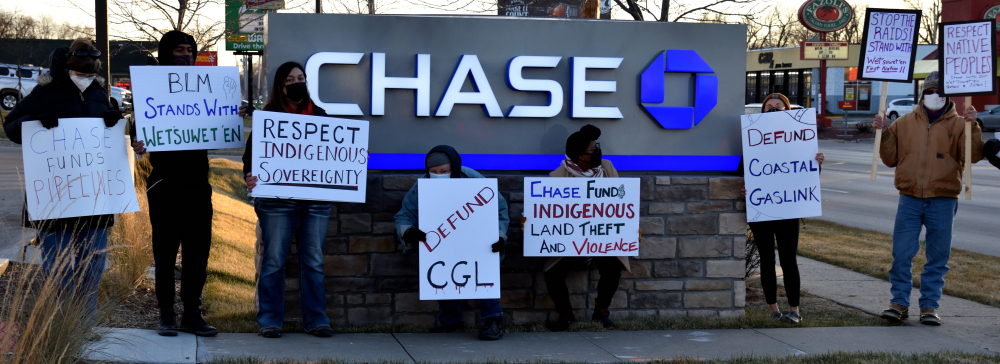
I continue to do what I can to support the Wet’suwet’en. We are presently organizing another gathering at Chase bank to call attention to their funding fossil fuel projects. Some others from the Buffalo Rebellion will be involved.
Bear Creek Friends Meeting
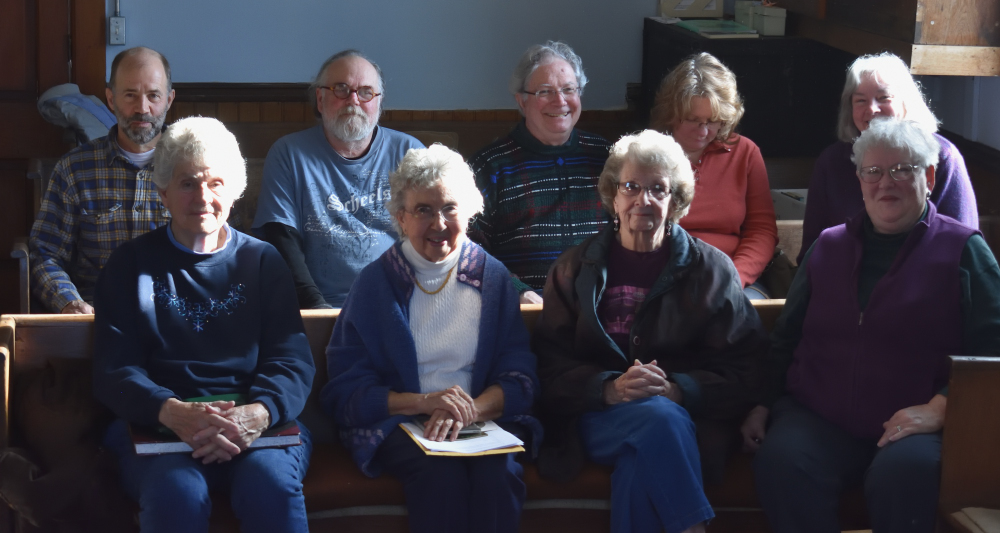
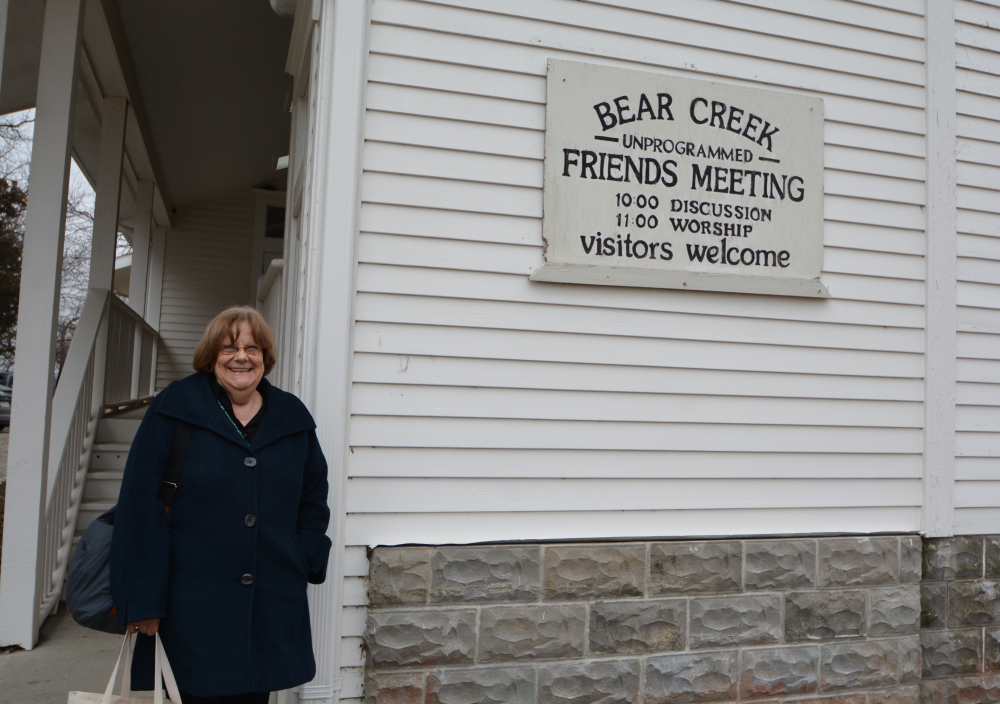
The small, rural Quaker meeting I’m a member of continues today to try to find ways we can help protect Mother Earth. This is one way to bring a Spiritual approach to these problems which I believe is very important.
Members of the meeting have supported the annual Prairie Awakening/Prairie Awoke ceremony that takes place at the Kuehn Conservation Area, just a few miles from the meetinghouse.
Bear Creek Friends Meeting
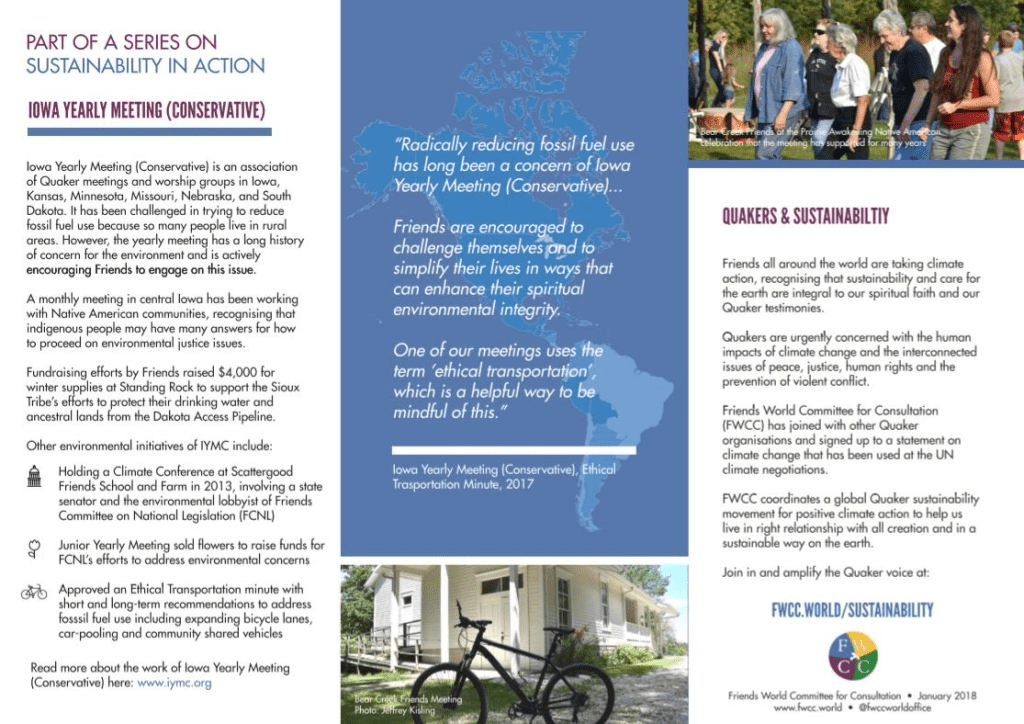
It is difficult to reduce fossil fuel use in rural areas.
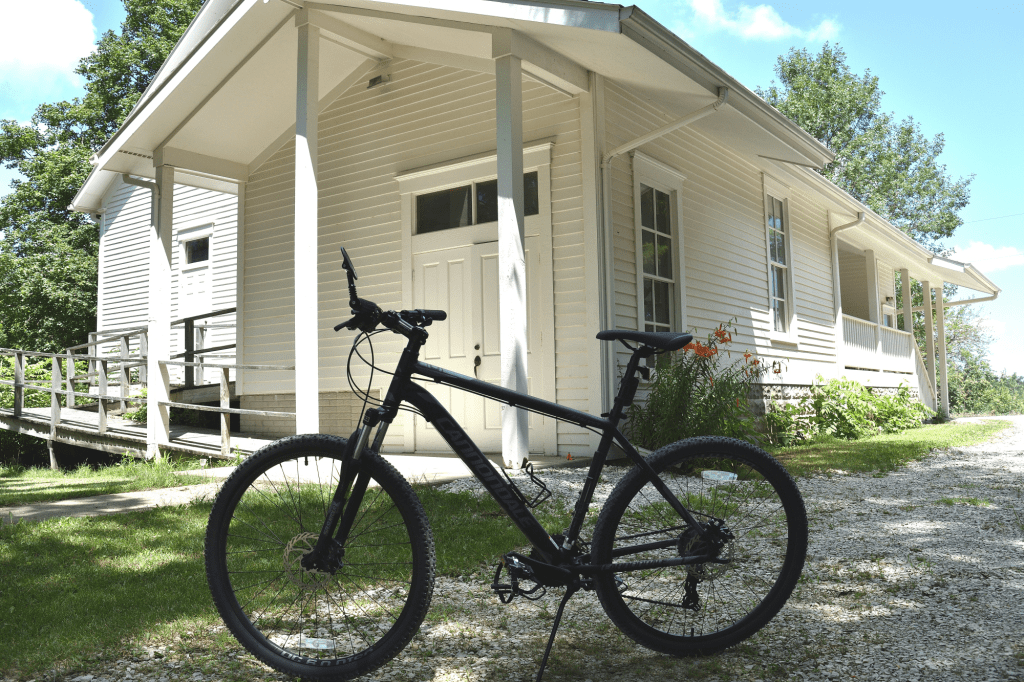
One thing we realized we could do was encourage more use of bicycles, since many members lived close to the meetinghouse just north of Earlham, Iowa. And encourage Friends in urban meetings to use bicycles when possible.
The Minute we wrote, and that was approved by Iowa Yearly Meeting of Friends (Conservative) was referred to as a Minute on “Ethical Transportation”.
Radically reducing fossil fuel use has long been a concern of Iowa Yearly Meeting (Conservative). A previously approved Minute urged us to reduce our use of personal automobiles. We have continued to be challenged by the design of our communities that makes this difficult. This is even more challenging in rural areas. But our environmental crisis means we must find ways to address this issue quickly.
Friends are encouraged to challenge themselves and to simplify their lives in ways that can enhance their spiritual environmental integrity. One of our meetings uses the term “ethical transportation,” which is a helpful way to be mindful of this.
Long term, we need to encourage ways to make our communities “walkable”, and to expand public transportation systems. These will require major changes in infrastructure and urban planning.
Carpooling and community shared vehicles would help. We can develop ways to coordinate neighbors needing to travel to shop for food, attend meetings, visit doctors, etc. We could explore using existing school buses or shared vehicles to provide intercity transportation.
One immediately available step would be to promote the use of bicycles as a visible witness for non-fossil fuel transportation. Friends may forget how easy and fun it can be to travel miles on bicycles. Neighbors seeing families riding their bicycles to Quaker meetings would have an impact on community awareness. This is a way for our children to be involved in this shared witness. We should encourage the expansion of bicycle lanes and paths. We can repair and recycle unused bicycles, and make them available to those who have the need.
Minute approved by Iowa Yearly Meeting (Conservative) 2017
Recently when I wrote about life without a car, I said being led to live without a car and struggling to convince others to not use fossil fuels were the most important spirit-led actions of my life. This is a continuation of the discussion of life without a car.
My grandmother, Lorene Standing, said the will of God is often revealed in a series of steps. Which was the case related to my spiritual leadings to reduce greenhouse gas emissions. Earlier I wrote about the beginnings of my spiritual guidance regarding our environment. But there were many times as life went on when I relied on that and further guidance. The series of steps along the way.
But there were also times when I somehow got off the right path of this journey. I made a lot of mistakes related to this over the years. Among other things, this created a great deal of tension with my Quaker meeting.
It wasn’t that members of the meeting weren’t concerned about Mother Earth. They were concerned and did many things to reduce their carbon footprint and pollution.
But I believed transportation was the single greatest contributor to greenhouse gas emissions that we had personal control over. It was a matter of scale. Emissions from even the minimal use of cars dwarfed the total emissions saved by all other efforts, such as turning off lights, reducing the use of heating and air conditioning, etc., combined. It was disconcerting to see Friends and others using air travel. The skies were full of planes.
There was also collateral damage related to fossil fuel transportation. Urban sprawl was premised on the use of cars for all transportation, including to work, school, grocery, church, healthcare, sports, and entertainment. That would not have occurred, at least to the extent is has, if we had focused on mass transit instead of personal automobiles.
Our communities would not have been fractured as they were when people drove to the suburbs and stayed in their homes when they got there. Not knowing their neighbors, not having a sense of community. Investing in armed police and prisons for a false sense of security. Spending incomprehensible amounts of money for a false sense of national security. And the greater horror of squandering the lives of soldiers on both sides of conflicts. So many civilian casualties. Crushing our souls.
Most importantly, we would not be facing the existential environmental crisis we are in now.
And the U.S. armed forces are the single greatest source of pollution.
Most importantly, we would not be facing the existential environmental crisis we are in now. With the strong storms, flooding, savage wildfires, heat and drought. Leading to mass migration, famine and deaths.
The root of the tensions with my Quaker communities was that many members lived in rural areas, small towns, or cities with no public transportation.
Indianapolis had a public bus system that wasn’t highly rated. The bus routes didn’t cover large areas of the city, didn’t operate during the night, and often not on weekends. They were often not on time.
So it is a paradox that I rarely used Indianapolis’s public transportation system, in part for the reasons mentioned above while being a strong advocate for mass transit. But these problems all need to addressed. Perhaps the most important thing we can do for Mother Earth is create good public transit systems. And stop military operations.
To live without a car, I had to carefully plan where I lived. There needed to be a grocery store and laundry within walking distance. And be within walking distance of the hospital I worked at.
I had to carefully choose the food I bought, limited to the weight and bulk I could walk with. That meant things like rice and not boxes of prepared foods. Another advantage was that also meant I had little trash.
I won’t deny it was often difficult to not have a car. Walking in inclement weather was a challenge. Sometimes I would just be tired. When I did use the bus system, the buses were often not on time. These were times when I would ask for some spiritual support. Some of the small steps my grandmother spoke of. Sometimes I’d receive that support, other times not.
There are many ways not having a car was a blessing. As I walked to and from work, I began to notice flowers and views. The more closely I paid attention, the more detail I saw. I began to carry my camera with me. It soon got to the point that I had to leave a little extra early for work, to account for the time taking the photos.
And there were many times I would run to the places I was going to. Besides my nearly daily runs for pleasure and fitness.
What did I think people in rural areas could do? The easiest would be to plan trips so multiple things could be accomplished on each. Friends were doing this. Friends could also coordinate trips with each other.
Rural towns could create inter-city transportation using school buses or electric vehicles.
People could install renewable energy systems. Perhaps community renewable systems. Including the meetinghouse.
Use electric powered vehicles or perhaps a return to animals to move things around the farm, pull plows in the fields.
These conversations went on for all of my adult life.
Invite the meeting into my concern
Finally, a f/Friend asked me if I had invited the meeting into my concern. And I realized I had not. We had fallen into a pattern of my expressions of concern, and often irritation actually. The physical separation didn’t help. I lived in Indianapolis my whole adult life.
With this change in perspective, and spiritual guidance as we considered this together, worshipped together, we came up with a statement (minute) we referred to as “ethical transportation”. We asked the yearly meeting (Iowa Yearly Meeting Conservative) to consider the minute, which was approved by the Yearly Meeting (below).
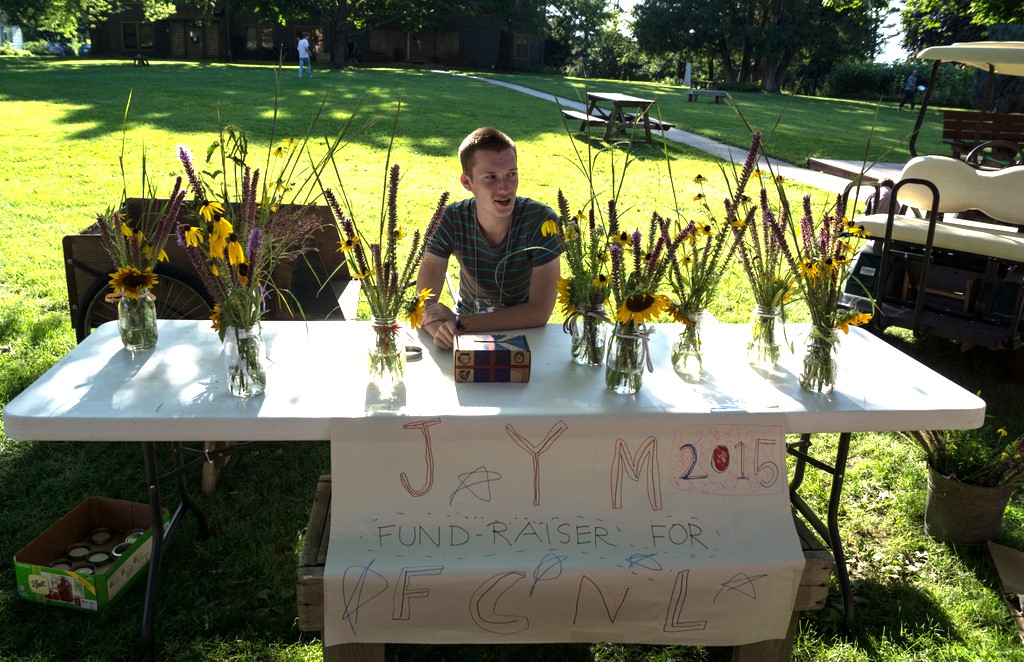
Our Yearly Meeting has approved other minutes related to our environment. In 2015 we approved this minute.
Minute
We are deeply moved and appreciate the contribution of Junior Yearly Meeting to our ongoing concern regarding changes in our environment. Their project to raise funds for FCNL’s efforts to address environmental concerns by selling flowers was both spiritually and artistically beautiful.
Junior Yearly Meeting sells flowers from the Scattergood prairie to raise money to support FCNL’s work related to our environment
And this was included in the approved Peace and Social Concerns Committee report.
We are exploring concerns of our younger Friends. Junior Yearly meeting at this Yearly Meeting are concerned about greenhouse gas emissions and rebuilding infrastructure in countries ravaged by war.
Queries
It would have been good if we had reached the point of inviting the meeting into my environmental concerns much sooner than we did. We have a practice that might have helped, which is consideration of queries (questions) related to various parts of our Quaker community lives. There are twelve sets of queries, so commonly each meeting considers one set of queries each month.
“This is my commandment: Love one another as I have loved you.” John 15:1
ADVICE
It is sometimes difficult to remember that love is a gift of the Divine Spirit and not simply a human emotion. As imperfect human beings, it is not always possible for us to feel loving toward one another, but by opening ourselves to the Light Within, we can receive and give love beyond our human abilities.
Relationships among meeting members take time to evolve. Sometimes misunderstandings develop. When differences arise, they should not be ignored for the sake of superficial unity. We believe disagreements which might divide or disrupt a meeting can be resolved through human effort and divine grace, and may result in a stronger and more creative meeting. True harmony depends upon each persons deep respect of and faithful attention to the Divine Spirit within us all. We endeavor to practice humility, attempting to understand positions of others and being aware of the possibility that we may be mistaken.
It is the responsibility of the Ministry and Oversight Committee to be sensitive to needs which may arise. Others in the meeting may be equally concerned, and because of greater understanding in certain cases, be able to give counsel. In reconciliation of differences, a position not previously considered may prove mutually beneficial. At times it may be necessary to confront individuals whose behavior is disruptive. A clearness committee or professional help may be suggested in some situations. We must always remember the power of holding one another in the Light, and the healing that comes from forgiving ourselves as well as others.
QUERY
What can we do to deepen our relationships with one another? How does gender affect the way we relate to each other?
How does our meeting balance the needs for honesty and kindness? What topics do we avoid for the sake of “unity”?
When in conflict with others, do we cultivate a forgiving spirit? Do we look to that of God in ourselves and seek to address that of God in those with whom we disagree?
Ethical Transportation
Radically reducing fossil fuel use has long been a concern of Iowa Yearly Meeting (Conservative). A previously approved Minute urged us to reduce our use of personal automobiles. We have continued to be challenged by the design of our communities that makes this difficult. This is even more challenging in rural areas. But our environmental crisis means we must find ways to address this issue quickly.
Friends are encouraged to challenge themselves and to simplify their lives in ways that can enhance their spiritual environmental integrity. One of our meetings uses the term “ethical transportation,” which is a helpful way to be mindful of this.
Long term, we need to encourage ways to make our communities “walkable”, and to expand public transportation systems. These will require major changes in infrastructure and urban planning.
Carpooling and community shared vehicles would help. We can develop ways to coordinate neighbors needing to travel to shop for food, attend meetings, visit doctors, etc. We could explore using existing school buses or shared vehicles to provide intercity transportation.
One immediately available step would be to promote the use of bicycles as a visible witness for non-fossil fuel transportation. Friends may forget how easy and fun it can be to travel miles on bicycles. Neighbors seeing families riding their bicycles to Quaker meetings would have an impact on community awareness. This is a way for our children to be involved in this shared witness. We should encourage the expansion of bicycle lanes and paths. We can repair and recycle unused bicycles, and make them available to those who have the need.
Minute approved by Iowa Yearly Meeting (Conservative) 2017
1 . SET CONFLICT RESOLUTION GROUND RULES:
Recognize whose lands these are on which we stand.
Ask the deer, turtle, and the crane.
Make sure the spirits of these lands are respected and treated with goodwill.
The land is a being who remembers everything.
You will have to answer to your children, and their children, and theirs—
The red shimmer of remembering will compel you up the night to walk the perimeter of truth for understanding.
As I brushed my hair over the hotel sink to get ready I heard:
By listening we will understand who we are in this holy realm of words.
Do not parade, pleased with yourself.
You must speak in the language of justice.
Harjo, Joy. Conflict Resolution for Holy Beings: Poems. W. W. Norton & Company. Kindle Edition.
The last post concluded with how I ended up working in the Neonatal Intensive Care Unit at Riley Hospital for Children, Indiana University Medical Center, Indianapolis.
Research: Infant Pulmonary Function
After I’d been working in the NICU for about four years, a research position was created to work in the newly opened Infant Pulmonary Function Laboratory at Riley. I was encouraged to apply for the job, in part because of my NICU experience. I didn’t know exactly what I’d be doing, since it was a new position. I didn’t have much experience in medical research at that time although I did learn about medical engineering when I spent the summer before my Senior year at Scattergood working with Don Laughlin in his medical electronics lab at the University of Iowa Hospitals in Iowa City.
I taught myself the FORTRAN computer language at Scattergood. Studying calculus at Earlham College was also very valuable.
It would be a real financial hardship in that the salary was half of what I was earning in the NICU. That was because the position was paid from research grants. Despite that, and not knowing exactly what the position would involve, the Spirit left no doubt that I should apply for that position. I had finally found my career path. It was part of the plan that I had the prerequisites for the position.
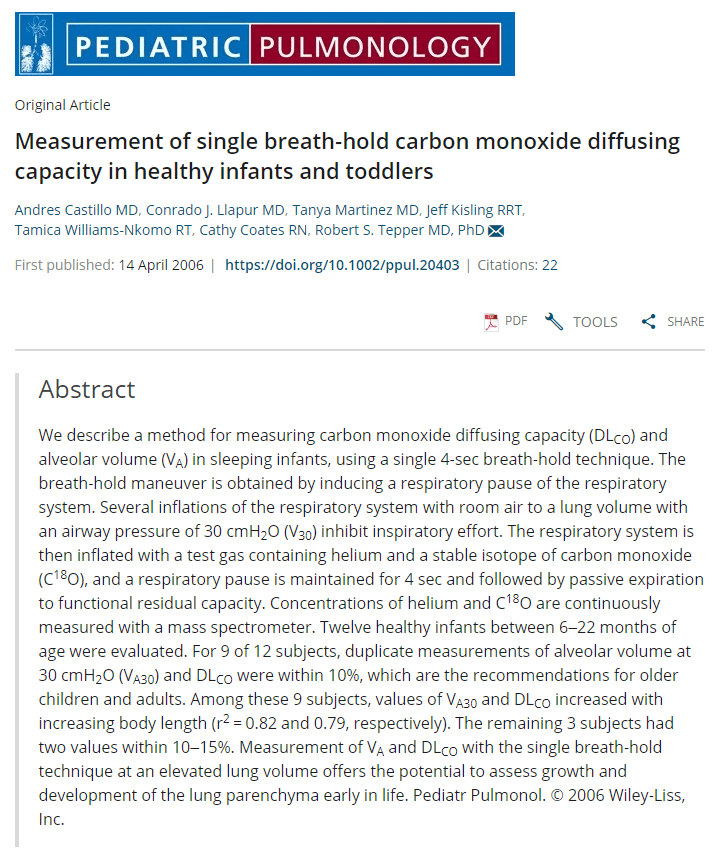
I wrote the computer software and engineered the hardware systems that allowed us to perform lung function measurements in infants. About fifteen years ago we developed a system that would measure lung diffusion in babies. That was a complex system that involved switching a number of valves at various times in the respiratory cycle, and using a mass spectrometer to measure gas concentrations of as little as hundredths of a percent. It took three years to get the system to work correctly. Ours was the only lab in the world able to perform such measurements in infants.
This editorial was about that research done by our lab with the lung diffusion system combined with molecular biology to identify the cells involved with the development of the pulmonary parenchyma in babies.
Recently a Quaker friend challenged us to consider what our foundational stories are, how they began, how they changed over time, and what they are now. I’ve been writing a series of blog posts about my foundational stories, which are related to the intersections between my Quaker faith, protecting Mother Earth, and photography.
Earlier I wrote Foundational Stories: Quaker Faith. I said we express our faith by telling stories about our faith-based decisions and actions. To continue telling my foundational stories related to faith, I’m led to share some of my Spirit-led stories.
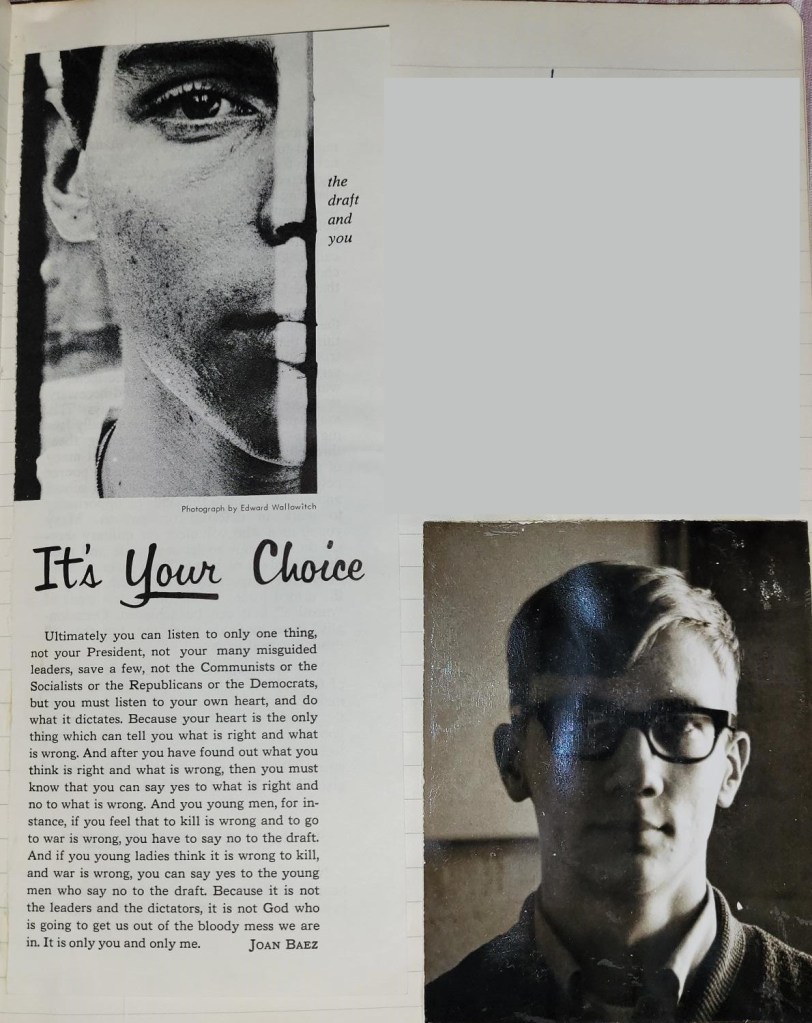
In the last post I wrote about my first spiritual challenge-how I came to be a draft resister at the time of the Vietnam War. I have become aware that many people today have almost no real conception of war, unless someone they love is in the armed forces. Something that happened fifty years ago is relegated to the history books.
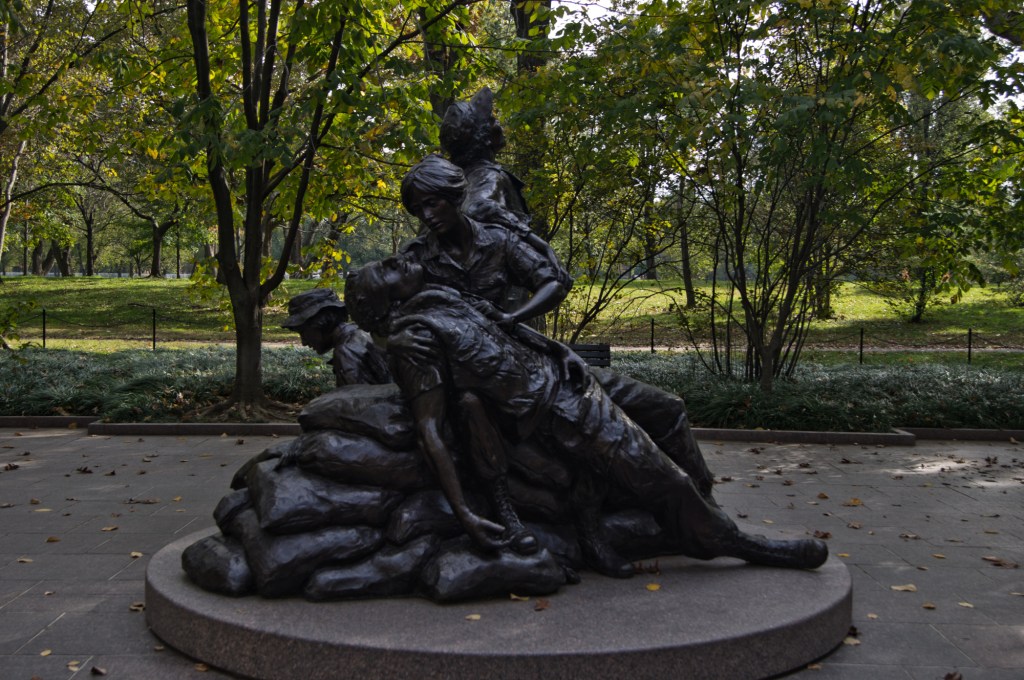
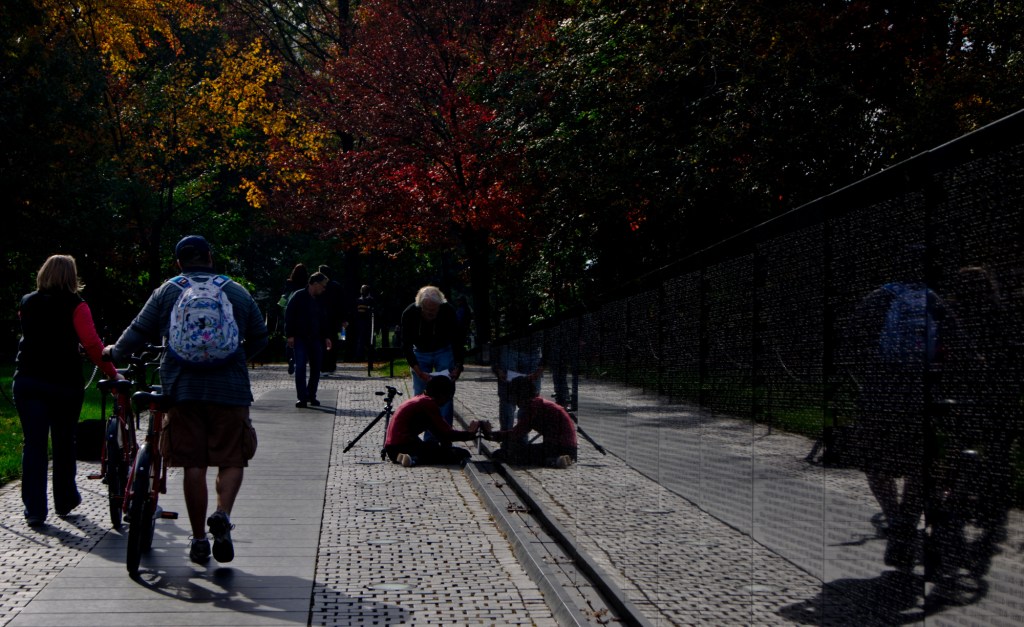
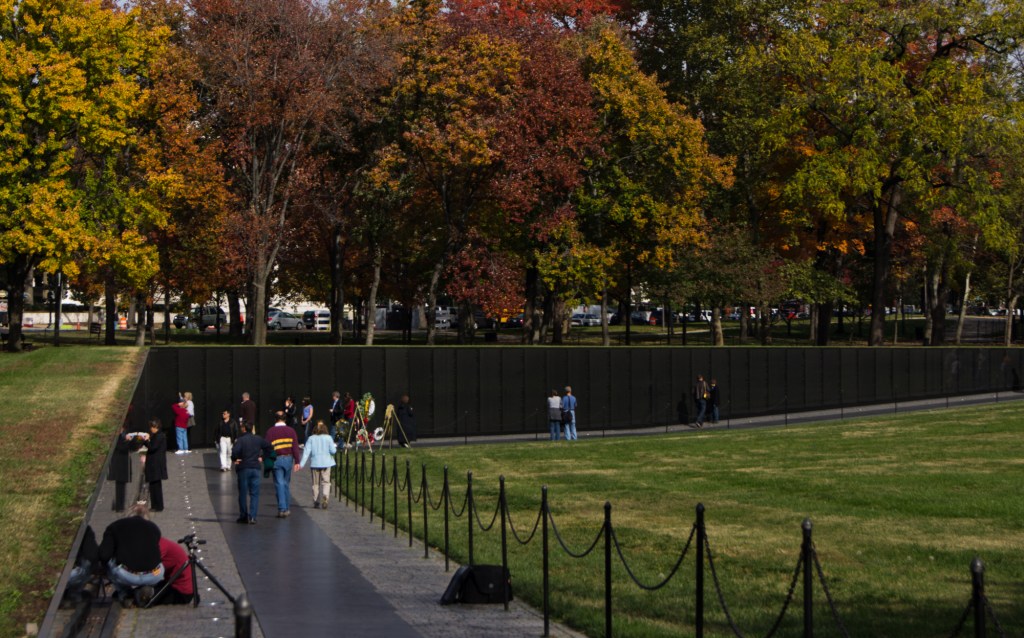
Photography is one of the three pieces of my foundational stories. I’ve taken the photos I share in my blog posts, including these from the Vietnam War Memorial in Washington, DC.
Vietnam VietnamVietnam Vietnam Vietnam
I have so many photos from Washington, DC, because of my years on the Friends Committee on National Legislation’s General Committee, which held annual meetings every November. Agreeing to be on the General Committee was another spirit-led decision. I was concerned about agreeing to do that because of the travel involved. I refused to have a car for environmental reasons (also spirit-led). So I took 22 hour train trips from Indianapolis to Washington for those meetings. Again I had many rich experiences and got to know Friends from all over the country. Today I attend the weekly Zoom worship sharing meeting, FCNL’s Witness Wednesday Silent Reflection. Your are welcome to join every Wednesday at 4:15 Central times. fcnl.org/ww-stream
In the previous post about Quaker Faith I wrote about my struggles at that time that led me to be a draft resister. That was such a huge issue that there were many stories within the stories about the war.
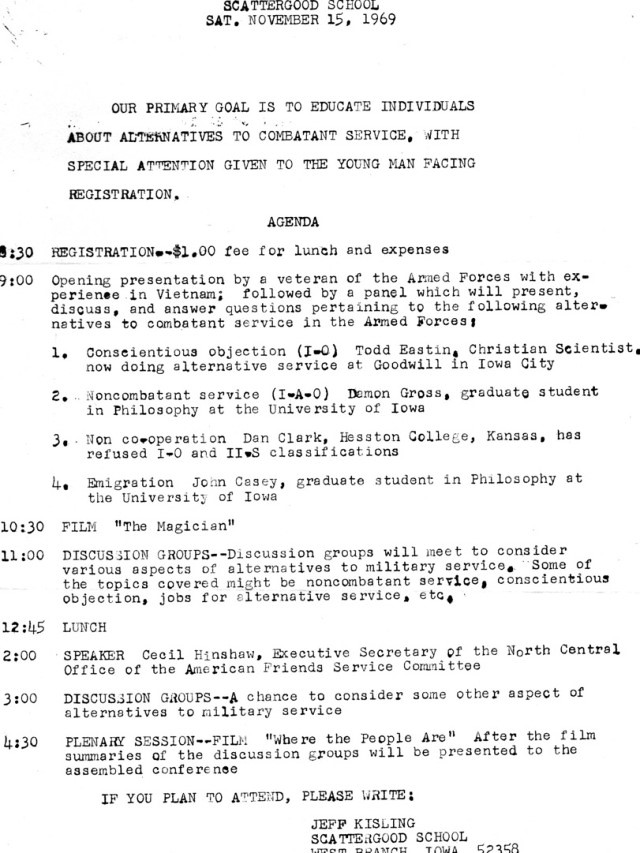
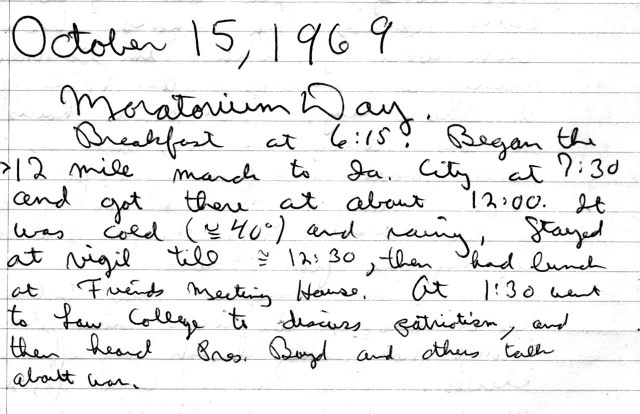
My first experience in organizing occurred at this time, when I helped organize a draft conference at Scattergood. This was held on one of the national days of the Moratorium to End the War in Vietnam.
During another of the National Moratorium days to end the war in Vietnam in 1969, Bob Berquist, our Scattergood government teacher, suggested we go to the nearby town of West Branch and talk with people there about the war. (Scattergood is located on a farm.) He drove three of us into town, stopped at a random house, and stayed in the car while we went up to the door. I still remember how scared I was. But it was a real education to find how unpopular the war was at every house we visited. People seemed to appreciate the chance to share their feelings. Although I was very uncomfortable with the idea, because of my strong spiritual feelings against war, I felt I should do this. And as with every other time I followed those leadings, I benefited in many ways. They were/are always growing experiences.
Earlham College
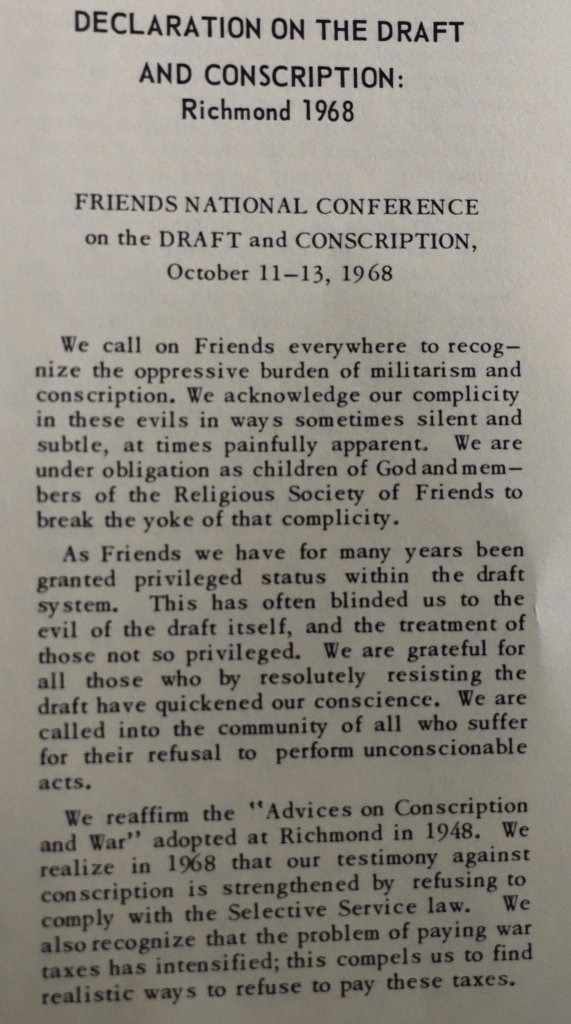
After Scattergood I attended Earlham College, a Quaker school in Richmond, Indiana. I had gone to the college in 1968, while a student at Scattergood, for a conference of Quakers from across the nation who gathered to write what became the Declaration on the Draft and Conscription: Richmond 1968.
There was a small group of Quaker students, Young Friends, which were an important part of my spiritual life at Earlham. Although I left Earlham after one year, I returned at the time I was preparing to turn in my draft cards. We held the meeting for worship described here.
4:00 pm. Went to Meeting for worship. Jan Cole, Al Ingles, Dav Nagle, Marggie Schutz, Margaret and Lewis Taylor, Becky Gibson, Jim Bay, Ruby, and several others attended.
Al had read my letter to the draft board and my statement on the draft earlier, and asked if I would let him read it during Meeting. I told him that would be alright, so he did.
Al spoke of support and the future and how God spoke through me. I would hope that would be true but felt unworthy.
Margaret Taylor spoke of Iowa Friends who had always spoken against war and done what they felt right. She spoke of her support for me.
Becky Gibson spoke, very movingly, about finding who you are, and how important it is to do what is right.
Then Dav spoke, also very movingly. He is certainly an able minister—one of the people I love and respect very much. He seems always to be close to the center. He said severing ties with Selective Service is a major decision—but ALL decisions are major when they deal with principle and the Spirit. All, each of our decisions must be integral. “Severing ties with Selective Service is not an isolated act in this life of Jeff’s.”
After a good while I felt moved to speak. When confronted with a decision, we are told to do God‘s will. But God’s will is so difficult to discern among many influences—people, law, self (selfishness and pride). Realizing this, Thomas A’ Beckett said, “I am loathsome.” This was how I felt at times. But after he said that, he heard what he believed to be the voice of God saying “Nevertheless, I love.
Journal 1/30/1972
I felt very uncomfortable having a student deferment from the draft. And as can be seen from this letter to my parents, I continued to work through what I was going to do about the war.
You want me to be practical; not so idealistic. But what you might see as idealistic, I see not only as practical, but necessary in order to be true to my code of life. And if you forsake your principles and all that you believe in, what do you have left?
The most difficult part of this decision has been that I would hurt you. But how far should a man go trying to protect those that he loves, at the same time denying the principles that give his life meaning?
Letter to my parents from Earlham College
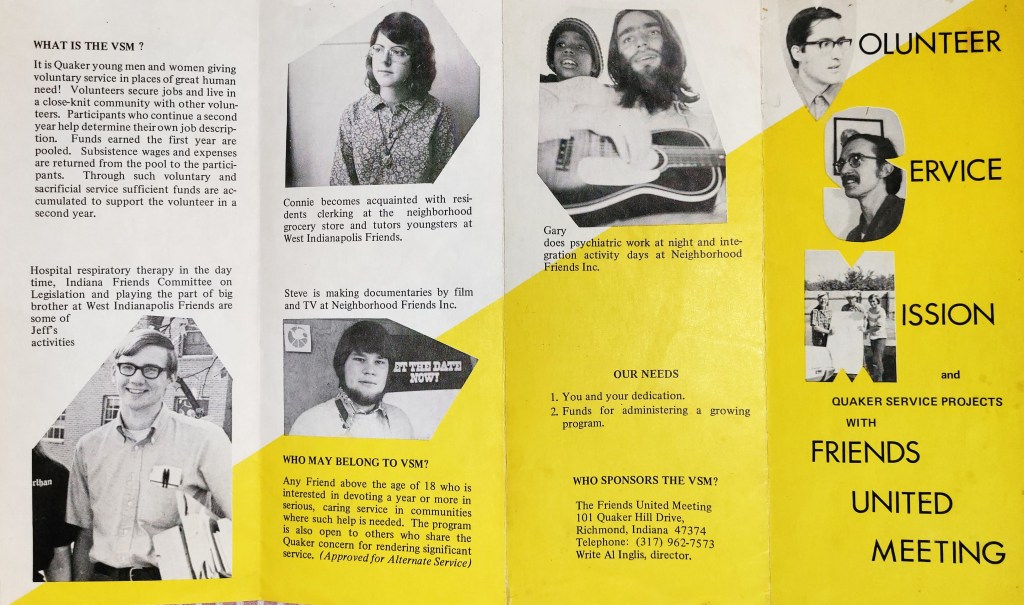
I previous wrote about the Friends Volunteer Service Mission (VSM) that was related to my Vietnam War decisions and actions. One of the significant consequences of my participation in VSM were the friendships I made with the kids in the neighborhood as I described in that post about VSM.
As I found over and over again as I worked in various community organizing situations, the most important thing is to build friendships. When I was about to leave VSM in Indianapolis and return to Iowa, the neighborhood kids made a meal of spaghetti, baked a chocolate cake, and gave me a record album of Jim Croce they knew I liked.
In Iowa I took classes at the community college, including photography (one area of my foundational stories), But I missed the kids in Indianapolis so much that I decided to return there. The family of several of those kids invited me to live with them while I looked for a job and a place to live. There wasn’t a significant difference in our ages, although at that age a difference of a year or two seemed big. I was about 21 and they were around 14 years old.
When I was first in Indianapolis, I received on-the-job training as a respiratory therapy technician. On my return to Indianapolis I got a job in the respiratory therapy department of Indiana University Medical Center.
At the Medical Center I worked with women on the labor and delivery ward. I was at times present for the miracle of birth.
Many of the women referred to the Medical Center had high risk pregnancies. Respiratory therapists from Riley Hospital for Children, which was part of the Medical Center, would come to help stabilize infants who had various conditions that needed to be taken to the Neonatal Intensive Care Unit at Riley.
It was definitely spirit-led that when I saw the skills those respiratory therapists had, I wanted to be trained to do that. I was able to transfer to the respiratory therapy department at the Childrens Hospital. After an introduction to respiratory care for general pediatric patients I was eventually trained to work in the Neonatal Intensive Care Unit (NICU). At one time I was the respiratory therapy supervisor for the NICU.
Permission was obtained to publish this photo, which was part of an article in the Indiana Business Journal
I hadn’t decided what I would study at college. The Medical Center had a degree program for Respiratory Therapy. Much as I loved my work, I hadn’t thought of applying to the Respiratory Therapy program. For one thing there were usually about two hundred applicants for each class of fifteen.
But on the day the applicants were being interviewed, the Clinical Instructor of the program came and pulled me off my patient assignments and took me to be interviewed. He was familiar with my work and wanted me to be in the class. I was selected to enter the program. These spirit-led steps resulted in me getting a degree in Respiratory Therapy and this became my career for my entire working life.
This is enough for today. I can tell it is going to take several more blog posts to tell more of my faith-based stories.
Post Script: I feel blessed to have been led to keep a Journal for a few years. I began that during the time I was struggling with the draft decision. This is a link to some of those Journal entries:
Recently a Quaker friend challenged us to consider what our foundational stories are, how they began, how they changed over time, and what they are now. I’ve been writing about my foundational stories, which are related to the intersections between my Quaker faith, protecting Mother Earth, and photography.
This challenge comes at a time when I’m considering changes in those three things. Thus far my blog posts have been about how these stories began and have evolved.
I’m at the point of considering what those stories are now. A couple of days ago I wrote about the current state of how I care for Mother Earth.
Now I’ll try to express the current state of my Quaker faith, which will be the most difficult of the three parts of my foundational stories to write.
Part of what I was taught is we should not call attention to ourselves. But I have been led, as part of my faith, to share stories about my experiences and faith. The way we live our lives is how we express our faith. We share our faith by telling stories about these faith-based actions. The main reason photography is such a large part of my foundational stories is because photos can be a way to share my spiritual experiences.
I often think about what Noah Baker Merrill, a Quaker, wrote about this.
“We need to be careful when we talk about humility. The kind of humility this work brings isn’t the kind that would have us reject or repress our gifts. This kind of false humility leads us to oppress each other in the name of preventing pridefulness. This happens far too often.”
Noah Baker Merrill, “Prophets, Midwives, and Thieves: Reclaiming the Ministry of the Whole.”
Or as my friend Ronnie James, another storyteller says, “anyways, brag, brag, blah, blah”.
Religious faith is a matter of beliefs and, sometimes, spiritual experiences. I’ve heard not everyone has had, or at least not recognized, spiritual experience(s). I find it very interesting that those Friends (Quakers) who have said they had spiritual experience(s), have all said something like “and that’s all I’ll say about that”. That’s understandable because we don’t have the language to express this. Which makes it difficult to write about faith. Also, there is something about protecting something that is so intimate and profound in our lives.
My first spiritual experience was when I was about ten years old during meeting for worship at the Bear Creek meetinghouse. “And that’s all I’ll say about that”. Except to say I had no doubt about the presence of the Spirit in the world from that day on. I know I am blessed to have had that, and subsequent spiritual experiences.
Another Friend said his first spiritual experience came when he was about that age. This makes me realize we should pay attention to what young people experience. I love the native concept of children as sacred beings.
The concrete expression of our faith is seen in our actions in this world. This might mean we are led to act in ways contrary to the laws or conventions of the society we live in. Which is often not easy to do. Peer pressure can be a powerful force. There might be significant monetary costs and/or legal penalties. Quakers were once (still?) known as “peculiar people”. When there are conflicts between our spiritual beliefs and the laws of the government, people of faith try to obey the creator. Unfortunately, many times it is apparent that people who identify themselves as religious do not act according to the beliefs they profess. This lack of spiritual integrity results in many people rejecting organized religion.
The first time I was confronted with a situation where my beliefs were contrary to the laws of the land related to registration for the Selective Service System. I attended Scattergood Friends School, a Quaker boarding high school, during the time of the Vietnam War (1960’s). A military draft was being used to conscript young men into the armed forces. Quakers do not believe in war nor in participating in the military. Those with religious objections to serving in the military could apply for Conscientious Objector (CO) status, which if granted, would allow them to do two years of alternative service, such as working in a hospital instead of military service.
My Quaker friend and mentor, Don Laughlin, collected these stories of Quakers who opposed war and conscription.
I turned eighteen years of age while a Senior at Scattergood (1969). Young men were required to register for the Selective Service System at that age. The choices were either to do so, or apply for Conscientious Objector status, or do neither and face imprisonment.
I really struggled with whether I should accept alternative service, or not cooperate with the Selective Service System. I studied and prayed a great deal. I was convinced that alternative service was going along with the system. The question was whether to take the safer path of conscientious objection, or risk prison by resisting the draft.
I recognized this decision would set the course for the rest of my life. Which is why this is part of my foundational stories. If I compromised about this, I would likely do so in similar circumstances for the rest of my life. I would always be aware that I had not acted according to my beliefs.
The following Epistle, and the examples of the men who refused to cooperate with the military, many of whom did serve time in prison, showed me there were those who acted according to their beliefs despite the consequences.
The following is an excerpt from a statement by a group of Quaker young men at that time, including Iowa Yearly Meeting (Conservative) Quakers Don Laughlin and Roy Knight.
Those of us who are joining in this epistle believe that cooperating with the draft, even as a recognized conscientious objector, makes one part of the power which forces our brothers into the military and into war. If we Friends believe that we are special beings and alone deserve to be exempted from war, we find that doing civilian service with conscription or keeping deferments as we pursue our professional careers are acceptable courses of action. But if we Friends really believe that war is wrong, that no man should become the executioner or victim of his brothers, then we will find it impossible to collaborate with the Selective Service System. We will risk being put in prison before we help turn men into murderers.
It matters little what men say they believe when their actions are inconsistent with their words. Thus we Friends may say that all war is wrong, but as long as Friends continue to collaborate in a system that forces men into war, our Peace Testimony will fail to speak to mankind.
Let our lives speak for our convictions. Let our lives show that we oppose not only our own participation in war, but any man’s participation in it. In our early history we Friends were known for our courage in living according to our convictions. At times during the 1600’s thousands of Quakers were in jails for refusing to pay any special respect to those in power, for worshiping in their own way, and for following the leadings of conscience.
We may not be able to change our government’s terrifying policy in Vietnam. But we can try to change our own lives. We must be ready to accept the sacrifices involved if we hope to make a real testimony for Peace. We must make Pacifism a way of life in a violent world.
We remain, in love of the Spirit, your Friends and brothers,
An Epistle to Friends Concerning Military Conscription
This story would not be complete without including another important part of this decision, which was the tensions with my parents. They were against the war but wanted me to accept Conscientious Objector status. They were very upset when I said I couldn’t do that. I understood they didn’t want me to face prison and life as a felon, but they didn’t understand why I knew I must resist. I felt betrayed by their lack of support. Looking back from this time, it is easier to accept what they were doing out of love.
I mailed the following to the draft board today (2/6/1972), along with my registration certificate and classification (1-0) card:
2/6/1972
Dear members and clerk of the draft board:
I have received an order to report for civilian work February 1, 1972.
I want to thank you for your concerned questions at my personal appearance, when we were considering my position as a conscientious objector. I have appreciated Mrs. Landon’s kindness and consideration, even when I returned my draft cards. Thank you for giving me more time to consider this decision. I hadn’t realized what a powerful affect that action would have on some people. The extra time gave them, and me, a chance to come to grips with the decision and its consequences. However, my beliefs have remained basically the same and the time has come to act accordingly.
I am sure none of us really want war. Many are convinced that was is a ‘necessary evil’—the only way to achieve peace. I think I can understand that, and I do respect those who sincerely believe it—their sacrifice has been very great.
But I do not believe war is the way to peace. True peace is a personal, internal, spiritual matter. When we come to know and love ourselves and our God, then and only then do we have peace. From this point, peace and love will flow from us and should engulf those we live and work with. This is the only way to find and promote peace.
In this matter, war has no place.
The enclosed attempts to illustrate my beliefs in relation to the Selective Service System. I hope this will help you to understand why I feel I cannot cooperate with the Selective Service System. I want it to be clearly understood that I am not doing alternative service. It is not my choice. There is nothing else I can do.
Love, Jeff Kisling
Letter to my draft board
I write concerning my relationship with the Selective Service System. There are many alternatives. In fact, someone once said the only alternative not open to a young man facing the draft is that of being left alone. I explored several of these. I applied for and was granted conscientious objector status (1-0). Then I had a student deferment, which made me very uneasy. I am now doing work which should qualify as alternative service, but for reasons I will attempt to explain herein, I find this alternative to be unacceptable.
I find it difficult to understand why one young man must explain his decision to do civilian work for a non-profit organization while another need make no explanation, indeed is encouraged to fight and perhaps kill other human beings. But it is one’s duty to explain one’s actions in order that others might understand, and perhaps follow. Noncooperation is less understood than conscientious objection, so I feel all the more compelled to try to present an explanation. I must try to explain, to spare my family the burden of doing so, for they neither clearly understand nor agree with my decision. (Note: they fully supported alternative service, but didn’t want to see me imprisoned).
This decision grew out of my experience as a member of the Society of Friends. Meetings of the Society of Friends can be a source of strength and guidance as one begins and continues to search for meaning in life. Quakers have always believed that there is that of God in every man, that each of us has the ability to communicate with that of God in us, and the responsibility to respond to that of God in everyone. It is evident that Jesus had communion with God—evident in the actions of his life and in his teachings—culminating in “not as I will, but as thou wilt.” This is the essence of Jesus’ teaching—that God’s will can be discerned and should be obeyed even at the cost of doubt and persecution. Quakers readily accept Jesus as an exceptional person and try to live up to the principles he gave us to live by. But we are even more concerned that we obey that Inner Light to which He was so sensitive, so we and have personal contact with and guidance from God. Thus, Quakers try to minimize distractions from “this (secular) world” in order to discern the will of God in their hearts and His presence in their midst. They gather together in a simple room and settle down together, searching in silence—each contributing to the spirit of the meeting as a whole. There are times when a member feels he has been ‘moved by the spirit’ to share with the group, in which case the meeting considers the message in further silence.
There is a spirit which comes from the silence which gives direction to life. The spirit is often difficult to discern because of our ties to ‘this world.’ We are afraid or too proud to give up our desire to ‘reason through’ decisions. Thus we develop a system of beliefs and guidelines composed of traditional beliefs, our own reasoning, and as much guidance from the Inner Light as we are willing to seek and accept. Thus our decisions, being not entirely grounded upon our faith, may not always be ‘right’. But we can do no more, nor should we do less, than follow our conscience as occasions arise—always seeking to become more attuned to the spirit.
Adolescence is that period when one begins to seriously consider ‘who he is’ and his purpose in the world. It is a time when one has so many question and so few answers. The extent to which a young person searches for, and finds answers to these questions is dependent upon guidance given by parents, peers, school and church; the degree to which this guidance corresponds to his own experience and needs; and his own self-discipline and desire to continue the search. Too often the leadership and resources are not available; he is ‘turned off’ by inconsistencies or shallowness or insincerity on the part of those he looks to for guidance and example; or materialistic demands distract from the search.
The draft requires fundamental moral decisions at this time in life. This may not be bad in itself, but tremendous pressure is brought to bear to influence the decision—tradition, parental and peer pressure, the law, etc. The Selective Service System tries to attract men to the armed forces by relying on these pressures and by not making alternatives widely known. The pressures in this case are for action which is contrary to the experience and desires of most young men—frustrating, anguishing when one is searching for truth, honesty and integrity. This type of experience stifles personal growth and leads to the loss of a spirit of idealism and faith in the goodness of men. Can there be a graver crime than that of destroying the spirit and dreams of the young? Only that of destroying life itself, and the Selective Service System is directly implicated in both.
Most of us agree that conscription and war are unjust-evil. The question is, how do we deal with evil? ‘Resist not evil’—a phrase widely known but little understood and less obeyed. ‘Do not set yourself against one who wrongs you’ (NEB) is a better way to put it, I think. In setting ourselves against those who harm us, we look, to some extent, for some way to hurt, or at least hinder them. We look for the worst in others and play upon their weaknesses rather than looking for the best and trying to fortify it. Out task is to overcome evil by doing good.
The time we spend ‘resisting evil’ could be better spent in trying to find out where we can do better ourselves. You do not change others by opposing them—rather, by respecting and trying to understand and learn from them, you can both benefit and move nearer the truth. A life of example—showing the possibilities and fruits of a life lived in love and concern for others, is the only way to overcome evil.
I do not want my example to be alliance with evil. Thus, I cannot serve with the Selective Service System. However, I will not set myself against it. I will break my ties with Selective Service, and concentrate on the difficult task of working for peace in whatever way I can.
The conclusion to my draft story is that I was drafted at a time when men were not being drafted for the armed forces. A Supreme Court case declared this to be illegal, so my order to report for civilian service was invalidated and I wasn’t prosecuted. I did finish my two years with Friends Volunteer Service Mission in Indianapolis.
Letters to and from Bear Creek Monthly Meeting
Homer Moffitt, Clerk Bear Creek Monthly Meeting
Dear Friends,
I am thankful for your kind letters and encouragement concerning my work in Indianapolis. I am learning much about love, and as I respond to the love of others, and they to mine, we are all amazed at how it grows.
I am enclosing a statement I have written concerning conscription, and my decision not to cooperate with the Selective Service System any more. I sent a copy of that statement, along with my draft cards, to my draft board.
Again, I tried very hard to follow the leading of the inner light. If I alone were making the decision, this would probably not be my choice. Thomas a’ Beckett, torn between his obligations to the Church and those to the State, was searching for guidance. When he realized all the forces that influence him—selfish desires for power and personal gain, fear of punishment or displeasing people, etc., he said. “I am loathsome.” But then he heard what he believed to be the voice of God saying, “Nevertheless, I love.”
I, too, feel shamed when I realize the factors that often influence my decisions and actions. On this matter, I have tried very hard to be sensitive to the will of God, and hope to do so in the times to come. Still somewhat uncertain that my choice is right, I am comforted in knowing that He still loves.
Love, Jeff Kisling
In reply:
Dear Jeff,
We have found your statement explaining your relationship to the Selective Service System very moving. Several of us are aware that your decision on this has been a difficult and lonely one. We want to assure you of our love and support as you meet the events which result from your courageous stand.
On behalf of the Peace Committee of Bear Creek Monthly Meeting
Scattergood Friends School students’ peace march Oct. 15, 1969John GriffithDon LaughlinRoy Knight
As I continue to write about my foundational stories, I was reminded of this document that describes the two years I spent in Indianapolis in the early 1970’s at the Friends Volunteer Service Mission.
“Alternative Service During the Vietnam War’ may be confusing to those who know I was a draft resister. At the time I joined the Indianapolis VSM Unit, I was struggling to discern whether I could accept doing alternative service. Joining VSM was a backup plan if I decided to do that
In the end I was led to turn in my draft cards, to resist the draft. And expected to be arrested as a result. But I was finding VSM so rewarding, I remained there for the two-year period.
During this time, the US Supreme Court case of another draft resister affected my situation, so I was not arrested.
Re-reading this fifty years later, the style and thinking seem a bit awkward, but I guess that is part of the story, as well.
Kenny and Curtis photo: Jeff Kisling4H Club photo: Jeff KislingDennis photo: Jeff KislingFriends Volunteer Service Mission house. 1971 photo: Jeff Kisling
I’ve been looking forward to describing the current state of my foundational story. The article below about Cai Quirk is remarkably similar to parts of my story now.
My foundational story is related to the intersections between my Quaker faith, protecting Mother Earth, and photography. This combination has remained a powerful, yet evolving, influence throughout my life. My faith led me to try to share my spiritual experiences and show my love for the beauty of Mother Earth through photography. These three things came into play in many ways throughout my life.
I continue to rely on my Quaker faith to guide these decisions. Sometimes the guidance is clear. Other times either I’m not discerning what the Spirit is telling me, or there isn’t anything new to hear. It’s all too easy to stay on a path we are comfortable with, to the extent we might not hear, or might ignore leadings that say we need to change direction, to do something we are uncomfortable with. One thing I was blessed to realize early in my life was the times I took risks resulted in significant growth. Which led me to search for ways to take risks.
The reason I invested in the idea of the evolution of my foundational stories is because I’m feeling I might need to change how I think about and put into practice faith, protecting Mother Earth, and photography. I don’t have a way to know how many people read my blog posts but have a better indication of how people see my photography. My impression is that more people see my photographs. I’m sensing I should “focus” more on photography to express my spirituality and encourage more people to work to protect Mother Earth. Although the main reason I write so much is to try to organize and clarify what I discern about my spiritual life, and what that means, how to put these leadings into practice, how to practice hope.
People often mistake hope for a feeling, but it’s not. It’s a mental discipline, an attentional practice that you can learn. Like any such discipline, it’s work that takes time, which you fail at, succeed, improve, fail at again, and build over years inside yourself.
Hope isn’t just looking at the positive things in this world, or expecting the best. That’s a fragile kind of cheerfulness, something that breaks under the weight of a normal human life. To practice hope is to face hard truths, harder truths than you can face without the practice of hope. You can’t navigate dark places without a light, and hope is that light for humanity’s dark places. Hope lets you study environmental destruction, war, genocide, exploitative relations between peoples. It lets you look into the darkest parts of human history, and even the callous entropy of a universe hell bent on heat death no matter what we do. When you are disciplined in hope, you can face these things because you have learned to put them in context, you have learned to swallow joy and grief together, and wait for peace.
“One of the pieces of Quaker witness I have been carrying in the world for many years now is around gender diversity and using art and storytelling as a way to explore that. This is some of the ministry that I carry.”
Cai Quirk (they/them or ey/em pronouns) shared this reflection with FCNL staff in a late-June Zoom lunch, along with the ways Spirit has been leading them to explore gender, faith, and nature through art.
Cai is a life-long Quaker. After years of spiritual deepening through writing poetry and creating self-portraits, Cai will soon release their first book. “Transcendence: Queer Restoryation” includes words and images that offer an expansive understanding of faith.
In speaking to FCNL staff, Cai showed many of their self-portraits, focusing especially on those exploring gender in the natural world. “I was finding new ways to create new stories that are empowering,” they told us. “Through these self-portraits, I found how far I can go in following Spirit. A lot of these photos were very freeing and empowering and have given me more connection to Spirit.” Cai explained that nature itself holds some inherent queerness; “Even when society tries to erase queer stories, they are still there in the landscape.”
…
Growing up Quaker, Cai learned the history of the social disruption inherent in Quaker faith. Yet today, Cai has noticed that only certain kinds of social disruption and ministry are accepted within some circles of Friends. “My art is an invitation to see how Spirit invites us all in different ways,” they said. While not all Quaker communities can feel welcome to those who rock the boat, social disruption and rage can be sacred as well. Changemaking occurs in many ways for many different people, and Cai is working to create more spaces where this kind of expansion and ministry are accepted, where more people can exist as their true selves.
…
“If I change myself to match society’s conventions, then I am not being authentic, I am not being faithful to Spirit,” Cai told us. Can we as the Religious Society of Friends expand our ideas of faith and community to invite everyone in? What would it take to seek and live into that welcoming Quakerism moving forward?
Minute There is that of God in every being. We support those of all gender identities and sexual orientation. And respect and will endeavor to use the pronouns each person identifies themselves by.
Approved by Iowa Yearly Meeting (Conservative) 2022
Bear Creel FriendsPlayground at Bear Creek FriendsBear Creek FriendsMidyear Meeting at Bear CreekLinda Lewis, AFSC Country Representative for China/North Korea, and Dan Jasper, AFSC Public Education and Advocacy Coordinator for Asia, visited Iowa at the invitation of Jeff Kisling, clerk of the Peace and Social Concerns Committee of Iowa Yearly Meeting (Conservative) and Patti McKee, director of Catholic Peace Ministry. Linda spoke at Bear Creek Friends Meeting in Earlham, Iowa. Linda and Dan both spoke at Des Moines Valley Friends Meeting House. They were interviewed by WHO-TV, local videographer Rodger Routh, and talk show host Ed Fallon. They met Iowa Immigrant Rights Program staff Jody Mashek, Erica Johnson and Berenice Nava and travelled to Scattergood Friends School to meet Thomas Weber, Head of School, and Mark Quee, Farm Manager. Mark gave them a tour of the school’s farm. In 2001, AFSC hosted a North Korean agricultural tour of Iowa.Scattergood Friends School and FarmBear Creek FriendsPaula Palmer and toward right relationship with native peoplesBear Creek Friends Meeting
This morning my spirit was restless. I wasn’t led to what to write. Those who know me know I have a pretty rigid practice of trying to write first thing in the morning. If I don’t, I can rarely write later in the day. I get distracted by the busy-ness of life. And it doesn’t work to try to force myself to write if I’m not clear about what the subject might be.
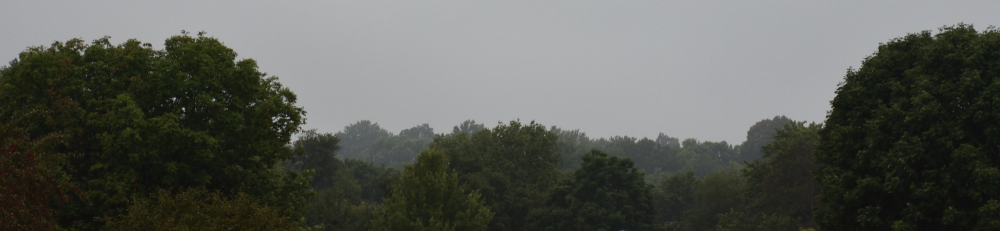
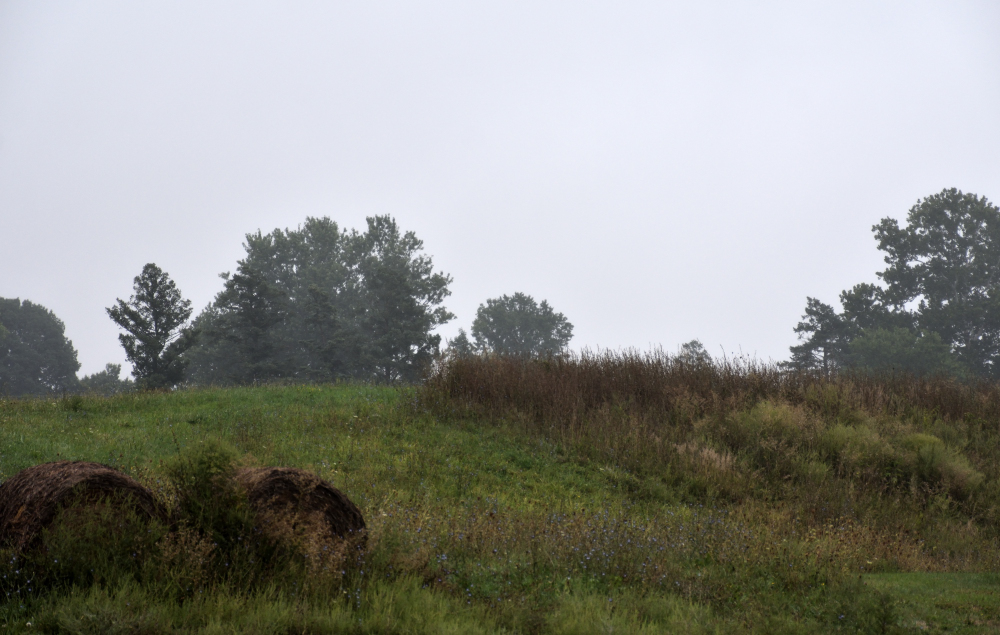
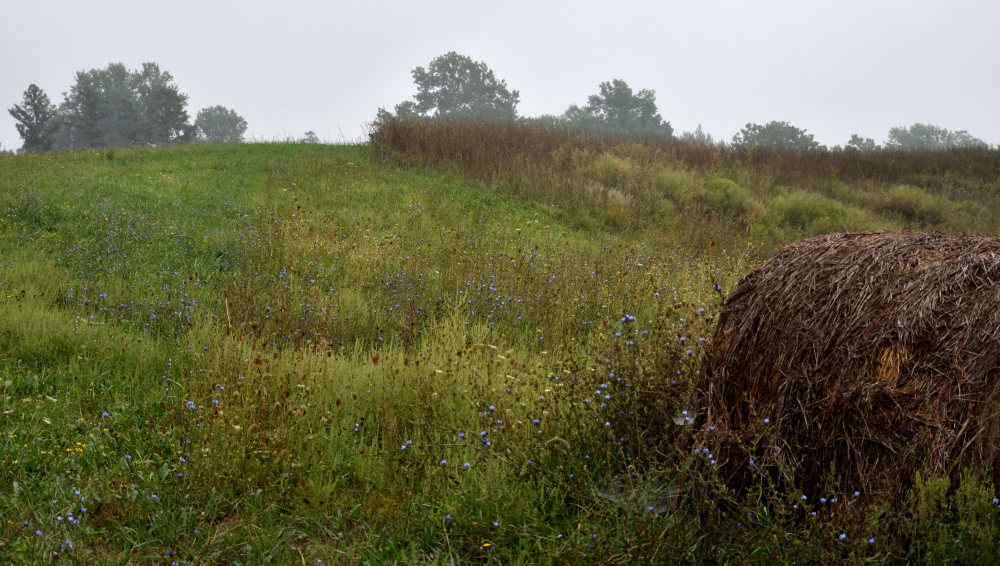
It was a little foggy out this morning and I loved to try to capture photos of that. Even though, or perhaps because, such images are a challenge to capture. So, I took the photography/nature path instead of trying to write. Some of today’s photos are at the end of this.
My Spirit was happy as we traveled together.
I had taken the phrase “the road not taken” literally. Often as I hike and walk, I’m presented with a choice of which way to go.
But of course, that can apply to many other choices. The two roads at the beginning of this day were writing or walking.
I took the road less traveled by, and that has made all the difference.
There have been many times taking the road less traveled by made “all the difference” in my life. Deciding to resist the draft, joining Friends Volunteer Service, choosing to work in neonatal intensive care, and then doing research in the Infant Pulmonary Function Lab. Learning computer programming. Being on the General Committee of FCNL. Connecting with the Kheprw Institute. Joining communities to protect the water including the Keystone Pledge of Resistance and Dakota Access pipeline. Getting in a van of fifteen people I didn’t know to go the Minneapolis on a snowy day to cut off the head of the black snake. Walking and camping ninety four miles with native and nonnative people. Learning to be clerk of peace and social concerns, and more recently Bear Creek Friends meeting. Joining Des Moines Mutual Aid. Many of those were difficult choices for a variety of reasons at the time. But every time they made all the difference.
Two roads diverged in a yellow wood,
And sorry I could not travel both And be one traveler, long I stood And looked down one as far as I could To where it bent in the undergrowth;
Then took the other, as just as fair, And having perhaps the better claim, Because it was grassy and wanted wear; Though as for that the passing there Had worn them really about the same,
And both that morning equally lay In leaves no step had trodden black. Oh, I kept the first for another day! Yet knowing how way leads on to way, I doubted if I should ever come back.
I shall be telling this with a sigh Somewhere ages and ages hence: Two roads diverged in a wood, and I— I took the one less traveled by, And that has made all the difference
The year was 1972. June was begun and Eldon’s classes at the University of South Dakota that spring had concluded. The Moreys and their two small children were en route on Highway 385 from north of Hot Springs, South Dakota headed to Rapid City. It was a long overdue vacation following two years of intense graduate study by Eldon and night-work at the Vermilion Hospital by Karen as an Emergency Room Nurse. Money was in short supply, so the trip was a tenting excursion with reservations and a documented travel plan which had been formulated over several months. The Rapid City Public Campground was free. Midway between Hot Springs and Deadwood they planned to turn on Highway 16 which goes to Rapid City. Deadwood farther to the northwest was scheduled to be visited after a short stay in Rapid City.
As they approached the turn to Highway 16, it suddenly occurred to Eldon they might change their travel plan and continue on Number 385 directly to Deadwood. So he immediately blurted-out, “Would anyone rather go directly to Deadwood and we can see Rapid City during our return trip to southeastern South Dakota?” Karen was amazed such a sudden thought had entered Eldon’s thinking. Such a change would nullify the dates of their camping reservations and confuse their friends who had been given a schedule of their plans should they need to be contacted. Karen, therefore, remained silent. The children were too small to have opinions. By then Eldon had made the turn to Highway 16. But, lacking family response he immediately turned the car around and re-entered Highway 385 going north. They were headed to Deadwood!
They arrived at Deadwood in time to participate in the final public tour of the “Gold Mine” at Lead, the adjoining city. They then searched for the campground where they had reservations for the next evening. There was plenty of room at the campground and they soon had their tent set and an evening meal cooking. All was well. The children were tired so all four of them took to their sleeping bags as darkness settled.
Soon thereafter it began to rain. Oh my, how it rained. It rained so hard the inside of the tent was coated with moisture from the condensation in the air. Never-the-less, they slept soundly. The rain stopped when breakfast time arrived. So they opened the tent vents, hung the opened sleeping bags on the clothesline to dry and made breakfast. Everything was dry and packed to resume car travel by 10 o’clock.
As they were entering the car, a fellow camper happened to walk past them. “Oh,” he said, “I see you are leaving the campground!” “Yes,” Eldon said, “We’re going back to Deadwood for a “look around,” and then we’ll head to Rapid City. “Rapid City?,” the man questioned. “You can’t go to Rapid City!” “Why not?” Eldon replied. “You don’t know, do you?” the man responded.
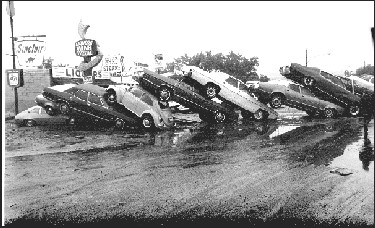
“Rapid City during the night of June 9-10, 1972 experienced one of the worst floods in the history of South Dakota. Fifteen inches of extreme rainfall over six hours sent Rapid Creek and other waterways overflowing… The Canyon Lake Dam became clogged with debris and failed, resulting in 238 deaths and 3,057 injuries… There were over 1,335 homes and 5,000 automobiles destroyed” (Wikipedia). They later were told a 12 foot high wall of water rushed down Rapid Creek through the center of Rapid City where the campground was located. Everyone in the campground was drowned”
Four or five years ago Karen and Eldon visited Rapid City for the first time since the flood more than 38 years earlier. In the Campground Park was a brass plated obelisk with the names of those people who perished the night of the flood while camping there. There were more than thirty names on that monument. It was a very sobering moment because the Morey’s knew their family’s four names would have been there had they not been re-directed.
A couple of years ago while en-route to Yearly Meeting, they stopped in Oelwein to visit Eldon’s aunt and his cousins. Don Avenson, one of his cousins, and he were talking about Quakerism. Don is a former Speaker of the Iowa House of Representatives and a past Candidate for Governor. Eldon told him the story of the Rapid City Flood and explained that many “Traditional Quakers” are strongly “convinced” that the Divine Spirit sometimes provides “Leadings” which guide people. Don’s comment was, “If I had been redirected to avoid Rapid City during the night of June 9, 1972, I would be a Quaker too!” (Check Google for detailed information and photographs of the “Rapid City Flood of 1972”.)

























 Quakers and Mutual Aid