I feel this strong tension to be doing something about the war in Ukraine. But I don’t know what that would be. What is the Spirit calling me, calling us to do? I was glad to come upon Clarence Pickett’s quote, at the time of World War II, because I have been feeling paralyzed. Not only from the war in Ukraine, but from so many things that make it feel like everything is falling apart. COVID, state sanctioned violence, political polarization, and the increasing environmental chaos to name just a few.
“The world was breaking loose in so many places that it was difficult to know how to think about one’s responsibilities…it was important in such a time not to become simply paralyzed by the quantity of the need.”
Clarence Pickett
I have been thinking about Quaker’s response to Nazism and World War II. I know the Scattergood Hostel story because many of my relatives and I attended Scattergood, a Quaker boarding high school.
In addition to assisting those still in Europe, the Quakers helped newly arrived refugees adjust to life in the United States. The AFSC established a series of workshops and hostels to help refugees learn English and prepare for their new lives, including Sky Island Hostel in Nyack, New York; the Haverford Cooperative Workshop in Haverford, Pennsylvania; and the Quaker Hill Hostel in Richmond, Indiana. The largest and longest-running hostel was Scattergood, in West Branch, Iowa, where more than 185 refugees lived between 1940 and 1943. Working with the Joint, Hertha Kraus traveled to Havana, Cuba, in 1939 to found the Finca Paso Seco hostel, where refugees could learn agricultural trades.
Michael Luick-Thrams has written a lot about the Scattergood Hostel, including the book, Out of Hitler’s Reach: The Scattergood Hostel for European Refugees, 1939-43. See more about Michael’s work here: https://www.traces.org/
In this video Michael tells the Scattergood Hostel story.
With the rising rhetoric and tensions regarding the Russian invasion of Ukraine, I’m asking myself, again, what does it mean to work for peace? A question I’ve returned to repeatedly over the course of my life. My answer to that question has changed over time. Following is some history of working for peace. But I intend to write how I see working for peace has changed, what that means today, soon.
As I was coming of age in the late 1960’s, at the time of the war in Vietnam, I continuously studied and thought about war and peace. On his eighteenth birthday, every male in the US was required to register with the Selective Service System, which recruited for the armed services. I was born into a Quaker community and attending Scattergood Friends (Quaker) boarding school at that time.
Because of their work for peace, Quakers, the Brethren, and Mennonites were known as historic peace churches. Young men who were members of one of those religious organizations could apply for conscientious objector (CO) status with the Selective Service System. If approved, they would spend two years working in civilian jobs for the public good. Most often in hospitals or mental health institutions.
Those who didn’t belong to one of the historic peace churches could apply for CO status, but that usually wasn’t granted to them. That was blatantly unjust. Similarly, those attending college were routinely granted a student deferment, allowing them to finish their studies. Yet another injustice for those who weren’t students.
Conscientious objector status and student deferments were transparent efforts to quiet resistance to the draft. A number of young men refused to accept those alternatives. Refusing to register with the Selective Service System or returning your draft card made you a draft resister. If convicted, the sentence was a felony conviction and usually a prison sentence.
The peacetime draft was implemented in 1940. Not long after, some Quaker families left the country and established the Monteverde community in Costa Rica.
About dozen men and their families in my Quaker community remained in this country but believed they could not participate in the draft. Which meant refusing to register or returning their draft cards if they had registered but came to believe that was wrong.
It took some time for my family to come to terms with my decision to resist the draft. I initially applied for and was granted conscientious objector status. When my family finally accepted my decision, I turned in my draft cards.
I wasn’t arrested, but Daniel Barrett, who attended Scattergood Friends School with me, was arrested and imprisoned.
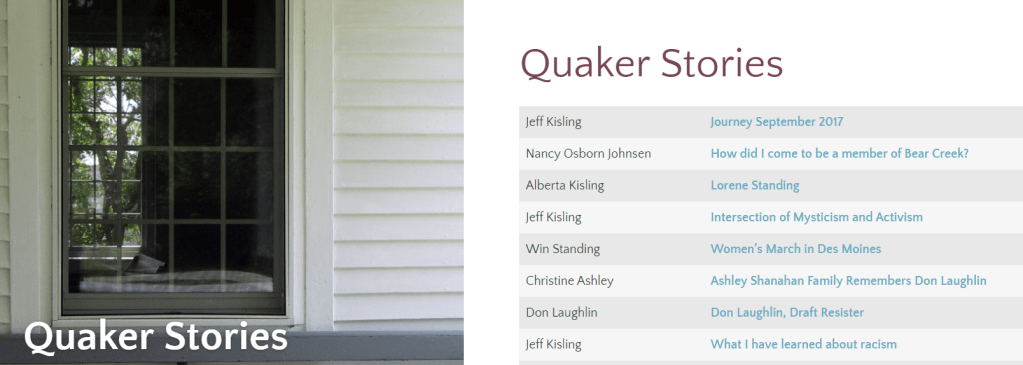
My Quaker friend and mentor, Don Laughlin, collected many stories of Quaker responses to several wars, including Danniel’s and mine. Don resisted the draft and was imprisoned. When I heard of his project and offered to help, which meant I had those stories when Don died. You can read those stories here:
This morning I saw a message from a Friend who suggested we begin to offer conscientious objector, or draft counseling, as was done during the Vietnam War.
I wanted to share the story of how Muhammad Ali was an inspiration to me as I struggled with my draft decision.
Muhammad Ali was one of the most significant influences in my life, at a difficult time in my life. Approaching my 18th birthday, when I would have to decide what I was going to do about registering with the Selective Service System, I saw Muhammad Ali take a very public, very unpopular stand against the Vietnam War.
He said: “Under no conditions do we take part in war and take the lives of other humans.”
“It is in the light of my consciousness as a Muslim minister and my own personal convictions that I take my stand in rejecting the call to be inducted. I do so with the full realization of its implications. I have searched my conscience.”
“Man, I ain’t got no quarrel with them Vietcong…they never called me n_____.”
It was very clear what the consequences of that decision could be, and yet he would not be persuaded to change his position, knowing he was jeopardizing his boxing career.
I was impressed by his clear vision of the universal struggle of every person for peace and freedom, and every person’s responsibility to the world community, no matter their religion, race or country.
He helped me make my decision to refuse to participate in the draft, and therefore, the Vietnam War. And continued to be an inspiration in the days that followed.
I read this Epistle to Friends Concerning Military Conscription many times as I was praying and thinking about draft resistance, and since.
An Epistle to Friends Concerning Military Conscription
Dear Friends,
It has long been clear to most of us who are called Friends that war is contrary to the spirit of Christ and that we cannot participate in it. The refusal to participate in war begins with a refusal to bear arms. Some Friends choose to serve as noncombatants within the military. For most of us, however, refusal to participate in war also involves refusal to be part of the military itself, as an institution set up to wage war. Many, therefore, become conscientious objectors doing alternative service as civilians, or are deferred as students and workers in essential occupations.
Those of us who are joining in this epistle believe that cooperating with the draft, even as a recognized conscientious objector, makes one part of the power which forces our brothers into the military and into war. If we Friends believe that we are special beings and alone deserve to be exempted from war, we find that doing civilian service with conscription or keeping deferments as we pursue our professional careers are acceptable courses of action. But if we Friends really believe that war is wrong, that no man should become the executioner or victim of his brothers, then we will find it impossible to collaborate with the Selective Service System. We will risk being put in prison before we help turn men into murderers.
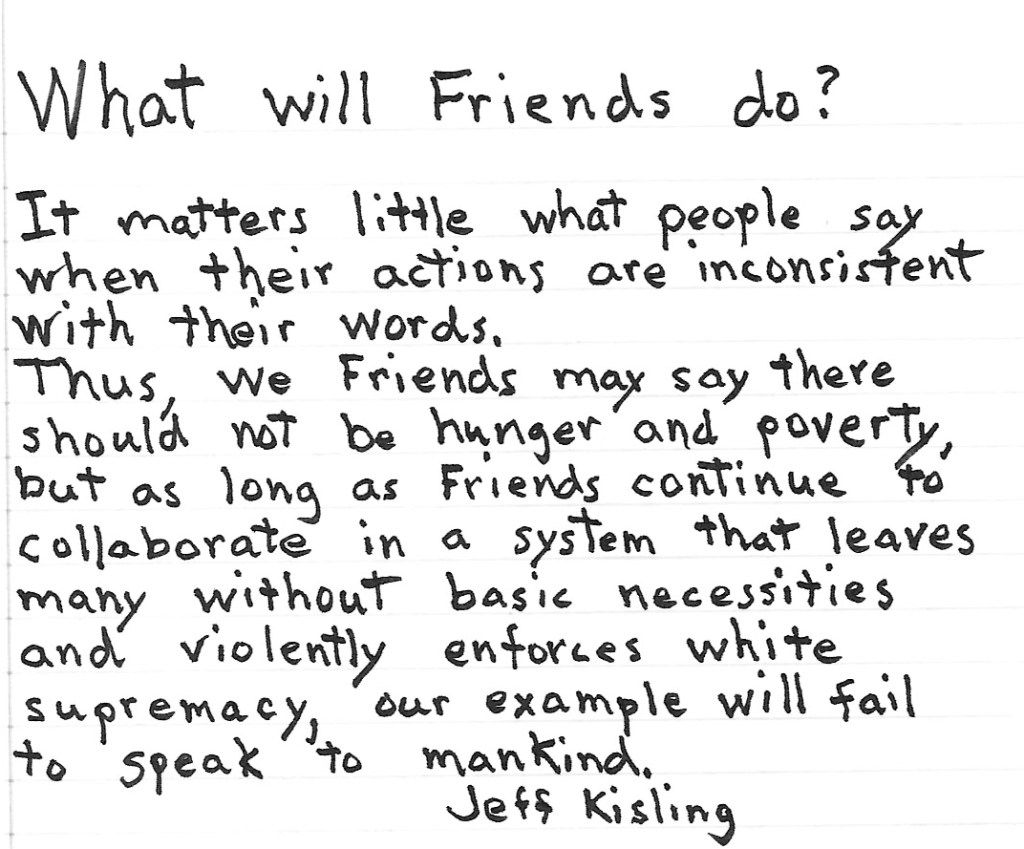
It matters little what men say they believe when their actions are inconsistent with their words. Thus we Friends may say that all war is wrong, but as long as Friends continue to collaborate in a system that forces men into war, our Peace Testimony will fail to speak to mankind.
Let our lives speak for our convictions. Let our lives show that we oppose not only our own participation in war, but any man’s participation in it. We can stop seeking deferments and exemptions, we can stop filling out Selective Service forms, we can refuse to obey induction and civilian work orders. We can refuse to register or send back draft cards if we’ve already registered.
In our early history we Friends were known for our courage in living according to our convictions. At times during the 1600’s thousands of Quakers were in jails for refusing to pay any special respect to those in power, for worshiping in their own way, and for following the leadings of conscience. But we Friends need not fear we are alone today in our refusal to support mass murder. Up to three thousand Americans severed their relations with the draft at nation-wide draft card turn-ins during 1967 and 1968. There may still be other mass returns of cards, and we can always set our own dates.
We may not be able to change our government’s terrifying policy in Vietnam. But we can try to change our own lives. We must be ready to accept the sacrifices involved if we hope to make a real testimony for Peace. We must make Pacifism a way of life in a violent world.
We remain, in love of the Spirit, your Friends and brothers,
Don Laughlin Roy Knight Jeremy Mott Ross Flanagan Richard Boardman James Brostol George Lakey Stephen Tatum Herbert Nichols Christopher Hodgkin Jay Harker Bob Eaton Bill Medlin Alan & Peter Blood
Roy Knight, John Griffith, and Don Laughlin were among the members of my yearly meeting, Iowa Yearly Meeting (Conservative) who resisted the draft. Don and Roy signed the epistle above.
Since I write so much, this article/story by Carrie Newcomer caught my attention. I can tell what she says will help me, can help all of us write better stories.
“Something I have learned as a writer is that every single day I wake up with a clean page. Each one of us awaken at the dawn with a pen and open notebook.”
Every day I wake up with a clean page, not knowing what I will write. It is a spiritual practice, listening to discern what to write. And lately I’ve been working on writing by hand, so I do “awaken at the dawn with a pen and open notebook.”
So let us honor the stories that gave us courage and personal grounding, the stories that brought us here, the finest ones the ancestors carried for us until we could carry them ourselves.
Carrie Newcomer
Carrie and I are Quakers. I got to hear her sing and tell stories when she visited our Quaker yearly meeting, Iowa Yearly Meeting (Conservative).
There are Quaker meetings that set aside time for people tell stories of their spiritual journey.
There are times when I’m afraid to write certain things. When I fear those I care about will be hurt by what I write. Afraid they will think poorly of me.
That was the case yesterday when I wrote “what this means for me is I don’t worry about the dysfunction of the political system. The culture and identity wars.”
For me this means rethinking whether we can influence government, which no longer serves us. Trying to engage with government officials has been one of the main ways Quakers and many others have worked for change. In earlier times, remarkable changes sometimes resulted.
I know many Friends will disagree when I say I believe this is no longer true.
Previously I wrote we need to rethink the stories we tell ourselves. Let go of the stories we have discovered were not, or no longer are true. Rethink stories of our past, of other cultures. To seek and really listen for Spiritual guidance. Act on that guidance. Question everything. Create new stories.
What I pay attention to, what I can actually help with are the survival needs of my community.
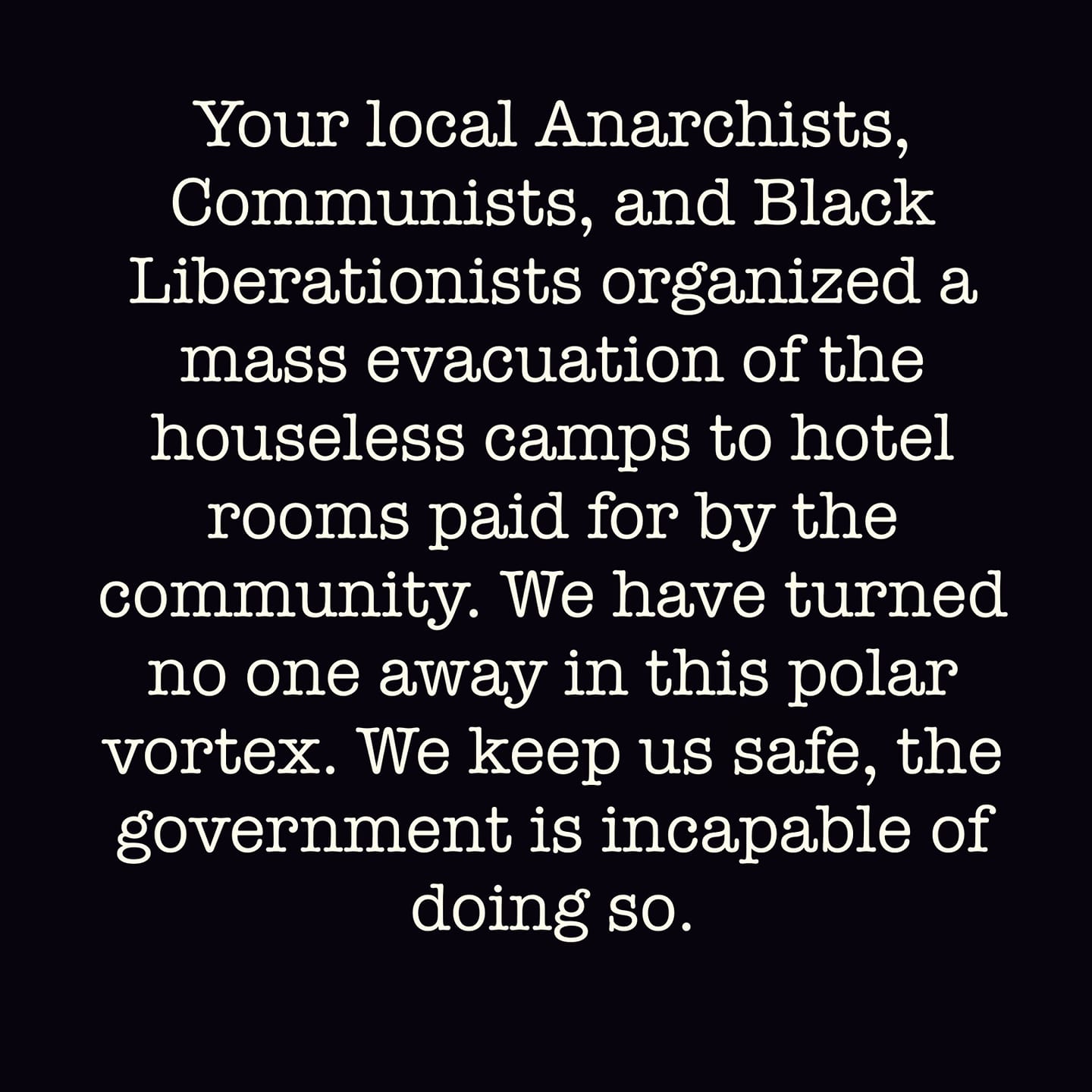
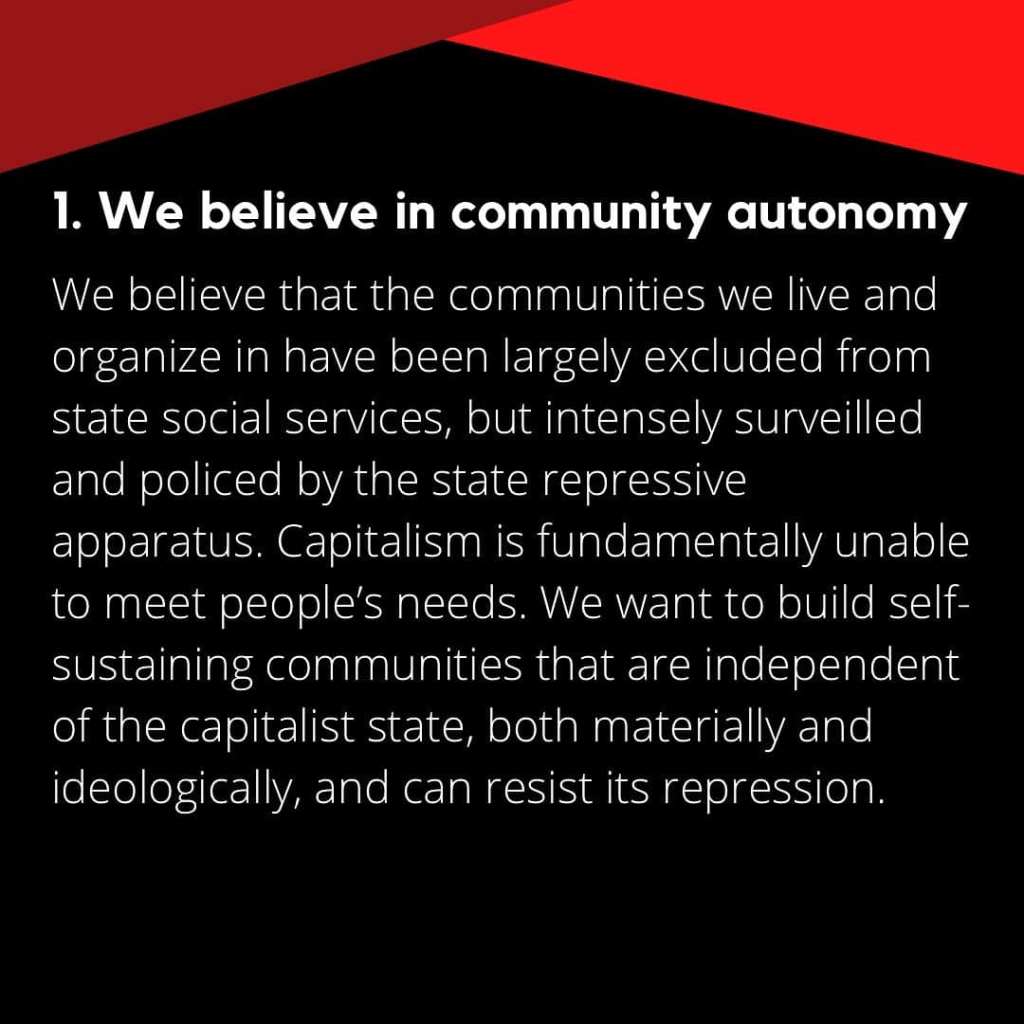
Your local Anarchists, Communists, and Black Liberations organized a mass evacuation of the houseless camps to hotel rooms paid for by the community. We have turned no one away in this polar vortex. We keep us safe, the government is incapable of doing so.
Des Moines Mutual Aid
The Mutual Aid work I’m most involved with is the free food project, which is a continuation of the Black Panther program mentioned below, that has existed in Des Moines since that time in the early 1970’s. I was there this morning. The wind chill was -11. Several of us mentioned we couldn’t see because our masks (which everyone wears) fogged up our glasses. Each time we would laugh about that. As always, we enjoyed being and working together.
We have only so much of ourselves that we can invest in work for justice. We can’t afford to waste that on things that will not result in change. The effort put into ineffective processes is effort that will not be available for other things, such as Mutual Aid.
I would ask what your stories are.
What is your justice work?
What has that work accomplished?
Have you developed deep, new friendships? New community?
Does that work excite and fulfill you?
Too little attention is paid to how justice work affects those doing the work. Too often I see those who want to make a difference go from committee meeting to meeting. Too often feeling dissatisfaction and fatigue. That isn’t going to do anyone any good.
That’s what Jason Laderas meant when he wrote mutual aid focuses on the root of community problems, rather than their symptoms. We bring the Beloved community into existence when we realize that with Mutual Aid, we are that community.
mutual aid focuses on the root of community problems, rather than their symptoms.
Jason Laderas
Now more than ever, it is clear to me that there is not much of a difference between the Democrats and Republicans in America.
While the Democrats may seem to favor human rights more than the Republicans, they have failed to deliver the type of change that could transform our society and lift millions out of suffering.
This whole two-party system is a facade. Neither party has the average person’s interests in mind. It’s about what benefits the billionaire corporations the most; it’s about serving the wealthy elite and leaving everyone else behind.
It’s not surprising that during this past year of COVID-19, where millions of people became unemployed, thousands of people died and millions were at risk of eviction, that the billionaires in the United States gained about 1.3 trillion since March of last year, according to inequality.org.
It doesn’t surprise me because this is just how our capitalist system is supposed to be working — the rich are getting richer, and the poor are getting poorer.
For far too long, our government has failed to vastly improve our material conditions. While people of other countries have enjoyed monthly government payments to help deal with COVID-19, the U.S. has only issued three direct payments.
It really makes me think, are we really the best country in the world?
If we cannot depend on our elected officials to deliver change that is going to benefit the overwhelming majority of this country, it is self-explanatory that the people may have to take matters into their own hands.
All massive changes in the history of America have started with everyday people banding together for a cause that they believe in. It does not start with the government. In the push for civil rights for Black people in the ’60s, change came to be with grassroots organizing.
The same can be applied to the changes that we want today. Since we cannot depend on our government, we have to depend on each other.
The Usefulness of Mutual Aid Against Our Failing Government, By Jason Laderas, slice of culture,
If we cannot depend on our elected officials to deliver change that is going to benefit the overwhelming majority of this country, it is self-explanatory that the people may have to take matters into their own hands.
Jason Laderas
One of the most famous examples of mutual aid is the Free Breakfast for Children Program of the Black Panthers. The Panthers took notice that poor black children often could not learn to the best of their ability because of poverty and hunger, so they took it upon themselves to feed the children.
They served free breakfast and lunch daily, also intaking donations from other organizations within the community like churches and other businesses.
This program spread all around the Black Panther chapters across America, eventually reaching 36 cities by 1971. In 1969, 20,000 children were fed across America through this program.
It was admitted during a 1969 U.S. Senate hearing in California, that the Panthers did a better job of feeding poor children than the state did.
The Black Panthers breakfast program is a prime example of just how mutual aid can benefit communities. They took notice that the government was not doing their job to adequately educate, feed and house Black people in America, so they did it themselves.
The Usefulness of Mutual Aid Against Our Failing Government, By Jason Laderas, slice of culture,
The tragic news of the recent killings of police officers ratchets up calls for more policing. Demonizing those of us who call for defunding the police. New York City’s mayor refers to defunding the police as a bumper sticker.
President Joe Biden’s meeting with New York City Mayor Eric Adams on February 3, 2022, comes as cities across the U.S. face a rise in violent crimes and represents a politically awkward shift in how the Democratic Party is approaching policing and criminal justice.
As a Senator in the 1990’s, Biden was known to be tough on crime, and Adams, a former NYPD captain, has been vocal about his support for police and the criminal justice system. They both find their long-held positions on policing and crime back in the Democratic mainstream, as some mayors and elected officials have shifted their stance on crime and the “defund the police” movement over the past several months.
During his meeting with Adams, Biden expressed his opposition to defunding the police as he said, “the answer is not the defund the police, it’s to give you the tools, the training, the funding, to be partners [and] to be protectors.”
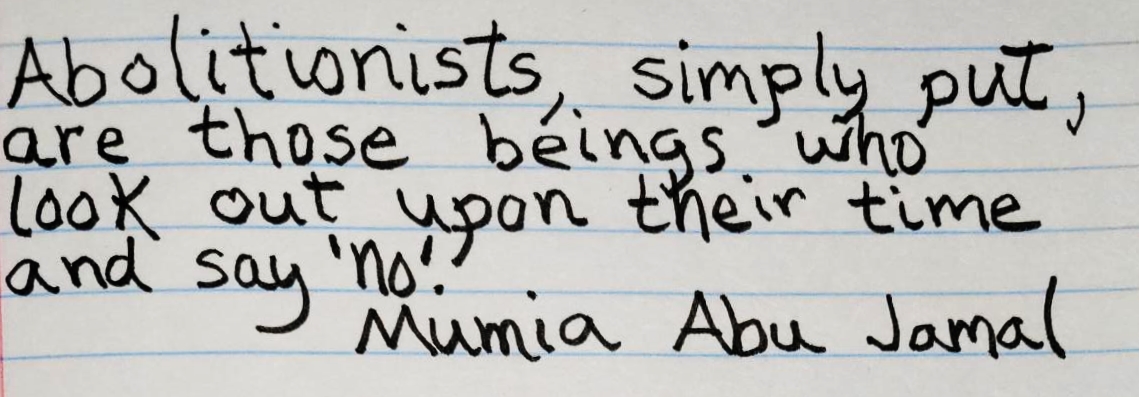
As an abolitionist, it feels like menace is in the air. I’m reminded of my teen days when I resisted the draft while the Vietnam war was raging. It was great to be living in the Scattergood Friends School community then.
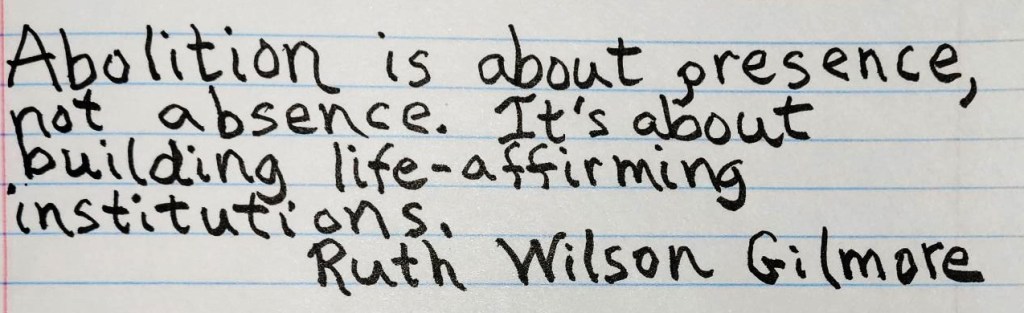
Most people think about abolition in terms of what it is against. Against the institution of slavery, against police and prisons. I like to think about what abolition is for.
I am a member of the Quakers for Abolition Network. Mackenzie Barton-Rowledge and Jed Walsh have been organizing this effort. Following are two articles published in Western Friend. To join the Quakers for Abolition Network, email Jed Walsh (jedwalsh9 [at] gmail.com) or Mackenzie Barton-Rowledge (mbartonrowledge [at] gmail.com).
Mackenzie: Let’s start with: What does being a police and prison abolitionist mean to you?
Jed: The way I think about abolition is first, rejecting the idea that anyone belongs in prison and that police make us safe. The second, and larger, part of abolition is the process of figuring out how to build a society that doesn’t require police or prisons.
M: Yes! The next layer of complexity, in my opinion, is looking at systems of control and oppression. Who ends up in jail and prison? Under what circumstances do the police use violence?
As you start exploring these questions, it becomes painfully clear that police and prisons exist to maintain the white supremacist, heteronormative, capitalist status quo. The racial dynamics of police violence are being highlighted by the recent uprisings and the Black Lives Matter movement.
…
We are in the same place, with a call to imagine a culture radically different than the one in which we live. Abolishing police and prisons, like abolishing slavery, would change the structure of our society: dramatically decreasing violence and undoing one set of power relationships that create domination and marginalization. And in place of this violence, we could, instead, have care.
Perspectives from the Quakers for Abolition Network
In late 2020, the two of us wrote an article for this magazine, called “Abolish the Police.” Through writing the piece, we realized we wanted to convene a larger space where Friends with an interest in police and prison abolition could have conversations with one another. Quaker abolitionists today face major pushback from our Meetings; we hoped that drawing Friends together would support and strengthen our work.
In this context, the Quakers for Abolition Network is being born. We are a collection of Friends from at least five Yearly Meetings; we range in age from high school to our 80s; we are disproportionately queer and trans. While AFSC and FCNL staff are participating, this is a grassroots project without any formal connections to existing organizations. We are in the process of defining our mission statement, structure, and our methods for addressing white supremacy when it shows up in our work, while building relationships with each other as we go. Below, four Friends write about their approaches to abolition, their lessons, and their visions for where Quakers might be headed.
Jeff Kisling: Mutual Aid and Abolition
I grew up in rural Iowa, where there was very little racial diversity and interactions with police and the court system were rare. About ten years ago, I was blessed to become involved with the Kheprw Institute, a Black youth mentoring and empowerment community. I’ll never forget how shocked I was when a Black mother broke down in tears, explaining how terrified she was every minute her children were away from home. It was obvious that every other person of color in the discussion knew exactly what she was saying.
After retiring, I was led to connect with Des Moines Mutual Aid, a multiracial organization founded to support houseless people. For over a year, I’ve helped my friends fill and distribute boxes of donated food, while continuing to learn about the framework of mutual aid.
To me, mutual aid is about taking back control of our communities. Besides the food giveaway, we support houseless people and maintain a bail fund to support those arrested agitating for change. We also work for the abolition of police and prisons.
To join the Quakers for Abolition Network, email Jed Walsh (jedwalsh9 [at] gmail.com) or Mackenzie Barton-Rowledge (mbartonrowledge [at] gmail.com).
Mackenzie Barton-Rowledge and Jed Walsh: Introducing the Quakers for Abolition Network, Western Friend, Sept 2021
I keep coming back to my failure to convince people we had to give up having personal automobiles if we were going to prevent the environmental catastrophe unfolding now. I was hoping the examples of those of us who refused to have cars combined with the warning signs about greenhouse gas emissions would make change happen.
I am similarly discouraged about the prospects of convincing people of the evils of capitalism, as I summarize here: The Evil of Capitalism.
But the global capitalist systems are collapsing now. The question is whether we will build alternatives before the worst happens.
when we join in a walkathon for the homeless or make an online donation for a food bank, we are relieved from the burden of confronting the underlying injustice of a society where great wealth exists alongside grinding poverty
Fran Quigley
My friend Fran Quigley has written Religious Socialism: Faith in Action for a Better World. One of the main premises of his book is “the grim, daily evidence of capitalism’s failures”. The following is from the Introduction of his book.
Rev. George Washington Woodbey is a member of a determined group of Americans who, over the course of 150 years, has insisted that there is an unbreakable connection between their religious values and the political and economic system of socialism. To make their case, they have pointed to the grim, daily evidence of capitalism’s failures. Today, the United States is one of the wealthiest nations in human history yet with far higher poverty rates than similar countries. The disparity reveals itself through health insurance company CEO’s making as much as $83 million per year, while tens of millions of the nation’s residents go without health care. It is shown by the richest Americans owning multiple homes, some worth as much as a quarter-billion dollars, while a half-million Americans are homeless. Three American men own more wealth than the bottom 50 percent of the nation’s population combined. At the same time, one of every six children in America—12 million overall—live below the poverty line.
Every faith tradition condemns this state of affairs. So does socialism. These faith traditions and socialism prescribe the same, straightforward remedy: all humans have the right to the necessities of life.
Note the word right. The capitalist U.S. system has survived its conflict with religious principles in significant part by projecting the illusion of caring about the suffering of the poor, while at the same time rejecting the recognition of any rights that would alleviate poverty. How is that tricky balancing act performed? By promising the U.S. public that the fortunate few will extend their charity to meet all the needs of the poor. If that promise is believed, massive concentrations of wealth do not seem so outrageous.
But that promise is a lie, demonstrated by the millions of American children going hungry while the wealthy luxuriate. Yet the false narrative persists, likely because it is so comforting to all of us who are not poor. In her 1998 book Sweet Charity, the sociologist Janet Poppendieck concludes that the American preference for charity over public welfare programs relieves the pressure for more fundamental solutions. Charity, she writes, acts as a “moral safety valve.”
From an individual perspective, that safety valve effect means that when we join in a walkathon for the homeless or make an online donation for a food bank, we are relieved from the burden of confronting the underlying injustice of a society where great wealth exists alongside grinding poverty. As for our political engagement, high-profile donations of plutocrats make us less likely to demand curbs on their lavish wealth. Charity may not be very effective at alleviating injustice, but it is quite good at relieving our sense of outrage about it.
Quigley, Fran. Religious Socialism: Faith in Action for a Better World (pp. 10-11). Orbis Books. Kindle Edition.
Every time I hear this interview, I am reminded of some of my own experiences related to Black Lives Matter.
This is a dream unrealized. MSNBC
Dr. Clarence Jones, former speechwriter and counsel to Martin Luther King, Jr., reflects on what Dr. King would think about the nation today. Jonathan Capehart What would Martin Luther King say about what’s going on in the United States today? Dr. Clarence Jones He would say Black lives have always mattered, always matter. The challenge has been for us to get the majority of society to recognize and to respect that.
These stories are about white Friends recognizing and respecting that Black Lives have always mattered.
2014
Racial justice, and Black Lives Matter, need vocal, visible and spiritual support from White Quakers now. How often has the Underground Railroad been invoked during discussions of Friends and enslavement and racial justice? Have you wondered what you would have done if you had been alive then? Twenty years from now what will you remember when you think back to this time and what you did, or did not do?
When I was living in Indianapolis, I attended the peace vigil every Friday afternoon in downtown Indianapolis. There were usually just three or four attending. We held signs about peace, including the Friends Committee on National Legislation’s ‘War is Not the Answer’.
I had been thinking a lot about peace building and feel that addressing economic, environmental and racial injustice is what constitutes peace building today in the United States.
After Michael Brown’s killing in 2014, and the ongoing killings of people of color, there were multiple demonstrations in Indianapolis.
I changed my message to Quakers Black Lives Matter. I made the sign below to take to our weekly peace vigil in front of the Federal Building in downtown Indianapolis. I was very unsure of how that sign would be received by people of any race, but felt called to do it
However, I had forgotten the first time I carried the sign to the vigil (I didn’t own a car) was the weekend of Indy Black Expo. As I was walking to the Federal Building and entered the downtown mall, I was suddenly in the middle of thousands of people of color. I was unsure of what the reaction would be. I was tempted to turn around and go home. But I mostly got looks of surprise and puzzlement. No one said anything then (there was music, food, etc.).
But during the hour of the peace vigil that day, there were a lot of interactions, both with people driving and those walking past our group of three, and they were all positive. Many people said “thanks” with smiles. Someone said, “that’s a good sign, a damn good sign”. “Our lives DO matter”, said another.
Carrying the sign on the way home after the peace vigil, I was surprised by the sound of an air horn, and looked up into the cab of the tractor trailer passing by, where two young black men were grinning and waving their arms.
Another day a young Black man stopped, got out of his car, and walked up to us. I wasn’t sure how that was going to go. But he said, “a white man holding a Black Lives Matter sign”. I said, “yes, a white man holding a Black Lives Matter Sign”. He started to go away, but returned and asked, “why are you doing it?” I told him about the Kheprw Institute (KI) that mentors Black youth that I had been involved with for several years now. And how those kids had become friends of mine. And I want a better life for them. He nodded, then said it was a brave thing to do. I only mention this to show how other people might see what you do in public. He went on to say he felt justice had to be grounded in faith.
Many times a car of people of color would honk, and people smile and cheer and wave their hands. Many times take photos with their phones.
Another day an energetic young Black man came and said “Quakers, Black Lives Matter”, and began to take a video of us, then had a friend take more video as he stood with his arms around our shoulders, narrating all the time–“Quakers”, “Black Lives Matter”.
Bear Creek Friend Jenny Cisar created this decal and made 100 copies, which people were eager to obtain.
Kathy Hall, of Whittier meeting, made this sign. Pictured is the Peace and Social Concerns Committee of Iowa Yearly Meeting (Conservative).
Peace and Social Concerns Committee of Iowa Yearly Meeting (Conservative).
July 12, 2016
Friends, this is a pivotal moment. Silence means supporting the status quo, which means supporting white privilege and racial injustice. Black Lives Matter is a nonviolent movement seeking to correct these injustices.
We are all aware of Friends’ history of speaking out publicly to witness against injustice. Many of us continue our weekly peace vigils and display our “War is Not the Answer” signs. Peace making now means speaking out for racial justice.
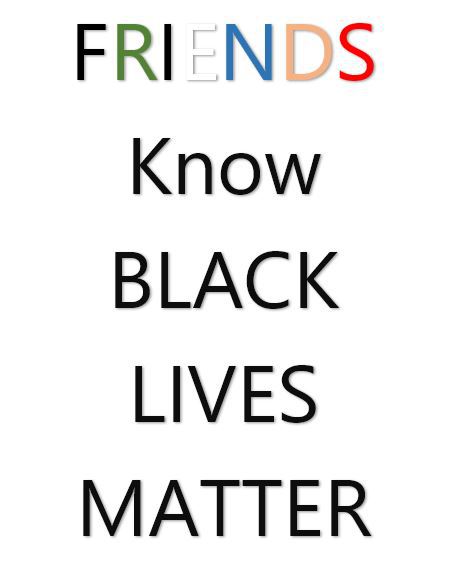
Here is one graphic you can make a sign from.
Friends, our small and rural communities especially need to hear these messages.
This is the time to stir up uncomfortable conversations. My black friends wonder why white people are not helping them. We need to show visible signs of support. We need to attend the Black Lives Matter rallies. We need to put Black Lives Matter signs on our meetinghouse and home lawns.
Dallas surgeon Brian Williams, who helped care for the police shot there, said “I understand the anger and the frustration and distrust of law enforcement. But they’re not the problem. The problem is the lack of open discussions about the impact of race relations in this country. . . . The killing, it has to stop.’’
“Please move away from the sidelines and unite together — regardless of your faith or religious practice — to seek an end to hatred and violence . . . What happened to our family is part of a larger attack on Black and Brown bodies . . . We call on all people, public officials, faith leaders and Americans from all walks of life to help address the festering sores of racism as it spurs an unforgiving culture of violence.” -Rev. Waltrina Middleton, longtime organizer, whose cousin Rev. Depayne Middleton, was killed in the massacre at Emanuel AME Church
2016
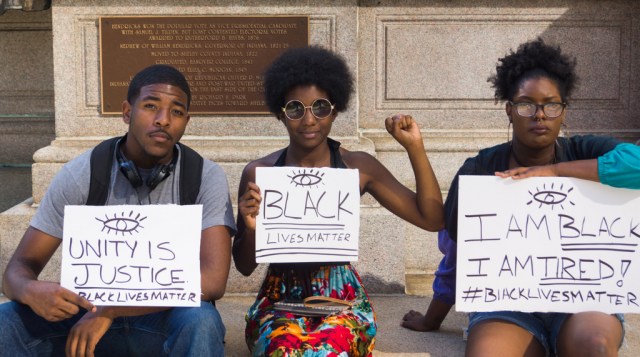
I’ve often looked at, and thought about this photograph I took at a Black Lives Matter protest in Indianapolis in July, 2016.
It was a warm, sunny summer evening, around sunset. I arrived about half an hour early and there weren’t many people gathered on the lawn of the Indiana Capitol, yet.
I almost walked past the trio above, but something made me stop. I thought they created an excellent image of the Black Lives Matter Movement…poised, stressed and tired, respectful, determined, nonviolent, hurt, angry, but very, very intent and serious.
It was important to me that I ask for their permission to take this photo, something I didn’t usually do then at public events. These days I no longer take photos that show people’s faces, because law enforcement uses such photos to bring charges.
They each considered my request for a moment, then each, with varying degrees of enthusiasm, indicated that would be permissible. I knelt in front of them, framed and then shot the photo, and thanked them. Silent nods, but also slight smiles.
I like each of the facial expressions, the story each person’s posture tells, and the raised fist salute. I like the sense of support, leaning in toward each other. I like the messages on the signs.
But the reason I keep coming back to this is because I also feel a real challenge from them to me/us. I think they are saying “we’ve taken the time and effort (and I would say courage) to come out in public to support our community and each other, and demand that these injustices stop.”
And they seem to be asking me/us, “what are you going to do? Do you have a little courage yourself? Will you make yourself, and others uncomfortable by speaking the truth about these things?”
Recently I described why Quakers should dismantle vertical hierarchies. The hierarchies that structure everything Western peoples live, work, and worship by. Every vertical hierarchy creates structures where one, or a select few, take power and benefit from those beneath them. We have been lulled into accepting these structures as the way things are. Such as a supervisor over workers. But the consequences of these hierarchies are more extensive and significant than often realized.
Des Moines Mutual Aid
Reflecting on what I last wrote, Hierarchy and Quakers, I realize I shouldn’t have made such a sweeping statement. When I wrote that means Black, Indigenous, and other people of color (BIPOC) don’t want to be associated with these Friends, I was speaking about the BIPOC people I know. By associate I meant there will be this awareness that there will be frustrations when those who are aware of hierarchies try to work with those who aren’t. Might make it impossible in some cases.
I say this from my two years of experience in a Mutual Aid community. This is not some theory I’ve read somewhere. This has changed me so much I now have trouble being in hierarchical situations myself.
I am a hierarchy resister.
I spend so much time praying and writing about Mutual Aid because I want to share what I am learning with Friends. I believe this can energize our peace and justice work. Mutual Aid is the framework that models the Beloved communities Friends strive to create. Gets to the roots of injustice. Some of the articles I’ve written about Mutual Aid can be found here: https://landbackfriends.com/mutual-aid/
My introduction to Mutual Aid was in response to a strong Spiritual leading.
Mutual Aid is NOT charity.
Maintaining a flat or horizontal hierarchy is what makes Mutual Aid work.
MUTUAL is the key.
Removing the artificial hierarchies eliminates grouping people by race, class, gender, education, etc. There cannot be white supremacy, for example, if there is no vertical hierarchy.
Mutual Aid resists authoritarianism and colonization.
Mutual Aid represents a paradigm shift away from capitalism, white supremacy, insurance-controlled healthcare, militarized police and punishment oriented judicial system, prisons, education that resists teaching critical thinking and promotes white supremacy, and domestic and global militarism. Away from commodifying all natural resources and continued extraction and burning of fossil fuels.
Queries related to Mutual Aid
Do we recognize that vertical hierarchies are about power, supremacy and privilege? What are Quaker hierarchies?
Do we work to prevent vertical hierarchies in our peace and justice work?
What are we doing to meet the survival needs of our wider community?
How are we preparing for disaster relief, both for our community, and for the influx of climate refugees?
Are we examples of a Beloved community? How can we invite our friends and neighbors to join our community?
What Is Mutual Aid?
Mutual aid is collective coordination to meet each other’s needs, usually from an awareness that the systems we have in place are not going to meet them. Those systems, in fact, have often created the crisis, or are making things worse. We see examples of mutual aid in every single social movement, whether it’s people raising money for workers on strike, setting up a ride-sharing system during the Montgomery Bus Boycott, putting drinking water in the desert for migrants crossing the border, training each other in emergency medicine because ambulance response time in poor neighborhoods is too slow, raising money to pay for abortions for those who can’t afford them, or coordinating letter-writing to prisoners. These are mutual aid projects. They directly meet people’s survival needs, and are based on a shared understanding that the conditions in which we are made to live are unjust.
There is nothing new about mutual aid— people have worked together to survive for all of human history. But capitalism and colonialism created structures that have disrupted how people have historically connected with each other and shared everything they needed to survive. As people were forced into systems of wage labor and private property, and wealth became increasingly concentrated, our ways of caring for each other have become more and more tenuous.
Today, many of us live in the most atomized societies in human history, which makes our lives less secure and undermines our ability to organize together to change unjust conditions on a large scale. We are put in competition with each other for survival, and we are forced to rely on hostile systems— like health care systems designed around profit, not keeping people healthy, or food and transportation systems that pollute the earth and poison people— for the things we need. More and more people report that they have no one they can confide in when they are in trouble. This means many of us do not get help with mental health, drug use, family violence, or abuse until the police or courts are involved, which tends to escalate rather than resolve harm.
In this context of social isolation and forced dependency on hostile systems, mutual aid— where we choose to help each other out, share things, and put time and resources into caring for the most vulnerable— is a radical act.
Dean Spade. Mutual Aid: Building Solidarity During This Crisis (and the Next) (Kindle Locations 104-120). Verso.
This morning I’m struggling to understand why so few people engage in civic responsibilities, or the many injustices we face. I’m writing in terms of my faith community, Quakers. It is telling that I must explain when I say “Quakers” I mean white Quakers unless otherwise specified. Historically there was so little diversity among Friends in this country that nearly all Quakers were white. Tragically that hasn’t changed much today. Something is wrong.
I’m struggling to understand why more white Quakers in this country aren’t engaged to:
stop the rise of authoritarianism
agitate for peace
support Black Lives Matter
work for healing and reconciliation related to the Indian residential schools and the children abused or killed there
work for LANDBACK
help those who are impoverished, houseless and hungry
protect the water
protect Mother Earth from the rape of resource extraction
protect women
protect those who are LGBTQ
speak to spiritual needs
Why this profound, widespread malaise?
I’m pondering these things now in the context of putting beliefs into action, to work on matters of justice and peace.
Historically Friends have worked for peace. A number of Quaker men and their families chose to face imprisonment for refusing to participate in war, militarism, and the peacetime draft.
Historically, Quakers were also credited for work related to race. And yet, relatively few white Friends were actually involved in things like the Underground Railroad. Today we sometimes see Friends suggest they deserve some credit for what abolitionist Friends did. Which is wrong.
Indeed, some Friends were involved in the institution of slavery in the early days of this country’s colonialism. Our ancestors were settler colonists, building farms and communities on land stolen from Indigenous peoples. Some white Quakers were involved in the policies and implementation of forced assimilation of Indigenous children. Genocide.
Many white Friends today struggle to understand white superiority and privilege. Which means they continue to act as if they are privileged. And means Black, Indigenous, and other people of color (BIPOC) don’t want to be associated with these Friends.
I know it is upsetting for white Friends to be reminded of these things. But that unease is nothing compared to the harm that was and continues to be done. Such trauma is passed from generation to generation. People today are deeply affected by this trauma. Both the victims and the perpetrators. For example, the growing numbers of the remains of native children located on the grounds of the institutions of forced assimilation are profoundly disturbing. Where is the outrage from white people, white Friends?
We must bring these things to light to understand why they happened. Whether they continue today. And ensure they don’t happen again. As the beginning of processes of truth, reconciliation, repatriation, and healing.
I intentionally use the phrase ‘bring these things to light’ because the Light, or Inner Light is one way we speak of spiritual guidance.
I’ve been blessed to have made friends in several different communities over the past few years. What I am learning is giving me new insight. One is being reminded that white Quakers have not spent significant time in communities outside the meetinghouse. Building relationships in oppressed communities by being present there is the most important thing we must do if we want to be effective allies. Nothing else we do will be meaningful if we don’t have these relationships.
From my Indigenous friends I’ve seen traumas that most white Quakers often don’t know about, let alone experience. My friends have relatives, some still living, who were in those institutions of forced assimilation. Some who have family members who are among the missing and murdered Indigenous relatives, related to the man camps at the sites of pipeline construction.
I’ve seen their love of the land as we walked together for ninety-four miles over eight days. They pointed out the changes in vegetation. The water standing in fields disturbed by the Dakota Access pipeline.
Another community I am blessed to belong to is Des Moines Mutual Aid, a diverse community that includes some Indigenous friends. Here I’ve been learning about the fundamental differences between a community based on a flat or horizontal hierarchy, and the vertical hierarchies that structure everything white people are involved in.
Learning this has revealed to me why white Quakers have been unable to understand or do anything about the problems of white supremacy. Why non-white people don’t become involved in our white Quaker communities.
As I wrote yesterday, it was interesting, but not surprising, to hear this also expressed as part of the Indigenous worldview.
A key principle is to live in balance and maintain peaceful internal and external relations.
This is linked to the understanding that we are all connected to each other.
The hierarchical structure of western world views that places humans on top of the pyramid, does not exist. The interdependency with all things, promotes a sense of responsibility and accountability.
This new awareness of the vertical hierarchies of white culture in general, and our white Quaker communities specifically, has given me insight into the list of things at the beginning of this that white Quakers have not in general been able, or perhaps willing, to engage with.
I’ve been very discouraged about Friends’ lack of engagement in a number of things over the years. Have I lost faith in what we will do? Does it mean Friends have lost faith in what they could do? Have they lost faith more generally? Do we believe we can discern the Inner Light? Will we do what the Light reveals?
What can we be?
We can be driven by the Inner Light.
We can dismantle vertical hierarchies.
We can be present in our wider communities.
Regarding the following, I recently wrote about calligraphy – a sacred tradition What follows is definitely not calligraphy. I was having more trouble getting ink to flow than getting any writing done. But it has been interesting to use a felt tip pen to write by hand.
I’ve begun the course Indigenous Canada offered by University of Alberta. This is a Massive Open Online Course (MOOC) from the Faculty of Native Studies that explores Indigenous histories and contemporary issues in Canada. I’ve already learned a great deal and recommend it. This is a free course described at the end of this post. https://www.coursera.org/learn/indigenous-canada
For years I’ve been praying for ways to bring about Beloved community. I’ve gone through many iterations of this diagram to help me visualize our current circumstances and what might be done to move toward such a community.
I’ve been blessed to become friends with and learn from Indigenous people. A common thread throughout my life has been to protect Mother Earth. For a long time, I looked for opportunities to make such connections because it was obvious that native peoples had always lived and continued to live in ways that protect Mother Earth.
The physical infrastructure of Beloved community was easy to see, but what I had trouble with was spirituality and governance, which are tightly bound together. I could see that Beloved community would not work with the mindset of capitalism and dominance. White people would have to learn to abandon those systems.
Two years ago I was blessed to become involved in a local Mutual Aid group which has been transformative. This is a model that teaches how to reject capitalism and dominance. A key is to leave the vertical hierarchies of power and decision making and instead use a flat or horizontal structure that gives everyone a voice. And encourages critical thinking and self-motivation. https://landbackfriends.com/mutual-aid/
I was fascinated to see this discussed in the Indigenous Worldviews course. “The hierarchical structure of western world views that places humans on top of the pyramid, does not exist. The interdependency with all things, promotes a sense of responsibility and accountability.”
Indigenous ways of knowing are based on the idea that individuals are trained to understand their environment, according to teachings found in stories.
These teachings are developed specifically to describe the collective lived experiences and date back thousands of years.
The collective experience is made up of thousands of individual experiences, and these experiences come directly from the land and help shape the codes of conduct for Indigenous societies.
A key principle is to live in balance and maintain peaceful internal and external relations.
This is linked to the understanding that we are all connected to each other.
The hierarchical structure of western world views that places humans on top of the pyramid, does not exist. The interdependency with all things, promotes a sense of responsibility and accountability.
Thriving in the harsh Arctic climate, Inuit people relied heavily upon each other for survival.
Each person had value and contributed to the community.
This reliance established codes of ethics and behaviors, or Maligait. Maligait has many meanings and translations, but to Inuit people it means, things that had to be done, and includes four main principles:
work for the common good
respect all living things
preserve harmony and balance
plan and prepare for the future
The hierarchical structure of western world views that places humans on top of the pyramid, does not exist.
Indigenous Canada is a 12-lesson Massive Open Online Course (MOOC) from the Faculty of Native Studies that explores Indigenous histories and contemporary issues in Canada. From an Indigenous perspective, this course explores key issues facing Indigenous peoples today from a historical and critical perspective highlighting national and local Indigenous-settler relations. Topics for the 12 lessons include the fur trade and other exchange relationships, land claims and environmental impacts, legal systems and rights, political conflicts and alliances, Indigenous political activism, and contemporary Indigenous life, art and its expressions.
Thank you for signing up for Indigenous Canada. This course examines the historical and contemporary lives, identities, cultural expressions, rights, and goals of Indigenous peoples in Canada. In this course, we have worked to bring Indigenous voices and perspectives to inform your learning experience.
The course material will be covered in twelve modules. Each module offers a series of videos communicating Indigenous experiences of history and current events. Topics covered include: the fur trade and exchange relationships, land claims and environmental impacts, legal systems and rights, Indigenous political activism, and contemporary Indigenous life, art, and its expressions. Together, these modules provide a basic familiarity with Indigenous perspectives as well as Indigenous/non-Indigenous relations.
We are excited to have you with us and be a participant in these learnings. Spread the word of this unique education experience by telling a family member, a friend, or a colleague. We hope that Indigenous Canada will serve you well and offer new insights. Thank you and take care, Dr. Paul Gareau












 Quakers and Mutual Aid