Willow Project

Will the existential threat of environmental devastation ever be taken seriously by capitalist countries?

Approval of the Willow Project is just the latest decision that will result in the emission of tons of carbon dioxide into the atmosphere. Another recent decision by the Biden administration was the release of millions of barrels of oil from the Strategic Petroleum Reserve solely to bring down gas prices.

The administration’s justifications were the valid leases of ConocoPhillips and that the courts would block the rejection of the project. One point is what are “valid rights on the land” in regard to Indigenous peoples?

As long as capitalism is the economic model of a country, fossil fuels will continue to be burned to drive that economy. Which is why we need to move to models such as Mutual Aid where profits are not the goal of society as soon as possible.

The Biden administration was limited by legal restraints in reviewing the Willow oil project, according to a White House official who said the company had valid rights on the land because of decades-old leases.

The administration was convinced the courts would have blocked an outright rejection of the Willow project and potentially imposed fines on the government, said the official, who spoke about the White House’s considerations on the condition of anonymity. 

Biden approves Willow Project. What to know about the move to allow oil drilling in Alaska by Sarah Elbeshbishi, USA Today, March 15, 2023

Instead of sticking to his own climate goals and listening to the people of the Village of Nuiqsut and the millions of us who got #StopWillow to nearly one billion views on TikTok, he let the fossil fuel industry win.

The Willow Project is a dangerous climate bomb — an $8 billion fossil fuel infrastructure project in Alaska, which would emit over 287 metric tons of carbon dioxide into the atmosphere, threaten Indigenous Alaska Native communities and destroy wild landscapes north of the Arctic Circle.

We’re living through an unprecedented climate crisis that will wreak havoc upon the lives of billions of people across the world, and for generations to come. We can’t afford any more drilling on our land.

The decision on Willow is shameful and a devastating blow to our generation. And it’s a reminder that the fossil fuel industry still holds so much power over us and our future. But if we can build enough people power, we know that together, we can defeat them.

We are the generation of a Green New Deal and we will keep fighting for our planet and our futures. 

Sunrise Movement

We are the generation of a Green New Deal and we will keep fighting for our planet and our futures.

Sunrise Movement

The Biden administration on Monday announced that it is approving the largest-ever proposed oil drilling project on U.S. public lands, in a direct repudiation of research warning that new fossil fuel development must cease to preserve a safe climate.

The Interior Department approved ConocoPhillips Alaska’s Willow project, located in one of the fastest-warming regions of the world. If completed, this project would produce the equivalent of an estimated 263 million tons of carbon dioxide over 30 years. This is about the same as building 20 new gas plants and running them for the same time period; burning 8.8 billion pounds of coal every year for 30 years; or adding 1.7 million cars to the road. 

Willow is not just an “environmentalist” concern. HEATED analyzed 30 national news stories about the Willow project and found that 75 percent framed its importance as primarily political by Arielle Samuelson and Emily Atkin, HEATED, March 15, 2023

Quakers and Change

Quakers have a long history of working for justice and social change. But what do we (Quakers) do when we realize change is necessary now? Throughout our history we have been led to see we are implicated in injustice. “Led” means the Spirit has shown what the injustices are, and what changes should be made. Most commonly, individuals discern what change is needed, and over time they and the Spirit convince others.

As my friend Lucy Duncan writes, “we as White Quakers like to think of ourselves as ahead or better than dominant culture, but we have been complicit in a system and mindset that are ubiquitous.”

The myths we tell ourselves and the lies those myths uphold are embedded in our contemporary faith practice. When we believe and perpetuate falsehoods about ourselves, it not only disconnects us from the truth, it also limits our ability to act with full integrity today. Telling the truth about ourselves and our White Quaker ancestors grounds us in reality, in a sense of the complexity of our identity. It allows us to create a different future, not built from delusion and half of the story but from an honest and grounded reckoning with who we are and who we have been. My friend Mila Hamilton calls this “intergenerational transformative justice.” As we deal with the uncomfortable truths of our White Quaker ancestors, we release them from the amber in which our myths have captured them. As we allow them to become the full, flawed humans they were, we also free ourselves to reckon with our present, which arises from their past, and to tell the full truth of who we are.

We as White Quakers like to think of ourselves as ahead or better than dominant culture, but we have been complicit in a system and mindset that are ubiquitous. Claiming the full truth of our history and committing to repair the harms done are deeply spiritual acts of healing our own wounds of disconnection. I would argue it is the pathway upon which we can, perhaps for the first time, discover and invigorate our faith with its full promise.

What would it mean for us to take seriously and collectively as a Religious Society a call to finish the work of abolition, hand in hand and side by side with those affected and their loved ones? What would it mean for us to stand fully with the calls to abolish the police and fully fund community needs instead? What would it mean to reckon with our past complicity with harm and fully dedicate ourselves to the creation of a liberating Quaker faith that commits to build the revolutionary and healing faith we long to see come to fruition? What would it look like to finally and fully abolish slavery?

A Quaker Call to Abolition and Creation by Lucy Duncan, Friends Journal, April 1, 2021

It can take a long time for change to occur. Personally, I’ve been working since the early 1970’s to convince Friends to consider my spiritual leading to drastically reduce our carbon footprint, including not having an automobile.

Most of our values, beliefs and assumptions regarding livelihoods need to be radically transformed in order to move into activities that are sustainable. If this transition is ever to occur, we must be able to visualize and share the details of these alternative occupations and embrace new social metrics to support those occupations.

I try to imagine myself making a move into a livelihood that would be fundamentally sustainable like the critical but overlooked work done by a young man I know who shuttles vegetable waste from homes in his neighborhood to a small composting center in his community by bicycle. He then sells and delivers by bike finished compost to neighbors with gardens. If I chose to move into this “career” my friends would think I had lost my mind. My friends might ridicule me. Certainly, they would worry about me! And worse, some people, perhaps even including my spouse, might simply think they no longer had anything in common with me. It’s like giving up alcohol in an alcohol inundated world. You stand outside, you are not one of the groups any longer. In reality, I would need to build an entirely new social network with different values and notions of success, a network that would respect my choices and understand their importance. Because living and working, having lifestyles and livelihoods that are truly regenerative and sustainable look nothing like how most of us live and work now. The cultural transition and change in our values and the metrics we use to measure our sense of success, therefore our identities, is hard to imagine, not to mention implement.

Nevertheless, I have interviewed people with very low carbon livelihoods and lifestyles, highly moral people who work and live outside of mainstream jobs and careers. And guess what? They did indeed initially have to suffer social backlash from family and friends for their lifestyle and work choices. 

Against the Economic Grain: Addressing the Social Challenges of Sustainable Livelihoods by Kim Kendall, Resilience.org, January 27, 2023

One of the things I appreciate in our spiritual practice is for the Quaker meeting to use questions to consider where we are today in our faith. For example, the following are the queries related to social and economic justice.

11.  SOCIAL AND ECONOMIC JUSTICE


“For when I was hungry you gave me food, when thirsty you gave me drink, when I was a stranger you took me into your home, when naked you clothed me, when in prison you visited me.”     Matthew 25:35‑36

ADVICE 

We are part of an economic system characterized by inequality and exploitation. Such a society is defended and perpetuated by entrenched power. 

Friends can help relieve social and economic oppression and injustice by first seeking spiritual guidance in our own lives. We envision a system of social and economic justice that ensures the right of every individual to be loved and cared for; to receive a sound education; to find useful employment; to receive appropriate health care; to secure adequate housing; to obtain redress through the legal system; and to live and die in dignity. Friends maintain historic concern for the fair and humane treatment of persons in penal and mental institutions.

Wide disparities in economic and social conditions exist among groups in our society and among nations of the world. While most of us are able to be responsible for our own economic circumstances, we must not overlook the effects of unequal opportunities among people. Friends’ belief in the Divine within everyone leads us to support institutions which meet human needs and to seek to change institutions which fail to meet human needs. We strengthen community when we work with others to help promote justice for all. 

QUERIES 

  • How are we beneficiaries of inequity and exploitation? How are we victims of inequity and exploitation? In what ways can we address these problems?
  • What can we do to improve the conditions in our correctional institutions and to address the mental and social problems of those confined there?
  • How can we improve our understanding of those who are driven to violence by subjection to racial, economic or political injustice? In what ways do we oppose prejudice and injustice based on gender, sexual orientation, class, race, age, and physical, mental and emotional conditions? How would individuals benefit from a society that values everyone? How would society benefit?


“We are part of an economic system characterized by inequality and exploitation. Such a society is defended and perpetuated by entrenched power. How are we beneficiaries of inequity and exploitation? How are we victims of inequity and exploitation? In what ways can we address these problems?”


Injustice cannot be addressed as long as we are involved in the system of injustice, in this case, capitalism. As my good friend Ronnie James says:

I’m of the firm opinion that a system that was built by stolen bodies on stolen land for the benefit of a few is a system that is not repairable. It is operating as designed, and small changes (which are the result of huge efforts) to lessen the blow on those it was not designed for are merely half measures that can’t ever fully succeed.

So, the question is now, where do we go from here? Do we continue to make incremental changes while the wealthy hoard more wealth and the climate crisis deepens, or do we do something drastic that has never been done before? Can we envision and create a world where a class war from above isn’t a reality anymore?”

Ronnie James


The following is a diagram I’ve been working on for several years to visualize unjust systems and possible alternatives. On the left is capitalism, built on colonialism. The red vertical bar indicates forces that interfere with making changes. Failing and corrupt institutions, authoritarianism, and environmental chaos. If we can move past those resistances, we can build communities for a viable and just future.

I’ve been part of a Mutual Aid community for the past three years. That experience convinces me the Mutual Aid is a vital component of a more just future for us all. It is a way to escape the capitalist economic system, which I’ve written about extensively.
(See: https://quakersandreligioussocialism.com/mutual-aid/ )


Imperialist contradictions

I’ve had a lifelong struggle to call attention to this country’s flagrant disregard for the need to protect nonrenewable sources of energy and the mounting environmental devastation from our greenhouse gas emissions. Obviously, these are also global issues. We are depleting fossil fuel supplies of the entire world. And our gigantic fossil fuel emissions affect the world.

It is often pointed out that those nations with the lowest emission are most affected by the environmental damage done by “developed” countries.

I haven’t learned enough about these global impacts. This recent paper, Eight Contradictions in the Imperialist ‘Rules-Based Order’ that I’ve been writing about is helping with my education.
(See: https://quakersandreligioussocialism.com/?s=imperialism )


Eight Contradictions in the Imperialist ‘Rules-Based Order’

  • The contradiction between moribund imperialism and an emerging successful socialism led by China.
  • The contradiction between the ruling classes of the narrow band of imperialist G7 countries and the political and economic elite of capitalist countries in the Global South.
  • The contradiction between the broad urban and rural working class and sections of the lower petty bourgeoisie (collectively known as the popular classes) of the Global South versus the US-led imperial power elite.
  • The contradiction between advanced rent-seeking finance capital versus the needs of the popular classes, and even some sections of capital in non-socialist countries, regarding the organisation of societies’ requirements for investment in industry, environmentally sustainable agriculture, employment, and development.
  •  The contradiction between the popular classes of the Global South and their domestic political and economic power elites.
  •  The contradiction between US-led imperialism versus nations strongly defending national sovereignty.
  • The contradiction between the millions of discarded working-class poor in the Global North versus the bourgeoisie who dominate these countries.
  • The contradiction between Western capitalism versus the planet and human life.

The eighth contradiction summarizes the fundamental contradiction, the contradiction between Western capitalism versus the planet and human life.

The inexorable path of this system is to destroy the planet and human life, threaten nuclear annihilation, and work against the needs of humanity to collectively reclaim the planet’s air, water, and land and stop the nuclear military madness of the United States. Capitalism rejects planning and peace. The Global South (including China) can help the world build and expand a ‘zone of peace’ and commit to living in harmony with nature.

With these changes in the political landscape, we are witnessing the rise of an informal front against the US-dominated imperialist system. This front is constituted by the convergence of:

  • Popular sentiment that this violent system is the main enemy of the people of the world.
  • Popular desires for a more just, peaceful, and egalitarian world.
  • The struggle of socialist or nationalist governments and political forces for their sovereignty.
  • The desires of other Global South countries to reduce their dependence on this system.

The main forces against the US-dominated imperialist system are the peoples of the world and the socialist and nationalist governments. However, there must be space provided for integrating governments that wish to reduce their dependency on the imperialist system.

The world currently stands at the beginning of a new era in which we will witness the end of the US global empire. The neoliberal system is deteriorating under the weight of numerous internal contradictions, historical injustices, and economic unviability. Without a better alternative, the world will descend into even greater chaos. Our movements have revived hope that something other than this social torment is possible.

CONTRADICTIONS OF THE IMPERIALIST ‘RULES-BASED ORDER’ by Vijay Prashad, Tricontinental: Institute For Social Research, March 10, 2023


What can those of us in capitalist systems do? We must find alternatives. For me, this has been to become involved in Mutual Aid.
(See: https://quakersandreligioussocialism.com/?s=mutual+aid )


Contradictions of the Imperialist ‘Rules-Based Order’

Have your views about our environmental situation changed? It is more difficult to deny environmental damage in the face of all kinds of climate chaos occurring globally.

Did you know the U.S. Military emits more carbon dioxide than many nations?

This leads to an existential paradox. If we are ever going to begin to mitigate greenhouse gas emissions, we must end military operations. Could this be a path to peace? Or will imperialism continue to feed increasing environmental devastation?

The new document described below, “Eight Contradictions in the Imperialist ‘Rules-Based Order’” identifies conflicts between imperialist nations and the rest of the world.


The Bulletin of the Atomic Scientists has now moved the Doomsday Clock to 90 seconds to midnight, the closest it has been to the symbolic time of the annihilation of humanity and the Earth since 1947. This is alarming, which is why leaders in the Global South have been making the case to halt the warmongering over Ukraine and against China. As Namibia’s Prime Minister Saara Kuugongelwa-Amadhila said, ‘We are promoting a peaceful resolution of that conflict so that the entire world and all the resources of the world can be focused on improving the conditions of people around the world instead of being spent on acquiring weapons, killing people, and actually creating hostilities’.

In line with the alarm from the Doomsday Clock and assertions from people such as Kuugongelwa-Amadhila, the rest of this newsletter features a new text called Eight Contradictions in the Imperialist ‘Rules-Based Order’ (which you can download as a PDF here). It was drafted by Kyeretwie Opoku (the convenor of the Socialist Movement of Ghana), Manuel Bertoldi (Patria Grande /Federación Rural para la producción y el arraigo), Deby Veneziale (senior fellow, Tricontinental: Institute for Social Research), and me, with inputs from senior political leaders and intellectuals from across the world. We are offering this text as an invitation to a dialogue. We hope that you will read, circulate, and discuss it.

We are now entering a qualitatively new phase of world history. Significant global changes have emerged in the years since the Great Financial Crisis of 2008. This can be seen in a new phase of imperialism and changes in the particularities of eight contradictions.

CONTRADICTIONS OF THE IMPERIALIST ‘RULES-BASED ORDER’ by Vijay Prashad, Tricontinental: Institute For Social Research, March 10, 2023

Eight Contradictions in the Imperialist ‘Rules-Based Order’

  • The contradiction between moribund imperialism and an emerging successful socialism led by China.
  • The contradiction between the ruling classes of the narrow band of imperialist G7 countries and the political and economic elite of capitalist countries in the Global South.
  • The contradiction between the broad urban and rural working class and sections of the lower petty bourgeoisie (collectively known as the popular classes) of the Global South versus the US-led imperial power elite.
  • The contradiction between advanced rent-seeking finance capital versus the needs of the popular classes, and even some sections of capital in non-socialist countries, regarding the organisation of societies’ requirements for investment in industry, environmentally sustainable agriculture, employment, and development.
  •  The contradiction between the popular classes of the Global South and their domestic political and economic power elites.
  •  The contradiction between US-led imperialism versus nations strongly defending national sovereignty.
  • The contradiction between the millions of discarded working-class poor in the Global North versus the bourgeoisie who dominate these countries.
  • The contradiction between Western capitalism versus the planet and human life.

In my mind, Indigenous nations, Indigenous homespaces, Indigenous homelessness must be engaged in a radical and complete overturning of the nation-state’s political formations and a refusal of racial capitalism. My vision to create Nishnaabeg futures and presences must structurally refuse and reject the structures, processes and practices that end Indigenous life, Black life and result in environmental desecration. This requires societies that function without policing, prisons, and property.

Nishnaabeg formations of nationhood mean a radical overturning of the current conditions and configurations within which we live—an absolute refusal of capitalism.

Maynard, Robyn; Simpson, Leanne Betasamosake. Rehearsals for Living (Abolitionist Papers) (p. 125). Haymarket Books. Kindle Edition.

Epic battle

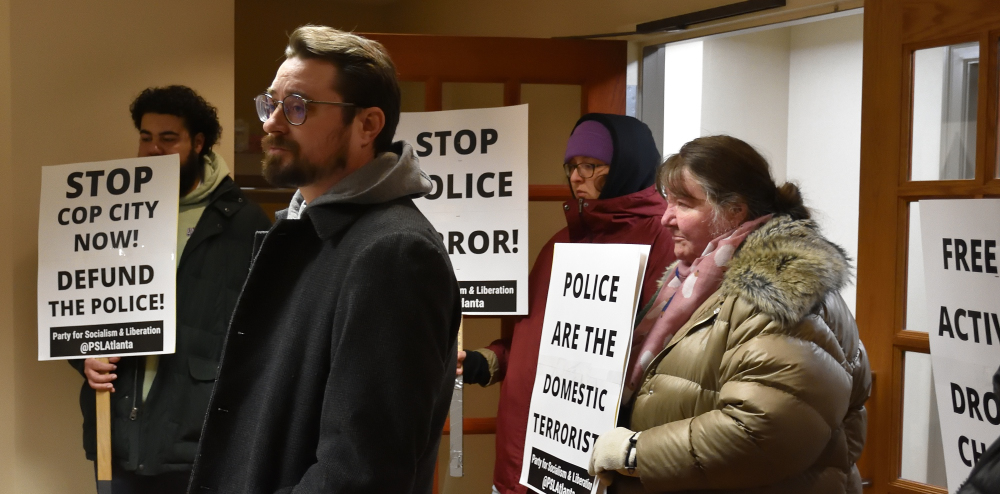
The battle to stop construction of the proposed militarized police training facility being referred to as “Cop City” in the Atlanta Forest has many components.

    Militarized policingAt this time of endless instances of militarized policing the last thing we need is a facility to train police to use these tactics. To train police from all over the country. International?
    Training will be provided for urban warfare. Including helicopter pads and a mock city.
    Of course, the location chosen was right next to communities of Black, Indigenous, and other people of color. Where men, women and children who are already traumatized by policing would hear all the shooting from the training facility.
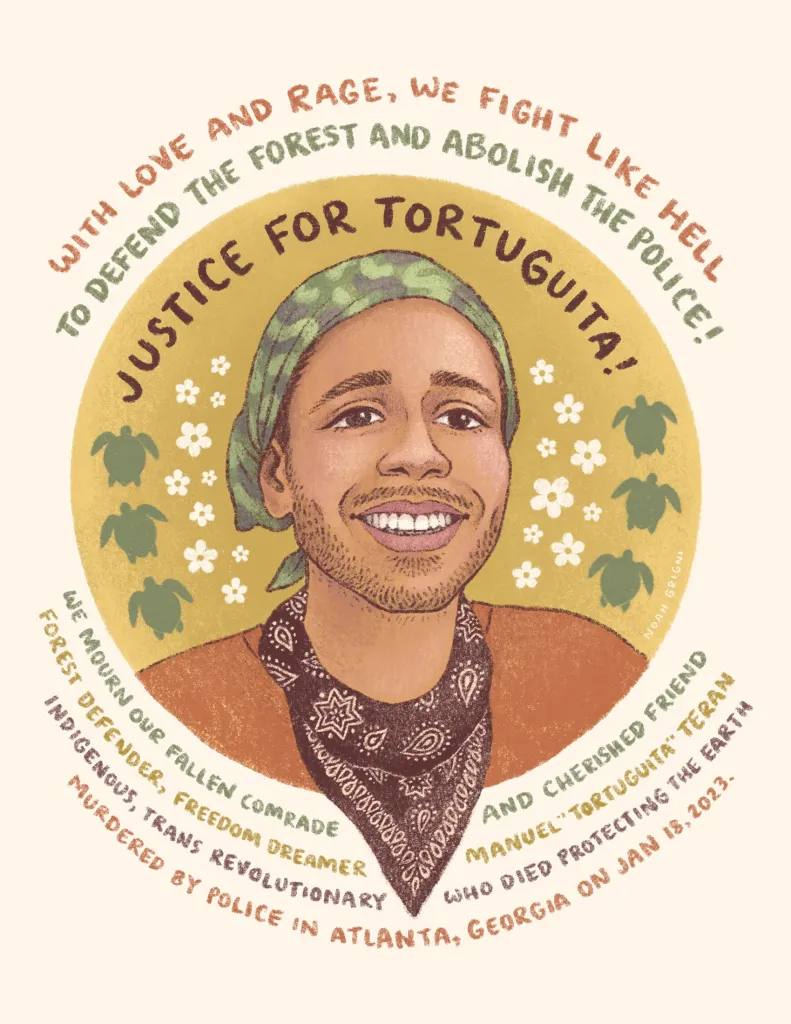
    Police from multiple agencies have continually harassed tree defenders. Manuel Teran (Tortuguita) was killed by police.
    Indigenous rights“You must immediately vacate Mvskoke homelands and cease violence and policing of Indigenous and Black people in Mvskoke lands” (Atlanta Forest)
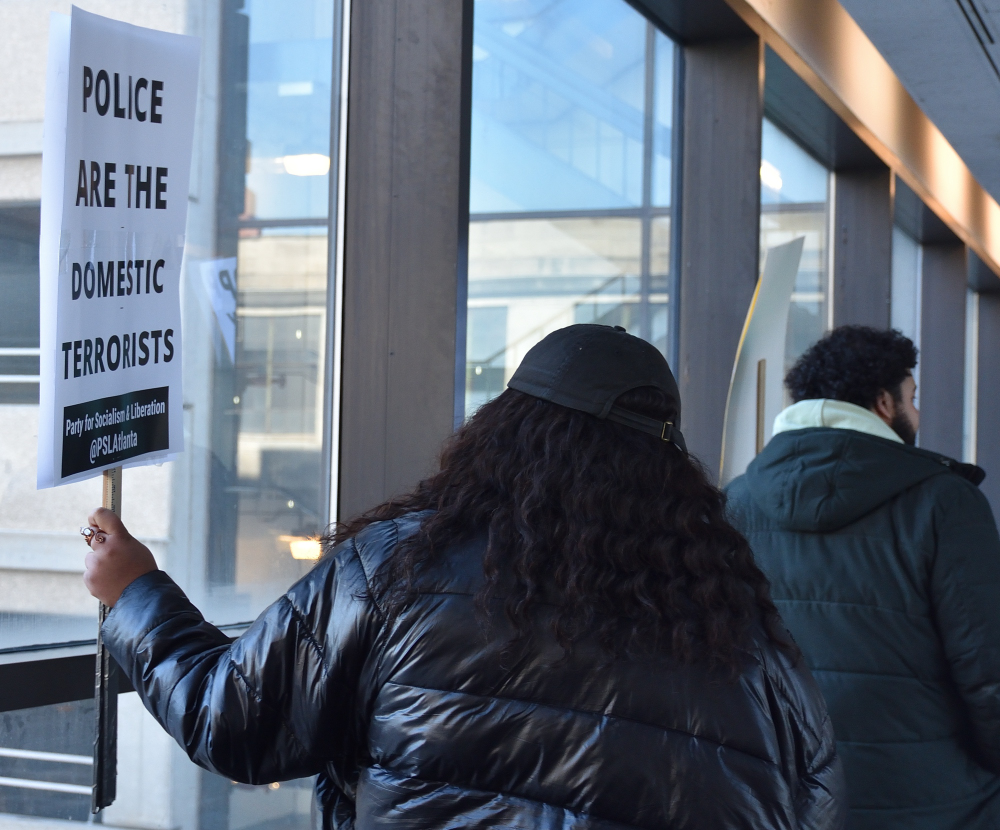
    Civil libertiesAs is occurring all over the country, civil disobedience and protest is being threatened by elevating charges to domestic terrorism.
    66 Organizations Urge that Domestic Terrorism Charges Against Defend the Atlanta Forest Protesters Be Dropped
    EnvironmentTrees are more important now than ever to pull carbon dioxide out of the air.

    DEFEND THE ATLANTA FOREST
    an autonomous movement for the future of South Atlanta

    We call on all people of good conscience to stand in solidarity with the movement to stop Cop City and defend the Weelaunee Forest in Atlanta.

    DEFEND THE ATLANTA FOREST


    MY GOODMAN: On Wednesday, a group of Mvskoke Creek activists interrupted a Regional Commission meeting and attempted to give an eviction notice to the Atlanta mayor.

    MVSKOKE CREEK ACTIVIST 1: Objection. Objection. We have a letter being delivered from the Mvskoke Creek Nation on behalf of Mvskoke Creek spiritual leadership in opposition to Cop City.

    MVSKOKE CREEK ACTIVIST 2: I came all the way on the Trail of Tears to deliver this letter to you folks.

    UNIDENTIFIED: You’re welcome to leave.

    MVSKOKE CREEK ACTIVIST 2: We want you to know that the contemporary Mvskoke people are now making their journey back to our homelands and hereby give notice to Mayor Andre Dickens, the Atlanta City Council, the Atlanta Police Department, the Atlanta Police Foundation, the Dekalb County Sheriff’s Office, and so-called Cop City, that you must immediately vacate Mvskoke homelands and cease violence and policing of Indigenous and Black people in Mvskoke lands. We also ask for an independent investigation into the assassination of our relative Tortuguita and that the charges be dropped against Weelaunee Forest defenders.

    Opposition Grows to Atlanta “Cop City” as More Forest Defenders Charged with Domestic Terrorism


    A number of people and organizations are calling for the cancellation of “Cop City”
    Students of the Atlanta University Center Denounce the Building of the Atlanta Public Safety Training Center
    Forest Defenders Vow Resistance After Court Okays Phase I Of ‘Cop City’
    Detroit ‘Cop City’ rally held in solidarity with Atlanta environmental defenders – BridgeDetroit
    CrimethInc. : The Forest in the City : Two Years of Forest Defense in Atlanta, Georgia
    Sign the petition: No massive police training complex. Stop Cop City!
    CITIES ACROSS THE US TAKE PART IN ‘WEEK OF ACTION’ AGAINST COP CITY
    RALLY IN SOLIDARITY WITH RESISTANCE TO COP CITY IN AVON, MASSACHUSETTS
    Elders Say Stop Cop City!
    Multiple State and Local Police Agencies Violently Raid Weelanuee Forest Music Festival, Week of Action Perseveres  

    On 1/31/2023, a number of people who are involved in justice work in central Iowa gathered at the offices of the law firm that represents Corporation Services Company. Which in turn represents U.S. Multifamily Capital Markets at Cushman and Wakefield. John O’Neill is the President of U.S. Multifamily Capital Markets. He sits on the executive committee board for the Atlanta Police Foundation, which is building “Cop City” in Atlanta. Where Manuel Teran (Tortuguita) was killed by police who were clearing tree sitters from the proposed construction area.

    Following are some of the photos I took at our action that morning.


    See more about “Cop City” here:
    https://quakersandreligioussocialism.com/?s=%22cop+city%22


    Pause and Transform

    I recently attended a Zoom meeting hosted by the Climate Mobilization Network. I was interested because I’ve been following the Climate Mobilization Network’s work for years.

    They articulate what has not been working and that they are looking into different strategies that might be successful. I was especially interested to discover their emphasis on Mutual Aid programs.

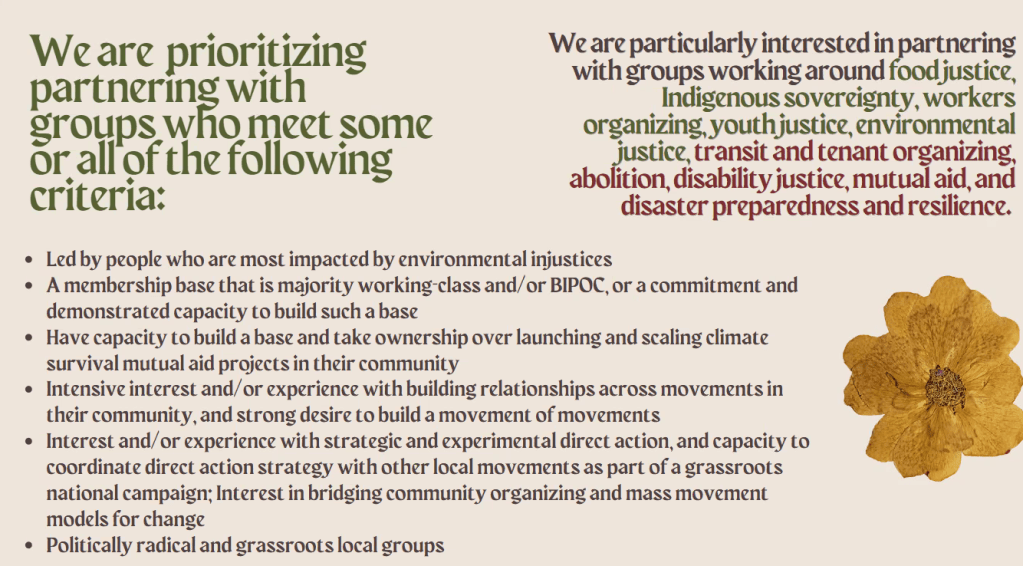
    This collective visioning, movement incubation and learning gathering will equip you with space for reflection, new ideas, inspiration, and next steps to participate in this new campaign.

    Together we will build relationships and explore:

    • How survival and mutual aid programs can grow the movement
    • New, creative approaches to taking action against fossil fuels
    • Ways to integrate healing into our work
    • And how to create space for reflection, intentionality and strategic clarity
    https://www.theclimatemobilization.org/


    Why We Decide to Pause and Transform our Strategy

    • Congressional failure to take meaningful action on climate
    • The slow pace of local climate programs where policy change is severely limited by what’s considered politically possible
    • Rising inequality amid continued neoliberalism
    • Escalating climate disasters that are hitting global and US-based frontline communities the hardest and will continue accelerating rapidly!
    • And widespread cultural and generational concern about climate change has not yet been tapped into effectively by a mass movement.

    Climate Mobilization Network


    Movement Analysis

    We reached out to more than 20 leaders across the Just Transition movement to guide our strategic planning process – we asked them about what learnings, gaps, and critical takeaways they saw emerging in their movement work. The opportunities that interviewees identified our movement needs to build on included:

    • We need more support for escalating, disruptive direct actions
    • We need work building a movement of movements
    • We need local organizing & base building as a foundation for larger mass movement
    • We need solutions outside of government
    • We need a more coherent, clear, and unified narrative strategy and message
    • We need more training on healing and community care as the center of our movements – and a politics of empathy and love at the center of our movements

    Climate Mobilization Network


    Climate Mobilization’s 2023 Pilot Programs: Political Education on Climate Survival, Healing Justice, Movement History and the Need for Escalated Direct Action

    After processing our movement analysis, as well as the strengths, weaknesses, opportunities, and challenges of our current focus campaigns and Network – and realizing the need for more radical and inventive approaches to addressing the climate emergency – we decided to build for our pilot program to focus on building out a transformational, motivational and commitment-driven political education training program that builds understanding, alignment and action around the need for climate survival programs and escalated, coordinated, and creative direct action. 

    This includes: 

    • Direct action strategy and tactics from Indigenous struggles, from the Global South & from history, encouraging participants to develop their emergent ideas
    • Why and how to start mutual aid based climate survival programs – pulling case studies for effective models of sustained community resilience 
    • Mass movement history  & state of current climate / need for climate survival 
    • Healing Justice organizing practices addressing burnout, trauma, climate grief at the root cause; integrating organizing and healing justice approaches into one, making climate organizing a more joyous, community-oriented, accessible, and sustainable practice for all peoples to get involved in – with a focus on building out leadership of resilience of frontline communities 

    Why This: Political education is movement connective tissue and a key resource for organizers to become more resilient, effective and reflective. Climate organizing in the US is particularly disconnected from the important resources offered by movement history rooted in global context.

    Why Now: This program addresses several emergent movement needs:

    • Burnout is at an all-time high, a signal to reflect, rebuild resilience, shift organizing practices across the movement to center healing, and re-root our organizations in movement history. 
    • Climate groups’ interest in direct action remains high, while increasing numbers of groups working on other issues will be trying to add climate programs. We will provide a container for this work. 
    • We’ve also heard concerns that the direct action toolbox and strategy need to be expanded and strengthened.

    This program will forge common ground among a burgeoning climate survival movement that brings together climate and non-climate groups. Alignment and political education around direct action, healing justice and mass movement history is an unmet need across sectors; the training will also provide an appealing, approachable framework for groups new to climate work to launch climate survival programs. The focus is on moving people to launch direct action and climate survival programs, change their organizing practices (to incorporate a climate survival focus and become more healing justice centered), and access improved resilience in the work they are already doing.

    Climate Mobilization’s New Direction for 2023


    Here are the slides from the presentation


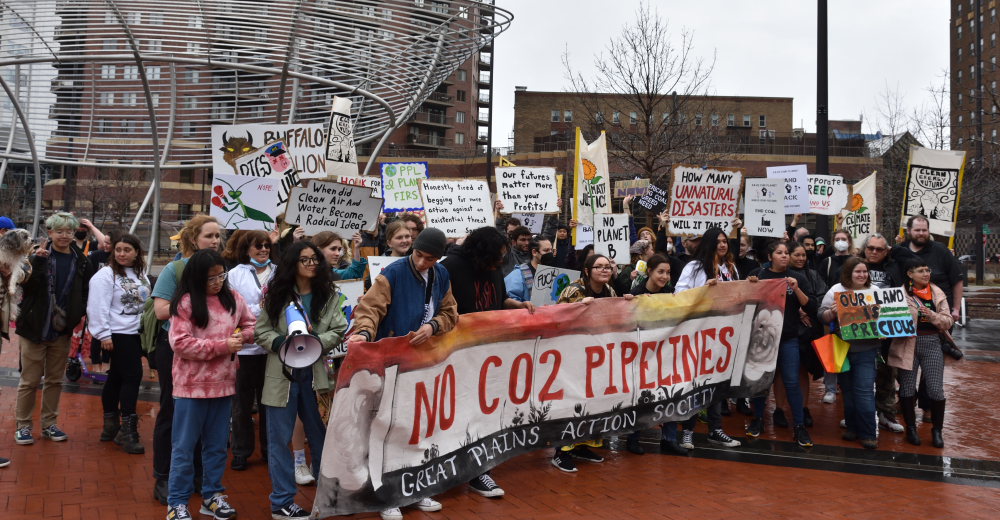
    #NoCarbonPipelines #NoCO2Pipelines #MutualAid

    Changing course

    How straight has the course of your life been?

    During my life I’ve changed course many times. Sometimes a change was forced upon me, sometimes a voluntary change. Sometimes both.

    I grew up on farms and in small towns in rural Iowa. I hadn’t lived in any cities prior to moving to Indianapolis in 1971. That was a culture shock. I had a tough time seeing how many cars there were and could see and smell the auto exhaust (prior to catalytic converters). I had a Spiritual vision of my beloved Rocky Mountains hidden in clouds of exhaust. That vision played a huge role in the rest of my life.

    In one way you might say my vision was wrong. The Rocky Mountains have not, yet, been hidden by smog. Although they are engulfed with greenhouse gases.

    In the late sixties we traveled to California. As we approached Los Angeles, our eyes began to water, and we coughed a lot. We were told we would get used to it. And the mountains and hills around Los Angeles were veiled in auto exhaust.

    I’d always had objections to people owning personal automobiles. Why own a complex machine that sits idle most of the time? Vast amounts of land became covered by highways. Those in large cities routinely sat in traffic for a long time each day. All the traffic and parking infrastructure, and police. Interstate highways cut through the middle of communities. Little or no mass transit was being created.

    I’d also always been interested in science. I learned how fossil fuels were formed, how long that took. And, most importantly, that meant fossil fuel sources needed to be protected, because they were not renewable. Our profligate waste of fossil fuels was energy stolen from future generations.

    When I first moved to Indianapolis, it was to join the Friends Volunteer Service Mission (VSM). There, wages from one year of working were saved to support yourself to do service work in that neighborhood the second year. So, there was no money for a car. At the end of those two years, I tried to avoid having a car. But the Metro city bus schedule did not always extend to the hours I was working, nor always run in the neighborhoods I lived in. When someone in the neighborhood offered to sell me his used car for $50, I bought it.

    Necessary Evil?

    But all this weighed on me spiritually. I knew it was not right to have a fossil fuel-based society/economy. And yet, I began to think having a car was a “necessary evil”, as so many people told me. But how could “evil” be “right”?

    After a few years, my car was involved in a traffic accident. Fortunately, no one was hurt, but the car was totaled.

    I clearly remember a Spiritual leading, telling me that this was an opportunity to find an alternative to a necessary evil. I had put a lot of prayer and thinking into my discomfort in having a car all during the time I had one.

    I had been making some changes that made this look possible now. I moved nearer downtown, since that is where the Medical Center where I was doing research was located. I had to be within walking or running distance of work in case the bus schedule changed. Or more commonly, to get to work on the weekends when the bus schedule was scaled back.

    I also made sure a laundromat and grocery store were within walking distance. I had been learning how to shop in a way that I could carry everything home.

    Opportunities

    My grandmother, Lorene Standing, said the will of God is often revealed in a series of small steps. The above is an illustration of that. With the pieces now in place, I wondered if the accident provided a new opportunity to try to live without a car. I remember a feeling of unease, whether I could really do this. At the same time, there was a much greater awareness that this might be the time. If not, I feared I would fall into the trap of owning a car. There was the fallback possibility, to get a car if this experiment didn’t work out.

    Many adventures resulted from making the decision to give up a car. It lifted the burden of the spiritual weight of having a car. It showed me and others that having a car was not a necessary evil. A witness.

    Just because you can’t make a difficult choice at one point in your life, doesn’t mean the opportunity won’t come around again.

    Changing Course

    At the beginning I said sometimes change is forced upon us, sometimes a voluntary choice, sometimes both. Perhaps what we thought was forced upon us was actually a spiritual leading. If that is true, shouldn’t we be paying more attention to the Spirit in our lives?

    How did we get here?

    I often reflect upon how I don’t know what I’ll end up writing on any given day. I thought I’d be writing about a Zoom meeting I attended that was hosted by Climate Mobilization, an organization that has been going through changes in their approach to call attention to our climate emergencies. I’ve been following their work for years.

    Tuesday night was an introduction to Climate Mobilization’s change of course that I’ll be writing more about. I was fascinated to see the emergence of a national/international plan to prepare for climate survival. And to see the pieces that have been coming together for me over the past five years are the same that Climate Mobilization has been going through.

    You can see these points in the diagram below.

    • Emphasis on working locally
    • Mutual Aid
    • Indigenous sovereignty
    • Abolition
    • Prefigurative solutions
    • Healing
      • Emotional
      • Spiritual
      • Physical
      • Transformative Mutual Aid Practices (T-MAPs)


    No Cop City Anywhere

    Simultaneously, as the climate warms, as storms and disasters worsen, as infrastructure crumbles, and as more and more people are left jobless and houseless, the true reason the political class pumps ever more resources into militarization is being revealed: It’s not to protect against some so-called ​“crime wave” the corporate media constantly fear mongers about, but instead to police the very collapse of capitalism itself. 

    BENJI HART, In These Times

    There are many efforts emerging to address the racism, militarism, and violence of policing in this country. These efforts are growing because they are at the intersection of capitalism, white supremacy, racism, militarism, authoritarianism, ongoing environmental devastation, and police and prison abolition.

    A monumental struggle is currently taking place in the Weelaunee Forest in DeKalb County near Atlanta, Georgia.

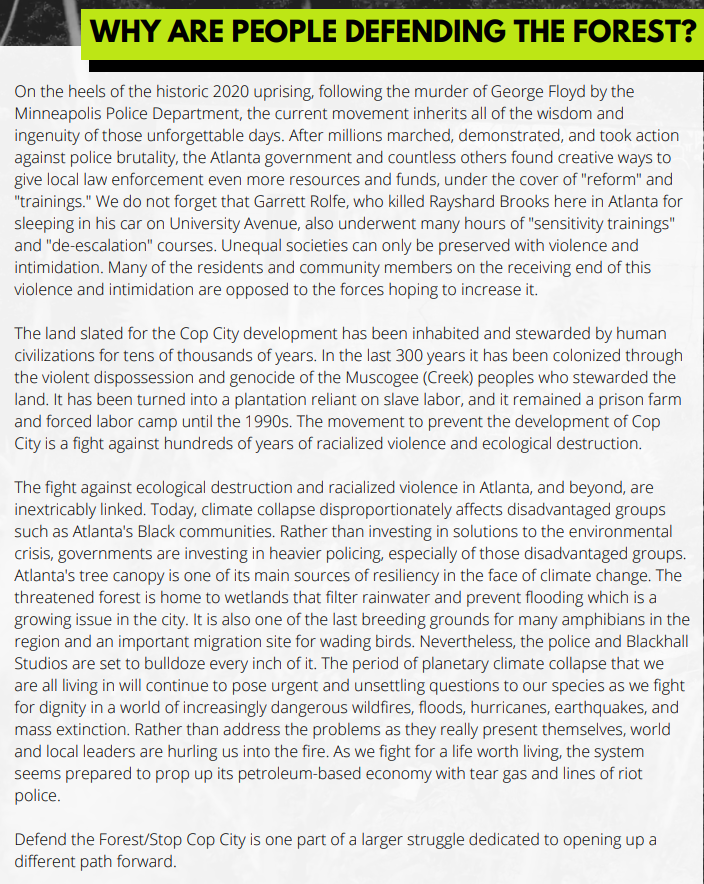
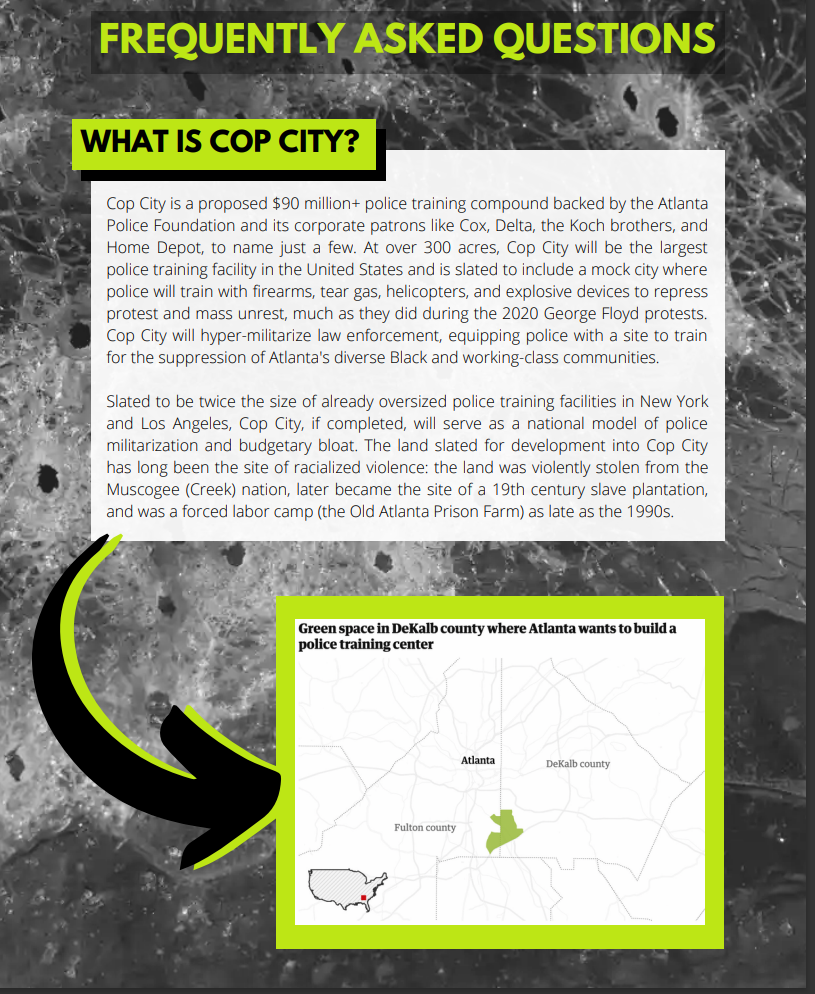
    The local government plans to level 85 acres of the forest to build a $90 million police training facility. The natural environment that would be lost is not only a precious recreational resource for Atlanta residents, but a crucial bulwark protecting against flooding and other climate change-related disasters, which are on the rise. Despite city leaders’ commitment to ramming the project through undemocratically, a decentralized campaign known as #StopCopCity is fighting back. 

    The movement is connecting police and prison abolition with environmental justice, and uniting organizations and individuals from across the political spectrum in demanding the city divert resources away from militarization and towards fighting climate change and protecting Black and brown lives.

    The threat of a militarized megadevelopment, and the intersectional, multiracial coalition mobilizing to resist it, bear some striking parallels with the recently-opened police academy in Garfield Park, Chicago — and the youth-led #NoCopAcademy campaign that fought its construction nearly six years ago.


    Simultaneously, as the climate warms, as storms and disasters worsen, as infrastructure crumbles, and as more and more people are left jobless and houseless, the true reason the political class pumps ever more resources into militarization is being revealed: It’s not to protect against some so-called ​“crime wave” the corporate media constantly fear mongers about, but instead to police the very collapse of capitalism itself. 

    Keeping poor and working people at bay while their communities are dismantled, their lands are poisoned, and their lives deemed insignificant can only be achieved through brute force. We are witnessing the robber barons barricade themselves in, sealed away from the catastrophes they created, with the same resources they stole from the people on the other side of the wall. 

    No Cop City Anywhere. Chicago’s #NoCopAcademy campaign and #StopCopCity in Atlanta are part of the same movement: to end violent policing, protect the environment and defend Black and brown lives by BENJI HART, In These Times, FEBRUARY 22, 2023
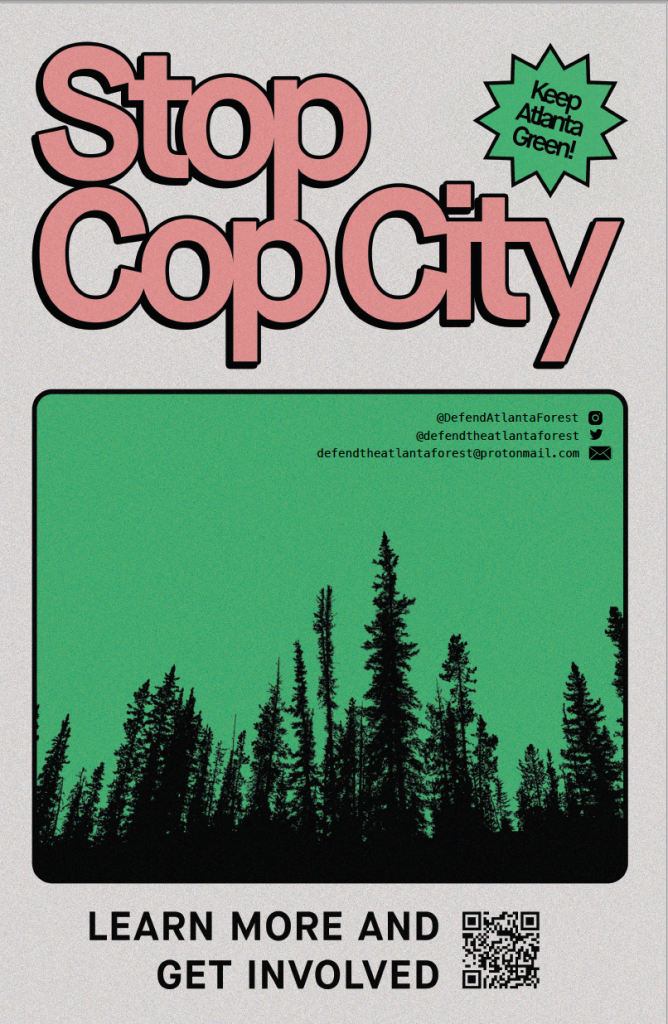

    As one example, solidarity is being built to support cities facing proposed construction of huge police training facilities. Some of these projects are referred to as No Cop City (Atlanta), No Cop Academy (Chicago), and Detroit Cop City (Detroit).


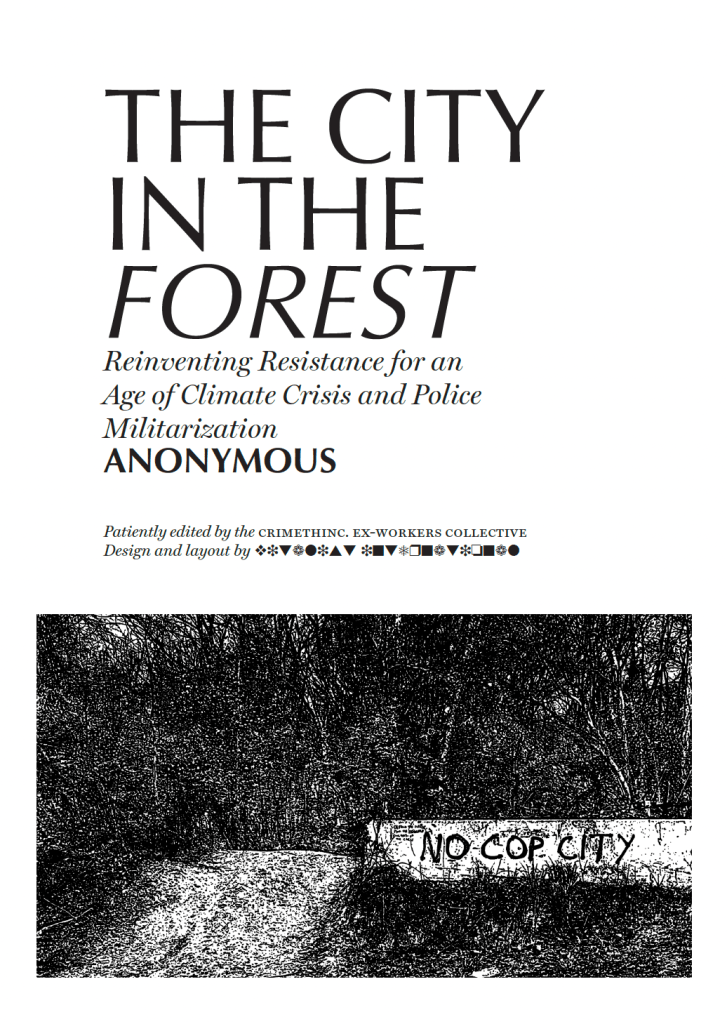
    Since april 2021, police abolitionists and environmentalists have been engaged in a furious struggle to prevent the destruction of a precious stretch of forest in Atlanta, Georgia, where the government aims to build a police training compound and facilitate the construction of a giant soundstage for the film industry. In this essay, participants in the movement chronicle a year of action, tracing the movement’s victories and setbacks and exploring the strategies that
    inform it. This campaign represents a crucial effort to chart new paths forward in the wake of the George Floyd Rebellion, linking the defense of the land that sustains us with the struggle against police.

    CRIMETHINC. EX-WORKERS COLLECTIVE
    CrimethInc. is a rebel alliance—a decentralized network pledged to anonymous collective action—a breakout from the prisons of our age. We strive to reinvent our lives and our world according to the principles of self-determination and mutual aid. www.crimethinc.com | USA, May 2022


    Environmental Justice

    The term “environmental justice” recognizes that environmental “bads” are not distributed evenly. Over generations, the effects of systematic racism concentrate environmental “bads” among the marginalized. Specifically, those cumulative effects concentrate the “bads” among people of color.

    In June 2022, Kwame Olufemi of Community Movement Builders told 11Alive News, “If you know anything about Atlanta at (all) then you know the places that flood the most are on the south side … In destroying the forest they’re going to exasperate those issues they’ve already had with peoples town flooding … It’s clearly not for us, it’s not for our community, and it’s going to be adverse to us and our people.”

    “Cop City is a catalyst for further nationwide militarization of the police and the continued expansion of the surveillance state,” Defend the Atlanta Forest argues. “This development would remove a natural barrier to flooding and pollution for communities downstream … These [effects] would primarily affect BIPOC [Black, Indigenous, and People of Color] communities in Dekalb County that the city has chosen to ignore.”

    The effort to save Atlanta’s Forests by Sean McShee, The Wild Hunt, June 14, 2022


    The campaign to defend the forest in Atlanta, Georgia has become one of the most vibrant movements of the post-Trump era, interweaving environmentalism, abolitionism, and the fight against gentrification. Yet as police shift to employing lethal violence and indiscriminate terrorism charges, it has reached a critical juncture. Participants explore how this struggle has developed over the past year, reflecting on the practices that have given it strength and analyzing the challenges before it.

    Our society is at a crisis point. Decades of escalating economic pressure have created rampant inequality and desperation. Rather than addressing the root causes of these, politicians across the political spectrum continue channeling more and more money to police, relying on them to suppress unrest by force alone. This dependance has enabled police departments and their allies to consume a vast amount of public resources. Meanwhile, driven by the same economic pressures, catastrophic climate change is generating hurricanes, forest fires, droughts, and widespread ecological collapse.

    In this context, starting in April 2021, a bold movement set out to defend a forest in Atlanta, Georgia, where local politicians and corporate profiteers want to build a police training compound and a soundstage for the film industry. The training compound, known as Cop City, would be the largest police training facility in the United States. It would devastate the South River Forest, also known as Weelaunee Forest in honor of the Muscogee Creek people who lived there until they were deported in the Trail of Tears.

    The Forest in the City. Two Years of Forest Defense in Atlanta, Georgia, Crimethinc, 2023-02-22


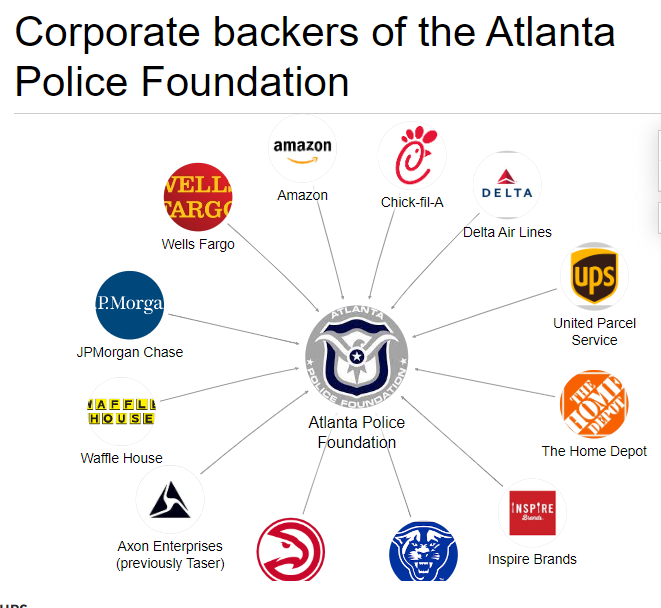
    The Atlanta Police Foundation has plans–backed by $60 million in corporate funding and $30 million in taxpayer money–to build an enormous police training facility over the city’s Weelaunee Forest.

    Activists and forest defenders are calling the plan “Cop City,” as it will include a mock village (complete with a nightclub), a Black Hawk helipad, an emergency vehicle driving course, dozens of firing ranges, and an area for explosives training.

    The neighborhoods that surround the forest are largely made up of lower-income Black residents. Cop City will decimate green space, which is already so rare in BIPOC communities, and replace it with a playground for the police to practice warfare tactics.

    Communities of color live with police-induced trauma every day. Now this Atlanta community will feel and hear the presence of a training facility where cops learn new ways to enact violence against Black and Brown communities, right in their own backyard.

    In addition to the terror of an ever-present police force, Cop City is an environmental racism nightmare. The Weelaunee Forest provides ecological relief for the people of Atlanta. It offsets stormwater runoff, which might otherwise push unwanted sediment into the drinking water. The mere presence of trees helps to keep the city cool during the long, hot, humid summers, and improves air quality by reducing carbon dioxide released into the air.

    Cop City has been gaining nationwide attention, and for good reason. The city of Atlanta, its police force, and its corporate sponsors are actively cooperating to increase police power, at a time when police departments are under scrutiny for abusing that power.

    Cop City will do irreparable harm to the city of Atlanta, and inspire more play villages for cops across the country. But there’s hope. Cop City does not have the full funding necessary to scale the project from private entities, meaning there is still time to put pressure on these investors to halt all funding to the Atlanta Police Foundation and APF Support Inc.

    Sign the petition to private investors: No massive police training complex. Stop Cop City!  

    Dozens of protesters made their way through downtown Detroit Friday afternoon before halting to a stop in the middle of Congress and Griswold, blocking traffic and prompting angry drivers to blare their horns. 

    “Stop Cop City!” the crowd chanted. “I am…a revolutionary!” 

    The march followed a rally with members of the Michigan Environmental Justice Coalition, Michigan Liberation, Detroit Will Breathe and several other social and environmental justice groups in a show of solidarity with protesters in the Atlanta area. For nearly two years, organizers and activists in Georgia have been protesting against “Cop City,” an 85-acre, $90 million police training center being developed in a forested area near Atlanta. In recent weeks, the “Stop Cop City” movement has spread across the country after an environmental protester defending the Georgia forest was killed by state police, and more than a dozen protesters were arrested. 

    In Detroit, protesters Friday spoke in opposition to a similar situation in Michigan – the expansion of Camp Grayling, a military training facility in the northern part of the state. Last year, the Michigan Department of Natural Resources began notifying locals that the National Guard wants to lease 162,000 acres of state-owned land across several counties, more than doubling its current training grounds, reported Bridge Michigan. The Guard said it needs the land to make Camp Grayling a destination for year-round cyber, electronic and space warfare training.

    Detroit ‘Cop City’ rally held in solidarity with Atlanta environmental defenders by Micah Walker and Jena Brooker, Bridge Detroit, February 24, 2023


    This morning (1/31/2023) a number of people who are involved in justice work in central Iowa gathered at the offices of the law firm that represents Corporation Services Company. Which in turn represents U.S. Multifamily Capital Markets at Cushman and Wakefield. John O’Neill is the President of U.S. Multifamily Capital Markets. He sits on the executive committee board for the Atlanta Police Foundation, which is building “Cop City” in Atlanta. Where Manuel Teran (Tortuguita) was killed by police who were clearing tree sitters from the proposed construction area.

    Following are some of the photos I took at our action that morning.

    The real war

    There is a lot of analysis regarding the war in Ukraine on this one-year anniversary of its beginning.

    I have so many questions.

    • What role did the US and NATO’s increasing militarization of the countries near Russia play?
    • What about the role of increased sanctions against Russia?
    • How is it acceptable to pay Ukraine to fight a proxy war for us?
    • Where will the increasing escalation of armaments the US gives to Ukraine end?
    • In how many ways does tremendous pressure from arms manufacturers control foreign policy?
    • Why is the US President suddenly sounding so belligerent? Not only against Russia, but now China?
    • How can billions upon billions be spent on arming Ukraine at a time when so many in this country and around the world struggle to afford basic necessities?
    • How can we countenance making so many children orphans?

    There are things I do know.

    • The Spirit is about peace.
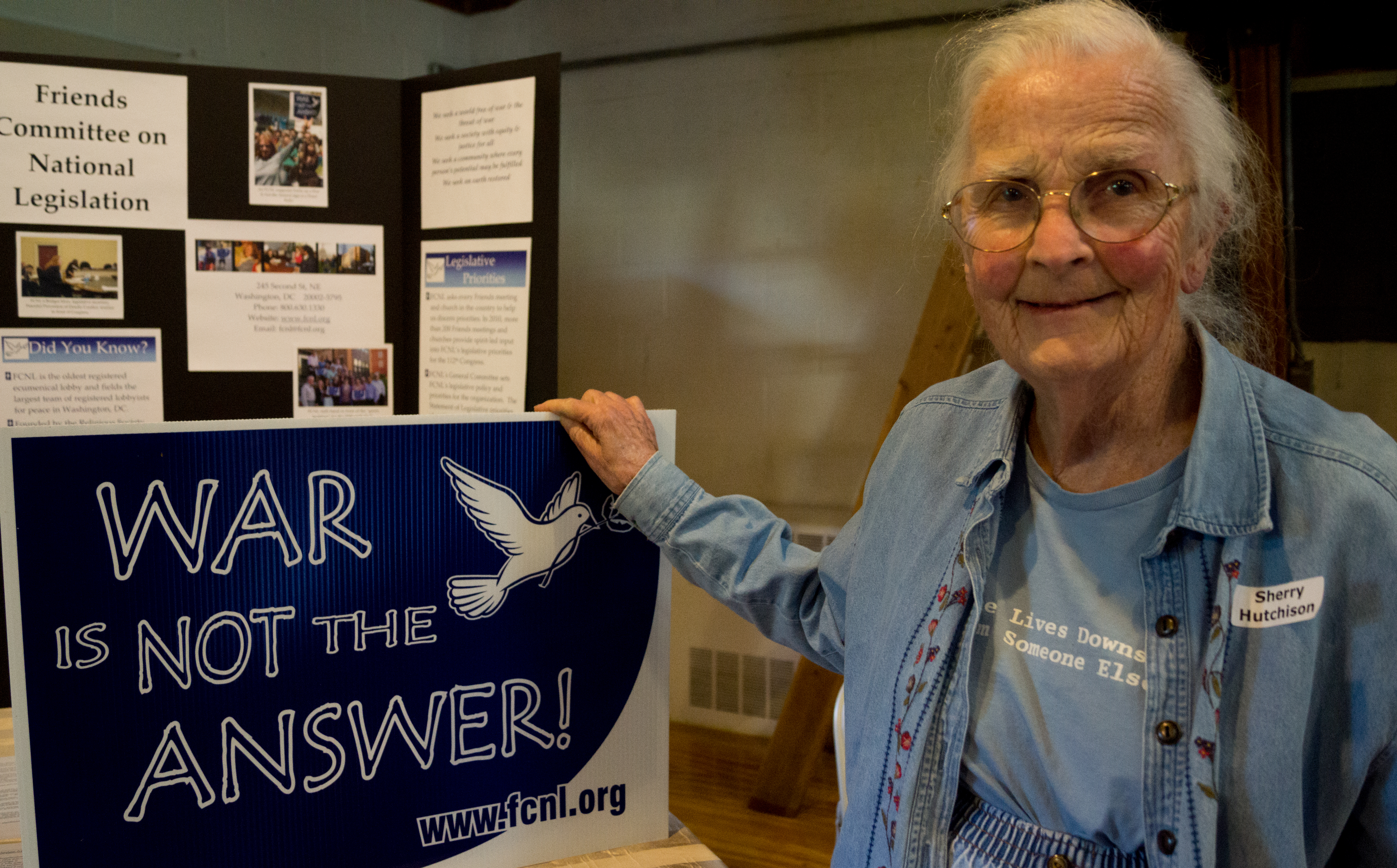
    • War is Not the Answer.
    • All military activities must cease, because that is the main source of pollution and greenhouse gas emissions.
    • The real war, the existential threat, is humanity against Mother Earth.

    Black and white photos

    I came across these black and white photos from an earlier age. 1970 seems so far away.

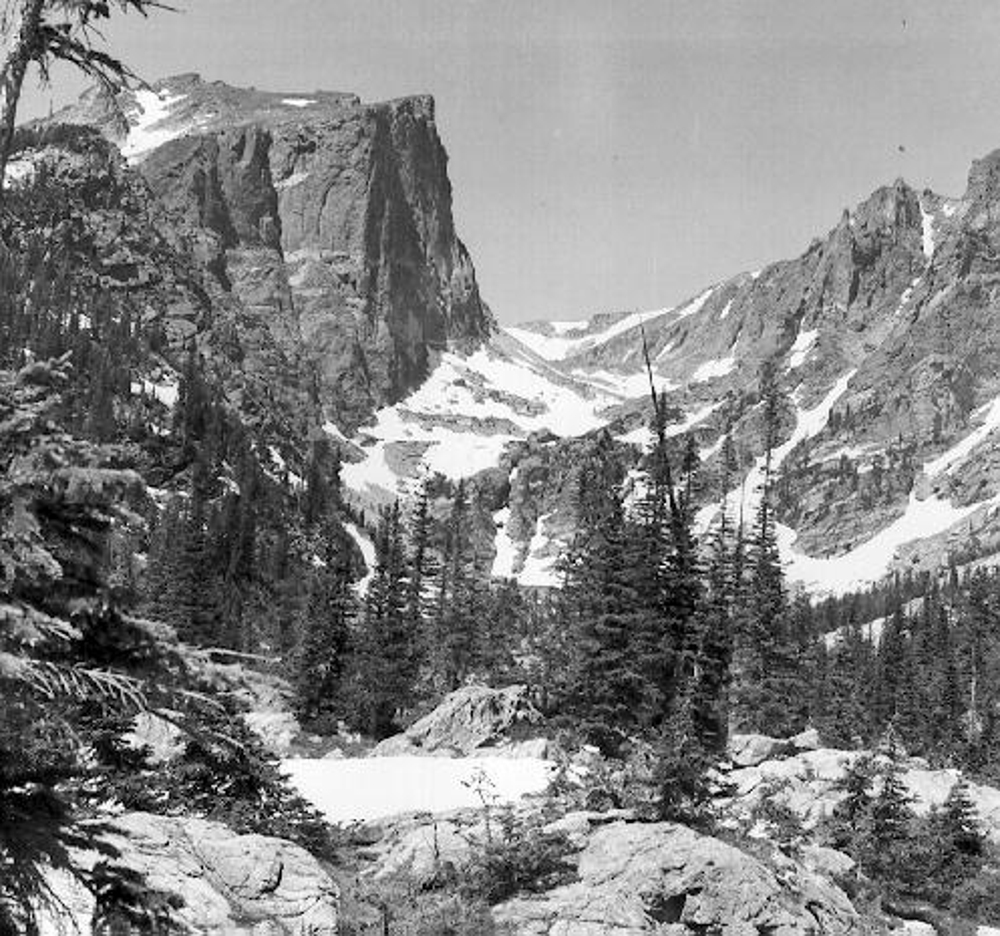
    Close to fifty years ago I had a life-changing vision related to mountains and air pollution. A horrific vision of my beloved Rocky Mountains hidden in clouds of smog, the very thing that did happen in an area near the Himalayas.

    My vision was related to this photo of Long’s Peak rising above Moraine Park in Rocky Mountain National Park, Colorado. I can barely bring myself to remember that vision of Long’s Peak hidden in smog.

    Long’s Peak above Moraine Park, Rocky Mountain National Park, Colorado

    That vision determined the course of my life. From that day I sought the Spirit to guide me in ways to protect Mother Earth. That led me to live without having a car, and the myriad of things that happened as a result. The unintended consequences, most of them very good.

    I developed the film and printed these photos in a darkroom I had set up in my bathroom. One reason I’m often reminded of this vision is because this photo was hanging on my wall

    Here is a link to some of my posts about photography. https://jeffkisling.com/?s=photography.
    And I have a website of my photos: https://jeffkislingphotography.wordpress.com/


    These black and white photos remind me of the lyrics of the song “Blue” by Troye Sivan.

    I know you’re seeing black and white
    So, I’ll paint you a clear blue sky
    Without you I am colour-blind
    It’s raining every time I open my eyes

    “Blue” by Troye Sivan

    And Worldwide Beautiful by Kane Brown, who is multiracial.

    You’re missing every color if you’re only seeing black and white
    Tell me how you’re gonna change your mind if your heart’s unmovable
    We ain’t that different from each other, from one to another
    I look around and see worldwide beautiful

    Kane Brown

    25 songs of civil rights, social justice, freedom and hope for Black History Month 2023 by Ed Masley, Arizona Republic, Feb 1, 2023