Faith Now

Faith Now can refer to what the state of our faith is at this moment. And/or it can be an admonition to focus our faith on what is happening now.

My witness has been so many people, including people of faith, are driven by the past. This is obviously true with religious practices demanding adherence to some set of rules. Rules created in the past. Rules designated by systems of dominance.

One of the reasons I have remained a Quaker is the minimum of such rules. We say we believe the Spirit can speak to us now, that ours is a living faith. We use a set of queries (questions) to help us continue to examine our faith. This can make our faith less passive.

It is not my place to judge other’s faith and practice. But there are things that have troubled my spirit for a long time.

One is that Quakers do have unwritten rules. As a recent example, prior to the forced separation because of the COVID pandemic, I was told, many times, that Quaker business decisions could only be made when Friends were together physically. When I lived in Indianapolis, I had suggested using programs for remote connections to my meeting in Iowa, but that was universally held to be unacceptable. We see how that has changed. What are other unwritten rules? Identifying them might account for why we are attracting few new attenders in this time of spiritual poverty.

And there is the universal challenge of living our daily lives consistently with our faith.

White Quakers were and continue to be settler colonists. Our ancestors claimed Indigenous land for their homes and farms. Ever since, we have continued to live on and profit from these lands. And have engaged with capitalism and systems of dominance and control that come from this colonization.

There is the devastating history of churches’, including white Quaker’s involvement in the institutions of forced assimilation of native children and genocide of Indigenous peoples.

I’m also devastated by the use of fossil fuels. Speaking from my own experience, when I saw the smog when I moved to Indianapolis (1970), I was led to know I could not be part of owning cars. My faith showed me how to go about this, helped me get through the significant challenges involved. I’m of course not the only person to have made the same choices. And I’m challenged today having moved to a small town in Iowa. The sprawling way our cities and towns are designed coupled with the absence of mass transit is a challenge. But we would not have built cities this way if we had chosen to build mass transit systems instead of the massive infrastructure for cars. Building all the streets and highways. Parking areas, traffic control systems, so many gas stations, extractive systems for coal and oil, and pipelines.

Had the decision not been made to follow the path of cars, we would not be in accelerating environmental collapse now. Think about that.

We are in perilous times. I believe spirituality and spiritual connections are key for survival. https://quakersandreligioussocialism.com/2022/11/17/spiritual-connections-for-survival/

My reference to faith now comes from being led to call on Quakers to apply our spiritual practices to critically evaluate the systems we live in and take for granted. That are unjust and must be replaced. We must reject capitalist systems and systems of dominance. Build Beloved communities where everyone is cared for. Mutual Aid communities are a template for doing so. Are radical in the sense of freeing us from the power systems we find ourselves living in.

By faith now I mean today. Every day we live in this settler, colonial, capitalist society, we continue to be oppressors.

The following quote expresses this eloquently. People are desperately hungry to have a purpose, to do something concrete to help others.

You and your relations, my friend, are (still) busy building a different world at the end of this one. This is something I’ve emphasized over and over again in my own work. I cherish the belief and practice that it is never enough to just critique the system and name our oppression. We also have to create the alternative, on the ground and in real time. In part, for me, because Nishnaabeg ethics and theory demand no less. In part because in Nishnaabeg thinking, knowledge is mobilized, generated, and shared by collectively doing. It’s more than that, though. There is an aspect of self-determination and ethical engagement in organizing to meet our peoples’ material needs. There is a collective emotional lift in doing something worthwhile for our peoples’ benefit, however short-lived that benefit might be. These spaces become intergenerational, diverse places of Indigenous joy, care and conversation, and these conversations can be affirming, naming, critiquing, as well as rejecting and pushing back against the current systems of oppression. This for me seems like the practice of movement-building that our respective radical practices have been engaged with for centuries.

Maynard, Robyn; Simpson, Leanne Betasamosake. Rehearsals for Living (Abolitionist Papers) (p. 39). Haymarket Books. Kindle Edition.

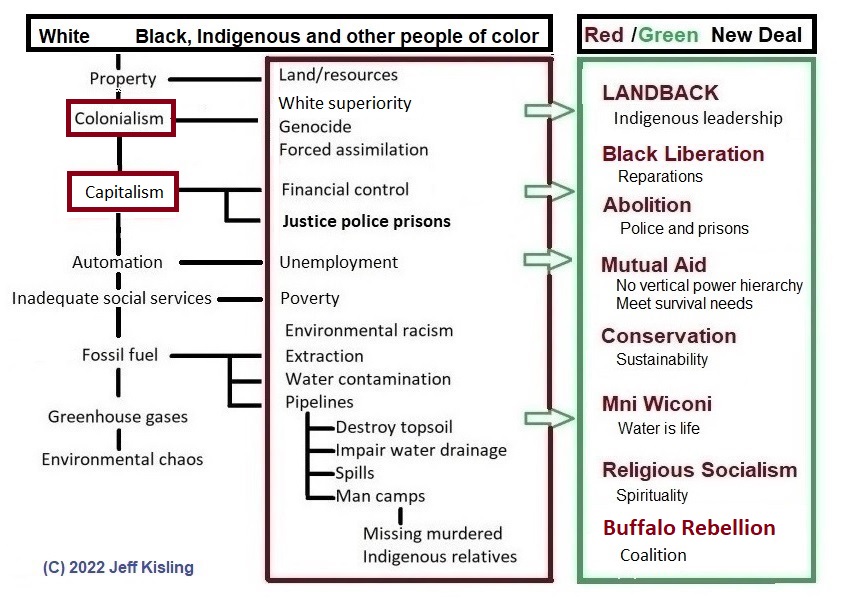
Following is a diagram I’ve been developing for several years. I’ve written a lot about these things on this blog (Religious Socialism, Mutual Aid, and Abolition of Police and Prisons).


Faith Now

  • Spirituality can show us how to live with integrity now. How to be examples to others. This is how change happens.
  • The Creator can help us heal the wounds of the past. And the wounds that continue to be inflicted.
  • The Spirit can guide us through the coming chaos.
  • It is by the Spirit we create connections among diverse peoples.

We must be willing to let go of the life we have planned, so as to accept the life that is waiting for us.

Joseph Campbell

Queries

  • How are we working to deal with existing chaos and preparing for further collapse?
  • Do we provide for everyone’?
  • What is our relationship with Mother Earth? Do we honor and conserve the resources we use?
  • What systems of dominance, of vertical hierarchies are we involved in?
  • Do we work to ensure there aren’t vertical hierarchies in our communities, in our relationships with all our relatives?
  • Do we have the courage to follow what the Spirit is saying to us? To not force those messages to conform to our existing beliefs and practices.
  • How do we connect with communities beyond our Quaker meetings? What are we learning about spiritual connections beyond our meetinghouses? Are we sharing these spiritual lessons with others?


Running throughout (Lopez’s book) Horizon is the question of human survival. The multiple threats we now face, especially the very real possibility of climate disaster, expose the tensions between human aspiration and ecological reality. Perhaps what is most needed, Lopez suggests, is for us to lament what we’ve destroyed, but also to praise and love the world we still have. “Mystery,” he writes, “is the real condition in which we live, not certainty.

Bahnson: You’ve confronted the darkness you see on the horizon with anthropogenic climate change. How do you talk about this with audiences? People need to know what’s coming, yet if you overwhelm them with depressing news, they might freeze. How do you strike the balance between educator and artist?

Lopez: Whenever I speak in public, I write out a new talk. I begin by stipulating, with a modulated voice, that things are way worse than we imagine. And I offer some examples: the collapse of pollinating insect populations; the rise of nationalism; belligerent and ignorant narcissists like Donald Trump; methane gas spewing out of the Siberian tundra. You’re saying to everybody, “Let’s take off the rose-colored glasses now and see what our dilemma really is.” And then the second part of the talk is an evocation of the healing that is necessary and possible, a gradual elevation of the human spirit. It’s about the mobilization that is needed and which is within our reach. Then people know you’ve spoken truthfully, and you have evoked in each person a desire to help, to take care of their families, to have self-regard. I see this pattern in every talk I give. To remember, geographically, exactly where you are speaking that night, and to know whether there might be a full moon outside the building; to offer that sense of immediacy and groundedness; to underscore the specificity of the moment; and to be sure that you implicate yourself in the trouble. It all helps in these situations. If you attempt any version of “I know, and you don’t” or “This is not my fault” or “I am the holy messenger, and you’re the fools,” the evening ends in darkness. You have to be in it with them.

The World We Still Have. Barry Lopez On Restoring Our Lost Intimacy With Nature BY FRED BAHNSON, The Sun, DECEMBER 2019


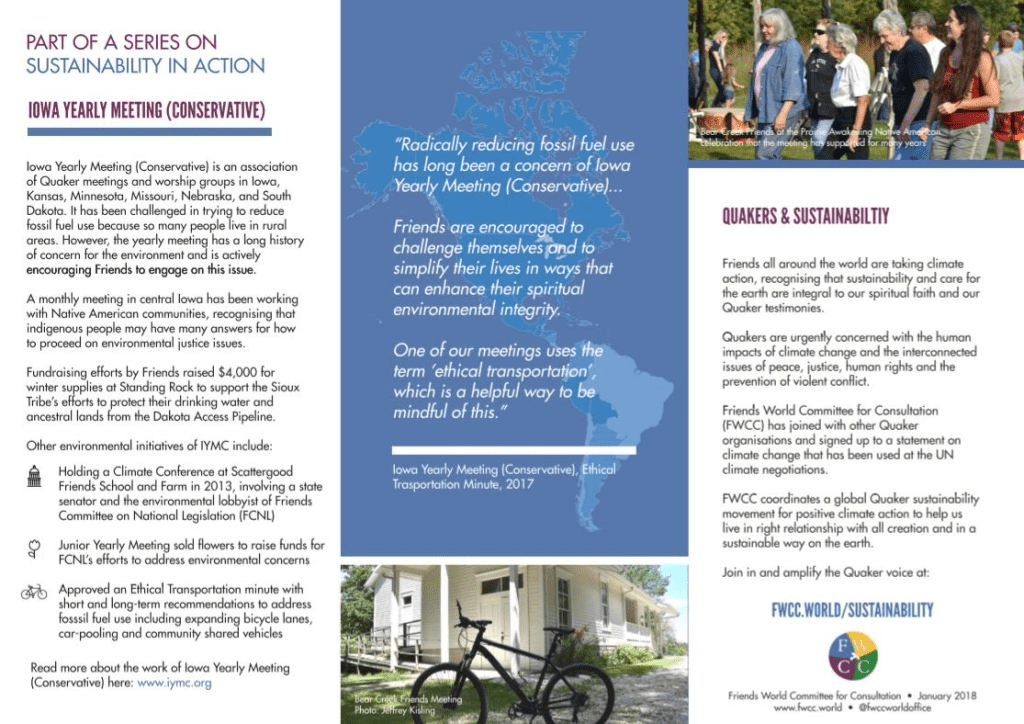
FCNL, Iowa Quakers and Native Americans

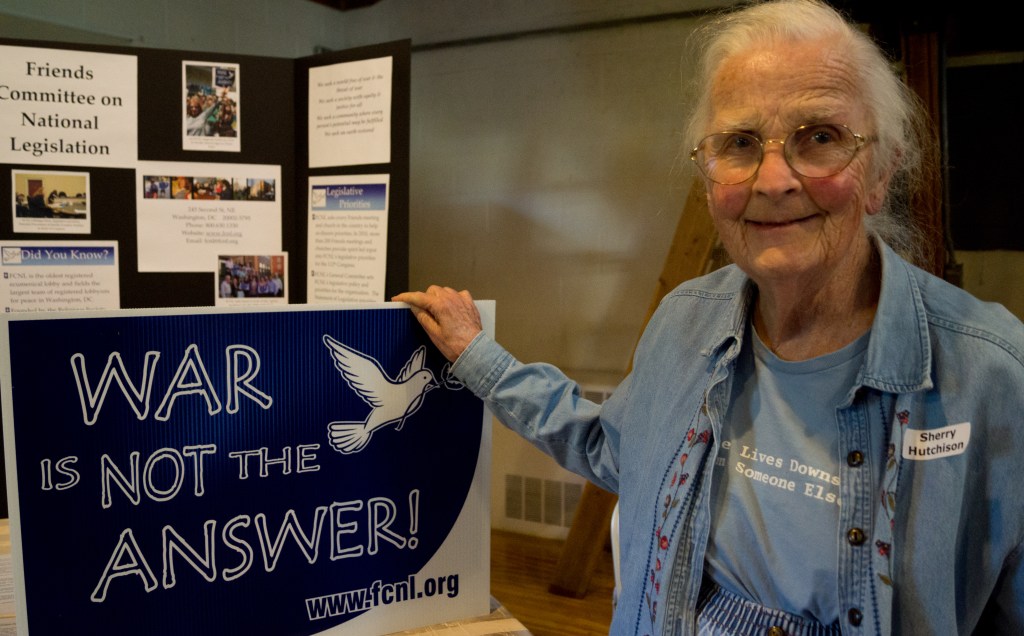
Members of Iowa Yearly Meeting (Conservative) (Quakers) have a long history of involvement with the Friends Committee on National Legislation (FCNL). FCNL is the national lobbying organization that works to promote legislation consistent with Quaker beliefs in the US Congress.

Every two years FCNL contacts all the Quaker meetings and churches in the US, to ask what those meetings’ legislative priorities are. All those responses are combined into a list of the priorities that FCNL and its supporters will work on during that Congress. (See below). Following are several recent stories about Iowa Quakers’ work with FCNL, which shows the variety of ways this work can be done.


A couple of days ago FCNL published the following story about a national FCNL network for Indigenous justice (see below). One of the priorities for this Congress is “witness and advocate for American Indian, Alaska Native, and Native Hawaiian rights and concerns. Honor the treaties and promises.

There is a web of interrelationships among Native and non-native peoples in the Midwest that presents opportunities to work together to learn and publish the truth about Indian Boardings Schools. There are parts of this that are only appropriate for each community to work on separately. But hopefully these Congressional visits will be the beginning of further work together.

This began with an appeal from Friends Committee on National Legislation (FCNL) asking us to contact our Senators to support that legislation (S. 2907). And specifically, to do this during their current recess when they would be in Iowa.

I know my friend Sikowis Nobiss is interested in supporting legislation related to Native Americans, so I contacted her about this. She put me in touch with Jessica Engelking, who is also part of the Great Plains Action Society. Fortunately, I met Jessica when we were attending the Buffalo Rebellion conference recently. Some of the networking that occurred there.

When Jessica asked what Quakers have been doing related to our role in some of the residential schools, I shared FCNL’s decades of advocacy for Native Americans. We began to work together to arrange visits to our Senators about the truth and healing commission act, and included Jessica Bahena, FCNL’s National Organizer, who is FCNL’s contact related to this legislation in our planning.

I told Jessica Engelking about the great tool FCNL has to help people write emails to support causes. The template sends your email to your Congressional representatives and senators. And that FCNL has such a letter template to Support the Establishment of a Truth and Healing Commission on Indian Boarding Schools (see below).

I was really glad when she wrote a blog post for Great Plains Action Society, telling their supporters about this letter writing tool!


Support the Establishment of a Truth and Healing Commission on Indian Boarding Schools: Friends Committee on National Legislation (FCNL)

As children are returning to school, we are reminded that school has not always been a safe place for Native children. For many years, Native children were taken from their homes and placed in government and religious run institutions with the aim of stripping away their Native language, culture, and identity. We are only now beginning the painful process of bringing home the children left in unmarked graves at the boarding schools they were sent to (U.S. report identifies burial sites linked to boarding schools for Native Americans). We are still working on healing the damage of boarding school and intergenerational trauma (American Indian Boarding Schools Haunt Many : NPR). Healing from the damage caused by the boarding school system will require effort by not just those harmed, but the institutions that did the harming. There is great work being done by our comrades at the Friends Committee On National Legislation (Native Americans | Friends Committee On National Legislation). For this edition of our Open Letter Campaign, we are directing you to a letter from our friends at FCNL to help you in urging your representatives to support the Truth and Healing Commission on Indian Boarding School Policies in the United States Act (S. 2907/H.R. 5444).

The following is courtesy our much appreciated Quaker friends (esp Jeff!):

It is long overdue for the United States to acknowledge the historic trauma of the Indian boarding school era. In the 19th and early 20th centuries, Christian churches collaborated with the government to create hundreds of boarding schools for Native American children. The conditions at these schools, some of them Quaker-run, were unspeakable.

Now we must work with tribal nations to advance congressional efforts to establish a federal commission to formally investigate boarding school policy and develop recommendations for the government to take further action. Although the wrongs committed at these institutions can never be made right, we can start the truth, healing, and reconciliation process for the families and communities affected as we work to right relationship with tribal nations.

Remind your members of Congress of their responsibility to tribal nations and urge them to support the Truth and Healing Commission on Indian Boarding School Policies in the United States Act (S. 2907/H.R. 5444).

https://www.greatplainsaction.org/single-post/open-letter-campaign-truth-and-healing-with-friends

A small group of us had meetings with Iowa’s Senators, Joni Ernst and Chuck Grassley’s staffs about the Truth and Healing Commission on Indian Boarding School Policies in the United States Act (S. 2907/H.R. 5444).

The following are excerpts from blog posts regarding those visits.

This morning Jean and David Hansen, Rodger Routh and I met with John Hollinrake, Regional Director for Iowa Republican Senator Joni Ernst. Several others had planned to join us but didn’t make it.

We expressed our appreciation for Senator Ernst voting for the Violence Against Women Act (VAWA).

I asked John if he was familiar with the Indian Boarding Schools. He indicated he had read the information I had sent from Friends Committee on National Legislation (FCNL) in emails prior to this meeting. Some of the great support we received from FCNL

John listened attentively and took notes as we told our stories and why we hope Senator Ernst will cosponsor and vote for the Truth and Healing Commission on Indian Boarding School Policies in the United States Act (S. 2907/H.R. 5444).

Jeff Kisling, Jean and David Hansen and Rodger Routh. Photo credit Rodger Routh

Senator Ernst and Indian Boarding Schools Commission, 8/31/2022


Yesterday we had a meeting with Senator Ernst’s Regional Director John Hollinrake, to ask the senator to co-sponsor the Truth and Healing Commission on Indian Boarding School Policies in the United States Act (S 2907). John was very polite and attentive but offered no feedback.

It was a much different story just now when I had a Skype meeting with Reid Willis in Senator Grassley’s Washington, DC, office.

Reid was familiar with the history of Indian Boarding Schools. He told me Senator Grassley agreed with intent of S 2907 with two exceptions. He feels the commission would duplicate work already being done by the Department of Interior’s Federal Indian Boarding School Initiative (see below). And that such a commission should not have subpoena power. Senator Grassley feels this particularly because he is the Ranking Member of the Senate Judiciary Committee.

Senator Grassley and Indian Boarding Schools Commission, Sept 1, 2022


National FCNL Network Mobilizes for Indigenous Justice

A diverse cohort of grassroots advocates are driving support for a Truth and Healing bill to address the Native boarding school era by Alex Frandsen and Bobby Trice, FCNL, November 17, 2022.

A diverse cohort of grassroots advocates are driving support for a Truth and Healing bill to address the Native boarding school era by Alex Frandsen and Bobby Trice, FCNL, November 17, 2022.

FCNL Priorities for the 117th Congress (2021-2022)

Since the early days of the Religious Society of Friends (Quakers), God’s spirit has led Friends to be a prophetic witness and to take action in the world. Friends are called to promote genuine equality of opportunity and communities in which everyone can safely live, learn, work, worship, and love.

The Friends Committee on National Legislation (FCNL) brings Friends’ spiritual values and testimonies to bear on U.S. public policy decisions, guided by the legislative priorities below.

Our work continues to be understanding and addressing the root causes and long-term consequences of today’s crises.

We are mindful that our nation has a special responsibility to redress the consequences of our history of slavery and genocide, together with ongoing race-based discrimination and oppression.

With each priority below, we will identify, expose, and work to eliminate institutional racism, institutional sexism, and other forms of systemic discrimination.

The order of these priorities does not reflect their comparative importance.

  • Promote peacebuilding by emphasizing diplomacy and honoring treaties and by working towards peaceful prevention and resolution of violent conflict, especially in the Middle East.
  • Confront the paradigm of global militarism, demilitarize space, reduce military spending, limit the spread of conventional weapons, prevent armed interventions, repeal the Authorizations for Use of Military Force (AUMFs), and reassert Congress’ oversight role.
  • Promote nuclear disarmament and nuclear non-proliferation.
  • Advocate for a justice system that is just and equitable, eliminates mass incarceration and police brutality, and establishes law-enforcement that is community-oriented and demilitarized.
  • Ensure that the U.S. immigration system promotes and respects the rights, safety, humanity, and dignity of all immigrants, refugees, and migrants.
  • Support equitable access for all to participate in open, secure, and transparent political and electoral processes; protect the integrity of our democratic institutions and processes; and work to ensure honesty and accountability of elected and appointed officials.
  • End gun violence by supporting policies that are informed by public health best practices.
  • Witness and advocate for American Indian, Alaska Native, and Native Hawaiian rights and concerns. Honor the treaties and promises.
  • Address structural economic inequality through measures such as a fair and progressive tax system, a living wage for all, and an adequate social safety net.
  • Prioritize programs that meet basic needs, including universal access to quality affordable healthcare, a necessity magnified by the COVID-19 pandemic.
  • Strengthen environmental protections and advance environmental justice, while recognizing the finite capacity of the earth and the need to protect human, animal, and plant diversity.
  • Promote sustainable, science-based solutions to the climate crisis and prioritize international cooperation to achieve global sustainability goals and protect vulnerable populations.

FCNL solicited the views and concerns of Quaker meetings, churches, and organizations around the country to help discern these priorities for our lobbying and public education work during the 117th Congress (2021-2022).

The Legislative Priorities for the 117th Congress was approved in November 2020 by the FCNL General Committee. The discernment process took nearly two years under the leadership of the FCNL Policy Committee. It is based on the discernment of more than 200 Quaker meetings, churches, and other organizations.

FCNL Priorities for the 117th Congress (2021-2022)

Honoring all victims of war, including those who resisted

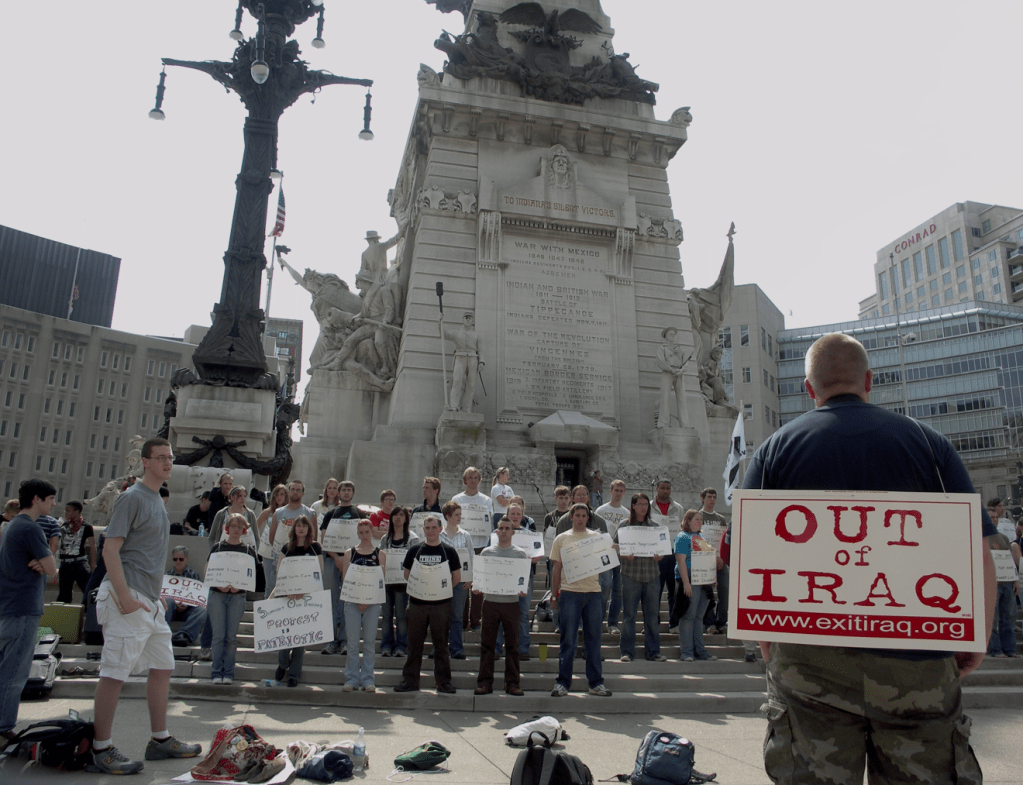
I have wished there were a memorial for those who resisted war. It was disconcerting to live in Indianapolis where there are blocks of war memorials downtown. The city streets are laid out from the Circle in the center of the city, where the Soldiers and Sailors Monument stands. Ironically, I have taken many photos over many years of anti-war and other demonstrations that have been held at the Circle.

Anti-war demonstration on the Circle, downtown Indianapolis

I’m grateful that a Quaker friend sent me this article in Bleeding Heartland.

By an act of Congress in 1954, the name of the holiday (Armistice Day) was changed to Veterans Day. Some, including the novelist Kurt Vonnegut and Rory Fanning of Veterans for Peace, have urged the U.S. to resume observation of November 11th as Armistice Day, a day to reflect on how we can achieve peace as it was originally observed.

It is in that spirit that we honor the original intent of Armistice Day this morning by honoring all victims of war, including those who resisted war, those who have advocated for peace.

Those who advocate for peace may do so in ways that challenge us. I would like to take the next few minutes to share with you stories of three advocates for peace, all associated with the University of Iowa over the past century, but each one following his own conviction in his own way.

Honoring all victims of war, including those who resisted by David McCartney, Bleeding Heartland, Nov 15, 2022


Steve Smith burns his draft card during “Soapbox Sound Off” in the Iowa Memorial Union on Oct. 20, 1965. Image from the 1966 Hawkeye yearbook, University Archives (RG 02.10), Department of Special Collections, University of Iowa Libraries.

Steve Smith, a slight 20-year old sophomore English major, took the speaker’s stand Wednesday afternoon and spoke quietly of what he believed. He then burned his draft card.

The audience of approximately 200 persons had known what was coming. Comments, encouragement and laughter greet Smith. An emotional debate on the virtue of U.S. policy in Viet Nam had preceded his appearance. But Smith was very much alone in his act of defiance. He said he was “sick to my stomach” at what he was doing.

“I feel,” Smith said, “that now is the time, because of my own sense of dignity, my own sense of morality, to burn my draft card.” He took the card from the pocket of his sweater and ignited it.

U of Iowa Student Burns Draft Card During ‘Sound Off’. Steve Smith, 20, Says His Action Moral Decision by Paul Butler, The Daily Iowan, Oct 21, 1965


By the following summer (1964), Steve grew restive. He became a political activist, speaking out against racial segregation and participating in local marches calling for an end to racial discrimination. In July 1964, while in Canton, Miss., to help register African-Americans to vote, he was detained by a sheriff’s deputy and beaten brutally while in custody (The Des Moines Register, July 18, 1964). He was 19 at the time.

Steve’s attention turned toward the escalating U.S. military involvement in Vietnam. During 1964 and early 1965, there were scattered but growing antiwar protests around the country, including instances of draft card burning. The cards, issued by the Selective Service System to draft-eligible men between the ages of 18 and 35, became a symbolic target of antiwar protestors. Alarmed by the trend, Congress passed, and President Lyndon Johnson signed, a law in August 1965 criminalizing the destruction of draft cards: a maximum five years in prison and a $10,000 fine.

For nearly two months, the law had its intended effect. But the silence ended on Oct. 15 when David J. Miller burned his draft card near an induction center in New York City. Five days later, on Oct. 20, Steve Smith became the first in the nation to do so on a college campus after the law’s enactment.

He did so during “Soapbox Sound Off,” a weekly open-mic session in the Iowa Memorial Union. Reaction from those in attendance was reportedly mixed: some cheered, others jeered. Smith was steadfast. “I do not feel that five years of my life are too much to give to say that this law is wrong,” he said at the forum. The next day’s newspapers reported that his father was unsympathetic and highly critical of his son’s action.

Two days later, FBI agents arrested Steve at an Iowa City apartment, where he was charged with violating the Rivers-Bray amendment to the Selective Service law. He left the UI after the fall 1965 semester and, while under arrest, married his first wife in Cedar Rapids the following February. For the charge of willful destruction of his Selective Service registration card, he was tried and convicted in U.S. District Court in 1966 and sentenced to three years’ probation. The Eighth Circuit of the U.S. Court of Appeals upheld his conviction later that year.

Old Gold: Steve Smith, following his conscience. UI archivist seeks info about the student who burned his draft card in 1965 by David McCartney, Iowa Now, 7/30/2012


Today we honor the good work of people like Steve. We honor his patriotism, his willingness to question our government’s actions. We honor his desire for a more just and generous and peaceful society. And we honor his legacy of courage that bloomed on our campus 57 years ago.

The University has taken steps to acknowledge this act of civil disobedience, and it has done so by recently installing a plaque in the Iowa Memorial Union. The plaque was unveiled last month and it recounts Steve Smith’s antiwar protest and its historic significance, an event that prompted further debate about the war not only on campus, but across the state and across the nation. I invite you to visit and view the plaque, which is located on the lower level of the Iowa Memorial Union near the south entrance.

The debate over war is never-ending.

What can we do? How do we respond, when our government engages in these practices? What can we do, individually or collectively?

We might feel powerless, we might feel hopeless, but we can start with ourselves. And we can do so on our terms. At age 18, in 1974, I registered for the Selective Service as a conscientious objector. It was a symbolic act, as the draft had been suspended by that time; I nonetheless found it necessary to commit myself to doing so. Yet as a U.S. taxpayer I realize I am complicit in the activities recounted in the Brennan Center report. Increasing charitable donations, in lieu of taxes, is perhaps one way to address this.

There is no single answer. But a common thread is hope. Rebecca Solnit writes,

I believe in hope as an act of defiance, or rather as the foundation for an ongoing series of acts of defiance, those acts necessary to bring about some of what we hope for while we live by principle in the meantime. There is no alternative, except surrender. And surrender not only abandons the future, it abandons the soul.

Rebecca Solnit

This of course is easier said than done. But if we recognize that the decisions we make come from our truth, as Steve Smith had done in 1965 in the face of hostility, we may find peace with ourselves. German philosopher Arthur Schopenhaur said, All truth passes through three stages. First, it is ridiculed. Second, it is violently opposed. Third, it is accepted as being self-evident.

In closing, I would like to share this from Kristen Suagee-Beauduy:

Resistance is not a one lane highway. Maybe your lane is protesting, maybe your lane is organizing, maybe your lane is counseling, maybe your lane is art activism, maybe your lane is surviving the day. Do NOT feel guilty for not occupying every lane. We need all of them.

Kristen Suagee-Beauduy

Honoring all victims of war, including those who resisted by David McCartney, Bleeding Heartland, Nov 15, 2022


I am grateful to learn about Steve Smith’s story and that he was a student at the University of Iowa.

I began as a student at Scattergood Friends School, a Quaker boarding high school in 1966, not far from the University of Iowa. While a student at Scattergood, in 1968 I attended the national conference on the draft and conscription, held at Earlham College. https://jeffkisling.com/2019/10/05/richmond-declaration-on-the-draft/

Friends Coordinating Committee on Peace has announced a national conference on the draft and conscription to be held at Earlham College (Richmond, Indiana), October 11th through 13th. It is primarily planned as a working conference, with about 180 representatives from Yearly Meetings, Friends schools and other Friends’ organizations and seventy to a hundred additional Friends appointed at large. A detailed program and other information may be obtained from FCCP, 1520 Race Street, Philadelphia, 19102.  

Friends Journal 8/15/1968

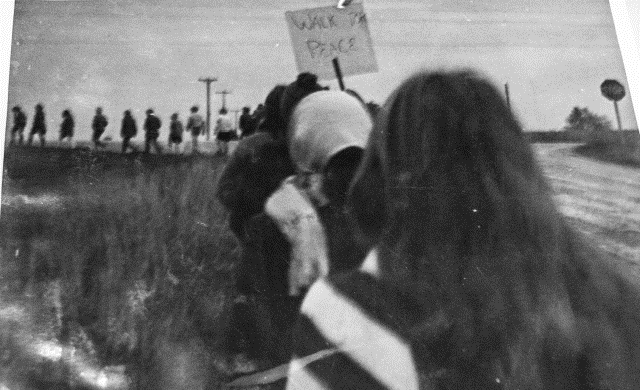
When I was a Senior, during one of the days of the Moratorium to end the war in Vietnam, Oct 15, 1969, the entire student body (about sixty) walked from the school into Iowa City, to the University of Iowa (about 12 miles). During another of the Moratorium days, Nov 15, 1969, we held a conference about the war and the draft at the school.

October 11, 1969  School Committee Day

From the Scattergood Friends School committee minutes:

A group of students attended Committee meeting and explained plans for their participation in the October 15 Moratorium. The Committee wholeheartedly endorses the plans. The following statement will be handed out in answer to any inquiries:

“These students and faculty of Scattergood School are undertaking the twelve mile walk from campus to Iowa City in observance of the October 15 Moratorium. In order not to detract from the purpose of the walk, we have decided to remain silent. You are welcome to join us in this expression of our sorrow and disapproval of the war and loss of life in Vietnam. Please follow the example of the group and accept any heckling or provocation in silence.”

Scattergood Friends School students’ Peace Walk from the School to the University of Iowa on the Moratorium to end the war in Vietnam


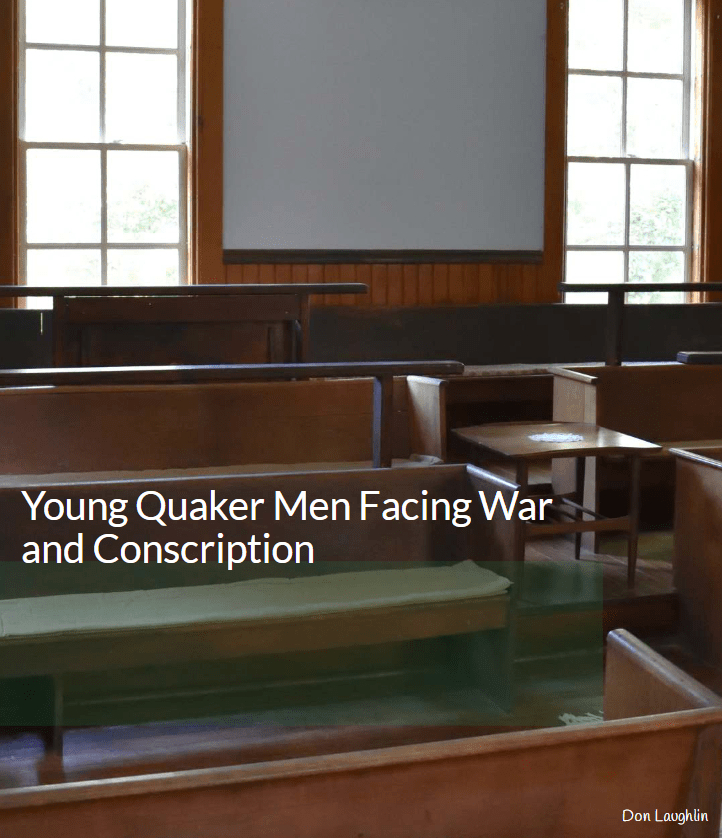
I turned in my draft cards but was not prosecuted. Unfortunately, my schoolmate, Daniel Barrett was imprisoned for his draft resistance. Our stories can be found in those collected by (Quaker) Don Laughlin, Young Quaker Men Facing War and Conscription.


My friend and mentor, Don Laughlin (Quaker) collected stories of Quaker men facing war and conscription.


David F. McCartney, University Archives

david mccartney

McCartney is a dedicated archivist ensuring access to University of Iowa history and highlighting voices that are underrepresented in the archives. McCartney has developed relationships across campus, working with classes or faculty in every department. After publishing an award-winning article on the life of UI student Stephen Smith, a young man from a small Iowa town who found his voice through civil rights activism in the 1960s, McCartney organized the Historical Iowa Civil Rights Network to bring together related repositories and collections from across the state. He also established the Stephen Lynn Smith Memorial Scholarship for Social Justice. He has served as a consultant for many smaller archives and libraries in Iowa and volunteers with smaller nonprofit organizations. He has held many positions in the Midwest Archives Conference, including president, and makes invaluable contributions to the Big Ten Academic Alliance University Archivist Group and the Consortium of Iowa Archivists.

UI honors recipients of 2020 faculty, staff awards by JACK ROSSI, Iowa Now, 11/17/2020


https://dsps.lib.uiowa.edu/hicrn/

The Historical Iowa Civil Rights Network uncovers, preserves, and shares the stories of Iowans who participated in Civil Rights-related activity or the African American experience. HICRN  is made up of community members, archivists, historians, librarians, former Civil Rights workers, and others from across Iowa who seek and preserve photographs, diaries, scrapbooks, letters, personal memoirs, and oral history interviews. https://dsps.lib.uiowa.edu/hicrn/


Although not exactly a memorial for war resisters, my dad, Burt Kisling, and Chuck Day, both Quakers, worked to have this sculpture of three intertwined doves, the “Path to Peace”, installed in downtown Des Moines, Iowa.

“Path to Peace”, Des Moines, Iowa

Spiritual connections for survival

For many years I’ve been praying, thinking, writing, and discussing how we can prepare for an increasingly dystopian future. In an article in Friends Journal, Donald McCormick asks “why is there no vision for the future of Quakerism?”  I wrote about my vision in the article What is your vision for the future?

The increasing threats from environmental devastation and chaos lead me to share more of my vision, which has been evolving over the past several years. It’s taken me a long time to write this article, I think because I haven’t found resources available to check on what I’m saying here.

I’ve always believed the greatest problem to solve is how communities of the future organize and govern themselves. We’ll have to do things differently because our present systems are collapsing. Which is often not a bad thing since those systems are based on colonialism and capitalism.


Spirituality

Spirituality is especially important now as we experience increasing environmental chaos, which will contribute to further social, economic, and political collapse. We will have no choice but to band together for the survival of us all. The alternative is tribalism with its violence, destruction and death.

We will need the help of those who know survival skills that we don’t. It takes time to build the trust necessary for these connections. It is urgent to do this now. It is by the Spirit that we can engage with everyone around us, of all cultures, identities, ethnicities.

  • Spirituality can show us how to live with integrity now. How to be examples to others. This is how change happens.
  • The Creator can help us heal the wounds of the past. And the wounds that will be inflicted in the future.
  • The Spirit can guide us through the coming chaos.
  • It is by the Spirit we create connections among diverse peoples.

Kheprw Institute (KI)

One set of my spiritual experiences relates to my introduction to a community of people of color, the Kheprw Institute (KI). I wrote about this in detail at: https://jeffkisling.com/2021/03/14/white-quakers-and-spiritual-connections-with-the-kheprw-institute/

At my first meeting with the KI community, I was asked a number of questions. When I said I was a Quaker, one of the adults (the group was mainly teenagers) spoke about the history of Quakers related to the underground railroad. When she finished, all eyes turned to me. I said I was glad my ancestors did that, it was the right thing to do, but we try not to take credit for things we have not done ourselves. When I was asked to speak more about that, I wasn’t sure what to say. I remember clearly that an answer came from the Spirit, which told me to not only say that Quakers believe there is that of God in everyone, but to also look into the eyes of each one there and say, “and that includes you”. Each person smiled at me when I did that. That ended the questioning, and I was welcomed into the community. We had this spiritual basis for our work together.

But that was just the first step. Trust was built, but slowly. With permission, I invited members of my Quaker community to engage with KI’s monthly book discussions. This was one way we began to get to know each other. But it was two years after this introduction before I was invited to teach a class on photography for KI.

Kheprw Institute, Indianapolis

First Nation-Farmer Climate Unity March

Because of my lifelong commitment to care for our environment, I’d always wanted to learn about Indigenous peoples and their sustainable lives. I jumped at the opportunity to do so when I heard about the First Nation-Farmer Climate Unity March in 2018. The intention was to build a community of native and nonnative people by walking and camping together along the route of the Dakota Access pipeline from Des Moines to Fort Dodge, Iowa (94 miles). Many long hours walking together, for eight days, along empty Iowa gravel roads was very effective in creating the beginnings of trust. There were about fifteen native and fifteen nonnative people, which allowed each of us the opportunity to share stories with every other person.

I’d hoped there would be ways to learn more about their spirituality, and to share some about my own. But I knew there was a huge barrier between us related to Friends’ involvement in the institutions of forced assimilation of native children. It is uncomfortable to admit this, but at the time I wondered how much awareness there was about the Indian Boarding Schools. I was soon to learn how profound that trauma was, and how it was passed from generation to generation. Is a deep wound today in every Indigenous person I know. I discuss this in detail in White Quakers and Native Peoples and other writings.

I didn’t know if, or how, the occasion might occur to talk about this during the March. Or whether I should.

But I vividly remember when the Spirit told me to say, “I know Quakers were involved in the Indian boarding schools and I’m sorry that happened” to the native person I was getting to know the best early in the March. I was worried saying that would upset him, open wounds. But he just nodded his head, and we kept walking together. But later in the day he said, “I want to tell you a story”, and proceeded to tell me a story related to him and his mother and the boarding schools.

At various times the Spirit led me to bring this up with each of my native friends. Every one of them and their families have had traumatic experiences related to forced assimilation. And the removal of native children from their homes continues in the guise of child welfare.

This is something that should not be taken lightly. A certain level of connection and trust is important. This is not about us (White people) and what we would like to see or do. There should be clear spiritual guidance.

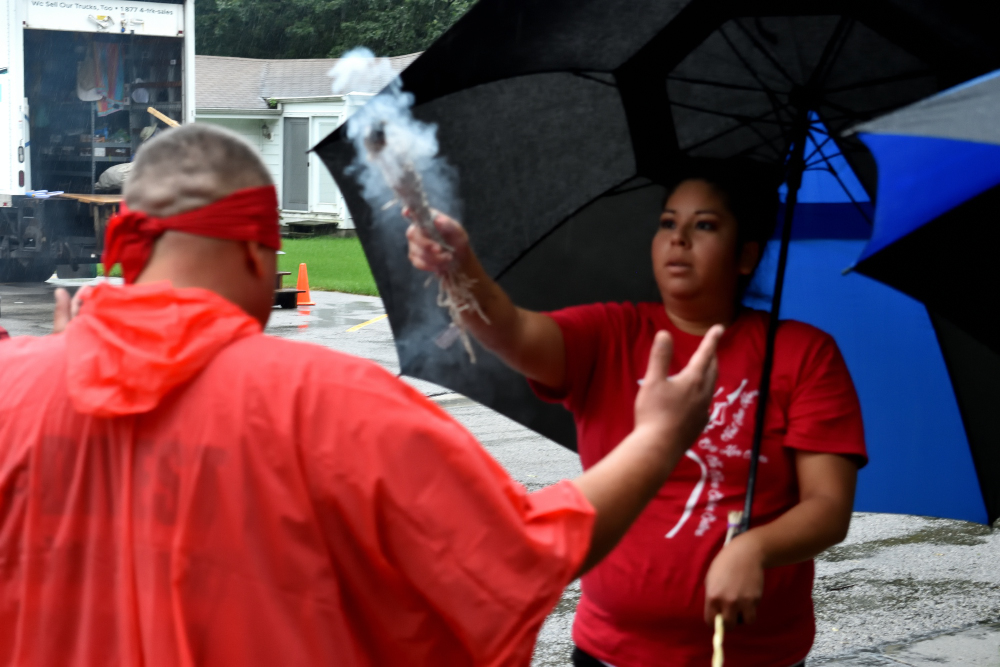
I’ve found my Indigenous friends to be deeply spiritual. I like the sign, Earth is my church, carried by my friends Foxy and Alton Onefeather during the March. That says a lot about why I feel my friends are spiritual, their reverence of all things human and nonhuman. And their practices such as smudging, putting down tobacco, expressing thanks to the Creator each time they speak in public. Their humbleness. One friend often says “we are just pitiful people” during her prayers.

In the four years since that March, various combinations of us have had numerous opportunities to work together.

And yet again, that trust has been built, is being built slowly.

Foxy Onefeather holds sign on First Nation-Farmer Climate Unity March (2018)


Spiritual guidance

Quakers believe our lives must be guided by the Spirit. But far too often people haven’t found, or don’t try to discern that spiritual guidance. They try to figure out how to do justice work on their own or in conjunction with like-minded people. with the best of intentions. That phrase usually indicates not listening to those affected by injustice. And indicates not having discerned what their faith is trying to tell them.

And that often results in unintended, harmful consequences. A common phrase to keep in mind is nothing about us without us. This is especially challenging for White people who are accustomed to their privileges. Often not even aware of those privileges. We would not need to qualify what our intentions were if we were following the leadership of the communities facing injustice.

One horrific example of best intentions gone wrong were the Indian boarding schools. A policy of forced assimilation of native children into White culture was thought by many to be a way to help Indian children adjust to the enveloping White society. But tens of thousands of children suffered physical, emotional, and sexual abuse. Thousands died. Genocide. And that trauma has been passed to each following generation, including todays. Every one of my native friends has been affected.

This is an example of difficulties in making connections between different communities and/or cultures. With this horrific history, and ongoing trauma, how can a bridge ever be built between these two cultures, White and Indigenous? Or between White and BIPOC people and communities? (Black, Indigenous and other people of color)

But for others, especially in the government and military, this policy and horror was exactly what they intended.


Mutual Aid

The Spirit also led me to become involved in a Mutual Aid community. And led me to be involved in efforts to abolish police and prisons. I’ve written extensively about these things on my website Quakers and Religious Socialism, Intersection of Mutual Aid, Abolition and Socialism.


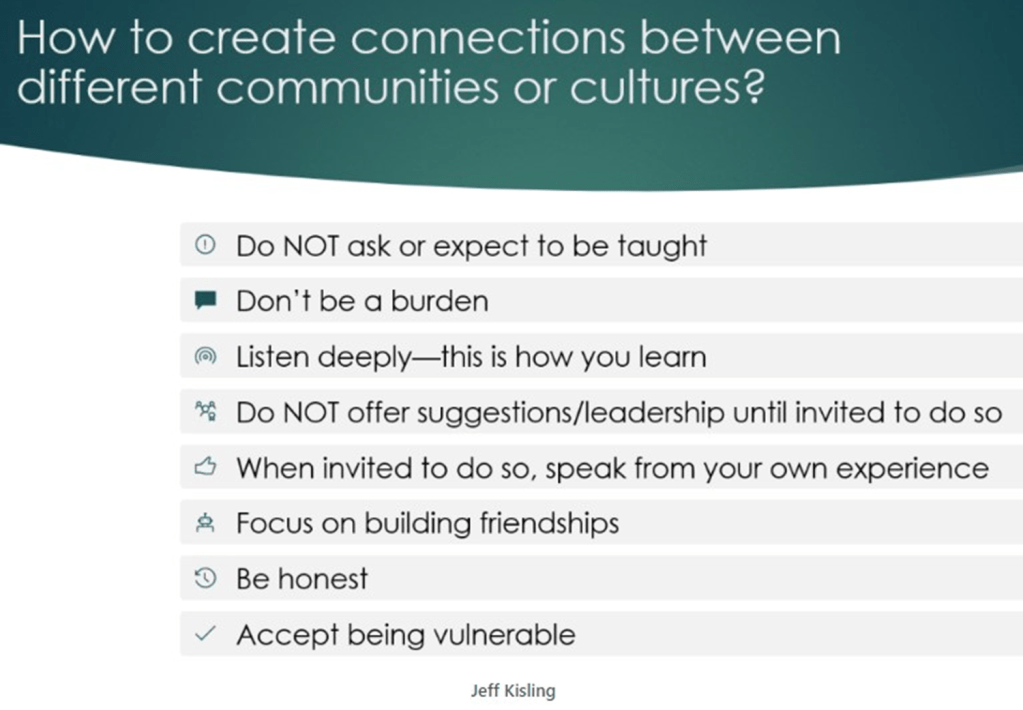
How to create connections between different communities or cultures

Returning to Donald McCormick’s question, “why is there no vision for the future of Quakerism?” I’ve tried to express my answer here. In these increasingly trying times, spiritual guidance is crucial. Sharing this with others is a gift Quakers have to offer. But we need to understand the history and concepts of oppression. Of Quakers’ role in oppression. And discern how the Spirit is leading us.

Frontline communities are figuring out how to live when the systems that are supposed to serve them no longer do, if they ever did. White communities will look to these communities and their solutions for our own survival.

I was recently surprised when a Quaker friend said I had a way of finding and connecting with oppressed communities. Which made me realize something I hadn’t expressed before, which is we must seek out these communities ourselves. Be guided to these communities by the Spirit. Search for these opportunities. Searching social media is usually very useful. And we can learn what our Friends and friends are doing and join those efforts.

Following is a list of things I have been learning from my experiences related to making connections between different communities and/or cultures.

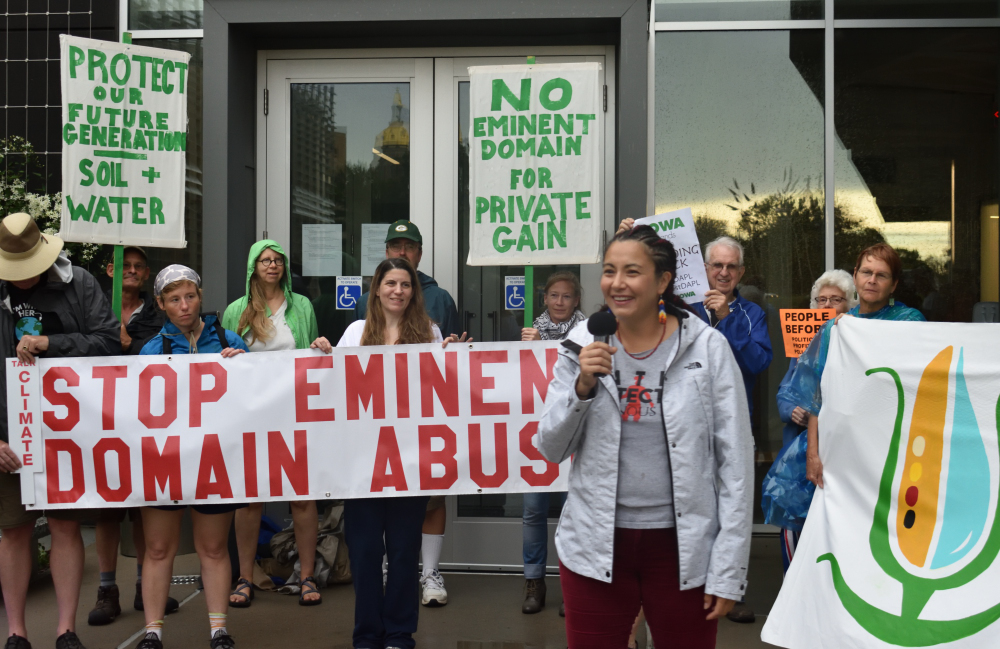
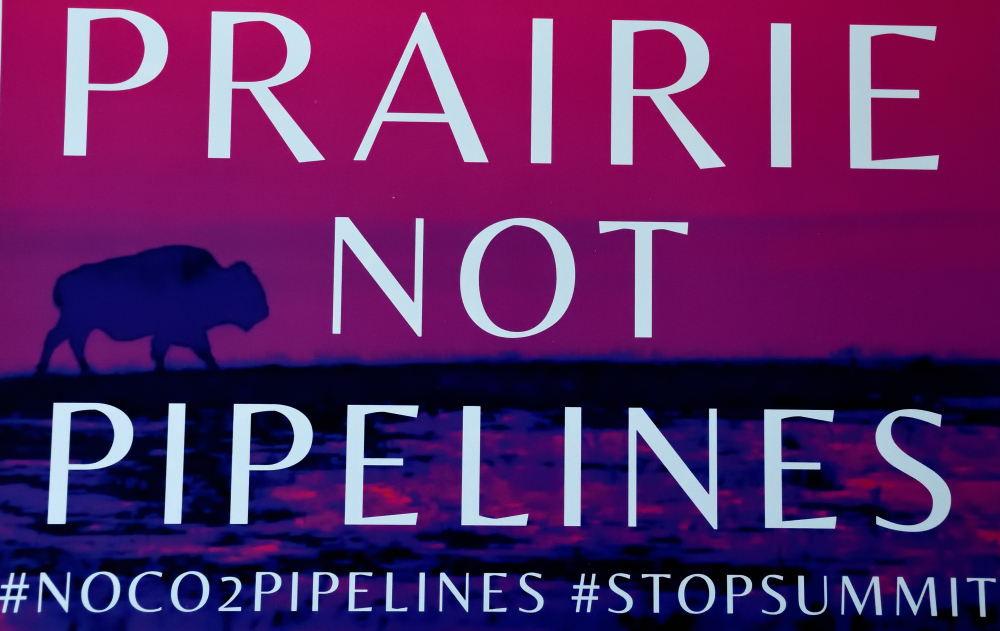
Peacemaking means stopping carbon capture and pipelines

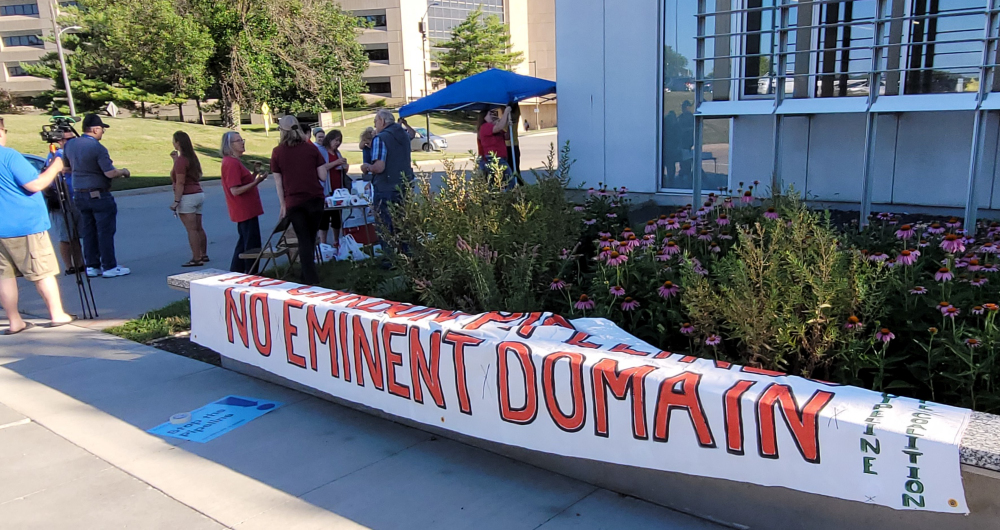
This morning I wrote about peacemaking. Encouraging Friends, each of us, to take a careful look at our life, and to speak out against the injustice and violence occurring today. To work to fill the spiritual void. But to do that means we have to show up. Be at Cowles Commons tomorrow at 1 pm

Tomorrow is our chance to do this. To speak against the violence of carbon capture, carbon pipelines and the hazardous material they carry. To support Black Lives Matter and Indigenous peoples. To protect our children and future generations. To be peacemakers.

You can see what my friends did today here!

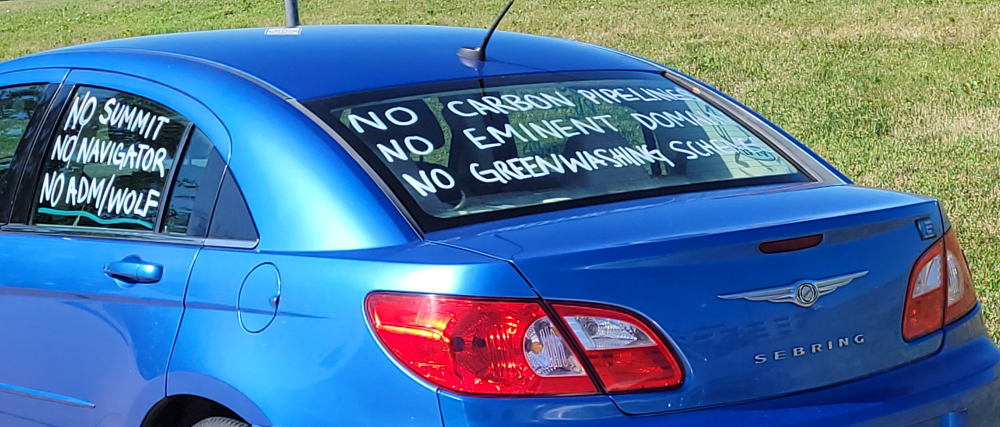
This morning, members of CCI Action and Des Moines BLM disrupted a nationwide carbon capture convention in Des Moines during a panel that featured the 3 companies who want to force their greenwashing scam on America’s heartland– Summit, Navigator, and Wolf. 

When the panel claimed that most Iowans and landowners are in support of their pipelines, seven of us rose up to speak the truth. 

Watch today’s action here!

We’re not done shaking things up yet– we need you to join us tomorrow to give these corporate polluters a proper sendoff! 

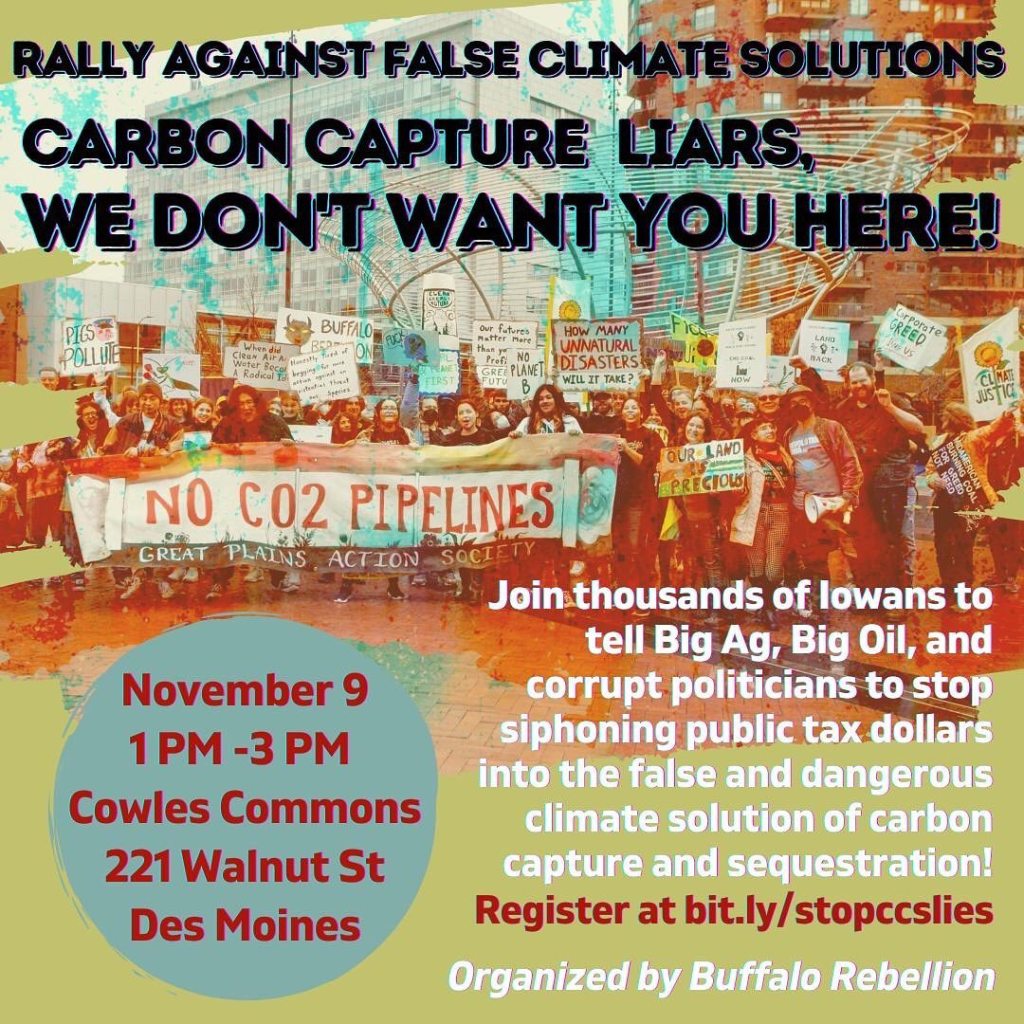
Buffalo Rebellion will be holding a rally against false climate solutions tomorrow at 1PM. Sign up here to fight back with us as we tell CO2 pipeline profiteers to pack their bags. 

Here is what the day will look like:

  • 1pm rally at Cowles Commons
  • 1:30pm March to the Iowa Events Center
  • 2:00pm Protest outside as the convention is concluding
  • 3:30 pm Report back to the CCI office for food, refreshments and to debrief

Between disruptions this morning, a panel member representing Summit Carbon Solutions– Bruce Rastetter’s company– had the nerve to tell the crowd that objection to the CO2 pipelines comes from a “small minority.”

We know that’s not true, let’s prove him wrong tomorrow! Join us by RSVPing here.

For people power, Caitlin, Devyn, and Jake
Farming & Environment  


Peacemaking: fill the spiritual void

Yesterday I wrote about the video of the interview of Friend Mary Mendenhall (included below). She told of the Quakers who left the United States because of their opposition to war and the military draft. That migration and the development of the Monteverde community in Costa Rica, where they settled, is an example of Quakers living in a manner consistent with their beliefs.

I also wrote about attending the Friends National Conference on War and Conscription in 1968. I had forgotten there was a similar declaration in 1948. One of the statements in that declaration is “We realize that the basic task in peacemaking is to fill the spiritual void in our civilization.” I’ve often prayed about what I call the Spiritual poverty that exists today and how Quakers could help fill that void.

The basic task in peacemaking is to fill the spiritual void in our civilization

Richmond Declaration Against the Draft, 1948

A statement in the 1968 declaration is “we acknowledge our complicity in these evils in ways sometimes silent and subtle, at times painfully apparent.” That declaration also includes a call for affirmation of action.

AFFIRMATION OF ACTION

We commit ourselves to validate our witness by visible changes in our lives, though they may involve personal jeopardy. We cannot rest until we achieve a truly corporate witness in the effort to oppose an end conscription. Let us hold each other in the Light which both reveals our weaknesses and strengthens us to overcome them.


I believe we were led to talk about Mary Mendenhall at Bear Creek meeting last Sunday. And that I was led to write about other stories related to Quakers and peacemaking yesterday. That I was led to remember the 1948 declaration against the draft.

I was especially struck by the Affirmation of Action part of the 1968 declaration. There is a similar admonition in a statement about racial justice of Iowa Yearly Meeting (Conservative). “Each person is urged to take a careful look at their life, to identify where one is benefiting from this, and work to correct that.  We urge Friends to speak out against the injustices and violence occurring today.

We urge Friends to speak out against the injustices and violence occurring today.

Declaration on the Draft and Conscription: Richmond 1968

Among the injustices and violence today are attacks, physical and otherwise, against Black, Indigenous, and other people of color (BIPOC). And the all-out assault against Mother Earth.

All of this relates to my Des Moines Mutual Aid community, and to the Buffalo Rebellion I’m part of. There will be a rally against carbon capture and the pipelines needed to transport the carbon. An important part of the Buffalo Rebellion, including tomorrow’s rally, is the leadership of Indigenous peoples in the Midwest.

This is an opportunity for Friends to speak out against the injustices and violence occurring today.


https://www.facebook.com/events/580951207110378

Did you hear? The corporations vying to get rich from building carbon capture pipelines across Iowa will be meeting at a convention right here in Des Moines Nov 8-9!

People from Minnesota, Illinois, Nebraska, and all four corners of Iowa will be there to say “NO CO2 PIPELINES! NO MORE FALSE CLIMATE SOLUTIONS!”

Will you help us send a strong message that Iowans are united against CO2 pipelines? RSVP at https://actionnetwork.org/…/rally-against-false…/

Here is what the day will look like:

1pm rally at Cowles Commons
1:30pm March to Iowa Event Center
2:00pm Protest outside the carbon capture convention

Whether you’re Black, White, Indigenous, rural or urban, we are ALL feeling the impacts of climate change ramping up in Iowa and around the world.

Big corporations that have significantly polluted our land, air, and water are scrambling to find “solutions”—false ones— in attempt to cover up the environmental damage they inflict on our state. And they’re trying to use our tax-payer dollars to do it.

CO2 pipelines are being pitched as the golden ticket to end greenhouse gas emissions from ethanol, fertilizer, and coal plants.

The problem?

–Carbon capture projects have never actually reduced greenhouse emissions.
–They bolster industries that capitalize off dirty energy and destructive agricultural practices
–CO2 pipeline leaks are extremely dangerous and public entities are not equipped to respond.
–Pipeline developers are bankrolling Governor Kim Reynolds to use eminent domain to seize land in order to enrich private corporations.

We need you to rise up with us to stop these projects! RSVP at https://actionnetwork.org/…/rally-against-false…/


References

Richmond Declaration Against the Draft, 1948
Advices on Conscription and War: By the Religious Society of Friends in the United States, Richmond, Indiana, 1948

We realize that the basic task in peacemaking is to fill the spiritual void in our civilization by replacing the fear that now cripples all our efforts with a faith in the Eternal Power by which God unites and sustains those who pursue His Will; and we extend our fellowship to all those of other persuasions who share this faith.

In humility and repentance for past failures, we call upon all Friends to renew the springs and sources of our spiritual power in our meetings for worship; to examine our possessions, to see if there be any seed of war in them/ and to live heroically in that life and power that takes away the occasion of all wars and strife.

By a called Meeting representing Friends in the United States, held at Earlham College, Richmond, Indiana, July 20-22, 1948.


Declaration on the Draft and Conscription: Richmond 1968

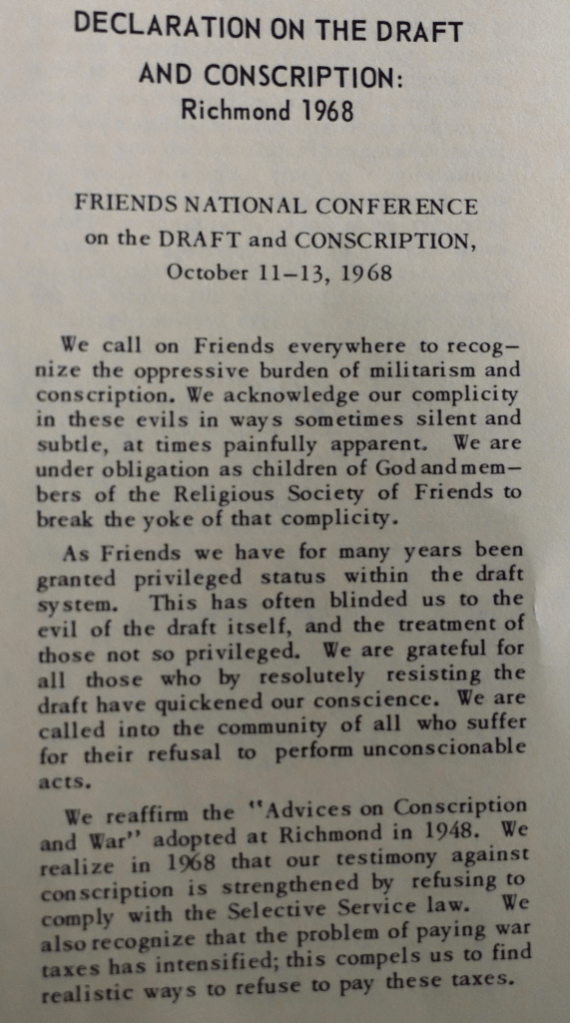
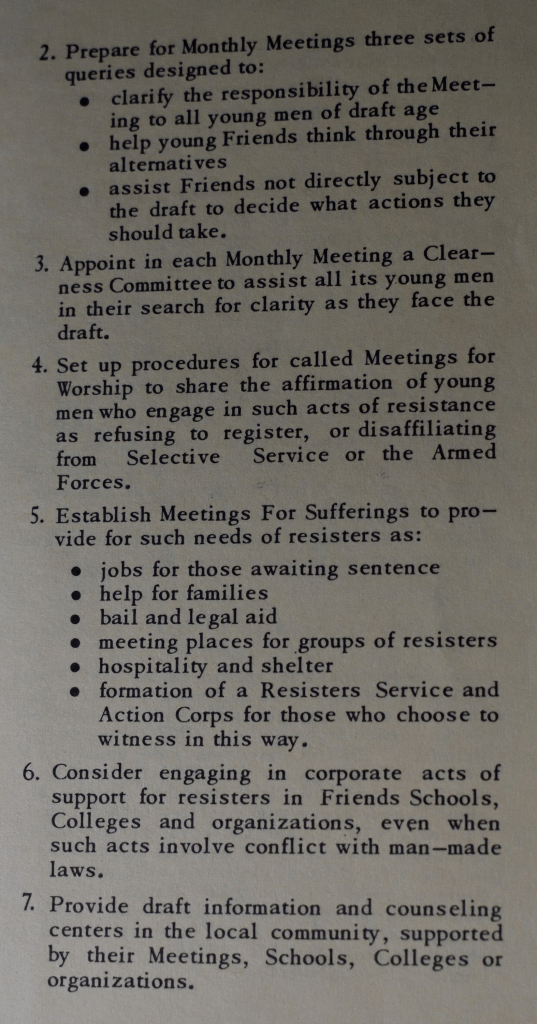
We call on Friends Everywhere to recognize the oppressive burden of militarism and conscription. We acknowledge our complicity in these evils in ways sometimes silent and subtle, at times painfully apparent. We are under obligation as children of God and members of the Religious Society of Friends to break the yoke of that complicity.

As Friends we have for many years been granted privileged status within the draft system. This has often blinded us to the evil of the draft itself, and the treatment of those not so privileged. We are grateful for all those who by resolutely resisting the draft have quickened our conscience. We are called into the community of all who suffer for their refusal to perform unconscionable acts.

We reaffirm the “Advices on Conscription and War” adopted at Richmond in 1948. We realize in 1968 that our testimony against conscription is strengthened by refusing to comply with the Selective Service law. We also recognize that the problem of paying war taxes has intensified; this compels us to find realistic ways to refuse to pay these taxes.

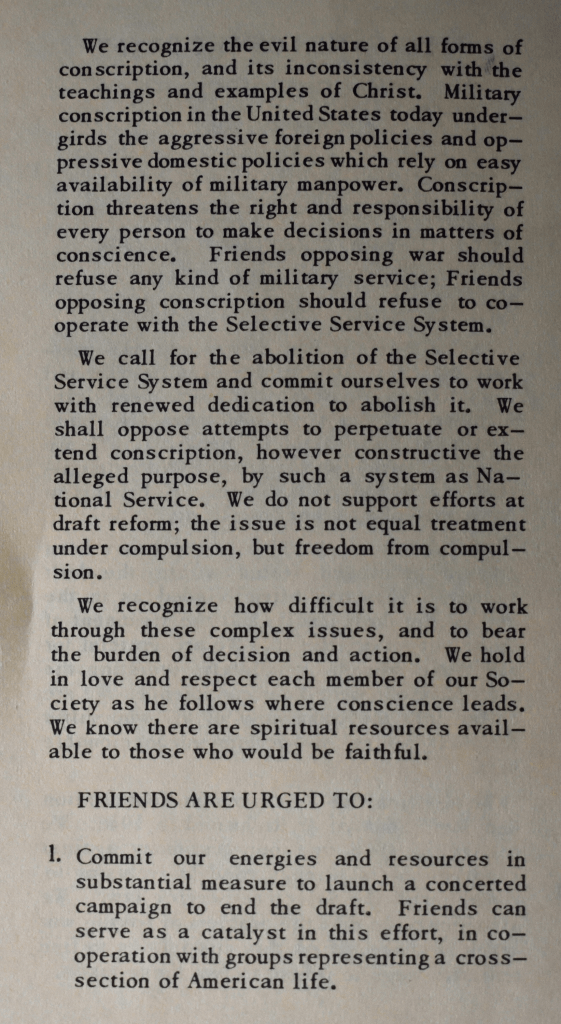
We recognize the evil nature of all forms of conscription, and its inconsistency with the teachings and examples of Christ. Military conscription in the United States today undergirds the aggressive foreign policies and oppressive domestic policies which rely on easy availability of military manpower. Conscription threatens the right and responsibility of every person to make decisions in matters of conscience. Friends opposing war should refuse any kind of military service; Friends opposing conscription should refuse to cooperate with the Selective Service System.

We call for the abolition of the Selective Service System and commit ourselves to work with renewed dedication to abolish it. We shall oppose attempts to perpetuate or extend conscription, however constructive the alleged purpose, by such a system as National Service. We do not support efforts at draft reform; the issue is not equal treatment under compulsion, but freedom from compulsion.

We recognize how difficult it is to work through these complex issues, and to bear the burden of decision and action. We hold in love and respect each member of our Society as he follows where conscience leads. We know there are spiritual resources available to those who would be faithful.

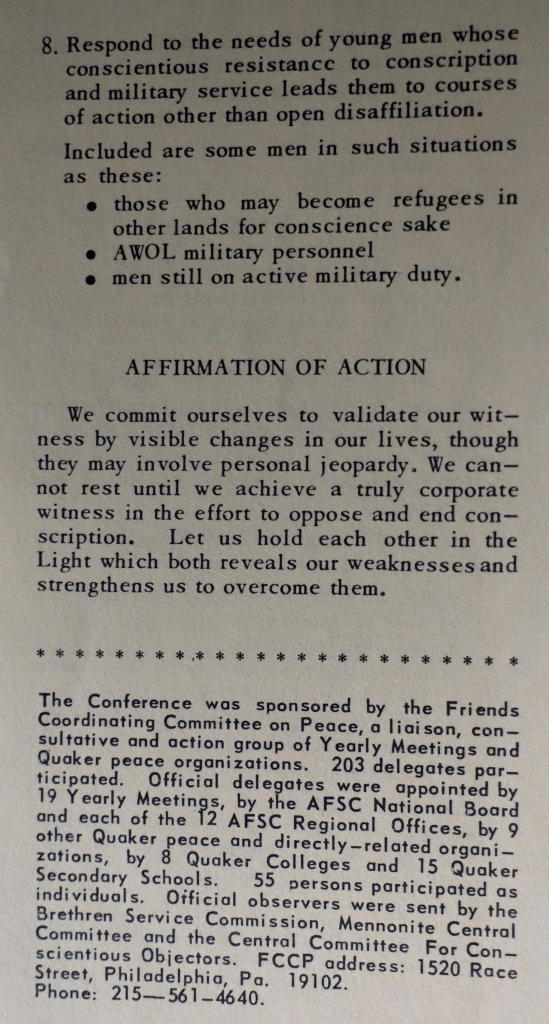
AFFIRMATION OF ACTION

We commit ourselves to validate our witness by visible changes in our lives, though they may involve personal jeopardy. We cannot rest until we achieve a truly corporate witness in the effort to oppose an end conscription. Let us hold each other in the Light which both reveals our weaknesses and strengthens us to overcome them.


Declaration on the Draft and Conscription: Richmond 1968. Friends National Conference on the Draft and Conscription, October 11-13, 1968


An Epistle to Friends Concerning Military Conscription

Dear Friends,

It has long been clear to most of us who are called Friends that war is contrary to the spirit of Christ and that we cannot participate in it. The refusal to participate in war begins with a refusal to bear arms. Some Friends choose to serve as noncombatants within the military. For most of us, however, refusal to participate in war also involves refusal to be part of the military itself, as an institution set up to wage war. Many, therefore, become conscientious objectors doing alternative service as civilians, or are deferred as students and workers in essential occupations.

Those of us who are joining in this epistle believe that cooperating with the draft, even as a recognized conscientious objector, makes one part of the power which forces our brothers into the military and into war. If we Friends believe that we are special beings and alone deserve to be exempted from war, we find that doing civilian service with conscription or keeping deferments as we pursue our professional careers are acceptable courses of action. But if we Friends really believe that war is wrong, that no man should become the executioner or victim of his brothers, then we will find it impossible to collaborate with the Selective Service System. We will risk being put in prison before we help turn men into murderers.

It matters little what men say they believe when their actions are inconsistent with their words. Thus we Friends may say that all war is wrong, but as long as Friends continue to collaborate in a system that forces men into war, our Peace Testimony will fail to speak to mankind.

Let our lives speak for our convictions. Let our lives show that we oppose not only our own participation in war, but any man’s participation in it. We can stop seeking deferments and exemptions, we can stop filling out Selective Service forms, we can refuse to obey induction and civilian work orders. We can refuse to register, or send back draft cards if we’ve already registered.

In our early history we Friends were known for our courage in living according to our convictions. At times during the 1600’s thousands of Quakers were in jails for refusing to pay any special respect to those in power, for worshiping in their own way, and for following the leadings of conscience. But we Friends need not fear we are alone today in our refusal to support mass murder. Up to three thousand Americans severed their relations with the draft at nation-wide draft card turn-ins during 1967 and 1968. There may still be other mass returns of cards, and we can always set our own dates.

We may not be able to change our government’s terrifying policy in Vietnam. But we can try to change our own lives. We must be ready to accept the sacrifices involved if we hope to make a real testimony for Peace. We must make Pacifism a way of life in a violent world.

We remain, in love of the Spirit, your Friends and brothers,

Don Laughlin
Roy Knight
Jeremy Mott
Ross Flanagan
Richard Boardman
James Brostol
George Lakey
Stephen Tatum
Herbert Nichols
Christopher Hodgkin
Jay Harker
Bob Eaton
Bill Medlin
Alan & Peter Blood.


Don Laughlin and Roy Knight, among those who signed that Epistle, were members of Iowa Yearly Meeting (Conservative). Both were imprisoned for their refusal to participate in the military draft. As were a number of other Quakers. Don collected some of those stories, which can be found here:

Young Quaker Men Facing War and Conscription


Bill Deutsch interviews Mary Mendenhall

One story leads to another

I’ve recently been writing a number of articles related to the beginning, evolution, and current state of my foundational stories. We were challenged to do this at the annual sessions of Iowa Yearly Meeting (Conservative) this summer. https://quakersandreligioussocialism.com/foundational-stories/

I wanted to do that, in part, because my experience has been that stories are among the most powerful tools we have to affect change. And stories of the past can remind us of how earlier generations worked on many of the same things we struggle with today. (Which is also a bit discouraging).

Yesterday at Bear Creek Friends Meeting, we were talking about the Mendenhall family and I said I would share the video I made of Bill Deutsch interviewing Mary Mendenhall about her life, including her time in the Monteverde Friends community in Costa Rica. Photography is one of my foundational stories. I took the photos in this video during my only international trip, which was to Costa Rica, for the 60th anniversary of the double wedding of my mom and dad (Burt and Alberta Kisling) and Lucky and Wolfe Guindon. Lucky was my mother’s childhood best friend. The wedding took place at Bear Creek Friends meeting in 1950, (where we were meeting yesterday). The Guindon’s moved to Costa Rica shortly afterward for reasons Mary explains during the interview.

Burt and Alberta Kisling and Lucky and Wolfe Quindon, wedding, Bear Creek Friends Meeting, 1950
Lucky, Birdie, Burt and Wolfe, Monteverde, Costa Rica, 2010

I love this tee shirt worn by my cousin Jeffrey. Costa Rica has not had an army since 1948.


Bill Deutsch interviews Mary Mendenhall


In 2012 Paullina Friends met at the Mapleside meetinghouse, and told stories related to the meeting.  Some of those videos are available at the links below. As you can see many of the stories relate to war and pacifism.

As I looked through my writings, I found this story by my uncle Bernard Standing, reporting on the annual sessions of Iowa Yearly Meeting (Conservative), in Friends Journal, 1966

Iowa Yearly Meeting (Conservative) Reported by BERNARD A. STANDING

IOWA Yearly Meeting of Friends (Conservative) held its sessions August 16-21 in the rural community of Mapleside near Paullina, Iowa. A family atmosphere prevailed, as evidenced by the parent-children groups arriving by car or seated in the meeting house, by the many young people at play on the volleyball court, and by the little children at the sand-pile and the swings. The mingling of Friends from urban communities with those from rural areas was a truly growing experience. Lincoln Meeting in eastern Nebraska has been added to this group within the past year. Visiting Friends were welcomed from Monteverde (Costa Rica), Concord (New Hampshire), and Media (Pennsylvania).

A dominant concern was the war in Vietnam. E. Raymond Wilson of the Friends Committee on National Legislation spoke on this topic to different age groups at several sessions. Various approaches to a peaceful settlement of the conflict were presented. The meeting gave its approval to the statement issued recently by Friends United Meeting, “An Appeal to End the War in Vietnam Now,” which calls for cessation of hostilities, negotiations, free elections, economic development of the land, and the help of all nations of the world to accomplish these results.

Boyd Trescott of the Friends World Committee for Consultation explained the function of that committee, placing special emphasis on the Friends World Conference to be held at Guilford College in North Carolina in 1967. Plans are being made to send seven delegates from Iowa Yearly Meeting.

Marian Baker, a young Friend from New Hampshire, told of the Young Friends’ plans for that conference and for subsequent visitation throughout the United States.

Other concerns were Indian welfare and race relations.

Projects of the North Central Region of the American Friends Service Committee were reported. The summer workshop in which several young people joined with the Musquakie Indians in preparing for the annual powwow at Tama, Iowa, was successful in fostering understanding and friendship between the two groups.

James Thomas, director of the Iowa Rights Commission, spoke one evening about the efforts of his group to achieve equal opportunities in housing and employment for minorities.

The annual report of Scattergood School at West Branch, Iowa, the Yearly Meeting’s major educational project, showed progress in the building program, including the construction of· a new science building. The purpose of the school is reflected in the lives of returning alumni.

At the last evening gathering, Cecil Hinshaw described possible vast changes in our material world in the near future. He challenged Friends to cope with these new situations by imaginative training of personnel in the fields of industry and education. Though change is inevitable, the eternal values of truth and love remain.

October I, 1966 FRIENDS JOURNAL


The date of that Friends Journal article was the year I first attended Scattergood Friends School. The Vietnam War was a large factor in the lives of the boys there, since we were required to register for the draft on our eighteenth birthday. Like many Iowa Quakers, I eventually decided to become a draft resister.  Cecil Hinshaw of the American Friends Service Committee (AFSC) who spoke at the 1966 Yearly Meeting sessions (see above), also spoke at a draft conference held at Scattergood that fall.


Cecil Hinshaw, President of William Penn College, and my father–counseled many of these young Quaker men to resist the draft. And many have thanked him over the years for helping them come to the decision, in writing letters of support. My brother, Robert, struggled with the decision, and at the age of 18, he wrote to his draft board and told them he would not register for the draft and would be willing to go to prison for his act of conscience. He never even got a response from his draft board. We all asked ourselves WHY?? My father finally came up with the response that to give the son of Cecil Hinshaw any publicity, would only further the cost of passive resistance and refusal to serve in the armed services. So Robert lived for many years with the fear that he might be arrested for speeding, or some other misdemeanor, and it would be discovered that he did not have a draft card and the waiting game would over. He must have lost his fear of being arrested for speeding–for he became quite a speed demon on the highways and I did not want to ride with him!! I was very proud of him.

Eleanor Hinshaw Mullendore
As often happens, one story leads to another. I appreciated this powerful letter when I was struggling with my decision about the draft.

An Epistle to Friends Concerning Military Conscription

Dear Friends,

It has long been clear to most of us who are called Friends that war is contrary to the spirit of Christ and that we cannot participate in it. The refusal to participate in war begins with a refusal to bear arms. Some Friends choose to serve as noncombatants within the military. For most of us, however, refusal to participate in war also involves refusal to be part of the military itself, as an institution set up to wage war. Many, therefore, become conscientious objectors doing alternative service as civilians, or are deferred as students and workers in essential occupations.

Those of us who are joining in this epistle believe that cooperating with the draft, even as a recognized conscientious objector, makes one part of the power which forces our brothers into the military and into war. If we Friends believe that we are special beings and alone deserve to be exempted from war, we find that doing civilian service with conscription or keeping deferments as we pursue our professional careers are acceptable courses of action. But if we Friends really believe that war is wrong, that no man should become the executioner or victim of his brothers, then we will find it impossible to collaborate with the Selective Service System. We will risk being put in prison before we help turn men into murderers.

It matters little what men say they believe when their actions are inconsistent with their words. Thus we Friends may say that all war is wrong, but as long as Friends continue to collaborate in a system that forces men into war, our Peace Testimony will fail to speak to mankind.

Let our lives speak for our convictions. Let our lives show that we oppose not only our own participation in war, but any man’s participation in it. We can stop seeking deferments and exemptions, we can stop filling out Selective Service forms, we can refuse to obey induction and civilian work orders. We can refuse to register, or send back draft cards if we’ve already registered.

In our early history we Friends were known for our courage in living according to our convictions. At times during the 1600’s thousands of Quakers were in jails for refusing to pay any special respect to those in power, for worshiping in their own way, and for following the leadings of conscience. But we Friends need not fear we are alone today in our refusal to support mass murder. Up to three thousand Americans severed their relations with the draft at nation-wide draft card turn-ins during 1967 and 1968. There may still be other mass returns of cards, and we can always set our own dates.

We may not be able to change our government’s terrifying policy in Vietnam. But we can try to change our own lives. We must be ready to accept the sacrifices involved if we hope to make a real testimony for Peace. We must make Pacifism a way of life in a violent world.

We remain, in love of the Spirit, your Friends and brothers,

Don Laughlin
Roy Knight
Jeremy Mott
Ross Flanagan
Richard Boardman
James Brostol
George Lakey
Stephen Tatum
Herbert Nichols
Christopher Hodgkin
Jay Harker
Bob Eaton
Bill Medlin
Alan & Peter Blood.


Don Laughlin and Roy Knight, among those who signed that Epistle, were members of Iowa Yearly Meeting (Conservative). Both were imprisoned for their refusal to participate in the military draft. As were a number of other Quakers. Don collected some of those stories, which can be found here:
Young Quaker Men Facing War and Conscription

This also leads to the story about the draft conference I attended at Earlham College in 1968.

[Friends Coordinating Committee on Peace organized a Friends National Conference on the Draft and Conscription, held in Richmond, Indiana, Oct. 11-13, 1968. This declaration was used by many Friends who took the noncooperator position at their trials. It was reprinted in Quakers and the Draft, Charles Walker, editor: 1969.]

I was a student at Scattergood Friends School at the time, and a classmate and I were able to attend. Scattergood was one of 15 Quaker Secondary Schools represented.

Foundational stories now: Quaker faith

[My foundational stories are related to the intersections between my Quaker faith, protecting Mother Earth, and photography. My faith led me to try to share my spiritual experiences and show my love for the beauty of Mother Earth through photography.]

I’ve been praying and struggling for many days to discern how to express the state of my Quaker faith today. Quakerism is the faith community I was born into and have remained in. I was raised in a White Quaker family and community. I had a Spiritual experience at the Bear Creek Meetinghouse when I was about ten years old, an experience that I have drawn upon for the rest of my life. I attended Scattergood Friends School, a Quaker high school, and Earlham College, a Quaker institution.

One of the reasons I accepted the challenge of reflecting on my foundational stories is because of my crisis of faith now.

I think it is common for people to be disappointed by their faith community at various times, for a variety of reasons. That has been true for me. Coming of age during the Vietnam War I wished more young men had resisted the draft. I wish we all had done more to reign in the use of fossil fuels. And that White people like myself had worked, harder to acknowledge our complicity in the oppression of Black, Indigenous, and other people of color (BIPOC), of various gender identities, and certain social and economic classes. I wish we were working harder now on acknowledging and trying to heal these injustices.

This country was built on the historical injustices of the institution of slavery, and the genocide and removal of Indigenous peoples from their lands. And the forced assimilation of native children in institutions where they were often physically and sexually abused, where thousands of children were killed or died.

Many people, including Quakers today question how complicit our ancestors were in these injustices. There were White Quakers who were involved in the slave trade, and who enslaved Black men, women, and children. Our ancestors were settler colonists. As are we who are now living on these lands. Quakers were involved in the Indian residential schools.

being involved with others in wrongdoing

complicity

These issues often generate significant emotional responses. I don’t have all the answers. But I have had spiritual and community experiences that I am led to speak and work from today. Many of these experiences have led me to understand we are living in a country, a society of structural racism and white superiority. As much as many of us White Quakers wish it weren’t so, our skin color automatically gives us many significant advantages in this country.

Our mainstream social, economic, and political systems are predicated on White superiority and dominance. I say mainstream because many people, including myself, are building alternative systems today. I’ve been deeply involved in Mutual Aid for a couple of years and believe this to be part of the answer. Mutual Aid is included in the following graphics.

NOTE: White supremacy is different from white superiority. “White supremacy or white supremacism is the belief that white people are superior to those of other races and thus should dominate them.”

Wikipedia

I’ve also seen in the lives of my friends what I once thought of as isolated historical traumas have been passed from generation to generation. They profoundly affect the lives of people today. What does that mean for White Quakers now?


“…capitalism and colonialism created structures that have disrupted how people have historically connected with each other and shared everything they needed to survive. As people were forced into systems of wage labor and private property, and wealth became increasingly concentrated, our ways of caring for each other have become more and more tenuous.”

Dean Spade, Mutual Aid: Building Solidarity During This Crisis (and the Next) (Kindle Locations 111-121). Verso

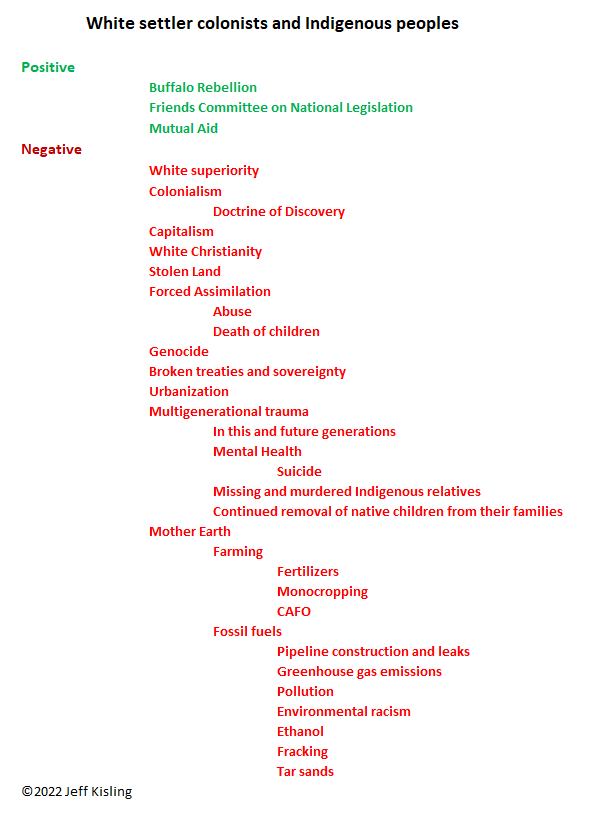
Following is another way of looking at the relationships between White settler colonists and Indigenous peoples. White Quakers need to acknowledge that when our ancestors came to these Indigenous lands, they were settler colonists. And since we are still occupying these lands, we are settler colonists, too. Some White Quakers were involved in the forced assimilation of Indigenous children. We are implicated in most of the “negative” things listed below.

Acknowledgement of wrongs is the necessary first step in the healing process.


On the positive side are Mutual Aid, the Buffalo Rebellion, and the Friends Committee on National Legislation (FCNL). I’ve written a lot about my experiences with Mutual Aid https://quakersandreligioussocialism.com/mutual-aid/

I’m fortunate to be part of the Buffalo Rebellion, a newly formed Green New Deal coalition in Iowa formed to protect the planet by demanding change from politicians and convincing the public that climate should be a priority. Buffalo Rebellion, is a coalition of grassroots, labor, and climate justice organizations growing a movement to pass local, state, and national policies that create millions of family-sustaining union jobs—ensuring racial and gender equity and taking action on climate at the scale and scope the crisis demands. It was formed in November 2021 and consists of: 

The Friends Committee on National Legislation (FCNL) has years of experience advocating for legislation related to Native American affairs. Recently FCNL has been supporting legislation to form a Truth and Healing Commission related to the Indian Boarding Schools. I’ve been blessed to have many years of experience with FCNL and have been working with my native friends in creating connections with FCNL, including several visits to our US Senators.


Foundational stories now: Protecting Mother Earth

[My foundational stories are related to the intersections between my Quaker faith, protecting Mother Earth, and photography. My faith led me to try to share my spiritual experiences and show my love for the beauty of Mother Earth through photography.]

Yesterday I described where my story related to photography is at this time. Today I write about where I am regarding protecting Mother Earth. The beginning of my stories about protecting Mother Earth and the water can be found here: Foundational stories about care for Mother Earth.

Concern for Mother Earth has been a constant in my life. I was 20 years old when I moved to Indianapolis and was horrified by the thick, noxious exhaust from cars. I couldn’t be part of that and have lived without a car since then (1970).


My foundational stories now

Protecting Mother Earth

It took a while for me to become comfortable with the term Mother Earth. But vocabulary can affect how you feel about something. Having Earth as your Mother describes a living relationship. This is one of the many things I’ve learned from my Indigenous friends.

It is a dichotomy that today, despite knowing the many ways our environment and so many other things are collapsing, I have more hope than I’ve had for years. That’s because of the coalitions of people coming together to heal each other and Mother Earth. We can’t be so paralyzed with fear about what may be coming that we don’t enjoy the beauty all around us.

Following are some ways I’m involved in protecting Mother Earth now.

  • Buffalo Rebellion
  • Mutual Aid
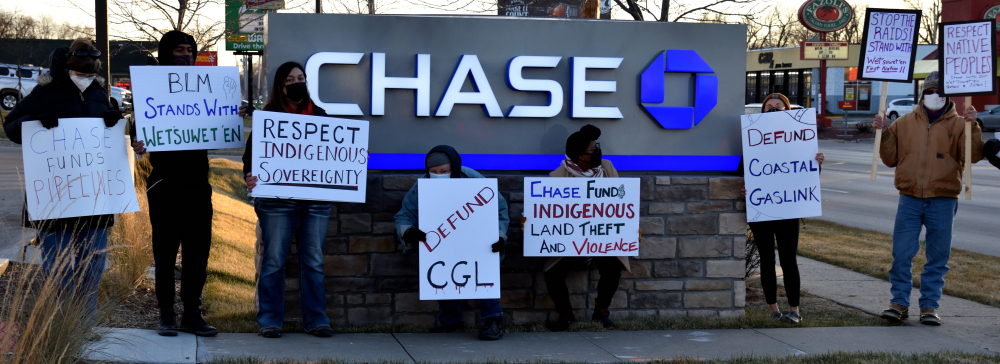
  • Wet’suwet’en
  • Bear Creek Friends Meeting

Buffalo Rebellion

Last night I participated in a meeting of the Buffalo Rebellion, which I’m proud to be a part of. This coalition of environmental activists is one of the things that gives me hope. Realizing we are all working on similar things, this coalition is being built to empower our work and support one another. Last night someone remarked that we’ve all suffered trauma and are all in need of healing.

Following is a description of the Buffalo Rebellion, including a link to a recording of my friend Sikowis Nobiss describing it.

The topic this month is on a newly formed Green New Deal coalition in Iowa called Buffalo Rebellion formed to protect the planet by demanding change from politicians and convincing the public that climate should be a priority. Buffalo Rebellion, is a coalition of grassroots, labor, and climate justice organizations growing a movement to pass local, state, and national policies that create millions of family-sustaining union jobs—ensuring racial and gender equity and taking action on climate at the scale and scope the crisis demands. It was formed in November 2021 and consists of: 


The root causes of what we are fighting against are capitalism and colonialism


The subject of last night’s gathering (at Iowa CCI and via Zoom) was CO2 (carbon) pipelines, the latest man-made environmental threat. Iowa is at the center of this problem because most of the ethanol plants are located here, because ethanol is produced from corn, and releases carbon emissions in the process. The carbon dioxide in the carbon pipelines is a hazardous material and could cause deaths if there is a rupture. A CO2 pipeline in Satartia, Mississippi ruptured last year, sickening dozens of people. First responders’ vehicles could not run because of the absence of oxygen. READ: The Gassing Of Satartia” (Huffington Post, August 2021)

Sikowis talked about what is below the crust of the earth also being a sacred space, and we don’t know what disturbing that with pipelines and fracking will cause.

The only way to address fossil fuel emissions is to stop burning fossil fuels.


Mutual Aid

Des Moines Mutual Aid has been the focus of my work for the past couple of years. How is this related to the protection of Mother Earth?

  • Being in a Mutual Aid community, we support each other and help each other heal.
  • Mutual Aid members are encouraged to use critical thinking to anticipate and solve problems. And immediately implement solutions, not waiting for permission from anyone.
  • Mutual Aid is about eliminating vertical hierarchies and the damage those hierarches do to a community. And how they harm Mother Earth.
  • Mutual Aid communities are explicitly local. There is no need for fossil fuel transportation and energy production. Our Mutual Aid communities are or will be “walkable”.
  • Our Mutual Aid communities are an example to others of how we can escape capitalism and colonialism that are the root causes of injustice
  • Our Mutual Aid practices are about sustainability and protection of Mother Earth
  • “These spaces become intergenerational, diverse places of Indigenous joy, care and conversation, and these conversations can be affirming, naming, critiquing, as well as rejecting and pushing back against the current systems of oppression”. Maynard, Robyn; Simpson, Leanne Betasamosake.
  • “…capitalism and colonialism created structures that have disrupted how people have historically connected with each other and shared everything they needed to survive. As people were forced into systems of wage labor and private property, and wealth became increasingly concentrated, our ways of caring for each other have become more and more tenuous.” Dean Spade
Ronnie James, Des Moines Mutual Aid

…in Nishnaabeg thinking, knowledge is mobilized, generated, and shared by collectively doing. It’s more than that, though. There is an aspect of self-determination and ethical engagement in organizing to meet our peoples’ material needs. There is a collective emotional lift in doing something worthwhile for our peoples’ benefit, however short-lived that benefit might be. These spaces become intergenerational, diverse places of Indigenous joy, care and conversation, and these conversations can be affirming, naming, critiquing, as well as rejecting and pushing back against the current systems of oppression. This for me seems like the practice of movement-building that our respective radical practices have been engaged with for centuries.

Maynard, Robyn; Simpson, Leanne Betasamosake. Rehearsals for Living (Abolitionist Papers) (p. 39). Haymarket Books. Kindle Edition.

In another example of how our work is interrelated, my Mutual Aid friends support the Wet’suwet’en.

Wet’suwet’en

The Wet’suwet’en peoples have been struggling for years to prevent the construction of the Coastal GasLink liquified natural gas pipeline from being built through their pristine, unceded lands.

https://quakersandreligioussocialism.com/?s=wetsuweten+wet%27suwet%27en
https://jeffkisling.com/?s=wetsuweten+wet%27suwet%27en

There was one particularly significant Spirit-led event in my life related to the Wet’suwet’en. When I first became involved with the Wet’suwet’en peoples was when they were asking allies to spread the news about their struggles, since there was no mainstream media coverage.

In February 2020, some of us were already planning to be at Friends House in Des Moines. We decided to hold a vigil for the Wet’suwet’en on the street in front of Friends House prior to that meeting. I created an event announcement on Facebook, that was shared by my friend Ed Fallon or Bold Iowa, an Iowa Citizens for Community Improvement.

As anticipated just those few of us who were planning to attend the meeting at Friends House anyway showed up. But the Spirit-led part of this is that Ronnie James, who I didn’t know at the time, joined us. Ronnie is an Indigenous organizer with twenty years of experience. He was surprised anyone in Iowa knew about the Wet’suwet’en peoples, so he came to see who was attending, a good organizing technique.

Ronnie and I began to exchange messages over the next couple of months. I was intrigued with the stories he was telling me about Des Moines Mutual Aid community he was involved with. When I felt we had begun to know each other well enough, I tentatively asked if I could attend the food giveaway that Ronnie/Des Moines Mutual Aid held every Saturday morning. This was a continuation of a variation of the Black Panther Party’s free school breakfast program in Des Moines from the 1970’s.

I thought I would just attend a time or two to see how that worked. Instead, I’ve been there almost every Saturday morning for over two years now, and Ronnie is one of my best friends. One of the many good things about Mutual Aid is how it attracts and keeps people engaged.


I continue to do what I can to support the Wet’suwet’en. We are presently organizing another gathering at Chase bank to call attention to their funding fossil fuel projects. Some others from the Buffalo Rebellion will be involved.

Bear Creek Friends Meeting

The small, rural Quaker meeting I’m a member of continues today to try to find ways we can help protect Mother Earth. This is one way to bring a Spiritual approach to these problems which I believe is very important.

Members of the meeting have supported the annual Prairie Awakening/Prairie Awoke ceremony that takes place at the Kuehn Conservation Area, just a few miles from the meetinghouse.

Bear Creek Friends Meeting

It is difficult to reduce fossil fuel use in rural areas.

One thing we realized we could do was encourage more use of bicycles, since many members lived close to the meetinghouse just north of Earlham, Iowa. And encourage Friends in urban meetings to use bicycles when possible.

The Minute we wrote, and that was approved by Iowa Yearly Meeting of Friends (Conservative) was referred to as a Minute on “Ethical Transportation”.

 Radically reducing fossil fuel use has long been a concern of Iowa Yearly Meeting (Conservative).  A previously approved Minute urged us to reduce our use of personal automobiles.  We have continued to be challenged by the design of our communities that makes this difficult.  This is even more challenging in rural areas.  But our environmental crisis means we must find ways to address this issue quickly.
 
 Friends are encouraged to challenge themselves and to simplify their lives in ways that can enhance their spiritual environmental integrity. One of our meetings uses the term “ethical transportation,” which is a helpful way to be mindful of this.
 
 Long term, we need to encourage ways to make our communities “walkable”, and to expand public
transportation systems.  These will require major changes in infrastructure and urban planning.
 
 Carpooling and community shared vehicles would help.  We can develop ways to coordinate neighbors needing to travel to shop for food, attend meetings, visit doctors, etc.  We could explore using existing school buses or shared vehicles to provide intercity transportation.  
 
 One immediately available step would be to promote the use of bicycles as a visible witness for non-fossil fuel transportation.  Friends may forget how easy and fun it can be to travel miles on bicycles.  Neighbors seeing families riding their bicycles to Quaker meetings would have an impact on community awareness.  This is a way for our children to be involved in this shared witness.  We should encourage the expansion of bicycle lanes and paths.  We can repair and recycle unused bicycles, and make them available to those who have the need.

Minute approved by Iowa Yearly Meeting (Conservative) 2017

War is never the answer

The invasion of Ukraine by Russia has dominated the news for six months now. There is news about two new developments.

  • The Russian draft to force men into the military
  • The use of weaponized drones

Russian conscription brings back memories of the draft in this country for the Vietnam War.

I came of age during the Vietnam War years. Organized a draft conference, walked with the entire student body of Scattergood Friends School (all sixty of us) fourteen miles into Iowa City during the Moratorium to End the War in Vietnam, became a draft resister. The entire country was in an uproar. Young men and their families lived in fear of induction based on a lottery system. Over 58,000 Americans were killed.

A key component to the sustenance of the permanent war state was the creation of the All-Volunteer Force. Without conscripts, the burden of fighting wars falls to the poor, the working class, and military families. This All-Volunteer Force allows the children of the middle class, who led the Vietnam anti-war movement, to avoid service. It protects the military from internal revolts, carried out by troops during the Vietnam War, which jeopardized the cohesion of the armed forces.

NO WAY OUT BUT WAR By Chris Hedges, Scheer Post. May 23, 2022. Permanent War Has Cannibalized The Country. It Has Created A Social, Political, And Economic Morass.

I’ve often despaired at the absence of an antiwar movement since our plunge into a ‘war on terror’ that is an excuse to have military presence and conflict in any place politicians define a threat.

There were three restraints to the avarice and bloodlust of the permanent war economy that no longer exist. The first was the old liberal wing of the Democratic Party, led by politicians such as Senator George McGovern, Senator Eugene McCarthy, and Senator J. William Fulbright, who wrote The Pentagon Propaganda Machine. The self-identified progressives, a pitiful minority, in Congress today, from Barbara Lee, who was the single vote in the House and the Senate opposing a broad, open-ended authorization allowing the president to wage war in Afghanistan or anywhere else, to Ilhan Omar now dutifully line up to fund the latest proxy war. The second restraint was an independent media and academia, including journalists such as I.F Stone and Neil Sheehan along with scholars such as Seymour Melman, author of The Permanent War Economy and Pentagon Capitalism: The Political Economy of War. Third, and perhaps most important, was an organized anti-war movement, led by religious leaders such as Dorothy Day, Martin Luther King Jr. and Phil and Dan Berrigan as well as groups such as Students for a Democratic Society (SDS). They understood that unchecked militarism was a fatal disease.

NO WAY OUT BUT WAR By Chris Hedges, Scheer Post. May 23, 2022. Permanent War Has Cannibalized The Country. It Has Created A Social, Political, And Economic Morass.

An anti-war demonstration against Israeli militarism

This photo was taken during a demonstration to bring attention to Israeli militarism. Christine Ashley, then head of Scattergood Friends School, offered to take the Iowa Yearly Meeting (Conservative) Peace and Social Concerns Committee to Iowa City for this demonstration in 2014. This occurred at the time when we were holding our annual sessions at the school. The sign I’m holding is from an American Friends Service Committee (AFSC) campaign to call attention of military spending and its consequences. That is a picture of a drone on the sign. You can see a War Is Not the Answer sign in the background, as well as a button on my camera strap, which I have been wearing for many years.


The peace and social concerns committee asks the clerk of Iowa Yearly Meeting (Conservative) to mail the following letter to our Congressional delegations. 

Jeff Kisling and Sherry Hutchison, co-clerks 
[Note: the photo below is of Sherry Hutchison]

 The Israeli government, with U.S. aid, now has the most powerful military in the Middle East.  In 2008 Israel attacked Gaza, with 1400 civilian casualties.  In 2013 Israel attacked Lebanon, with 750 civilian casualties.  Currently Israel is engaging in a massive military siege of Palestine, with over 800 civilian deaths so far.  All three of these Israel assaults have involved devastating destruction of schools, hospitals, power plants, and other infrastructure. 

Tragically, we the American taxpayers are paying for this human rights travesty. Israel receives 9.9 million U.S. dollars each day in military aid from us. This makes it our largest aid recipient in the world. While Americans are struggling to make ends meet and our government struggles to maintain our own infrastructure, we are subsidizing Israel to conduct activities in direct opposition to international law.  

We ask that no more military aid be given to the Israeli government. 

Iowa Yearly Meeting (Conservative) 2014


Sherry Hutchison

Drone terrorism

Recently Russia has begun to use weaponized drones against Ukraine. I remember how devastated I was when I learned of how people, how the children in Iraq and Afghanistan were terrorized by the sounds of drones circling overhead. Knowing an attack could be triggered at any moment, with untold numbers of civilian casualties. Death by remote control.

In a recent news story, a reporter from NBC News spoke about this, about how unnerving it was to hear the sounds of the drones overhead.


Drones: The Face of War Today, Friends Committee on National Legislation (FCNL) October 13, 2016


It was fascinating to learn how a drone strike helped trigger the formation of Des Moines Mutual Aid, which has been the focus of my work for the past two years.

One year ago today (January 2021) Des Moines Mutual Aid participated in a march protesting the potential for war or increased hostilities with Iran that followed the fallout of the assassination of Qassem Soleimani by drone strike in Baghdad. 

This was our first “public” event since adopting the name Des Moines Mutual Aid, a name we gave our crew during our growing work with our relatives at the houseless camps throughout the city and our help with coordinating a weekly free grocery store that has a 50 year history, founded by the Des Moines Chapter of The Black Panther Party For Self Defense.  

A year ago we started laying the foundation for work we had no idea what was coming. As we were adjusting our work with the camps and grocery re-distribution in response to the Covid-19 pandemic, both that continued to grow in need and importance, the police continued their jobs and legacy of brutality and murder.  

This nation exploded in righteous rage in response to the pig murders of Breonna Taylor and George Floyd. DMMA realized we were in a position to organize a bail fund to keep our fighters out of jail, both to keep the streets alive as a new phase of The Movement was being born, and because jails are a hotspot of Covid-19 spread. Not to mention the racial and economic oppression that is the cash bail system.  

In the past year DMMA has expanded its work in multiple directions and gained many partners and allies.  

We partnered with the Des Moines Black Liberation Movement to create the DSM BLM Rent Relief initiative to help keep families in their homes in the midst of a pandemic and the winter.  

The camp work has grown exponentially, but is being managed with our collaboration with Edna Griffin Mutual Aid, DSM Black Liberation Movement, and The Great Plains Action Society.  

The bail fund remains successful because of desire from the public and a partnership with Prairielands Freedom Fund (formerly The Eastern Iowa Community Bond Project).  

The weekly free food store has maintained itself, carrying on the legacy it inherited.  

Every one of our accomplishments are directly tied to the support of so many people donating time, talent, and funds to the work. We are overwhelmed with all of your support and hope you feel we are honoring what we promised.   

All of these Mutual Aid projects are just a few of many that this city has created in the last year in response to the many crises we face, not only confronting the problems and fulfilling the needs directly in front of us, but creating a sustainable movement that will be capable of responding to what’s next and shaping our collective futures as we replace the systems that fail us.  

These last 12 months have been wild and a real test of all of our capabilities to collectively organize. But it is clear that we as a city have what it takes to do what is needed in 2021, no matter what crisis is next.  

Much gratitude to you all.  

In love and rage, 

Des Moines Mutual Aid