Why we need different queries

As I’ve been praying about why the Quaker meetings I’m familiar with are slowly dying from attrition and not attracting new attenders, I’m struggling to understand why this is happening. I feel a special urgency, wondering if my Quaker meeting can continue when we lose even one more member. Lose another elderly member, or one who turns away from Quakerism.

I was led to think about our Advices and Queries because they guide the spiritual discussions in our meetings. And they are one concrete thing we can point to for people interested in learning about Quakerism.

It surprised me to be led to the conclusion that our Queries seem rooted in maintaining the status quo of this country’s current economic and political systems. Systems of dominance, systemic racism, and White supremacy. And an implicit view of ‘us versus them.’ (See: Advices and Queries). Today, I hope to explain that more fully and offer suggestions for what we might do differently.

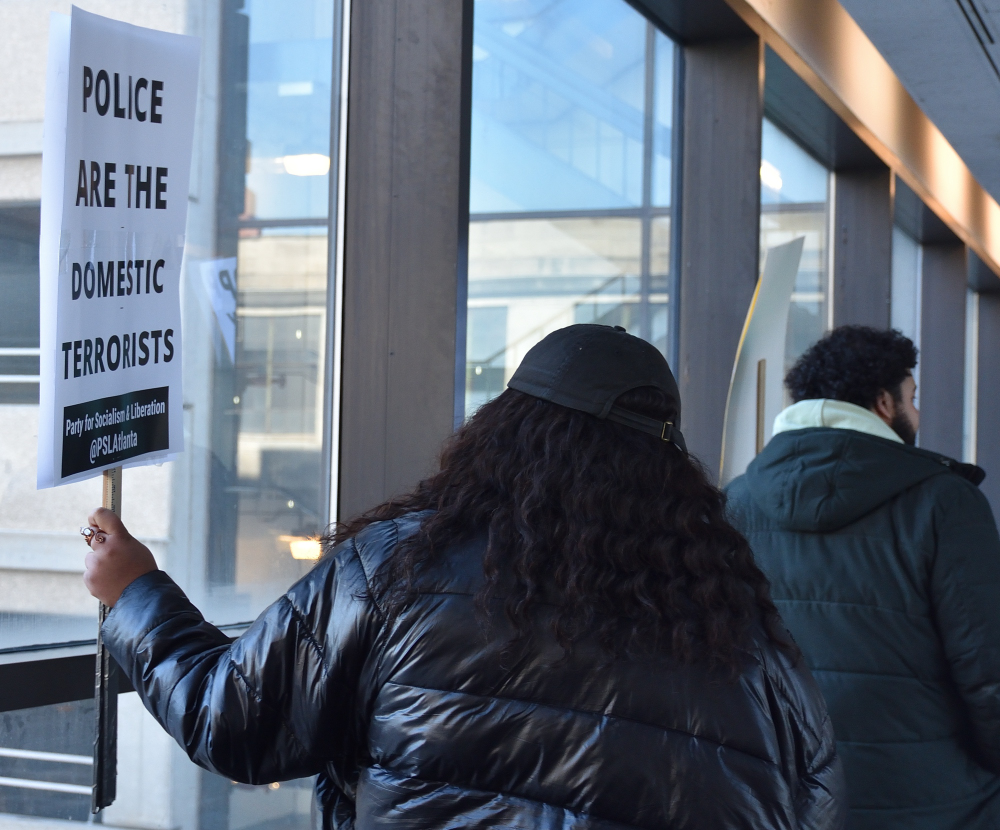
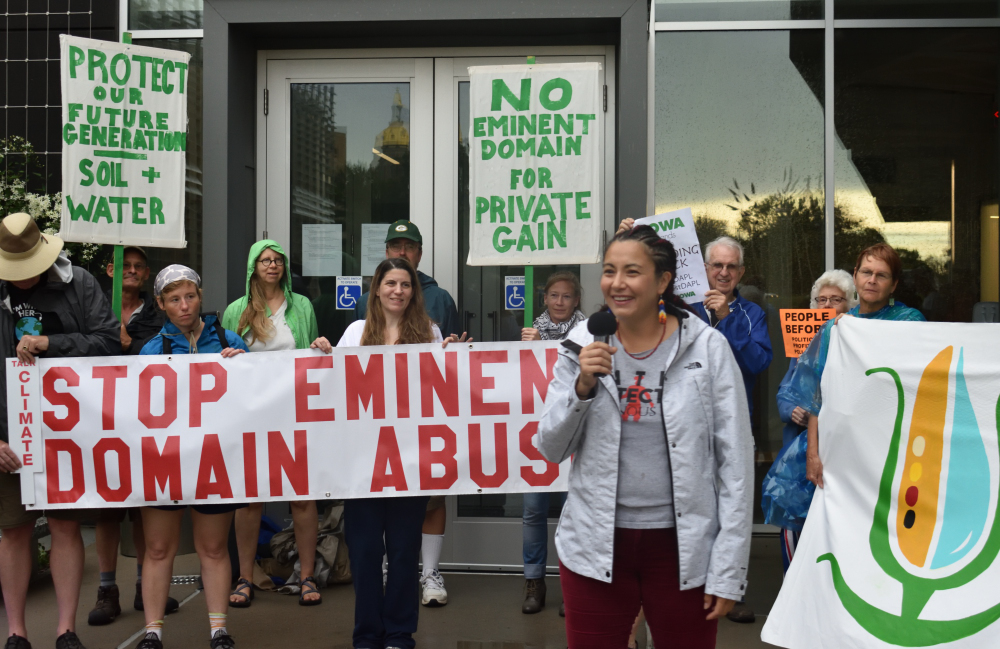
I’m focusing on the abolition of police and prisons, both because this is something I’ve been learning and writing about (https://quakersandreligioussocialism.com/abolition/) and because it is a deep concern of some activist Quakers I know and of my Mutual Aid community. One of my abolitionist Friends is leaving Quakers because of the lack of attention to this concern. This is an example of the attrition I’m concerned about.

We are police and prison abolitionists. Abolition and the mutual aid that we practice are inextricably linked. We don’t rely on capitalist institutions or the police to do our work. We believe in building strong and resilient communities which make police obsolete, including community systems of accountability and crisis intervention. Des Moines Mutual Aid

What does it mean that abolition is not one of our Query topics?

  • Meeting for Worship
  • Outreach
  • Meeting for Business
  • Harmony within the Meeting
  • Mutual Care
  • Education
  • Home and Family
  • Personal Responsibility
  • Civic Responsibility
  • Environmental Responsibility
  • Social and Economic Justice
  • Peace and Nonviolence

I think that is because abolition touches several of these topics and illustrates why I think we need new queries.


Quakers are pretty white, and that comes with quite a bit of power and privilege. A Quaker in Omaha, Nebraska is going to have probably more weight in what they say to a legislator than a Black Lives Matter activist in Brooklyn, New York. I think there’s a need for Quakers to step out of their meeting and away from a lot of these phenomenal institutions that they’ve created and speak to individuals in an interfaith setting (from Black churches or Black Lives Matter) and have a cross-cultural understanding of what that experience is like because you’ll find that it’s very different, and I think the more we can do of that the more effective we’ll be in addressing these problems. These exchanges and fusion coalitions are what I think it’s going to take, not only for Friends to be effective in dismantling these systems of racism, classism, and white supremacy in American society, but also for all of us to better address these problems in our country.

José Santos Woss (FCNL), Quaker Faith and Justice Reform, QuakerSpeak video

Perhaps the revolutionary Quaker faith we imagine ourselves to inhabit has never really existed, and if we tell the whole truth and commit to the healing the truth-telling calls us to, perhaps together we can embody and create the prophetic religion we thirst for.

Abolitionist thinking is holistic—that ending the system of punishment and incarcerating control itself is necessary—and invites us to imagine a whole new way of not only dealing with harm but of how we think of ourselves in community. It provokes questions like, what does true justice look like? What does it mean to center healing and transforming relationships and create community safety from authentic accountability and relational reconnection? Abolition does not minimize the reality of harm or violence but rather invites us to consider a way of doing things that interrupts cycles of harm, violence, and trauma, and restores perpetrators and victims into community and their humanity.

We as White Quakers like to think of ourselves as ahead or better than dominant culture, but we have been complicit in a system and mindset that are ubiquitous. Claiming the full truth of our history and committing to repair the harms done are deeply spiritual acts of healing our own wounds of disconnection. I would argue it is the pathway upon which we can, perhaps for the first time, discover and invigorate our faith with its full promise.

A Quaker Call to Abolition and Creation by Lucy Duncan, Friends Journal, April 1, 2021

Jed Walsh and Mackenzie Barton-Rowledge are close friends who do police and prison abolition work together. They sent Western Friend a conversation about what abolition means to them, and how it fits into their lives as Quakers.

The way I think about abolition is first, rejecting the idea that anyone belongs in prison and that police make us safe. The second, and larger, part of abolition is the process of figuring out how to build a society that doesn’t require police or prisons.

Abolish the Police by Mackenzie Barton-Rowledge and Jed Walsh, Western Friend, Nov 2020

Jeff Kisling: Mutual Aid and Abolition

I grew up in rural Iowa, where there was very little racial diversity and interactions with police and the court system were rare. About ten years ago, I was blessed to become involved with the Kheprw Institute, a Black youth mentoring and empowerment community. I’ll never forget how shocked I was when a Black mother broke down in tears, explaining how terrified she was every minute her children were away from home. It was obvious that every other person of color in the discussion knew exactly what she was saying.

After retiring, I was led to connect with Des Moines Mutual Aid, a multiracial organization founded to support houseless people. For over a year, I’ve helped my friends fill and distribute boxes of donated food, while continuing to learn about the framework of mutual aid.

To me, mutual aid is about taking back control of our communities. Besides the food giveaway, we support houseless people and maintain a bail fund to support those arrested agitating for change. We also work for the abolition of police and prisons.

Mackenzie Barton-Rowledge and Jed Walsh: Introducing the Quakers for Abolition Network, Western Friend, Sept 2021

Some queries about police and prison abolition:

  • What is your understanding of the term “abolition” and what does it entail? How does it differ from the reform or improvement of the existing system?
  • What are some historical and contemporary examples of abolitionist movements and practices, such as the abolition of slavery, the anti-apartheid struggle, the prison strike movement, the mutual aid networks, and the community defense initiatives?
  • What are some of the root causes of violence, harm, and crime in our society, and how do they relate to the structures of white supremacy, capitalism, heteronormative patriarchy, and settler colonialism?
  • How do the police, courts, and prisons perpetuate and exacerbate violence, harm, and crime rather than prevent or reduce them? How do they disproportionately target and oppress Black, Indigenous, and people of color (BIPOC), poor people, LGBTQIA+ people, immigrants, and other marginalized groups?
  • What are some of the alternatives to policing and incarceration that can address the needs and rights of survivors, perpetrators, and communities more humanely and effectively? How can we build and support these alternatives in our own contexts and networks?
  • What are some of the challenges and barriers to achieving abolition, internally (such as fear, doubt, or attachment) and externally (such as resistance, backlash, or co-optation)? How can we overcome or transform them through education, organizing, and action?

Sources:

Learn more:

1. https://www.newyorker.com/news/our-columnists/the-emerging-movement-for-police-and-prison-abolition
2. https://www.peoplesworld.org/article/prison-and-police-abolition-re-imagining-public-safety-and-liberation/
3. https://www.peoplesworld.org/article/on-becoming-police-and-prison-abolitionists-but-what-about-the-murderers/
4. https://www.autostraddle.com/police-and-prison-abolition-101-a-syllabus-and-faq/
5. https://www.radcliffe.harvard.edu/news-and-ideas/rethinking-incarceration

Queries about our future

The recent passing of another of our elders brings new urgency to understanding why we are not attracting new attenders to our Quaker meetings and what to do about that.

“I’m so afraid of climate change. I just turned 17 not so long ago and I’m afraid I’ll never get to grow up because of the way our Earth is going.

“Most of my friends and family are apathetic, such as my parents who don’t like me talking about this stuff since they feel we can’t really change anything. My mom thinks it’s completely irreversible. I hate holding it all inside all the time. …

“I guess what I really wanna hear is it’s all gonna be ok even though it’s probably not the truth. I’m just scared. I’d appreciate any positive news or insight from those who feel the same way and how you manage it while doing everything you can. Thanks for reading.”

I’m a teen and I’m really scared for my future

A pair of recent articles by Steve Genco is about what to say to a 17-year-old terrified about their future and poses some queries. These questions are relevant to the future of us all.

  • What predictions can you rely on?
  • What will give your life meaning?
  • What skills and mental habits will you need?
  • How will you live?

What Can You Tell a 17 Year Old Who’s Afraid of Dying from Climate Change? Part 1 by Steve Genco, Aug 29, 2023, Medium

The article lists the following predictions we can rely on:

  • It’s going to get hotter
  • The weather is going to get more unpredictable and more extreme
  • Natural disasters are going to arrive at greater and greater frequency
  • Economic inequality (income and wealth) is going to get worse
  • We will continue depleting the natural world
  • The effects of climate change will be unevenly distributed around the planet
  • We will run out of oil and gas

What will give your life meaning?

Psychologists Edward Deci and Richard Ryan began developing what they called Self-Determination Theory (SDT) in the 1970s. SDT emerged out of Deci’s interest in intrinsic motivation

Deci began searching for the underlying needs that intrinsically motivated behavior seemed to fulfill. He and Ryan discovered three motivators that appeared to represent basic or innate psychological needs

  • A need for autonomy: People need to feel self-directed and in control of our actions. We are more motivated to pursue activities we voluntarily and freely choose for ourselves, as opposed to activities we feel are imposed on us by other people or external circumstances.
  • A need for competence: People need to feel accomplished and capable. We are more motivated to pursue activities we feel competent to accomplish. We are also motivated to pursue activities that allow us to increase our competence through practice and repetition.
  • A need for belonging: People need to feel connected to others. We are more motivated to pursue activities that make us feel closer to others and that can be pursued in a supportive social context. This need is called relatedness by Deci and Ryan.

Throughout their research, Deci and Ryan studied how the goals people pursue on a daily basis and throughout their lives fulfill basic needs and contribute (or not) to personal wellbeing. In these studies, they found compelling evidence that:
placing strong relative importance on intrinsic aspirations was positively associated with well-being indicators such as self-esteem, self-actualization, and the inverse of depression and anxiety, whereas placing strong relative importance on extrinsic aspirations was negatively related to these well-being indicators.

What skills and mental habits will you need?

So, how do you create a life of autonomy, competence, and belonging? You plan your life around goals and activities that make you more self-sufficient, knowledgeable, and socially connected.

In a world of cascading climate crises, shortages, and social and political unrest, people who can think for themselves, have useful practical skills, and are connected to a like-minded community, are going to have significant advantages over the cult followers, the totally-unprepared, and the socially isolated.

What Can You Tell a 17 Year Old Who’s Afraid of Dying from Climate Change? Part 2 by Steve Genco, Aug 29, 2023, Medium

How will you live?

  • Think global, act local
  • Stay mobile
  • Embrace simplicity
  • Learn how to repair/reuse/recycle
  • Don’t tie your happiness to material accumulation

The needs for autonomy, competence, and belonging are exactly what Mutual Aid is about. These are the Points of Unity of my Des Moines Mutual Aid community.

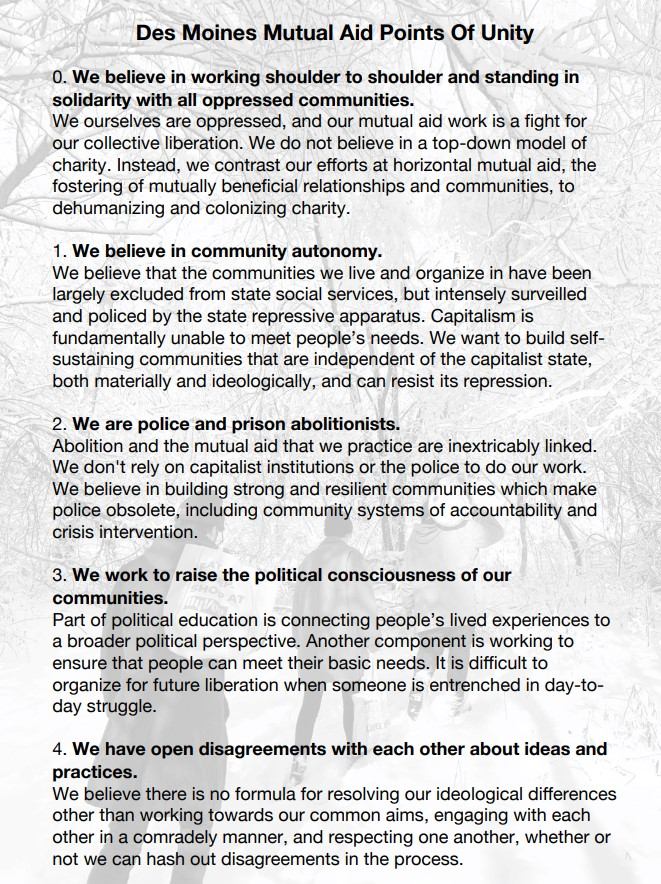
Mutual Aid Points of Unity

We believe in working shoulder to shoulder and standing in solidarity with all oppressed communities.

We ourselves are oppressed, and our mutual aid work is a fight for our collective liberation. We do not believe in a top-down model of charity. Instead, we contrast our efforts at horizontal mutual aid, the fostering of mutually beneficial relationships and communities, to dehumanizing and colonizing charity.

We believe in community autonomy.

We believe that the communities we live and organize in have been largely excluded from state social services, but intensely surveilled and policed by the state repressive apparatus. Capitalism is fundamentally unable to meet people’s needs. We want to build self-sustaining communities that are independent of the capitalist state, both materially and ideologically, and can resist its repression.

We are police and prison abolitionists.

Abolition and the mutual aid that we practice are inextricably linked. We don’t rely on capitalist institutions or the police to do our work. We believe in building strong and resilient communities which make police obsolete, including community systems of accountability and crisis intervention.

We work to raise the political consciousness of our communities.

Part of political education is connecting people’s lived experiences to a broader political perspective. Another component is working to ensure that people can meet their basic needs. It is difficult to organize for future liberation when someone is entrenched in day-to-day struggle.

We have open disagreements with each other about ideas and practices.

We believe there is no formula for resolving our ideological differences other than working towards our common aims, engaging with each other in a comradely manner, and respecting one another whether or not we can hash out disagreements in the process.


Much of the above will be uncomfortable for many Friends because it involves rejecting the status quo. I contend that is why we are not attracting new attenders. If we don’t do so voluntarily these changes will be forced upon us as the status quo continues to collapse.

I believe we are in a time of great spiritual poverty. Friends have a precious gift to offer those needing a spiritual home. But the two will never be connected if Friends continue isolating themselves in their meetinghouses and cling to the status quo. We need to be police and prison abolitionists, find alternatives to capitalism, block the development of fossil fuel infrastructure, reject empire and militarism, and promote and follow the leadership of Indigenous peoples.


MUTUAL AID MONTHLY

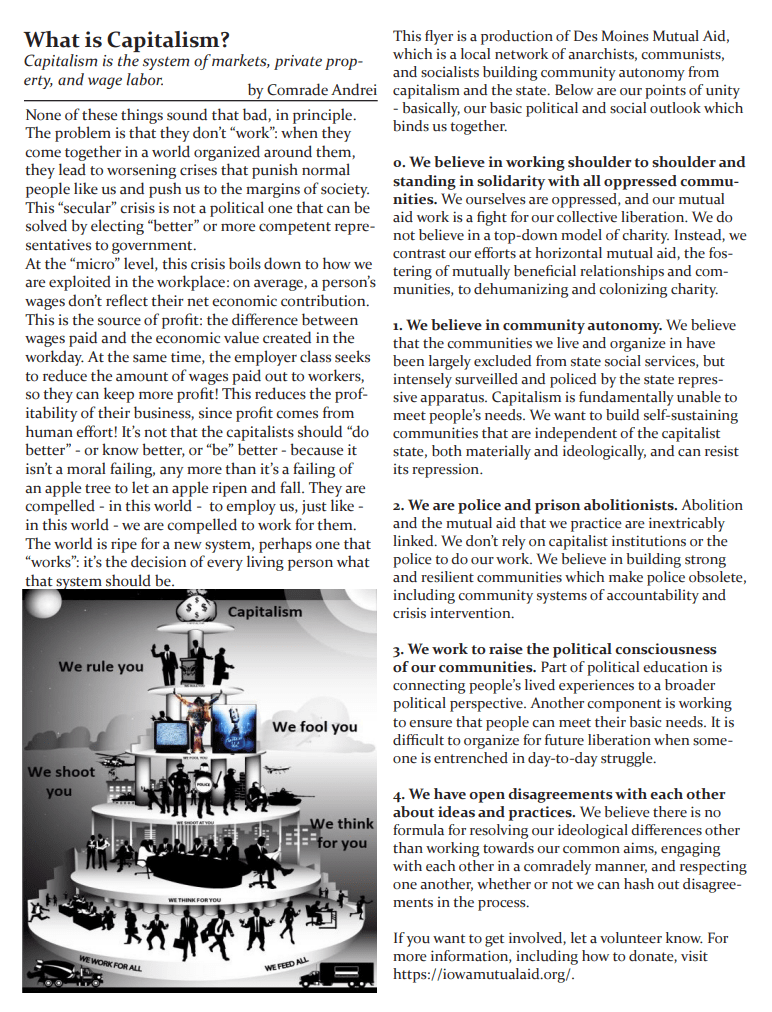
One of the principles of Mutual Aid is political education. As part of this education, found below is the March 2023 edition of MUTUAL AID MONTHLY, A Production of Des Moines Mutual Aid. You can download it using the DOWNLOAD button on the PDF file display window at the end.

“This flyer is a production of Des Moines Mutual Aid, which is a local network of anarchists, communists, and socialists building community autonomy from capitalism and the state. Below are our points of unity – basically, our basic political and social outlook which binds us together.”

Des Moines Mutual Aid

This is a good description of Des Moines Mutual Aid. We are a network of anarchists, communists, and socialists. Understanding these terms applied to a community I belong to has been part of my political education. My life has been a rebellion against capitalism and the state. But am I an anarchist, communist and/or socialist? I learned that those are parts of me. It’s a step to not only learn what you are not, but also what you are. It’s easy enough to say I’m not a capitalist, but am I a so-called enemy of the state? Yes, I am, in the nonviolent sense. The state is becoming increasingly oppressive and authoritarian. But I’ve learned that even when the capitalist system was “working”, it was and is still a system built on supremacy, violence, abuse, and oppression.

Several years ago, I changed the name of this blog to QUAKERS AND RELIGIOUS SOCIALISM as part of my evolving political education.

I learned about the Democratic Socialists of America’s (DSA) Religious Socialism Committee from my friend Fran Quigley, director of the Health and Human Rights Clinic at Indiana University McKinney School of Law and a religioussocialism.org editorial team member.

Fran wrote in response to a blog post I had written, The Evil of Capitalism, December 31, 2020.

This post of yours struck me close to home. I too have become fully convinced of the evils of capitalism. Moreover, I have come to the conclusion that my faith dictates that I work to replace it. Turns out I am far from alone, so I’ve been devoting much of my time this past year to the Religion and Socialism Committee of the DSA, www.religioussocialism.org

My Introduction to Religious Socialism, Jeff Kisling

I like the Points of Unity of Des Moines Mutual Aid. I like the emphasis on the positive, “our basic political and social outlook which binds us together“. We are tightly bound together. I often hear my friends say how much they look forward to being together, working alongside each other, being directly connected to those who come for help. And knowing there is no judgement, because we are all aware that we might one day need help ourselves. I like the stories of those putting together boxes of food tell me they once came for food, themselves. I like the expectation that anyone of us should take food ourselves. It took me a while to realize my mistake in not taking any food. (As a result, my friends now know of my sweet tooth.)

One of our principles of unity is:
We have open disagreements with each other about ideas and practices.
“We believe there is no formula for resolving our ideological differences other than working towards our common aims, engaging with each other in a comradely manner, and respecting one another whether or not we can hash out disagreements in the process.”

The publication of MUTUAL AID MONTHLY relates to another of our Points of Unity, political consciousness.

We work to raise the political consciousness of our communities.
Part of political education is connecting people’s lived experiences to a broader political perspective. Another component is working to ensure that people can meet their basic needs. It is difficult to organize for future liberation when someone is entrenched in day-to-day struggle.
from Points of Unity, Des Moines Mutual Aid

Political ignorance is one of the main reasons this country is falling into chaos and authoritarianism. People would be less susceptible to falling for cults of personality and understand the threats to freedom posed by culture wars if they had a better education, including critical thinking skills. You might think of sharing MUTUAL AID MONTHLY with others in furtherance of their/your political consciousness. As a resource to stimulate discussions.


Nothing like how most of us currently live and work

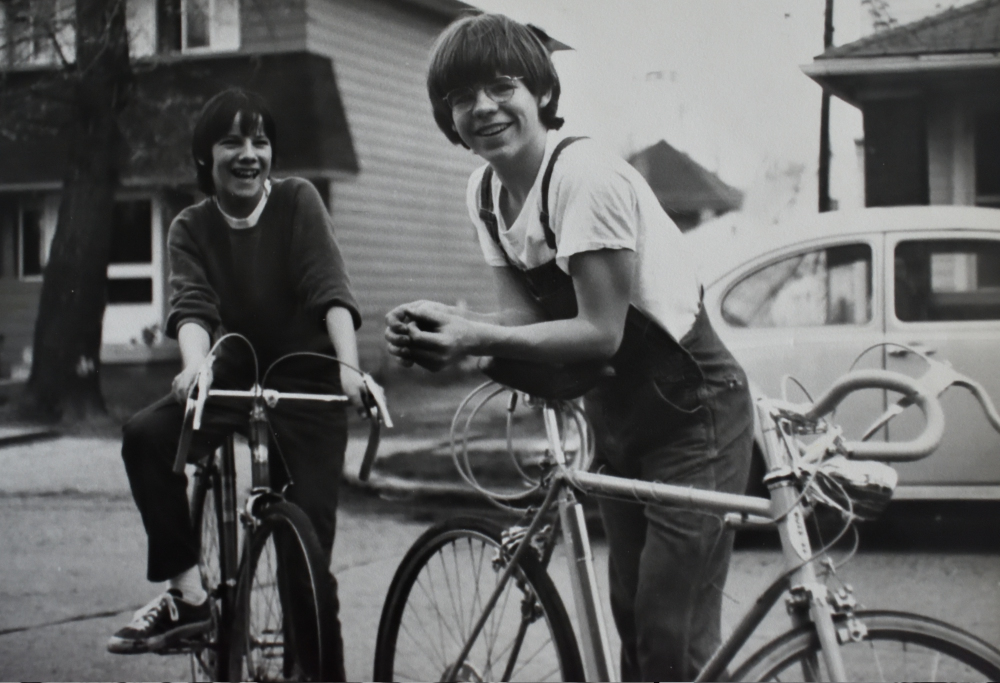
It is humbling to realize mistakes I’ve made over the course of many years. In the 1970’s, when I moved to Indianapolis, the foul air from automobile exhaust convinced me I could not add to the environmental damage, and I was led by the Spirit to live without a car since. People of faith believe our actions should reflect our convictions. And while a life without a car was right for me, I could not convince others to do the same. This was a source of contention with my Quaker meeting. This is a significant challenge for people living in rural areas, as was the case with many of the meeting members.

There was a breakthrough of sorts when a Quaker friend asked if I had invited the (Quaker) meeting into this concern, and I realized I had not done so. That led us to consider, together, what could be done, i.e. what would be possible for us to do in the current circumstances. And led to the Minute we called Ethical Transportation (see below).

While riding bicycles might not seem that significant, the importance is that it is a concrete thing that could be done. My error in pleading for people to give up their cars was not working, in part because I hadn’t shared ways to make the transition. I knew it was possible, if not often inconvenient, to do so where mass transit is available.

But I hadn’t fully realized “living and working, having lifestyles and livelihoods that are truly regenerative and sustainable look nothing like how most of us currently live and work.”

I’m exploring these things now as I advocate for the adoption of Mutual Aid. Being involved in Mutual Aid for three years has given me the experience to speak from. It was the Spirit that led me to Des Moines Mutual Aid. And that leads me to advocate for Quakers and others to adopt Mutual Aid. This time, I’m trying to envision practical ways to transition to the Mutual Aid model.

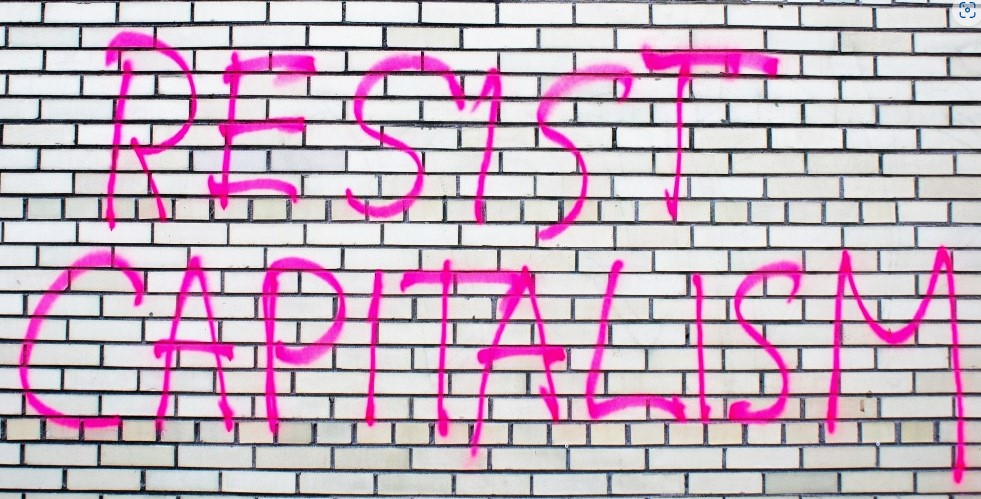
Capitalism is destroying our environment (because it is based upon fossil fuels), and the hierarchies of capitalism enforce structures of superiority, privilege, and oppression. Historically Quakers have worked for justice, against injustice. Capitalism is a profoundly unjust system. At the end of this is a Quaker statement about economic justice.

The concept of dual power means transitioning from current circumstances to desired change. I am hoping my Quaker meeting will support my leading to explore how Mutual Aid can be used to support our justice work. And how Mutual Aid can support our spirituality, and connections with others in the communities our meetings are located in.

There is much more detail in this blog post: Mutual Aid is the Quaker Way of Being in the World.

Living and working, having lifestyles and livelihoods that are truly regenerative and sustainable look nothing like how most of us currently live and work.

Kim Kendall

Living and working, having lifestyles and livelihoods that are truly regenerative and sustainable look nothing like how most of us currently live and work.

When we are told we need to cut fossil fuel emissions in half by 2030 we not only need to completely reorganize our energy systems (deep decarbonization), we also need to completely reorganize our day-to-day lives. When thoughtful authors speak of the need for “the deep transformation” of our values and sense of connection to Earth, the need for transformative or “quantum” social change, what exactly are they getting at? What would that transformation look like on a day-to-day basis for the majority of us? And what is getting in the way?

I hear a lot of vague talk about the need for a shift in our spiritual orientation and economic goals in order to move forward more sustainably and grapple with the inevitable stressors fueled by the climate crisis. Some authors also refer to the greater levels of happiness we could experience living more simply. Gratefully these latter authors are coming close to describing the changes that the large majority of us need to make implied in the idea of living more simply. But notions of increased happiness and simplicity while helpful, are not sufficient to get us going, because they omit reference to practical strategies that are available to us and overlook significant sociocultural barriers in our way.

Against the Economic Grain: Addressing the Social Challenges of Sustainable Livelihoods by Kim Kendall, Resilience.org, January 27, 2023

Ethical transportation

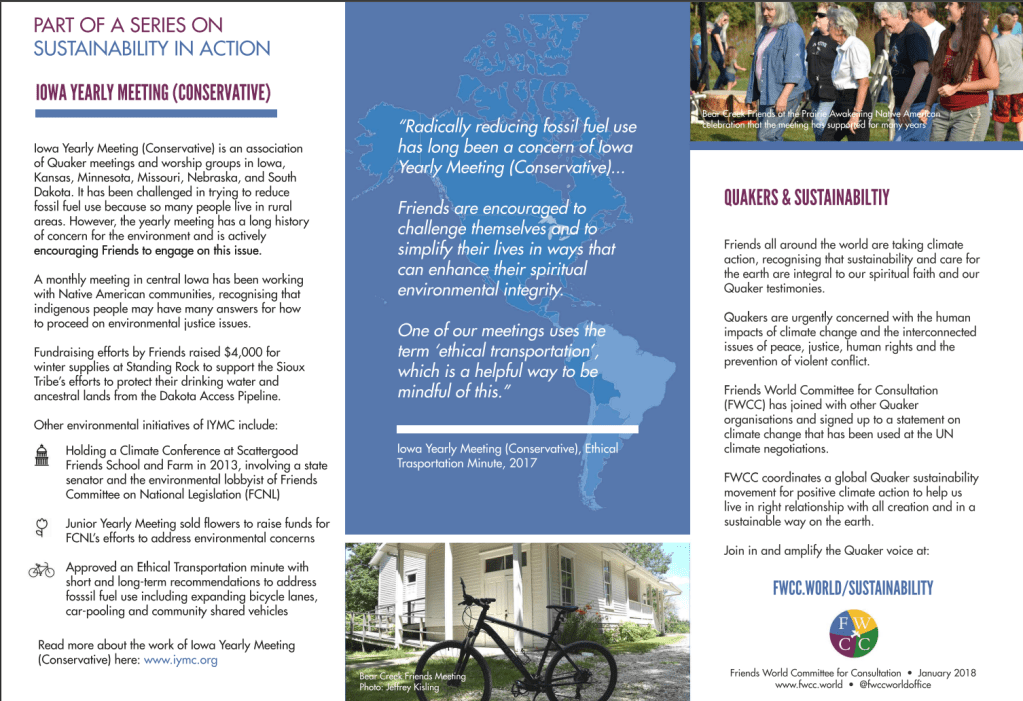
Radically reducing fossil fuel use has long been a concern of Iowa Yearly Meeting (Conservative).  A previously approved Minute urged us to reduce our use of personal automobiles.  We have continued to be challenged by the design of our communities that makes this difficult.  This is even more challenging in rural areas.  But our environmental crisis means we must find ways to address this issue quickly.

Friends are encouraged to challenge themselves and to simplify their lives in ways that can enhance their spiritual environmental integrity. One of our meetings uses the term “ethical transportation,” which is a helpful way to be mindful of this.

Long term, we need to encourage ways to make our communities “walkable”, and to expand public transportation systems.  These will require major changes in infrastructure and urban planning.

Carpooling and community shared vehicles would help.  We can develop ways to coordinate neighbors needing to travel to shop for food, attend meetings, visit doctors, etc.  We could explore using existing school buses or shared vehicles to provide intercity transportation. 

One immediately available step would be to promote the use of bicycles as a visible witness for non-fossil fuel transportation.  Friends may forget how easy and fun it can be to travel miles on bicycles.  Neighbors seeing families riding their bicycles to Quaker meetings would have an impact on community awareness.  This is a way for our children to be involved in this shared witness.  We should encourage the expansion of bicycle lanes and paths.  We can repair and recycle unused bicycles, and make them available to those who have the need.


ECONOMIC JUSTICE

May we look upon our treasures, the furniture of our houses, and our garments, and try whether the seeds of war have nourishment in these our possessions. John Woolman, A Word of Remembrance and Caution to the Rich published posthumously, 1793

I will never adjust myself to economic conditions that will take necessities from the many and give luxuries to the few. Martin Luther King, Jr., speaking in Cleveland Heights, Ohio, [St Paul’s Episcopal Church] 1963

Friends’ historical testimony has included the message that all people are equal, and deserve to share equally in the blessings of creation. The world is far from this ideal, and most in Iowa Yearly Meeting (Conservative) have benefited from global and local inequalities, however inadvertently. But we also suffer spiritually and otherwise because of the injustice in which we participate.

Friends believe that we should live in ways that do not “sow seeds of war.” Many are called to act in quiet or public ways to promote lifestyle choices, policies, laws, and treaties that will ensure the basic human rights of all people, including the rights to safe and healthy places to live and work. Historically, Friends have been able to help correct major injustices such as slavery, inhumane conditions for prisoners, and inequality in the treatment of women. The magnitude of current problems caused by economic injustice does not excuse Friends from the struggle against it, but makes obedience to God’s call all the more necessary.

Friends are reminded that there can be no peace without justice, and to live simply, so others may simply live. Many Friends find seeds of war and injustice in their lifestyles. Friends are challenged to participate constructively in the economy by supporting fair trade, choosing investments with attention to their social impact, and purchasing products produced under safe and healthy conditions. What each can do individually may not seem like much, but, guided by the Spirit and added to the efforts of others, it can make a difference.

The Book of Discipline of Iowa Yearly Meeting of Friends (Conservative)
Religious Society of Friends


https://fwcc.world/wp-content/uploads/2021/10/Case-Study-Iowa-Yearly-Meeting-Conservative.pdf

Quakers and Change

Quakers have a long history of working for justice and social change. But what do we (Quakers) do when we realize change is necessary now? Throughout our history we have been led to see we are implicated in injustice. “Led” means the Spirit has shown what the injustices are, and what changes should be made. Most commonly, individuals discern what change is needed, and over time they and the Spirit convince others.

As my friend Lucy Duncan writes, “we as White Quakers like to think of ourselves as ahead or better than dominant culture, but we have been complicit in a system and mindset that are ubiquitous.”

The myths we tell ourselves and the lies those myths uphold are embedded in our contemporary faith practice. When we believe and perpetuate falsehoods about ourselves, it not only disconnects us from the truth, it also limits our ability to act with full integrity today. Telling the truth about ourselves and our White Quaker ancestors grounds us in reality, in a sense of the complexity of our identity. It allows us to create a different future, not built from delusion and half of the story but from an honest and grounded reckoning with who we are and who we have been. My friend Mila Hamilton calls this “intergenerational transformative justice.” As we deal with the uncomfortable truths of our White Quaker ancestors, we release them from the amber in which our myths have captured them. As we allow them to become the full, flawed humans they were, we also free ourselves to reckon with our present, which arises from their past, and to tell the full truth of who we are.

We as White Quakers like to think of ourselves as ahead or better than dominant culture, but we have been complicit in a system and mindset that are ubiquitous. Claiming the full truth of our history and committing to repair the harms done are deeply spiritual acts of healing our own wounds of disconnection. I would argue it is the pathway upon which we can, perhaps for the first time, discover and invigorate our faith with its full promise.

What would it mean for us to take seriously and collectively as a Religious Society a call to finish the work of abolition, hand in hand and side by side with those affected and their loved ones? What would it mean for us to stand fully with the calls to abolish the police and fully fund community needs instead? What would it mean to reckon with our past complicity with harm and fully dedicate ourselves to the creation of a liberating Quaker faith that commits to build the revolutionary and healing faith we long to see come to fruition? What would it look like to finally and fully abolish slavery?

A Quaker Call to Abolition and Creation by Lucy Duncan, Friends Journal, April 1, 2021

It can take a long time for change to occur. Personally, I’ve been working since the early 1970’s to convince Friends to consider my spiritual leading to drastically reduce our carbon footprint, including not having an automobile.

Most of our values, beliefs and assumptions regarding livelihoods need to be radically transformed in order to move into activities that are sustainable. If this transition is ever to occur, we must be able to visualize and share the details of these alternative occupations and embrace new social metrics to support those occupations.

I try to imagine myself making a move into a livelihood that would be fundamentally sustainable like the critical but overlooked work done by a young man I know who shuttles vegetable waste from homes in his neighborhood to a small composting center in his community by bicycle. He then sells and delivers by bike finished compost to neighbors with gardens. If I chose to move into this “career” my friends would think I had lost my mind. My friends might ridicule me. Certainly, they would worry about me! And worse, some people, perhaps even including my spouse, might simply think they no longer had anything in common with me. It’s like giving up alcohol in an alcohol inundated world. You stand outside, you are not one of the groups any longer. In reality, I would need to build an entirely new social network with different values and notions of success, a network that would respect my choices and understand their importance. Because living and working, having lifestyles and livelihoods that are truly regenerative and sustainable look nothing like how most of us live and work now. The cultural transition and change in our values and the metrics we use to measure our sense of success, therefore our identities, is hard to imagine, not to mention implement.

Nevertheless, I have interviewed people with very low carbon livelihoods and lifestyles, highly moral people who work and live outside of mainstream jobs and careers. And guess what? They did indeed initially have to suffer social backlash from family and friends for their lifestyle and work choices. 

Against the Economic Grain: Addressing the Social Challenges of Sustainable Livelihoods by Kim Kendall, Resilience.org, January 27, 2023

One of the things I appreciate in our spiritual practice is for the Quaker meeting to use questions to consider where we are today in our faith. For example, the following are the queries related to social and economic justice.

11.  SOCIAL AND ECONOMIC JUSTICE


“For when I was hungry you gave me food, when thirsty you gave me drink, when I was a stranger you took me into your home, when naked you clothed me, when in prison you visited me.”     Matthew 25:35‑36

ADVICE 

We are part of an economic system characterized by inequality and exploitation. Such a society is defended and perpetuated by entrenched power. 

Friends can help relieve social and economic oppression and injustice by first seeking spiritual guidance in our own lives. We envision a system of social and economic justice that ensures the right of every individual to be loved and cared for; to receive a sound education; to find useful employment; to receive appropriate health care; to secure adequate housing; to obtain redress through the legal system; and to live and die in dignity. Friends maintain historic concern for the fair and humane treatment of persons in penal and mental institutions.

Wide disparities in economic and social conditions exist among groups in our society and among nations of the world. While most of us are able to be responsible for our own economic circumstances, we must not overlook the effects of unequal opportunities among people. Friends’ belief in the Divine within everyone leads us to support institutions which meet human needs and to seek to change institutions which fail to meet human needs. We strengthen community when we work with others to help promote justice for all. 

QUERIES 

  • How are we beneficiaries of inequity and exploitation? How are we victims of inequity and exploitation? In what ways can we address these problems?
  • What can we do to improve the conditions in our correctional institutions and to address the mental and social problems of those confined there?
  • How can we improve our understanding of those who are driven to violence by subjection to racial, economic or political injustice? In what ways do we oppose prejudice and injustice based on gender, sexual orientation, class, race, age, and physical, mental and emotional conditions? How would individuals benefit from a society that values everyone? How would society benefit?


“We are part of an economic system characterized by inequality and exploitation. Such a society is defended and perpetuated by entrenched power. How are we beneficiaries of inequity and exploitation? How are we victims of inequity and exploitation? In what ways can we address these problems?”


Injustice cannot be addressed as long as we are involved in the system of injustice, in this case, capitalism. As my good friend Ronnie James says:

I’m of the firm opinion that a system that was built by stolen bodies on stolen land for the benefit of a few is a system that is not repairable. It is operating as designed, and small changes (which are the result of huge efforts) to lessen the blow on those it was not designed for are merely half measures that can’t ever fully succeed.

So, the question is now, where do we go from here? Do we continue to make incremental changes while the wealthy hoard more wealth and the climate crisis deepens, or do we do something drastic that has never been done before? Can we envision and create a world where a class war from above isn’t a reality anymore?”

Ronnie James


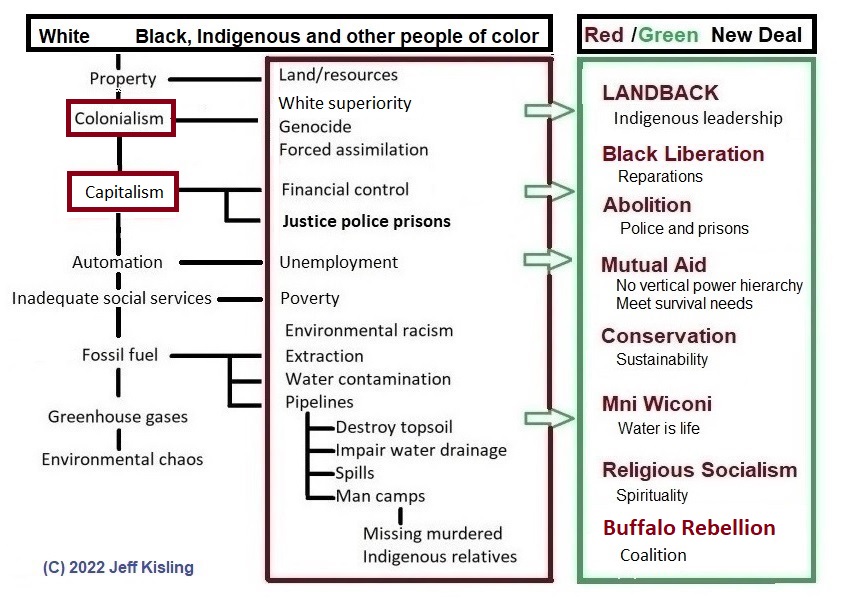
The following is a diagram I’ve been working on for several years to visualize unjust systems and possible alternatives. On the left is capitalism, built on colonialism. The red vertical bar indicates forces that interfere with making changes. Failing and corrupt institutions, authoritarianism, and environmental chaos. If we can move past those resistances, we can build communities for a viable and just future.

I’ve been part of a Mutual Aid community for the past three years. That experience convinces me the Mutual Aid is a vital component of a more just future for us all. It is a way to escape the capitalist economic system, which I’ve written about extensively.
(See: https://quakersandreligioussocialism.com/mutual-aid/ )


Martin Luther King and Capitalism

Whenever I try to talk about the necessity of rejecting capitalism, people don’t seem to even comprehend what that means. Why it must happen. When I asked Ronnie, my Mutual Aid mentor about this, he said he’s been having that experience for the twenty years he’s been an activist. He said that was because people hadn’t experienced the collapse of capitalism in their lives, yet. I believe he’s right. Unfortunately, that is changing as the capitalist economy is collapsing. Yet another reason to form more Mutual Aid communities.

I’m of the firm opinion that a system that was built by stolen bodies on stolen land for the benefit of a few is a system that is not repairable. It is operating as designed, and small changes (which are the result of huge efforts) to lessen the blow on those it was not designed for are merely half measures that can’t ever fully succeed.

So the question is now, where do we go from here? Do we continue to make incremental changes while the wealthy hoard more wealth and the climate crisis deepens, or do we do something drastic that has never been done before? Can we envision and create a world where a class war from above isn’t a reality anymore?”

Ronnie James, Des Moines Mutual Aid

I too have become fully convinced of the evils of capitalism. Moreover, I have come to the conclusion that my faith dictates that I work to replace it.

Fran Quigley, Director of the Health and Human Rights Clinic at Indiana University McKinney School of Law

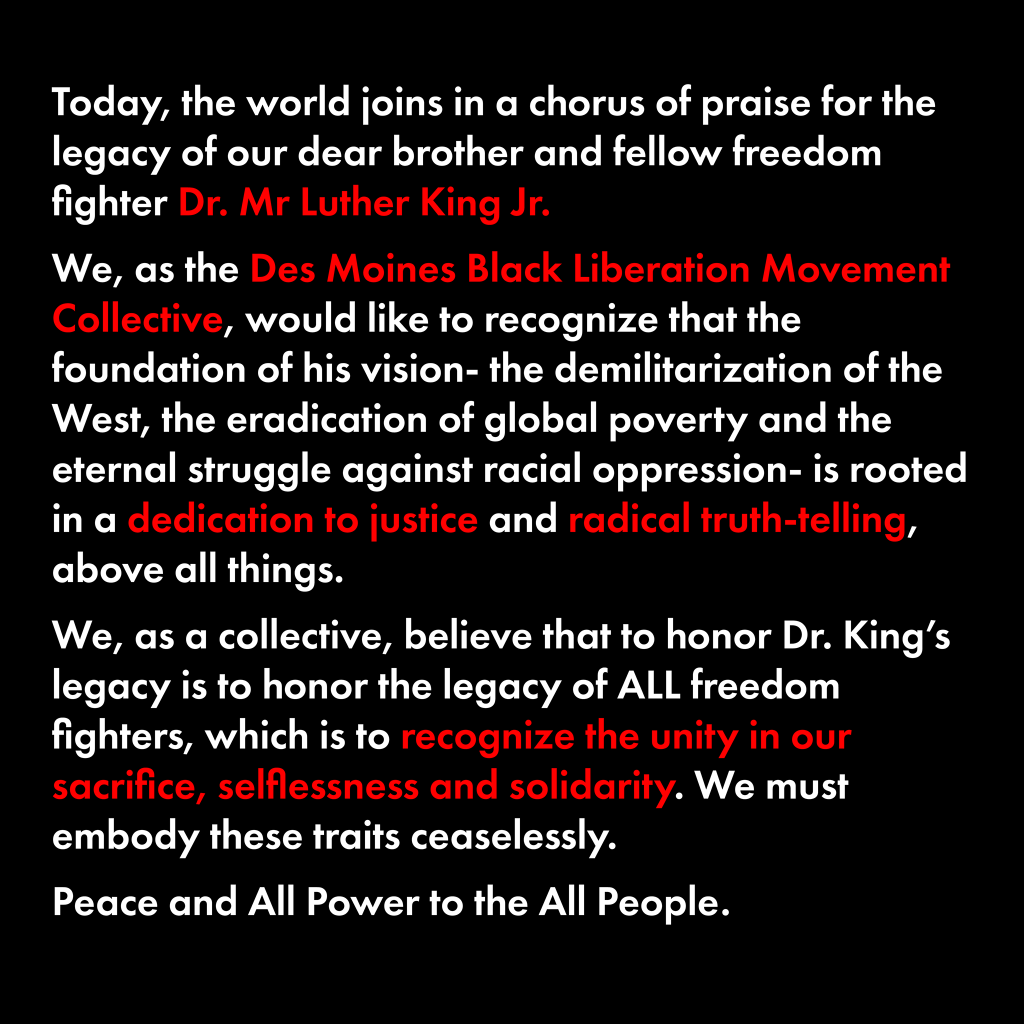
Martin Luther King, Jr.’s work was as much about economics and poverty, as it was about racial equality.


“I am much more socialistic in my economic theory than capitalistic,” Martin Luther King admitted to Coretta Scott, concluding that “capitalism has outlived its usefulness.”

Speaking at a staff retreat of the SCLC in 1966, King said that “something is wrong … with capitalism” and “there must be a better distribution of wealth” in the country. “Maybe,” he suggested, “America must move toward a democratic socialism.”

For King, the only solution to America’s crisis of poverty was the redistribution of wealth. In a 1961 speech to the Negro American Labor Council, King declared, “Call it democracy, or call it democratic socialism, but there must be a better distribution of wealth within this country for all God’s children.”

The Forgotten Socialist History of Martin Luther King, Jr. by Matthew Miles Goodrich, In These Times, January 16, 2023


Again, we have deluded ourselves into believing the myth that Capitalism grew and prospered out of the protestant ethic of hard work and sacrifice, the fact is that Capitalism was built on the exploitation and suffering of black slaves and continues to thrive on the exploitation of the poor both black and white, both here and abroad. If Negroes and poor whites do not participate in the free flow of wealth within our economy, they will forever be poor, giving their energies, their talents and their limited funds to the consumer market but reaping few benefits and services in return.”

I wish that I could say that this is just a passing phase in the cycles of our nation’s life; certainly, times of war, times of reaction throughout the society but I suspect that we are now experiencing the coming to the surface of a triple prong sickness that has been lurking within our body politic from its very beginning. That is the sickness of racism, excessive materialism and militarism

The Three Evils of Society – Delivered at the National Conference on New Politics August 31, 1967, Chicago, Ill

“And one day we must ask the question, ‘Why are there forty million poor people in America? And when you begin to ask that question, you are raising questions about the economic system, about a broader distribution of wealth.’ When you ask that question, you begin to question the capitalistic economy. And I’m simply saying that more and more, we’ve got to begin to ask questions about the whole society…”

Excerpts from King’s speech “Where Do We Go From Here?” delivered at the 11th Annual SCLC Convention, Atlanta, Georgia, August 16, 1967

The title for this blog, Quakers and Religious Socialism, came from exchanges of messages with my friend Fran Quigley. The following was in response to my blog post, The Evil of Capitalism.  

This post of yours struck me close to home. I too have become fully convinced of the evils of capitalism. Moreover, I have come to the conclusion that my faith dictates that I work to replace it. Turns out I am far from alone, so I’ve been devoting much of my time this past year to the Religion and Socialism Committee of the DSA, www.religioussocialism.org .

And, as part of a book project on religious socialism, I have published several articles profiling activists from different faith and spiritual traditions who feel called to advocate for a socialist society.  (Examples, if you are interested: a Catholic socialist, a Jewish rabbi socialist, a Black Presbyterian minister socialist, a Liberation Theologian Lutheran minister/professor,  Muslim socialists , a Buddhist socialist and a Black Baptist minister socialist.  I also co-wrote with longtime Religion and Socialism activist Maxine Phillips a short, one-stop primer on the argument for Christian socialism: https://mphbooks.com/democratic-socialists/ )

I do not know of a definitive guide to Quaker socialism, but I know Bayard Rustin, Staughton Lynd, and AJ Muste (late-in-life switch to being a Friend) at various times identified as socialists, and there is a robust UK Quaker Socialist Society: https://quakersocialists.org.uk/  Willard Uphaus was a Christian socialist and pacifist Earlham alum, but it’s not clear to me if he was a Quaker: https://www.americanswhotellthetruth.org/portraits/willard-uphaus

Fran Quigley, director of the Health and Human Rights Clinic at Indiana University McKinney School of Law and a religioussocialism.org editorial team member


Des Moines Black Lives Matter/ Black Liberation
https://www.facebook.com/desmoinesblm

Early in our lifetimes, industry provided nearly full employment. Nearly every household had someone who was working, and bringing home a paycheck. All commerce was based on capitalism. Money was required for every transaction. Money was the only way to obtain goods and services.

Then with increasing automation, and moving jobs overseas for cheap labor, the unemployment rate began to increase. Soon millions of people no longer had the income needed to pay for goods and services. The numbers of those without jobs has increased dramatically from the economic impact of the COVID pandemic. Those without jobs have to rely on social safety nets, which often means people are living in poverty, at subsistent levels.

As a society we failed to address the loss of wages for millions of people who no longer had money, in a system that required money for everything–food, shelter, healthcare, etc.

It is clear to me that capitalism is an unjust, untenable system, when there is plenty of food in the grocery stores, but men, women and children are going hungry, living on the streets outside the store. There is no justification for this.

Conscientiously Object to Capitalism, Jeff Kisling, 12/4/2020


Transformative Mutual Aid Practices

This was a morning when I didn’t seem to be led to write anything. Then, as I was searching using the keywords prefigurative and mutual aid I found references to Transformative Mutual Aid Practices.

I’ve just recently become aware of traumas I hadn’t known I was suffering from. My Des Moines Mutual Aid community practices many of the things listed below. This awareness of healing comes from experiencing our care for each other, including those who come for the food.

I’ve heard Indigenous friends speak of the intergeneration traumas in their communities.

My Quaker meeting has recently discussed healing.

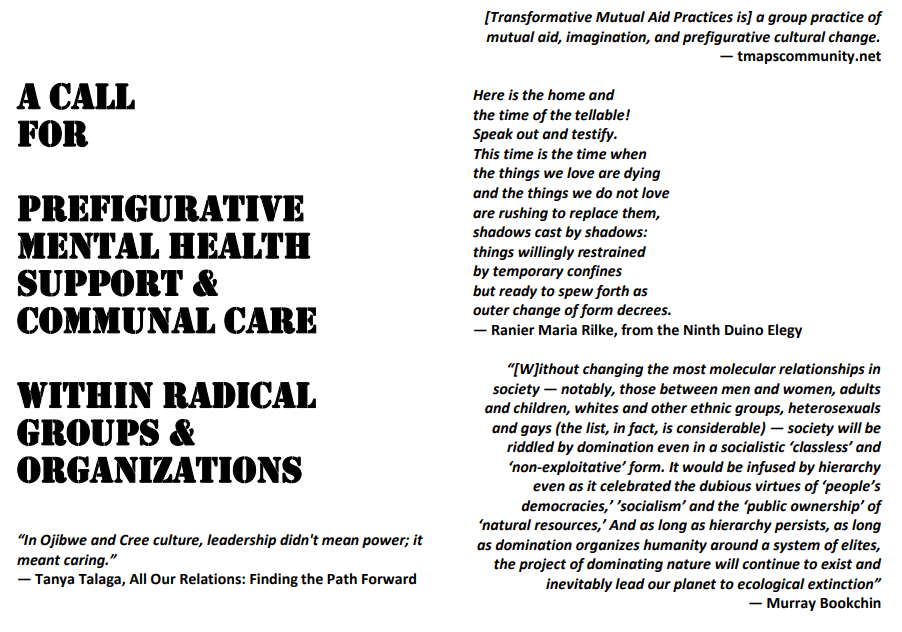
So, I was interested to see this zine, A Call for Prefigurative Mental Health Support and Communal Care Within Radical Groups and Organizations. Creative Commons licensing allows sharing material from this zine.

.

This zine has a lengthy list of things related to mental health and communal care. Here are a few.

  • Many of us experienced childhood and adolescent traumas and continue to experience traumas based on our individual intersectionalities
  • We understand the mechanics of the harms and traumas inflicted by the prevailing social order’s oppressive and exploitative systems
  • We must recondition ourselves towards caring for each other; communal care is ongoing radical action
  • Alone we are vulnerable, but together we are strong; therefore, genuine community is paramount
  • We acknowledge that the architecture of capitalist society is colonizing white supremacy culture; it is an architecture of domination, abuse and exclusion
  • We focus intensely on the concept and practice of mutual aid
  • We endeavor to decolonize our thinking, group interactions, and architecture of group processes
  • We center acting in solidarity across groups in ways that build unity through diversity
  • We emphasize prefiguration within our organizations as necessary to counteract the abuses of prevailing society and manifest community and liberatory ways of being and living
  • When we do not prefigure communal care into our group structures and routines, we unconsciously recreate the alienation, racism, homophobia and transphobia, hierarchical ableisms, and neuro-homogeneities of capitalist society, along with their negative effects
  • If we don’t practice solidarity with our own comrades, we cannot expect to practice solidarity with others
  • Knowing what we know about how prevailing society operates to oppress, exploit, and traumatize vulnerable people, a group or org that does not actively engage and support the mental and emotional wellbeing of its members is not revolutionary
  • Many folx who show up to our groups do not stay because they sense the group is non-supportive or unsafe for their being

A Call for Prefigurative Mental Health Support and Communal Care Within Radical Groups and Organizations


What can prefigurative community care that supports the mental health and wellbeing of all members look like?

1. Create space for an in-depth group discussion focused on the concept of your collective as an organism with a life of its own. Talk about your group as an organism that can flourish with everyone’s nurturance or get sick and die from everyone’s lack of care. The objective is to create group consciousness and ownership, and to arrive at and agree to incorporating new features that will consistently support the mental and emotional health of members.

    2. In addition to your regular monthly meeting, commit to a regular monthly restorative gathering for wellbeing. This is for members only. It could potentially serve as a welcoming way for prospective members to dip their toe in, as opposed to their first engagement being a meeting or an action. In organizing circles, more often than not the more powerful, demonstrative, or vocal members guide their groups, narrowing opportunities for other modes of expression, communication, and consciousness to emerge. Monthly nurturance counterbalances that tendency. The focus here is on creating a predictable format for restorative connection, communal care, and wellbeing among comrades.

    Based on years of creating group cohesion and deep trust among vulnerable students from disparate backgrounds, the author recommends a specific format: a regular relaxed gathering where individuals enjoy solo projects alongside each other (when two or more people work on one project, it tends to disrupt the group dynamic). Each member brings a relatively quiet activity that they will work on, such as creative writing, drawing, crafting, reading, planning or visioning, designing, etc. At the start, folx will want to greet each other and it’s interesting to get to know each other through hearing what everyone else is going to work on. Once y’all get started, talking will become secondary to the texture or feel of the group-as-relaxed, meaning that talk should not be allowed to take over the ability of everyone to generally stay focused on their activity. This container fosters individual and collective nervous system soothing, group nurturance, authentic group communication, divergent group thinking, and organic group relations. Relaxing, restoring, and recreating together is very powerful medicine.

    Many of us only experience each other in supercharged situations like intense meetings, protests, street outreach, and community work. Our groups attempt to balance those experiences out by having social gatherings such as potlucks, bar karaoke, and game nights, which have their own place. However, social containers do not foster egalitarian ommunity-building or the types of experiences required to build the trust comrades need in order to open up and be vulnerable with each other. In addition, social gatherings often reenact the ableisms and other -isms present in dominant society. This monthly gathering allows members to relax and encourages other parts of their beings to emerge within the safety of the calm group in ways that round out both the individual and the group experience. It fosters care of the self via meaningful recreation; it cultivates group consciousness and group heart via the commitment to be more patient, open, and authentic with each other; it provides an antidote to alienation and isolation, restoring the communal bonds that dominant capitalist society strips away.

    A Call for Prefigurative Mental Health Support and Communal Care Within Radical Groups and Organizations

    See beyond our own time

    My Quaker meeting plans to discuss questions to not only stimulate discussion, but to begin to form a plan to meet our survival needs. We need to establish a baseline to know what Friends think about our present condition and what to do about it.

    Survival needs are ranked as:

    • Oxygen/air
    • Water
    • Food
    • Shelter
    • Physical, mental, and spiritual health

    So, the questions are:

    • What will we do to prepare for when clean water is no longer available? (Coming through water lines or even available to buy).
    • What will we do when food is no longer available from grocery stores?
    • What will we do for shelter? Survival will require us to live near water and food supplies. And each other.
    • How do we govern our communities? Who is included in our communities?
    • What to do about energy?
    • What to do about safety?
    • What medications and diagnostic equipment (blood pressure, thermometer, etc) should we stockpile?
    • What are our children thinking? Can we find ways to engage those who aren’t now involved?
    • How can we gather and store things like books for when digital technologies are no longer available?
    • Who already has such plans that might help us?

    Faith Now

    Faith Now can refer to what the state of our faith is at this moment. And/or it can be an admonition to focus our faith on what is happening now.

    My witness has been so many people, including people of faith, are driven by the past. This is obviously true with religious practices demanding adherence to some set of rules. Rules created in the past. Rules designated by systems of dominance.

    One of the reasons I have remained a Quaker is the minimum of such rules. We say we believe the Spirit can speak to us now, that ours is a living faith. We use a set of queries (questions) to help us continue to examine our faith. This can make our faith less passive.

    It is not my place to judge other’s faith and practice. But there are things that have troubled my spirit for a long time.

    One is that Quakers do have unwritten rules. As a recent example, prior to the forced separation because of the COVID pandemic, I was told, many times, that Quaker business decisions could only be made when Friends were together physically. When I lived in Indianapolis, I had suggested using programs for remote connections to my meeting in Iowa, but that was universally held to be unacceptable. We see how that has changed. What are other unwritten rules? Identifying them might account for why we are attracting few new attenders in this time of spiritual poverty.

    And there is the universal challenge of living our daily lives consistently with our faith.

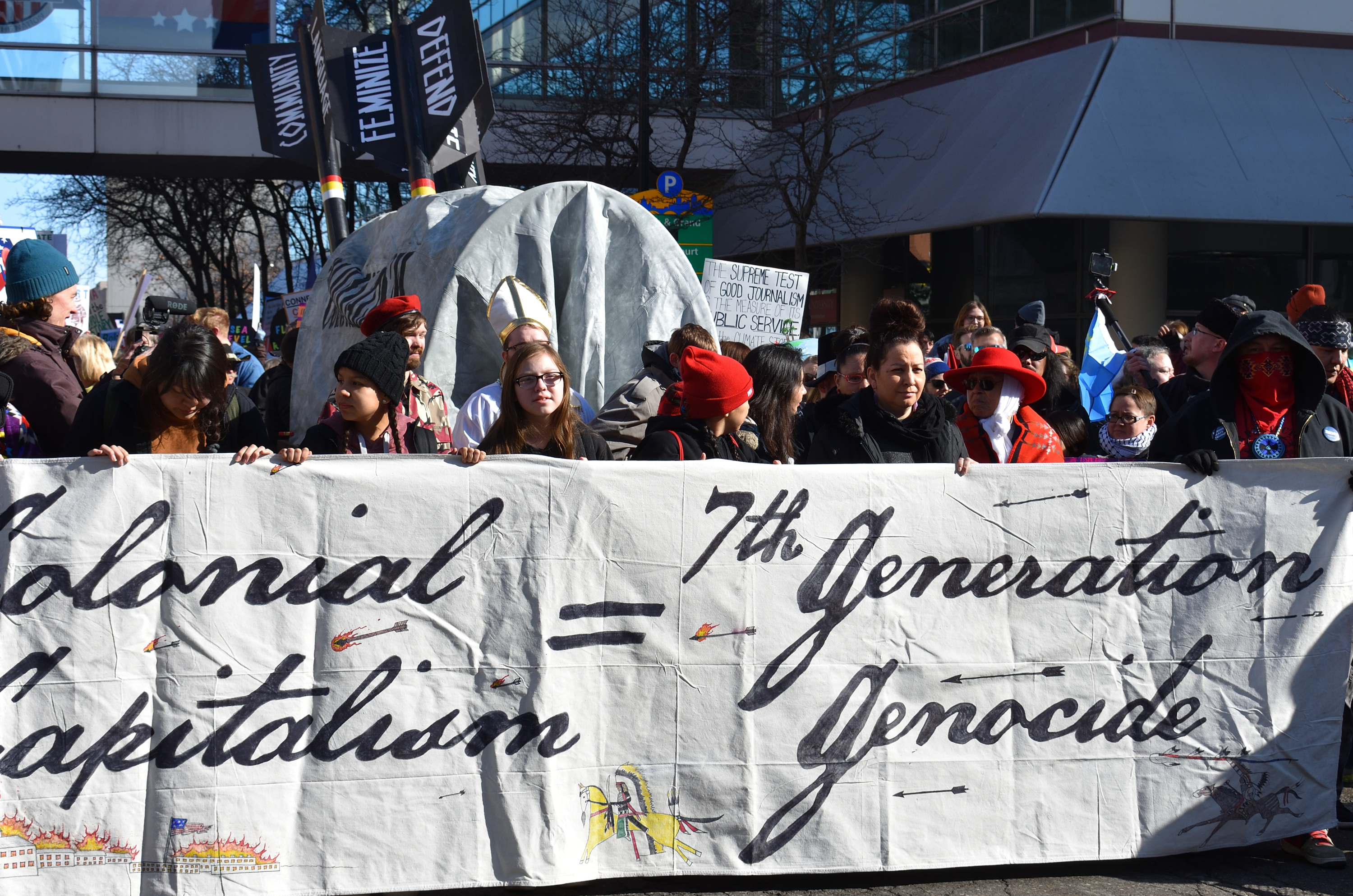
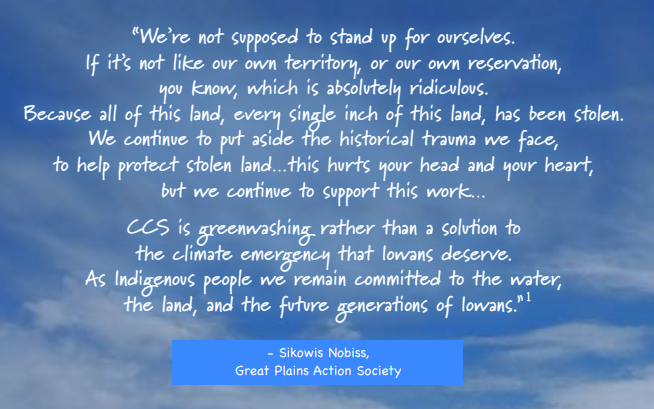
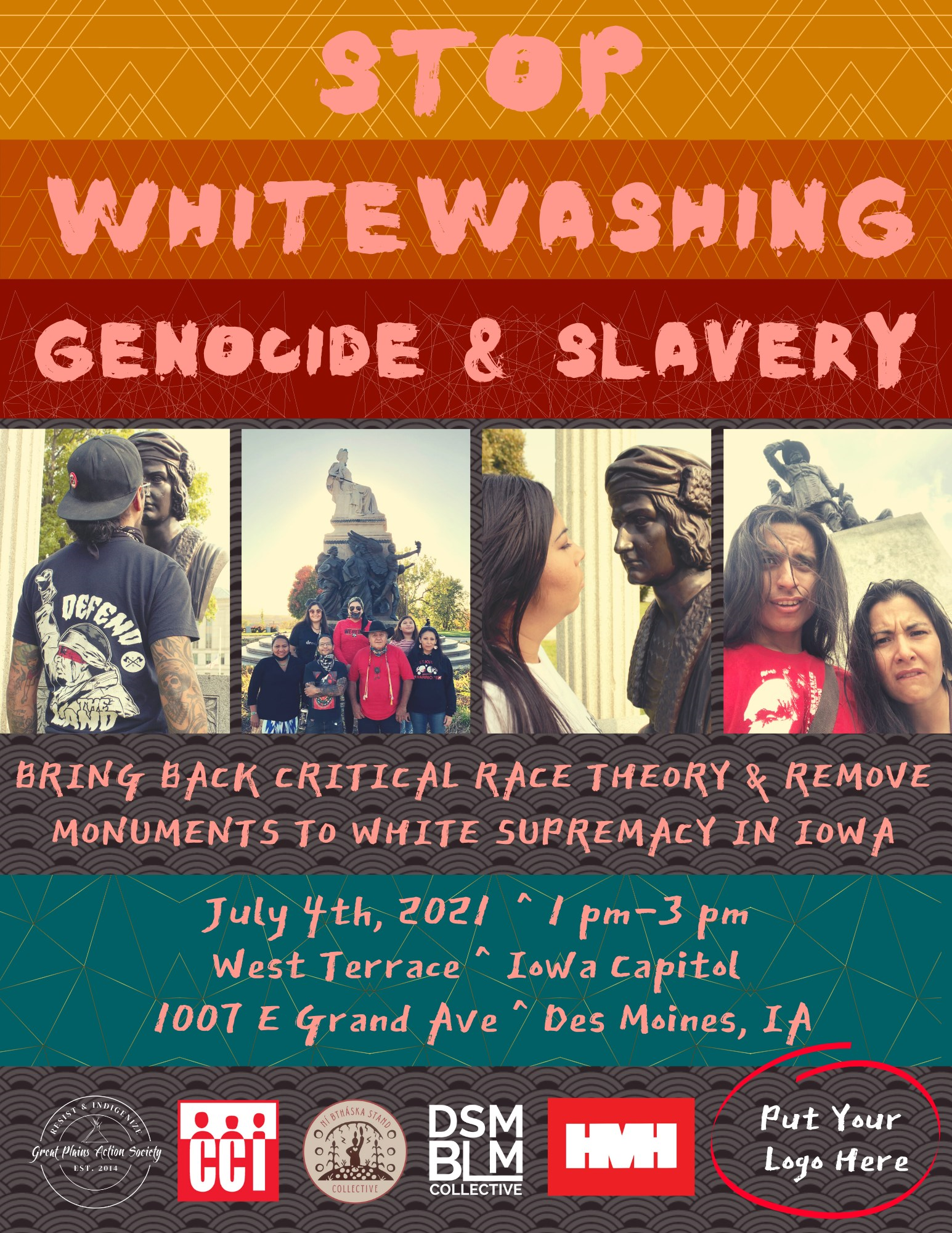
    White Quakers were and continue to be settler colonists. Our ancestors claimed Indigenous land for their homes and farms. Ever since, we have continued to live on and profit from these lands. And have engaged with capitalism and systems of dominance and control that come from this colonization.

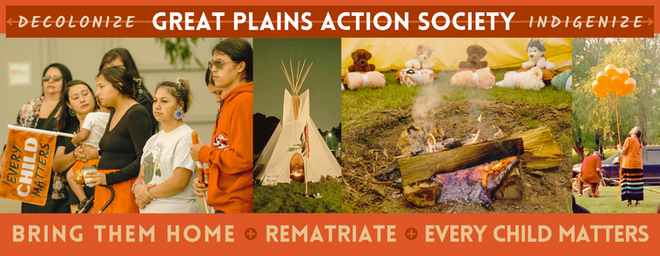
    There is the devastating history of churches’, including white Quaker’s involvement in the institutions of forced assimilation of native children and genocide of Indigenous peoples.

    I’m also devastated by the use of fossil fuels. Speaking from my own experience, when I saw the smog when I moved to Indianapolis (1970), I was led to know I could not be part of owning cars. My faith showed me how to go about this, helped me get through the significant challenges involved. I’m of course not the only person to have made the same choices. And I’m challenged today having moved to a small town in Iowa. The sprawling way our cities and towns are designed coupled with the absence of mass transit is a challenge. But we would not have built cities this way if we had chosen to build mass transit systems instead of the massive infrastructure for cars. Building all the streets and highways. Parking areas, traffic control systems, so many gas stations, extractive systems for coal and oil, and pipelines.

    Had the decision not been made to follow the path of cars, we would not be in accelerating environmental collapse now. Think about that.

    We are in perilous times. I believe spirituality and spiritual connections are key for survival. https://quakersandreligioussocialism.com/2022/11/17/spiritual-connections-for-survival/

    My reference to faith now comes from being led to call on Quakers to apply our spiritual practices to critically evaluate the systems we live in and take for granted. That are unjust and must be replaced. We must reject capitalist systems and systems of dominance. Build Beloved communities where everyone is cared for. Mutual Aid communities are a template for doing so. Are radical in the sense of freeing us from the power systems we find ourselves living in.

    By faith now I mean today. Every day we live in this settler, colonial, capitalist society, we continue to be oppressors.

    The following quote expresses this eloquently. People are desperately hungry to have a purpose, to do something concrete to help others.

    You and your relations, my friend, are (still) busy building a different world at the end of this one. This is something I’ve emphasized over and over again in my own work. I cherish the belief and practice that it is never enough to just critique the system and name our oppression. We also have to create the alternative, on the ground and in real time. In part, for me, because Nishnaabeg ethics and theory demand no less. In part because in Nishnaabeg thinking, knowledge is mobilized, generated, and shared by collectively doing. It’s more than that, though. There is an aspect of self-determination and ethical engagement in organizing to meet our peoples’ material needs. There is a collective emotional lift in doing something worthwhile for our peoples’ benefit, however short-lived that benefit might be. These spaces become intergenerational, diverse places of Indigenous joy, care and conversation, and these conversations can be affirming, naming, critiquing, as well as rejecting and pushing back against the current systems of oppression. This for me seems like the practice of movement-building that our respective radical practices have been engaged with for centuries.

    Maynard, Robyn; Simpson, Leanne Betasamosake. Rehearsals for Living (Abolitionist Papers) (p. 39). Haymarket Books. Kindle Edition.

    Following is a diagram I’ve been developing for several years. I’ve written a lot about these things on this blog (Religious Socialism, Mutual Aid, and Abolition of Police and Prisons).


    Faith Now

    • Spirituality can show us how to live with integrity now. How to be examples to others. This is how change happens.
    • The Creator can help us heal the wounds of the past. And the wounds that continue to be inflicted.
    • The Spirit can guide us through the coming chaos.
    • It is by the Spirit we create connections among diverse peoples.

    We must be willing to let go of the life we have planned, so as to accept the life that is waiting for us.

    Joseph Campbell

    Queries

    • How are we working to deal with existing chaos and preparing for further collapse?
    • Do we provide for everyone’?
    • What is our relationship with Mother Earth? Do we honor and conserve the resources we use?
    • What systems of dominance, of vertical hierarchies are we involved in?
    • Do we work to ensure there aren’t vertical hierarchies in our communities, in our relationships with all our relatives?
    • Do we have the courage to follow what the Spirit is saying to us? To not force those messages to conform to our existing beliefs and practices.
    • How do we connect with communities beyond our Quaker meetings? What are we learning about spiritual connections beyond our meetinghouses? Are we sharing these spiritual lessons with others?


    Running throughout (Lopez’s book) Horizon is the question of human survival. The multiple threats we now face, especially the very real possibility of climate disaster, expose the tensions between human aspiration and ecological reality. Perhaps what is most needed, Lopez suggests, is for us to lament what we’ve destroyed, but also to praise and love the world we still have. “Mystery,” he writes, “is the real condition in which we live, not certainty.

    Bahnson: You’ve confronted the darkness you see on the horizon with anthropogenic climate change. How do you talk about this with audiences? People need to know what’s coming, yet if you overwhelm them with depressing news, they might freeze. How do you strike the balance between educator and artist?

    Lopez: Whenever I speak in public, I write out a new talk. I begin by stipulating, with a modulated voice, that things are way worse than we imagine. And I offer some examples: the collapse of pollinating insect populations; the rise of nationalism; belligerent and ignorant narcissists like Donald Trump; methane gas spewing out of the Siberian tundra. You’re saying to everybody, “Let’s take off the rose-colored glasses now and see what our dilemma really is.” And then the second part of the talk is an evocation of the healing that is necessary and possible, a gradual elevation of the human spirit. It’s about the mobilization that is needed and which is within our reach. Then people know you’ve spoken truthfully, and you have evoked in each person a desire to help, to take care of their families, to have self-regard. I see this pattern in every talk I give. To remember, geographically, exactly where you are speaking that night, and to know whether there might be a full moon outside the building; to offer that sense of immediacy and groundedness; to underscore the specificity of the moment; and to be sure that you implicate yourself in the trouble. It all helps in these situations. If you attempt any version of “I know, and you don’t” or “This is not my fault” or “I am the holy messenger, and you’re the fools,” the evening ends in darkness. You have to be in it with them.

    The World We Still Have. Barry Lopez On Restoring Our Lost Intimacy With Nature BY FRED BAHNSON, The Sun, DECEMBER 2019


    Foundational stories now: Quaker faith

    [My foundational stories are related to the intersections between my Quaker faith, protecting Mother Earth, and photography. My faith led me to try to share my spiritual experiences and show my love for the beauty of Mother Earth through photography.]

    I’ve been praying and struggling for many days to discern how to express the state of my Quaker faith today. Quakerism is the faith community I was born into and have remained in. I was raised in a White Quaker family and community. I had a Spiritual experience at the Bear Creek Meetinghouse when I was about ten years old, an experience that I have drawn upon for the rest of my life. I attended Scattergood Friends School, a Quaker high school, and Earlham College, a Quaker institution.

    One of the reasons I accepted the challenge of reflecting on my foundational stories is because of my crisis of faith now.

    I think it is common for people to be disappointed by their faith community at various times, for a variety of reasons. That has been true for me. Coming of age during the Vietnam War I wished more young men had resisted the draft. I wish we all had done more to reign in the use of fossil fuels. And that White people like myself had worked, harder to acknowledge our complicity in the oppression of Black, Indigenous, and other people of color (BIPOC), of various gender identities, and certain social and economic classes. I wish we were working harder now on acknowledging and trying to heal these injustices.

    This country was built on the historical injustices of the institution of slavery, and the genocide and removal of Indigenous peoples from their lands. And the forced assimilation of native children in institutions where they were often physically and sexually abused, where thousands of children were killed or died.

    Many people, including Quakers today question how complicit our ancestors were in these injustices. There were White Quakers who were involved in the slave trade, and who enslaved Black men, women, and children. Our ancestors were settler colonists. As are we who are now living on these lands. Quakers were involved in the Indian residential schools.

    being involved with others in wrongdoing

    complicity

    These issues often generate significant emotional responses. I don’t have all the answers. But I have had spiritual and community experiences that I am led to speak and work from today. Many of these experiences have led me to understand we are living in a country, a society of structural racism and white superiority. As much as many of us White Quakers wish it weren’t so, our skin color automatically gives us many significant advantages in this country.

    Our mainstream social, economic, and political systems are predicated on White superiority and dominance. I say mainstream because many people, including myself, are building alternative systems today. I’ve been deeply involved in Mutual Aid for a couple of years and believe this to be part of the answer. Mutual Aid is included in the following graphics.

    NOTE: White supremacy is different from white superiority. “White supremacy or white supremacism is the belief that white people are superior to those of other races and thus should dominate them.”

    Wikipedia

    I’ve also seen in the lives of my friends what I once thought of as isolated historical traumas have been passed from generation to generation. They profoundly affect the lives of people today. What does that mean for White Quakers now?


    “…capitalism and colonialism created structures that have disrupted how people have historically connected with each other and shared everything they needed to survive. As people were forced into systems of wage labor and private property, and wealth became increasingly concentrated, our ways of caring for each other have become more and more tenuous.”

    Dean Spade, Mutual Aid: Building Solidarity During This Crisis (and the Next) (Kindle Locations 111-121). Verso

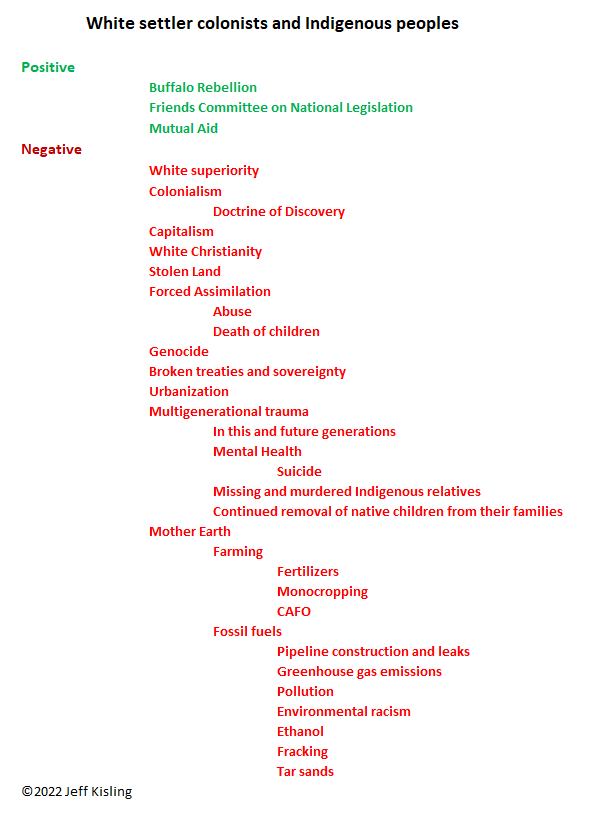
    Following is another way of looking at the relationships between White settler colonists and Indigenous peoples. White Quakers need to acknowledge that when our ancestors came to these Indigenous lands, they were settler colonists. And since we are still occupying these lands, we are settler colonists, too. Some White Quakers were involved in the forced assimilation of Indigenous children. We are implicated in most of the “negative” things listed below.

    Acknowledgement of wrongs is the necessary first step in the healing process.


    On the positive side are Mutual Aid, the Buffalo Rebellion, and the Friends Committee on National Legislation (FCNL). I’ve written a lot about my experiences with Mutual Aid https://quakersandreligioussocialism.com/mutual-aid/

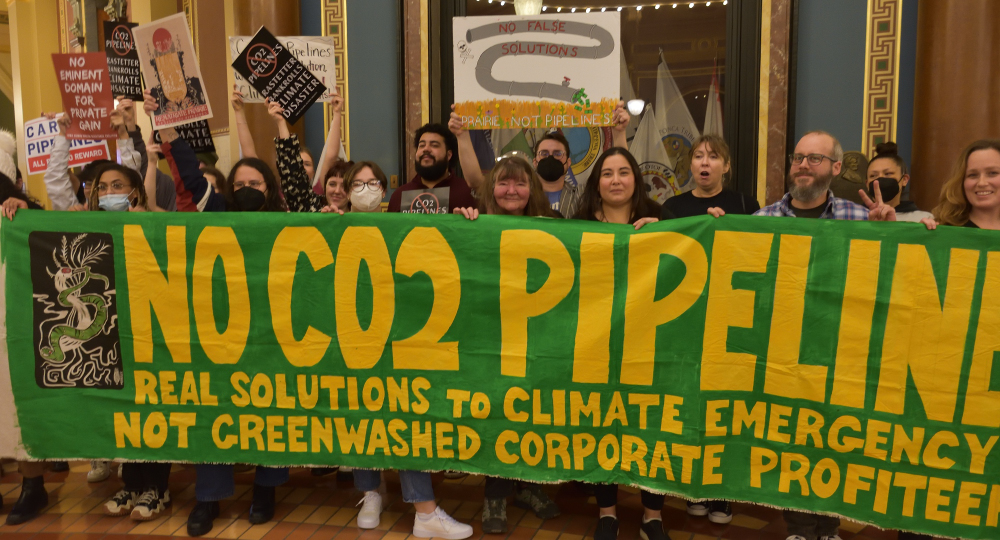
    I’m fortunate to be part of the Buffalo Rebellion, a newly formed Green New Deal coalition in Iowa formed to protect the planet by demanding change from politicians and convincing the public that climate should be a priority. Buffalo Rebellion, is a coalition of grassroots, labor, and climate justice organizations growing a movement to pass local, state, and national policies that create millions of family-sustaining union jobs—ensuring racial and gender equity and taking action on climate at the scale and scope the crisis demands. It was formed in November 2021 and consists of: 

    The Friends Committee on National Legislation (FCNL) has years of experience advocating for legislation related to Native American affairs. Recently FCNL has been supporting legislation to form a Truth and Healing Commission related to the Indian Boarding Schools. I’ve been blessed to have many years of experience with FCNL and have been working with my native friends in creating connections with FCNL, including several visits to our US Senators.