Support for Ukraine

Here is some information related to support for Ukraine.

  • There is news from Quakers of Kyiv, Ukraine, including how to connect for meeting for worship.
  • Information from Mennonite Central Committee who have been in Ukraine since the 1920’s
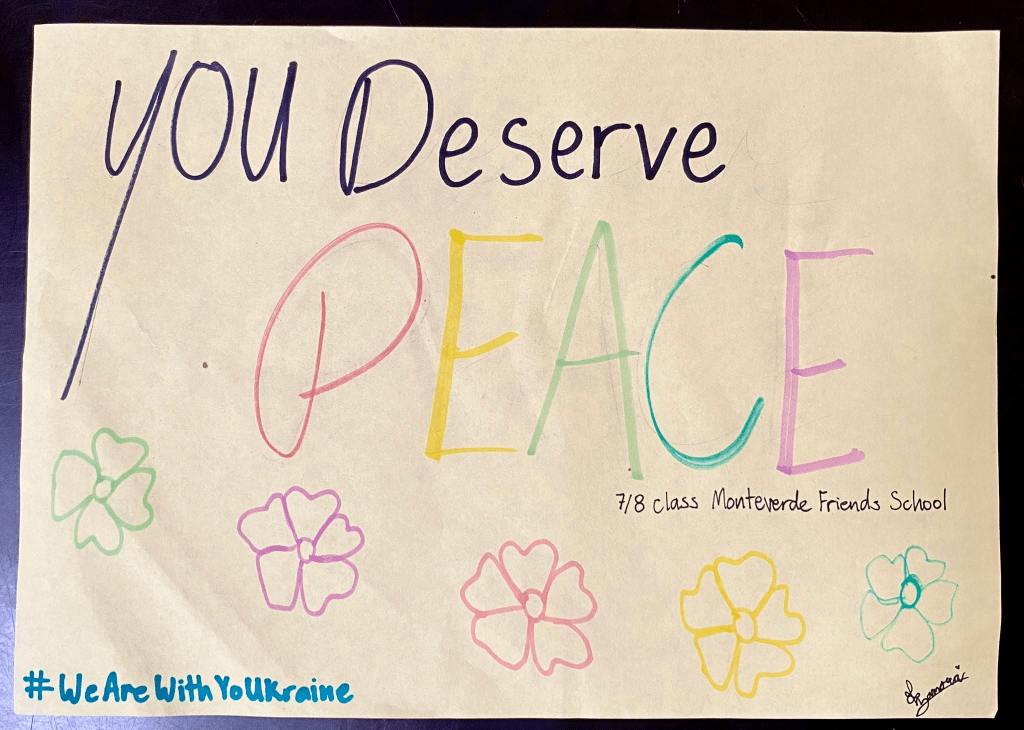
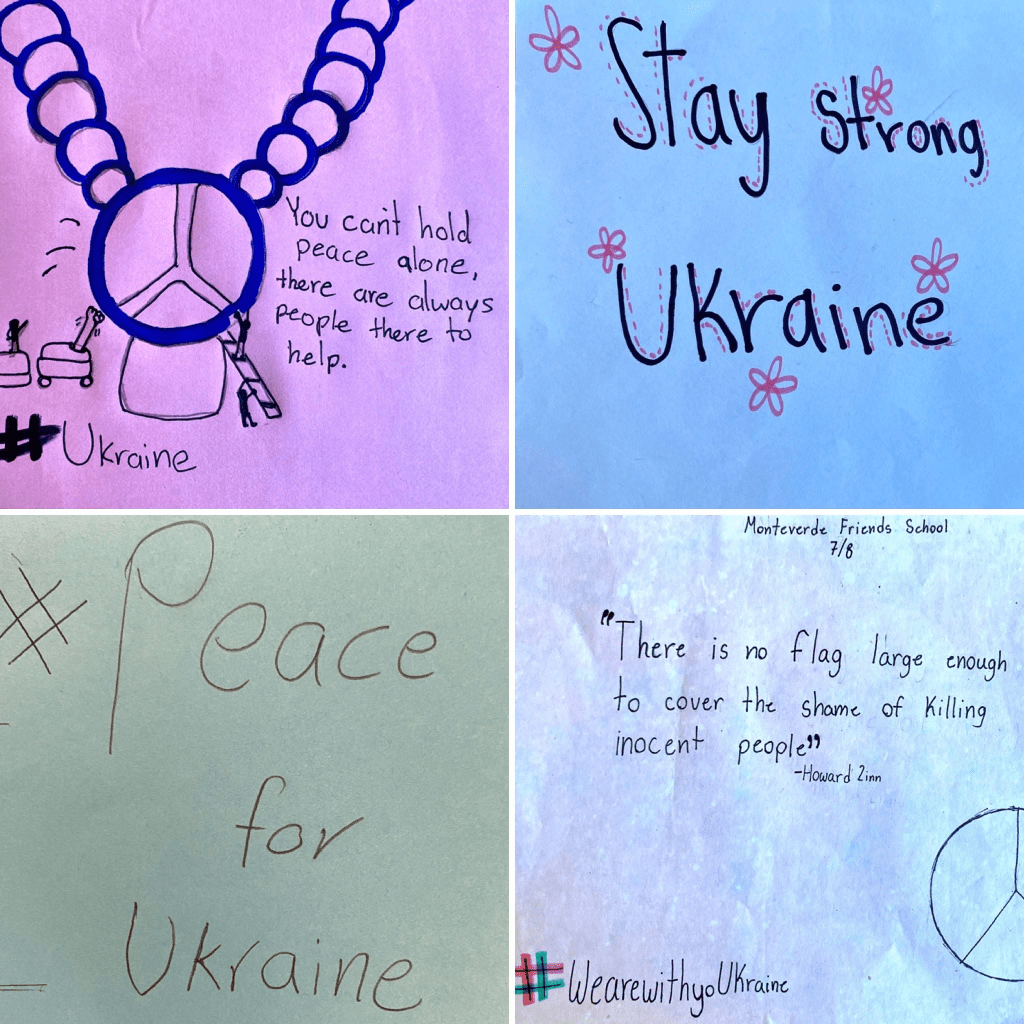
  • Posters of support 7/8 grade students at Monteverde Friends School in Costa Rica. sent to Ukraine Quakers.
  • There will be a ZOOM meeting for worship sharing related to Ukraine at 7:00 pm Central on Thursday, March 3. Everyone is welcome. Email me for the link. jakislin@outlook.com

Quakers Of Kyiv, Ukraine / Квейкери Києва

Welcome to the page of Ukrainian supporters of Quakerism.
Religious Society of Friends is a Protestant Christian church, known for its humanistic orientation, human rights and environmental guidelines, etc.
The Quaker prayer meeting is first and foremost a time of peace. This is an hour free from unnecessary words.
Quakers in the world have different currents. We, the Quakers of Kyiv, belong to the liberal trend without the well-known religious speechifying and lexicon.
Seekers of friendship, peace, truth, and equality are cordially invited to the meeting, following the Spirit’s guidance in affairs, ready for the hour of silent worship.
Details on messenger:
m.me/QuakersKyivUkraine
by e-mail: quakers@ukr.net

February 25, 2022

Despite everything, we prepare for silent prayer worship on Sunday at 10:30 Kyiv Time EET Eastern European Time UTC/GMT +2 hours
We did it and we’ll do it again!

zoom.us/j/718459680
Passcode: 002873

🇺🇦

If you are unable to enter this conference due to the limited number of participants, there will be an opportunity behind this link to enter:
https://zoom.us/j/95573361111
Passcode: d02uNj

February 24, 2022

Dear Friends!

We don’t know anything about how our traditional meeting of worship will go. It is not clear whether the Internet and electricity will be available, whether we will be in the capital or evacuated.

Today all Kyiv people were warned that the city will be bombed. And that all citizens should be ready to hear the sound of sirens go to the bomb shelter.

We don’t lose our temper. God and your prayers help us.

This is the kind of lovely support we get from Costa Rica. (see the following from Monteverde Friends School.)


When I contacted Monteverde Friends School for permission to share the signs from the students, Ellen told me, “The post with the 7/8 class posters for the people of Ukraine has already gone to over 11,000 people, with 112 shares on the post. “

The post with the 7/8 class posters for the people of Ukraine has already gone to over 11,000 people, with 112 shares on the post.

Ellen, Monteverde Friends School

Monteverde Friends School / Escuela de los Amigos de Monteverde

February 24, 2022

Update: Quakers in Kyiv have shared these posters on their page!

Our 7/8 grade social science class discussed the war in Ukraine today and made these posters for the Ukraine people. https://www.facebook.com/QuakersKyivUkraine/

#wearewithyouUkraine

Mennonite Central Committee

MCC has worked in Ukraine since our beginnings in 1920, opening soup kitchens to provide relief to thousands of starving families. Our current projects include relief, peace, health and education.

Since the beginning of the conflict in eastern Ukraine, MCC has worked with partners to assist internally displaced people (IDPs) and to build peace. The UNHCR reports there are some 1.8 million IDPs and conflict-affected people in Ukraine.

“We pray that hard hearts of conquest will be softened. We pray that the very best practices of peace will prevail among leaders. We pray gratefully that your spirit of healing and hope is present.” Rick Cober Bauman and Ann Graber Hershberger, executive directors of MCC, share a prayer for peace in Ukraine. We invited you to pray, give and advocate for peace for our global neighbours in Ukraine.

For more information, or to make a gift, please visit,
mcc.org/crisis-ukraine
Peace and the seeds of war

It is devastating to see the images and hear the stories of the Russian invasion into Ukraine. It is disheartening to feel helpless. Good to see the efforts many governments are attempting for nonviolent means to end the war.

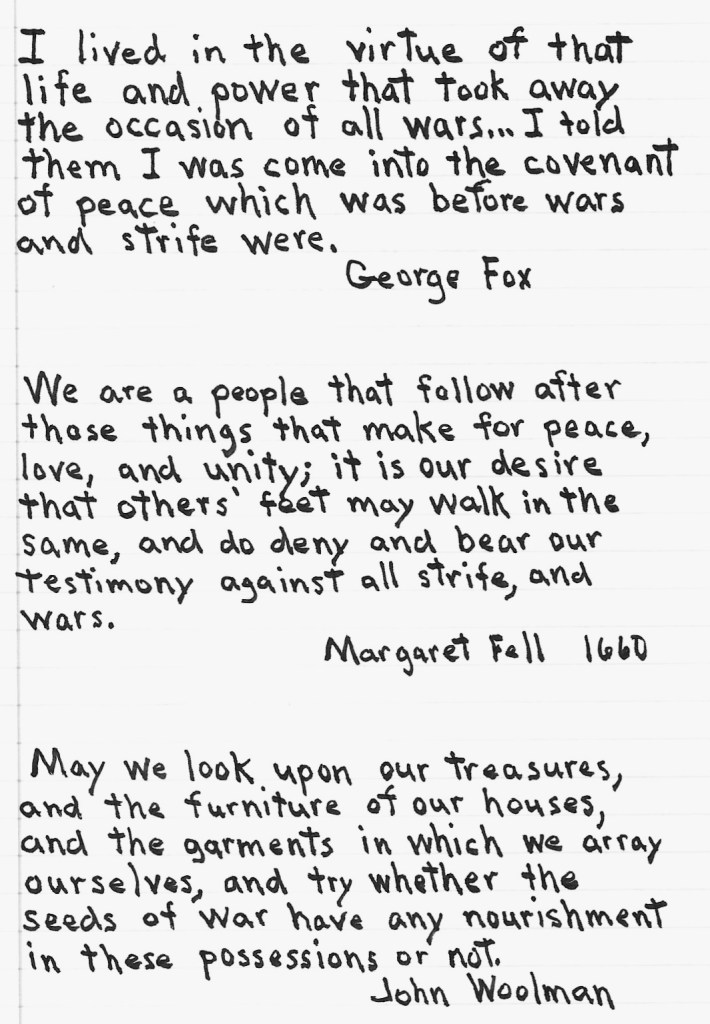
I’ve been praying about the statements below from early Friends admonishing us to look at ourselves, to explore what in our lives might contain the seeds of war.

I don’t say this to call attention to myself because my carbon footprint is many times greater than that of those who live in less industrialized countries. But it was a crystal-clear spiritual message that led me to live without owning a car. This was in 1975. Think of what might have been if all Friends had done so then. Such an example by thousands of Friends would have influenced others to do the same, I believe.

  • Would have resulted in good mass transit systems.
  • Would have dramatically slowed fossil fuel emissions and at least slowed the accelerating environmental catastrophe.
  • Might have prevented multiple wars for oil.
  • Might have meant the Dakota Access and other pipelines would not have been built.
  • Might have meant our children would have a livable future.

I can’t believe the Spirit did not say this to everyone. Did Friends not hear the message? Or if they did hear it, they must have decided to ignore it. On further reflection, I don’t know what the Spirit is saying to anyone else. Again, I’m not saying I’m blameless.

This time of war is an opportunity to listen to the Spirit, to that still small voice. To support each other. During our meetings for worship. To hold worship sharing meetings. And act on that spiritual guidance. Either individually and/or together as a meeting. To make a “commitment to active peace making” as Sidney Bailey says below.

Working for peace

With the rising rhetoric and tensions regarding the Russian invasion of Ukraine, I’m asking myself, again, what does it mean to work for peace? A question I’ve returned to repeatedly over the course of my life. My answer to that question has changed over time. Following is some history of working for peace. But I intend to write how I see working for peace has changed, what that means today, soon.

As I was coming of age in the late 1960’s, at the time of the war in Vietnam, I continuously studied and thought about war and peace. On his eighteenth birthday, every male in the US was required to register with the Selective Service System, which recruited for the armed services. I was born into a Quaker community and attending Scattergood Friends (Quaker) boarding school at that time.

Because of their work for peace, Quakers, the Brethren, and Mennonites were known as historic peace churches. Young men who were members of one of those religious organizations could apply for conscientious objector (CO) status with the Selective Service System. If approved, they would spend two years working in civilian jobs for the public good. Most often in hospitals or mental health institutions.

Those who didn’t belong to one of the historic peace churches could apply for CO status, but that usually wasn’t granted to them. That was blatantly unjust. Similarly, those attending college were routinely granted a student deferment, allowing them to finish their studies. Yet another injustice for those who weren’t students.

Conscientious objector status and student deferments were transparent efforts to quiet resistance to the draft. A number of young men refused to accept those alternatives. Refusing to register with the Selective Service System or returning your draft card made you a draft resister. If convicted, the sentence was a felony conviction and usually a prison sentence.

The peacetime draft was implemented in 1940. Not long after, some Quaker families left the country and established the Monteverde community in Costa Rica.

About dozen men and their families in my Quaker community remained in this country but believed they could not participate in the draft. Which meant refusing to register or returning their draft cards if they had registered but came to believe that was wrong.

It took some time for my family to come to terms with my decision to resist the draft. I initially applied for and was granted conscientious objector status. When my family finally accepted my decision, I turned in my draft cards.

A lot more about my draft resistance story can be found here: https://jeffkisling.com/2017/05/01/my-draft-resistance-story/

I wasn’t arrested, but Daniel Barrett, who attended Scattergood Friends School with me, was arrested and imprisoned.

My Quaker friend and mentor, Don Laughlin, collected many stories of Quaker responses to several wars, including Danniel’s and mine. Don resisted the draft and was imprisoned. When I heard of his project and offered to help, which meant I had those stories when Don died. You can read those stories here:

Young Quaker Men Facing War and Conscription

This morning I saw a message from a Friend who suggested we begin to offer conscientious objector, or draft counseling, as was done during the Vietnam War.

I wanted to share the story of how Muhammad Ali was an inspiration to me as I struggled with my draft decision.

Muhammad Ali was one of the most significant influences in my life, at a difficult time in my life. Approaching my 18th birthday, when I would have to decide what I was going to do about registering with the Selective Service System, I saw Muhammad Ali take a very public, very unpopular stand against the Vietnam War.

He said:
“Under no conditions do we take part in war and take the lives of other humans.”

“It is in the light of my consciousness as a Muslim minister and my own personal convictions that I take my stand in rejecting the call to be inducted. I do so with the full realization of its implications. I have searched my conscience.”

“Man, I ain’t got no quarrel with them Vietcong…they never called me n_____.”

It was very clear what the consequences of that decision could be, and yet he would not be persuaded to change his position, knowing he was jeopardizing his boxing career.

I was impressed by his clear vision of the universal struggle of every person for peace and freedom, and every person’s responsibility to the world community, no matter their religion, race or country.

He helped me make my decision to refuse to participate in the draft, and therefore, the Vietnam War. And continued to be an inspiration in the days that followed.

Muhammad Ali and Me


I read this Epistle to Friends Concerning Military Conscription many times as I was praying and thinking about draft resistance, and since.

An Epistle to Friends Concerning Military Conscription

Dear Friends,

It has long been clear to most of us who are called Friends that war is contrary to the spirit of Christ and that we cannot participate in it.  The refusal to participate in war begins with a refusal to bear arms.  Some Friends choose to serve as noncombatants within the military.  For most of us, however, refusal to participate in war also involves refusal to be part of the military itself, as an institution set up to wage war.  Many, therefore, become conscientious objectors doing alternative service as civilians, or are deferred as students and workers in essential occupations.

Those of us who are joining in this epistle believe that cooperating with the draft, even as a recognized conscientious objector, makes one part of the power which forces our brothers into the military and into war.  If we Friends believe that we are special beings and alone deserve to be exempted from war, we find that doing civilian service with conscription or keeping deferments as we pursue our professional careers are acceptable courses of action.   But if we Friends really believe that war is wrong, that no man should become the executioner or victim of his brothers, then we will find it impossible to collaborate with the Selective Service System.  We will risk being put in prison before we help turn men into murderers.

It matters little what men say they believe when their actions are inconsistent with their words.  Thus we Friends may say that all war is wrong, but as long as Friends continue to collaborate in a system that forces men into war, our Peace Testimony will fail to speak to mankind.

Let our lives speak for our convictions.  Let our lives show that we oppose not only our own participation in war, but any man’s participation in it.  We can stop seeking deferments and exemptions, we can stop filling out Selective Service forms, we can refuse to obey induction and civilian work orders.  We can refuse to register or send back draft cards if we’ve already registered.

In our early history we Friends were known for our courage in living according to our convictions.  At times during the 1600’s thousands of Quakers were in jails for refusing to pay any special respect to those in power, for worshiping in their own way, and for following the leadings of conscience.  But we Friends need not fear we are alone today in our refusal to support mass murder.  Up to three thousand Americans severed their relations with the draft at nation-wide draft card turn-ins during 1967 and 1968.  There may still be other mass returns of cards, and we can always set our own dates.

We may not be able to change our government’s terrifying policy in Vietnam.  But we can try to change our own lives.  We must be ready to accept the sacrifices involved if we hope to make a real testimony for Peace.  We must make Pacifism a way of life in a violent world.

We remain, in love of the Spirit, your Friends and brothers,

Don Laughlin
Roy Knight
Jeremy Mott
Ross Flanagan
Richard Boardman
James Brostol
George Lakey 
Stephen Tatum
Herbert Nichols
Christopher Hodgkin
Jay Harker
Bob Eaton
Bill Medlin
Alan & Peter Blood

Roy Knight, John Griffith, and Don Laughlin were among the members of my yearly meeting, Iowa Yearly Meeting (Conservative) who resisted the draft. Don and Roy signed the epistle above.

The future we want

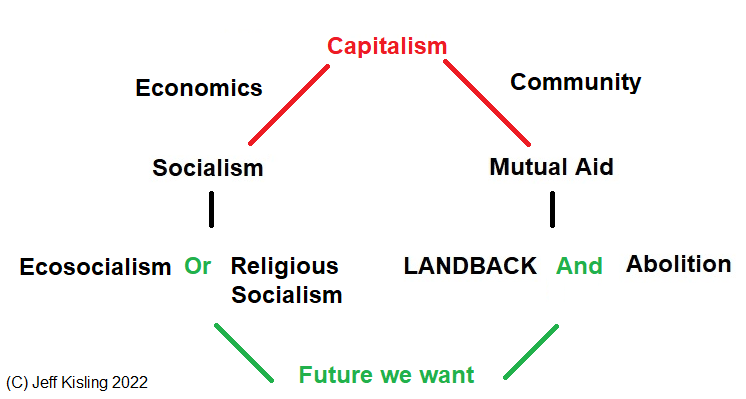
I’ve been trying to integrate all that I’ve been learning about Mutual Aid, #LANDBACK, Abolition, Religious Socialism, Ecosocialism, photography, forced assimilation and Indigenous worldview. There are many intersections among these. This is stimulated in part as I reflect on yesterday. It was a spiritual time when I stopped at Easter Lake to take photos there, despite, or because of the bitter cold. Then continuing to be with my Mutual Aid friends as we filled boxes of food to distribute in the neighborhood. To witness people coming together to share stories. Each moving from one friend to another. This is part of the future we (I) want that exists now. That is the wonderful thing about Mutual Aid, as the focus is on addressing survival needs in the present. As my friend Ronnie says, you work intensely for an hour and a half, and when you’re done you feel sweaty, tired and good.

As I hear so many friends expressing feelings of hopelessness and despair, I feel fortunate to be involved in a community that gives us a sense of doing something good together. Which is one reason I’m trying to get more people involved in Mutual Aid.

I heard some of this discouragement when those in the Quakers for Abolition Network met via ZOOM yesterday.

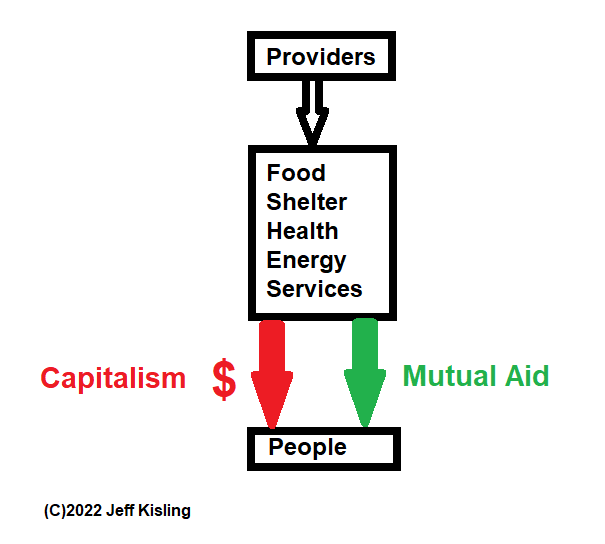
I’ve been working on a new diagram to help me visualize the relationships between the concepts mentioned at the beginning. The root cause of so much suffering is the capitalist economic system. Socialism is an alternative to capitalism. Ecosocialism is about how environmental devastation will be the end of capitalism. Or faith communities can help bring about socialism as an alternative to capitalism from a moral lens. Or both.

Mutual Aid is a framework to replace vertical hierarchies and the unjust power structures they enforce. LANDBACK, returning to Indigenous relationships with the land, and abolition of police and prisons are part of building communities that represent the future we want.

EPSON MFP image

Eco Socialism

I’m spending hours searching for information about religion and socialism since learning about the idea of Religious Socialism.

Socialism has a negative connotation for many that is related to Marxism and its support of revolution by any means.

In one of our nation’s best moments, the civil rights movement of the mid-20th century, Christian socialists played major roles. A. Philip Randolph and Bayard Rustin were very open about their socialism, and Dr. Martin Luther King Jr., who praised democratic socialism both publicly and privately, stood on the shoulders of previous generations of socialist African American social gospel leaders.

These Christian socialists agreed with Karl Marx’s ground-breaking analysis of the devastating impact capitalism wreaks on working people. But they parted ways when it came to Marx’s antipathy to religion, and they rejected Marx’s exhortations to revolution by any means. For religious socialists, the instrument of revolutionary reform is a political one at the ballot box and nonviolently in the streets. That approach works. Consider the many nations comparable to the United States, particularly in western and northern Europe, where socialist advocacy within the democratic process has led to universal healthcare, progressive taxation, and comprehensive social services that assure safe housing and a minimum income. Compared to the United States, life there is far closer to the kingdom of God on earth.

Christian Socialist by MAXINE PHILLIPS and FRAN QUIGLEY

I’ve long known evolving environmental chaos would be the end of capitalism. This chaos will increasingly lead to the physical destruction of the infrastructure that produces and distributes goods and the shops where they are sold, resulting in widespread financial ruin. The impact of severe drought and storms will significantly impact food production and supplies of clean water. These things will increasingly impact housing, energy, healthcare, education, finance, transportation, and other social and political systems.

We are finally at a place where the public can no longer refuse to recognize the impacts of climate change. The fear that generates, and the realization things will only get worse, is fueling social unrest. Movement toward authoritarianism, and domestic violence and terrorism.

I have become interested in religious socialism to create communities to support each other as current systems fail. This interests me as an opportunity to revitalize my Quaker communities. Or for more people to turn to whichever spiritual community meets their needs.

But it is unclear how many people will turn to spirituality, especially those who previously felt disenfranchised from churches and religious organizations.

As I’ve searched for information about religious socialism I’ve found a lot of information about Eco socialism, a term new to me. But which encapsulates what I’ve always believed about environmental chaos and the need for socialism to respond.

In the wake of Australian fire storms, global crop loss and catastrophic climate shifts, billions of people are recognizing the dangers to society and life itself presented by capitalism’s profit-driven despoiling of nature. At the same time, the last 40 years of deepening inequality inside virtually all nations have undermined their social cohesion, and increasingly, capitalism’s mechanisms are being blamed. Anti-capitalism is exploding across many political landscapes.

One broad socialist response to ecological crisis has produced a global eco-socialist movement and a rich set of eco-socialist writings. They rightly argue that a solution to the ecological crisis requires a transition from capitalism to socialism. Profit-driven capitalism is the problem that socialism can solve. Likewise, socialists argue, today’s extreme economic inequalities flow from capitalism. Socialism’s traditionally egalitarian focus on state redistributions of wealth and income has attracted mass interest and support.

Will Climate Change Provoke a Widespread Revival of Socialism? by Richard D. Wolff, TRUTHOUT, Feb 13, 2020

Illusion of Caring

I keep coming back to my failure to convince people we had to give up having personal automobiles if we were going to prevent the environmental catastrophe unfolding now. I was hoping the examples of those of us who refused to have cars combined with the warning signs about greenhouse gas emissions would make change happen.

I am similarly discouraged about the prospects of convincing people of the evils of capitalism, as I summarize here: The Evil of Capitalism.

But the global capitalist systems are collapsing now. The question is whether we will build alternatives before the worst happens.

when we join in a walkathon for the homeless or make an online donation for a food bank, we are relieved from the burden of confronting the underlying injustice of a society where great wealth exists alongside grinding poverty

Fran Quigley

My friend Fran Quigley has written Religious Socialism: Faith in Action for a Better World. One of the main premises of his book is “the grim, daily evidence of capitalism’s failures”. The following is from the Introduction of his book.

Rev. George Washington Woodbey is a member of a determined group of Americans who, over the course of 150 years, has insisted that there is an unbreakable connection between their religious values and the political and economic system of socialism. To make their case, they have pointed to the grim, daily evidence of capitalism’s failures. Today, the United States is one of the wealthiest nations in human history yet with far higher poverty rates than similar countries. The disparity reveals itself through health insurance company CEO’s making as much as $83 million per year, while tens of millions of the nation’s residents go without health care. It is shown by the richest Americans owning multiple homes, some worth as much as a quarter-billion dollars, while a half-million Americans are homeless. Three American men own more wealth than the bottom 50 percent of the nation’s population combined. At the same time, one of every six children in America—12 million overall—live below the poverty line.

Every faith tradition condemns this state of affairs. So does socialism. These faith traditions and socialism prescribe the same, straightforward remedy: all humans have the right to the necessities of life.

Note the word right. The capitalist U.S. system has survived its conflict with religious principles in significant part by projecting the illusion of caring about the suffering of the poor, while at the same time rejecting the recognition of any rights that would alleviate poverty. How is that tricky balancing act performed? By promising the U.S. public that the fortunate few will extend their charity to meet all the needs of the poor. If that promise is believed, massive concentrations of wealth do not seem so outrageous.

But that promise is a lie, demonstrated by the millions of American children going hungry while the wealthy luxuriate. Yet the false narrative persists, likely because it is so comforting to all of us who are not poor. In her 1998 book Sweet Charity, the sociologist Janet Poppendieck concludes that the American preference for charity over public welfare programs relieves the pressure for more fundamental solutions. Charity, she writes, acts as a “moral safety valve.”

From an individual perspective, that safety valve effect means that when we join in a walkathon for the homeless or make an online donation for a food bank, we are relieved from the burden of confronting the underlying injustice of a society where great wealth exists alongside grinding poverty. As for our political engagement, high-profile donations of plutocrats make us less likely to demand curbs on their lavish wealth. Charity may not be very effective at alleviating injustice, but it is quite good at relieving our sense of outrage about it.

Quigley, Fran. Religious Socialism: Faith in Action for a Better World (pp. 10-11). Orbis Books. Kindle Edition.

Black Lives have always mattered

Every time I hear this interview, I am reminded of some of my own experiences related to Black Lives Matter.

This is a dream unrealized. MSNBC

Dr. Clarence Jones, former speechwriter and counsel to Martin Luther King, Jr., reflects on what Dr. King would think about the nation today.
Jonathan Capehart
What would Martin Luther King say about what’s going on in the United States today?
Dr. Clarence Jones
He would say Black lives have always mattered, always matter. The challenge has been for us to get the majority of society to recognize and to respect that.

These stories are about white Friends recognizing and respecting that Black Lives have always mattered.

2014

Racial justice, and Black Lives Matter, need vocal, visible and spiritual support from White Quakers now. How often has the Underground Railroad been invoked during discussions of Friends and enslavement and racial justice? Have you wondered what you would have done if you had been alive then? Twenty years from now what will you remember when you think back to this time and what you did, or did not do?

When I was living in Indianapolis, I attended the peace vigil every Friday afternoon in downtown Indianapolis. There were usually just three or four attending. We held signs about peace, including the Friends Committee on National Legislation’s ‘War is Not the Answer’.

I had been thinking a lot about peace building and feel that addressing economic, environmental and racial injustice is what constitutes peace building today in the United States.

After Michael Brown’s killing in 2014, and the ongoing killings of people of color, there were multiple demonstrations in Indianapolis.

I changed my message to Quakers Black Lives Matter. I made the sign below to take to our weekly peace vigil in front of the Federal Building in downtown Indianapolis. I was very unsure of how that sign would be received by people of any race, but felt called to do it

However, I had forgotten the first time I carried the sign to the vigil (I didn’t own a car) was the weekend of Indy Black Expo. As I was walking to the Federal Building and entered the downtown mall, I was suddenly in the middle of thousands of people of color. I was unsure of what the reaction would be. I was tempted to turn around and go home. But I mostly got looks of surprise and puzzlement. No one said anything then (there was music, food, etc.).

But during the hour of the peace vigil that day, there were a lot of interactions, both with people driving and those walking past our group of three, and they were all positive. Many people said “thanks” with smiles. Someone said, “that’s a good sign, a damn good sign”. “Our lives DO matter”, said another.

Carrying the sign on the way home after the peace vigil, I was surprised by the sound of an air horn, and looked up into the cab of the tractor trailer passing by, where two young black men were grinning and waving their arms.

Another day a young Black man stopped, got out of his car, and walked up to us. I wasn’t sure how that was going to go. But he said, “a white man holding a Black Lives Matter sign”. I said, “yes, a white man holding a Black Lives Matter Sign”. He started to go away, but returned and asked, “why are you doing it?” I told him about the Kheprw Institute (KI) that mentors Black youth that I had been involved with for several years now. And how those kids had become friends of mine. And I want a better life for them. He nodded, then said it was a brave thing to do. I only mention this to show how other people might see what you do in public. He went on to say he felt justice had to be grounded in faith.

Many times a car of people of color would honk, and people smile and cheer and wave their hands. Many times take photos with their phones.

Another day an energetic young Black man came and said “Quakers, Black Lives Matter”, and began to take a video of us, then had a friend take more video as he stood with his arms around our shoulders, narrating all the time–“Quakers”, “Black Lives Matter”.

Bear Creek Friend Jenny Cisar created this decal and made 100 copies, which people were eager to obtain.

JennyBLM

Kathy Hall, of Whittier meeting, made this sign. Pictured is the Peace and Social Concerns Committee of Iowa Yearly Meeting (Conservative).

Peace and Social Concerns Committee of Iowa Yearly Meeting (Conservative).

July 12, 2016

Friends, this is a pivotal moment.  Silence means supporting the status quo, which means supporting white privilege and racial injustice.  Black Lives Matter is a nonviolent movement seeking to correct these injustices.

We are all aware of Friends’ history of speaking out publicly to witness against injustice.  Many of us continue our weekly peace vigils and display our “War is Not the Answer” signs.  Peace making now means speaking out for racial justice.

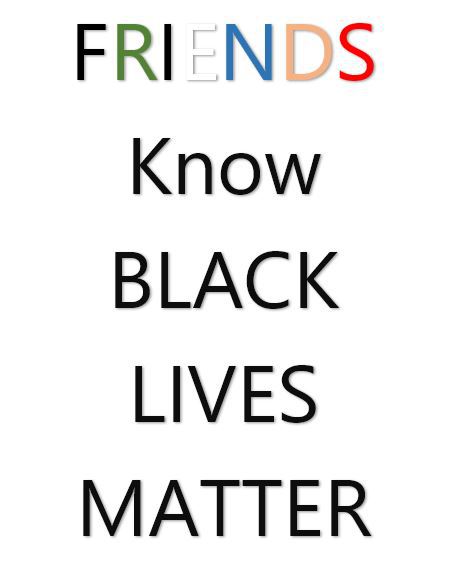
Here is one graphic you can make a sign from.

Friends, our small and rural communities especially need to hear these messages

This is the time to stir up uncomfortable conversations.  My black friends wonder why white people are not helping them.  We need to show visible signs of support.   We need to attend the Black Lives Matter rallies.  We need to put Black Lives Matter signs on our meetinghouse and home lawns.

Dallas surgeon Brian Williams, who helped care for the police shot there, said “I understand the anger and the frustration and distrust of law enforcement. But they’re not the problem. The problem is the lack of open discussions about the impact of race relations in this country. . . . The killing, it has to stop.’’

Please move away from the sidelines and unite together — regardless of your faith or religious practice — to seek an end to hatred and violence . . . What happened to our family is part of a larger attack on Black and Brown bodies . . . We call on all people, public officials, faith leaders and Americans from all walks of life to help address the festering sores of racism as it spurs an unforgiving culture of violence.” -Rev. Waltrina Middleton, longtime organizer, whose cousin Rev. Depayne Middleton, was killed in the massacre at Emanuel AME Church

2016

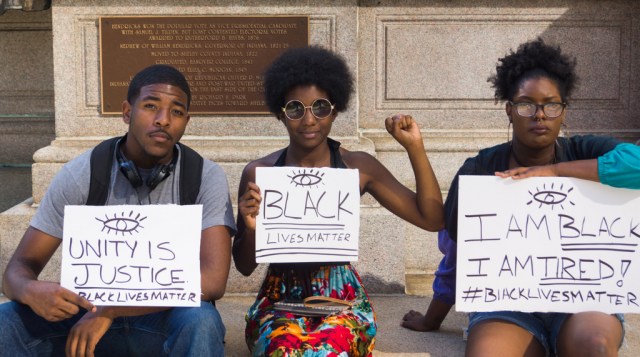
I’ve often looked at, and thought about this photograph I took at a Black Lives Matter protest in Indianapolis in July, 2016.

It was a warm, sunny summer evening, around sunset.  I arrived about half an hour early and there weren’t many people gathered on the lawn of the Indiana Capitol, yet.

I almost walked past the trio above, but something made me stop.  I thought they created an excellent image of the Black Lives Matter Movement…poised, stressed and tired, respectful, determined, nonviolent, hurt, angry, but very, very intent and serious. 

It was important to me that I ask for their permission to take this photo, something I didn’t usually do then at public events. These days I no longer take photos that show people’s faces, because law enforcement uses such photos to bring charges.

They each considered my request for a moment, then each, with varying degrees of enthusiasm, indicated that would be permissible.  I knelt in front of them, framed and then shot the photo, and thanked them.  Silent nods, but also slight smiles.

I like each of the facial expressions, the story each person’s posture tells, and the raised fist salute.  I like the sense of support, leaning in toward each other.  I like the messages on the signs.

But the reason I keep coming back to this is because I also feel a real challenge from them to me/us.  I think they are saying “we’ve taken the time and effort (and I would say courage) to come out in public to support our community and each other, and demand that these injustices stop.”

And they seem to be asking me/us, “what are you going to do?  Do you have a little courage yourself?  Will you make yourself, and others uncomfortable by speaking the truth about these things?”

New paths for faith and justice

Much of my work and writing last year has been related to Mutual Aid. This has solidified my conclusions that our hope now is to continue and expand Mutual Aid projects across the county and world.

The greatest driver to build mutual aid groups is we will soon have no choice. It is increasingly clear our political system has failed us. Capitalism has failed us. Our healthcare industry is failing despite the valiant efforts of front-line health workers. And most of all, environmental chaos will rapidly worsen.

It has seemed our faith bodies are failing us, too. Where is the church in helping us through these increasingly trying times?

We can take advantage of skills that we cultivate within our faith spaces—such as mindfulness, active listening and servant leadership—to build multi-faith, multi-tendency, and multi-generational coalitions for systemic change

Ty Kiatathikom

For example, I’ve worked my entire adult life to convince Quakers to stop owning personal automobiles. And failed to do so. I’m aware this could be related to mistakes I’ve made in communicating.

I’ve been discouraged, but not surprised, at the lack of response I’ve been getting when trying to convince people of the evils and failure of capitalism. (See Evils of Capitalism). But I know it will require spiritual guidance to help us through the coming times. I still have faith the Inner Light will show us the way.

I am intrigued by the idea of Religious Socialism that my friend Fran Quigley told me about. Fran is director of the Health and Human Rights Clinic at Indiana University McKinney School of Law and has published the book Religious Socialism: Faith in Action for a Better World.

In the following Lucy Duncan writes “What would it mean to reckon with our past complicity with harm and fully dedicate ourselves to the creation of a liberating Quaker faith that commits to build the revolutionary and healing faith we long to see come to fruition? What would it look like to finally and fully abolish slavery?”

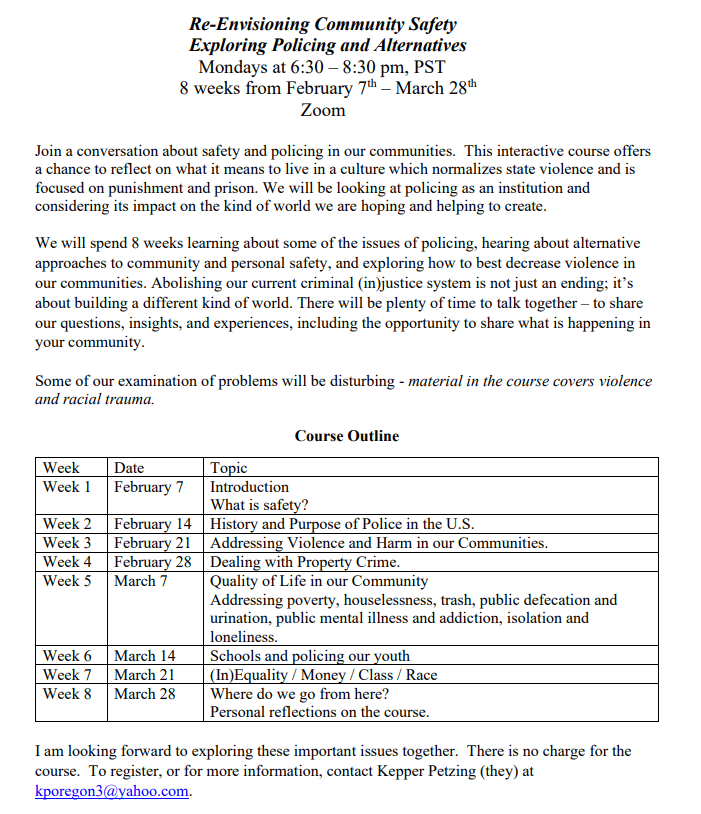
Ty Kiatathikom writes about Religious Socialism. And there is information about an eight-week course, “Re-Envisioning Community Safety. Exploring Policing and Alternatives”.

Early Friends understood the Inner Light not only as a beacon shining from each person’s soul but also as a searchlight exposing the knots and blocked or wounded places in ourselves, the spaces requiring reckoning and real repair. I would argue that these stories of White Quaker complicity (which do not in any way diminish the stories of individual and collective Quaker courage) implicate us in the harms of slavery and incarceration in deep ways. They implicate us as perpetrators but also as wounded ourselves.

As Wendell Berry so eloquently put it, we carry the mirror image of the harm we’ve caused in our souls. This “hidden wound” is ever present and disrupts our ability to be fully intact, fully grounded, and human. We render ourselves in some ways obscure to our own history and to a full knowing of who we are.

I tell the stories of early White Quaker relationships to slavery because slavery was never really abolished. If we can reckon with the full truth of our connection to slavery and its afterlives, perhaps we can begin the healing necessary to fulfill the promise of the Religious Society of Friends of Truth. 

We as White Quakers like to think of ourselves as ahead or better than dominant culture, but we have been complicit in a system and mindset that are ubiquitous. Claiming the full truth of our history and committing to repair the harms done are deeply spiritual acts of healing our own wounds of disconnection. I would argue it is the pathway upon which we can, perhaps for the first time, discover and invigorate our faith with its full promise.

What would it mean for us to take seriously and collectively as a Religious Society a call to finish the work of abolition, hand in hand and side by side with those affected  and their loved ones? What would it mean for us to stand fully with the calls to abolish the police and fully fund community needs instead? What would it mean to reckon with our past complicity with harm and fully dedicate ourselves to the creation of a liberating Quaker faith that commits to build the revolutionary and healing faith we long to see come to fruition? What would it look like to finally and fully abolish slavery?

A Quaker Call to Abolition and Creation by Lucy Duncan, Friends Journal, April 1, 2021

Where do religious socialists fit into that struggle?

Every religion teaches the power of redemption. In every faith, there are stories about human beings redeeming and being redeemed. Siddhartha Gautama renounces his status as a prince to live and die as an ascetic, and in doing so, escapes from the cycle of life and death entirely. The Abrahamic religions call on their adherents to answer for their misdeeds by doing virtuous acts and asking forgiveness from God. Universally, our faiths extol the importance of understanding that our actions in this life define us and carry us on over to the next, and that no person is ever beyond redemption for their vilest act.

We can take advantage of skills that we cultivate within our faith spaces—such as mindfulness, active listening and servant leadership—to build multi-faith, multi-tendency, and multi-generational coalitions for systemic change. Relationship-building is a foundational step in birthing a revolutionary culture, and abolitionist culture is no different. As religious socialists, we have the potential—and therefore the responsibility—to nourish the culture that connects us within and without prison walls. 

One example of religiously informed abolitionist organizing is Abolition Apostles, a national jail and prison ministry based in New Orleans. Serving thousands of incarcerated people across the country, Abolition Apostles connects them with pen pals, material support, and advocacy for their parole and re-entry. 

We cannot claim to live in a moral society until we have achieved the permanent abolition of the prison-industrial complex. The words echo in religious and socialist texts: Hebrews 13.3: Remember those who are in prison as though you were in prison with them; the Dhammapada: Whoever, being pure, forbears with punishment, bondage, and abuse, having the strength of endurance, having an army of strengths, that one I say is a brahmin;  Eugene Debs: While there is a lower class, I am in it, while there is a criminal element, I am of it, and while there is a soul in prison, I am not free

WHILE THERE IS A SOUL IN PRISON: REMEMBERING ATTICA, COMMITTING TO ABOLITION by Ty Kiatathikom, religioussocialism.org

Dear Friends,

From October through December 2021, I led a course for Friends from Multnomah Friends Meeting and West Hills Friends Church (both in Portland, OR) based on the Mennonite Church, USA curriculum about police abolition. https://www.mennoniteusa.org/abolition-curriculum-intro/  
This Portland Quaker gathering was sponsored by Multnomah’s Peace and Social Concerns Committee and Friends for Racial Justice. 

After spending nine weeks exploring these issues and obtaining feedback from course participants, I feel led to widen the discussion to a broader community. I am hoping that additional Friends will join me for an exploration of this topic – and that Friends will forward this opportunity to friends who are not Quakers who may be interested.

Below is the course announcement. Unfortunately, the timing of the course (6:30 – 8:30 pm PST) only works for West Coast, or possibly Mountain Time people. 

Please get in touch if you have questions, suggestions, or are interested in participating.

Gratefully,

Kepper Petzing (they)

kporegon3@yahoo.com

An Epistle to Friends Regarding Religious Socialism

Religious Socialism is fundamentally about the many injustices that are consequences of the capitalist economic system. It is difficult to come to terms with the evils of this system we dwell in. But we must have the moral courage to reject capitalism.

But our moral lag must be redeemed; when scientific power outruns moral power, we end up with guided missiles and misguided men. When we foolishly maximize the minimum and minimize the maximum we sign the warrant for our own day of doom. It is this moral lag in our thing-oriented society that blinds us to the human reality around us and encourages us in the greed and exploitation which creates the sector of poverty in the midst of wealth. Again, we have diluted ourselves into believing the myth that Capitalism grew and prospered out of the protestant ethic of hard work and sacrifice, the fact is that Capitalism was built on the exploitation and suffering of black slaves and continues to thrive on the exploitation of the poor – both black and white, both here and abroad. If Negroes and poor whites do not participate in the free flow of wealth within our economy, they will forever be poor, giving their energies, their talents and their limited funds to the consumer market but reaping few benefits and services in return. The way to end poverty is to end the exploitation of the poor, ensure them a fair share of the government services and the nation’s resources. I proposed recently that a national agency be established to provide employment for everyone needing it. Nothing is more socially inexcusable than unemployment in this age. In the 30s when the nation was bankrupt it instituted such an agency, the WPA, in the present conditions of a nation glutted with resources, it is barbarous to condemn people desiring work to soul sapping inactivity and poverty. I am convinced that even this one, massive act of concern will do more than all the state police and armies of the nation to quell riots and still hatreds. The tragedy is our materialistic culture does not possess the statesmanship necessary to do it.

Martin Luther King, Jr. The Three Evils of Society, August 31, 1967, National Conference on New Politics, Chicago

Capitalism was built on the exploitation and suffering of black slaves and continues to thrive on the exploitation of the poor

Martin Luther King, Jr

Following is An Epistle to Friends Regarding Religious Socialism I wrote based upon An Epistle to Friends Concerning Military Conscription’

An Epistle to Friends Regarding Religious Socialism

Dear Friends,

The measure of a community is how the needs of its people are met. No one should go hungry, or without shelter or healthcare. Yet in this country known as the United States millions struggle to survive. The capitalist economic system creates hunger, houselessness, illness that is preventable and despair. A system that requires money for goods and services denies basic needs to anyone who does not have money. Black, Indigenous, and other people of color (BIPOC) are disproportionately affected. Systemic racism. The capitalist system that supports the white materialistic lifestyle is built on stolen land and genocide of Indigenous peoples, and the labor of those who were enslaved in the past or are forced to live on poverty wages today.

Capitalism is revealed as an unjust, untenable system, when there is plenty of food in the grocery stores, but men, women and children are going hungry, living on the streets outside. White supremacy violently enforces the will of wealthy white people on the rest of us.

It has become clear to some of us who are called Friends that the colonial capitalist economic system and white supremacy are contrary to the Spirit and we must find a better way. We conscientiously object to and resist capitalism and white supremacy.

capitalism has violated the communities of marginalized folks. capitalism is about the value of people, property and the people who own property. those who have wealth and property control the decisions that are made. the government comes second to capitalism when it comes to power.

in the name of liberation, capitalism must be reversed and dismantled. meaning that capitalistic practices must be reprogrammed with mutual aid practices. 

Des Moines Black Liberation Movement

Mutual Aid

How do we resist? We rebuild our communities in ways not based upon money. Such communities thrive all over the world. Indigenous peoples have always lived this way. Generations of white people once did so in this country. Mutual Aid is a framework that can help us do this today.

The concept of Mutual Aid is simple to explain but can result in transformative change. Mutual Aid involves everyone coming together to find a solution for problems we all face. This is a radical departure from “us” helping “them”. Instead, we all work together to find and implement solutions.  To work together means we must be physically present with each other. Mutual Aid cannot be done by a committee or donations. We build Beloved communities as we get to know each other. Build solidarity. An important part of Mutual Aid is creating these networks of people who know and trust each other. When new challenges arise, these networks are in place, ready to meet them.

Another important part of Mutual Aid is the transformation of those involved. This means both those who are providing help, and those receiving it.

With Mutual Aid, people learn to live in a community where there is no vertical hierarchy. A community where everyone has a voice. A model that results in enthusiastic participation. A model that makes the vertical hierarchy required for white supremacy impossible.

Commonly there are several Mutual Aid projects in a community. The initial projects usually relate to survival needs. One might be a food giveaway. Another helping those who need shelter. Many Mutual Aid groups often have a bail fund, to support those arrested for agitating for change. And accompany those arrested when they go to court.

LANDBACK

The other component necessary to move away from colonial capitalism and white supremacy is LANDBACK.

But the idea of “landback” — returning land to the stewardship of Indigenous peoples — has existed in different forms since colonial governments seized it in the first place. “Any time an Indigenous person or nation has pushed back against the oppressive state, they are exercising some form of landback,” says Nickita Longman, a community organizer from George Gordon First Nation in Saskatchewan, Canada.

The movement goes beyond the transfer of deeds to include respecting Indigenous rights, preserving languages and traditions, and ensuring food sovereignty, housing, and clean air and water. Above all, it is a rallying cry for dismantling white supremacy and the harms of capitalism.

Returning the Land. Four Indigenous leaders share insights about the growing landback movement and what it means for the planet, by Claire Elise Thompson, Grist, February 25, 2020

What will Friends do?

It matters little what people say they believe when their actions are inconsistent with their words.  Thus, we Friends may say there should not be hunger and poverty, but as long as Friends continue to collaborate in a system that leaves many without basic necessities and violently enforces white supremacy, our example will fail to speak to mankind.

Let our lives speak for our convictions.  Let our lives show that we oppose the capitalist system and white supremacy, and the damages that result.  We can engage in efforts, such as Religious Socialism, Mutual Aid and LANDBACK, to build Beloved community. To reach out to our neighbors to join us.

We must begin by changing our own lives if we hope to make a real testimony for peace and justice.

We remain, in love of the Spirit, your Friends and sisters and brothers,