Sadly, but importantly, white settler colonists such as me, at least those paying attention, are learning a great deal about the genocide of native peoples, in large part facilitated by the institutions of forced assimilation. Sometimes referred to as Indian boarding or residential schools, though school is a misnomer, an example of whitewashing. The remains of thousands of native children are being located on the grounds of these institutions in this country and Canada.
whitewash: deliberately attempt to conceal unpleasant or incriminating facts about (someone or something):
The following was written by my friend Sikowis Nobiss.
There are many settler colonial mythologies about Native Americans. These widely held but false beliefs are rooted in deeply entrenched discriminatory attitudes and behaviors that are perpetuated by institutionalized racism. One of the most celebrated mythologies is the holiday of Thanksgiving, which is believed, since 1621, to be a mutually sanctioned gathering of “Indians” and Pilgrims. The truth is far from the mythos of popular imagination. The real story is one where settler vigilantes unyieldingly pushed themselves into Native American homelands, and forced an uneasy gathering upon the locals.
In the words of Wamsutta Frank James, Wampanoag, “the Pilgrims had hardly explored the shores of Cape Cod four days before they had robbed the graves of my ancestors, and stolen their corn, wheat, and beans.” These words came from his 1970 Thanksgiving Day speech, which he wrote for the annual celebration of the landing of the Pilgrims held every year in Plymouth, Massachusetts. However, this speech was never presented; the organizers of the celebration reportedly asked to see his speech ahead of time, according to James’ obituary in theBoston Globe, and allegedly asked him to rewrite it on the basis that his words were not aligned with the popular mythology. He instead declared Thanksgiving a National Day of Mourning.
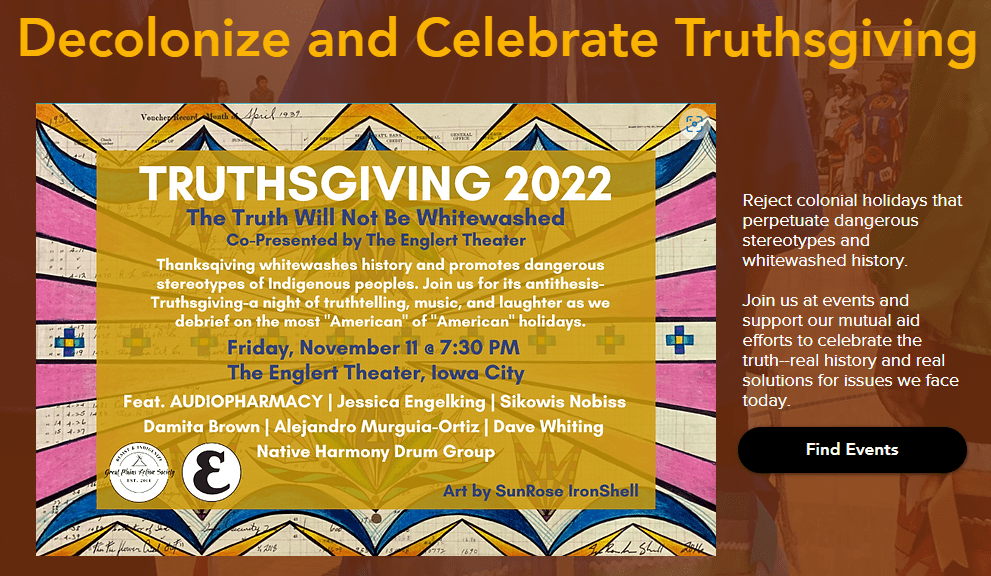
“The following resources are available so that folks can learn more about Indigenous perspectives on Thanksgiving, the land they live on, how to be a good ally, and how they can decolonize their minds in order to abolish personal and institutionalized white supremacy.” https://www.truthsgiving.org/resources
For many years I’ve been praying, thinking, writing, and discussing how we can prepare for an increasingly dystopian future. In an article in Friends Journal, Donald McCormick asks “why is there no vision for the future of Quakerism?” I wrote about my vision in the article What is your vision for the future?
The increasing threats from environmental devastation and chaos lead me to share more of my vision, which has been evolving over the past several years. It’s taken me a long time to write this article, I think because I haven’t found resources available to check on what I’m saying here.
I’ve always believed the greatest problem to solve is how communities of the future organize and govern themselves. We’ll have to do things differently because our present systems are collapsing. Which is often not a bad thing since those systems are based on colonialism and capitalism.
Spirituality
Spirituality is especially important now as we experience increasing environmental chaos, which will contribute to further social, economic, and political collapse. We will have no choice but to band together for the survival of us all. The alternative is tribalism with its violence, destruction and death.
We will need the help of those who know survival skills that we don’t. It takes time to build the trust necessary for these connections. It is urgent to do this now. It is by the Spirit that we can engage with everyone around us, of all cultures, identities, ethnicities.
Spirituality can show us how to live with integrity now. How to be examples to others. This is how change happens.
The Creator can help us heal the wounds of the past. And the wounds that will be inflicted in the future.
The Spirit can guide us through the coming chaos.
It is by the Spirit we create connections among diverse peoples.
At my first meeting with the KI community, I was asked a number of questions. When I said I was a Quaker, one of the adults (the group was mainly teenagers) spoke about the history of Quakers related to the underground railroad. When she finished, all eyes turned to me. I said I was glad my ancestors did that, it was the right thing to do, but we try not to take credit for things we have not done ourselves. When I was asked to speak more about that, I wasn’t sure what to say. I remember clearly that an answer came from the Spirit, which told me to not only say that Quakers believe there is that of God in everyone, but to also look into the eyes of each one there and say, “and that includes you”. Each person smiled at me when I did that. That ended the questioning, and I was welcomed into the community. We had this spiritual basis for our work together.
But that was just the first step. Trust was built, but slowly. With permission, I invited members of my Quaker community to engage with KI’s monthly book discussions. This was one way we began to get to know each other. But it was two years after this introduction before I was invited to teach a class on photography for KI.
Kheprw Institute, Indianapolis
First Nation-Farmer Climate Unity March
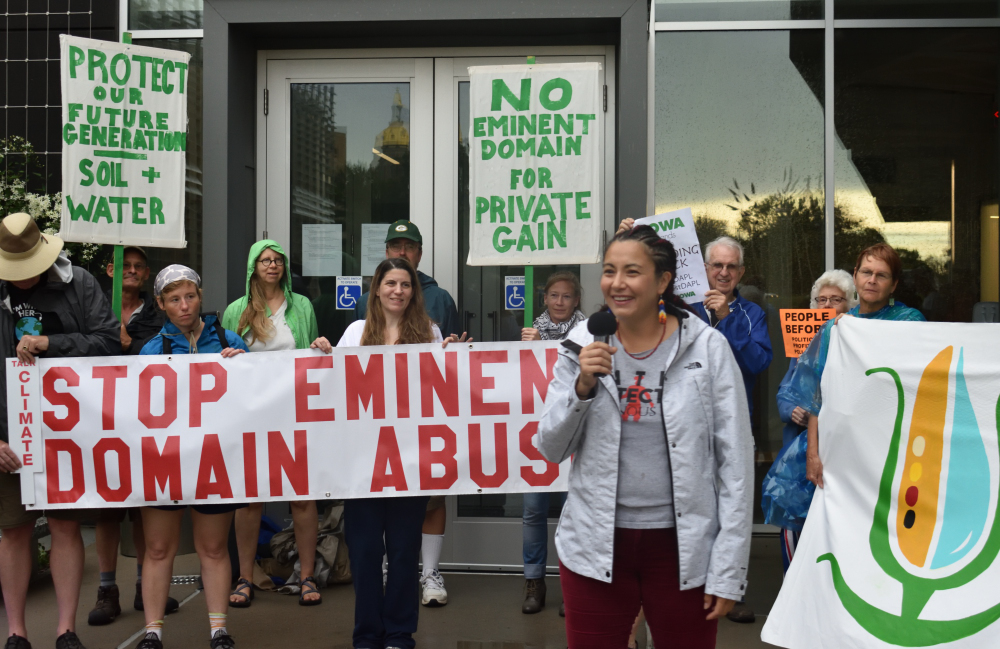
Because of my lifelong commitment to care for our environment, I’d always wanted to learn about Indigenous peoples and their sustainable lives. I jumped at the opportunity to do so when I heard about theFirst Nation-Farmer Climate Unity March in 2018. The intention was to build a community of native and nonnative people by walking and camping together along the route of the Dakota Access pipeline from Des Moines to Fort Dodge, Iowa (94 miles). Many long hours walking together, for eight days, along empty Iowa gravel roads was very effective in creating the beginnings of trust. There were about fifteen native and fifteen nonnative people, which allowed each of us the opportunity to share stories with every other person.
I’d hoped there would be ways to learn more about their spirituality, and to share some about my own. But I knew there was a huge barrier between us related to Friends’ involvement in the institutions of forced assimilation of native children. It is uncomfortable to admit this, but at the time I wondered how much awareness there was about the Indian Boarding Schools. I was soon to learn how profound that trauma was, and how it was passed from generation to generation. Is a deep wound today in every Indigenous person I know. I discuss this in detail in White Quakers and Native Peoples and other writings.
I didn’t know if, or how, the occasion might occur to talk about this during the March. Or whether I should.
But I vividly remember when the Spirit told me to say, “I know Quakers were involved in the Indian boarding schools and I’m sorry that happened” to the native person I was getting to know the best early in the March. I was worried saying that would upset him, open wounds. But he just nodded his head, and we kept walking together. But later in the day he said, “I want to tell you a story”, and proceeded to tell me a story related to him and his mother and the boarding schools.
At various times the Spirit led me to bring this up with each of my native friends. Every one of them and their families have had traumatic experiences related to forced assimilation. And the removal of native children from their homes continues in the guise of child welfare.
This is something that should not be taken lightly. A certain level of connection and trust is important. This is not about us (White people) and what we would like to see or do. There should be clear spiritual guidance.
I’ve found my Indigenous friends to be deeply spiritual. I like the sign, Earth is my church, carried by my friends Foxy and Alton Onefeather during the March. That says a lot about why I feel my friends are spiritual, their reverence of all things human and nonhuman. And their practices such as smudging, putting down tobacco, expressing thanks to the Creator each time they speak in public. Their humbleness. One friend often says “we are just pitiful people” during her prayers.
In the four years since that March, various combinations of us have had numerous opportunities to work together.
And yet again, that trust has been built, is being built slowly.
Foxy Onefeather holds sign on First Nation-Farmer Climate Unity March (2018)
Spiritual guidance
Quakers believe our lives must be guided by the Spirit. But far too often people haven’t found, or don’t try to discern that spiritual guidance. They try to figure out how to do justice work on their own or in conjunction with like-minded people. with the best of intentions. That phrase usually indicates not listening to those affected by injustice. And indicates not having discerned what their faith is trying to tell them.
And that often results in unintended, harmful consequences. A common phrase to keep in mind is nothing about us without us. This is especially challenging for White people who are accustomed to their privileges. Often not even aware of those privileges. We would not need to qualify what our intentions were if we were following the leadership of the communities facing injustice.
One horrific example of best intentions gone wrong were the Indian boarding schools. A policy of forced assimilation of native children into White culture was thought by many to be a way to help Indian children adjust to the enveloping White society. But tens of thousands of children suffered physical, emotional, and sexual abuse. Thousands died. Genocide. And that trauma has been passed to each following generation, including todays. Every one of my native friends has been affected.
This is an example of difficulties in making connections between different communities and/or cultures. With this horrific history, and ongoing trauma, how can a bridge ever be built between these two cultures, White and Indigenous? Or between White and BIPOC people and communities? (Black, Indigenous and other people of color)
But for others, especially in the government and military, this policy and horror was exactly what they intended.
Mutual Aid
The Spirit also led me to become involved in a Mutual Aid community. And led me to be involved in efforts to abolish police and prisons. I’ve written extensively about these things on my website Quakers and Religious Socialism, Intersection of Mutual Aid, Abolition and Socialism.
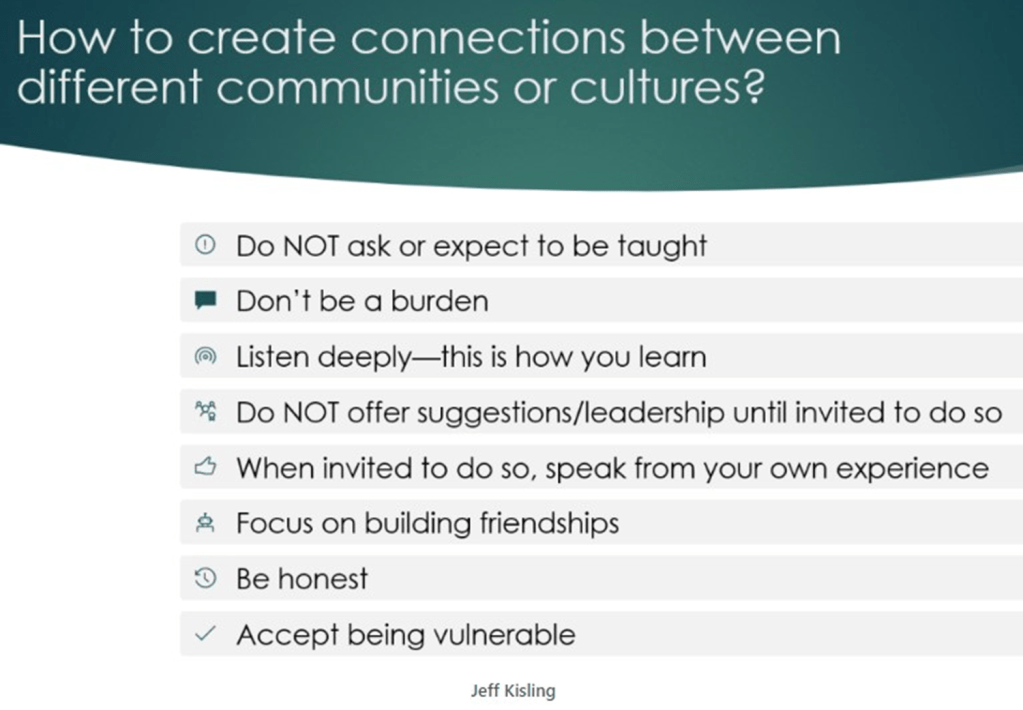
How to create connections between different communities or cultures
Returning to Donald McCormick’s question, “why is there no vision for the future of Quakerism?” I’ve tried to express my answer here. In these increasingly trying times, spiritual guidance is crucial. Sharing this with others is a gift Quakers have to offer. But we need to understand the history and concepts of oppression. Of Quakers’ role in oppression. And discern how the Spirit is leading us.
Frontline communities are figuring out how to live when the systems that are supposed to serve them no longer do, if they ever did. White communities will look to these communities and their solutions for our own survival.
I was recently surprised when a Quaker friend said I had a way of finding and connecting with oppressed communities. Which made me realize something I hadn’t expressed before, which is we must seek out these communities ourselves. Be guided to these communities by the Spirit. Search for these opportunities. Searching social media is usually very useful. And we can learn what our Friends and friends are doing and join those efforts.
Following is a list of things I have been learning from my experiences related to making connections between different communities and/or cultures.
[My foundational stories are related to the intersections between my Quaker faith, protecting Mother Earth, and photography. My faith led me to try to share my spiritual experiences and show my love for the beauty of Mother Earth through photography.]
I’ve been praying and struggling for many days to discern how to express the state of my Quaker faith today. Quakerism is the faith community I was born into and have remained in. I was raised in a White Quaker family and community. I had a Spiritual experience at the Bear Creek Meetinghouse when I was about ten years old, an experience that I have drawn upon for the rest of my life. I attended Scattergood Friends School, a Quaker high school, and Earlham College, a Quaker institution.
One of the reasons I accepted the challenge of reflecting on my foundational stories is because of my crisis of faith now.
I think it is common for people to be disappointed by their faith community at various times, for a variety of reasons. That has been true for me. Coming of age during the Vietnam War I wished more young men had resisted the draft. I wish we all had done more to reign in the use of fossil fuels. And that White people like myself had worked, harder to acknowledge our complicity in the oppression of Black, Indigenous, and other people of color (BIPOC), of various gender identities, and certain social and economic classes. I wish we were working harder now on acknowledging and trying to heal these injustices.
This country was built on the historical injustices of the institution of slavery, and the genocide and removal of Indigenous peoples from their lands. And the forced assimilation of native children in institutions where they were often physically and sexually abused, where thousands of children were killed or died.
Many people, including Quakers today question how complicit our ancestors were in these injustices. There were White Quakers who were involved in the slave trade, and who enslaved Black men, women, and children. Our ancestors were settler colonists. As are we who are now living on these lands. Quakers were involved in the Indian residential schools.
being involved with others in wrongdoing
complicity
These issues often generate significant emotional responses. I don’t have all the answers. But I have had spiritual and community experiences that I am led to speak and work from today. Many of these experiences have led me to understand we are living in a country, a society of structural racism and white superiority. As much as many of us White Quakers wish it weren’t so, our skin color automatically gives us many significant advantages in this country.
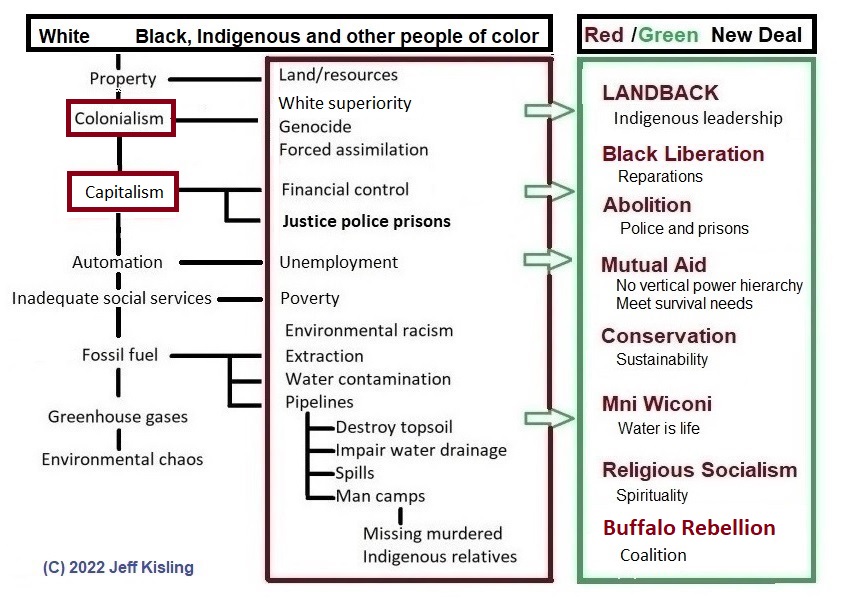
Our mainstream social, economic, and political systems are predicated on White superiority and dominance. I say mainstream because many people, including myself, are building alternative systems today. I’ve been deeply involved in Mutual Aid for a couple of years and believe this to be part of the answer. Mutual Aid is included in the following graphics.
NOTE: White supremacy is different from white superiority. “White supremacy or white supremacism is the belief that white people are superior to those of other races and thus should dominate them.”
I’ve also seen in the lives of my friends what I once thought of as isolated historical traumas have been passed from generation to generation. They profoundly affect the lives of people today. What does that mean for White Quakers now?
“…capitalism and colonialism created structures that have disrupted how people have historically connected with each other and shared everything they needed to survive. As people were forced into systems of wage labor and private property, and wealth became increasingly concentrated, our ways of caring for each other have become more and more tenuous.”
Dean Spade, Mutual Aid: Building Solidarity During This Crisis (and the Next) (Kindle Locations 111-121). Verso
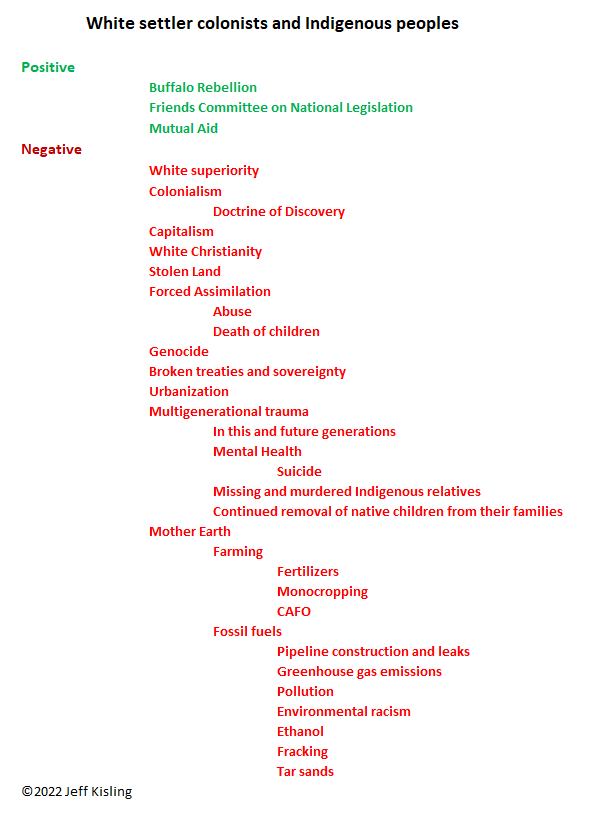
Following is another way of looking at the relationships between White settler colonists and Indigenous peoples. White Quakers need to acknowledge that when our ancestors came to these Indigenous lands, they were settler colonists. And since we are still occupying these lands, we are settler colonists, too. Some White Quakers were involved in the forced assimilation of Indigenous children. We are implicated in most of the “negative” things listed below.
Acknowledgement of wrongs is the necessary first step in the healing process.
On the positive side are Mutual Aid, the Buffalo Rebellion, and the Friends Committee on National Legislation (FCNL). I’ve written a lot about my experiences with Mutual Aid https://quakersandreligioussocialism.com/mutual-aid/
I’m fortunate to be part of the Buffalo Rebellion, a newly formed Green New Deal coalition in Iowa formed to protect the planet by demanding change from politicians and convincing the public that climate should be a priority. Buffalo Rebellion, is a coalition of grassroots, labor, and climate justice organizations growing a movement to pass local, state, and national policies that create millions of family-sustaining union jobs—ensuring racial and gender equity and taking action on climate at the scale and scope the crisis demands. It was formed in November 2021 and consists of:
The Friends Committee on National Legislation (FCNL) has years of experience advocating for legislation related to Native American affairs. Recently FCNL has been supporting legislation to form a Truth and Healing Commission related to the Indian Boarding Schools. I’ve been blessed to have many years of experience with FCNL and have been working with my native friends in creating connections with FCNL, including several visits to our US Senators.
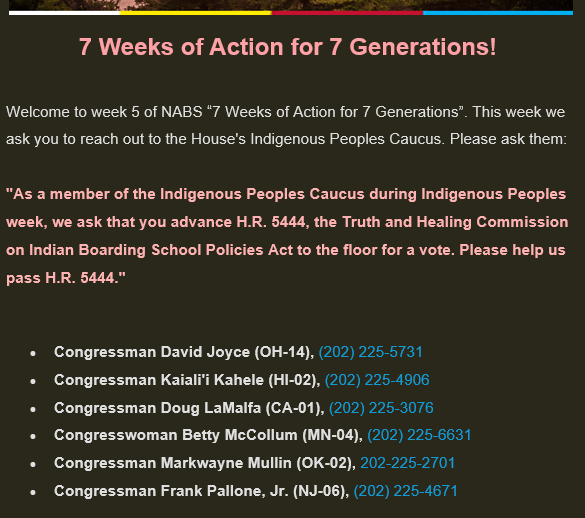
A fundamental principle of justice work is to follow the leadership of those impacted by the injustice. The 7 Weeks of Action for 7 Generations are what Native peoples are asking us to do to help them. This week we are asked to contact US House representatives belonging to the Indigenous Peoples Caucus.
I recently wrote about my friends at the Great Plains Action Society’s (GPAS) Open Letter Campaign: Truth and Healing with Friends. GPAS describes how their supporters can use the Friends Committee on Legislation’s (FCNL) online tools to help people write messages and send them to their representatives. This is a great collaboration between GPAS and FCNL that we can build upon.
Help us bring justice, accountability, awareness, and healing by telling the unvarnished truth about America’s history and genocide committed against Indigenous Peoples by way of Federal Indian boarding school policies. NABS asks us to please call members of the House’s Indigenous Peoples Caucus and request that they bring forward HR. 5444, the Truth and Healing Commission to the floor for a vote #NABS #Time4Justice
MSNBC Symone Sanders, Indigenous Peoples Day NABS Interview
NABS Creative Director Kenrick Escalanti spoke with Symone Sanders of MSNBC today on Indigenous Peoples Day to discus the history of the U.S. Indian Boarding School Policies and what needs to be done to pass House Bill H.R. 5444 and Senate Bill S.2907 the Truth and Healing Commission on Indian Boarding School Policy Act.
We are entering week 3 of NABS’s 7 Weeks of Action! We have been receiving positive feedback from your phone calls so please keep making these calls into the Congressional offices. This week we ask you to call into the Senate Committee on Indian Affairs to ask them to schedule a markup for S.2907, the Truth and Healing Commission on Indian Boarding Schools Policies Act.
NABS thanks you for joining us in this advocacy. Together we will get S.2907 /H.R. 5444, the Truth and Healing Commission on Indian Boarding School Policies Act passed!
Please CALL these Senators Today and Request The SCIA hold a markup session for “S. 2907, the Truth and Healing Commission on Indian Boarding School Policies Act” so the bill may move forward.
“When we begin to cry, that’s part of the healing process. Our tears are meant to cleanse us, they’re meant to cleanse our spirit, our mind, and our body. When we cried as children, no one was there. We were left to cry alone. But today we have each other.”
SANDY WHITE HAWK (SICANGU LAKOTA), NABS BOARD PRESIDENT
A fundamental principle of working with those experiencing injustice is to wait for that community to ask you for help. This Seven Weeks campaign is what Indigenous peoples are asking us to do.
Join NABS in Week 2 of 7 Weeks of Action for 7 Generations, highlighting the need to pass H.R. 5444, the Truth and Healing Commission on Indian Boarding School Policies Act in the U.S.
Please CALL the Congressional Members listed today and request they bring “H.R. 5444, the Truth and Healing Commission on Indian Boarding School Policies Act” to the floor for a vote in House and Pass H.R. 5444
NOTE: Please include calls to those who don’t represent your Congressional district. They are making decisions that affect us all.
All of this may be news to you, but for Indigenous people, this report simply confirms painful truths their families have long known. Survivors left these institutions abused, in poor health and without the language and cultural knowledge to connect with the homes they returned to. The way these children were raised in boarding schools — with fear, shame, violence and servitude — was in complete conflict with the way their tribal communities would have raised them; with love, identity and purpose.
In short, the pain of these survivors is the foundation of modern Indigenous life.
This federal policy created generations of trauma that tribes continue to navigate as they reclaim everything these institutions tried to destroy. For every language learner, for every heirloom seed planted, for every newborn receiving a traditional name instead of an English one, there are people struggling with trauma, battling addiction and trying desperately to survive a world that doesn’t fit or understand them.
This is a video my friend Rodger Routh made when he joined a few of us when we spoke to Senator Ernst’s staff recently. Besides making the phone calls listed above, you can request a meeting with the local staff of your representatives.
One September 1, I had a Skype meeting with Reid Willis in Senator Grassley’s Washington, DC, office. Reid was familiar with the history of Indian Boarding Schools. He told me Senator Grassley agreed with intent of S 2907 with two exceptions. Or, as a friend says, he doesn’t support it.
And particularly because he is the Ranking Member of the Senate Judiciary Committee, he doesn’t think that such a commission should have subpoena power.
The Federal Indian Boarding School Initiative lays the groundwork for continued work of the Interior Department.
Federal Indian Boarding School Initiative
In June 2021, Secretary of the Interior Deb Haaland announced the Federal Indian Boarding School Initiative, a comprehensive effort to recognize the troubled legacy of federal Indian boarding school policies with the goal of addressing their intergenerational impact and to shed light on the traumas of the past.
The announcement directed the Department, under the leadership of Assistant Secretary for Indian Affairs Bryan Newland, to prepare a report detailing available historical records relating to federal Indian boarding schools and to develop the first official list of sites. On May 11, 2022, Secretary Haaland and Assistant Secretary Newland released Volume 1 of the investigative report. This report lays the groundwork for the continued work of the Interior Department to address the intergenerational trauma created by historical federal Indian boarding school policies. It reflects an extensive and first-ever inventory of federally operated schools, including profiles and maps.
I am pleased to release the first volume of the report, which represents the first attempt to produce a historical list of all Federal Indian boarding schools, to collect information about known and possible student burial sites, and to lay out a critical historical overview that sheds light on the damaging consequences of these policies and marks a path toward redressing their lasting consequences. A second volume will follow and will serve as a roadmap for continuing the compilation of records, in order to further efforts to heal the intergenerational trauma and associated economic, health, social, spiritual, and political impacts created by these failed policies.
One area of particular concern is whether the Truth and Healing Commission would have subpoena power. The bill, in its current form, allows for the commission to subpoena organizations involved in the operation of Native boarding schools. Some lawmakers have expressed concern that this would grant too much power to the investigation, outside of what is legally necessary.
Supporters of the bill, however, argue that without subpoena powers, the ability of the commission to conduct its investigation would be severely hindered.
“I do believe there needs to be some requirement that any entity, including state governments and churches, who operated boarding schools and received Federal funding or support must make any relevant documentation available to the Commission,” said Kirk Francis, chief of the Penobscot Nation, during the Senate hearing.
“I do believe there needs to be some requirement that any entity, including state governments and churches, who operated boarding schools and received Federal funding or support must make any relevant documentation available to the Commission,” said Kirk Francis, chief of the Penobscot Nation, during the Senate hearing.
The House Education and Labor Committee will consider the Truth and Healing bill next before it can go to the House floor for vote. This is a critical time for faith communities, Quaker meetings, and lawmakers in Congress to support the commission and uphold support for subpoena powers. Without access to records and documents, the commission cannot effectively bring justice to the countless victims and their families.
The Great Plains Action Society has published an “Open Letter Campaign: Truth and Healing with Friends”, which includes information about using FCNL’s letter writing templates for supporters of the bill to use to contact their representatives in Congress about this legislation.
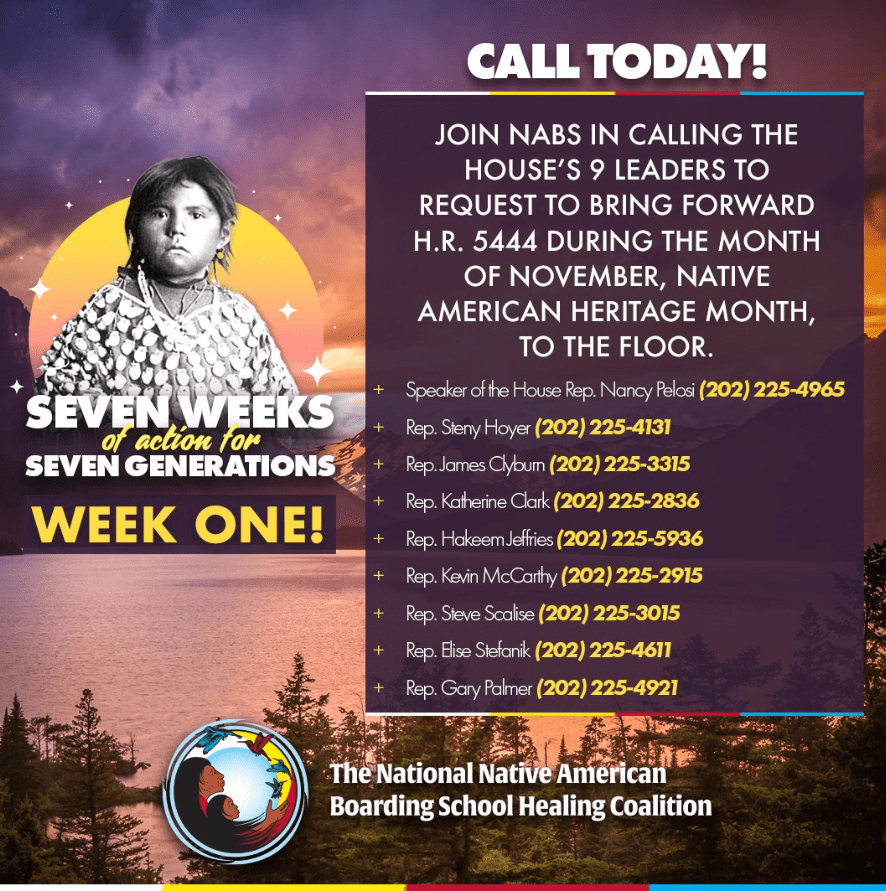
Week One of Seven: Help us bring justice, accountability, awareness, and healing by telling the unvarnished truth about America’s history and genocide committed against Indigenous Peoples by way of Federal Indian boarding school policies. NABS asks that you please call the U.S. House leadership and request “they bring forward HR. 5444, the Truth and Healing Commission to the floor to vote on during November which is Native American Heritage Month.” #NABS#Time4Justice
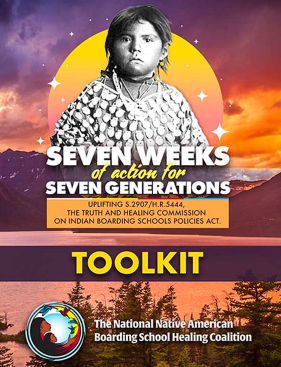
Yesterday I was moved by the stories of survivors of the Indian Boarding Schools. The stories were shared by the National Native American Boarding School Healing Coalition (NABS) during a two hour Zoom online seminar titled Seven Weeks of Action for Seven Generations, Week One! The purpose is to support the passage of the Truth and Healing Commission on Indian Boarding School Policies in the United States Act (S. 2907/H.R. 5444)
I really related to the story told by Ku Stevens.
Kutoven “Ku” Stevens and his family organized a 50-mile run honoring the survivors and victims of the Stewart Indian School in Carson City over the weekend. He recently spoke to KUNR’s Gustavo Sagrero about the ultramarathon at his family’s home on the Yerington Paiute Reservation.
I’m able to represent my people, and one of the best ways I know how, which is through running. So to be able to combine two things that I’m very passionate about, which is running and activism for my people, I’m able to really make a difference and an impact in a way that I could see, in a way that other people can understand, and in a way that I feel like is reaching a lot of people’s hearts, which is ultimately what the goal is.
You were almost like … you were sent there to die.
Ku Stevens
Sagrero: The trauma of Indian boarding schools is just starting to get the national attention it deserves. What do you wish people understood more about this history?
Stevens: You were almost like … you were sent there to die. You know, the Native American in you was supposed to be killed or yourself; if you couldn’t conform to modern society, then you would die. These schools were built with graveyards in mind. They were built with the thought of having a cemetery on campus because they knew that kids would die. That’s not a school; that’s like a camp.
Sagrero: When you say camp, what do you mean?
Stevens: Like Nazi Germany, man. The roads and the building blocks that it took to make America what it is today are filled with the blood and bones of my people. And people need to understand that.
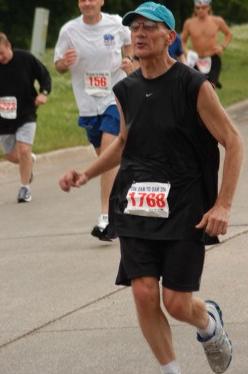
I relate to this story for several reasons. I, too, have always been a runner. I was on the track team in Junior High School, with one school record (OK, it was for the 440 yd relay). And at the Quaker boarding high school I attended, Scattergood Friends School, a few of us ran instead of playing soccer. We ran a path of gravel roads for five miles. I apologize for the description of Scattergood as a boarding school. Much different from the Indian boarding schools.
The reason running was activism for me is because that was one of my main modes of transportation, because I refused to own a car for environmental and spiritual reasons.
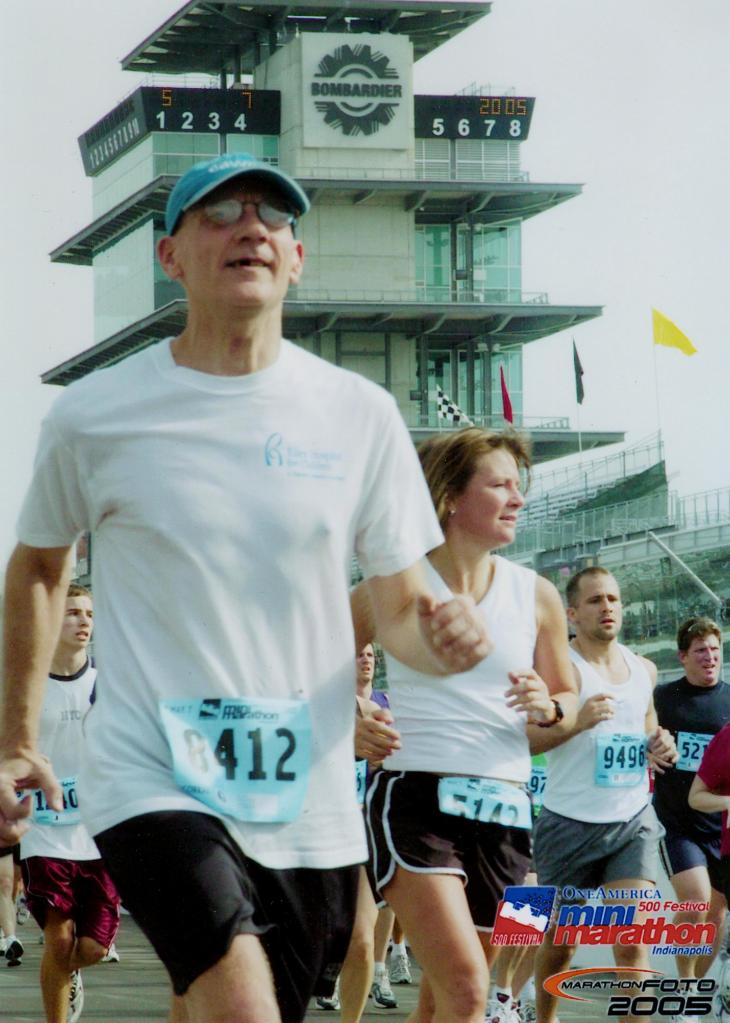
Most of these photos were taken during the Indianapolis 500 Mini Marathon. Mini means half-marathon, which is 13.1 miles. Which didn’t seem very “mini” to me. The Mini was part of the festivities each May related to the running of the Indianapolis 500 (auto) race. I ran the race every year for twenty-three years. I realize the irony of running being related to race cars.
Created with Nokia Smart CamRunning shoes hitting leg
This afternoon the National Native American Boarding School Healing Coalition (NABS) provided a two hour Zoom online seminar titled Seven Weeks of Action for Seven Generations, Week One! The purpose is for support and passage of the Truth and Healing Commission on Indian Boarding School Policies in the United States Act (S. 2907/H.R. 5444)
As is nearly universally true for every American Indian, Alaska Native, and Native Hawaiian each of the speakers were affected by the residential schools. Nearly every speaker had times when they were so overcome with emotion that they had to pause what they were saying.
Each week for the next seven weeks a list of Congressional Representatives or Senators will be targeted for phone calls from us, asking the legislation to be brought out of committee for votes before the House and Senate.
Week One of Seven: Help us bring justice, accountability, awareness, and healing by telling the unvarnished truth about America’s history and genocide committed against Indigenous Peoples by way of Federal Indian boarding school policies. NABS asks that you please call the U.S. House leadership and request “they bring forward HR. 5444, the Truth and Healing Commission to the floor to vote on during November which is Native American Heritage Month.” #NABS#Time4Justice
I recently wrote about my friends at the Great Plains Action Society’s (GPAS) Open Letter Campaign: Truth and Healing with Friends. That describes how people can use the Friends Committee on Legislation’s (FCNL) online tools to help people write messages and send them to their representatives.



















 Quakers and Mutual Aid